NOVOCAINE (2025)

by Miguel E. Rodriguez

DIRECTORS: Dan Berk, Robert Olsen
CAST: Jack Quaid, Amber Midthunder, Ray Nicholson, Jacob Batalon
MY RATING: 9/10
ROTTEN TOMATOMETER: 82% Certified Fresh

PLOT: When the girl of his dreams is kidnapped, a man incapable of feeling physical pain turns his rare condition into an unexpected advantage in the fight to rescue her.


Just when I thought the John Wick franchise had shown me everything there was to see in terms of modern action films, along comes Novocaine.  If there are philosophical rumblings at the heart of the screenplay, I didn’t see them.  There is a brief scene where a character says probably the deepest line in the film, something along the lines of, “We all have something to hide.  Maybe we’re just looking for someone to show it to.”  Apart from that, though, this movie is a machine designed for one thing: thrill you and make you laugh and cringe all at the same time.  That’s three things, but you get the point.

Because this machine has only one purpose, any criticisms accusing it of not doing something it wasn’t designed for are moot.  You don’t eat a cheeseburger and then complain it didn’t taste like chateaubriand.  I got what the movie’s goals were after 10-15 minutes – or, actually, even after just watching the red-band trailers.  I went in with eyes wide open, and I was not disappointed.  My only real complaint is that those same trailers gave away a little too much of the very best fight scenes in the film, ruining two of the best gags (the deep fryer and the ball-and-chain).  But I forgive the trailer editors because the rest of the movie was so freaking entertaining.

Nathan Caine (Jack Quaid, whose father’s famous smile will haunt his face for the rest of his life) is an assistant bank manager living with a very real genetic disorder called Congenital Insensitivity to Pain, or CIP.  He literally cannot feel pain, to the degree that he can’t even chew solid food because he could theoretically chew off bits of his tongue and not realize it.  His obligatory meet-cute with the love interest, Sherry (Amber Midthunder), involves him spilling scalding hot coffee on his hands, but of course he doesn’t feel a thing.  One thing leads to another, and they spend the night together.  Apparently, Nate can’t feel pain, but pleasure is another story.  (I thought that scene might include a homage to Marilyn Monroe and Tony Curtis’s love scene in Some Like It Hot [1959], but alas.)

Next day, as is revealed in the trailers, three robbers dressed as Santa Claus rob his bank, kill his boss, and take Sherry hostage.  On impulse, he takes off after them in a stolen police car, which of course leads authorities to believe he’s in on the case.  This also leads to the first of several jaw-dropping fight scenes, not because they’re insanely choreographed like a Jackie Chan movie, but because the physical violence shown on screen goes beyond anything I can remember seeing before in a fight scene.  Maybe Oldboy (2003) comes close.

Fair warning: if you are squeamish, this movie is simply not for you.  Just in the first fight scene alone, we see Nate get kicked, punched, seared by a scalding hot frying pan, and burned horrifically, which results in him wearing a bandage (and a disturbingly realistic prosthetic) on his hand for the rest of the movie.  The comedy comes from equal parts watching as Nate gets injured and simply powers through it, and from cringing and cursing and covering your face as those injuries occur.

I won’t give anything else away.  The movie does include an intriguing story development that I did not see coming.  My fellow Cinemaniac, Anthony, also made an interesting observation.  It was unusual to see a clearly comic film featuring so many actual deaths: multiple cops murdered after the bank robbery, a death inside the bank itself, and the body count keeps adding up as Nate gets closer and closer to rescuing Sherry.  Nate himself contributes (minimally) to the body count, but it’s mostly the bad guys killing anyone who gets in their way.  Is it possibly to balance almost slapstick physical comedy with so many, almost gratuitous deaths?

For myself, I didn’t think so.  I look at a movie like Tarantino’s Kill Bill: Vol. 1 (2003), with umpteen deaths, but it’s a movie that’s clearly having fun with the kung-fu genre, which requires lots of death.  Novocaine felt to me like a riff on the John Wick movies.  John Wick mows through LEGIONS of bad guys, getting punched and shot and sometimes falling from four-story buildings onto vans and just getting up, brushing himself off, and moving to the next fight scene.  Nathan Caine does the same thing, just not with legions of bad guys, but you’re constantly aware that he could be killed at any minute.  That kept the stakes raised, so I didn’t feel like I was watching a video game come to life.

Novocaine might be the most fun I’ve had at the movies in 2025 so far.  I laughed a lot, I CRINGED a lot (usually while I was laughing), and uttered more curse words at the screen than I have in a long time (usually “JEEEsus!” or “Oh SHIT”).  The story doesn’t quite reinvent the wheel, but the execution is superb.  Just to restate my warning from earlier: if you don’t like graphic onscreen violence, stay away.  Everyone else, enjoy!

M*A*S*H

By Marc S. Sanders

Forgive me.  I’m not sure my position on Robert Altman’s film will be fair.  All my life, I think I deliberately eluded seeing the motion picture of M*A*S*H as I have been so accustomed to the classic television show that ran for eleven seasons on CBS.  As I expected the two properties couldn’t be further apart from one another.

Altman’s movie still carries a zippy kind of perspective to the horrors of war.  With their hands and surgical scrubs in the thick of gory, blood red surgery, the characters are so much more apathetic to the turnaround of wounded that arrive at the 4077th American mobile army hospital, located three miles from the explosive front lines of the bloody Korean War.  The well-known characters were first given live action roles here following the published novel by Richard Hooker.  

Most surprising is near the end of the film when two doctors realize they are being sent home. One surgeon who is in the midst of operating on a head injury actually instructs a colleague to take over.  This guy has his hands covered in brains and blood and chooses not to finish saving his patient’s life.  Alan Alda of the television show, as a writer, director or while portraying Hawkeye Pierce, would never respond in such a manner. Yet, this is the approach that Robert Altman chose to follow, having infamously always despised the TV series that eclipsed his film in popularity.

Altman’s movie is a slap in the face to the famed oxymoron called “military intelligence.” In 1970, we say bravo for finally saying something frank and honest while a Vietnam War has carried on far too long for not necessarily any of the right reasons.  It’s not so simple to declare war is hell.  It’s much more complicated and horrifying than that.

The film’s opening bylines are quotes by celebrated military leaders of the time, like MacArthur and Eisenhower.  However, these championed commanders are lampooned as we watch shlubby Hawkeye Pierce (Donald Sutherland) arriving in Korea.  He heads directly towards a General’s jeep and steals it, plain as day.  From there on, M*A*S*H operates like a precursor to Animal House with a series of hijinks and a lack of care for military leadership or the U.S.’s purpose in this conflict.  

About the only time, there is any care or forthright anger from anyone is when the jerky Major Frank Burns (Robert Duvall) chastises an underling.  Trapper (Elliot Gould) and Hawkeye punch his lights out and the schmuck ends up in a straightjacket.  Nonetheless, these guys could care less about criticizing and exposing the truth about the institution they have been drafted to serve.  Their purpose is not to make an ironic statement like a Doonesbury comic strip.  They just punch the commanding officer in the face and drink.  The TV show was at its strongest when it relied on the wit and delivery.  Trapper and Hawkeye never use irony or intelligence to belittle a buffoon.  They punch, or they embarrass an authority who’s taking a shower. Regretfully, it’s the dialogue that’s lacking. Robert Altman encouraged much improv on the set and overlayered conversations within his scenes. He found nothing organized or neat and pretty about war, including daily functioning. Chaos did not only reign on a battlefield.

The pace of M*A*S*H moves episodically, and it is likely what led to the idea of a half hour TV show that dominated the airwaves for the better part of eleven years.  A character called Painless contemplates suicide and so a Last Supper reenactment before he sends himself off is inserted. It’s a funny caption from these halfwits, but a storyline focused on deliberately ending a life does not connect with me in a humorous way here. Burt Reynolds, the dark comedy Heathers, and even more recently Tom Hanks toed the line of humor to be found in death by suicide. I think it worked better in those examples. With the somber, well known theme song of “Suicide Is Painless” that is forever linked with M*A*S*H, I just could not muster the laughs for this bit.

There’s also time to build comedy against another regular army brat like Major “Hot Lips” Houlihan (Sally Kellerman, also the best and most memorable of the cast).  The iterations of shower hijinks has been duplicated so often since the release of this picture. Therefore, this gag is dried up. It does not hold its impact fifty years later after dozens Porky’s movies. As well, there’s golfing off the helicopter pad, heavy drinking and a long, drawn-out final act of an overstayed football competition which leads to one of the first times the F-word was used in a mainstream American film.  

In 1970, Robert Altman delivered a bold, risky and daring film to counteract against a losing Vietnam War and the heroism of John Wayne’s bravado in war pictures.  The chutzpah to lash out against American politics likely felt relatable to many who saw different and more realistic images when they understood their young sons and daughters were not coming home and were thus forever changed.  Richard Hooker’s properties and stories lent an understanding to the animosity of those who forced the war on America’s children and loved ones.  War has never been consistent with the short film propaganda asking you to buy war bonds. M*A*S*H negated the heroism of Hollywood sensationalism found in machine gun fare and overtaking a hill while draped in green fatigues with shiny bronze ammunition hanging off their shoulders. These soldiers of war deserve our country’s utmost respect, but they did so much more than what John Wayne demonstrated. They offered up parts of themselves they would never get back.

M*A*S*H deliberately left out the heroes.  However, seeing the film for the first time, over fifty years later, I wish that at least we could follow the escapades of doctors who also directed a bed side manner to the pawns who were dying while upholding their leaders’ cause.  The doctors of Robert Altman’s interpretation hardly emulate a reason to care. 

The film interpretation of M*A*S*H is outdated of its time of release and the period in which it takes place.  I like to think we live more humanely than not just how our military leaders functioned.  I wished these physicians used their scalpels with a much less obtuse absence of empathy.  Hate the puppet masters, yes. Yet would it kill these guys to still care about the puppets? 

THE MAGIC FLUTE (Sweden, 1975)

by Miguel E. Rodriguez

DIRECTOR: Ingmar Bergman
CAST: Josef Köstlinger, Irma Urrila, Håkan Hagegård, Birgit Nordin
MY RATING: 8/10
ROTTEN TOMATOMETER: 91% Fresh

PLOT: Valiant prince Tamino and his zestful sidekick Papageno are recruited by the Queen of the Night to save her daughter from the clutches of evil.


Here lies the noble, magical illusion of the theater.  Nothing is; everything represents. – Ingmar Bergman

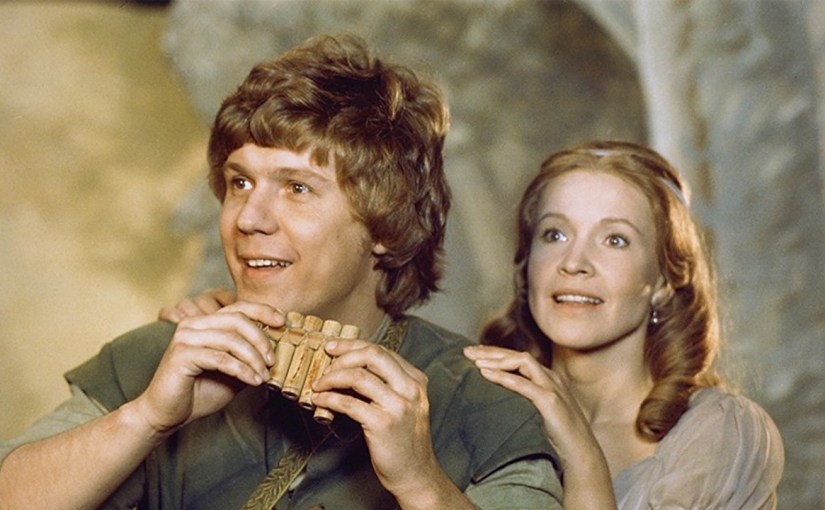
Ingmar Bergman’s whimsical staging of Mozart’s opera The Magic Flute is a movie made by a theater fan, for theater fans…and to a certain degree, it’s about theater fans.  I use the word “staging” instead of “film of” because, throughout the movie, Bergman never once lets us forget that we’re watching a staged production.  The opera’s overture plays over shots of the audience members, and at intermission we watch actors passing the time by playing chess or smoking where they shouldn’t be.  Once or twice, we see the hands of the stage crew as they move from one “cue card” to the next.  Fishing wire is clearly visible when objects “float.”  But the very artificiality of the production is what makes it so charming.  It celebrates artifice and scorns reality.  It wouldn’t surprise me if this were one of the favorite films of Tim Burton or Terry Gilliam.

Since my only previous knowledge of the story of The Magic Flute comes from a precious few scenes in the film Amadeus (1984), here’s a brief summary for anyone else who knows as much about opera as I do.  The brave, handsome prince Tamino and his enthusiastic sidekick Papageno are recruited by the Queen of the Night to rescue her beautiful daughter, Pamina, from the clutches of the evil Sarastro.  Before the opera is over, there will be revelations, separations, reunions, laughter, tears, semi-divine intervention, and even an operatic strip-tease.  There are monsters, woodland creatures, villains, three angelic young boys in a hot air balloon, and, of course, a magic flute.  And it’s all portrayed as it might be seen if we were watching it on a real stage in a real theater, with some obvious cinematic licenses taken with time and space.

I’m gonna be brutally honest: having never seen an opera, I had moderate-to-low expectations of how much I would enjoy it, even if the music is by my second-favorite classical composer of all time.  (Beethoven is the king, and that is that.)  But Bergman’s film sidestepped my expectations by not trying to present anything in a realistic way, or by simply staging a live production and just filming it from multiple cameras.  By keeping everything clearly artificial, clearly staged, and occasionally using clever movie tricks, The Magic Flute held my attention, making me curious about what other tricks Bergman might have up his sleeve.

For example, he’ll start a scene with a wide shot, showing the entire stage with the flats and fake backdrops, then cut to a medium shot, making us think we’re in the space we just were, then panning over to reveal a completely separate set that was invisible before.  But because it’s been established that we’re in the realm of theater, this kind of spatial paradox isn’t jarring, it’s almost expected.  You can get away with certain things in theater, especially opera, especially in a fantasy, that would never fly in a regular movie.  In The Magic Flute, a person’s face can be completely made over with a simple edit.  A picture in a locket can come to life.  A journey through a fantastic hellscape can be suggested by clever editing and careful camera placement.

But what if you simply don’t like opera?  Is The Magic Flute enough to convert you?  I mean…maybe?  If you’re a fan of the films of Terry Gilliam, particularly Brazil (1985) and The Adventures of Baron Munchausen (1988), then this movie is going to be right up your alley.  They share the same visual strategies and production design sensibilities.  Even if you believe you don’t like opera, The Magic Flute could still win you over for at least this one movie, simply because it’s such fun to look at.

Looking back over what I’ve written so far, I don’t believe I’ve accurately conveyed how the deliberate “fakeness” of the film enhances its effectiveness.  Live theater has the ability to get audiences to suspend their disbelief in a way that film cannot always achieve.  I’ve seen community theater productions where, for example, the walls of a café are supposed to “fly” off the stage revealing a night sky, and the effect was accomplished by simple lighting tricks.  A clubhouse foyer can be magically transformed into a golf course with a green carpet and some more selective lighting.  In live theater, the audience is constantly aware that it’s fake, but when they’re in the grip of a good story, their mind fills in the blanks.  That’s the effect Bergman is going for in The Magic Flute, and it works.

So, in the end, what you have here is a love letter to the stage, to opera, to Mozart, to fantasy.  Throughout the film, Bergman will cut to the face of young girl, an audience member, who watches with rapt attention and an almost Mona Lisa-esque smile.  Not only is he reminding us, the viewer, that this is a staged production, but maybe he’s also sending a reminder to filmmakers to never forget that, for a movie or play or opera to work, you have to remember who you’re making it for: the paying audience.  Speaking as an occasional audience member myself, I know that, when I buy a ticket, I want to be taken out of myself.  I want to believe that a man can fly, or that a wooden puppet can come to life, or that a valiant prince can overcome three tasks to win the heart of his beloved.  The Magic Flute is a tribute to the magic-makers and the storytellers, to the genius of Mozart, and to the people out there in the dark who make it all possible.

IT HAPPENED ONE NIGHT

By Marc S. Sanders

If you want to stay on top of how the world of American cinema evolved over the last hundred years, within all its categories, you must find time to watch the one film that paved the way for the romantic comedy, as well as the travel comedy.  Frank Capra’s Oscar winning picture, It Happened One Night, is the first of three films to win Oscars for every major category: Best Picture, Director, Screenplay, Actor and Actress. Nearly a hundred years later, the accolades still feel worthy.

Claudette Colbert is wealthy heiress Ellie Andrews who dives off and swims away from the captivity of her father’s yacht and buses from Miami to New York to reunite with her new husband, King Westly (Jameson Thomas).  Her father, Alexander Andrews (Walter Connolly), never approved of this marriage and insists his spoiled daughter get it annulled once she is found.  A ten-thousand-dollar reward is up for grabs to the person who finds her.

Along the way, a rogue reporter, Peter Warne (Clark Gable) ends up next to this young lady on the bus.  Complications ensue where their money gets lost, bags are stolen, buses are missed, and buses get stuck.  Then this trip becomes a walking experience.  Ellie has agreed to stay by Peter’s side though.  He promises to get her to New York as long as he gets to write about her story firsthand amid the constant headlines that recount Alexander’s desperation to get his daughter back.

It’d be easy enough if only Peter and Ellie were not falling for one another.

Sounds familiar, doesn’t it?  Any Nora Ephron script has the elements of It Happened One Night.  Screwball comedies with Cary Grant and Katharine Hepburn seemed to follow a similar blueprint.  To the best of my knowledge, Frank Capra’s film was first though.  

A famous scene has Colbert and Gable on the side of the road trying to hitch a ride.  Colbert’s bare leg does the trick that Gable’s outstretched thumb could not.  Eventually, this scene for the ages evolved into Meg Ryan and Billy Crystal daring to fake an orgasm effectively while dining at Katz’s Delicatessen.

When Harry Met Sally… is what easily comes to mind while watching It Happened One Night.  Peter will tease this spoiled rich girl. Yet, he will also be gentlemanly enough to put up a blanket to divide a cabin room he shares with Ellie, allowing for some privacy.  In the middle of the night though, the two will stay up chatting from either side of their blanket wall, as both acknowledge sad voids within their personal lives.  It’s parallel to how Harry and Sally would chat on the phone from their respective apartment bedrooms while discussing their newly evolving friendship with Casablanca on TV.  

Ellie and Peter become relaxed as their sojourn continues.  They could be left in the middle of nowhere with no money or food, but Gable and Colbert’s chemistry show an easy comfort to each other.  That is what’s expected of any troubled travel film.  At first Ellie does not want to share a rear bench on the bus with Peter.  She’s married to King and the purpose of this runaway trip is to be back in her new husband’s arms.  Plus, this odd fellow on the bus feels unseemly.  His charm is overbearing to the socialite’s proper petiteness.  He’ll resort to munching on a carrot he finds in a patch. She can’t find the appetite for it. Time together breaks down barriers though, just as movies in later decades eventually accomplished with films like Midnight Run and Planes, Trains & Automobiles.  This kind of formula, with ongoing new settings and circumstances, is almost guaranteed to end in positivity once the mutual antagonism is behind the pair.  

For 1934, It Happened One Night was bold in its content, ahead of an eventual ratings system intent on upholding an acceptable level of conservatism.  Colbert’s leg is the most unforgettable.  Later, Peter feels it necessary to spank Ellie.  Then there is the fact that the two share a room together.  Comedic circumstances and shock lend to the humor of this scenario.  Plus, there’s Claudette Colbert undressing down to her slip while a bare-chested Clark Gable is only one side of a blanket away from her.  

Would It Happened One Night endure an endless admiration if moments like these were contained? I doubt it.  Frank Capra’s film hinges on sexual appeal that feels naughty and rebellious.  

The dialogue remains witty.  Clark Gable’s introduction in the film while on the phone with his editor is a precursor to what an outlandish Bill Murray might have done with the script. The material is sometimes quite brash, and the ending, which has been duplicated hundreds of times since, is a perfect example of romantic escapism.  

Over ninety years have passed but unexpected romance is what remains treasured.  When two people with nothing in common begin an unwelcome journey together, it’s still easy to hope they find a way to like each other.  They have to like one another first before they can even concern themselves with falling in love.  The progress of this east coast bus ride allows for the stages to develop naturally.  Frank Capra, Clark Gable and Claudette Colbert were the first to give it a shot and it works brilliantly and beautifully.

ANORA

By Marc S. Sanders

Anora, or Ani as she prefers to be called, had to have been a character that writer/director Sean Baker always intended on loving.  Not in an intimate way though.  Sean Baker had to deeply care about this twenty-three-year-old girl who has no connections or family or solid friendships or kinships.  Baker wrote about Anora, wanting her to be appreciated by someone who would finally embrace her. 

Anora—sorry…Ani…has a good heart.  She may be an exotic dancer at a New York City strip club, but she is someone who has every right to be respected and valued. If you choose to watch the film you’ll know why, as a pertinent prop referenced earlier in the picture suddenly resurfaces when you least expect it.  A minute or two later the closing credits appear amid the sound of flapping windshield wipers and there is no music to cue your emotional response.  You likely will have spent the last two and a half hours laughing loudly, dropping your jaw, and gasping in shock at what unfolds for Ani. In the end though, you’ll realize that you want the best for her, like her creator did when he originally drafted this script and shot the film about Ani’s episodic escapades.

Sean Baker’s film is eye opening right from the start.  Club music blares within the HQ, the name of Ani’s strip joint where she collects an exorbitant amount of dollar bills while she strategically flirts with middle-aged men and frat boys looking for an evening of debauchery.  She has a talent for one on one charm with any customer, as she repeatedly bares her chest and reveals her thong, but she also delivers a very satisfying service.  A young man named Ivan, sometimes it’s Vanya (Mark Eydelshteyn), specifically requests a girl who speaks Russian to cater to his needs.  Ani is the only one who can comply.  Ani and Ivan get to talking, mostly in Russian but limited English too.  She gets invited to his private, deco mansion, which is really owned by his Russian aristocratic parents, and a slap happy relationship of sex and more sex, and money, and drugs and drinking and partying and New Year’s Eve partying and money, and clothes and expensive coats, and travels to Las Vegas ensue.  (Yes! I know that was a run on sentence.  My elaborate text does not even come close to what these twenty-somethings indulge in though.  It must be seen to be believed.)

Anyway, since they’re in Vegas, why not get married?  Vows are taken, the bride is kissed and Ani is emptying her locker at HQ for a promising future of being a spoiled, but loved, aristocratic wife.

In the few times that Ivan calms down, he is only engrossed in his online video games while Anora lies on his chest with an expression of wanting more than to come in second to Call Of Duty. Baker focuses on Ivan’s childish habit a few times.  So be sure to observe how Ani sadly looks upon an inattentive Ivan.

A problem occurs though that neither character could ever expect.  The tabloids have reported that Vanya, this spoiled brat son of a Russian oligarch, has up and married a prostitute. Now the family image is at risk of being shamed.  Mom and dad are on their way back to the states and have summoned Toros (Karren Karagulian), an Armenian Catholic priest and the son’s Godfather, to round up Vanya and the so-called whore to get the marriage annulled immediately.  Not divorced!  Divorce does not happen within the legacy of this family.  An annulment is what is needed. 

Toros rounds up Igor and Nick (Yura Borisov, Paul Weissman) to get over to the house right away, get the marriage license and bring the kids in for the quick annulment at the courthouse.  If only it were that simple.

Watching Anora allowed me to reminisce about other films that catered to outrageous debauchery and led to a domino effect of problems.  Doug Liman’s Go for example, or True Romance written by Quentin Tarantino, or even a super ridiculous comedy known as Very Bad Things with Christian Slater and Cameron Diaz.  The first two examples are very good films because the dialogue is sharp with eclectic casts who elevated simplistic material.  Let’s not talk about the third one, but I will say it is delicious junk food.  With Anora though, just when you think you know where this story should be going it doesn’t.  You think it will turn right, but then it makes a sharp left and Sean Baker knows he just needs to keep the fighting and the screaming and the cursing at an organic natural level.  What do you do when the wards you are put in charge of will not cooperate?  What if one of them goes missing and simply won’t answer his cell phone?

Well, on a cold winter night you may get a broken nose, car sick, and your car might get towed.   Anora is not about big stunts or gratuitous violence.  It’s not mobster movie material either.  Anora works naturally for people in desperate situations, from a handful of different perspectives.

Oh yeah.  Anora—sorry Ani, is played by Mikey Madison and she is bound for marquee attraction over the next twenty or thirty years.  This performance is so concentrated in moments of natural glee, anger, and maybe despair and sadness.  You applaud her character’s strength.  Ani talks like an updated version of Judy Holliday from Born Yesterday, but she’s no dummy and she never succumbs to intimidation.  I’ll confess it right here.  If two hulking Armenian thugs approach me, I’ll do whatever they want me to do. Ani gets all my props though.  She will never settle.  She’s a married woman and no one will deny her of her rights.

Mikey Madison has such wonderous chemistry with Sean Baker’s camera.  There must be over a hundred and fifty close-ups on this young actor and each one is unique.  I was sad for Anora when Ivan would not give her attention.  I was cheerful when the two were overindulging in carefree sex and sin city fun.  I was on Anora’s side when she was restrained. I was admirable of her giving a good fight to the giants that enter her space.  I was exhausted with her as she was forced to sit in Toros’ car while brainstorming where her husband could be.  I was supportive when she makes appeals with the family to offer a good first impression.  She hates her name, but she introduces herself as Anora to Vanya’s steely mother. Ani is willing to make all of this work. Finally, I was angry—very angry–alongside of her whenever she was unfairly treated like garbage. 

Amid all of the chaos that ensues, Sean Baker works like the eyes of the film’s audience. We keep guard over Ani’s condition and state of mind as she’s coerced into looking all over Brooklyn and Coney Island for her new husband that the Armenians need to find before the boy’s parents arrive by noon the next day. 

None of the dialogue is crafty like Quentin Tarantino’s or Neil Simon’s.  I could not quote a single line.  The yelling and conversations and overtalking and interruptions are natural and raw.  Sometimes, the exchanges feel pointless until you arrive at another scene that demonstrates with brilliant insight why certain throwaway moments are preserved in the final print of the film.  It makes complete sense that Sean Baker did not just write, produce and direct this film.  He edited it as well. 

The whole way through the picture I kept wondering how this story would end.  I spelled out variations of doom for any one of the characters.  I considered gratuitous violence or swashbuckling adventure and daring escapes.  Man o’ man, have I become cliché.  Because just as you arrive at the picture’s conclusion, a meaningful prop puts the period at the end of the story and the last audible expression before the picture goes to black comes from Anora. You now realize that this girl, who is as self-reliant as many exotic dancers must be, has feelings too.  As defiant as Anora can be, she can also get pricked and bleed and the big laughs you responded to for most of the film are distant memories. Anora can feel pain like any of us.

When I drove home, I was hurting.  I was hurting for Anora, and my one wish is that I hope Anora will be okay.

Roger Ebert once gave a seminar that lasted for eleven hours as he commented on practically every shot and piece of dialogue in Tarantino’s Pulp Fiction.  My long shot wish is that on a subsequent viewing of Anora, I can deliver a similar kind of observational lecture to others who had already seen the film too.  I believe I could reveal sincerity and perception related to every close up, every chaos-stricken scene of panic or decadence, and especially when that one prop reappears. I’d likely spend a half hour simply discussing the value that this prop carries and what it means to Sean Baker’s film, and especially to Ani.

As messy and gritty as Anora may appear, it is also one of the most adoring and perceptive films to be released in a long time. 

Anora must be in my top five favorite films of 2024.  It might just be my favorite.  There are a few other candidates, but I left feeling so satisfied with Mikey Madison’s performance and Sean Baker’s sloppy, yet astute, little film. 

This is superb filmmaking.

THE WILD ROBOT (2024)

by Miguel E. Rodriguez

DIRECTOR: Chris Sanders
CAST: Lupita Nyong’o, Pedro Pascal, Bill Nighy, Stephanie Hsu, Ving Rhames, Mark Hamill, Catherine O’Hara
MY RATING: 10/10
ROTTEN TOMATOMETER: 97% Certified Fresh

PLOT: An intelligent helper robot winds up stranded on an island populated only by wild animals.  To survive its new environment, it adjusts its programming, with unexpected results.


Just days after watching Flow [2024], a dialogue- and human-free animated film about animals struggling to survive after a cataclysmic flood, I watched The Wild Robot, also human-free, also starring mostly animals, and also about the struggle for survival, but it adds conventional dialogue and an intelligent robot in search of its purpose.  In broad, REALLY broad strokes, they are similar, but don’t bother asking me which one is better.  I give them both a ten-out-of-ten, each for different reasons from the other.  Flow may be literally unique, at least in my experience, but The Wild Robot tames its genre and bends it to its will, creating one of the most heart-tugging movie experiences since Wall*E [2008].  If you’re prone to crying during a movie, this is a three-hanky film, at least.  (Penni went through five, herself.)

On a dark and stormy night, a mysterious container washes up on the shores of an uninhabited island.  Inside is Rozzum 7134, an intelligent helper robot with exceptional physical capabilities and the speaking voice of Lupita Nyong’o.  Hope she gets her royalty checks.  Upon escaping her would-be watery coffin, Rozzum searches the island for the one thing that will give her existence meaning: a task to complete.  The opening scenes get us off to a hilarious start as she tries to complete tasks for various animals, to no avail.  In an intelligent bit of screenwriting, she powers down for a couple of days and, through passive listening, effectively learns the language of the animals around her.  In a lesser movie, this feat might have been handled with the push of a button.  I liked the fact the writers went for something a little easier to swallow, science-fiction-wise.

Through circumstances which I will not reveal, Rozzum winds up as the guardian for a newly-hatched gosling, and as the unlikely friend of a fox named Fink (Pedro Pascal, whose voice was utterly unrecognizable; I thought it was Matthew Broderick).  The gosling imprints on Rozzum, which she finds bothersome.  A helpful mom opossum, Pinktail (Catherine O’Hara), warns Rozzum that the gosling must learn to feed itself, swim, and fly by the next fall so he can migrate with the other goose; otherwise, it will starve during the harsh winter.  Presto…a task!

Eventually, Rozzum is shortened to Roz and she names the gosling Brightbill (Kit Connor).  As she undertakes her task of raising the gosling, Roz’s programming…evolves.  She starts to actually care for the little guy.  She starts asking questions that robots aren’t supposed to ask.  She exhibits all the early warning signs of helicopter-momism.  And all the while, she debates whether to activate the internal beacon that will let her makers know where she is…

Because the plot is so dependent on tugging those heartstrings, that’s all I’ll say about it.  Let me talk instead about Wild Robot’s visual style.  The backgrounds and characters are gorgeous, sumptuous, evocative of oil or acrylic paintings.  I could mention two or three specific shots right now that contain some of the most beautiful animated imagery I’ve seen since Pinocchio [1940], but I don’t want to give anything away.  (Hint: butterflies and geese.)  In this way, among others, it shares a lot of DNA with Flow, whose backgrounds and characters also resembled hand-painted objects.  I don’t even want to think about how long it took to create such a painterly style and make it look so effortless and organic.

I also liked the way Wild Robot used its story to make a pointed commentary, but not in the direction I thought it would go.  From the trailers, I assumed it would be yet another paint-by-numbers story about preserving nature or life, which was already covered as well as it possibly could be covered by Brad Bird’s The Iron Giant [1999].  Instead, Wild Robot makes some eloquent statements about the terrifying task of parenthood.  At one point, Roz, who is programmed to solve problems, discovers the task she’s undertaken – raising a gosling, i.e., being a parent – is a task that could potentially never end.  She experiences the fear of almost losing a child.  The joy of watching Brightbill learn to fly, while at the same time realizing that means he will one day migrate.  As I list the plot points here, it sounds like the movie is composed of cliches, but I can assure you, it’s not.  All of these nuances, and many more, are allowed to occur organically without the slightest hint of being nudged along by the screenplay.

DreamWorks has created possibly their best animated film since…gosh, I’ll go all the way back to The Prince of Egypt [1998].  It’s a crowd-pleasing adventure with a point, which is a hallmark of only the best science-fiction movies/stories.  There are real stakes on the line.  There are some actual deaths in the story, which surprised me for some reason, but there you are.  It looks sensational.  It’s smart.  I can’t say enough about it.  The Wild Robot was one of my most favorite films of 2024.

NIGHTBITCH (2024)

by Miguel E. Rodriguez

DIRECTOR: Marielle Heller
CAST: Amy Adams, Scoot McNairy, Jessica Harper
MY RATING: 7/10
ROTTEN TOMATOMETER: 59%

PLOT: A woman pauses her career as an artist to be a stay-at-home mom, but her domesticity takes a surreal turn.


[SPOILER ALERT…if you plan on seeing Nightbitch, avoid this review.  This movie, like most movies, works best on the viewer if they have no idea what’s happening or what’s about to happen.  Consider yourself Spoiler-warned.]

Nightbitch shoots out of the starting gate like a thoroughbred – or a greyhound, if you will – but about halfway through, it runs out of narrative steam.  I felt like a gambler watching a horse race, watching my horse lead the pack around the first turn, already spending the winnings in my head, and then my horse fades a bit, then a bit more, and by the time we get to the finish line, I’m tearing up my ticket in frustration.  I needed a WIN, not a PLACE.  There goes my trifecta.

Amy Adams plays an unnamed Mother who has put her promising career as an artist on pause to be a stay-at-home mom while her also-unnamed Husband (Scoot McNairy) pursues his career as a…um…well, whatever it is, he has to travel a lot, leaving Mother at home with, you guessed it, Son (played by adorable twins Arleigh and Emmett Snowden).  Referred to throughout the movie as “my guy” and “sport” and “little buddy,” Son is a typical toddler in the throes of the terrible twos: cute for long stretches, maddeningly frustrating for longer stretches.  [Ed. Note: the author is not a father, has no plans on becoming a father, and will never possess the immense dedication it takes to rear a child, so don’t expect him to embrace the chaos of toddler-hood because it ain’t gonna happen.]

Mother is going through an identity crisis, set up in a brilliant opening scene where Sally, the woman who assumed Mother’s job at an art gallery, asks her, “Do you just love getting to be home with him [Son] all the time?”  Mother answers the question with a little more honesty than Sally or anyone had a right to expect, including this tidbit: “I am deeply afraid that I am never going to be smart, or happy, or thin ever again.”  I am a straight Hispanic cisgender male, so I’m here to tell you, I will never understand that mindset, but I am reasonably certain there are untold millions of moms out there who, if they listened to Mother’s opening statement, would say, “AMEN, sister.”

A little later, Mother delivers an internal monologue where she reflects that, as a mother, you can squeeze someone into the world “who will one day pee in your face without blinking.”  Again, I’m not a parent, but I know that’s truth in cinema right there.

After a few more establishing scenes of Mother interacting with Son, who absolutely REFUSES to go to sleep at night or eat anything for breakfast except, apparently, hash brown patties fried in butter, some odd things start to happen.  At the playground, some stray (?) dogs approach her as if she’s their best friend.  Mother notices her sense of smell has become much more acute.  Son helpfully points out that her back is hairy.  And, in a creepy Cronenberg-y moment, she notices a lump growing at the base of her spine just above her rump.  Curiosity gets the best of her.  She heats a needle, lances the lump, and…well, if you remember the title of the film, you have an idea of what pops out of that lump.

This was all wonderfully thrilling stuff as a movie lover.  I’m thinking, “My god, this is a Spike Jonze movie told from a woman’s perspective!  I’ve never seen anything like this!  This is gonna be GREAT!”  Mother starts to enjoy eating a lot of meat.  She starts to play “doggie” with Son, growling and barking at each other like two puppies.  The two of them eat their lunch at a deli with no silverware…or hands, to the consternation of other diners.  Son doesn’t sleep at night, so Mother, in a genius parenting move, buys a dog bed and gets Son to play “doggie” and sleep in the dog bed at night.  Presto, problem solved!

And more and more dogs start showing up at her door, at night, sometimes bringing gifts: small dead animals.  One night she walks outside, starts digging around, and an astonishing transformation takes place…

I know, I know, SPOILERS, I get it.  But it’s important to get across just how brilliantly original the first act of the film is, because the second act is, alas, all downhill.  I am not saying that the film’s message is unimportant, not at all.  I admire the film because of its message, and because it was being delivered in such an original way.  But then we get into conflict with Husband, who is desperately trying to understand why their 2-year-old is now sleeping in a dog bed on the floor, or why their cat suddenly turned up dead on the front porch, or why his wife suddenly wants a separation.  It must be said, Nightbitch is remarkably even-handed with the Husband’s dialogue.  He is not reduced to a 2-dimensional sitcom husband.  When she lays into him for not supporting her career, he fires back with a well-reasoned argument.  Their dialogue could be turned into a first-rate play.

But instead of exploring the surreal nature of Mother’s new condition, the movie settles into soap-opera territory, with only the occasional nod to the mystical incidents in the first act.  I distinctly remember, in the middle of the second act, feeling as if a balloon had deflated in the plot.  I imagine defenders of the film might say, “Well, the second act is where the weird stuff has to take a back seat to deal with the real issues at hand.”  Okay, maybe that’s true from a real-world perspective, but to me, it felt as if the filmmakers were on the verge of showing us something mindboggling, then backed away from the precipice at the last minute.

Does that make me guilty of critiquing a movie for what I wanted as opposed to what I got?  I guess it does, as much as I dislike that tendency in myself.  I feel there are so many different ways the movie could have gone in act two, could have leapt gleefully over the edge of convention and truly broken the mold with this movie.  When it became clear what they were doing instead, my elation evaporated.

I give Nightbitch a generally favorable score, though, based on the mad inventiveness of the first act and the plot in broad strokes, and also on the incredibly brave performance from Amy Adams, who maybe has two scenes in the entire film where she seems to be wearing any makeup.  She also appears to have to put on some weight for the role, which is not something I can ever recall seeing a female actor do.  Male actors have turned that kind of thing into a cottage industry, but when was the last time you saw a woman do it?  That took guts.  Watch Nightbitch for Amy Adams’ performance and for the story, even if the movie doesn’t follow its own plot to a satisfying conclusion.

RED ONE (2024)

by Miguel E. Rodriguez

DIRECTOR: Jake Kasdan
CAST: Dwayne Johnson, Chris Evans, Lucy Liu, J.K. Simmons
MY RATING: 8/10
ROTTEN TOMATOMETER: 30%

PLOT: After Santa Claus is kidnapped, the North Pole’s Head of Security must team up with a notorious hacker in a globe-trotting mission to (all together now) save Christmas.


Jake Kasdan’s Red One is by no means perfect, but it is not nearly as bad as the plethora of negative reviews would have you believe.  The Rotten Tomatoes website lists such jabs as:

  • “…forgettable as a first dusting of snow.”
  • “…offers big-budget visuals but lacks soul…”
  • And my favorite: “An ugly, under-lit, joyless slog, devoid of any holiday charm or sense of fun.”

Let me first address that “under-lit” comment.  I first attempted to watch this movie at our local AMC cineplex, and I noticed that the ads and previews were so dim that parts of the screen looked almost black.  I petitioned the manager to adjust the projector settings twice, but to no avail.  (“That projector has been giving us problems for two weeks.”)  When the movie started and it was just as dark as the previews, I gave it up as a lost cause, left and got a refund, and streamed it on Prime instead, and on our big-screen HD TV, presto, no more under-lit areas.  Everything was perfectly visible, clear, and bright.  So, it’s entirely possible that that reviewer’s issue with the screen being “under-lit” could have been a projector issue, and NOT a problem with the film itself.  Just wanted to throw that in there.

As far as those other negative comments go, well, I don’t know what kind of mindset those folks were in as they watched Red One, but it’s difficult for me to comprehend how anyone could call it “joyless.”  I found it charming and funny myself.  But then, when it comes to holiday movies, I have always been partial to the ones that attempt to provide logical solutions to the massive logistical problems involved in getting one man to travel the entire globe in a single night, delivering presents to every household that’s waiting for them.

For example, in The Polar Express, we are treated to a semi-industrial North Pole that runs like clockwork and (thanks to convenient time dilation) can get everything into Santa’s sleigh so he can dash away just before midnight. Red One ups that ante right from the get-go.

After he has taken a brief holiday in the city – masquerading as, of course, a mall Santa – the real Santa Claus, call sign “Red One” (J.K. Simmons), is driven to the nearest military airbase in an armored limo with a motorcade escort.  Accompanying him is his Chief of Security, Callum Drift (Dwayne Johnson)…because of course the real Santa would have a bodyguard.  It just makes sense.  Then, at the airbase, under blacked-out radar coverage, Santa’s state-of-the-art sleigh, powered by eight gigantic reindeer and carefully monitored by NORAD, takes off for the North Pole with a fighter jet escort.

I dunno, man, I just ate this stuff up with a spoon.  The imagination and attention to detail that went into creating this version of the Santa mythology brought a smile to my face for pretty much the entire movie.  Another example: I mentioned to my girlfriend that this version of Santa Claus is not very fat, which is usually a given.  But then there’s a scene where Santa lifts weights in a gym as Drift spots him, and I thought, okay, I can buy that.  Santa needed to drop a few pounds. It sounds absurd writing it out like that, but I’m telling you, for me it all made sense.

So, like I said, right away I was on board with the logistics of the story.  Then the real plot kicks in when Santa is kidnapped under everyone’s noses by a gang of bad guys who manage to infiltrate the North Pole’s highly sophisticated defensive measures.  The only way Drift and his colleagues will have a chance of retrieving Santa before Christmas Eve is with the help of Jack O’Malley (Chris Evans), a talented but amoral tech genius who claims he can track down anyone, anywhere, anytime.

There’s the usual backstory of Jack’s son who lives with his mother and her husband, and Jack was never father material to begin with, but the son is going to play in a concert on Christmas Eve, and so on.  I’m not saying this material is irrelevant, but for me it was secondary to my enjoyment of how the filmmakers were treating all the mythological/fantasy/sci-fi material.  We get talking polar bears [not the Golden Compass kind, the Zootopia kind], murderous snowmen who are seemingly invincible, tech gadgets that turn Matchbox cars into full-size vehicles [I want one!], a whole new use for Rock ‘Em Sock ‘Em Robots, and we even get to meet Santa’s brother.  Yep…his brother.

I mention all these details because they are what I responded to mostly during the film.  The plot?  The plot is, let’s face it, standard thriller fare, with a reasonably interesting big-bad and hidden connections and a few surprises, but because the filmmakers went to such great lengths to provide a fascinating backstory for all the mythological characters and how the North Pole is organized logistically, I didn’t particularly care if the story was perhaps shallow and mildly predictable to anyone who has seen more than 10 movies in their lives.  I’m not ashamed to admit it.

But because of how the filmmakers were telling the story this time around, I just ate it up.  Dwayne Johnson and Chris Evans are a decent screen pairing.  Bonnie Hunt as Mrs. Claus was a treat.  Lucy Liu was perhaps the most wasted of the entire cast, although she does get one very brief kicking-ass scene.  The motive behind Santa’s kidnapping was credible.  There was nothing in the movie that broke its own set of rules, which is more than I can say of quite a few would-be thrillers out there.

Heck, I’m just gonna say it: Red One is the Galaxy Quest of Christmas movies.  You either buy into the preposterous, but logically sound, premise and laugh for a while, or you don’t.  As for me, I’ll be watching this one again next Christmas.  Or maybe sooner.

SCROOGED

By Marc S. Sanders

Bill Murray with director Richard Donner delivered their contribution to the Charles Dickens assortment of A Christmas Carol iterations with a modern update called Scrooged.  Until now, this movie eluded me.  Yet I can’t deny it has all the ingredients for a sure-fire green light to make the movie.  Bill Murray? Doing Ebenezer Scrooge?  Stop everything people!  Get this ready for December.  STAT!

Unfortunately, it misses the mark.  

Now, I’m supposed to like this miser by the end of the story, right?  So then why is Murray’s personification so annoying and unappealing by the end? If I was his nephew, I’d rescind my invitation to come over for Christmas dinner.

The best and most hilarious part of Scrooged occurs in the beginning following the easily recognizable Danny Elfman instrumentals.  Santa and his elves are happily making toys when suddenly terrorists attack the North Pole and Lee Majors jumps out of nowhere ready to bear arms with ol’ St. Nick and his crew.  I was sad to realize this was only a TV commercial for the station programming that Murray’s character oversees.  If there is a God, he’ll reveal the location of the lost film for The Night The Reindeer Died.  Earlier this year I saw Lee Majors needlessly squandered away in the terrible Fall Guy adaptation.  It crushes me that he got this same kind of treatment over thirty years prior.

Bill Murray is the uncaring and thoughtless Frank Cross.  When we meet him on Christmas Eve day, he’s firing an executive (Bobcat Goldthwaite) for simply disagreeing with him.  Also, in typical overplayed Bill Murray fashion, Frank insists that his assistant Grace (Alfre Woodard) ignore the needs of her family during the holiday and get work done with him.  Grace of course filling in for the Bob Cratchit role.  

Following a few other gags to parade the comedian’s antics around, Frank is encountered with the Jacob Marley stand in, played by John Forsythe.  At this point I’m still with the picture even if the breadcrumbs are easy to follow.  Forsythe, in his grotesque makeup, works well against the clown who leads this movie.  (Not a bad scene together between Charlie and Bosley. “Hello Angels!”).

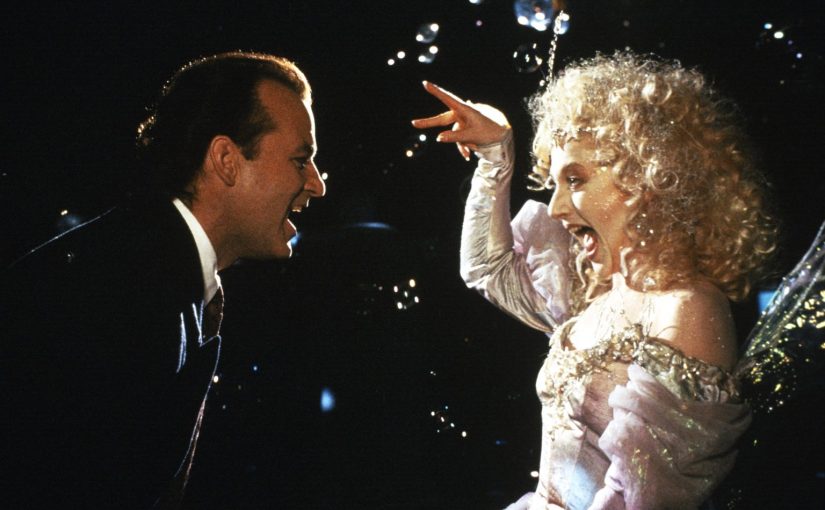
It’s when the follow up ghosts make appearances that my mind ponders what I’ll be writing about in this review.  Ghosts of Christmas Past (David Johansen) and Present (Carol Kane) enter on cue and right away I grew bored and uninterested.  

Johansen is a cabbie, or just another screeching screamer like Murray.  He’s laughing at Frank’s demise and past missed opportunities, but I’m not seeing what’s funny or even heartbreaking.  Neither theatrical mask of comedy or tragedy is functioning.  Carol Kane does her typical schtick with the high-pitched baby talk voice, dressed in a fairy get up.  Beyond that familiar routine, she commits every kind of Three Stooges smack and painful tug on Frank’s face that you can imagine.  Why of all things does she rely on a toaster to upper cut the jerk in his face?  I mean why a toaster???? If the comedy works, then I should not be wondering why a toaster or a pie or two by four or an anvil.

There’s nothing wisely written here.  The screaming and the smacking get old very fast and it gets in the way of a potential love story passed by that the script was promising for the Frank Cross character and his crush Claire (Karen Allen, whose smile always lights up a room).  I never felt like Bill Murray was ever listening to Karen Allen in the scenes they share.  Did they even rehearse this stuff?  Too often, Bill Murray seems to just be winging it, and it wouldn’t make a difference if Karen Allen even memorized her lines.

Scrooged starts out with fresh, quality made National Lampoon material but then waddles into the same typical chapters of Dickens’ holiday story.  However, while it hammers the familiar story beat by beat and you tell yourself there’s the Fred character and there’s the mute kid covering for a crippled Tiny Tim and there’s Yet To Come, you got Bill Murray who was granted too much artistic license to improvise, and has thus squeezed out all of the sensitivity and spirit that we expect from A Christmas Carol.

I’m sorry but I think I liked this Frank Cross a whole lot more before he was visited by the ghosts.  This is one Scrooge who should’ve been allowed to sleep through Christmas.

PS: If anyone can find a DVD print of The Night The Reindeer Died, I’m ready to review it.

WHITE MEN CAN’T JUMP (1992)

By Marc S. Sanders

I’m not enamored so much by sports unless they are dramatized effectively in the movies.  If I can see Woody Harrelson and Wesley Snipes making magnificent trick shots with a basketball in White Men Can’t Jump, my attention will be had.  There’s lot of street corner basketball depicted in Ron Shelton’s film and for the most part it is sensational and quite funny when partnered with the on court ribbing that guys toss at one another.  This film arrived with the oncoming trend of “Your momma is so…” insults, which still bring out the sophomoric glee in me.

Fortunately, White Men Can’t Jump doesn’t just rely on the basketball antics. There’s a good set up here and some well-drawn characters.  It’s one flaw may be that I think the film overstays its welcome.  Just when you think the picture is over and every loose end is tied, a new development occurs.  That’s because every sports movie demands a final championship game.  Who made up that stupid rule?

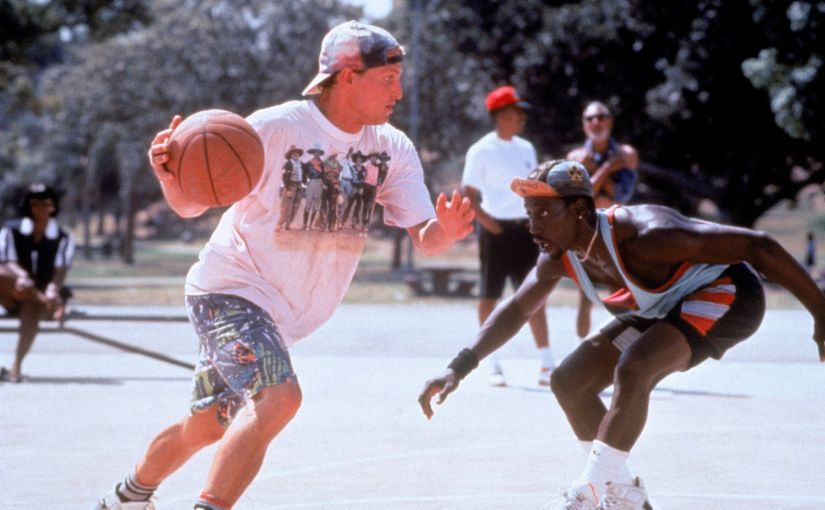
Billy Hoyle (Harrelson) makes quick cash on the court by being the fish out of water on Venice Beach.  He’s the pasty white kid with the dorky rainbow-colored cap that any urban black athlete will happily challenge for a game of one on one or two on two.  That’s the trick to his con because he’s a magnificent player actually, and regular player and loudmouth Sidney Deane (Snipes) sees an opportunity for them to partner up and clean up.  Like most competitive sports, you gotta taunt your opponent and when they have gone overboard, you lay on your conceit and declare that you can beat them any day with any guy they choose to partner them up with, such as the blond, white guy sitting on the bench doing morning stretches. 

They each have their own motivations.  Billy is up to his neck in debt to some bookies who he wouldn’t throw a game for. They are ready to collect or shoot him in the head, or both.  His girlfriend Gloria (Rosie Perez in a standout performance) aspires to land a spot on Jeopardy!. Sidney lives with his wife Rhonda (Tyra Ferrell) and baby in the criminal area of Watts.  She’s pressuring him to get them out of the slums and buy a house in a nice neighborhood. 

At first, the cons work for the pair, but the question is can Billy and Sidney trust one another.  Will they scam each other while trying to work together?

Ron Shelton’s script works because it turns in various directions when you do not expect it.  These are unusual characters. Lovable, but not all that they seem either and they are built with flaws that will undo them while they try to make a further leap ahead.  Billy is a smart kid on the court but he’s not smart with money like Gloria.  Sidney is smart at putting up the façade of a dumb loudmouth on the court but that’s his M.O. for being a responsible family man.  Gloria seems like a zany dingbat on the surface but she may be the smartest character of them all.  It’s definately not because she has memorized every kind of food that begins with the letter Q for the game show.  She has true instincts and knows to see through the B.S. of people that her boyfriend Billy can’t. 

White Men Can’t Jump is a both a con movie and a sports movie, but it’s not the greatest of each of those categories.  Still, it’s very, very entertaining thanks to Harrelson, Snipes and Perez working in top form. Wesley Snipes is doing the fast-talking wise ass routine that Eddie Murphy built his career on.  You don’t see this kind of guy in every Wesley Snipes movie though, like you do in Murphy’s films.  That’s what impresses me with Wesley Snipes.  He’s not known to be an Eddie Murphy or a Chris Rock.  He’s an actor, not a comedian, and yet he’d convince me otherwise if this was the only performance I ever saw.  

Other than his obvious role in Cheers, Harrelson normally portrays smarter guys.  Billy is smart, but he lacks instinct and not just with money but with how he considers Gloria.  The best thing Ron Shelton could have done after perfectly casting this trio was to give these characters heart followed by the flaws that weigh them down.  All that maintains what could have been a one note and flat story.

However, the film runs a little longer than I cared for.  While basketball is at the forefront of the script, I believed the film was concluding when I saw the two guys had finally grown up and learned.  Only then, a new development occurs for Sidney and his family. Suddenly, it’s up to the two guys to get back together for one more game.  I didn’t need that one more game.  I had my fill and that final tournament is shot in slow motion – literally every shot the guys make, and I’m starting to lose my patience.  Don’t get me wrong.  I’m impressed.  Harrelson and Snipes are not stunt doubled.  That’s them doing the doing the shots and accomplishing enormous efforts of agility to wow the audience.  They’re great, but by this point, I had seen enough basketball to deliver the message and I found the tacked-on twenty-minute epilogue mostly unnecessary. 

Granted some may argue that something occurs in that last game to justify the literal title of the movie.  I know what you’re talking about.  Yet, that could have been covered a lot more efficiently, I believe.  Less would have been more in this situation.

White Men Can’t Jump is great comedic entertainment, full of improvised dialogue and characters that are easy to like while keeping up a skeptical guard on them.  That’s good.  It states that Shelton’s characters are complex and that holds my interest.  Even the extras are ones to appreciate in their sweaty t-shirts while delivering urban vernacular to harass one another.  It’s a great culture to get a peek into.  I love the one guy who is a sore loser and whips out his knife, but then just as his girl calms him down, he says forget the knife.  He’s gonna get his gun. I challenge anyone not to laugh as all the other guys on the playground make a mad dash escape in a hundred different directions.  It would likely go down this way.  We hear of violent stabbings and shootings all the time. In this movie however, Ron Shelton and his cast find the natural humor of this opposing conflict.

I guess that’s the best compliment I can give the writer/director.  He didn’t sensationalize his characters.  Ron Shelton has a way of just letting his creatures of the court play.  Into—the—basket it goes. 

SWISH!!!!  It works.