THE BIG SHORT

By Marc S. Sanders

Ever since Adam McKay’s The Big Short was released in 2015, it has remained a favorite film of mine. I watch it at least once every year. McKay’s script with Charles Randolph, adapted from the book by Michael Lewis, is enormously funny but also realistically frightening.

The film shows how America’s housing market crashed in the first decade of the 21st Century. Mortgage backed securities never failed in history until now, and no one anywhere, especially the banks, ever believed a crash would occur, but it did. Only a select few people like Dr. Michael Burry (Christian Bale) and Jared Vennet (Ryan Gosling) foresaw what no one else could imagine, and thus they took advantage of it by making enormous betting transactions against the housing market. To say you need a strong stomach for this kind of investment is a serious understatement.

Burry is the first one to realize that the country as a whole will default on their mortgages once their interest rates go up in 2007. He represents Scion Capital and invests billions of dollars against the mortgage backed investments. Now he watches for the next two years while the capital at Scion declines into negative digits and drowns out the frustration with death metal music. Bale is fascinating as Burry who has a brilliant mind, but he lacks social skills.

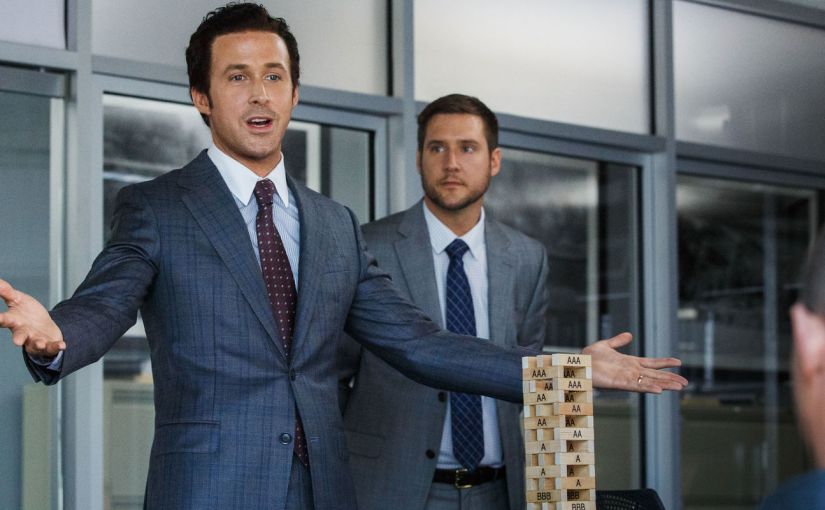
Vennet gets wind of Burry’s discovery and sells the idea to Mark Baum (Steve Carell) and his team of representatives. Vennett narrates how it all played out in the market; how ratings agencies gave triple A rankings to bonds made up of worthless backed securities. McKay wisely has Vennett introduce celebrities like Margot Robbie, Anthony Bourdain and Selena Gomez to break down the vast complexities of everything. Robbie in a bathtub. Gomez playing black jack. It’s hilarious and relatable. Gosling is great. A great scene is his selling presentation which includes a metaphoric prop of a Jenga tower. Vennet has no qualms about collecting premiums as the rest of the country is going down. He’s profiting, and why not? Big banks have been doing it for years.

Carell is spectacular as well as Mark Baum. He has a heart, but he’s an angry individual. It sickens him to make money off this short buy, but it’s the responsible action to take for the benefit of his own clients. Mark also suffers from his brother’s suicide. McKay allows just enough time for this to draw out the misery of this character. Carell should have gotten an Oscar nomination at least. Baum is a guy with no filter as he confronts authoritarian parties throughout the film. He’s a hero really, but he’s not a guy I’d ever want to be left in a room with either.

An additional story arc comes from two young guys (Finn Wittrock & John Magaro) who also uncover this opportunity. They enlist Brad Pitt as a recluse who get them into the arena of big traders. These kids who started their investment company in a garage are great as well. Another party who came out of nowhere to uncover what no one else saw.

McKay assembled a magnificent blend of actors for these unusual characters who always hid behind their computer monitors. He directs with a lighthearted approach having his characters breaking the 4th wall at times to explain what all of this means in the simplest terms.

As simple as McKay makes it with his humor, this was a terrible, terrible tragedy putting millions of people out of work and owners losing their homes. Even renters lost their homes. Pay your rent but it means nothing if your landlord isn’t paying his mortgage. McKay tragically shows this outcome.

It’s terrible to imagine, but it’s a major downfall of the American economy. When the country, is doing well, while paying short term low interest rates, no one concerns themselves with what could all go away in an instant. It’s a vicious cycle, and the only funny thing about it all is that the supposedly most brilliant investors will naively allow this to happen over and over again.

The Big Short is one of the best films made in the last 20 years.

LICORICE PIZZA (2021)

by Miguel E. Rodriguez

Director: Paul Thomas Anderson
Cast: Alana Haim, Cooper Hoffman, Sean Penn, Tom Waits, Bradley Cooper
My Rating: 7/10
Rotten Tomatometer: 92% Certified Fresh

PLOT: The story of Alana Kane and Gary Valentine growing up, running around and going through the treacherous navigation of first love in the San Fernando Valley, 1973.


You know that old saying, “You’ll either love it or hate it”?  I’m afraid that doesn’t apply to Paul Thomas Anderson’s latest film, Licorice Pizza.  At least not for me.

The plot: Gary, an impossibly precocious and business-savvy 15-year-old child actor, still in high school (the movie opens with him getting his yearbook pictures taken), develops a crush on Alana, a 25-year-old production assistant, and pursues her – and pursues her and pursues her – while she wrestles with her own emotions and the fact that, dude, he’s fifteen years old.  He calls a shaky truce on his emotions so they can remain friends, and in the process they…let me see if I can remember it all…go on several auditions, help Gary’s mom with her public relations business, open their own business selling waterbeds, fly to Texas (?) and back, fall in and out of “like” with each other several times by attempting to form physical relationships with people their own age, meet an actor who is clearly meant to be William Holden, and by the end of the movie they finally seem to be mutually in love with each other.  Sort of.  Maybe.  It depends on your point of view.  But moving on…

For all its faults, Licorice Pizza did keep me grinning for virtually all of its longish running time, and it also made me laugh out loud many times.  Only in a Paul Thomas Anderson – or maybe also a Tarantino movie – could you have a scene where a mixed-race couple (white husband/Asian wife) have a conversation in which the white husband speaks the most atrociously absurd, cringeworthy pidgin Japanese to his wife, and it gets an earned laugh for the sheer audacity of the scene.  Is it offensive?  Certainly, if this happened in real life, the husband would be cancelled faster than an all-Latino sitcom.  (Ba-ZING.)  But I’ve gotta be honest, that was one of the great belly-laughs in the film.  I found it funny in the same way that Robert Downey Jr. in blackface in Tropic Thunder was funny, in that the people committing the offenses are clearly dumber than sacks of sand and so have absolutely no idea they’re being morons.  But I’ll leave the Theory-of-Comedy discussion for another review…

In true P.T. Anderson fashion, the dialogue is as sharply written as anything by Sorkin or Mamet.  Not a second is wasted on unnecessary exposition or explanation.  (Although, to be fair, a LITTLE more explanation would have been preferred…more on that later.)  Each scene gets to the point, either directly or indirectly, with surgical precision.

There are some editing jumps that will keep a viewer on their toes.  The movie shows a scene of Gary testing a waterbed for the first time, then jumps to him hawking them at a “Teen Fair”, then suddenly he has his own storefront, sales reps, and a bank of telephone operators.  We can only assume that he had the capital, the licenses, and the business logistics to not only make this happen but to clearly be successful at it, at least for a while.  I mean, he is fifteen years old, so why wouldn’t he know how to do all this, right?

[Actually, now that I think about it, there IS a precedent for this plot: Rushmore, Wes Anderson’s 1998 film about another precocious 15-year-old boy who falls in love with a much older woman and spends most of the rest of the film attempting to woo her while she wrestles with her emotions and her desire for a relationship with someone who was born in the same decade as she was.  Do with that information what you will.]

When the age gap between Gary and Alana was explained very clearly at the beginning of the film, I was pretty sure the two of them could never be in a relationship, and I was taken out of the movie a little.  However, as the movie progressed, the film’s charm and effortless wit made me forget how far apart they were.  Gary behaves in such a way that I forgot just young he’s supposed to be, and I forgot just how old Alana is supposed to be.  The film expertly took me by the hand and got me rooting for them to be together, despite how – let’s not mince words – illegal it would be for them to be together.

SPOILER ALERT, SPOILER ALERT, SPOILER ALERT, YOU HAVE BEEN WARNED.

SPOILER ALERT.

So the movie does its job, that I’ll grant you.  But when the film ends, and Gary and Alana kiss and go running off screen together, and Alana finally says, “I love you, Gary”, and the credits started rolling…I stared at the screen, raised my arms in supplication to the scrolling credits, and said, “Say WHAT…?”  Because it was at that point, after the abrupt ending, that I started to have questions.  Lots and lots and LOTS of questions.

If Gary is a high school student – and he is a high school student – when did he ever go to class?  The film never shows us.  One could make the case of, well, you have to ASSUME he’s going to class.  Okay…but when?  In between auditions and plane flights to a live taping of a musical number in front of a live audience and opening not one but two small businesses where his employees seem to be composed entirely of his school-age buddies?  And one of these businesses involves him buying a large quantity of pinball machines to start an arcade.  Where is this money coming from?!  His acting paychecks?  He’s not a major star.  He’s a minor bit player, at best.  And yet, not only can he finance two small businesses on his own (he has a mother, but we only meet her twice), but the maître d’ at a local restaurant knows him by name and treats him like Hollywood royalty – he even has his own table at this place.

And let’s talk about that ending.  She says, “I love you, Gary”, and they run off screen.  What does this mean?  Does this mean she’s about to embark on a physical relationship with an underage boy?  One could say, “Well, of COURSE she’s not going to start going steady with him or anything.  She’s twenty-five and he’s fifteen!  The idea’s absurd and icky!  No, there’s no way anything like that can happen between the two of them, so this ending is just her affirming her love for him in a platonic way because that’s all they will ever be able to be to each other: devoted friends.”

Yeah, but…are we just supposed to make that assumption out of thin air?  The entire movie has been working on getting these two characters together, and it ends (quite suddenly) with that happening, and…we’re just supposed to think, “Yeah, but they’re not TOGETHER-together”?  If that’s the case, I feel there should have been a little more information to make that clearer.

I’m reminded of something I read where a college professor is teaching film students about Hal Ashby’s prescient film Being There.  MORE SPOILER ALERTS, kind of unavoidable here…but the film ends with a humble gardener with an IQ in the double-digits walking serenely out onto the surface of a lake.  The professor asks his students what this final scene means.  And the students say, well, there’s a sunken pier just out of sight under the water, or the water is quite shallow, or they even theorize that the scene isn’t really happening, it’s just in the gardener’s mind.

The professor pounds on his desk and says, “No, no, NO!  What you see is what you get.  The guy is literally walking on water.  Nothing in the film mentions a sunken pier or low water levels, and we’ve never seen any of his dreams before now.  Any explanations you’re giving for why he’s walking on water, aside from his ability to actually do it, is just you bringing something the scene that isn’t there.

That’s what I think about the ending of Licorice Pizza.  It’s problematic because, to me, it doesn’t matter what I think happens at the end when she proclaims her love and they run off.  The movie is clearly indicating they DO wind up in a relationship.  We can infer all we want about what may have happened after the cameras cut, but we are left with what the film has presented to us.  And that left me feeling weirdly uncomfortable.

To be sure, there are movies out there, acknowledged masterpieces, that depend heavily on the viewer doing some heavy lifting.  The one that comes to mind the most for me is 2001: A Space Odyssey, a film whose ending is suitably awesome and beautiful…but what in the Sam Hill does it MEAN?  Do enough reading and analysis and there are conclusions to be made that make sense and which elevate that film.

But Licorice Pizza is no 2001.  This is just not the kind of movie that lends itself to that kind of theoretical dissection.  If there are buried truths to be discovered, fair enough, but how much digging am I expected to do?  As the great man once said, “If you have to ask what something symbolizes, it doesn’t.”

First impressions are very important. And my first impression of Licorice Pizza is that, while it’s solidly acted and directed, and the dialogue is pitch perfect, the story itself leaves something to be desired.

[P.S.  A friend of mine said that if you were to switch the genders in this movie, it would never have been made.  I might agree, were it not for the fact that there have already been several films already made about that very topic, that is, an adult man in an inappropriate relationship with a much younger or underage woman.  American Beauty, Lolita, Lost in Translation, etcetera.  Maybe Lost in Translation is not the best example, as both characters are legal adults, but you get my point.  Frankly, I thought the gender switching in Licorice Pizza was kinda refreshing…up to a point.]

LICORICE PIZZA

By Marc S. Sanders

Can you ever imagine topping your pizza with licorice?  Seems weird, odd and just…well…no!  That’s the message of Paul Thomas Anderson’s winning film Licorice Pizza.

As I watched the picture, I knew that many would not get the point.  They may become bored or even think this is a weird movie.  That’s what I thought when I first saw Anderson’s 1999 film, Magnolia.  I loved that film, but that ending is…yeah…waaaaaay out there. 

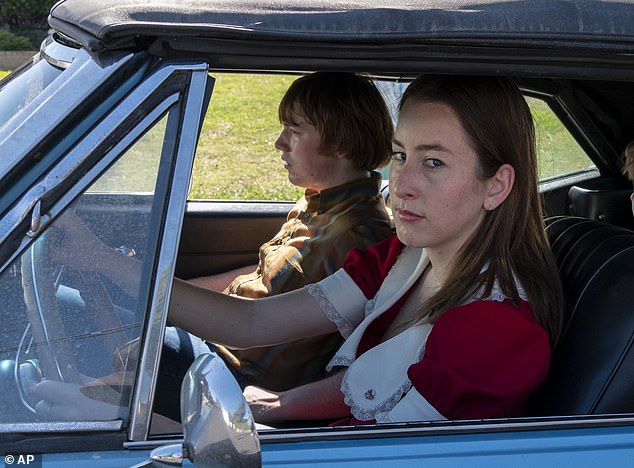
Anderson’s script centers on a 15-year-old boy named Gary Valentine (Cooper Hoffman; son of Phillip Seymour Hoffman) and the girl-SCRATCH THAT-woman, I mean, that he becomes enamored with named Alana (Alana Haim).  Gary approaches Alana at his high school where he is about to have his class picture taken.  She’s there working in a dead-end assistant position with the photographer.  Fast dialogue takes place in this opening scene where Alana can’t take this kid seriously even though he’s a seasoned child actor, known throughout the San Fernando/Encino, California landscape among known casting directors and agents.  Eventually, the relationship blossoms as Alana serves as an adult escort for Gary who has to go on a television program.  (Mom was not available to accompany underage Gary; hence the word escort.)  Soon after, it’s established that though Gary seems more mature than a typical 15-year-old because he’s had a career during most of his young life, Alana is in a limbo of not reaching adulthood yet, despite the number of her age.

Gary’s worth as an actor is expiring as he’s not the cute precocious kid that Hollywood is looking for anymore, and so he’s on his way to his next venture, never allowing himself to be set back.  Why not sell the newest innovation of the early 1970’s?  Waterbeds!  Meanwhile, Alana does her best to move on to her next life changing chapter by dating an actor her age.  However, things don’t work out.  He was born Jewish, like her family, but he defiantly announces he’s an atheist over Shabbat dinner and will not recite the kiddush prayers. 

The contrast in Gary and Alana’s progress through life in 1973 couldn’t be further separated from one another.  Anderson writes these two characters as they are going in opposite directions.  They are 10 years in age apart from one another.  Gary doesn’t allow himself to be defeated when one business venture after another doesn’t pan out.  Alana is short tempered and easily stuck in a rut, however, when things don’t go her way.  This is the running theme of Licorice Pizza.

Other folks that I’ve discussed this film with find it weird that a 15-year-old boy and a 25-year-old woman are hanging together and drawn to one another.  Yeah, it’s weird, but it happens.  Out there, there are unusual relationships or friendships.  Spend a month working in a community theatre like I have and then tell me weird relationships don’t happen.  Forget about whether they are legal or not.  Forget about if it’s perverted.  (Though, truly it really isn’t depicted in a perverted manner in Anderson’s film.) There’s a relationship between Alana and Gary where romance and attractiveness are certainly tested, but that doesn’t mean it’s ever consummated. 

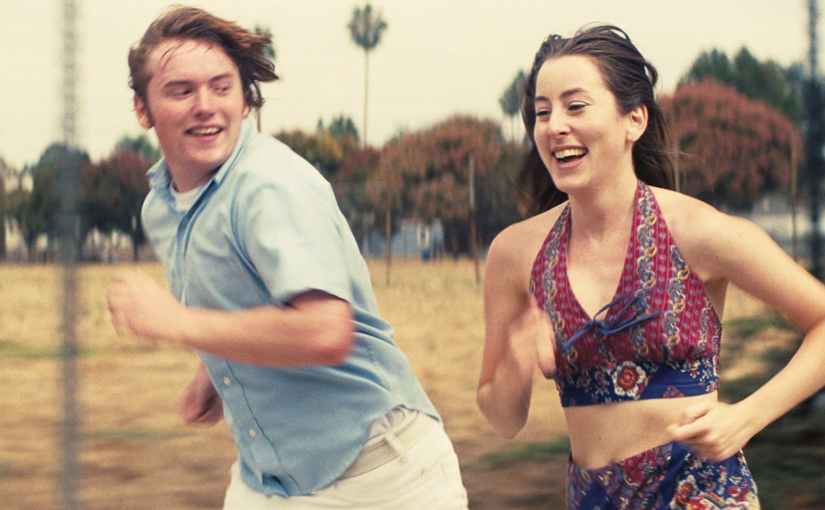
The fact that the relationship between the two characters is difficult on them and the audience is the point of Licorice Pizza.  Anderson is a brilliant writer/director here because he has an ongoing visual theme happening.  Often during the film, both characters are filmed running towards something.  They are either running towards one another or something else or they are running away from each other.  Gary and Alana seemingly know that this relationship could never come to an intimate, loving, romantic relationship.  After all, he’s fifteen!  She’s twenty-five!  Yet, what Paul Thomas Anderson demonstrates is that no matter how physically fast you can run or how far you can run, these two characters will never, ever catch up to one another. 

Gary yearns for Alana because lust interferes in most boys at age fifteen.  Alana needs Gary, however.  She tries and tries new opportunities to stimulate her daily lifestyle beyond Gary, like volunteering on a politician’s campaign or attempting to get in the good graces of a well-known Hollywood actor (a brief, yet memorable appearance from Sean Penn).  Dating a man closer to her age also doesn’t work out.  She’s outgrowing her Jewish home life that she’s still stuck in as well.  Alas, it doesn’t ever work out for her. 

The actress, Alana Haim, who takes on the role is surprisingly skillful.  She’s tough and sad and lost.  Anderson may have written the character, but Haim evokes the emotions that progress her listless story arc.  Each time, something happens to Alana, I couldn’t help but feel such despair for her.  I’ve been there.  When I graduated high school!  When I graduated college!  When I broke up with a girl!  When I had to move into an apartment!  When I became a father!  How many of us truly go on to the next plateau knowing exactly what to do?  Some folks like Gary, can do that.  Others like Alana just can’t.  I think more people have been in her spot than they care to admit.  Paul Thomas Anderson is brave enough to not present Alana’s triumph so easily or quickly.  Movies don’t always have to show the happily ever after ending.

Gary moves from one chapter to another as well.  Because he’s a well-known kid actor of yesteryear, he’s granted more resources than Alana, even though he’s ten years younger.  He always gets a table at the local restaurant.  He knows all the casting directors.  He knows how to get around and get things started.  Audiences are smarter and likely know that whether Gary is selling waterbeds in a run-down business shop or later turning the place into a pinball arcade (now that pinball machines are legalized; which I never knew they were illegal to begin with), he won’t become such a successful entrepreneur.  Yet, that never fazes Gary.  This is just the next big thing that occurs to Gary.  So, he’ll just give it a go.  The confidence Alana lacks in herself, Anderson gifts with the Gary character.  Cooper Hoffman makes a grand debut with Anderson’s direction and character foresight.  He’s definitely not performing in his father’s shadow here.

Licorice Pizza carries so much symbolism in the point to the story that you might not even realize how apparent it is until later when you reflect back on the film. Obviously, Paul Thomas Anderson is very careful to insist how far apart these two people are, not just in age, but in how they carry themselves and their lifestyles.  However, he does not stop with just the two main leads.  A side gag has a guy who’s the owner of a Japanese restaurant discuss an advertising campaign with Gary’s mother.  A suggestion is proposed by Gary’s mom.  The man then “translates” to the woman simply by repeating the same thing in English with a terribly awful Japanese accent and then the Japanese woman sitting next to the man speaks in her native tongue.  The man carries himself as if he understands the woman and translates back to Gary’s mom in his own Americanized dialect.  It’s shockingly funny how wrong and insulting this guy is.  This guy knows nothing about Japanese cuisine or culture or what they say or what interests them and yet he’s trying to make a business venture out of it.  It’s wrong and highly inappropriate (which makes the scene very funny), but it exists. It’s garish to watch this behavior, but there are thousands of insensitive people doing thousands of insensitive things every day; people who couldn’t be further apart from practicing what they truly were not destined to preach.  If you stop and think for a second, you can’t deny that this is one more weird thing out there in the world that’s odd and yet probably exists somewhere down the street or in another state or another time.  This guy has a connected with a Japanese woman without any concept of understanding or appreciation.

The title of Anderson’s film is never literally addressed.  (Later, I read that Licorice Pizza was actually the name of a popular record store in California way back when.)  Yet, my mind periodically went to its significance while watching the movie.  Try eating pizza with a thick, doughy crust and topped with tough, taffy texture like licorice topped on it.  I’ve never done it, but I’d imagine it’s hard, very hard, to swallow.  So, while Alana and Gary are certainly friends, the hormones of a fifteen-year-old boy and the lonely, lost nature of a twenty-five-year-old woman becoming involved with one another are hard to digest as well.  No matter how Gary and Alana approach their connection to one another it just does not work.  Alana falls off a motorcycle at one point. Gary runs to her.  We see that all the time in movies.  But what’s he going to do when he reaches her to offer aid?  What more can Gary do except to say “Are you okay?”  Gary gets arrested during another time in the film.  Alana runs after the police car Gary is handcuffed in, and tells him it’s going to be okay.  Yet, what is she really going to do?  She doesn’t know anybody like a lawyer or an adult that can help.  She doesn’t have the capability of helping him.

Run as fast as you want.  Run as far as you want.  Gary and Alana can never, and will never, catch up to one another.  They’ll never meet at an appropriate age, always living a decade apart.  They’ll never share a commonality with each other that promises a loving and intimate relationship.  So, while Licorice Pizza has a silly, comedic name, it’s truly a tragic story of impossible love. 

Licorice Pizza is definitely one of the best, most inventive and sensitive films of the year.

LOVE, ACTUALLY

By Marc S. Sanders

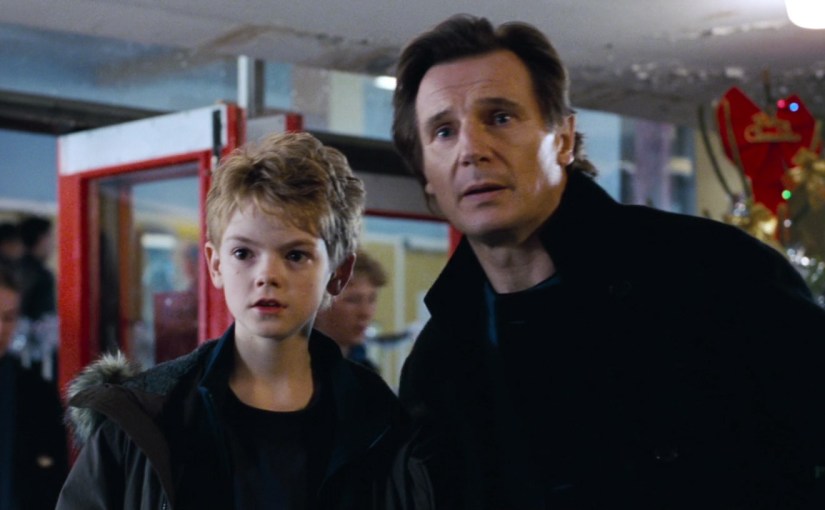
Love, Actually is like a warm favorite blanket to snuggle up in. Richard Curtis writes and directs a collection of the greatest British actors (along with American Laura Linney) in a kaleidoscope of love and relationships against the backdrop of beautiful London, England during the five weeks leading up to Christmas.

I won’t list my favorite characters or actors. In a film this treasured, this loved and this appreciated, that would be like picking your favorite child. It’s impossible when every single storyline is perfectly executed with thought and tenderness.

The stories of love uncovered, love that’s lost, love based in friendship, and love drowning in heartache beautifully jump from one to the next and then back again. Curtis is wise to not show all of the facets of each story early on. Some stories reveal more about themselves later that’ll leave you hurting for those that are not so merry and those that offer plenty of cheer.

I’m especially happy that Curtis did not compromise in the language or subject matter of his tales. Strong language at times makes for some memorable dialogue and nudity presents a normality to how we really are with those we have affections for.

It’s fair to say everyone in life experiences some variation of love. Yes! I mean everyone. Richard Curtis reminds you that love is a natural instinct, and so we can not focus on the easily recognized gloom of our world. To have these stories captured around Christmas time only enhances what we treasure, or what we wish we didn’t have to endure at times. Curtis’ blazing soundtrack helps along the way.

Love is hard. Love is challenging. Love will sweep you off your feet and love will destroy everything you thought you had. However, love will never leave you with complete regret. It’s never the love we have for someone that we regret. It’s only a wish to have it wholesome, healthy, happy and pure.

Love, Actually is all around.

HAPPINESS (1998)

by Miguel E. Rodriguez

Director: Todd Solondz
Cast: Jane Adams, Jon Lovitz, Philip Seymour Hoffman, Dylan Baker, Lara Flynn Boyle, Louise Lasser, Ben Gazzara, Camryn Manheim, Molly Shannon
My Rating: 8/10
Rotten Tomatometer: 81% Certified Fresh

PLOT: Various characters, some linked, some not, struggle with the search for happiness in their lives.


A little history:

Todd Solondz’s film Happiness was so controversial that the Sundance Film Festival actually refused to screen it.  It was originally financed by October Films, but upon seeing the final product, October’s owner, Seagrams, dropped the film like a hot potato.  Happiness initially received an NC-17 rating, which would have immediately limited distribution opportunities, as well as created advertising difficulties.  Therefore, it was released unrated, uncut, and unaltered.

I remember reading about this movie years ago in Roger Ebert’s four-star review; he eventually labeled it one of the top ten movies of 1998.  I got curious, so, since this was in the days before Netflix – and I’m not sure Netflix would have made it available anyway – I snapped up the first DVD copy I could find and watched it.

And…um…oh my.  There are dark comedies (Pulp Fiction), and there are Dark Comedies (Dr. Strangelove).   And then there are DARK COMEDIES.  Happiness is a DARK COMEDY.

Remember that scene in Pulp Fiction when Marvin gets shot in the back of the car?  Remember the blood that covered the rear windshield and the blood and pieces of flesh and skull that were peppered all over John Travolta and Samuel L. Jackson?  Horrific, right?  But it was such a shocking moment that I remember laughing hysterically for the first few seconds after the incident, so that I missed the next few lines of dialogue from Vincent and Jules.

Happiness is like that.  You’re watching scenes of emotional devastation, but the circumstances under which they’re happening are…kinda funny.  Or at least funny in that shocked kind of way.  Your brain can’t quite believe what your eyes and ears are feeding it, and so you laugh.  At least, I did when I recently re-watched it with my girlfriend last night.  She didn’t do a lot of laughing, for the record.

The plot: We meet three sisters, Joy (Jane Adams), Helen (Lara Flynn Boyle), and Trish (Cynthia Stevenson).  Joy is an aspiring 30-something songwriter who still lives at home and has just broken up with her boyfriend in a scene that’s right at the top of the film and sets the appropriate mood: somewhere between funny and discomfort.  Helen is a moderately successful writer who has written a bestselling collection of poems about childhood rape.  Cynthia is a mother of two boys, married to a successful psychiatrist named Bill (Dylan Baker).  She seems to be the happiest of the three sisters, but she’s that kind of person who says things like, “You know, we all thought you would never amount to much, but NOW look at you!”

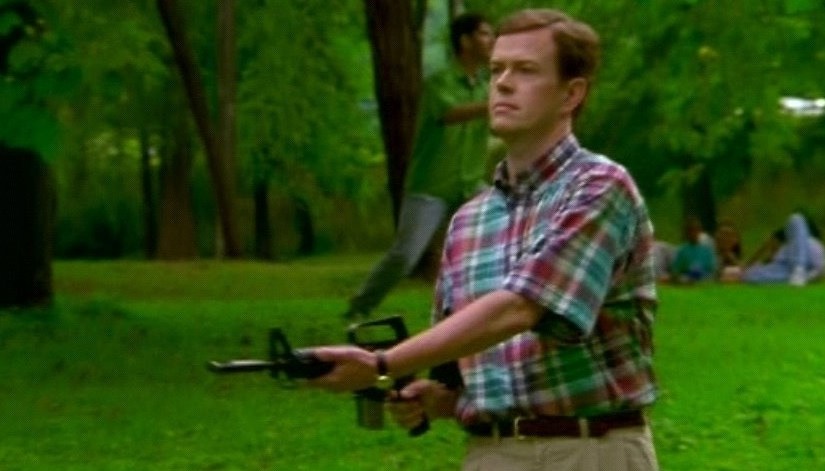
Cynthia’s husband, Bill, has a dark secret, one which I will not divulge here, but it’s revealed fairly early in the film.  He is a man so desperately in search of happiness that his efforts to fulfill his desires dance on the edge of farce.  He is so compelled to be happy (or at least what passes for happy in his mind) that he is, at one point, reduced to, um, “interfering with himself” in the backseat of his own car in broad daylight, risking discovery at every second by passers-by.

I haven’t even mentioned the part where he drugs the tuna fish sandwich.  Or ditches the PTA meeting for an impromptu “rendezvous.”  Or has a conversation with his 11-year-old son about why length doesn’t matter.  But enough about Bill for now.

Helen, the author, feels like a faker because she was, in fact, never raped as a child, so her happiness and success is built on lies.  She wishes her work could have more immediacy or legitimacy.  Then she could be REALLY happy.  And she might have a way: Daryl (Philip Seymour Hoffman), her next-door neighbor, is so obsessed with her that he finds it impossible to talk to her in person.  So he starts making obscene phone calls to her while he’s at work.  He gets the shock of his life when, after one call, she star-69s him and says, “I want to see you.”

And Joy…poor, ironically-named Joy.  Her trials and tribulations in the movie are more relatable than the others I’ve mentioned previously, so I’ll leave them alone for now.

Now, the subject matter of the movie has sparked controversy, as I mentioned earlier.  Are we, as an audience, expected to empathize with these characters?  Speaking as a guy who has had his fair share of heartbreaking crushes, I’ve gotta say I did empathize a bit with Daryl, the phone pervert.  I certainly don’t condone his behavior, but I was achingly aware of his thought processes as he stood in the elevator next to the object of his desire, desperate to talk to her, certain that she represents true happiness, but eternally unable to do anything about it.

I also identified a little with Kristina, played by Camryn Manheim.  She lives a couple of doors down from Daryl and is always knocking on his door to deliver tidbits of news.  (“Our doorman was found bludgeoned to death in his apartment this morning…supposedly his penis was missing.”)  She is clearly crushing on Daryl, but Daryl is oblivious in the face of his own crush.  Their relationship, or lack thereof, pays off in a scene set in a diner during which a secret is revealed that sees the Marvin scene from Pulp Fiction and raises.

But what about Bill, Cynthia’s husband with the dark secret?  While I can relate to characters like Kristina and Daryl and Joy, what is this distasteful nonsense doing in this movie?  Let’s make no bones about it: Bill is a monster, enslaved to desires he can’t understand; he can only bend to their will.  Does that make him an object of sympathy?  SHOULD that make him an object of sympathy?  There’s an excruciating scene where Bill’s son asks him very, VERY specific questions about his compulsion, and to our amazement, instead of shying away from them, Bill tearfully answers them honestly and directly, including that last question that I had completely forgotten was in the movie.  Does this honesty make Bill honorable?  Previous scenes have shown that Bill is always honest with his son, and he makes the decision not to break that streak, even when the answers are shameful and, probably for some, gag-inducing.

My take: Bill’s crimes and desires have made him irredeemable, in my book.  But…BUT…he did the right thing by being honest with his son.  In that ONE sense, I have to give the character props.  If I were in his place, I’m not sure I would have done the same thing.

Geez, I just realized I haven’t even mentioned another subplot about the parents of the three sisters who have relocated to Florida and are undergoing a separation (NOT a divorce!), even though they’re still living in the same house.  Eh, I’ll leave that one alone, too.

So anyway.  Whenever I read a review that gets this long-winded, I always find myself asking the question, “Yeah, but is it any GOOD?”

Yes, it is.  It’s literate, compelling, and funny, but you may hate yourself for laughing afterwards.  That’s the genius of the movie.  It creates these situations that you laugh at, but when you try to describe the scene to your friends, they just stare at you in abject horror.

(I give it an 8 instead of a higher score just on the basis of the “icky” feeling I get when watching some of the scenes.  You’ve been warned.)

MIDNIGHT IN PARIS (2011)

by Miguel E. Rodriguez

Director: Woody Allen
Cast: Owen Wilson, Rachel McAdams, Marion Cotillard, Kathy Bates, Adrien Brody, Tom Hiddleston, Alison Pill, Léa Seydoux, Michael Sheen
My Rating: 10/10
Rotten Tomatometer: 93% Certified Fresh

PLOT: A nostalgic screenwriter travels with his fiancée’s family to Paris where, every night at midnight, he inexplicably finds himself going back in time to the 1920s.


The best of times is now / As for tomorrow, well, who knows?
La Cage Aux Folles

It’s currently 11:05 at night on a Sunday evening.  I’m getting older, so if I’m smart, I should get off to bed, owing to the fact I have to get up early tomorrow to get ready for work.

But I can’t.  I have just re-watched Woody Allen’s Midnight in Paris for only the second time in my life, and I have revised my original rating of 9 up to a 10.  And I am just bursting to write about how wonderful this movie is.  I’m hoping that I can reach someone who has not seen it before, so I can convince them that, even if they’ve never seen a Woody Allen movie before, this is the one they should start with.  Yes, even over Annie Hall or Manhattan or even Match Point.  In my mind, Midnight in Paris captures the voice of the artist as he is reaching a certain age and has something important to say about nostalgia, and how sometimes it’s not always what it’s cracked up to be.

Gil Pender (Owen Wilson) is a Hollywood screenwriter trying to complete his first novel.  He and his fiancée, Inez (Rachel McAdams), travel to Paris with her family so he can perhaps get inspired by one of the all-time great cities of the world.  He is immediately smitten with the atmosphere of the place; the movie opens with a wordless montage of static shots of Parisian cafés, streets, museums, statues, apartment buildings, and, of course, the Eiffel Tower.  The sequence sounds simple on paper, but the effect is – I don’t know how to describe it.  It captures the ineffable romance of the place.  More so than any other movie set in Paris, Midnight in Paris really, REALLY makes me want to go there.

Gil and Inez seem happy enough, but he is a little more antisocial than she is.  He is star-struck by Paris, but Inez is not incredibly fond of it.  They bump into an old friend of Inez’s, a pleasant enough man who turns out to be a bit pedantic; during a museum tour, he presumptuously corrects the tour guide on details of the life of Auguste Rodin.  This is not the kind of guy I would want to be stuck with on an elevator.

One night, Gil goes walking by himself on the Paris streets and gets a little lost.  Long story short, he inexplicably finds himself transported back to Paris of the 1920s, when the cafés were full of American expats and frequent visitors like Ernest Hemingway, F. Scott and Zelda Fitzgerald, Cole Porter, Gertrude Stein, T.S. Eliot, Pablo Picasso, Salvador Dalí, etcetera.  As a writer, Gil is over the moon; it just so happens his unfinished novel is about a man who runs a “nostalgia shop”, so this pleasant turn of events is a welcome tonic to his vaguely unhappy days back in the present.

Watching the scenes of Gil rapturously conversing with Hemingway, or goggling at Cole Porter playing the piano, I was swept away by the audaciousness of this movie.  It’s illogical and steeped in fantasy and seems to be begging not to be taken too seriously.  But it is a pure joy to watch.  I immediately identified with Gil.  I found myself imagining how I would respond if I were somehow transported back to a time and place when some of my own idols walked the Earth: Hollywood, the 1940s, walking around and conversing with Orson Welles, Alfred Hitchcock, Jimmy Stewart, Katharine Hepburn.  Or even not so far back: the 1970s, having lunch with young Spielberg and Coppola and Lucas, and Pacino and Streep and DeNiro, discussing film and life and getting insight into their inner workings.

From our perch in the present, it’s easy for us to look back at the past and say, well, those were the days.  Just earlier today, I was having an online discussion about the difference between CGI and practical effects in movies like Star Wars or The Lord of the Rings and even Honey, I Shrunk the Kids.  We tell each other that older movies felt more real because the effects were made with real props occupying real space, whether they were miniatures or matte paintings or what have you.  And we say, “Man, they just don’t make them like that anymore.  They knew what they were doing back then.”

That’s Gil.  He looks around at the shimmering jewel of Paris in the 1920s and he’s convinced that this is “where it’s at.”  What can today’s world offer in comparison to sitting in a café and discussing art with Salvador Dalí and Luis Buñuel?  Or the pleasure at hearing Ernest Hemingway tell you he’ll hate your book, even if it’s good, because that would make you a better author than him?  Or getting constructive notes on your novel from Gertrude Stein?

The story progresses.  Gil becomes infatuated with a beautiful woman from the past, Adriana (a luminous Marion Cotillard), and it becomes harder and harder for him to go back to his own present each night.  Inez’s father gets suspicious and hires a private detective to follow Gil during his midnight strolls.  You may ask how a private detective can follow someone who is traveling back in time.  Well, my friend, that is an EXCELLENT question, one which the movie answers in satisfying and gut-busting fashion in the final reel.

But the heart of the movie lies in the touching, revealing segment when Gil and Adriana go even further back in time, this time in a horse-and-carriage, back to the Belle Époque, the “Beautiful Age” of Paris, which lasted from about the 1870s to the 1910s.  Adriana, who lives — lived — in the ‘20s, is entranced with this even more bygone era.  She feels about the Belle Époque the way Gil feels about the ‘20s.  To her, the ‘20s are slow-paced, a drudge.  But, oh, to be back in the 1890s!  Dinner at Maxim’s, the Moulin Rouge, meeting Toulouse-Latrec and Gauguin and Degas!  How wonderful those days must have been compared to the Boring Twenties!

And there’s the message of the movie.  We can grouse and grumble about the modern world all we want.  The movies are dime-a-dozen.  The books even more so.  The music is crap.  Cell phones have turned us into tiny-screen junkies.  But, oh, to be back in the good old days of the 1980s, when the music was gnarly, and the movies were iconic, and the books were amazing, and everything was just better.

But we forget that, in the ‘80s, people were grousing and grumbling about THAT era, and they longed for the more sedate and rosy era of the 1950’s.  And in the ‘50s, people said the ‘30s were the BEST.  DECADE.  EVER.  And so on and so on.

It’s human nature for us not to realize what we’ve got going for us until it’s gone.  We are living in glorious times.  (Coronavirus and politics notwithstanding…gimme a break, I’m trying to make a point here.)  Look around.  Really SEE it.  Embrace it.  We don’t need a time machine to go back to our glory days.  We’re IN our glory days.  Just wait.  In 20 years, you’ll look back on the 2010s and say, “Man, wasn’t that a time?”

If you take nothing else away from the above review, remember this: Midnight in Paris is pure charm, is laugh-out-loud funny, and is the best Woody Allen film since Match Point.  So if you haven’t seen it, you really, really, REALLY need to make a point to do so.

PARASITE (2019)

by Miguel E. Rodriguez

Director: Bong Joon Ho
Cast: Kang-ho Song, Sun-kyun Lee, Yeo-jeong Jo
My Rating: 10/10
Rotten Tomatometer: 99% Certified Fresh

PLOT: Ki-taek and his family, all unemployed, take peculiar interest in the wealthy and glamorous Parks, as they ingratiate themselves into their lives one by one.


Watching Parasite reminded me of the first time I saw Pulp Fiction.  I told my friends that it was like being on a roller-coaster at night wearing a blindfold: you have no idea where you’re going or what’s coming, but the ride is exhilarating.

That’s Parasite.  The hype is real.  This is one of the best movies I’ve ever seen, and if you plan on seeing it, I would highly recommend you do so BEFORE reading further.  I have no plans to spoil ANYTHING, but the less you know about the movie before going in, the better.

(You’ll have to bear with me, I’m writing this shortly after seeing the movie myself, it’s currently 11:14 PM, and I’m starting to get a little tired, but I want to get this all down before I pass out, so it may get a little “rambly” for a while.  You’ve been warned.)

Parasite is many things.  It’s a social commentary, a black comedy, a family drama, and a Hitchcockian thriller all rolled into one delicious Korean dish.  (The film and filmmakers are Korean.)  The beauty of the movie is that it manages to be all those things without losing track of itself.  I can’t count how many movies I’ve seen that attempted a tonal shift in the middle or at the end, and it just falls flat.  Where lesser movies failed, Parasite succeeds.

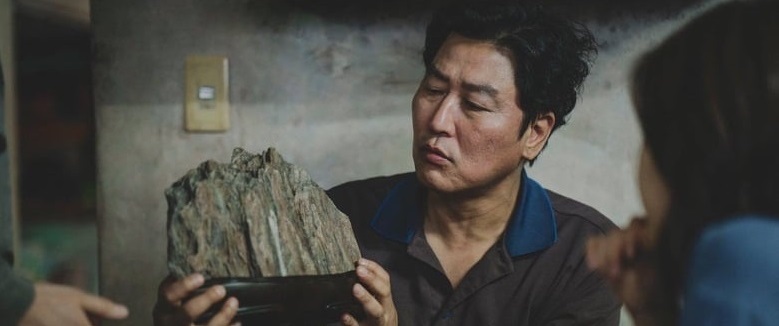
The plot involves a nuclear family, the Kims (father, mother, college-aged son and daughter), living in near-poverty in a sub-basement.  They fold pizza boxes to make a little cash.  They steal wi-fi from a shop next door.  When fumigators spray outside their street-level window, they open it wide to take advantage of the free pest control.  They aren’t starving, but they are desperate.  Yet they don’t appear to be beaten down by their condition.  They’ve become a family of hustlers, not in any criminal manner, but in ways that enable them to get by on the bare minimum until one of them can get a leg up.

Opportunity knocks one day when a friend of the son, Ki-woo, gets him a job as an in-home tutor for the high-school daughter of a wealthy family, the Parks.  Ki-woo changes his name to Kevin, then suggests to Madame Park that her 7-year-old son could use an art tutor.  This gets his sister, Ki-jung hired.  She changes her name to Jessica and finds a creative way to get her father hired as Mr. Park’s personal driver.  Then the Parks’ long-time housekeeper somehow has to be eliminated so the MOTHER can get hired.

Before long the entire family is working for the Parks, though it’s important to note the Park family has no idea their new employees are all related.  This is all done with great humor, not in a farcical way (that will come later), but in such a way that you find yourself rooting for this down-on-its-luck family of con artists to finally get a taste of the good life.

There’s a long scene where the Parks have gone camping, and the Kims gather in the enormous living room of the Parks’ lavish home and just sit and eat and drink and talk and get drunk.  This is the family drama/social commentary part of the movie.  There’s something a little sad about seeing these people who are like any other people, who seem no less deserving than the Parks, but their best-laid plans have come to nothing, and the highlight of their lives is to get hammered in somebody else’s house.  Suppose Kevin falls in love and decides to marry the girl he’s tutoring, when she’s a little older.  Who will they get to be his parents?  Will they need to hire actors?

Trust me, I haven’t spoiled ANYTHING.  Swearsies.  This movie is brilliantly, ingeniously split into two parts.  The first half is prologue.  The second half is genuinely, literally breathtaking.

Something happens that forces the Kim family to examine and re-evaluate their life choices up to the present.  It also forces them to do some very fast thinking indeed, which is where some of the funniest and darkest comedy takes place.  This is where the movie really takes off, where it had me reminiscing about the twists and turns in Pulp Fiction.

And nothing…nothing can prepare you for the finale.  About which I’m saying nothing.  Again.

From a cinephile’s perspective, Parasite is miraculous.  It manages to be several different things all at once, allowing you to savor every individual aspect of it without any one part of it overpowering the other parts.  The screenplay is unbelievably inventive.  The direction is sure-footed and masterful.  The acting is pitch perfect throughout.  It made me think, it made me laugh, it made me cringe, it made me say, “Oh S#i+!” MANY times, and it made me bring my hand to my mouth like a shocked Victorian-era woman many, MANY times.

I say again.  The hype is real.  You owe it to yourself to see this movie whenever you can.

[Ed. note: the Criterion blu-ray of Parasite contains an interesting experiment: a black-and-white version of the film, which is apparently how the director originally envisioned the film, and which might account for its stark imagery in places.]

LATE NIGHT (2019)

by Miguel E. Rodriguez

Director: Nisha Ganatra
Cast: Emma Thompson, Mindy Kaling, John Lithgow
My Rating: 7/10
Rotten Tomatometer: 79% Certified Fresh

PLOT: After being accused of hating women, the female host (Thompson) of a popular late-night talk show makes a “diversity hire” for the writer’s room: Molly Patel (Kaling), whose straight-talking instincts put her at odds with her boss and co-writers.


On the whole, Late Night is like the best movie Judd Apatow hasn’t made yet.  It’s funny (not explosively funny, but pointedly funny), smart, and actually has something relevant to say about a host of topics, but mostly it’s about women: women in the workplace, in Hollywood, in positions of power, in traditionally male-dominated industries, even women and sexual indiscretions.

Mindy Kaling (who also wrote the screenplay) plays Molly Patel, a chemical plant worker who lands an interview for a writing job at one of the most popular (fictional) late-night shows on television, and also the only one hosted by a woman: Katherine Newbury, played with style and wit by Emma Thompson.

(For the record, I could watch Emma Thompson read the phone book, and I would say that was also done with style and wit, and I’d probably be right.  But moving on…)

Molly’s interview is perfectly timed, because Katherine desperately needs a “diversity hire” after she is accused of hating women.  The fact that her writer’s room consists of all white men does not help her case, so Molly is hired more or less on the spot.  IMDb tells me that Mindy Kaling once interned for the Conan show, so I personally have no idea how accurate the characterizations are of these writers, but I got the feeling they were pretty spot on.  For example, when she’s first introduced to the room, a couple of the guys immediately ask her for sandwiches and coffee.  In another twist, she uses the ladies room, only to discover that, since there are so few women employed there, all the male writers use the ladies room as well…but only when “duty” calls. (…he said as he chuckled to himself.)

We have the makings of what could have been a great comedy.  As it is, we have a pretty good comedy.

My issues are at the screenplay level.  The story is awesome, the characters are awesome, and the screenplay does make some sharp criticisms of the current status quo.  (The best and funniest scene occurs when Katherine takes to the streets, a la Conan or Jimmy Fallon, and does a “White Savior” bit; it sounds terribly racist when I write it out like that, but I assure you, it’s hilarious and not a bit racist.)  But…there were times when I thought the screenplay was pulling its punches.

For example, there’s a moment when Katherine decides to deliver a politically charged joke in her monologue (it’s a doozy, by the way).  Given the plot developments by that time, I thought there would be more of that kind of material later on.  But there isn’t.  Alas.

There are lots of moments like that, when the screenplay felt like it was building to some kind of climactic, powerfully-written dialogue or monologue that would really lay into the characters and the audience, like an Aaron Sorkin script, or even like a comedy from earlier this year, Long Shot.  But it never QUITE happens.

(Okay, there IS one scene that does deliver a great payoff…it’s played out on an empty stage between two of the main characters, and it has as much heartfelt emotion and drama as any Merchant Ivory film.)

I liked this movie.  I felt like there was MORE that could have been said and done with this material that could have elevated it even more. But it is ultimately a feel-good movie that has some very funny scenes and has a lot to say. 

THE LOBSTER (2015)

by Miguel E. Rodriguez

Director: Yorgos Lanthimos
Cast: Colin Farrell, Rachel Weisz, John C. Reilly, Olivia Colman
My Rating: 4/10
Rotten Tomatometer: 87% Certified Fresh

PLOT: In a dystopian near-future, single people, according to the laws of The City, are taken to The Hotel, where they are obliged to find a romantic partner in forty-five days or be transformed into an animal.

[So, yeah, this is about 1,800 words of how much I disliked the majority of this movie, so this review is FULL OF SPOILERS, because it pissed me off so much…if you have ANY interest in seeing this movie, I’d seriously advise against reading this review.  I’d advise you MORE against SEEING the movie, but whatever, dealer’s choice.]


“The course of your relationship will be monitored closely by our staff and by me personally. If you encounter any problems, any tensions, any arguing, that you cannot resolve yourselves, you will be assigned children. That usually helps, a lot.” – Hotel Manager (Olivia Colman)

(That’s the best line in the movie, just thought you should get the highlight now.)

——————


I first became interested in The Lobster after discovering The Favourite, one of the very best films of 2018.  I thought director Yorgos Lanthimos’s vision and directorial style were stunningly original, and the story was exquisitely well-acted by all three of the female leads.  So, by extension, I figured The Lobster would be more of the same.  It came highly recommended by other friends, and I remember seeing it in stores with that now-familiar “Certified Fresh on Rotten Tomatoes” sticker.

Well, I just finished watching The Lobster on Netflix.  It was, putting it mildly, a major letdown.

It had a promising start.  The opening scene features a woman driving wordlessly through some countryside.  She stops on the side of the road, and as she exits the car, you can see she’s carrying a revolver.  She calmly walks into a field and approaches a nearby donkey and…well, let me just say that my attention was immediately grabbed.

Eventually, the audience is fed enough information to deduce that, for reasons left unexplained, single people from The City (it’s never referred to by its proper name) are being trucked to a resort hotel in the country.  Their personal possessions are confiscated, and they are assigned small rooms with single beds.  They are calmly informed that, if they manage to pair up with another hotel guest, they will both be relocated to a room with a queen bed, and from there to a yacht.  (They are mum about what’s supposed to happen after that.)

If, however, you are unable to pair up with someone after 45 days, you will be literally transformed into an animal.  You are permitted to decide which animal.  Well, naturally. (David, our “hero” (Colin Farrell), wants to be a lobster if his time comes, although not for any reasons that Phoebe Bouffay might celebrate…)

So…yeah.  You’ve basically got Logan’s Run meets Black Mirror.

—————–

For the first section of the film, taking place mostly in and around the resort, I was mesmerized.  It felt like the best films of Spike Jonze, or even Monty Python.  For example, The Hotel strictly prohibits masturbation.  When John C. Reilly’s character breaks this rule, his punishment is bizarre but, I would imagine, 100% effective.  (And let me just say, it’s probably not what you’re thinking.)

Another bizarre moment: sexual intercourse with any other guest while still single is also strictly prohibited, but as part of the “treatment” for a single person, once a day, a maid comes to your room to replace any tranquilizer darts you may have used the previous night (long story) and then performs, for lack of a better word, a lap dance.  This dance, while technically “erotic”, is drained of any sexual chemistry.  It defies description.  It is one of the most bizarre things I’ve seen on film in recent years.

Now, I LIKE bizarre.  This whole opening third of the film is right up my alley.  I had literally NO idea where any of this was headed, and that thrills me. But then…disaster strikes, at least from my point of view.

David, Colin Farrell’s character, can take it no longer and engineers an escape from the Hotel.  In the surrounding forests, he discovers a band of Loners, single people who survive off the land, as they are unwelcome in The City.  They pride themselves on being able to do what they want where they want (as long as it’s not in The City), but they ALSO have strict rules about not pairing up.  Masturbation: A-OK.  Hooking up: VERBOTEN.

From an allegorical point of view, I believe The Hotel represents the cult of Couplehood, or Marriage, if you like, that tends to assault single folks, in one way or another, their entire single life.  (Argue with me all you want, but if you want concrete examples, look no further than television commercials, game, set, match.)  On the other end of the spectrum, you’ve got the cult of Singularity [my own name, not from the film], the folks who love being single so much that, when their friends couple up, the single friend backs off from invitations and begs off of parties and fades away, because who needs that pressure, am I right?

So the rules of the Loners make sense from that perspective.  But…from a STORY perspective, the movie comes to a stop once David finds himself in that forest.  He meets a beautiful woman (Rachel Weisz, credited only as “Short Sighted Woman”), they flirt surreptitiously, they develop a forbidden relationship, they go undercover into the city with another faux couple (just to prove they can, I guess), and then they are discovered by the leader of the Loners.  The Loner leader tricks Short Sighted Woman into seeing an eye doctor on the pretense of getting her vision corrected, but instead, the doctor [SPOILER ALERT] blinds her as punishment for her transgression.

BLINDS her.  Don’t you think a severe tongue-lashing and two nights without food or water would have sufficed here?  I mean, what the actual f***?

At this point, I was getting tired of this story.  I felt bogged down by melodrama after a seriously promising start.  (For example, the way in which the forbidden relationship between David and Short Sighted Woman was discovered was absurdly preventable; it felt like something that happened only because the screenplay required it, not because it was something the characters would actually do.)

——————————

So, now we’re at the REAL reason I disliked this movie so much.  If you’ve stuck with me this long, we’re at the home stretch.  MAJOR spoiler follows, so last chance to bail.

David and the newly-blinded S.S.W. engineer a second escape and wind up on foot on a country road, presumably heading into The City.  At this point, I made a startling realization.  From an allegorical point of view, David and S.S.W., at least to a small degree, represented my relationship with my own girlfriend.  They were in a relationship, but not an officially “sanctioned” one (Marriage), so they don’t belong in The City.  And they’re a couple, but not truly “single”, so they don’t belong at The Hotel.  They’re in relationship limbo, at least as far as cultural designations go.

I was like, “Hey!  Finally, a movie that acknowledges a relationship like mine!  …although I certainly don’t feel like I’m navigating a no-man’s land, but at least we’re being represented in some small way.”

So.  They wind up at a diner, where David makes a decision: he will blind himself with a steak knife.

What.  The f**k.  What is this plot point supposed to represent in this allegory?  The need (requirement?) for one partner in a relationship to make drastic changes to themselves, physically or otherwise, in order to belong with the other person?  I understand the need for change and compromise in ANY relationship, but here’s my two cents: if you decide your relationship depends on you BLINDING YOURSELF for your partner, you need to check yourself before you wreck yourself.

So, picture the scene: David leaves blind S.S.W. at the table and heads to the bathroom.  We see him preparing to do the deed.  The knife is in his hand.  He stuffs paper towels in his mouth to stifle the screams that are sure to come.  He holds the steak knife with the point JUST about to penetrate the eyeball.  Suddenly, CUT back to S.S.W. at the table.  Waiting.  And waiting.  And waiting some more.  A waiter refreshes her water glass.  She continues waiting.  Through the diner window, construction is in progress across the street.  She waits.  And waits.  And waits.

Suddenly…CUT TO BLACK…ROLL CREDITS.

Reader, I am being 100% truthful when I say, at that point, I literally flipped the double-bird at my TV screen and yelled out, “WHAT THE F**K!!!”

I mean, seriously…what is the POINT of that dangling participle of an ending?  There are only three possible outcomes: he blinds himself and returns to S.S.W., OR he chickens out and returns to S.S.W., OR he chickens out and bails on S.S.W.  Since we get the Schrodinger’s Cat ending, it is simultaneously ALL of those endings and NONE of those endings, which is extraordinarily FRUSTRATING BEYOND BELIEF.  I got NO resolution to the story OR the characters.  Do they try to find safe harbor in The City, perhaps on forged documents?  Do they travel the country, taking only the back roads and taking shelter in backyard sheds or hastily dug shelters?  ARE THEY BOTH BLIND during all this?

Don’t tell me, “Well, it’s up to you what happens.  What do YOU think he does?”  I don’t know, I DIDN’T WRITE THE SCREENPLAY.  Farrell plays the character with an almost childlike simplicity, so it’s impossible to predict what he’ll do.  This serves the story extremely well in the first part of the movie, but it does the viewing audience no favors when it comes to this absurd anti-climax.

I felt short-changed and cheated at the end of this movie.  And I really liked the characters, and I liked the first third of the story, and I stuck with it hoping it would arrive at a grand conclusion, some epic, symbolic imagery that would bring things full circle or SOMETHING.  And I got bupkis.  That’s not how you treat a viewer, folks.  I felt insulted.

So.  Despite my hatred for the ending, I still give it a 4 (rounding up 1/3 of 10) because of how original and oddball the first third of the film was, and how much promise it displayed.  If they had stuck with that tone all the way through, I could see this REALLY being a gem.  As it is, I would like to quote Admiral Ackbar:

“IT’S A TRAP!”

THE FAVOURITE (2018)

By Miguel E. Rodriguez

Director: Yorgos Lanthimos
Cast: Olivia Colman, Rachel Weisz, Emma Stone, Nicholas Hoult
My Rating: 10/10
Rotten Tomatometer: 94% Certified Fresh

PLOT: In early 18th century England, a frail Queen Anne (Colman) enjoys the attentions of her close friend, Lady Sarah (Weisz), but when Sarah’s cousin (Stone) arrives at court, a subtle power struggle ensues.


This movie is a TRIP.  Imagine that someone crossed the sex-driven antics in Dangerous Liaisons with the cat-fighting in All About Eve, directed by someone who idolizes Stanley Kubrick and David Fincher.  It’s that good.

Where to begin?

I loved the story.  It’s a basic power struggle/love triangle, but told with immense wit and originality.  Queen Anne indulges in sexual dalliances with her closest confidante, Lady Sarah.  Then Abigail appears, a distant cousin to Lady Sarah; she’s hired as a scullery maid and slowly works her way into Lady Sarah’s confidence as her handmaiden.  When the Queen starts to show a preference for Abigail over Lady Sarah, oh, the fur doth fly.

Rarely has it been so much fun to see such bad people behaving so badly.  At first, I was rooting for Abigail, who is only doing what seems necessary to survive, but then it becomes obvious that there ARE no good guys in this movie.  Abigail proves herself just as capable of social atrocities as Lady Sarah or Queen Anne herself.  Normally, I HATE movies with no clear heroes, but the screenplay and camerawork kept me constantly engaged and entertained.  I think I had a smile on my face continuously after the 30-minute mark.

And let’s talk about that camerawork.  I’ve never seen one of this director Yorgos Lanthimos’s films before, but if they share the same visual inventiveness as THIS movie, I am going to seek them out.  The list of directors working today with visual styles unique to them is relatively short, so to find this fresh take on moving pictures was a delightful surprise.  There are a couple of places where extremely-wide-angle “fish-eye” lenses are used, distorting the picture on the edges so it looks like you’re looking at the scene through the bottom of a Coke bottle.  I found that particular device odd, calling attention to itself, but it worked.  It sort of created this idea that we’re looking at a staged performance rather than attempting to mimic or capture strict reality, which makes some of the behavior of the main characters more palatable than they might be in another film.

There are one or two moments that are so over the top, they might have derailed another film.  At one point, two characters dance during a formal party, as the Queen looks on.  It starts out daintily enough, like you’ve seen in countless other 18th-century films, the mincing steps back and forth, a little bow here, a curtsy there.  Then, as the music continues…something happens.  The man lifts the woman and swings her around on his hips like a swing dance.  They start to move their hands like in the “Vogue” video.  At one point, I’d swear the man started a rudimentary breakdancing move.  What’s going on here?  Why is this jarringly anachronistic dance intruding on the proceedings?

My first reaction while watching the movie was to just laugh in disbelief, while asking, “What IS this?”  Looking back on it now, I’d guess the purpose was to put ourselves into the mind of the Queen, whose perception of the dance starts to degrade the angrier she gets.  Regardless of its true purpose, it’s thoroughly weird but hilarious.

(Also, the screenplay contains some of the greatest zingers I’ve heard in a very long time, although I doubt some of them are historically accurate.  Not that I’m a historian, of course, but I remain unconvinced that British royals in the 1700s ever used the term “vajoojoo.”)

I’ll be honest, I was not previously aware of the actress Olivia Colman, who portrays the fragile, temperamental Queen Anne, before this movie, but I’ll be looking out for her from now on.  She more than holds her own with two Oscar winners (Emma Stone and Rachel Weisz).  Colman’s Queen Anne is a spoiled brat whose petulance is tolerated because, you know, she’s the Queen.  I loved a moment when she walks past an unsuspecting footman and yells at him, “Look at me!  Look at me!!!”  He turns and looks, and she immediately yells: “HOW DARE YOU LOOK AT ME!!!”  Right there, early on, her character is indelibly defined.

The depths to which all three women sink to exact their own particular brands of revenge upon each other will astonish you.  While the ending is not the one I quite hoped for, it’s extremely satisfying in a “be careful what you wish for” kind of way.  This movie was a delicious romp, and is definitely worth your time.