THE KING’S SPEECH

By Marc S. Sanders

A man can carry the title of Duke Of York, but that doesn’t make him a super man.  After all, he is just a man like any other, and he can possess annoying hinderances like a stammer for example.  However, when you are part of the Royal Family with a historical lineage of thousands and thousands of years, celebrated and honored in majestic paintings and medals, the inconvenience is never acceptable. 

Colin Firth is Prince Albert George (and forgive me but he has assumed two or three other first names as his birthright that I can not recall.  Phillip, as well I think).  The King’s Speech opens when Albert has been tasked by his father, the King of England, to deliver a speech at Wembley Stadium.  Director Tom Hooper never made a small staircase, a microphone or an audience appear so fearful.  As Albert addresses the crowd, the words do not come out and the only one who can lovingly empathize with him is his devoted wife Elizabeth (Helana Bonham Carter).  The archbishop (Derek Jacobi) puts his head down in disappointment along with all the other formally attired spectators.  It’s a heartbreaking beginning of a story for a well-dressed crippled hero.

Following advisors and doctors who offer ridiculous remedies that allow no alleviation, Elizabeth finally finds an Australian speech therapist who just might be the best last resort for her husband.  Albert is stubbornly reluctant to visit with Dr. Lionel Logue (Geoffrey Rush) who insists that their sessions occur in his office.  Albert does not like that he will also not be addressed formally by Dr. Logue.  Lionel will call him Bertie. 

An unorthodox approach, at least for royalty, is what Lionel insists will aid Bertie.  It is certainly better than his doctor’s recommendation of smoking cigarettes directly into his lungs.  Bertie will lie and roll on the floor.  He’ll hum and bellow unusual noises.  He’ll have to loosen up his physique and even allow Elizabeth to sit on his belly to help him with breathing exercises while working his diaphragm.  The art of swearing is especially helpful.

An interesting fact that Lionel shares with Bertie is that no infant is born with a stammer.  It develops from another source.  Perhaps it is abuse or neglect as a child.  When you are a child of royalty you are not necessarily loved directly by your parents.  A nanny is likely closer to you; maybe even more abusive. 

The King (Michael Gambon) is respected by Bertie, but he is fearful of the future of his monarchy.  The older son, David (Guy Pearce) is next in line to assume the throne, but he is an immature bedhopping playboy, and the threats of Hitler and Stalin are becoming more prominent.  The King begins prepping his Albert by insisting he deliver radio addresses.  The father is not the encouraging type, though.  His disdainful demands are not the cure for Albert’s debilitation.

The King’s Speech advances a couple years during the 1930’s towards the precursors ahead of World War II.  The King has died.  David is behaving just as expected and Albert still suffers with his ability to speak, but Lionel has therapeutically made advances with his student and friend.  He just can’t lose his student.  Otherwise, Bertie will not overcome.

The film’s strength relies on a solid friendship that develops between a common civilian and a man of Royalty.  Geoffrey Rush and Colin Firth work marvelously together.  They are very different personalities with backgrounds that could not be more apart from each other.  The chemistry is a beautiful duet of dialogue from an Oscar winning script from David Seidler. This was Seidler’s first script he ever wrote at the age of eighty. 

The entirety of the picture has a set design from Eve Stuart and Judy Farr that is absolutely grand.  Every room of the palace has the most beautiful furnishings and wallpaper designs.  Tom Hooper uses wide distant lens’ that show the enormities of each room of the castle as well as Prince Albert’s home.  Sometimes he shoots from the floor above, pointing his camera at Albert and Elizabeth.  The majesty of royalty looks down upon the Prince and his speech impediment.  It’s an absorbing setting for the film.  Exterior shots also look authentic with the cars and the dreary coldness of the country and London cobblestones.  I love the hardwood floors that the characters walk upon in the picture, particularly in Lionel’s office.  The resonances of their dress shoes speak more clearly than the Prince. It all seems to echo the overwhelming conflict that our protagonist must overcome, and Colin Firth is terrific at demonstrating his frustrated insecurities.  It’s an Oscar winning performance not only earned for the well-timed stammer but also the mournful facial expressions that are caught in close ups.

The triumphant moment at the end of the film occurs after Albert has succeeded the throne from his incapable brother. He is obligated to address his country in a world-famous speech that eventually brought a defiant England into the second world war to fight off Hitler’s undoubted tyranny.  Tom Hooper’s camera follows a strong hearted, yet nervous Colin Firth walk from one room of the palace to the next until he finally reaches the small makeshift studio where his friend Lionel accompanies him to offer assurance as he speaks to his people and allies across the seas.  I don’t simply see a coach or one who lends confidence.  I see a friend working with another friend.  Again, Geoffrey Rush and Colin Firth make a wonderful pair in a long line of cinematic mentors and their students.

As history has taught us, the King’s speech was simply the beginning of a very dark and bloody experience.  The speech itself became a success, but the real challenge was yet to come.  However, confidence is what allowed a generation to survive.  The irony of The King’s Speech is that the hero a people needed lacked confidence in himself.  By the end of this picture, he is sending his faith, his trust, and his own assurance over to his constituents, who needed it the most in spite of a hindering stammer.  It’s a doubly blessed occasion that a lifelong friendship formed out of a troubling time.

OPPENHEIMER

By Marc S. Sanders

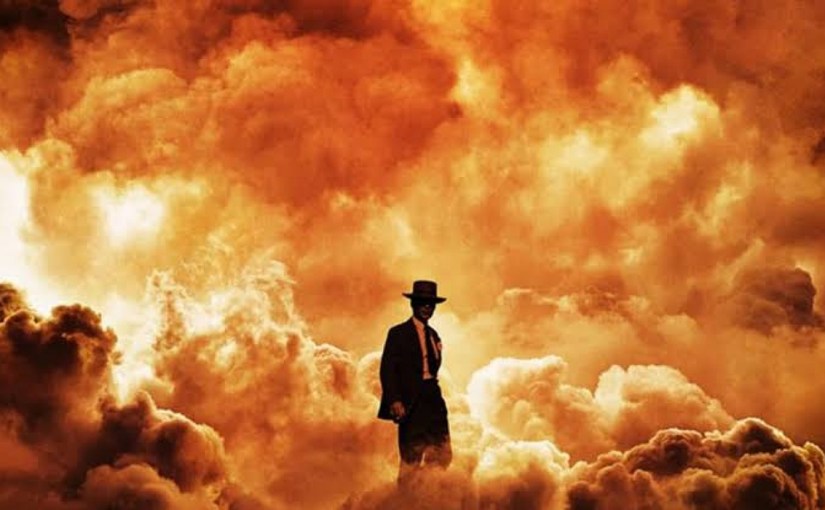
Christopher Nolan is one of the modern-day directors that you can rely on for brainy science fiction whether they are in embedded in dream subconsciousness, intergalactic space travel, transcendences of time, or even putting a fresh polish on a favorite superhero.  With Oppenheimer, he triumphs with exploring the actual prophets of science in the twentieth century, particularly its title character J Robert Oppenheimer, the brilliant physicist played convincingly well by Cillian Murphy.  Nolan doesn’t just stop at the assembly and discovery of science though.  He uncovers the consequences of Oppenheimer’s innovation and genius insight.  Dr. Oppenheimer might have been the man who knew too much and arguably that cost him quite a bit, personally.  Additionally, the so-called lab rat of his atomic bomb, namely the planet Earth, suffered the expense of a, at the time, troubling present day, and a still ongoing future. 

This movie seems to start right in the middle of its story and as a viewer you need to claw your way through the dense foliage to find its beginnings and what comes afterwards.  The first two scenes of the movie are titled “Fission” and “Fusion.”  There are no time periods specified by a font caption, however.  The differences in various points in history are distinguished by where J Robert Oppenheimer is located during select points in his life.  For seconds at a time, the film will change its photography from vibrant color to black and white, for example.  The characters will either look more aged with grey hair and some wrinkles or during more youthful time in their lives.  At one point Oppenheimer is being recruited by Lewis Strauss (Robert Downey, Jr) to head the department of a new kind of weapon development.  Work the science to make a difference.  There’s another time period where he’s being interrogated in a small room by a governmental suit and tie committee.  Oppenheimer is also in his classroom or debating and working with colleagues.  Another story observes his progress with building the atomic bomb among a collection of other engineers and scientists in a desert town, Los Alamos, specifically built at his own request, under the order of the nothing but militant Colonel Leslie Groves (Matt Damon), to conduct his work and research while hiding in plain sight. 

The film also covers Oppenheimer’s association with possible suspects of the Communist Party during the stressful pre-cold war era of McCarthyism.  Questions arise if his reliable brother Frank (Dylan Arnold) is a communist or even his mistress (Florence Pugh).  Does that in turn make Oppenheimer a communist as well?  If that is the case is J Robert Oppenheimer, the man tasked with ultimately ending World War II in favor of the Allies, sharing secrets with Russia and/or the Communist Party?

Nolan’s film gets easier to watch as it moves along, but you must get used to his pattern of filmmaking.  If you have never seen a Christopher Nolan film, I do not recommend you start with Oppenheimer.  His work is recognized for fast paced edits of different time periods and conversations.  There is much information to decipher. As well, there’s a very large collection of welcome characters to sort through, who worked with or against Oppenheimer.  Having only seen it once, I was captivated with the picture, but I know that I need to see it again.  The quick edits, working beautifully against the soundtrack orchestrations of Ludwig Göransson (nominate him for an Oscar, please), happen a mile a minute.  I appreciated this method because it enhanced the urgency of Dr. Oppenheimer in the eyes of the world, first as the savior of the united Allies against the last remaining superpower of the Axis countries, Japan. Then later focus is on whether it is in the United States’ best interests for the regarded physicist to have security access to the country’s most secret weapons and technological progress in a post war age.

People have been cajoling about how they know the ending to Oppenheimer.  They drop the bomb, of course!  (Twice actually.)  However, they do not know the entire story adaptation that Christopher Nolan as director and screenwriter presents. 

Cillian Murphy is perfectly cast. Give him an Oscar nomination.  He serves the confident, assured scientific leader who becomes envious of competing powers who achieve the impossible, like splitting the atom, while also admiring peers and mentors like Niels Bohr and Albert Einstein (Kenneth Branagh, Tom Conti).  All these men are interested only in what can be accomplished.  The superpowers that fight in war, though, are interested in how these accomplishments of modern science can be used to their advantage at a cost of collateral damage.  It is these conflicts of interests that Nolan admirably demonstrates over the course of the film. 

A telling scene for me, that I won’t forget, is when Robert Oppenheimer meets Harry Truman (Gary Oldman, doing an unforgettable cameo).  As the physicist exits the Oval Office, having shared his concerns and scruples with the Commander in Chief, Nolan includes a throwaway line delivered by the President, that I won’t soon forget.  It will not be spoiled, here.  Yet, the dialogue speaks volumes of what the United States held important regarding the servants who did the country’s bidding.  The scene closes like a stab in the heart, and suddenly science is no longer just facts within our planet.  Science is now questioned on whether it should ever be acted upon. Those questions certainly have remained as long as I’ve been alive to read about our never-ending world climate.  These inquiries will be here for many generations after I’m gone as well; that is if men and women’s recklessness with science doesn’t destroy the Earth before then.  At one point, Oppenheimer shares a small fraction of possibility for the end of the world when they activate and test their first atomic bomb. Matt Damon’s Colonel Groves’ asks for a reiteration of that observation.  Is this finding worth even the smallest, most minute risk?

Emily Blunt portrays Kitty Oppenheimer.  She’s marvelous as a lonely alcoholic wife to Robert, and a mother minding a home built in the desert while her husband serves an important purpose.  I didn’t take to her presence in the film until her grand moment arrives during an interrogation scene.  As the character gives her testimony regarding Oppenheimer’s communist ties, Blunt locks herself in for a wealth of awards in late 2023/early 2024.  Once you’ve watched the movie, you’ll likely know which scene I’m referring to and you can bet it’ll be that sample clip shown on all the awards programs.  This might not be Blunt’s best role, because it is rather limited within crux of the film, but I’d argue it is her greatest scene on film that I can remember.

Oppenheimer is a three-hour film, and it demands its running time.  There are so many angles to the man that few really know about.  Many know it was he who instrumentally built the atomic bomb that to date has only been used twice within a period of four days.  Thankfully never since.  Nolan emphasizes how unaware we are of how carefree the doctor’s government supervisors performed with the weapon he agreed to build.  Don’t just drop the bomb once.  Send a message to Japan by dropping it twice so they know to no longer engage in this ongoing war.  Choose the area where an army/government official didn’t honeymoon though.  It’s too beautiful a region.  Tens of thousands of men, women and child civilians perished immediately following the strikes.  Many others died weeks later following exposure to the nuclear effects that followed.  All issued as a horrifying cost to end a war that was already being won now that Hitler was dead.

Mechanically, Christopher Nolan does not disappoint either.  I watched Oppenheimer in a Dolby theater and I highly recommend it over a traditional one.  However, beware of the sound.  It is a LOUD!!!!!  Your seat will rattle early in the film when Cillian Murphy is shown in close up imagining the collision of atoms, protons, and neutrons.  How a star naturally dies in space runs through Oppenheimer’s consciousness as well, and then we see how a black hole forms.  Nolan offers a Cliff’s Notes edit of science doing its job.  Murphy performs so well when he’s not speaking and cut against the quick edits of Nolan’s visual and sound effects of science at play.  It shows how an educated scientist thinks beyond what is documented on a chalkboard or in a textbook.  J Robert Oppenheimer used to teach about the building blocks and natural destruction that occurs within the universe.  Regrettably, what he learned about natural function soon becomes manufactured capability when the professor accepts the task of building scientific destruction with his bare hands. Man stole fire from the Gods.

Oppenheimer is so dense in the scope of science and the scientist behind it.  That’s a huge compliment.  It’s an engaging film with much to tell, and a lot more to think about afterwards.  It accomplishes what the best movies do.  It leaves you thinking long after the film has ended.  More importantly, it’ll leave you frightened for the future based on the behavior of this planet’s past. 

Oppenheimer is one of the best films of the year.

AMERICAN SNIPER (2014)

by Miguel E. Rodriguez

DIRECTOR: Clint Eastwood
CAST: Bradley Cooper, Sienna Miller, Luke Grimes, Jake McDorman
MY RATING: 9/10
ROTTEN TOMATOMETER: 72% Certified Fresh

PLOT: Real-life Navy S.E.A.L. sniper Chris Kyle becomes the most lethal sniper in American history during four tours of duty in Iraq, but he finds it difficult to leave the war behind when he finally returns home.


I once called Katherine Bigelow’s award-winning The Hurt Locker the Deer Hunter for the Iraq War generation.  Having just seen Clint Eastwood’s masterful American Sniper for the first time, I must now amend my statement.  American Sniper presents its story concisely, almost tersely, states the facts of the matter, and leaves the audience to draw its own conclusions when the credits roll.  For myself, I was once again struck by the sacrifices of those men and women who have ever made, and will ever make, the choice to serve their country, for whatever reasons.

Chris Kyle’s reasons are made clear at the outset.  30-year-old Kyle (Bradley Cooper) is a skilled cowboy and rodeo rider when he decides to enlist in the military after seeing footage of the embassy bombings in 1998.  In a marvelously edited prologue (resembling a Scorsese film), we see Kyle’s father impress upon a school-age Kyle how people are either sheep, wolves, or sheepdogs.  Wolves attack the sheep, and the sheepdogs protect the sheep.  Kyle has lived his entire life with a sheepdog mentality and badly wants to do his part to protect his country against what he feels are the forces of evil.

Kyle enlists in the Navy S.E.A.L.s and, after a brutal training process, becomes a skilled sniper.  Shortly after graduation, he meets and falls in love with Taya (Sienna Miller).  The abbreviated exposition of their courtship and marriage contains little details that give a ring of authenticity that even The Deer Hunter lacks at times.  (After their first meeting in a bar, for example, Taya has to run outside and throw up after doing one too many shots.  Kyle follows and discreetly holds her hair back, as every gentleman should.  It’s the kind of scene you would normally see in a mid-level rom-com, but it feels as real as an autobiography.)

Kyle’s and Taya’s relationship at home is an important factor in the film, but the bulk of the story shows us Kyle putting his unique skills to use in Iraq, where he is sent shortly after the 9/11 attacks.  These scenes belong in some kind of war movie Hall of Fame.  Kyle’s first kills occur when he has to make a command decision whether or not to shoot a young Iraqi boy holding a grenade and running towards a US convoy.  The scene takes on an even more horrific dimension when the mother tries to pick up where her young son failed.  This horror is echoed in triplicate in a later scene when an even younger boy approaches an abandoned rocket launcher and appears ready to fire it at American troops.

Kyle goes on to much more “conventional” warfare later on (including a virtual duel between himself and another similarly skilled enemy sniper), but it’s scenes like the ones I mention above that elevate American Sniper into a masterpiece.  Watching them, I could not help but remember that this movie is based on a real person who went to real war zones during his lifetime.  I have no idea whether Kyle really did make those choices in real life, but the idea remains: whether Kyle did or not, it’s a foregone conclusion that someone had to make similar decisions at one time or another, not just in the Iraq War, but in other wars, many wars, ALL wars.  (I was perversely reminded of another superior war film, also based on fact, Jarhead, where the main character is also a sniper, except he never gets to fire his weapon in combat.  My respect for that character is no less profound.)

Speaking for myself, I don’t know if I have it in me to make that kind of call.  I have nothing but admiration and respect for those people who are making those calls every day in wartime, who are asked to put their lives and mental health on the line and do their duty no matter what.

Kyle’s compulsion to be a protector leads to his decision to become part of the teams “clearing” houses on the ground, as opposed to being the “overwatch” who protects them from the rooftops.  He sees too many squads being cut down by enemy soldiers inside the houses where he can’t see them from above.  “If I can’t see them, I can’t shoot them.”  One of his comrades disagrees with this decision.

“All these guys?  They know your name, and they feel invincible with you up there.”
“They’re not.”
“They are if they think they are.”

His decision puts him in even greater danger than before, but he can’t help himself.  Every death that he feels he could have prevented haunts him.  In another echo of another shattering war film, I was reminded of Oskar Schindler’s last scene in Schindler’s List when he breaks down thinking of how many more Jews he could have saved, instead of focusing on the ones he did save.  It’s impossible to say exactly how many lives Chris Kyle may have saved with his actions in Iraq, but in his mind, he was just doing the right thing, not the heroic thing, so he never felt comfortable accepting the title bestowed upon him by his grateful comrades: “The Legend.”

American Sniper is also very careful to depict the cost Kyle faced as the result of his job.  For one, the Iraqi insurgents put a $180,000 bounty on his head, making his job even more dangerous than it already was.  For another, he witnesses some things firsthand that would give Quentin Tarantino nightmares.  At one point, he tracks down an Iraqi enforcer nicknamed “The Butcher” who uses a drill to punish anyone who collaborates with American soldiers.  When Kyle raids his compound, he finds a freezer full of the Butcher’s “souvenirs.”  This is all on top of the various times he sees his teammates cut down by enemy fire, sometimes right in front of him.

The other cost comes during the brief periods at home between tours.  He loves his wife and children, but he finds it impossible to share the details of what happened to him in Iraq.  This reticence threatens his marriage to the point where Taya tells him flat out: “If you leave again [for another tour of duty], I don’t think we’ll be here when you get back.”  This kind of plot point is hardly new, but again, there is a ring of truth to it in this movie that makes it much more poignant than it normally is.  Kyle’s internal code can’t allow him to let someone else go to a war zone and do a job that he is eminently more qualified than anyone else to do.  “I have to serve my country.”  And that’s that.

(The film does have one drawback that compels me to score it as a “9” instead of a “10.”  There are scenes later in the film depicting more of Kyle’s troubles at home and as he speaks to a psychiatrist who recommends he go down to the VA and meet with disabled veterans as a way of “saving” soldiers without being in combat.  While these scenes are invaluable in terms of shedding even more light on Kyle’s character, even this late in the film, I did feel like there could have been a little more time spent with Kyle and those veterans so we could flesh that issue out just a little more.  There’s much more to it than could possibly be explored in just the last fifteen minutes of a movie.  I’m not saying it should have become Coming Home, but…that’s my opinion.)

In the event you don’t know Chris Kyle’s ultimate fate, I won’t spoil it here.  I had forgotten about it, and when the movie sprung it on me, it was as surprising as any other plot twist I can think of.  American Sniper proved to me, as if it needed proving again, that the people in our armed forces, especially those in combat zones, face unthinkable decisions, sometimes on a daily basis.  The morality of those decisions can, and will, be debated from now until such time (God willing) that armed forces are no longer necessary in this world.  This movie doesn’t pass that kind of judgement.  It merely says, “Here is what happened.  What do you think about it?”  How you answer that question is what the movie was really about.

SHE SAID

By Marc S. Sanders

I get high off movies about journalism.  All The President’s Men and Spotlight are at the top of this pillar.  The main characters seem to be moving a hundred miles per hour even if they are reserved to their cluttered desks and phones, or if they are talking delicately, and slowly, with empathy as they carefully approach a potential, yet frightened source.  She Said is a 2022 film about how the New York Times reporters, Megan Twohey and Jodi Kantor (Carey Mulligan, Zoe Kazan), exposed the systemic process of sexual harassment and rape that was running rampant through Miramax Films.  The accused was always its CEO, Harvey Weinstein.

It’s extraordinary that this film got produced so soon after the MeToo movement and Weinstein’s downfall occurred.  All of it seems like it just happened yesterday.  In fact, Harvey Weinstein is still going through court procedure and trials for sexual crimes he’s accused of that occurred in London, New York and Los Angeles.  There might even be more locations.  New developments hit the internet all the time.  This guy just never stopped.  So, there’s much for the courts to process and try.  This was a terrible black eye, not only for Miramax’s reputation (at the time owned by Disney), but on the entire film industry in Hollywood.

She Said explores not only Twohey and Kantor’s relentless pursuit of the truth and various descriptions of Weinstein’s method with young women, but also how corrupt non-disclosure agreements (NDAs) were used.  The NDAs contained unreasonable demands for hush money provided.  Mandates such as speaking with a therapist or other professionals and close-knit relatives were never allowed lest they suffer consequences.  The victims would get paid, but would also be denied of a copy of the contract, and thus Weinstein found a way to allow his constant grooming and sick pleasures of perversion to carry on. 

The reporters concluded that these victims had no money or resources to stand up to the kind of bullying and harassing that Weinstein’s power exerted.  Quitting or getting fired for fighting for their rights or just refusing his advances left these women out of an industry in which they were trying to elevate their careers.  They lacked proof of the occurrences.  They had to fight a he said/she said scenario.  They were victimized by a man who associated with some of the most powerful people in the world.  It happened to known actresses like Rose McGowan and Ashley Judd (who plays herself in the picture).  It nearly happened to Gwyneth Paltrow (providing her own voice on the phone) as well.  Even worse, it happened to women who didn’t even have the luster of celebrity brand name recognition to help them in their cause.    Nevertheless, it practically destroyed McGowan’s reputation in Hollywood altogether as she was labeled a crazed pariah for declaring her truth.  The tolerance and strategic payoffs were perhaps just as overwhelming as the attacks by Harvey Weinstein.  (Forgive me, I say perhaps because there is no way I am qualified to empathize, measure, or relate to what these victims endured or continue to survive through.)

Maria Schrader’s film does a good job at explaining the risks these reporters take.  A brief prologue shows Megan Twohey getting death threat calls for her write up of Donald Trump’s accusations of sex crimes.  A very convincing Trump vocal impersonator even calls her to tell her she’s a disgusting human being and how he must be innocent simply because he does not know any of these women.  Reader, it bears repeating that many rapists and harassers never know their victims.  When Twohey teams up with Kantor, the intimidations don’t stop and their supervisors and editors in chief (Patricia Clarkson, Andre Braugher) lend support.

Paltrow’s ex-boyfriend, Brad Pitt, was a producer on this film and it’s gratifying to see him lend the support.  I recall reading how he confronted Weinstein following attempts of harassment upon Paltrow shortly after they began dating and making the film Seven together.  Looking back to those years of the mid-1990s, I’d argue that Pitt and Paltrow were taking enormous risks with their careers.  They were just becoming marquee names. Yet, they could have still been ruined within the industry.  This is an environment synonymous with putting blinders on to systemic offenses that occur while lending praise to those that’ll eventually grant them potential Oscar winning roles or twenty-million-dollar paychecks.  

When Matt Damon, Ben Affleck, George Clooney, and Quentin Tarantino say in interviews that I’ve seen that they had no idea what was occurring with Harvey behind closed doors, my reaction has always been skeptical to these claims.  At one point in this film, Twohey and Kantor refer to Harvey’s antics as the worst kept secret in Hollywood. It is sad to say that these marquee names will always owe their careers and success to Harvey Weinstein, criminal rapist or not.

I do have some reservations with She Said, though.  Often the reporters are typing and quick close ups or glances at their monitors are edited into the film, but I can’t read what they are documenting, and I believe the film was assuming I could.  At one point, Braugher’s character announces that Weinstein spoke to Variety magazine and another competitor to share his side of the story and declares “This is bad.”  Yet, we never find out what Weinstein said, and we just get the “Oh shit!” expression from Twohey and Kantor.  Why leave us in the dark on subjects like this?  Why is this so bad? 

The film is fast paced, but many of the scenes are identical to prior ones.  As the reporters speak with victims, they break down their own story.  I believe Weinstein practiced a similar method each time, but the dialogue in these accounts seems redundant.  I get that we are to understand how excessive his predatory actions were, but I was hoping for fresh angles to their ongoing investigation.

The cast is spectacular, particularly Mulligan and Kazan who make a great pair. I really like the dialogue written and delivered by Andre Braugher.  I always thought I don’t see that actor enough in films.  He’s sensational in everything he does, and he carries a real strength to his authority in the New York Times offices.  A championing moment occurs when he cuts in on Harvey’s call with the reporters to give an ultimatum and hangs up.  He just told Harvey, “ENOUGH ALREADY!”

She Said relies on prior knowledge that you must have before watching the film.  You must know who Harvey Weinstein was and the large space he occupied within Hollywood and the film industry.  You need to know who these actresses were, and you have to be familiar with the overwhelming female response to Donald Trump’s agendas which set up the picture.  Unless you’ve been hiding under a rock, it’s hard not to be aware of what’s occurred in the last 5-6 years. 

However, as this film is discovered by future generations, long after Weinstein and Trump, and these victims are passed on, future generations like our children’s children may not fully understand the terrible conspiracies that transpired. 

She Said is a good movie and it holds significant importance.  However, I imagine the book written by Twohey and Kantor provides more details and exposition that I wish the film adaptation offered.  The pace and performance of the picture work very well.  I’m just afraid the script relies a little too much on assuming we know the whole backstory as the film carries on to its triumphant ending.

Watch it anyway, though.  It’s a bravely daring film to say the least.

AIR

By Marc S. Sanders

Pop culture for me began in the early 1980s.  Burger King had Star Wars glasses to collect. Everyone was running to the theatres to see Beverly Hills Cop.  Ray Parker Jr asked us who we were gonna call, and a little old lady wanted to know “Where’s The Beef?” 

Apparently, basketball was big too.  I wouldn’t know.  I only followed sports once in a blue moon.  However, I wanted the high-top sneakers that all the guys were wearing, the Nike Air Jordans.  Couldn’t make a free throw shot to save myself, but I explained to my mom that I just had to wear the shoes.  I owned two pair – one was charcoal and white and the other were black and blue.  Beautiful accessories to go with my Levi jeans, Ralph Lauren Polo shirts and my Member’s Only jacket.

All of these memories flooded back to me as I watched Ben Affleck’s latest directorial production called Air.  The film recaps how Nike, a distant leading third place sneaker brand in the USA, signed the eventual greatest basketball player to ever perform on an NBA court, Michael Jordan of the Chicago Bulls, as the celebrity face for its flagship shoe that still reigns supreme today, over forty years later.  Air is not so much a sports movie, as it is that rare breed of film hardly touched upon.  Air is an inspirational, stand up and cheer success story of capitalism and materialism. 

The year is 1984.  Nike’s headquarters reside in the sleepy state of Oregon.  Affleck’s longtime friend Matt Damon portrays Sonny Vacarro, an out of shape Vice President of Marketing for Nike who is tagged with finding the next flash in the pan basketball star to sponsor their shoes.  Sonny can recite statistics and facts about any past or present player in the league verbatim.  He also has a knack for recognizing the potential of up-and-coming stars fresh out of high school and college.  Nothing seems interesting, however.  Sonny religiously watches videotapes of game footage and one night it occurs to him that a rookie kid named Michael Jordan is the answer to Nike’s stagnant profit and loss statements. 

Sonny’s got challenges to overcome though, like convincing his fellow executives played by Jason Bateman and Chris Tucker to jump on his campaign.  He also needs to get Phil Knight (Nike’s CEO, played by a bearded and often barefoot Affleck) to invest their entire $250,000 budget in the faith of one player with no proven track record, as opposed to spending the money on multiple players.  It’s like playing roulette with everything on Red 23.  Perhaps the hardest obstacle will be swaying Mr. Jordan’s tough and intuitive mother, Deloris Jordan (Viola Davis, a clear front runner for Best Supporting Actress), to go with this company, as opposed to Adidas and Converse who seemingly can provide for any of her son’s requests, including a shiny red Mercedes coupe on top of any dollar figure imaginable.

Ben Affleck’s direction, with Alex Convery’s script, works so well because it operates on industry.  Vaccaro not only travels unexpectedly to the Jordans’ home in North Carolina, but he’s constantly working the phone on Michael Jordan’s ball busting, slick and foul-mouthed sports agent (Chris Messina giving a hilarious performance worthy of a nomination as well.).  The negotiations these guys communicate with hinges on how descriptively ugly they can be with their dialogue and tete a tete cursing.  Every conversation has to end with that much more of a dramatic hang-up.  Sonny also must take the elevator down to the design center basement, and delegate a quirky kind of guy (Peter Moore, played by Matthew Maher) with designing a shoe that stands above anything ever seen before. 

There’s a process to how to some of the most well recognized manufactured goods in the North American continent came to be and continue to circulate for decades on end.  It could be Coca Cola, or Ray Ban sunglasses or Ford Mustangs or Nike Air Jordans.  Matt Damon is the energetic thread that is connected to every ingredient and participant responsible for this finished product. 

Outside of the operation is the quiet Deloris Jordan protecting the best interests and image of her talented son.  She will ensure he is not taken for granted and most importantly he will be the one credited for every consumer who puts a pair of Air Jordan shoes on their feet. 

In less than two hours, Ben Affleck uses Convery’s script with perfect efficiency and time devoted to a passion for Sonny Vaccaro and a careful process of examination by Deloris Jordan.  Matt Damon and Viola Davis are so much in tune with their respective roles. In fact, the whole picture is perfectly cast.

This is a story that takes place in boring offices and cubicles.  Yet, the film comes alive with a culturally relevant soundtrack of pop culture music of its specific year, 1984, when life for middle class families seemed easier following an exhausting Vietnam War and an assurance of politics from a US President who held office for most of the decade.  People went to the movies in the summertime. They watched Dallas and Miami Vice on Friday nights.  Teens wore the one glitter glove on their hand as a salute to Michael Jackson.  Kids collected Care Bears, He-Man toys, and Garbage Pail Kids cards, and they saved up their money to emulate a basketball superstar by wearing his brand name shoes.

Too often films reflect back on business and industry that has betrayed the buyers and investors.  Films like The Big Short and a few interpretations of Bernie Madoff’s pyramid scheme come to mind.  I’m waiting for the movie that will focus on one of the greatest foul ups in business history, New Coke.  Air reminds me that we don’t have to always embrace the tragedies of business operations by focusing on where it has failed us time and again. 

Nike Air Jordans are an expensive epitome of materialistic need.  Yet, business is also about giving consumers what they want, and if that is done, then its success spreads to prosperity and financial security for many parties throughout the nation and the world.  Air is a film that should be shown to business majors in universities.  It teaches the art of risk, passion and confidence when taking on an investment and holding on to who can be each generation’s next hero. 

Air is a standout film, and I’ll accept the risk of declaring it one of the best films of 2023.

LAWRENCE OF ARABIA

By Marc S. Sanders

The moment finally arrived where I was able to see David Lean’s epic, also regarded as my colleague Miguel’s favorite film, Lawrence Of Arabia.  It truly is an eye-opening spectacle, and one of the most beautiful pictures I have ever seen, especially enhanced by an up-to-date Blu Ray restoration.  With a near four hour running time there is hardly an element or sliver of film that does not appear out of place.  Far ahead of the conveniences of dazzling special effects and CGI to arrive later in the twentieth century and beyond, Lawrence Of Arabia must be one of the greatest cinematic achievements ever created. 

When you factor in what David Lean made with an earlier picture, The Bridge On The River Kwai, it is fair to say that he was the James Cameron of his time – a bold, daring film director who did not surrender until every shred of a masterpiece was included in a final cut.  What puts a man like Lean ahead of Cameron perhaps, is that he depended on the resources of thousands of human extras and animals, broad desert landscape locations, painstaking architecture to set designs and buildings, along with authentic explosions and battlegrounds while delivering the story of British Lieutenant T.E. Lawrence and his efforts to aid an Arab nation into battle against the Turks during World War I. David Lean was persistent in bringing as much natural quality to his finished product as possible.  In fact, Miguel informed me that Lean was seeking out any possible way to point his cameras at the desert sun to heighten the feeling of the sweltering, unimaginable heat endured by his cast of characters.  It likely pained Mr. Lean that he had to settle for an optical illusion.  Nevertheless, when I was watching the movie, it did not occur to me once.  I was still appreciating his strive for absolute authenticity.

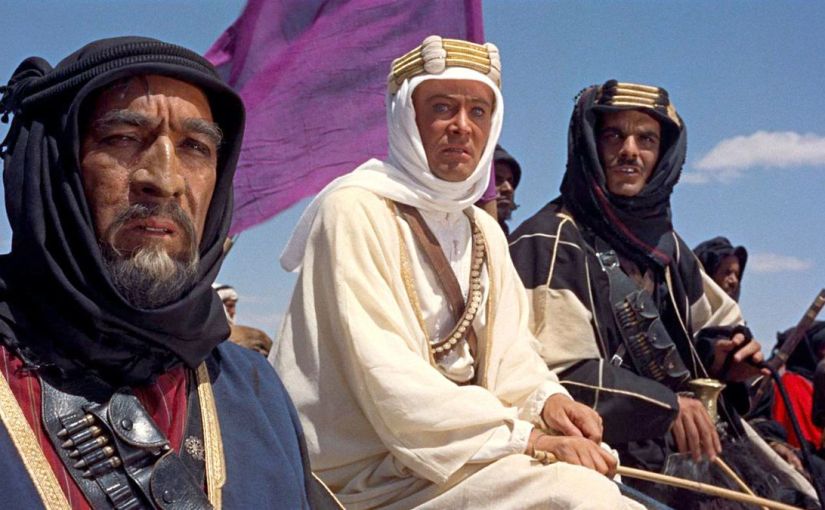
Peter O’Toole is the title character in his unforgettable film debut.  A daring, handsome, charming blond leading actor poised for adventure.  Lawrence is assigned to ally with the Arabs during the war to hold on to the necessary access of the Suez Canal which is a through way for oil, supplies and territory.  His determination for crossing wide, endless desert plains under a sun drenched open blue sky turn him into a leader, and a hero to the Arab soldiers, particularly represented by Sherif Ali (Omar Sharif).  They are a small band of fifty men, but Lawrence proceeds with the intent of gaining fifty more as he begins a long trek from one side of the desert to the other with persistent walking or by riding camel.  Lawrence won’t even leave a single man behind.  His resolve is courageous but could be costly later.

The technical construction of Lawrence of Arabia is likely what many notice and remember first, but the film comes with a well-set character arc for its protagonist.  Peter O’Toole was a perfect casting selection for this role.  Lawrence changes over the course of the film and it’s not a celebratory transformation.  Oft times, it seemed ironic to consider him the villain; perhaps a hero who falls from grace.  His derring-do is impressive, but likely also his undoing.  Lawrence allows strength and confidence to awaken a weak Arab nation who only survived for themselves with what little they held onto before their encounter with him.  Yet, the monster Lawrence creates within his own psyche may have also spawned a challenging threat from the Arabians for many years to come, long after this war is over and further generations come into play.  Bless a people with power but be aware of how that gift is used thereafter.

Lawrence accomplishes what has been regarded as seemingly impossible and now the Arabs adorn him in heroic white cloths (which must be one of the memorable costumes in film history).  He is who they look up to as the giver of their strength and confidence.  However, like most heroes that we find in the best of stories, T.E. Lawrence is weighed by fault, particularly his own hubris.  After his conceit gets him captured and tortured, it is not so easy to return to his home country who insist he continue to carry out his leadership.  Madness is invading his mindset and the hero we have borne witness to for well over two hours of film is now significantly diminished.  Parallel to that is the overconfidence and newfound freedom a political leader like Prince Faisal (Alec Guinness) absorbs for his Arabian people.  The end of David Lean’s film seems to imply what came of T.E. Lawrence’s contributions to the Arabs.  Was the world better or worse for what he achieved with his pioneering, yet dedicated military efforts?  What about Lawrence?  How did he fare, personally?

Forgive my incessant urge to compare David Lean to James Cameron.  I look at a film like Avatar and I see the monies and efforts invested to make that piece.  Yet, I feel like I walk away with little substance.  The films of Cameron not only fall short of story, but often lack texture as well.  I could never reach out and shake the hand of a “Pandoran.”  When I see Lawrence Of Arabia, though, I can feel the sweat and heat that O’Toole and Sharif experience.  Both are big films, not made on the fly. Rather, time and stress and a means to improve and show what’s never been seen or done before are offered.  David Lean might have been given all the monies in the world or the keys to kingdom to make his masterpiece.  However, it’s how he used these resources to painstaking perfection that lend to longevity in reputation for his career and Lawrence Of Arabia.

A train explosion near the start of third act is very impressive.  Lawrence and his men detonate a planted bomb on the tracks, and we see the locomotive derail onto its side, plowing into the hot desert sand.  We feel the immense weight of that steam engine.  We can detect the sand cloud that forms from the crash.  The collision of the cars being ripped apart and burned black thus create a new setting as Lawrence’s Arab followers rush to loot the train.

Grand battle scenes on horse and camel backs are meant to be seen at least ten times over in order to capture every piece of activity from the numerous extras and animals occupying a thousand different corners of the screen.  The bigger the screen, the better enhanced is the viewing experience. 

Long walks and camel rides in the desert may seem tedious for some, but not for me.  I was accompanying T.E. Lawrence and Sherif Ali on this journey.  This is another film where its running time affects what Lean set out to accomplish.  A trek through the desert is impossible to rush and this film is a testament to that notion.  I can’t say I’ve hiked through a desert plain that bears no end in near sight, but now I can lay claim that I’ve watched Lawrence Of Arabia.

Having only seen David Lean’s picture once thus far, I know that on repeat viewings I’d likely see something new each time hereafter.  This film is so alive of its period setting and backdrop and the unforgettable original score from Maurice Jarre give definition to the sweeping adventure that awaits with T.E. Lawrence’s travels.  The cast is marvelous as well.  Peter O’Toole is positively engaging.  Omar Sharif and Anthony Quinn are scene stealing character actors, much like Robert Shaw would become known for a decade later with Jaws.  Alec Guinness may be doing a brown face appearance as an Arab leader, but I’ll just salute the performance.  A charming actor of grand, yet subtle, skill.  I’m glad I’ve discovered him all over again from beyond …River Kwai and Star Wars.

Movies like Lawrence Of Arabia must remain at the top of the broad lexicon of films to watch.  It’s length and scope may be challenging, but its edits, its score, its immense visuals, and the performances therein, are unmatched by most anything else available to watch. 

ELVIS (2022)

By Marc S. Sanders

Baz Luhrmann’s take on the legacy of Elvis Presley will certainly grab your attention, even if the director refuses to carry an attention span of his own lasting longer seven seconds.  Having watched the celebrated film from 2022 for a second time, eight months after my first viewing, I see more faults with the picture than achievements.  Elvis is strongest when the carnival ride stops moving, allowing its cast of colorful characters to have conversations with one another. 

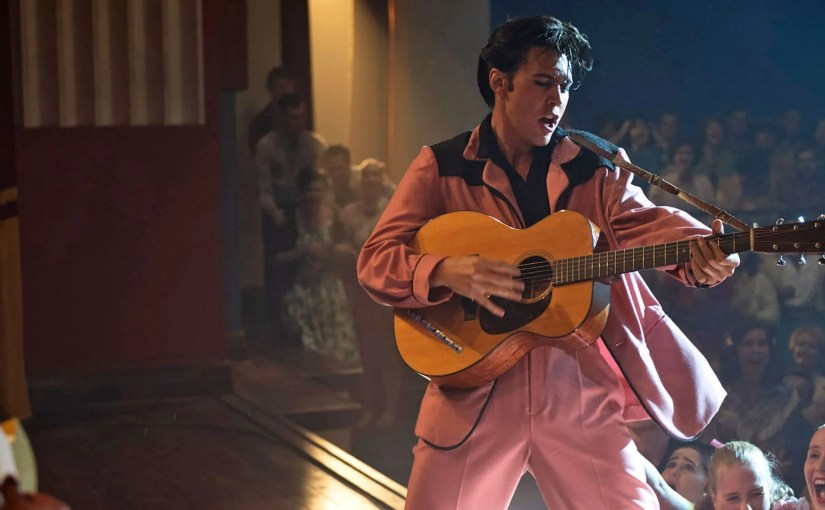
Austin Butler is now a known name for his portrayal of the King Of Rock N Roll, whose career was squandered by a slimy business manager known as Colonel Tom Parker (Tom Hanks).  Butler personifies what pop culture has recognized first and foremost about Elvis Presley, everything from the wild stage presence of dancing to the deep rockabilly singing or speaking (you decide) vocals.  He really bears an uncanny resemblance to The King as well.  Butler could have been better though had he been graced with a more economical and thoughtful script.  I don’t think Austin Butler was given enough to do.

The Elvis character hardly shares any conversations with any of the supporting characters.  That’s the film’s major shortcoming.  There are a scant few scenes of dialogue exchanged between Elvis and his mother and father, between Elvis and the Colonel, and between Elvis and his wife Priscilla Presley.  Baz Lurhmann wrote the script with Sam Bromell and Craig Pearce, and I guess it incorporates some major moments within the singer’s illustrious career but nothing seems to hold much weight.  Elvis gets threatened with being arrested for his pelvis swiveling gyrations while he performs.  We get a close up of the state Governor who leads this censoring campaign, but we don’t get an idea of his warped logic.  Elvis gets drafted into the army and the Colonel thinks to sell it as a comeback when his tour of duty will finish in two years.  Two years go by in a matter of sixty seconds however and the King is back to touring and donning the outrageous costumes, but we don’t see the marketing machinations led by the Colonel.  Where’s the deviousness and conniving?  Where’s the brainwashing of the public and our hero?  Elvis is also bedhopping from one woman to another and popping pills, but these incidents which arguably led to his life being cut short are glossed over with a sway of Luhrmann’s camera work.  When the third act of the film arrived, I didn’t even know Elvis was sleeping around until Priscilla (Olivia DeJonge) announces she is leaving him.  On her way out the door, the two characters share about five or six lines of dialogue before the film races to another transition or scenario.  In this film, the love of Elvis’ life, Priscilla, holds about as much presence as an extra in the film.  Their relationship isn’t explored like Johnny and June Carter Cash in Walk The Line, for example.

Lurhmann edits his scenes with title cards of what year it is or what place it is as Elvis tours the country.  Yet, I never got the feeling that I was inside these time periods.  A minute to a minute and a half go by and suddenly it is “One Year Later.”  What difference does that make?  Where’s the transition in Elvis’ character?  When exactly did he become a sensation?  Suddenly I see that Elvis is moving into a mansion (I think is what will eventually be Graceland) with his parents and I presume he’s…well…he’s a success?!?!?!

An opportunity presents itself for Elvis to have a mentor into the world of celebrity stardom by means of B.B. King (Kelvin Harrison Jr.), but as soon as he introduces himself, the man disappears and is not heard from again.  Elvis only offers a piece of dialogue later suggesting that “B.B. King once said…”  There’s no significance to the influences or naysayers who enter Elvis’ life.  The same goes for Elvis’ mother, Gladys (Helen Thomson).  The Colonel will assure Elvis’ parents that he has their son’s best interests in mind as he blossoms his career, but we don’t get enough of a solid foundation for his mother’s apprehension or her religious doctrine or the alcohol addiction that kills her.  

I know, reader.  You can argue that I’m offering descriptive text for these people.  However, the text that I give in this column is all that you see.  Baz Lurhmann is a flashy director.  I don’t doubt his skill for color with sparkles and glamour. No subject is glitzier than Elvis Presley.  Yet, if a biography is going to be recounted on film, it needs to be more than just a near three-hour music video.  Luhrmann seems prouder of the letter fonts and graphics that introduce another year like 1956 or another state like Tennessee as it zooms towards you from the depths of the screen.  The gloss of the photography in the movie is overly animated, lacking feeling or character arcs.

The script for Elvis seems to also adopt the approach that Milos Forman’s Amadeus took, where the puppet master/antagonist recalls the celebrity’s story.  Colonel Parker provides voiceover with a thick, German/Austrian (maybe ???), dialect for Tom Hanks to deliver.  Unlike popular opinion, I was surprisingly taken with Hanks’ portrayal.  He’s quite the villain in a disproportioned fat suit and bulbous sweat-soaked head.  The relationship between Elvis and the Colonel is nothing surprising.  We’ve seen plenty of bios where the manager swindles the fortunes of the outstanding talent.  Considering that is how it happened, I don’t mind seeing it again in Elvis.  However, much like everything else in the film, it is glossed over.  Only very late in the film do we learn that Colonel Parker is deeply indebted to the Las Vegas casinos, and he signs away a long-term Elvis obligation in lieu of repayment.  Before all of that comes into play however, while we know we can’t trust the Colonel, we also don’t know what his endgame is.  Only near the end, Luhrmann and his script writers throw in a last-minute Hail Mary to shock the viewers and uncover how the Colonel destroyed Elvis’ financial assets and betrayed his trust.  Unfortunately, we haven’t seen much of a relationship between the two rivals after over two hours of film.  A build up is missing.  The best way for a villain to attack a hero is to whet his appetite with trust and then use that reliability as a control device.  The script for Elvis never sets up those early moments of exposition that get the viewer, and more importantly Elvis, to trust the Colonel. 

Michelle Williams once played Marilyn Monroe in a film called My Week With Marilyn.  It’s an astonishing performance in a very shallow film.  In my review of that picture, I wrote that I wish I could see Williams play the role again in a story more worthy of what she puts on screen.  She was above that movie.  I feel the same way for Austin Butler and Tom Hanks here.  These are great actors who were not given adequate material to shine.  If only another Elvis picture could be made with them in the principal roles.

What I find ironic about Elvis is that when I first saw the film upon initial release in theatres, I felt thoroughly impressed.  While I am always more cold than hot on Baz Luhrmann’s movies, I thought maybe this was the exception.  Watching it a second time however, eight months later, I realize that much of the film I could not remember and that is because that movie doesn’t invest in memorable scenes.  It focuses much too much on flashy edit, cut aways.  What I lost from that narrative is an intimate connection to Elvis or any of the other characters. 

Even the music is not as electrifying as it is known for.  There is not enough time devoted to individual set pieces of Elvis performing numbers like Heartbreak Hotel or Jailhouse Rock, and because of the quick cuts, I’m not convinced that Austin Butler is truly crooning away in an Elvis impersonation like Jamie Foxx as Ray Charles or Joaquin Phoenix as Johnny Cash or Val Kilmer as Jim Morrison.  Austin Butler is just not offered ample opportunity to do his best Elvis performing.

As colorful as Elvis’ life was and his legacy continues to be, Baz Lurhmann is certainly a viable candidate to direct this biography.  The problem is maybe that Lurhmann needed an editor and producer who would put their foot down and tell him to try again.  Lurhmann was more concerned with showing his own kind of magic in filmmaking and reserving the story and plot devices for the closing act.  Exposition within the last thirty minutes of a movie usually never works.

APOLLO 13

By Marc S. Sanders

What’s fascinating about Ron Howard’s film Apollo 13 is that I can hardly understand what anyone is talking about.  I don’t know how they identify the problems of the doomed spacecraft.  I don’t know how any of the folks at NASA resolved the issue to get the three astronauts, Jim Lovell, Fred Haise or Jack Swigert (Tom Hanks, Bill Paxton, and Kevin Bacon), back to Earth.  What I do know is that William Broyles’ script, based upon the novel from Lovell with Jeffrey Kluger, allows for an ease of comprehension to know where one thing has started, where it leaves off and where it needs to go with each passing scene.

Forgive me, but when I watch NASA documentaries, I honestly get bored.  It’s amazing what has been accomplished during the history of our space program.  So much has been discovered but it’s only a fraction of what’s still left to be uncovered beyond our planet.  The films and literature that account for the engineering of space craft and what is required to travel in space lose me though.  Ron Howard puts everything in place with Apollo 13, however.  It’s the emotions that stem from the actors.  All I need to understand are the efforts each character serves to the ending that we all know.  It’s not about telling us what these guys are educated with or what science mandates.  Rather, it is about how these people respond to an unexpected and unfamiliar crisis.

On the ground in Houston, Texas Ed Harris portrays Gene Krantz.  He’s a pretty quiet kind of character, but upon his entry into the film, just ahead of the anticipated launch of Apollo 13, he is gifted a pure white vest.  Krantz wears this as his armor, prepared to take on any challenge including navigating a crew of three astronauts towards the moon.  He is surrounded by a school of nerdy looking engineers and scientists, in their short sleeve shirts, skinny ties and black rimmed eyeglasses.  They are all disbursed among an assortment of different departments.  I think one specified simply in human waste disposal aboard the ship.  Yeah, there’s a guy there making sure the urine is dispensed properly.  Again, I couldn’t tell what specialty each man is designed for, but they’re the experts.  Harris simply tells his men what needs to be done by drawing two circles on a chalkboard; one is the moon, the other is Earth.  When a frightening malfunction occurs aboard the rocket, Harris explains that his men now need to get the ship back to Earth by drawing a line between the solar locales.  He doesn’t know how it can be done, but like a football coach he demands his team find a way.

On board Apollo 13, the three astronauts are crammed in what is left of their ship, marooned to float through space. The interior gets extremely cold, exhaustion gradually overtakes them, and they are left with no choice but to power down whatever sources they have left as a means of preservation. 

A third angle comes from the wives and families of the three men.  More precisely, focus is drawn towards Marilyn Lovell (Kathleen Quinlan) with her family, including the children and Jim’s elderly mother watching the television with anticipation for ongoing developments while the media waits outside their doorstep.  The first act of the picture offers the anxiety that Jim’s wife has with this upcoming mission.  There is the standard nightmare scene.  Acknowledgement of the unlucky number thirteen.  Marilyn loses her wedding ring down the shower drain (something that actually happened). Ironically, the Lovells’ eldest daughter seems to carry the same kind of apathy for her dad’s upcoming trip like the rest of the country.  Jim may finally be having his dreams come true, to walk on the moon.  However, the rest of the world is more concerned with the possibility of the Beatles breaking up or what else is on TV.

A side story is delivered by Ken Mattingly (Gary Sinise).  The poor guy was originally a part of Lovell’s three man crew, only to be sidelined at the last minute because of a suspected case of measles.  When things go wrong for Apollo 13, he enters the flight simulator to diagnose the issue and find a resolution.  He’s offered a flashlight but rejects it because the guys in space don’t have that tool.  He specifically tells his men not to give him anything that they don’t have up there, and he refuses to take a break either.  If they don’t get a chance to rest, then neither does he.  This mantra carries over to the other guys working diligently to keep the astronauts alive and get them home. 

Apollo 13 is not a how to picture.  Rather, it is a film that focuses on response. 

Ron Howard offers amazing shots of the rocket and footage in space.  The launch is extremely exciting as shrapnel sheds off the craft during its fiery liftoff. Then other parts disengage after it leaves the Earth’s atmosphere.  The interior looks extremely claustrophobic, but the actors look comfortable within the floating zero gravity confines. Hanks, Paxton and Bacon have great chemistry together whether they are kidding one another about vomiting in space or bickering with each other while caught up in the problem at hand. 

The base of NASA is alive with hustle and bustle.  Not one extra looks like they are sitting around.  They all know what monitor to look at or which teammate to lean over as they desperately discuss what needs to be accounted for.  There’s a great moment that is explained to the audience as if they are a four year old.  A man in charge throws a pile of junk onto a boardroom table and says they need to build something with nothing but what’s on this table to absolve the problem the astronauts are having with carbon dioxide poisoning.  A few scenes later, we see the junky device that’s been rudimentarily assembled.  Who knows what it does?  All I need to know is that it works. 

I did take one issue with Apollo 13.  To heighten the dramatics, sound is provided as the ship comes apart. Even I know that sound does not travel through space.  I forgive it when I’m watching fantasies like Star Wars or Superman.  However, this film recaps a real-life event and during those moments, as startling as they may be, I could not help but think about the dramatic clanging and crashing penetrating my sound system.  Apollo 13 draws from a well-known case, but it still resorts to cinematic tropes to hold my attention.  I wonder if the picture would have worked had it remained faithful to basic scientific fact through and through.  It’s not a terrible offense.  It’s forgivable.  Though it got me thinking. Heck, it obviously never bothered the masses because the film was awarded the Oscar for Best Sound Design.

Ron Howard’s film is a magnificent experience, full of outstanding footage.  It relies on actors who depend on the emotions of the scenario to narrate the story.  Recently, I watched the film Tár with Cate Blanchett.  In that film, the mechanics of orchestral music and conducting are endlessly discussed.  It’s like listening to a foreign language at times while trying to keep up.  Howard’s film could have taken that approach and bored me to tears with a lot of technical jargon from engineers and scientists.  Instead, Apollo 13 succeeds by only presenting the basics of the issues at hand.  I couldn’t name one specific part on the engine of my car, but I know it powers the vehicle, allowing it to go from point A to point B.  The army of NASA folks declare this thing has never done that before or it must be crazy to consider because that has never been attempted.  I can count on the players of Apollo 13 to know what they’re doing.  They are aware of the risks that need to be taken and know what’s at stake.  I don’t need to see their diplomas to trust their concern or computations.

Like other films where known historical events are depicted, Apollo 13 maintains its suspense even if you already know the ending.  The aborted mission to the moon became known as “The Successful Failure.”  It’s refreshing to see how this proud moment all played out. For fleeting window in time America, actually most of the world, seemed to hold a unified care for three men trying to outlast a doomed, desperate and impossible situation. 

Apollo 13 is a triumph.

BABYLON

By Marc S. Sanders

Director Damien Chazelle has come a long way since his first major motion picture, Whiplash, a small film about a young, tortured drummer.  Since that accomplishment, he seems to get more and more elaborate with each project.  Babylon certainly exceeds ambition in any select 3–5-minute scene it offers within its grand opus.  The main title card doesn’t appear on screen until after the first thirty minutes and by then you are exhausted, yet completely awakened.

Babylon begins in the mid-1920s, during the pioneering times of Hollywood filmmaking where silent films were fresh and were regarded outlets for escapism and entertainment.  Big studios like MGM were not quite on the scene just yet and movie makers experimented with their films having no regard for rule and caution while constructing them.  On a busy day of shooting at around 3:15pm, an open field sword and sandal battle might turn up an extra in an accidental death with an impaled spear.  No matter.  Must keep shooting before daylight is lost and everything runs off schedule. 

It was at this time that a star like Jack Conrad (Brad Pitt), rugged with a square jaw and dashing with a pencil thin mustache, offered greatness in movie houses that showed silent pictures.  A new discovery like Nellie LaRoy (Margot Robbie) who seemingly came in off the street captured producers and patrons alike with her wide-eyed expressions and lanky, yet appealing posture.  These were the first celebrities of the advancing twentieth century.  They were starlets that brought people back and back again to the cinemas to witness battles of roman conquest or dancing on top of a bar while batting their long eyelashes for a mug at the camera.  The filmmakers loved to work with them. 

These performers ruled Hollywood until the Talkies appeared on the scene.  Movies with sound revolutionized the industry, but these famed individuals couldn’t keep up with the evolution.  Audiences and filmmakers couldn’t accept a compatibility.  Try to imagine a Jack Conrad listen to a packed movie house chuckle at one of his romantic speaking scenes.  It’s heartbreaking to watch.  He was admired, but now he’s a joke.

When the sun would set, the parties soaked–make that drenched–in orgy and debauchery would begin and nothing was off limits.  Naked women would happily get high and drunk and tossed over a large crowd.  Prop penises would be inserted into one partygoer and then another and then another.  Fat ugly men would happily accept getting urinated on.  Endless amounts of liquor and especially cocaine would be gulped and snorted and the greatest dares imaginable would always try to top themselves.  Have you ever heard of a party getting so out of control that someone would go so far as to wrestle a rattlesnake in the middle of the desert?  Jack happily watched all this decadence go down.  Nellie joyfully became the outrageously intoxicated and fearless ringleader. 

I have offered only a sliver of description for Chazelle’s over three-hour film.  To sum up, Babylon offers a hard-edged response to the family friendly interpretation found in Singin’ In The Rain.  Both films delve heavily into the transition of silent filmmaking to talking pictures and those who were left behind.  Gene Kelly and Stanley Donen’s G rated picture will have you giggle at their Lina Lamont with the squeaky voice and pratfalls who’s all wrong for the next phase.  The heavy R rated dramatic interpretation is offered in Chazelle’s script with Margot Robbie’s Nellie LaRoy and her Jersey accent, accompanied by unrefined posture and behavior.  Her drug binges are no help either.  Margot Robbie is fearless in her performance.  She is messy, sloppy, harsh and frenzied with her character.  One thing that came to mind as she is snorting line after line of coke is that at that time, there was no such thing as a means for rehabilitation like today.  No one was even looking out for the harm that drugs and alcoholic binging could have on people.  People were left to their vices to just drown in their poison of choice.  For silent pictures, you could plaster them in makeup and costume and let them mug and bat their eyes for the camera.  It didn’t matter if their speech was slurred.  Talkies required much more concentration of their performers.

The main player of the film is newcomer, Diego Calva, as Manny Torres.  A Mexican who inadvertently finds himself in the Hollywood nightlife while pushing an elephant up a steep hill only to get shit on.  (The elephant serves no purpose except to make an appearance at one of these crazy parties.)  Manny has an instinct for what’s to come in the movies and builds himself up into a studio executive.  While he’s dangerously falling in love with Nellie, he’s also discovering next big things like a Negro entertainer who’s magnificent with a trumpet, Sidney Palmer (Jovan Adepo).  Manny is a good man who swims above the dangerous life of Hollywood partying and decadence.  He’s an innovator that’ll never receive credit for what he uncovers.  That’s for the white executives to profit from.

A minor but welcoming story is Sidney’s.  He’s soon hung on posters outside movie houses, and performing with big bands.  Hollywood awards him with riches he could never imagine and never asked for.  However, ironically, his complexion comes off too white against some of his other band players and the idea of caking himself in charcoal makeup is insisted.  How will Sidney respond to this humiliating request? The wealthy also have a particular regard for him.  His status as an entertainer.  Do they see him as a showboat clown or the artist he values himself to be?  How does Sidney want to be considered?

With all of the parties and drinking and drug use to go around, Babylon goes off in a hundred different directions before it finds an even keel outline that switches storylines from Jack to Nellie to Manny and Sidney.  Chazelle strives to one up what other filmmakers before have attempted.  I could not help but think about Paul Thomas Anderson’s Boogie Nights which follows the porn industry in the late 70s and early 80s.  Happiness abounds until time and technology and constant self-abuse cause everything to unravel.  Babylon follows a very similar trajectory.

A friend of mine found Babylon too be overly gratuitous.  She’s not wrong, but while she took it as a complaint with the film.  I take how superfluous the movie is as a major compliment.  There are long scenes where Chazelle will not surrender for the audience.  He shows how drug raged Nellie is when no one will fight that rattlesnake by having her violently pick it up, swing it around and thus it will eventually latch on to her neck while she’s running around amid a gang of naked partygoers.  Then we get to see another starlet cut the snake off below it’s head, rip its fangs out of Nelly’s skin and proceed to suck the venom out.  Oh, you’ll squint and squirm through the whole scene.  What do we learn from this?  Drugs are bad.  Really bad, and they will delude you into acting with no vices or boundaries.  So, let’s be completely honest about it.

When Nellie is recruited for a talking film, we see take after take after take of her trying to make her mark while it is shouted over and over again to the crew to shut the fuck up.  There can be absolutely no noise from anywhere that the mikes can pick up and it doesn’t matter if a crewman is getting dangerously overheated in a soundbox.  (No air conditioning could be allowed because the hum would be picked up by the microphones.)  It’s a brilliantly, well edited, long and tortuous scene of flaring tempers, sweat, heavy light and stress.

I remember reading an interview with Henry Hill, the mobster who was the focus of Martin Scorsese’s Goodfellas.  Hill said with no uncertainty that the characters portrayed by Joe Pesci and Robert DeNiro were not even close to how frightening and violent their real-life counterparts were.  So maybe even Scorsese glossed over how harsh that world ever was.  Damien Chazelle is a relentless filmmaker with Babylon.  Nothing is whitewashed.  Most of what you see is shock value, but that’s the message he’s conveying and per his research he must be convinced the life of this era was actually this outrageous and way over the top. He’s certainly not forgiving with how manic these people lived, particularly with Margot Robbie’s character.

At the same time, he calms the film down to offer a harsh truth to a quickly becoming has been like Jack Conrad, Brad Pitt’s character, no longer in his prime.  Jean Smart portrays a gossip columnist reminding Jack that the height of his career is long gone, but fifty years from now, new generations will be rediscovering his achievements.  He will be a legend for all eternity.  Chazelle is speaking to us, those that appreciate what Turner Classic Films and other formats like videotape and DVD offer to see the first of these kinds of pictures where it all began with legends like Jack and maybe Nellie and especially Chaplin. Chazelle was an important student of this later generation.  This is the best scene of the picture with a magnificently written monologue, and I won’t be surprised if Jean Smart gets an Oscar nomination that no one ever saw coming.  I’m inclined to declare she should just get the award.  It’s such a telling moment for all kinds of movies.

Chazelle loves to make films.  The epilogue to Babylon demonstrates his affection as his story jumps to twenty years later, and an older Manny watches Singin’ In The Rain in a theatre. From what he inadvertently brought to the fold all those years ago, movies have evolved and continue to develop into bigger scales of what we could never have thought possible.  Chazzelle edits in a sequence where it started with silent films like A Trip To The Moon and Keystone Kops over to grand musical ensembles and adventures like Ben-Hur and then on to special effects with quick cuts of Raiders Of The Lost Ark, Terminator 2, and Avatar.  Flashes of color appear on the screen and then quickly cut back to these captions in celebrated films and film stock.  I don’t believe any of this spoils anything of the film, but I like to recognize how Chazzelle takes inspiration from Stanley Kubrick’s bewildering conclusion to 2001: A Space Odyssey.  Movies are going on and on and on.  Whoever is hot now and presently significant will have to adjust to an ever-changing industry.  Once celebrated puppeteers working for guys like George Lucas have no value in an age of computer graphic engineering.  Big box office stars might not be able to uphold their careers during a time of streaming films that come to us by means of our flat screen TVs we can affordably buy at Walmart.  Kardashian girls are more widely recognized than maybe a Jack Nicholson or a Meryl Streep.  (Someone I know had no idea who Carol Burnette is.)

It’s hard to sum up everything captured in a film this big and ambitious and yes, gratuitous.  Perhaps, the best I can tell you is simply that a hard truth to accept is that casualties come from discovery in a film like Babylon

SERPICO

By Marc S. Sanders

In the 1970’s Al Pacino had a slew of Oscar nominated roles.  One of those revered performances was as Frank Serpico, the righteous cop working with a corrupt New York City police department, in Sidney Lumet’s gritty Serpico.  The wardrobes and appearances of New York and its five boroughs seem unfamiliar nearly 50 years later, but the film can still maintain interest for a viewer because it’s astonishing how valid and true all the facts remain.  Cops were happily taking handouts, while the politicians and commissioners took no issue with looking the other way.  Whether it was disregarding a deli owner’s double-parking offenses for a free sandwich, or skimming some payouts from drug and prostitution rings, Serpico’s morals were always facing an insurmountable conflict.

Lumet’s film starts off with an interesting observation.  Word gets out that Frank has been shot and is being rushed in an ambulance, and one police officer asks the other, if a cop did it (not who did it).  If you never knew anything about this guy’s life or what he experienced, you know in just a small economy of words that Frank Serpico has become everyone’s enemy; not just to the hoods, pimps and drug pushers, but to those who are supposed to be his allies and support.

Long before Al Pacino inherited his gruff smoker’s voice that bellows like an angry lion with too much phlegm, he had the ear piercing outbursts with the same intensity to frighten his co-stars.  His character is seemingly the one true blue cop in the entire squad who doesn’t befriend the local hoods.  Serpico never accepts a bribe or hides a report.  It’s a frustrating ordeal and Pacino goes to the limits with big outbursts while pacing back and forth and showing terrible fear and panic in his eyes.  Lumet’s camera is quick enough to capture every tick that Pacino exudes.  It’s not Al Pacino performing within the frame of the camera.  It’s actually Sidney Lumet’s lens adjusting to how wild Pacino goes physically with his volume and body language.  

Frank Serpico was a lone wolf.  As the story progresses, the other cops find it hard to believe that he will not accept being part of the gang that is on the take. They grow concerned.  Can they trust Frank to keep his mouth shut and let things be?  No, they can’t count on Frank to toss a blind eye.  He is persistent on getting this story out to the proper authorities.  Naturally, it’s hard for these corrupt individuals to share a locker room or ride in the same car with him as a passenger.  Frank’s limit though is that he is reluctant to testify.  Get the investigation going and have the authorities uncover it for themselves, and then do something about it.  That’s all.  If he testifies, then his life is truly in danger as this all becomes official in a court of law.

Serpico is a good film because of Pacino and because of the concept of the story.  It’s more compelling because arguably in the United States’ most well-known city, corruption actually abounds.  Dirty cops in New York City?  Why, that’s unheard of! It was sadly all true and justice was not being executed fairly.  

However, Serpico is not Lumet’s best film, nor Pacino’s.  Often it meanders.  There’s not a lot of action.  There’s quite a number of scenes where Pacino’s screaming paranoia takes over.  It grows tired, honestly.  Moreover, it gets repetitive.  Many of Pacino’s outbursts feel like I just saw a scene like that, five minutes earlier.  

What keeps me going through the film is the fact that one authority after another refuses to take this problem head on.  The captains, the commissioner, the prosecutors and even the mayor of New York City never allow any chance of pursuing the wrongdoing that’s occurring.  After all, if you prosecute everyone involved, who is going to be left and how would that make an elected official look in the eyes of his constituents?

There are subplots focusing on the relationship between Frank and a couple of his girlfriends played by Barbara Eda-Young and Cornelia Sharpe.  I found these connections to exist as additional outlets for Pacino’s outbursts.  I didn’t terribly mind this material.  The acting is fine, but what did I gain from moments?  I read that the actual Frank Serpico had four relationships during his time as a New York City cop.  From a story perspective however, condensed into a film, I didn’t gain any new insight.

Serpico is worth watching.  I just wouldn’t put this on the top of my Lumet or Pacino priorities for must see viewing.  Still, it’s a true story that I’m satisfied was told.  In 1974, Hollywood was taking risks to show the ugly side behind a uniform or face of nobility.  This is where I consider film medium to be a necessary conduit of information and awareness for us.  On that level, Serpico serves as an important treatment.