GONE WITH THE WIND

By Marc S. Sanders

Gone With The Wind is probably the first of the sweeping epic.  It spans a transitional period in history from the American Civil War and through the aftermath known as Reconstruction.  Contained within these historical contexts are the prominent Georgian Southern Plantation residents. They court and romance one another ahead of the war. They celebrate with welcome glee, ready to fend off the horrible Yankees of the North who desire to put an end to black slavery.  Nearly ninety years later Victor Fleming’s film, based on Margaret Mitchell’s bestseller, is an impressive piece of movie making with set designs and shots that remain superior to many modern films of today. 

At the top of the character pyramid is young Scarlett O’Hara (Vivien Leigh), the spoiled Southern Belle of a wealthy Irish plantation owner.  Her spoiled livelihood pines only for the noble and dashing Ashley Wilkes (Leslie Howard).  Yet, he has committed himself to his cousin and Scarlett’s best friend Melanie (Olivia de Havilland).  Enter Rhett Bulter (Clark Gable), a self-made wealthy prospector who is taken with Scarlett. She gives him the coldest of shoulders as she waits for Ashley to leave Melanie and have him all to herself. 

Before the soap operas of radio and television arrived, there was Rhett and Scarlett in a competition of romantic swordplay. As you watch Gone With The Wind, you see how the relationships change with marriages and children, along with death as a cost of war.  If it wasn’t for how well this collection of actors perform, all of this storytelling would feel quite hammy by today’s expectations.  Yet, Clark Gable is undeniably handsome and confident as Rhett.  His stature is so impressively consistent with that pencil thin perfect mustache to enhance his proud grin.  He doesn’t wear the costumes of 1860 regality.  The costumes wear Clark Gable.  If the film were ever to be remade, no one could match what Gable delivered.  Vivien Leigh is also unforgettable.  Scarlett is hard to like, though amusing in how she holds to her convictions of rejecting Rhett’s advances while still obsessing over Ashley.  Sometimes you want to shake this spoiled brat down to reality.  Yet, as the film demonstrates, reality shellshocks the young lady as the war overcomes and she must learn to fend for herself and those closest to her.  Viviene Leigh is radiant, and she epitomizes this character amid the vibrant colors of her dresswear and her piercing eyes that focus on what is important to her.  Whether it is schoolgirl flirtations or determined survival, Viviene Leigh is always focused on Scarlett’s stubborn strengths, which at times are also her weaknesses.

The construction of Gone With The Wind is what stays with me most.  Knowing what we know of our country’s bloody history, it’s surprising to see how excited the men of the South are to enlist in the Confederate Army, defending their ways of Southern gentility and slave ownership.  Yet, even for a film, Victor Fleming does not shy away from the atrocities of war.  Before Oliver Stone demonstrated the false heroism that a man like Ron Kovic expected to find in Vietnam (Born On The Fourth Of July) or even what could be found in the first acts of All Quiet On The Western Front, Gone With The Wind was there to flip the coin first.  The same men who bucked their horses and fired their pistols in celebration of going off to fight either never returned or they came back to a thinly spread, elderly doctor ready to sever their limbs. 

The most unforgettable shot of this film occurs when naïve Scarlett traipses across a long block of wounded men to find the doctor and insist he tend to Melanie who is about to deliver a child.  The number of extras and the amount of detail and design in this one scene is astounding.  It’s truly a walk back in time and it never glamourizes an unforgiving history.  You cannot help but be marveled at this wide shot; one of the best I’ve ever encountered.

Following this moment, Scarlett is forced to grow up as Sherman’s forces advance through Atlanta and Savannah burning everything in sight, including what’s most precious, her plantation home known as Tara.  The art design of Tara should be studied in film school.  Victor Fleming’s crew show a beautiful expanse of land and prominence to open the film, just ahead of the Civil War, then it is followed by a pillaged and burn stained remnant of invasion that could not be fended away.  Fleming also captures stunning silhouettes of Scarlett and others with the foreground bathed in a burnt orange sunset or a grey and gloomy sky.  An unleafed oak tree is off to the side lending to the foreground and implying a current barrenness of what was once a luxurious South.  Just ahead of the film’s intermission, Victor Fleming completes his canvas on film showing a defiant Scarlett with a raised fist delivering her self-sworn testimony to reviving Tara for a new day.  It’s just another unforgettable moment in all of film history.

The length of Gone With The Wind feels overwhelming clocking in at just under four hours.  Still, the picture moves and progresses through historical landscapes and the developments of young Scarlett as she moves from her unquestioned reliance from Mammy, her house servant (Hattie McDaniel, the first African American to win an Oscar) and on to her courtships and marriages.  During her transitions, she must contend with lack of food, money and resources for herself and the slaves she’s grown up with at Tara, as well as the other plantation widows and wives.  Scarlett also must grow up quickly to find ways to fend off tax demands of Union Carpetbaggers.  All of these character developments hold my interest much more than the battle of the sexes engaged between her and Rhett.  These characters are wonderful.  Pure cuts of cinema grandeur.  However, I was caught up more in their recoveries following an undeniable defeat at the hands of war and what little was left behind.

When the film returns to the soap opera chapters, it is not so much that I am admiring Vivien Leigh, Clark Gable, Olivia de Havilland or Leslie Howard.  I am much more engaged in the backgrounds they occupy.  The rubble of carnage followed by the grand reconstructions that remedied their new situations.  Rhett and Scarlett fight for common ground in their eventual marriage, have a child and then emotionally toy with one another.  It’s nothing boring.  However, it is a lot of same old, same old and Margaret Mitchell’s sweeping epic finds sad resolutions to their dilemma of uncommon grounds with each other.  Arguably, these resolves in the storylines are a little too convenient as the story works to draw your tears while keeping you engaged in the drama.  Gone With The Wind is so legendary though, and still one of the biggest revenue earning films of all time. It is likely had I seen this film at the end of the 1930s when technicolor films were rare treats, that anything put on the screen would take me away in the splendor and heartache.  I reflect on the film after watching it for a second time and I still do not like Scarlett.  However, I admire what she endures and how she persists.

In 1939, Victor Fleming directed both The Wizard Of Oz and Gone With The Wind, two films with only the commonality of technicolor achievements.  They remain two of the greatest cinematic triumphs of all time and will always carry that honor.  I’d argue that Fleming was a Francis Ford Coppola, or a James Cameron or George Lucas of his time.  A pioneering and aggressive filmmaker looking to invent a new way to absorb moving images on a screen, accompanied by grand instrumental soundtracks and actors who complimented zoom ins and outs with his camera.  Victor Fleming is a director who truly remains unmatched.  When you watch these two films, you are carried off into unfamiliar times and places. You are forced to observe beyond what appears closest to you.  The immediate stories do not stop with Dorothy or Scarlett.  Look at Munchkinland or war-torn Savannah as far as your eye can take it. Fleming has something all the way back there, that far out, for you to see and collect in your consciousness.

Today, Gone With The Wind is accepted as a piece with an asterisk next to its title.  The treatment of African Americans in the film along with their dialects and appearances is held into question.  Should these people be depicted in this manner?  Ahead of the film, streaming on MAX currently, there is a warning label of what some may consider inappropriate content even though the film remains preserved in its original final edits.  It should be.  How blacks were cast in films and how blacks were treated in history can not be changed and if we are to improve on our future of filmmaking and the histories that have yet to come, then the worst thing we could ever do is disregard the errors of our ways and whitewash over how any people were regarded and what our perspectives looked like.  Hattie McDaniel’s character may be the most beloved and memorable character in Gone With The Wind.  She’s a scene stealer whenever Gable or Leigh share a moment with her.  It speaks volumes that she could win the Oscar during a time when overt prejudice was never subtle. She was not even permitted in the theatre to accept her trophy. Clark Gable almost didn’t attend the ceremony in protest of her restriction.  McDaniel held that he go in honor of the film.  Still, Ms. McDaniel insisted that she’d rather play a maid on screen a hundred times over than live the life of a real maid fulfilling the servitude of someone else’s demands. 

Ahead of the challenging progress that came over twenty years later with the civil rights movement, McDaniel demonstrated a need for people of color to connect and relate to any kind of movie watcher.  Gone With The Wind would not have the reputation it has always held without Hattie McDaniel or Butterfly McQueen (as Prissy, another house servant).  To wit, these actors upheld what was being fought for within the Civil War and how those of the deep south lived and treated one another.  While we should be sensitive to how blacks were treated at this time, I am also grateful for their contributions into a historical depiction of a violent and unfair period.

Gone With The Wind takes commitment to watch.  Yet, it is such an important masterpiece in filmmaking.  It carries an immense significance that I believe it is one of a select number of films that must be watched in everyone’s lifetime.  I expect to still be breathing when the film reaches its one hundredth anniversary, and while some critics and skeptics poke at its shortcoming in sensitivity, I also hope that those who wish not to censor or erase an often-cruel history will give the picture its ongoing salutes and applause.  I’ll be at that Fathom event in the movie theater for that one hundredth anniversary.  This film was made to last a full century after its debut and then to last another hundred years thereafter.

It’s a masterful, epic and unforgettable piece of movie making.

A COMPLETE UNKNOWN (2024)

by Miguel E. Rodriguez

DIRECTOR: James Mangold
CAST: Timothée Chalamet, Edward Norton, Elle Fanning, Monica Barbaro, Boyd Holbrook
MY RATING: 9/10
ROTTEN TOMATOMETER: 79% Certified Fresh

PLOT: In 1961, Bob Dylan arrives in NYC for the first time.  Four years later, his groundbreaking performance in Newport changed the music world forever.


The 1994 documentary Hoop Dreams began as a small-scale, 30-minute project concentrating on two inner-city boys who dreamed of making it to the NBA.  It was supposed to cover only a few months in their lives, but as their stories progressed, the filmmakers just continued filming, and the sprawling documentary eventually covered five years and became an absorbing three-hour odyssey.

In a weird way, that’s how I felt about James Mangold’s Dylan biopic A Complete Unknown.  The movie opens with no backstory, no flashbacks, just a disheveled young Bobby Dylan (Timothée Chalamet) arriving in 1961 New York City with his guitar, determined to meet his idol, legendary folk singer Woody Guthrie, hospitalized at the time with Huntington’s disease and no longer able to sing or speak.  In Guthrie’s hospital room, Dylan also meets another folk legend, Pete Seeger (Edward Norton), in what must count as one of the greatest musical summit conferences of all time.

The way this scene is shot, it almost feels like, after it’s over, it could be the end of a marvelous short film about three legends bumping into each other.  But, like Hoop Dreams, this biopic remains focused on the unknown Bobby Dylan, with his nasal whine and preternatural gift for lyrics, for five years.  He eventually gets more and more exposure and cuts his first album.  Along the way, he meets two women who will be his emotional touchstones during the film: the celebrated Joan Baez (Monica Barbaro), whom Dylan accuses of being and singing “too pretty,” and Sylvie Russo (Elle Fanning), who becomes his girlfriend despite his flirtations with Ms. Baez.

But throughout the film – and this is one of the reasons I enjoyed it more than I thought I would – we remain focused almost exclusively on Dylan, the man and his music.  We are treated to countless scenes of Dylan performing live, Dylan recording in a studio, Dylan scratching out a new song note for note and word for word.  If a soundtrack album were ever compiled of the full-length versions of all the songs we hear in A Complete Unknown, I have to believe it would be between two to three hours long, if not more.

Why did I react so favorably to this kind of treatment?  My two favorite musical biopics of all time are Ray [2004] and Amadeus [1984].  Amadeus certainly contains a LOT of music, much like A Complete Unknown, but we are given a lot of background information into Mozart’s life, his relationship with his father, his childhood years, and so on, whereas the Dylan film presents him as a blank slate without a single flashback to his younger years.  Ray is much more in the vein of your “traditional” musical biopics like Walk the Line [2005, also directed by Mangold] or Bohemian Rhapsody [2018], containing the standard story beats of struggles in their personal lives, a haunting past, liberal-to-moderate use of flashbacks, you get the idea.

I suppose part of my enjoyment of A Complete Unknown stems from the fact that, even though I’m not a Dylan fan, or Fan with a capital F, I appreciate the songs themselves, with their intricate lyrics and folksy rhythms, so I thoroughly enjoyed the myriad musical breaks.  I also liked the way the movie did not spoon-feed me chunks of information it felt I needed to know.  Instead of the movie telling me how I should feel about a scene or a moment with clunky dialogue or exposition, it simply presents a situation and kind of stands back from it, allowing me to form my own emotional reactions to the material.  That’s a tricky storytelling method; one false step and you’re left with a story with no heart, no meat in the middle.  But A Complete Unknown pulls it off extremely well.  I’m sure there’s a way to explain how they did it, but I’m not the one to try.  I just know that it works, and that’s enough for me.

Any discussion of this movie must necessarily include Timothée Chalamet’s magnetic performance as Bob Dylan.  It is destined for an Oscar nomination.  I am reliably informed that Chalamet did all the singing himself (as did Norton and Barbaro as Seeger and Baez, and Boyd Holbrook as Johnny Cash), and he went to great lengths to mimic Dylan’s trademark sound.  Combined with the pitch-perfect hair and makeup, it really feels like the real Dylan onscreen, especially when the movie jumps forward to the Newport Music Festivals of ‘64 and ‘65.  Of course, I wasn’t alive back then, but I have seen pictures and documentary footage of the man himself, and Chalamet is utterly convincing.  Even if you’re not a Dylan fan, this movie is worth watching just to see Chalamet’s performance…he’s that good.

My colleague, Marc Sanders, mentions in his review how the production design of the film went to great lengths to recreate early-1960s New York City, and I second that statement.  It’s as utterly convincing as Chalamet himself, especially when it comes to the various “underground” music clubs Dylan performs in, clubs where the folk music revolution was born.  I get the feeling that anyone who watches this movie, who was also alive at the time, will be easily transported back to that era when Kennedy’s Camelot was in full swing, as was the hippie movement, the folk movement, the civil rights movement, the Cold War, the Beatles.  There are aspects of this film that I may never fully appreciate since I was born in the early ‘70s, but I get the gist.

I feel compelled to rebut a specific argument from my girlfriend, who did not like the movie because it did not give us any real background information about who Bob Dylan really is.  (We only get a single tantalizing glimpse when someone leafs through one of his old scrapbooks that had been delivered to a “Mr. Zimmerman.”)  All the movie does, so her argument goes, is present us with a performer singing his music, culminating in a pivotal big concert, of which the same could be said of many other biopics that came before.  A Complete Unknown could just as well have been about Richie Havens, or Jerry Lee Lewis, or Janis Joplin, or anyone else.  There is no real personal conflict presented in the film.

To which I have to say…that’s not quite true.  I acknowledge the absence of background story and flashbacks, but for me, as I said, that’s a strength, not a weakness.  It follows the theme set up by the film’s title, after all.  Also, there is a real conflict in the story, as Dylan, after becoming the figurehead for the folk music movement in America, takes the unprecedented step of recording an album and performing live songs that are (gasp!) non-acoustic.  He complains that his fans want him to sing “Blowin’ in the Wind” for the rest of his life. This generates shockwaves throughout the folk community, and at one of his concerts where he performs an electric set, the crowd jeers, throws trash at him, and even calls him “Judas.”  That pretty much counts as “conflict,” in my opinion.

A Complete Unknown goes down as one of the best films of 2024 that I’ve seen.  For Dylan fans, it is an absolute must-see.  For fans of great acting, it’s also a must-see.  If you’re not a Dylan fan at all, well, it’s not likely to change your mind, but do yourself a favor and give it a chance.  Not many musical biopics, or films of ANY kind, are made this well and with as much loving care as A Complete Unknown.

A COMPLETE UNKNOWN

By Marc S. Sanders

A drifter hitches a ride into New York City with a guitar on his back looking for Woody Guthrie.  He only comes to realize that his musical idol is in a New Jersey hospital ward with a debilitating illness. The drifter just came from Jersey.

The young stranger eventually catches up with the legendary folk singer, and a friend named Pete Seegar.  He plays a song he wrote for the ill and mute Mr. Guthrie and the men are dazzled by this young man.  This is Bob Dylan, and he writes music and lyrics as quickly as he breathes.  But where did this wunderkind stem from?  To everyone that encounters Bob Dylan, he’s simply A Complete Unknown.

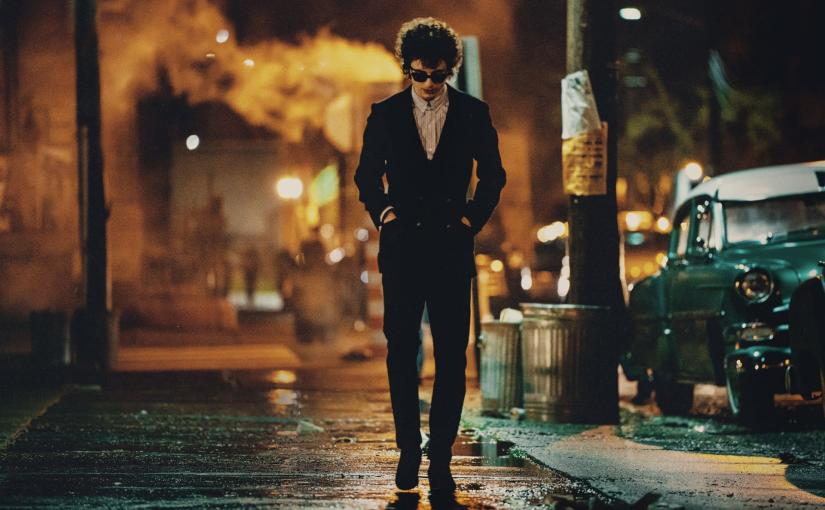
Timothée Chalamet delivers a blazingly convincing performance as Bob Dylan, surely a front runner for the Best Actor Oscar.  The appearance is easy to get used to. The dialect and expressions of what I’d like to think is the summit of what most of us know about the musician never falters from an apathetic expression or that mumbling hoarseness we all know.  Everything from the clothes to the shaggy brown hair to the sunglasses and motorcycle he confidently rides perfect this embodiment. In James Mangold’s latest musician biography (prior credits include the Johnny Cash bio Walk The Line), with Timothée Chalamet in this role, I was truly watching a Bob Dylan of the early to mid-1960’s.

Any movie has a conflict for its story to work around.  There’s more than one conflict in A Complete Unknown, but Bob Dylan would not know that.  He’s content with doing what he does and has not one care for what anyone else wants him to be or wants him to share.  Bob lacks much concern for the tumultuous times of the mid twentieth century either.  JFK and Malcolm X are assassinated.  The Vietnam War persists.  The Cuban Missile Crisis terrifies everyone.  Yet, Bob only focuses on his songwriting.  He’ll make connections with Pete Seegar (Edward Norton) and develop a sometimes-romantic tryst but mostly singing partnership with Joan Baez (Monica Barbaro).  He also gets involved with Sylvie Russo (Elle Fanning), one of his first fans.  However, no matter what they might expect of the performer, he’s only going to follow the path that drives him.  Therefore, that will be their own respective problems to contend with, not his.  Bob is only going to follow that path that he chooses.

Sylvie wants to know more about her live-in boyfriend who only tells tales of when he moved with a travelling carnival.  Joan wants to know where he learned to play guitar or even how he developed a knack for poetic lyricism.  Later, she’ll want to play the original numbers that solidified their friendship on stage despite his stubbornness not to agree.  It becomes curious when photo albums are delivered, addressed to a Robert Zimmerman.  Pete and his other peers want Bob, a now marquee name, to hold on to the grassroots of folk singing.  Bob will not acquiesce though.  Like other masterful musicians such as Prince or John Lennon and Elton John, Bob Dylan is going to continue to reinvent himself. 

In a matter of months, the signer becomes a nationwide superstar and he can’t walk the streets without getting bombarded; something he never wanted.  He performs with a passion for the music he’s written and he persists in making the next new thing with his talents as he transitions from acoustic to electric guitar and incorporates keyboards and drums to accompany his performances.  His friend Pete sees a berth becoming wider from the folk music he parades at annual festivals in Newport, Rhode Island and what Dylan insists on only playing.  Record producers (primarily represented by actor Dan Fogler) beg the singer to perform his older familiar tracks, but Bob Dylan only wants to move on to what is new and fresh. 

A Complete Unknown is full of such energy because it delivers what was produced by the guy who composed all of these magnificent and magnetic tracks from Song To Woodie to Blowin’ In The Wind to Like A Rolling Stone and to The Time’s They Are A Changing and A Hard Rain’s A-Gonna Fall.  You might not know or even understand all the verses by heart, but you quickly catch on to the choruses. To hear these newly composed songs pulled out of a dusty attic for an updated biography, performed by Timothée Chalamet in underground bars, at concert festivals or even in messy apartments is addicting.  You don’t want the actor to stop the song.  You don’t want the film to cut away from any of the numbers and you wish the concert would never end.  Like Joan Baez, Bob Dylan’s works stay with you.

I’ve become a huge admirer of James Mangold.  He’s a writer/director who does not criticize his subjects.  He empathizes with them and respects their boundaries.  We might find frustrations in people like Bob Dylan or Johnny Cash, but Mangold does not compromise the biography.  He finds reasons for you to like these men even while those who stand in their circles might not care for their attitudes. 

The director is also skillful at showing the history of the time.  Like the last Indiana Jones film he covered, the settings are so authentic.  New York City in A Complete Unknown is depicted down to the finest detail including the yellow street signs within the small boroughs of damp Brownstones and city streets that Bob Dylan navigates. The musty interiors of Woody Guthrie’s hospital room or Pete Seegar’s cabin home are shot with a hazy photography.  The Newport music festival, full of concert spectator extras feels like it was pulled from a documentary; what maybe a calm and relaxing Woodstock might have looked like.

Beyond Timothée Chalamet, the cast of this film is superb.  Elle Fanning need not say a word as James Mangold provides an assortment of close ups depicting her pain of wanting to love Bob Dylan but knowing she just can’t.  Her complexion turns into a weeping pink without one tear shed.  Monica Barbaro is on the cusp of becoming a marquee name in films.  The actress who was recently in action material with Tom Cruise and Arnold Schwarzenegger hides so well under the folk appearance of Joan Baez and she carries an immense stage presence. Scoot McNairy is Woody Guthrie who never speaks and only stares straight ahead during visits from Bob and Pete. Yet, the silent performance offers the only character who truly understood the value of an enigmatic Bob Dylan. Edward Norton has given a new range as a liberal and calm Pete Seegar who uses folk music as an escape from the turmoil of the times and not as a harbor to protest or fight an authority with aggression and violence.  He might wish for his friend Bob Dylan to uphold the value of folk music, but he knows he can’t keep a bird caged in one place either.  Norton’s introductory scene in a courthouse with a banjo in hand is unforgettable.  The casting is simply perfect in A Complete Unknown.

Since I saw this film on Christmas Day, I have not stopped thinking about it, and I think I want to see it again in a theater with a speaker system that amplifies the power of Bob Dylan’s guitar and mumbly vocals.  Right now, nothing sounds better.

A Complete Unknown is one of the best films of the year.

AMERICAN GANGSTER

By Marc S. Sanders

My favorite kind of crime dramas are the ones that tackle the grit.  The screenwriters and directors go for where the itty-bitty stuff scrounges up into something bigger for either the career criminal or the low-level cop.  These guys start out as butterflies flapping their wings and before you know it their legacies and pursuits are as big as hurricanes.  Movies like The French Connection or Heat operate on these trajectories.  How did we get from there to HERE?

Ridley Scott went in an unconventional direction away from his science fiction eye and ancient history recollections when he directed American Gangster with a screenplay by Steve Zallian based on the true stories of Harlem drug kingpin Frank Lucas (Denzel Washington) and narcotics detective Richie Roberts (Russell Crowe).

These two sensational actors don’t share one scene together until the epilogue of this always interesting three-hour opus.  Yet, in their second film together their pairing is as classic as DeNiro and Pacino or Newman and Redford.  I hope before they retire, these men pair up for at least one more film.  

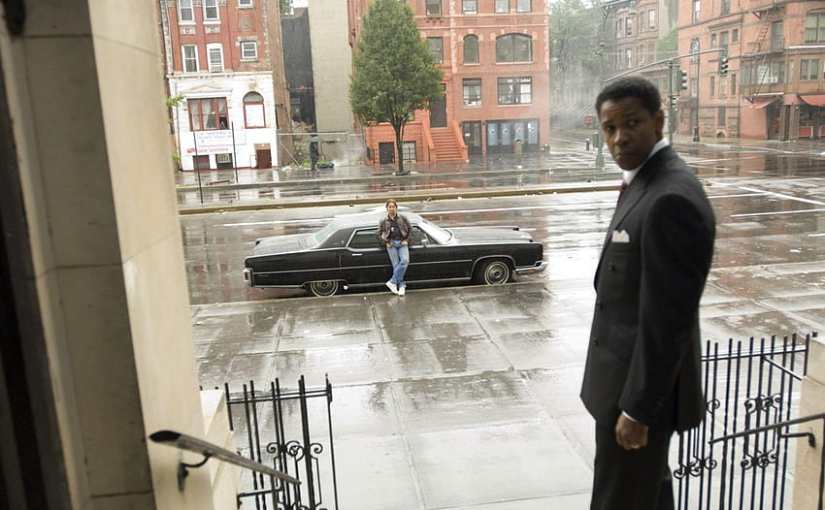
Ridley Scott and his nominated art directors, Arthur Max and Beth A Rubino, capture a gritty urban, crime ridden Harlem of the 1960s/70s.  The streets are filthily here, as well as in the five New York boroughs and all the way across the bridge into New Jersey.  Frank’s markets carry a very wide berth. The buildings are distressed and cracked.  The clothes are of the hippie era with polyester suits.  This is where Frank Lucas moves his imported contraband, white powder heroin, labeled exclusively as “Blue Magic.”  The film provides a convincing source locale deep within the jungles of Vietnam where thousands of kilos are shipped to Frank for sale on the street.  The purity of the drug is beyond compare.  Scott and his art designers place you directly in this time period of dingy grime and among the sweaty Viet Cong and rivers to finally arrive at the crop Frank purchases his products from.

Once he finds his footing by eliminating the competition and recruiting his brothers and cousins to run his business, Frank invests in creature comforts with a furnished penthouse apartment for himself and a beautiful mansion for his mother (Ruby Dee in an Oscar nominated performance that comes off so naturally; you’d think she’s sitting at the Thanksgiving table with you).  He marries a beautiful Puerto Rican wife that he treats like a princess. Frank is smart.  He stays under the radar by wearing conservative suits and not making many waves like going out at nights and showing himself around the social scene.  He knows famous athletes like boxer Joe Lewis or the staff on the New York Yankees that could give his nephew a shot at being a pitcher. Still, his profile manages to stay low. Like his mentor, he just operates a business with a viable commodity.  He tells his younger brother (Chiwetel Ejiofor) that the loudest one in the room is the dumbest and the most likely to get caught.  So, mind how you carry yourself, how you dress yourself and how you flaunt yourself.

A separate story has no business intersecting with Frank’s plight until something gives.  Richie Roberts is a good, honest cop. Though he’s also a lousy husband and father. He has been assigned to head up a task force that will bust the top of the assorted drug empires.  He needs those rare breed cops who are not on the take and follow a strict policy of law enforcement ethics.  His team will not bust a common street hustler.  They will be looking for the kingpins with unquestionable evidence to put them away for good.

American Gangster follows two separate stories for most of its running time.  At least during the first two acts of the film, Frank and Richie are unaware of one another.  It’s only through some gradual surveillance that the cop finally gets a whiff of an idea and starts to move methodically towards a conclusion. The methods are the fascinating parts the movie.

When Denzel Washington plays a villain it’s always memorable and contrary to popular opinion, Frank Lucas is my favorite of his antagonists, especially compared to his Oscar winning work in Training Day.  Watch how he walks or sits on a sofa and broods over how his family and his business are functioning.  He’s the only African American actor I can see playing this guy because I’m always convinced that whoever Denzel Washington portrays, it’s a character who will never be intimidated.  This guy faced down Gene Hackman during a threat of nuclear holocaust. Not many other actors can do that so authentically.

Russell Crowe works like that hero who doesn’t want to wear the cape.  Richie Roberts succeeds on so many levels where his peers surrender to their inhibitions.  This cop passes the bar exam while fighting for custody of his kid on top of going after the empirical criminals who litter the streets in drugs and murder.  I’m reminded of his role in The Insider, where he used a similar American accent.  Richie is not as temperamental or hard wired as that guy, but he is at least as focused on doing what’s right regardless of threat or distraction.  Russell Crowe has a way of getting audiences to admire the concentration needed for many of his complicated characters.  You have as much tunnel vision as he wants the men he’s portraying to have. You are zoned in with what his characters live by.  You only trust their standards.

There are signature staples within the construct of this true story adaptation.  There are gunfights.  Punches are thrown.  The guy at the top beats up one of his cronies when he gets out order.  Yet, what stands this material apart from others is that now I’m watching how Denzel Washington and Russell Crowe handle everything.

The truth behind the story of a black gangster defying the dirty cops and the Italian mobsters who were thought to run the metropolitan undergrounds is amazing.  It’s so interesting to see how novel Frank is with smuggling the product from one side of the world to the other. Then, you see how he uses his family members to distribute to the consumers and collect the monies. Ridley Scott provides all the breadcrumbs in an easy-to-understand fashion.  

Painted against the landscape of an unwinnable Vietnam War that just won’t end, power is acquired and thus the best police officers are forced to change their approach.  So again, you see two different stories that start out small and undetected.  Frank and Richie are the most careful and meticulous of guys in their respective fields.  Therefore, it only makes sense that their paths don’t cross until their missions are nearly over.

There’s much to learn from American Gangster.  

You get an idea of how the harm of the war was not exclusive to just what was happening over in Vietnam.  There were more indirect effects to that crisis impacting the streets of New York and New Jersey.  

You see what subtleties an investigation will collect upon before pouncing on to a bigger stake.  You also learn how to handle a criminal empire with trust and dignity rather than announcing your immorality. You witness the sheer defiance of a righteous guy in what is supposed to be a law-abiding field. Steve Zaillian’s script is not just good guy vs bad guy. It’s each of these guys holding on to the top while trying to catch up with or stay away from each other.

American Gangster is a very thorough and well-planned biographical thriller.  

UNSTOPPABLE (2024)

By Marc S. Sanders

The Oscar winning film editor of Argo, William Goldenberg, finally directs his first film and it’s a winner.  The true story of Anthony Robles, the one-legged NCAA world champion wrestler is brought to the screen in Unstoppable.  While the story is paint by numbers for a typical sports movie, because it is adapted from his real-life experiences during his time at Arizona State University, it cannot help but be embraced.  The cast is sensational as well, with not one weak link.

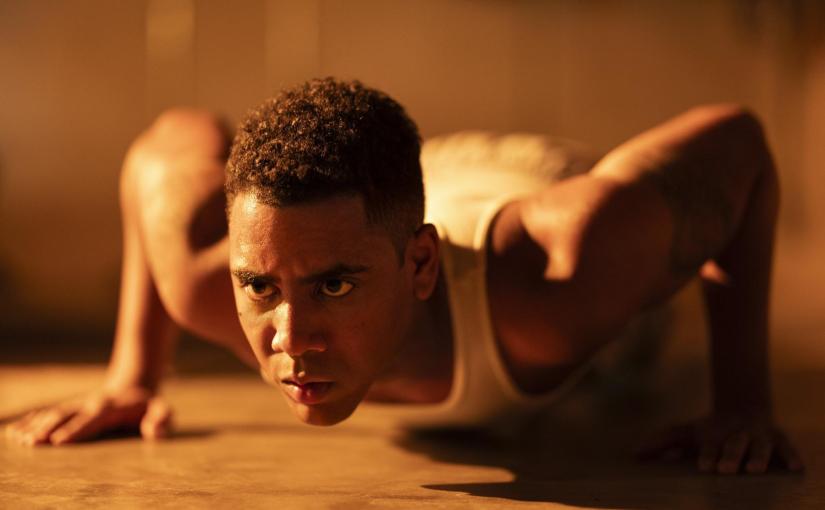
Anthony Robles (Jharrel Jerome, the Emmy winner of the HBO miniseries When They See Us) is a good kid.  Anthony is loved by his brothers and sisters, and his mother.  They cheer him on to persist and win.  He’s a hero to his younger siblings.  Anthony also gets much encouragement from his high school wrestling coach, Michael Peña, and his co-worker that he cleans airplanes with, played by Mykelti Williamson.  Still, he has a troubled domestic life.  His stepfather is an intimidating tyrant.  Bobby Cannavale plays one of the harshest villains in recent memory.  A towering monster with a voice that’ll make you wince.  He’s verbally abusive and eventually we learn physically as well to Anthony’s mother Judy (Jennifer Lopez). 

As the film begins, following a winning match, Anthony receives an all expenses paid ride to a Pennsylvania college.  However, that school does not contend in the NCAA and despite everyone telling him to take the free ride, he has his eyes set on Arizona State.  Even ASU’s Coach Shawn Charles (Don Cheadle, and dang is he ever good) is not confident in Anthony making the final cut for the team.  Yet, Anthony defies what everyone else thinks and scrounges up the monies with his family’s support to attend the local university.  Now the challenge is to make the team against all odds with his crutches to support him through rocky terrain hikes and laps around the track while carrying heavy weights.  How does a man with one leg stand upright and manage to climb mountainous terrains in the desert heat while staying in pace with the rest of the candidates?  How does he even hold a thirty-pound weight while running the track on crutches?  Anthony Robles will show you.

Unstoppable does not offer anything new or inventive.  Anthony even reflects on the fictional character Rocky Balboa a few times.  There are challenges to overcome, not just for Anthony, but for Judy as well.  The bank wants to foreclose on their home and her husband is monster of a jerk.  Plus, there’s Anthony’s handicap which can never serve as an excuse for falling behind with the rest of his squad. 

Some matches are lost.  There are scary episodes at home.  There’s the imposing undefeated champion that Anthony will eventually have to face.  There are the loving moments between mother and son.  It’s all textbook, and the ending is predicted as soon as the film begins.  Still, had I known Anthony Robles personally while growing up, I’d be saying this story is prime for a movie or a book and that is what became of it. 

At the 2024 AFI Film Festival, there was a Q&A following the film’s presentation.  Jennifer Lopez, Jharell Jerome, William Goldenberg, and Judy and Anthony Robles were in attendance.  To watch the film and then hear of these people’s real-life experiences afterwards is astonishing.  Both mother and son came from rock bottom scenarios mired in debt and abuse.  Now, long after Anthony has finished his career as a champion wrestler, we see that the two continue their crusades.  I won’t spoil what they went on to next.  The film provides a footnote ahead of the end credits, but it is nothing short of inspiring.  The Robles demonstrate that anything is possible and nothing works as an excuse.

Jennifer Lopez and Jharrel Jerome share a lot of beautiful scenes together.  Lopez might be easy fodder for gossip columns, but she is truly a wonderful actress.  Jerome reminds me of when I first saw Cuba Gooding Jr in Boyz In The Hood, which was an astonishing debut of a promising career.  This guy needs to be cast in a lot of beefy roles going forward.  He’s a sensation. 

William Goldenberg has made an under the radar film, but it has box office success written all over it like The Karate Kid or Rocky.  His vast experience in editing allows for a well-paced two hours so that even if you know what is coming next, you remain enthralled and wanting to cheer on the protagonists. 

The film will be streaming on Amazon Prime soon, and that is perhaps it’s only disappointment.  Again, as I have written in other recent columns, a movie like Unstoppable belongs in the theatres first and seen with well attended audiences who will clap and cheer at both Judy and Anthony’s triumphs.  Some of my fondest memories are watching the heroes I grew up with played by Ralph Macchio and Sylvester Stallone finally achieving that hard-to-reach gold crown, and suddenly there’s an overwhelming cheer from the audience within the darkness of the theatre.  Remember when Rocky sprinted up the 72 steps of the Philadelphia Museum Of Art?  A cued response almost seems edited into the context of the film.  That kind of experience is absent from the private confines of a living room.

Unstoppable has joined the lexicon of amazing sports stories.  You can’t help but cry while you are cheering.

REAGAN

By Marc S. Sanders

I read that Reagan completed shooting in 2021 during the height of Covid.  It was not released until three years later because it had trouble finding a distributor.  Everything happens for a reason, because it is more fitting that the cinematic biography of America’s fortieth President be released during an important election year.  I do not believe it matters what political party you lean towards, this telling of Ronald Reagan’s life demonstrates a man of principals with an adoring sense of humor, even when death’s door might be knocking. 

Reagan is one of the best films of 2024.

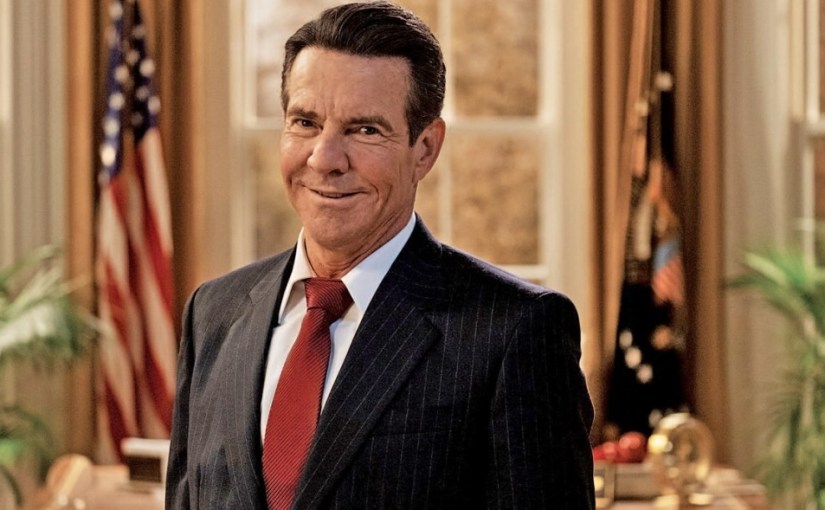
Dennis Quaid is an early Oscar contender for Best Actor as the title character.  It’s easy to fall into the trap of a Saturday Night Live impression or what Johnny Carson famously did on his show.  Quaid, with the assistance of some flawless makeup, finds Ronald Reagan’s crooked grin that shows a welcoming and open-minded figure, but also makes use of a slight scowl when the President emulated a need for tough policy, particularly with a bullying Soviet Empire and their possession of over thirty-five thousand nuclear missiles against America’s twenty-two thousand.  Like most of this cast, you absolutely believe that Dennis Quaid is Ronald Reagan, in a performance that quickly attracts a likability for the man, laughter when the film calls for it and earned sorrow when the figurehead is facing death or illness.  I cannot say I’m a big admirer of Dennis Quaid’s long career.  None of his films ever stood out to me, until now.

The film directed by Sean McNamara follows a pattern like another celebrated biography, Amadeus.  An outside observer narrates a person’s life to someone else.  This time it is a retired KGB spy named Viktor Petrovich portrayed delicately by Jon Voight.  Viktor claims that in the early 1940s he was assigned to penetrate the ranks of American activities to allow the Russians a leg up during pre-Cold War.  He thought a good route was through Hollywood as there were some connections between that industry and politics.  Viktor zeroed in on the eventual president of the Screen Actors Guild, a young Ronald Reagan, whose espouses of policy against Communist doctrine seemed to be overshadowing his budding acting career.  At the same time, he was frustrating his first wife, actress Jane Wyman (Mena Suvari).  Viktor could never anticipate this man would ever go from movie star to a life mired in divorce and bankruptcy, but then on to Governor of California and eventually a two term President of the United States.

It’s hard to find a way to get a biography off its feet and hit the ground running.  Where do you begin and how do you start the story? Fortunately, McNamara is working with a script by Howard Klausner and Paul Kegnor who find the most unexpected storyteller and Jon Voight is perfect in the role, perhaps a supporting actor nomination should be considered for his Russian interpretation that is utterly convincing.

After the film hops around in time for a bit, beginning with the day of Reagan’s assassination attempt (March 30, 1981) to young actor to early childhood when he was addressed with the nickname “Dutch,” does the story move on a straighter path.  The months, years and decades move in a chronological pattern.  I’m grateful for it because I can easily connect the dots.  

McNamara and Quaid show developments that lead to the next big moments, including time for Ronald to meet Nancy.  Penelope Ann Miller plays the First Lady and I’ve been missing her on the big screen.  She’s also perfectly cast and the picture allows her character to become fully developed so that a solid marriage of affection, love and image seems complete. 

Two stories I had heard before are included in Reagan.  Nancy enters the hospital just after the President has been shot and Ron tells his wife “Nancy, I forgot to duck.”  Years later, ahead of the very important Geneva Convention with Mikhail Gorbachev, Nancy insists that her husband not appear with a winter coat on when he goes to meet with the Soviet Prime Minister.  Ronald will be able to handle the cold air while Mikhail, the Russian, cannot.  It was an image of a strong, defiant leader standing in front of the world. 

In less than two and a half hours so much is covered in Reagan, but like any biography it cannot cover everything.  That is okay here.  A lot of details are explored and you do not need to be familiar with the history that was made during this man’s life.  Sean McNamara’s film never makes it overly complex.  News articles flash in front of you depicting some challenges that John F Kennedy faced which compounded on what Reagan would contend with nearly twenty years later.  Much of it has to be blink and miss it moments to allow other details and events to be presented.  You get an idea, but you do not need to reference an encyclopedia to understand the film. 

Reagan is primarily a favorable depiction of the famous President.  He’s almost always faced in a positive light.  I’d argue it is fair actually.  In his second election, he beat Walter Mondale by a landslide of forty-nine states to Mondale’s one.   Ronald Reagan remains a celebrated statesman among both sides of the aisle.  He was a bi-partisan man.  Room is allowed for Ron to have a friendship with the Democratic Speaker Of The House Tip O’Neill (Dan Lauria) despite their disagreements in ideals. 

I try to avoid getting too passionate and political as I write this article, and I know it is just a movie, but Reagan serves as a reminder when a political system was not hinged on the extremism that is demonstrated today.  The politicians did not seem to be running for themselves ahead of the party they supposedly represented on a ballot.  My family and I leaned Republican during the time of Ronald Reagan and Bush after him.  My ideals have had no choice but to change however, because as Reagan demonstrates, the Republican party of today is not what it stood for thirty and forty years ago. 

This film glosses over Ronald Reagan’s faults and shortcomings, particularly the scrutiny that came with the Iran-Contra Hearings and his possible negotiation with terrorists to rescue hostages.  However, while Reagan may have contradicted his line in the sand of no negotiations with terrorists, his intent steadfastly never remained with a personal self-interest.  Whatever he opted to do, he acted on behalf of the greater good of the nation he was elected to oversee.  That mentality is not easy to find today.  Presently, ego and self-entitlement drive many of the candidates to run for office, and at least I believe that is a very unhealthy mantra. 

Sean McNamara’s film is a sensational biography with a superb cast.  Many faces are familiar and only appear for minutes on screen to portray important members of Reagan’s cabinet or other political leaders.  Time of course is given to Gorbachev (Olek Krupa) as well as the Iron Lady, Margaret Thatcher (Lesley Anne-Down).  There’s also George Schultz (Xander Berkeley) and a California hippie named Dana (Derek Richardson in a scene stealing performance) who apparently was Reagan’s go to speech writer and created the line “Mr. Gorbachev, tear down this wall!!!” Never heard of Dana, and he seems like a far cry from who would exist significantly within the President’s career.  However, McNamara and the writers allow for some entertainment in the picture.

You see jars of Reagan’s jellybeans on tables everywhere and you cannot help but grin.  A door-to-door campaign for Ron and Nancy has a hilarious outcome with a housewife.  As President, Ron is tasked with feeding a goldfish belonging to the daughter of the Swedish Prime Minister.  The Secret Service even has the challenge of finding an agent to ride horseback alongside the President. These are issues that people face and live with, and the attention that McNamara lends to Ronald Reagan shape the kind of person he was.

The most memorable sequence is circumstantial when it is quickly depicted how three Russian Prime Ministers in a row suddenly die ahead of Gorbachev taking the spot.  Jon Voight is especially funny here amid his subtle expressions.  McNamara is working in the same mindset that Robert Zemeckis did with Forrest Gump’s fictional history.  Ronald Reagan even has a zinger of a line in response to this series of unexpected deaths.  Trust me.  If you watch this film with a crowd, you’ll be laughing among the masses.  It’s so unbelievable that it could only be true.

It makes no difference where you stand politically to appreciate Reagan.  It’s another biography to take advantage of and quickly gather a lesson in history.  The film is favorable and not overly judgmental of the figure it depicts.  That’s okay. 

The United States of America and its leaders were never entirely great.  No President ever satisfied an entire nation of people.  Reagan was not favored among the young adults of his time in an MTV age faced with the adversity of an unfamiliar AIDS crisis.  He faced challenges from his opposing party and he could have been the President that led the world into a World War Three of nuclear destruction.  All of these considerations are touched upon in a two- and half-hour movie and any world leader must be scrutinized in the same way they can be celebrated.  Yet, for a movie, this is about all we can ask for.  If you want to dive deeper, then I encourage you to do your research, find a podium or a college class or forum and declare your passions. Use a website like I do.  You absolutely have that right.  A movie does not have that luxury of time to go that far into the entirety of a man’s near ninety years on Earth.

I reiterate just how accomplished Reagan is.  Sean McNamara is a director to lookout for.  If he does not receive award recognition for this picture, and frankly I doubt he will (though I want to be wrong), his time will come.  This is a guy who only recently was directing silly Nickelodeon and Disney TV shows.  Yet, this director has a great vision for film assembly and a telling insight.  Ahead of the movie, I saw a preview for a Holocaust picture that he recently completed called Bau: Artist Of War. Because of McNamara’s work here, that film is on my radar. 

The cast of Reagan is also outstanding, worthy of Oscar nominations for Dennis Quaid, Jon Voight and Penelope Ann Miller.  As well, a host of character actors really embrace their short time on screen such as Dan Lauria, Lesley-Anne Down and Xander Berkeley (always a celebrated character actor), plus this bearded hippie guy Derek Richardson.  At the very least, the SAG awards should recognize this cast with a nomination for Best Ensemble.

Reagan is a very important film to see regardless of whatever generation you stem from.  At the very least, no one can argue that Ronald Reagen lived his life touting his own name and his own special interests.  Like the greatest of Presidents, he willingly served, only to serve the best interests of a country.  Watch the film that explores the life of one of American history’s greatest servants. 

For our country’s own future and prosperity, Ronald Reagan needs to be remembered.

BORN ON THE FOURTH OF JULY (1989)

by Miguel E. Rodriguez

DIRECTOR: Oliver Stone
CAST: Tom Cruise, Kyra Sedgwick, Raymond J. Barry, Jerry Levine, Frank Whaley, Caroline Kava, Willem Dafoe
MY RATING: 7/10
ROTTEN TOMATOMETER: 84% Certified Fresh

PLOT: A biography of Ron Kovic, a fiercely patriotic Marine who fights in Vietnam, is paralyzed in battle, and experiences a dramatic turnaround upon his return home.


I can already tell this is going to be a difficult review to write.

There is nothing overtly wrong with Oliver Stone’s Born on the Fourth of July.  It is expertly directed, and the pacing never flags.  Tom Cruise’s Oscar-nominated performance is deservedly legendary; he leaves nothing in the tank, a fierce rebuttal to critics who thought he was nothing but a pretty face.  But even though there is much to admire, when the closing credits rolled, I felt oddly detached.  The movie kept me at arm’s length from really engaging with the lead character.  Or maybe I kept the movie at arm’s length.

Could it be that I simply don’t care for Vietnam films anymore?  Not likely.  One of my absolute favorite films is Michael Cimino’s masterpiece The Deer Hunter.  In fact, the opening scenes of Born on the Fourth of July are reminiscent of that earlier film in that it takes its time establishing the main character, Ron Kovic, as a young man in the early-to-mid 1960s at the dawn of the Vietnam War.  Born and raised in Massapequa, New York, his strict Catholic upbringing and his devotion to high-school wrestling instill a strong sense of right and wrong in the world.  A point is made about how America had never lost a war up to that time.  Kovic’s wrestling coach exhorts him and his teammates as if he were a Marine drill instructor.  “I want you to kill!  You hear me?! …You got to pay the price for victory, and the price is sacrifice!!”  It’s not very subtle, but Stone is making it clear that, in those days leading up to the Vietnam quagmire, the American credo was, “Winning isn’t everything, it’s the ONLY thing.”

Kovic enlists, sees combat, and during two horrific sequences, he experiences: an unintended massacre of Vietnamese civilians, the accidental shooting of a fellow soldier (with Kovic himself behind the trigger), and a fateful gun battle during which a bullet went through his right shoulder, collapsing a lung and severing his spinal cord, paralyzing him from the waist down.  These scenes are appropriately skittish and terrifying, putting us in Kovic’s boots and making us feel the unimaginable stress of fighting a war where half the time you weren’t sure who or what you were shooting at.  Kovic is shipped stateside…and here, as they say, is where his troubles REALLY began.

If the scenes set at the VA Hospital during Ron Kovic’s convalescence weren’t based on his actual experiences, I would denounce them as sensationalistic and manipulative.  Rats roam free among the beds.  (A nurse provides spectacularly unhelpful advice: “You don’t bother them, they ain’t gonna bother you.”)  Orderlies spend their down time getting high on marijuana or worse.  Unchecked catheters get backed up.  When a vital blood pump malfunctions, a doctor has to go to the basement to “rig up a substitute.”  And through it all, Ron Kovic does everything in his power to prove to the (correctly) pessimistic doctors that he will walk again, even re-injuring himself in the process.

(It’s futile, I know, to critique a film for what it’s not instead of what it is, but I can’t help wondering if I might have developed a more emotional reaction or attachment to the film if the entire film had focused on Kovic’s tenure at the VA hospital…although I will admit that would be a thoroughly depressing film.  Also, it might have developed some unintentional similarities to One Flew Over the Cuckoo’s Nest.  Who knows.)

The rest of the film details Kovic’s return home to his family, his emotional swings between the lowest kind of depression (“Who’s going to love me, Dad?  Who’s ever going to love me?”) and angry shouting matches with his parents and occasional bar fights.  Eventually, Kovic has a revelation: he still loves his country, but he can’t stand the government that sent him and his friends halfway around the world for a cause he no longer understands.  After a short hiatus in Mexico (I won’t get into too many details about that plot point because it’s the one section of the film that borders on boring), he returns home and dedicates his life to speaking up for the men and women who returned from Vietnam to a country that, at worst, hated them, and at best, simply didn’t care about them.

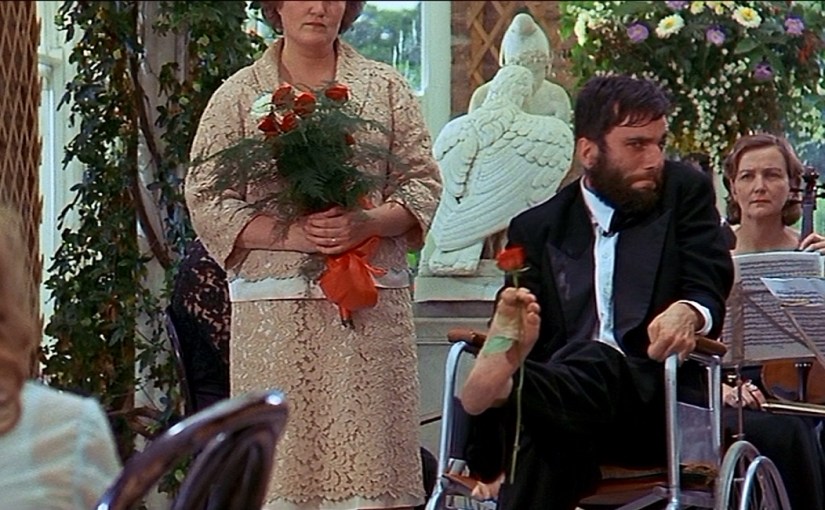
Again, the film is a stirring portrait of a man and a life.  However, as much as I want to, I can’t pin down what it is about the movie that failed to reach me at the kind of emotional level that other biographies have done before.  I just recently watched My Left Foot, with Daniel Day-Lewis’s towering performance at its center.  Another film biography, another main character confined to a wheelchair, a character who comes to terms with himself and how the world responds to him and comes up with a way to respond to the world.  But My Left Foot made my heart soar in a way that Born on the Fourth of July never achieved.  I watched the movie intently, focusing on every plot development and every nuance.  But it just didn’t grab me.  I am at a loss to explain why.

Could it be because of the presence of Tom Cruise in the lead role?  He showed these kinds of acting chops again ten years later in Magnolia, giving another Oscar-nominated performance.  In that movie, he completely disappeared into the role, despite having one of the most recognizable faces on the planet.  Perhaps the younger Tom Cruise (only 27 at the time) emits the kind of wattage that overshadows those around him?  So that you’re aware of the face first and the character second?  Maybe.  So why doesn’t the same thing happen in Magnolia or even The Last Samurai?  Perhaps it took him ten years to find a way to modulate or customize his performance so that, when it counts, the character comes first and the Cruise persona second.

I’m speculating.  The bottom line is, Born on the Fourth of July is a worthy addition to the resumes of both Oliver Stone and Tom Cruise.  It knows the story it wants to tell and resolutely sticks with it the whole way.  There are no sidetracks at any time, not even when he becomes an activist.  The focus is always on Ron Kovic, not the cause.  Stone and his screenwriters trusted that the story of Ron Kovic would draw enough attention to the cause on its own.  That approach would work with just about any other film.  This time, it had the effect of diluting the emotional experience while still holding my attention all the way through.  I would still recommend it to anyone who hasn’t seen it, if for nothing else to see Cruise play a role where he gets to sound notes he rarely got to play in his early career.  Would I watch it again?  Maybe.  I think the story is important enough for me to try to see what I might have missed this time around.

MY LEFT FOOT (Ireland, 1989)

by Miguel E. Rodriguez

DIRECTOR: Jim Sheridan
CAST: Daniel Day-Lewis, Brenda Fricker, Fiona Shaw
MY RATING: 10/10
ROTTEN TOMATOMETER: 98% Certified Fresh

PLOT: Christy Brown, born in 1932 with cerebral palsy, learns to paint and write with the only limb under his full control – his left foot.


For so many years, I have admired Daniel Day-Lewis as an actor, especially his performance in There Will Be Blood, which is the only performance I’ve seen on screen that has ever really motivated me to be a better actor myself.  However, I never got around to seeing his breakout movie, My Left Foot, until just recently.  All I can say is: WOW.  I had always assumed (big mistake) that this film would be a long, dark journey of the soul leading finally to an uplifting climax, but not after a lot of scenes of heartbreak and pathos and general gloom.  I could not have been more wrong.  There is as much heartwarming joy in My Left Foot as it’s possible to contain in any film, and it’s balanced by acknowledgement of Christy Brown’s condition and his down days and his struggles.  It’s a brilliant high-wire act, flawlessly performed both in front of and behind the camera.

Christy Brown is born with cerebral palsy in Ireland in 1932 to a Catholic family that grows in number almost through the entire film.  In a day and age that was simply not equipped to handle disabled children, Christy’s father is blunt: “He’ll go in a coffin before any son of mine will go in a home.”  While his motives were probably more about saving face in his community than anything altruistic, it’s this attitude that most likely saved Christy’s life.  Christy is brought home where his parents and his many sisters and brothers acknowledge and learn to work around his condition, but they refuse to treat him as anything other than a “normal” playmate and sibling.  Some of the happiest scenes in the film are when the children push Christy around in a wheelbarrow, racing up and down their street, as much for his enjoyment as for theirs.

Christy’s mother (Oscar-winner Brenda Fricker) patiently learns how to interpret young Christy’s unintelligible grunts and constantly shifting facial expressions, so it seems as if they’re communicating with each other in a secret language.  When young Christy shocks the family by picking up a piece of chalk with his left foot and writing “MOTHER” on the floor, the father’s response made me smile and smile: he carries Christy to the local pub and announces, “This is Christy Brown!  My son!  Genius!”  If this didn’t happen in real life, it bloody well should have.

(I also loved the bit where the older Christy plays soccer with his friends.  As a very capable goalie, no less.  When the time comes to take a penalty kick, his brothers line him up carefully on the ground so he can use his deadly left foot to rip the back of the net.  Or storage shed, whatever.)

I mention all these moments and interactions between Christy and his family because they are at the core of what makes this movie special.  Yes, Day-Lewis’s performance is the stuff of legend, there’s no denying that.  But the screenwriters are very careful to let us see that, despite his literally crippling affliction, Christy never lacked an unshakeable support structure.  I found myself wondering if I had the kind of fortitude, not to persevere like Christy, but to go all in on supporting a sibling or any loved one, loving them, and always being there for them.  It’s easy enough to say I am willing to do things like that.  I only hope, if I were ever faced with that kind of challenge, that I would meet it with the same kind of unconditional grace and love exhibited by the family of Christy Brown.  Here endeth the introspective portion of this review.

I can’t tell you enough how enthralling and well-balanced this film is.  In my experience, most movies about characters with terminal illnesses tend to wallow too deeply in the grief and sorrow associated with that illness.  My Left Foot makes a conscious decision to establish the illness, lay down the boundaries, and then move forward as if the main character weren’t ill at all.  In a sense, that is the case with Christy Brown in the first place.  As brilliantly portrayed by Day-Lewis, you can always see the mind at work behind the uncontrollable gestures.  There is nothing at all wrong with his mind, only his body, which betrays him and frustrates him.

There is one specific scene that seems to stick in the mind of everyone who sees the film.  Christy has been taken under the wing of a doctor, Eileen Cole (Fiona Shaw) who specializes in treating his condition.  His speech improves, his painting improves.  He falls in love with her.  In an agonizing scene, he confesses his love to her in a restaurant while several other associates look on.  She mistakes his declaration of affection and informs him of her engagement to another man at the table.  After a stunned silence, Christy uses his loudest speaking voice and carefully and very slowly says, “Congratulations.”  Director Jim Sheridan points the camera, not at Christy, but at the horrified and embarrassed dinner guests at the table, and at the other restaurant patrons who stop and stare in disbelief at the noises Christy is forcing into the air.  He has some other choice words regarding platonic love, and the scene ends with him pulling the tablecloth off the table with his teeth.

The emotions on display in this scene were so raw and honest and painful that I found myself covering my eyes a bit.  I felt every bit as embarrassed as those dinner guests.  But I also felt enormous empathy for Christy.  He is raging, not only at Dr. Cole and her rejection of his affection, but at the fates that locked his soul away in a body that was a constant reminder of his “differentness.”  Later scenes show us that he was able to make peace to a much greater degree in later life, but these scenes and others reveal the unimaginable conflict in his sharp mind.

I’m rambling, I think.  I don’t feel I have successfully conveyed how joyous My Left Foot truly is.  I had a goofy smile on my face for the first half hour of the movie.  I laughed out loud many times, especially at Christy’s father’s wake, a scene I vividly remember seeing at the Oscars that year.  Christy Brown was not a perfect man, and the movie does not pretend that he is.  But the movie does end on a wonderful high note that would be crushingly melodramatic in almost any other film.  My Left Foot earns it by showing us his journey, completely, concisely, and with enormous understanding.

BLACK MASS

By Marc S. Sanders

Black Mass tells the story of an FBI agent, and his two childhood friends who are brothers.  One brother is Billy Bulger, a Massachusetts state senator.  The other is notorious Boston gangster James “Whitey” Bulger.  The script has a lot of elements to make for a great crime drama, but I wonder what Johnny Depp is doing here made up to perform like a crazed ghoul.

The FBI agent is John Connolly (Joel Edgerton) who turns to Whitey (Depp), a fearful leader of the Irish mob in South Boston during the nineteen seventies through eighties to work as an informant, providing intel on the competing Italian Mafia.  It’s no secret about Whitey Bulger’s dealings or what territory he covers.  Agent Connolly does his best to protect his friend, so long as he collects pertinent information that leads to arrests.  However, what’s the limit to Bulger’s activities, and how does this reflect on a public figure like Whitey’s politician brother, Billy (Benedict Cumberbatch)?

Much of Black Mass reenacts recorded testimonies after everything has shaken out.  Guys who survived Whitey’s violent crew (Jesse Plemmons, Rory Cochrane) offer information on the gangster’s activities and what he compelled his captains to carry out.  Mixed in with these voiceovers are how Connolly responds to the progress of his operations.  Time and again, his superiors (first played by Kevin Bacon and later by Corey Stoll) question Connolly about how beneficial Bulger can be if the crook always has his finger on the trigger, killing those that might rat him out.  Black Mass is told from an assortment of different perspectives and sometimes that muddies the water.

The most interesting storyline is how Connolly uses and protects his criminal friend, while also stepping away from getting blood on his hands.  Joel Edgerton gives the best performance of the film as an FBI guy who turns a blind eye to Whitey’s crimes. Connolly thinks he can continue his own corruption while Whitey cooperates and leads him to big, heroic indictments of the Italian mob.  As long as the arrangement upholds, the corrupt agent will always have an answer for his actions and stay ahead of the ethical lines he knows he’s crossing.  More importantly, even if his wife protests, Connolly is getting prestigious promotions and collecting substantial paychecks for his progress.  Scott Cooper directs Edgerton with conflicts of overwhelming complications.

One problem is that Whitey Bulger is a loose cannon who is never intimidated, not even by the Feds, especially not by his childhood friend.  His brother Billy looks away to maintain a clean political image.  Therefore, it is quite easy for Whitey to gun down a rat associate in broad daylight in the middle of a wide-open parking lot, shotgun and all.  The killer doesn’t even need to run away from the scene of the crime.  This is Whitey Bulger.

Johnny Depp is great in the role, but does his portrayal belong in this film?  Depp’s career is widely celebrated for the quirky, makeup clad parts he plays such as Jack Sparrow and Edward Scissorhands.  Even Ed Wood is delightfully weird.  In Black Mass, the actor dons steel grey eye contacts, white slicked back hair making him appear almost bald, and skeletal teeth beneath a near albino complexion.  He looks like Skeletor without the hood.  Throw in a brooding, deep Bostonian accent and you have the ghoul I referred to earlier.  Is this Whitey Bulger?  Online photos of the real guy do not seem consistent with the film’s appearance.  Depp’s delivery of dialogue and even his wicked Freddy Krueger laugh seem too far beyond the realm of this crime drama.  The actor is working on another plane than everyone else in the cast who wear hairpieces, three-piece cotton suits and cheesy off-the-rack polyesters and denims to populate this time period from forty years ago. 

A scene showing Bulger dining on steaks with Connolly and his FBI partner (David Harbor) was famously used in preview showings ahead of the film’s release.  Take this scene out of context like the trailer did and Depp looks scary good as he terrifies Harbor for doing something as simple as revealing a long-time secret family recipe.  Afterwards, Whitey goes upstairs to harass Connolly’s wife (Julianne Nicholson) at the bedroom door.  The dinner scene sold me on getting a ticket for the movie as soon as it was released.  However, put it back into the framework of the script and I feel like Black Mass is diverting itself from a complex crime drama to a vampire in a Member’s Only jacket.  As good as Depp is with his makeup and his vocal inflections and pace, it just doesn’t seem to belong in this particular film.  Marlon Brando as Don Corleone with the shoe polish in the hair and the cotton in the mouth? That works.  Johnny Depp as Count Dracula in Sergio Valente skinny jeans is not as effective.

Because the script changes hands from one perspective to another and then another, I found the reenactments of Connolly and Bulger’s reign of crimes to be a little inconsistent.  I found much potential for Benedict Cumberbatch’s purpose as Whitey’s brother, but there is too much diverted away from that character because the picture is trafficked with what everyone else is doing and seeing on top of giving Johnny Depp a lot of scenery to chew.

Black Mass pursued the potential for a very interesting gangster picture like Goodfellas or Donnie Brasco, but it wants to capitalize too much on the latest Johnny Depp routine.  I think James “Whitey” Bulger is an interesting twentieth century bad guy with a violently daring and checkered background.  He had associates within his family and gang to color in a movie that’ll grab you.  The tainted lawmen who were involved are also intriguing.  Scott Cooper and the screenwriters knew this, but often they opt to go in different directions.  

Now that a loose interpretation of Bulger has been played by Jack Nicholson in Martin Scorsese’s Oscar winning The Departed and again here, it’s time to tell the cold-blooded killer’s story once more.  Just go simpler without all the clownish theatrics.

JFK – DIRECTOR’S CUT

By Marc S. Sanders

Oliver Stone’s JFK is told through perspective, not necessarily history.  It’s not a biography and I do not believe Stone would ever claim it to be so.  It’s a thinking person’s picture that gives viewers entitlement to question what occurred, how it occurred and why it occurred.  It might guide you not to trust what anyone says, sees or hears, but let’s face it.  Probably the day Kennedy was shot, November 22, 1963, could we ever completely trust anyone ever again? 

(Forgive my cynicism.  I must backtrack a little.  I still trust my wife and daughter.)

Oliver Stone works through the eyes of New Orleans Prosecutor Jim Garrison (Kevin Costner, in what may have been his most challenging role to date at the time).  Garrison sees a little too easily that there are circumstances out of place, or maybe too neatly in place to satisfy the ultimate resolution that a known American defector to the Soviet Union, like Lee Harvey Oswald (Gary Oldman), acted alone in the assassination of the President.  Stone wrote the script for JFK with Jim Marrs and used Garrison’s input from his own novel. Nearly every scene builds into another possibility of how that fateful day came to be.  Stone even questions if a famous photo of Oswald on the cover of Life Magazine is real.   Too many cover ups with a building list of body count witnesses and too many coincidences keep Garrison up at night.  So, he assembles a crack team of investigators and fellow attorneys to reopen the case and question the official Earl Warren Commission.

Firstly, JFK is magnificent entertainment with a hair raising and unusual original score from famed film composer John Williams.  His notes on percussion with dings and harpsichord strings cue in at just the right moments when Stone introduces another one of many scenes that point out what seems cagy and suspect. The music of JFK works as a narrator.  This narrative keeps you alert.  Maybe you should look in each corner of the screen at times for some subtle clues.

It was also wise of Stone to go with a well-known cast of actors.  The Oscar winning editing from Joe Hutshing and Pietro Scalia moves at a breakneck pace.  Yet, because I recognize fine performers like Ed Asner, Jack Lemmon, Kevin Bacon, Tommy Lee Jones, Brian Doyle-Murray (Bill’s brother), John Candy and Joe Pesci it is easy to piece together who is playing who and what significance they lend to the many theories Garrison and Stone question next.  

My admiration for the casting continues with the Garrison team that performs with Costner – Michael Rooker, Laurie Metcalf (especially impressive), Wayne Knight, and Jay O. Sanders.  There’s also a clandestine trench coat guy named X portrayed by Donald Sutherland.  Who even knows if this guy ever existed?  He’s more secretive than Deep Throat, but Mr. X has a hell of a lot of information to justify Jim Garrison’s suspicions.  That is an especially marvelous sequence between two men strolling through Washington D.C., eventually concluding a disturbing realization on a park bench.

Sissy Spacek brings out another dimension to the Jim Garrison character.  She’s his wife and the mother of five who suffers the loss of her husband’s attention which is entirely focused on this compounding investigation.  I like Costner’s take on the Garrison character.  Early on he politely asks one of his associates to stop cursing.  He does not like that kind of talk.  Later, it is Garrison who is dropping a number of eff bombs in front of his wife and young children.  This conundrum of a case, a very puzzling detective story, is unraveling the investigator. 

JFK was instrumental for further Congressional consideration following its release.  Files were reopened.  Additional research was executed, and soon many of those secret documents pertaining to the assassination will be revealed in 2029.  Back in 1991, of course that appeared to be a lifetime away.  It’s time we know everything, though.  Arguably, most of who were involved in this incident are dead by now.  Let us know our history.  Still, Garrison was bold enough to point skepticism at not just the adversarial relationship Kennedy may have had with Castro, the Cubans and their Communist allies, but also the people within the CIA and the FBI.  Lyndon Johnson is not even free from scrutiny after he’s sworn in.  Some on Garrison’s team went so far as to factor in culpability from the mafia.  Garrison was not so keen on that theory, actually. 

The construction of Oliver Stone’s film is unparalleled.  I think it’s his best film to date and I can find few others that even compare to how he assembled the picture.  It begins with the voiceover of Martin Sheen laying out many news cycles that were occurring ahead of Kennedy’s murder such as the Bay Of Pigs and the President’s supposed efforts to withdraw from Vietnam.  Sheen’s narrative comes at you very fast with Stone incorporating real life home movies of Kennedy along with his brother Bobby, as well as Castro, and television news footage from Vietnam and anywhere else events were happening.  By the end of the roughly five-minute opening, your head might be spinning. 

Thereafter, though, Stone goes through Garrison’s day on November 22, 1963, watching the outcome following the momentous event and the writer/director works his way into the drama beginning with Asner and Lemmon as two drunk old guys walking through the rain and getting into an argument. 

Three years pass by and so begins Jim Garrison’s motivations to follow multiple trails of breadcrumbs that lead to a lot of different places, all unlike what Earl Warren surmised. 

The scenes work quickly from that point on, and cuts of theoretical reenactments occur.  Who knows if any of these scenes are factual?  Stone and Garrison want you to at least consider their reasonable likelihood.  Moments happen where Joe Pesci and Tommy Lee Jones’ characters appear to be lying about even knowing one another while Stone will depict a sexual role play encounter between them which also includes Kevin Bacon as someone with no more reason to lie. 

Episodes are deeply focused on Lee Harvey Oswald depicted as an infamous and suspected patsy in association with others who may have a reason to want Kennedy dead.  Gary Oldman hides so well in the role.  Oliver Stone even lends focus to how different witnesses describe Oswald.  In some scenes it is Oldman, but then there are other times where a shorter, more overweight man may have been the real Oswald. Later, there’s an Oswald who is taller and more slender. 

A few years ago, I was visiting Dallas, and I was able to spend a some time walking around the crossroads where Kennedy was shot in the convertible while seated next to his wife Jackie.  Watching JFK again lent more clarity to all of the locales such as where Oswald was supposedly shooting from the top floor of the corner book depository.  Kevin Costner and Jay O. Sanders go through the motions of Oswald firing the three shots from his rifle in the short amount of time span.  The script also questions why Kennedy was taken out by Oswald after the turn off the corner of Elm and Houston. There appears to be a better wide-open clear shot long before the turn with the car only going ten miles per hour.  The men question if it was Oswald, then why didn’t he take advantage of the clearer shot.

I know.  I could go on and on.  I have to stop myself.  There’s a ton – A TON – of information in JFK.  It becomes addicting to watch.  You don’t even want to pause the long film for a bathroom break.  I watched the extended Director’s Cut by the way. 

Many common critiques of JFK lean towards how many of these scenes did not even happen.  People are happy to point out there’s no evidence to truly say any of Oliver Stone’s enactments occurred.  I agree, but that’s not the point of this director’s piece.  This is primarily told through the eyes of Jim Garrison.  Kevin Costner is great as the listener, the observer and especially at the conclusion, the describer.  Watch him physically respond to anyone he shares a scene with.  There’s a memorable twitch he offers while at the scene of the assassination that works perfectly with a jarring echo of a gunshot edited into the film.  He’s also great at turning his head down as the thinker while Mr. X lays out an enormous amount of information that comes from several different directions.  Because the film comes from Garrison’s perspective, it does not have to be true.  It only has to be what the investigating prosecutor reasonably believes, and what he absorbs from suspects, witnesses, and his devoted team. 

A final speech of Garrison’s is told at the trial of suspect Clay Bertram, aka Clay Shaw (Tommy Lee Jones), who was the only man tried by Garrison for Kennedy’s murder.  First, it’s important to note that during this fifteen-minute sequence, when Stone cuts back to Garrison in the courtroom, Costner is wearing different suits.  So, while it is assembled as an ongoing rundown, it is not meant to all be in one instance.  Garrison lays claim to an endless amount of possibilities and circumstances that at times have no correlation with each other but could possibly all merge together towards November 22, 1963.  Critics argued this speech of Garrison’s never took place.  That’s correct.  However, this is a movie and for the efficiency of information to come out, a funnel must be opened up to learn what is being pursued and what has been uncovered.  This is the strategy that the script for JFK adopts and it works, leaving you thinking and rightfully doubting what our governing bodies and history books have told us.  Most famous of all of these nonsensical happenings delivered by Garrison is the “Magic Bullet Theory” made extra famous by Jerry Seinfeld with Wayne Knight on the comedian’s sitcom.  It’s silly but it is also a response to the impact that came from JFK.

JFK has a very glossy appearance from the Oscar winning cinematography.  Reflections and natural glares come off of Jim Garrison’s glasses.  The exasperation, along with the shiny persperation of John Candy’s sleazy lawyer character is undeniably noticed as his integrity is being questioned.  Staged reenactments are shown in black and white, clear color or grainy distressed output (such as recreations of the known Zapruder Film).  Nothing is clear about what led to Kennedy’s murder.  So, Oliver Stone’s filmmaking team will ensure that nothing should look consistent.  There are no straight answers; only endless amounts of reasons to ask another question after another.

Oliver Stone does not make JFK as complex as some will have you believe.  It’s quite easy to piece together who represents what in this story.  Many theories are offered at lightning speed, but they hardly ever intersect with each other until a probability is completely laid out on the table and then the film moves on to the next one.

JFK may have a long running time and a large cast with a lot to say and ask, but it’s an exhilarating thrill to behold.  Who knows what is true?  The importance of Oliver Stone’s masterpiece demonstrates that much of what we were told as truth may not consist of the entirety of facts. 

Again, question your governing bodies and ask the hows and whys and whos.  Oliver Stone reminds us that we have that right as the citizens of America. 

What really happened to our President, and who was really responsible?