SUPERMAN (2025)

By Marc S. Sanders

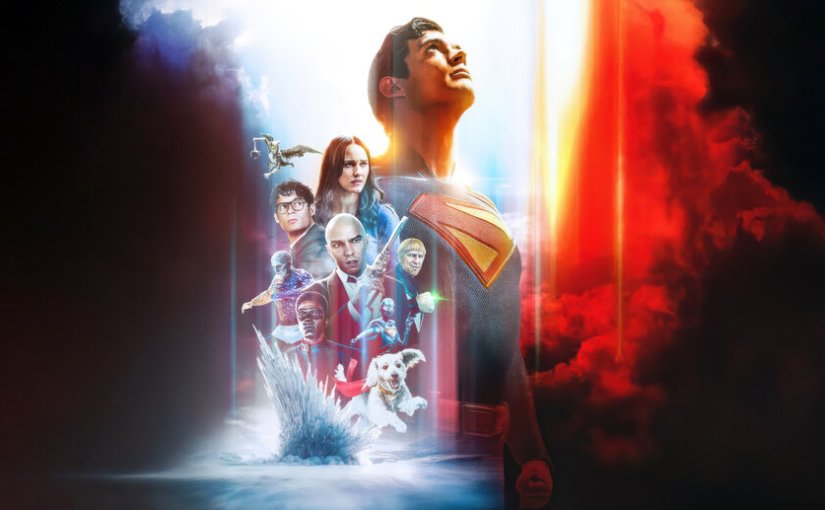
Once again the man in blue, red and yellow has returned to the big screen by means of director James Gunn who is intent on starting a whole new universe of DC comics characters.  The 2025 interpretation of Superman is zippy and fun even if it is a little too shallow of character development and dimension.  That’s regrettably ironic actually.  A man who dons two different personalities, Superman and mild-mannered reporter Clark Kent. Yet, neither has much to say or stand for in this two hour picture.

Gunn’s film is defiant to avoid any heavy exposition as this film begins.  There’s a slim foreword as the picture begins to describe this new universe that contains metahumans who arrived on Earth centuries ago, along with a little bit of Kal-el’s origin that many of us are familiar with.  Then we see the Man Of Steel crater into the Antarctic wounded from battle and aided by his feisty canine friend, Krypto, who drags him to his ice palace, the Fortress of Solitude.

Action commences thereafter back in Metropolis.  Lex Luthor (Nicholas Hoult) is pulling the puppet strings.  Lois Lane (Rachel Brosnahan) and the rest of the Daily Planet staff witness the mayhem over the city.

Then we get a bit of Clark looking a little goofy as he rushes into work, followed by some romantic interlude between Clark and Lois back at her apartment.  The two toe the line of their relationship when finally, the Superman persona allows his girlfriend to test his purpose for serving planet Earth along with his limits of authority and decisive action.  They go back and forth but none of the dialogue lands and the argument has no impact.  A missed opportunity to set up the Lois and Clark relationship.

The rest of the picture focuses on comic book episodes of endangering Superman while other metahumans make appearances – an obnoxious Green Lantern (Nathan Fillion), Hawkgirl, the shape shifting Metamorpho, and the surprisingly entertaining Mr. Terrific (Edi Gathegi) who seems to operate like Mr. Spock from Star Trek.  Of the four, the guy with the dumbest name actually serves the picture the best.

James Gunn’s film takes a huge departure from the recent films of Zach Snyder’s universe.  Nothing is dark and hardly anything is morose.  Some subplots seem to be ripped from the headlines of current events that’ll have you thinking about the Russian-Ukraine war.  None of it is overly heavy though because this picture is designed for families to watch together. 

Superman is pure escape with a red cape.

What I miss though is what both the Snyder and the Christopher Reeve pictures offered.  What does Superman mean to himself and the planet Earth?  The one conversation between Lois and Clark/Superman goes on long and while it feels like there is a purpose in that exchange, I cannot recall one kind of conclusion that stemmed from it.  For the rest of the film, Lois flies a spaceship and helps a weakened Superman find aid. When the two share any more scenes together it is for the action of the piece followed by a kissing scene.  I just didn’t respond to the puppy love or risks of their relationship that other iterations offered.  Their connection is just written a little too thin.  That’s a problem, because the Superman mythos always hinged on their relationship in the face of danger or true love or even journalistic integrity.

Am I being too serious and hardheaded?  Yes.  Nevertheless, even with a comic book/Saturday morning cartoon gloss, I wanted to see more weight to the relationship between the two characters.

The best attraction is Nicholas Hoult as a connivingly evil Lex Luthor.  He’s a raging madman bent on destroying Superman like everyone knows and the actor chews the scenery while primarily hiding in his glass headquartered command center for most of the film.  Anytime the movie diverts to Luthor, the picture just felt more alive.  This is a great Lex Luthor!!!!!!

Like he did with a smart aleck racoon in his other films, James Gunn introduces a toy line merchandise with the flying white terrier dog known as Krypto.  His intent is for audiences to cheer for him like other precocious creatures from past films such as any Disney movie or E.T. or Baby Yoda or Rocket Raccoon.  He’s cute and spirited.  When he’s in danger, the kids will be worried.  When he flies into the center of the screen with a bark or a yelp, everyone will applaud. 

David Corenswet is Superman.  He’s fine.  He definitely looks like the part.  He’s a happy go lucky Kryptonian.  He’ll never be as memorable as Christopher Reeve.  I also have more to appreciate in Henry Cavill’s performance.  I just didn’t see Corenswet do enough with this role.  I’ve yet to really see the dramatic chops he could offer.  Simply lying on the floor of a cell while falling ill to Krytonite is not urgent or frightening enough.  I hardly got to know this guy to care enough if he lives or dies.  I hope he’ll blossom some more within future installments of Gunn’s superhero universe.  That’s up to the writers though.  David Corenswet is pleasingly relaxed in a role that demands almost a hundred years of acceptance for a modern age.  I’m confident he can do it and that Gunn cast the right guy for the part.  While he’s acceptable, both Corenswet and Brosnahan would best be served better material for them to work together. 

As for Rachel Brosnahan, I guess she’s okay.  I don’t see her do much beside fly a spaceship.  Lois Lane is such an immense character of brains and gusto striving to always be the number one reporter.  Her only weakness is her love for Superman.  There’s not much I remember about her from this film.  I did notice that she primarily wears purple like the character did in 1990’s animated series.  Nice salute.  Come on James Gunn.  Rachel Brosnahan is good actress.  Give her something more to do.  Let her act a little.  (Let David Corenswet act a little too.)

It’s wonderful that an optimistic interpretation of Superman has arrived.  We need it.  It’s colorful and fun.  It could be more exciting, though, with higher stakes that just didn’t arrive quite right.  This film is not my ideal picture of the hero, but the universe to come, especially with a quick appearance from another character at the conclusion, offers promise. 

Despite my reservations, the new DC Cinematic Universe seems to be in the right hands once again, and James Gunn’s team will deliver something entertaining for the next few years to come.
BATMAN BEGINS

By Marc S. Sanders

The merits of a lot of action/adventure films is predicated on how strong the villain is to the story.  Often the hero is the straight character in the heroic garb ready to enter the scene just as the bad guy is on the brink of maniacally destroying the world.  In the early 2000s however, the focus diverted to the hero when big franchises opted to reinvent themselves.  James Bond’s origin was finally offered up in the best film of the series, Casino Royale.  Christopher and Jonathan Nolan served up one of the best cinematic Batman stories on screen.  The title said it all.

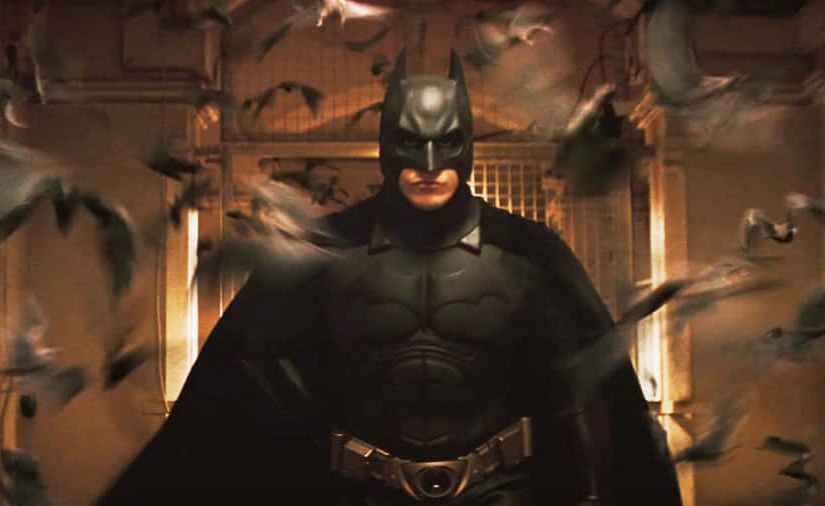
Batman Begins gets every note right with the all too familiar back story of Bruce Wayne’s drive to become Gotham City’s Dark Knight vigilante.  The film has its collection of villains but the center of the picture is always circumventing around Bruce Wayne, perfectly played by Christian Bale, with somber truth hidden by handsome playboy disguise.  As a child, he discovers his fear of bats and then attends the theater with his billionaire parents.  Upon their exit through a back alley, he witnesses their death and is left to be raised by his trusty butler, Alfred Pennyworth (Michael Caine, my favorite actor in the role to date).

This film achieves my undivided attention because it paints a full canvas of this character before he ever adopts an alter ego in a black costume.  We explore how he becomes motivated followed by his intense training in the zenith alps, on the Asian continent.  Then we see how he supplies himself with all of the familiar gadgets and costumes when he befriends an ally within his father’s company, Lucius Fox (Morgan Freeman). 

Jonathan Nolan’s script diverts away on occasion to embrace the capable villains of this story with the Scarecrow (Cillian Murphy), Rha’s Al Ghul (Ken Watanabe) and mob boss Carmine Falcone (Tom Wilkinson).  Bruce’s mentor, Ducard (Liam Neeson), is a big factor in the hero’s development as well.  Lastly, there’s Bruce’s childhood friend and legal connection, Assistant D.A. Rachel Dawes (Katie Holmes).  Lt. James Gordon is the uncompromised police detective that Bruce singles out to trust within this dense world of corruption.

Just to read this cast list is impressive as they fall beautifully within the matrix of Nolan’s blueprint.  Everyone is given enough time to make more than one impression as their storylines twist and alter.

Christopher Nolan’s films are always moving like a smooth ride on a never-ending stretch of road with no traffic in the way.  Nothing bears repeating from what was already shown in an earlier scene.  There’s something new to learn as the pace continues.  Nolan is one of the few filmmakers where you do not mind the time jumps he incorporates into his stories.  Bruce will first be seen as a ten-year-old boy, then in his muscular fit thirties in a Chinese prison completely departed from the wealth of Wayne Manor.  A step back before that shows him as a Princeton drop out with a mop top haircut.  Every different appearance of Bruce is interesting and you become intrigued with how he ends up in one place after another. 

Like the first appearance of Daniel Craig in the Bond series, this Batman/Bruce Wayne is repeatedly imperfect.  He’s flawed because he still needs to learn and the characters that enter and exit and reenter his life must teach him.  Alfred will lecture a short-triggered Bruce when he’s on the cusp of risking the reputation of his father’s legacy.  Rachel will slap him when he’s prepared to kill in cold vengeance.  Ducard will teach him the ways of physical survival and will test Bruce’s loyalty and the measures of crime with punishment.  Even the Scarecrow is smarter than Batman when he springs an unexpected trap.

The ongoing education of Bruce Wayne is the theme of Batman Begins, all the way to the end, when he finally learns to mind his surroundings.

Christopher Nolan made Batman exciting in a new unfamiliar way.  The Batmobile is a not a sporty kind of vehicle.  It’s a tank called The Tumbler and it bears a thunderous series of sound edits as it barrels through Gotham City.  After some slip and falls off rooftops, Batman becomes much more covert than in other interpretations.  You don’t have to physically see Batman to observe him operate.  If a thug gets swallowed into a void of darkness, you know what has ensnared him.  The crusader’s devices which stem from his gold utility belt are demonstrated with explained reason for why he selected them for his fighting advantage.  The Nolans proudly recognize the theatricality of this guy.

Cillian Murphy is unforgettable as he lives up to the name of Scarecrow, also known as Dr. Jonathan Crane, a criminal psychologist.  His choice to put his victims into a hypnotizing sense of fear lend to the back story of Bruce Wayne’s intent to become a frightening figure himself, where his enemies will recognize his dread.  Tom Wilkinson claws his gangster persona straight from a Godfather kind of picture, but he represents an old guard of Gotham City before costumed and makeup identities take over.  Gotham will transition from the sharp dressed mobsters over to the crazed clowns yet to come. 

Gary Oldman invents another unique personality – a strait-laced city guy who might have come from a 1970s ABC cops and robber show like Dragnet.  No two characters of Oldman’s are ever the same.  So much so, you almost wish they would all assemble in a movie for the various personalities to interact.  Morgan Freeman and Michael Caine are like comfort food who are so subtle and relaxed in front of a camera.  Neither one makes big waves with their characters.  Jonathan Nolan wrote their respective purposes for this Bruce Wayne and they execute their techniques of less is more beautifully.

Liam Neeson delivers the second-best performance of his career thus far, after Oskar Schindler.  He adopts the same kind of method that Freeman and Caine work with, but then he sways from that behavior when Ducard has to surprise Bruce as a means for his pupil’s development. Some of what he does comes from nowhere.  Early in the film, his first two scenes could not be more different.  Neeson works like an unpredictable entity.

The next film in this trilogy replaced Katie Holmes with Maggie Gyllenhaal.  I was disappointed because Holmes was maturing as a very formative actor by this time.  She was blessed with a well written character in Rachel Dawes.  When I watch the next film, The Dark Knight, I cannot help but wonder how she would have performed the role for a second and much more developed opportunity. 

There is not one flaw in Batman Begins.  This is the movie that placed Christopher Nolan in the echelon of top blockbuster directors like Spielberg and Hitchcock, along with Lumet and Mann.  Hans Zimmer’s soundtrack is thrilling as it speaks for The Dark Knight who is of few words.  Zimmer’s scores announce the introduction of Bruce Wayne first, and then later Batman. 

Gotham City makes for a sensational character with various rooftops, fire escapes, tunnels, bridges and a gorgeous, elevated train at its center.  The entire city breathes steam amid the distressed decay, wet streets and rusted architecture. 

Wayne Manor has a ghostly effect as Alfred and Bruce climb the large staircases and floors.  Further down under its platforms rests the cave that’ll serve Batman well.  The waterfalls and rocky caverns are immense. 

Batman Begins is not one of the best films of a genre like any other superhero movie.  I refuse to recognize it that way.  Instead, I see a character study where a man accepts a responsibility to fix what scarred him at a young age.  He wants to right a world that once had promise.  I don’t see the costumed protagonist announce himself as a superhero.  I don’t see the costume.  With the cape and the horns on the head and the car and the tools, I see an image, never a superhero.  With Christopher Nolan’s first film in what will become a well-received trilogy, I always see the man underneath the mask. 

BATMAN FOREVER

By Marc S. Sanders

Last month, upon hearing the news of Val Kilmer’s unfortunate passing, Joel Schumacher’s Batman Forever actively swept the social media rounds.  Fans of Kilmer praised his one and done occupation with the costumed role.  Some declared the film their favorite of all the superhero’s cinematic adventures and expressed their immense appreciation of the Juilliard graduate as Bruce Wayne and his vigilante persona.  He’s good.  Yeah.  I’m not going to say he’s great though because the film doesn’t offer much meat for Kilmer to chew off the bone.  As for the film, well, it’s a Joel Schumacher movie.  Should it be good?

The director took over the reigns from Tim Burton.  Michael Keaton opted not to return following two films and thus Kilmer was contracted.  The villains of the week are a very miscast Tommy Lee Jones as Two Face and Jim Carry doing a misbehaved class clown interpretation of The Riddler.  Unlike Burton’s noir approach, Batman Forever is gleefully campy and colorful with overly apparent winks and nods to Batman’s butt, codpiece and notorious chest nipples.  None of it necessary because it’s all wrapped in vinyl and plastic.  Buy the action figures if you want to cop a feel.

Akiva Goldsman was the head screenwriter.  His script carries no reluctance in delivering cliche dialogue.  “It’s the car right? Chicks dig the car!”  or “I’ll get drive thru.” (McDonalds was a proud sponsor.) Worse though are the two halves of the picture.  Kilmer’s Batman endures his ongoing traumatic psychosis of losing his parents, while Jones and Carrey go for a reiteration of the beloved Adam West slapstick TV series.  These two languages never speak to one another.  The hero and the villains hardly confront or challenge each other and never hold a substantial conversation during the course of the film.

Jim Carrey and Tommy Lee Jones try way too hard to duplicate what Jack Nicholson’s Joker portrayal memorably did the first time.  There is no backstory to Jones’ character except a brief news clip.  Otherwise, the middle-aged actor looks like he’s exhausting himself out of breath while trying to match Nicholson and Carrey.  As a Batman fan, he’s entirely wrong for this role.  The Two Face alter ego is the handsomely vain district attorney Harvey Dent.  According to comics lore, when Dent gets half his face grotesquely disfigured, he develops a deep-seeded anger to losing his looks and it leads to his ongoing villainy.  Tommy Lee Jones is a fantastic actor, but he is not the Adonis that Billy Dee Williams (Burton’s Harvey Dent) carried his charming career on.  The makeup job with Estee Lauder pink and purple is awful craftsmanship.

Jim Carrey is doing his usual schtick that skyrocketed his career with Ace Ventura and Dumb & Dumber, but it’s overly abundant here.  Goldsman, Schumacher and Carrey take equal blame.  This Riddler only offers three or four puzzles.  Otherwise, we get Carrey doing the Nicholson gags that should never have made the final print; a baseball pitcher tossing a curveball bomb in the Batcave and a mad scientist routine that drives the bad guy’s stupid plot line of using television waves to absorb the collective intelligence of the people of Gotham City.  The more this side story carries on the more mind numbingly stupid it becomes.  The Riddler’s device is nothing more than a kitchen blender that glows neon green while it hardly maintains balance on anyone’s head.  Junky production value.

Nicole Kidman is radiant as the next romantic Bat gal in line.  She’s so much better than this insubstantial material, though. She consists of zero significance.  Nothing else I can say.

Chris O’Donnell makes his first of two appearances as Dick Grayson, Batman’s sidekick known as Robin.  O’Donell actually has the most interesting storyline as a daredevil kid who tragically loses his family but can’t sit still when adventure awaits.  He gets into all kinds of mischief on his motorcycle and within the confines of Wayne Manor before he finally dons the famous costume. Yet, even when he’s standing in the same frame as Kilmer, both actors look like they are performing in different films.  One guy is hyperactive.  The other is morose and neither seems to be reading from the same script. Their chemistry is begging. Did these guys ever stop and develop an appreciation for one another?

Joel Schumacher applies a candy-colored polish to his Gotham City with black light graffiti, bright lights and more glow, glow, glow!!! Even the street gangs use neon glowing fighting sticks and Two Face’s henchmen work with neon red machine guns.  Oy!!! Enough.  Willy Wonka’s factory was not this sugary sweet.  Batman Forever is one film that can give you diabetes just by looking at it.

Other than an impressive opening scene with a helicopter and a cylindrical bank vault, none of the action sequences are worthy of postponing your bathroom break.  Batman’s fighting prowess and his ugly car and jet look like they are being run by an eight-year-old with his action figures.

So, as I noted before, I took another look at Batman Forever to explore what Val Kilmer did with the role.  He would have been a good Batman if he was given some things to do.  Ultimately, his dashing good looks complement Bruce Wayne’s suits and ties quite well and his square jaw fits perfectly in the mask.

What else can I say except I can’t imagine any chicks loving the car because this Batmobile has a pointless fin sticking out of the chassis and the wheels glow white, plus there’s an odd rib cage of lights on the sides of the vehicle.  Oh, and it drives up the wall of a building.  Is this where people are supposed to be impressed with Val Kilmer?

BATMAN (1989)

By Marc S. Sanders

If Warner Bros was to abandon the campy familiarity of the Adam West TV series, Tim Burton was the best candidate to deliver The Dark Knight into the macabre gloominess of a bustling crime ridden Gotham City.  Burton is proud of his grotesque weirdness which is what this famed comic book character demands.  

Despite a story that always teetered on flimsy to me, this close-out picture of the decadent 1980s, has so many elements that work. It begins with the marquee cast to the richly deserved Oscar winning hell on Earth art designs from Anton Furst to silly pop/funk samples from Prince and the orchestral score from Danny Elfman.  This is truly the film that put Elfman on the map.

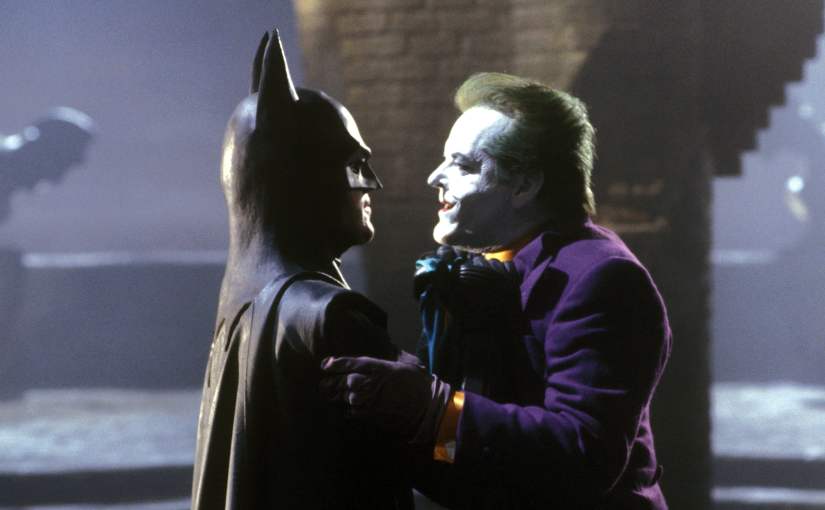
Jack Nicholson collected buckets and buckets of cash to bring Batman’s arch nemesis Joker to life.  He earned every penny.  There’s been copycat attempts (Hello Jim “Mr. Shameless” Carrey) to a handful of other interpretations of the psychotic clown, and still no one has overshadowed what Nicholson brought to the role.  His performance seems like a combined amalgamation of previous celebrated career roles from Easy Rider to …Cukoo’s Nest.  Prince served as his cheerleading entourage to compliment the purple and green color schemes.  This Joker is a perfect antithesis to the famed title character superhero.

Batman is portrayed by Michael Keaton.  Let the record show that when news broke of Mr. Mom occupying the part, I was not a skeptic.  I had seen the dark and dramatic side of the former standup comic a year prior (Clean And Sober, my review is on this site).  I knew he could pull it off.  His quiet pondering as either billionaire Bruce Wayne, whose parents were gunned down in front of him as a child, to the Batman under the cape and mask work on the opposite spectrum to Nicholson’s uncompromising insanity and hyperactivity.  

Keaton against Nicholson are a defined Yin and Yang.

The supporting cast have good moments too including the loyalty of Bruce’s butler, Alfred.  Michael Gough brings Wayne Manor alive and Burton, with a script from Sam Hamm, welcomes several spotlights from the expected council of the trusty character.  Kim Basinger is photojournalist Vicki Vale, Bruce’s love interest.  Frankly she has better scenes to share with Robert Wuhl as Gotham’s reporter.  The Batman fan in me stops short at Pat Hingle as Commissioner Gordon.  It’s not the actor’s fault however that the film offers little for him to do on screen.    Hingle never had much material to play with in the four films he occupied.  That’s regrettable.

The best supporting character is the setting of Gotham City.  With Burton’s penchant for a Vincent Price characterization, he relies on Anton Furst to bring the towering midnight blue steel, skyscraper pillars to enormous heights, reaching into the blackness of heaven.  Every street, alleyway, balcony, puddle, garbage can or mugger, policeman and cabbie that circumvent this city lend life to this hopeless, criminal world.  It’s astonishing how well constructed this Gotham is.  Designs go just as far with Wayne Manor, the underground Bat Cave and a chemical plant designed in hot steam,  with enormous barrels of rainbow, acidic liquids and rickety platforms. Even Vicki Vale’s apartment is gorgeous to look at as both Bruce Wayne and the Joker compliment it as having “lots of space.” Tim Burton and Anton Furst make certain the people who roam these environments are entirely aware of what they occupy.

Sam Hamm’s script doesn’t appear as solid as everything else on screen.  There’s never a cohesive beginning to end trajectory and a lot of the film feels like short story episodes.  Joker takes over the localized mob.  There’s that story.  Joker somehow concocts a chemical poisoning amid the various hygiene products.  Yet it only spreads to the local newscasters.  Gordon, Alfred, Vicki Vale, and certainly not Bruce Wayne ever gets exposed.  Once that storyline begins, it’s quickly disposed.  A little attention focuses on Batman’s beginnings.

The irony of Batman is that unlike other superhero films, this one does not hinge on an origin story for the good guy dressed in black.  That angle is devoted mostly towards Joker, and Nicholson makes the most of his large amount of screen time.  A favorite, sinister scene that maybe Edgar Allen Poe might have approved of is Burton’s invention for Joker to gradually reveal himself beneath the darkness.  He’s depicted sitting in a dirty office basement with an underground cosmetic doctor who witnesses a transformation in the gangster turned madman.  I just like it.  It’s hair raising.  The moment plays like Poe writing a new version of The Mask Of The Red Death.

For me, this is likely Tim Burton’s best film, just below his passion for detail in Ed Wood.  Batman offers up a lot of variety ranging from the darkness of the character to the disruptions revealed in the antagonistic, loudly dressed, Joker.  

There’s no denying how visually memorable the film remains and how quotable it is as well.  In 1989, when superhero movies were not the event release commodities they are today, the endless hype only enhanced the experience of finally seeing the movie on the big screen.  Over a year ahead of release, t- shirts, caps, action figures and costumes were of the highest demand among kids, teenagers and adults.  I actually miss the marketing blitz that overtook the finished film product.  Everyone you encountered was embracing Batman and Joker.  These might be pop culture phenomena, but they created a commonality among the masses of the world.  Batman was worthy of all its swag and endless mania.  It was a celebration of movies for people of all ages to take seriously.

Fortunately, the first half of the 1989 promotional partnerships were never squandered on a decidedly terrible movie.  The end product was immensely satisfying.

Tim Burton upheld his dedication while still a young director in a cutthroat and competitive industry.  As the later films, from a careless Joel Schumacher, demonstrated, it takes an endearing kind of passion to pull these eccentrics off on a silver screen.  Fanboys will happily toss that Bat logoed t-shirt away if they feel betrayed by the movie, they couldn’t wait to sink their teeth into.

An enormous sigh of relief came across the entire pre-internet world.  Keaton is great.  Nicholson of course.  Check out the Batmobile and Bat Jet as well!!! Prince’s music videos served as free commercialization to see the movie over and over again.  A separate record was released to highlight Danny Elfman’s work.

Rightly so!

The grand scheme of delivering Batman and Joker to audiences, was worth every second of the wait.

An astounding achievement of near perfect filmmaking, this Batman film was never overshadowed even with a better, leaner Dark Knight interpretation to arrive nearly two decades later.

Right this way Mr.  Nolan.  Your table is ready for you.

JOKER: FOLIE à DEUX

By Marc S. Sanders

Joker: Folie à Deux is an unnecessary sequel.  A lethargic bore.  That is its one problem, and it infects the merits the film clings to but never gets off the ground.

It amuses me, with a pinch of vitriol, that at the closing credits the picture is said to be based on characters published in DC Comics.  My perspective still stands as it did with Todd Phillips’ first film.  These characters are not consistent with any variation that appears with any superheroes/super villains who occupy the assorted comic books.  It is especially true in this new installment.  Just because the players are named Joker, Harley Quinn and Harvey Dent does not translate to where these folks stemmed from.  Joker: Folie à Deux stands on the shoulders of a hot, pop culture, geek property simply to bank on the residuals.

This sequel picks up two years after the original Joker left off.  Arthur Fleck (Joaquin Phoenix, returning to his deserved Oscar winning role) is imprisoned and awaiting trial for the murder of five people including the famed talk show host he shot on live television.  He’s abused both physically and verbally by the prison guards led by actor Brendan Gleeson, who is a better actor than this unoriginal dreck has to offer.  His attorney played by Catherine Keener believes in upholding a defense by reason of insanity.

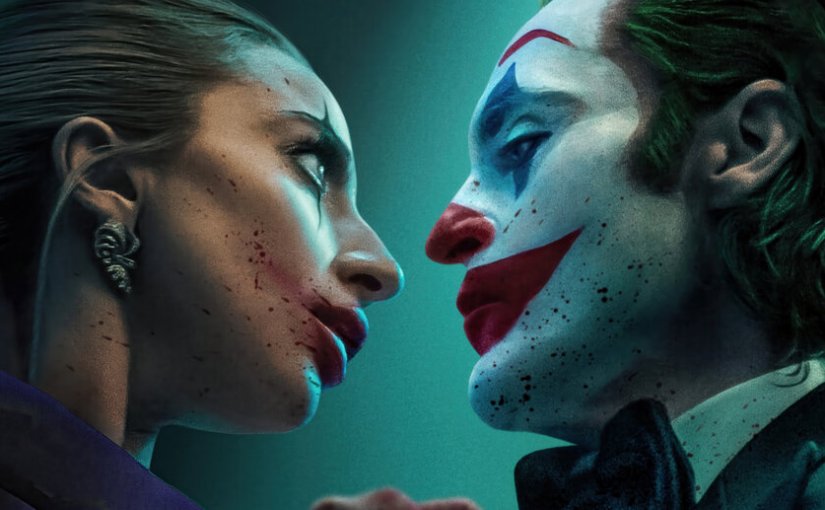
Arthur normally keeps quiet while endlessly smoking cigarettes (boring stuff). Everyone else talks.  None of this goes nowhere for a very, very long time.  The one positive that enters his life is a fellow inmate named Lee Quinn played by Lady Gaga, another actor worthy of better material.  Lee is being held for setting fire to her parents’ house.  The two develop a quick kinship.

Within his psyche, does the clown image of Arthur’s Joker personality let loose in morose song and dance performances with Lee, also known as Harley.  Uplifting musical montages of classic numbers would normally invoke toe tapping cheerfulness.  Yet, that is not what happens for this disturbed man. Numbers like That’s Entertainment, Get Happy, and What The World Needs Now are given somber and depressing interpretations for these sad sack clowns to sing.  Singer Lady Gaga is not belting out the numbers.  Rather, she puts on a weakened, hoarse inflection to her performance.  Joaquin Phoenix works in tow with his co-star. YOU HAVE LADY GAGA!!!! YOU HAVE JOAQUIN PHOENIX WHO CAN ALSO SING (Walk The Line)!!!!! WHY WON’T YOU LET THEM REALLY, REALLY SING??????

The overall problem with Joker: Folie à Deux is that it remains very stationary.  Director Todd Phillips and Phoenix will set up a performance scene with building intensity of the original score.  You hear the treble of the string instruments build and build.  The camera will zoom on Arthur while signing a book or smoking cigarette as he gets taunted, and you think the animal inside is going to unleash, but then it doesn’t and the moment pancakes flat out.  Nothing means anything in this picture, and it looks like the script is being made up as the film goes along.

About halfway through the movie, the Catherine Keener character is simply dispatched from the film altogether with one line, never to be seen or focused on again. I guess this is supposed to be an impactful moment, but it seems to occur because the screenplay by Scott Silver and Todd Phillips had a bout of writer’s block and decided to “let’s try this!”.  I got to know this person, only to realize she’s pointless.  This is what an edit looks like within a finished product. 

The difference between this film and its predecessor is the Arthur Fleck character actually does not appear in every single scene of the movie this time.  The last film focused on Fleck’s internal struggle with an alternative personality and the cruel world he’s forced to live in.  This film seems to observe Arthur as a subject from the outside.  I believe Joaquin Phoenix has less dialogue this time as we get to hear from his attorney and the prison guards and Lee, and how each of them respectfully perceives Arthur.  So, I credit the film for going in that different direction.  It’s an alternate narrative.  Yet, there’s no advance in Arthur’s plight or story development.  The film just meanders and meanders.  You’d be drunk about ten minutes after the movie begins if you paced yourself by how often a cigarette is lit.  At the very least, Phoenix and Gaga could have exhaled smoke rings for a little fun.  Only Big Tobacco will be this film’s biggest fan.

Look there’s Harley Quinn!  Look there’s Harvey Dent!  He’s the one that becomes Two-Face, right?  Ha!  They said the word Gotham.  Oh, and check it out!  Arthur and Lee are being held at Arkham Prison!  Hold the phone!  Did I hear that witness’ last name is Kane, as in Batman creator Bob Kane? 

So what?

If you are seeking another DC Comics vehicle, look further please.  Joker: Folie à Deux is a possessor of someone else’s intellectual property and the film should surrender it.  Name drops from the universe of Batman does not constitute another variation of the celebrated Clown Prince of Crime.  As good as Joaquin Phoenix’ performance was in the first film (here, in the second film it is nothing special, just the same old same old), his Joker does not belong anywhere in the fraternity house that is shared with the likes of Romero, Nicholson, Ledger and yes even Leto.  Lady Gaga is doing the best she can here.  Beyond the sleepy song and dance numbers, this role is not up there with some of her other memorable performances though.  She is Lee, but she is not Harley Quinn.  No one will remember Lady Gaga for this film.

The original Joker was a box office smash that truly hinged on a very special and impressive performance from Joaquin Phoenix.  It also relied on the Joker label which Hollywood will never have enough of, despite Batman’s impressive vastness of villainous rogues.  That first film garnered a worldwide box office of over a billion dollars.  It stands to reason that Warner Bros would demand a follow-up film for more bucks to stuff under the mattress.  Whatever this new picture earns is not merited on anything but the theft of the brand names it incorporates.  This is a shameless cash grab that surges only to the top of that uncelebrated list. 

I recommend movie goers find a real Gotham City to step into.  Joker: Folie à Deux takes you on an endless detour you can’t find your way out of.

SUPERMAN II

By Marc S. Sanders

It’s time for the man in the red cape and blue tights to fall in love with Lois Lane, but wouldn’t you know it?  Three Krytonian criminals possessing the same powers as our hero have arrived on Earth with a means to dominate the planet and exact revenge on the son of their jailer.  Superman II picks up where Richard Donner’s original 1978 smash left off.  It remains a fantastically fun and breathless sequel.

Richard Lester (A Hard Day’s Night) gets the directing credit on this film following one of Hollywood’s most infamous behind-the-scenes stories.  While I’m a big admirer of Donner’s body of work, I think it was a blessing that Lester finished the job.  I’ve seen what Donner was intending to do on a special Blu Ray cut, and it just does not work. The characters make odd choices that seem inconsistent with how they were perceived in the first film.  That’s all I need to say about that comparison right now, though. 

In the original theatrical release, the story expands on the relationship between Superman & Lois (Christopher Reeve, Margot Kidder) as well as Clark Kent and Lois.  Eventually, both relationships intersect with one another, and Lois realizes the man she’s been admiring and the one she hardly takes notice of are one and the same.  The problem for Superman, known by his krypton name Kal-El, son of Jor-El, is if it is acceptable to be intimate with an earthling. 

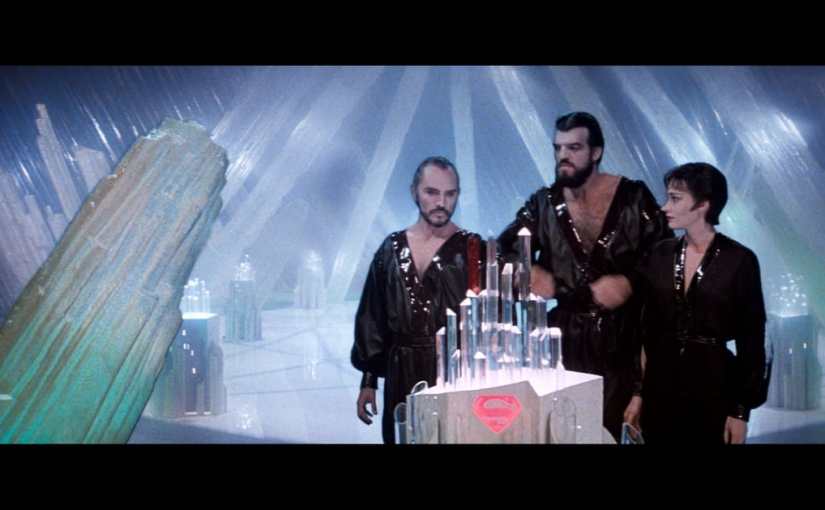
Meanwhile, Lex Luthor (Gene Hackman) has escaped prison to entice three villains from Krypton into a partnership that will allow them to take over the Earth and destroy Superman.  The trio is led by General Zod (Terence Stamp) with the wicked Ursa (Sarah Douglas) and the mindless and mute Non (Jack O’Halloran).  Following their attack on Houston, or as they call it the “Planet Huuston,” and the White House, it is on to Metropolis in search of Kal-El.

I’ve offered up quite a bit of what Superman II provides and I am not even close to sharing all it’s adventurous features and character dynamics.  This is a solid picture all the way through, and it begins with the casting.

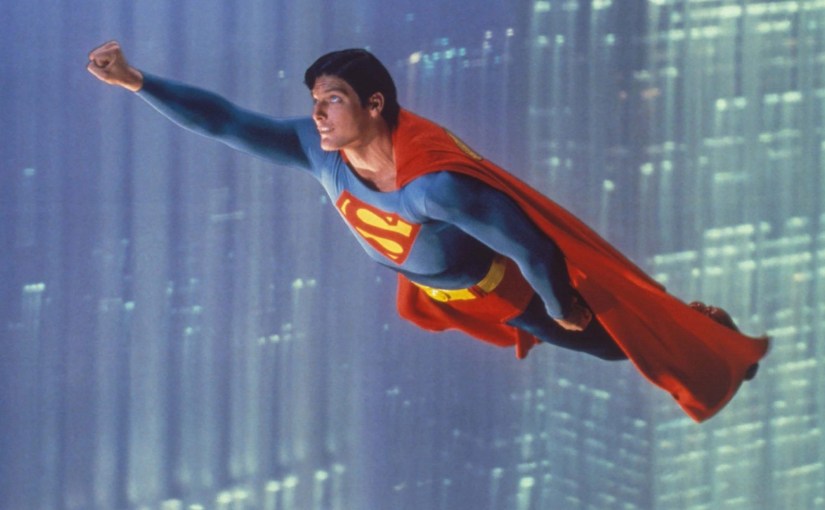
I’ll be bold by declaring that Christopher Reeve as Clark Kent/Superman is one of the best casting decisions in film history.  Think about this for a moment.  As good as Henry Cavill was in Zach Snyder’s films, thirty years later, and how well some of the WB iterations have been, the contrary point that most people make is that none of them are Christopher Reeve.  From the smile, his handsome face, clear voice with perfect enunciation and even the signature hair curl over the forehead, no one has looked as good as a superhero come to life better than Mr. Reeve.  When he’s flying, even with outdated visual effect backgrounds, you are still convinced that Christopher Reeve knows exactly how to fly.

Following the director shake up on this picture, it is said Gene Hackman refused to shoot some scenes or do follow up edits.  You can tell when there is a double in place for him and you can hear the different vocal sound bites from Lex Luthor.  Nevertheless, what survived from Hackman’s participation is silly and twisted like you would expect from a modern-day, dastardly villain or as he declares himself to be “the greatest criminal mind of our age.” Some of these lines look hokey on paper, but Hackman invests his showmanship once again in the character.  I love it.  On all of those top ten lists, Gene Hackman as Lex Luthor is the one that everyone is regrettably forgetting about.

Margot Kidder is just as committed.  Lois Lane is best when she is the go-getter and Kidder is thoroughly convincing at not just being seen in the stunts and action but actually performing through Lois’ fears, sense of daring, and adoration for the love of her life.  Near the beginning of the film, there’s a great close up of Kidder looking up into the heights of the Eiffel Tower as Superman flies a hydrogen bomb out of danger.  No dialogue, but you can read it all over Margot Kidder’s face.  There goes my hero.  Watch him as he goes.  Few love interests in superhero films have ever matched what Margot Kidder accomplished in these pictures.

The action scenes are great set ups.  I get a chill down my spine every time I watch the showdown in Metropolis between the three baddies against the man in blue and red.  However, Richard Lester never neglects the acting throughout the whole two hours, particularly by the leads, as well as the Shakespearean maniacal performances from Stamp and Douglas.  Furthermore, the extras throughout Metropolis, Houston and even in Niagara Falls are performing very well and therefore turning the various settings into characters themselves.  Just as the fight over Metropolis is to begin, a cabbie declares “Man, this is gonna be good!”  Isn’t that guy speaking for the audience?  I remember the room applauding in the theater at that line.  When Superman rescues a child in Niagara Falls, a woman utters “What a nice man!” Clifton James, from a couple of James Bond movies, resurrects that redneck persona and it works better here as the guy who clashes with the imposing new visitors.  All of these walk on characters further shape the purpose of the visitors from space.  None of it depends on B-movie tripe like declaring “Peace!”  The personality of the folks meet the strangers from a strange land.  Sometimes it is done for means of slapstick, but it is always very entertaining.

Superman II is a perfect complement to the original film thanks especially to the cast.  Reeve gives multiple performances of Clark and Kal-El that could not be more different.  Kidder takes her character in new directions upon learning the surprises the script has in store for Lois.  Hackman is doing the same routine, but fortunately it’s welcome because I can not get enough of his antics.

This sequel really set the bar high and the next installments for Reeve came nowhere close. Though I actually have an affection for Superman III with that internal struggle depicted in the junk yard scene; one for the ages. 

The first two movies are legendary and Warner Bros/DC films realize they still have not superseded what was done over forty years ago.  The studios are not trying hard enough. However, more to the point, the filmmakers back then got it absolutely perfect, and you cannot beat Superman, nor can you beat perfection.

BLACK ADAM

By Marc S. Sanders

Black Adam has to be the first superhero movie that apologizes for the mind numbingly stupid two hours you just endured, by offering up an enticing ninety second end credits scene.  That’s all that this headache inducing piece of noise has going for it; the end credit scene.  The film is so headache inducing that I’d rather be serenaded with a duet performance of a car alarm and a leaf blower singing a rendition of a song I’ve always despised, like Red, Red Wine.

About twenty minutes into Dwayne Johnson’s debut into the DC Cinematic Universe, as the title character, I reflected on Raiders Of The Lost Ark from 1981.  Remember when the government suits ask Indiana Jones about the significance of the Ark Of The Covenant?  It took three minutes to sum up what was at stake, what the hero was going after and who he was expected to be up against.  That’s it.  After that, the piece was constructed to offer up one kind of stunt or action sequence or visual effect after another.  The difference is that everything you saw served its story and thus carried on the pursuit. How I long for the days of intelligent writing.

Black Adam tries at least three times over the course of two hours to explain brainless conjecture about an ancient city where its inhabitants dig for some powerful element, called Eternium, at the behest of their harsh ruler.  Then there’s something about a crown and a slave boy who comes into play.  Later, I think his father is mentioned, but I was nodding off by then.  I’m only mad at myself for focusing more on inhaling the contents of my popcorn bucket rather than getting invested in a movie.  My mission was no longer to maintain an interest in this big budget comic book tripe.  Now, I was destined to get to the bottom of my overly priced snack food container.  This is not why I go to the movies, people!

When the movie is not talking (which hardly ever happens), it is pounding at my cranium with horrible CGI dust clouds and lightning bolts that offer up blindingly, irritating sights and bombastic sounds.  My eyes hurt.  My ears hurt.  Light a firecracker, drop it in a tuba and blow.  It’s likely more soothing to the senses.  For surround sound, turn on your garbage disposal with your car keys in it.  It’ll all be much more harmonious and pleasant. 

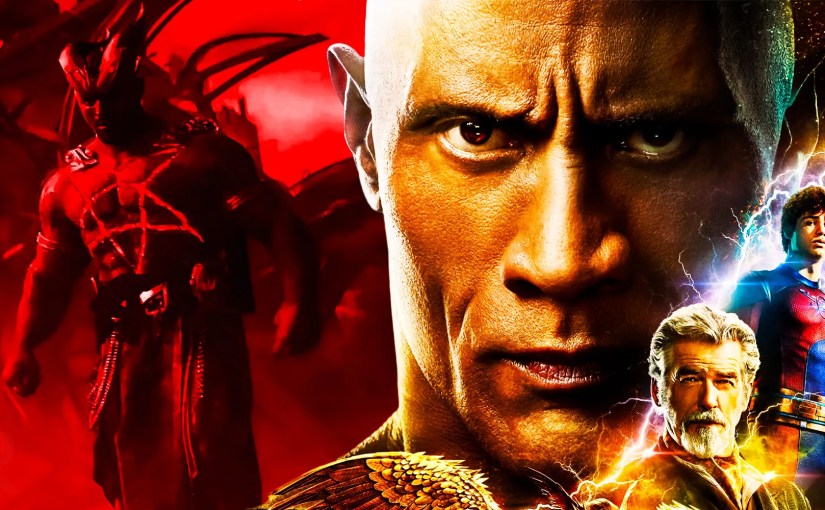
What little I know of Black Adam is limited to a scant few comic book images.  Long before I knew of Dwayne Johnson, it seemed inevitable that only this guy could play the part.  It’s an uncanny resemblance.  No one else can play this role.  The supporting cast is promising, especially a sophisticated and well-aged Pierce Brosnan as the one with sorcerer like powers.  His Dr. Fate is maybe DC’s equivalent to Marvel’s Dr. Strange.  Aldis Hodge is Hawkman, and he looks absolutely confident in the guise with outspread bird wings and a kick ass helmet and spiked ball on a staff for a personal weapon.  A guy named Noah Centineo is the Atom Smasher.  He’s cute enough to fill the void for Ezra Miller when he eventually gets fired from his cushy gig as the Flash.

So, I don’t get it.  Warner Bros and DC assemble a terrifically talented cast who not only look good in the costumes, but can act with timing as well. Yet, they give them nothing to do but be digitized in terrible CGI that makes the Hanna Barbera Superfriends cartoons look like breakthrough technology.  Everything looks terribly animated in Black Adam, and therefore it’s as boring as a church sermon that won’t end because the minister is overindulging in chastising you for cheating on your diet.  Johnson on the big screen flying up to the top of a towering monument looks ridiculous, like an ¾ inch action figure next to a life size kitchen refrigerator.  I’m supposed to believe that’s Dwayne Johnson up there?  Probably because Johnson was not in the image, or if he was there, he had no concept what he was supposed to be looking at.  Captions like this happen multiple times here, but they are all devoid of emotion or depth.  The statue itself looks unfinished by the effects wizards.  There’s hardly any detail to it. What’s it supposed to signify?  I completely bought it when Christopher Reeve flew against the skyscrapers of Metropolis way back when.  In today’s age of films, this movie takes about a hundred steps back in progress.  Everything looks artificial.  Nothing looks convincing.

Black Adam is also unsure of a well contained story.  I’ll take no issue with the movie being episodic if that’s what its intention was meant to be.  First the main character is fighting a military that stems from I don’t know what organization or country.  They fire rockets and machine guns at him.  Does nothing.  So, what do I care?  Then he’s fighting the other super heroes in the picture.  They pound each other into the desert streets and dust clouds heighten into the earth.  What’s to be gained from any of that? Black Adam then fights a gang that looks no more threatening than a lame motorcycle posse.  Eventually, he’s battling some kind of CGI devil monster who needs a cough drop.  This guy mustn’t sit on the throne located at the top peak over the city.  If he does, all hell breaks loose and blah, blah, blah.  This is like watching a lame CW TV series crammed into two long tortuous hours.  How does this movie go from here to there and then over there and end up wherever?  I gave up trying to string it all together.

It’s ridiculous how dumb Black Adam is, especially when you consider how much thought went into a ninety second epilogue teaser before you leave the theatre.  I’m sorry but I expect these filmmakers and studios who harbor these big budgets and hype to work on the same level of imagination and craft as a Steven Spielberg or a Christopher Nolan.  Nolan reinvented the Batman franchise.  He took his time to flesh out character motivation while painting a scenery for his own flavor of Gotham City.  Marvel did this as well when Jon Favreau was wise enough to follow a Spielbergian trajectory with the original Iron Man.  Kevin Feige often has not broken the formula since, because it succeeds.  Black Adam neglects all of these techniques.  Its lack of any quality is traitorous towards its consumers.

I don’t recall a conversation among the characters that lasts longer than four sentences.  By the end of the film, I’m not sure if Black Adam is a bad guy or a good guy.  I don’t know what was resolved to tie up the picture.  I don’t know when the turning point occurred, and Black Adam got an upper hand over anyone he does battle with.  Actually, he’s never challenged or weakened.  So, where’s the suspense?  What stakes are at play?

Black Adam functions as an eight-year-old kid in his room with his toy action figures.  They crash into another and the child makes a “pshoosh!” sound with his duck face lips.  I expect eight-year-olds to just enjoy their play things.  They don’t have to focus on exposition for themselves or anyone else.  Let them escape.  However, I didn’t pay to watch an eight-year-old play on the floor with his toys. 

The failure of this movie is inexcusable.  It angers me that filmmakers with unlimited resources and a wealth of source material are not trying harder like some of their industry peers.  It’s unfair to movie goers to pay for junk primarily assembled on a Dell computer with a wireless mouse.  Coloring books have more texture than this finished product.

Black Adam is a treachery in any context of the word, filmmaking.  It’s not art.  It’s not fun.  It’s nothing more than shit turned white.  It’s not fresh shit.  It’s worse.  It’s rotten shit.

BATMAN RETURNS

By Marc S. Sanders

I’ve always been a little hot and cold with Tim Burton’s films.  They are beautifully constructed in set and costume design, always well cast with exceptional talent and composer Danny Elfman’s music accompanies perfectly with Burton’s wide collection of social misfits and altogether celebrated weird material.  Still, more often than not, I leave Burton’s movies feeling less fulfilled than I want. Tim Burton’s one sequel film to date, Batman Returns, is one such example. 

To commemorate the annual Batman Day, I opted to watch Burton’s return to the murkiest of comic book locales, Gotham City, where Michael Keaton reprised the role of billionaire Bruce Wayne who dons the costume of The Dark Knight.  This time the villains of the week are the grotesque Penguin (Danny DeVito) and the sexy, dominatrix like Catwoman (Michelle Pfeiffer). 

Penguin resurfaces from the sewers of Gotham 33 years after his parents abandoned him as an infant, depositing him into the city reservoir in a bassinet to be raised by…you guessed it…penguins.  (Schools of penguins reside in the city sewers???? I guess it’s better than rats.)  Nerdy and mousy Selina Kyle is raised from the dead by the gnawing and licking of random alley cats to take on a warrior persona for Catwoman.  How exactly a feline resurrection works in either myth or science is never explored.  I guess I just have to go with it.  The manipulator behind these villains’ actions is a wealthy industrialist named Max Shreck, portrayed by Christopher Walken.  I was never sure of his stake here.  I’m only supposed to understand that he’s unlikable on the surface and he is not good for Gotham. 

I love all these actors.  I love them in these roles.  I do not love the script doled out for them though, which serves none of them well.

Batman Returns is best when the Batmobile or the Bat Glider is on screen.  They are awesome pieces of hardware to see in action as much as any tripped-up James Bond vehicle.  However, these are props.  They don’t speak, or laugh, or cry, or get angry.  Therefore, they don’t drive or develop a story.  When Luke Skywalker pilots an X-Wing Fighter, I care about the pilot.  The pilot speaks for the vehicle.  Batman doesn’t speak for the Batmobile. 

It’s ironic that the title character has only one sentence of dialogue in the first 30 minutes of this two-hour film.  There’s no dynamic to Batman or Bruce Wayne.  Keaton looks great sitting by his fireplace in deep thought or watching his television as the bat signal beams upon him.  He stands, and then when we see him next, he’s sitting in his bat car in full horned head regalia.  Otherwise, the Batman character is a prop to be used for scapegoat tactics by Penguin, Schreck and Catwoman, or he’s present to hurl a bat gadget, or throw a stiff-arm punch.  He doesn’t even do much of that stuff, anyway.  In Batman Returns, I learn nothing new about Batman or Bruce Wayne or his crusade to protect Gotham City.

Keaton shares one good scene in the film with Michelle Pfeiffer. It may be the one scene with a story to it as the two are dressed down from their comic book evening wear to dance slowly at a masquerade Christmas ball where they gradually realize who they are when they are not with one another.  Of course, we know this should be so obvious, yet a rule of thumb for comic book literature is not to realize what’s right under your nose.  A nice touch to this scene is having Keaton and Pfeiffer be the only guests not wearing a mask while everyone else is.  Batman and Catwoman have in fact dressed up as someone else for the costume party.  Very ironic and almost clever.

Too much material is given to Walken as the conniving Max Shreck.  Walken performs well, but just like his Bond bad guy in A View To A Kill, he belongs in a different movie.  The Schreck character lends nothing to this Batman adventure.  Who’s interested in this guy?  McDonalds and the other merchandising companies could even see how unattractive this character is.  So, why couldn’t Tim Burton or his writers and producers?  I’ll pay you a gazillion dollars for your rare, never manufactured Max Schreck action figure.  Yet, the bland script from Daniel Waters and Sam Hamm arguably provides the most dialogue to this guy.  You’ve got Batman, Penguin, Catwoman, even Alfred the butler and Commissioner Gordon, and yet this grey-haired guy with a wolf like pompadour in a bland, black business suit is hijacking a Batman movie.  Makes no sense.  Much of Batman Returns is made with cutting room floor material taped together featuring an unwanted Christopher Walken.

Who else is better to play The Penguin than Danny DeVito?  No one!  So, it is disappointing when the squat actor has nothing to do.  A seemingly inspired storyline from the campy Adam West TV series, and maybe a handful of comics, have him running for Mayor of Gotham.  A good start, but then the script does nothing remotely interesting with it, even though this stuff sells itself.  Where’s the political jokes to parallel the campaign? Where’s the ridiculous podium debates?  Imagine Penguin kissing little old ladies and holding babies while on a campaign trail.  None of that happens here.  You have outstanding talent from DeVito and yet all he’s left to do is ride around in a duck boat, spit out black and green sludge goo, and scream frustrations in a groggy, ear-piercing bellow on more than a couple of occasions. Unlike Jack Nicholson before him, DeVito is abandoned to play scenes with no dialogue while he chomps on raw fish or screams for the sake of screaming. 

An error in judgement was layering the actor in ugly makeup and unattractive costume wear.  Usually, DeVito is seen wearing a stained and damp white footy pajama suit with black dental pieces and very black eyeshadow on a whited out facial texture with a giant hook nose.  This is Danny DeVito.  He already looks like The Penguin.  If it ain’t broke, don’t fix it!  The only charming accessories are his top hat and his collection of umbrellas (shooting fire or bullets or flicking out knives) that serve as exclamation points on dialogue when a jokey punchline could not be considered with even just a smidgen of effort from the writers.  The umbrellas were more expressive than the guy operating them, and yet even they were hardly used in any action scenes.

Batman Returns has some sloppy scene cuts as well.  A scene will appear with Catwoman skipping through a store, then it’ll jump to Batman punching out a few circus clowns, then the two meeting up on a rooftop somehow.  Why, where and how did this all happen?  The math doesn’t add up.  Penguin will somehow appear within this stitchery too.  For what reason?  Three movies are happening here and none of them are communicating with one another.

Films like the original Batman, or Edward Scissorhands or even Pee Wee’s Big Adventure carry the weirdo trademark of Tim Burton.  I know what I’m getting when I turn on almost any one of his films.  (Ed Wood being the surprising, and pleasing biographical exception.)  These are gorgeous, macabre films to look at, whether they are dimly lit or staged in deliberately bright and gaudy rainbow colors.  Yet, there are often scenes or moments that lack that hook that carries you from the exposition to the acclimation I normally get from the universe on screen before my eyes.  Batman Returns especially lacks that transition. 

Because the film looks so good, it is not the worst of the Dark Knight’s many films.  Yet, it is an uninspired and disappointing piece.  Any film with such storied and legendary characters as these is going to be a big letdown if they are given nothing to do.  Why, oh why, did they give almost all of the lines to the boring guy in the business suit?  If I wanted to entertain myself with an accountant, all I needed to do was sit in the lobby of an H & R Block.

SUPERMAN: THE MOVIE

By Marc S. Sanders

Richard Donner’s Superman: The Movie is one of the best biographical films of a fictional character ever made.  Yes.  It absolutely is a biography.  How can you call it anything but?  The visitor from the planet Krypton is embedded so deeply within the lexicon of worldwide pop culture and historical significance that he rests within all of our subconsciousness.   When we think of ongoing problems in the world from natural disasters to destructive wars or famines and disease, or to even kittens stuck in trees, for a split second we all consider how simple we could go on with our lives if only Superman were here to rescue us. 

By 1978, forty years after Joel Siegel and Joe Shuster created the character, visual effects were at a more than adequate level to convince us that a man could fly. Thus, the man with the red cape was ready to appear on the big screen.  With creative input from writer Mario Puzo, Donner’s film goes through various stages of life from when the extra terrestrial is a new born baby, to a toddler, then a teenager and on to a thirty something adult.  While living on the planet Earth, his powers may make him virtually invincible, but he’s far from godlike.  He cannot prevent the unforgiving nature of death.  He can’t be everywhere all at once.  He can’t even perform on the same level as his colleagues or friends, who are skillfully beneath him.  It would be unfair to have Clark Kent on your football team.

To watch Superman is to see a mini-series over a span of nearly two and a half hours.  We begin on the white crystal planet of Krypton featuring one of the greatest actors of the twentieth century, Marlon Brando, cast as the father of the superhero to be.  Brando is Jor-El.  He serves the planet as a prosecutor and a political leader with an expertise in science.  He’s championed for his knowledge, but he’s also challenged by his peers when he is certain of his planet’s demise. Thus, he must release his newborn son, known as Kal-El, into the far reaches of space to survive.  The script here takes an almost Shakespearian approach in debates of facing inevitability.  Brando’s authoritative screen presence is perfect here. 

Kal-El moves on to Earth, particularly Smallville, Kansas, and the nature of the film changes personality.  1950s Americana becomes our main character’s environment with endless plains of crop fields and farm land as Kal-El becomes identified as Clark Kent, the teenager who develops a crush on the high school cheerleader and gets bullied in the process while he must deliberately withhold all that he’s capable of by influence from his adoptive parents (Glenn Ford and Phyllis Thaxter).  Life for any of us is never complete until we experience the death of a loved one and Donner showcases that here to demonstrate that Kal-El/Clark can not prevent what’s meant to happen when biologically our bodies shut down.  Not even a super man can save us. 

Clark reaches age 18, usually perceived by most as a turning point into adulthood and through a means of Krytonian process he’s educated until his thirtieth birthday upon the rules and boundaries he must function within while on Earth.  He learns of his ancestry and then Donner changes the setting of his film once again into the furthest extreme from quaint Smallville. 

We have transitioned to sprawling Metropolis where Clark works as a mild-mannered reporter at The Daily Planet.  Christopher Reeve plays Clark/Superman and there was no one who could have filled the role better.  Physically, Reeve is the example by which all super human character portrayals still look towards.  Yet, the Julliard trained actor performs the dual personality so well.  When he dons Clark’s glasses you feel as if you are looking at another actor from when he’s dressed in the blue and red costume of Superman.  His posture and voice inflections are so distant from each character he’s playing.  Christopher Reeve was a stellar actor of versatility. 

In Metropolis, we are also introduced to an impure villain, Lex Luthor (Gene Hackman, who never got enough praise for this role) focused on greed and individual power for him to consume at the expense of everyone else on Earth. 

As well, just as life must bring us towards the experience of loss, it also must introduce us to love in the form of Lois Lane. Margot Kidder does a magnificent job of the hustle and bustle career woman with a sense of romance and need for ongoing adventure.  A reporter’s life will only give you that some of the time.  Superman will let you live that every day.  In life, we all start with valuing one person in our lives beyond our immediate family, and Lois serves that purpose to Clark’s perspective. 

Donner takes advantage of comedy and slapstick when Metropolis comes into play.  It’s not as polished as Krypton.  Nor is it as calm and reserved as Smallville.  Again, the personality changes.  Reeve plays Clark as a persona of the inept and gullible newcomer nerd to hide his powerful alter ego.  Hackman’s Lex is accompanied by Ned Beatty as a bumbling sidekick to play off of. (This same actor was a frighteningly powerful and intimidating corporate CEO in Network just a few years prior!) Valerie Perrine holds her own against Hackman as Lex’ alluring dame to have a tete a tete of sarcasm with. Kidder is the leader of Metropolis’ populace always on the go so much that she’s not even aware of her insensitivity to poor Clark.  A great gag is that as a good as a reporter as she is, Lois has terrible skills in spelling.  (There’s only one p in ‘rapist’.)

Maybe you’ve never seen Superman from 1978, or maybe it’s been too long since you last took it in.  It remains a watch that’s worthwhile.  Donner’s film covers so much of this one individual’s life that also includes two separate ancestries.  I get hot and cold on biographical films, sometimes.  It’s a tough scale to measure.  Sometimes filmmakers don’t show you enough.  I thought the film Ray, ended too suddenly on its depiction of Ray Charles.  Sometimes, it’s an overabundance of material.  The Last Emperor and Chariots Of Fire seemed to never end, and became mired in long, drawn-out, sleep-inducing pieces of dialogue.  Superman allows just the right amount of time to live within these different parts of Kal-El/Clark Kent/Superman’s life that you get familiar with who the main character encounters and how he responds to those around him. You also witness how these environments respond back to him.  You get a sense of what he stands for and where he feels insufficient and where feels strong and secure, as well as valued by others. 

It might be crazy to believe, but biographical writers and filmmakers should turn towards Richard Donner’s film for an outline that perfectly establishes every scene and moment that’s cut into its mold.  Superman: The Movie?  When I want to tell the life story of Golda Meir, or Barack Obama or Joseph Stalin or Jesus Christ?  Yes, Superman.  If we are crazy enough to follow the exploits of a man who wears a cape and flies through the sky, then why can’t we believe he can provide the answers to the great mysteries of life better than any of us?

THE BATMAN (2022)

By Marc S. Sanders

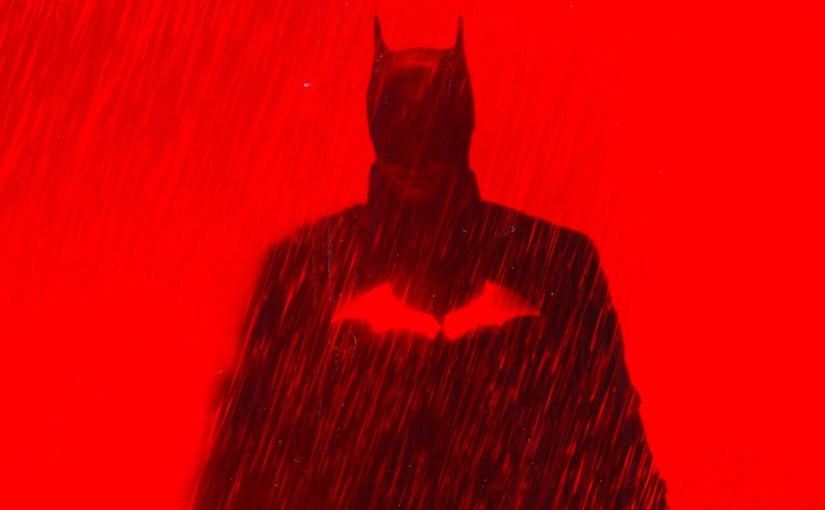
Another year at the movies, means another trip to see Batman on the big screen.  I think we are close to a dozen iterations, no?  Fortunately, the latest reinvention for March 2022, The Batman, is a refreshing interpretation that focuses on the detective skills of the masked vigilante hero who prowls from the rooftops of Gotham City.  Matt Reeves has written and directed a gripping and engaging film that doesn’t rely on simple paint by numbers.  He’s capitalized on using the mysterious Riddler (Paul Dano) as the main villain here, and Batman’s (Robert Pattinson) brains get more exercise than his brawn.   

It is the second year since Batman has introduced himself to the crime ridden city.  The man behind the mask, Bruce Wayne, keeps a journal of his exploits and observations, and through voiceover he questions if his actions have benefitted since it appears that crime has only increased since his first appearance.  A serial killer is taking responsibility for the grisly deaths of important people within the city and he’s leaving greeting cards for “The Batman” with a common scribble of “No More Lies,” along with a “?,” and a riddle for The Batman to solve.  Thanks to a strong partnership with Police Lt. Jim Gordon (Jeffrey Wright), Batman is given easy access to the crime scenes so he can attempt to reveal the mysterious villain and determine exactly what his endgame is. The Riddler doesn’t make it easy, though.

Mobsters like the Penguin (Colin Farrell) and Carmine Falcone (John Turturro) have a grip on the city, as well.  There’s also a possible lead from a woman (Zoe Kravitz) who’s managed to infiltrate the gangsters’ underground headquarters.  She also has the fighting skills and agility that’s comparable to the caped crusader, and maybe she’s a cat burglar as well.  Still, is she pertinent to Batman’s investigation or not?

It’s better not to spoil anything that occurs in Reeves’ film.  The mysteries that are uncovered are part of the fun, and it does take some time and exposition to get there, but I found it worth it.  Barring a few ingredients within the film that I recognized from the Christopher Nolan and Tim Burton films, the picture is worth seeing for a new formula on a character, that although is a favorite of mine, I feel has also been done to death on the big and small screens.  This is a Batman film where I appreciate the thinking approach of its craft, over the action.  When Batman is playing detective with Jim Gordon, it is much more enticing than just another Batmobile chase or another ham-handed fist fight.  This film is a test of Batman’s mental capacity and ability for analysis.

Reeves direction is also appreciated, though I’m expecting the naysayers.  The Batman is a very dark motion picture.  When it’s not dark, the photography is dim and blurred.  There’s lots of rain and dimly lit streets and garages.  There are strobe lit nightclubs.  Windows are blurred, so sometimes you can’t make out the image in front of you.  He makes the viewer work for the focus and that kept me alert.  I believe Matt Reeves was attempting to give the viewer the literal point of view of the characters.  It will not be a surprise, however, to find some movie watchers lose patience with the technique. 

The Riddler especially is most mysterious with a twisted and inspired Zodiac killer approach.  Often, Matt Reeves’ film feels especially reminiscent of David Fincher’s Seven.  I would not be surprised if Reeves wrote his script as a cop/detective story, and then added the Batman flavor to make his final draft.  This is not a picture of grand special effects or superpowers and gadgets. 

It’s definitely not the Batman film that everyone wants.  I foresee the response being very divisive.  Nonetheless, if you’re a Batman devotee like me who grew up on the character in the macabre storied comics (as well as the hammy tongue in cheek material), you’re going to be thankful for this “at last” interpretation.  I’ll definitely be seeing it again.

NOTE: The Batman is not a film for children under age 13. I truly believe that. There are disturbing images and threats within the story, and the violence depicted or left to the imagination is not for celebratory effect and amusement. This is definitely a film for mature audiences. Do not presume it’s meant for all ages based on its misleading marketing approach with companies like Legos and Little Caesars pizza.