AVENGERS: INFINITY WAR

By Marc S. Sanders

Avengers: Infinity War is a really FAT movie. Like ORCA FAT (thank you Keyser Soze), because it is chock full of so much to see. If this equated to gorging on junk food, after two hours and forty minutes, I would have a diabetic cardiac arrest immediately following the credits. Is this a film that is worth that handicap, however? You bet it is.

There is an ensemble of top Hollywood talent portraying a huge cast of characters, once again, and thus another installment has surfaced in the franchise that allows them to have various moments to shine. Producer Kevin Feige with all of Disney’s support, has mastered the formula to ensemble casting and production, as good as when George Clooney and company performed under Steven Soderbergh’s direction in the Ocean’s 11 remake. Thousands of special effects shots do not overpower the stage presence of the actors. The Marvel movies succeed because a story is always written first. Then witty dialogue comes thereafter, and then valid, convincing shock value. The special effects are the final ingredient. This is what the Transformers franchise and (yes, I’ll even own up to it) the Star Wars prequel trilogy (about ¾ of it) failed to achieve. This successful formula gives merit to the (at the time) biggest opening weekend ever, worldwide, and Avengers: Infinity War deserves the accolades.

How good is it? Well, reflecting back to May 1980, when sitting in a crowded theatre watching the ending to The Empire Strikes Back, by comparison I think audiences have finally been served up a cliffhanger (10 years in the making) that is just as effective. How is this all going to wrap up from here? How is this all going to be resolved? Reader, I don’t know if the next chapter will be satisfying. I don’t know if we will feel cheated like Annie Wilkes from Stephen King’s Misery. Presently, however, I’m turning an ending like this over in my mind; the same way I did with my pals in 1980 debating the survival ratio of Han Solo and if Darth Vader has told the truth, and if that was Vader’s brain or head that I saw, and who is this “another” that Yoda referred to….and that, my friends, is what makes a spectacular film. I don’t care if it gets watered down in the hype and McDonald’s promotions and toys. If you can mull over a movie long after it has ended, for days, even months and years, then a film like The Empire Strikes Back and Avengers: Infinity War has more than served its purpose.

Josh Brolin provides a villain with a justification to his madness. He’s not just twirling his mustache to be mischievous and sinister. He has a destiny to fulfill, and his portrayal of the mad titan Thanos does not compromise. This is a beast of a purple villain with size 52 boots and gold-plated armor with a chin that looks like it was clawed by Wolverine. Thanos cries, actually cries, while committing his crimes. He’s not just cackling. He flat out says that he executes his actions all so that he can relax and retire. Isn’t that what we are all trying to do, anyway? Nothing wrong with that. Guy sounds like a CEO to a large corporation. Maybe Thanos is updated to resemble an Elon Musk. 

All of the other actors from main staple Robert Downey Jr to Chris Pratt to Chadwick Boseman to Zoe Saldana and Chris Hemsworth, and so on, remain consistent to what we’ve seen of various prior installments. Their gimmicks continue to avoid becoming stale. Audience applause is cued by their appearances. These are well loved characters.

As an avid comic book reader of the silver age (1980s), Avengers: Infinity War presents itself as of one those annual limited series runs that were special because they were MAIN EVENTS!!!! My favorite back then was Marvel’s Secret Wars. Typically, a comic book from the 1980s would average about 18-22 pages with advertisements sprinkled in. Nearly every scene in this film equates to one issue of a limited run of a main event. That is a why a fat movie like this succeeds. The cast of characters are separated in various story lines. The scenes are given their time to flesh out and develop to move the subplots and overall story along. Each scene is like reading a new 18 page issue comic book. If I’m watching a comic book film, by golly, I want to see how a comic book is brought to life in a cinematic medium. Marvel’s films succeed greatly over DC’s films (produced by Warner Bros) because they rely on the source material. They know they got the goods. Cast it right, adapt it properly and go with that. If it ain’t broke, don’t fix it. A wealth of material (nearly 70 years) and Marvel/Disney uses it all. (How does DC/Warner Bros miss the mark so often?)

Of all of the Avengers films, Infinity War is definitely the best one. Ironically, I wasn’t expecting it to be. I was waiting for this stuff to get old and tiring. It just hasn’t faltered yet. It hasn’t gotten lazy yet. It all seems so fresh still. It’s a fantastic cinematic accomplishment. Sure, its main story is a guy chasing down six different colorful MacGuffins. So what! It’s simple. It allows the characters to stand out from there. An organized plotline like this doesn’t take much effort or time to explain its purpose. It states its conflict early on, and then the show stopping moments present themselves. One after the other after the other until a monster of an ending that is so jaw dropping, head shaking, thrilling and gasping, satisfyingly arrives. 

More importantly, the MacGuffin search drives the motivations and fleshes out the film’s main character, Thanos. This Marvel installment belongs to Josh Brolin as Thanos. Everyone else serves as his antagonists. What matters is that the bad guy wins this time, just like demonstrating that an Empire will strike back. Ironic that Spider-Man makes a humorous correlation to that celebrated franchise from almost forty years ago.

Avengers: Infinity War ended up in my top 10 list of 2018, and still holds as the best film in the Marvel Cinematic Universe.
A HAUNTING IN VENICE

By Marc S. Sanders

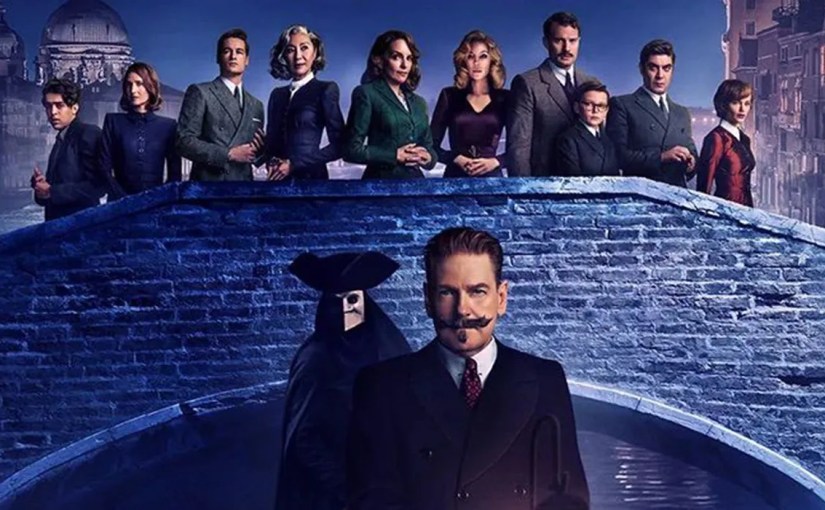
There’s A Haunting In Venice and Hercule Poirot is on the case.  

Kenneth Branagh returns for a third time as Agatha Christie’s famed literary detective.  He also serves in the director’s chair again, and this is his best installment in the updated franchise.

The man with the exaggerated mustache is living in Venice, Italy, with the assurance of a bodyguard (Fernando Piloni) to fend off any pestering folk needing their own personal conundrums resolved.  Poirot is not interested to assist.  

On All Hallow’s Eve, he is invited to be a tag along with his American mystery novelist friend Ariadne Oliver (Tina Fey) at Rowena Drake’s home. A celebrity Medium known as Mrs. Reynolds is to appear and perform a seance. My first impression of Fey’s character is a loose interpretation of Dame Agatha come to life to partner up with Hercule.  She’s sort of a wink and nod to the author’s fan base.  What if Agatha and Hercule actually worked together?  This is as close as you’ll get.  Branagh and Fey work so well together.

Poirot reluctantly agrees to accept Ariadne’s invitation.  Upon arrival at the affair, the best feature of the film is introduced.  Rowena’s home is a foreboding dwelling alongside the Venetian River, and this Hallowe’en evening is turning into a dark and stormy night.  A children’s costume party is wrapping up complete with creepy puppetry, ghost story telling and apple bobbing.  Then it is time to welcome the arrival of a figure dressed in black wearing a pearl white Kabuki mask.  The children have left, and the eventual suspects of a murder mystery are all that remain in the house when the seance begins.  Mrs. Reynolds will use her talent to communicate with Rowena’s daughter who passed away a year earlier following a fall off the rooftop and into the murky river below.  

Poirot is the most skeptical of the guests as he staunchly believes only in logic, not the supernatural.  Ariadne insists that he will be amazed at the unexplainable talent at play. A well timed falling chandelier and a typewriter that seems to answer the Medium’s questions are not convincing enough for him.  

Eventually, a gruesome and shocking murder occurs.  Like most formula mysteries, everyone appears to have an alibi.  Yet, Poirot refuses to believe this crime took place by means of a supernatural element.  Even if there are unexplained noises within the home and the appearance of Rowena’s daughter turn up, there must be a more logical resolution.  

A Haunting In Venice works especially well thanks to the atmosphere of its setting.  The multi-floored and darkened home lend to the eeriness necessary for a spooky story focusing on death.  The faucet of a sink doesn’t work.  The innocence of apples takes on a nervous feeling.  Lanterns allow shadows to float within the darkness while the lightning flashes and the thunder pounds outside with choppy waters in the river. This haunted place where a young girl recently died is not somewhere I want to stay overnight.  

One suspect that especially stands out is Leopold (Jude Hill), a preteen boy with a fondness for the macabre works of Edgar Allen Poe.  Poirot suggests he turn towards Dickens.  Leopold seems much wiser than his years, as he tends to and speaks on behalf of his unwell father, Dr. Leslie Ferrier (Jamie Dornan).  

Michelle Yeoh turns in another memorable performance permitting the strangeness of her Medium character, Mrs. Reynolds, to elevate suspense.  Poirot can choose to be doubtful.  Nevertheless, I’m convinced Mrs. Reynolds can speak to the actual dead.  

A Haunting In Venice has murder on its mind and the sudden death of one of the characters is horrifying.  I dare not spoil how it transpires.  Thankfully, this tale returns to an approach that so many classic films adopted.  You don’t need pools of blood and guts to get the hairs on the back of your neck to stand up.  It’s clear that with the approval from Agatha Christie’s estate, Branagh is well researched in what the author wanted to accomplish.  

The screenplay from Michael Green lends wonderful color to the characters, as Poirot interviews each person.  All of the performers are engaging.  This collection of actors especially works because unlike the other two Branagh films, this installment does not rely so much on stunt casting with recognizable marquee names.  For me, the who done it resolution was more challenging to solve because the actors portraying the assortment of suspects were deliberately vague, airing a sense of distrust in any one of them.  

This is a fireplace story to curl up with under a blanket and a cup of hot cider on a brisk Autumn night. The best compliment I can give A Haunting In Venice is that it’s a never-ending page turner.

OPPENHEIMER

By Marc S. Sanders

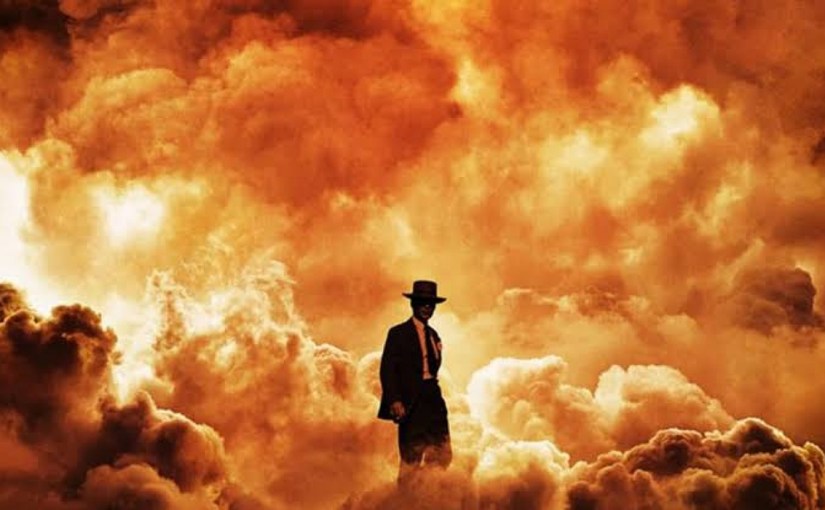
Christopher Nolan is one of the modern-day directors that you can rely on for brainy science fiction whether they are in embedded in dream subconsciousness, intergalactic space travel, transcendences of time, or even putting a fresh polish on a favorite superhero.  With Oppenheimer, he triumphs with exploring the actual prophets of science in the twentieth century, particularly its title character J Robert Oppenheimer, the brilliant physicist played convincingly well by Cillian Murphy.  Nolan doesn’t just stop at the assembly and discovery of science though.  He uncovers the consequences of Oppenheimer’s innovation and genius insight.  Dr. Oppenheimer might have been the man who knew too much and arguably that cost him quite a bit, personally.  Additionally, the so-called lab rat of his atomic bomb, namely the planet Earth, suffered the expense of a, at the time, troubling present day, and a still ongoing future. 

This movie seems to start right in the middle of its story and as a viewer you need to claw your way through the dense foliage to find its beginnings and what comes afterwards.  The first two scenes of the movie are titled “Fission” and “Fusion.”  There are no time periods specified by a font caption, however.  The differences in various points in history are distinguished by where J Robert Oppenheimer is located during select points in his life.  For seconds at a time, the film will change its photography from vibrant color to black and white, for example.  The characters will either look more aged with grey hair and some wrinkles or during more youthful time in their lives.  At one point Oppenheimer is being recruited by Lewis Strauss (Robert Downey, Jr) to head the department of a new kind of weapon development.  Work the science to make a difference.  There’s another time period where he’s being interrogated in a small room by a governmental suit and tie committee.  Oppenheimer is also in his classroom or debating and working with colleagues.  Another story observes his progress with building the atomic bomb among a collection of other engineers and scientists in a desert town, Los Alamos, specifically built at his own request, under the order of the nothing but militant Colonel Leslie Groves (Matt Damon), to conduct his work and research while hiding in plain sight. 

The film also covers Oppenheimer’s association with possible suspects of the Communist Party during the stressful pre-cold war era of McCarthyism.  Questions arise if his reliable brother Frank (Dylan Arnold) is a communist or even his mistress (Florence Pugh).  Does that in turn make Oppenheimer a communist as well?  If that is the case is J Robert Oppenheimer, the man tasked with ultimately ending World War II in favor of the Allies, sharing secrets with Russia and/or the Communist Party?

Nolan’s film gets easier to watch as it moves along, but you must get used to his pattern of filmmaking.  If you have never seen a Christopher Nolan film, I do not recommend you start with Oppenheimer.  His work is recognized for fast paced edits of different time periods and conversations.  There is much information to decipher. As well, there’s a very large collection of welcome characters to sort through, who worked with or against Oppenheimer.  Having only seen it once, I was captivated with the picture, but I know that I need to see it again.  The quick edits, working beautifully against the soundtrack orchestrations of Ludwig Göransson (nominate him for an Oscar, please), happen a mile a minute.  I appreciated this method because it enhanced the urgency of Dr. Oppenheimer in the eyes of the world, first as the savior of the united Allies against the last remaining superpower of the Axis countries, Japan. Then later focus is on whether it is in the United States’ best interests for the regarded physicist to have security access to the country’s most secret weapons and technological progress in a post war age.

People have been cajoling about how they know the ending to Oppenheimer.  They drop the bomb, of course!  (Twice actually.)  However, they do not know the entire story adaptation that Christopher Nolan as director and screenwriter presents. 

Cillian Murphy is perfectly cast. Give him an Oscar nomination.  He serves the confident, assured scientific leader who becomes envious of competing powers who achieve the impossible, like splitting the atom, while also admiring peers and mentors like Niels Bohr and Albert Einstein (Kenneth Branagh, Tom Conti).  All these men are interested only in what can be accomplished.  The superpowers that fight in war, though, are interested in how these accomplishments of modern science can be used to their advantage at a cost of collateral damage.  It is these conflicts of interests that Nolan admirably demonstrates over the course of the film. 

A telling scene for me, that I won’t forget, is when Robert Oppenheimer meets Harry Truman (Gary Oldman, doing an unforgettable cameo).  As the physicist exits the Oval Office, having shared his concerns and scruples with the Commander in Chief, Nolan includes a throwaway line delivered by the President, that I won’t soon forget.  It will not be spoiled, here.  Yet, the dialogue speaks volumes of what the United States held important regarding the servants who did the country’s bidding.  The scene closes like a stab in the heart, and suddenly science is no longer just facts within our planet.  Science is now questioned on whether it should ever be acted upon. Those questions certainly have remained as long as I’ve been alive to read about our never-ending world climate.  These inquiries will be here for many generations after I’m gone as well; that is if men and women’s recklessness with science doesn’t destroy the Earth before then.  At one point, Oppenheimer shares a small fraction of possibility for the end of the world when they activate and test their first atomic bomb. Matt Damon’s Colonel Groves’ asks for a reiteration of that observation.  Is this finding worth even the smallest, most minute risk?

Emily Blunt portrays Kitty Oppenheimer.  She’s marvelous as a lonely alcoholic wife to Robert, and a mother minding a home built in the desert while her husband serves an important purpose.  I didn’t take to her presence in the film until her grand moment arrives during an interrogation scene.  As the character gives her testimony regarding Oppenheimer’s communist ties, Blunt locks herself in for a wealth of awards in late 2023/early 2024.  Once you’ve watched the movie, you’ll likely know which scene I’m referring to and you can bet it’ll be that sample clip shown on all the awards programs.  This might not be Blunt’s best role, because it is rather limited within crux of the film, but I’d argue it is her greatest scene on film that I can remember.

Oppenheimer is a three-hour film, and it demands its running time.  There are so many angles to the man that few really know about.  Many know it was he who instrumentally built the atomic bomb that to date has only been used twice within a period of four days.  Thankfully never since.  Nolan emphasizes how unaware we are of how carefree the doctor’s government supervisors performed with the weapon he agreed to build.  Don’t just drop the bomb once.  Send a message to Japan by dropping it twice so they know to no longer engage in this ongoing war.  Choose the area where an army/government official didn’t honeymoon though.  It’s too beautiful a region.  Tens of thousands of men, women and child civilians perished immediately following the strikes.  Many others died weeks later following exposure to the nuclear effects that followed.  All issued as a horrifying cost to end a war that was already being won now that Hitler was dead.

Mechanically, Christopher Nolan does not disappoint either.  I watched Oppenheimer in a Dolby theater and I highly recommend it over a traditional one.  However, beware of the sound.  It is a LOUD!!!!!  Your seat will rattle early in the film when Cillian Murphy is shown in close up imagining the collision of atoms, protons, and neutrons.  How a star naturally dies in space runs through Oppenheimer’s consciousness as well, and then we see how a black hole forms.  Nolan offers a Cliff’s Notes edit of science doing its job.  Murphy performs so well when he’s not speaking and cut against the quick edits of Nolan’s visual and sound effects of science at play.  It shows how an educated scientist thinks beyond what is documented on a chalkboard or in a textbook.  J Robert Oppenheimer used to teach about the building blocks and natural destruction that occurs within the universe.  Regrettably, what he learned about natural function soon becomes manufactured capability when the professor accepts the task of building scientific destruction with his bare hands. Man stole fire from the Gods.

Oppenheimer is so dense in the scope of science and the scientist behind it.  That’s a huge compliment.  It’s an engaging film with much to tell, and a lot more to think about afterwards.  It accomplishes what the best movies do.  It leaves you thinking long after the film has ended.  More importantly, it’ll leave you frightened for the future based on the behavior of this planet’s past. 

Oppenheimer is one of the best films of the year.

DEAD AGAIN

By Marc S. Sanders

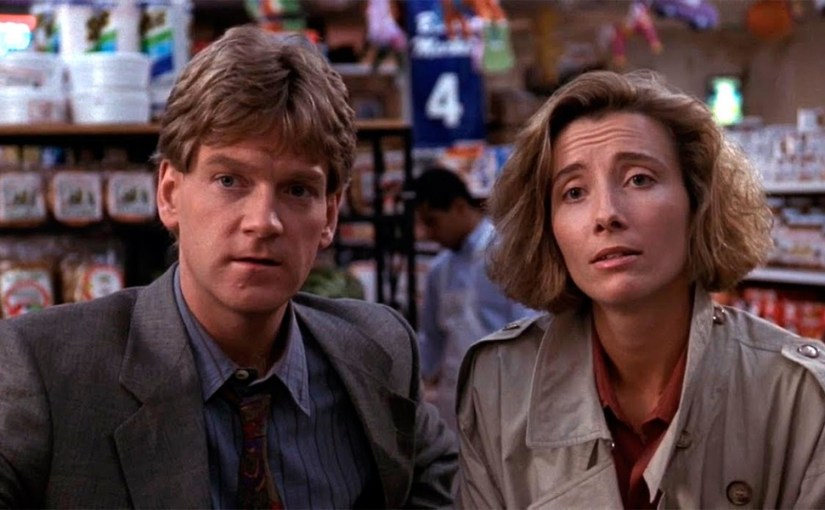
Kenneth Branagh is inventive director.  Arguably, his most uncelebrated film is the noir inspired mystery, Dead Again, which features himself and his wife at the time, Emma Thompson, in the leading roles. 

Branagh and Thompson do double duty, playing multiple parts in two different time periods.  In a 1940s post war Los Angeles, they are Roman and Margaret Strauss.  Roman is a composer.  Margaret is a musician in his company.  They quickly fall in love and live in the limelight of glitz and glamour amid the gossip magazines of the time.  Their life together only becomes juicier when Roman is sentenced to death for the murder of Margaret.  The weapon of choice, a pair of scissors.

In present day 1991, Branagh portrays a private detective named Mike Church who ends up being responsible for an amnesiac, Thompson, who can’t even speak when she’s found.  The woman has unexplainable dreams that recall moments of Roman and Margaret’s life together only to end up as terrible nightmares.  A curious hypnotist (Derek Jacobi) enters the story to lend aid to Mr. Church and the woman.  He serves as a guide, bringing her back to the times of the celebrity couple, helping her to find clues that perhaps could lead to her true identity and uncover exactly why she is haunted by these dreams.

Additional characters enter the storyline as well.  There’s Wayne Knight as a humorous sidekick for Church.  In the flashback 1940s, there’s Andy Garcia as a handsome Pulitzer winning journalist who follows the escapades of Roman and Margaret.

Dead Again is not a long movie, and that lends to how good a film it is.  It’s a lean picture that sets up its clues the moment it starts.  Branagh gives you a background tutorial with newspaper headlines that flash up within the opening credits.  The two time periods are separated with the 1940s shown in gorgeous black and white, while the modern scenes are presented in color.  Branagh puts on a German accent for Roman.  Thompson is English for Margaret.  In the present day, they are Americans.  Of course, it is acknowledged that the respective characters look alike and that allows for possibilities of reincarnation, karma and past lives to enter the frame. 

The screenplay from Scott Frank gets you curious.  What connection could these two wildly different couples have with one another?  What don’t we know about the murder of Margaret at the hands of her husband, Roman?  Who really is the woman that Thompson is portraying in modern times?  How is it possible that a private dick like Mike would coincidentally end up with this “Margaret lookalike” amnesiac?

The cast is having a lot of fun with the puzzle, particularly Derek Jacobi.  His old English mannerisms offer a relaxing storyteller’s narrative to the film.  It feels as if his hypnotist carried over from an Alfred Hitchcock film.  I also appreciate how far apart the respective characters that Branagh and Thompson play.  Not only am I watching a thrilling mystery, but I’m looking at skilled, well-trained actors demonstrating a wide range of performance work.  At times, it’s as if I’m watching two different movies.  How exactly are they going to intersect, though?

I originally saw Dead Again in theatres and was taken with it immediately.  I did not see the end coming and when the veil was lifted, my eyes went wide open.  It has a terrific plot twist.  Branagh, known at the time as a celebrated Shakespearean actor/director, introduced a sweeping, mystery yarn that relishes in fun escapism like Hitchcock or Orson Wells would apply to film noir.  It only makes sense, looking back over thirty years later, why the director opted to turn his craft towards rejuvenating the classic Agatha Christie stories (Murder On The Orient Express, Death On The Nile) for film.  We are better for his contributions.

Now, Dead Again is a film that deserves the attention from a new generation of movie lovers.

MY WEEK WITH MARILYN

By Marc S. Sanders

Simon Curtis directs a glimpse into the life of Marilyn Monroe with an exquisitely cast Michelle Williams in the title role of My Week With Marilyn.

The film is told through the perspective of 23 year old Colin Clarke played under dream like naivety from Eddie Redmayne. Clarke embarks on joining the production crew of Sir Laurence Olivier’s (pompously over played by Kenneth Branagh) newest film that he is directing and starring in, opposite Monroe. When Marilyn’s new husband, playwright Arthur Miller, returns to the states, Colin is drawn into Marilyn’s seduction; protecting her from an intimidating Olivier and tolerating her drug and alcohol use.

This film features an outstanding cast of who’s who from Dame Judi Dench to Emma Watson to Dougray Scott, Julia Ormand (playing a past her prime Vivienne Leigh), Toby Jones and Dominic Cooper. An amazing cast and amazing performances all around.

Still, I just wasn’t wild about the film. With her life startlingly cut short, Marilyn Monroe is arguably one of the biggest enigmas to come out of Hollywood, and yet this tiny glimpse into her life just wasn’t interesting enough for me.

Fully aware of her impending doom to come, the sad foreshadowing of pills on her dresser, and her unfamiliar stupors didn’t drive anything for the character. It all becomes repetitious with nothing new to say. Colin’s virginal experience with this celebrity tryst never drives anywhere but back into Marilyn’s bed after he’s requested to appear at any given hour. This occurs again and again. The film just doesn’t progress past these moments. I found myself saying “I’ve seen this already!”

Did Marilyn learn anything from this fleeting moment in her lifetime? Did Colin? Maybe Colin got to witness the dichotomy of the privately ill Marilyn versus her ability to turn on the public charm with curvaceous ease and a wide lipstick smile. Yet, I have to wonder what came of it for Colin, thereafter.

Redmayne is quite good in his naive innocence. He inhabits nearly every scene since the story is told from Colin’s experience. Storywise though, what was the point of all this really?

Williams as Marilyn is astonishing. As good at playing a Hollywood legend as when Cate Blanchett deservedly won her Oscar for playing Katherine Hepburn in The Aviator. My one wish is that Williams accepted the role with a much more dimensional and nuanced script.

Perhaps because of the mystery that always seemed to surround Marilyn, Williams will never get the chance at playing the bombshell in something better. Marilyn’s life was so dubious and questionable. What filmmakers would be brave enough to truly make claim of how the starlet lived and how she died?

I can wish for another Marilyn portrayal to come one day, with Michelle Williams in the role, but alas I won’t hold my breath.

DEATH ON THE NILE (2022)

By Marc S. Sanders

It’s time for the murder mystery to maintain an ongoing trend in modern films.  They’re just fun to watch and play with and deduce.  Why do you think the board game Clue has lasted so long in so many households?  Films like Rian Johnson’s Knives Out and a recent retelling of Murder On The Orient Express have already whetted our appetites for the “who done it?” tales.  Endless variations of Sherlock Holmes continue to appear.  Even Steve Martin and Martin Short have gotten in on the mystery circuit.  Adam Sandler with Jennifer Aniston, too.  Kenneth Branagh’s second time as Hercule Poirot (following …Orient Express), in an adaptation of Agatha Christie’s Death On The Nile, is proof positive that the sleuth is the next super hero that movie goers should follow.

Branagh returns to direct his detective character in Egypt, aboard a privately rented boat occupied by the newly engaged couple, Lynette Ridgeway and Simon Doyle (Gal Gadot and Armie Hammer).  As the luxurious yacht makes its way down the majestic river Nile, the couple suspects that someone, particularly Simon’s recent ex-fiancée, Jacqueline (Emma Mackey), is determined to cause harm or even murder towards them.  They ask for the sleuth’s services in uncovering who is scheming against them.  Poirot is on vacation, however, and tells them his services cannot be made available as no crime has been committed.  Yet, he accepts their invitation to board the boat and attempt to relax and recline. 

Naturally, a murder will eventually occur.

Hercule Poirot was not even a character in Agatha Christie’s original novel.  Yet, Branagh seamlessly weaves the detective into an elegant page turner on screen, with a script from Michael Green.  Branagh is a skillful actor/director. 

As this is a murder mystery, there are a wealth of characters with possible motives and red herrings to keep the journey down the Nile tense and engaging.  There’s the doctor (Russell Brand), an aunt (Annette Benning), a nephew (Tom Bateman, returning from Orient Express), Lynette’s housemaid (Jennifer Saunders), a speakeasy blues singer and her niece (Sophie Okonedo, Letitia Wright), as well as Lynette, Simon and Jacqueline, and on and on.  Branagh wisely moves his camera repeatedly at times across the boat panning over the faces of the cast, as if to the remind the viewer of who are the suspects.  There’s a wealth of information to take in, but this is not going to feel like you are cramming for a final exam the next morning. 

Because everyone could have a motive and/or a background with the murder victim, each actor within the colorful cast has various moments to shine.  There are some great acting scenes going on here that the players share with Branagh, and they don’t come off with similar formulas from one moment to the next.  Each character actor is thankfully unique in both appearance and personality.  It’s not hard to keep up, and while I may have known the ending before seeing the film (having read the book and seen stage adaptations over the years), I don’t believe it’s easy to deduce and solve as a viewer.  Different characters and moments that never occurred in the source material turn up.  There might even be few unexpected deaths along the way.  Branagh also keeps the picture alive with outstanding blues numbers that begin in an underground speakeasy bar in Paris and then play over transitional moments throughout the film.  This picture has a great period soundtrack.

Beyond the well diversified mystery, Branagh treats the viewers to gorgeous scenery aboard the boat, but even beneath the surface of the river and within the pyramids and sphinxes of Egypt.  There are spectacular starry night skies and breathtaking sunrises and sunsets to take in with palm trees and wildlife in the desert frames.  Sure, I imagine most of it is CGI, but it’s well done and nothing looks artificial.  Costume work is also magnificent as they lend to the distinctiveness of the suspects.  Whether it is evening wear, or casual garb for post-World War I, each character looks so intriguingly lively and different.

Michael Green’s script even delves further into the Poirot character.  There’s a background to that infamous mustache and tiny goatee.  I recall how people responded to the outrageously grotesque facial hair that Branagh donned in his first film as Poirot.  I appreciated it, however.  His appearance was as unforgettable as the red and yellow “S” on Superman’s chest.  Yet, why go to such great lengths, even if this is the early 1900’s amid an exaggeratingly glamourous murder mystery, to grow a mustache like that? Thankfully, there’s reason given here that draws out a dimension to Hercule Poirot both within a ten-minute prologue, and then implied periodically during the course of the film and wrapping up in a bluesy epilogue before the credits roll.  All I’ll say is that absurd mustache delivers a humanity to the film’s protagonist.

Death On The Nile has already suffered from negative publicity involving controversy with some of its cast members.  Its release was also postponed a number of times due to the pandemic.  Finally, it has arrived in theatres and what a refreshing experience it is to see on a big screen.  It opened to a modest box office response in its first weekend, though it finished at number one.  Normally, I don’t care about rankings at the box office.  How much money a film makes does not lend to the merits or faults of a piece.  However, for this film, I think I do care a little.  I hope it becomes a profitable success only to allow more films of the mystery genre to appear on screen in the future.  I’d certainly welcome another gripping yarn from Agatha, out of service from Kenneth Branagh.  Could And Then There Were None… be next?  That’s the real mystery.