
by Miguel E. Rodriguez
DIRECTOR: Jean Luc Godard
CAST: Mireille Darc, Jean Yanne
MY RATING: 8/10
ROTTEN TOMATOMETER: 93% Fresh
PLOT: A married couple go on the road trip from hell to visit the wife’s parents, intending to kill them for her inheritance.
You don’t risk the time it takes to do this…unless the act itself has meaning. – Detective Somerset, Se7en (1995)
In my personal opinion, there are few things more dangerous than a skilled director who genuinely has something to say. Oliver Stone. Stanley Kubrick. Martin Scorsese. Spike Lee. Even Kevin Smith (Dogma, 1999), among many others you or I could name. Give these guys a finished script and a camera and watch the fireworks from a safe distance.
In 1967, iconoclastic filmmaker Jean Luc Godard became disgusted or disillusioned or just plain pissed off about the class division in France and around the world, especially with how the middle class/bourgeoisie had forsaken human connection for the accumulation of material wealth. So, he dashed off a screenplay, gathered up a crew and some actors (including a lead actress that he specifically did not like, because he needed her to play a CHARACTER he did not like), and made a film that defies classification or genre. Is it a comedy? A drama? Satire? I’m still not sure. All of the above? None of the above? Weekend stands stubbornly apart from anything I’ve ever seen, thumbing its nose at the world with one hand while flipping the bird with the other. It is many things, but timid it is not.
The movie begins with a simple enough scene, interrupted by title cards that say things like, “A FILM FOUND IN A DUMP”. A husband and wife calmly discuss their plans to murder her parents so she can get her inheritance. They might as well be talking about what movie to see tonight. When the husband leaves the room, the wife takes a call from her lover. In the driveway of their house, a fight breaks out among three people about…what? Doesn’t matter, they’re never seen again, and the husband and wife observe the fight without commenting on it or making any attempt to stop it.
This is followed by an extraordinary scene, in a film full of extraordinary scenes, in which the wife, apparently speaking to her analyst, describes, in graphic detail, a sexual encounter she had with a strange man and his other mistress. Meanwhile, Godard’s camera does a slooow zoom in to the woman’s face, then a slooow zoom out to reveal she’s in her bra and panties, then another slooow zoom in, and out, and in, and out, and you get the idea, right, wink, wink, nudge, nudge?
Is Godard being too obvious in this scene? Clearly. So, what is he trying to say here? By being so blatantly obvious, is he parodying earlier French New Wave and Italian neo-realist films, some of which invested a lot of screen time in long conversations about nothing? Sure, let’s go with that. What’s with that in-and-out camera move that I read someone describe as “masturbatory” that occurs during the explicit discussion? Is he also poking fun at other filmmakers who lack subtlety? Yep, that works, too. In a weird way, I was reminded of Tarantino’s Kill Bill cycle, movies that took every kung fu trope imaginable, turned the volume up to eleven, and then turned it up some more. That’s what Godard is doing here. Why? As Robin Williams once said, “Because we’re French.”
That’s just the first two scenes. Later, there is a justly famous tracking shot (really two or three that are spliced together) that lasts for nine minutes and covers 300 meters of ground. It tracks past an endless traffic jam as our “heroes” try to get around them on their way to kill her parents. The camera passes cars, convertibles, trailer trucks, a flatbed with two caged lions and a monkey on a leash, horns honking, people yelling at each other. THIS part reminded me of some of the best “Family Guy” gags where something is spun out for a ridiculously long time, where the duration of the event becomes the gag, instead of the gag itself. In the film, it actually did become kind of funny…until finally, nine minutes later, we see the cause of the traffic jam, and my jaw dropped.
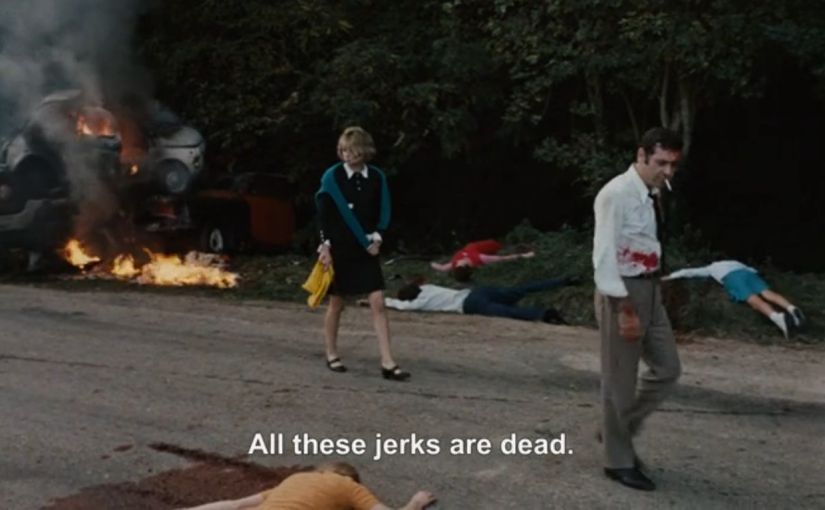
Car accidents are a recurring motif throughout the film. Perhaps they represent Godard’s assertion that his country was, at the time, more or less a trainwreck. With other filmmakers, showing just one or two car wrecks would get the point across. Not Godard. They’re everywhere. And you don’t get just twisted and burning metal; there’s also broken and bloody bodies adorning the wrecks and the roadside. And through all of this (and more), our main characters walk or drive, apathetic to the chaos, asking everyone – even the dead bodies – how to get back to the main road, blind to the madness around them.
Godard adds intertitles at random intervals, some of which are laden with French cultural references that escaped me. Some of them didn’t even get translations on my Blu Ray. One of them says “THE EXTERMINATING ANGEL”, which is the title of a famous film by Luis Buñuel…sly wink to the cinemaniacs in the audience. Go Godard, celebrating geek culture before it was cool. Some of them are repeated while the film backtracks as if the projectionist is having a spasm. At one point, the film jumps and skips forward as if there was a bad splice in the reel. At another, a scene occurs in a field full of abandoned cars. Then, JUMP CUT, and the cars are now a flock of sheep. Take THAT, audience expectations!
At every stage, Godard is constantly reminding the viewer that they’re watching a movie. One of the characters even says, “What a rotten film, all we meet are crazy people.” Later there are scenes that approximate some kind of revolution. Battles are fought. The gunplay looks curiously amateurish. There’s a scene with a pig. I don’t want to give too much away, but let’s just say that it was definitely harmed in the making of this movie. Same with the chicken.
The chaotic nature of the movie was mesmerizing, like…a car accident that you can’t turn away from. To fully analyze every historical, literary, and cinematic reference would be like trying to catalog every single pop culture reference in Ready Player One [2018], and that’s something for which I have neither the time, the inclination, the education, nor the space to do. Weekend is not for everyone, he said, blatantly stating the obvious. But I ultimately enjoyed it because it’s not that often I get to listen to the voice of a really angry filmmaker. I may only understand the basics of what Godard is angry about, but that doesn’t diminish the power of his statement.


 2 UNPAID MOVIE CRITICS!!!!