THE HOMECOMING (Great Britain, 1973)

by Miguel E. Rodriguez

DIRECTOR: Peter Hall
CAST: Paul Rogers, Ian Holm, Cyril Cusack, Viven Merchant
MY RATING: 7/10
ROTTEN TOMATOMETER: 86% Fresh

PLOT: After a nine-year absence, a philosophy professor visits his psychologically dysfunctional family in London to introduce them to his wife.  Let the mind games begin.

[WARNING: This review contains mild spoilers. …not that a ton of people will run out to find this movie right away, but still…just in case…mild spoilers.]


There have been countless movies about dysfunctional families through the ages, so many that I won’t bother listing any.  I haven’t watched them all because there is only so much psychic room in my mind for movies about mean people being mean to each other for the sake of being mean.  There are exceptions to the rule, as always, but that is my general feeling on the matter.  Peter Hall’s The Homecoming, based on a blistering play by Harold Pinter, has an ending that I’m still trying to sort out, and which I felt left me hanging, but I think I may see what Pinter was reaching for, and in order to suss all that out, it will be necessary for me to discuss specifics of that ending.  So, be warned.

In the tradition of Arthur Miller, Edward Albee, and Tennessee Willaims, Pinter’s The Homecoming is a portrait of several unlikable people who are thrown together due to an accident of birth.  Based on the movie, it is unlikely any of them would cross the street to piss on any of the others if they were on fire.  Max (Paul Rogers) is the patriarch, a mean, abusive little man who spews never-ending insults at whomever is in range.  He is a widower with three sons: Lenny (Ian Holm), Joey, and Teddy.  Lenny and Joey are grown but still live at home.  Joey is an aspiring boxer, and Lenny…well, we never quite get to know what Lenny does for money, although it is hinted towards the end that he is involved in some less-than-savory enterprises.  Teddy, miraculously, has made good as a professor of philosophy in the United States, but he hasn’t been home in nine years.

There is also Max’s brother, Sam (Cyril Cusack), a tall, effete man with a high, reedy voice that would probably be comic in different circumstances.  Sam absorbs Max’s tirades with the kind of unruffled calm that only comes after years of experience.  Together, they form one of the most unpleasant family units since Jaime and Cersei in Game of Thrones.  Here’s one of Max’s more pleasant descriptions of his sons: “Look what I’m lumbered with.  One cast-iron bunch of crap after another.  One flow of stinking pus after another.”  How is this guy still single.

One night, they’re surprised by the return of Teddy, the philosophy professor, with his wife, Ruth (Vivien Merchant) in tow.  It’s indicative of Teddy’s relationship with his family that none of them knew he had been married for nine years…with three sons of his own.  After some quote-unquote pleasantries, everyone goes to bed except Ruth and Lenny.  Lenny has the balls to slyly put some moves on her in a weird-ass game of cat and mouse, as if he’s probing her for weaknesses, looking for the best place to stick the knife in.  Ruth is passive at first, but shows a spark of strength before everyone calls it a night.  But the next day…that’s when the feces really hits the fan.

The Homecoming is a great example of a “slow burn” film, the kind of movie that takes its sweet time getting around to its prime directive because it only makes sense because of everything that came before, like Atonement [2007] or Incendies [2010].  We are shown so much of Max’s vitriolic harangues because we have to see how momentous it is when his brother or Ruth finally respond in a meaningful way.  We are shown so little of what Ruth is capable of at the beginning because it is that much more shocking when she proves herself even more adept at psychological warfare than anyone else in the house, including her husband.

But what is the point of all this?  In a movie like In the Company of Men [1997], for example, we spend so much time in the presence of sociopathic monsters so that, at the end, one of them can be shown the error of his ways in an immensely satisfying conclusion.  But, in The Homecoming, we don’t really get that kind of wallop in the face at the end.  Granted, Ruth displays her tenacity in a satisfying manner, putting each and every man in the house in their place in one way or another (some ways more surprising than others), but when that final shot faded to black, I was like, “That’s IT?”

What is Pinter getting at?  Is he demonstrating that, no matter how bad you may think your family is, it could always be worse?  Did he perhaps exorcise some demons in his own past by committing these flawed individuals to paper?  The film is based on a play, but the acting style throughout is very stilted, for lack of a better word.  The only character who displays something vibrant on the screen is Max, but his vibrancy is only defined by his cruelty.  Everyone else (with the possible exception of Ian Holm as Lenny) sounds almost as if they’re reciting their lines at the first read-through of the rehearsal period.  Cyril Cusack gets some jabs in as Sam, but they’re very few and far between.  Why does the meanest character have the strongest voice, at least until the final sequence?

It might be easy to explain it as a Whiplash [2014] thing, where great things can only be accomplished after even greater trials and tribulations.  You can’t appreciate the light unless you’ve spent some time in the dark, et cetera.  As a movie-watching experience, I must honestly report that my patience was starting to wear thin until we finally got to the second act of the film.  I would have enjoyed more color and flair from the other actors.  However, that might have ruined the effect the filmmakers were going for, so I’m of two minds.  It explains my only slightly-above-average rating.  If the entire movie moved and sparkled like its second half, I may have gone a little higher.

It’s also worth mentioning that this film only exists because of a filmmaking project spearheaded by producer Ely Landau whereby fans of stage drama would purchase a subscription to a “season” of films that would be shown simultaneously at 500 movie theaters across America, sort of like what Fathom Events does today.  These were filmed adaptations of stage plays, not a record of a staged production, and 100% faithful to the original scripts.  Notable films in this experiment included The Homecoming, Eugene O’Neill’s The Iceman Cometh [1973, dir. John Frankenheimer], Ionesco’s Rhinoceros [1973, dir. Tom O’Horgan], and Albee’s A Delicate Balance [1973, dir. Tony Richardson and starring Katharine Hepburn and Paul Scofield <!!!>].  American Film Theatre only lasted two seasons, but if you’re a fan of faithful cinematic adaptations of stage plays, these are going to be worth the search on streaming or home video.

The Homecoming is ultimately a rewarding watch, for the performances from Paul Rogers and Ian Holm, if for nothing else.  (Vivien Merchant is appropriately cool, but again, you have to wait for near the end of the film to see her really shine.)  It’s an interesting record of a moment in film history when a group of people had a radical idea and the money to fund it.  And, it must be said, it’s an excellent way to remind yourself that, however bad your family is, it can always be worse.  MUCH worse.

THE BRUTALIST (2024)

by Miguel E. Rodriguez

DIRECTOR: Brady Corbet
CAST: Adrien Brody, Felicity Jones, Guy Pearce, Joe Alwyn, Raffey Cassidy
MY RATING: 7/10
ROTTEN TOMATOMETER: 93% Certified Fresh

PLOT: When a visionary architect and his wife flee post-war Europe, their lives are changed forever by a wealthy client.


Maybe I’m a victim of too much hype.  Maybe that’s partly my fault, too, as I waited to see Brady Corbet’s The Brutalist until after it had been nominated for a whopping ten Oscars, including the so-called “Big Five:” Best Picture, Director, Actor, Actress, and Screenplay.  As a result, my expectations were possibly a little too high.  I admit it.  However, even if my expectations hadn’t been inflated, I don’t believe The Brutalist would have affected me any differently.  It never lost my interest during its 3.5-hour running time, but it never achieved the kind of liftoff I felt I was being prepped for.  At the end, I was left with more questions than answers, which can be acceptable for some films, but for this one, I felt like I was left out of the loop.

In 1947, László Tóth (Adrien Brody), an Austro-Hungarian Jew, successfully emigrates to America, fleeing intolerable conditions at home, but is forced to leave behind his wife, Erzsébet (Felicity Jones), and his mute niece, Zsófia (Raffey Cassidy).  He was a respected architect in his home country, but now he is part of the huddled masses, represented in a sensational shot as his ship sails past Lady Liberty, the camera tilting so she is upside-down and cattywampus in the frame.  That really got my attention, for some reason.  If you want to really drill down, it could be visual foreshadowing for how László’s American experience will not be quite as stable as he had hoped.  Or maybe director Corbet just liked how it looked.  Either way.

Although László’s overriding priority is to somehow get his wife and niece to America, he must first get a job (after first engaging in a surprisingly frank and raunchy sex scene with a prostitute).  His first safe harbor is with his Americanized cousin, Attila (Alessandro Nivola), who runs a custom furniture company with his shiksa wife, Audrey.  It’s through this job that László meets American millionaire Harrison Lee Van Buren Sr. (Guy Pearce), a man who will unwittingly shape László’s life for the next several years.  Harrison has a son, Harry (Joe Alwyn), who looks like a distant relative of the Hemsworth clan and is a condescending racist, let us not mince words, but who, in his own words, tolerates László’s presence because of his architectural skills.  (Harrison wants László to design a community center in honor of his late mother.)

This is all just in the first act of the movie, before the intermission.  The Brutalist moves with a deliberate calmness, in spite of its thriller-esque title.  I was reminded of Doctor Zhivago [1965], as it covers large swatches of László’s life with nice attention to detail, never hurrying, but never losing my interest.  The second act finally introduces Erzsébet, László’s wife, for the first time in two hours (hope that’s not too much of a spoiler).  The plot spins out for the rest of the film as a series of conflicts between László, his wife, Harrison and his son, and the crew building the community center that László has designed.  László becomes more irascible as changes are proposed and approved without his knowledge, plus he must deal with a change in his wife’s condition.  There is a detour to Italy where László and Harrison must decide on which marble to use for the center’s, er, centerpiece, and it’s here where an act is committed that, although it feels like it came out of left field, does not seem too surprising considering the behavior of the perpetrator during the first couple of hours.

As I was watching The Brutalist play out, I was repeatedly reminded of another film, featuring another madman with a single-minded focus, also played out in an earlier era of American history, though it takes place decades earlier than The Brutalist: Paul Thomas Anderson’s There Will Be Blood [2007].  Both films have the same deliberate pacing, the same focus on men of industry, their familial and professional challenges, even the same kind of jarring, atonal score playing in the background during key scenes.  But while The Brutalist is at least equally as well made as There Will Be Blood, the latter movie reached out and grabbed me by the lapels and didn’t let go until the final scene, ending with a bang and not a whimper.  I cannot say the same about The Brutalist.  I give props to the craft of the film, to the filmmakers who clearly had a lot to say and needed the time to say it.  The editors knitted everything together and gave the film a very specific voice.  But as the film’s epilogue played out, and I realized how it was about to end, I sank a little lower in my seat and thought to myself, “Well, this is mildly disappointing.”

Sidney Lumet once wrote words to the effect of, “If your movie is over two hours long, you’d better have a lot to say.”  The Brutalist does have a lot to say about the Jewish experience in post-war America, about the single mindedness of gifted artists, about the casual racism embedded in white America that persists even today.  But I couldn’t get away from the feeling that it could have said it in a movie that wasn’t long enough to require an intermission, that didn’t answer questions that were left unanswered (how and when did Zsófia suddenly start speaking?  where did Harrison go??  what exactly happened on that stream bank between Harry and Zsófia???), and that didn’t leave me feeling as if I’d watched a correspondence course video on American architecture instead of a movie.  Again, it’s well-made and occasionally beautiful to look at.  It’s not a BAD movie.  It’s just not a GREAT one.

WEEKEND (France, 1967)

by Miguel E. Rodriguez

DIRECTOR: Jean Luc Godard
CAST: Mireille Darc, Jean Yanne
MY RATING: 8/10
ROTTEN TOMATOMETER: 93% Fresh

PLOT: A married couple go on the road trip from hell to visit the wife’s parents, intending to kill them for her inheritance.


You don’t risk the time it takes to do this…unless the act itself has meaning. – Detective Somerset, Se7en (1995)

In my personal opinion, there are few things more dangerous than a skilled director who genuinely has something to say.  Oliver Stone.  Stanley Kubrick.  Martin Scorsese.  Spike Lee.  Even Kevin Smith (Dogma, 1999), among many others you or I could name.  Give these guys a finished script and a camera and watch the fireworks from a safe distance.

In 1967, iconoclastic filmmaker Jean Luc Godard became disgusted or disillusioned or just plain pissed off about the class division in France and around the world, especially with how the middle class/bourgeoisie had forsaken human connection for the accumulation of material wealth.  So, he dashed off a screenplay, gathered up a crew and some actors (including a lead actress that he specifically did not like, because he needed her to play a CHARACTER he did not like), and made a film that defies classification or genre.  Is it a comedy?  A drama?  Satire?  I’m still not sure.  All of the above?  None of the above?  Weekend stands stubbornly apart from anything I’ve ever seen, thumbing its nose at the world with one hand while flipping the bird with the other.  It is many things, but timid it is not.

The movie begins with a simple enough scene, interrupted by title cards that say things like, “A FILM FOUND IN A DUMP”.  A husband and wife calmly discuss their plans to murder her parents so she can get her inheritance.  They might as well be talking about what movie to see tonight.  When the husband leaves the room, the wife takes a call from her lover.  In the driveway of their house, a fight breaks out among three people about…what?  Doesn’t matter, they’re never seen again, and the husband and wife observe the fight without commenting on it or making any attempt to stop it.

This is followed by an extraordinary scene, in a film full of extraordinary scenes, in which the wife, apparently speaking to her analyst, describes, in graphic detail, a sexual encounter she had with a strange man and his other mistress.  Meanwhile, Godard’s camera does a slooow zoom in to the woman’s face, then a slooow zoom out to reveal she’s in her bra and panties, then another slooow zoom in, and out, and in, and out, and you get the idea, right, wink, wink, nudge, nudge?

Is Godard being too obvious in this scene?  Clearly.  So, what is he trying to say here?  By being so blatantly obvious, is he parodying earlier French New Wave and Italian neo-realist films, some of which invested a lot of screen time in long conversations about nothing?  Sure, let’s go with that.  What’s with that in-and-out camera move that I read someone describe as “masturbatory” that occurs during the explicit discussion?  Is he also poking fun at other filmmakers who lack subtlety?  Yep, that works, too.  In a weird way, I was reminded of Tarantino’s Kill Bill cycle, movies that took every kung fu trope imaginable, turned the volume up to eleven, and then turned it up some more.  That’s what Godard is doing here.  Why?  As Robin Williams once said, “Because we’re French.”

That’s just the first two scenes.  Later, there is a justly famous tracking shot (really two or three that are spliced together) that lasts for nine minutes and covers 300 meters of ground.  It tracks past an endless traffic jam as our “heroes” try to get around them on their way to kill her parents.  The camera passes cars, convertibles, trailer trucks, a flatbed with two caged lions and a monkey on a leash, horns honking, people yelling at each other.  THIS part reminded me of some of the best “Family Guy” gags where something is spun out for a ridiculously long time, where the duration of the event becomes the gag, instead of the gag itself.  In the film, it actually did become kind of funny…until finally, nine minutes later, we see the cause of the traffic jam, and my jaw dropped.

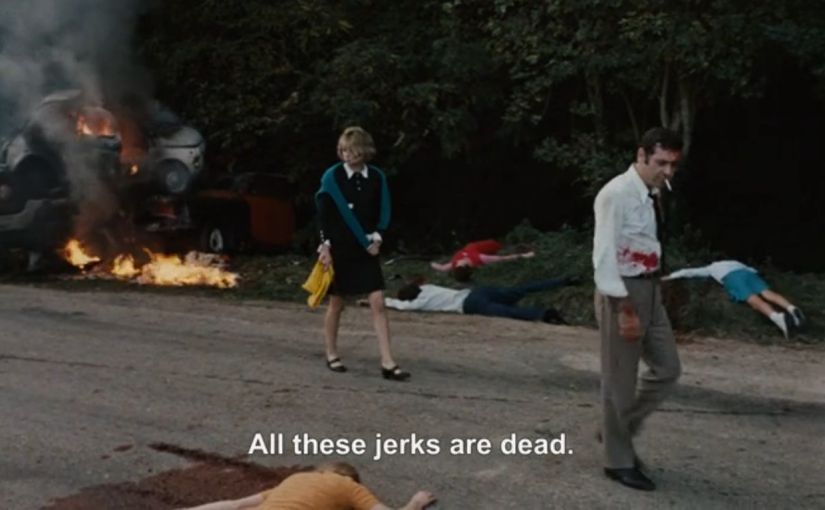
Car accidents are a recurring motif throughout the film.  Perhaps they represent Godard’s assertion that his country was, at the time, more or less a trainwreck.  With other filmmakers, showing just one or two car wrecks would get the point across.  Not Godard.  They’re everywhere.  And you don’t get just twisted and burning metal; there’s also broken and bloody bodies adorning the wrecks and the roadside.  And through all of this (and more), our main characters walk or drive, apathetic to the chaos, asking everyone – even the dead bodies – how to get back to the main road, blind to the madness around them.

Godard adds intertitles at random intervals, some of which are laden with French cultural references that escaped me.  Some of them didn’t even get translations on my Blu Ray.  One of them says “THE EXTERMINATING ANGEL”, which is the title of a famous film by Luis Buñuel…sly wink to the cinemaniacs in the audience.  Go Godard, celebrating geek culture before it was cool.  Some of them are repeated while the film backtracks as if the projectionist is having a spasm.  At one point, the film jumps and skips forward as if there was a bad splice in the reel. At another, a scene occurs in a field full of abandoned cars. Then, JUMP CUT, and the cars are now a flock of sheep. Take THAT, audience expectations!

At every stage, Godard is constantly reminding the viewer that they’re watching a movie.  One of the characters even says, “What a rotten film, all we meet are crazy people.”  Later there are scenes that approximate some kind of revolution.  Battles are fought.  The gunplay looks curiously amateurish.  There’s a scene with a pig.  I don’t want to give too much away, but let’s just say that it was definitely harmed in the making of this movie.  Same with the chicken.

The chaotic nature of the movie was mesmerizing, like…a car accident that you can’t turn away from.  To fully analyze every historical, literary, and cinematic reference would be like trying to catalog every single pop culture reference in Ready Player One [2018], and that’s something for which I have neither the time, the inclination, the education, nor the space to do.  Weekend is not for everyone, he said, blatantly stating the obvious.  But I ultimately enjoyed it because it’s not that often I get to listen to the voice of a really angry filmmaker.  I may only understand the basics of what Godard is angry about, but that doesn’t diminish the power of his statement.

NIGHTBITCH (2024)

by Miguel E. Rodriguez

DIRECTOR: Marielle Heller
CAST: Amy Adams, Scoot McNairy, Jessica Harper
MY RATING: 7/10
ROTTEN TOMATOMETER: 59%

PLOT: A woman pauses her career as an artist to be a stay-at-home mom, but her domesticity takes a surreal turn.


[SPOILER ALERT…if you plan on seeing Nightbitch, avoid this review.  This movie, like most movies, works best on the viewer if they have no idea what’s happening or what’s about to happen.  Consider yourself Spoiler-warned.]

Nightbitch shoots out of the starting gate like a thoroughbred – or a greyhound, if you will – but about halfway through, it runs out of narrative steam.  I felt like a gambler watching a horse race, watching my horse lead the pack around the first turn, already spending the winnings in my head, and then my horse fades a bit, then a bit more, and by the time we get to the finish line, I’m tearing up my ticket in frustration.  I needed a WIN, not a PLACE.  There goes my trifecta.

Amy Adams plays an unnamed Mother who has put her promising career as an artist on pause to be a stay-at-home mom while her also-unnamed Husband (Scoot McNairy) pursues his career as a…um…well, whatever it is, he has to travel a lot, leaving Mother at home with, you guessed it, Son (played by adorable twins Arleigh and Emmett Snowden).  Referred to throughout the movie as “my guy” and “sport” and “little buddy,” Son is a typical toddler in the throes of the terrible twos: cute for long stretches, maddeningly frustrating for longer stretches.  [Ed. Note: the author is not a father, has no plans on becoming a father, and will never possess the immense dedication it takes to rear a child, so don’t expect him to embrace the chaos of toddler-hood because it ain’t gonna happen.]

Mother is going through an identity crisis, set up in a brilliant opening scene where Sally, the woman who assumed Mother’s job at an art gallery, asks her, “Do you just love getting to be home with him [Son] all the time?”  Mother answers the question with a little more honesty than Sally or anyone had a right to expect, including this tidbit: “I am deeply afraid that I am never going to be smart, or happy, or thin ever again.”  I am a straight Hispanic cisgender male, so I’m here to tell you, I will never understand that mindset, but I am reasonably certain there are untold millions of moms out there who, if they listened to Mother’s opening statement, would say, “AMEN, sister.”

A little later, Mother delivers an internal monologue where she reflects that, as a mother, you can squeeze someone into the world “who will one day pee in your face without blinking.”  Again, I’m not a parent, but I know that’s truth in cinema right there.

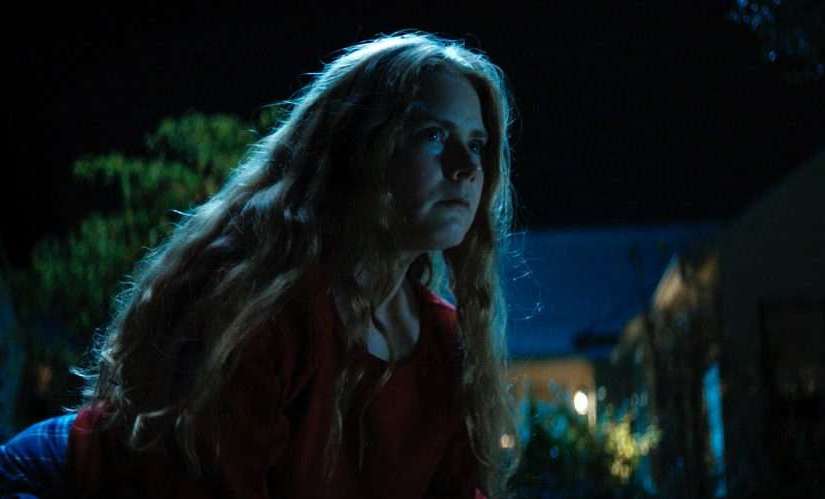
After a few more establishing scenes of Mother interacting with Son, who absolutely REFUSES to go to sleep at night or eat anything for breakfast except, apparently, hash brown patties fried in butter, some odd things start to happen.  At the playground, some stray (?) dogs approach her as if she’s their best friend.  Mother notices her sense of smell has become much more acute.  Son helpfully points out that her back is hairy.  And, in a creepy Cronenberg-y moment, she notices a lump growing at the base of her spine just above her rump.  Curiosity gets the best of her.  She heats a needle, lances the lump, and…well, if you remember the title of the film, you have an idea of what pops out of that lump.

This was all wonderfully thrilling stuff as a movie lover.  I’m thinking, “My god, this is a Spike Jonze movie told from a woman’s perspective!  I’ve never seen anything like this!  This is gonna be GREAT!”  Mother starts to enjoy eating a lot of meat.  She starts to play “doggie” with Son, growling and barking at each other like two puppies.  The two of them eat their lunch at a deli with no silverware…or hands, to the consternation of other diners.  Son doesn’t sleep at night, so Mother, in a genius parenting move, buys a dog bed and gets Son to play “doggie” and sleep in the dog bed at night.  Presto, problem solved!

And more and more dogs start showing up at her door, at night, sometimes bringing gifts: small dead animals.  One night she walks outside, starts digging around, and an astonishing transformation takes place…

I know, I know, SPOILERS, I get it.  But it’s important to get across just how brilliantly original the first act of the film is, because the second act is, alas, all downhill.  I am not saying that the film’s message is unimportant, not at all.  I admire the film because of its message, and because it was being delivered in such an original way.  But then we get into conflict with Husband, who is desperately trying to understand why their 2-year-old is now sleeping in a dog bed on the floor, or why their cat suddenly turned up dead on the front porch, or why his wife suddenly wants a separation.  It must be said, Nightbitch is remarkably even-handed with the Husband’s dialogue.  He is not reduced to a 2-dimensional sitcom husband.  When she lays into him for not supporting her career, he fires back with a well-reasoned argument.  Their dialogue could be turned into a first-rate play.

But instead of exploring the surreal nature of Mother’s new condition, the movie settles into soap-opera territory, with only the occasional nod to the mystical incidents in the first act.  I distinctly remember, in the middle of the second act, feeling as if a balloon had deflated in the plot.  I imagine defenders of the film might say, “Well, the second act is where the weird stuff has to take a back seat to deal with the real issues at hand.”  Okay, maybe that’s true from a real-world perspective, but to me, it felt as if the filmmakers were on the verge of showing us something mindboggling, then backed away from the precipice at the last minute.

Does that make me guilty of critiquing a movie for what I wanted as opposed to what I got?  I guess it does, as much as I dislike that tendency in myself.  I feel there are so many different ways the movie could have gone in act two, could have leapt gleefully over the edge of convention and truly broken the mold with this movie.  When it became clear what they were doing instead, my elation evaporated.

I give Nightbitch a generally favorable score, though, based on the mad inventiveness of the first act and the plot in broad strokes, and also on the incredibly brave performance from Amy Adams, who maybe has two scenes in the entire film where she seems to be wearing any makeup.  She also appears to have to put on some weight for the role, which is not something I can ever recall seeing a female actor do.  Male actors have turned that kind of thing into a cottage industry, but when was the last time you saw a woman do it?  That took guts.  Watch Nightbitch for Amy Adams’ performance and for the story, even if the movie doesn’t follow its own plot to a satisfying conclusion.

CARMEN JONES (1954)

by Miguel E. Rodriguez

DIRECTOR: Otto Preminger
CAST: Harry Belafonte, Dorothy Dandridge, Pearl Bailey, Brock Peters, Diahann Carroll
MY RATING: 8/10
ROTTEN TOMATOMETER: 75% Fresh

PLOT: The Bizet opera Carmen is translated into a modern-day story (with an all-black cast) of a sultry parachute factory worker and a GI who is about to go to flying school during World War II.


Otto Preminger’s Carmen Jones will be (or OUGHT to be) remembered for many things, but the thing I will remember it for the most is the dynamic presence of the sexy, sultry Dorothy Dandridge in the titular role.  She may not have done her own singing – nearly all the major characters’ singing voices were dubbed by opera singers – but, by God, she knew how to own a role.  In the first five minutes, she steals the movie lock, stock, and barrel when she performs that first aria in the mess hall.  It’s like watching a Marilyn Monroe film: everything around her pales in comparison to her sheer magnetism, although with Dandridge (at least with the character of Carmen), you can see an intelligence behind the sexiness.  Dandridge thoroughly deserved her Oscar nomination.  A quick Google check shows she had some stiff competition that year: Grace Kelly, Judy Garland, Audrey Hepburn, and Jane Wyman…although how Kelly pulled out a win over Dandridge AND Garland will forever remain a mystery to me.

ANYWAY.

In this modern retelling, Carmen Jones is a factory worker during World War II, making parachutes for the war effort.  During the opening aria, she sets her sights on Joe (Harry Belafonte), a naïve GI in love with a country girl, Cindy Lou, from his hometown.  If I’m being completely honest, nothing in the film matches the simmering sexual energy of this opening number.  Carmen slinks from table to table in the mess hall, modestly dressed, but with complete knowledge of exactly how to work with what’s available.  She flirts shamelessly with Joe, right in front of Cindy Lou.

Later, Carmen gets in a knock-down, drag-out catfight with Frankie (Pearl Bailey, the only principal actor whose singing voice WASN’T overdubbed) and is arrested by the MPs.  Joe, who was just about to elope with Cindy Lou, is ordered to drive Carmen to a town some 50 miles away, since the Army can’t put civilians in jail.  This sets up another opportunity for Carmen to flirt with Joe, as she does everything but unbutton his pants during their drive.  The more he resists, the more she wants him.

…but I don’t want to simply summarize the plot, which was a mystery to me since I have never seen a production of Carmen.  (The ending is mildly pre-ordained, because, hello, it’s an opera.)  I want to express my admiration of this film, particularly for its ambition.  I’m no film scholar, but I’m prepared to bet that in 1954, there weren’t an awful lot of big studio films being directed by A-list directors featuring an all-black cast.  The fact this film exists at all is, I think, a minor miracle.  I won’t attempt to put words in the mouth of anyone in the black community, but at that time in cinematic and American history, I have to believe this was seen as a giant leap forward, AND a giant risk.  (There is probably MUCH more to this story, but I do not want to turn this article into a research paper.)

Otto Preminger’s directing style in Carmen Jones also deserves recognition.  A factoid on IMDb trivia states: “This film contains just 169 shots in 103 minutes of action. This equates to an average shot length of about 36 seconds, which is very high, given the 8-10 seconds standard of most Hollywood films made during the 1950s.”  This is important because those longer shots create, in many places, an illusion of watching a stage performance.  For instance, if I remember correctly, that opening aria that I keep going on about – Dandridge is SMOKING – runs for about 4-5 minutes and has only three total shots.  Towards the middle of the film, there’s an astonishingly long take that travels from a bar across the room to a table, following a group of five people, all singing simultaneously at multiple points.  The shot lasts just under five minutes, but it feels much longer.  It’s a brilliant piece of work.

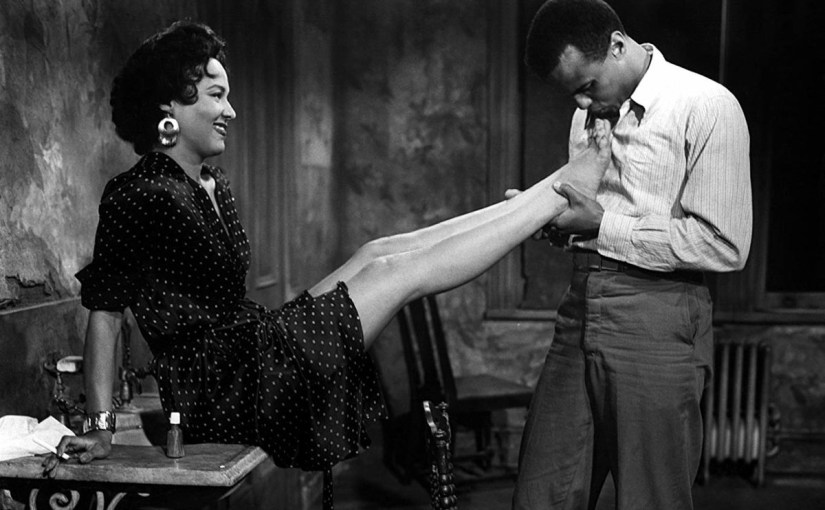
The tragic arc of Carmen Jones may seem inevitable, as I said before, but it remains an entertaining watch.  You can see the dominos falling, and you bemoan the choices Joe makes as he falls under Carmen’s spell, but I mean, LOOK at her.  There’s a scene that I’m sure would bear the Tarantino stamp of approval as Carmen paints her toenails and coyly asks Joe to blow on them for her so they can dry faster.  Dayum.  Show me a straight man who wouldn’t fall for that kind of treatment from a woman who looks like Dorothy Dandridge and I’ll show you a dead man.

If I wanted, I could get nitpicky about Carmen Jones.  Has it aged well?  Not exactly.  Does it feature great acting aside from Dandridge?  Not exactly.  Does it look natural to hear an operatic tenor burst forth from Harry Belafonte’s mouth?  Not exactly.  But Carmen Jones is a landmark of black cinema in an era when schools and government buildings still had segregated water fountains and restrooms.  Based on that fact alone, I consider Carmen Jones to be a vital step in Hollywood’s painfully slow racial evolution. (It is also a painful reminder of a career that might have been; Dandridge died 11 years later at only 42.)

MONTE WALSH (1970)

by Miguel E. Rodriguez

DIRECTOR: William A. Fraker
CAST: Lee Marvin, Jeanne Moreau, Jack Palance, Mitchell Ryan
MY RATING: 7/10
ROTTEN TOMATOMETER: 89% Fresh

PLOT: An aging cowboy realizes that the West he knew and loved will soon be no more – and that there will be no room for him, either.


Based on this film, Monte Walsh, and the other two films he directed, A Reflection of Fear [1972] and The Legend of the Lone Ranger [1981], I think it would be charitable to say that William A. Fraker’s best films are the ones where he served instead as director of photography, such as Bullitt [1968], WarGames [1983], and Tombstone [1993], among many other notable movies.  Am I saying Monte Walsh is a bad film?  No, but it’s certainly not as bad as Gene Siskel’s 1-star rating, nor is it as stellar as Roger Ebert’s 4-star rating.  I give it a 7-out-of-10 on my scale because of the way the second half of the film builds and builds so that the outbursts of violence feel earned and motivated instead of cliched.

Monte Walsh (Lee Marvin, grizzled as ever, even with a handlebar moustache) and his friend and partner, Chet (Jack Palance in a rare non-villainous role), come down off a mountainside after a rough winter keeping watch on Mr. Brennan’s herd of cattle, only to get news that Brennan’s ranch has been purchased by a corporate entity, Consolidated Cattle.  Brennan offers them a steady job, which they reluctantly take, but deep inside they know this means their prairie-roaming way of life is coming to an end.  Chet is prepared to accept this, but Monte chafes at the idea.  “I ain’t doing nothing I can’t do from a horse,” he warns Brennan.

We get entertaining glimpses of the ranch hand life, complete with the saloon fights and the stinky cook.  Monte dallies with a French madame, Martine (played by the exotic Jeanne Moreau).  At one point, Monte and Chet ride out and meet a weathered old ranch hand who is “riding fence,” or inspecting every foot of fence around the ranch for repairs…the only work he’s cut out for anymore.  “Looks like his life is over with,” they say, and you can tell they’re looking into their own future.

The thrust of the film is one I’ve seen in many other westerns before this one: “The old West is changing, and there’s no place in it for people like us anymore, so we’d better evolve or die.”  This theme is present in Once Upon a Time in the West [1968], Butch Cassidy and the Sundance Kid [1969], and especially The Wild Bunch [also 1969]…seemed to be a trend for westerns at the turn of the decade, for some reason.  Monte Walsh handles it in an episodic format, kind of like another Lee Marvin film, The Big Red One [1980].  It doesn’t quite tell a straightforward plot with a pre-determined story arc.  It skips around a little bit, painting a picture without telling a conventional story.

There can be a sense of freedom in this kind of storytelling.  Unshackled by traditional story beats – at least for the first half – the movie is laid back, asking the viewer for a little patience as it slowly lays down building blocks for the finale.  However, I must report that I found this section of the movie a little slow.  I grew impatient.  I felt I was being set up for something, but pretty soon I just wanted the movie to get on with it.  Butch Cassidy sort of works that way, but you had two of the most photogenic stars who ever lived as the two leads.  I struggled to care the same way for Jack Palance as I did for Paul Newman.

But then an unexpected scene of violence occurs, setting into motion a series of events that culminate in a tragic series of deaths that, I must admit, had me glued to the screen as they unfolded.  Because of the gangbusters nature of this section, I am inclined to forgive the film’s shortcomings in its first half.  Here, we see, yes, Monte must evolve or die, and even if it’s never in any real doubt what he will choose, it’s entertaining to watch him make that choice.

If not for the second half of the picture, I might not even be writing about Monte Walsh.  I didn’t care for the opening song (even if it WAS sung by Mama Cass), some of the movie felt ripped off from several other westerns, and I was borderline bored for the first half.  But if you stick with Monte Walsh until the end, I think you’ll agree it’s worth a look.

UMBERTO D. (Italy, 1952)

by Miguel E. Rodriguez

DIRECTOR: Vittorio De Sica
CAST: Carlo Battisti, Maria Pia Casilio, Lina Gennari
MY RATING: 8/10
ROTTEN TOMATOMETER: 98% Certified Fresh

PLOT: An elderly man and his beloved pet dog struggle to survive on his government pension in Rome.


The greatness of Vittorio De Sica’s Umberto D. is something I was only able to appreciate after it was over.  As the film plays out, I was waiting for something more to happen, something to add to the paper-thin plot of an elderly man struggling to make ends meet in a city whose government has forsaken him and thousands or millions like him.  When the screen faded to black at the end, my first thought was, “That’s it???  Well, what happens next?”  The fact that the film prompted me, not only to ask the question, but to attempt to come up with an answer, is probably one of the reasons why this film is widely regarded as a classic.  Not many films can claim to keep the story running forward in your head after it’s over.

Umberto Domenico Ferrari is an elderly man living in post-war Rome.  The film opens with him joining a crowd protesting the city government’s policy of cutting their pensions.  Umberto is in dire straits.  He’s behind on his rent, low on cash, his landlady threatens eviction, and he must somehow still feed his beloved dog, Flike (rhymes with “like”).  The film will follow Umberto’s tribulations over the course of several days as he berates his landlady, tries to get some cash by selling some of his books and other possessions, dines at a soup kitchen while furtively feeding scraps to Flike, and befriends the young maid in his building who has problems of her own.

Umberto D. is as good an example as any, and better than most, of Italian post-war neo-realism, a cinematic movement in which Italian film directors aimed to paint the silver screen with portraits of everyday life in their country, which was wracked with poverty and unemployment at the time.  Rather than provide an escape from such hardships, these directors felt it was their civic duty to bring the everyman (or everywoman) into the spotlight, to remind the audience that movies could be more than escapist entertainment.  They felt obliged to say, “There are more stories of despair and hardship ten feet out your front door than can be imagined by any Hollywood screenwriter.”

There are pros and cons to this approach, at least in my opinion.  On one hand, the neo-realist movement created such immortal classics as La strada [1954], Bicycle Thieves [1948, also directed by De Sica], and a little later, Rocco and His Brothers [1960]; these are films that have stood the test of time and will continue to do so for decades to come.

On the other hand, a quote from Roger Ebert comes to mind: “A man goes to the movies; the critic must admit that he is this man.”  In other words, learn to say exactly what you think about a film as opposed to what you think you should think.  And when it comes to Italian neo-realism, I’ll say this: give me a choice between a De Sica retrospective and a Christopher Nolan marathon, and it’s the Nolan marathon seven days a week and twice on Sunday.  Yes, I am aware of the place that neo-realism films have in cinematic history, and I can appreciate their greatness on a cerebral level.  However, on a gut level, I can usually only watch them once or twice, with very few exceptions.  La strada, for example, is heart-wrenching, but in such a way that I want to revisit it just to relive those emotional gut-punches at the end.

Umberto D. didn’t quite deliver those gut-punches, at least not during its running time.  …okay, there IS a moment when Flike runs away, and the possibility arises that he may or may not have been put down by the local pound.  There is a cringe-inducing scene when we watch hardened men roll a cage full of stray dogs into a large box where the dogs will be gassed; we are spared the sight of the actual procedure, but we see enough of it to get the picture.  Umberto watches the box with fear in his eyes.  Another man wants to retrieve his captured pet, but he falters when he lacks the money to pay for his return.  The look on his face as he repeatedly asks, “So, if I don’t take him, you’ll kill him?”  THAT is a scene where my emotional juices where stirred up.

(Okay, there is ONE other scene that got me a little riled up emotionally, but it happens near the film’s climax, so I can’t describe it without spoiling something.)

Aside from those very rare moments of heightened emotion, the film is mostly pedestrian, giving us more details of Umberto’s daily life as he tries and tries to find a way to get enough cash to pay his rent.  In one pathetic scene, he debates whether he should resort to panhandling like so many other men he sees on the streets.  At first, he tries it himself, practicing holding out his hand on a street corner, but when someone actually turns to give him some money, Umberto pretends he was just stretching – he just can’t bring himself to accept handouts from a stranger.  He tries to enlist Flike instead, getting him to hold his hat while sitting on his hind legs, but that doesn’t work out either.  He reaches out to former friends, to no avail.

As I’ve said before, DURING the film, these scenes, and others like them, didn’t stir me up the way I felt the director was shooting for.  It was only afterwards that I found myself pondering those scenes and Umberto’s actions.  I used to own a dog, a very long time ago.  If my dog were my only remaining connection, with no family or friends to reach out to in times of need, how would I feel if I learned he might have been captured and put down?  If I suddenly had no means of income, no way to pay the rent/mortgage/whatever, and nowhere to go if I got kicked out of my apartment/house/whatever, how would I manage?  Would I manage?  Late in the film, Umberto makes a couple of hard choices.  Would I make the same choices in his position?

As FINE appears on the screen, Umberto D. invites us to wonder about Umberto’s fate.  The last scene is, on the surface, a happy one, but somber music plays over it, and the scene does not address or solve Umberto’s situation.  This is in the neo-realist tradition.  If De Sica were asked, “But what happened to him at the end?”, I can imagine him saying, “The same thing that happens to all such men.”  If he was told, “But I don’t know what happens to such men,” De Sica might say, “Well, now you have something to think about.”  Q.E.D.

[Trivia: The lead actor, Carlo Battisti, was not a professional actor, but a professor of linguistics. Umberto D. would be his only film, and not many people can claim that kind of legacy with just one film.]

JOKER: FOLIE à DEUX

By Marc S. Sanders

Joker: Folie à Deux is an unnecessary sequel.  A lethargic bore.  That is its one problem, and it infects the merits the film clings to but never gets off the ground.

It amuses me, with a pinch of vitriol, that at the closing credits the picture is said to be based on characters published in DC Comics.  My perspective still stands as it did with Todd Phillips’ first film.  These characters are not consistent with any variation that appears with any superheroes/super villains who occupy the assorted comic books.  It is especially true in this new installment.  Just because the players are named Joker, Harley Quinn and Harvey Dent does not translate to where these folks stemmed from.  Joker: Folie à Deux stands on the shoulders of a hot, pop culture, geek property simply to bank on the residuals.

This sequel picks up two years after the original Joker left off.  Arthur Fleck (Joaquin Phoenix, returning to his deserved Oscar winning role) is imprisoned and awaiting trial for the murder of five people including the famed talk show host he shot on live television.  He’s abused both physically and verbally by the prison guards led by actor Brendan Gleeson, who is a better actor than this unoriginal dreck has to offer.  His attorney played by Catherine Keener believes in upholding a defense by reason of insanity.

Arthur normally keeps quiet while endlessly smoking cigarettes (boring stuff). Everyone else talks.  None of this goes nowhere for a very, very long time.  The one positive that enters his life is a fellow inmate named Lee Quinn played by Lady Gaga, another actor worthy of better material.  Lee is being held for setting fire to her parents’ house.  The two develop a quick kinship.

Within his psyche, does the clown image of Arthur’s Joker personality let loose in morose song and dance performances with Lee, also known as Harley.  Uplifting musical montages of classic numbers would normally invoke toe tapping cheerfulness.  Yet, that is not what happens for this disturbed man. Numbers like That’s Entertainment, Get Happy, and What The World Needs Now are given somber and depressing interpretations for these sad sack clowns to sing.  Singer Lady Gaga is not belting out the numbers.  Rather, she puts on a weakened, hoarse inflection to her performance.  Joaquin Phoenix works in tow with his co-star. YOU HAVE LADY GAGA!!!! YOU HAVE JOAQUIN PHOENIX WHO CAN ALSO SING (Walk The Line)!!!!! WHY WON’T YOU LET THEM REALLY, REALLY SING??????

The overall problem with Joker: Folie à Deux is that it remains very stationary.  Director Todd Phillips and Phoenix will set up a performance scene with building intensity of the original score.  You hear the treble of the string instruments build and build.  The camera will zoom on Arthur while signing a book or smoking cigarette as he gets taunted, and you think the animal inside is going to unleash, but then it doesn’t and the moment pancakes flat out.  Nothing means anything in this picture, and it looks like the script is being made up as the film goes along.

About halfway through the movie, the Catherine Keener character is simply dispatched from the film altogether with one line, never to be seen or focused on again. I guess this is supposed to be an impactful moment, but it seems to occur because the screenplay by Scott Silver and Todd Phillips had a bout of writer’s block and decided to “let’s try this!”.  I got to know this person, only to realize she’s pointless.  This is what an edit looks like within a finished product. 

The difference between this film and its predecessor is the Arthur Fleck character actually does not appear in every single scene of the movie this time.  The last film focused on Fleck’s internal struggle with an alternative personality and the cruel world he’s forced to live in.  This film seems to observe Arthur as a subject from the outside.  I believe Joaquin Phoenix has less dialogue this time as we get to hear from his attorney and the prison guards and Lee, and how each of them respectfully perceives Arthur.  So, I credit the film for going in that different direction.  It’s an alternate narrative.  Yet, there’s no advance in Arthur’s plight or story development.  The film just meanders and meanders.  You’d be drunk about ten minutes after the movie begins if you paced yourself by how often a cigarette is lit.  At the very least, Phoenix and Gaga could have exhaled smoke rings for a little fun.  Only Big Tobacco will be this film’s biggest fan.

Look there’s Harley Quinn!  Look there’s Harvey Dent!  He’s the one that becomes Two-Face, right?  Ha!  They said the word Gotham.  Oh, and check it out!  Arthur and Lee are being held at Arkham Prison!  Hold the phone!  Did I hear that witness’ last name is Kane, as in Batman creator Bob Kane? 

So what?

If you are seeking another DC Comics vehicle, look further please.  Joker: Folie à Deux is a possessor of someone else’s intellectual property and the film should surrender it.  Name drops from the universe of Batman does not constitute another variation of the celebrated Clown Prince of Crime.  As good as Joaquin Phoenix’ performance was in the first film (here, in the second film it is nothing special, just the same old same old), his Joker does not belong anywhere in the fraternity house that is shared with the likes of Romero, Nicholson, Ledger and yes even Leto.  Lady Gaga is doing the best she can here.  Beyond the sleepy song and dance numbers, this role is not up there with some of her other memorable performances though.  She is Lee, but she is not Harley Quinn.  No one will remember Lady Gaga for this film.

The original Joker was a box office smash that truly hinged on a very special and impressive performance from Joaquin Phoenix.  It also relied on the Joker label which Hollywood will never have enough of, despite Batman’s impressive vastness of villainous rogues.  That first film garnered a worldwide box office of over a billion dollars.  It stands to reason that Warner Bros would demand a follow-up film for more bucks to stuff under the mattress.  Whatever this new picture earns is not merited on anything but the theft of the brand names it incorporates.  This is a shameless cash grab that surges only to the top of that uncelebrated list. 

I recommend movie goers find a real Gotham City to step into.  Joker: Folie à Deux takes you on an endless detour you can’t find your way out of.