BLADE II (2002)

by Miguel E. Rodriguez

Director: Guillermo del Toro
Cast: Wesley Snipes, Kris Kristofferson, Ron Perlman, Norman Reedus, Donnie Yen
My Rating: 9/10
Rotten Tomatometer: 57%

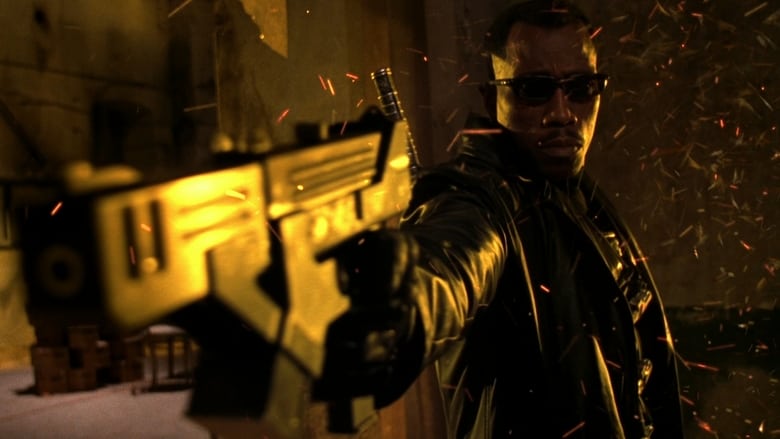
PLOT: Blade, half human/half vampire, forms an uneasy alliance with the vampire nation in order to combat a new breed of monster, the Reapers, who are feeding on vampires and humans alike.


Why don’t more people like this movie?  It’s like someone took the best fight scenes from The Matrix, removed the pretentious plotting, added a crapload of gore, and created one of the best villains in the history of vampire movies: the Reaper, an evil-looking creature whose lower jaw splits wide down the middle to reveal a blood-sucking appendage that might even give the Xenomorph nightmares.

Blade II is lean and mean.  Director Guillermo del Toro has gone on record as saying this was not exactly the movie he intended to make, as it doesn’t keep precisely to the Blade “canon” (in case you didn’t know, Blade is a lesser-known Marvel comics character who is scheduled to eventually make an appearance in the Marvel Cinematic Universe).  However, despite his misgivings about this film, del Toro nevertheless created an action-horror masterpiece.

If you’re a fan of action films, what do you like?  Because it’s all here.  There are five great fight scenes, including a doozy in Blade’s own lair between Blade and two vampire ninjas wearing elaborate headgear that makes them look like humanoid bugs.  You like a great villain?  Here’s Jared Nomak, the vampire who carries the Reaper virus, whose wounds heal by themselves almost instantly, and who carries a dark secret.  His fighting skills are equal to those of Blade himself, who must learn to use more than brute force if he’s going to defeat Nomak.  (And let’s not overlook the cameo by Asian superstar Donnie Yen.)

You like a good story?  We got that, too.  Blade’s sworn enemies, the vampire nation, are forced to approach Blade for help when it becomes apparent they are no match for the Reapers.  Blade HAS to help, because who will the Reapers go after once they dispatch all the vampires?  Humans.  So you have the whole “uneasy alliance” going on, with no one more uneasy than Reinhardt, a vampire played by a deliciously malevolent Ron Perlman.  Reinhardt goes along with the plan, but can’t resist poking the tiger by asking Blade, “…can you blush?”  Blade’s response gives a whole new meaning to the term “kill switch.”  Game, set, match.

This is also a horror film, let’s not forget.  You like scares?  How about the part where a Reaper gets pinned to a wall with a ninja sword through its stomach…but escapes by crawling backwards up the wall, forcing the sword to slice through his body as he skitters away, unfazed by the damage?  YIKES.  We got gore, too.  Blade and company perform an autopsy on a dead Reaper.  I haven’t seen that much detailed gore since the autopsy in John Carpenter’s The Thing.

I mean, seriously.  This movie has everything I want in an action movie that’s also a horror film.  It covers ALL the bases.  (I could’ve done without the quasi-love-story, but it’s not dwelt on too much, so I can live with it.)  What more could anyone ask for?

(Also, it’s great to listen to on a bad-ass audio system…BOOMING bass and sound effects.  Great stuff.)

INCENDIES (2010, Canada)

by Miguel E. Rodriguez

Director: Denis Villeneuve
Cast: Mélissa Désormeaux-Poulin, Lubna Azabal, Maxim Gaudette
My Rating: 10/10
Rotten Tomatometer: 93% Certified Fresh

PLOT: Twins living in French Canada journey to the Middle East to fulfill their mother’s last wishes by discovering their family history.


A few years before French-Canadian director Denis Villeneuve made a big splash in American cinema with Sicario, Arrival, and Blade Runner 2049, he directed Incendies [French for “flames” or “fires”…I had to look it up].   This is one of the best films I’ve ever seen.  It’s a mystery, a melodrama, and an urgent plea for peace, all at once.  It’s heartbreaking, engaging, absorbing, and beautiful to look at.  There are two directors currently working who I believe have successfully picked up the mantle left behind by Stanley Kubrick.  Denis Villeneuve is one of them.

(The other is Alejandro G. Iñárritu [Babel, The Revenant], but let’s not get sidetracked…)

A mother dies.  At the reading of her will, her twin son and daughter receive a mission: go to the Middle East and track down their previously unknown father and brother, and give them letters in sealed envelopes.  Only then will the mother allow a headstone to be erected on her gravesite.

The brother, Simon, is skeptical, owing to the mother’s strange behavior in her later years, but the daughter, Jeanne, dutifully follows her mother’s wishes and travels to an unnamed country in the Middle East and begins the laborious process of tracking down anyone who knew her mother and father.

We also get flashbacks of the mother, Nawal, in her younger years, paralleling the daughter’s search.  We learn that Nawal, a Christian, fell in love with a Muslim, Wahab, which is a BIG no-no, to say the least.  Soon, Wahab is out of the picture, and Nawal gives birth to a son who is immediately taken from her arms and delivered to an orphanage.

So far, this is standard soap opera material, but it’s depicted with gorgeous cinematography and spot-on direction.  Director Villeneuve uses a lot of wide shots that have a stark beauty; they reminded me of some of the memorable vistas from Bonnie and Clyde and The Deer Hunter.

When Nawal gets a little older, she decides to track down her son.  This is made difficult owing to the state of war that now exists between Muslims and Christian Nationalists.  Attacks and reprisals make it nearly impossible to find accurate records.  She travels alone from one burned-out orphanage to another looking for clues.  At a key moment, she flags down a bus, but is very careful to first hide her crucifix necklace and put on a head-covering.  Can’t be too careful.

At this point, regrettably, I have to abandon summarizing the story, because the less you know about what happens after Nawal gets on that bus, the more effective those events will be.  Suffice to say it’s a life-changing event, one that sends her on a wildly careening path from activist to assassin to political prisoner.

All of this, naturally, comes as a shock to her children, Jeanne and Simon, who are starting to think this search for missing family members may be a mistake.  At one point, someone makes an important statement: “Sometimes, it’s better not to know some things.”

So…what is this movie really about?  It’s not just about the mystery of the missing family members, which is enough of an engine to make a compelling movie on its own, especially when it’s intertwined with the mother’s past.  But there is a deeper, much more profound level to Incendies that is not apparent until the movie’s final sections, when the threads of Nawal’s past converge in a moment of shattering revelations.  The movie beautifully hides its real motives along the way so you get blindsided by its true message, its true heart.

I dunno, maybe I’m getting too mushy.  But that’s the effect this movie had on me.  I’ve only experienced this kind of emotional catharsis after a precious few films.  It’s impossible to fully describe it without giving away the secrets lying at the heart of Incendies.

DRAG ME TO HELL (2009)

by Miguel E. Rodriguez

Director: Sam Raimi
Cast: Alison Lohman, Justin Long, Dileep Rao, David Paymer
My Rating: 8/10
Rotten Tomatometer: 92% Certified Fresh

PLOT: Christine Brown has a good job, a great boyfriend, and a bright future. But in three days, she’s going to hell.


Re-read that plot description above.  That’s pretty much the movie in a nutshell.  And it was directed by Sam Raimi getting back into his grindhouse-y horror zone after five years of hobnobbing with Columbia Pictures and their Spider-Man franchise.

In other words, it’s a movie showcasing a director getting back to what he does best.  And it is nothing if not effective.

Christine Brown (Alison Lohman), a loan officer at a bank, tries to impress her boss by refusing to extend the home loan of an elderly woman, Sylvia Ganush, who is facing eviction.  Later that night, Mrs. Ganush accosts Christine in a parking garage (one of the movie’s many exceptionally effective scare sequences).  As revenge for rejecting her loan extension, Mrs. Ganush bestows a curse upon Christine: in three days, a demonic spirit will come for Christine’s soul, and there’s nothing she can do to stop it.

(We have already received a glimpse of what potentially awaits Christine during a horrifying prologue…and it is not good.  Helpful Tip for a Longer Life: Never piss off an old woman with a glass eye.)

Drag Me to Hell is not really trying to be “great”.  It’s a D-list story filmed by an A-list director.  It’s not concerned with the thematic dichotomy of good versus evil, or anything like that.  It is simply a delivery device for scares intended to jolt people out of their chairs every 5 or 10 minutes.

And, MAN, does it deliver.  There are sequences of poor Christine alone in her house, while something sinister prowls around outside, and eventually gets into the house…and I haven’t been that scared since I saw John Carpenter’s Halloween on VHS for the very first time.

There’s a creepy scene involving a single fly buzzing around Christine’s head while she sleeps, and then it alights on her face and crawls INSIDE HER NOSTRIL and then OUT THE OTHER ONE.  <shudder>  But then it moves towards her lips and starts to force its way INTO HER MOUTH…and it just makes your skin crawl in a way that’s hard to describe.  Accomplished with no blood or gore, just…eeyuck.

Mrs. Ganush herself makes a few encore appearances, just to keep things interesting, and then there’s a climactic séance at the house of a celebrated medium who once battled this particular evil spirit before.  This will certainly go down in movie history as one of the scariest/most gonzo séances EVER.  Without going into too many details, let me just say this: I could tell you the scene involves, at one point, a talking goat, and you might laugh, because what’s funnier than a talking goat, and it IS funny for the first couple of seconds…but that laughter will fade as soon as you see what happens next.  The word “bizarre” was invented for the séance in Drag Me to Hell.

That right there sort of encapsulates the general mood of this movie.  In all of his horror films, Sam Raimi’s sense of humor was always evident, most especially in Evil Dead 2 [1987] and Army of Darkness [1992].  In returning to the genre that started his career, he retains that gleeful, mischievous tone.  As horrifying as Drag Me to Hell is, it’s also pretty damn funny, even while we’re getting the bejeebers scared out of us.  (It’s hard to explain without getting into spoilers, but you’ll see what I mean when you watch it.)

So there you go.  It’s a horror movie that will make you laugh and shriek at the same time.  I thoroughly enjoyed it.

…but I would advise checking your doors are locked before starting it. Just saying.

KNOWING (2005)

by Miguel E. Rodriguez

Director: Alex Proyas

Cast: Nicolas Cage, Rose Byrne, Ben Mendelsohn (plus an early sighting of a young Liam Hemsworth in his first movie role)
My Rating: 9/10
Rotten Tomatometer: 33%

PLOT: M.I.T. professor John Koestler links a mysterious list of numbers from a 50-year-old time capsule to past and future disasters and starts to wonder…what happens when the numbers run out?


[SPOILER ALERTS…not that anyone is going to rush out and stream this, but whatever, still … SPOILER ALERTS]

Knowing is a polarizing film from Alex Proyas, the visionary director of The Crow (1994) and Dark City (1998).  It tells the story of an M.I.T. professor whose son is given an envelope that has been sealed inside a time capsule for 50 years.  Inside the envelope is a list of seemingly random numbers that appear to be meaningless, until he notices a pattern emerging.

I remember when this movie came out very well.  I was stoked to go see it because Alex Proyas is one of my favorite directors. But it got PANNED right out of the gate.  And most of the negativity stemmed from the movie’s ending, which turned off the vast majority of moviegoers who thought was the equivalent of someone saying, “It was all a dream!”

Knowing does NOT have one of your typical Shyamalan-esque endings.  The ending follows the strict logic of everything that has come before and arrives at an astonishing, awe-inspiring conclusion that left me gobsmacked.  But more on that later.

Let’s talk about how Knowing works.  First, everything about the movie sets us up for what appears to be a standard horror movie with Nicolas Cage’s son apparently in danger from mysterious pale figures in dark coats who show up at their house in the middle of the night and just stand there…watching the house.  Creepy.  At one point, one of them somehow gets INSIDE the house, a sequence that ends with the boy having a nightmarish vision of a raging forest fire.

These are, so far, basic horror tropes.  But director Proyas uses skillful styling and editing to create something that feels as creepy and suspenseful as any horror movie I’ve seen.  In fact, every time I watch Knowing, I find myself still on edge during certain scenes, particularly the ones involving the pale strangers.

Another feature of the movie that I feel elevates it is the visceral nature of the key scenes involving various accidents.  See, that 50-year-old list of numbers is actually a list of dates on which various catastrophes occurred over the last 50 years, along with the number of casualties…and Nicolas Cage’s character, John Koestler, can plainly see that three of them are coming up in the next few days.

So it’s a foregone conclusion that we, the audience, are going to see some sort of major accidents.  And, man…I have never seen, before or since, such astonishing, nerve-racking sequences of horrible accidents in films.  I don’t want to be a spoiler, but I CAN say that I guarantee this is one movie that will never be an option for in-flight movie channels on commercial airliners.  I mean…when it happens, it’s out of the blue, and it feels as real as these things can get with CGI.  It literally takes my breath away every time I watch, and I’ve seen it like ten times.  Easily.

So now that Koestler has proof the list is real, the question that keeps nagging at him is…what happens when the numbers run out?

And that’s where Knowing leapfrogs over other genre thrillers and actually becomes ABOUT something.  Before finding that fateful list, Koestler asks his students at M.I.T. to write a paper on determinism versus coincidence in the natural world.  That is, do you believe that everything up to this point has happened for a reason, or is literally everything we do completely random, with no purpose or design?  Koestler believes in the latter, even though he’s the son of a minister, a man with whom he’s had no contact for years.

Koestler has his reasons.  Years ago, his wife was killed in a hotel fire, an event which he perceives as a random accident.  But then he gets this list, and it seems as if someone has been able to accurately predict seemingly random events.  This list flies in the face of everything he’s believed for years.  If these accidents are predictable, is everything ELSE predictable?  Is there a REASON for the accidents?  Is life more than just the result of millions of years of evolution and genetic mutations?

Koestler cannot square this list with his personal beliefs, and it’s that conflict that’s at the heart of the movie.  Knowing forces its main character (and, by extension, the audience) to make a decision one way or the other.  Is there a plan for existence, or is it random?  How long can he ignore the evidence of his own eyes before he makes his choice?

And over all of that, there’s still the issue of the list running out of numbers.  What happens then?  The end of the world?  Is he destined to SAVE the world?  Or stand by helplessly as pre-determined events spin forward out of his control?

This is why the movie stands above other genre sci-fi thrillers.  It poses tough questions and forces us to confront our own beliefs.  And the movie does not take the easy way out by trying to have it both ways.  The finale of Knowing is as implacably logical as it is visually stunning.

Detractors of the movie decry this finale as a “deus ex machina” that cheapens everything that came before.  I even remember some mild laughter in the audience when I first saw it.  But seriously…given everything that happened before, what ELSE would have been a good ending?  Have Koestler wake up from a dream?  Have him discover that it was all really a government experiment?  A drug-fueled hallucination?

None of those would have worked NEARLY as good as the ending the movie DOES provide.  As I said before, it follows the logic of its own story to the bitter end, and gives us some spectacular visuals into the bargain.  It doesn’t cheat, it doesn’t pander or cop out.  We have gone from point A to point B, and the only way out is through point C.  When you think about it, isn’t that kind of audacious?  How many movies have had the nerve to follow the courage of its own convictions?  (I’m reminded of The Bridge on the River Kwai with its own fatalistic finale, combining spectacular visuals with an ending that was not a “happy” one by any stretch of the imagination.)

I stand behind this movie as one of the great sci-fi mystery thrillers.  Love the ending or hate it…I challenge you to come up with an ending that would have been better than the one presented in the film.

THE SQUID AND THE WHALE (2005)

by Miguel E. Rodriguez

Director: Noah Baumbach
Cast: Jeff Daniels, Laura Linney, Jesse Eisenberg, Anna Paquin
My Rating: 9/10
Rotten Tomatometer: 92% Certified Fresh

PLOT: Two young brothers deal with the divorce of their parents in 1986 Brooklyn, specifically the Park Slope neighborhood.


I started writing this as a “conventional” review, and I found myself unable to make it more than a simple summary of the plot.  I have rarely seen a movie that has left me more inarticulate than this one.  I can tell you the movie works, and works extremely well, but I am unable to explain exactly why.

It’s a simple story of a husband and wife going through divorce, deciding on joint custody of their two sons, and the complications that ensue.  The husband, Bernard (Jeff Daniels), is a literature professor and a published novelist, but who hasn’t had anything published for some time.  The wife, Joan (Laura Linney), is in the final stages of getting her own first novel published.  This fact may or may not be one of the causes of the divorce, but Bernard is pretty sure it is.  Their sons, Walt (high school senior, played by Jesse Eisenberg) and Frank (maybe 12 years old), deal with this news in a predictable manner: initial numb acceptance, then some acting out a little later.

Bernard, whose well-educated narcissism is impossible to miss, almost cheerfully informs the sons that he and Joan will share joint custody evenly during the week.  One of the sons asks, “How can you share us evenly?”

“I’ll have you every other Thursday,” Bernard explains helpfully.  This answers the question without making anything better.

Walt starts a relationship with a classmate whom he coldly describes as “cute, but not gorgeous.”  Bernard casually invites a female student to live in a vacant room in his new house.  Joan and Bernard fiercely protect their “days” with their sons.  Frank starts drinking beer and masturbating in public places (this is handled with much more discretion than that description would have you believe).

But the story itself is not what makes this movie such a pleasure.  It’s the movie’s style and editing that create a unique experience.  The movie clocks in at an unthinkable 81 minutes, WITH credits.  I learn from the bonus features on the Blu-Ray that it was shot on Super-16 film stock with a mostly hand-held camera, lending the film a low-budget, documentary look that enhances its “reality”.  Scenes last only long enough for us to get the point before a jump cut takes us to the next plot point.  Normally, this creates in me a sense of nervousness or anxiety, but for some reason it didn’t work that way.  I never felt cheated or short-changed.  It all just felt “right.”  It gave me the same sensation I get when I’m reading a really good short story with sharply-drawn characters and impeccable dialogue.

That may sound like more details than I had promised at the beginning, but it’s really just a clinical description.  Words can’t express how the film’s brevity, atmosphere, dialogue, and characters all combined to produce one of the most touching films about family and/or divorce that I’ve ever seen.

(No, I HAVEN’T seen Marriage Story by this same director, Noah Baumbach, but I will get around to it one day.  Today is not that day, though.)

QUANTUM OF SOLACE (2008)

by Miguel E. Rodriguez

Director: Marc Forster
Cast: Daniel Craig, Olga Kurylenko, Mathieu Amalric, Judy Dench, Gemma Arterton, Jeffrey Wright, David Harbour
My Rating: 5/10
Rotten Tomatometer: 65%

PLOT: Super-spy James Bond investigates a mysterious organization that seems intent on cornering Bolivia’s water supply.  Yes, you read that right.


The trivia on IMDb for Quantum of Solace (Bond #22, for those keeping track) contains this revealing nugget:  “Editing this movie was so stressful that co-editor Richard Pearson was brought in to assist Matt Chesse, to speed up editing. Director Marc Forster only had five weeks to edit the entire movie. In his previous movies, Forster would take an average of fourteen weeks to edit.”

Right there.  That’s the biggest problem with Quantum of Solace, the reason it’s ranked among my least favorite Bond films.  The stunts are there, the wordplay is there, the Bond girls are there…I was going to add “good villain” to the list, but more on him later.

Anyway, most of the important elements are there, but the movie never really makes us CARE about what’s going on.  We do get the barest bones of a connection to Casino Royale from two years earlier, but that’s still not enough to bring this up to the level I’ve grown accustomed to with Bond films.  This film feels more like one of Vin Diesel’s old XxX movies.

One of the biggest problems is the aforementioned editing issue.  In Casino Royale, the fight scenes were clearly defined and visually exciting.  (Remember that fight in the stairwell?  BRILLIANT.)  In Quantum of Solace, the fight scenes are cut so rapidly I’d swear they were from a Michael Bay movie.  Rather than make the scenes more exciting, this had the effect of making the scenes feel like the trailer for the movie, rather than the movie itself.  It was distracting, and lessened the tension for me.

Another problem that kept me from caring what happened is the plot.  Dominic Greene (Mathieu Amalric) is the villain this time around, and I’m sorry, but he does not exactly come across as a dangerous fellow.  He’s a little on the shorter side, he doesn’t dress impeccably (except when attending the opera), and his hair looks…greasy.  This is not a villain; this is a sidekick looking for a villain.

And his evil plot?  Using an environmental advocate organization as a front to…corner the Bolivian water supply.

The water.  In Bolivia.  After decades of James Bond stopping villains who wanted to do everything from steal nuclear submarines to kill literally every human on Earth, it seems to me this particular mission could have been left to the varsity squad.

There are other elements that were distracting.  David Harbour makes an appearance as a CIA agent whose character serves no real purpose other than to be the stereotypically obnoxious American.  One scene takes place during a beautifully staged outdoor production of Tosca that looked so amazing, I almost wished I could have left the movie just to finish watching the opera.  Gemma Arterton plays Agent Fields (first name Strawberry…get it?), another in a very long line of female characters in Bond films whose sole purpose is to sleep with Bond and/or get killed…or both.  Usually both.  (In an interesting first for the franchise, Bond actually does NOT sleep with the main Bond girl…go figure.)

The movie’s showdown takes place in a location that looked very real, but was ALSO distracting.  What is a four-star hotel doing in the very middle of the Bolivian desert?  We get a clumsy exposition line about the hotel running on “fuel cells” that are apparently poorly protected indeed, given the building’s incendiary tendencies during the climax.

I’m making the movie sound like a BAD movie.  It’s not truly BAD, but it just feels so slipshod in comparison to its predecessor, Casino Royale.

So what happened here?  Well, another tidbit on IMDb quotes Daniel Craig as saying this is the last time he’d work on a Bond movie without a finished script.  I guess THAT’S what happened here.  Shooting a movie without a finished script can sometimes end well, but not usually.  It’s like building a 30-story skyscraper using plans that only go up to the 15th floor, with couriers bringing new blueprints for the floors already under construction as well as the unbuilt floors.

But…BUT.  There is one overwhelmingly bright spot in the film: the THEME SONG.  Performed by Jack White and Alicia Keys, it marked the first (and, so far, only) Bond song to be performed by a duet.  It’s called “Another Way to Die”, and it is a SCORCHER.  Words fail me.  It’s down, dirty, mean, and growling, complete with the occasional staccato brass flourishes so evocative of John Barry’s score from earlier Bond films.

Too bad the rest of the movie is unable to live up to the promise of its title song.  Alas.

BARAKA (1992)

by Miguel E. Rodriguez

Director: Ron Fricke
Cast: N/A
My Rating: 10/10
Rotten Tomatometer: 81% Certified Fresh

PLOT: The rhythms of life and time are explored in this wordless montage of spectacular filmed images from around the globe, set to a haunting, ethereal score.


Some time ago, I wrote a post on Facebook about movies with an extremely rare quality: transcendence.  Movies that are so good that mere genre definitions are not enough to quantify them.  I’m not talking about perfect examples OF a genre (Aliens, Unforgiven, Young Frankenstein, et al.)  I’m talking about movies that wind up being more than the sum of their parts and take on a haunting, spiritual quality.

Film is an extremely subjective medium, so my list of such “transcendental” movies will likely differ wildly from your own.  For example: Breaking the Waves (1996), a meditation on the capacity for human suffering, forgiveness, and the definition of belief.  Or Cloud Atlas (2012), a mind-bending journey that poses the greatest “what-if” question of our existence.  Or Fearless (1993), a mainstream drama concealing life-altering truths at its core.

And then there’s Baraka, a 1992 film that premiered in Canada on the festival circuit before receiving its American release a year later.  I suppose it would have to be classified as a documentary, since it consists entirely of wordless images edited together into a feature-length music video.  It was directed by Ron Fricke, who had previously worked with director Godfrey Reggio on Koyaanisqatsi (1982), a groundbreaking film, similar in structure to Baraka, that introduced time-lapse photography to the mainstream; it’s hard to believe, but there was a time when time-lapse was a novelty.

But this clinical description doesn’t nearly do justice to the religious experience that is Baraka.  This is one of those movies that begs for the best viewing conditions possible, on the biggest screen and with the best sound system you can afford.  The cinematography simply defies belief.  There are monumental shots of Himalayan mountain ranges, ancient temples, an enormous graveyard of decommissioned B-52 bombers, the interior of a spectacular cathedral where the walls appear to be inlaid with millions of tiny mirrors.

The film’s score is credited to Michael Stearns, but it also includes existing musical pieces that lend certain sequences an exotic, global feel.  These music choices are absolutely essential to Baraka’s success. 

In particular, a musical piece called “Host of Seraphim” by Dead Can Dance brings unbearable sadness and pity to a sequence in which we see Indian families picking through massive garbage dumps, searching for food or God knows what.  The sequence shifts to showing homeless people, families, sleeping on city streets, next to sewer grates, under makeshift shelters, and there is an overwhelming sense of mourning that this kind of thing is happening today, right now, all over the world.

In addition to the sequence above, there are also sequences depicting members of various religions worshiping in their own unique way.  And oceans of clouds swirling and flowing over and around mountaintops.  And the horrible abandoned camps at Auschwitz and in Cambodia.  And majestic waterfalls.  Oil fires in Kuwait.  A vast, still lake that perfectly mirrors the sky above it.

Every time I watch this film (this marks at least the 9th or 10th time I’ve seen it), I am left at the end feeling hopeful, expansive, with the urgent need to show this film to other people.  Is this what they mean by religious fervor?  I felt this same way after watching Parasite (2019), for example, but for very different reasons.  Parasite is thrilling.  Baraka is transcendent.  It pierces through my sometimes cynical expectations of what a movie should be and presents me with a showcase of the human experience.  It makes me feel, however temporarily, more connected to the global population as we travel through the cosmos on our huge (and also tiny) planet.  It gives me a shiver of comprehension when I look at the ruins of ancient temples on the screen and realize the people who built them many thousands of years ago were just…people.  Like you and like me.  Humans on this uniquely life-sustaining chunk of space rock, hurtling through the universe.

You may disagree with my assessment.  You may hunt it down on Netflix or Amazon or wherever, and you may give it a shot, and you may turn it off after 15 minutes, thinking, “What was he THINKING???  This is boring as hell!”  I suppose that’s the beauty of this movie.  It’s like a Rorschach test.  It doesn’t tell a story, per se.  It’s more like a tone poem, where certain images are juxtaposed with completely different images, but which are nevertheless similar.  This kind of moviemaking doesn’t always work.  (See, for example, Naqoyqatsi (2002), also directed by Reggio, part of his vaunted Qatsi trilogy, but which I find insufferably cryptic.)  But when it does work, it’s quite literally magical.

So, if you can, go ahead and see if this is available somewhere.  Check your television’s settings so you get the optimal picture.  Turn your speakers up as loud as you can get before the neighbors call 911.  And open yourself up to the possibility that a picture truly is worth a thousand words.

PARASITE (2019)

by Miguel E. Rodriguez

Director: Bong Joon Ho
Cast: Kang-ho Song, Sun-kyun Lee, Yeo-jeong Jo
My Rating: 10/10
Rotten Tomatometer: 99% Certified Fresh

PLOT: Ki-taek and his family, all unemployed, take peculiar interest in the wealthy and glamorous Parks, as they ingratiate themselves into their lives one by one.


Watching Parasite reminded me of the first time I saw Pulp Fiction.  I told my friends that it was like being on a roller-coaster at night wearing a blindfold: you have no idea where you’re going or what’s coming, but the ride is exhilarating.

That’s Parasite.  The hype is real.  This is one of the best movies I’ve ever seen, and if you plan on seeing it, I would highly recommend you do so BEFORE reading further.  I have no plans to spoil ANYTHING, but the less you know about the movie before going in, the better.

(You’ll have to bear with me, I’m writing this shortly after seeing the movie myself, it’s currently 11:14 PM, and I’m starting to get a little tired, but I want to get this all down before I pass out, so it may get a little “rambly” for a while.  You’ve been warned.)

Parasite is many things.  It’s a social commentary, a black comedy, a family drama, and a Hitchcockian thriller all rolled into one delicious Korean dish.  (The film and filmmakers are Korean.)  The beauty of the movie is that it manages to be all those things without losing track of itself.  I can’t count how many movies I’ve seen that attempted a tonal shift in the middle or at the end, and it just falls flat.  Where lesser movies failed, Parasite succeeds.

The plot involves a nuclear family, the Kims (father, mother, college-aged son and daughter), living in near-poverty in a sub-basement.  They fold pizza boxes to make a little cash.  They steal wi-fi from a shop next door.  When fumigators spray outside their street-level window, they open it wide to take advantage of the free pest control.  They aren’t starving, but they are desperate.  Yet they don’t appear to be beaten down by their condition.  They’ve become a family of hustlers, not in any criminal manner, but in ways that enable them to get by on the bare minimum until one of them can get a leg up.

Opportunity knocks one day when a friend of the son, Ki-woo, gets him a job as an in-home tutor for the high-school daughter of a wealthy family, the Parks.  Ki-woo changes his name to Kevin, then suggests to Madame Park that her 7-year-old son could use an art tutor.  This gets his sister, Ki-jung hired.  She changes her name to Jessica and finds a creative way to get her father hired as Mr. Park’s personal driver.  Then the Parks’ long-time housekeeper somehow has to be eliminated so the MOTHER can get hired.

Before long the entire family is working for the Parks, though it’s important to note the Park family has no idea their new employees are all related.  This is all done with great humor, not in a farcical way (that will come later), but in such a way that you find yourself rooting for this down-on-its-luck family of con artists to finally get a taste of the good life.

There’s a long scene where the Parks have gone camping, and the Kims gather in the enormous living room of the Parks’ lavish home and just sit and eat and drink and talk and get drunk.  This is the family drama/social commentary part of the movie.  There’s something a little sad about seeing these people who are like any other people, who seem no less deserving than the Parks, but their best-laid plans have come to nothing, and the highlight of their lives is to get hammered in somebody else’s house.  Suppose Kevin falls in love and decides to marry the girl he’s tutoring, when she’s a little older.  Who will they get to be his parents?  Will they need to hire actors?

Trust me, I haven’t spoiled ANYTHING.  Swearsies.  This movie is brilliantly, ingeniously split into two parts.  The first half is prologue.  The second half is genuinely, literally breathtaking.

Something happens that forces the Kim family to examine and re-evaluate their life choices up to the present.  It also forces them to do some very fast thinking indeed, which is where some of the funniest and darkest comedy takes place.  This is where the movie really takes off, where it had me reminiscing about the twists and turns in Pulp Fiction.

And nothing…nothing can prepare you for the finale.  About which I’m saying nothing.  Again.

From a cinephile’s perspective, Parasite is miraculous.  It manages to be several different things all at once, allowing you to savor every individual aspect of it without any one part of it overpowering the other parts.  The screenplay is unbelievably inventive.  The direction is sure-footed and masterful.  The acting is pitch perfect throughout.  It made me think, it made me laugh, it made me cringe, it made me say, “Oh S#i+!” MANY times, and it made me bring my hand to my mouth like a shocked Victorian-era woman many, MANY times.

I say again.  The hype is real.  You owe it to yourself to see this movie whenever you can.

[Ed. note: the Criterion blu-ray of Parasite contains an interesting experiment: a black-and-white version of the film, which is apparently how the director originally envisioned the film, and which might account for its stark imagery in places.]

1917 (2019)

by Miguel E. Rodriguez

Director: Sam Mendes
Cast: Dean-Charles Chapman, George MacKay, Colin Firth, Mark Strong, Benedict Cumberbatch
My Rating: 10/10
Rotten Tomatometer: 89% Certified Fresh

PLOT: Two British soldiers during the First World War are given an impossible mission: deliver a message deep into enemy territory that will stop 1,600 men, including one of the two soldiers’ brothers, from walking straight into a deadly trap.


Bear with me for a second…I promise I’ll actually get to the movie in a second.

I’m not a professional movie critic.  I write reviews simply because it amuses me to do so, and because one of my friends made it possible for him and I to post our reviews in an online forum.  For about two months, though, I haven’t written a single review.  I pondered this with Marc a little while ago, and the only reason I could come up with was that I didn’t feel INSPIRED to write something.

Not that I haven’t seen good movies in those two months. Waves, Uncut Gems, Star Wars: The Rise of Skywalker, Jumanji: The Next Level, Frozen 2, Little Women, Bombshell, maybe one or two others – they were all good, even great.  (In the case of Uncut Gems and Waves, I’d even call them “must-see” events.)  But I never felt compelled to run home and put pen to paper, or fingers to keyboard.  I simply felt that I had nothing to contribute where those movies were concerned.

Well, tonight I saw 1917, and now I have to say, this is a different case altogether.

For anyone who’s not quite aware of why this movie is so special, aside from it just being really good, 1917 was hyped as being told in one single shot with a camera that follows two soldiers through battlefields and countrysides as they attempt to deliver an important message to a distant company of English soldiers.  No cuts to different angles, no cuts at all, in fact.  (Actually, there IS a single cut, but more on that later.)

While I originally felt it was a bit of a stunt to get it noticed at Oscar time (remember Birdman [2014]?), after seeing the movie it was abundantly clear that this was no mere trick to dazzle an audience with.  This specific story is particularly suited to this specific method of filming.  It forces the audience to empathize with these two soldiers immediately, and only them.  I was reminded for some reason of Saving Private Ryan, and a line spoken by Tom Sizemore: “This time the mission is a man.”  Well, this time, the men are the mission, and the mission is paramount.  The single-take strategy has the uncanny ability to put us in the shoes of these soldiers more so than many other war films.  You feel like you’re right there in the mud with the empty artillery shells and the corpses and the rats.

And that’s the supreme achievement of the movie: its ability to put us there and KEEP us there for two hours without ever calling attention to the fact that, “Hey, we haven’t cut yet and it’s been over a half hour!”  A lot of that has to do with camera placement and movement and, of course, the actors’ ability to keep us engaged.

But one thing that I kept noticing throughout the movie was the small details.  I’m not going to remember them all, but they included:

  • At one point, the British soldiers walk through an abandoned German bunker.  In a throwaway detail, the name “KLARA” is seen scrawled on one of the walls.  The camera doesn’t focus on it, but it just passes by.
  • We encounter a group of British soldiers, and of them is a Sikh.  The other soldiers are doing bad impressions of their superior officers, but the Indian’s impression is clearly better than the other Englishmen, with proper diction, upper-class accent, everything.
  • In the British trenches, various sections have unique names.  The one I remember most clearly is “Paradise Alley.”
  • As they walk, one of our two heroes notices cherry trees, and he quickly rattles off several different varieties of cherries.  He knows them because his family has an orchard back home.
  • An intense scene where someone has to literally wade through dozens of corpses.
  • In one remarkable scene, the movie pauses to listen to a song. Fighting is imminent, death may arrive at any moment, but for a brief moment, everything stops. It’s a brilliant moment…almost holy.

Little things like that.  The reason I bring them up is because some of them seemed unnecessary to the story, but they colored the story so that it felt more real than most.  And the closing credits reveal that this movie is based on stories told to director Sam Mendes by his grandfather, who served in World War One.  So many, if not all, of those little details were probably one hundred percent REAL details, the kind of details that could only be remembered by someone who was there.

Another reason the movie is so suspenseful is because we’ve become subtly programmed to believe that, in a war movie, the ending can’t be too Hollywood; otherwise, it’s not real enough.  The soldiers must deliver a message.  Will they even survive long enough to deliver the message?  Assuming they do, will the officers receiving the message even follow the order?  A civilian appears at one point…will they live?  They engage in combat…who will live and who will die?  I was on edge the whole movie because I never really felt “safe”, which was EXACTLY the kind of feeling you want when you’re watching a war movie.  In my opinion.

Now, about that whole single-shot thing.  There actually IS one cut, a SINGLE cut, during the whole movie.  You’ll know it when it happens.  But when you’ve seen as many movies as I have, you’ll also notice “invisible wipes”, where the camera passes by something in the foreground – a pillar, or a rock, or a tree – that comes in between the camera and the person/object being filmed.  Using clever editing and lighting, you can cut two shots together using that pillar/rock/tree as the splicing point.  And there is a LOT of that going on in this movie.

I’m not taking anything away from the achievement of the film, it’s spectacular.  It’s just something I noticed that I could not UN-notice for the duration of the film.  A minor quibble, nothing more.

1917 is definitely a top contender for Best Picture of 2019.  I have only seen a handful of World War I movies, but this is certainly one of the very best.  I’d rank it up there with Kubrick’s Paths of Glory any day.

DOCTOR SLEEP (2019)

by Miguel E. Rodriguez

Director: Mike Flanagan
Cast: Ewan McGregor, Rebecca Ferguson, Kyliegh Curran
My Rating: 9/10
Rotten Tomatometer: 76% Certified Fresh

PLOT: Nearly forty years after the events of The Shining, an adult Danny Torrance makes contact with someone else who can “shine”, and is soon drawn into a war with a band of people who hunt gifted people like himself.


If you had asked me a year ago to list movies will never get a sequel, Stanley Kubrick’s 1980 adaptation of The Shining would have been near the top of that list.  As adaptations go, it has its share of fans and detractors, but as a stand-alone horror movie, it’s a stone-cold masterpiece that has never been equaled.  When I heard that they were actually making a sequel based on Stephen King’s own sequel to The Shining, I was extremely skeptical.  The last time someone made a follow-up to a Kubrick film was 2010 (1984), and while that film was a decent sci-fi flick, it didn’t come close to the spectacle of Kubrick’s 2001: A Space Odyssey (1968).  So my expectations were, as they say, tempered.

After watching Doctor Sleep earlier tonight, I can say, unequivocally, that while the film is not perfect, I could not have asked for a better sequel to The Shining.  It’s a treasure trove for fans of the original, and also for fans of the extended universe that King has created for his novels, starting with the Dark Tower series forward.  (For those particular fans, you’ll be glad to see a very specific two-digit number making a conspicuous cameo…)

To begin with, the story is classic King.  Danny Torrance has grown into an irresponsible adult with a drinking problem, marking an unfortunate parallel with his father, Jack.  He hits bottom and takes up residence in a sleepy New Jersey town, joins AA, and works as an orderly at a local hospice.  Up to now, he has done everything in his power to keep his “shine” in check, but he finds a pragmatic use for his gift working with terminal patients, with the help of an inscrutable cat who can sniff out which patient is going to die next.

Eventually he comes into contact with a young girl named Abra, who lives in another part of New Jersey, but who can “shine” like he can.  And then there’s this nomadic group of people, calling themselves The True Knot, who are apparently hunting down other people with the “shine” for their own nefarious purposes.

It all wraps and weaves into a thrilling tale that skillfully retains the feel of Kubrick’s film.  Doctor Sleep works on its own merits, but the more you know about The Shining, the more thoroughly you’ll enjoy this new film.  Sharp-eyed cinephiles will be amazed at how many times, and in how many different ways, Kubrick’s style is echoed and referenced in this sequel.  These include liberal use of fade transitions, lots of static shots, Steadicam shots, use of natural lighting, those shots with the axe (!), even the aspect ratio that the film was shot in.  I got a giddy little swoop every time I saw how carefully the director, Mike Flanagan, was working the master’s craft into his film.  It was like watching a very subtle Kubrickian version of Ready Player One.  And it never comes off as plagiarism…it’s definitely homage, not theft.

Another aspect I really enjoyed was how the movie doesn’t rush through anything.  It’s two-and-a-half hours long, longer than average these days, which is yet another echo of The Shining.  When it works, that kind of pacing and running time gives the viewer the luxury of settling into the rhythm of the characters, makes them feel more like real people instead of cardboard cutouts hurrying from one milestone to the next.  For example, there’s a scene where one character performs a kind of astral projection to find someone.  There is a rather long series of shots showing her traveling through space that I can easily imagine would have been truncated in a lesser film.  Doctor Sleep, instead, gives us a good long look at her journey, to really feel the distance involved.  It’s quite a beautiful sequence, in fact.

This was a much better movie than I anticipated, which is good, because I never believed it was necessary.  It’s a relief to see that the continuation of Danny Torrance’s story has been handled in such a respectful manner, both towards the first film nearly 40 years ago and towards the viewers and fans.  It’s not perfect (I could pick nits about one particular aspect of the finale if I wanted to), but it’s a worthy successor to Kubrick’s masterpiece.  This belongs on the list of the best Stephen King adaptations along with It (2017), The Green Mile, and The Shawshank Redemption.

P.S. The blu-ray edition of Doctor Sleep contains a director’s cut that extends the running time by thirty minutes, adds more details about Abra’s powers, among other things, and inserts “chapter breaks” that almost make it feel like a miniseries.