MY COUSIN VINNY

By Marc S. Sanders

The American Bar Association’s publication, The ABA Journal, ranked My Cousin Vinny #3 on its list of the “25 Greatest Legal Movies.”  Surprised?  You really shouldn’t be.  

This “fish out of water” film follows a goodfella who did not pass the bar exam until his sixth try.  Now he’s defending his cousin and another UCLA college kid in an Alabama courtroom.  It’s Vinny’s first murder trial.  So he’s gotta learn the ropes of how to dress properly for court all the way up to discrediting material witnesses and demonstrating reasonable doubt to get his clients exonerated.  It’s a great courtroom picture because within the dense slapstick comedy there are authentic lessons to learn about being a member of the Bar and having confidence in yourself.

Bill and Stan (Ralph Macchio, Mitchell Whitfield) are roadtripping through southern America, en route to UCLA, when they get pulled over and framed for the murder of a convenience store clerk.  With no money or hope of retaining a reliable public defender, the young men turn to Bill’s cousin Vinny.  

Straight out of the five boroughs of New York wearing a black leather jacket, black boots and a slick pompadour, Vinny Mancini arrives in small town Alabama.  You know something?  If I didn’t know any better I’d say he looks and acts a lot like Joe Pesci.  With him is his long time fiancée, Mona Lisa Vito (Marisa Tomei, in her very well remembered Oscar winning role). Mona Lisa Vito!  I love when there’s some thought put into a character’s name.

The future looks grim for the accused as Vinny doesn’t know where to begin.  The iron horse Judge Chamberlain Haller (Fred Gwynne) habitually holds the guy in contempt because Vinny can’t shed his New York ways either in wardrobe or proper decorum. The prosecutor played by Lane Smith really doesn’t have to try hard at all.  Though he deliberately gets all Southern showy each time he faces the jury, made up of friendly locals.  In an unexpected and tender moment, the tough guy, Vinny, admits to Lisa that he’s “a-scared.”

I never cared for My Cousin Vinny since I had seen it in theaters.  However, there’s much I appreciated on only my second viewing of this film directed by Jonathan Lynn, an actual law scholar.  Lynn is always striving for an authenticity within the courtroom.  His protagonist might not know anything about being a litigator, but the director ensures that a genuine regiment of customary courtroom behavior, procedure, and theatrics will be upheld even if this is only a silly, little comedy flick.  

Outside the courtroom, there’s primarily an updated George and Gracie situational comedy at play.  Marisa Tomei is of cinema’s great scene stealers.  Mona Lisa Vito might look like an overly familiar character, but the actress’ performance is entirely unique.  She never plays Lisa as a dumb side character to her boyfriend who will not commit to marriage.  Lisa comes off generous, always offering to assist Vinny despite his rejections.  She’s also positively smart as a whip with her extensive knowledge of automotive repairs, and she’s a quick study of Alabama law.  When she gets put on the witness stand it hardly matters what she’s saying.  Marisa Tomei owns the expertise and defiance of Lisa.  Turn the scene on mute to watch her doing some of her best work would be equally effective.

Go look at Silver Linings Playbook when Jennifer Lawrence rhythmically dictates numeric football statistics at Robert DeNiro.  Both actresses won Oscars for these respective roles.  These performances stand apart from so many other second, third and fourth billed actresses because they are written with immense intelligence.  That’s what Tomei and Lawrence normally embrace first, ahead of costume and makeup.  The confidence from these actors is uncanny.  More women need to be cast in roles like these.  

Joe Pesci is doing his reliable, familiar schtick from Goodfellas, Raging Bull and Easy Money.  He’s in a what if scenario though.  What if there’s a movie with Jersey Boy Joe Pesci, but he’s put in Alabama country with roosters crowing and trains chugging into town at five in the morning? There can even be a communication gap between the Judge and Vinny for some padded laughs.  “What is a yoot?”

I was bored with this movie the first time I saw it.  I just didn’t think the humor was funny even if I recognized the attempts.  Over thirty years later, what I appreciate is the heart that feels much more apparent.  The hero feels weak and at a loss.  Only when he is given strength and support from a wisecracking, sexually frustrated girlfriend does he get the drive to behave like a lawyer he’s licensed to become.  I like Vinny.  I like Lisa.  Therefore, now I can laugh at their unfortunate dilemmas as they work towards an end goal – getting him to do his best at becoming a courtroom lawyer and hopefully reaching a not guilty verdict. 

I gotta give a shout out to the supporting cast.  Bruce McGill plays a familiar sheriff that we’ve seen before, but so what.  It’s the way he carries himself that I’m always welcome to see him in a movie.  Same goes for Lane Smith.  These guys are sophisticated Dukes Of Hazzard.  Fred Gwynne, most famously known as Herman Munster, was always a brilliant character actor.  He has the ability to be goofy and intimidating all in the same scene.  To place his towering stature against little Joe Pesci? Who needs dialogue? Watch Fred Gwynne’s moments in My Cousin Vinny.  He could’ve been Oscar nominated, and I would not have complained.  While Ralph Macchio is doing his typical routines (same things we saw in The Karate Kid, The Outsiders and so on), it’s Mitchell Whitfield playing his buddy who really stands out.  This is a nothing role but it’s as if this guy fell out of a Woody Allen or Neil Simon picture to claim his own territory among an outstanding cast.

My Cousin Vinny is one of those comfort films to put on when the stress is becoming too much in real life.  Everyone is so likable here.  There isn’t a villain to dual against.  Instead, it’s a conflict of cultures who must work together to uncover truths within a murder trial while also learning about what any one of us is actually capable of accomplishing. 

Vinny from da Bronx is a lawya???? 

FUGGETABOUTIT!!!!!
WHITE MEN CAN’T JUMP (1992)

By Marc S. Sanders

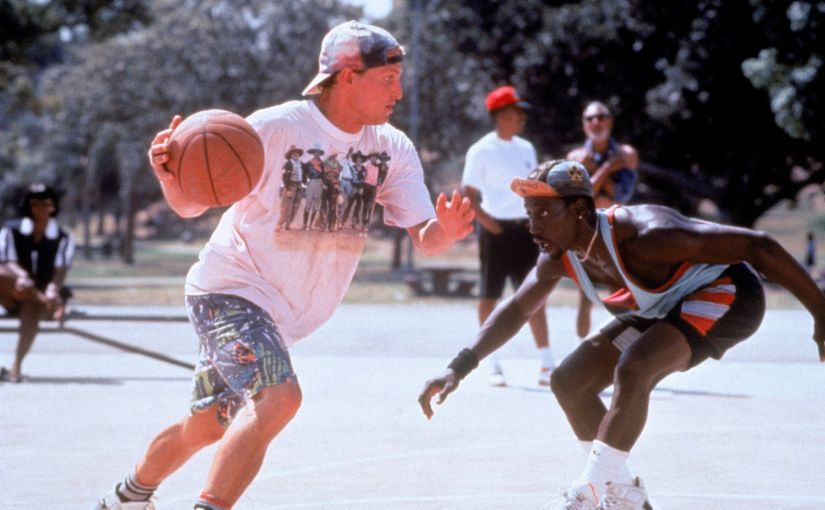
I’m not enamored so much by sports unless they are dramatized effectively in the movies.  If I can see Woody Harrelson and Wesley Snipes making magnificent trick shots with a basketball in White Men Can’t Jump, my attention will be had.  There’s lot of street corner basketball depicted in Ron Shelton’s film and for the most part it is sensational and quite funny when partnered with the on court ribbing that guys toss at one another.  This film arrived with the oncoming trend of “Your momma is so…” insults, which still bring out the sophomoric glee in me.

Fortunately, White Men Can’t Jump doesn’t just rely on the basketball antics. There’s a good set up here and some well-drawn characters.  It’s one flaw may be that I think the film overstays its welcome.  Just when you think the picture is over and every loose end is tied, a new development occurs.  That’s because every sports movie demands a final championship game.  Who made up that stupid rule?

Billy Hoyle (Harrelson) makes quick cash on the court by being the fish out of water on Venice Beach.  He’s the pasty white kid with the dorky rainbow-colored cap that any urban black athlete will happily challenge for a game of one on one or two on two.  That’s the trick to his con because he’s a magnificent player actually, and regular player and loudmouth Sidney Deane (Snipes) sees an opportunity for them to partner up and clean up.  Like most competitive sports, you gotta taunt your opponent and when they have gone overboard, you lay on your conceit and declare that you can beat them any day with any guy they choose to partner them up with, such as the blond, white guy sitting on the bench doing morning stretches. 

They each have their own motivations.  Billy is up to his neck in debt to some bookies who he wouldn’t throw a game for. They are ready to collect or shoot him in the head, or both.  His girlfriend Gloria (Rosie Perez in a standout performance) aspires to land a spot on Jeopardy!. Sidney lives with his wife Rhonda (Tyra Ferrell) and baby in the criminal area of Watts.  She’s pressuring him to get them out of the slums and buy a house in a nice neighborhood. 

At first, the cons work for the pair, but the question is can Billy and Sidney trust one another.  Will they scam each other while trying to work together?

Ron Shelton’s script works because it turns in various directions when you do not expect it.  These are unusual characters. Lovable, but not all that they seem either and they are built with flaws that will undo them while they try to make a further leap ahead.  Billy is a smart kid on the court but he’s not smart with money like Gloria.  Sidney is smart at putting up the façade of a dumb loudmouth on the court but that’s his M.O. for being a responsible family man.  Gloria seems like a zany dingbat on the surface but she may be the smartest character of them all.  It’s definately not because she has memorized every kind of food that begins with the letter Q for the game show.  She has true instincts and knows to see through the B.S. of people that her boyfriend Billy can’t. 

White Men Can’t Jump is a both a con movie and a sports movie, but it’s not the greatest of each of those categories.  Still, it’s very, very entertaining thanks to Harrelson, Snipes and Perez working in top form. Wesley Snipes is doing the fast-talking wise ass routine that Eddie Murphy built his career on.  You don’t see this kind of guy in every Wesley Snipes movie though, like you do in Murphy’s films.  That’s what impresses me with Wesley Snipes.  He’s not known to be an Eddie Murphy or a Chris Rock.  He’s an actor, not a comedian, and yet he’d convince me otherwise if this was the only performance I ever saw.  

Other than his obvious role in Cheers, Harrelson normally portrays smarter guys.  Billy is smart, but he lacks instinct and not just with money but with how he considers Gloria.  The best thing Ron Shelton could have done after perfectly casting this trio was to give these characters heart followed by the flaws that weigh them down.  All that maintains what could have been a one note and flat story.

However, the film runs a little longer than I cared for.  While basketball is at the forefront of the script, I believed the film was concluding when I saw the two guys had finally grown up and learned.  Only then, a new development occurs for Sidney and his family. Suddenly, it’s up to the two guys to get back together for one more game.  I didn’t need that one more game.  I had my fill and that final tournament is shot in slow motion – literally every shot the guys make, and I’m starting to lose my patience.  Don’t get me wrong.  I’m impressed.  Harrelson and Snipes are not stunt doubled.  That’s them doing the doing the shots and accomplishing enormous efforts of agility to wow the audience.  They’re great, but by this point, I had seen enough basketball to deliver the message and I found the tacked-on twenty-minute epilogue mostly unnecessary. 

Granted some may argue that something occurs in that last game to justify the literal title of the movie.  I know what you’re talking about.  Yet, that could have been covered a lot more efficiently, I believe.  Less would have been more in this situation.

White Men Can’t Jump is great comedic entertainment, full of improvised dialogue and characters that are easy to like while keeping up a skeptical guard on them.  That’s good.  It states that Shelton’s characters are complex and that holds my interest.  Even the extras are ones to appreciate in their sweaty t-shirts while delivering urban vernacular to harass one another.  It’s a great culture to get a peek into.  I love the one guy who is a sore loser and whips out his knife, but then just as his girl calms him down, he says forget the knife.  He’s gonna get his gun. I challenge anyone not to laugh as all the other guys on the playground make a mad dash escape in a hundred different directions.  It would likely go down this way.  We hear of violent stabbings and shootings all the time. In this movie however, Ron Shelton and his cast find the natural humor of this opposing conflict.

I guess that’s the best compliment I can give the writer/director.  He didn’t sensationalize his characters.  Ron Shelton has a way of just letting his creatures of the court play.  Into—the—basket it goes. 

SWISH!!!!  It works.

LEAP OF FAITH

By Marc S. Sanders

You never know when God may come knocking.  You never know when Jonas Nightengale may come knocking either.  If you’re fortunate enough to reside in small town Rustwater, Kansas, you sir, or you ma’am, or you dear child may be blessed by the healing powers of Reverend Nightengale. 

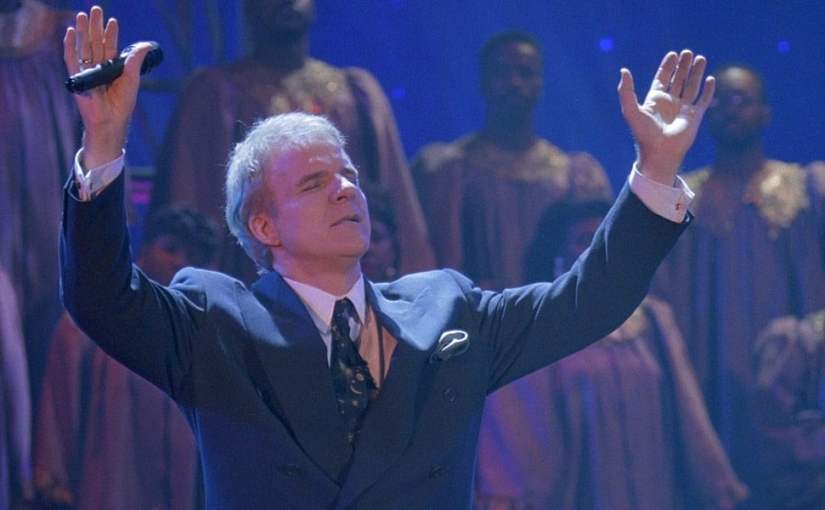
On the surface, Jonas appears like a comedic role for Steve Martin, but in actuality it is not aiming for laughs at all.  When it comes to the confidence scheme that Reverend Jonas offers the townsfolk of Rustwater, Steve Martin plays the phony preacher with nothing but a serious operandi. 

Jonas and his crew travel the states from one big city to the next where he preaches his gospel of deceitful hope in exchange for donations to his traveling church that supposedly serve the almighty lord.  When one of their trucks breaks down in Rustwater, Jonas and his top aide, Jane (Debra Winger) use it as an opportunity for easy cash.  This Kansas town relies on harvests and the infrequent rain that feeds the crops.  Otherwise, this sleepy town has one diner, a movie theater, and a sheriff named Will (Liam Neeson) who is out to reveal the false Oz behind the curtain.  At the same time, Will is romancing Jane who has been eagerly seeking out a flame that never had a chance to flourish because she is on the road so often.

Jonas is wooing Marva (Lolita Davidovich), a waitress at the diner who is also skeptical of the whole act and is protective of her younger handicapped brother, Boyd (Lukas Haas) who suffered a permanent leg injury in a car accident that killed their parents.  Boyd was once told by a preacher that there is not enough faith in his heart for him to be the receiver of healing powers.  Lukas Haas was not just cast because he’s a talented actor.  He also has that angelic face that suggests he’s never committed a sin.

The tricks of Jane and Jonas’ trade are all revealed here.  Jane hides in the back feeding information about certain audience members and their ailments into Jonas’ earpiece.  Eavesdropping by the crew (including an early appearance by Phillip Seymour Hoffman) ahead of the show provides Jane with all the data.  It’s neat to see and it is likely how these outrageous televangelists pull off their miraculous “gifts.”

There’s an interesting argument to Leap Of Faith.  Jane defends Jonas’ façade to Will by him just selling fairy tales that make people feel good and fulfilled.  Will sees the obvious moral dilemma.  Jonas offers another defense.  Is this any different than a circus act that presents the fantastic for an audience to witness. Personally, I think Jonas and Jane’s defense is a bunch of hooey.  Yet, the residents of Rustwater buy into the act and soon people from all over the Midwest are lining up to listen to the gospel and witness the miracles of Reverend Nightengale. 

Jonas has a dilemma himself though.  He has a fondness for Marva, and he likes Boyd.  Boyd is not a plant in the audience to go along with the healing power showmanship.  So, how is Jonas going to explain his position?  He’s quick on his feet to fend off public accusations from Will, but how can someone who is not a miracle worker perform a miracle while maintaining his illusion.

I like the set up and questions that Leap Of Faith asks.  It’s the story of the arriving snake oil salesman which I do not see too often in films.  The showy pieces of the movie are wonderful with terrific singing from the choir under the big top circus tent with the enormous crucifix of Jesus in the center.  There’s also an enthusiastic supporting cast from Phillip Seymour Hoffman, as well as Meat Loaf as the church keyboardist.  The crowd extras are wonderful with their vocal responses.  I also especially love how Jonas ups the ante with a terrific sight gag to silence his biggest doubter, namely Will. 

The film is different, especially for Steve Martin.  He’s a ball of energy on the stage. He does his one-foot slide that was often seen on Saturday Night Live and his stand-up acts, but here it is not done for laughs.  Instead, Martin’s recognizable schtick upholds the public persona of Judas, and it works. 

Still, I do not think I got what I would have prayed for from the film.  I could not get past how Liam Neeson does not work as a Midwest sheriff in this Podunk town.  His boyish good looks from the early 1990s are right for the romance, but he makes no effort to hide his native Irish dialect.  He just doesn’t blend into the Americana canvas very well.  Debra Winger is great and it’s a shame I do not see her in enough films.  Almost everything she does I like.  She just has a natural vibe about her.  She has good scenes with Neeson, but just like his character, their storyline belongs in another movie very distant from the prime directive of Leap Of Faith.

The romance between Martin and Davidovich does not amount to much either. Frankly, it feels as if the story editors opted to abandon this angle midway through the making of the film. I do not recall how the relationship resolved itself and the ending certainly does not generate any kind of response for how either character regards one another. 

Towards the end of Leap Of Faith, the unexpected occurs twice, sort of like what happens in the end of Magnolia.  I found it interesting, but then the credits roll and the gospel choir sings on until the screen goes dark.  I’m leaping from my chair asking but wait, what about this and what about that.  Nevertheless, the choir keeps on singing, deafening my concerns.  Janus Cerone’s script seems to paint itself into a corner just when a brilliant irony arrives and hardly an acknowledgement, and certainly no explanation, is offered for the new phenomena that occurs. 

Leap Of Faith begins with a prologue between Jonus and a traffic cop.  It’s a brilliant scene demonstrating right away how smooth this “preacher” is when it is a one on one grift.  (Celebrated trickster and former con man Ricky Jay was a consultant on the film.) Later, we see how mesmerizing Jonus is in front of hundreds of people.  I was very excited during the first hour and a half of the picture, but then the movie gives up on itself.  The best way to describe this viewing experience is to say that Leap Of Faith simply loses faith in itself.

PATRIOT GAMES

By Marc S. Sanders

You may remember Patriot Games as a tense thriller featuring the favorite hero Jack Ryan doing the wherewithal action that is demanding for the adaptation of Tom Clancy’s best-selling novel.  Harrison Ford (taking over the role from Alec Baldwin) plays the guy who will thwart an assassination attempt on the Royal Family or punch out a terrorist thug invading his home or on a speed boat during a dark and stormy night.  Only a small bit of the action sequences are flawed, but that doesn’t take away from what makes the picture truly special.  In the follow up to The Hunt For Red October, Jack Ryan goes back to the CIA to investigate who wants revenge against him and who was responsible for that assassination attempt.  What the picture serves as the covert halls of the Central Intelligence Agency is what is especially convincing and most fascinating.

On the surface, the Irish Republican Army appears to be the scapegoat for attempting to murder members of the Royal Family as they are pulling out of the front gates of Buckingham Palace.  Jack Ryan is in London vacationing with his wife Cathy (Anne Archer) and daughter Sally (Thora Birch) when he comes upon the incident just in time to foil the crime.  In the process, Ryan takes a bullet to the shoulder and kills the younger brother of the most dangerous squad member, Sean Miller (Sean Bean).  A quick trial puts Miller behind bars and Jack is recognized as a hero.

However, Sean Miller escapes with his surviving comrades and vows revenge on Jack and his family.  An attempt is made on the Ryans’ lives and Jack insists on getting back into the CIA to locate Miller and his team.

The revenge plot is the main thread and its pretty ho hum.  We’ve seen all that many times before.  However, what branches off are the conflicts within Irish politics and how Jack Ryan gradually uncovers who and where this small faction of terrorists may be.  Cold War commentary is delivered by an under the radar performance from one of my favorite character actors, Richard Harris.  He attempts to deny responsibility of these attacks and offer an olive branch to Ryan.  Ford and Harris have three good scenes together, two of which are minimal on dialogue but effective in sending their messages to one another. 

As well, Harrison Ford occupies another great heroic role.  I agree with a majority who believe he was too old to play the novice Jack Ryan described in Clancy’s early novels.  Many insist casting Baldwin was perfect.  It was. Yet, I am able to look past that as the character does not have the rookie appearance or regard in this picture.  With Harrison Ford, Jack Ryan is now at a point where he looks seasoned and experienced like the character eventually becomes in the book series.

Director Phillip Noyce is good at using the mysterious and quiet orchestral accompaniments of James Horner to follow Jack as he studies photographs or reflects on the day of the assassination attempt in order to piece together random clues.  In other films, this might get boring and tedious.  However, the director captures good closeups of Harrison Ford and quick flashbacks are edited to help identify what were important blink and miss it moments necessary to assemble the puzzle.  A simple visit to the restroom for Jack Ryan and a glance at a woman’s ponytail lead to a solid conclusion.

Sean Bean has the physical and quiet intensity to his role.  He’s the muscle of the terrorist group, not the leader (played by Patrick Bergen).  Bean serves the revenge element and his physique and weapon handling work well as a nice threat to the hero of the picture.

As the story progresses, the audience follows along with Ryan.  Satellite photographs are studied and zoomed in seeking some semblance of an image in a blur.  Sometimes Jack Ryan is moving in the right direction but in other times he’s unsure.  Even though we always know how the bad guys are doing and where they are, we empathize because Harrison Ford’s character does not.  Still, it’s a thrill to witness him eventually make his discoveries.

A nice approach occurs when the CIA sends in troops to what they believe is an enemy base camp.  We watch Jack Ryan and all of the government officials stare with intensity on a big screen as little black pixels drop down and move at a running pace from an overhead satellite shot.  We don’t have to endure one more machine gun battle.  This kind of intensity is much more interesting where lives are taken as a means of protection, but still a principled man like Jack Ryan does not feel good about what has to be done.

Patriot Games works well with its plays on espionage, spy activity, traitors, and government relations between America, Great Britain and Ireland.  The select action scenes are done well and hold their suspense for quite long.  However, the final sequence is challenging to sit through. 

As the enemy prepares a covert attack on the Ryans’ Virginia home where the Royal Family are guests, there is much running around upstairs and down, in the basement, and outside the roof and so on.  It’s pouring rain with the standard thunder and lightning in the middle of the night as well.  Once the villains and the hero make their way to some getaway boats, the film unravels.  The picture shakes like crazy against the waves and rain.  There’s little light on any of the shots as well and the sound goes loud due to the boat engines and the storm setting.  All of these elements make it challenging to get absorbed in the movie’s climactic ending. 

Hollywood pictures fall back on this approach often in films like Ang Lee’s Hulk and the first installment of The Hunger Games.  It’s dark and wet and shaky and rainy. So, it is hard to decipher who is hitting who and who is shooting at who and who is driving which boat and where are they now.  It’s a shame really because Patriot Games is a taut thriller that holds your attention for nearly two hours, but then you give up in the final few minutes to simply rely on your instincts for how the story is going to wrap itself up.

Jack Ryan’s second adventure is worth watching but oddly enough, maybe wait for your restroom break until the last ten minutes of the picture.

GLENGARRY GLEN ROSS

By Marc S. Sanders

The characters in David Mamet’s Glengarry Glen Ross are under terrible pressure.  They are salesmen who are consistently chasing insurmountable sales goals in real estate properties.  One of them has an ill daughter in the hospital.  Another has a temptation to rob his office as a means of earning some fast cash.  Another is in despair of his self-worth.  To be a salesman, of any kind of commodity, is a tough life to lead.  The payoffs can be enormous when a sale is successful.  However, once a transaction is complete, the response is often “what have you done for me lately?”  These guys are never happy.  However, they are also some of the cruelest, most insensitive, and thoughtless people you will ever meet.  They have no other choice but to behave that way.  It’s the nature of the business.

The film adaptation of Mamet’s Pulitzer Prize winning play contains a collection of outstanding actors doing some of their best work.  They embrace the brutal dialogue the screenplay hands over to them with relentless cursing and flaring tempers.  Glengarry Glen Ross has you believe that you run your sales career on your own with little help or encouragement from the people you slave for. 

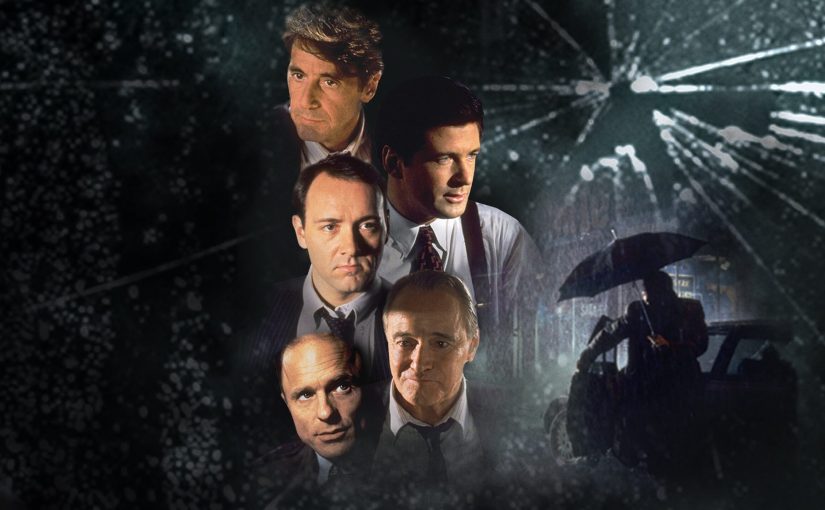
Early in the film, Alec Baldwin, known only as a man named Blake (based on the end credits) visits the office where these salesmen are based out of.  He delivers an unforgiving and harsh reality of what these men must do.  They either get their sales numbers high on the board, where they can win a new Cadillac, or they settle for a set of steak knives for second place.  After that, they are fired.  Regardless of where they currently stand though, they should not even be pouring themselves a cup of coffee.  Coffee is only for closers.  The office manager, known as Williamson (Kevin Spacey), only provides the men with sales leads that have already been exhausted with rejection and hang ups. 

Director James Foley does a wise technique with color.  The first half of the film appears in drabs of greens and greys amid an evening of torrential rain downpour.  Before Blake finishes his threatening presentation, he dangles new leads, the “Glengarry Leads,” in front of the men saying these are not for them, because they are only for closers.  The old leads that Williamson hands out are on green index cards, nothing flashy.  Blake’s leads are bright pink with a gold ribbon tied around them.  Foley makes sure that even a prop tells a story.

The salesman that gets the most attention is perhaps Shelley “The Machine” Levene played by Jack Lemmon.  He’s elderly and past his prime with no numbers currently on the sales board.  Frequently, he is making calls to the hospital for an update on his daughter who is due for surgery, but if he can’t make a payment, then the procedure is likely not to happen.  Lemmon is fascinating in maybe the best performance of his career.  Many of his scenes are toe to toe with Spacey as he shifts from pleading to demanding to disingenuously threatening and ultimately bribing Williamson for the new leads. Levene is so out of touch now that he can’t even sell Williamson on helping him out.  Spacey as Williamson is terrific in his defiance to not lend any sort of aid to Shelley.

David Mamet added additional material to the script, not found in the stage play.  The Blake character is new to the film, for example, and I think it is a better, more fleshed out story because of it.  As well, Foley is able to go outside of the reserved settings of the bar and office, as he follows Levene making a knock-on-the-door sales call in the middle of the rainy night to a family man.  This may be Lemmon’s best scene of the film as he weasels his way into the home to quickly get his raincoat and hat off and get a seat on the sofa as he begins his “once in a lifetime” opportunity that the potential customer may miss out on.  It’s a sales pitch, despite Lemmon’s charm, and the patron can see right through Levene’s performance.  As the door closes on Shelley, you’re terribly sad for his desperation and failure.

On the other end of the spectrum is the current, most successful salesman named Richard Roma.  He’s played by a showy looking Al Pacino who initially doesn’t perform in the broad strokes he’s become recognized for as an actor.  Pacino does a quiet, delicate approach to his character’s sales presentation as he shares a table with a sap (Jonathan Pryce) who is weeping into his liquor glass.  Roma stretches the rainy evening out in the bar with this guy, talking about vague anythings, until he can subtly pounce on him with a brochure that’ll get his signature on a contract. 

Two other salesmen, Moss and Aaronow (Ed Harris, Alan Arkin) vent their frustrations elsewhere in the bar as they eventually segue into an idea of burglarizing the office for those tempting new leads.  However, are they working together as a team on this idea, or is one working something over on the other?  Mamet’s dialogue is chopped up perfectly with utterances and interruptions, that before a character reveals his intentions, you are left flabbergasted.  What is demonstrated here is that a skillful salesman is also an efficacious manipulator.

The second half of the film is set on the following morning where the sunlight has come through.  New revelations following the stormy night from before will present themselves as the men gradually arrive at the office to find it actually has been robbed.  The obvious of circumstances are there.  However, Mamet sets up an ending that’ll leave you breathless.  It did for me the first time I watched the film.  Just when you think you are watching a protagonist throughout the film, something else entirely comes up.

Glengarry Glen Ross has been regarded as a modern-day Death Of A Salesman.  Maybe it is.  I’ve worked in this kind of field before. There were months where I was good at it, and like everyone else, I would brag about my success with recaptured anecdotes and celebratory curse words flying out of my mouth.  There were also months where I would gripe about how uncompromising this life is. When I didn’t want to do sales any longer, I spent twelve years as an assistant to sales representatives.  They are not your friend.  They are only focused on the next contract to be signed and booked before month end, and they will ask anything of you with a seething f-word attached to their request.    Are we so terrible if we can not make an unreachable goal with tools that offer no help and supervisors that lend no encouragement or forgiveness?  To be a salesman means that any of your past accomplishments or education do not define you.  You are only identified as the one who must acquire the next thing, and then the next thing after that.  It will change your attitude about yourself and how you treat others.  It’ll alter your dialogue which is so vitally apparent in Mamet’s story.  It will even influence you to take measures you never thought you’d be capable of.

James Foley enhanced an already electrifying script from David Mamet.  He knew that if he was going to show how hard and challenging it is to be a salesman of boring, uninteresting, and practically intangible parcels of land, then he was going to have to be relentless in the art direction and settings contained in the film.  The first half of the film never, ever lets up with the rain storm going on outside in the city street.  The evening is as black as can be, and yet Williamson casually will ask Levene if he is going out tonight. Who in the dead of night in the rain is going to want to talk to a droning salesman about anything?  Yet, that’s what is expected of this life.  The office setting is unfriendly, decorated with ideals that hang from the walls with phrases like “A man must embrace further than what he can reach.”  Little touches like this only add to the uncaring and selfish nature the men really have for one another. 

Glengarry Glen Ross depicts a hard life for the man in a suit.  You may dress like what is expected of a professional, but you are also always scraping the bottom of another bottom.  The cliché that money can’t buy happiness is personified in a film like this.  You may get to the top and score a nice commission, but it’ll soon be forgotten and nothing you’ve done before will lend to your current state.  Next month, someone else will be standing where you are standing.  Worse, you may never be standing on top again, and then what will you do?

Sadly, I believe that Glengarry Glen Ross reflects what many people experience at least at one point in their lives.  We are all salespeople to a degree whether we are doing a job interview or even trying to impress the parents of someone we are dating.  It doesn’t always work out.  The question is where do any of us go from that point.

RESERVOIR DOGS

By Marc S. Sanders

The first time I saw Quentin Tarantino’s Reservoir Dogs, I was flabbergasted by the inventiveness of the twists present within the simplicity of its low budget filmmaking.  As a community theatre actor, I could see there were many moments that were executed as if they were stage performances.  Tarantino just happened to record it all live on camera. Amid the bloody gore, there were some surprises to the script that I never saw coming even if they were plain as day.  Much like The Usual Suspects or The Shawshank Redemption where the unexpected is offered, and it is seemingly obvious despite no signs of early detection, I was entertained.  However, thirty years later, my values have evolved since the release of Tarantino’s first film.  You gotta show me more than just circumstances and contrived set pieces.

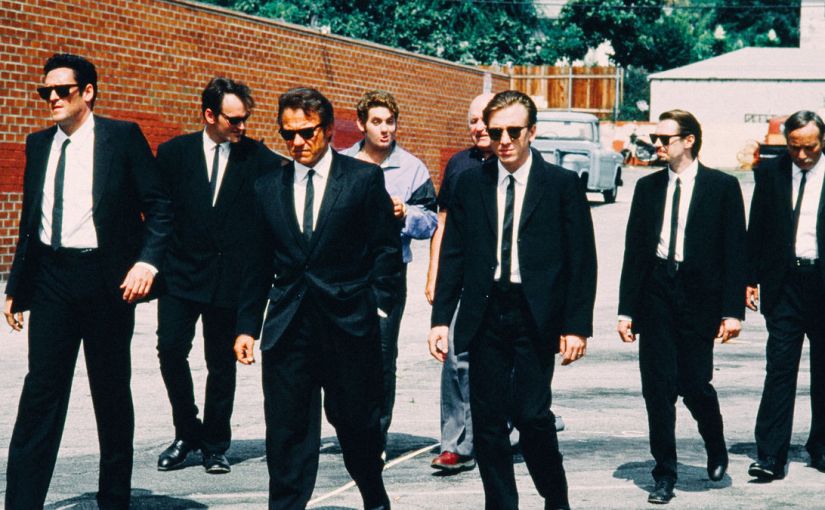
As director and writer of the movie, Tarantino plays puppet master to a collection of criminals.  Six of them are dressed uniformly in black suits and ties and they only know one another by a moniker nickname of “Mister” followed by a color.  These are no ordinary criminals though.  Unlike other films, they don’t just talk about the stretch they had in prison or a heist they pulled off at one time.  These guys debate the artistic merits of Madonna’s Like A Virgin and if she went down hill following her True Blue album.  One of them, even has an opinion contrary to the others about tipping a waitress at a diner.  He doesn’t believe in it.  United, the others try to tell him how wrong he is, but he has higher standards for excellence in table service.  It’s deliberately ridiculous!  Clint Eastwood never talked about any of this.  Not even Newman or Redford.  Lee Marvin?  Charles Bronson?  Forget it!  (Jack Nicholson may be the exception in Five Easy Pieces, but that character wasn’t a criminal.) Quentin Tarantino, however, believes that even low-level hoods have a viewpoint on anything from pop culture to societal expectations.

These six guys have been assembled by a kingpin named Joe (Lawrence Tierney) and his husky, bruiser son Nice Guy Eddie (Chris Penn) to carry out a diamond robbery.  The film opens with these conversations over breakfast and then jumps to the aftermath where Mr. Orange (Tim Roth) is bleeding to death in the back seat while Mr. White (Harvey Keitel) is high tailing it away.  When they get to their rendezvous warehouse, eventually Mr. Pink (Steve Buscemi) and Mr. Blonde (Michael Madsen) arrive and the strangers among themselves contemplate if they were set up by one of their own since the police were already waiting for the robbery to take place.  Is one of them a cop or a rat?  Occasionally, Tarantino cuts away from this one warehouse setting to flashback to how some of these guys came to be recruited for the heist.

The scenario of Reservoir Dogs is creative.  It demonstrates that there is no honor among thieves.  Much like Tarantino’s films to come afterwards, his characters are thin and two dimensional.  That works in pictures like Inglorious Basterds and Django Unchained.  Here, I didn’t embrace that aspect.  Reservoir Dogs seems to move in a direction of the Clue board game.  I know nothing about Professor Plum or Colonel Mustard’s history.  I just need to determine if one of them did it with the candlestick in the Billiard Room.  In Tarantino’s film, I just need to put a blindfold on and take a shot in the dark of who the rat among the gang is.  That’s all.  It’s just circumstantial. 

I appreciate how unique these criminals are with their mundane conversations and their cool swagger, but there’s nothing much beyond that.  Tarantino might have known that too.  He only has one question to answer before the end of the movie.  In between, to fatten up the length of the film, he incorporates a savage torture scene on a cop that Mr. Blonde takes hostage.  It’s memorable, but what does the scene really serve?  What do I take away from watching Michael Madsen’s cool, strutted character hacking off a man’s ear and dousing him in gasoline, while Stealer Wheel’s Stuck In The Middle With You plays on the radio?

The seeds of Tarantino’s brand were definitely showing in his first film, an independent project that luckily Harvey Keitel had enough faith in to help finance its shoestring budget.  The black suits became usual for Tarantino’s films along with pop rock of the seventies for a soundtrack.  Action scenes of a Lethal Weapon flavor have never been the director’s choice.  Rather, quick shots of gunfire followed by cutaway edits to the next talking scenes are his narrative.   It all shows here.  It just wasn’t as well rounded as it came to be in his seminal film, Pulp Fiction

The best acting comes from Tim Roth as Mr. Orange.  The character is given a flashback moment for how he’s brought into the gang. It is intriguing enough to be a movie of its own.  I wanted more from this guy’s story, because of Roth’s performance.  As well, for most of the film he’s bleeding his guts out from a gunshot wound in the stomach.  His hysteria is contrary to most other bad guys who get shot in the movies.  Mr. Orange suddenly doesn’t look so tough.  He’s crying like a baby and begs his closest teammate, Mr. White, to drop him off at the hospital.  He even tells Mr. White “God bless you for what you’re doing for me.”  Lee Marvin or Jimmy Cagney would never say that.  For a tough guy low level hood, this is not a cliché gangster who laughs at the face of death.  It’s imagination that thinks outside the box.  Forgive the intended pun, but Mr. Orange may be one of Tarantino’s most colorful characters.  I just wanted more from the guy.

These guys may be intentionally corny in their conversations. They may be super cool with their sunglasses and curse word laced dialogue.  However, that only goes so far before it looks like an ad for the Gap in the 1990s.  Beyond what the film shows with the Mr. Orange character, there had to be more depth.  

What Reservoir Dogs lacks turns me towards a mixed review for the film.  Still, I saw the movie before Pulp Fiction ever came out and I recall way back then that this Quentin Tarantino fellow has got something special brewing.  I couldn’t wait to see what was coming next, and I wasn’t disappointed.

BATMAN RETURNS

By Marc S. Sanders

I’ve always been a little hot and cold with Tim Burton’s films.  They are beautifully constructed in set and costume design, always well cast with exceptional talent and composer Danny Elfman’s music accompanies perfectly with Burton’s wide collection of social misfits and altogether celebrated weird material.  Still, more often than not, I leave Burton’s movies feeling less fulfilled than I want. Tim Burton’s one sequel film to date, Batman Returns, is one such example. 

To commemorate the annual Batman Day, I opted to watch Burton’s return to the murkiest of comic book locales, Gotham City, where Michael Keaton reprised the role of billionaire Bruce Wayne who dons the costume of The Dark Knight.  This time the villains of the week are the grotesque Penguin (Danny DeVito) and the sexy, dominatrix like Catwoman (Michelle Pfeiffer). 

Penguin resurfaces from the sewers of Gotham 33 years after his parents abandoned him as an infant, depositing him into the city reservoir in a bassinet to be raised by…you guessed it…penguins.  (Schools of penguins reside in the city sewers???? I guess it’s better than rats.)  Nerdy and mousy Selina Kyle is raised from the dead by the gnawing and licking of random alley cats to take on a warrior persona for Catwoman.  How exactly a feline resurrection works in either myth or science is never explored.  I guess I just have to go with it.  The manipulator behind these villains’ actions is a wealthy industrialist named Max Shreck, portrayed by Christopher Walken.  I was never sure of his stake here.  I’m only supposed to understand that he’s unlikable on the surface and he is not good for Gotham. 

I love all these actors.  I love them in these roles.  I do not love the script doled out for them though, which serves none of them well.

Batman Returns is best when the Batmobile or the Bat Glider is on screen.  They are awesome pieces of hardware to see in action as much as any tripped-up James Bond vehicle.  However, these are props.  They don’t speak, or laugh, or cry, or get angry.  Therefore, they don’t drive or develop a story.  When Luke Skywalker pilots an X-Wing Fighter, I care about the pilot.  The pilot speaks for the vehicle.  Batman doesn’t speak for the Batmobile. 

It’s ironic that the title character has only one sentence of dialogue in the first 30 minutes of this two-hour film.  There’s no dynamic to Batman or Bruce Wayne.  Keaton looks great sitting by his fireplace in deep thought or watching his television as the bat signal beams upon him.  He stands, and then when we see him next, he’s sitting in his bat car in full horned head regalia.  Otherwise, the Batman character is a prop to be used for scapegoat tactics by Penguin, Schreck and Catwoman, or he’s present to hurl a bat gadget, or throw a stiff-arm punch.  He doesn’t even do much of that stuff, anyway.  In Batman Returns, I learn nothing new about Batman or Bruce Wayne or his crusade to protect Gotham City.

Keaton shares one good scene in the film with Michelle Pfeiffer. It may be the one scene with a story to it as the two are dressed down from their comic book evening wear to dance slowly at a masquerade Christmas ball where they gradually realize who they are when they are not with one another.  Of course, we know this should be so obvious, yet a rule of thumb for comic book literature is not to realize what’s right under your nose.  A nice touch to this scene is having Keaton and Pfeiffer be the only guests not wearing a mask while everyone else is.  Batman and Catwoman have in fact dressed up as someone else for the costume party.  Very ironic and almost clever.

Too much material is given to Walken as the conniving Max Shreck.  Walken performs well, but just like his Bond bad guy in A View To A Kill, he belongs in a different movie.  The Schreck character lends nothing to this Batman adventure.  Who’s interested in this guy?  McDonalds and the other merchandising companies could even see how unattractive this character is.  So, why couldn’t Tim Burton or his writers and producers?  I’ll pay you a gazillion dollars for your rare, never manufactured Max Schreck action figure.  Yet, the bland script from Daniel Waters and Sam Hamm arguably provides the most dialogue to this guy.  You’ve got Batman, Penguin, Catwoman, even Alfred the butler and Commissioner Gordon, and yet this grey-haired guy with a wolf like pompadour in a bland, black business suit is hijacking a Batman movie.  Makes no sense.  Much of Batman Returns is made with cutting room floor material taped together featuring an unwanted Christopher Walken.

Who else is better to play The Penguin than Danny DeVito?  No one!  So, it is disappointing when the squat actor has nothing to do.  A seemingly inspired storyline from the campy Adam West TV series, and maybe a handful of comics, have him running for Mayor of Gotham.  A good start, but then the script does nothing remotely interesting with it, even though this stuff sells itself.  Where’s the political jokes to parallel the campaign? Where’s the ridiculous podium debates?  Imagine Penguin kissing little old ladies and holding babies while on a campaign trail.  None of that happens here.  You have outstanding talent from DeVito and yet all he’s left to do is ride around in a duck boat, spit out black and green sludge goo, and scream frustrations in a groggy, ear-piercing bellow on more than a couple of occasions. Unlike Jack Nicholson before him, DeVito is abandoned to play scenes with no dialogue while he chomps on raw fish or screams for the sake of screaming. 

An error in judgement was layering the actor in ugly makeup and unattractive costume wear.  Usually, DeVito is seen wearing a stained and damp white footy pajama suit with black dental pieces and very black eyeshadow on a whited out facial texture with a giant hook nose.  This is Danny DeVito.  He already looks like The Penguin.  If it ain’t broke, don’t fix it!  The only charming accessories are his top hat and his collection of umbrellas (shooting fire or bullets or flicking out knives) that serve as exclamation points on dialogue when a jokey punchline could not be considered with even just a smidgen of effort from the writers.  The umbrellas were more expressive than the guy operating them, and yet even they were hardly used in any action scenes.

Batman Returns has some sloppy scene cuts as well.  A scene will appear with Catwoman skipping through a store, then it’ll jump to Batman punching out a few circus clowns, then the two meeting up on a rooftop somehow.  Why, where and how did this all happen?  The math doesn’t add up.  Penguin will somehow appear within this stitchery too.  For what reason?  Three movies are happening here and none of them are communicating with one another.

Films like the original Batman, or Edward Scissorhands or even Pee Wee’s Big Adventure carry the weirdo trademark of Tim Burton.  I know what I’m getting when I turn on almost any one of his films.  (Ed Wood being the surprising, and pleasing biographical exception.)  These are gorgeous, macabre films to look at, whether they are dimly lit or staged in deliberately bright and gaudy rainbow colors.  Yet, there are often scenes or moments that lack that hook that carries you from the exposition to the acclimation I normally get from the universe on screen before my eyes.  Batman Returns especially lacks that transition. 

Because the film looks so good, it is not the worst of the Dark Knight’s many films.  Yet, it is an uninspired and disappointing piece.  Any film with such storied and legendary characters as these is going to be a big letdown if they are given nothing to do.  Why, oh why, did they give almost all of the lines to the boring guy in the business suit?  If I wanted to entertain myself with an accountant, all I needed to do was sit in the lobby of an H & R Block.

UNLAWFUL ENTRY

By Marc S. Sanders

The boogeyman is dressed as a police officer!

In 1992’s Unlawful Entry, Jonathan Kaplan (The Accused) directs a well-played Ray Liotta as a psychotic cop named Pete Davis who is terrorizing a yuppie couple named Michael & Karen Carr (Kurt Russell, Madeleine Stowe). The Carrs experience a home intruder who puts a knife to Karen’s throat. Officer Davis offers comfort to the pair and happily volunteers the arrangements for a high-tech alarm system. The first mistake that Michael makes is sharing the password with trusty Pete. You’ll expect that to come into play later on. Maybe what inspired the password will work itself into the film as well. Hmmmmmm?????

It’s difficult for Pete to resist the obsession he has for Karen and so he begins a campaign to get Michael out of the way. First, he demonstrates his brutality by offering Michael the opportunity to senselessly beat up the home intruder for no other purpose than personal satisfaction. When Mike refuses, Pete finishes the job. Later, Mike makes efforts to keep Pete out of their lives. It’s hard to do that when a highly decorated cop is involved. Karen, his own loving spouse, won’t even truly believe Mike; neither will the police chief.

As Pete continues with his intentions, Mike’s credit cards are maxed out, he loses a high priced client that Pete has been talking to, parking tickets add up, and so on. Pete also appears at the house at inopportune times like when Karen is taking in a swim or creepily stepping into their bedroom while the married couple is having sex. Eventually, Mike is put out of the way when he’s imprisoned after being framed as a drug dealer. Now Karen is all alone for a terrifying third act that you’ve likely seen hundreds of times before.

Unlawful Entry is engaging while you’re watching, but it does not convey much. The happenings all appear probable if a deranged cop wanted to go through all this trouble. Therefore, Ray Liotta owns the picture. Yet, what did I learn here? Don’t call the police?

For Kurt Russell, this is the first of two “husband is being terrorized” roles for him. Later, Russell would headline the cast of a better film to fall in this genre called Breakdown. Still, I like Russell here. He starts out as a guy who is not capable of fighting for the sake of his wife. He regrettably admits that shame to Pete early on. Pete pounces on that advantage to win Karen. Later, the strength of Mike’s short temper followed by his fear push him to do what he must to protect himself and his wife.

Madeleine Stowe is a good actress. There’s just not much for her to do with this part. She’s the spouse who opts not to believe her husband’s concerns. If she did, there wouldn’t be much of a movie. The third act is all action and blood and falling down the stairs and running back up the stairs. It’s no surprise really. Though it is convenient that Michael is finally able to post bail and get home in time for a final confrontation with Pete.

One thing that kept echoing in my head though was that as good as Ray Liotta is (he’s very, very good actually; very primal and deceiving), he is terrorizing a woman named “Karen.” Every time he says the name Karen, all that comes back to me is the film Goodfellas where he more or less tormented and disrespected Lorraine Bracco known as, you guessed it, Karen. A rule should be put in place, Liotta can no longer be cast with other characters named Karen. His Karen quota is maxed out.

A FEW GOOD MEN

By Marc S. Sanders

A Few Good Men really does hold up.

Anyone with even minimal movie going experience can predict how it is going to end almost as soon as it starts, but that doesn’t take away from Aaron Sorkin’s first screenplay based on his original stage play.

It is well cast. For the film, no one else could ever play the intimidating and terrifying Colonel Nathan R Jessup other than Jack Nicholson. It’s not that it is just him in the role. It’s really Nicholson’s whole career legacy against the arguably still ripening careers of Demi Moore, Kiefer Sutherland, Kevin Bacon, Kevin Pollack and Tom Cruise. Nicholson’s timed grandstanding is necessary for the role to work.

Cruise on the other hand left me feeling a little too overplayed. The role calls for cockiness, yes, but is Cruise too cocky? Some of the gags he does work. Some don’t, like impersonating Nicholson momentarily (leave that for the guys on SNL, Tom), or when he’s poking fun at Moore’s character to his own delight. It’s a little too much. Still, his courtroom scenes are like watching the best in live theatre. Those scenes play like great sport, notably thanks to Tom Cruise.

Major props go to JT Walsh as a conflicted witness. When I say conflicted, I mean he authenticates a seriously valid and personal dilemma beautifully. Had it not been for Jack Nicholson, Walsh might have had an Oscar nomination. A shame he didn’t come close to such recognition while he was alive. He was such a great character actor.

Recognition also goes out to Kevin Bacon as a well versed prosecutor/Marine. His timing exudes the experience his character has, despite his youthful appearance.

Demi Moore might be caught trying too hard, I think. Kevin Pollack is the wise mentor sitting quietly waiting for his great moments. Kiefer Sutherland is great in almost anything he does. He doesn’t ever steal the spotlight like Cruise, Nicholson or Moore but he makes a great presence; conniving and bold.

The direction is nothing special really. Rob Reiner does fine but honestly Sorkin’s script sells itself.

Yeah, yeah. “You can’t handle the truth.” Great line, but I got news for you. I’d argue there’s even better lines in this 1992 film. It’s worth revisiting.

BARAKA (1992)

by Miguel E. Rodriguez

Director: Ron Fricke
Cast: N/A
My Rating: 10/10
Rotten Tomatometer: 81% Certified Fresh

PLOT: The rhythms of life and time are explored in this wordless montage of spectacular filmed images from around the globe, set to a haunting, ethereal score.


Some time ago, I wrote a post on Facebook about movies with an extremely rare quality: transcendence.  Movies that are so good that mere genre definitions are not enough to quantify them.  I’m not talking about perfect examples OF a genre (Aliens, Unforgiven, Young Frankenstein, et al.)  I’m talking about movies that wind up being more than the sum of their parts and take on a haunting, spiritual quality.

Film is an extremely subjective medium, so my list of such “transcendental” movies will likely differ wildly from your own.  For example: Breaking the Waves (1996), a meditation on the capacity for human suffering, forgiveness, and the definition of belief.  Or Cloud Atlas (2012), a mind-bending journey that poses the greatest “what-if” question of our existence.  Or Fearless (1993), a mainstream drama concealing life-altering truths at its core.

And then there’s Baraka, a 1992 film that premiered in Canada on the festival circuit before receiving its American release a year later.  I suppose it would have to be classified as a documentary, since it consists entirely of wordless images edited together into a feature-length music video.  It was directed by Ron Fricke, who had previously worked with director Godfrey Reggio on Koyaanisqatsi (1982), a groundbreaking film, similar in structure to Baraka, that introduced time-lapse photography to the mainstream; it’s hard to believe, but there was a time when time-lapse was a novelty.

But this clinical description doesn’t nearly do justice to the religious experience that is Baraka.  This is one of those movies that begs for the best viewing conditions possible, on the biggest screen and with the best sound system you can afford.  The cinematography simply defies belief.  There are monumental shots of Himalayan mountain ranges, ancient temples, an enormous graveyard of decommissioned B-52 bombers, the interior of a spectacular cathedral where the walls appear to be inlaid with millions of tiny mirrors.

The film’s score is credited to Michael Stearns, but it also includes existing musical pieces that lend certain sequences an exotic, global feel.  These music choices are absolutely essential to Baraka’s success. 

In particular, a musical piece called “Host of Seraphim” by Dead Can Dance brings unbearable sadness and pity to a sequence in which we see Indian families picking through massive garbage dumps, searching for food or God knows what.  The sequence shifts to showing homeless people, families, sleeping on city streets, next to sewer grates, under makeshift shelters, and there is an overwhelming sense of mourning that this kind of thing is happening today, right now, all over the world.

In addition to the sequence above, there are also sequences depicting members of various religions worshiping in their own unique way.  And oceans of clouds swirling and flowing over and around mountaintops.  And the horrible abandoned camps at Auschwitz and in Cambodia.  And majestic waterfalls.  Oil fires in Kuwait.  A vast, still lake that perfectly mirrors the sky above it.

Every time I watch this film (this marks at least the 9th or 10th time I’ve seen it), I am left at the end feeling hopeful, expansive, with the urgent need to show this film to other people.  Is this what they mean by religious fervor?  I felt this same way after watching Parasite (2019), for example, but for very different reasons.  Parasite is thrilling.  Baraka is transcendent.  It pierces through my sometimes cynical expectations of what a movie should be and presents me with a showcase of the human experience.  It makes me feel, however temporarily, more connected to the global population as we travel through the cosmos on our huge (and also tiny) planet.  It gives me a shiver of comprehension when I look at the ruins of ancient temples on the screen and realize the people who built them many thousands of years ago were just…people.  Like you and like me.  Humans on this uniquely life-sustaining chunk of space rock, hurtling through the universe.

You may disagree with my assessment.  You may hunt it down on Netflix or Amazon or wherever, and you may give it a shot, and you may turn it off after 15 minutes, thinking, “What was he THINKING???  This is boring as hell!”  I suppose that’s the beauty of this movie.  It’s like a Rorschach test.  It doesn’t tell a story, per se.  It’s more like a tone poem, where certain images are juxtaposed with completely different images, but which are nevertheless similar.  This kind of moviemaking doesn’t always work.  (See, for example, Naqoyqatsi (2002), also directed by Reggio, part of his vaunted Qatsi trilogy, but which I find insufferably cryptic.)  But when it does work, it’s quite literally magical.

So, if you can, go ahead and see if this is available somewhere.  Check your television’s settings so you get the optimal picture.  Turn your speakers up as loud as you can get before the neighbors call 911.  And open yourself up to the possibility that a picture truly is worth a thousand words.