POINT BREAK (1991)

By Marc S. Sanders

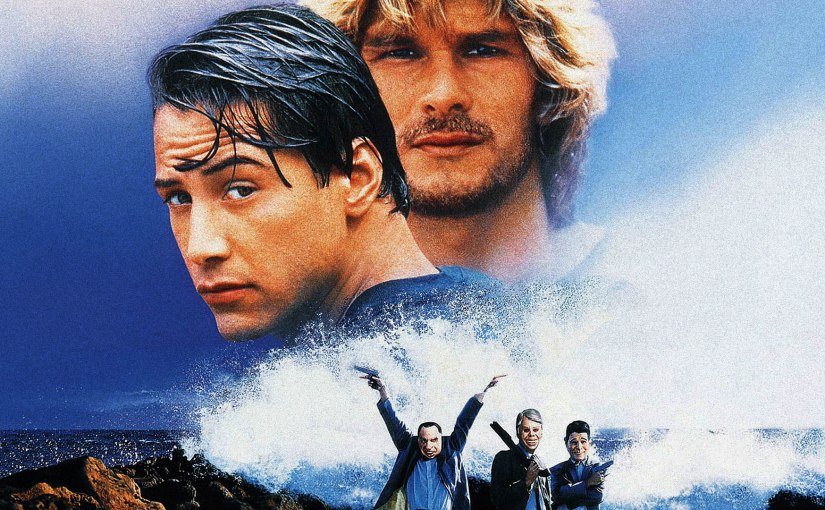
Stop me if you heard this one before.  Richard Nixon, Gerald Ford, Jimmy Carter and Ronald Reagan walk into a bank…

Yeah.  That’s right.  I’m talking about Kathryn Bigelow’s Point Break.  There’s a line in the movie where the rookie FBI hero, Johnny Utah (Keanu Reeves), is described by his new supervisor as being young, dumb and full of cumb.  Pretty fair assessment.

Much of this crime caper works despite the silly summary.  Agent Utah’s seasoned partner Pappas, played by Gary Busey, believes that a series of coastal California bank robberies are being committed by surfers who roll into town each year when the waves are at their most tubular.  They don silly looking rubber masks in the appearance of the Ex-Presidents of the United States to commit their ninety second smash and grab.  Fortunately, Johnny Utah looks and talks like Keanu Reeves who was raised in Hawaii and has experience playing a gomer like this in two other movies that were headlined by some dudes named Bill & Ted.  As well, don’t forget what he hilariously did in Ron Howard’s Parenthood.  Yes, Johnny Utah should fit right in with the California surf.

Point Break does not take itself seriously in its first half.  Johnny has to learn how to look the part of a surfer with a neon pink board amid the colony of saltwater dwellers.  Standard stuff pops up like the angry supervisor (John C McGinley) who screams about no progress being made.  Unfortunately, a romantic love interest named Tyler has to enter the fold played by an actor I’ve never been fond of, Lori Petty.  I’m supposed to believe that she is going to teach Johnny how to ride the waves and chastise him when he’s doing it wrong, and then he’s going to fall hard for her when she delivers one arbitrary piece of dialogue after another.  “What’s this pig board piece of shit?”  “Too much testosterone around here. Later!” Also, for those intimate scenes in the dark calm waters with the moon and stars gleaming in her eyes, Tyler has to ask Johnny something along the lines of “What’s that strange look you got?”  and “There it is again.”  Maybe it’s not all Petty’s fault.  The script doesn’t give her much to work with honestly.  Nothing Tyler says is relevant.  How it is delivered by Petty is not the least bit intriguing and honestly with only few nip/tucks, this character storyline could have been saved for special edition DVD featured deleted scenes that you’ll only watch once and never share on You Tube. 

On to the good stuff. 

You can see how amazingly talented a director like Kathryn Bigelow really is and it is no surprise that a couple of decades of experience led her to a well-deserved Oscar for directing The Hurt Locker.  Going all the way back to films like Blue Steel and Point Break demonstrated that Kathryn Bigelow made a name for herself based on stellar filmmaking skills.  Just look at the sky diving footage alone.  You see all the tricks as the camera follows the daredevils out of the plane and into the sunny blue sky with genuine close ups and acrobatic flips to relish in.  Sensational work.  Gorgeous photography and smooth, unshaking camera operations. Nothing artificial in these sequences.

Moreover, there is the surfing of course.  The checkered bag guy of this action picture is another variation of a dashingly handsome Patrick Swayze with shaggy dirty blond hair, dirty blond facial whiskers and his distinctive voice that if it could be described as dirty blond it would be dirty blond. Plus, a chiseled chest to show off during a karate fight scene.  He plays a guy named Bodhi.  I guess Walter, Melvin, Murray and Jack would not be cool enough.  (My dad, uncle, and grandfathers by the way.)  While Johnny maintains his undercover investigation with Pappas watching from the outside, he becomes enamored with Bodhi and his crew.  They like him in return.  Yet are these those Ex-Presidents who are robbing the banks?

Point Break is a smarter thriller than I think the filmmakers even realized because other than Lori Petty it is cast very well with Reeves and Swayze in the lead roles and a fun cooky Gary Busey on the side.  These actors are game for the quick moving adventures that Bigelow strives for.  There’s a fantastic foot chase through the back streets of Santa Monica following one such bank robbery.  This scene alone is eligible for a Best Editing Oscar with handheld Steadicams following the running players in and out of houses, around flaming gas stations and backyards with barking dogs and dense red light running traffic getting in the way.  Amazing film work.

The surfing would have to be stellar if the antagonists are in fact surfers. The photography is magnificent with narrow waves curving over the cameras directly pointing at Swayze, Reeves and cast coming right towards the screen while balanced on their boards with golden suns hovering overhead.

While Point Break does not seem to know when to end because the credits could have rolled up on three or four different occasions, at least the film insists on having fun with itself. 

I recall in The Predator Olivia Munn’s character went to MIT with a science major that somehow also included military trained special ops in its elite curriculum. I’m expected to believe that nonsense.  On the other hand, when I see Bill’s friend Ted has graduated in the top two percent of his FBI class at Quantico, Viginia, I can buy it.  I don’t have to dwell on it. Now I can enjoy the ride from a sky diving standpoint or a choppy mariner’s perspective.  My suspension of disbelief is bought, sold and paid for. 

Point Break is a smart thriller with a dangerously fun, zippy edge to it.

SOAPDISH

By Marc S. Sanders

To get inside the head of a character on a soap opera would best be portrayed by someone who’s literally living a soap opera off the set.  That’s the paramount theme of every member of the cast and crew of the daytime drama The Sun Also Sets.  Everyone is living through their own checkered background from the lead actress to the returning actor to the homeless deaf/mute extra on down to the trampy nurse and the buxom doctor on the show. By default, the program’s head writer and the producer fall into this category as well. 

The hilarity found in Soapdish gave me remembrances of classic films like All About Eve and Sunset Blvd. Ego and stardom are treasured commodities above all else and an actress’s greatest fear is being aged out of fandom and replaced by the new girl in town. 

Celeste Talbert (Sally Field) is a star actress with dozens of career awards but an insecurity with becoming past her prime. A diva concern is that the stories written for her are not worthy of her importance to the show.  David (Robert Downey Jr) is the young producer feeling the pressure to come up with something to boost the ratings before his boss, the always naturally funny Garry Marshall, replaces the program with game shows.  On David’s side for her own ulterior motives is Montana Moorehead (Cathy Moriarty) who plays the resident nurse and is ready to take the reins from Celeste and make the show her own.  She’ll seductively manipulate David into getting things to work out her way. 

In the meantime, Lori Craven (Elisabeth Shue) sneaks onto the set seeking an opportunity by way of Aunt Celeste.  Best she can get is to portray a deaf/mute homeless woman extra.  Head writer Rose (Whoopi Goldberg) has devised a new plot where Celeste’s character will be tried for murdering Lori’s homeless mute character.  Lastly, at least through the first thirty minutes of the film, Jeffrey Anderson’s (Kevin Kline) character who died on the show twenty years prior by an unfortunate beheading is recruited out of dinner theater by David to return to the program.  Both Lori and Jeffrey’s unexpected arrivals do not sit well with Celeste.

Following along okay, so far? Well…

SECRETS ABOUND on Soapdish!

This film was developed by the powers who delivered Steel Magnolias to the big screen a few years prior.  The original playwright and screenwriter, Robert Harling, teamed up with Andrew Bergman, to satirize the weepy material that daytime drama promises and which he embraced seriously with his beloved play.  The director of Magnolias, Herbert Ross, also serves as an executive producer on this film.  To add some extra authentic spice, Aaron Spelling is producer.  That’s right.  The guy who produced Dynasty, 90210 and Melrose Place.  Michael Hoffman directs. 

The look of this film is so odd and has a garish blood coated red appearance to the television studio where the show within the movie is set, as well as to the offices that hover above.  The set designer for the film, Eugenio Zanetti was inspired by Dante’s Inferno.  Makes sense really because no one is ever satisfied with how The Sun Also Sets develops from one atrociously delicious storyline to the next, and how it makes them look in the public eye.  Zanetti is quoted as saying the offices of the producers and writers hover above the set for the soap opera.  So, it looks as if the powers that be are staring down into the depths of hell that the cast and crew must work and reside in.  While it looks odd, after having seen the film, I can’t help but believe Zanetti makes sense.

There are moments here that are outright hilarious.  As a community theater actor and director, I can totally relate to Kline’s character being stuck in a retirement community steak/playhouse performing as Willie Loman in Death Of A Salesman while elderly patrons call for their waiters.  Poor Jeffrey also has to project that much louder for the old folks to hear him.  This scene stands as gold on its own. A whole farcical film could be developed on this side story alone. 

Soapdish does lose some of its comedic appeal before it reaches the middle of the picture when secrets are uncovered related to Celeste, Jeffrey, Lori and so on.  Sally Field goes for great physical comedy that lands perfectly with the skeletons that Celeste pulls out of the closet.  Kevin Kline makes for a hysterical arguing scene partner, and the craziness just gets bigger from there. 

Whoopi Goldberg is also very funny as the one with common sense and brains behind her character.  For once, she’s not going for the female Eddie Murphy equivalent.  I’m with Rose when she vents to David about how she’s supposed to write a believable return from the dead of a character who was killed when he lost his head.  Maybe a brain transplant?

Cathy Moriarty does a fine job of being the conniving seductress.  She’s a full-bodied intimidator of teased, frizzy blond hair and a buxom nurse’s uniform costume against Robert Downey, Jr.’s nervous preppy producer.

There’s satisfying moments for cameos from Carrie Fisher as a casting director as well as Teri Hatcher and Costas Mandylor as bubbleheaded supporting characters.  However, the best scene stealer is Garry Marshall. I don’t think a single line he’s given would be as funny if he was not providing them.  He’s just got that Neil Simon kind of delivery as the studio boss.  “The nurse is in the restaurant?  Was there a meeting I missed?”

Other than a few F bombs, I think Soapdish works as movie the whole family could watch the next time they are snowed in or hunkering down from a blizzard or hurricane.  Soap operas are designed for escape and the outrageous comedy of Michael Hoffman’s film reaches into outrageous areas that work with surprise and big laughs. 

This nonpaid critic, who endures his loving wife’s adoration for General Hospital each night before bed, is at least a fan of The Sun Also Sets and Death Of A Salesman dinner theater. 

HOMICIDE (1991)

by Miguel E. Rodriguez

DIRECTOR: David Mamet
CAST: Joe Mantegna, William H. Macy, Ving Rhames, Rebecca Pidgeon
MY RATING: 8/10
ROTTEN TOMATOMETER: 88% Fresh

PLOT: A Jewish homicide detective investigates a seemingly minor murder and falls in with a Zionist group as a result.


Homicide is one of those movies where the lead character experiences just one damn thing after another until he winds up in a situation that is not even barely hinted at in the film’s first half hour.  If I didn’t think it was being a little pretentious – and maybe if I understood the term just a little more – I’d call it Kafkaesque.  It reminds me a bit of Martin Scorsese’s After Hours, where that lead character is drawn unwittingly into the unexplored jungles of New York City at night.  Likewise, Detective Bobby Gold (Joe Mantegna) starts the film on a manhunt, searching for a wanted killer, and thirty-six hours later winds up begging Zionist activists to let him be involved in blowing up a storefront suspected of printing Nazi pamphlets.

In other hands, the events of the film leading up to Gold’s digression into racial/social activism could come off as comic.  First, he’s put on the manhunt case, searching for a man named Randolph.  Then a weirdo booked for killing his family wigs out at the station and attacks Gold, ripping the strap off his holster, and giving him a bump on the head that’s visible for the rest of the movie.  (I was unavoidably reminded of Jake Gittes’s nose in Chinatown.  Both wounds serve as constant reminders of either the odds the characters face or of the unpredictability of the world they inhabit.)  On their way to interrogate Randolph’s mother for his whereabouts, Gold and his partner, Sullivan (William H. Macy), randomly run into what looks like a hostage situation which turns out to be a cop cornered by a vicious dog in a candy store.  In the store is a dead woman.  The commanding sergeant arrives at the scene and gives Gold the dead woman case.  Turns out the dead woman is Jewish.  Her family shows up at the scene, learns Gold is Jewish, and insist he be their personal liaison for the case.  Meanwhile, Sullivan has to carry on with the Randolph case on his own.  A recurring theme will be how Gold keeps missing out on important events with the Randolph case while babysitting the family of the dead woman, a case he considers unimportant.

What happens next unfolds so naturally and surprisingly that I will not spoil it for you.  What I will say is that Mamet turns a standard police procedural into a searing character study of a man who has never really considered who he is in terms of his heritage.  At one point, he speaks with a Jewish scholar who shows him a page of Hebrew text.  Gold says, “I can’t read it.”  The scholar tells him, “You say you’re a Jew and you can’t read Hebrew.  What are you then?”  This is a question that Gold will try to answer for the rest of the film.

On a personal note, that bit of dialogue resonated quite a bit with me.  I’m full-blooded Puerto Rican on both sides of my family.  Yet my knowledge of Spanish is barely passable.  When faced with reading Spanish text, I can sound out the words, but my comprehension level is probably only 60 to 70%.  My conversation with fluent Spanish speakers is halting, at best.  I just never took the time to learn it as thoroughly as my parents or my sister did.  Does that make me any less Puerto Rican?  I don’t think so, and I might feel resentment towards a stranger telling me that I’m not Puerto Rican just because I don’t speak Spanish.  I know who and what I am, and my identity is not tied to what language I speak.

But things are different for Detective Gold.  Earlier in the film, he talks to his partner, Sullivan, on the phone and talks about how the Jewish family he’s now working for, or with, are high-strung, crying wolf (they claim someone is shooting at them from the building next door, but there are no bullet holes to prove it), how they saved ten bucks a week by letting the old lady work at the store herself, how they’re “not MY people, baby.”  Only after he realizes he’s been overheard does he feel immense guilt and obligation to help the family.  Not to just solve the case, but to “find the killer.”  So, he’s experiencing all sorts of new emotions that may or may not be interfering with his ability to do his job impassively.

The people in Homicide sound as if they are speaking in subtext only, using Mamet’s unique writing style to bypass what we think of as “normal” speech and deliver lines that are almost poetic, even when laced with racial epithets and curse words.  This makes the overall tone of any Mamet-scripted film seem hyper-stylized, as if the characters are one level removed from reality, but not in a bad way.  It elevates the film somehow.  I’m at a loss to describe it more accurately.

One bit of dialogue exemplifies what I’m talking about.  Gold is being thrown out of a building.  The gentleman at the door tells him, “Don’t bother to return.  The next time you come, there’ll be nobody here.”  Don’t bother to return?  That’s unnecessarily decorous.  “Normal” conversation would be something like, “Don’t bother coming back.  If you do, we won’t be here.”  However, Mamet’s signature word choices here suggest an almost Shakesperean construction, as if the words are being shoehorned into a buried structure or pattern that operates subconsciously.  Based on what happens with Gold throughout the film, I could theorize that Mamet is trying to create a mood reminiscent of Greek tragedy, and the actors are reciting dialogue that has been translated from Greek or some other language.

But that’s just me.

The experience of watching Homicide will never be quite as exciting or kinetic as other superlative crime dramas like, say, Heat or The Departed, movies that also examine their characters in detail, sending them on similar journeys of self-discovery.  Those other movies are defined as much by their action as by their intelligence.  In Homicide, any “standard” action scenes are purely incidental, or sometimes accidental, intended not to thrill but to move the plot forward with a minimum of fuss.

In any event, the action is not the linchpin of this film.  We watch Homicide, not to see who Gold kills or who tries to kill Gold, but to see if he is capable of resurrecting the person within himself that he thought he had killed long ago, a sacrifice he made on the altar of being a good cop.  He has a painful conversation where he realizes that everything he’s done to suppress his own self has been, “Not for me.  All for someone else.”  He must decide whether to act in service of his conscience or his sworn duty as a cop.  The choices he makes have consequences he never anticipated, as with all good tragedies.  Homicide reminds us of that inescapable fact, not with a bang or a whimper, but with the calm, flat gaze of an impassive Greek god who lets us draw our own conclusions.

THE MAN IN THE MOON (1991)

by Miguel E. Rodriguez

DIRECTOR: Robert Mulligan
CAST: Sam Waterston, Tess Harper, Reese Witherspoon, Jason London, Emily Warfield
MY RATING: 10/10
ROTTEN TOMATOMETER: 91% Fresh

PLOT: A 14-year-old girl in 1957 comes of age when she develops a crush on a handsome neighbor…who only has eyes for her older sister.


The Man in the Moon has a plot that sounds like a high-concept pitch somewhere between an ABC After-School Special and a third-tier soap opera.  But somehow, magically, it transcends the trappings of soap opera and veers towards the truly operatic, touching on grand emotions while keeping itself grounded in reality.  I watched the movie in awe, wondering how something so sappy was holding my interest the whole way through.  Afterwards, I came up with two overarching reasons: the spectacular debut performance of a 14-year-old Reese Witherspoon, and the sure-footed direction from one of Hollywood’s old masters, Robert Mulligan, who cut his teeth on stage plays for television in the 1950s before directing his masterpiece in 1962, To Kill a Mockingbird.

Like Mockingbird, The Man in the Moon takes place in the deep South.  The time is 1957, when Elvis was king and children were still encouraged to say “Yes, ma’am” and “No, sir” to their parents.  Dani Trant (Witherspoon) is still young and tomboyish enough to escape her Sunday chores by dashing off to the local swimming hole after church.  Her older sister, Maureen (Emily Warfield), is set to start college at Duke in a few months.  Their close relationship is established in a sweet opening scene where they sit in their outdoor, screened-in bedroom, doing each other’s hair and talking about life and Maureen’s doubts and how Dani envies Maureen, and so on.  Like in real life, the conversation touches on deep topics, but never really resolves anything.  It just feels good to talk, to know the other person is really listening.  This scene is mirrored in the movie’s final scene in a fantastic bit of screenwriting where the conversation is very different, but the emotions being discussed are more or less the same.

One day, Dani goes skinny dipping in the watering hole and finds an unexpected visitor: Cort Foster (Jason London), 17, whose mother and younger brothers have just moved back to their old farm next door.  Turns out Cort’s mother, Marie, is an old friend of Dani’s mom, Abigail.  This is the kind of stuff soap operas thrive on, but even at that point, even though I was aware of the contrivances of the story, I never felt overly manipulated.  It all just felt very…real.  Once again, it’s a testament to the director’s skill in making sure nothing gets punched up unless there’s a reason for it.  It’s never bland, don’t get me wrong.  But it never feels fake.  I don’t like the word “organic” in connection with acting or directing, but that feels like the right word to use here.

Things move swiftly.  Dani and Cort become quick friends, but when things get a little too flirtatious at the swimming hole, Cort backs away and admonishes Dani.  “You almost got more than kissed, little girl.”  Dani asks Maureen for tips on kissing boys.  It looks as if Cort is always on the verge of making a bad decision, but he has the good sense to put on the brakes.  The film is making you think the movie is going to be about one thing, but then there’s a family crisis, and in the hubbub, Cort meets Maureen, there’s an instant attraction, Dani feels left out…

But that’s enough summarizing.  Based on what I’ve written, you may already think you know the arc of the film, but I can assure you, you’re wrong.

Let’s talk instead about Reese Witherspoon’s performance.  It must be seen to be believed.  It belongs in the pantheon of the greatest debut performances of all time.  She is as self-assured and confident and natural as she was in her Oscar-winning performance in Walk the Line.  It’s almost like watching some of the early films of Marilyn Monroe; the screen just seems a little brighter when she’s present.  Watch her facial expressions when Cort realizes who she is after their first encounter at the swimming hole.  Watch her smile after her first kiss.  Look at her self-control when she tells her father she understands why he had to take the strap to her (that’s a long story that I won’t spoil).  For the most part, I just watched her performance in awe, but once or twice I turned on my analytical mode and tried to see if I could “catch” her acting.  Couldn’t do it.  The fact she wasn’t at least nominated for an Oscar for this movie is a complete freaking mystery to me.

For that matter, the whole movie is a mystery to me.  Before watching it, I had only heard about it from a rave review by Roger Ebert.  I couldn’t find it streaming anywhere so I had to pay a relatively pretty penny to get it on Blu ray, sight unseen.  (Spoiler alert: it was worth it.)  Yet here is a brilliant gem of a film that tells a simple story of love and sadness and doubt and everything in between.  There are some plot surprises – I won’t say twists, exactly, it’s not a Shyamalan movie – that I absolutely did not see coming.  In retrospect, maybe I should have, but the storytelling kept me engrossed in the moment.  It kept me focused on the here and now, so I never felt the need to try and guess what was around the corner.  I hesitate to use this word, too, but it was mesmerizing.  To tell a story this cornball (on the surface!) and keep it fresh and alive is some kind of miracle.

It’s been said that no good movie is too long.  The Man in the Moon clocks in at just under 100 minutes with credits, but I was prepared to stick with it for at least another half hour, just to see what these characters would do and say, and how they would deal with the next challenges life throws at them.  When the movie ends, it doesn’t feel like an ending.  It has the good sense not to make things too final, as if the solutions to all the issues in the film could be wrapped up in a bow.  All that remains is the bond between two sisters, and if they have that, that’s all that matters.

JFK – DIRECTOR’S CUT

By Marc S. Sanders

Oliver Stone’s JFK is told through perspective, not necessarily history.  It’s not a biography and I do not believe Stone would ever claim it to be so.  It’s a thinking person’s picture that gives viewers entitlement to question what occurred, how it occurred and why it occurred.  It might guide you not to trust what anyone says, sees or hears, but let’s face it.  Probably the day Kennedy was shot, November 22, 1963, could we ever completely trust anyone ever again? 

(Forgive my cynicism.  I must backtrack a little.  I still trust my wife and daughter.)

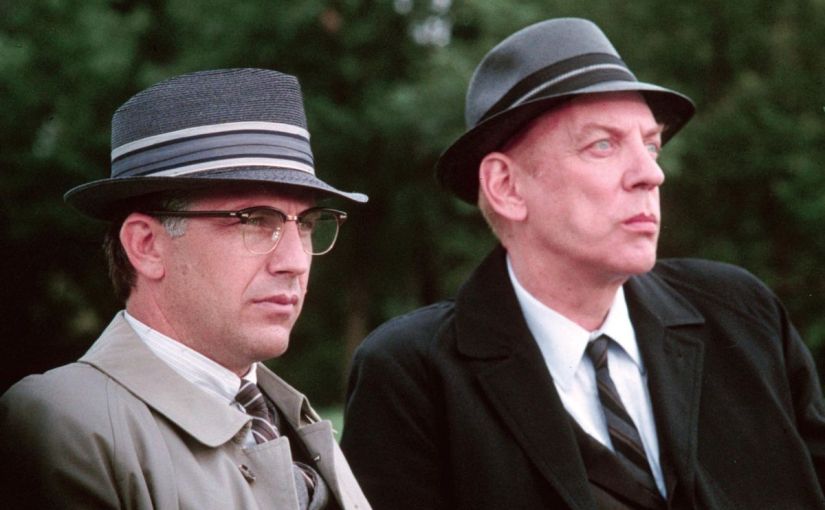
Oliver Stone works through the eyes of New Orleans Prosecutor Jim Garrison (Kevin Costner, in what may have been his most challenging role to date at the time).  Garrison sees a little too easily that there are circumstances out of place, or maybe too neatly in place to satisfy the ultimate resolution that a known American defector to the Soviet Union, like Lee Harvey Oswald (Gary Oldman), acted alone in the assassination of the President.  Stone wrote the script for JFK with Jim Marrs and used Garrison’s input from his own novel. Nearly every scene builds into another possibility of how that fateful day came to be.  Stone even questions if a famous photo of Oswald on the cover of Life Magazine is real.   Too many cover ups with a building list of body count witnesses and too many coincidences keep Garrison up at night.  So, he assembles a crack team of investigators and fellow attorneys to reopen the case and question the official Earl Warren Commission.

Firstly, JFK is magnificent entertainment with a hair raising and unusual original score from famed film composer John Williams.  His notes on percussion with dings and harpsichord strings cue in at just the right moments when Stone introduces another one of many scenes that point out what seems cagy and suspect. The music of JFK works as a narrator.  This narrative keeps you alert.  Maybe you should look in each corner of the screen at times for some subtle clues.

It was also wise of Stone to go with a well-known cast of actors.  The Oscar winning editing from Joe Hutshing and Pietro Scalia moves at a breakneck pace.  Yet, because I recognize fine performers like Ed Asner, Jack Lemmon, Kevin Bacon, Tommy Lee Jones, Brian Doyle-Murray (Bill’s brother), John Candy and Joe Pesci it is easy to piece together who is playing who and what significance they lend to the many theories Garrison and Stone question next.  

My admiration for the casting continues with the Garrison team that performs with Costner – Michael Rooker, Laurie Metcalf (especially impressive), Wayne Knight, and Jay O. Sanders.  There’s also a clandestine trench coat guy named X portrayed by Donald Sutherland.  Who even knows if this guy ever existed?  He’s more secretive than Deep Throat, but Mr. X has a hell of a lot of information to justify Jim Garrison’s suspicions.  That is an especially marvelous sequence between two men strolling through Washington D.C., eventually concluding a disturbing realization on a park bench.

Sissy Spacek brings out another dimension to the Jim Garrison character.  She’s his wife and the mother of five who suffers the loss of her husband’s attention which is entirely focused on this compounding investigation.  I like Costner’s take on the Garrison character.  Early on he politely asks one of his associates to stop cursing.  He does not like that kind of talk.  Later, it is Garrison who is dropping a number of eff bombs in front of his wife and young children.  This conundrum of a case, a very puzzling detective story, is unraveling the investigator. 

JFK was instrumental for further Congressional consideration following its release.  Files were reopened.  Additional research was executed, and soon many of those secret documents pertaining to the assassination will be revealed in 2029.  Back in 1991, of course that appeared to be a lifetime away.  It’s time we know everything, though.  Arguably, most of who were involved in this incident are dead by now.  Let us know our history.  Still, Garrison was bold enough to point skepticism at not just the adversarial relationship Kennedy may have had with Castro, the Cubans and their Communist allies, but also the people within the CIA and the FBI.  Lyndon Johnson is not even free from scrutiny after he’s sworn in.  Some on Garrison’s team went so far as to factor in culpability from the mafia.  Garrison was not so keen on that theory, actually. 

The construction of Oliver Stone’s film is unparalleled.  I think it’s his best film to date and I can find few others that even compare to how he assembled the picture.  It begins with the voiceover of Martin Sheen laying out many news cycles that were occurring ahead of Kennedy’s murder such as the Bay Of Pigs and the President’s supposed efforts to withdraw from Vietnam.  Sheen’s narrative comes at you very fast with Stone incorporating real life home movies of Kennedy along with his brother Bobby, as well as Castro, and television news footage from Vietnam and anywhere else events were happening.  By the end of the roughly five-minute opening, your head might be spinning. 

Thereafter, though, Stone goes through Garrison’s day on November 22, 1963, watching the outcome following the momentous event and the writer/director works his way into the drama beginning with Asner and Lemmon as two drunk old guys walking through the rain and getting into an argument. 

Three years pass by and so begins Jim Garrison’s motivations to follow multiple trails of breadcrumbs that lead to a lot of different places, all unlike what Earl Warren surmised. 

The scenes work quickly from that point on, and cuts of theoretical reenactments occur.  Who knows if any of these scenes are factual?  Stone and Garrison want you to at least consider their reasonable likelihood.  Moments happen where Joe Pesci and Tommy Lee Jones’ characters appear to be lying about even knowing one another while Stone will depict a sexual role play encounter between them which also includes Kevin Bacon as someone with no more reason to lie. 

Episodes are deeply focused on Lee Harvey Oswald depicted as an infamous and suspected patsy in association with others who may have a reason to want Kennedy dead.  Gary Oldman hides so well in the role.  Oliver Stone even lends focus to how different witnesses describe Oswald.  In some scenes it is Oldman, but then there are other times where a shorter, more overweight man may have been the real Oswald. Later, there’s an Oswald who is taller and more slender. 

A few years ago, I was visiting Dallas, and I was able to spend a some time walking around the crossroads where Kennedy was shot in the convertible while seated next to his wife Jackie.  Watching JFK again lent more clarity to all of the locales such as where Oswald was supposedly shooting from the top floor of the corner book depository.  Kevin Costner and Jay O. Sanders go through the motions of Oswald firing the three shots from his rifle in the short amount of time span.  The script also questions why Kennedy was taken out by Oswald after the turn off the corner of Elm and Houston. There appears to be a better wide-open clear shot long before the turn with the car only going ten miles per hour.  The men question if it was Oswald, then why didn’t he take advantage of the clearer shot.

I know.  I could go on and on.  I have to stop myself.  There’s a ton – A TON – of information in JFK.  It becomes addicting to watch.  You don’t even want to pause the long film for a bathroom break.  I watched the extended Director’s Cut by the way. 

Many common critiques of JFK lean towards how many of these scenes did not even happen.  People are happy to point out there’s no evidence to truly say any of Oliver Stone’s enactments occurred.  I agree, but that’s not the point of this director’s piece.  This is primarily told through the eyes of Jim Garrison.  Kevin Costner is great as the listener, the observer and especially at the conclusion, the describer.  Watch him physically respond to anyone he shares a scene with.  There’s a memorable twitch he offers while at the scene of the assassination that works perfectly with a jarring echo of a gunshot edited into the film.  He’s also great at turning his head down as the thinker while Mr. X lays out an enormous amount of information that comes from several different directions.  Because the film comes from Garrison’s perspective, it does not have to be true.  It only has to be what the investigating prosecutor reasonably believes, and what he absorbs from suspects, witnesses, and his devoted team. 

A final speech of Garrison’s is told at the trial of suspect Clay Bertram, aka Clay Shaw (Tommy Lee Jones), who was the only man tried by Garrison for Kennedy’s murder.  First, it’s important to note that during this fifteen-minute sequence, when Stone cuts back to Garrison in the courtroom, Costner is wearing different suits.  So, while it is assembled as an ongoing rundown, it is not meant to all be in one instance.  Garrison lays claim to an endless amount of possibilities and circumstances that at times have no correlation with each other but could possibly all merge together towards November 22, 1963.  Critics argued this speech of Garrison’s never took place.  That’s correct.  However, this is a movie and for the efficiency of information to come out, a funnel must be opened up to learn what is being pursued and what has been uncovered.  This is the strategy that the script for JFK adopts and it works, leaving you thinking and rightfully doubting what our governing bodies and history books have told us.  Most famous of all of these nonsensical happenings delivered by Garrison is the “Magic Bullet Theory” made extra famous by Jerry Seinfeld with Wayne Knight on the comedian’s sitcom.  It’s silly but it is also a response to the impact that came from JFK.

JFK has a very glossy appearance from the Oscar winning cinematography.  Reflections and natural glares come off of Jim Garrison’s glasses.  The exasperation, along with the shiny persperation of John Candy’s sleazy lawyer character is undeniably noticed as his integrity is being questioned.  Staged reenactments are shown in black and white, clear color or grainy distressed output (such as recreations of the known Zapruder Film).  Nothing is clear about what led to Kennedy’s murder.  So, Oliver Stone’s filmmaking team will ensure that nothing should look consistent.  There are no straight answers; only endless amounts of reasons to ask another question after another.

Oliver Stone does not make JFK as complex as some will have you believe.  It’s quite easy to piece together who represents what in this story.  Many theories are offered at lightning speed, but they hardly ever intersect with each other until a probability is completely laid out on the table and then the film moves on to the next one.

JFK may have a long running time and a large cast with a lot to say and ask, but it’s an exhilarating thrill to behold.  Who knows what is true?  The importance of Oliver Stone’s masterpiece demonstrates that much of what we were told as truth may not consist of the entirety of facts. 

Again, question your governing bodies and ask the hows and whys and whos.  Oliver Stone reminds us that we have that right as the citizens of America. 

What really happened to our President, and who was really responsible?

CLASS ACTION

By Marc S. Sanders

Two sharp San Francisco attorneys go against one another in Michael Apted’s Class Action.  The hitch is that it is father vs daughter and the two were adversarial with each other long before this trial ever began.

Gene Hackman is Jed Ward, the small-time lawyer who grandstands big theatrics in a courtroom while fighting for the little man who’s repeatedly suffered at the negligence of Goliath corporations.  His daughter is Margaret Ward played by Mary Elizabeth Mastrantonio.  She’s vying to be partner for the giant law firm that represents an automobile manufacturer getting sued for faulty explosive gas tanks on their cars.  

Jed is bullish and cocky.  Margaret is trying to prove her dominance over a father who repeatedly cheated on mom and was hardly the devoted dad as he pursued one landmark case or bed partner after another.

I saw Class Action in college while taking a law studies class.  The case at hand was inspired by a well-known trial focused on Ford Pintos.  Ford was found to deliberately ignore a faulty car part because the cost to replace the item on all of their automobiles would far outweigh the cost to settle with all of the victims of the class action lawsuit.  That’s a neat connection showing what was real being weaved into a fictitious story.  

The problem with Apted’s film is the amount of melodramatic scenes devoted to its father and daughter main characters.  It’s hammered into our consciousness over and over, and like most arguments they run in circles, getting nowhere.  We get it already.  You’ve got animosity towards each other.  Move along!

The olive branch is eventually extended as the film is approaching its standard third act, conveniently thanks to the giant law firm’s indiscretions to conceal evidence for the sake of victory.  

I’m really not spoiling much here.  This is a paint by numbers, cookie cutter outline.  You can see where everything will fall as soon as the 20th Century Fox logo appears at the beginning.

These are two good actors, but Gene Hackman is far better.  Most would agree. Mary Elizabeth Mastrantonio is not a good enough contender against him.  Hackman comes off fierce.  Mastrantonio comes off hokey like something out of a day time soap opera. She’s been much more impactful in other films like The Color Of Money and even Robin Hood: Prince Of Thieves.

I argue though that she would have been much more effective if James Horner’s instrumental music wasn’t used so much. I can feel the emotions with just the two playing out their scenes of dialogue and tempers flaring.  I shouldn’t need help to get there from a swooning saxophone that intrudes and plays over, of all people, the great Gene Hackman.  

Too much is focused on the family melodrama that also includes the mom/wife (Joanna Merlin) caught right in the middle.  I got tired of it.

I’m a sucker for courtroom drama.  I know.  In most movies, you know the beats of a cinematic trial.  You can easily predict which witness is going to be undone on the witness stand.  You likely will predict who will win the trial.  Yet, I get a thrill out of the rapid-fire pace of the questioning and the calls for objections with the barking rulings heaped on by the judge.  It’s all standard, but I gobble it up like potato chips.  The two leads are marvelous in the courtroom, despite the spoon fed ease the script allows.

When the two are screaming at each other about their past transgressions, I had no interest.  The film angles itself as a courtroom thriller with a twist on the litigators when it’s barely that way at all.  

It’s right in front of you guys!  An astounding case of deliberate negligence by one of the country’s biggest industrialists.  Why couldn’t we uncover more of the underhandedness that occurred there? Regrettably, the trial takes second banana to the trite family squabbles with a cheesy late ‘80s soundtrack. 

Hard and Fast Rule: Don’t ever play off the great Gene Hackman.

TERMINATOR 2: JUDGMENT DAY SPECIAL EDITION

By Marc S. Sanders

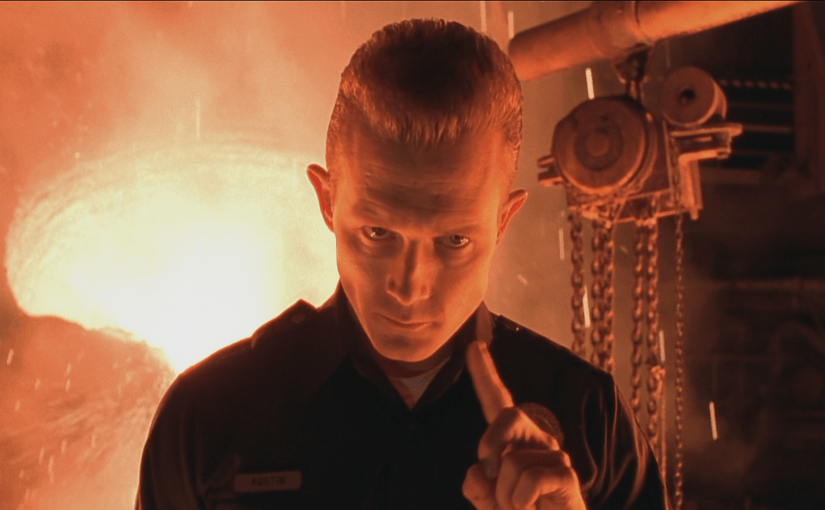
Hailed as one of the greatest sequels ever made, James Cameron’s sci-fi extravaganza Terminator 2: Judgment Day remains revolutionary in its achievements in special effects that still hold up over thirty years later.  This was a major film in Arnold Schwarzenegger’s career, but Robert Patrick became a known character actor for his stoic expressions as a sinister android with the ability to shape shift out of a substance of liquid metal that consumes his entire body.  Neither of these actors have much dialogue and yet the hero versus villain element is so well defined with Cameron’s imagination and drive for effects enhancements. 

It’s ironic.  The first Terminator was a scrapy film with an interesting plotline of time travel to serve outstanding shoot out and car chase mayhem for an hour and forty minutes.  Stan Winston’s make up work was effective. Visual effects of the metal exoskeleton look like the work of Ray Harryhausen from his days working on the Sinbad movies.  Impressive, but they looked outdated.  It’s forgivable though because the storyline and the action were masterfully orchestrated.  Cameron’s sequel makes up for these shortcomings.  It was a box office smash.  The image of Schwarzenegger mounting a Harley Davidson with sunglasses and a black leather motorcycle outfit (shotgun in hand) became as iconic as his standard promise of “I’ll be back,” and just about everything in the film raised the bar that much higher for all vision effects to be produced thereafter.  Some of the imagery in this film remains absolutely astonishing.

In this 1991 installment, two Terminators from the year 2029 are sent back in time to protect a pre-teen John Connor (Edward Furlong in a wonderful and spirited debut performance), the leader of the human resistance in a futuristic war between man and machine.  There is Schwarzenegger as a new T-800 (a steel skeleton with living tissue and skin on top) designed with good intentions to keep John alive.  The T-1000 is the much more advanced liquid metal monster who can form sharp objects like knives and stabbing weapons.  It can also take the shape of any human it encounters.  So, it has the capability of deceit.  This thing is truly unstoppable. 

John’s mother, Sarah (Linda Hamilton), who was being hunted in the first film is now a bulked-up warrior imprisoned in a psychiatric hospital for her violent tendencies, making outrageous stories that predict a doomed future, and for the crime of blowing up a computer factory.  Hamilton makes a major departure from her hokey damsel in distress in the first picture.

James Cameron is a director with high standards.  With each film he has made in his storied career (Titanic, Avatar), he seems to be both the teacher and student of advanced filmmaking.  Every new film shows a new discovery on his part.  The dazzling special effects of Terminator 2 work because they serve the robotic characters.  The effects are the threats and superpowers meshed within the plotline.  The technology used, along with Stan Winston’s artistic make up imagery, serves the story.  The liquid T-1000 will get frozen in liquid nitrogen.  Cameron will show Robert Patrick breaking apart like chipped ice.  Schwarzenegger will shoot the frozen statue, breaking it into a thousand pieces.  Is the monster dead though?  Cameron applies another cool effect for a fast resurrection, and you see how it all functions and morphs into something new.  The T-800 will shoot a grenade into the head of the T-1000, and you’ll see it break apart and what it does next in response.  It’s groundbreaking.  More importantly, it is eye opening.  Absolutely marvelous work.

There’s a handful of cheesy dialogue in Terminator 2: Judgment Day.  That’s to be expected in many of James Cameron’s scripts.  I can’t help but roll my eyes when I hear Michael Biehn or Linda Hamilton deliver a line like “On your feet, soldier!”  I dunno.  It just doesn’t come off authentic to me in the same way a drill sergeant would demand.  Hamilton’s voiceovers never did it for me either and I think it’s a combination of the dialogue and the vocal performance from the actor.  The melodrama is a little too thick in these areas. I’ve often regarded faults like those of Cameron.  That doesn’t make his films any less watchable.  I’m looking at some of the greatest visuals ever to grace a screen.  I do wish that he would take his screenplays to a script doctor, though.

Terminator 2 is never boring.  I opt to watch the Special Edition found in a DVD set.  It’s a recut of the film with lots of extra footage that flesh out the functionality of these sci fi futuristic figures and lend to more character depth.  A dream sequence is included.  Sarah sees the return of Kyle Reece (Michael Biehn), John’s father, to push Sarah on her campaign to change the future and ensure the technology that soon develops in a future 1997 never comes to be, while also continuing to protect their son.  My favorite new addition comes in the final act when we see the T-1000 suffer from the cumulative damage done by the heroes.  That welcomes some new visuals not seen in the original theatrical cut.

No matter which edit you watch though, the set pieces are spectacular with lots of shoot ‘em up mayhem, truck and motorcycle chases, and bullets blazing all over the place, including bouncing off of Arnold Schwarzenegger, while being “absorbed” by Robert Patrick.  A helicopter collides with a SWAT team van.  An entire building explodes into a huge blaze. Cameron offers frequent nightmares for Sarah that depict a truly frightening end to nearly all of humanity with scorching white heat, fire and ash.  A playground never looked so scary.

I digress with a mild spoiler alert.  This most recent watch of the film was fun because I showed it to my fifteen-year-old daughter.  She had a different impression than most movie going audiences who saw the film in 1991.  Promotions at that time clearly demonstrated that Schwarzenegger was a good Terminator this time, while Patrick was the threatening bad guy.  My daughter had no idea.  So, a well edited suspense scene that builds in a shopping mall left her quite surprised when both Terminators meet face to face for the first time, with their guns drawn and John perched right between them.  Who was the protector and who was the killer?  See?  It pays not to watch the commercials and previews.

Terminator 2: Judgment Day is one of many outstanding achievements for James Cameron.  It enhanced a new visual effect introduced in an earlier film of his, the “water worm” in The Abyss, and made it a major story element.  He might not be the best dialogue writer, but Cameron repeatedly showcases the art of writing a solid storyline around the technology he toys with as he brings it all to perfection. 

DEAD AGAIN

By Marc S. Sanders

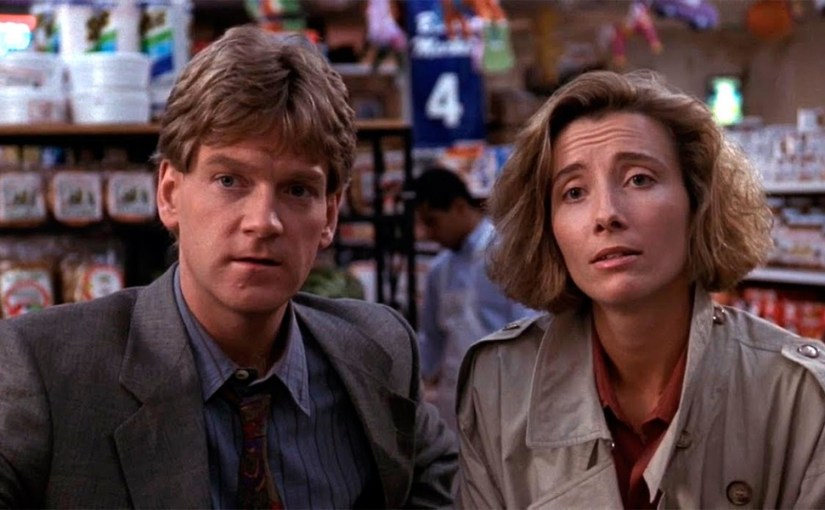
Kenneth Branagh is inventive director.  Arguably, his most uncelebrated film is the noir inspired mystery, Dead Again, which features himself and his wife at the time, Emma Thompson, in the leading roles. 

Branagh and Thompson do double duty, playing multiple parts in two different time periods.  In a 1940s post war Los Angeles, they are Roman and Margaret Strauss.  Roman is a composer.  Margaret is a musician in his company.  They quickly fall in love and live in the limelight of glitz and glamour amid the gossip magazines of the time.  Their life together only becomes juicier when Roman is sentenced to death for the murder of Margaret.  The weapon of choice, a pair of scissors.

In present day 1991, Branagh portrays a private detective named Mike Church who ends up being responsible for an amnesiac, Thompson, who can’t even speak when she’s found.  The woman has unexplainable dreams that recall moments of Roman and Margaret’s life together only to end up as terrible nightmares.  A curious hypnotist (Derek Jacobi) enters the story to lend aid to Mr. Church and the woman.  He serves as a guide, bringing her back to the times of the celebrity couple, helping her to find clues that perhaps could lead to her true identity and uncover exactly why she is haunted by these dreams.

Additional characters enter the storyline as well.  There’s Wayne Knight as a humorous sidekick for Church.  In the flashback 1940s, there’s Andy Garcia as a handsome Pulitzer winning journalist who follows the escapades of Roman and Margaret.

Dead Again is not a long movie, and that lends to how good a film it is.  It’s a lean picture that sets up its clues the moment it starts.  Branagh gives you a background tutorial with newspaper headlines that flash up within the opening credits.  The two time periods are separated with the 1940s shown in gorgeous black and white, while the modern scenes are presented in color.  Branagh puts on a German accent for Roman.  Thompson is English for Margaret.  In the present day, they are Americans.  Of course, it is acknowledged that the respective characters look alike and that allows for possibilities of reincarnation, karma and past lives to enter the frame. 

The screenplay from Scott Frank gets you curious.  What connection could these two wildly different couples have with one another?  What don’t we know about the murder of Margaret at the hands of her husband, Roman?  Who really is the woman that Thompson is portraying in modern times?  How is it possible that a private dick like Mike would coincidentally end up with this “Margaret lookalike” amnesiac?

The cast is having a lot of fun with the puzzle, particularly Derek Jacobi.  His old English mannerisms offer a relaxing storyteller’s narrative to the film.  It feels as if his hypnotist carried over from an Alfred Hitchcock film.  I also appreciate how far apart the respective characters that Branagh and Thompson play.  Not only am I watching a thrilling mystery, but I’m looking at skilled, well-trained actors demonstrating a wide range of performance work.  At times, it’s as if I’m watching two different movies.  How exactly are they going to intersect, though?

I originally saw Dead Again in theatres and was taken with it immediately.  I did not see the end coming and when the veil was lifted, my eyes went wide open.  It has a terrific plot twist.  Branagh, known at the time as a celebrated Shakespearean actor/director, introduced a sweeping, mystery yarn that relishes in fun escapism like Hitchcock or Orson Wells would apply to film noir.  It only makes sense, looking back over thirty years later, why the director opted to turn his craft towards rejuvenating the classic Agatha Christie stories (Murder On The Orient Express, Death On The Nile) for film.  We are better for his contributions.

Now, Dead Again is a film that deserves the attention from a new generation of movie lovers.

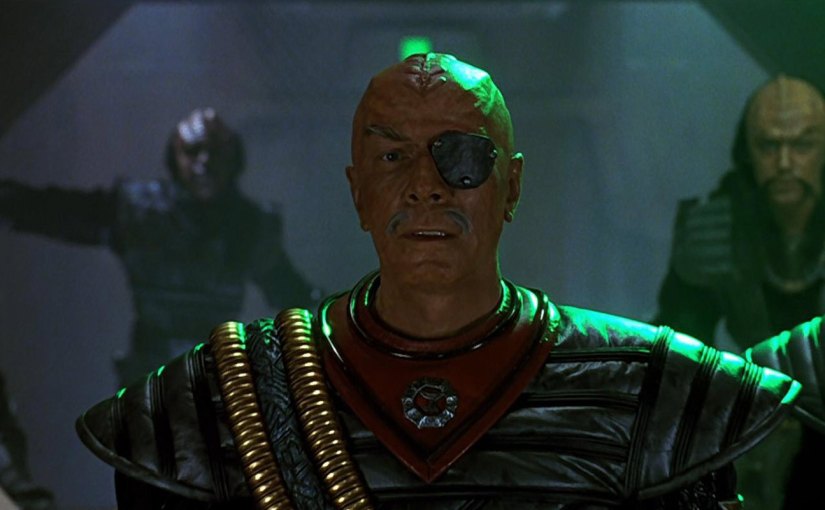
STAR TREK VI: THE UNDISCOVERED COUNTRY

By Marc S. Sanders

I got the urge to watch Star Trek VI: The Undiscovered Country after seeing the compelling HBO miniseries Chernobyl. The Star Trek franchise succeeds best when it applies current and true-life events to its fictional future set in the 23rd century.

Like the USSR, the savage Klingon empire suffers a terrible accident at one of their most powerful energy planets, that spirals them into possibly having only fifty years of life left to survive. Therefore, Klingon Chancellor Gorkon (David Warner) reaches out to representing Ambassador Spock of Starfleet (Leonard Nimoy) to begin peace talks that will help prolong the alien race’s survival.

Captain Kirk (William Shatner) however, is not so keen on the idea, especially after he blames them for the murder of his son. It turns out many other factions are not enthused either, as Gorkon is assassinated and Kirk and McCoy (DeForrest Kelley) are sentenced to an ice like Siberian prison planet.

There’s much to think about in the original Star Trek cast’s final film together. Beyond the sentiments of the crew retiring and the Enterprise being put out to pasture so to speak, there’s an interesting story to ponder about how we map out the future for upcoming generations when we are still living with the past that we’ve grown accustomed to. It’s telling, considering much of the real-life events happening twenty-two years into our new century with historical statues being removed and minorities fighting for fairness among their communities.

As well, is one country or people too proud and always wanting to be at odds with another by relishing in being a super power? Can we think beyond that nature? I think that’s maybe where the curious title, The Undiscovered Country, stems from. We just haven’t seen the possibility that could be truly within our reach, if we all wanted it that way.

Christopher Plummer plays Klingon General Chang who vows revenge for the assassination. Plummer is spectacular; a villain not recognized enough on all of those on line top 10 lists of bad guys. Plummer brings his theatrical training to the role as he relies on Shakespearean quotes to take in the scene at hand. He’s at least as good as Ricardo Montalban’s Khan is remembered.

The crew is adored as usual. The supporting cast are given their fair share of lines and moments in the spotlight. Kim Cattrall joins as a Vulcan Federation Officer who’s helpful to uncover the true criminals at play.

Director Nicholas Meyer contributed to the best of the Star Trek films, and this is a perfect example of his strength within the franchise. The story was partly conceived by Nimoy with Meyer credited on the screenplay. Cold War politics really lend to this film. It’s interesting to see how the Klingons are initially in denial of assistance or the desperate problem they face which is similar to Russia’s response following the horrifying nuclear accident at their power plant in Chernobyl. I just love how the ideas within The Undiscovered Country parallel the world’s response and effects of what was happening just a few years prior to this film’s release, in 1986.

Never let it be said that movies can’t teach you anything.

CAPE FEAR (1991)

By Marc S. Sanders

Would you ever think that Martin Scorsese could be a master of horror? I do. I thought so ever since I saw his remake of Cape Fear, back in 1991, featuring Robert DeNiro, Nick Nolte, Jessica Lange and Juliette Lewis. This cast of four is an astonishing assemblage of talent, complimented with players from the original film, Robert Mitchum and Gregory Peck, as well as Joe Don Baker, Fred Thompson and Illeana Douglas.

Wesley Strick is credited with this updated screenplay that questions the measure of sin; pot vs heroine, battery vs rape, flirting vs infidelity, as well as the ethics and justifications that we reason with every day.

DeNiro provides one of his greatest roles. He lost the Oscar in 1991 to Anthony Hopkins. Reader, DeNiro should have won for a much more complex, fleshed out part. He plays Max Cady, a man released from prison after a fourteen year stretch. His focus during his time was to learn how to read, build up his body, tattoo his flesh with the principals he inherited from the Almighty Bible and other literary sources, and most importantly reconnect with his defense attorney Sam Bowden (Nick Nolte in one of his best roles, as well). Cady needs to remind Bowden of how he was misrepresented during his trial.

Strick’s screenplay is so smart. Smart because the antagonist never, ever makes an error, not until the end of the story. Cady’s intelligence is always one step above anyone else’s intuition and with the literal mechanics of the law beside him, Cady’s tactics come off very believably. Cady might come off as hokey, hillbilly white trash with ugly polyester clothing, a slicked back mullet and a fat, offensive cigar but he is a smart hunter who will weaken his victims before initiating his attack.

Bowden is a smart lawyer but he’s at a loss, and he does not have the support he needs from his family to protect himself and them, Jessica Lange as his wife and Oscar nominee Juliette Lewis as his daughter. Lange is very good as a wife who has survived marital turmoil of infidelity from her husband. She’s a marketing career woman who does not succumb to Sam as being head of the household. Sam asks that the dog not be put on the table and Lange as Leigh Bowden scoffs at his concern.

Fifteen years old at the time, Lewis is astonishing as a young girl discovering her sexuality but unsure of what is appropriate; almost like a kid finding a loaded weapon in a closet. One of the greatest acting sequences in the last thirty years, occurs between DeNiro and Lewis alone on a stage set against a sinister lighted Hansel & Gretel set. Lewis twitches and stutters like any girl would, as DeNiro assuredly comforts her and seduces her into a touch that leads to a kiss. Scorsese uses this midpoint scene to quiet down an aggressively frighteningly film, meticulously edited by the legendary Thelma Schoonmaker. Before this moment, telephone rings, shutters, racket balls, car engines, aggressive close-up zooms, and Elmer Bernstein’s horn and string sections of his orchestra startle you and scare you when almost nothing terribly vicious has really happened. When we arrive at Lewis and DeNiro’s scene, Scorsese quiets it all down. He needs no devices for this exchange of disturbing, yet researched dialogue by Strick, blended with the performance talents he has at his disposal.

Another stand out performance belongs to Illeana Douglas in a small, early role. She plays a court clerk to Bowden’s lawyer and they are flirtatious. Cady uses this as an opportunity to remind Bowden that he must take his sins seriously. Douglas is supreme in an inebriated scene with DeNiro as she flirts with him and then goes to bed with him. We can sense the danger she’s in. Douglas’ drunken portrayal cannot. Never does she look like she’s foreseeing her immediate future.

It’s ironic, really. I can’t help but compare Cape Fear to any one of the various slasher films featuring Jason, Freddy, Michael, etc. Those guys stalk the house or are seen from the distance at the end of the street. Those are horror films as well where an entity stalks a prey. Scorsese really has that here with Strick’s screenplay. However, Scorsese finds other ways than to just have the menace be…well the menace. He offers up an overabundance of fireworks behind Cady as he sits in Bowden’s backyard. He’s got Bernstein’s blaring horns and squealing strings for soundtrack, of course. He colors the palette of the sky above Bowden’s doomed house in bruised purples and blood reds. He even changes the perception of the Bowden family by showing what they are looking at in a sort of X-ray/black light like state. Are they seeing what they think they are seeing? Sure, Cady is stalking them, but in a given moment, are they just being paranoid by the disturbances Cady has cemented in their consciousness?

I’d imagine these are filmmaking inventions of Scorsese not specifically featured in Strick’s script. That’s what makes Martin Scorsese a director above so many others. He doesn’t just settle for the page. He won’t necessarily manipulate the script, but he won’t settle to just leave it at only what he reads. Cape Fear is a demonstration in unsettling, visual terror, and it’s worth revisiting for a look.