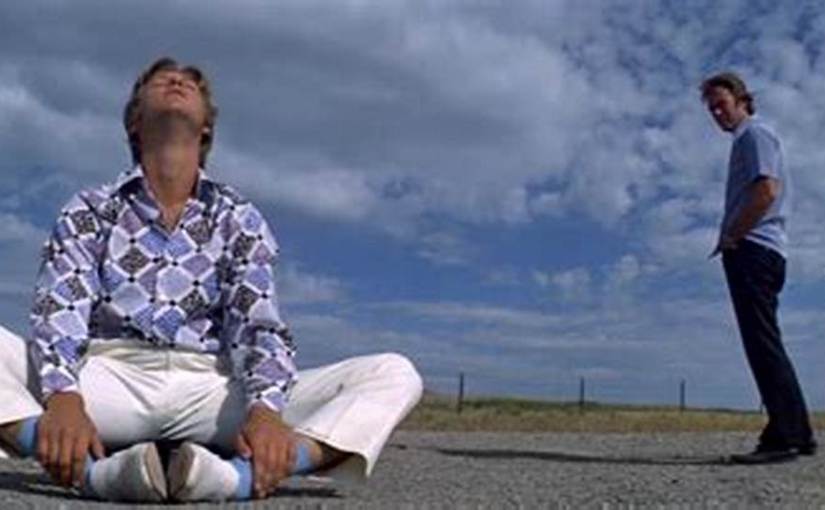
THE SUGARLAND EXPRESS (1974)

by Miguel E. Rodriguez

DIRECTOR: Steven Spielberg
CAST: Goldie Hawn, Ben Johnson, Michael Sacks, William Atherton
MY RATING: 6/10
ROTTEN TOMATOMETER: 87% Certified Fresh

PLOT: A young wife breaks her husband out of prison in 1969 Texas so he can help reclaim their infant from a foster family.  The ensuing media circus takes everyone by surprise.


Watching Steven Spielberg’s The Sugarland Express is like looking at one of those historical medieval tapestries of fierce battles, created by artists who didn’t yet know how to depict perspective.  There is plenty of action on display, but everything looks and feels flat.  The film took an award at Cannes that year for Best Screenplay, probably (at least partly) in recognition of how it shies away from a traditional Hollywood resolution, but even its downbeat ending is reminiscent of earlier, more resonant films like Bonnie and Clyde [1967] or Butch Cassidy and the Sundance Kid [1969].  As a stepping stone in the career of an eventual legend, it’s worth a view.  As a stand-alone film, it never quite achieves liftoff.

Based on real events, The Sugarland Express tells the story of Lou Jean Poplin (Goldie Hawn at her irrepressible, bubbly best), the young wife of prison inmate Clovis Poplin (William Atherton).  During a conjugal visit, just four months before Clovis is to be released, Lou Jean boldly busts him out because she needs his help to reclaim their infant, Langston, from a foster home.  Lou Jean herself has just finished serving time at a women’s prison, and the state, probably very wisely, determined Langston was better off with a foster family.  But they need to hurry because “I bet those Methodists are gettin’ ready to move out of state.”  Lou Jean’s delivery of “Methodists” tells you all you need to know about her feelings on the matter.

After Lou Jean breaks him out, a comedy of errors ends up in a situation where she and Clovis have hijacked a police cruiser and are holding a police officer at gunpoint.  They demand to be left alone while they drive to Sugarland, Texas, and retrieve their son, at which point they’ll release their hostage.

Now, this has all the makings of a smart, character-driven “road” movie, instigated by desperate people with no real plans for their end-game.  But for reasons I can’t put a finger on, nothing ever happens in the film that got me on the edge of my seat, figuratively speaking.  I fully comprehended the situation intellectually, but the film never got to me at an emotional level.

Could it be because we never really learn a lot about Lou Jean and Clovis in order to make them more empathetic?  No, I don’t think so, because over the course of the film, we’ll hear all about their past histories and previous brushes with the law.  The very fact they’re executing this plan to essentially kidnap Langston is proof of how unfit they are as parents.

I think part of the problem with the movie is…

…I’ve been sitting here for the last fifteen minutes trying to finish that sentence.  I can report that the film didn’t get to me emotionally, but I am struggling to explain why.  Could it be as simple as I think they’re not such great people, but the film seems to be siding with them as the movie progresses?  I mean, the movie HAS to side with them at least partially in order to make their journey mean anything.  Look at Butch Cassidy and the Sundance Kid.  Bank robbers, lawbreakers, but clearly the good guys because, duh, Paul Newman and Robert Redford are playing them.

So, maybe it has to do with the casting?  The Sugarland Express had one of America’s sweethearts as a woman willing to resort to kidnapping just to commit another kidnapping in the name of maternal love.  So, we’ve gotta root for her, right?  But then we see her behaving in the most inane, brainless way for so much of the movie.  I found it difficult to side with her when I just wanted to, forgive the expression, slap some sense into her.

What about Clovis?  I could side with him.  He appears to have misgivings throughout the entire film, right up to the point of no return.  But the way he willingly goes along with the scheme because, dammit, it’s his wife…something about that also turned me off on him.  There are moments I felt sorry for him, for them both, because I could see where this movie was headed early on.  But that empathy wasn’t enough to make me feel a catharsis of tragic energy at the film’s finale.  There’s just something about Clovis and Lou Jean that wouldn’t allow me to get too worked up over their fate.

I guess I identified most with the kidnapped police officer, Slide (Michael Sacks).  Maybe too much.  From the beginning, Slide is begging them to drop their weapons and turn themselves over to the police.  At first, he looks like he’s just following his training.  But then the movie progresses, and doggone it, he starts to like these two loonies, even though Clovis handcuffs him and even shoots at him a couple of times in the heat of the moment.  He can see where this road ends, and he pleads with them not to do exactly what the Texas state troopers expect them to do, because he doesn’t want to see them dead.  Because Slide never stops imploring the Poplins to see sense and do the smart thing, I guess he’s who I sided with for the entire movie.  (Well, him and his superior, Captain Tanner [Ben Johnson], who also doesn’t want to see them die.)

But…isn’t that the wrong way to approach this movie?  I shouldn’t be siding with the cops, for cryin’ out loud, should I?  At least, not in this movie.  Discuss.

From a technical standpoint, it is pretty cool to see how Spielberg, in only his second film, was able to marshal vast resources to create some arresting imagery.  The sight of what looks like literally hundreds of cop cars following the Poplins is a deceptively difficult feat, logistically speaking.  There’s a tense shootout in a used car lot that would have been right at home in The French Connection.  And everywhere, there’s bits of humor that made me smile.  From the elderly couple abandoned on the road (long story) to the solution of how to get Lou Jean to a toilet while in the middle of an extended police chase, Spielberg constantly pokes us in the ribs.  If this had gotten to the hands of someone like John Landis, it’s easy to see how this could have been turned into an out-and-out comedy with thriller elements, instead of the other way around.

One other aspect I did like was the media circus that blew up around the Poplins’ plight.  I’m sure it is yet another link to previous anti-heroic films, but while I was watching it, I was reminded of only one film: Oliver Stone’s Natural Born Killers [1994].  The outpouring of affection from the general public for these two, let’s face it, outlaws was both funny and sobering at the same time.  It would have been interesting to see a scene or two at the end of the film as an epilogue, so we could get a reading on what the public thought about how the police should have handled the situation.

If comparing The Sugarland Express to most of Spielberg’s later films, it certainly comes up lacking, no question.  As a lifelong Spielberg fan, I am compelled to say it SHOULDN’T be compared to his later films because it was made before he’d had a chance to hone his skills and become the populist/mainstream film icon he is today.  Look carefully at the two-dimensional storytelling and you can see the outlines of what was coming around the bend for this modern-day master.

THE TAKING OF PELHAM ONE TWO THREE (1974)

By Marc S. Sanders

I’m a big fan of gritty, urban crime thrillers.  A wealth of them came out in the 1970s.  There was a rawness to their material.  They were equal opportunity offenders, picking on every race and demographic out there. It only lent an honesty to the characters that occupied these spaces.  The two guys that easily come to mind are Dirty Harry and Popeye Doyle from The French Connection.  Still, there were others that wedged their way through the cracks.  The Taking Of Pelham One Two Three from 1974 belongs in this fraternity of films as well. 

Walter Matthau is Lt. Zachary Garber, who has a ho hum job working the law enforcement area of the New York City subway system.  Beyond muggings and vagrants lying around you wouldn’t expect any major crimes to happen underground and thus Zach moves with a slow pace that never gets him upended or panicked.  Yet, on the day that he is giving a tour to some visiting Japanese subway architects, a hijacking of the train to Pelham Bay, number one two three, occurs.  Four armed men, only designated by Mr. Blue, Mr. Green, Mr. Grey and Mr. Brown don fake mustaches, hats and overcoats.  They are demanding a cash ransom from the city in the amount of one million dollars.  Zach and his crew have less than an hour to respond with the money, or Mr. Blue (Robert Shaw) will order the killing of one hostage for every sixty second delay.

Joseph Sargent’s film then steers its way into several conundrums.  Even if the ransom is paid according to the criminals’ exact instructions, how are these guys going to make an escape from underground?  What’s the nebbishy mayor supposed to do?  He’s in bed with the flu and he doesn’t know how to respond to this kind of craziness.  What’s the point of him making a public appearance near the scene of the crime? 

Long before everyone’s favorite hostage flick, Die Hard, came about Sargent’s movie was poking fun at the humorous and inconvenient cracks that leak out of a serious captive crisis.  First you gotta get the mayor to agree to the demands and as his wife (Doris Roberts) sensibly points out, there are seventeen potential voters on that train.  Then, you gotta count the money and drive it from uptown to midtown before the clock runs out.  That’s not so easy.  You think New Yorkers get out of the way when a speeding patrol car is barreling through the city? 

Zach doesn’t have it so easy as well.  Schluby Walter Matthau is great at trying to contain a situation but his co-workers are not so understanding.  Rush hour is less than two hours away and this stand still train is holding up the subway traffic.  Dick O’Neil and Jerry Stiller are genuine hilarity born directly out of the concrete jungle for roles like this. O’Neil has to keep all tracks open and the trains moving.  Initially, Stiller doesn’t take this seriously – a precursor to his Frank Costanza role on Seinfeld.

Robert Shaw was always one of the best villains and antagonists with films like From Russia With Love, The Sting, and Jaws.  He’s just as good here, but like those other characters, Mr. Blue is unique.  He carries a uniform, hospital cornered method, and he keeps it to the letter so well, that he’s relaxed enough to play his crossword puzzle as he waits for the money to arrive.  Martin Balsam is Mr. Green, a nervous underling recruited for operating the train.  Hector Elizondo is a crazed kamikaze kind of guy who might just knock the criminals plan out of whack because he’s a little too trigger happy.

The Taking Of Pelham One Two Three carries a simple plot.  What makes it complicated though are the characters surrounding the story.  There are a few levelheaded guys on both sides, but it’s the others around them and even the daily happenings of New York City that tilts any progress to be made off kilter. 

The city and many of these characters are unpredictable and therefore surprises will trip everything up just when it all seems to fall into place.  This even happens in the very, very, very last scene and caption of the film.  I’d love to share what a simple involuntary action that can break any of our concentrations does for a couple of these guys, but then I’d spoil the fun.  Trust me though, you get the last laugh before the end credits roll.

THE TAKING OF PELHAM ONE TWO THREE (1974)

by Miguel E. Rodriguez

DIRECTOR: Joseph Sargent
CAST: Walter Matthau, Robert Shaw, Martin Balsam, Hector Elizondo
MY RATING: 9/10
ROTTEN TOMATOMETER: 98% Certified Fresh

PLOT: An NYC transit chief must outmaneuver a gang of armed professionals who have hijacked a New York subway train and threatened to kill one hostage per minute unless their demands are met.


How?  How is it possible that it’s taken me this long, until fifty years after its release, to finally watch the original The Taking of Pelham One Two Three?  Until now, my knowledge of the film included only its title, its basic plot, and the fact it was remade with John Travolta and Denzel Washington.  Now that I’ve seen the original, my desire to watch the remake has dwindled from microscopic to zilch.  This is one of the most thrilling heist films I’ve ever seen, and its influences are clearly felt in the best thrillers in the decades since its release, from Die Hard to Speed to Reservoir Dogs.

In the first half of the 1970s, widely regarded as one of New York City’s worst decades (at least by me, anyway), four armed men methodically hijack a subway train, decouple the engine from the rest of the train, and bring it to a stop between stations.  Their leader, known only as Mister Blue (Robert Shaw), radios the transit system authorities with his ultimatum: deliver one million dollars to the train in one hour and leave quietly or he and his companions will kill one hostage for every minute the money is late.

The chaos that ensues is sprinkled with the kind of humor I did not expect from any cop thriller made before Die Hard.  The transit chief, Lt. Garber (Walter Matthau as an unlikely but strangely convincing action hero), must interrupt a tour he is giving to a visiting cadre of Japanese subway officials.  Colorful dialogue is provided to the transit system engineers and administrators as their carefully maintained schedule is destroyed by the hijackers.  One of Garber’s associates shows where his priorities lie when, in the middle of a hostage crisis, he complains, “Jesus…you realize the goddamn rush hour starts in an hour?!”  This and many other moments provide welcome comic relief, but they are also firmly grounded in the reality of career officials under a great deal of stress.  There is never a moment that doesn’t feel exactly right.

When it becomes clear the hijackers mean business and will have no compunction about following through on their threats, important logistical questions arise.  Where will they get the million dollars from?  The bedridden city mayor (who bears an uncanny resemblance to Ed Koch, four years before the real Koch was elected) doesn’t know.  The hijackers want it in specific numbers of bundles of fifties and hundreds.  How long will it take to assemble the money correctly, assuming they even GET the money?  Lt. Garber raises an interesting question: where will the hijackers go once they get their money?  They can’t simply get off at the next station, and they can’t leave the controls of the train while it’s in motion, thanks to the “dead man’s switch” that prevents such a thing.  What’s their end game?  Another transit official, played by Jerry Stiller, has the answer: “They’re gonna fly the train to Cuba.”

These and many other questions (including why the train is called Pelham One Two Three) are answered during the film’s running time, although one of them is answered without getting too specific because either it really is impossible to do so, or the filmmakers had no desire to lay out a step-by-step procedural for budding criminals.

One of the most important factors in the film’s success is its slam-bang pacing.  I’m not saying it’s cut together like Run Lola Run or an MTV video, not at all.  But the flow of the film is meticulously managed to keep the suspense going even when not much is happening on the train for their one-hour waiting period.  This is accomplished by having a local beat cop happen upon the train and provide close-cover reconnaissance to the transit authorities.  There’s also suspense among the passengers, obviously, as they plead with their captors.  (They provide more comic relief when one of them asks how much their captors are asking for their release.  “One million dollars,” one of them answers.  The hostage takes a perfectly timed beat, then says, “That’s not so terrific.”  Welcome to New York, ladies and gentlemen.)

Everything comes together so efficiently, so elegantly, that it’s a bit depressing that the film’s director, Joseph Sargent, would return to his roots and make a string of TV movies with only one other high-profile film to his name 1987’s Jaws: The Revenge.  That these two movies were made by the same director is mind-boggling.

I do have one quibble, though, and I will do my best to spoil as little as possible.  It involves a showdown where one man has a gun and the other doesn’t, and the infamous “third rail” in New York’s subway system.  If someone can successfully explain to me why one of those two men makes the choice he does, I will be happy to mail them a shiny new penny.  As it stands, that man’s decision made zero sense to me.  It almost felt like the screenwriter had written himself into a corner.  It was the one questionable moment in the entire film for me, but it did not ruin the movie, for what it’s worth.  It’s still an amazing ride.

The Taking of Pelham One Two Three deserves to be mentioned on any list of great ‘70s thrillers like The French Connection and Dog Day Afternoon, especially the latter with its tricky mix of humor and suspense.  It grips you with its realism and credibility right from the opening scenes and barrels along with barely a minute to breath right up to the literal final image.  This is superior filmmaking, and any fan of film, at any level, needs to add this to their must-watch list.

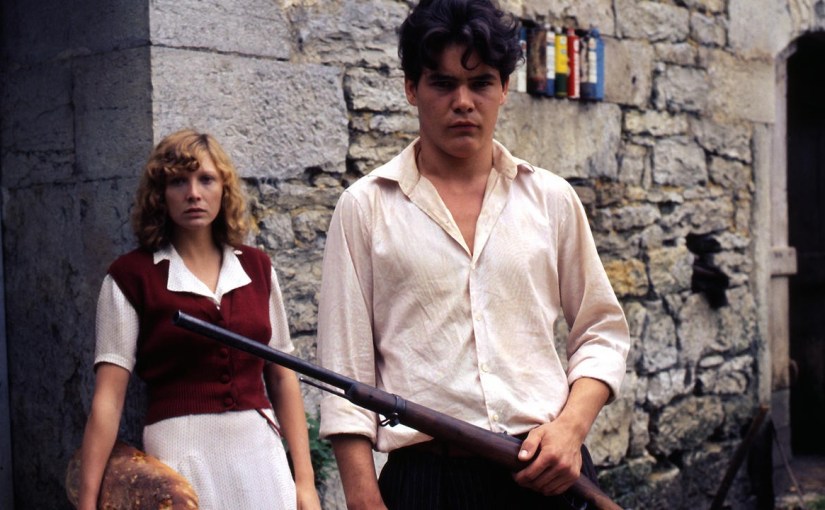
LACOMBE, LUCIEN (France, 1974)

by Miguel E. Rodriguez

DIRECTOR: Louis Malle
CAST: Pierre Blaise, Aurore Clément, Holger Löwenadler
MY RATING: 7/10
ROTTEN TOMATOMETER: 100% Fresh

PLOT: In 1944, an 18-year-old boy from a small French village collaborates with the Gestapo and subsequently falls in love with a Jewish girl.


The effectiveness of Louis Malle’s Lacombe, Lucien may depend partially on how much you know about cinema history after World War II.  It’s a historical fact that there were French countrymen who sided with the invading Nazis, going so far as to infiltrate the French Resistance and inform on their neighbors to the Gestapo.  When the war ended, that fact was politely and discreetly avoided in war films for decades.  No one wanted to spoil the notion that the whole of France united with each other to harass the Nazis at every opportunity, and that the Resistance fighters were unambiguously, morally pure.  In France, surviving collaborators went about their business, some more anonymously than others.

In 1974, Lacombe, Lucien became one of the first, if not THE first, French film to not only broach the topic of Nazi collaborators, but also to depict the French Resistance as employing guerilla tactics and carrying out assassinations that were just as morally questionable as any other similar attacks in history.  It was a bold move, to be sure.  Even when you remove that context from the film, when you watch it as a stand-alone piece of cinema, it is still makes for compelling viewing.  However, for my part, the very ending of the movie left me frustrated.  While French audiences may have seen it differently in 1974, I saw it almost as if the filmmakers simply ran out of story and used a title card to tie things up in a bow.  But the journey to get to those final frames is worthwhile, even though the lead character is one of the most loathsome people I’ve ever seen on film.  I would compare him to Amon Goeth from Schindler’s List, not because they are similar characters, but because they elicited the same reaction from me: disgust.  (Or maybe they are similar characters…you tell me.)

The film opens in 1944, just a few weeks after D-Day, in a small town in southwest France.  We first meet young Lucien Lacombe, maybe 17 or 18, mopping a hospital floor, apparently doing a good deed for his community.  Through an open window, he spies a small songbird chirping on a tree branch.  Lucien makes sure no one is watching, pulls a slingshot from his pocket, takes careful aim, and kills the little bird with one shot.  He smirks and goes back to the business of mopping.  We will witness many other instances of Lucien killing other animals.

Indeed, many of these scenes are done for real: the actor playing Lucien clearly kills several rabbits with a shotgun, one with a wooden club.  In another scene, he catches, decapitates, and calmly starts to pluck a chicken for dinner, all in one unbroken take.  Now, this would have been normal behavior for someone living in a farm community in the French countryside, where someone has to prepare tonight’s dinner.  The difference is, Lucien seems to enjoy these tasks a little too much.  Even worse, though, are the times where he is utterly impassive about it, especially with the one rabbit he catches in the snare.  These are hard scenes to watch, but in hindsight, they are vital to unpacking or interpreting Lucien’s actions later in the film.

Through a series of events that reminded me a little bit of Goodfellas (“All my life, I wanted to be a gangster”), Lucien allows himself to be recruited into a cadre of French collaborators whose base of operations is a fancy hotel where their opulent lifestyle is a rebuke to those silly Resistance fighters who must scrape a living from the dirt.  He is more than willing to do what it takes to get a taste of the good life.  He turns in a schoolteacher who is also a Resistance officer; he makes a show of being contrite about it, but he quickly gets over it.

The rest of the movie shows Lucien puffed up with pride in his new social status, bullying anyone and everyone who dares to talk down to him.  There are, to be sure, broader statements being made here about the psyche of anyone who deludes themselves into believing in their inherent superiority over their fellow man just because they’re handed a membership card, regardless of how small-minded or shallow they might be.  However, during the movie, I never thought of those broader implications.  It’s a testament to how well the movie was directed and acted that I was concerned only with how Lucien behaved and acted, and not with whatever director Malle was trying to say from a metaphorical or allegorical standpoint.

To watch Lucien bully people around was sickening and pathetic.  He is introduced to a tailor, Albert Horn, who will make him some new clothes.  Lucien’s friend in the Gestapo casually informs him that Albert is a Jew who is only allowed to live in relative peace because of his skills as a tailor, and because he makes regular payoffs to the Gestapo.  Albert has a 20-something-year-old daughter, improbably named France, with whom Lucien is almost immediately smitten, despite her ethnicity.  He tries to impress France by getting her to the front of a food line, but she demurs.  When people in line complain, he smugly explains he’s with the German police and he can do whatever he wants.  The idea of that kind of power in the hands of someone as despicable as Lucien made me as angry as I can ever recall being while watching a film.

In the background of Lucien’s plotline is the shadowy Resistance itself.  Various members of the French collaborators are being killed here and there, certainly not a bad thing.  But the aftermath of their attacks is no less disquieting than anything perpetrated by the pro-Nazi collaborators, especially after a brazen attack on the fancy hotel headquarters, where the bodies of the collaborators are just as dead as the bodies of the Resistance fighters.  Perhaps the film is making a point that dead is dead, no matter which side you’re on, so you’d better be sure you’re dead for the right reasons because history will remember you one way or the other.

At the center of all this is Lucien’s face with his cold eyes and virtually expressionless mouth.  He doesn’t smile, he smirks.  He threatens Albert and France with exposure and arrest if Albert doesn’t allow Lucien to date, then marry, France.  For her part, France is wise enough to know when to humor Lucien and when to go along with his behavior, for the good of her father.  Lucien, besotted with power, is too clueless to realize how smart she really is.

I have a general guideline that I dislike movies with rotten characters at the center of them.  But I must admit that Lacombe, Lucien sucked me into the story and kept me there, despite how much I disliked Lucien himself.  I guess I wanted to see how much the filmmakers would allow him to get away with before he was swatted down.  Whether he gets swatted down or not is for you to discover, but let it be said that the ending manages to have it both ways, which was challenging for me.  I both did and didn’t get the kind of closure I wanted, which explains my somewhat median rating despite how well-made the film is.

It may be that I’m not old enough, or knowledgeable enough, to really appreciate the impact Lacombe, Lucien had on 1974 audiences.  I can only report how it made me feel right now.  It made me feel anger and indignance towards Lucien throughout the whole movie, even when he makes a crucial decision that seems as if it will redeem his character.  I don’t think it does, because the damage he instigated has been done and cannot be undone by a single act of contrition when it’s far too late to make any difference.  Perhaps that’s not a very Christian idea, but that’s how the movie made me feel, regardless.  Lucien deserves what he gets and more.  Does that apply to the real-life French collaborators, many of whom were still alive when this movie was released?  It’s not for me to pass judgement on those people.  But I can’t deny how the movie itself made me feel towards the people within the world of the film.

DEATH WISH (1974)

By Marc S. Sanders

I never saw the original Death Wish before.  Never felt I needed to having already watched Death Wish II and Death Wish 3.  Yes!  The inconsistency in the numbers (Roman vs numeral) is how the “saga’s” films are titled.  Sometimes self-described writers and studio marketers do not pay attention to the minute details.  If you’re gonna be stupid with your five film franchise, then be sure to strive for a complete lack of intellect.

Now before I get back to discussing the original film which I finally watched last week, I offer you this confession.  In 1985, there were two films I saw five times each in theaters.  Oh God, You Devil and Death Wish 3.  I guess Out Of Africa and Prizzi’s Honor did not appeal to my twelve-year-old mentality.  Death Wish 3, however, had a hideously violent gang making social progress because they consisted of whites, blacks and Hispanics.  A couple of punk girls too.   A welcome melting pot of deranged animals operating under an equal opportunity philosophy.  They were all pals and they pillaged, robbed, vandalized, murdered and raped the helpless neighbors of the destitute projects in New York.  Happy times.  More importantly, have you ever seen that shootout that occupies the last thirty minutes of Death Wish 3?  It is one for the ages and worth your time to watch on repeat.  Dare I say it’s as good as anything in a Stallone, Schwarzenegger or Eastwood actioner.  

Here’s where my endorsement stops with this article, though.  Skip the first two trashy Death Wish films. Unless you want to see Laurence Fishburn try to shield himself from a Charles Bronson bullet by covering his face with a boom box and then drooling blood and radio parts out of his mouth before collapsing dead on the pavement.  That glorious moment occurs midway through the second installment.

Stay with me, now.

Having experienced the happy bloodshed of the third of five films in the Charles Bronson franchise, I am surprised to learn his city architect character Paul Kersey begins the original film as a “bleeding heart liberal” who would prefer to stay away from guns.  What a departure for Bronson’s most famous role.  All that being said, director Michael Winner likely started filming this piece with a need for a message about justifiable homicide or vigilantism, but unfortunately it very quickly drowns in repulsive ugliness.

I’ll say this for Michael Winner.  He’s keen enough to show Paul and his wife (Hope Lange) vacationing in beautiful Hawaii.  Then as they return home, an overhead shot of a bloody sun-soaked New York City appears on screen with the title of the picture DEATH WISH in big block letters, accompanied by some sinister sounding music.  Hawaii is heaven.  Home is hell.  John Milton was never this poetic.

Paul Kersey’s wife and adult daughter are attacked in their home.  Interesting tidbit! One of the slimeballs is Jeff Goldblum in his first film role.  Though there’s nothing for him to be proud of here.

Kersey’s wife dies.  The daughter is brutally raped, and I mean brutally.  It’s a disgusting scene that offers no sense of sadness or fear or awareness.  It also looks as if Winner and his crew and cast never even rehearsed the scene.  The poor girl’s clothes are ripped off of her, she’s pulled against one of them from behind by her throat, and then the attackers spray paint the center of her bare anus in orange as a “target” for where to penetrate.  Another thug paints a swastika on the wall. What is that supposed to tell me? Then we are treated to seeing Goldblum and company baring themselves and mounting the actress who was awarded this unfortunate role.  Reader, I’ve seen just about everything there is to see in films.  When I consider the point of delivery that Jodie Foster offered in her Oscar winning role in The Accused, what is smeared across Death Wish is exploitative garbage. Any shred of cinematic artistry is entirely devoid in this picture.  In this case it was not just another movie.  It’s just truly sickening.

Anyway, Bronson has never been a great actor.  Nor has he been charismatic.  Yet, there’s a tough guy and dark presence to what the camera found in him.  A client gifts Paul a modern-day Colt handgun and considering the high level of violence that occurs within the streets of New York, he takes it upon himself to seek out or bait would be muggers and criminals.  He never catches up to the hooligans that tormented his family, but he takes on the mission of cleaning up the streets while a useless police force amounts to little results.

After Paul’s first shooting, he comes home to vomit.  I can only guess the liberal cannot stomach what he’s committed.  This is about the only dimension we get out of this guy.  Paul has boring conversations with his son in law.  Poorly acted scenes with actor Steven Keats; poorly acted, poorly directed, poorly written, poorly filmed.  Paul hardly ever shares a scene with his traumatized daughter who goes in and out of catatonic states when she appears in the film.

As the body count piles up, a detective played by Vincent Gardenia starts the investigation around town and wrangles up his police force posse to be on alert. Hey, look who is giving a run down on a progress report.  It’s Gardenia’s Moonstruck wife, Olympia Dukakis.  Pretty neat to see this. Still, Death Wish is not recommended for your Vincent Gardenia/Olympia Dukakis movie marathon.

Death Wish is tone deaf.  I’d be interested to see how a liberal, who shutters at violence, transitions into a vigilante.  That’s a story with an eccentric transformation. However, Michael Winner and his writers are not even aware or interested in talking to you about that.  I only know Paul Kersey starts out as a liberal because his co-worker mockingly calls him one, and again he vomits after his first shooting.  How humane of Paul.

I won’t disclose the entire ending, but I’ll share this with you.  Paul relocates to Chicago and upon arrival, Michael Winner freeze frames on a grinning Charles Bronson pointing a finger gun at a couple of harassing punks who are tormenting some citizens in a train station.  What do I gather from this hint of subtly?  I guess Paul Kersey registered with a different political party when he became an Illinois citizen.  Quite the message!

CHINATOWN

By Marc S. Sanders

Forget it Jake!  

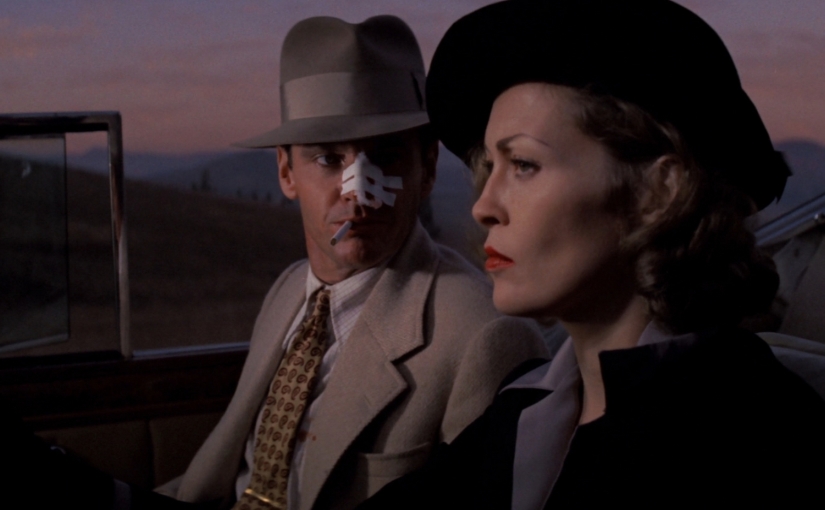
Roman Polanski turned Robert Towne’s page turning script into a noir mystery for the ages.  Practically every scene in Chinatown turns whatever you learned before off its axle.  The mystery of what Jake Gittes, a private dick played so well by Jack Nicholson, is attempting to uncover seems to repeatedly take the guy back to square one.  

Towne’s Oscar winning original screenplay, one of the best ever written, begins with simplicity in motion.  A Mrs. Mulwray insists on hiring Mr. Gittes to find out if her husband is having an affair.  The husband is in charge of the water supply within the surrounding areas of Los Angeles.  Despite Jake’s encouragement for her not to go down this path and recuse herself of heartache, he accepts the case charging his regular fee plus a bonus should he turn up anything that points to something illicit.

Just before meeting with the wife in despair, Jake wrapped up a case, handing over photographs of a wife to her bruiser husband (Burt Young).  The poor guy understands that his spouse was messing around.  None of it is shocking to Jake.  He’s seen the same results many times before and he’ll likely come upon the same situation with Mr. Mulwray.  However, as he follows her husband, it does not seem to be just an affair that is transpiring.  Jake finds himself driving out to a dried-up reservoir and then he’s adjacent to a drainpipe by the ocean shore.  The more he sniffs out, the more likely his nose is going to pay for what he gets closer to.

It’s hard to write about Chinatown as I reflect on the film for a review.  There’s just so much to spoil, even beyond what is now considered to be one of the all time great twists in film history.  I would dare not give anything away.  Some of the luckiest people today are those that have never seen the picture.  To watch Chinatown with a blank slate.  If that’s you…Wow!!! You are blessed of the experience that awaits you.

The cast is a bevy of recognizable faces; character actors who went on to popular television shows and movies (Higgins from Magnum P.I. and Miss Collins from What’s Happening!!!).  Faye Dunaway though is maybe the most unforgettable.  Jake is smart enough not to trust the famed actress’ character (I don’t even want to share the name of who she portrays).  Long before Sharon Stone hammed it up with a less creative eye rolling commando cross legged sitting, Faye Dunaway was best at being sexy, alluring and especially enigmatic.  With her Hollywood glamor appearance in costume wear from Anthea Sylvester, she has that classic noir dame appearance with a smooth inflection in her voice.  Word is that Polanski wanted Dunaway to reflect his own mother’s appearance.

Then there is the celebrated filmmaker John Huston representing old money, a lot of it, in a rare acting appearance.  He plays Noah Cross, a great name to be associated with water.  His gravelly voice and hulking mass lend to what he’s earned demonstrating his power over a commodity resource that everyone cannot live without.  Per Jake Gittes’ experience, he knows it’s best to seek out a motive long before he can uncover a crime.  Gittes’ perusal of some photographs on an office wall will allow him the gumption to go up against a titan like Cross. 

It’s a welcome setting to see late 1930’s L.A.  There is a drought going on and coincidentally Jake is perhaps tailing the guy responsible, but only because of a likely affair.  Still, when his pursuit takes him to the most unexpected places, something more sinister may be happening.  When someone turns up dead by drowning, Chinatown becomes more deliciously complex. Why would Dunaway’s character pay Jake, and later why would Noah Cross double the fee to hire the detective, as well? Jake’s clients may be playing against one another, but he’s the one being tossed in several different directions.

There has to be over a dozen twists in Chinatown.  Thankfully, none of them are contrived or thought up out of the blue.  New depths await further down the rabbit hole.  

I love how Jake Gittes functions.  He might be accused of being sleazy in his profession, but he drives a nice Pontiac classic convertible and dons a stylish wardrobe to go with his fedora hats, designer sunglasses and sterling silver cigarette case.  He’s also quite sharp.  He’s got methods to easily prove how long someone has been at a certain locale and how to follow another car at night.  All of it makes perfect sense.  

Jack Nicholson is great in his role. He does not go all looney like in other pictures, but he’s quiet with his tone, reserved of any kind of shock to the discoveries he finds.  Yet, this particular case might challenge the detective’s sense of acuity into another realm.

Polanski, Towne and Nicholson also thought it best to apply a crudeness to Gittes.  He’ll happily tell an off color joke to his colleagues.  When Dunaway, sneaks up behind him, Gittes is not quick to apologize.  Instead, he gives an annoying scowl for her being there when a prim, genteel woman has no business listening in.  When he gets a phone call, he’ll tell his partners in the room to “shut the fuck up.”  Sam Spade never talked like this.  

The production value is great.  Nothing in or on top of a desk, for example, looks out of place.  From the cars to the interior furnishings of the homes and offices, it’s a Technicolor transport back in time with the dialogue uttered like characters of the ‘70s and ‘80s might deliver.  Humphrey Bogart could never occupy the role of Jake Gittes.

I recently watched The Offer on Paramount Plus which explores how The Godfather made it to the big screen.  Chinatown was next on the horizon, but executives were left confused by a boring middle section about – excuse me, water???? Plus, there was an unsavory plot twist that is hard to even fathom.  The script’s first draft doesn’t even have a scene set in Chinatown.  So what’s with the title? Casting was also unsatisfying.  Now producer Robert Evans wanted you to see more and identify with the chutzpah of the ultra-powerful and wealthy, because only the super-rich are the ones who can get away with murder.

Despite the movie’s welcome yet perplexing surpises, it’s all incredibly satisfying.  Who is doing what to whom, and why?  The best mysteries are the ones that make perfect sense yet can’t be figured out until someone finally starts telling the protagonist the whole shocking truth.  In Jake’s line of work, nothing is shocking. However, the greater the secret, the bigger the liability for everyone involved. 

I’m sorry reader.  I know I’m being vague but therein lies the delight in watching Chinatown.  As you watch, you may throw your hands in the air.  Now what?  You’ll find yourself in disbelief and that would be the best compliment you can give to Roman Polanski, Robert Evans and Robert Towne.

Chinatown is the best example of a film noir pot boiling thriller.  It’s the reason movies continue to thrive; to witness a scene chewing villain, pine after a beautiful, lustrous woman who is not telling us everything, and follow a gumshoe detective who thinks he knows everything but actually could never fully comprehend anything until he makes it all the way back to Chinatown.

THE GAMBLER (1974)

By Marc S. Sanders

James Caan is Axel Freed, The Gambler, and when the film starts it shows the main character figuratively at the bottom of a very deep hole.  From this point on, he’s always looking at its great endless height above; a depth so low or a height so high, that there’s no crawling out of this trap.  No matter the opportunities that rescue Axel from a $44,000 debt to some bookies, he’ll never allow himself to be saved.

The autobiographical inspiration of James Toback’s first screenplay is hardly entertaining, but it held my attention all the way through.  Axel is a well-educated literature professor and an expert on Dostoyevsky but he’s entirely foolhardy.  A parallel inspiration comes from the author’s novella The Gambler.

I dunno.  Whether it’s 1974 or 2024, if I’m told I owe forty-four grand to someone who will otherwise break my legs and then who knows what else, I’d be terrified with fear.  Axel Freed seems to brush off his dilemma as he cruises through the city in his Mustang convertible.  To him, this is just the current setback of the week.  Nothing big.  He’s been in worse situations.  At least that’s what he tells himself. Axel swallows some pride and asks his mother (Jacqueline Brooks) for a loan, and she has to go through her own hoops to scrounge up the funds.  Look for an early appearance from James Woods as an unsympathetic banker.  Once mother’s monies are in hand though, Axel opts for a different route than to wipe his debt clean. Therein lies the anchoring burden of gambling addiction.

Toback’s script, directed by Karel Reisz, is not so much about a story as it is about living with overwhelming compulsion.  He writes good dialogue performed with apathy by Caan.  It’s not about winning.  It’s about the thrill of possibly losing the money he’s got in hand. 

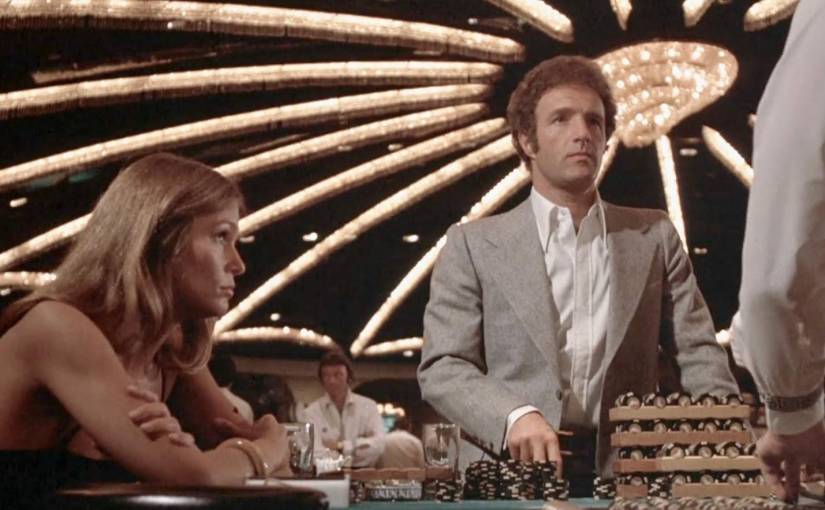
Once Axel obtains money, he ventures off to Vegas feeling sure that he will double what he’s got and still manage to pay off this huge debt.  The brilliance of the film is that it had me tricked as Axel marathons through victory at every table while also feeling confident on three college basketball games that seem to be moving in his favor.  I was not sure if I was looking at a hero or a despairing loser during this sequence.  Reisz convinces me that it can go either way for Axel with his girlfriend, Billie (Lauren Hutton) in tow.

As many films, books, and programs that I’ve encountered focusing on gambling and the addiction it musters, I feel confident I know the outcome of the piece.  What sets The Gambler apart though is the realistic nature of what this kind of craving does to a person.  It depicts the victim as in denial, rejoicing when he dodges bullets, thinking he’s invincible.  The film demonstrates how those close to Axel Freed respond to his mounting dilemmas, but also how they are affected.  It’s inclusive not only of his Billie, his mother, his self-made millionaire grandfather, or even his main bookie (Paul Sorvino), but an admiring student of his as well. 

There are scenes that I could see how they are going to play out as soon as they begin.  I’m sorry but when I see tough guy character actors like Burt Young and Vic Tayback enter a story like this, I know something, or someone, is about to endure some damage and walk away feeling terribly threatened.  Still, I’d be complaining if Toback excised moments like this from his screenplay.

The ending left me feeling a little perplexed as to if it really belongs here.  It’s not a happy ending but seemed to come out of nowhere and I questioned its relevance against everything else that was seen before. 

The strength of The Gambler lies in the honesty of James Toback’s script and the performance of James Caan.  The film belongs exclusively to Caan and his character, with the others entering the frame when they are called upon for a cause and effect of Axel’s actions and decisions.  There’s nothing to celebrate in a hard drama like this, but I applaud the film’s will to uphold a genuine truth of how gambling addiction leaves behind a crippling life for those caught in continuing temptation.

MURDER ON THE ORIENT EXPRESS (1974)

By Marc S. Sanders

When considering Sidney Lumet’s admirable body of work, many would likely connect him with covering corruption within police precincts and the legal jargon of courtrooms.  Fortunately, on occasion, he experimented outside of those genres, and we are all the better cinematic viewers because we were treated to an all-star cast, devouring up the scenery in an adaptation of Agatha Christie’s celebrated mystery Murder On The Orient Express.

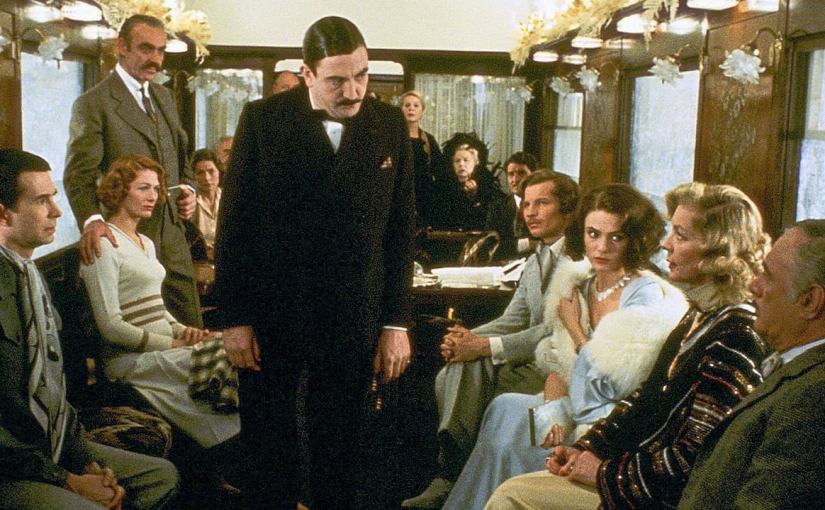
Lumet abandons his penchant for the metropolitan jungles of conflicted souls and high stakes drama to offer up a deliciously fun who done it, with Albert Finney gleefully playing the oddball, mustached Belgian (not French) detective, Hercule Poirot.  Despite a cast that features Sean Connery, Lauren Bacall, Jacqueline Bisset, Vanessa Redgrave, Martin Balsam, Richard Widmark, Michael York, John Gielgud, Anthony Perkins, and an Oscar winning performance from Ingrid Bergman, it is Albert Finney who makes the film wonderfully delightful.  His stature that seemingly hides his neck within his stout torso, along with a shoe polished, flattened hairstyle and a thick, echoing dialect tempo are an absolute combination of pleasure.  He makes the glossary of Tim Burton’s bizarre characters seem rather straightlaced.

He’s strange, but funny.  Before the expected murder gets underway, we observe an unrecognizable Finney performing Poirot’s nightly routines, including applying cream to his hands and unique mustache, as well as donning a kind of strap beneath his nose to keep his signature trait in its proper shape.  Batman maintains care of his cowl.  This crime fighter must preserve his facial hair.  It’s completely normal for Hercule.  While these mundane tasks of his are executed, the great inspector is also alert to several rumblings and bustles going on in the nearby cabins aboard the famous train in the title. Lumet ensures we see how smart and observant Mr. Finney chooses to portray Poirot; unique, and instinctively wise without limits.

An impolite and bossy man named Ratchett (Widmark) is discovered dead with multiple stab wounds to the chest.  It doesn’t make much sense considering the other passengers should all be complete strangers to one another.  Or are they?  Each one has an alibi, and their respective personalities couldn’t be more different.  Who would have the motive to kill a stranger aboard a moving train?

There appear to be twelve suspects for Poirot to consider.  That’s quite a list.  The standouts for me include Bergman, Bacall, and Perkins, but Lumet allows at least a scene or two for each celebrated actor to shine.

Ingrid Bergman dresses down to portray a shy, nervous, homely Swedish woman.  Sidney Lumet knows to back off on directing inventions when working with talent of such magnitude.  In one uncut take, Bergman controls an interrogation scene with Poirot and the camera stays fixed on her never diverting away and very subtly tracking behind Finney to stay with the actress’ nervous portrayal and expression.  The question is, should we trust this person? If Ingrid Bergman is putting on a façade, she’s awfully good at it.

Lauren Bacall carries such a strength on screen.  She walks with square shoulders and utter confidence that makes it seem like she’ll be impenetrable to Poirot’s inquiries.  Bacall’s booming signature voice would make me back down at any given moment.  She commands the supporting cast and appears to defy intimidation.

This film was made fourteen years after Psycho and yet Anthony Perkins portrays Mr. McQueen, a secretary of the murder victim, with youthful naïveté.  His stutter is perfectly timed and authentic, and he’s got body language that flails from one direction to the next when put to the test, not just by scenes he shares with Albert Finney, but anyone else in the cast as well.  His character is clearly unrelaxed.

I decided to watch this picture for reference.  In September of this year, I will be portraying Hercule Poirot in a stage adaptation of Agatha Christie’s story, written by Ken Ludwig.  My colleague Miguel Rodriguez is in the production as well, occupying Martin Balsam’s role.  They’re brilliant with magnificent energy by the way; Balsam and Rodriguez.  I had to watch Lumet’s film twice to appreciate the gleeful nuances he offers with this celebrated cast, including the actual train which serves as not only a claustrophobic setting but a character as well, stuck in a snowdrift, trapping the guilty party with no means to escape.  The dialogue flies fast and many of the various accents (Belgian, Russian, Scottish, Italian, Swedish, Hungarian) are challenging to decipher on a first watch, particularly Finney’s performance.

On a second watch, I was more wide-eyed to the detective’s behavior and how he breaks down a suspect during an interrogation.  No two interviews of suspects are even remotely similar.  Finney alters his way of approaching a scene partner each time.  I’ll credit the screenplay’s dialogue from Paul Dehn for that achievement as well. 

When a cabin door is opened to reveal the deceased victim, Finney’s odd mannerisms drastically change as he enters the room knowing what to say and look for immediately.  Sidney Lumet characteristically will position his camera pointing up at his actors, so the audience is the perspective of the subject being looked upon.  Albert Finney is gifted a wide scope within a narrow quarter to react as the famed detective.  This filming technique was an inspired choice by the director. Hercule Poirot is built up to be the foremost detective and now we see him demonstrating his specialty for examining a crime scene, and thus where to begin with his examination.  Albert Finney received an Oscar nomination for this role and it’s because of the skills he orchestrates under a guise of heavy makeup with a thick incomprehensible dialect.  All are meant to be taken as winning compliments from me.

The art design of the train is breathtaking.  The exteriors are magnificent too, particularly the train station located in Istanbul where the Turkish merchants crowd each cast member as they enter the film for the first time ready to board the Orient Express.  In one spot, a steward is inspecting the food cargo.  Another area has a merchant spilling over a carriage of oranges.  Locals crowd Bacall, Bissett and York with trinkets to buy.  Lumet captures the whole exotic tapestry.

Richard Rodney Bennett’s musical score is unforgettable.  A sweeping, romantically uplifting waltz accompanies the locomotive’s ongoing trajectory.  Then it gets more brooding when the journey comes to an unexpected halt in a chilling snowdrift, with the thought of a dangerous killer nearby.

Sidney Lumet is to be applauded for stepping back to allow his who’s who of legendary cast members play with Agatha Christie’s famous mystery.  He’s done this on other occasions including his outstanding cast in Network and Paul Newman’s career best performance in The Verdict

Those who are not familiar with the Agatha Christie’s tale are fortunate to experience the wonderfully twisted ending that serves the story’s continued appreciation.  Lumet deserves credit for the final touch though.  It’s not often that a film boasts such a collected caliber of talent together.  So, the best way to cap it off is with a charmingly giddy champagne toast.  It’s Sidney Lumet’s perfect little garnish to wrap one of greatest literary mysteries to ever be published and adapted for the stage and screen.

THE CONVERSATION

By Marc S. Sanders

To watch Francis Ford Coppola’s The Conversation from 1974 is to feel the paranoia of what Harry Caul, the protagonist played by Gene Hackman, endlessly feels as a surveillance expert. Harry is so skillful at his job and yet so modest, that he only believes someone may actually be better. Even he doesn’t believe he’s that good. Still, his own expertise can drive him to insanity.

Coppola opens the picture on a wide lens that gradually zooms in, looking down on a sunny afternoon in a crowded park. There are musicians and mimes. Bums that sleep on a park bench and food vendors, and then there is a couple (Cindy Williams, Frederic Forrest) who we are drawn to to get some sound bites of their random conversation. Their voices are muffled at times. Feedback and background noise interferes as well. Harry is spotted trying to keep within a perimeter to allow his hardware to function and get every tidbit of the conversation.

Following this sequence, Harry is back at his fenced in warehouse operation that he shares with a loudmouth partner named Stan (John Cazale) attempting to clean up the recording for his client, only known as The Director. It’s a skill that only Harry has the means to do. Hackman plays the part as a quiet and reserved man, unlike his competitors who proudly boast of their next, great invention to eavesdrop and capture the actions and discussions of any subject. With an awareness of what he’s capable of, I’d argue he trusts no one, even when he’s being praised. Does he even trust Stan, who he works with?

To be good at this kind of work requires the ability to separate yourself from the content of what you’re listening to. Just get an audible recording and move on. The content should be for someone else to stew over. For Harry, this becomes a challenge. He uncovers a hint in the couple’s exchange that suggests perhaps their lives are in danger. When he goes to drop off the recordings and collect his fee, he is not met by The Director. Instead, he comes across a lackey (Harrison Ford) who insists that he was instructed by the client to make the exchange. His paranoia sets in, when the lackey keeps on appearing at random, unexpected moments with Harry. None of it feels right for Harry. So he violates what should be his own rules and investigates further. The risk is whether his own capabilities will undo his sense of humanity and decency, including his connection with God.

Coppola, who also wrote the script for his film, puts Harry to the test in nearly every scene. He writes Harry to be the best at what he does, and yet that doesn’t prevent failure from occurring. He even fails to recognize when he’s being victimized and listened to. A midway point features a party among the men who specialize in surveillance. Harry quietly flirts with a girl only to feel embarrassed when his East Coast competitor reveals that he recorded their conversation from across the room. Seems like a harmless prank, as sophomoric as playground or locker room teasing, but it’s enough to maybe drive Harry into madness.

Harry Caul is one of Gene Hackman’s best roles. It stands apart from other films he’s been in. Harry is very much a three dimensional character who values his religious connection and his sense of morality. The problem is that Harry is a specialist in something that’s really not very moral or ethical. His Catholic beliefs might suggest what he does is sinful. Sure, he goes to confession, but he still pursues actions that are deemed inappropriate in the eyes of God.

Francis Ford Coppola depicts a very telling moment as Harry tries to find a listening device in his apartment. He takes apart everything in the place by either breaking it or unscrewing it. What do you think he’ll do when he comes upon his figurine of the Virgin Mary? Is there anything left to trust? Anything of value or purity in Harry’s world? He doesn’t trust others. He doesn’t trust himself? Does he trust a higher power that he’s leaned on his entire life?

Because The Conversation does not delve too much into the now dated-very dated– technology from the early 1970s, it is a film that is especially relevant in today’s age of cell phone recordings and devices that are relied upon for everyday use. While Harry is possibly thinking he’s on a noble pursuit with his means to eavesdrop, either by servicing a client or even rescuing someone from what appears to be imminent danger, is this the right way to go about it? What will it cost Harry? As well, what does it cost our society to embark on the convenience of what we are now capable of? Does the ability to record someone’s actions contain absolute merit, or are we violating a civil mentality within ourselves and among our fellow human beings?

There’s a lot of hard questions to answer in The Conversation. I think that’s why especially now it’s an important picture to see.

THUNDERBOLT AND LIGHTFOOT

By Marc S. Sanders

There are good Clint Eastwood films and there are bad Clint Eastwood films. You’d probably guess where I rank 1974’s Thunderbolt and Lightfoot (T & L).

I’m amazed. Director Michael Cimino, at the time, was really only known for polishing Eastwood’s Dirty Harry flick Magnum Force into a great crime drama of cop vigilantism. Then he does this picture, and how did anyone at Warner Bros trust him with The Deer Hunter a few years later? Sure, that film won Best Picture, but should anyone really have been surprised when the box office nuclear bomb, known as Heaven’s Gate came along, and bankrupted Orion Pictures? You think the producers of that turd said, “Fellas, we never considered Thunderbolt and Lightfoot. Hindsight 20/20. We shoulda known better.”

Back to the subject at hand. T & L is mindless of any coherence. Two criminals just happen to find each other randomly on some out of nowhere highway while running from the law (for Lightfoot) and a couple of bumbling henchmen (for Thunderbolt). Their respective crimes are unconnected. Eastwood’s quiet, familiar, tough guy demeanor (Thunderbolt) meets up with wild boy Jeff Bridges (Lightfoot) and then they eventually get to a plot of devising some kind of money heist with early adversaries George Kennedy and Geoffrey Lewis, former crime pals of Thunderbolt. However, they need to arrange to acquire a cannon, get on a job digging water lines for housing properties, work as ice cream delivery guys, hitch a ride in a redneck’s Dodge Challenger, and have Lightfoot dress in drag. There’s also a schoolhouse, no longer located where it once was, with a secret stash hidden behind a blackboard.

Doesn’t this seem like much too much effort for an ordinary bank heist in 1974? Security personnel and systems were probably not as sophisticated back then, no? Eastwood made an easier time of escaping from Alcatraz then all the work put in here.

The movie is sweaty, dirty, stupid, and it just doesn’t make sense really. Bridges actually got an Oscar nomination in the supporting actor category, up against nearly the entire cast of The Godfather Part II, for this film, and I’m…well…perplexed. How was that possible? Best guess, Cimino, who also wrote this dreck, decides to have Lightfoot die at the end. (There!!!!! I ruined it for you!!!!) Problem is I don’t know why or how. He’s not shot or wounded. There’s never an indication that he is ill. The script is too dumb to consider any kind of foreshadowing of his demise. The guys are just driving along with the money in backseat, and Lightfoot appears weak all of the sudden. Thunderbolt pulls over to the side and his partner just quietly dies in the passenger seat. Cimino cues up the Paul Williams music and the end credits appear. Bridges had a death scene. So, Bridges has to get a shot at Oscar glory. The math ain’t pretty but it’s the best logic that I can come up with.