THE HUNGER GAMES

By Marc S. Sanders

Some of the worst atrocities in history have often spawned some of the greatest stories.  I’d expect it would at least leave us feeling melancholy, but I hope it shapes a future that learns from humanity’s worst offenses.  That’s what came to mind as I watched the film adaptation of Suzanne Collins’ dystopian best-selling novel The Hunger Games.

In what was once a supposed North America, the continent is now called Panem and it is divided into twelve districts, with each specializing in some means of living.  Districts 1 and 2 are the upper-class wealthy.  Districts 11 and 12 are the starving destitute.  To maintain a semblance of order, President Snow (a chillingly older Donald Sutherland) oversees the nation’s Annual Hunger Games where a boy and a girl from each district is selected to compete in a dangerous competition of being the last one to outlive their competitors.  May The Odds Be Ever In Your Favor!  In the 74th edition, expert hunting archer Katniss Everdeen (Jennifer Lawrence in her most celebrated role) volunteers herself from District 12 to spare her younger sister from danger and selection.  She is paired up with the District 12 boy, Peeta Malark (Josh Hutcherson). 

Like any sporting competition, Collins’ story takes time to hype up the event.  The youths are fashioned up in the most glamourous adornments and interviewed for television by Caesar Flickerman portrayed by a delicious, yet unsung Stanley Tucci in bright blue hair and sparkly suits, doing his best Griffin, Carson, Letterman, Leno, and O’Brien.  With every white molar revealed in Tucci’s broad smile, he appears even more sinister in the purpose he serves for the Games, Panem, and President Snow.

Jennifer Lawrence gives a faithful portrayal to the Katniss character found in the pages of Collins’ series of young adult novels.  A new hero has been conceived – the rebel who stands along other well knowns like Luke Skywalker, Robin Hood and Harry Potter.  Katniss is not looking to be a savior but with influence from a prior Hunger Games champion (Woody Harrelson, doing his drunken best) and a calm, but humble fashion designer (Lenny Kravitz) she finds herself elevated towards a promising future.  Katniss Everdeen inherits the moniker known as “The Girl On Fire” with a three finger salute and a somber three note battle cry harmony.

I’ve likened the setting of The Hunger Games to the Holocaust and the early twentieth century European Nazi occupation.  (It seems more apparent in the next film, Catching Fire.)  If I had to compare the real-life period to this fictional one, then they are not anywhere close.  Yet, Suzanne Collins and director Gary Ross’ film depict hardship and oppression from a ruling upper class gleefully using their young for savage sport entertainment, while being forced to dwell in concentration camps with no permission to escape or run free, lest they suffer terrible punishments for themselves or those they care most about.

The Hunger Games values the themes of sacrifice while some characters inadvertently become heroes for a people against a domineering force.  It’s fantasy.  It’s adventurous.  It’s sprinkled with romanticism for Katniss and the triangle she’s pitted within for her care of Peeta but also her loving affections for another District 12 resident named Gale (Liam Hemsworth).   Frankly, the romance angle is a little weak in the films and books.  Ultimately though, it is harsh for the young characters in the story, which is why my wife refuses to invest her time.  I empathize with her position.  However, I find the story inspiring.  It’s also a hell of a thriller.

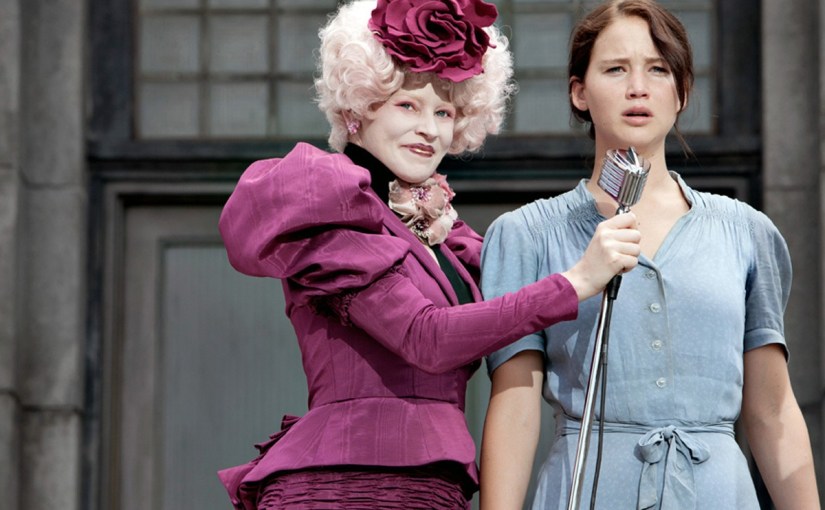
As a film, Gary Ross assembled a strong and alive production of gaudy, bright colors within the capital against morose grays found in District 12.  The clash of the two settings is no more apparent than when squeaky Effie Trinkett in her garishly loud facial makeup and wardrobes arrives in District 12 to host the Reaping, also known as the selection of the child contestants.  So many actors in this cast are memorable.  An unrecognizable Elizabeth Banks is no exception.  As Effie, her personality that publicly represents a hesitant Katniss and Peeta is deliberately inappropriate and further demonstrates how demonically twisted the mentality of The Hunger Games truly is. 

When it is time to finally arrive at the manufactured arena where the contestants will do battle to the death, Gary Ross effectively incorporates the inventive surprises offered by Collins’ source material.  Some competitors are brutal in their combative skills, but environmentally speaking the forest like jungle is dangerous as well.  Especially notable is a hive of stinging tracker jackers that’ll leave the viewers shaken. 

Suzanne Collins’ first installment of her series persists in leaving its ending completely questionable.  Will all these children, some of them who are noble and good, actually die?  Could a good soul like Katniss follow through with what the Games demand of her like killing Peeta for example?  I appreciate the imagination that went into the ending, leaving a subsequent tale to be told beyond this film.  

My one complaint is common in action films.  Gary Ross does really well with the edits and filming of his movie.  However, one of the last scenes develops into a hand-to-hand combat moment taking place in darkness with very shaky camera work and uneven grunts, punches, and kicks.  I abhor when filmmakers go this route.  It’s lazy work.  I can’t tell who is hitting who or where.  I’m just supposed to accept the final struggle that the hero is having with the bad guy and feel a sense of urgency and suspense as they supposedly cast a harsh blow to their enemy and fall over. I might as well close my eyes during moments like this because it’s all just blurry streaks in midnight blackness with sound editing filtered into the sequence.  This tiring approach happens so often in movies, and it becomes a let down for me time and again.   I love a well-made, thought-provoking thriller but the filmmaker hacks it all up near the end and it looks like he’s got to meet a deadline for the final print to get out to the theaters.

There’s much to discuss and think about in The Hunger Games.  Suzanne Collins’ idea stemmed from how television viewers soaked up the drama found in reality tv shows like Survivor and Big Brother.  It’s not so much the fate of the contestants that we care about, but how do they serve the producer’s crafted storylines.  Even American Idol steers the drama of the kids who get their shot at Hollywood fame.  The Super Bowl will position a star player like Tom Brady as a focus with questions of whether this is his final season, and how the championship games affect his marriage and family.  Does he get along with his coach?  None of this has anything to do with the points on the board.  Is all of this about the games, or is it about those tasked with playing the games, and for whose benefit of control, wealth, and power?  In this fantasy film, do the people of Panem cry at the drama spurned from the horrifying death of a child they got to know from Caesar’s colorful interviews, or are they in despair at the loss of another young life?  Whether it is real or fictional, is the drama of these gladiator games and competitions focused in the right direction?

The cast and production team under Gary Ross have put together an effective dystopian and bleak future reliant upon what the world focuses on more than anything beyond who they truly love or what they stand for.  The Hunger Games might seem inconceivable, but it is frighteningly relatable. 

THE USUAL SUSPECTS

By Marc S. Sanders

There’s something inviting – or maybe intriguing – about seeing a person in a hat with a dark trench coat on.  Just the person’s silhouette will leave you asking for more.  What is it to this guy?  Steven Spielberg does that in the first few minutes with Indiana Jones in Raiders Of The Lost Ark.  Before Indy, there was Orson Welles as Harry Lyme in The Third Man.  Guys like these have a danger to them, and we can’t look away.  In The Usual Suspects, one of many variations of a legend called Keyser Soze has a dangerous reputation that carries him, and we want to know more about the figure in the hat and coat.  In the first few minutes of the film, we see this mysterioso extinguish a kerosene flame by urinating on it.  Who is this guy?  Maybe we, as the viewers, are Icabod Crane looking at an updated inspired spawn of The Headless Horseman.  Perhaps, we are actually catching a glimpse of that boogeyman who hid in our closets or under the beds.

Bryan Singer’s modern day film noir, masterfully written with inventive riddles by Christopher McQuarrie, works towards its ending as soon as the opening credits wrap up.  Each scene hops from a different setting or time period and as a viewer you feel like you are sitting at a kitchen table turning puzzle pieces around trying to snap them together.  Not all of it makes sense by the time the picture has wrapped up.  That’s okay though, because one of the players in the story perhaps played a sleight of hand and we can do nothing but applaud when we realize we’ve been had.  Magic is fun when you never quite realize where or when the deceit began.

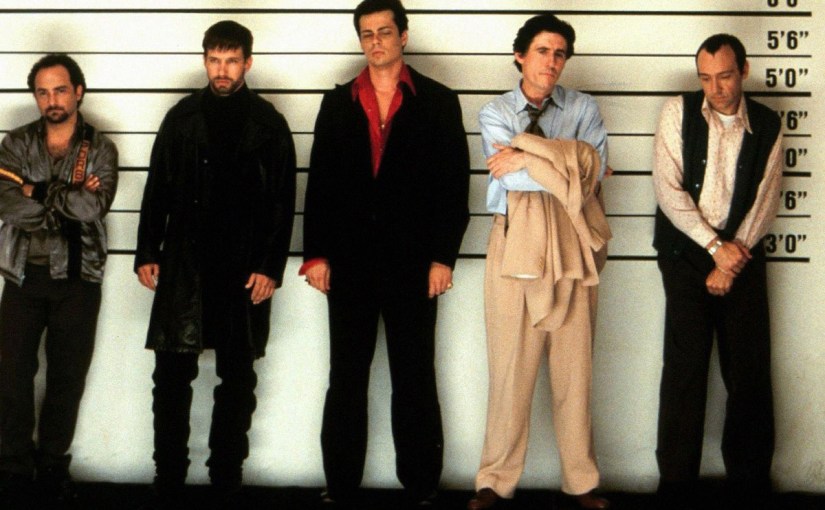
A scenario is set up early on that assembles five different kinds of criminals in a police lineup.  It works as a device to team these guys together to pull off additional heists.  A prologue to the film depicts the aftermath of their last job together.  One holdover, a hobbled cripple named Verbal Kint (Kevin Spacey) is brought into a police precinct to be interviewed by a determined detective named Kujan (Chazz Palminteri).  Verbal might ramble on endlessly in circles about nothing, but Agent Kujan is going to get to the bottom of what happened the night prior on a shipping dock that turned up several corpses.  How did it all go down, and where is the money and cocaine that was expected to be there?

Verbal was one of the five in that lineup, along with McManus (Stephen Baldwin), Hockney (Kevin Pollack), Fenster (Benicio Del Toro) and Keaton (Gabriel Byrne).  Each carries a different specialty or personality, but Keaton is the guy that Kujan is really after.  He’s a master criminal who’s been known to fake his own death, supposedly turn legitimate while dating a high-priced lawyer, and now may be the lead suspect in an armored truck heist.  On the other hand, maybe it was one of these other four guys. 

Amid all of this back and forth and side stepping stories, there is mention of a name – Keyser Soze.  Whenever he comes up in the vernacular of the script, the mood seems to change.  These criminals, usually comfortable in their own cloth of transgressions, get noticeably frightened and concerned if there is even a remote possibility that this Soze character is the engineer behind what follows them. 

It’s fun!  The Usual Suspects is fun.

McQuarrie’s script will toss out names of people we never meet.  It will quickly imply an anecdote from another time.  It’ll share a bunch of short stories with how these five guys work together, like upending a secret criminal sect of the New York City police force while robbing them of their fortunes. Yet, a tall tale of lore will intrude on their typical heists to derail what we may normally be familiar with in other crime dramas or noir films.   

Spacey is the real star of The Usual Suspects.  He earned the Academy Award for Supporting Actor because Verbal Kint is so well drawn out as a weak, unhelpful, and frustrating man.  Often, you ask yourself what the heck is this geeky looking crippled guy even talking about. 

On other occasions, I’ve noted that sometimes with movies I can not determine if I just watched a superior film or dreadful nonsense until I’ve reached the final five minutes.  The final five minutes of a movie can be the verdict.  Sometimes you’ll claim the journey getting there was great, but the conclusion was a big letdown.  If you have never seen The Usual Suspects, then you likely won’t know if the path towards its end is good until you’ve reached the culmination. 

Roger Ebert couldn’t stand this picture, and I’m not going to say he didn’t know what he was talking about or that he was wrong.  Bryan Singer and Christopher McQuarrie’s assembly of scenes don’t make for a well-defined picture, even after the movie is over.  Ebert was less than fond of that technique.  I think that was their intent, though.  Everything you have seen doesn’t have a suitable answer.  Certain parts don’t link well with others.  However, the director and screenwriter were always working towards an ending while piloting the film in swerves and unexpected knee jerk turns.

Unlike Ebert, however, I’m wholly satisfied with the film.  In fact, the first time I saw the movie, I cheered for the conclusion that got more than just one over on me.  On repeat viewings, knowing how the picture wraps up, I treasure the path towards its finale. 

If you study Verbal Kint, you’ll realize that he doesn’t offer easy answers and explanations for what’s occurred, thereby lending to the frustration of Agent Kujan who only demands cookie cutter, fall-into-place arrangements. What can I say Roger Ebert?  How else should I lay it out for you Agent Kujan? Life is messy with no easy answers sometimes.  Especially, in film noir.  

Ironically, one of Ebert’s favorite cinematic characters is Harry Lyme.  So, I guess Keyer Soze couldn’t live up to that threshold or repute.  If that’s the case, then I forgive you Roger.

GLENGARRY GLEN ROSS

By Marc S. Sanders

The characters in David Mamet’s Glengarry Glen Ross are under terrible pressure.  They are salesmen who are consistently chasing insurmountable sales goals in real estate properties.  One of them has an ill daughter in the hospital.  Another has a temptation to rob his office as a means of earning some fast cash.  Another is in despair of his self-worth.  To be a salesman, of any kind of commodity, is a tough life to lead.  The payoffs can be enormous when a sale is successful.  However, once a transaction is complete, the response is often “what have you done for me lately?”  These guys are never happy.  However, they are also some of the cruelest, most insensitive, and thoughtless people you will ever meet.  They have no other choice but to behave that way.  It’s the nature of the business.

The film adaptation of Mamet’s Pulitzer Prize winning play contains a collection of outstanding actors doing some of their best work.  They embrace the brutal dialogue the screenplay hands over to them with relentless cursing and flaring tempers.  Glengarry Glen Ross has you believe that you run your sales career on your own with little help or encouragement from the people you slave for. 

Early in the film, Alec Baldwin, known only as a man named Blake (based on the end credits) visits the office where these salesmen are based out of.  He delivers an unforgiving and harsh reality of what these men must do.  They either get their sales numbers high on the board, where they can win a new Cadillac, or they settle for a set of steak knives for second place.  After that, they are fired.  Regardless of where they currently stand though, they should not even be pouring themselves a cup of coffee.  Coffee is only for closers.  The office manager, known as Williamson (Kevin Spacey), only provides the men with sales leads that have already been exhausted with rejection and hang ups. 

Director James Foley does a wise technique with color.  The first half of the film appears in drabs of greens and greys amid an evening of torrential rain downpour.  Before Blake finishes his threatening presentation, he dangles new leads, the “Glengarry Leads,” in front of the men saying these are not for them, because they are only for closers.  The old leads that Williamson hands out are on green index cards, nothing flashy.  Blake’s leads are bright pink with a gold ribbon tied around them.  Foley makes sure that even a prop tells a story.

The salesman that gets the most attention is perhaps Shelley “The Machine” Levene played by Jack Lemmon.  He’s elderly and past his prime with no numbers currently on the sales board.  Frequently, he is making calls to the hospital for an update on his daughter who is due for surgery, but if he can’t make a payment, then the procedure is likely not to happen.  Lemmon is fascinating in maybe the best performance of his career.  Many of his scenes are toe to toe with Spacey as he shifts from pleading to demanding to disingenuously threatening and ultimately bribing Williamson for the new leads. Levene is so out of touch now that he can’t even sell Williamson on helping him out.  Spacey as Williamson is terrific in his defiance to not lend any sort of aid to Shelley.

David Mamet added additional material to the script, not found in the stage play.  The Blake character is new to the film, for example, and I think it is a better, more fleshed out story because of it.  As well, Foley is able to go outside of the reserved settings of the bar and office, as he follows Levene making a knock-on-the-door sales call in the middle of the rainy night to a family man.  This may be Lemmon’s best scene of the film as he weasels his way into the home to quickly get his raincoat and hat off and get a seat on the sofa as he begins his “once in a lifetime” opportunity that the potential customer may miss out on.  It’s a sales pitch, despite Lemmon’s charm, and the patron can see right through Levene’s performance.  As the door closes on Shelley, you’re terribly sad for his desperation and failure.

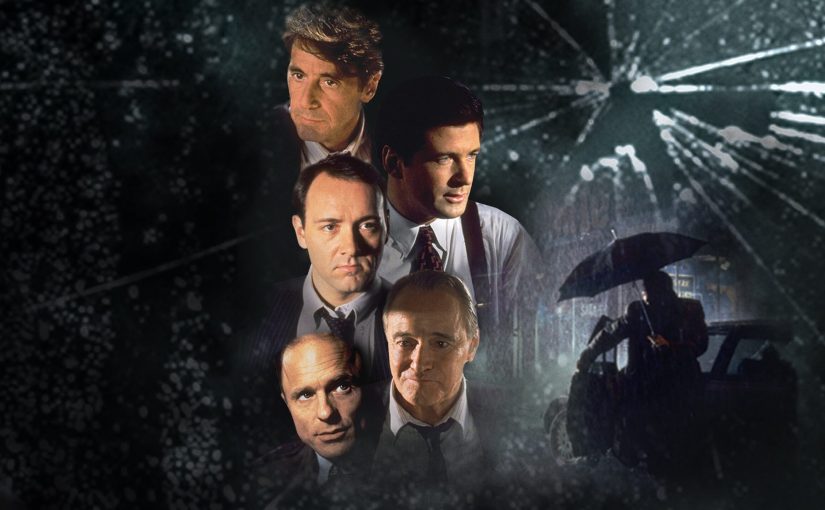
On the other end of the spectrum is the current, most successful salesman named Richard Roma.  He’s played by a showy looking Al Pacino who initially doesn’t perform in the broad strokes he’s become recognized for as an actor.  Pacino does a quiet, delicate approach to his character’s sales presentation as he shares a table with a sap (Jonathan Pryce) who is weeping into his liquor glass.  Roma stretches the rainy evening out in the bar with this guy, talking about vague anythings, until he can subtly pounce on him with a brochure that’ll get his signature on a contract. 

Two other salesmen, Moss and Aaronow (Ed Harris, Alan Arkin) vent their frustrations elsewhere in the bar as they eventually segue into an idea of burglarizing the office for those tempting new leads.  However, are they working together as a team on this idea, or is one working something over on the other?  Mamet’s dialogue is chopped up perfectly with utterances and interruptions, that before a character reveals his intentions, you are left flabbergasted.  What is demonstrated here is that a skillful salesman is also an efficacious manipulator.

The second half of the film is set on the following morning where the sunlight has come through.  New revelations following the stormy night from before will present themselves as the men gradually arrive at the office to find it actually has been robbed.  The obvious of circumstances are there.  However, Mamet sets up an ending that’ll leave you breathless.  It did for me the first time I watched the film.  Just when you think you are watching a protagonist throughout the film, something else entirely comes up.

Glengarry Glen Ross has been regarded as a modern-day Death Of A Salesman.  Maybe it is.  I’ve worked in this kind of field before. There were months where I was good at it, and like everyone else, I would brag about my success with recaptured anecdotes and celebratory curse words flying out of my mouth.  There were also months where I would gripe about how uncompromising this life is. When I didn’t want to do sales any longer, I spent twelve years as an assistant to sales representatives.  They are not your friend.  They are only focused on the next contract to be signed and booked before month end, and they will ask anything of you with a seething f-word attached to their request.    Are we so terrible if we can not make an unreachable goal with tools that offer no help and supervisors that lend no encouragement or forgiveness?  To be a salesman means that any of your past accomplishments or education do not define you.  You are only identified as the one who must acquire the next thing, and then the next thing after that.  It will change your attitude about yourself and how you treat others.  It’ll alter your dialogue which is so vitally apparent in Mamet’s story.  It will even influence you to take measures you never thought you’d be capable of.

James Foley enhanced an already electrifying script from David Mamet.  He knew that if he was going to show how hard and challenging it is to be a salesman of boring, uninteresting, and practically intangible parcels of land, then he was going to have to be relentless in the art direction and settings contained in the film.  The first half of the film never, ever lets up with the rain storm going on outside in the city street.  The evening is as black as can be, and yet Williamson casually will ask Levene if he is going out tonight. Who in the dead of night in the rain is going to want to talk to a droning salesman about anything?  Yet, that’s what is expected of this life.  The office setting is unfriendly, decorated with ideals that hang from the walls with phrases like “A man must embrace further than what he can reach.”  Little touches like this only add to the uncaring and selfish nature the men really have for one another. 

Glengarry Glen Ross depicts a hard life for the man in a suit.  You may dress like what is expected of a professional, but you are also always scraping the bottom of another bottom.  The cliché that money can’t buy happiness is personified in a film like this.  You may get to the top and score a nice commission, but it’ll soon be forgotten and nothing you’ve done before will lend to your current state.  Next month, someone else will be standing where you are standing.  Worse, you may never be standing on top again, and then what will you do?

Sadly, I believe that Glengarry Glen Ross reflects what many people experience at least at one point in their lives.  We are all salespeople to a degree whether we are doing a job interview or even trying to impress the parents of someone we are dating.  It doesn’t always work out.  The question is where do any of us go from that point.

WHEN HARRY MET SALLY…

By Marc S. Sanders

Two years after my family and I moved from New Jersey to Florida, I was age 16 and still felt lonely. Very lonely.  I was not prepared for the culture shock of leaving a primarily Jewish community and transitioning into a mixed bag of different cultures and mentalities.  I couldn’t adjust and the only people I could understand in 1989 were Batman, Indiana Jones and Harry & Sally.

The script written for When Harry Met Sally… focuses on the title characters adjusting to life in the decade following college graduation, where their paths cross periodically and they debate the aftermath of Casablanca, as well as what it means to sleep with someone or not.  More importantly, they are often returning their attention to whether a man and a woman can be friends without any temptation for love or intimacy, no matter how attractive they find each other to be.  Boy oh boy, that’s a loaded observation, isn’t it?  It is so consuming that as close as Harry (Billy Crystal) and Sally (Meg Ryan) become with one another as best friends, no matter how many people they date, they still couldn’t be any lonelier.  At the time, I could understand their dilemma.  I had a terrible crush on a girl at school. We were close friends who could laugh with each other.  Yet, I never took it to the next step.  I should have asked her to the homecoming dance in our sophomore year.  I really should have.  The risk, though, is the change in the comfortable dynamic we had.  I didn’t want to lose that.  Harry and Sally are attractive to one another.  Rob Reiner includes great close ups of the two actors looking at each other, wondering who is going to make the first move.  Will they bring this relationship to a new level?  It may never happen.  It didn’t for the girl I thought I could fall in love with.  At least Harry and Sally had each other’s shoulders to cry on. I adore this film, directed by Rob Reiner, because I yearned for what they had in friendship first, and as a relationship second.

Sally and Harry couldn’t be any different.  He is of the mindset that any woman he encounters is destined to be slept with, or more simply put, men and women could never be friends because at the bare minimum, men are thinking about sleeping with every woman they come across.  Sally can’t understand that, but when Harry shares his philosophy with her the first time they meet, while on an 18-hour drive from the University of Chicago to New York City, she can’t help but suspect that it just might be possible.

The two depart from one another to start their new lives in the big city, and come across each other five years after that on a flight they inadvertantly share, and then another five years later when they are given an opportunity to catch up on their relationship status.  In present day, 1988, Sally has just broken up with her longtime boyfriend.  Harry has gotten a divorce.  Ephron has written these characters to ultimately need one another.

When Harry Met Sally… is certainly a comedy, but more than likely it’s because Billy Crystal’s quick wit and delivery comes off familiar from his other career accomplishments.  Meg Ryan works beautifully as a scene partner that debates Harry’s cynical view of people with Sally’s natural positivity.  Their mentalities go in opposite directions, but the film continues to imply that these two couldn’t be more perfect for one another.  Chalk that up to Meg Ryan and Billy Crystal’s chemistry.  They are one of the all-time great on-screen couples.  These two actors are my friends.  I want it to work out for them.  When I saw the film three times in the theatres, I wanted to experience what they experienced.  Their story has bumps in the road.  They get mad and upset with each other.  They debate with one another, but they amuse one another too, and what a romantic adventure they share together.

A terrific novelty of Reiner’s film is when he cuts away to elderly couples with rich histories of how they met and stay together for decades after.  We weren’t there to see these wonderful people kindle their relationships, but we’ll see how Harry and Sally come together.  I remember long ago, that my father told me that when you get married, make sure you are marrying your best friend.  He said love is important, but you have to like each other first.  I did marry my best friend and I like her.  I love her too.  We drive each other crazy.  We have very different interests.  We even live in our home differently, that we share with our daughter and dog, but we want to be with each other and no one else.  No one else factors.  When you watch When Harry Met Sally… you see why two people continue to be with each other, first as friends, and maybe as lovers later.  When you have a best friend in your life there’s no one else you want to laugh with or cry with more often than that person.  There’s no other hand you want to hold.

A brilliant midway scene in the film occurs when Harry and Sally have the misguided idea of setting up their other best friends with each other.  Harry’s buddy Jess (Bruno Kirby) may be a good fit for Sally.  They are both writers, after all.  Sally’s girlfriend Marie (Carrie Fisher) has a keen interest in conquering married men, not far off from how Harry routinely proceeds with one relationship after another by sleeping with the women he dates.  He’s not in love with them, but of course he’ll sleep with them.  The irony comes when both Harry and Sally could never fathom that Jess and Marie find each other attractive, not the ones they were originally intended for.

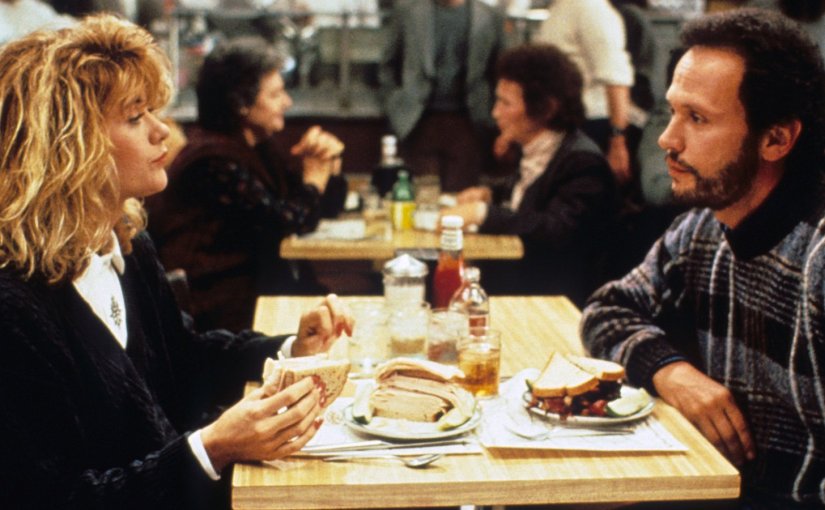
There’s much heightened romanticism to When Harry Met Sally… I won’t claim it to be very realistic with how life works out for many of us.  Look at the famous deli scene where Meg Ryan demonstrates for Crystal’s character that a woman can convincingly fake an orgasm.  It’s a hilarious scene.  One for the ages.  However, a scene like that wouldn’t happen.  If a scene like that did occur in real life, the woman would be asked to leave the premises immediately.  It’s not the point though. 

Love and happiness should consist of elevating ourselves to a delightful fantasy of joy, affection and laughter.  Love should also guide us to carry our best friends through sadness and frustration.  We can’t survive this challenge, we call life, alone.  I realized that first hand when my innocent, naïve and unsure teenage self watched the movie for the first time all those years ago at the Mission Bell movie theatre in Tampa. 

People need someone to grow with.  We need someone to continue to teach us while we teach them in return.  Most importantly, as it becomes a running theme in When Harry Met Sally…, we need someone to kiss at midnight every New Year’s Eve. 

MOLLY’S GAME

By Marc S. Sanders

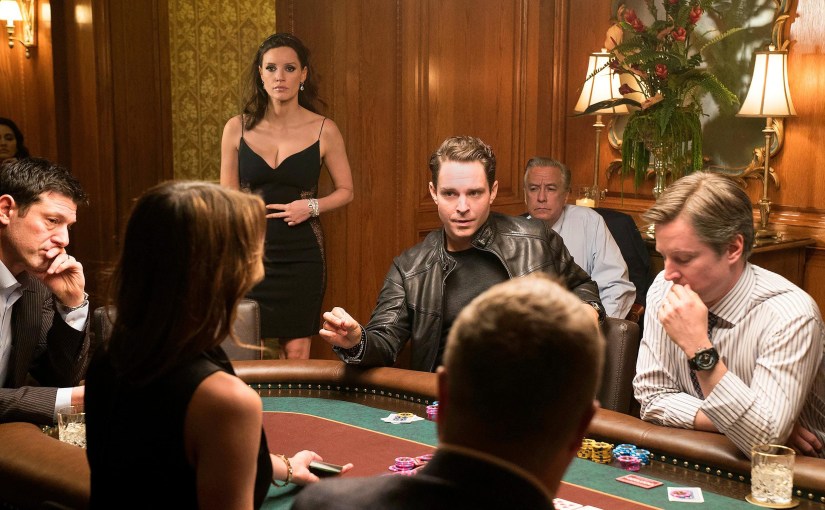
Despite being a little distracted by a drunk patron sitting next to me, I thought Molly’s Game was very good. It doesn’t measure up to The Social Network, and I feel justified in comparing the two because the sharp, fast dialogue follows what appears to be an intentionally similar narrative from writer, and here director, Aaron Sorkin.

Sorkin in his directorial debut uses great techniques for film editing to match the beats of his dialogue.  His opening voiceover of Jessica Chastain as Molly describing the ultimate worst sports experience will get your heartbeat racing.  It draws you into the film right away.

Chastain is good, but maybe a little over the top.  I needed a little more convincing that she was actually this brilliant, inventive and resourceful woman who was also considered one of the world’s greatest skiers.  Can’t put my finger on it but something was missing with her playing the Molly Bloom role.  Was she really holding her own against these high stakes guys who take big risks in her personally constructed poker ring?  I’m just not sure.

Felt the same about Kevin Costner in the role of her father.  He’s supposed to be an incredibly brilliant psychologist and an intimidating patriarch.  Yet Costner doesn’t fit that mold for me here.  Couldn’t feel the pressure from Dad on his daughter.  Someone else might have been stronger.

Michael Cera too.  I think he is playing a combination variation of Tobey Maguire & Leonardo DiCaprio, two of the most famous celebs that participated in the real Molly Bloom’s underground poker games, but Michael Cera?  Really?  He doesn’t carry the weight or looks of guys like that.  There just was not enough power or presence from him.

None of these actors were the worst options for this cast, I just think the film could have used more appropriate performers. There was more appropriate talent out there, I’m sure.

Idris Elba is great, however.  He’s blessed with an awesome Sorkin monologue in the 3rd act of the film, and he hits every note.

A great script.  A great story worthy of being a big screen film and it’s got me interested to learn more about the real Molly Bloom, including reading her novel.

BLACK PANTHER

By Marc S. Sanders

Ryan Coogler’s Black Panther is a stand out film among what has become an overpopulated Marvel Cinematic Universe.

It is a super hero film for sure, complete with the standard gadgets, super strength and abilities, action and over the top science fiction. Yet, this film did not have to be a superhero narrative to drive home the message of its story. This could have been an Oliver Stone film rooted in political quagmire. It could have been a John Hughes teen rip off film that takes place in a typical Wasp suburban school.

A question embraces this film. Simply, when is it appropriate to share?

Chadwick Boseman plays the title character also known as T’Challa, and following the recent death of his father he becomes the next king of the fictional African based country of Wakanda, a location hidden from the rest of the world so that no one else can take advantage of its most precious resource, Vibranium, which has allowed for the most sophisticated technology, weaponry and even medical advancements ever known. How it’s all lumped together, who knows? Pick up a Marvel Comics Encyclopedia for that answer. T’Challa is tasked with whether it is a moral obligation to share the resource with the rest of the world. However, if it is provided, will the Vibranium be taken advantage of for nefarious purposes?

(SIDE NOTE: Reviewing all of these Marvel films is getting to be trying, as I feel resorted to using the same terminology some times; words and phrases like “hero,” “villain,” “nefarious purposes” and “also known as.”)

His nemesis is Eric Killmonger played by Michael B. Jordan; this guy is going to get an Oscar one day. Killmonger is an educated, skilled soldier and cousin to T’Challa who was abandoned by Wakanda following his own father’s betrayal of the country. He grew up in the projects of Oakland, California. Killmonger returns to Wakanda with the purpose of becoming king and allowing the tech and resources Wakanda possesses to be used by the outside world, particularly by populations of African descent and people of color who have endured a history of suffering. Once again, Marvel Studios scores with a villain you want to root for and endorse. Just like Jeff Bridges’ Obidiah Stane in the first Iron Man film, you have to recognize the stance that Killmonger holds on his side of argument. That’s great writing. It’s not so much that Killmonger is a slaughterer. He really isn’t at all. Once he overthrows the hero, the mission is only just beginning as he wishes to right the wrongs of Wakanda for never providing in the first place. It’s ironic really. This guy sides on the fact that he doesn’t want a wall, while the protagonist is doing all he can to maintain a divider to the outside world. In 2018, was there another film that really reflected the sign of the times so succinctly?

Coogler makes a beautiful sweeping film of country and special effects. The Wakandan ships are very cool. Overhead shots of Africa and the camp bases of various tribes are astonishing. One particular tribe resides on a winter like mountainside and the leaders room is spectaculary decorated in horizontal lumber hangings. T’Challa’s staff of mostly female combat warriors and scientists led by Lupita Nyong’o are really exciting. At times the film takes inspiration from some of the best standards of the James Bond films, as his sister introduces her latest inventions for the Black Panther suit. Naturally, the Black Panther costumes are stand outs in the film, black with glowing power enhancements of purples and yellows.

Is Black Panther worthy of a Best Picture nomination and an abundance of awards attention? I’m still not sure. It’s a very strong piece that is light years ahead of any DC Universe film, but it has great characters and messages like most of the Marvel films and even some of the more recent Bond films featuring Daniel Craig. Maybe it is one of the best films of they year, and maybe it should be a Best Picture nominee, but perhaps only because 2018 did not offer a wealth of extraordinary film achievements to begin with. I found merits in all of the 8 Best Picture nominees in this particular year, but I also found problems with many of them too (don’t get me started on A Star Is Born); shortcomings that in another year with better films would keep many of these nominees from ever being considered for the grand prize.

Yet, as I document these thoughts, I think about Black Panther again. Truly, it does not have anything negative in its feature. Ryan Coogler directed and wrote a very focused and thought provoking film. Yup! It was truly one of the year’s best films.

RED DRAGON

By Marc S. Sanders

So this may be director Brett Ratner’s best film, but that doesn’t make it a great film. Ratner directs Anthony Hopkins as Hannibal “The Cannibal” Lechter in this prequel film to The Silence of The Lambs.

Hopkins does his best with a script that lacks the wit of the original Lambs script. The puns are lacking this time as he plays mind games with Edward Norton’s FBI agent who is trying to apprehend “The Tooth Fairy,” a deranged killer of families played by a disturbing Ralph Fiennes.

Red Dragon boasts a who’s who of a great cast; Hopkins, Norton, Fiennes, Harvey Keitel, Emily Blunt, Mary Louise Parker and Phillip Seymour Hoffman. Yet, every player is incredibly boring. It’s as if they memorized their lines and just recited them at the call of action. There are no nuances. No fear or fascination within their interactions, and thus what’s at stake seems awfully minimal. We get a LOT of Norton just talking to himself or a tape recorder. It’s all very flat.

Ratner’s art director should be commended for effectively duplicating Hannibal’s prison from Lambs. That’s where the eye-popping stops, however. Hannibal’s infamous muzzle mask also makes a return.

I remember loving this book by Thomas Harris. It was so imaginative and descriptive. Very fast reading. Ratner gets all the important scenes in his film as well as some additional fodder for Hopkins but it’s all color by numbers. Nothing is here to carry a swell of emotion. No close ups. No lighting technique.

The best that Ratner comes up with is to chain Hannibal to a steel cable like a wild animal. He lunges for Norton and the chain rattles. Meh. A cat jumping out of nowhere has given me worse nightmares. Ratner forgot to cast the cat, however.

THE PELICAN BRIEF

By Marc S. Sanders

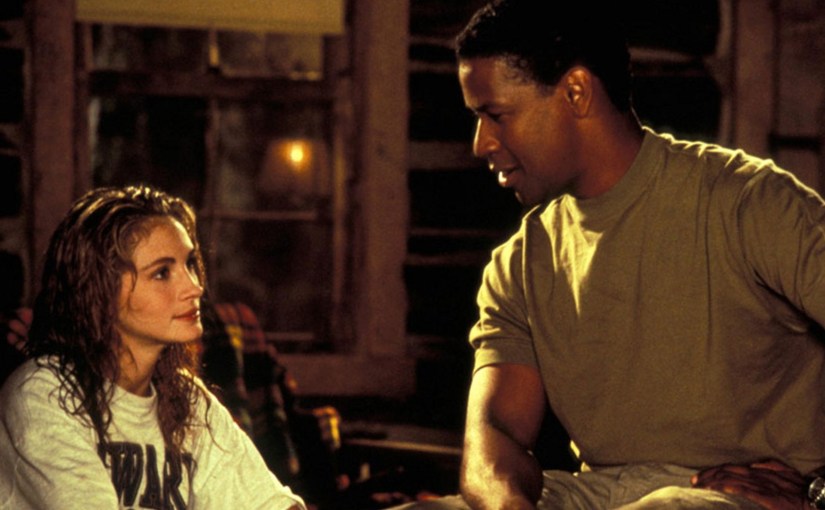
Tulane Law Student Darby Shaw (Julia Roberts) is unbelievably lucky. She can find herself being pursued by one white guy in a suit after another over the course of a two hour movie and will be fortunate enough to escape every threat by sheer chance. It’s only to her benefit when she is being chased by two assassins in a creepy downtown parking garage that someone left an angry doberman in a car to startle the killers. As well, it’s really a blessing that Darby has caught on that if an engine sputters when turning the ignition it can only mean one thing – car bomb! GET OUT!!!!!

Darby is the main protagonist of The Pelican Brief directed by Alan J Pakula, adapted from John Grisham’s best-selling novel. When the eldest and the youngest Supreme Court justices are murdered, Darby conceives of an outrageous conspiracy stretching all the way to the President and documents the whole rundown in the so-called Pelican Brief. She shares the document with her law professor who shares it with his government friend who shares with the CIA who shares it with…and so on and so on.

Pakula is an under celebrated director when you consider his better thrillers like Presumed Innocent, Klute, and especially All The Presidents Men. Here though, I think he got a little lazy with his screenplay and direction. The Pelican Brief is a little too paint by numbers.

Sure, the film has suspense. I think Grisham’s story has some convincing weight to it where wealth and government won’t stand for the platforms of environmental causes and therefore people have to die. Still, while the meat of that story eventually surfaces, we are left with A LOT of buildup before Darby gets involved. Just a lot of white guys in different office buildings walking down hallways, entering doorways and talking on the phone. Every so often we come across a DC crack reporter, Grey Grantham (Denzel Washington) who gets a phone call from a potential informant. When that guy gets scared and hangs up, thank goodness Darby just happens to call two seconds later regarding the same story. Good on you Grey for being by that telephone.

That’s my problem here. Pakula just works in the lucky conveniences to keep Grey and Darby on the trail. Neither of them ever truly escape a bind on their own. Neither of them ever truly dig the hole any deeper without something COMING UPON THEM to help them along at just the right moment.

We learn a safe deposit box belonging to a dead character exists. Darby just strolls into the bank and posing as the widow, who is not a signer on the box, is just asked for her address and phone number. No proper identification necessary. Why didn’t anyone ever tell me it’s that easy? Folks, hide your valuables because I’m gonna be robbing you blind.

Pakula will even set up a good scenario where Darby thinks she’ll be meeting someone who can help but it’s an assassin ready to kill, only suddenly the assassin is killed while holding Darby’s hand in a crowded courtyard. Wow!!! Lucky again, Darby. I’m still fuzzy on who actually killed the guy. That didn’t concern Pakula though. It’s explained in a quick throwaway line before the credits roll. Pakula only had to get Darby out of danger again. So let’s see he’s got the barking doberman for something else, the engine sputter will be used later on. Hmmmm??? Meh!!! we’ll just have someone randomly kill this guy. Now run, Darby. RUN!!!

Notice I haven’t talked about performances. Well, there’s not much to them. The Pelican Brief boasts an impressive cast of character actors like Sam Shepherd, Anthony Heald, John Lithgow, Stanley Tucci, Robert Culp and John Heard. Yet, these guys, along with Roberts and Washington are flat. Just reciting their lines when the cues call for them. There’s nothing very exciting to any of them really. Very monotone. Roberts is beautiful yet depressing even before she gets caught up in the mystery. Washington, while handsome, does not seem to have the gusto that Pakula’s reporters did when he directed Hoffman & Redford. Grey is too neat, physically fit and tailored for an always on the job, aggressive reporter looking for a scent.

There was a better movie to be made here, thanks to some convincing motivations that were started with Grisham’s novel. Unfortunately, Pakula just didn’t devote enough respect to the original author’s imagination.

THE HUNT FOR RED OCTOBER

By Marc S. Sanders

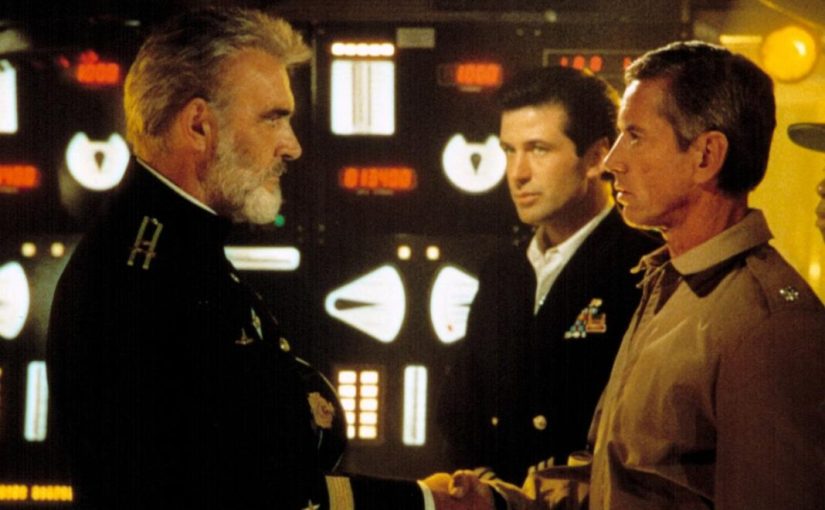
John McTiernan’s adaptation of Tom Clancy’s first bestselling novel, The Hunt For Red October, might seem dated but it’s still a crackling good thriller. It’s one of those films where you truly feel like you’re walking through the secretive hallways of DC government buildings with their elevators accessed only by an Admiral’s key. Soon you’re in a dark, underground boardroom. You’re also there on the various naval crafts and submarines with alarming lights, shiny steel and glowing monitors. The biggest treat is being in the command center of the titled sub, Russia’s Red October, commanded by their captain, Marko Ramius (Sean Connery). All in all, Terence Marsh built a convincing production design.

Clancy’s story takes a different approach than most thrillers involving Cold War politics. Ramius might have been a James Bond villain in another film as he hijacks Red October, but there’s more to him actually. Rather, Ramius wants to defect to the United States. Most of his command crew is in agreement as well. America doesn’t necessarily see it that way; a Russian, missile equipped submarine quickly approaching the eastern seaboard with other subs following him?!?!?!? Let’s not polish the tea set so quickly.

Fortunately, one man had the pleasure of meeting Ramius once and doing extensive research on the General’s background; Jack Ryan (appropriately cast with a young Alec Baldwin). Ryan is given three days to catch up to Ramius and guide him safely to the United States while avoiding getting the famed submarine shot down by either power nation.

I must point out my favorite scene and it actually takes place in that secret boardroom where it dawns on Ryan of Ramius’ true plan. Baldwin is great here. The young guy who is green when it comes to military and political protocol. McTiernan gets his company of generals and high ranking officials into a large quarrel over what to do and then he zooms in on Baldwin thinking for the close up before he calls Ramius a SON OF A BITCH. It’s at this moment, that the movie going consensus and fans of Clancy overall determined that Alec Baldwin was the best of the cinematic Jack Ryans. (No slight to Harrison Ford, who was too middle aged for the role when he took the part).

Connery at least has the commanding appearance of Ramius’ stellar reputation. He is not very exciting or charismatic. Then again, I don’t think Clancy built the character that way. Connery plays the role as silent, yet wise and experienced as implied by his well groomed, white beard and hairpiece plus his square stature. If this man is standing in your presence, you better give him an update. You shouldn’t have to ask if he wants one.

Good moments are made available to Scott Glenn, James Earl Jones, Sam Neill and Stellan Skaarsgard as well. It is the talking scenes among all these fabulous actors that really build tension. The underwater scenes…not so much. The subs look like long, black blobs weaving their way through depths and avoiding missiles coming their way. It’s forgivable because McTiernan always keeps the characters at play. This isn’t a film that relies on the dog fights depicted in Top Gun or Star Wars. McTiernan keeps his audience away from drowning in the underwater murkiness.

The makers of this yarn really are a great combination of imagination. We got Tom Clancy and John McTiernan to thank for a gripping tale from 1990 that still holds up today. The Hunt For Red October is definitely a film worth revisiting.

TOTAL RECALL

By Marc S. Sanders

Paul Verhoeven is an in-your-face director. His material regarding sex and violence goes at least a ginormous step further than other directors. For an action film like Total Recall, if someone gets shot, they don’t get shot once but hundreds of times. That way we can see more blood splurt all over the place. I especially feel ashamed how much I laugh when a tourist extra gets caught in good guy/bad guy crossfire. Once this guy is dead, Verhoeven makes sure his central nervous system is nonfunctional and none of his vital organs will qualify for donation. If Verhoeven sets a scene in a Martian adult night club, then you’ll have ample opportunity to take in an upfront view of a three breasted woman, or a little person in stiletto heels and hooker garb with the boa included.

Total Recall is a well-regarded Arnold Schwarzenegger action flick with a psychological twist to keep your attention. As soon as the film begins, you are questioning if you are watching a real-life experience for Douglas Quaid (Schwarzenegger) or is this a dream or is this all a purchased memory. A purchased memory is the new novelty of this science fiction future. If you can’t travel to a destination like the planet Mars, you can certainly buy an implant that’ll convince you were there and even living the life of a secret agent while romancing a beautiful buxom brunette.

The exposition for Total Recall really arrives in the second half of the film. The first hour deliberately leaves the viewer as confused as Quaid while he tries to uncover why he’s being pursued and shot at.

The film is full of surprising twists including another character reveal that Schwarzenegger portrays. It’s hard to trust anyone Quaid comes in contact with or who is real or even what is real.

The settings are very well constructed. When you enter a security zone before hopping on a subway, your entire skeleton appears in blue on a screen you pass by. Mars is brutally red while it tries to comfort the civilization with familiar products like a Hilton Hotel or Pepsi. All of this sensory overload is present while a brutal overseer named Cohagen (an over-the-top Ronny Cox just like Paul Verhoeven likes it) seems to disregard the alien inhabitants by hoarding their breathable air.

It all feels familiar but the product placement is a little much as well. When I first saw the film in its theatrical release, I was enthralled with this picture. The action seemed to come as fast as the various twists. However, now it’s hard not to notice the blatant commercialization of the film. Its like watching a football game and every few minutes a commercial comes on. I’m aware of you, Pepsi. I don’t think I need a reminder during a loud, violent gun fight. Look! Instead of “USA Today” there’s “Mars Today.” Ha!!!! Even if you have the means to travel to Mars, you might want to visit the local Sharper Image for the latest high tech toy.

Total Recall relies on a story from sci fi writer Phillip K Dick who also inspired Minority Report and Blade Runner. Fortunately, that’s a good strength to hinge upon. I think the weirdness of it all makes Schwarzenegger a better actor; a muscle guy who can only appear more like an Everyman in a film like this. He’s good with emoting confusion. He’s as good as always with delivering a pun, and his fight scenes are consistent with his other actioners like Predator and Commando.

Total Recall is a good picture but it’s a lot to absorb in story. It’s over inflated in its unsubtle appearance of product placement, violence and nudity. If you’ve got the stomach for it, then you’ll have a good time. It’s not Star Wars lite. It’s definitely Star Wars heavy. Prepare to be bloated.