THE SILENCE OF THE LAMBS

By Marc S. Sanders

Everyone remembers Anthony Hopkins’ memorable turn as the infamous Dr. Hannibal Lecter in The Silence Of Lambs.  He was “Hannibal The Cannibal;” a renowned and brilliant psychiatrist who was eventually captured for being the one who ate his victims with sophisticated glee.  The real attraction, though, is how director Jonathan Demme delivers the film adaptation of Thomas Harris’ best selling novel through a lens that only finds one strong heroine amid a sea of intimidating men.  The heroine is the intuitive, but petite Clarice Starling.  The men are nearly everyone else cast in the film, and I mean everyone all the way down to the extras; the extras, here, are a perfect example how necessary they are towards any film’s palette.

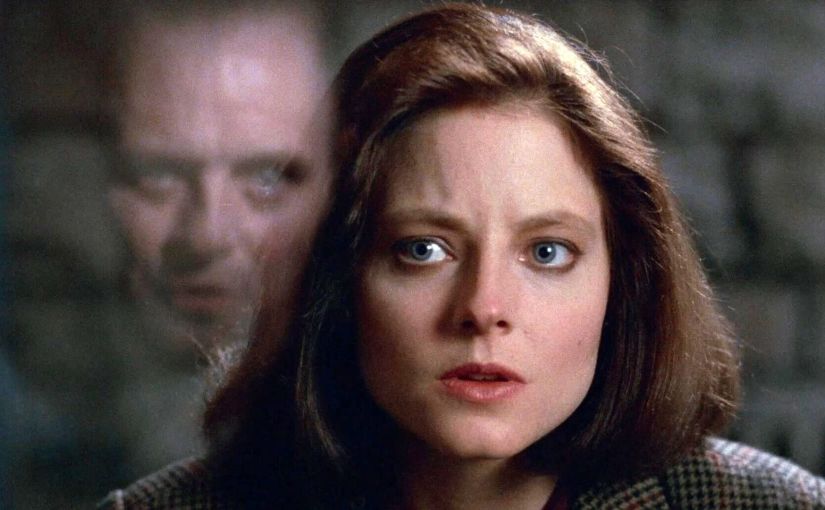
Ever since the film was released in 1991, the dialogue of Ted Tally’s script is worthy of repeating and mimicking in social circles.  Lecter remains spoofed in nearly every pop culture medium.  Hopkins’ character is unforgettable and he’s been ranked among the greatest film villains of all time with the likes of Darth Vader and Harry Lyme.  It’s a worthy honor.  His timing is subtle and mischievous while he remains silently dangerous.  You can’t take your eyes off the actor and you can’t erase the devilishly fun and evil character from your sub conscious.  Opposite this performance though is Jodie Foster in a top billing role as an FBI trainee named Clarice Starling, assigned to interview and maybe study Lecter as a means to a solid lead in finding a serial killer that has been identified in the media as “Buffalo Bill.”  Bill has been skinning and killing girls with large physicalities, around the east to mid-west portion of the United States.

So, there is a detective story at play here as Hannibal aids Clarice in her search for the killer, but only under his rules.  Demme paints the film with Clarice ably performing her job no matter the towering strength or perverted fantasies found in nearly any man.  An outstanding image early on shows her small frame entering an elevator.  She has been summoned to her supervisor’s office from the outdoor obstacle course.  She is sweaty, and looking tired.  The elevator is full of a dozen men in red uniform polo shirts that hug every muscle; they are strong, fit and healthy.  Clarice stands front and center and she has no reluctance to stand among this exclusive group.  Later in the film, Clarice is invited by her supervisor, Jack Crawford (Scott Glenn in a deservedly dark and quiet performance), to investigate one of Bill’s victims that turned up in the swampy waters of West Virginia.  The coroner’s examination room is filled to the max with sheriffs who believe they serve a purpose to stay there to witness what’s uncovered.  The strength of Clarice is really shown here as she shoos them away.  The men’s facial expressions tell us they don’t care for this request, but Clarice isn’t going to allow them to remain.  Most importantly are her encounters with the head of the Baltimore psychiatric ward that houses Lecter.  He is known as Dr. Chilton played by Anthony Heald.  Chilton – a great character name that clearly colors in the twisted perversion of this guy.  Chilton is happy to boast of his prized attraction, Lecter, as if he’s a rare tiger and he has no reluctance to hit on Clarice when she comes to visit with Lecter.  Always, Clarice will not allow herself to be succumbed, patronized or victimized by any of these towering figures of masculinity in what is unfairly regarded as a man’s world in law enforcement, crime or psychiatry.  Starling easily reminds Chilton that she was a student at the University of West Virginia, not a charm school.  With Tally’s script, Jodie Foster uses these deflective techniques of her character without effort.  Her methods of fencing with these men are a natural ability.  Even when she’s in film transition periods of training at the Academy, Clarice can maintain her stance against a hard-hitting male boxer pounding away at her boxing shield.  She just won’t fall over. As well, she doesn’t wince as the male students give her a glance from behind when she’s jogging on the grounds. 

Demme is an outstanding director who uses these interpretations of this woman to drive his film.  This very same year, 1991, Ridley Scott directed Thelma & Louise.  In that film, the title characters had to realize that they didn’t have to take any shit from a man.  They started out weak, though, and had no choice but to eventually get stronger.  Here, it’s already part of the woman’s instinctive nature. 

Hannibal Lecter is shown to be well versed in the finer things of art, literature, music and, forgive me, cuisine.  At one point, Demme focuses on a picture Lecter has sketched depicting Clarice in an almost angelic nature.  I’ve never forgotten that image.  Nearly all of the settings in The Silence Of The Lambs include stairways that always lead us in the down direction, to an assortment of various hells.  Clarice, the pure angel with nary a fault beyond limited experience as an FBI agent peels the onion away on her quest for a killer by entering into the treacherous depths beneath her; pits of hells.  The opening shot of the film has Clarice pulling herself up with a rope on an obstacle course as if she is ready to enter the heavens, ready to stand above everything, but then she is summoned to Crawford’s office located at the Department of Behavioral Sciences at the FBI.  She has to take an elevator down and then various stairways further down into a labyrinth of claustrophobic offices with no windows, surrounded by cinderblock and populated with men in uncharacteristic suits that don’t appear warm or cuddly.  Crawford may seem like her ally, but really, he’s using her as a sacrificial pawn on a chess board putting her in an arena with psychotically dangerous prisoners, in particular, the worst of them all, Hannibal The Cannibal. 

When Clarice goes to visit Hannibal, she is escorted by Dr. Chilton, who relishes in describing how careful he handles his prized thing, and willingly shows what this monster is truly capable of by providing an unwelcome photograph of how Lecter brutalized a female nurse.  This conversation is played upon a much more frightening descent of unlimited stairways and bars that clang loudly and are painted red and rusted, eventually leading to a stone walled dungeon for these unimaginable beings of death and perversion.  Clarice is left all alone to navigate her way down a long corridor until she reaches Lecter’s cell.

Yet, an even more frightening third descent into hell occurs in the final act as Clarice’s pursuit leads to Buffalo Bill.  Bill’s home is dark, lurid, filthy and maze like; but always seeming to go down further and further into one doorway after another and down one staircase after another, including a deep well where his latest victim is kept.  Like the other descents, Clarice uses her femineity as a tool of strength to survive.  I can claim without any hesitation that Clarice Starling is one of the greatest heroines in the history of film. 

The one man who rattles her, and weakens her, though is Hannibal Lecter.  Watch their tete a tete when they meet for the first time.  Starling demonstrates some overconfidence against Lecter’s seemingly polite demeanor.  With her white trash Virginia dialect, she even gets a little smarmy with the Doctor, but then he disarms her immediately with a comeback that shakes her very core.  Demme’s reliance on close ups for both characters serve this scene and others so well.  Clarice’s encounters with Hannibal are the most important and vital moments in the film because they are the only opportunities for Jonathan Demme and Ted Tally to show the main character’s weakness.  Every hero has to have a weakness if they are to remain compelling.  Clarice is not, in fact, undefeatable. 

The film could have simply worked as a basic detective story.  Put up the clues and the narration of the picture will eventually assemble all together for a resolution where the bad guy is captured.  Yet, Thomas Harris’ character creation uses Hannibal as a defiant obstacle blocking the path for Clarice.  Hannibal lacks much stimulation in a cold, specially designed prison cell.  He’s maybe only honored with impenetrable plexiglass to contain him as opposed to traditional bars.  He needs to be enthralled.  On the surface, Clarice appears as a frail prey that he can take his time munching on.  He’s happy to help Clarice catch Buffalo Bill with the case files she provides, but in exchange he wants to uncover what haunts her psyche.  Such a strong character Clarice is, but she has to be willing to weaken and expose herself to desperately find a dangerous killer.  Can she do it?  She’s never allowed herself to do that before.  And thus, we come to comprehend the obscure title of this film and the book it stems from.  (Anthony Hopkins actually thought it was a children’s fantasy when he was sent the script to read over.)

This write up is not necessarily a review, but a means to honor the careful film and storytelling technique that Jonathan Demme strives for with The Silence Of The Lambs.  You might say, yeah, there’s a lot of walking in this picture, but pay attention to the direction of the walking.  Always going down, somewhat reminiscent as Little Red Riding Hood entering a dark and spooky forest and encountering the biggest and baddest wolf.  Jodie Foster might be in a company of men here, but the film works as a dual of femineity vs masculinity.  It’s strange to believe that Demme actually had Michelle Pfeiffer in mind for the Starling role initially, a more than capable actress, but one who at the time was more glamourous (The Fabulous Baker Boys and The Witches Of Eastwick).  Beyond the silly Disney films, Foster was known for lurid pieces like Taxi Driver and her first Oscar winning role as a rape victim in The Accused.  Clarice Starling is a character beyond a pop culture appearance of the time, and Jodie Foster emanates that portrayal.

The writing of The Silence Of The Lambs is so intelligent.  There’s a witty, yet deliberately poor taste, of sarcasm to Hannibal Lecter as he thrives off his superior intellect over Jack Crawford and the FBI.  It’s only enhanced when he’s dealt a lowly, formally white trash female student to play with.  Ted Tally offers precise timing in the dialogue with Clarice and Hannibal.  Thomas Harris’ drive to further a cameo appearance of Lecter in a prior novel (Red Dragon) with this book is a gift to readers and eventually movie watchers.  The Silence Of The Lambs doesn’t follow formula with a Law & Order technique of ballistics and witness interviews.  It drives into other directions to feed its development. 

Jonathan Demme’s film is pioneering.  I recall seeing it in theatres with other high school friends.  I was not enthused to see it.  The title was too odd.  The picture was primarily a talking piece.  There were gross and unwelcome images within the film.  It’s very ugly at times.  I was frankly accustomed to the likes of Dirty Harry and Lethal Weapon films for my cops pursuing the robbers ideals.  I recall not even liking the film when we left, and I couldn’t comprehend its appeal that followed for the remainder of nearly an entire year, all the way up to when it was awarded the five main categories of Oscar wins (Actress, Actor, Screenplay, Director and Picture).  I definitely wasn’t accustomed to a strong character like Clarice.  Later that year, I saw Thelma & Louise and fell in love with their eventual triumph.  I needed to be spoon-fed their initial weaknesses at first.  Who was this Clarice in this picture, though?  I could not identify her strength that displayed right from the get go.  I wasn’t even 18 years old at the time and now I can say I just wasn’t mature enough for this film back in 1991.  Now, it’s thankfully clearer, though I still appreciate its subtlety so much. Jonathan Demme had such a clear vision of where he was taking this film and because it’s not dated, The Silence Of The Lambs stands as thriller, and an intelligent thought provoking piece that stays with you for a long time after each viewing.

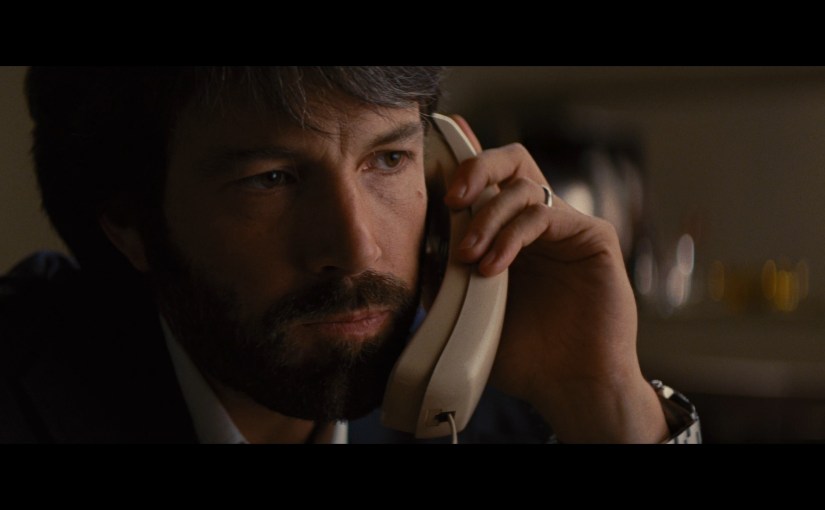
ARGO

By Marc S. Sanders

Ben Affleck’s third directorial effort Argo is his best. It makes me wonder why he followed this with playing Batman, a done to death cinematic character.

Argo showed promise of another great actor/director in the same vein as Orson Wells, Woody Allen, Robert Redford and Clint Eastwood. I’m sure Affleck will direct again but a Batman commitment certainly sidelines you. I hope he’ll direct again. I’m a big fan of his previous films, The Town and Gone Baby Gone.

The story tells of one aspect of the Iranian hostage crisis that spanned the end of 1979 through 1980. Six employees of the riot stormed American embassy in Iran manage to escape and hide in the Canadian ambassador’s home. Slowly but surely their hideaway will be revealed and they will inevitably be taken prisoner. Affleck plays CIA operative Tony Mendez who is tasked with getting them out. His plan, with assistance from John Goodman as legendary Hollywood makeup artist, John Chambers, and Alan Arkin as producer Lester Siegel, will make up a cockamamie story about producing a fake science fiction Star Wars rip off film called, you guessed it, Argo. They will do marketing write ups, poster advertising, and even a costumed table read at the Beverly Hills Hotel, all with the intent to just appear authentic as a film studio seeking out production locales in exotic Iran. The six hostages naturally are the film’s crew.

Affleck directs two acts here with two different narratives using both masks of theatre. Namely comedy and tragedy. The pleasure comes in watching Arkin and Goodman pair up to bring the Hollywood flavor that’s necessary. It’s great fun, especially when watching Arkin (in an Oscar nominated role) shyster his way with character actor Richard Kind to buy the Hollywood script-these two guys are like Oscar and Felix. Goodman is great as the been there done that Hollywood insider. He says “You can teach a Rhesus monkey to be a director.”

The drama comes with Affleck’s talent for delivering taut tension from his directing especially but also from his own performance as well as his cast of six hostages consisting of Tate Donovan, Scoot McNairy and Kerry Bishe. Bryan Cranston is also good as Mendez’ comunica from home. Cranston is just good in anything.

The tension builds with intimidating locals screaming of their loyalty to the Ayatollah as well as the eventual airport security. It’s all very nerve racking.

The critique for the the film lies in its own admission of historical inaccuracies. The escape was not as tense as the film suggests. More importantly, the caper was really primarily pulled off by the Canadian Ambassador, Ken Taylor (great actor Victor Garber). No. Canada is not given enough credit in the film. Still, here is a rare exception where I don’t mind. I guess because the suspense Affleck offers up is at its peak. You really shake your head at it all.

Forgive the cliche but Argo is a nail biting, edge of your seat thriller. At best, I can be grateful for learning about the true story following seeing the film. It’s a story that was kept hidden for 17 years. In these times of hardship and turmoil in America, it’s fortunate that a success can finally be celebrated.

Argo was undoubtedly worthy of its Best Picture Oscar win, and Ben Affleck should have at least been nominated for Best Director.

Fun Fact: Argo is produced by two former Batmans: George Clooney and Ben Affleck.

THE STING

By Marc S. Sanders

Find me a better combination of script, cast, direction, score, art direction and costume and I guarantee it’ll take you some time and effort.

The Sting, directed by George Roy Hill and written by David Ward, is the kind of movie where you uncover something new every time you watch it. It’s because the film is all in the minute details to assemble the beginning to the middle to the end. The film is wisely edited in step by step chapters; The Set Up, The Wire, The Shut Out and eventually on to the satisfying The Sting.

The audience is even set up but you’ll have to watch to see how. I dare not spoil it.

Cars, trains, drug stores, diners, a carousel, dames, gangsters, Bunko Cops, Grifters; all are elements needed for the best confidence men superbly played by Robert Redford and Paul Newman, along with a supporting cast like no other, Eileen Brennan, Harold Gould, Charles Durning, Ray Walston, Jack Kehoe and the best villain, or rather “mark,” Robert Shaw.

This is one of my favorite movies. When I first saw it, I was probably age 10 or 12. I understand next to nothing of what was going on. It was the music that drew me in first followed by the sharp suits designed by the legendary Edith Head. The movie’s script is its greatest asset but visually it is just as fun. The 1930s Chicago setting is a character in and of itself. Newman cheats beautifully at poker against a temperamental Shaw, and gets him!!! “You owe me 15 grand pal.” When I first saw it, I didn’t know what he was doing or how he did it. How did he switch hands? I was enamored with the hands that were dealt and the poker chips on the table, but I loved it when the better cheat won out.

The second iteration of the Hill/Newman/Redford trifecta (following “Butch…& Sundance…”) is just plain fun. It was the fun that earned it a Best Picture Oscar.

No other film has come close to duplicating it. Maybe the Clooney/Pitt/Damon version of “Ocean’s 11”? I don’t know. However, if you love that film, you owe it to yourself to watch “The Sting.”

The Sting is…”the quill!”

THE CANDIDATE

By Marc S. Sanders

A politician’s career isn’t being elected. A politician’s career is getting elected. Once it is all over, what does the politician do now?

I’m not sure I understand why Jeremy Larner’s script won the Oscar in 1972; only because I didn’t gather much from this Robert Redford star vehicle. What exactly was the point of what I was watching? Redford plays Bill McKay, an idealistic lawyer recruited to run for the California senate on a Democratic ticket.

He’s sure to lose and I guess he’s okay with that because it’s acknowledged that way early on, and yet he just follows through with the campaign. He’s a kid compared to his seasoned Republican incumbent opponent. So he’s got that to deal with, and he’s remorsefully living in the unwanted shadow of his father, a former good ol’ boy governor. He also occasionally brushes past a girl that follows his campaign. Bill is happily married. Sounds like a good set up, right? Maybe it is. Yet I’m not sure any of this is the set up of the film. There is rarely any conversations in The Candidate. Hardly any dramatic pauses occur either. Nary a scene with his wife. The televised debate midway through is generic cliche really. One good moment occurs when the Republican candidate steps on Bill’s toes during a threatening brush fire. Now here’s some conflict. Now we’re cooking. Except…we’re not. The film returns to its established theme from earlier. For some reason in the last half of the film, it throws two or three punchlines at you, and…well, I guess it’s a comedy now.

The Candidate fills a majority of its two hours with McKay doing a lot of handshaking, baby holding, celebrity meets (Hi Natalie Wood!) and autograph signing. When that’s not happening, we are treated to repetitive close ups of members of his campaign and voters. I felt like I should have known these people. Did I fall asleep during their big introduction in the film, or were those scenes deleted from the finished product? Bill doesn’t say much except to make generic statements that no voter would ever disagree with. That’s okay, I guess, yet really it’s just boring. None of this packs any punch.

Larner was a speechwriter for Eugene McCarthy in 1968, and Redford recruited him to write and tailor this script for him to produce and star, in response to his own dismay with the political climate at the time. Maybe The Candidate is supposed to be narrated in a documentarian sense but even if that’s the case, it fell short for me. Scenes here seem about as interesting as someone who unwraps a stick of gum and chews it.

Perhaps the Oscar was merited due to the political climate at the time. Redford’s character told audiences what they wanted to hear and magically Larner’s screenplay is now brilliant. If that’s the case, then I guess The Candidate is now dated. There’s no way this film outshines other political films like Wag The Dog, Primary Colors, Mr. Smith Goes To Washington, or from what I hear Bulworth (never saw it).

The Candidate carries no drama, no comedy, no shock value. I’d say no message either, but the unexpected ending (unexpected only because I didn’t know the end scene was actually the end scene) finally told me something that I laboriously waited a long two hours for. The wait wasn’t worth it.

MIDNIGHT IN PARIS (2011)

by Miguel E. Rodriguez

Director: Woody Allen
Cast: Owen Wilson, Rachel McAdams, Marion Cotillard, Kathy Bates, Adrien Brody, Tom Hiddleston, Alison Pill, Léa Seydoux, Michael Sheen
My Rating: 10/10
Rotten Tomatometer: 93% Certified Fresh

PLOT: A nostalgic screenwriter travels with his fiancée’s family to Paris where, every night at midnight, he inexplicably finds himself going back in time to the 1920s.


The best of times is now / As for tomorrow, well, who knows?
La Cage Aux Folles

It’s currently 11:05 at night on a Sunday evening.  I’m getting older, so if I’m smart, I should get off to bed, owing to the fact I have to get up early tomorrow to get ready for work.

But I can’t.  I have just re-watched Woody Allen’s Midnight in Paris for only the second time in my life, and I have revised my original rating of 9 up to a 10.  And I am just bursting to write about how wonderful this movie is.  I’m hoping that I can reach someone who has not seen it before, so I can convince them that, even if they’ve never seen a Woody Allen movie before, this is the one they should start with.  Yes, even over Annie Hall or Manhattan or even Match Point.  In my mind, Midnight in Paris captures the voice of the artist as he is reaching a certain age and has something important to say about nostalgia, and how sometimes it’s not always what it’s cracked up to be.

Gil Pender (Owen Wilson) is a Hollywood screenwriter trying to complete his first novel.  He and his fiancée, Inez (Rachel McAdams), travel to Paris with her family so he can perhaps get inspired by one of the all-time great cities of the world.  He is immediately smitten with the atmosphere of the place; the movie opens with a wordless montage of static shots of Parisian cafés, streets, museums, statues, apartment buildings, and, of course, the Eiffel Tower.  The sequence sounds simple on paper, but the effect is – I don’t know how to describe it.  It captures the ineffable romance of the place.  More so than any other movie set in Paris, Midnight in Paris really, REALLY makes me want to go there.

Gil and Inez seem happy enough, but he is a little more antisocial than she is.  He is star-struck by Paris, but Inez is not incredibly fond of it.  They bump into an old friend of Inez’s, a pleasant enough man who turns out to be a bit pedantic; during a museum tour, he presumptuously corrects the tour guide on details of the life of Auguste Rodin.  This is not the kind of guy I would want to be stuck with on an elevator.

One night, Gil goes walking by himself on the Paris streets and gets a little lost.  Long story short, he inexplicably finds himself transported back to Paris of the 1920s, when the cafés were full of American expats and frequent visitors like Ernest Hemingway, F. Scott and Zelda Fitzgerald, Cole Porter, Gertrude Stein, T.S. Eliot, Pablo Picasso, Salvador Dalí, etcetera.  As a writer, Gil is over the moon; it just so happens his unfinished novel is about a man who runs a “nostalgia shop”, so this pleasant turn of events is a welcome tonic to his vaguely unhappy days back in the present.

Watching the scenes of Gil rapturously conversing with Hemingway, or goggling at Cole Porter playing the piano, I was swept away by the audaciousness of this movie.  It’s illogical and steeped in fantasy and seems to be begging not to be taken too seriously.  But it is a pure joy to watch.  I immediately identified with Gil.  I found myself imagining how I would respond if I were somehow transported back to a time and place when some of my own idols walked the Earth: Hollywood, the 1940s, walking around and conversing with Orson Welles, Alfred Hitchcock, Jimmy Stewart, Katharine Hepburn.  Or even not so far back: the 1970s, having lunch with young Spielberg and Coppola and Lucas, and Pacino and Streep and DeNiro, discussing film and life and getting insight into their inner workings.

From our perch in the present, it’s easy for us to look back at the past and say, well, those were the days.  Just earlier today, I was having an online discussion about the difference between CGI and practical effects in movies like Star Wars or The Lord of the Rings and even Honey, I Shrunk the Kids.  We tell each other that older movies felt more real because the effects were made with real props occupying real space, whether they were miniatures or matte paintings or what have you.  And we say, “Man, they just don’t make them like that anymore.  They knew what they were doing back then.”

That’s Gil.  He looks around at the shimmering jewel of Paris in the 1920s and he’s convinced that this is “where it’s at.”  What can today’s world offer in comparison to sitting in a café and discussing art with Salvador Dalí and Luis Buñuel?  Or the pleasure at hearing Ernest Hemingway tell you he’ll hate your book, even if it’s good, because that would make you a better author than him?  Or getting constructive notes on your novel from Gertrude Stein?

The story progresses.  Gil becomes infatuated with a beautiful woman from the past, Adriana (a luminous Marion Cotillard), and it becomes harder and harder for him to go back to his own present each night.  Inez’s father gets suspicious and hires a private detective to follow Gil during his midnight strolls.  You may ask how a private detective can follow someone who is traveling back in time.  Well, my friend, that is an EXCELLENT question, one which the movie answers in satisfying and gut-busting fashion in the final reel.

But the heart of the movie lies in the touching, revealing segment when Gil and Adriana go even further back in time, this time in a horse-and-carriage, back to the Belle Époque, the “Beautiful Age” of Paris, which lasted from about the 1870s to the 1910s.  Adriana, who lives — lived — in the ‘20s, is entranced with this even more bygone era.  She feels about the Belle Époque the way Gil feels about the ‘20s.  To her, the ‘20s are slow-paced, a drudge.  But, oh, to be back in the 1890s!  Dinner at Maxim’s, the Moulin Rouge, meeting Toulouse-Latrec and Gauguin and Degas!  How wonderful those days must have been compared to the Boring Twenties!

And there’s the message of the movie.  We can grouse and grumble about the modern world all we want.  The movies are dime-a-dozen.  The books even more so.  The music is crap.  Cell phones have turned us into tiny-screen junkies.  But, oh, to be back in the good old days of the 1980s, when the music was gnarly, and the movies were iconic, and the books were amazing, and everything was just better.

But we forget that, in the ‘80s, people were grousing and grumbling about THAT era, and they longed for the more sedate and rosy era of the 1950’s.  And in the ‘50s, people said the ‘30s were the BEST.  DECADE.  EVER.  And so on and so on.

It’s human nature for us not to realize what we’ve got going for us until it’s gone.  We are living in glorious times.  (Coronavirus and politics notwithstanding…gimme a break, I’m trying to make a point here.)  Look around.  Really SEE it.  Embrace it.  We don’t need a time machine to go back to our glory days.  We’re IN our glory days.  Just wait.  In 20 years, you’ll look back on the 2010s and say, “Man, wasn’t that a time?”

If you take nothing else away from the above review, remember this: Midnight in Paris is pure charm, is laugh-out-loud funny, and is the best Woody Allen film since Match Point.  So if you haven’t seen it, you really, really, REALLY need to make a point to do so.

PARASITE (2019)

by Miguel E. Rodriguez

Director: Bong Joon Ho
Cast: Kang-ho Song, Sun-kyun Lee, Yeo-jeong Jo
My Rating: 10/10
Rotten Tomatometer: 99% Certified Fresh

PLOT: Ki-taek and his family, all unemployed, take peculiar interest in the wealthy and glamorous Parks, as they ingratiate themselves into their lives one by one.


Watching Parasite reminded me of the first time I saw Pulp Fiction.  I told my friends that it was like being on a roller-coaster at night wearing a blindfold: you have no idea where you’re going or what’s coming, but the ride is exhilarating.

That’s Parasite.  The hype is real.  This is one of the best movies I’ve ever seen, and if you plan on seeing it, I would highly recommend you do so BEFORE reading further.  I have no plans to spoil ANYTHING, but the less you know about the movie before going in, the better.

(You’ll have to bear with me, I’m writing this shortly after seeing the movie myself, it’s currently 11:14 PM, and I’m starting to get a little tired, but I want to get this all down before I pass out, so it may get a little “rambly” for a while.  You’ve been warned.)

Parasite is many things.  It’s a social commentary, a black comedy, a family drama, and a Hitchcockian thriller all rolled into one delicious Korean dish.  (The film and filmmakers are Korean.)  The beauty of the movie is that it manages to be all those things without losing track of itself.  I can’t count how many movies I’ve seen that attempted a tonal shift in the middle or at the end, and it just falls flat.  Where lesser movies failed, Parasite succeeds.

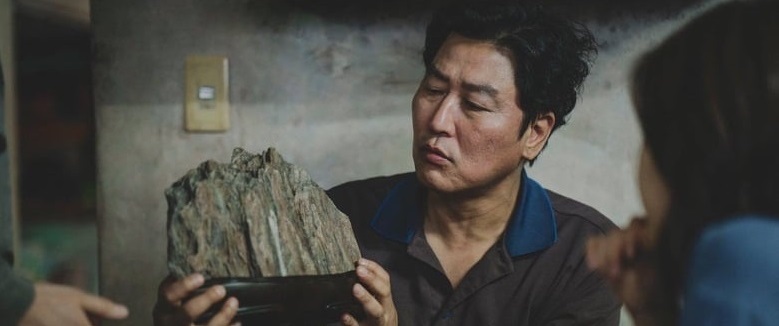
The plot involves a nuclear family, the Kims (father, mother, college-aged son and daughter), living in near-poverty in a sub-basement.  They fold pizza boxes to make a little cash.  They steal wi-fi from a shop next door.  When fumigators spray outside their street-level window, they open it wide to take advantage of the free pest control.  They aren’t starving, but they are desperate.  Yet they don’t appear to be beaten down by their condition.  They’ve become a family of hustlers, not in any criminal manner, but in ways that enable them to get by on the bare minimum until one of them can get a leg up.

Opportunity knocks one day when a friend of the son, Ki-woo, gets him a job as an in-home tutor for the high-school daughter of a wealthy family, the Parks.  Ki-woo changes his name to Kevin, then suggests to Madame Park that her 7-year-old son could use an art tutor.  This gets his sister, Ki-jung hired.  She changes her name to Jessica and finds a creative way to get her father hired as Mr. Park’s personal driver.  Then the Parks’ long-time housekeeper somehow has to be eliminated so the MOTHER can get hired.

Before long the entire family is working for the Parks, though it’s important to note the Park family has no idea their new employees are all related.  This is all done with great humor, not in a farcical way (that will come later), but in such a way that you find yourself rooting for this down-on-its-luck family of con artists to finally get a taste of the good life.

There’s a long scene where the Parks have gone camping, and the Kims gather in the enormous living room of the Parks’ lavish home and just sit and eat and drink and talk and get drunk.  This is the family drama/social commentary part of the movie.  There’s something a little sad about seeing these people who are like any other people, who seem no less deserving than the Parks, but their best-laid plans have come to nothing, and the highlight of their lives is to get hammered in somebody else’s house.  Suppose Kevin falls in love and decides to marry the girl he’s tutoring, when she’s a little older.  Who will they get to be his parents?  Will they need to hire actors?

Trust me, I haven’t spoiled ANYTHING.  Swearsies.  This movie is brilliantly, ingeniously split into two parts.  The first half is prologue.  The second half is genuinely, literally breathtaking.

Something happens that forces the Kim family to examine and re-evaluate their life choices up to the present.  It also forces them to do some very fast thinking indeed, which is where some of the funniest and darkest comedy takes place.  This is where the movie really takes off, where it had me reminiscing about the twists and turns in Pulp Fiction.

And nothing…nothing can prepare you for the finale.  About which I’m saying nothing.  Again.

From a cinephile’s perspective, Parasite is miraculous.  It manages to be several different things all at once, allowing you to savor every individual aspect of it without any one part of it overpowering the other parts.  The screenplay is unbelievably inventive.  The direction is sure-footed and masterful.  The acting is pitch perfect throughout.  It made me think, it made me laugh, it made me cringe, it made me say, “Oh S#i+!” MANY times, and it made me bring my hand to my mouth like a shocked Victorian-era woman many, MANY times.

I say again.  The hype is real.  You owe it to yourself to see this movie whenever you can.

[Ed. note: the Criterion blu-ray of Parasite contains an interesting experiment: a black-and-white version of the film, which is apparently how the director originally envisioned the film, and which might account for its stark imagery in places.]

BROKEBACK MOUNTAIN (2005)

By Miguel E. Rodriguez

Director: Ang Lee
Cast: Heath Ledger, Jake Gyllenhaal, Randy Quaid, Michelle Williams, Anne Hathaway
My Rating: 10/10
Rotten Tomatometer: 87% Certified Fresh

PLOT: The story of a taboo romantic relationship between two cowboys, and their lives over the years.


Brokeback Mountain is the kind of movie that makes me wish I was a better communicator, like Lost in Translation.  I know I love these movies, I know WHY I love these movies, but it’s difficult for me to put into words.

Brokeback is, of course, the movie that will forever be known among the snark peddlers as “that gay cowboy movie,” which is insultingly reductive.  That’s like referring to Star Wars as “that space movie.”  To reduce the movie to those terms is to totally ignore the boundless riches to be had by watching it, I mean really watching it.

For one thing, damn, just LOOK at it.  Look at the way the skies fill the frame, with clouds hanging heavily over the mountains and the dusty streets and the trailer parks.  Director Ang Lee makes the sky into a tangible character all its own, much like Kubrick did with the Overlook Hotel.  It infuses every outdoor scene with a sense of the largeness of the world around us.  It’s a fitting backdrop for the intimate story presented to us.  In fact, those huge scenic backdrops are kind of a throwback to the ‘70s, to the films of Cimino and Arthur Penn and Bertolucci, when painting a picture with the camera was two-thirds of the story.  Virtually every outdoor scene in Brokeback Mountain is worthy of framing in an art gallery.  Stupendous.

The movie turns on the story of two men who unexpectedly and passionately fall in love in 1963, a time when gay love was still taboo, at least in polite society, and especially in any given cowboy community.  But as the story winds its way through almost twenty years in the lives of these men, it becomes less about the FACT of their affair, and more about the enormous sense of yearning and loss that comes from desperately wanting something that you can’t have.  Who among us has never felt that kind of insane desire?  Not necessarily for a person, even, but for anything at all?  A crippled man who longs to walk, or a blind man who yearns to see.  A dream job.  A dream vacation.  That’s what this movie is about.

Heath Ledger delivers the performance that really put him on the map.  His portrayal of Ennis Del Mar is incredibly subtle, although his Western accent flirts with impenetrability at times.  I love the way he shambles and mumbles through his role, virtually the entire movie, which pays off in that fantastic scene by the lake (“I wish I knew how to quit you!”) when this hulk of a man is torn down by his own unspoken passion.

Again…I’m not a poet, so this really doesn’t quite get at the mood generated by the movie.  It’s no feel-good film, that’s for sure, but it’s worth seeing by anyone who loves world-class storytelling.  Don’t let anyone, or your own preset notions, steer you different.

THE FRENCH CONNECTION

By Marc S. Sanders

Popeye’s in town.

“You been picking yer feet in Poughkeepsie?”

One of the first gritty crime dramas.

With modern cinema offering huge bravura performances a la Daniel Day Lewis or Christoph Waltz these days, it’s any wonder that today’s generation of movie goers would be puzzled that Gene Hackman won the Best Actor Oscar for this film, The French Connection, which also happened to win Best Picture. His character has no big monologues, no huge crying scenes. In fact for most of the film, he’s slamming guys up against a wall or following them up and down the dirty Brooklyn streets. Yet, his accolades were nothing short of deserved.

Watch as Hackman’s Popeye Doyle gradually exhausts himself in pursuit of “Frog 1.” His character starts out as a thrill seeking detective only to find his limits pushed against a better cat and mouse player. Dialogue isn’t sophisticated here to show his state of mind, but rather his expressions offer everything. Simply look at his close up following the extensive car search (an incredibly satisfying scene for me as a viewer).

If that’s not enough, the car/foot chase through Brooklyn is one that still has not been matched. See how it was done before CGI.

A simple drug deal is plotted perfectly from Marseille to New York, and best of all, it is all true (well mostly).

What’s most curious is the film provides one of the oddest and most unforgiving endings in a film ever. Perhaps you’ll agree (????). But, remember…THAT IS HOW IT HAPPENED!!!!

This was a film from 1971 that was raw in its language, gritty in its setting, spiteful and unafraid of the image it would leave, and that is why it won Best Picture, Best Director and Best Actor.

Bottom line, it would never have been made today. Never!

(Word of advice, ignore the sequel. A prime example of Hollywood shamelessly cashing in.)

SUNSET BLVD

By Marc S. Sanders

One of Billy Wilder’s most famous films is Sunset Blvd. A film that’s always escaped me despite seeing two productions of the stage musical, most recently on Broadway with Glenn Close as Norma Desmond. No matter how it is interpreted, it is a haunting story narrated from the grave of young screenwriter, Joe Gillis. In the 1950 film, Joe is played by William Holden. Norma is played by Gloria Swanson, with Erich von Stroheim as her butler Max.

Joe is a down on his luck screenwriter trying to avoid his car being repossessed. Events lead him toward hiding the car in the garage of a mysterious mansion belonging to one time silent film star, Norma Desmond, now obsolete during the age of talkies. She was big at one time. Though Norma insists she is big. “…it’s the pictures that got small.”

Joe is caught in Norma’s web, feeling obligated to write her story while she provides him with all the money and clothes that she can, to keep him close with no opportunity to escape. Even a sneak away to a New Years Eve party leaves Joe feeling compelled to return to Norma where Max has set up living quarters for him.

Holden’s voiceover narration is wry and descriptive like a novelist’s words being emoted vocally. Feelings are shared allegorically. It lightens the mood of Wilder’s film which is a quite dark and strangely sad depiction of a one time film star who has aged amid her isolation and is all but forgotten among the Hollywood elite. Even Cecil B DeMille (playing himself) doesn’t carry much interest in Norma anymore. It’s especially quite telling later in the film when she unexpectedly shows up on the Paramount lot. She had been called upon, but not necessarily for a new role, rather something else entirely.

Swanson is unforgettable as Norma; one of the greatest and most memorable film characters to ever grace the screen and the part is drawn out so well within the Oscar winning script from Wilder and his long time collaborator Charles Brackett. Swanson gives honesty to Norma’s madness; look at the famous final stair descending scene. It doesn’t get much better or more impactful than that. Don’t believe me? Go watch Carol Burnett spoof that moment. It’s one of the greatest cinematic moments ever placed on celluloid.

I digress.

Yet, I get Norma’s refusal to accept the changes to Hollywood films. She tells the modern screenwriter, Joe, that back then they had FACES, not dialogue. I get it Norma. I truly get it.

Joe is challenged to maintain his own present state of mind. He’s a writer with ideas like a baseball picture. Only he needs a producer to invest. Sure the money comes to him easy from Norma but it’s conditioned under her rules and unwavering possessiveness. It’s a shame when Joe only gets an opportunity at something following meeting Betty Schaefer (Nancy Olson), a pretty, up and coming writer herself, and engaged to his best friend. Joe is stuck. He has to be covert in sneaking away to write with Betty unbeknownst to Norma. Worse, he has to resist the urge to get intimate with Betty as well. Joe has multiple problems to contend with here all stemming from being stuck in someone else’s past that offers no stimulation sexually or creatively. Wilder and Brackett pen a perfect character conundrum. Joe has no escape.

It may sound silly but I couldn’t help but think of Paris Hilton while watching Sunset Blvd. I’ve never followed the heiress’ comings and goings. However, I recall a time in the early 2000s when Hilton would be all over reality TV. She was in every magazine and on every gossip headline. Not anymore. Reality TV, like network TV, is losing its flame quickly to the newest medium of streaming services. Hilton is now 15 years older. (Desmond is only 50 in the film, when she’s all but washed up.) Could Paris be wondering what’s become of her starlight? Is Paris waiting for the “Joe” who she’ll insist on being her boy toy? My mind actually drifted towards this subject!!!!

If anything, it tells me that Sunset Blvd still holds relevance. Mediums change and those that were once prominent sadly become obsolete. Either we change with the times, or we opt to be abandoned by an ever developing future.

Sunset Blvd should be seen simply as a reminder that our history never stays stagnant. However, a danger lies in refusing to move on or in Norma’s case losing the opportunities to move on. We might all be ready for our close up Mr. DeMille, but doesn’t that mean someone needs to be holding the camera?

PULP FICTION

By Marc S. Sanders

No one can deny that Quentin Tarantino’s classic film, 1994’s Pulp Fiction is one of the greatest screen accomplishments of the latter half of the 20th century. It’s strange, lurid, scary, unforgivingly funny and altogether different from practically anything that came before it. How did the Weinstein brothers with Miramax films prophesize the energy it would surge in mainstream audiences?

When I first saw the film I was apprehensively going with two college friends who insisted I see what they experienced from a prior viewing. Suddenly, I realized that alternate surf 70s rock, black suits, and a kinetic visit to the restaurant known as Jack Rabbit Slims could entertain and make me look further than just a facial close up.

Tarantino entertains the lens of his camera by making his audience the camera. A drug dealer scrambles to find a medical book to awaken a boss’ wife who is dying from a potent heroin overdose, and the camera stands in place only frantically swinging left and right. The camera doesn’t move while everyone in the scene remains in a panic, frightened of administering an adrenaline shot. The camera stands still to allow the audience to stand in the room as well. It’s very unusually funny, but unnerving and suddenly we are amid the clutter of crime and drugs frightened of a terrible fate.

Another scene follows two gangsters down the hall as they debate whether a foot massage equates to fellatio on a woman. They look serious as they earlier regretted bringing shotguns to their destination but here they are having a debate likely reserved for men’s locker room talk. Is a foot massage really worthy of dropping a guy out of a four story window into a glass enclosed garden below? I mean, apparently the poor guy developed a speech impediment.

Tarantino used Pulp Fiction as an excuse to show how criminals inadvertently lead their lives to the unexpected, beyond a cliché cop bust. Two guys might be settling a personal vendetta, but somehow get interrupted by a redneck gang rapist and his chained up “gimp.” Two other guys might be trying to deliver a briefcase and yet somebody’s brains splatter all over the inside of a car. Another guy might have left behind a family heirloom gold watch as he and his girlfriend run for their lives, or they might suddenly acknowledge a moment of clarity when death seemingly walks out of a bathroom door.

Some might not agree but I always consider Tarantino’s colorful film characters to be rather two dimensional. What you see is all you see. There are no hints at an underlying motivation or a background to anyone you meet in Pulp Fiction, or any of his other films. Normally, that’s a negative in my book but with Quentin Tarantino it is what’s expected. He’s a masterful script writer of the situation. A well known fan of kung fu and lurid crime movies of the B variety, gangsters like Vincent Vega, Jules Whitfield, Marsellius Wallace, Butch Coolidge and Winston Wolf (even the names are entertaining) get caught up in just a random moment in time. Beyond the incident nothing else matters, and just to make it fun Tarantino uses his favorite editor, Sally Menke, to scramble everything out of order. I like to think the script was assembled this way to demonstrate that what happens in one instance doesn’t reflect what happens in another. Every brief moment is bookended. Again, two dimensional characters who don’t reach an intended karma. It doesn’t matter what’s been done before or what will be done next. It only matters in the moment.

The cast is great. Likely, you know who all the players are by now. The best compliment is that they obviously listened closely to the director’s vision. They spoke his language which had yet to be very mainstream before this film’s release. They are a pioneering cast of great talent and many owe quite a bit to Tarantino for jump starting and reviving their careers.

Pulp Fiction is a rousing expedition in sin and surf music symphony with endless quotable and un-PC dialogue that revolutionized filmmaking and brought about risk taking movie makers. It’s just exciting and fun and wild and it especially became a favorite upon seeing one of my favorite kinds of scenes-a dance sequence. If you incorporate dancing into a non musical film, you’ll likely win me over.

Spoiler alert: Vincent & Mia win the dance contest, and right they should. Chuck Berry’s “You Never Can Tell” became that other popular film song once Pulp Fiction hit the scene.

Thank you Quentin Tarantino.