

by Miguel E. Rodriguez
DIRECTOR: Oliver Stone
CAST: Tom Cruise, Kyra Sedgwick, Raymond J. Barry, Jerry Levine, Frank Whaley, Caroline Kava, Willem Dafoe
MY RATING: 7/10
ROTTEN TOMATOMETER: 84% Certified Fresh
PLOT: A biography of Ron Kovic, a fiercely patriotic Marine who fights in Vietnam, is paralyzed in battle, and experiences a dramatic turnaround upon his return home.
I can already tell this is going to be a difficult review to write.
There is nothing overtly wrong with Oliver Stone’s Born on the Fourth of July. It is expertly directed, and the pacing never flags. Tom Cruise’s Oscar-nominated performance is deservedly legendary; he leaves nothing in the tank, a fierce rebuttal to critics who thought he was nothing but a pretty face. But even though there is much to admire, when the closing credits rolled, I felt oddly detached. The movie kept me at arm’s length from really engaging with the lead character. Or maybe I kept the movie at arm’s length.
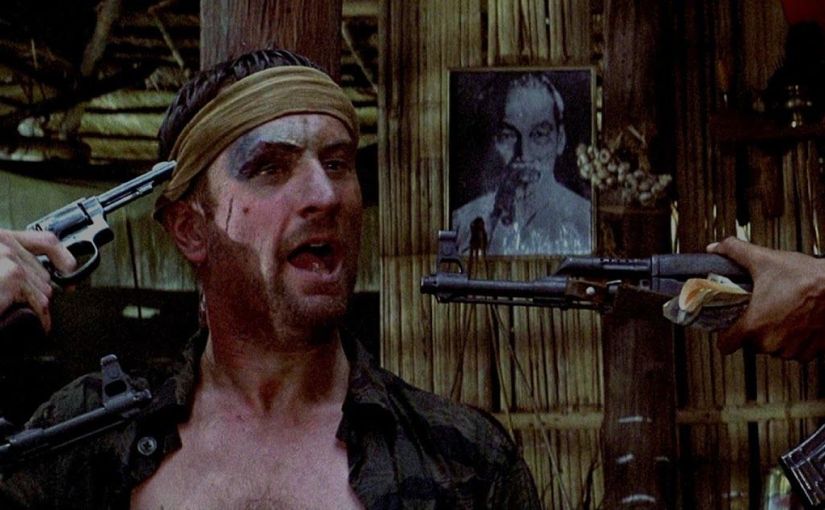
Could it be that I simply don’t care for Vietnam films anymore? Not likely. One of my absolute favorite films is Michael Cimino’s masterpiece The Deer Hunter. In fact, the opening scenes of Born on the Fourth of July are reminiscent of that earlier film in that it takes its time establishing the main character, Ron Kovic, as a young man in the early-to-mid 1960s at the dawn of the Vietnam War. Born and raised in Massapequa, New York, his strict Catholic upbringing and his devotion to high-school wrestling instill a strong sense of right and wrong in the world. A point is made about how America had never lost a war up to that time. Kovic’s wrestling coach exhorts him and his teammates as if he were a Marine drill instructor. “I want you to kill! You hear me?! …You got to pay the price for victory, and the price is sacrifice!!” It’s not very subtle, but Stone is making it clear that, in those days leading up to the Vietnam quagmire, the American credo was, “Winning isn’t everything, it’s the ONLY thing.”
Kovic enlists, sees combat, and during two horrific sequences, he experiences: an unintended massacre of Vietnamese civilians, the accidental shooting of a fellow soldier (with Kovic himself behind the trigger), and a fateful gun battle during which a bullet went through his right shoulder, collapsing a lung and severing his spinal cord, paralyzing him from the waist down. These scenes are appropriately skittish and terrifying, putting us in Kovic’s boots and making us feel the unimaginable stress of fighting a war where half the time you weren’t sure who or what you were shooting at. Kovic is shipped stateside…and here, as they say, is where his troubles REALLY began.
If the scenes set at the VA Hospital during Ron Kovic’s convalescence weren’t based on his actual experiences, I would denounce them as sensationalistic and manipulative. Rats roam free among the beds. (A nurse provides spectacularly unhelpful advice: “You don’t bother them, they ain’t gonna bother you.”) Orderlies spend their down time getting high on marijuana or worse. Unchecked catheters get backed up. When a vital blood pump malfunctions, a doctor has to go to the basement to “rig up a substitute.” And through it all, Ron Kovic does everything in his power to prove to the (correctly) pessimistic doctors that he will walk again, even re-injuring himself in the process.
(It’s futile, I know, to critique a film for what it’s not instead of what it is, but I can’t help wondering if I might have developed a more emotional reaction or attachment to the film if the entire film had focused on Kovic’s tenure at the VA hospital…although I will admit that would be a thoroughly depressing film. Also, it might have developed some unintentional similarities to One Flew Over the Cuckoo’s Nest. Who knows.)
The rest of the film details Kovic’s return home to his family, his emotional swings between the lowest kind of depression (“Who’s going to love me, Dad? Who’s ever going to love me?”) and angry shouting matches with his parents and occasional bar fights. Eventually, Kovic has a revelation: he still loves his country, but he can’t stand the government that sent him and his friends halfway around the world for a cause he no longer understands. After a short hiatus in Mexico (I won’t get into too many details about that plot point because it’s the one section of the film that borders on boring), he returns home and dedicates his life to speaking up for the men and women who returned from Vietnam to a country that, at worst, hated them, and at best, simply didn’t care about them.
Again, the film is a stirring portrait of a man and a life. However, as much as I want to, I can’t pin down what it is about the movie that failed to reach me at the kind of emotional level that other biographies have done before. I just recently watched My Left Foot, with Daniel Day-Lewis’s towering performance at its center. Another film biography, another main character confined to a wheelchair, a character who comes to terms with himself and how the world responds to him and comes up with a way to respond to the world. But My Left Foot made my heart soar in a way that Born on the Fourth of July never achieved. I watched the movie intently, focusing on every plot development and every nuance. But it just didn’t grab me. I am at a loss to explain why.
Could it be because of the presence of Tom Cruise in the lead role? He showed these kinds of acting chops again ten years later in Magnolia, giving another Oscar-nominated performance. In that movie, he completely disappeared into the role, despite having one of the most recognizable faces on the planet. Perhaps the younger Tom Cruise (only 27 at the time) emits the kind of wattage that overshadows those around him? So that you’re aware of the face first and the character second? Maybe. So why doesn’t the same thing happen in Magnolia or even The Last Samurai? Perhaps it took him ten years to find a way to modulate or customize his performance so that, when it counts, the character comes first and the Cruise persona second.
I’m speculating. The bottom line is, Born on the Fourth of July is a worthy addition to the resumes of both Oliver Stone and Tom Cruise. It knows the story it wants to tell and resolutely sticks with it the whole way. There are no sidetracks at any time, not even when he becomes an activist. The focus is always on Ron Kovic, not the cause. Stone and his screenwriters trusted that the story of Ron Kovic would draw enough attention to the cause on its own. That approach would work with just about any other film. This time, it had the effect of diluting the emotional experience while still holding my attention all the way through. I would still recommend it to anyone who hasn’t seen it, if for nothing else to see Cruise play a role where he gets to sound notes he rarely got to play in his early career. Would I watch it again? Maybe. I think the story is important enough for me to try to see what I might have missed this time around.


 2 UNPAID MOVIE CRITICS!!!!