KLUTE

By Marc S. Sanders

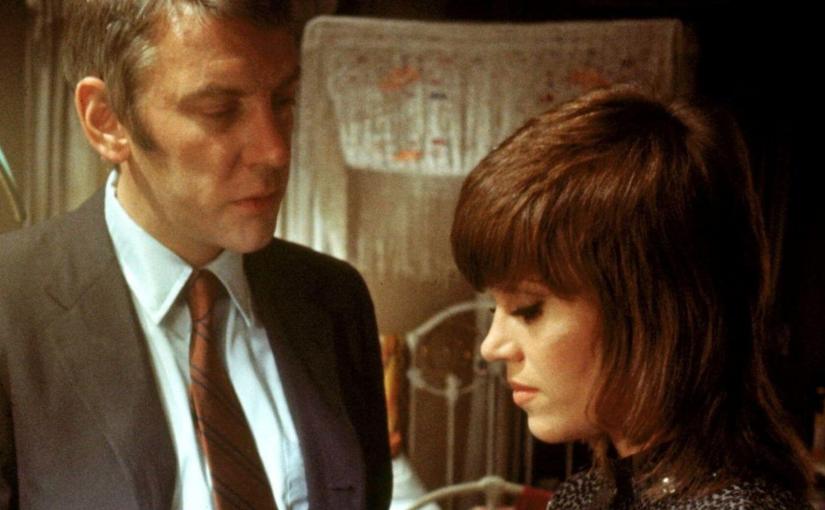
Perhaps Klute, directed by Alan J Pakula, was one of the earliest erotic thrillers to hit the cinema.  In 1971, with Jane Fonda portraying a call girl who briefly goes topless on screen, the daringness of the picture likely garnered a lot of attention.  I bet it was perceived as controversial and elevated the common murder mystery to a grittier more forthright and sleazier height.  Even John Klute, the investigator, played by Donald Sutherland, did not possess the theatrical disposition of a Sam Spade like Bogart or even a Jake Gittes that was just a few years away.  The case at hand in Klute felt real and disturbing.  The actions of the characters were unmentionable and unfathomable.

A highly respected married man named Tom Grunerman turns up missing.  The most unusual clue into his disappearance are letters found in his desk that were written to a New York City prostitute named Bree Daniels (Jane Fonda).  According to his wife and the CEO of his company, the letters seem out of character for a man like Tom.  Six months go by and there is still no sign of the man.  So, John Klute voluntarily goes to New York to investigate for himself while becoming acquainted with Bree.  

Bree is a very high-priced call girl who estimates she does between five hundred and six hundred calls each year.  She’s trying her best to step away from this lifestyle and work as a professional actress and model.  Yet, to uphold her means of living and to make up for the various rejects at auditions, she can’t help but return to what she’s best at.  Occasional visits to a therapist help her justify why she maintains this seedy occupation.  Various recordings of Bree’s observations and conversations with her Johns are about her regard for the profession. She claims that she is capable of catering to any particular vice a man might have. Most impressive is that she does not get turned on by the trysts she shares with these men. She also does not cast much judgment on whatever niche her various clients are into.  She’s positively cold to the demands of her job. Tom does not sound familiar to her, but he might have been the guy who beat her up a year earlier.  

I like the slow burn wait of this story.  A picture like Sea Of Love with Al Pacino works this way.  That’s a better movie though.

Donald Sutherland has significantly less dialogue than Jane Fonda.  He’s got a disturbing expression with large eyes and closed lips, not to mention a tall stature, that allows him to seem alert as an observer and a listener, particularly to Fonda’s character who is protective of herself even if she has much to say.  So, while the two get to know one another with Bree offering some possible leads for Klute to follow, there is an eerie and deliberately meandering pace to the story.  I knew I had to keep up my patience with Klute because an unexpected payoff would eventually arrive.

What bothered me though is that the twist of the mystery is revealed midway through the movie.  You brought me my steak before I had time to finish my salad.  Now, for the rest of the story I’m smarter than the characters and I’m only watching everything unfold. That left me feeling unchallenged through the whole second half of the film. Klute became boring and less inviting.

In 1971, this was a bold kind of picture though, not a common 1990’s erotic thriller like Basic Instinct or Color of Night.  It was seedy, unheard of and therefore fascinating.  At the time, the intrigue for a picture like this must have been off the charts.  Pakula even shows off how novel a tiny tape recorder was in 1971. Imagine what this recorder is capable of!

Had Klute been released today, I’m certain many would take issue with its final edit of story development.  I would also argue that a young Jane Fonda would never be accepted in a role like this.  Frankly, twelve years after this film, Jamie Lee Curtis was more convincing to me as a call girl in Trading Places.  Fonda’s inflection and voice of maturity just did not work for me in this role.  I did not find her alluring in the part, and I think she was too organized and educated to be Bree the call girl.  I was surprised to read afterwards that Jane Fonda won the Oscar for Best Actress for this film because I considered her miscast. Fonda’s voice always sounded overly patronizing to me.  I read later that the actress’s moments with the therapist were primarily improvised by Fonda, shot after the bulk of the picture was completed. Pakula honored her wish to shoot the therapist scenes later because Fonda wanted to have more of a grasp on this call girl character. The therapist scenes definitely look unpolished, particularly for the woman portraying Bree’s counselor. I could detect the improv going on before I knew that it was so. I was watching Jane Fonda, the actress, making a case for the research she collected to prepare for this role.  I wasn’t convinced Jane Fonda was playing the role, though.

The film provides moments where Bree is catering to a couple of clients.  Pakula is honest with his staging.  One client breathes heavily with nervousness about the trouble he’s about to indulge in and then there is the awkward business agreement between Bree and the man followed by the necessary construction of turning the hotel sofa into a bed. It’s weird and unromantic. All this business interrupting this guy’s ultimate fantasy. Very good direction by Alan J Pakula.

Another client hires Bree to pose like a woman from a pre-World War I era where she simply narrates a scenic moment from his past. He does not touch her. He does not undress. This old man from the city’s fabric district simply takes it all in, allowing Bree to do the heavy lifting while he remains stoic in his chair surrounded by the darkness provided by famed cinematographer Gordon Willis (The Godfather).  Still, Fonda seems out of place in these episodes.  Even her fear of a possible killer on her trail left me unsatisfied.  This woman always looks like she has it altogether. She arrives on John Klute’s doorstep in the middle of the night because she’s apparently haunted by what he’s pursuing and also, she’s getting prank calls at odd hours. Nevertheless, I’m still not convinced that Jane Fonda as Bree the call girl is truly shaken by any of this. Jane Fonda is just too put together and hardly evokes any convincing weakness.  

It is ironic the film is named after Sutherland’s character, Klute.  The story begins with his perspective.  I liked his detective.  Almost like the guy could’ve branched off into other stories, like Sherlock Holmes or Sam Spade or Mike Hammer.  The fact that the picture is called Klute leaves me wondering if a series of mysteries would have been paved for this character.  To my knowledge, I do not believe that ever came to be.  I’m sorry the trajectory of the movie veers off into Fonda’s character primarily when she enters the story.  Little is revealed about John Klute.  I only know his experience as a detective is limited, and he’s actually never visited New York City before.  Some interesting challenges for this guy, but none of this hardly becomes obstacles or factors for the rest of the film.  Much is learned about Bree Daniels, but hardly anything is absorbed about the title character, John Klute.

Klute starts off with a lot of promise.  I was excited to tag along with a new kind of brooding investigator who is impervious to influence and looks like he could not get easily overwhelmed. The mystery to uncover why a man went missing but not murdered is very intriguing.  My curiosity was there from the start.  Unfortunately, my interest dwindled as the picture carried on.  Jane Fonda talks a lot with not much to say and when the real culprit is unmasked at the midway point, my attention span is no longer demanded by the film.

Klute was likely a risky, pioneering kind of picture at the time of its release.  A sexy thriller.  Nowadays, it’s like any Saturday night midnight kill thrill of the week where the tempos are foreseen several minutes before they come to life.  Klute just loses its lust–ahem–sorry luster.

THE HEIRESS (1949)

by Miguel E. Rodriguez

DIRECTOR: William Wyler
CAST: Olivia de Havilland, Montgomery Clift, Ralph Richardson, Miriam Hopkins
MY RATING: 10/10
ROTTEN TOMATOMETER: 100% Fresh

PLOT: In the mid-1800s, a naïve young woman falls for a handsome young rogue whom her emotionally abusive father suspects is the male version of a gold-digger.


[Author’s note: If you have not seen this film, but intend to do so, I urge you not to seek out spoilers.  The final resolution of this movie deserves to be seen in a vacuum, if you know what I mean.]

The AFI’s list of the 50 Greatest Villains in American film does not include Dr. Austin Sloper, played with indifferent cruelty by the great Ralph Richardson in William Wyler’s The Heiress.  This is a miscarriage of justice, as Dr. Sloper is one of the most ruthlessly harsh characters I’ve seen in a movie in many years.  The fact that he is successfully upstaged by Olivia de Havilland as his daughter, Catherine, is a triumph of screenwriting, directing, and pitch-perfect acting from both performers.  The fact that both performances nearly overshadow a charismatic young Montgomery Clift is something that must be seen to be believed.

The film starts in the mid-1800s in the Washington Square area of New York City.  It’s a time of horse-drawn carriages, corsets, and garden parties.  Catherine Sloper is a very plain, very shy, single woman who lives in a three-story brownstone with her widowed aunt, Lavinia (Miriam Hopkins), and her father, a financially successful doctor who will bequeath a $30,000-a-year inheritance to Catherine upon his death.  In addition to the $10,000-a-year she already receives from her mother’s inheritance, Catherine will be financially comfortable for the rest of her life.  Alas, her social graces are virtually nonexistent, and she is quite plain when compared to her late mother…as Dr. Sloper casually mentions from time to time, utterly oblivious to the effect this has on Catherine.

At a garden party, during which Catherine is socially humiliated by a thoughtless gentleman, she meets the well-dressed, well-behaved, and nearly penniless Morris Townsend (Clift), who makes it clear that he is utterly taken with her and would like nothing more than to spend the rest of the evening talking or dancing with her and no one else.  Her aunt Lavinia is ecstatic the next day, but Dr. Sloper is skeptical.  In his mind, no gentleman in his right mind would express romantic intentions towards his socially unsuitable daughter unless he simply wanted the money that comes with her, and he says as much to Mr. Townsend AND to Catherine.  The callousness of Dr. Sloper’s behavior is abhorrent, and I found myself thinking, “If this guy were drawn and quartered by the end of the movie, that would still be too good for him.”

The brilliance of the screenplay becomes apparent when Morris boldly announces his love for Catherine, to her complete stupefaction.  And when he actually proposes, that pushes her over the edge, and she falls head over heels in love with him, because he’s the first man who has ever shown anything more than polite tolerance towards her…including her father.  Dr. Sloper lays out his case for what he believes Townsend’s true intentions are: to take control of or squander her inheritance after they marry.

Dr. Sloper’s brutality knows no bounds…but you find yourself thinking: what if he’s right?  Certainly, Townsend is completely genuine in his love for Catherine, or at least seems to be.  He knows exactly what to say, and when and how to say it.  Is it an act?  He’s handsome enough to be an eligible catch for any number of society women in the city, so why waste his time on such a plain-Jane girl as Catherine?

This conflict occupies the main thrust of at least the first half of the film.  What transpires and how and when, I will not say.  I will say that the story led me in one well-traveled direction, took a left turn, then took another unexpected turn that left me kind of breathless at its audacity.  The movie as a whole has been compared in some circles to Scorsese’s The Age of Innocence (1993), and deservedly so.

Olivia de Havilland’s performance as Catherine is one of the greatest performances I’ve seen in any film of that era.  It trumps even her powerful turn in The Snake Pit a year earlier.  Clearly, de Havilland was anything but plain and awkward in real life, but careful makeup and performance nuances helped her bring off one of the most commanding roles of her career.  There is an emotional transformation that occurs at one point where she is able to affect a complete one-eighty in her character, and it never once feels histrionic or gimmicky.  She shares a scene with her father in which she has “found [her] tongue at last,” as he puts it, that I would rank as one of the greatest two-handed scenes I’ve ever watched.  The surgical application of language to inflict harm on another person is breathtaking.  Neil LaBute or David Mamet couldn’t have written it any better.

The Heiress left me feeling a little wrung out at the final credits.  I remember watching this movie many years ago, but nothing stuck with me except that ending.  Despite this foreknowledge, the movie still worked its spell on me, leaving me with a dropped jaw and a blown mind.  The ending is somehow definite and ambiguous at the same time, a screenwriting miracle.  (And I don’t mean in a Sopranos kind of way, either.)  The Heiress is officially one of my new favorite films.

IT HAPPENED ONE NIGHT

By Marc S. Sanders

If you want to stay on top of how the world of American cinema evolved over the last hundred years, within all its categories, you must find time to watch the one film that paved the way for the romantic comedy, as well as the travel comedy.  Frank Capra’s Oscar winning picture, It Happened One Night, is the first of three films to win Oscars for every major category: Best Picture, Director, Screenplay, Actor and Actress. Nearly a hundred years later, the accolades still feel worthy.

Claudette Colbert is wealthy heiress Ellie Andrews who dives off and swims away from the captivity of her father’s yacht and buses from Miami to New York to reunite with her new husband, King Westly (Jameson Thomas).  Her father, Alexander Andrews (Walter Connolly), never approved of this marriage and insists his spoiled daughter get it annulled once she is found.  A ten-thousand-dollar reward is up for grabs to the person who finds her.

Along the way, a rogue reporter, Peter Warne (Clark Gable) ends up next to this young lady on the bus.  Complications ensue where their money gets lost, bags are stolen, buses are missed, and buses get stuck.  Then this trip becomes a walking experience.  Ellie has agreed to stay by Peter’s side though.  He promises to get her to New York as long as he gets to write about her story firsthand amid the constant headlines that recount Alexander’s desperation to get his daughter back.

It’d be easy enough if only Peter and Ellie were not falling for one another.

Sounds familiar, doesn’t it?  Any Nora Ephron script has the elements of It Happened One Night.  Screwball comedies with Cary Grant and Katharine Hepburn seemed to follow a similar blueprint.  To the best of my knowledge, Frank Capra’s film was first though.  

A famous scene has Colbert and Gable on the side of the road trying to hitch a ride.  Colbert’s bare leg does the trick that Gable’s outstretched thumb could not.  Eventually, this scene for the ages evolved into Meg Ryan and Billy Crystal daring to fake an orgasm effectively while dining at Katz’s Delicatessen.

When Harry Met Sally… is what easily comes to mind while watching It Happened One Night.  Peter will tease this spoiled rich girl. Yet, he will also be gentlemanly enough to put up a blanket to divide a cabin room he shares with Ellie, allowing for some privacy.  In the middle of the night though, the two will stay up chatting from either side of their blanket wall, as both acknowledge sad voids within their personal lives.  It’s parallel to how Harry and Sally would chat on the phone from their respective apartment bedrooms while discussing their newly evolving friendship with Casablanca on TV.  

Ellie and Peter become relaxed as their sojourn continues.  They could be left in the middle of nowhere with no money or food, but Gable and Colbert’s chemistry show an easy comfort to each other.  That is what’s expected of any troubled travel film.  At first Ellie does not want to share a rear bench on the bus with Peter.  She’s married to King and the purpose of this runaway trip is to be back in her new husband’s arms.  Plus, this odd fellow on the bus feels unseemly.  His charm is overbearing to the socialite’s proper petiteness.  He’ll resort to munching on a carrot he finds in a patch. She can’t find the appetite for it. Time together breaks down barriers though, just as movies in later decades eventually accomplished with films like Midnight Run and Planes, Trains & Automobiles.  This kind of formula, with ongoing new settings and circumstances, is almost guaranteed to end in positivity once the mutual antagonism is behind the pair.  

For 1934, It Happened One Night was bold in its content, ahead of an eventual ratings system intent on upholding an acceptable level of conservatism.  Colbert’s leg is the most unforgettable.  Later, Peter feels it necessary to spank Ellie.  Then there is the fact that the two share a room together.  Comedic circumstances and shock lend to the humor of this scenario.  Plus, there’s Claudette Colbert undressing down to her slip while a bare-chested Clark Gable is only one side of a blanket away from her.  

Would It Happened One Night endure an endless admiration if moments like these were contained? I doubt it.  Frank Capra’s film hinges on sexual appeal that feels naughty and rebellious.  

The dialogue remains witty.  Clark Gable’s introduction in the film while on the phone with his editor is a precursor to what an outlandish Bill Murray might have done with the script. The material is sometimes quite brash, and the ending, which has been duplicated hundreds of times since, is a perfect example of romantic escapism.  

Over ninety years have passed but unexpected romance is what remains treasured.  When two people with nothing in common begin an unwelcome journey together, it’s still easy to hope they find a way to like each other.  They have to like one another first before they can even concern themselves with falling in love.  The progress of this east coast bus ride allows for the stages to develop naturally.  Frank Capra, Clark Gable and Claudette Colbert were the first to give it a shot and it works brilliantly and beautifully.

ANORA

By Marc S. Sanders

Anora, or Ani as she prefers to be called, had to have been a character that writer/director Sean Baker always intended on loving.  Not in an intimate way though.  Sean Baker had to deeply care about this twenty-three-year-old girl who has no connections or family or solid friendships or kinships.  Baker wrote about Anora, wanting her to be appreciated by someone who would finally embrace her. 

Anora—sorry…Ani…has a good heart.  She may be an exotic dancer at a New York City strip club, but she is someone who has every right to be respected and valued. If you choose to watch the film you’ll know why, as a pertinent prop referenced earlier in the picture suddenly resurfaces when you least expect it.  A minute or two later the closing credits appear amid the sound of flapping windshield wipers and there is no music to cue your emotional response.  You likely will have spent the last two and a half hours laughing loudly, dropping your jaw, and gasping in shock at what unfolds for Ani. In the end though, you’ll realize that you want the best for her, like her creator did when he originally drafted this script and shot the film about Ani’s episodic escapades.

Sean Baker’s film is eye opening right from the start.  Club music blares within the HQ, the name of Ani’s strip joint where she collects an exorbitant amount of dollar bills while she strategically flirts with middle-aged men and frat boys looking for an evening of debauchery.  She has a talent for one on one charm with any customer, as she repeatedly bares her chest and reveals her thong, but she also delivers a very satisfying service.  A young man named Ivan, sometimes it’s Vanya (Mark Eydelshteyn), specifically requests a girl who speaks Russian to cater to his needs.  Ani is the only one who can comply.  Ani and Ivan get to talking, mostly in Russian but limited English too.  She gets invited to his private, deco mansion, which is really owned by his Russian aristocratic parents, and a slap happy relationship of sex and more sex, and money, and drugs and drinking and partying and New Year’s Eve partying and money, and clothes and expensive coats, and travels to Las Vegas ensue.  (Yes! I know that was a run on sentence.  My elaborate text does not even come close to what these twenty-somethings indulge in though.  It must be seen to be believed.)

Anyway, since they’re in Vegas, why not get married?  Vows are taken, the bride is kissed and Ani is emptying her locker at HQ for a promising future of being a spoiled, but loved, aristocratic wife.

In the few times that Ivan calms down, he is only engrossed in his online video games while Anora lies on his chest with an expression of wanting more than to come in second to Call Of Duty. Baker focuses on Ivan’s childish habit a few times.  So be sure to observe how Ani sadly looks upon an inattentive Ivan.

A problem occurs though that neither character could ever expect.  The tabloids have reported that Vanya, this spoiled brat son of a Russian oligarch, has up and married a prostitute. Now the family image is at risk of being shamed.  Mom and dad are on their way back to the states and have summoned Toros (Karren Karagulian), an Armenian Catholic priest and the son’s Godfather, to round up Vanya and the so-called whore to get the marriage annulled immediately.  Not divorced!  Divorce does not happen within the legacy of this family.  An annulment is what is needed. 

Toros rounds up Igor and Nick (Yura Borisov, Paul Weissman) to get over to the house right away, get the marriage license and bring the kids in for the quick annulment at the courthouse.  If only it were that simple.

Watching Anora allowed me to reminisce about other films that catered to outrageous debauchery and led to a domino effect of problems.  Doug Liman’s Go for example, or True Romance written by Quentin Tarantino, or even a super ridiculous comedy known as Very Bad Things with Christian Slater and Cameron Diaz.  The first two examples are very good films because the dialogue is sharp with eclectic casts who elevated simplistic material.  Let’s not talk about the third one, but I will say it is delicious junk food.  With Anora though, just when you think you know where this story should be going it doesn’t.  You think it will turn right, but then it makes a sharp left and Sean Baker knows he just needs to keep the fighting and the screaming and the cursing at an organic natural level.  What do you do when the wards you are put in charge of will not cooperate?  What if one of them goes missing and simply won’t answer his cell phone?

Well, on a cold winter night you may get a broken nose, car sick, and your car might get towed.   Anora is not about big stunts or gratuitous violence.  It’s not mobster movie material either.  Anora works naturally for people in desperate situations, from a handful of different perspectives.

Oh yeah.  Anora—sorry Ani, is played by Mikey Madison and she is bound for marquee attraction over the next twenty or thirty years.  This performance is so concentrated in moments of natural glee, anger, and maybe despair and sadness.  You applaud her character’s strength.  Ani talks like an updated version of Judy Holliday from Born Yesterday, but she’s no dummy and she never succumbs to intimidation.  I’ll confess it right here.  If two hulking Armenian thugs approach me, I’ll do whatever they want me to do. Ani gets all my props though.  She will never settle.  She’s a married woman and no one will deny her of her rights.

Mikey Madison has such wonderous chemistry with Sean Baker’s camera.  There must be over a hundred and fifty close-ups on this young actor and each one is unique.  I was sad for Anora when Ivan would not give her attention.  I was cheerful when the two were overindulging in carefree sex and sin city fun.  I was on Anora’s side when she was restrained. I was admirable of her giving a good fight to the giants that enter her space.  I was exhausted with her as she was forced to sit in Toros’ car while brainstorming where her husband could be.  I was supportive when she makes appeals with the family to offer a good first impression.  She hates her name, but she introduces herself as Anora to Vanya’s steely mother. Ani is willing to make all of this work. Finally, I was angry—very angry–alongside of her whenever she was unfairly treated like garbage. 

Amid all of the chaos that ensues, Sean Baker works like the eyes of the film’s audience. We keep guard over Ani’s condition and state of mind as she’s coerced into looking all over Brooklyn and Coney Island for her new husband that the Armenians need to find before the boy’s parents arrive by noon the next day. 

None of the dialogue is crafty like Quentin Tarantino’s or Neil Simon’s.  I could not quote a single line.  The yelling and conversations and overtalking and interruptions are natural and raw.  Sometimes, the exchanges feel pointless until you arrive at another scene that demonstrates with brilliant insight why certain throwaway moments are preserved in the final print of the film.  It makes complete sense that Sean Baker did not just write, produce and direct this film.  He edited it as well. 

The whole way through the picture I kept wondering how this story would end.  I spelled out variations of doom for any one of the characters.  I considered gratuitous violence or swashbuckling adventure and daring escapes.  Man o’ man, have I become cliché.  Because just as you arrive at the picture’s conclusion, a meaningful prop puts the period at the end of the story and the last audible expression before the picture goes to black comes from Anora. You now realize that this girl, who is as self-reliant as many exotic dancers must be, has feelings too.  As defiant as Anora can be, she can also get pricked and bleed and the big laughs you responded to for most of the film are distant memories. Anora can feel pain like any of us.

When I drove home, I was hurting.  I was hurting for Anora, and my one wish is that I hope Anora will be okay.

Roger Ebert once gave a seminar that lasted for eleven hours as he commented on practically every shot and piece of dialogue in Tarantino’s Pulp Fiction.  My long shot wish is that on a subsequent viewing of Anora, I can deliver a similar kind of observational lecture to others who had already seen the film too.  I believe I could reveal sincerity and perception related to every close up, every chaos-stricken scene of panic or decadence, and especially when that one prop reappears. I’d likely spend a half hour simply discussing the value that this prop carries and what it means to Sean Baker’s film, and especially to Ani.

As messy and gritty as Anora may appear, it is also one of the most adoring and perceptive films to be released in a long time. 

Anora must be in my top five favorite films of 2024.  It might just be my favorite.  There are a few other candidates, but I left feeling so satisfied with Mikey Madison’s performance and Sean Baker’s sloppy, yet astute, little film. 

This is superb filmmaking.

GONE WITH THE WIND

By Marc S. Sanders

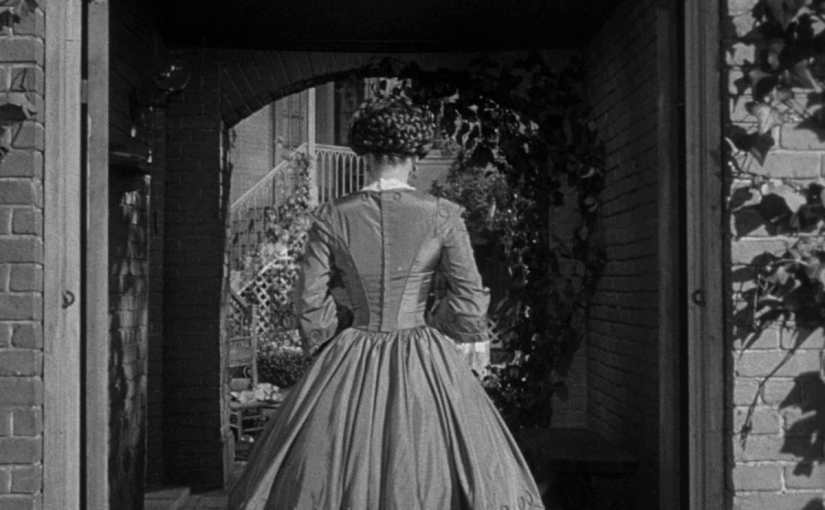
Gone With The Wind is probably the first of the sweeping epic.  It spans a transitional period in history from the American Civil War and through the aftermath known as Reconstruction.  Contained within these historical contexts are the prominent Georgian Southern Plantation residents. They court and romance one another ahead of the war. They celebrate with welcome glee, ready to fend off the horrible Yankees of the North who desire to put an end to black slavery.  Nearly ninety years later Victor Fleming’s film, based on Margaret Mitchell’s bestseller, is an impressive piece of movie making with set designs and shots that remain superior to many modern films of today. 

At the top of the character pyramid is young Scarlett O’Hara (Vivien Leigh), the spoiled Southern Belle of a wealthy Irish plantation owner.  Her spoiled livelihood pines only for the noble and dashing Ashley Wilkes (Leslie Howard).  Yet, he has committed himself to his cousin and Scarlett’s best friend Melanie (Olivia de Havilland).  Enter Rhett Bulter (Clark Gable), a self-made wealthy prospector who is taken with Scarlett. She gives him the coldest of shoulders as she waits for Ashley to leave Melanie and have him all to herself. 

Before the soap operas of radio and television arrived, there was Rhett and Scarlett in a competition of romantic swordplay. As you watch Gone With The Wind, you see how the relationships change with marriages and children, along with death as a cost of war.  If it wasn’t for how well this collection of actors perform, all of this storytelling would feel quite hammy by today’s expectations.  Yet, Clark Gable is undeniably handsome and confident as Rhett.  His stature is so impressively consistent with that pencil thin perfect mustache to enhance his proud grin.  He doesn’t wear the costumes of 1860 regality.  The costumes wear Clark Gable.  If the film were ever to be remade, no one could match what Gable delivered.  Vivien Leigh is also unforgettable.  Scarlett is hard to like, though amusing in how she holds to her convictions of rejecting Rhett’s advances while still obsessing over Ashley.  Sometimes you want to shake this spoiled brat down to reality.  Yet, as the film demonstrates, reality shellshocks the young lady as the war overcomes and she must learn to fend for herself and those closest to her.  Viviene Leigh is radiant, and she epitomizes this character amid the vibrant colors of her dresswear and her piercing eyes that focus on what is important to her.  Whether it is schoolgirl flirtations or determined survival, Viviene Leigh is always focused on Scarlett’s stubborn strengths, which at times are also her weaknesses.

The construction of Gone With The Wind is what stays with me most.  Knowing what we know of our country’s bloody history, it’s surprising to see how excited the men of the South are to enlist in the Confederate Army, defending their ways of Southern gentility and slave ownership.  Yet, even for a film, Victor Fleming does not shy away from the atrocities of war.  Before Oliver Stone demonstrated the false heroism that a man like Ron Kovic expected to find in Vietnam (Born On The Fourth Of July) or even what could be found in the first acts of All Quiet On The Western Front, Gone With The Wind was there to flip the coin first.  The same men who bucked their horses and fired their pistols in celebration of going off to fight either never returned or they came back to a thinly spread, elderly doctor ready to sever their limbs. 

The most unforgettable shot of this film occurs when naïve Scarlett traipses across a long block of wounded men to find the doctor and insist he tend to Melanie who is about to deliver a child.  The number of extras and the amount of detail and design in this one scene is astounding.  It’s truly a walk back in time and it never glamourizes an unforgiving history.  You cannot help but be marveled at this wide shot; one of the best I’ve ever encountered.

Following this moment, Scarlett is forced to grow up as Sherman’s forces advance through Atlanta and Savannah burning everything in sight, including what’s most precious, her plantation home known as Tara.  The art design of Tara should be studied in film school.  Victor Fleming’s crew show a beautiful expanse of land and prominence to open the film, just ahead of the Civil War, then it is followed by a pillaged and burn stained remnant of invasion that could not be fended away.  Fleming also captures stunning silhouettes of Scarlett and others with the foreground bathed in a burnt orange sunset or a grey and gloomy sky.  An unleafed oak tree is off to the side lending to the foreground and implying a current barrenness of what was once a luxurious South.  Just ahead of the film’s intermission, Victor Fleming completes his canvas on film showing a defiant Scarlett with a raised fist delivering her self-sworn testimony to reviving Tara for a new day.  It’s just another unforgettable moment in all of film history.

The length of Gone With The Wind feels overwhelming clocking in at just under four hours.  Still, the picture moves and progresses through historical landscapes and the developments of young Scarlett as she moves from her unquestioned reliance from Mammy, her house servant (Hattie McDaniel, the first African American to win an Oscar) and on to her courtships and marriages.  During her transitions, she must contend with lack of food, money and resources for herself and the slaves she’s grown up with at Tara, as well as the other plantation widows and wives.  Scarlett also must grow up quickly to find ways to fend off tax demands of Union Carpetbaggers.  All of these character developments hold my interest much more than the battle of the sexes engaged between her and Rhett.  These characters are wonderful.  Pure cuts of cinema grandeur.  However, I was caught up more in their recoveries following an undeniable defeat at the hands of war and what little was left behind.

When the film returns to the soap opera chapters, it is not so much that I am admiring Vivien Leigh, Clark Gable, Olivia de Havilland or Leslie Howard.  I am much more engaged in the backgrounds they occupy.  The rubble of carnage followed by the grand reconstructions that remedied their new situations.  Rhett and Scarlett fight for common ground in their eventual marriage, have a child and then emotionally toy with one another.  It’s nothing boring.  However, it is a lot of same old, same old and Margaret Mitchell’s sweeping epic finds sad resolutions to their dilemma of uncommon grounds with each other.  Arguably, these resolves in the storylines are a little too convenient as the story works to draw your tears while keeping you engaged in the drama.  Gone With The Wind is so legendary though, and still one of the biggest revenue earning films of all time. It is likely had I seen this film at the end of the 1930s when technicolor films were rare treats, that anything put on the screen would take me away in the splendor and heartache.  I reflect on the film after watching it for a second time and I still do not like Scarlett.  However, I admire what she endures and how she persists.

In 1939, Victor Fleming directed both The Wizard Of Oz and Gone With The Wind, two films with only the commonality of technicolor achievements.  They remain two of the greatest cinematic triumphs of all time and will always carry that honor.  I’d argue that Fleming was a Francis Ford Coppola, or a James Cameron or George Lucas of his time.  A pioneering and aggressive filmmaker looking to invent a new way to absorb moving images on a screen, accompanied by grand instrumental soundtracks and actors who complimented zoom ins and outs with his camera.  Victor Fleming is a director who truly remains unmatched.  When you watch these two films, you are carried off into unfamiliar times and places. You are forced to observe beyond what appears closest to you.  The immediate stories do not stop with Dorothy or Scarlett.  Look at Munchkinland or war-torn Savannah as far as your eye can take it. Fleming has something all the way back there, that far out, for you to see and collect in your consciousness.

Today, Gone With The Wind is accepted as a piece with an asterisk next to its title.  The treatment of African Americans in the film along with their dialects and appearances is held into question.  Should these people be depicted in this manner?  Ahead of the film, streaming on MAX currently, there is a warning label of what some may consider inappropriate content even though the film remains preserved in its original final edits.  It should be.  How blacks were cast in films and how blacks were treated in history can not be changed and if we are to improve on our future of filmmaking and the histories that have yet to come, then the worst thing we could ever do is disregard the errors of our ways and whitewash over how any people were regarded and what our perspectives looked like.  Hattie McDaniel’s character may be the most beloved and memorable character in Gone With The Wind.  She’s a scene stealer whenever Gable or Leigh share a moment with her.  It speaks volumes that she could win the Oscar during a time when overt prejudice was never subtle. She was not even permitted in the theatre to accept her trophy. Clark Gable almost didn’t attend the ceremony in protest of her restriction.  McDaniel held that he go in honor of the film.  Still, Ms. McDaniel insisted that she’d rather play a maid on screen a hundred times over than live the life of a real maid fulfilling the servitude of someone else’s demands. 

Ahead of the challenging progress that came over twenty years later with the civil rights movement, McDaniel demonstrated a need for people of color to connect and relate to any kind of movie watcher.  Gone With The Wind would not have the reputation it has always held without Hattie McDaniel or Butterfly McQueen (as Prissy, another house servant).  To wit, these actors upheld what was being fought for within the Civil War and how those of the deep south lived and treated one another.  While we should be sensitive to how blacks were treated at this time, I am also grateful for their contributions into a historical depiction of a violent and unfair period.

Gone With The Wind takes commitment to watch.  Yet, it is such an important masterpiece in filmmaking.  It carries an immense significance that I believe it is one of a select number of films that must be watched in everyone’s lifetime.  I expect to still be breathing when the film reaches its one hundredth anniversary, and while some critics and skeptics poke at its shortcoming in sensitivity, I also hope that those who wish not to censor or erase an often-cruel history will give the picture its ongoing salutes and applause.  I’ll be at that Fathom event in the movie theater for that one hundredth anniversary.  This film was made to last a full century after its debut and then to last another hundred years thereafter.

It’s a masterful, epic and unforgettable piece of movie making.

STILL ALICE

By Marc S. Sanders

Still Alice is the observation of a woman whose mind gradually deteriorates from the symptoms of early onset Alzheimer’s disease.  Julianne Moore won an overdue slew of awards, particularly the Oscar, for the portrayal of the title character.  It’s a magnificently sensitive performance that will have you in tears following the first twenty minutes of the film.

Alice Howland is a revered Columbia professor of linguistics.  She has three grown children (Kristen Stewart, Kate Bosworth, Hunter Parrish) and John, her loving husband (Alec Baldwin).  The sad irony of Still Alice, adapted from Lisa Genova’s novel, is the fact that Alice specializes in teaching word origins and their formations, but she is stricken by the disease that will wipe her memory of the simplest vocabulary.  A highlighter becomes a “yellow thing.” 

The beginning of the film shows Alice functioning at her highest capacity following her fiftieth birthday.  She teaches her classes, does her daily jogs across campus, plays word games on her phone, travels across country delivering seminars and also tries to convince her youngest daughter, Lydia (Stewart) to abandon her dreams of becoming an actor and acquire a college degree.  Mixed in, however, are losses of train of thought, forgetting recipes, misplacing basic objects, forgetting appointments and getting lost during her jogs.  A quick glance over some visits with a neurologist (Stephen Kunken) set the wheels in motion of what we will witness Alice struggle with over the course of the film.  These doctor visits also teach the audience how one is examined for symptoms with simple memory tests and spelling questions. 

The film was directed by Richard Glatzer and Wash Westmoreland.  After I watched the movie, I learned that Glatzer could not speak while he was directing.  Due to his gradual deterioration from ALS, he had to resort to a computer monitor that would express his instructions to the cast and crew.  So now I’m that much more impressed.  To home in on the sensitivity of Still Alice, it only seems fitting that someone with Glatzer’s condition could co-direct this story. 

This is not a glamourous film.  Sometimes we may laugh at ourselves because we cannot think of a word or we forget a year or a name or we put our car keys in the refrigerator as soon as we come home and reach for a cold beverage.  However, when we see Alice discover that she puts a bottle of liquid soap in the fridge it says so much more.  Illnesses like Alzheimer’s and ALS strip people of the basics in living.  Having recently witnessed a friend slowly suffer and perish from ALS, I know that one disease brings you to this point with complete mental capacity while the other seems to tease you with how your mind gradually deteriorates.  Yet, like Richard Glatzer, my friend Joe did not stop functioning and co-wrote a play with me in his final year of life.  He couldn’t speak.  He couldn’t walk, but the man could write.

I have to credit the supporting cast behind Moore’s performance.  The film begins with the ease of conversations between the family members.  Before you know it, the exchange of dialogue shifts and becomes more one sided.  Julianne Moore most often shares scenes with Alec Baldwin and Kristen Stewart respectively.  She hides so well in her character’s mental incapacity that eventually, it looks like Alice Howland is not even applying the intelligence she’s collected and earned over her lifetime.  A scene in a yogurt shop towards the end of the film seems like Baldwin is the only one working.  He’s consuming his yogurt and reminding his wife of where she used to work while she sits beside him in an absolute haze of emptiness.  He simply says she is the smartest woman he’s ever known and by this point, I know exactly what he is talking about.  Moore is so heartbreaking in moments like this that I have to give credit to Alec Baldwin for maintaining his own performance against a scene partner who cannot offer much in return.

Alzheimer’s first affects the victim but also the family.  Still Alice allows time to explore the inconvenience of the illness.  There is the expected residual squabbling among the siblings.  Alice needs to be overlooked more and more as she gets sicker.  Who can be with her?  John still has to earn a living and has an opportunity for career advancement that he cannot afford to pass up.  A relocation is questioned because will it be okay for his wife.  Lydia is on the other side of the country trying to build her acting career.  Anna (Bosworth) is a pregnant, busy attorney, while Tom (Parrish) is in medical school. 

It’s also much more serious when the family learns that the gene Alice possesses has a one hundred percent chance of being passed down to the children.  This angle is touched upon for a brief moment, but then is hardly reflected as the film moves along.

Still Alice is a difficult film to stay with because it feels genuine in its account of living with Alzheimer’s.  Simple mistakes are just as heartbreaking as the big developments.  Leaving a potato in a purse is as hard to watch as seeing a mother speak to her daughter backstage, following a live acting performance. The daughter is now a stranger to the mother. 

Yes.  At times, the film feels like schmaltz you may find on the Lifetime channel, but then again you are seeing authentic, relatable performances from a cast who make up this family, especially the Oscar winner, Julianne Moore.  Alzheimer’s is an unfair and cruel disease that strips away everything a person builds for themselves in a lifetime.  Pardon the pun, but Still Alice makes sure you never forget that.

FARGO

By Marc S. Sanders

The seeds of a crime begin in the dead of winter, in a saloon, located in Fargo, North Dakota.  A car salesman requests two thugs kidnap his wife so that they can demand an eighty-thousand-dollar ransom from his wealthy father-in-law.  The salesman will split the monies with the crooks and all will be well.  Hold on there!  It’s not as simple as it looks.

The Coen Brothers (Joel and Ethan) completed some of their most legendary work when they opted to “adapt” a supposedly true story that sheds blood over the snow-covered plains of northern Minnesota when all of the characters involved choose not to cooperate with one another.  The unpredictable is what keeps their film Fargo so engaging.  With each passing scene, you ask yourself “What next????”

Jerry Lundegaard (William H Macy, in my favorite role of many good ones from him) is the salesman who gets in over his head.  This cockamamie scheme of his stems from a need to land a get rich quick investment, but he doesn’t have the money and his father-in-law Wade Gustafson (Harve Presnell) certainly won’t lend it to him.  Steve Buscemi and Peter Stormare are the hired criminals, Carl and Gaere.  As quick as the agreement is made, Jerry wants to call off the arrangement, but things are already set in motion.  The kidnapping occurs, albeit sloppily, and a late-night pullover on a dark, snow covered back road leads to the bloody shootings of three people. 

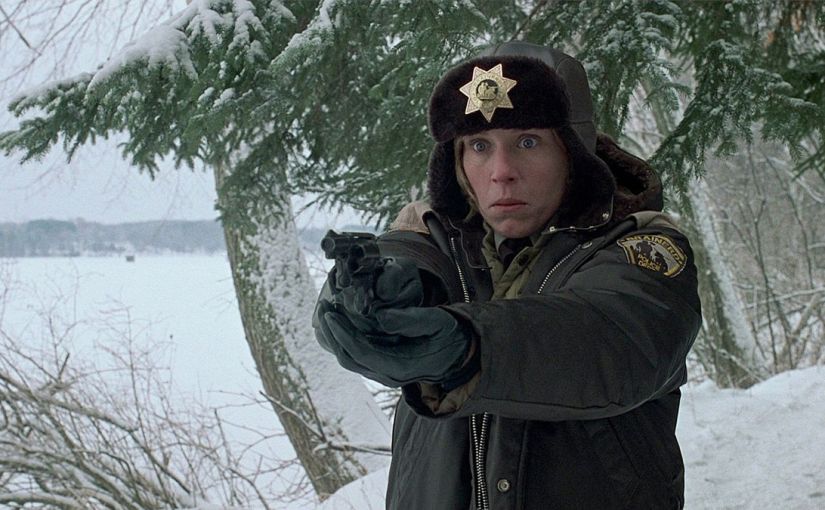
Marge Gunderson (Frances McDormand, in her first Oscar winning role) is awoken early in the morning.  Her sweet husband makes her a quick breakfast and she’s off in a jiff to inspect the crime scene of the three murders.  She is seven months pregnant, but she’s got a job to do.

Murder, kidnapping, fraud, and embezzlement piece together the Coens’ Oscar winning script.  What makes Fargo special though is how out of frame it all seems among these odd and quirky characters.  The Minnesotan dialects and vernacular (“You betcha!!” “You’re darn tootin’!” “Oh, for Pete’s sake!!!”) from Marge and Jerry do not seem standard in a story like this.  Even their names – Lundegaard and Gunderson – seem totally out of place here.  However, the pregnant, sweet natured police officer should not be underestimated, and the puppet master behind this plot should have known better.  In fact, other than Marge, no one should be doing what they’re doing, and yet that’s exactly what spins everything off the rails.

The Coens humanize the characters of their film.  Marge must stop inspecting the grisly crime scene because her morning sickness is about to overtake her.  “No, I think I’m gonna barf!” It is not the blood or the cold winter that’s holding her back.  Natural pregnancy gets in the way.  When clues lead her to Minneapolis for an overnight stay, she takes advantage of meeting with a high school friend.  Their meet-up has nothing to do with the central plot, but the writers insist on showing Marge during her off hours.  It’s a hilarious scene and Frances McDormand’s timing is naturally comedic with a guy who just has an overenthusiastic way about himself.  Marge is not just a smart cop.  She’s got a life outside of her career as a loving wife, friend and soon to be mother.

As well, Jerry insists to Wade not to contact the police and let him deal directly with the kidnappers when they call.  Wade isn’t just going to sit by for long though.  He got to the top of his powerful pyramid by taking things head on.  Jerry just doesn’t have the instinct to realize this is how the cards will fall.  Wade was not to be involved, under any circumstances.  Yet, that’s exactly what is happening.  This is not good Jerry.

Carl and Gaere (These names!!!!  I’m telling ya.), as crooked hoods, have no honor among themselves.  One might betray the other and that could lead to another gory, very gory, yet inventive moment. 

Other than Marge, either no one is particularly smart in Fargo, or they are just not seeing the possible outcomes all the way through.  Still, even the dumbest of folk can make a turn of events gone awry so fascinating.  When one tiny detail gets out of place, then the players improvise. That only twists several other expectations to go off kilter and the dominoes begin to tumble.  Very quickly, as everything has unraveled, it is any wonder how this all began in the first place. 

Fargo demonstrates that crime is hardly committed with a perfect plan.  Fortunately, the imperfections are at least as entertainingly curious as the perfections found in so many other films.  Oh, you betcha!!!!! 

MILLION DOLLAR BABY

By Marc S. Sanders

Clint Eastwood has one of the most remarkable careers in Hollywood history.  As his appearance has aged, so have the roles he’s occupied. He’s got these long lines that run down his cheekbones and across his forehead that compliment his signature scowl and white hair.  These facial features lend to a background in many of the characters he’s portrayed over the last thirty years ranging from a “Frank” in In The Line Of Fire to a “Frank” in Million Dollar Baby, his second film to be a recipient Oscars for Best Picture, Best Director, and Best Supporting Actor.  A Best Actress Oscar was also garnered for Hilary Swank. 

Swank won her second Oscar as Maggie Fitzgerald, a backwoods product of a hillbilly upbringing, who only lives for one dream and that is to be a championship boxer.  When she’s not waitressing to collect coins and singles for tips, she is spending every waking moment at Frank’s boxing gym, The Hit Pit.  Maggie keeps to herself by punching a bag, but she is persistent at convincing a closed off Frank to become her trainer.  Frank has no interest in training a girl, but maybe there’s more to why he’s reluctant to take her on.  The lines on Eastwood’s face seem to metaphorically hint at a challenging past.

Frank’s best friend is Eddie, or otherwise known as “Scrap Iron,” played by Morgan Freeman in a very long overdue Oscar winning role.  Some may argue that Freeman was bestowed with an award for such an illustrious career.  That’s fine.  I still believe that this performance is just as worthy as his other celebrated works (Driving Miss Daisy, The Shawshank Redemption).  Eddie lives in a small room in the gym and manages the place by day.  Frank is a crank towards Eddie, but they’re the best of pals. Frank carries the responsibility for Eddie losing an eye in the ring while under his coaching. 

Frank also suffers from the loss of a relationship with a daughter.  He writes her but the letters come back “return to sender.”

Million Dollar Baby is a boxing movie but the film, written by Paul Haggis, serves a much deeper and intimate purpose.  Eastwood, as director, gives beautiful and sensitive focus towards a relationship between Maggie and Frank.  Maggie has an ungrateful family with a mother (Margo Martindale) who spits the gift of a purchased home back in Maggie’s face.  Hilary Swank offers silent, yet agonizing hurt at the rejection and Haggis writes a simple line for her to share with her coach by asserting “You’re all I have, Boss.”  In turn, without his daughter, Maggie is all Frank has.  Their commonality is “Scrap Iron” who is there to offer insight into what Maggie needs from Frank, and what Frank needs from Maggie.  As well, Scrap even suggests that Maggie seeks out another manager to salvage both of their souls.

Haggis and Eastwood go even further with the setting of The Hit Pit.  A mentally disabled kid who proudly identifies himself as Danger (Jay Baruchel) relies on the gym for his own personal glorification.  Danger is a kid with no experience and no business being a boxer, but he glorifies himself as the next all-time great champion while the other boxers (Anthony Mackie, Michael Pena) tease and jeer him.  Frank hems and haws at Scrap Iron to get rid of him.  Danger doesn’t belong here.  Scrap Iron just lets the kid come and go.  The two old guys are both protecting Danger.  One doesn’t want to see another kid get permanently injured, but the other is well aware this kid has nowhere to go.

Million Dollar Baby is a film of acceptance when every other direction leads to rejection for its characters.  Every main character is destined to serve a purpose for another character.  The surprisingly heartbreaking third act is an ultimate test for a dare-to-dream fighter and her coach, however. 

A grizzled old trainer like Frank will laugh in the face of one of God’s ministers with his daily visits to Mass to hide the guilt he feels responsible for, while a girl boxer who wasn’t even much of a fighter until Frank reluctantly accepted her is forced to question how useful she is for herself or Frank or Scrap Iron after she’s been trained to be an elite.

There is so much to appreciate of the sins and curses that weigh on Frank, Scrap Iron and Maggie.  Accompanied with their anguish is a quiet, tearful piano soundtrack composed by Clint Eastwood, himself.  To complete the picture is the dark shadowed cinematography from Tom Stern.  So often, Eastwood with Stern shoots the cast in silhouette. A narrow beam of white light points down on Maggie punching the bag with earnest, but no rhythm.  It could also be Scrap Iron looking from a window upon his friends who accept the pain they live with.  The characters show only a small portion of profile while they are involved in their character.  You’ll catch a glimpse of Frank’s chiseled lines, or Maggie’s black eye and broken nose, or the rough texture of Scrap Iron’s dark complexion.  Other moments, Eastwood follows himself walking through the front door of Frank’s home to find another letter on the floor coming back to him, unopened, returned to sender.  The pain never gets numb.  The darkness of Stern’s photography is haunting, and yet it’s blanketed as comfort for these lonely souls.

Morgan Freeman as Scrap Iron narrates this bedtime story, and we eventually learn who he’s actually speaking to.  It’s the last element of the picture needed to complete Million Dollar Baby.  Freeman is the best candidate for any kind of voiceover.  He only draws attention to these people, in this beat-up old boxing gym, who never acquired acceptance from who they once thought should matter most in their lives. 

This film takes place in and out of a boxing ring.  However, it’s not so much about the sport as it is about surviving through personal battles that’ll never be won. 

Million Dollar Baby is one of the best films Clint Eastwood directed as well as performed in, and it belongs at the top of Freeman and Swank’s career best as well.  It’s just a beautiful piece.

FUNNY GIRL (1968)

by Miguel E. Rodriguez

DIRECTOR: William Wyler
CAST: Barbra Streisand, Omar Sharif, Kay Medford, Walter Pidgeon
MY RATING: 7/10
ROTTEN TOMATOMETER: 94% Certified Fresh

PLOT: Barbra Streisand elevates this otherwise rote musical melodrama with her ultra-memorable star turn as real-life stage performer Fanny Brice.


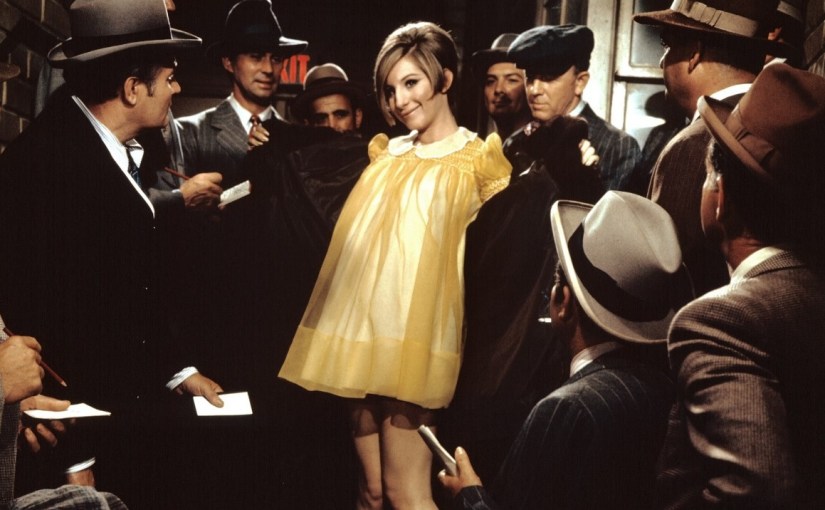
There is nothing wrong with Funny Girl that couldn’t have been fixed by the film not taking itself so seriously.  With its widescreen compositions and scores of extras and lavish stage productions featuring flocks of Ziegfeld girls in the most extravagant costumes imaginable, this should have been a romp, even with the serious bits in between.  Instead, the movie sinks under the weight of its pretentiousness, short-changing the funniest bits and wallowing in pathos way more than is necessary.  Thank goodness Barbra Streisand is there, giving a debut performance for the ages that is part Groucho Marx, part Debbie Reynolds, but mostly just Barbra.  Come for the spectacle, stay for the songs.

The story begins with Fanny Brice (Streisand) walking backstage at a theater and delivering her immortal opening line to a mirror: “Hello, gorgeous.”  From there, the rest of the movie is a flashback to the rise and rise of Fanny Brice, a plain-ish vaudeville chorus girl who is discovered by a roguish playboy, Nick Arnstein, played by Omar Sharif, who looks like a man whose last name would be anything BUT Arnstein.  He cleverly gets her boss to raise her pay to $50 a week (about $800 in today’s dollars, so not bad), and in the process captures Fanny’s heart.  Shortly after that, she’s invited to join Florenz Ziegfeld’s legendary troupe of dancing girls, where she manages to tweak his authority in probably the funniest number in the movie, “His Love Makes Me Beautiful.”

It’s in this number where the first tonal tug-of-war takes place between Streisand’s playfulness and the movie’s urgency to look “important.”  There is an earlier number, “I’m the Greatest Star”, that really showcases Streisand, but the movie never gets that tone right for the rest of the movie.  In “His Love Makes Me Beautiful”, she has these wonderful glances and occasional throwaway lines, but most of them are lost in medium or long shots that emphasize the extravagant Ziegfeld costumes and the expensive-looking set dressing.  It’s like watching a play where the lights are shining everywhere except the stage.

Arnstein comes and goes, sometimes for weeks or months at a stretch, always making sure to see Fanny when he’s in town but repeatedly pointing out that he doesn’t want to be tied down by a relationship.  Their “courtship” lasts through “People”, a song most people know without knowing what it’s from, and a curious number where Arnstein invites her to dinner in a private room upholstered entirely in red velvet, and we know and Fanny knows what’s going to happen, and she has a funny argument between her lust and her manners in “You Are Woman, I Am Man.”  The song also contains a duet with Arnstein, and brother, if you haven’t seen Omar Sharif crooning, you haven’t lived.

Everything comes to a head at the finale of Act One when Fanny learns Arnstein is sailing to Europe and decides to join him instead of going to the Ziegfeld girls’ next port of call.  Here is where Streisand really pours it on, proving her virtuosity with the classic “Don’t Rain on My Parade”, belting out note after note and ending on the iconic shot of her standing on a tugboat as it passes the Statue of Liberty.  If anyone ever doubted she was the real thing before that moment and this movie, their doubts were certainly erased by intermission.

Alas, all good things come to an end, and Act Two falls into a predictable series of economic rises and falls as Arnstein’s volatile income stream finally goes south permanently, while Fanny’s career continues arcing upwards without looking back.  It’s here where the pretentious sensibilities of the filmmakers finally take over for good.  In a second number that could have been downright hilarious, “The Swan”, the movie once again keeps its distance from Streisand’s (appropriate) mugging, asides, and pratfalls…although, being a ballet, it is interesting to see her doing all the dancing herself.

I found myself committing a critical sin by comparing this movie to another widescreen, elaborate movie musical from around the same era, My Fair Lady.  Here’s a movie shot on a grand scale with huge sets, lavish costumes, and big musical numbers, but instead of feeling ponderous, there is a lightness to it.  It zings along, even during the long stretches between songs, thanks to its crackling pace, and gives us just enough pathos to appreciate why we need glee and glamour.

Everything that’s wrong with Funny Girl could have been fixed by just lightening the mood, man.  You’ve got a star-making performance by an experienced theatre actress (Streisand is actually reprising the role she played on Broadway), you’ve got one of the most legendary directors of the time at the helm, William Wyler (Ben-Hur, Roman Holiday), and you’ve got some above-average songs that people can still hum over fifty years later.  Why cloak everything in this gloomy overcoat of affectation and heavy-handed emotional beats that we can see coming a mile away?

When all is said and done, Funny Girl is by no means a bad film.  Streisand is too good at what she does to let this movie fall by the wayside without recognition.  But without her, it’s easy to imagine this movie sinking into near-obscurity, yet another maudlin melodrama that crams 100 minutes of story into a 2-hour-and-35-minute film.  So, rather than mourn what could have been, let’s instead give thanks for what we’ve got: one of the last of the old-fashioned Hollywood musicals with a 24-karat-gold star at its center and a handful of memorable songs.  I suppose it could have been worse.  [insert shrug emoji here]

POOR THINGS

By Marc S. Sanders

A sexually explicit rendering of Mary Shelley’s Frankenstein is brought to life by Yorgos Lanthimos’ film, Poor Things.  The strongest element of the picture is certainly Emma Stone’s uncompromising performance as Bella Baxter.  It’ll at least get an Oscar nomination.  The film will likely collect an abundance of nominations as well for it’s fantastical imagination in art direction, garish costuming and makeup and directing.  Maybe there will be some accolades for Willem Dafoe and Mark Ruffalo as well.  The adapted screenplay of Alasdair Gray’s novel, written by Tony McNamara, is a contender too.  It’s already being hailed by many outlets as a top 10 picture for 2023.  Yet, I grew tired of the novelty, and bored with the excessive sexual exploits of Bella.

Bella was once a pregnant woman who deliberately plunged herself off a London bridge to escape her misery.  Godwin Baxter (Willem Dafoe), who Bella appropriately recognizes as simply God, discovers her lifeless body in time to conduct an experimental procedure.  Replace Bella’s brain with that of the unborn child she carries and raise her from there.  God is scarred and altogether bizarre, and recruits a medical student named Max (Ramy Youssef) to observe the reborn girl’s progression and behavior; a grown woman with that of an infant who is learning to speak, walk, eat, and behave for herself.  After a while it is decided by God that Max will become engaged to Bella.  However, another man enters the picture, Duncan Wedderburn (Mark Ruffalo), who convinces Bella to accompany him on a sojourn.  God permits the idea as an opportunity for Bella to learn what is out there and not restrict her.  It is at this point, that Lanthimos’ film transitions from a blue tinge monochrome photography to vibrant color as Bella and Duncan travel to destinations such as Lisbon, Alexandria, and Paris, where Bella abandons a destitute Duncan to join a Parisian brothel.  Bella sees opportunity.  She can earn money for allowing men to put their things inside her.

I could not help but think of films like Forrest Gump, The Curious Case Of Benjamin Button and even Pinocchio while watching Poor Things.  An unwise subject discovers an independence to witness how a world around her functions.  As she learns, she matures, and she realizes she does not need to be held down by any party.  Shelley’s monster also broke free of its master’s clutches, tried to acclimate itself, but was revolted against for its grotesqueness on the outside and simply for being misunderstood.  Bella does not encounter such a fate.  Instead, she discovers acceptance but only at what she’s worth monetarily speaking with a simple attraction limited to individual thought.

Poor Things is constructed in the narrative themes of Yorgos Lanthimos’ preferred way of filmmaking.  Just like The Favorite, it’s deliberately weird and proud of it.  Nothing appears conventional.  You could substitute the settings for Paris, London and even the cruise ship that Bella and Duncan travel on for set pieces in Wonka.  It’s all fantasy with an adoption of real-world locales.  I surmise Lanthimos excuses these outlooks as a perception of Bella.  The settings look like they were spawned from a pop-up children’s book.  It’s all so different but I found it to be tiring. If someone were to argue that it is inventive as opposed to another stale backdrop of London Bridge or the Eiffel Tower, I wouldn’t debate them. Yet, I was growing tired of the piece. 

Moreover, the second act of the film concentrates abundantly on Bella’s adventures within the brothel.  Bella discovers the comfort of self-pleasure.  Later, the sensation is enhanced by the possibilities of getting satisfied by the company of a man.  The audience chuckled.  So did I, but I also squirmed quite a bit.  Bella insists to God that she wants to “go adventure,” and God allows her his blessing.  Yet, I found these series of sexual encounters to be overly exploitive.  Nothing is held back on what Emma Stone performs for the camera as a concubine for one needy, stinky, and ugly gentleman caller after another.  She takes it the traditional way, the oral way, the way from behind and much more.  She is captured with S & M straps across her nude body and the Oscar winning actress goes all the way to sending the scenes home.  It’s as if Yorgos Lanthimos needs to deliver his point, but it’s not enough to try it once, twice, or even three times.  I get it already.  Bella is used for whatever fetishistic imagination the male mind can fathom and more importantly she thrives off of the stimulation. She happily recounts how a pineapple can be used in the bedroom.  It’s even better that she can get paid for this lifestyle.  It sounds amusing while I type this all out, but I was not entirely comfortable watching it either.  I’ve seen enough porn in my day to not be shocked, and I wasn’t shocked.  Yes, I was amused at times.  Look, I don’t have ice water running through my veins.  Eventually, though, I was just bored.

Godwin Baxter is an interesting character as played by an always reliable Willem Dafoe.  Early on, we see how in addition to his experiment with Bella, God has toyed with the ideas of blending different breeds of animals together.  Roaming his estate are the likes of a dog crossed with a chicken and a pig crossed with…you know what I can’t even remember after seeing the film only once.  There was also a duck crossed with something.  Kind of sophomoric material and I think Lanthimos would accept that observation as a compliment.  Oh yeah, there was a goat crossed with something too; was that the pig?  What I think lacks from Poor Things, however, is to probe if these kinds of experiments should even be conducted and I cannot recall a conversation that goes in that direction.  Max seems taken aback by what he witnesses but he never investigates further.  This is all most unusual (a serious understatement) and it’s hardly ever questioned. Even Jeff Goldblum tossed a contrary opinion at the idea of Jurassic Park.

I suppose I wanted more from Poor Things.  Beyond sexual pleasure and what can be gained from it, isn’t there anything else that naïve Bella has to learn about?  I guess in conjunction, she also learns how to earn a wage and a gumption to stand up for herself.  What about love and the fear of death?  What about what else occurs within the world around her?  What about loss, or betrayal?  As well, Godwin’s occupations never go further than what we see he is capable and daring enough to do.  How do others consider his experiments?  What residual effects stem from his accomplishments?

I’m glad I saw Poor Things.  I think I’d like to see it again actually because I may gain a greater understanding from the attempts the script strives for in accordance with Lanthimos’ vision.  I know this film is not for everyone, though.  It’s proudly peculiar, but its plodding in its glee to step very far over a line that most filmmakers wouldn’t dare go.  It has my salute for what it has set out to do.  Nonetheless, I’m not sure I’m a fan of the material it served, though.