UNLAWFUL ENTRY

By Marc S. Sanders

The boogeyman is dressed as a police officer!

In 1992’s Unlawful Entry, Jonathan Kaplan (The Accused) directs a well-played Ray Liotta as a psychotic cop named Pete Davis who is terrorizing a yuppie couple named Michael & Karen Carr (Kurt Russell, Madeleine Stowe). The Carrs experience a home intruder who puts a knife to Karen’s throat. Officer Davis offers comfort to the pair and happily volunteers the arrangements for a high-tech alarm system. The first mistake that Michael makes is sharing the password with trusty Pete. You’ll expect that to come into play later on. Maybe what inspired the password will work itself into the film as well. Hmmmmmm?????

It’s difficult for Pete to resist the obsession he has for Karen and so he begins a campaign to get Michael out of the way. First, he demonstrates his brutality by offering Michael the opportunity to senselessly beat up the home intruder for no other purpose than personal satisfaction. When Mike refuses, Pete finishes the job. Later, Mike makes efforts to keep Pete out of their lives. It’s hard to do that when a highly decorated cop is involved. Karen, his own loving spouse, won’t even truly believe Mike; neither will the police chief.

As Pete continues with his intentions, Mike’s credit cards are maxed out, he loses a high priced client that Pete has been talking to, parking tickets add up, and so on. Pete also appears at the house at inopportune times like when Karen is taking in a swim or creepily stepping into their bedroom while the married couple is having sex. Eventually, Mike is put out of the way when he’s imprisoned after being framed as a drug dealer. Now Karen is all alone for a terrifying third act that you’ve likely seen hundreds of times before.

Unlawful Entry is engaging while you’re watching, but it does not convey much. The happenings all appear probable if a deranged cop wanted to go through all this trouble. Therefore, Ray Liotta owns the picture. Yet, what did I learn here? Don’t call the police?

For Kurt Russell, this is the first of two “husband is being terrorized” roles for him. Later, Russell would headline the cast of a better film to fall in this genre called Breakdown. Still, I like Russell here. He starts out as a guy who is not capable of fighting for the sake of his wife. He regrettably admits that shame to Pete early on. Pete pounces on that advantage to win Karen. Later, the strength of Mike’s short temper followed by his fear push him to do what he must to protect himself and his wife.

Madeleine Stowe is a good actress. There’s just not much for her to do with this part. She’s the spouse who opts not to believe her husband’s concerns. If she did, there wouldn’t be much of a movie. The third act is all action and blood and falling down the stairs and running back up the stairs. It’s no surprise really. Though it is convenient that Michael is finally able to post bail and get home in time for a final confrontation with Pete.

One thing that kept echoing in my head though was that as good as Ray Liotta is (he’s very, very good actually; very primal and deceiving), he is terrorizing a woman named “Karen.” Every time he says the name Karen, all that comes back to me is the film Goodfellas where he more or less tormented and disrespected Lorraine Bracco known as, you guessed it, Karen. A rule should be put in place, Liotta can no longer be cast with other characters named Karen. His Karen quota is maxed out.

WITNESS

By Marc S. Sanders

Recently, I viewed The Last Emperor and one issue I had was that it was challenging to comprehend the in-depth culture of the people it depicted. I really wanted to learn and pass the final exam with flying colors. Sadly, this was an AP class that I just wasn’t qualified for.

Now that I have watched Witness for the first time in many moons, I can honestly say there is an approach where you can get absorbed in a thrilling crime drama while also appreciating the core values of the community the film focuses on, namely the Amish who reside in the state of Pennsylvania. It’s a much easier film to learn from. That’s for sure.

Peter Weir directed Harrison Ford to his only Oscar nomination to date. Ford plays police officer John Book, opposite Kelly McGillis as Rachel Lapp, a widowed Amish mother traveling by train from home to visit family. At a layover stop in Philadelphia, her young son Samuel (Lukas Haas, in one of the best child performances I’ve ever seen, so bright, observant and wide eyed) witnesses a murder committed by a decorated narcotics police officer (Danny Glover). When Book gets wind of who the cop is, all three of their lives are in danger and they are forced to flee and hide back at the Lapps’ home among the Amish community. Book, however, has taken a gun shot wound following an attempt on his life. The Amish see no choice but to heal him, especially at Rachel’s insistence.

Weir, with a marvelous script by Earl & Pamela Wallace and William Kelley, shows the intersection of two extremely different ways of life where an “Englishman’s” belief in aggressive tactics conflicts with the peaceful nature of people looking to never get involved with any other culture. A romance may seem inevitable between the two leads but it’s a difficult one to embrace. It’s truly forbidden, not simply by the elder Amish and their respective code, but both Book and Rachel know it can’t happen either.

Because we are aware of this forbidden romance that seems to break through anyway, there’s a terrific dance scene at night lit only by headlights within the barn. Ford and McGillis really shine through in this scene as it is the first escape from the fear they have for their lives and the code they honor and are reluctant to violate. It’s the best scene in the whole film. It presents possibilities for different people to interact despite the barriers that prevent such feelings and actions. They laugh and swing naturally. It’s a different kind of moment for Harrison Ford, unconventional when compared to a large majority of the action film roles he’s widely recognized for.

With a biting soundtrack of suspense from Maurice Jarre, Peter Weir also focuses on the theme of intrusion. When the climactic and certainly expected shootout sequence on the farm is to begin, it’s frightening and disturbing to actually see men in suits holding shotguns amid an unarmed society. There’s a masterful shot at dawn of the three men marching down the hill quickly approaching the farm. These aren’t cops being covert. These are cops storming a palace of peace and tranquility. It’s hard to watch because of the stain it leaves.

Josef Sommer is the lead dirty cop and he plays a great villain, truly an uncelebrated bad guy character, as the years have gone on. He’s a decorated officer who comes off with an intent that looks like it’s noble, until nobility will no longer work and intimidation has to set in. Weir shoots Sommer at a lower angle to give him an imposing height.

Ford is terrific. You see some of the Han Solo vibe in the character. He’s a tough cop after all, but then he transitions into an awakened man healed by the more primitive methods of the Amish and their drive to simply build and nurture. Another good moment occurs when Book contributes to building a barn with the other men. He shares lemonade with them. Assists with lifting the framework and hammering along. Two communities are no longer clashing. They are now blending.

McGillis is also very good in her role. She is determined to honor her background, but questions if she is capable of sin and defends her position later.

Witness gives an in depth look into the daily life of the Amish, literally how they farm, build and dress. Book wakes up with them before sunrise to milk the cow and he experiences what they endure from pesky tourists looking for photo ops. It makes for some funny moments as well as an opportunity to cheer for the stand he eventually takes.

Another funny moment is when Ford dons the Amish attire for the first time; it doesn’t exactly compliment him well at first. Book’s adaptability to his new community is awkward to grasp.

Witness presents a bird’s eye view into a very private way of living, and I saw a very large picture.

Beyond that, it’s also a crackling, good thriller.

THREE DAYS OF THE CONDOR

By Marc S. Sanders

Sydney Pollack is such a hero of Hollywood filmmaking. He was a terrific actor and a better director. As Three Days Of The Condor opens I got completely engrossed in its simple, yet frightening set up.

Joseph Turner (Robert Redford) arrives at his office where he works day to day as a “book reader.” He chats a little with his colleagues, jots a few notes down, and steps out the back door to pick up lunch for everyone. When he returns, he finds the entire office staff has been shot to death. This seems like a common day in the life of an Everyman, until it’s not. Alfred Hitchcock capitalized on this motif over and over again.

Turner makes a phone call and is asked for his code name, but before he reveals he’s known as “Condor,” he asks a very good question to the man on the other end of the line. Why is it so important that Turner reveals his code name, but the man he called doesn’t feel the need to share his own?

Having recently watched the film adaptation of The Firm with Tom Cruise, made almost twenty years after this film, I can see that Sydney Pollack knows how to not only build suspense very, very quickly but also how to maintain it too. Still, in both films the complications of the why and how become overbearing. With Three Days Of The Condor, it’s best to just watch the tight editing and well drawn characterizations all the way from Max Von Sydow as a disciplined assassin to John Houseman as the elder authority who relaxes himself with his tweed suit and bow tie behind a large table as the problems unfold. Cliff Robertson is Higgins, the contact for Turner. He’s serviceable in the part.

The entire first hour of the film is perfection; taut and gripping as we uncover what purpose Turner as a book reader serves, and for whom. The second hour found me feeling less engaged, regrettably. To aid himself, Turner kidnaps a woman shopping in a sporting goods store. Faye Dunaway plays Kathy Hale. He forces Kathy to take him back to her apartment where he hides out. Never would it occur to me that these two characters over the course of a day and a half would fall for one another and make passionate love. This is not that kind of movie, and yet there it is. Some producer must have said “Fellas, we’ve got Dunaway and Redford on screen. This is a no brainer.” Faye Dunaway is fine in the part. I bought that out of desperation Redford would hold her at gun point and force her to help. But, c’mon! Really? They gotta bang each other too????

As for the plot behind killing people, the film doesn’t work its way into car and foot chases. It relies on its wording. The problem for me is that Turner works it all out himself. There’s little reference back to earlier moments for an audience to connect the dots along with the hero. So when Turner realizes one of the motivations is in regards to oil trading, I was trying to figure when anyone said anything about oil to begin with. Revelations just seem to be pulled out of a rabbit’s hat at times. They could have said people had to be murdered because the price of milk went up by fifty cents, and that would’ve held about just the same amount of weight as oil. What ABOUT oil????? Nothing ever needed to be so explicitly discussed here.

Part of the fun sometimes in Hitchcock films, for example, is simply seeing the man unexpectedly on the run and then watching how he outwits his adversaries. Harrison Ford does that in The Fugitive. Tom Cruise did it in The Firm. Cary Grant did it plenty of times with Hitchcock. In this film, however, I never felt there was any need to explain. Once it tried to grow a brain, I thought sometimes less is more, because now I’m stuck feeling frustratingly confused amid a lot of convoluted mumbo jumbo, on top of an out of left field, unsubstantiated love sequence.

Three Days Of The Condor was one of the best, edge of your seat suspense stories I’d seen…until it wasn’t.

EVERYTHING EVERYWHERE ALL AT ONCE (2022)

by Miguel E. Rodriguez

Directors: Dan Kwan, Daniel Scheinert
Cast: Michelle Yeoh, Stephanie Hsu, Ke Huy Quan, James Hong, Jamie Lee Curtis
My Rating: 10/10
Rotten Tomatometer: 96% Certified Fresh

PLOT: A middle-aged Asian woman tries to do her family’s taxes with mind-bending results.


Every once in a while, a movie comes along that is so daring and original that any attempt to accurately describe it feels futile.  Scott Pilgrim vs. the World was one of them.  Being John Malkovich was another.  And now comes Everything Everywhere All at Once, a sci-fi action brainteaser that feels as if it were written by Terry Gilliam and Quentin Tarantino and directed by Stephen Chow (Kung Fu Hustle, Shaolin Soccer…two movies that also meet that “indescribable” criterion).  It feels like an episode of Black Mirror crossed with Jackie Chan and a dash of David Lynch and Terrence Malick.  If you can’t find anything to like in this movie, check your pulse.

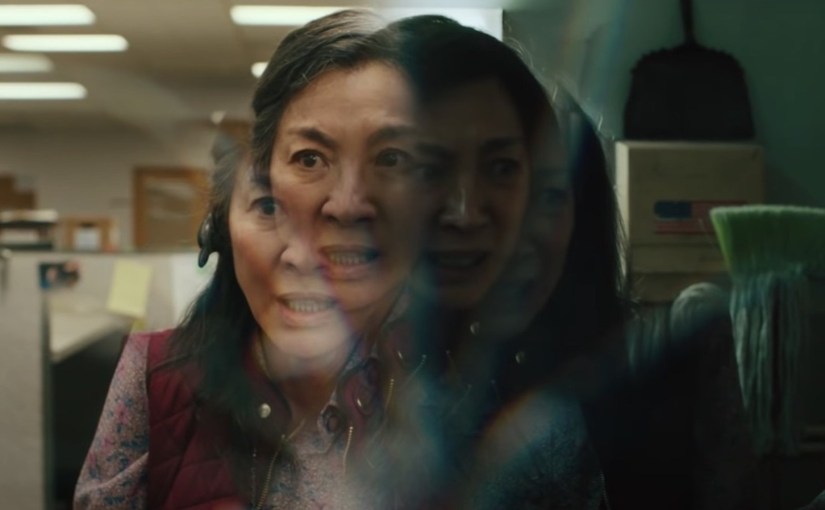
Evelyn Wang (Michelle Yeoh) opens the film trying to do her family’s taxes.  She and her husband, Waymond (Ke Huy Quan – “Short Round” from Temple of Doom!!), carry stacks and stacks of receipts to their local IRS branch and try to explain to their case worker (a dowdy Jamie Lee Curtis) how a karaoke machine can be deducted as a business expense.  However, before that can happen, after a series of very strange events involving Waymond and a pair of Bluetooth headsets, Evelyn finds herself immersed in a trans-dimensional battle between the forces of good, led by an alternate-universe version of Waymond – the “Alpha Waymond,” if you will – and someone called Jobu Tupaki, a being or person who is hunting for Evelyn in every conceivable parallel universe.  All Evelyn has to do is use these weird headsets to access the infinite multiverse and harness the skills learned by the infinite Evelyns before Jobu Tupaki can track her down and kill her.

To access the multiverse in such a way, one must commit random acts of…randomness, which leads to bizarre scenes of individuals doing some very weird things to access special skills.  What kind of weird things, you ask?  Things involving…sticks of lip balm, putting your shoes on the wrong feet, saying “I love you” to a stranger, or wiping someone else’s nose for them and…well, use your imagination.

That’s seriously just scratching the surface.  I haven’t even mentioned Evelyn and Waymond’s daughter, Joy; their laundromat; Evelyn’s elderly grandfather, Gong Gong (veteran character actor James Hong – 450 film and TV credits and counting); or the divorce papers Waymond has on his person.

This movie is a trippy, joyous, tightrope-walking masterpiece.  There are moments where you can sense it tap-dancing on the line of self-parody, then jumping over it and daring the audience to go along with it.  If there are some people that say they were unable to follow where this movie leads, I can’t really say I’d blame them.  Not many movies would ask you to take it seriously, then include a scene involving two rocks having a conversation via, I guess, ESP.  Or where the two lead characters turn into piñatas.  Or where Jamie Lee Curtis staples a piece of paper to her own head.  Or where the fate of the world might hinge on who gets their hands (in a manner of speaking) on a trophy shaped like…a very specific kind of toy.

HOT DOG FINGERS, people.  HOT.  DOG.  FINGERS.

I’m frankly amazed this movie didn’t collapse on itself.  There are so many ways it could have gone wrong, and so much it wants to say, while trying to be simultaneously massively entertaining and heartbreakingly poignant.

From a technical standpoint, I think it’s the frontrunner for the Best Film Editing Oscar for 2022.  This movie jumps from one parallel universe to the next and the next and back again so frequently that I got whiplash, BUT it was never confusing or mystifying.  It was always crystal clear what I was watching and why I needed to see it.  I could list any number of films or TV shows that have attempted this kind of thing on a much more modest scale and failed.  This is like the Who Framed Roger Rabbit of film editing.  It has been done so well and on such a grand scale that it seems unlikely anyone will try to tell this kind of story in the same way again.

Some may quibble at the mildly melodramatic resolution of the conflict among Evelyn, the “Alpha” universe, and Jobu Tupaki.  I can understand that viewpoint, but honestly, I just rolled with it when it came around.  And so did the theater audience I was with the night I saw it.  We all laughed uproariously on cue, sometimes for something funny, sometimes in sheer disbelief at what we had just seen.  But when the wrap-up started to come together, we all hushed and waited to see what would happen.  Even when it involved a parallel universe with something called Raccacoonie.  (It’s a long story…)

I hope I’ve conveyed how crazy good this movie is while preserving some of its best surprises.  I haven’t felt this urgent about getting the word out about a great movie since I saw Roma.  To call this an entertaining night at the movies does a serious injustice to the words “entertaining” and “movies.”  It’s more than entertaining and, not to get too hyperbolic, this is more than a mere movie.  It’s a masterwork, a collision of grand ambition and even grander moviemaking.  I plan on seeing it at least once more in theaters, if only just to see what I may have missed the first time around.  (And maybe also to tune more carefully into audience reactions at key moments, like the performance trophies, or those two rocks.  Who knew two rocks could be funny?  Like REALLY funny?)

FATAL ATTRACTION

By Marc S. Sanders

When Adrian Lyne’s Oscar nominated film hit theatres in 1987, apparently men thought twice about having an extra marital affair. It wasn’t enough that a man could violate the marital bond of commitment. No. Now he could get his loving wife and child killed.

Fatal Attraction works as a great psychological study for its first three quarters of film. Then it slogs its way into a slasher/horror fest of burned bunnies and gutting kitchen knife hysteria. The ending was an insult to the intelligence of everything we had seen before.

An unstable woman who knows she’s destroying a man’s happy home life is doing even worse by destroying herself. Mentally she cannot control what she commits and what she obsesses over. She is ill. This unstable woman is played by Glenn Close, and it is evident that she has done her research in psychopaths. Close is great at simply changing the inflection in her voice. In the beginning of the film, she has a relaxed whisper about herself as she exudes seductiveness.

Later, her tone is sharp, accusatory, patronizing, and intimidating. By the end, a new whisper of a psychotic personality threatens. The role is played by Close as if she is changing from one number to the next on a musical instrument.

The man in this scenario is worse. He gets his rocks off and tries to move on unaware of the collateral damage he leaves the woman with, and beyond presumption of how his break in trust will wreak havoc on his loving wife and young child. His moral crimes are nowhere near as apparent as the obsessed woman’s. At least she has evidence of a psychological symptom. He’s just an ignorant jerk when it comes down to it. Michael Douglas was just right for this role of a very successful lawyer with good looks and brash silliness with his friends and wife, while also being an attentive father. Yet, he’s also good at letting his guard down, foolishly assuming he can put it back up again once his weekend fling is over.

The film really is a duel in the aftermath of adultery. Disturbing phone calls, the demand for contact to stop, the nagging need for ongoing affection. It’s all orchestrated very well. Then, comes the crazy person who boils a bunny to generate a frightful scream from its audience followed by knives and blood and the last minute (SPOILER ALERT) “she’s not really dead” shocker. The delicate nature of a common and sensitive scenario is exploited for sudden jumps and terror.

James Dearden’s screenplay is so well thought out until it is executed desperately for box office returns in its last five minutes. Granted, Dearden had a different ending in mind, more appropriate to earlier references to Madame Butterfly. Hollywood decided to nix that plan and go with a more satisfying comeuppance for the villain, or rather one of the villains. What a shame.

Personal note: I’d seen Fatal Attraction before, but this is the first time I’m watching it in well over 11 years. I could never get myself to watch a late scene in the film where Close’s character takes Douglas’ daughter for a day of fun on a roller coaster. It was too real. Too disturbing. It was too easily done, and as a father it was too nightmarish for me.

THE DEVIL’S ADVOCATE

By Marc S. Sanders

The Devil’s Advocate does not get the accolades it truly deserves, and I’ve never understood why. It is more than just a supernatural thriller or a legal drama. It’s both actually, and most films cannot lay that claim.

Director Taylor Hackford has assembled a brilliant cast that boasts a debut from Charlize Theron in the incredibly complex role of Marienne, wife to Keanu Reeves’ hot shot southern drawled, Gainesville attorney. Theron hits every pulse perfectly beginning with loose, beautiful and cocky to insecure, haunted and victimized. When I first saw the film in theatres, I left believing she’ll get an Oscar nomination. Alas, the powers that be never gave her consideration and they were wrong. Beyond a relishing Al Pacino as the lord’s most infamous fallen angel, Theron’s performance sends the script home into absolute believability. The power of Satan is executed on Marienne, and the visual and audible evidence lies in Theron’s delirious performance. She’s astonishing.

Next up, Reeves is entitled to lots of credit. The role of Kevin Lomax is his best role (Ahem…Sorry, Neo. Sorry John Wick. Sorry Johnny Utah.). He carries a disillusioned swagger that he is as good as his record of trial wins implies. Yet, is he as good as the best of the best New York City attorneys? When you are the son of Satan, maybe so. What works best though are the ongoing tests of will for Reeves’ character. His inescapable hillbilly dialect blends perfectly with a script that questions temptation against instinct, against opting for what is right. At the time of release, Keanu Reeves might have been perceived as his surfer dude Bill & Ted character not be taken seriously enough here. I never let that be an interference for me, however. Reeves doesn’t compromise and he avoids the wholesome, God-fearing kid that Kevin Lomax is meant to be. Instead, his Christian teachings seem like a nuisance for him; an obstacle to a more satisfying life regardless of sin. Reeves balances the dimensions beautifully.

Then there’s the machine behind all this. Al Pacino is John Milton, hardly disguising his true identity. He’s too proud of who he is to do that. Sure Pacino is chewing the scenery. Yet, shouldn’t he? This is Mephistopheles he’s playing here; an entity ready to undo the will of the Lord. He carries no honor for God. However, he maintains a rule book and before he accepts a disciple, he’ll make certain that it is by the follower’s choice alone. He administers the test, but he doesn’t take it. Pacino gets the best lines and the best monologues. He’s treated with an opportunity to two step along to Frank Sinatra. He’s given free reign to operate based on his legendary career. He’s my favorite devil of any and all films.

Taylor Hackford is meticulous in his direction. There’s a great moment near the beginning where Kevin is saying goodbye to his God loving and very Christian mother. He goes to her church. This is the first of many smart choices for Hackford. He does not allow Kevin to step inside the church. Rather, he paces just outside the door. Kevin does not have a relationship with God, thus opening an opportunity for Satan. Other moments are there too, such as Milton always insisting on traveling by subway…underground. Heck, there’s even a moment where a man with a box that says “Halo Industry” walks by Kevin and John; nice subtle nod. New York City is treated like a character boasting its numerous, sky-high cathedrals and angelic artwork. Pacino is the ultimate NYC resident; a creature of the concrete jungle. Hackford also recruits the notorious to boost the lair surrounding Reeves and Theron with appearances from the likes of Don King and Alphonse D’Amato. (Satan’s disciples, perhaps?)

This is one of my favorite films. It carries not one single flaw. It is richly assembled in dialogue, story, cast, set design and direction.

The Devil’s Advocate is one of those films that you want to watch over and over and delight in Pacino’s thought provoking one liners, debate with your conscience vs Satan’s own argument (he makes some good points here) and question the power of free will. It’s a fun, thinking picture.

CAPE FEAR (1991)

By Marc S. Sanders

Would you ever think that Martin Scorsese could be a master of horror? I do. I thought so ever since I saw his remake of Cape Fear, back in 1991, featuring Robert DeNiro, Nick Nolte, Jessica Lange and Juliette Lewis. This cast of four is an astonishing assemblage of talent, complimented with players from the original film, Robert Mitchum and Gregory Peck, as well as Joe Don Baker, Fred Thompson and Illeana Douglas.

Wesley Strick is credited with this updated screenplay that questions the measure of sin; pot vs heroine, battery vs rape, flirting vs infidelity, as well as the ethics and justifications that we reason with every day.

DeNiro provides one of his greatest roles. He lost the Oscar in 1991 to Anthony Hopkins. Reader, DeNiro should have won for a much more complex, fleshed out part. He plays Max Cady, a man released from prison after a fourteen year stretch. His focus during his time was to learn how to read, build up his body, tattoo his flesh with the principals he inherited from the Almighty Bible and other literary sources, and most importantly reconnect with his defense attorney Sam Bowden (Nick Nolte in one of his best roles, as well). Cady needs to remind Bowden of how he was misrepresented during his trial.

Strick’s screenplay is so smart. Smart because the antagonist never, ever makes an error, not until the end of the story. Cady’s intelligence is always one step above anyone else’s intuition and with the literal mechanics of the law beside him, Cady’s tactics come off very believably. Cady might come off as hokey, hillbilly white trash with ugly polyester clothing, a slicked back mullet and a fat, offensive cigar but he is a smart hunter who will weaken his victims before initiating his attack.

Bowden is a smart lawyer but he’s at a loss, and he does not have the support he needs from his family to protect himself and them, Jessica Lange as his wife and Oscar nominee Juliette Lewis as his daughter. Lange is very good as a wife who has survived marital turmoil of infidelity from her husband. She’s a marketing career woman who does not succumb to Sam as being head of the household. Sam asks that the dog not be put on the table and Lange as Leigh Bowden scoffs at his concern.

Fifteen years old at the time, Lewis is astonishing as a young girl discovering her sexuality but unsure of what is appropriate; almost like a kid finding a loaded weapon in a closet. One of the greatest acting sequences in the last thirty years, occurs between DeNiro and Lewis alone on a stage set against a sinister lighted Hansel & Gretel set. Lewis twitches and stutters like any girl would, as DeNiro assuredly comforts her and seduces her into a touch that leads to a kiss. Scorsese uses this midpoint scene to quiet down an aggressively frighteningly film, meticulously edited by the legendary Thelma Schoonmaker. Before this moment, telephone rings, shutters, racket balls, car engines, aggressive close-up zooms, and Elmer Bernstein’s horn and string sections of his orchestra startle you and scare you when almost nothing terribly vicious has really happened. When we arrive at Lewis and DeNiro’s scene, Scorsese quiets it all down. He needs no devices for this exchange of disturbing, yet researched dialogue by Strick, blended with the performance talents he has at his disposal.

Another stand out performance belongs to Illeana Douglas in a small, early role. She plays a court clerk to Bowden’s lawyer and they are flirtatious. Cady uses this as an opportunity to remind Bowden that he must take his sins seriously. Douglas is supreme in an inebriated scene with DeNiro as she flirts with him and then goes to bed with him. We can sense the danger she’s in. Douglas’ drunken portrayal cannot. Never does she look like she’s foreseeing her immediate future.

It’s ironic, really. I can’t help but compare Cape Fear to any one of the various slasher films featuring Jason, Freddy, Michael, etc. Those guys stalk the house or are seen from the distance at the end of the street. Those are horror films as well where an entity stalks a prey. Scorsese really has that here with Strick’s screenplay. However, Scorsese finds other ways than to just have the menace be…well the menace. He offers up an overabundance of fireworks behind Cady as he sits in Bowden’s backyard. He’s got Bernstein’s blaring horns and squealing strings for soundtrack, of course. He colors the palette of the sky above Bowden’s doomed house in bruised purples and blood reds. He even changes the perception of the Bowden family by showing what they are looking at in a sort of X-ray/black light like state. Are they seeing what they think they are seeing? Sure, Cady is stalking them, but in a given moment, are they just being paranoid by the disturbances Cady has cemented in their consciousness?

I’d imagine these are filmmaking inventions of Scorsese not specifically featured in Strick’s script. That’s what makes Martin Scorsese a director above so many others. He doesn’t just settle for the page. He won’t necessarily manipulate the script, but he won’t settle to just leave it at only what he reads. Cape Fear is a demonstration in unsettling, visual terror, and it’s worth revisiting for a look.

THE 355 (2022)

by Miguel E. Rodriguez

Director: Simon Kinberg
Cast: Diane Kruger, Penélope Cruz, Jessica Chastain, Lupita Nyong’o, Bingbing Fan
My rating: 5/10
Rotten Tomatometer: 25% (…oof…)

PLOT: When a highly advanced technological googah falls into mercenary hands, a wild card CIA agent joins forces with three international agents on a mission to retrieve it.


I can’t speak for my colleague, Marc, but sometimes it’s harder for me to write about mediocre films than about films that are either outstanding or truly terrible. It’s harder to muster up the motivation to break down a movie that’s not bad or great, but merely so-so.

That’s the situation in which I find myself, sitting down here to write about The 355, a female-led action-thriller from director Simon Kinberg, whose previous writing credits are like a roll call of woulda-shoulda-coulda superhero movies: xXx: State of the Union, X-Men: The Last Stand, Jumper, X-Men: Apocalypse, the ill-fated 2015 reboot of Fantastic Four, and so on. (Full disclosure: he did write the 2005 comedy thriller Mr. & Mrs. Smith, which I believe is highly underrated, but that might be due more to the onscreen chemistry of Angelina Jolie and Brad Pitt than the script.)

The 355 (the title is explained only in the film’s final five minutes, so be patient) is standard Bond/Bourne stuff: an advanced technological doodad has surfaced and every bad guy on Earth wants it. It’s a fancy-looking USB drive that, once connected to any laptop in the world and properly decrypted, can access literally any network and/or mainframe in existence. As proof, the device’s inventor uses it to first crash a military transport jet flying overhead and then, as an encore, cuts the cable to his house. Personally, I would have reversed that lineup, but that’s just me.

(If this plot device sounds familiar, well, that’s because it is, as anyone who remembers the movie Sneakers will attest…but whatever.)

The device is stolen, and the good guys need to get it back before the bad guys do. Enter the main characters of the film: Mason Browne (Jessica Chastain) for the CIA, Marie Schmidt (Diane Kruger) for German intelligence, Khadijah Adiyeme (Lupita Nyong’o) for MI6, and poor Graciela Rivera (Penélope Cruz), a therapist who is in the wrong place at the wrong time. There’s some nonsense about them fighting each other at first, then banding together when they belatedly realize they’re on the same side.

The first major action scene is really well done, I have to say. There’s a foot chase through Parisian streets and subways that is as well done as any similar chase in the Bourne trilogy or any given Bond film. For that matter, ALL of the action scenes are competently executed…but that’s about it. There’s no flash or style, no real sense of originality.

There’s one sequence in particular that takes place in and around a fish-packing warehouse that, after a few minutes, became extremely muddled, and I lost track of who was chasing whom, and why, and how. The camera just seemed to be recording the action without getting me invested. It was curiously bland and detached.

The story itself was vaguely disappointing and unsatisfying, as well. It serves as the very definition of “by-the-numbers.” Virtually every cliche from better spy films are evident. The partner (Sebastian Stan) who’s dead…or is he? The trustworthy boss…or is he? The villain (Bingbing Fan) who lurks in the background…or is she a villain?

Now, there are uncountable films that have used these cliches to better effect, but it’s especially disappointing in The 355 because, throughout the movie, the story felt as if it was on the verge of talking about some truly interesting topics, specifically as it relates to women. There are subplots about how Mason, the CIA agent, has no personal attachments, while Khadijah, the MI6 agent, has a lover, and Graciela, the therapist, has a whole family waiting at home for her. Marie, the German spy, has some REAL problems that I won’t get into here. The story dances around the social perception of what women should or shouldn’t do with their lives. You want to be a secret agent full time? Okay, but you’ll get judged for not wanting to start a family. You want to start a family? Okay, but you’ll get judged for not being as professional or as dedicated as others in your line of work. You want to try to do both? Fine, but just when you think it can work, it doesn’t, so you should have come down on one side or the other. It’s a no-win scenario, and it happens all the time.

The movie dances with exploring this concept further, and then dances away in favor of more cliches and unnecessary plot twists. There’s even a whole sequence that feels as if it was lifted directly from one of the Ocean’s movies. Any one of them, take your pick.

There is also a moment when, out of NOWHERE, the stakes are raised in dramatic and horrifying fashion, so much so that it felt completely out of place. I was reminded, oddly, of a scene in the 2006 remake of The Hills Have Eyes where one of the mutant baddies slowly waves a gun over an infant in a crib. To me, it felt like overkill, and that’s the feeling I got with this off-putting twist. Was it necessary? It was shocking, true, and effective, but was it necessary? I don’t believe it was. I would have believed these women were motivated enough without bringing in outside pressure. And, to be honest, it felt like it was punishing those women who dared to have a life outside of their profession and rewarding those women who didn’t. No doubt there are other interpretations, but that’s how I saw it.

All in all, The 355 wasn’t downright unpleasant or super thrilling. It wasn’t exactly a waste of time, but it didn’t exactly blow my hair back, either. I don’t think it’s quite as bad as that Tomatometer would suggest, but…

Yeah…wait for streaming.

JAWS

By Marc S. Sanders

Steven Spielberg’s third film, Jaws, is more than just an adventure or thriller piece of filmmaking. I believe it explores the dichotomy of motivations by man versus the intrinsic behavior of nature. In other words, in the peak season of summertime a great white man-eating shark will never care about how important it is for a small harbor town to sell the necessary amount of ice cream cones or hotel bookings to make an annual profit. You wanna swim with nature, then die by nature.

The New England coastal town of Amity Island has a new Police Chief named Martin Brody (Roy Scheider). When he comes upon what’s left of a girl’s mutilated corpse on the beach, he takes it extremely seriously when he learns the cause of death was a shark attack. The Mayor (Murray Hamilton) cannot afford to be mired with the inconvenience of a large fish just before the always profitable 4th of July weekend. So, the beaches must continue to stay open.

When the town gets a bloody public viewing of the problem at hand, a young, wealthy, educated oceanographer named Matt Hooper (a perfectly cast sarcastic and smart Richard Dreyfuss) is recruited. His knowledge with the science of shark behavior is not very welcome to anyone but Brody.

One dynamic of Hooper is his reliability of technology. Will any of his expensive tools be enough to rid the town of this shark?

As well, will a bounty hunt worth $3,000 satisfy? Any Joe Blow fisherman will take a crack at it. Spielberg’s film explores Hooper’s intellect of sea life, against the buffoonery that follows from others both near and far. Why not randomly toss some sticks of dynamite in the water or bait the animal with a pot roast while you’re at it? Maybe that’ll work. It’s money and technology in the face of one of nature’s most dangerous creations.

Will a sea faring Ahab like fisherman named Quint (Robert Shaw playing one of the greatest characters ever on screen) do the trick? His philosophy stems from his experience with the might of sharks in general. An illustrious monologue from Shaw describing Quint’s harrowing experience aboard the USS Indianapolis confidently tells us he’s seen what sharks can do. He’s floated in the blood red waters that sharks leave behind. Therefore, Quint has devoted his life to hunting one shark after another, boiling their large jaws of teeth for trophy hangings. He’ll win battle after battle, but never will he win the war with the nature of the ocean water.

Brody might be the only sensible guy, though. He fears the water and won’t go near it. He’s over with danger, leaving the cop’s life behind in the city for what he expected of the tranquility of ocean front real estate.

A mounting pressure always exists in Jaws. The townsfolk are hard pressed resistant to allow their businesses to avoid prosperity because of something as silly as a shark that isn’t even known to swim in these waters normally. Money is what matters. Money is what’s needed to live. During the age of quarantining with the spread of Coronavirus, Jaws is a fair allegory for the argument of staying at home or going back to work. You could die, but it’s still expensive to live.

The other argument lies in what’s more appropriate for this problem. Hooper’s technology or Quint’s hunter instinct. A metal “anti shark cage” with a spear of poison vs tying barrels to the predator and drowning him out in the shallows.

Spielberg with a script by Carl Gottlieb adapted from Peter Benchley’s best selling novel proposes no easy answer to ridding an ocean area of a man eating, uncompromising animal. That’s the thrill that keeps Jaws alive for over 45 years. Sharks will never change. Man might, but nature’s creatures will consistently emote the exact same patterns of behavior.

Unlike the fantasies of Jurassic Park or a Friday The 13th picture, a beast born of nature with enormous strength will always be unpredictable performing on God’s purpose. It will never be negotiable. If you’re a raggy fisherman like Quint, your old, leaky boat might keep you afloat for so long, but a shark will also not feel intimidated, no matter how many others of its kind this hunter might have conquered before.

Experience, technology or disregard for the elements of nature will not always win. Something unconquerable will come along.

To maintain the strength of the film’s monstrous antagonist is to watch the movie with your own most frightening, worst case scenario in mind. Hence, Spielberg gratefully never shows the great white until long after half the film is over. Masterful shots occur where his cameras seem positioned just at the surface of the water. When swimmers make desperate runs for the shore, away from danger, it feels as if the viewer is frozen in fear and getting trampled on by the panicked extras cast in the picture. What could be so terrible that these people are swimming and running away from? When Spielberg finally shows the gigantic shark emerge from the water, Scheider’s shock with his suggestion of needing a bigger boat assure you that, yes, this problem is actually this insurmountable.

Additionally, Spielberg uses props to keep the mystery of his beast alive. When the shark pulls a dock off its moorings with his bait, we know the fish is turning around to pursue its next victim as the wreckage now floats in the direction of a man’s panicky, desperate swim.

Most effectively beyond Steven Spielberg’s camerawork, has got to be the pulse pounding and blood curdling soundtrack from John Williams. (Cliche descriptions they may be, but I’d argue Williams’ score created the terms, nonetheless.). Without his music, the narration of the story would be a little lost, I’m sure. John Williams’ repetitive string notes that build, feel like the dialogue of the underwater monster. His music goes beyond the short rhythm everyone is familiar with. Looking at the opening scene with Susan Backline portraying the moonlight skinny dipper in the opening scene of the film, Williams brings in a variety of different sounding instruments that leave an impression of her body being torn apart by something she’s truly not aware of. Splashing, screams, body thrusting and harsh chords of long strings with percussion the emote panic and anarchy make for one of the most memorable opening scenes of any film. Spielberg with a collaboration of cinematography from Bill Butler and Williams orchestration make for an arguably unforgettable and frightening scene on the same level of the shower scene in Psycho.

Jaws transcends generation after generation. Everyone eventually has some kind of familiarity with the film, even if they’ve never seen it. People have seen the poster, heard the music or truly refused to step in the water off a coastline out of fear for what can’t be seen. Few films ever leave a subconscious effect on a viewer or a general public, but Jaws is most definitely one of those exceptions.

THE SILENCE OF THE LAMBS

By Marc S. Sanders

Everyone remembers Anthony Hopkins’ memorable turn as the infamous Dr. Hannibal Lecter in The Silence Of Lambs.  He was “Hannibal The Cannibal;” a renowned and brilliant psychiatrist who was eventually captured for being the one who ate his victims with sophisticated glee.  The real attraction, though, is how director Jonathan Demme delivers the film adaptation of Thomas Harris’ best selling novel through a lens that only finds one strong heroine amid a sea of intimidating men.  The heroine is the intuitive, but petite Clarice Starling.  The men are nearly everyone else cast in the film, and I mean everyone all the way down to the extras; the extras, here, are a perfect example how necessary they are towards any film’s palette.

Ever since the film was released in 1991, the dialogue of Ted Tally’s script is worthy of repeating and mimicking in social circles.  Lecter remains spoofed in nearly every pop culture medium.  Hopkins’ character is unforgettable and he’s been ranked among the greatest film villains of all time with the likes of Darth Vader and Harry Lyme.  It’s a worthy honor.  His timing is subtle and mischievous while he remains silently dangerous.  You can’t take your eyes off the actor and you can’t erase the devilishly fun and evil character from your sub conscious.  Opposite this performance though is Jodie Foster in a top billing role as an FBI trainee named Clarice Starling, assigned to interview and maybe study Lecter as a means to a solid lead in finding a serial killer that has been identified in the media as “Buffalo Bill.”  Bill has been skinning and killing girls with large physicalities, around the east to mid-west portion of the United States.

So, there is a detective story at play here as Hannibal aids Clarice in her search for the killer, but only under his rules.  Demme paints the film with Clarice ably performing her job no matter the towering strength or perverted fantasies found in nearly any man.  An outstanding image early on shows her small frame entering an elevator.  She has been summoned to her supervisor’s office from the outdoor obstacle course.  She is sweaty, and looking tired.  The elevator is full of a dozen men in red uniform polo shirts that hug every muscle; they are strong, fit and healthy.  Clarice stands front and center and she has no reluctance to stand among this exclusive group.  Later in the film, Clarice is invited by her supervisor, Jack Crawford (Scott Glenn in a deservedly dark and quiet performance), to investigate one of Bill’s victims that turned up in the swampy waters of West Virginia.  The coroner’s examination room is filled to the max with sheriffs who believe they serve a purpose to stay there to witness what’s uncovered.  The strength of Clarice is really shown here as she shoos them away.  The men’s facial expressions tell us they don’t care for this request, but Clarice isn’t going to allow them to remain.  Most importantly are her encounters with the head of the Baltimore psychiatric ward that houses Lecter.  He is known as Dr. Chilton played by Anthony Heald.  Chilton – a great character name that clearly colors in the twisted perversion of this guy.  Chilton is happy to boast of his prized attraction, Lecter, as if he’s a rare tiger and he has no reluctance to hit on Clarice when she comes to visit with Lecter.  Always, Clarice will not allow herself to be succumbed, patronized or victimized by any of these towering figures of masculinity in what is unfairly regarded as a man’s world in law enforcement, crime or psychiatry.  Starling easily reminds Chilton that she was a student at the University of West Virginia, not a charm school.  With Tally’s script, Jodie Foster uses these deflective techniques of her character without effort.  Her methods of fencing with these men are a natural ability.  Even when she’s in film transition periods of training at the Academy, Clarice can maintain her stance against a hard-hitting male boxer pounding away at her boxing shield.  She just won’t fall over. As well, she doesn’t wince as the male students give her a glance from behind when she’s jogging on the grounds. 

Demme is an outstanding director who uses these interpretations of this woman to drive his film.  This very same year, 1991, Ridley Scott directed Thelma & Louise.  In that film, the title characters had to realize that they didn’t have to take any shit from a man.  They started out weak, though, and had no choice but to eventually get stronger.  Here, it’s already part of the woman’s instinctive nature. 

Hannibal Lecter is shown to be well versed in the finer things of art, literature, music and, forgive me, cuisine.  At one point, Demme focuses on a picture Lecter has sketched depicting Clarice in an almost angelic nature.  I’ve never forgotten that image.  Nearly all of the settings in The Silence Of The Lambs include stairways that always lead us in the down direction, to an assortment of various hells.  Clarice, the pure angel with nary a fault beyond limited experience as an FBI agent peels the onion away on her quest for a killer by entering into the treacherous depths beneath her; pits of hells.  The opening shot of the film has Clarice pulling herself up with a rope on an obstacle course as if she is ready to enter the heavens, ready to stand above everything, but then she is summoned to Crawford’s office located at the Department of Behavioral Sciences at the FBI.  She has to take an elevator down and then various stairways further down into a labyrinth of claustrophobic offices with no windows, surrounded by cinderblock and populated with men in uncharacteristic suits that don’t appear warm or cuddly.  Crawford may seem like her ally, but really, he’s using her as a sacrificial pawn on a chess board putting her in an arena with psychotically dangerous prisoners, in particular, the worst of them all, Hannibal The Cannibal. 

When Clarice goes to visit Hannibal, she is escorted by Dr. Chilton, who relishes in describing how careful he handles his prized thing, and willingly shows what this monster is truly capable of by providing an unwelcome photograph of how Lecter brutalized a female nurse.  This conversation is played upon a much more frightening descent of unlimited stairways and bars that clang loudly and are painted red and rusted, eventually leading to a stone walled dungeon for these unimaginable beings of death and perversion.  Clarice is left all alone to navigate her way down a long corridor until she reaches Lecter’s cell.

Yet, an even more frightening third descent into hell occurs in the final act as Clarice’s pursuit leads to Buffalo Bill.  Bill’s home is dark, lurid, filthy and maze like; but always seeming to go down further and further into one doorway after another and down one staircase after another, including a deep well where his latest victim is kept.  Like the other descents, Clarice uses her femineity as a tool of strength to survive.  I can claim without any hesitation that Clarice Starling is one of the greatest heroines in the history of film. 

The one man who rattles her, and weakens her, though is Hannibal Lecter.  Watch their tete a tete when they meet for the first time.  Starling demonstrates some overconfidence against Lecter’s seemingly polite demeanor.  With her white trash Virginia dialect, she even gets a little smarmy with the Doctor, but then he disarms her immediately with a comeback that shakes her very core.  Demme’s reliance on close ups for both characters serve this scene and others so well.  Clarice’s encounters with Hannibal are the most important and vital moments in the film because they are the only opportunities for Jonathan Demme and Ted Tally to show the main character’s weakness.  Every hero has to have a weakness if they are to remain compelling.  Clarice is not, in fact, undefeatable. 

The film could have simply worked as a basic detective story.  Put up the clues and the narration of the picture will eventually assemble all together for a resolution where the bad guy is captured.  Yet, Thomas Harris’ character creation uses Hannibal as a defiant obstacle blocking the path for Clarice.  Hannibal lacks much stimulation in a cold, specially designed prison cell.  He’s maybe only honored with impenetrable plexiglass to contain him as opposed to traditional bars.  He needs to be enthralled.  On the surface, Clarice appears as a frail prey that he can take his time munching on.  He’s happy to help Clarice catch Buffalo Bill with the case files she provides, but in exchange he wants to uncover what haunts her psyche.  Such a strong character Clarice is, but she has to be willing to weaken and expose herself to desperately find a dangerous killer.  Can she do it?  She’s never allowed herself to do that before.  And thus, we come to comprehend the obscure title of this film and the book it stems from.  (Anthony Hopkins actually thought it was a children’s fantasy when he was sent the script to read over.)

This write up is not necessarily a review, but a means to honor the careful film and storytelling technique that Jonathan Demme strives for with The Silence Of The Lambs.  You might say, yeah, there’s a lot of walking in this picture, but pay attention to the direction of the walking.  Always going down, somewhat reminiscent as Little Red Riding Hood entering a dark and spooky forest and encountering the biggest and baddest wolf.  Jodie Foster might be in a company of men here, but the film works as a dual of femineity vs masculinity.  It’s strange to believe that Demme actually had Michelle Pfeiffer in mind for the Starling role initially, a more than capable actress, but one who at the time was more glamourous (The Fabulous Baker Boys and The Witches Of Eastwick).  Beyond the silly Disney films, Foster was known for lurid pieces like Taxi Driver and her first Oscar winning role as a rape victim in The Accused.  Clarice Starling is a character beyond a pop culture appearance of the time, and Jodie Foster emanates that portrayal.

The writing of The Silence Of The Lambs is so intelligent.  There’s a witty, yet deliberately poor taste, of sarcasm to Hannibal Lecter as he thrives off his superior intellect over Jack Crawford and the FBI.  It’s only enhanced when he’s dealt a lowly, formally white trash female student to play with.  Ted Tally offers precise timing in the dialogue with Clarice and Hannibal.  Thomas Harris’ drive to further a cameo appearance of Lecter in a prior novel (Red Dragon) with this book is a gift to readers and eventually movie watchers.  The Silence Of The Lambs doesn’t follow formula with a Law & Order technique of ballistics and witness interviews.  It drives into other directions to feed its development. 

Jonathan Demme’s film is pioneering.  I recall seeing it in theatres with other high school friends.  I was not enthused to see it.  The title was too odd.  The picture was primarily a talking piece.  There were gross and unwelcome images within the film.  It’s very ugly at times.  I was frankly accustomed to the likes of Dirty Harry and Lethal Weapon films for my cops pursuing the robbers ideals.  I recall not even liking the film when we left, and I couldn’t comprehend its appeal that followed for the remainder of nearly an entire year, all the way up to when it was awarded the five main categories of Oscar wins (Actress, Actor, Screenplay, Director and Picture).  I definitely wasn’t accustomed to a strong character like Clarice.  Later that year, I saw Thelma & Louise and fell in love with their eventual triumph.  I needed to be spoon-fed their initial weaknesses at first.  Who was this Clarice in this picture, though?  I could not identify her strength that displayed right from the get go.  I wasn’t even 18 years old at the time and now I can say I just wasn’t mature enough for this film back in 1991.  Now, it’s thankfully clearer, though I still appreciate its subtlety so much. Jonathan Demme had such a clear vision of where he was taking this film and because it’s not dated, The Silence Of The Lambs stands as thriller, and an intelligent thought provoking piece that stays with you for a long time after each viewing.