SALTBURN (2023)

by Miguel E. Rodriguez

DIRECTOR: Emerald Fennell
CAST: Barry Keoghan, Jacob Elordi, Rosamund Pike, Richard E. Grant
MY RATING: 9/10
ROTTEN TOMATOMETER: 71%

PLOT: A scholarship student at Oxford finds himself drawn into the world of a charming and aristocratic classmate, who invites him to his eccentric family’s sprawling estate for a summer never to be forgotten.


What is Saltburn?

I sit in front of my keyboard and try to figure out a way to write a review of Saltburn that doesn’t spoil its surprises in any way.  I ponder.  I rack my brain.  As of this writing (January 2024), the film has already been released theatrically and in the public eye for almost three weeks.  Any avid filmgoer who hasn’t seen it has heard rumblings about some kind of dark undertones and risqué material in writer-director Emerald Fennell’s follow-up to her astounding debut film Promising Young Woman.  The trailers reveal nothing except a plot that seems almost too similar to another film released over a month ago, The Holdovers.

Having just watched it last night, I can say that Saltburn is a pure thriller, masquerading as a dark comedy about class warfare, heavily influenced by The Talented Mr. Ripley and, say, Howards End, but that’s just plotting.  With this movie, it’s all about style and delivery, both verbally and visually.

First, a plot summary.  Young Oliver Quick (nice Dickensian name), played by Barry Keoghan, is a scholarship freshman at Oxford University in the long-ago year of 2006.  Virtually friendless except for an antisocial math whiz, he notices the strikingly handsome Felix Catton (Jacob Elordi, unknown to me), a very rich…what, junior?  Senior?  Probably a senior.  People of all genders are attracted to him like bees to honey.  Oliver is instantly attracted to him, but that doesn’t stop him from making out with one of Felix’s paramours given the opportunity.  He is nothing if not opportunistic.

After a meet-cute involving a flat bicycle tire, Felix gradually folds Oliver into his flock of hangers-on, much to the dismay of Felix’s cousin, Farleigh (who is brown-skinned…that will be important later), and to Oliver’s math friend, who cryptically tells Oliver, “He’ll get tired of you.”  One thing leads to another, and Felix winds up inviting Oliver to stay at his – there’s no other word for it – palatial manor house, Saltburn.  There, Oliver meets Felix’s aristocratic, idiosyncratic family: Felix’s mother, Elspeth (Rosamund Pike); his father, Sir James (Richard E. Grant); his sister, Venetia (newcomer Alison Oliver); a “friend of the family”, Pamela (Carey Mulligan); and the creepiest butler since that guy in the men’s room with Jack Nicholson in The Shining.

Here at Saltburn, and at Oxford, Fennell proves to be a master at creating a certain kind of mood.  There is an air of…something in the offing.  You know how some animals supposedly know when an earthquake or a tornado is coming?  That’s what the movie feels like during its first half.  I kept expecting a gruesome murder to occur, or for Oliver to discover a literal skeleton in a forgotten closet, or an explosion, I dunno, something.  I don’t know how much of that is due to my expectations after Promising Young Woman and how much to the carefully modulated camerawork and editing, but either way, the mood was there, permeating the screen with a sense of foreboding.

Oliver revels in his proximity to Felix, and I remembered with some chagrin my own formative years as a geeky teenager.  Trust me, I recognize hero worship when I see it.  At Saltburn, they sleep in separate rooms with a common bathroom, but there’s no shower, just an old-fashioned bathtub in the middle of the room.  At one point, Oliver hears…noises…coming from the bathroom and takes a peek inside, where he sees Felix lying back in the filled bathtub and – well, I’m given to understand that in Catholic schools, it was called “interfering with yourself.”

And it’s here I must stop with any kind of summarizing.  It’s here where Saltburn abandons its masquerade as a comedy of manners and becomes something else entirely.  It’s still comic, in my opinion, but it becomes less about manners and more about Machiavelli.  Oliver may present a meek façade, but he reveals the ability to do some very quick thinking indeed, especially in a moonlit scene involving Felix’s sister, Venetia, and during a karaoke party when Farleigh suggests a song for Oliver to sing that hits a little too close to home.

I admired how the movie turned my expectations on their head…twice.  There were a couple of times when, I must admit, my conspiratorial thinking led me to a couple of conclusions that turned out to be right in the end, which is something I don’t really like to do.  I don’t like to be that guy who goes to see The Sixth Sense and thinks, “You know, I don’t see how Bruce Willis could have survived that gunshot…”  I want to revel in the mystery, to live in the moment of the film and let its surprises work organically.  When a movie does its job well, I don’t even have to think about it.

What’s cool about THIS movie is that I managed to pick up on little “clues” about what was happening, or about to happen, but as the movie progressed, other things occurred (especially Felix’s little field trip with Oliver), and I found myself thinking, “Nah, never mind.”  And that is pretty ingenious, I think.  To lead the viewer down the garden path, make a left turn, get back to what looks like the main road so you think you know where it’s headed, then to pull a sudden U-turn into something else entirely?  That’s masterful misdirection.  I dunno, I fell for it hook, line, and sinker.  Call me crazy.

I haven’t even really touched on what will no doubt be the most famous elements of this movie.  That would be the scenes involving the bathtub, the cycle of the moon, a surprise midnight visit, a freshly dug grave, and Oliver’s, er, choreographic inclinations.  With the exception of that last one, which occurs too late to mean anything to the plot except as a wonderful ribbon to tie it up with, these scenes were, yes, shocking, but not in a hostile way.  Or even a Hostel way, if you take my meaning.  They were not intended to disgust or horrify the audience.  Or perhaps they ARE meant to horrify, but not in the kind of way that a serious horror movie disgusts people, like The Thing or Hellraiser.  It’s very tongue-in-cheek.  I’d like to believe there was a certain kind of glee in Emerald Fennell’s face when she watched her actors performing those scenes, knowing the material might completely turn some people off to the film without hesitation.  I found them to be yet another example of misdirection.  The off-putting nature of those scenes sort of lulled me into thinking one thing was happening and that the movie would then follow that thread into a more predictable conclusion.  But it didn’t.

I know, I’m being maddeningly vague.  The movie is new enough that I don’t want to risk spoiling anything.  There are supposedly some moths that, once touched by human hands, can never fly again.  Or is that butterflies?  Either way, I don’t want to deprive this movie of flying high in the eyes of a first-time viewer.  It’s refreshing to see a movie that seems to be following all the mile markers towards one thing, when it was really leading you somewhere else.  Saltburn is a treasure.

IN THE LINE OF FIRE

By Marc S. Sanders

While watching Wolfgang Petersen’s In The Line Of Fire for about the umpteenth time, it occurred to me that good, solid action pictures work so well when there is at least one or two characters who suffer from a past trauma.  Recently, I wrote about John Rambo in First Blood where what haunts the character sets the story in motion.  In Petersen’s film, both the villain and the hero attack one another’s personal sufferings to stay ahead of a game that could result in the assassination of the President Of The United States.

Clint Eastwood is aging Secret Service agent Frank Horrigan.  He served on the team the day Kennedy was killed in Dallas.  A deranged lunatic who initially goes by the name of Booth (John Malkovich), a salute to Lincoln’s assassin, forces Frank to play hand after hand through disturbing phone calls he makes to Frank where he discusses his eventual rendezvous with death when he will finally kill the President.  Booth tests Frank mettle though.  Does Frank have the guts to take a bullet for the subject he is supposed to protect? 

In The Line Of Fire is a very effective thriller because of its lead performances from Eastwood and Malkovich – two actors of different ranges with very different personalities.  Eastwood is famous for being the quiet kind of hero in films like Dirty Harry and Unforgiven.  Malkovich is a character actor who hides within his roles, which is especially demanding of the character in this film.  It is hard to find two roles in his career that seem similar. 

Booth is a master of disguise.  Wolfgang Petersen takes more the one opportunity to show the endless possibilities of what Malkovich as Booth could do to alter his appearance.  The morphing of the digital composites-bald, hairy, thin, plump, glasses or no glasses-is a welcome disturbance.  Interestingly, the basic John Malkovich that audiences are familiar with does not even make an appearance until at least a third into the movie.  Prior to that he’s disguised as a hippie or Petersen has him concealed in dark corners where all that you are seeing are his eyes hiding behind a pair of binoculars. 

What holds your attention in a script from Jeff Maguire is that you learn more and more about the man called Booth as the story moves on, all the way to final act.  What would motivate someone to assassinate the most powerful leader of the free world?  The odds of accomplishing the act are enormous against the security and protection devoted to one person. 

You also witness the defeat that Horrigan endures as Booth stays ahead of him and torments him over his past transgressions. At first Frank is forced to recollect his past failures by what Booth brings up in one phone call after another.  Later, Frank gets the upper hand as his investigation uncovers more.  A later scene in the movie brings about a sensational exchange of dialogue between the two actors.  The agent also has to contend with a difficult supervisor (Gary Cole) and a Chief Of Staff (Fred Thompson) who carry no faith in Frank’s efforts and are more concerned with the President’s image versus saving his life. 

Clint Eastwood and John Malkovich are a terrific protagonist and antagonist. There are a few scenes the two actors share together but they arrive later.  Before those moments, much material depends on the phone calls they have.  So, they work well off each other without even being in the same room.  The characters come at one another with the demons they dig up and the responses from Eastwood and Malkovich appear very convincing.  Very effective work with script, direction, and performance.

The supporting cast is terrific too.  There’s a romantic angle that could have been filler, but thanks to a good matchup between Eastwood and Rene Russo, as another Secret Service agent, there are some humorous moments as well as tender scenes for the heroic agent who is approaching a dinosaur period.  Clint Eastwood is great to watch as a piano player in this film.  Watch as he plays As Time Goes By when Russo rejects his advances and wanders off for the elevator.   Shortly after, she succumbs and there’s a hilarious moment that pokes fun at what it takes to be an active agent.

Dylan McDermot is Frank’s younger partner.  He’s quite good, representing the fear that goes with being a man willing to take a bullet for someone else.  An opening scene presents a frightening moment for the character.  On a Clint Eastwood level, it works with the signature charm that most are familiar with, but from McDermott’s perspective it is something else entirely, helping to shape his character for the rest of the film.

The characters in In The Line Of Fire are not tough guys beyond dares.  They are conflicted.  They experience fear and hesitation.  They have pasts that haunt them as well, and the opponents use psychological warfare to weaken their enemy.

Because Maguire’s characters are so fleshed out, the suspense works nicely with Petersen’s direction and a recognizable Ennio Morricone soundtrack.  The ending is great, not just for the action and editing, but the tension is quite palpable as well.

In The Line Of Fire has magnificent performances. You get a clear picture of what is necessary to be in the Secret Service, all the way down from the department’s appearance while jogging next to a Presidential limousine while wearing a suit, to the process of preparations, and what heights Presidential protection strives for to stay ahead of endless threats that come their way.

Wolfgang Petersen’s film is thirty years old, and the technology and procedures within the governmental departments have assuredly been updated since its release, but this picture does not appear dated or out of touch.  This thriller still works.

ONIBABA (Japan, 1964)

by Miguel E. Rodriguez

DIRECTOR: Kaneto Shindô
CAST: Nobuko Otowa, Jitsuko Yoshimura, Kei Satô
MY RATING: 7/10
ROTTEN TOMATOMETER: 90%

PLOT: In feudal Japan, two women kill samurai and sell their belongings for a living. While one of them is having an affair with their neighbor, the other woman meets a mysterious samurai wearing a bizarre mask.


Squint your eyes, and long stretches of Onibaba look as if they were adapted from comic books.  I’m not talking about the eye-popping colors of Kirby, though.  More like the moody noir of Miller or McFarlane…especially Miller.  Extreme closeups, off-centered faces (to make room for word balloons, of course), sneering lips and bared teeth, gratuitous female nudity, shocking violence, the possibility of supernatural elements getting involved in the story – we’ve got all the makings of a new chapter for the Sin City saga.

But Onibaba misses its chance for true greatness by the disappointing nature of its ending, which I cannot, in good faith, describe in detail here.  The last time I felt this cheated by the ending of a film was when I watched the original Night of Living Dead for the first time.  When the credits for that movie rolled, I wanted to throw popcorn at the TV.  Since I didn’t have popcorn, I cursed out my friends instead.  C’est la vie.

The story of Onibaba begins as we see two women – one older, one younger – living in poverty in medieval Japan.  Some later exposition informs us of an ongoing war far away between two warlords.  Weary soldiers from both sides wander into the tall grassy fields where the women live, and the women promptly kill them, take their clothes and belongings, and sell them to local merchant for bags of millet.  (We never learn the women’s names, by the way.  They are identified only by how they relate to Kichi, a man we never see: one is Kichi’s mother, the other is Kichi’s wife.)  The bodies of the men they kill are disposed of in a large, ominous pit hidden by the tall grass.

I should mention yet another stylistic and visual flourish.  The two women live in a grass hut constructed in a vast field of tall grass at least six, possibly seven feet tall.  There is poetry in many shots when the wind rises and pushes the grass.  In one neat overhead shot, the only way we can see a man pushing his way through the grass is by tracking the hole he makes as he walks.  It’s an indescribably lyrical moment in an otherwise mundane scene.

ANYWAY.  A neighbor arrives, Hachi, with sad news for the two women: Kichi has been killed.  When he asks how the women got by during his absence, they are cagey.  It’s here where we get the first of many masterful sequences where faces and eyes are used to convey emotion more vividly than any prose could.  When Hachi propositions the young woman, now a freshly-minted widow, she sneers.  But as days go by, Hachi wears her down, and they begin an affair, much to the mother-in-law’s disapproval.

Night after night, the young widow wanders off to Hachi’s shack, while the mother-in-law sneaks off and follows her, disapproving but never interrupting their liaisons.  All she offers as a rebuke are stern words and resentful glares.  This cycle repeats itself several times, and despite the visually unique methods of showing us these middle passages, I found myself wondering where this was going.  No doubt people more knowledgeable than I can make conjectures about how this might be a representation of Japanese culture at the time: the old severely disapproving of the young, but powerless to stop the march of progress.  It’s not a far-fetched theory, but if so, it’s an obvious one.  So, what’s the point?

Hope arrives (story-wise) in the form of a tall samurai warrior the mother-in-law encounters in the tall grass one night.  He wears a fearsome demon mask and demands the old woman show him the way to the nearest town.  She asks him to remove the mask.  He refuses, but he assures her that he is very handsome underneath.  Right.

At this point, I was on the edge of my seat.  At last, here we go, some real horror-story stuff.  The mask looks awesomely horrifying, not like the kind of demons we tend to think of, but a weird, bug-eyed, fanged face that still looks vaguely human, which only makes it that much creepier.  When the old woman finally gets her hands on the mask (I won’t say how), she formulates a plan.  The next night, when the younger woman sneaks off to another rendezvous with Hachi, she is confronted by a tall figure with long black hair with the face of a demon…gliding through the grass is if it were floating over the ground.  Floating?  People can’t float.  …what exactly is going on here?

At this point, I was primed for a Twilight Zone kind of twist, revealing the true nature of the samurai warrior, the mask, and the old woman.  (Onibaba translates to “demon woman”, according to the main titles of the movie.)  But what?  I was pleasantly surprised by my eagerness to see what would happen next, even if it were mildly predictable.  The movie had shown great visual flair, so even if the ending was a cliché story-wise, it would look really cool.

But…alas.  The film’s ending teases us with several minutes of truly disturbing stuff psychologically, and then throws it away in a moment of ambiguity, the kind of open-endedness that may inspire discussions on the movie blogs, but which is terribly unsatisfying when it doesn’t work.  And here, unfortunately, it doesn’t work.  It leaves us with more questions than answers, and when “The End” appears, it almost feels like the director and/or screenwriter said, “That’s it, I’m out of story.”

The liner notes of the Criterion Blu Ray for Onibaba inform me that it’s based on an ancient samurai legend, so I guess I can’t totally blame the director/screenwriters.  But I just wish there had been something meatier waiting at the end of what had been a visual treat.  If it had provided a nudge into something deeper or more visceral, I’d have been ready to put Onibaba near the top of my favorite Japanese films.  Visually, it’s stunning with a surprisingly modern feel.  But, oy, that ending.

WHAT EVER HAPPENED TO BABY JANE? (1962)

by Miguel E. Rodriguez

DIRECTOR: Robert Aldrich
CAST: Bette Davis, Joan Crawford, Victor Buono, Maidie Norman
MY RATING: 9/10
ROTTEN TOMATOMETER: 92% Certified Fresh

PLOT: A delusional former child star torments her paraplegic sister in their decaying Hollywood mansion.


I have heard of this movie by reputation almost my entire life, and only now, near the end of my 52nd year on Earth, have I finally sat down to watch What Ever Happened to Baby Jane?, a movie that has been called a camp classic, a horror film in the guignol tradition, and a showcase for two of the greatest bitches in the history of cinema.  And let me tell you, it was worth the wait.  Bette Davis’s performance as Baby Jane Hudson is the stuff of legend: evil, despicable, vile, and impossible to look away from.  She doesn’t just chew the scenery, she purees it.

And yes, before faithful readers get up in my grill, this is one of the slowly growing list of films where the main character is an absolute douchebag, and I not only tolerate it, I celebrate it.  It’s impossible not to.  Like Christian Bale or Jack Torrance, Davis hypnotizes viewers by so perfectly embodying the character that it becomes impossible to imagine anyone else playing it.  It’s been said that at one point, Joan Crawford was going to play Baby Jane, but as talented as Ms. Crawford was, I can’t imagine her improving on Davis’s fearless performance.  This is the very definition of “commit to the bit.”

If you’re like me before I watched the movie, you know the bare bones of the story.  Back in the heyday of vaudeville, Baby Jane Hudson with her golden curls was the darling of the stage, entrancing audiences with her heartbreaking rendition “I’ve Written a Letter to Daddy.”  Her slightly older sister, Blanche, was ignored by her talented sister and, tragically, her father.  But karma is a bitch, and in the early-to-mid-1930s, Blanche becomes a Hollywood superstar, while Baby Jane toils in obscurity, clearly an inferior talent to her celebrated older sister.

One night, there is a terrible “accident” in front of their house (an old Hollywood mansion that once belonged to Valentino), and Blanche is paralyzed from the waist down.  For the next thirty years, Blanche is confined to a wheelchair on the second floor of their mansion, while the delusional Jane, who in her late sixties still wears her Baby Jane makeup and curls, dutifully brings up Blanche’s meals and verbally abuses her.  Their part-time maid, Elvira (Maidie Norman, unknown to me, but quite good in a pivotal role), discovers a trove of Blanche’s fan mail…opened and discarded by Jane.

How to describe these scenes of emotional and verbal abuse?  The words that come out of Jane’s mouth are as harsh as you can get in a movie from 1962.  (In one scene, watch her mouth carefully, and you can see her call Blanche a “bitch” just as a buzzer drowns out her voice.)  But because Blanche, with the patience of a saint, puts up with it, we the audience are forced to accept it.  I mean, I wanted to punch Jane in the face about 30 minutes into this two-plus-hour movie, but I had to tough it out because Blanche is toughing it out.  At that point, I just wanted to see what kind of karmic fate awaited this intolerable harridan.  I wanted her to get trampled by horses while being drawn and quartered by four tractors.

But this is just summary.  I’m not doing the movie justice.  For a 61-year-old movie, it felt just as tense and thrilling as anything I’ve seen in theaters this or any year.  The term “camp” I absolutely disagree with when applied to this movie.  Camp occurs when someone genuinely believes they’re making a great film, and the result is so laughably bad it’s good.  Ed Wood is camp.  Reefer Madness is camp.  Troll 2 is camp.  But NOT What Ever Happened…  Director Robert Aldrich knew what a casting coup he got with Davis and Crawford in the leads, two actresses whose well-known feuds were constantly reported.  All he had to do was turn them loose on the script and keep the cameras rolling.  Rather than getting a movie that got overcooked by hammy histrionics, Aldrich got a top-notch thriller that keeps audiences off-kilter right up to the last five minutes.  That’s not an exaggeration.  As such, this cannot qualify as “camp” because the result was not a bad movie, but a brilliant one.

The different ways in which the screws get turned in such a claustrophobic thriller are ingenious.  Blanche has a pet parakeet that flies away while Jane is cleaning the cage…so she says.  Jane serves dinner to Blanche one day, always with a covered dish, and just as she walks out, she casually mentions there are rats in the basement.  Blanche and we look with horror at the covered dish waiting on her table.  Blanche tries to send a distress signal to their next-door neighbor; the way THAT scene plays out would have warmed the cockles of Hitchcock’s heart.  Blanche discovers that Jane has been practicing forging Blanche’s signature…UH oh.  One day the maid, Elvira, sees too much, and I found myself yelling at the screen when it becomes apparent her life is in danger.

The whole movie works on you like that.  I did a lot of yelling at the screen, just like your stereotypical rude audience member.  At one point, Jane has lied and lied and dug a hole so deep she can’t find a way out, and she pleads to Blanche, “Help me, Blanche, I don’t know what to do!”  The things I yelled at the screen at that point, I will not repeat here, but they involved words that rhymed with “witch”, “ducking”, and “blunt.”  That’s how well the movie got under my skin, in a good way, I should hasten to add.

What Ever Happened to Baby Jane? is one of the finest thrillers I’ve ever seen.  I hesitate to call it a horror film because, in a way, I guess it transcends the horror genre.  It includes some occasional horrific imagery, but the movie is too complex, too rooted in real-world physics and situations for me to see it as a horror film.  It’s a domestic thriller that flirts with self-indulgence, but the performances are so good, we forgive it when, for example, Jane performs her old Baby Jane number, her voice croaking on the high notes like a frog on helium.  In any other movie, I can imagine people would shake their heads and mutter, “Oh, brother…”  In this movie, we still shake our heads, but in awe of an utterly unafraid actor.

As for why I give it a “9” instead of a “10”…ask me after watching it yourself and I’ll tell you.

SEVEN DAYS IN MAY (1964)

by Miguel E. Rodrigugez

DIRECTOR: John Frankenheimer
CAST: Burt Lancaster, Kirk Douglas, Fredric March, Ava Gardner, Edmond O’Brien, Martin Balsam
MY RATING: 9/10
ROTTEN TOMATOMETER: 91%

PLOT: United States military leaders plot to overthrow the President because he supports a nuclear disarmament treaty, and they fear a Soviet sneak attack.


Barely two years after The Manchurian Candidate shocked audiences, director John Frankenheimer delivered the goods again with a political conspiracy thriller that is the equal of Candidate in almost every way.  Were it not for some overcooked sermonizing during a transitional scene, I would almost call Seven Days in May a perfect example of the genre.  I’m frankly a little surprised it’s not mentioned more often in the same breath with other similar thrillers like Fail Safe, The Parallax View, and Three Days of the Condor.

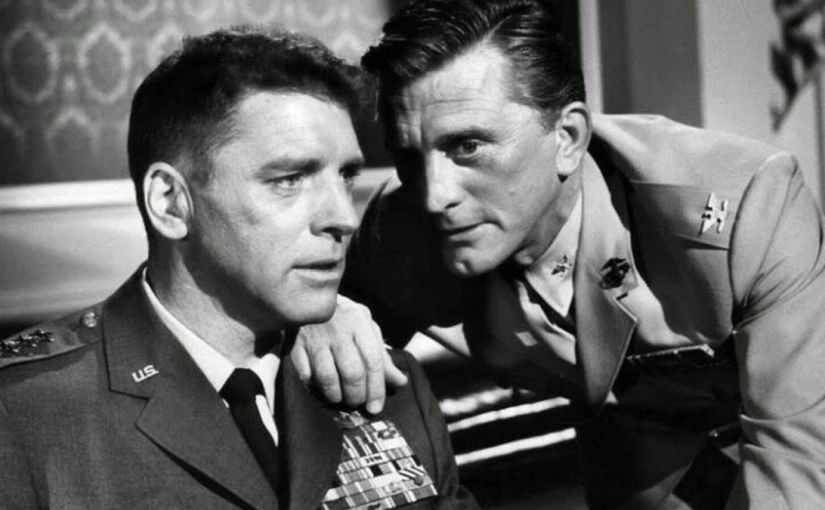
The action starts on a Monday and, predictably, spools out over the next seven days.  We learn that the current American President, Jordan Lyman (Fredric March) has just signed a nuclear disarmament treaty with the Soviets, this being the height of the Cold War in the early 1960s.  His actions have brought his approval ratings to a record-setting low, and demonstrators outside the White House express their desire to see someone else in the Oval Office: General James Scott (Burt Lancaster), a hawkish individual who sees no evidence the Russians will ever honor such a treaty.  General Scott’s aide is Colonel “Jiggs” Casey (Kirk Douglas), a soldier who disagrees with Scott’s views privately, but who knows his duties and performs them admirably.

Over the next couple of days, Casey picks up scraps of conversations from senators and other generals critical of the President.  There is talk of the President attending an “alert”, or an exercise in which armed forces are scrambled in a drill; uncharacteristically, he’s attending alone – no press.  A friend of Casey’s mentions something called “ECOMCON”, a secret Army base in El Paso, and a mysterious “Site Y.”  A Pentagon messenger relays a teletype message from General Scott to other members of the Joint Chiefs about who’s placing bets in the Preakness pool…then gets transferred to Pearl Harbor.  Casey wonders why questions about a horse race would be broadcast over Top Secret channels…

Watching Casey piece the clues together is one of the pleasures of this movie.  It never talks down to the audience, depending on them to follow Casey’s line of reasoning while he draws his own conclusions.  Once he brings his suspicions to the President, and the President elects not to attend the alert, things start happening very fast.  It’s here where the height of suspense occurs, as three men are sent in different directions to accomplish three separate fact-finding missions.  As each man got closer to achieving their goal, there was a feeling in the air, a vibe, a tone that felt like disaster was just around the corner, knocking on the next-door window.  A man drives his car into the desert in search of the secret base in El Paso, and I half-expected the sands to just open up and swallow him whole.

Frankenheimer always was an expert at that kind of suspense generation.  Second only to Hitchcock among his contemporaries, he was a genius at creating tense situations with a minimum of flash, depending on strength of story and screenplay, and his actors, to generate a nervous tension in his viewers.  Those powers are on full display here.

It’s odd…Seven Days in May is a political thriller that doesn’t have any real action scenes or sequences.  A plane crash is referenced but never seen, as opposed to today’s films that would make room in the special FX budget to show audiences the crash.  At least in this film, it’s far more effective when it’s revealed but never seen.  That’s pretty gutsy.  There are no pumped-up chase scenes between a guy with crucial evidence and the shadow forces trying to keep it a secret.  It’s all handled very simply, which makes everything more plausible…and, as a further result, much more suspenseful.

I haven’t mentioned Ava Gardner’s character yet, Eleanor Holbrook, a former lover of General Scott’s.  How she figures in Casey’s plans to uncover evidence of Scott’s treason leads to a devastating scene involving old love letters and mistaken assumptions.  It’s some brilliantly incisive writing, and another example of how the movie achieves plausibility through simplicity.

Any further discussion would necessarily involve spoilers, so I’ll stop here.  Seven Days in May is a prime example of a good story told well, with hardly any bells or whistles.  It reminded me, for some reason, of some of those classic ‘80s thrillers where their only reason for existence was to turn up the tension without getting bogged down in subtext (Body Heat, No Way Out, Blow Out).  There is that one sermonizing speech, as I mentioned before, and I cringed a little when it happened, but it’s a minor quibble.  This is a superior thriller that deserves to be seen.

SEA OF LOVE

By Marc S. Sanders

Al Pacino is a twenty-year veteran New York City cop, working out of Manhattan, on the trail of a serial killer in Sea Of Love.  The profession is nothing new to Pacino’s repertoire of roles, but the portrayal is unique thanks to a smart and suspenseful script from Richard Price and intense directing from Harold Becker.

The killer leaves a calling card.  A 45 LP record of Phil Phillips ’50s classic crooner, “Sea Of Love,” spinning on the turntable.  The victims are naked men lying face down in bed with a bullet to the head.  Turns out that a cop from another precinct played by John Goodman has uncovered a similar crime scene in Queens.  So, the two team up.  They believe the murderer is a woman.

All the victims have posted a Lonely-Hearts Club blurb in a magazine. The invitation for a date stands out because the text rhymes.  The detectives decide to post their own ad in the same kind of format, meet the women who respond and hope to nab the killer.  It gets complicated when Pacino encounters a breathtaking and sultry woman played by Ellen Barkin. 

Pacino’s cop is a smart guy.  He’s got instincts.  Yet, perhaps due to his constant drinking, insomnia, and the bitterness he carries now that his partner (Richard Jenkins) has hooked up with his ex-wife, he’s also quite vulnerable.

The mystery is strong, and the tension builds as Sea Of Love moves on.  Barkin has Pacino and the audience convinced that she’s the prime suspect.  Still, he lets his defenses down because he’s easily getting seduced by her advances.

Whether you’re watching Al Pacino share scenes with John Goodman or Ellen Barkin, the execution is fantastic.  Great performances from the three.  Pacino and Goodman have a natural exchange with one another. Often humorous, but the guys always talk like cops.  When Pacino admits to tossing away a fingerprinted glass from Barkin, Goodman suggests lifting the prints from something- ahem – more personal of his.  A cute wink and nod exchange.

More important to the film is the erotic chemistry between Barkin and Pacino.  Harold Becker uses a late-night supermarket visit in the vegetable aisle to evoke the risky and irresistible nature the two characters develop for one another.  Other scenes build well on the relationship between these two lonely strangers who’ve only recently met. 

Moments of isolation and drunken stupors also work towards fleshing out Pacino’s burned out cop.  He’s got a schleppy posture to him and an exhausted expression with his sullen eyes and shaggy black hair.  At the same time, his character’s twenty years of experience seem to uphold his alertness.  This cop knows he’s letting his guard down. Without any dialogue, you see the internal struggle Pacino has with what should be done against what he is deliberately neglecting.

This film was Ellen Barkin’s breakthrough role.  She received rave reviews as someone who takes care to uphold a New York City trendy appearance by day as a shoe salesperson in contrast to a woman looking for some carefree lust in the evening.  For Pacino, Sea Of Love reinvigorated a career slump following a series of poorly reviewed films.  Together, they make for a sexy yet untrusting pair.

Circumventing this relationship is the mystery.  Is Barkin the culprit? She seems to have a dark way about her that may not surprise you.  Price, Barkin and Becker designed the character quite well for her to at least have the potential to be a killer of men.  Is she setting Pacino up to be the next victim?

New York City from the late 1980s looks great, even though interiors were shot in Toronto.  Trevor Jones offers a nail-biting soundtrack to keep the suspense heightened at just the right beats of the picture with Becker’s camera pointing down dark hallways or when new clues are discovered.

I’ve seen Sea Of Love a few times and even with knowing the surprise ending, the film still holds up thanks to the performances from its three stars, along with its taut editing, well-paced writing, and smart direction. 

This is a good erotic murder mystery.

THE MEAN SEASON

By Marc S. Sanders

I get caught up in movies focused on serial killers.  As an actor, I imagine it must be fun to portray a deranged psychopath like Norman Bates or Hannibal Lector, or maybe even John Doe from Seven.  On the other hand, maybe not because an effective screenplay needs to be nearby.

The Mean Season from 1985 has an effective premise but that’s where the positives of the picture stop.  Kurt Russell portrays Malcolm Anderson, a burnt-out reporter for the The Miami Journal.  He is the paper’s most reputable writer but just as he is ready to resign and move to Colorado with his loving girlfriend, Christine (Mariel Hemingway), he’s tasked with writing an article about the murder of a teenage girl on the beach.  Soon after, he’s getting phone calls from the killer himself, played by Richard Jordan whose face is concealed through most of the film by his hand holding a telephone.  The killer insists on only maintaining communication with Malcolm and no one else, especially not the cops.  He relays that the city of Miami can expect four more murders.

The title of the film stems from south Florida’s well known weather variations that occur at the start of hurricane season, primarily in July.  That does nothing for me, but the title alone sounds marketable enough for a thriller.  Almost sounds like a Stephen King novel.  The Mean Season!!!!!  Unfortunately, that’s all that this movie has to rely on, even if Kurt Russell is doing his best like he always does in better suspense movies like Unlawful Entry and Breakdown.

The fault with The Mean Season resides with the director’s amateurish approaches.  Fifteen minutes into the film, with the story hardly in motion, a nude Christine is taking a shower.  The haunting music begins and suddenly the shower curtain is pulled for Malcolm to deliberately startle his girlfriend.  So, we have the Psycho salute.  Check!  Later, following an argument between the two lovers, Malcolm gets in his car and is startled by Christine coming up from behind in the backseat. Ha!!!! Okay and there’s the Halloween nod.  Another check!  I bet these cheap tactics were not even written in the script.  Director Phillip Borsos (never heard of this guy before; doesn’t surprise me) must be so insecure in his skills behind a camera that he just goes for duplicative tripe.

Threats to the couple elevate as the film moves on and when Malcolm gets wind of Christine being in danger, he’s in his Mustang racing to her.  The cops (Andy Garcia, Richard Bradford) are right behind him, and no one thinks of summoning a squad car to where Christine is expected to be?  Of course not.  If they did, then we wouldn’t be treated to a clumsy sequence where an elevated bridge gets in Kurt Russell’s way forcing him to make a leap across the gap and come down on the steep other side and continue his foot race.  Kurt Russell really looks stupid in this moment, and I’m sure he was thinking I can not believe I agreed to this.

As with any of these movies, there is a just when you think the bad guy is dead, there he is again.  No wonder we didn’t get a long enough closeup on the corpse found in the dense Everglades.  However, we get treated to seeing a long, meaningless sequence of Kurt Russell being a passenger on a swamp buggy.  Big deal.  Does this enhance any kind of suspense?  Does it move the story along?  The director got access to a couple of swamp buggies and a day of shooting in the Everglades and said we gotta get this in here.

The final fight is as moronic as the rest of the picture.  Richard Jordan and Kurt Russell are going at it in the living room while a hurricane rages outside.  Mariel Hemingway just sits on the sofa and watches.  She just watches.  She doesn’t reach for a kitchen knife or a vase to smash on the bad guy’s head and help her poor boyfriend.  We just get a sad excuse of a damsel who is not in distress. 

Thankfully, Kurt Russell’s career survived this junk of standard jump scares and shortness on intellect. 

As I’ve said before in other columns, there was a better movie here.  There could have been a movie that explored the endless hours that an investigative reporter must endure.  His editor and photographer (Richard Masur, Joe Pantoliano) could have shared the heightened fear and suspense.  The cops on the case could have applied more pressure and/or assistance to the reporter.  They don’t even tap his phone to trace where the calls are coming from.  In 1985, I think they already had the technology to do that.  A tape recorder was used though, and the audience not only gets to listen to the conversations once as they are happening but then again as the characters listen to the tape.  Why?  Is there something I missed the first time I heard Kurt Russell say hello?  This is filler crap. 

A better movie would have pursued what motivates this killer we hardly get to know.  We should have learned more about this guy because he’s the one making the phone calls.  So, it is obvious he wants to be heard.  However, the guy has nothing to say of any significance.  Even a psychologist who’s recruited for one scene doesn’t make any observation that gives me, or the characters in the film, pause. 

The Mean Season is an “I got it!” film.  It’s where the director gets his big break and declares “I’ve got it!!!!  We’ll do Psycho and then we’ll do Halloween.  Gotta make sure we see Marial Hemingway topless.  That’s definitely at the top of the list. Oh yeah, and then we’ll get swamp buggies and can we get some wind and rain machines for a really, really, really mean—I mean very mean—season!”

PROMETHEUS

By Marc S. Sanders

In 2012, Ridley Scott was well established as an elite film director that I’d argue could pick and choose what projects he would want to work on.  So, the question is was it worth the opportunity to return to the Alien franchise that had been established back in 1979?  Following its just as magnificent sequel, Aliens helmed by James Cameron, none of the other subsequent installments (including the Predator mish mash stuff) lived up to the first two films. Not even close.  So, was it worth another go at exploring the world of Alien under Ridley Scott’s leadership?  Yes.  I believe it was worth every effort exhausted into making the prequel/side story picture known as Prometheus.

The movie begins with an odd prologue where an unusual looking strong man consumes a black liquid while standing at the precipice of a wild waterfall, while an unidentifiable shadow looms above, darkening a blue sky.  Shortly after his drink, the man seems to violently implode, and a graphic of his DNA strand explodes apart while what is left of him descends into the bottom of the falls.  The natural waters are now contaminated.

Afterwards, in the year 2089, an exploration crew of scientists uncover a hieroglyphic on the wall of a cave in Scotland, and then the film follows Prometheus, a large technologically advanced spaceship (a very cool looking spaceship I might add), on a trajectory into deep space four years later.  An elderly man named Weyland (Guy Pearce) is uploaded on a video and describes the mission to the ship’s crew.  He explains that he is now dead and that the lead scientists, Shaw and Holloway (Noomi Rapace, Logan Marshall-Green), have discovered a link between what they found in Scotland to similar hieroglyphics uncovered in other parts of Earth.  Coordinates lead to this particular planet where Prometheus will make its landing.  Their goal is to research what made them–the human race in other words.

Prometheus works like a sci-fi/monster fest of course, like the other Alien films.  However, I admire the intelligent questions it asks even if it is all based on fiction.  For example, I look at the film as continuously testing whether technology can overcome man, or religion, or even the theory of Darwinism.  A significant character in the piece is an android known as David (Michael Fassbender, doing an uncompromisingly sterile performance).  As the ship embarks on its four-year journey, with the crew resting in cryo-sleep, David continues to collect data including studying the film Lawrence Of Arabia and looking over visuals of Dr. Shaw’s dreams.  Both sources seem to offer a tolerance to live (“The trick…is not minding that it hurts.”) and die.  The latter option depicts a pre-adolescent Shaw inquiring of her father about the death of her mother.  David is a mechanical creation that never stops pursuing advancement even beyond what the science of humanity allows.

Upon arrival on the mysterious planet, the crew enthusiastically approaches a structure to explore.  Finally, they will receive answers to life’s greatest mysteries.  It’s not hard to realize that things will not go as planned, however.  It’s also not worth detailing everything that happens within the confines of this column.  I’ll let you absorb the imaginative visual feast of horrors and effects for yourself.  Most interestingly is that Dr. Shaw shares with her lover/scientist partner that the strong men, which they identify as “Engineers,” possess the same DNA as humans.  That’s an interesting observation.  Is it disappointing though?  Should it be grander for this long hike into outer space?

In many films like Prometheus or Alien, not everything cooperates as the characters expect.  None of that is surprising but it is welcome for the entertainment of suspense and thrills.  However, what I took away from the picture is where technology duals against religion and biology.  A pertinent blink and miss moment occurs following a traumatic event for Shaw.  David the android removes the cross around her neck.  Is there sound reason any longer to believe in God or the biblical teachings she was raised on if Shaw found the origin of herself and fellow humans?  Is her faith now a moot point?

On a scientific level, we learn Shaw is incapable of bearing children.  Yet, through a set of circumstances David informs her that she is suddenly three months pregnant.  The high-tech invention of David may have had a hand in this development by the way, and this is not some normal kind of pregnancy either.  Technology lends to a horrifyingly memorable scene where Shaw “delivers” her offspring. 

I’m sure we all question our beginnings.  Did it begin in six days by God, with Adam and Eve, as initial products?  Was there a big bang that just started it all?  I’d argue these questions will likely never be answered in our lifetimes.  Thus, the debates rage on because we have nothing better to do with our lives.  Cynical, right?  Well movies like Prometheus try to offer suppositions on possibilities.  In fact, there’s one pessimistic crew member on the ship who questions Shaw and Holloway’s goals of undoing a century of Darwinism on some distant planet, billions of miles away from Earth.

As the film reaches its climax, I found it even more interesting that Shaw puts on her cross necklace again, and David asks her if its even necessary at this point. 

The visuals of Ridley Scott’s film are impressive, though the planet surface and space travel doesn’t look any more creative than other science fiction films.  Frankly, it doesn’t need to reinvent the wheel.  The cast is quite diverse in personalities from a space pilot captain portrayed by Idris Elba, to a nothing but business professional played by Charlize Theron.  Other cast members are there for the casualty line up.

How Prometheus relates to the universe of Alien is fun, but the film still stands on its own. This movie does not require knowledge of the other films to follow this storyline.  Yet, if you’ve seen the other pictures, it is fun to uncover a few wink and nods here and there.

Jon Spaihts and Damon Lindelof (writer of the TV series Lost) deserve more credit for the construction of Prometheus because of the subtle debates ingrained in the monster movie themes of the picture.  Would an emergency C-section be considered a natural way of giving birth?  Would a belief in an “Engineer” supersede someone’s faith in a higher God-like power?  Should technological advancement overcome what’s destined for humanity?

As I close this article, you know what?  I’m going to say yes to all those questions.  Whatever put people on the planet Earth to live and occupy, granted us the capabilities to find alternatives to biological functionality.  Alternatives of religion preach a variety of different content that all humans choose to believe (yes even atheism, because if it’s got a name then it is some form of belief).  The science and engineering capability of technology did not arrive and develop without tests and experimentation, and it will forever proceed that way.  Dr. Frankenstein toyed with invention that did not go as expected.  Ridley Scott’s film suggests that the characters of Prometheus had a similar experience.  The point is we never advance unless we try and unless we fail before we hopefully succeed.

THE SENTINEL

By Marc S. Sanders

You know those movies where in the first twenty minutes you learn that there is a mole in the department?  The department could be the police or the FBI or the Starship Enterprise.  In the Presidential assassination thriller, The Sentinel, the mole is someone within the Secret Service.  Having read several John Grisham and Brad Meltzer novels in my day, I have a weakness for assassination plotlines within the hallowed halls of the White House or on-board Air Force One.  However, if the object is to uncover who is framing the hero, in this case that’s Michael Douglas, and more importantly to reveal the mole, then at least give me more than one possibility. 

Director Clark Johnson works adequately with the sunglasses, dark suits and ties adorned by Douglas and his antagonist former colleague and friend played by Kiefer Sutherland.  Douglas portrays Pete Garrison, an elder agent who has commendations for heading off the Reagan assassination.  Amazing that President Reagen was even shot because on top of Michael Douglas, I believe Clint Eastwood and Kevin Costner were also there on that fateful day.  Sutherland is Dave Breckinridge. He wasn’t there because he was just a teenager in 1981.

There’s troubling bubbling up in this Presidential cabinet, particularly because black and white photographs have mysteriously landed on Garrison’s desk depicting his clandestine tryst with the First Lady, played by Kim Basinger.  An agent partner of Garrison’s is shot dead on his front porch.  Then Marine One is taken out by a missile.  Obviously, someone has the President (David Rasche) in their sights.  Therefore, it must be a mole.  Who’s the likely traitor?  Pete Garrison is suspect numero uno, and so Michael Douglas is in the spotlight doing a subpar Jason Bourne treatment of resourcefulness to prove his innocence and uncover who framed him.

The Sentinel is not a terrible movie by any means.  It’s just this flavor of film has been done countless times before it came out in 2006, and thereafter.  Eva Longoria plays a former student of Garrison and now partner to Breckinridge and together with Sutherland they do the staple run with guns drawn down the streets of D.C. and the black sedan daytime drives while trying to stay hot on Garrison’s trail.  For some extra spice, Pete and Dave had a falling out some time ago and when we discover what that’s about it’s not very savory.

What keeps Johnson’s film from entering the lexicon of other grade A thrillers is that the true bad guy is completely apparent long before the plot unravels itself.  You know who’s spiking the voodoo doll within the first five minutes of the picture.  Why did Clark Johnson have to give this character the most oblivious close up?  That’s a failure on the director’s part, I’m afraid.  The Sentinel is short of plausible red herrings.  Someone told me recently that the best part of a magic trick is when you forget you are watching a magic trick.  Well in this movie, you know how the rabbit pops out of the hat.

There are obligatory shootouts. There’s also the big speech the President gives at the end when the bad guy is about to make a deadly move at the podium. As well, naturally there’s another typical Michael Douglas affair in a long line of on-screen Michael Douglas affairs.  Kim Basinger, I’d like to introduce you to Sharon Stone, Demi Moore, and Glenn Close.

Michael Douglas and Kiefer Sutherland (more or less doing his Jack Bauer schtick) have a magnetism on screen that’s upheld their long careers.  However, The Sentinel is not evidence of their worthiness.  Watch this film after you’ve exhausted all the other movies belonging in this category, and you just need to see who Michael Douglas is sleeping with this time, while the President gets saved one more time.   

THE BIG CLOCK (1948)

by Miguel E. Rodriguez

DIRECTOR: John Farrow
CAST: Ray Milland, Charles Laughton, Maureen O’Sullivan, George Macready, Elsa Lanchester, Harry Morgan
MY RATING: 10/10
ROTTEN TOMATOMETER: 100%

PLOT: A harried magazine editor finds himself in the unique position of trying to track down the person who murdered his boss’s mistress…when all the clues lead back to him.


I have been a fan of 1987’s No Way Out since first seeing it on cable umpteen years ago.  The marvelous twists and turns in the script – yes, including that improbable ending – kept me guessing from the moment of the murder to the final pull-away shot.  Having seen it multiple times, I always noted the fact that it was based on a book with an odd title: The Big Clock.  Since No Way Out takes place mostly at the Pentagon, I always wondered what the story has to do with a clock, but I wasn’t motivated enough to track down the book, so I just let it go.

Imagine my surprise when years later, I discovered that No Way Out is not just based on a BOOK called The Big Clock, it’s also a reboot of an earlier film-noir from 1948, also called The Big Clock.  For years I had never been able to track down an affordable copy of the movie until recently.  I just finished watching it a couple of days ago, and wow.  It has all the snappy pacing of a Howard Hawks screwball comedy, the witty dialogue of a Thin Man film, and the coiling suspense of Hitchcock at the height of his powers.  The Big Clock is a forgotten film that deserves to be rediscovered by the public.

The story opens in typical noir fashion with our hero, George Stroud (the dour-but-likable Ray Milland) avoiding security guards before hiding inside a giant mechanical clock located in the lobby of the office building where he works.  His voice-over narration wonders how he got into this mess and tries to figure out where it all began…and we’re on our way.  So far, pretty stereotypical, not very promising.  But once the prologue ends, the surprises start rolling in.

George’s boss is Earl Janoth (Charles Laughton), a clock-watching, penny-pinching tyrant who doesn’t hesitate to fire an employee who leaves a light on in a broom closet, for example.  George is the editor of a magazine called Crimeways, one of many magazines in Janoth’s publishing empire.  Crimeways specializes in investigative reporting like tracking down murder suspects, allegedly to assist law enforcement, but mostly so they can publish attention-grabbing headlines about captured criminals to boost circulation.

Through a series of events too circuitous to list here, George winds up missing a very important train (he was supposed to finally give his wife a long-delayed honeymoon) and spends a drunken night carousing with Pauline York (Rita Johnson), a blonde bombshell who also happens to be Janoth’s mistress.  He winds up passing out on her couch at her apartment (having NOT slept with her, mind you), but is forced to skedaddle when Janoth unexpectedly shows up.  Janoth catches a glimpse of George in the hallway but cannot see his face.  When Janoth confronts Pauline, things get heated, and Pauline winds up dead.  Instead of going to the police, Janoth confides in his second-in-command, Steve Hagen (George Macready, whom you may or may not remember as the slimy general in Paths of Glory [1957] who charges three men with treason for not following a suicidal order).  Hagen returns to the scene of the crime, “amends” the crime scene, and comes up with a brilliant plan: use the magazine’s considerable resources to track down the mystery man Janoth saw outside Pauline’s apartment.

And who better to lead the investigation than George himself, whose investigative skills are second to none?

There is a delightful thrill of suspense when George receives his assignment and realizes that he cannot reveal the truth of his whereabouts without implicating himself, but he is compelled to lead the investigation as thoroughly as possible.  There is an amusing but highly-charged moment when an investigator reaches a witness on the phone and starts dictating the suspect’s vital features…and they match George almost to a T.

The beauty of the film is the head-fake.  We are shown the details of the drunken night George spend with the dead woman, but we are never tipped off that what we’re watching will eventually come back to haunt him.  Green mint martinis.  The hunt for a green clock.  A sundial.  An antique painting.  An eccentric painter.  A radio actor.  All disparate elements that are almost thrown away while they’re happening, but all of which come back to neatly bite George in the ass at just the wrong moments.

I cannot stress enough how ingeniously the screenplay is constructed.  One of the greatest joys of watching The Big Clock is admiring how airtight it is, how George is forced to fly by the seat of his pants from one moment to the next, putting on a show of doing his job while simultaneously trying to find a way to sabotage the investigation without showing his hand in any way.  I won’t give away how he manages this high-wire act, but it’s brilliant screenwriting.

Eventually, the building gets locked down with George still inside and two or more witnesses who can identify him prowling the hallways, including one who is drawing a sketch of his face.  At this point, even though I’ve seen No Way Out many times, I was 100% sucked into the story: “How can this guy possibly get out of this?”  The answers will be just as unexpected to you as they were to me.

(I should mention a small role played by an impossibly young Harry Morgan.  It’s one of the most sinister performances by a mute character that I’ve ever seen.  One shot in particular feels out of time, like it was shot in a movie from the ‘60s or ‘70s.  Creepy stuff.)

The Big Clock deserves a place among the great noirs like The Maltese Falcon, Out of the Past, and The Big Sleep.  It’s filled with great performances, the visuals are suitably moody and shadowy when necessary, and the plotting is impeccable.  What more can you ask from a great film noir?