FALL

By Marc S. Sanders

Sometimes a movie will simply cover a circumstance.  The crew of Apollo 13 end up lost in space.  James Franco gets trapped behind a rock for 127 Hours.  Chrissy Watkins and Alex Kintner wind up abandoned in shark infested Open Water.  I recall Ryan Reynolds being buried alive in a coffin for ninety minutes.  Haven’t seen that one yet.  Not interested, honestly.  

Any of you curious to see what happens when two expert rock climbers neither of whom wear safety gloves, while one wears Converse All Star high tops, (Pass the grain of salt, please!) opt to climb a rusty 2,049-foot-high television antenna and get stuck at the top?  That’s about all there is to Fall, directed by Scott Mann.  

Granted, there is a thin slice of characterization layered on the crust.  Becky (Grace Caroline Currey) is severely depressed and maybe suicidal following a rock-climbing accident that took her beloved husband Dan (Mason Gooding) away from her.  Fifty-one weeks later, she still defies her father’s (Jeffrey Dean Morgan) pleas to help her.  Yet, her best friend Hunter (Virginia Gardner) urges Becky to accompany her while she records their climb up the infamous B-67 TV Tower, located in the Mojave Desert.  Hunter’s thousands of online followers will be in awe!

Subtle beats of conversation show that Hunter may be hiding a secret from Becky.  Frankly, if you’ve at least read a Dr. Seuss book, you’ll be much more intuitive than Becky, and know what the secret is.  So why should I waste the keystrokes spelling it out for you?

The climb up is pretty unchallenging as the young ladies are tethered together by about fifty feet of climbing rope.  The photography will dazzle you though. They’ve got their cell phones and a drone for some masterful sights of the wide expanse of desert and unlimited blue sky.  One water bottle between the two should be enough. The vultures are nothing to worry about as they are feasting on a near dead coyote down below.  Only thing is that we know something the girls don’t.  As the ascent gets higher into the upwards void, the frailer the rusted ladder becomes, and the more bolts and beams pop off.  You can guess what happens next and follow the film all the way down to its end.

What saves Fall from being a waste of time is Scott Mann’s use of his camera.  IMDb states that he insisted on not doing green screen work.  If he was going to be this daring, the climb up and the need for the ladies to hold out on a grilled, narrow platform high above had to be as authentically real as possible.  Mann’s team built a duplicate antenna on the top of a high mountain location, that reached as close to the structure’s actual height as possible.  So, the height matches that of the real structure.  The recreated antenna was apparently shorter though.  Hey, I was convinced of everything I was looking at from a scorching sun to heavy breezes to sunburns and running mascara and the eventual exhaustion, fear and despair the girls had to endure while trying to survive close falls and drops.  

The edits will make shout and gasp as one of the girls slips or barely holds on to a bar or rope or hand that could give way.  It’s not as impressive as some of the material in Cliffhanger.  Remember that opening?  The enormity of the elevation also does not compare to what Robert Zemeckis did across the open chasm between the World Trade Center Towers either (The Walk).  However, there’s much to look at and take in with a strong sense of vertigo and shortness of breath.

Becky and Hunter’s dilemma left me with trying to figure how they’ll get out this scenario.  You account for what they climbed up with and what might be at the top of the pole for them to use.  You also consider the injuries they suffer when they attempt a risk at gaining an advantage.  Most of what is tried seems apparent.  Though I question their short cut knowledge for charging a cell phone or drone battery.  

I was skeptical of their plight as well.  Expert climbers would wear gloves while climbing a rock or an old rusty two thousand foot high ladder.  Converse sneakers with no tread on the soles? C’mon!  As well, this giant, narrow thing is erect in the middle of the scorching, desert sun.  These girls ever experience going down an aluminum playground slide?  My hands were burning just looking at every rickety piece of this thing.  How did Becky and Hunter avoid painful skin tears and callouses? How did they not have any sort of involuntary reflex against touching what should be burning hot, rusted metal?

Despite the unnecessary, or maybe neglected liberties, the film takes, Fall is watchable. Just take your bathroom breaks during the two “it’s only a nightmare” scenes that look lifted straight out of Jaws: The Revenge. When will filmmakers realize how stupid and unnecessary an “it’s only a nightmare” scene is? The only time it worked was in Aliens. Beyond that, this stale uncreative kind of filler is there simply to muster a jump scare that does not advance a character or teeter a plot. Just stop with the nonsense.

Fall offers a situation I never want to end up in.  I’ve actually developed a fear of heights as I’ve gotten older.  Yet, I’d love to observe from the safety of my home theater how others like Becky and Hunter respond.  The ending is acceptable with a mild twist.  I think I would have embraced this fictional circumstance much more had the story been more frank with itself and the characters who were selected to play this foolhardy game.

One thing I’ve learned though. Nursery rhymes will not help you get your mind off the heights. Thing about what happened to Humpty Dumpty, or if we all play Ring Around The Rosie. Yikes!!!!!!!

TWILIGHT’S LAST GLEAMING (1977)

by Miguel E. Rodriguez

DIRECTOR: Robert Aldrich
CAST: Burt Lancaster, Charles Durning, Richard Widmark, Paul Winfield, Burt Young, Melvyn Douglas, Joseph Cotten, Richard Jaeckel, John Ratzenberger
MY RATING: 7/10
ROTTEN TOMATOMETER: 80% Fresh

PLOT: A renegade USAF general takes over an ICBM silo and threatens to provoke World War III unless the President reveals details of a secret meeting held just after the start of the Vietnam War.


Twilight’s Last Gleaming, one of Robert Aldrich’s last films, is a cleverly constructed Cold War thriller whose pointed message about the Vietnam War nearly torpedoes the suspense.  The political message is hammered home in a scene that goes on for a bit too long with people speaking dialogue that feels hammy and trite.  But the movie surrounding this one scene is good enough that I would still recommend it to anyone in the market for something off the beaten track.

The movie is set in 1981, four years after it was released, so no one could draw any real-life parallels between the characters and people in real life.  In an opening sequence that feels reminiscent of Die Hard (1988), General Lawrence Dell (Burt Lancaster) and his team of military ex-cons manage to infiltrate and take command of a US ICBM missile silo in Montana.  While I highly doubt it would be as easy as portrayed in the film, Aldrich films the sequence so that I got caught up in the suspense of the narrative instead of worrying about pesky details.  (If there’s a drawback to these and other sequences featuring military hardware and installations, it’s the overall low-budget feel to the sets and props; everything looks like it was shot on a TV soundstage instead of a big-budget film set.)

Once inside, Dell makes his demands: $20 million for each of his remaining team (Burt Young and Paul Winfield), the President must read the transcript of a secret meeting held just after the Vietnam war started, and the President must hand himself over as a hostage to secure their escape.  Otherwise, he’ll launch nine Titan ICBMs at their targets.

This creates a little tension among the would-be terrorists.  Winfield and Young couldn’t care less about the secret meeting, but Dell is adamant.  Meanwhile, General MacKenzie (Richard Widmark) formulates a plan to eliminate Dell and his crew using a “tiny” nuclear device, the President (Charles Durning) agonizes over the secret transcript, and his best friend and aide uses some “tough love” to get him to make a decision.

Despite the fakeness of the surroundings, I was absorbed by the thriller elements in Twilight’s Last Gleaming.  I would compare them to the best parts of WarGames (1983) and The China Syndrome (1979).  There is some impressively impenetrable technobabble about booby traps and inhibitor cables and fail-safe systems that I just rolled with.  The plan involving that “tiny” nuclear device leads up to a sequence that I would compare favorably with any contemporary thriller you can name.

One of the ways Aldrich achieves this effect is through the use of split-screens…LOTS of split-screens.  It starts at the beginning of the film with two screens.  Then there are moments with three split screens, two on top and one in the bottom section.  Then, during the most intense sequence of the film, we get four splits in each corner of the screen.  At first, I found it disorienting, but it absolutely works when it most needs to.  (I’m trying not to give away too many plot details, so excuse the vagueness.)  I don’t know that I would want to watch an entire movie like this (Timecode, 2000), but in small doses, it’s very effective.

Where the movie bogs down is the middle section of the film when the President expresses his disapproval of the contents of the secret transcript Dell wants publicized.  It’s a bit theatrical to believe a sitting American President would be this vocal about his feelings in the middle of a dire crisis.  I think the scene would have played just as well if we had gotten a general idea of the transcript, or even if the contents had NEVER been revealed to the audience.  It would have been a perfect Macguffin, leaving viewers free to imagine anything they want.  The truth about Kennedy’s assassination?  Area 51?  Pearl Harbor was an inside job?  The Super Bowl really IS fixed?  Who knows?

Instead, the President insists on reading a portion of it out loud to his Cabinet members, enlisting them to read certain lines.  While I admire Aldrich’s intent (to send a cinematic protest to the architects of the Vietnam war), the scene nearly brought the movie to a stop, which is deadly when dealing with a suspense thriller.

But, like I said, the rest of the movie is so good, I am compelled to let it slide.  Later, we get surprise attacks, snipers, helicopters, a crafty fake-out involving torture, and an ending that is as cynical as they come, but which felt like the best way out of the situation for everyone involved…except for the American people, but that’s another story.  Twilight’s Last Gleaming feels virtually forgotten, and that’s a shame.  Aldrich directs this movie with a lot of passion for the material and milks every ounce of suspense he can with the tools at hand.  If you’re prepared to overlook that middle section, you’ll get a kick out of this movie.

P.S. Look fast for an unexpected appearance by William Hootkins, aka “Porkins” from Star Wars (1977).

SEPTEMBER 5 (Germany, 2024)

by Miguel E. Rodriguez

DIRECTOR: Tim Fehlbaum
CAST: Peter Sarsgaard, John Magaro, Ben Chaplin, Leonie Benesch
MY RATING: 10/10
ROTTEN TOMATOMETER: 93% Certified Fresh

PLOT: During the 1972 Summer Olympics in Munich, Germany, the ABC Sports broadcasting team must adapt to providing live coverage of Israeli athletes being held hostage by a terrorist group.


Two of my absolute favorite true-life movies (United 93 [2006], Bloody Sunday [2002]) happen to be from the same director, Paul Greengrass.  Watching Tim Fehlbaum’s film September 5 felt at times like I was watching a Paul Greengrass film, and I can offer no higher compliment than that.  From the moment the first gunshots are heard coming from the Olympic village in Munich in the wee morning hours of September 5, 1972, this movie never lets up on the tension.  Over the next 24 hours, we will follow the ABC Sports broadcasting team as the managers and crew work through a tangle of journalistic ethics and operational logistics to report on the biggest news story of their lives while maintaining objectivity and their obligation to the truth, and ALSO keeping the safety of the victims and their families in mind.

The four major characters are legendary ABC Sports executive Roone Arledge (Peter Sarsgaard); a then-unknown control-room functionary, Geoffrey Mason (John Magaro), who was in the right place at the wrong time; ABC Sports producer Marvin Bader (Ben Chaplin); and German-to-English translator Marianne Gebhardt (Leonie Benesch), who is probably an amalgam of several different people who were most likely present during the actual events of the film.

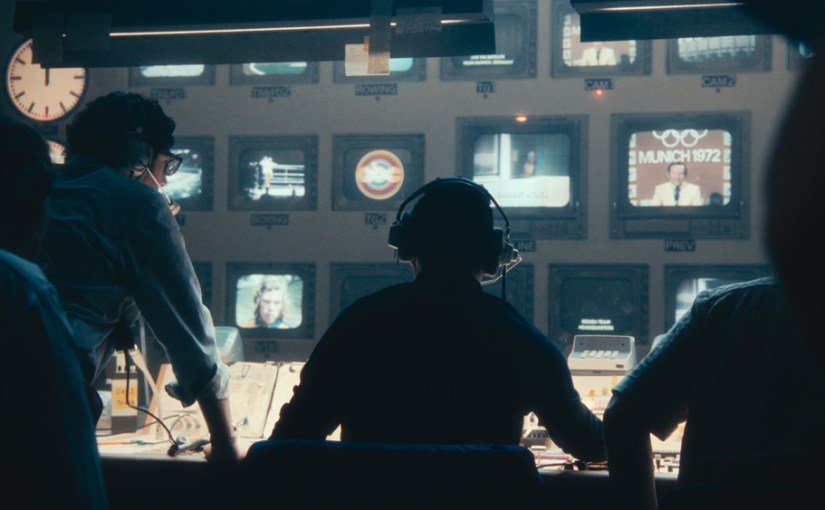
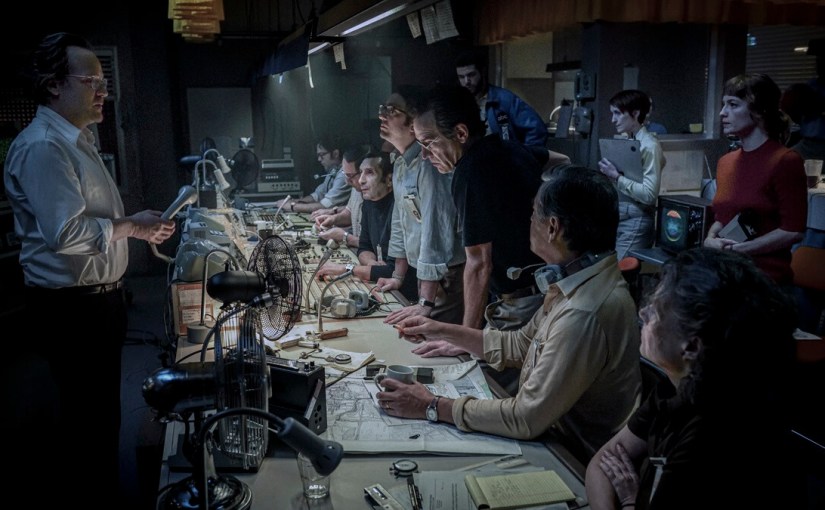
One of the masterstrokes of September 5 is how it rachets up the tension by staying inside the claustrophobic control room and connected offices for the entire film, minus the opening and closing shots showing Geoff arriving for work and leaving the next morning.  Anything showing us the outside world is only visible on the banks of television monitors in front of them, which leads to much confusion towards the end of the film as reports of the Israeli hostages being freed begin circulating, but no one can actually see what the hell is going on.  This is one of the ways the film reminded me of some of the best scenes in United 93 when the people responsible for making the most crucial decisions of their lives were limited by what they could see and hear on the news.

I have never worked in a TV studio, but this movie carries a palpable authenticity that made me believe everything I was seeing.  I never knew, for example, that chyrons (those small captions on the bottom of a TV screen during the news) were analog back in 1972.  Whenever a new development occurs, the control room has to call up a woman in a completely separate room/mini-studio so she can manually place individual letters onto a physical message board, then get behind a camera and shoot the image so it can be superimposed back in the main control room.  Exhausting!

Peter Jennings is reporting remotely across the street from the Israeli apartments, but he cannot be heard live from his radio into the audio feed for the TV signal.  So, some random dude takes a phone handset, unscrews it, solders some wires, clamps it all together in front of a microphone, and presto, now Jennings is live.  The whole operation is put together with spit and baling wire.  It feels like it’s a miracle that anything was televised at all.

The other conflicts presented to us are no less important.  Marianne, a German woman, is drafted into helping with the translation, but first she must endure some brief accusations from Marvin.  The fact these Olympics are being held in Munich less than thirty years after the end of World War II is something many people are still coming to terms with.  He asks her if her parents knew about the concentration camps.  She stares for a second and gives the best answer possible: “But I am not them.”  After that, she earns the complete trust of the entire staff.

The subtext of the German guilt over World War II is bubbling just beneath the surface for the entire film.  A German maintenance worker won’t release replacement cables to a French tech until Marianne talks him into it.  It is theorized at one point that German military forces could possibly end the hostage situation within minutes, but the German military is constitutionally forbidden to operate within the Olympic village, for obvious reasons.  Roone Arledge watches Mark Spitz win yet another gold medal, and instead of going to a closeup of Spitz, he instructs the cameraman to cut to the face of the German swimmer who lost.  Someone asks him, “Do you really want to bring politics into this?”  And he replies, “It’s not about politics, it’s about emotions.”

Which brings in the other major point of retelling this story in this way.  There is a point where ABC’s cameras have great shots of the building, the balcony, and the entire complex, and they are broadcasting live (the first time the Olympics had been broadcast live, by the way).  Someone spots German policemen – non-military – getting into position with sniper rifles.  Marianne hears chatter on the police band about an operation getting the green light.  The press is ordered out of the area, but ABC’s cameras continue to broadcast live.  Someone notices that a TV appears to be on inside the apartment where the hostages are being held.  Geoff suddenly asks a reasonable question: “Are the terrorists seeing this?”  Minutes later, German police storm the ABC control room and demand the cameras be turned off, pointing a gun at the crew at one point.  The cameras get turned off and a furious Arledge kicks the Germans out of the building, but the point is made.  Minutes later, the operation is called off. 

“They should’ve cut the electricity to the apartment, it’s not up to us to double-check on them,” says Marv.  But Geoff makes a point: “Marv, it’s not okay if we made it worse.”  The fine line between the freedom of the press and general public safety could not be more elegantly portrayed than it is here.  Earlier in the film, just as the cameras have been set up with shots of the balcony of the apartment, someone asks, “Black September [the terrorist group responsible], they know the whole world is watching, right? …if they shoot someone on live television, whose story is that?  Is it ours, or is it theirs?”

It seems like an easy question to answer: “Public safety comes first.”  But who gets to decide what’s in the public’s best interest?  Those policemen who burst into the control room and shut the cameras off at gunpoint?  Perhaps it should be left to each newsperson’s individual conscience, but can that always be trusted?  These are questions I am not qualified to answer, but I appreciate films like September 5 because they have enough faith in the viewer to pose those questions and then refrain from providing a tidy answer.  It’s one of those rare thrillers that tells a crackling good story and also asks some big, relevant questions that you may not even think about until you’re driving to work the next day.

One of the last things we hear is Marianne talking to Geoff, who had sent her to the German airport where the hostages were supposed to have been flown out of Germany.  “I was there with hundreds of people, we stared into the night.  We were waiting for something to happen because we wanted to take a picture of it.”  While that’s a rather bleak way of describing a profession that has given us some compelling images that have swayed the world’s opinion on vitally important matters, perhaps it’s also a way to caution those who would exploit situations, like the paparazzi who chased Princess Di into that tunnel.

SEPTEMBER 5

By Marc S. Sanders

September 5 is a sweeping account of how breaking news used to be assembled.  You had to be in the right place at the right time.  If you weren’t, then perhaps the sports department of your media conglomerate is, and they will get the story. 

The very first televised terrorist attack was broadcast at a sadly appropriate time.  The 1972 Olympics were being covered by the ABC television network.  For the first time, homes all across the world would be able to watch the games in color, from a satellite feed shared among the big three networks.  ABC had the broadcasting rights to the games though.  The setting is especially interesting to this story.  The Olympics are being hosted by Germany, primarily out of Munich.  This is an opportunity for the country to finally redeem itself, only twenty-seven years after World War II had come to an end and their country’s Nazi regime had been overthrown.  Germany had a lot to make up for.

The Sports Division of ABC news turn over in the wee hours of the morning of September 5.  Geoffrey Mason (John Magaro) slumps into the studio and relieves Roone Arlege (Peter Sarsgaard) following long hours of editing and covering competitions in swimming, volleyball, boxing, track and so on.  There’s minimal staff on shift as the athletes and coaches are asleep for the night, but then Geoffrey and crew believe they hear machine gun fire out of the direction of Olympic Park, and suddenly everyone is awakened and scrambling to put together the story fast. 

No other broadcasts are reporting on this alarming incident.  This is a story that comes at ABC Sports in their own time.  Had this happened today, amid an age of worldwide shrinkage with the existence of the internet, these guys would have been way behind.  In 1972 however, they can rely on Mariane Gebhardt (Leonie Benesch) a female German flunky of the sports division to translate the various radio communications between the terrorists and the German negotiators, and what plans are being put in place.  Nine Israeli athletes have been taken hostage in their hotel rooms with two believed to have already been killed.  The terrorists (believed to be a Palestinian militia group called Black September) demand that Israel release two hundred of their prisoners or they will kill a hostage every hour beginning at noon.

Forgive the cliché terminology, but September 5 is a taut, nail biting, documentary style thriller told only through the perspective of the ABC Sports division.  While the developments of the hostage situation feel urgent, for these unshaven guys in glasses and wrinkled shirts who are operating on little sleep and a lot of coffee, it is about getting the news out quickly and accurately, and just as importantly, first.  Geoffrey and Roone are constantly on the phones trying to learn whatever they can from Peter Jennings, the eventual famed ABC reporter, who is nearby the incident and at times hiding from the German police who are desperately trying to clear the area of the press.  The guys even send in a staff member with a smuggled camera and reels of film taped to his belly while he poses as an Olympic weightlifter.  The Germans forbid the press from trespassing but insist the games carry on.  So, the athletes and coaches are the only ones who can enter the area to prepare for competitions of the day.  Even Howard Cosell happens to be in a hotel staircase nearby and can provide feedback. 

In the news control room, the guys are literally putting walkie talkies next to microphones that broadcast live on air with Jim McKay who is behind the desk, talking to the world.  This is bare bones news broadcasting with unsophisticated technology to aid them in this short window of time.  The director of this film, Tim Fehlbaum, brilliantly captures the desperate inconveniences of reporting this way. 

Roone and Geoffrey also have to contend within their own ranks.  This is not a sports story.  This is a news story and so Roone must insist on keeping the story.  They are the only ones there.  How much more effective would a news division located on the other side of the world fare?  Therefore, Roone’s team are the only ones qualified to cover this developing story.  ABC News will not have access to this. 

Roone also has to improvise how the satellite feed is shared with their competitor, CBS Sports.  It’s a pain in the ass inconvenience and yet the resourcefulness and quick thinking of the control room staff find a way to uphold their claim on this story.

While watching this account, it matters little if we know the outcome of the September 5, 1972, Munich attack.  This film’s purpose is covering how the first few who knew about the situation responded. By the time the ninety-five-minute film is over a lot has been shared.  Tim Fehlbaum, with an Oscar nominated screenplay written by him along with Moritz Binder cover quite a bit.  The pace moves as fast as these people in the control had to move on that terrible day.  So, the information comes quick.  With real life archived ABC footage spliced within the film, you feel as if you are standing in the corner of this dark room with various tv screens, microphones, and telephones. 

You watch John Magaro feed information to Jim McKay, and then the picture cuts to real life footage of McKay at the desk.  It’s quite inventive how the script is accommodated to work in line with what Jennings, Cosell, McKay and others literally said as the crisis was being reported.

Having seen all ten Best Picture nominees for 2024, it is disappointing that September 5 did not make the cut.  Tim Fehlbaum’s picture certainly deserves more recognition and a slot over other contenders this year.  Still, the screenplay is a well-deserved accolade.  To interweave a fresh script that hinges on what was literally said on television screens around the world at that time is a marvelous strategy. 

September 5 is a crackling thriller of a terribly sad day.

FAREWELL, MY LOVELY (1975)

DIRECTOR: Dick Richards
CAST: Robert Mitchum, Charlotte Rampling, John Ireland, Sylvia Miles, Anthony Zerbe, Harry Dean Stanton, Jack O’Halloran, Joe Spinell, Sylvester Stallone
MY RATING: 9/10
ROTTEN TOMATOMETER: 71% Fresh

PLOT: When a giant ex-con fresh from prison asks Philip Marlowe to find his missing sweetheart, Marlowe winds up entangled in multiple murders, prostitutes, and a sultry trophy wife.


Because it was released only a year after Chinatown (1974), it is tempting to compare Farewell, My Lovely to that landmark film noir, but although they are in the same genre, the two films are apples and oranges…or at least apples and pears.  Both feature hard-nosed private eyes accepting cases that turn out to be more complicated and far-reaching than they appear, both feature multiple unexpected deaths, and both feature curvy, smoky-eyed dames with dangerous secrets and aging husbands.  All true to the genre.  But Chinatown breaks (successfully) with film noir in several key areas, while Farewell, My Lovely achieves its lofty heights while still remaining faithful to the bedrock tropes of vintage film noir, right down to the tired voice-over narration from the hero.  I have no idea how faithful it is to the Raymond Chandler novel by the same name, but if the book is half as entertaining as the movie, I may have to track it down and give it a read.

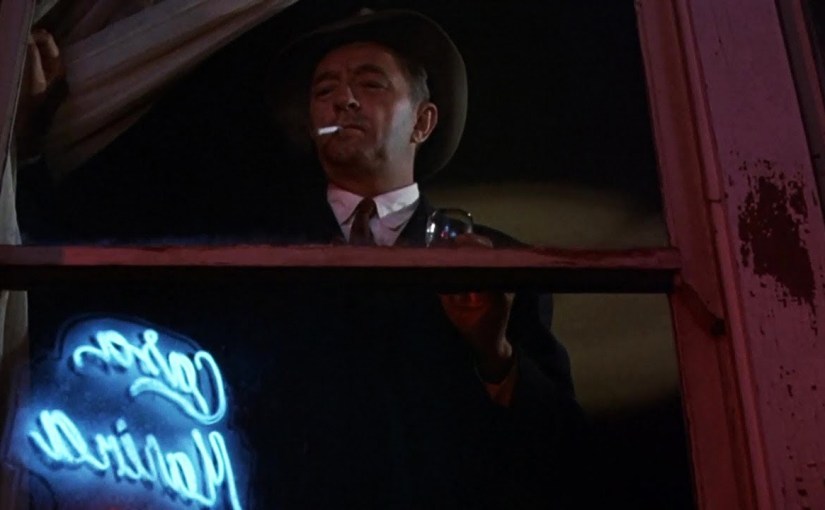
Robert Mitchum plays legendary gumshoe Philip Marlowe, the third version of the character I’ve ever seen after Humphrey Bogart (The Big Sleep, 1946) and Elliott Gould (The Long Goodbye, 1973).  Compared to the other two, Mitchum is by far the most shambling version, but I mean that in a good way.  We first see him staring out of a rundown hotel room in downtown Los Angeles, some time in 1941.  We know the timeframe because of a calendar here and there, and because Marlowe is obsessively following Joe DiMaggio’s progress, as he is on the verge of breaking the record for hits in consecutive games.  That’s a nice touch.  Marlowe’s world-weary narration plays over Mitchum’s sagging face and drooping cigarette, and the spell is complete: we are in the hands of one of the great genre pictures, from a story by one of the greatest mystery writers of his generation.

Marlowe’s story starts as a flashback, a story he’s relating to similarly-weary Lieutenant Nulty (John Ireland).  See, it all began when Marlowe was tracking down a rich family’s runaway daughter.  Soon thereafter, “this guy the size of the Statue of Liberty walks up to me.”  This is Moose Malloy, an ex-con fresh out of the slammer after serving seven years for armed robbery and making off with $80,000, which was never recovered.  Moose is played by Jack O’Halloran, whom cinephiles will recognize immediately as the overly large/tall man who played Non, the mute superpowered henchman in 1980’s Superman II.  To see this man actually string words together into sentences was a strange experience, but I eventually got used to it.

Moose wants Marlowe to find his sweetheart, Velma, who hasn’t written to him the last six years of his stretch.  Next thing you know, someone takes a potshot at Moose on the street, Moose winds up killing a guy in a bar, and Marlowe follows Velma’s trail to an insane asylum, and that’s still just the tip of the damn iceberg, because now there’s this guy who wants Marlowe to help deliver $15,000 in ransom to some other guys who stole a jade necklace…and we STILL haven’t seen the rich trophy wife yet.

And round and round it goes.  I have seen other films that attempted to combine this many plot threads and they wound up a jumbled mess.  Not this movie.  Farewell, My Lovely skillfully walked that tightrope and held my interest all the way through.  I was never lost, never confused…except for a couple of places where the soundtrack obscured a word or two, but I don’t know if that’s the soundtrack’s fault or the actors for mumbling too much.  Plus, this movie contains one of the single greatest interrogation sequences I’ve ever seen, starring Marlowe, two thugs, and the madame of a whorehouse.  It starts semi-normal, escalates with a shocker, then tops the first shocker with something I didn’t think even a hardcase like Philip Marlowe would do.  But the more I watched this movie, the more I got the sense (whether it’s true or not, I don’t know) that this Mitchum version of Marlowe is truer to the literary Marlowe than we ever got previously, in terms of Marlowe’s principles.

I should also mention the dialogue, which contains some of the best one-liners and comebacks I’ve ever had the pleasure of listening to.  For example:

  • Marlowe describing a large house he’s driving up to: “The house wasn’t much.  It was smaller than Buckingham Palace and probably had fewer windows than the Chrysler Building.”
  • Marlowe on his billing practices: “I don’t accept tips for finding kids.  Pets, yes…five dollars for dogs, ten dollars for elephants.”
  • Marlowe describing the obligatory femme fatale (Charlotte Rampling): “She had a full set of curves which nobody had been able to improve on.  She was giving me the kinda look I could feel in my hip pocket.”
  • Marlowe when the femme fatale asks him to sit next to her: “I’ve been thinking about that for some time.  Ever since you first crossed your legs, to be exact.”

Dialogue and lines like this are dangerous because they have been the targets of so many parodies for so long that modern audiences may have forgotten how to take them at face value.  But in Farewell, My Lovely, it comes off perfectly as a tribute to the classic noirs of the 1940s and ‘50s, a tip of the hat to the giants of the past.

Conversely, this movie also reminded me of many of the best eighties thrillers I remember watching, which is ironic considering it was released in 1975.  Movies like Body Heat and Jagged Edge and Silverado, whose purpose for existing seemed to be just to tell a freaking awesome story, unburdened with subtextual layering but laden with style and wit and intelligence, paying homage to their cinematic ancestors by emulating them without plagiarizing them.  There are no doubt film historians who could analyze this film scene by scene and explain exactly what the filmmakers were really trying to tell us underneath the ingenious dialogue and intricate plotting.  But even if I knew or understood all of that, I maintain the best reason for seeking out and watching Farewell, My Lovely will always because it’s just a damn good movie.

(…if for no other reason because of that interrogation scene…I had to rewind it a couple of times just to get my shocked laughter out of my system…)

CAPTAIN PHILLIPS

By Marc S. Sanders

“You had thirty thousand dollars, and a way to Somalia. It wasn’t enough?”

– Captain Richard Phillips

Paul Greengrass is a director with a documentary style technique.  Look no further than his salute to the hero hostages of United flight 93 on 9/11.  United 93 depicted an ordinary Tuesday of people going about their business on commercial airlines and in working in radio towers. Eventually, it was nothing but ordinary.  Greengrass reminded us of the day the world permanently changed.  He applied the same technique to his film Captain Phillips when a commercial cargo ship was hijacked by Somali pirates looking for a large amount of American dollars to bring back to their tribes. 

Tom Hanks is Captain Rich Phillips, an Irish American Naval captain residing in Vermont.  When the film starts, the captain is packing up one last bag and signing off his computer.  The screen shows a trajectory course that he will command the American cargo ship Maersk Alabama around the horn of Africa and make do on his delivery of hundreds of corporate cargo containers.  Though he’s well aware, he is given official warnings to be mindful of Somali pirates in the area.  When he rides with his wife (Catherine Keener) to the airport though, it is not international threats that concern him.  Rather it is whether their son is going to start taking his life seriously with grades and aspirations.  Whatever Captain Phillips does faces professionally is simply routine.  No matter how dangerous, it’s his family back home that concerns him most.

Even in this opening throw away scene, Greengrass looks like he’s shooting reality TV with a cameraman placed in the back seat of the characters’ SUV, getting shaky side shots of the husband and wife taking a drive to the airport.  The handheld technique will carry over the course of the film and sometimes it will relax itself when caution is of utmost importance.  Other times, it will emote frenzied chaos when desperation and time have overloaded the senses.

The film allows time for the Somali pirates led by an unknown, but eventual Oscar nominated actor named Barkhad Abdi to assemble a group of four to lead a charge into the deep waters seeking out a target to hijack and pillage.  They are armed with machine guns and foolish gusto, which will be hard to negotiate.  After one day’s failure, the pirates manage to overtake the ship and then Captain Phillips must subvert the pirates away from the majority of his crew hidden within the confines of the large engine room of the ship. 

As the second half of the film takes over, it becomes a claustrophobic encounter aboard a small lifeboat.  The pirates have taken Phillips as their hostage along with thirty thousand dollars in cash and their plan is to return to the shores of their country and negotiate with the United States for the Captain’s release.

With no navigation for the pirates to follow, the Navy intercepts the lifeboat with a battleship and an aircraft carrier in nearby waters. Now it becomes a strategic plan for Phillips to stay alive while the armed services try to peacefully end this conflict with no harm to the hostage.

The length of Captain Phillips is close to two and a half hours and you realize it because that is the point.  The main subject at the heart of this true story was held in this tiny boat with limited vision of what was occurring outside, fighting rough seas while constantly being berated in a foreign language by his captors.   It’s also never easy for any authority to negotiate with powers that are operating with dizzying confusion and helplessness.  The only advantage these pirates have is to hold on to their prized captive.  There is nowhere to run, or swim, or much less spread out in this tiny ocean vehicle that lacks any kind maritime direction or security.  Paul Greengrass makes sure you know this as he often points his camera upwards from tiny crevices on the floor, lining up at the pirate players along with Barkhad Abdi and Tom Hanks.  Sometimes a cameraman must have been standing and pointing a handheld down at Hanks watching his captors while he tries compute his next move.  Within these cramped quarters, you can smell the body odor and feel the desperate need for a shower, a drink of water or a morsel of food as these people remain contained within this floating box.

Elsewhere, I’m especially impressed with how Paul Greengrass observes the routines of the Navy and US Seals who are doing their best to end this situation.  The Seals, who are also sharpshooters, covertly parachute on to the nearby aircraft carrier, gear up and position themselves.  It’s so routine even though I know they are being especially careful.  Some tactics for easy movie narration are likely adopted here.  The commander makes clear that they need green targets, not red.  I’m sure it is more complex than that. How these military men speak and carry stoic expressions like it is another day at the office works in converse to the chaos occurring in the tiny boat that everyone has their eyes set upon.  Yet, Greengrass’ documentarian strategy remains consistent in both environments.  You are getting a “You Are There” experience to uphold the film’s authenticity.

Tom Hanks is great and easy to rely on as usual.  However, his performance does not seem so impressive until you finally witness his sensible and alert demeanor deteriorate and crumble to pieces.  You might know the ending to this heart pounding story, but I won’t spoil it here. A final scene bears the right side of an equal sign to all the hysteria you watched add up before. Tom Hanks’ penchant for improvisation is what strengthens the epilogue of the film, following a harrowing climax.  It might just be his best scene ever on film.  Knowing his celebrated career, I gave that declaration quite a bit of thought.

Captain Phillips is a taut, sensational thriller where common sense cannot easily win against irrational thinking. Still, that is exactly what took place. You involuntarily hold your breath until the film suddenly goes quiet, the director’s camera stops in place, and a sharp order is given.  Only then do you finally exhale and slowly sit back in your seat.  Paul Greengrass is a master at timing out the tension.

MAXXXINE (2024)

by Miguel E. Rodriguez

DIRECTOR: Ti West
CAST: Mia Goth, Elizabeth Debicki, Michelle Monaghan, Bobby Cannavale, Giancarlo Esposito, Kevin Bacon
MY RATING: 8/10
ROTTEN TOMATOMETER: 72% Certified Fresh

PLOT: In 1985 Hollywood, adult film star and aspiring actress Maxine Minx finally gets her big break. But as a mysterious killer stalks the starlets of Hollywood, a trail of blood threatens to reveal her sinister past.


When I started posting my blissful reviews of X and Pearl [both 2022], I got one response more than any other: “Wait till you get to MaXXXine; it’s the weakest of the trilogy.”  Having just watched it, I would say that calling MaXXXine the weakest film in this trilogy is like calling Return of the Jedi [1983] the weakest film in the original Star Wars trilogy.  You may be technically correct, but it’s still a great ride and a better film than many others in this genre.

Six years after the bloody events of X, we pick up the story of Maxine Minx (Mia Goth) as she auditions for a film role in Los Angeles.  She’s been signed by a devoted but semi-skeevy agent, Teddy (Giancarlo Esposito in a fabulously bad hairpiece), and she has experienced modest success as a porn star.  But she longs to spread her wings in “legitimate” films, because as we all remember, Maxine craves fame more than anything in the world.  As she never tires of repeating: “I will not accept a life I do not deserve.”

Just as things start looking up for Maxine’s career, a package is left on her doorstep…a VHS tape labeled ominously, “For Maxine.”  When she pops it into her VCR, she’s treated to a shot from her filmed but unfinished porn movie from six years ago…evidence which would link her to those horrific murders and endanger her newfound success.  Meanwhile, the infamous real-life serial killer Richard Ramirez, aka “The Night Stalker”, terrorizes Los Angeles at night, not to mention a copycat killer who is branding his victims with pentagrams.  How these murders are linked to Maxine, and when and where John Labat (Kevin Bacon) comes into play, is not for me to divulge.  And one by one, Maxine’s friends and co-workers are turning up dead…

The plot of MaXXXine is nothing new, let’s face it.  What makes it sparkle is the wit and TLC provided by director Ti West and his collaborators.  For anyone who was alive in 1985, this film is like a stroll down memory lane.  I found myself thinking about Quentin Tarantino’s Once Upon a Time…in Hollywood [2019], with its loving recreation of late-1960s Los Angeles and serial-killer-related plotline.  That’s not to say MaXXXine is ripping off Q.T.’s film, not at all.  Both films have an immense affection for their respective timeframes and have gone to great lengths to immerse us in that culture.

Another filmmaker that came to mind during MaXXXine was Jordan Peele, director of his own trio of horror neo-classics: Get Out [2017], Us [2019], and Nope [2022].  Ti West’s films share a lot of characteristics with Peele’s films.  The Maxine trilogy looks like a million bucks on screen, despite what must have been very limited budgets.  The plots and screenplays are airtight with one or two minor exceptions.  (Peele’s plots are more Twilight Zone than reality, so they get a bit of a pass on plausibility.)  And the characters are intelligent, sharply drawn, and rarely fall into cliched behavior.

If MaXXXine is not quite as terrifying as its predecessors, I’m prepared to forgive it.  Whatever it lacks, it makes up for in its besottedness with Hollywood.  There is a scene where one character chases another through a Universal backlot (oddly deserted, but whatever); they run through various movie sets, including the town square featured in Gremlins [1984] and Back to the Future [1985], winding up at – and I almost could not believe this – the Bates Motel and even inside the Bates house behind it.  Only a director/screenwriter deeply in love with the movies, and horror films specifically, would dare to write a scene like that into their script, and I loved it.  (Trivia note: they had to get permission from the Hitchcock estate first…awesome.)

I haven’t even mentioned the movie’s subtext.  The movie Maxine has gotten a part for is being directed by a woman, Elizabeth Bender (the pleasingly towering Elizabeth Debicki), who believes The Puritan II is her chance to prove that her voice is worth listening to in an industry dominated by male voices, especially in 1985.  If the only way to get people to listen is to make a B-list horror movie with A-list concepts/ideas, so be it.  Two of the best horror movies I’ve seen in recent years were directed by women: The Babadook [2014] and Saint Maud [2019].  And yet, out of over 1,850 movies in my personal collection, only 70 were directed by women.  I guess things haven’t changed that much in the movie industry in forty years.  Discuss.

MaXXXine begins with a quote from Bette Davis.  I won’t recite the quote here, but it implies that an actor isn’t a star until they’re considered a monster.  I hope that’s not true.  But for Maxine Minx…if that’s what it takes, well, then…that’s what it takes.

CARRY-ON

By Marc S. Sanders

Action movies have been done to death, haven’t they?  Yet, don’t we still get a kick out of them?

Sure, I need my TCM classics like It Happened One Night or my updated biographies like Angelina Jolie’s Maria, but action movies are like the best junk food without any of the calories.  Still, an action picture has to have that special attraction if it is to stand apart from the others.  I got bloated by the time I got to the fourth Lethal Weapon.  The first is a perfect wham bang shoot ‘em up set during Christmas time. Now Netflix grants us a long-lasting candy cane with its airport run around chaser flick known as Carry-On.

What makes this mad bomber fest a smash is that the hero, TSA agent Ethan Kopek (Taron Egerton), actually cries out of fear and pain as the bad guy beats up on him and frightens him into direct obedience.  He begs with tears coming down his cheeks for the bad guy to just stop with his mission.  He screams “WHY ME?”  The Rock, Stallone, Schwarzenegger, Willis, Ford, Gibson – those guys don’t cry.  Yet, little Ethan Kopek does, and once he gets his wits about him does he truly become a super hero.  I recall the moment happens in the last twenty minutes of the picture.  Ethan throws off his pansy TSA uniform shirt and makes a go at saving the day in his black undershirt.  Now he’s earned John McClane’s respect.

On the busiest travel day of the year, December 24th, Ethan is assigned to scan the carry on luggage ensuring travelers have not packed contraband items.  He and his colleagues have to put up with all the typical TSA complaints that come with the job.  My hat’s off to screenwriter T.J. Fixman for allowing some time to show the challenges of this occupation.  It adds some truth, comedy and depth to a thankless job that’s hardly celebrated or acknowledged like cops, doctors, athletes, and attorneys.  

Ethan is handed an earpiece and a mysterious voice, provided by Jason Bateman, gives him direct instructions to allow one black suitcase with a red ribbon to pass through inspection.  If Ethan deviates in any way at all, the voice promises that Nora (Sophia Carson) will be killed.  She is Ethan’s pregnant girlfriend and also runs airport security at LAX.  

Movies like this function like a game or sport.  The villain sets up boundaries.  How is Ethan going to save the day or get around the unexpected while trying to avoid harm to Nora or the airport as a whole?  As far as he knows, he is always being watched by the guy talking in his ear.  There’s rules and obstacles he must observe.  Granted, Carry-On allows a lot of unlikely and hard to buy conveniences to let our hero obtain the advantage, but he’s also not Superman, and at times when you believe Ethan is coming out ahead, Bateman’s antagonist changes up the game.  

Heck! A bomb is activated not at the end of the movie, but dead center right in the middle of the story.  Normally, the end all be all explosive serves as the final exclamation point with the expected digital clock countdown.  However, in Carry-On if it can get deactivated, there will still be more story to go.  Bateman’s villain really has everything thought out and Egerton’s character has no choice but to man up to the plate once again.

A side story with Danielle Deadwyler as an investigative cop named Elena will eventually intersect with the main narrative.  It’s nothing special until a car ride on the way to the airport plays Wham’s Last Christmas on the radio and the scene explodes into a mind-blowing thrill reminiscent of what I saw in Children Of Men twenty years ago.  The construction of this scene alone is absolute fun.  

Deadwyler’s character is written with a lot of carte blanche to allow Ethan to save the day.  No, none of this is ever likely to be how things go.  Yet, I recall Arnold Schwarzenegger being thrown out of an airplane and surviving a crash landing in a garbage heap thirty thousand feet below (Eraser).

If you watch Carry-On, I will not be surprised if you protest its merits based on a collection of plot holes.  The most glaring one to me is that LAX does not look nearly as crowded as the script insists, nor what I’d expect on Christmas Eve day.  Also, traffic is really easy to get around on the way to the airport.  (New Orleans fills in for Los Angeles.). However, just because Dreamworks and Netflix cut corners on spending for more extras and scenic inconveniences, it does not mean my enjoyment with the film is suspended. 

To make up for where the film’s budget might have come in the way, there are storyline surprises that enter from nowhere. Logic is applied to what’s inserted at these opportune times.  Ethan and Elena experience a set back and now new forms of game play must take hold.  You accept what’s thrown at you because of the cast and set ups.

Taron Egerton is a deliberately wimpy, but also an attractive, unlikely hero.  Jason Bateman ranks with other impressive Die Hard type movie villains like Alan Rickman, Tommy Lee Jones and Dennis Hopper.

Carry-On’s director, Jaume Collet-Serra, is well aware of the near miss escapes that allow his movie to…well…carry on.  He really doesn’t try to hide or distract from the plot holes or questions that audiences may argue.  Yet, I say who cares? This cast of mostly unknowns step up to embrace the dialogue and circumstances of the script while trying to win the game.  

Look, anything you see in Carry-On can theoretically happen.  

Would it happen?  

Let’s just change the subject please.  You have a plane to catch.

CRIMSON TIDE

By Marc S. Sanders

A little over a year ago, having just seen Christopher Nolan’s Oppenheimer, I shared with friends how it is sadly surprising that a nuclear weapon has not been launched by a super power country since the bombs were dropped on Hiroshima and Nagasaki.  Those two bombs certainly served their purpose in response to the Pearl Harbor attack of 1941.  I deem it sad that any of us consider this a possibility that can easily be repeated. With all of the threats that continue worldwide with weapons testing, technological advancements and arms trading, it’s frightening to wonder what can ever be expected. Is it easier to execute a command like that again, now that it has been done?  It’s got to be a little surprising that the United States did not respond that way following the 9/11 attacks.  Tony Scott’s Crimson Tide comes close to providing an answer by weighing sound vs unsound reasoning. 

This is not only my favorite of Tony Scott’s films, but the movie also offers maybe my favorite performances from Denzel Washington and Gene Hackman.  The two actors of different generations are equal in measure as they debate what should be done, along with how the submarine they command, the U.S.S Alabama, should respond while in the midst of a revolutionary conflict stemming out of Russia.  

Washington is Commander Hunter, recruited at the last minute to serve as the Executive Officer aboard the Alabama.  Hackman is Captain Ramsey who proudly leads the charge of the sub with an intimidating welcome to Hunter.  Before any kind of real conflict comes their way, Ramsey puts Hunter to the test.  An uncomfortable dinner conversation, wisely written by Robert Towne (Chinatown), has the Captain question Hunter’s stance on using nuclear force to deliver a harsh defeat to the enemy.  Hunter’s position though is the real enemy is war itself.  Ramsey and his commanding staff have no reply to the new member’s observation.

Another moment occurs when Ramsey orders a missile launch drill while Hunter is assisting with containing an on-board fire in the galley.  The Captain has his reasons that Hunter cannot truly debate. Besides, Ramsey precisely tells his XO to “bite (his) fucking tongue,” even if he doesn’t agree with him.

The centerpiece of the officers’ conflict arrives when they receive a fractured message from command.  Ramsey’s instinct is to launch missiles at Russia based on the presumption that the Soviet rebels have overtaken the country’s arms.  Though Hunter cannot deny the concern, he will not agree to a missile launch until they receive the entirety of the broken order.  This occupies the second half of the film, and it becomes a back-and-forth mutiny of power.  The Captain is relieved of command but then retains control and the crew is divided between the leaderships of these two characters.

Having recently seen and reviewed the submarine classic Das Boot, it’s fair to say that film feels much more authentic and maybe it should be much more tense than any other movie of its kind.  Crimson Tide is glossier with outstanding interior cinematography on a studio constructed set designed to tilt like a maritime vessel should.  The dashboards and colored lighting are fancier.  The cast is good looking as Tony Scott obtains close up shots of them beaded in glistening perspiration with no facial hair.  Crimson Tide is definitely a Hollywood picture.  However, the screenplay from Michael Schiffer is razor sharp with not one wasted piece of dialogue.  In addition to Robert Towne’s contribution, Quentin Tarantino also script doctored a portion of the piece as well which includes a well-placed Star Trek allegory. 

There’s a jolt of energy to Crimson Tide that Das Boot has at times, but because of the latter’s three hour plus running time it also slumbers like life should while living on a submarine.  It is the theatrics of Crimson Tide that hold my attention on many repeat viewings.  I’d never want to question a guy like Captain Ramsey, but I’d be grateful that someone like Commander Hunter is around to stand in protest.  

I wish Gene Hackman and Denzel Washington had done another film together.  Their conflicted chemistry is second to none.  You like them both equally in the scenes they share together, or individually.  The timing of their tempos is perfect.  They find just the right moments to be alarming in a quiet way and save other opportunities for shocking outbursts.  The best actors practice their scripts this way and avoid any traps of overdramatizing.

Tony Scott made this film before his penchant for chaotic angles and grainy captions took over much of his other films to come hereafter.  Crimson Tide is cut perfectly from one scene to another with outstanding colors of blue, red and green lights that illuminate the cast while they stand at their posts.  Washington, Hackman as well as a sensational supporting cast (Viggo Mortensen, James Gandolfini, George Dzundza, Steve Zahn, Matt Craven, Lillo Brancato) do fine work and respond beautifully to the director’s camera positions. 

It’s impossible not to feel the tension accompanied with the progression of this film.  It serves as a motivation to wonder if we act on what we know or don’t act on what we don’t know.  As taut and dramatic as Crimson Tide is, you find yourself considering if those with access to the real-life red button consider all that could come of their decisions.  

Crimson Tide may tidy itself up after two hours, but the movie still makes me ponder if this planet’s military forces are thinking each and every day about if we are preventing nuclear war or if we are on the cusp of waging a nuclear holocaust.

This is one of my most favorite films. 

THE TAKING OF PELHAM ONE TWO THREE (1974)

By Marc S. Sanders

I’m a big fan of gritty, urban crime thrillers.  A wealth of them came out in the 1970s.  There was a rawness to their material.  They were equal opportunity offenders, picking on every race and demographic out there. It only lent an honesty to the characters that occupied these spaces.  The two guys that easily come to mind are Dirty Harry and Popeye Doyle from The French Connection.  Still, there were others that wedged their way through the cracks.  The Taking Of Pelham One Two Three from 1974 belongs in this fraternity of films as well. 

Walter Matthau is Lt. Zachary Garber, who has a ho hum job working the law enforcement area of the New York City subway system.  Beyond muggings and vagrants lying around you wouldn’t expect any major crimes to happen underground and thus Zach moves with a slow pace that never gets him upended or panicked.  Yet, on the day that he is giving a tour to some visiting Japanese subway architects, a hijacking of the train to Pelham Bay, number one two three, occurs.  Four armed men, only designated by Mr. Blue, Mr. Green, Mr. Grey and Mr. Brown don fake mustaches, hats and overcoats.  They are demanding a cash ransom from the city in the amount of one million dollars.  Zach and his crew have less than an hour to respond with the money, or Mr. Blue (Robert Shaw) will order the killing of one hostage for every sixty second delay.

Joseph Sargent’s film then steers its way into several conundrums.  Even if the ransom is paid according to the criminals’ exact instructions, how are these guys going to make an escape from underground?  What’s the nebbishy mayor supposed to do?  He’s in bed with the flu and he doesn’t know how to respond to this kind of craziness.  What’s the point of him making a public appearance near the scene of the crime? 

Long before everyone’s favorite hostage flick, Die Hard, came about Sargent’s movie was poking fun at the humorous and inconvenient cracks that leak out of a serious captive crisis.  First you gotta get the mayor to agree to the demands and as his wife (Doris Roberts) sensibly points out, there are seventeen potential voters on that train.  Then, you gotta count the money and drive it from uptown to midtown before the clock runs out.  That’s not so easy.  You think New Yorkers get out of the way when a speeding patrol car is barreling through the city? 

Zach doesn’t have it so easy as well.  Schluby Walter Matthau is great at trying to contain a situation but his co-workers are not so understanding.  Rush hour is less than two hours away and this stand still train is holding up the subway traffic.  Dick O’Neil and Jerry Stiller are genuine hilarity born directly out of the concrete jungle for roles like this. O’Neil has to keep all tracks open and the trains moving.  Initially, Stiller doesn’t take this seriously – a precursor to his Frank Costanza role on Seinfeld.

Robert Shaw was always one of the best villains and antagonists with films like From Russia With Love, The Sting, and Jaws.  He’s just as good here, but like those other characters, Mr. Blue is unique.  He carries a uniform, hospital cornered method, and he keeps it to the letter so well, that he’s relaxed enough to play his crossword puzzle as he waits for the money to arrive.  Martin Balsam is Mr. Green, a nervous underling recruited for operating the train.  Hector Elizondo is a crazed kamikaze kind of guy who might just knock the criminals plan out of whack because he’s a little too trigger happy.

The Taking Of Pelham One Two Three carries a simple plot.  What makes it complicated though are the characters surrounding the story.  There are a few levelheaded guys on both sides, but it’s the others around them and even the daily happenings of New York City that tilts any progress to be made off kilter. 

The city and many of these characters are unpredictable and therefore surprises will trip everything up just when it all seems to fall into place.  This even happens in the very, very, very last scene and caption of the film.  I’d love to share what a simple involuntary action that can break any of our concentrations does for a couple of these guys, but then I’d spoil the fun.  Trust me though, you get the last laugh before the end credits roll.