GET OUT

By Marc S. Sanders

Consider this for a second.  You’re an African American thirty year old who has recently begun a promising relationship with an affectionate, loving Caucasian woman.  As she attempts to ease your apprehension about meeting her parents for the first time she tells you her dad would have voted for Obama if he could have run for a third term.  When you arrive at their upstate home, one of the first things dad tells you is that if he could, he would have voted for Obama for a third time.  Exactly why is that so important to say?  From her?  And later from him?  Why is it necessary for an audience to hear the statement twice within a span of less than fifteen minutes? While it should sound assuring, it feels anything but trusting.  That’s how smart Jordan Peele’s debut horror/thriller is.  He has a way of delivering two different perspectives with one simple statement.

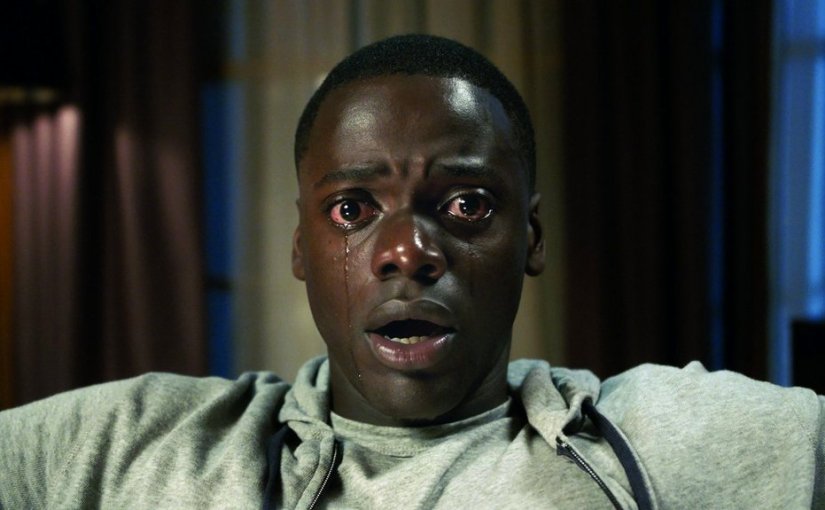
In Get Out, Daniel Kaluuya is Chris.  His girlfriend is Rose played by Allison Williams.  These actors are a perfect pair on screen but that’s about all I want to share with you considering their relationship.  

Chris is meeting Allison’s family at their home for their weekend.  It’s a beautiful, quaint estate off the beaten path from any intrusive neighbors.  Burrowed within the woods, this is a place to escape the stresses of city life.  Just like with any horror film though, the characters do not know they are operating inside a horror film.  The audience always does, and the best filmmakers find those frequent moments to get their viewers to squirm in their seat, tuck their knees under their chin, clench the butt cheeks maybe and say, “Don’t do that!,” “Don’t go in there,!” or maybe they’ll urge you to “GET OUT!!!!”

Nevertheless, the storyteller finds it important to bring up Barack Obama on more than one occasion???? 

Before they even get out of the car, the landscaper, a black gentleman, seems curious to Chris.  Friendly handshakes and welcoming hugs on the porch segue into the furnished home and there’s the maid, a black woman, who is as intriguing as the first black person to be seen.  Wouldn’t you know it but over lunch, you learn that tomorrow there’s the annual party gathering of friends.  Oh my gosh, was that this weekend?  

Jordan Peele doesn’t turn on the creepy music you may expect.  He relies on his visuals and while you are being as observant as Chris, you just might be alarmed and less sensible than he is.  That credit goes to Kaluuya, giving a reserved, contained performance.  This guy does not look like a hero in the least because he has instincts but seems to never look for a fight or a debate or the need to set an example.  An unexpected stop on the drive over demonstrates where Chris stands in a topsy turvy world of political divides in the twenty first century.  He just wants to make life easy.  So, he also will not make waves when that groundskeeper runs directly at him in the middle of the night.  This is just too freaky, but Chris tells us to just get through the weekend.

Rose’s brother seems like a weirdo from a Judd Apatow comedy, but he’s not being a clown.  Dad (Bradley Whitford) is a successful surgeon always ready with a relaxing tone and an open hug.  Mom (Catherine Keener) has done well as a psychiatrist performing hypnosis on her patients.  Yet, a late-night encounter with her leaves Chris feeling uneasy. Visually, it’s disturbing when he reflects on what he thinks he experienced with her.  However, he tries to give the family the benefit of the doubt especially when he shares his concerns with Rose.  Allison Williams is quite good with being convincingly dismissive.  I trust her, and I like her too. 

Then there’s the party the next day.  All the guests, primarily white, arrive exactly at the same time in a convoy of tinted black sedans and SUVs.  Chris doesn’t hide himself despite feeling awkward, and he doesn’t initiate the odd conversations with these middle age WASPs, but he politely keeps engaged with them.  Ironically, the strangest conversation he experiences is when he approaches a fellow black guest who is oddly dressed inconsistently compared to everyone else while his demeanor looks like he’s in a trance.

For comedic effect, Jordan Peele incorporates a best friend for Chris to confide in with opportune cell phone calls.  Lil Rey Howery is Rod and I can say, unequivocally, he is the best endorsement for the TSA. I do not recall seeing Howery in other films of late, but this actor deserves a long career for making a big splash in Peele’s busy picture.  Get Out would never be as inventive if Howery’s role is edited out.  Rod is the only other guy who, from a distance, can tell something is not right, here.

Get Out closes on an airtight ending.  Explanations for everything that is questionable is provided.  Yet, on both occasions that I’ve watched the movie, I think about it long after it’s over.  It takes some of the best elements you might uncover from The Twilight Zone, plus what you might have seen in the original Texas Chainsaw Massacre, and builds new ideas off of those circumstances.  

It is especially fun to read the IMDb trivia about the film to uncover a wealth of appropriate symbolism that does not jump directly at you.   You’ll appreciate how clever Jordan Peele is as a writer.  Froot Loops without milk in a bowl says much about a character.  Another character is engorged with the antler of a taxidermic deer head.  One character scrapes cotton stuffing out of an armchair.  Jordan Peele approaches his scary fiction with an educated eye.  

This movie is inventive.  Its horror does not seem redundant and thankfully the monsters are not vampires and zombies all over again.  There are new tactics at play.  There are fresh approaches to victimize the heroes, and there are creative ways to surprise the audience.  

Get Out is amazing the first time you watch the film.  On a second viewing, Jordan Peele’s story works like a class experiment in social standards while it still has fun by keeping you in triggering suspense.

DOCTOR SLEEP

By Marc S. Sanders

I never yearned for a sequel to The Shining.  Yet, color me surprised at how well I took to Mike Flanagan’s adaptation of Stephen King’s return to psychic Danny Torrance and the haunting baggage he carries as a middle-aged adult in Doctor Sleep.  This is a time jump sequel that is nearly forty years in the future.

The film version of this story had a tricky challenge.  King notoriously despised Stanley Kubrick’s horror classic adaptation of The Shining. Several important details were not consistent between his book and the movie.  So, what was Flanagan to do?  Well, he got his blessing from the author to move ahead as a sequel to Kubrick’s interpretation because he also ensured that he would not veer too far away from how the novel was edited.  The director reasoned with King that more people are familiar with Kubrick’s product than what’s in King’s pages. Mike Flanagan found the right balance to please not only Stephen King, but also the respective fans of the novels and Kubrick’s unforgettable film.

Danny is played by Ewan McGregor.  He’s often reflecting on his childhood following his survival from his stay at the haunted Overlook Hotel in the snowy mountains of Colorado, where his delirious and murderous father terrorized him and his mother Wendy with an axe.  Now Danny is making efforts to recover from alcoholism as he takes a job as a hospice orderly in a small New Hampshire town.  It keeps him isolated while the ugly hauntings that he shines on stay contained in his mental lockboxes.  He also uses his gift to allow patients to peacefully carry over to the other side.   Danny becomes known as Doctor Sleep.

Elsewhere in the country there is a traveling cabal of people who devour the energies off of young children with similar shining abilities like Danny.  This small cult is known as The True Knot and their leader is the charming Rosie The Hat (Rebecca Ferguson).  The presence of one very special child is Abra (Kyliegh Curran).  Flanagan gets very creative in showing how Rosie, Abra and Danny locate and communicate with one another from faraway points.  Rosie’s technique is reminiscent of an amusing sequence in The Big Lebowski, though as you might expect the mood is altogether different in Doctor Sleep.  

Doctor Sleep is a longer picture than it needed to be.  The exposition goes on for quite a while where three separate stories are proceeding, and it becomes cumbersome to see how the dots are connected.  Yet, the movie eventually finds its way as things become more simplified.  Flanagan works some action scenes and neat visuals into the picture, but he does not neglect Stephen King’s penchant for nauseating and grotesque horror either.  Normally, I feign at seeing victimized children in deadly peril for the sake of escapist entertainment.  Here, it is repulsive on more than one occasion, but the moments serve the story and enhance the motives of the villains.  

The payoff of the film is the third act where this adaptation relies on much of Kubrick’s treatment of The Shining.  As the book was entirely different with its ending, Flanagan had to take a chance with some creative liberties.  Amazingly, his efforts score very well.  I’m not the biggest fan of Stanley Kubrick’s film (read my review on this site), but I had to cheer as more developments gradually unfolded.  There’s much to explore through the eyes of Ewan McGregor as Danny.

Mike Flanagan’s craftsmanship with a cast of supporting actors, including Henry Thomas (E.T.: The Extra-Terrestrial) assuming Jack Nicholson’s role, are quite uncanny and lend to the argument to not depend on AI or “de-aging” visuals to recapture what once was.  Carl Lumbly effectively takes over for Scatman Caruthers and Alexandra Essoe does a very good pick up from Shelley Duvall’s performance as Wendy – a little flighty, melancholy and zany. The little ticks and inflections in these newly cast actors are mimicked quite well without going over the top.

Set pieces etched into anyone’s subconscious who has seen The Shining are impressively recreated by Flanagan’s team, from stained walls, big curtains and chandeliers to that very familiar orange, brown/black sectional pattern on the carpet of The Overlook.  At one point in film, Danny goes for a job interview and the office he sits in is an exact recreation of when his father Jack met with the managers of the hotel at the beginning of Kubrick’s film.  This kind of attempt at consistency has to be saluted.  It’s really amazing.  Mike Flanagan shows his painstaking efforts at recapturing Kubrick’s designs. I do not look at these efforts by Flanagan as commemorations so much as I see an omnipotence that observes Danny like it did to his father Jack before him. Danny might have survived, but the demons of his past and the sins of his father remain. He can never escape where he came from even if he relocates to New Hampshire, or wherever he goes.

Doctor Sleep offers the disturbing imagery you’d expect from Stephen King.  I’ve never been the author’s biggest fan.  Still, I really appreciate the creativity he lent to his sequel nearly a half century later.  It makes sense to have waited this long for the writer to pick up where he left off with some of his most well-known characters and locations.  

This dark fantasy works for its collection of heroes and their villains.

NOTE: I viewed the Blu Ray Director’s Cut which Miguel informed me is the better way to watch the film. I agree. There are more nods to Stanley Kubrick’s original film, and the outline of the picture performs in chapter sections like you might expect in Stephen King’s novel. Mike Flanagan never lost sight of either storyteller’s accomplishments. Doctor Sleep is an undervalued achievement in film. A very worthy sequel.

A TIME FOR SUNSET

By Marc S. Sanders

Tom Calloway’s A Time For Sunset is a well-crafted film with shadowy, haunting cinematography and some decent edits.  Unfortunately, it travels towards its conclusion on a repetitive Groundhog Day trajectory.  Regrettably, the deliberate slow burn does not work.

A cell phone rings.  It’s answered.  A few lines are exchanged and then there is the hang up.  Five seconds later, the phone rings again and the same routine occurs, between the same two people. This pattern occupies the ninety-minute running time of this film. Sometimes the same questions are asked. The conversations seem similar to what I’ve already encountered, and I asked myself if we’ve covered this already. Out of nowhere someone gets shot right between the eyes, but I am so numb to this lethargic routine that I can’t even become alert to see what could happen next.  After all, the phone is going to ring again for a couple of lines to be said before the next hang up, followed by another call.

Don Worley is John, a seasoned assassin, who checks into a downtown hotel room with a set of golf clubs.  He calls his wife and daughter to say hello while he begins to assemble his sniper rifle.  Just after he disconnects with them, “No Caller ID” (Nicholaus Weindel) rings and John realizes that while he awaits his assigned target to appear on the street below, John has also become a target.  Each time this caller phones, he seems to share more information about John’s current circumstance thereby putting him in danger along with his wife and daughter.  Now it’s one assassin against another, but John is clearly at a disadvantage because he is unable to pinpoint from where this caller is watching him.

With Thomas L Callaway directing, A Time For Sunset monopolizes its camera work on actor Don Worley who is up for the one-man challenge.  Intermittently, other figures on the hotel floor disrupt the phone conversation to lend to John’s contained paranoia such as a bellhop, a couple of rowdy kids, a manager and an angry mother.  One person arrives to up the stakes with a cleverly rigged bomb and my mind immediately went to the third act of Jan DeBont’s Speed.  These all feel like brief episodes though with not enough oomph to break the monotony.

The pace of the film moves very slowly because it focuses too often on a guy talking into his cell phone or the accompanying earpiece. So, the thrill of this thriller is mostly absent.  Don Worley might be portraying this expert assassin with a measure of calm and cool sensibility during a high-pressure circumstance.  However, his tone hardly changes as the stakes are getting higher.  I never saw the desperation unfold, even as the film was wrapping up.  John hardly breaks a sweat.  Joel Schumacher’s Phone Booth was another picture that came to mind.  Colin Farrell’s everyday man seemed to respond to the fear that is sorely lacking in Callaway’s film.

I liked the idea of this bottled up storyline.  It has the potential to be compelling. A lot can be generated when someone must work against an unknown entity within a small setting.  The original Saw, for example.  Yet, even with a ticking time bomb front and center, plus the intrusion of a red pointer beam from a sniper scope, the direction does not build any suspense here. 

Despite what the introductory scene appears to spell out for John’s fate, I really didn’t care what would become of the poor fellow.

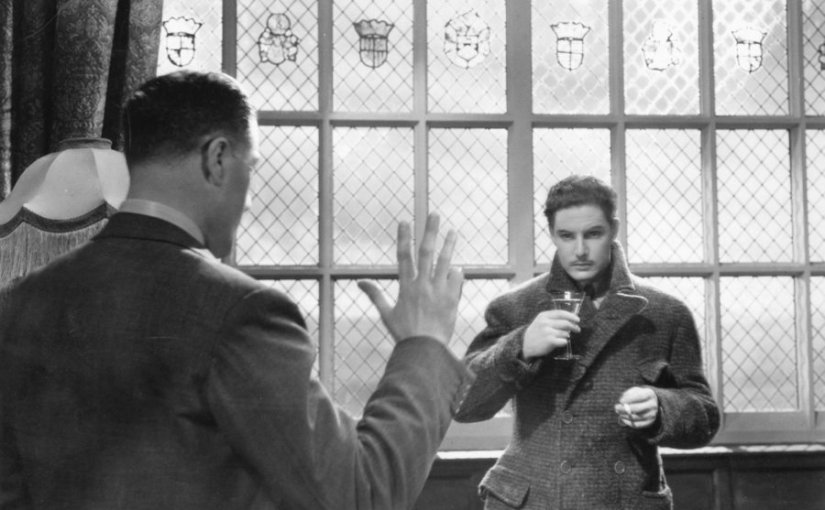
THE 39 STEPS

By Marc S. Sanders

I propose you try an experiment.  Watch one of Alfred Hitchcock’s earliest, British produced films, The 39 Steps, and then have a look at Andrew Davis’ The Fugitive with Harrison Ford and Tommy Lee Jones.  You’re likely to recognize how inspiring Hitchcock’s film is towards modern thrillers almost sixty years later.  In particular, Hitch explored the thrill of the chase.  All he needed was the simplest of reasons for the pursuit to begin.  Then, he had the framework for his entire motion picture.

The 39 Steps is a loose adaptation of John Buchan’s novel.  Hitchcock’s film invented so much more than the book offered.  When the film was previewed for Buchan, midway through, the author reportedly told the filmmaker how he was wondering how it was going to end.  I took a film studies course in college and one of my assignments was to read the book and then document how it compares with the movie.  The nationality of the hero is different, a potential love interest appears in the film that is nonexistent in the novel, and even the actual 39 steps is entirely something else in the film.  Some books are challenging to deliver on a visual medium.  Alfred Hitchcock knew what needed to be altered to make for an adventuresome thriller.

The film opens in a European theater where one of the most astonishing people has taken the stage.  He is Mr. Memory (Wylie Watson) and he claims that his mind contains an infinite number of facts.  So much so, that any reasonable question pertaining to math, science, geography, sports or history can be answered by him instantly.  He won’t be able to tell a lady where her husband is spending his nights, and while he knows how old Mae West is, because he’s a gentleman, he will never reveal a woman’s age.

A Canadian gentleman named Hannay (Robert Donat) is in the audience and after a riot breaks out within the crowd and some gunshots go off, he’s escorting a mysterious woman back to his flat.  She hides from the windows, away from the light and is fearing for her life because of what she knows about The 39 Steps.  She also accurately points out two men down below on the street who have been following them. When she awakens Hannay in the middle of the night with a knife in her back, he is suddenly on the run, trying to make it to Scotland with what few clues she has shared with him.  However, he’s also become a prime suspect in her murder.  The police are after him. These two men are following him and who knows who else is on his tail relation to the 39 steps. This foreigner is now up against an entire country that offers no friends and only suspicions. Alfred Hitchcock relishes in drowning his characters within whatever can be sinister.

Though I have not seen the picture in decades, I’ve never forgotten the secret of The 39 Steps. This recent viewing (on a superb Criterion print) offers moments that are near copies of films that had yet to come.  

Ian Fleming declared that without the invention of the suave, well dressed and sarcastic Mr. Hannay there would be no James Bond.  A woman’s scream upon discovering a murder victim is reminiscent of a scene transition from Spielberg’s The Lost World: Jurassic Park.  Black Widow and Captain America evade secret agents the same way Hannay does with a woman named Pamela (Madeleine Carroll) who he inadvertently encounters on a train.  How many times have you seen two characters handcuffed together while on the run? Plenty, right?  (The Defiant Ones and I’m sure there’s an episode or two from Moonlighting or Starsky & Hutch). Here’s where the idea of such an inconvenience first took place.  Of course, there’s Davis’ thriller with so many near identical scenarios like a foot chase through a chilly countryside to blending within the crowd of a town’s marching parade.  The one-armed man from The Fugitive franchise of TV and film is seen here as a character with a deformity on one of his fingers. Both films even boast nail biting train scenarios, and pursuits that take to the air while the escapee flees down below on the ground.

Alfred Hitchcock tricks his viewer time and again.  He will make you believe that the focus of his pictures carries an overwhelming weight.  Often, they do.  However, it’s of no consequence to reveal what must remain secret or concealed.  Instead, his themes are to make sure his protagonists survive and evade.  The 39 Steps is one of his first efforts he thematically became known for about an ordinary man getting entangled in undeserving threats of danger.  

I directed a stage adaptation of The 39 Steps and the script, published in 2005, pays deliberate tributes to some of the most famous films from Hitchcock such as North By Northwest, Rear Window and The Man Who Knew Too Much.  (Liberally, I incorporated my crew into the play and called them The Backstage Psychos.) The play is notable for its broad spoof treatments and the fact that only four actors are intended to play every character, and some props and pieces, within the story.  It may teeter on satire, but it’s also a salute to Hitchcock’s career.  Before any of his most famous films were conceived, The 39 Steps created some of the director’s most well-known set ups.  While Hitch is a direct, or indirect, inspiration to modern filmmakers, he was also laying groundwork for what audiences would accept as shocking and eye-opening beginning with something as simple as a knife in someone’s back.  

I was also impressed with the director’s use of the camera.  The audience’s questions for Mr. Memory come at him fast, and Hitchcock moves his camera from row to row in a zig zag trajectory with a new extra ready with a demanding query as soon as the camera arrives on every face.  You’d think this was Steadicam work, but this is nearly fifty years before that option was available.  Alfred Hitchcock was daring enough to work beyond simplicity.  

Wide shots of a small Hannay silhouette stumbling across the mountainous Scottish terrain allow for the pursuit to appear overbearing.   The police close in, while a flying machine above is ready to bear down on the hero.  Close ups during a dinner sequence at a farmer’s home are provided with alarming looks and eyes widening to spell doom and fear. Hannay’s need for caution while containing his paranoia uphold the suspence. 

The 39 Steps is a picture that any film enthusiast should watch.  When you see a Marvel movie or an Indiana Jones adventure or even an episode of Murder, She Wrote, you are apt to uncover staples and tropes you have become all too familiar with.  Yet, what about when these ideas were fresh and new? 

The 39 Steps is nail biting entertainment from the early twentieth century, ninety years ago.  Despite its grainy black and white footage, its pursuit moves at a brisk pace with new encounters to overcome while a man tries to hide in plain sight. Again, it seems of utmost importance to discover the answers to a conspiracy wrapped in murder and secrecy.  Actually, it’s the struggle to stay ahead and alive that hold you until the end.

You have watched movies like this before, but have you watched one of the first of this kind?

NOTORIOUS

By Marc S. Sanders

In 1946, Alicia Huberman (Ingrid Bergman) is numbing the shame of her father being convicted for treason by drinking herself silly at a party she’s hosting.  We see the back of the head of a nameless guest, eventually revealed to be a man named Devlin (Cary Grant).  Once Alicia is sobered up, she awakens to the handsome image of this man entering her room with her point of view turning like a clock in a hundred- and eighty-degree direction.  This mysterious fellow is about to escort her into a dizzying labyrinth that will test the limits of her loyalty to him and the patriotism she has for her country.

Devlin is an American agent who has been assigned to recruit Alicia as an insider to an associate of her father’s.  His name is Alexander Sebastian (Claude Rains) and he’s likely a Nazi stooge with a deadly plot ready to set in motion.  Alicia is tasked with reacquainting herself with Alex and uncovering who he is working with and what they all have in mind.  Devlin will check in with her on occasion.

Complications ensue however because just before Alicia begins her mission in Rio De Janerio, she has fallen in love with Mr. Devlin.  Normally, I would not be able to buy into the quick whirlwind romance of Alicia and Devlin.  I never liked it when Sydney Pollack would wedge a love story into his thrillers (Absence Of Malice, Three Days Of The Condor).  However, this is Ingrid Bergman and Cary Grant we are talking about here, and they are being directed by Alfred Hitchcock in the classic film, Notorious.  The famous three-minute kiss in the picture seals the argument.  

Standard film practice of the time would not permit a kiss lasting longer than three seconds.  The actors though expand on this romantic moment with inserted dialogue, none of which is altogether memorable, and focus on a prepared chicken dinner to have on the balcony overlooking the coastline.  This scene occurs early in the film just after the exposition of Alicia and Devlin’s assignment is established.  I still don’t know either of character very well.  So why do I care about them?  Well, it’s how Hitchcock films the script by Ben Hecht.  There’s disturbing shadows and ominous mystery to the world that Alicia is seduced into entering after her drunken binge has ended.  As well, Devlin is warned that he will have to keep his distance from her so as not to alarm Alex or any of his Nazi associates.  Now, I’m genuinely nervous for Alicia’s safety.

Once Alicia is ingrained in Alex’ world, a new romance arrives, and she willingly marries the German aristocrat to uphold her ruse while making efforts to uncover the Nazis’ plot.  Devlin enters and exits her life to collect whatever information and access Alicia can supply.

As Notorious played out for me, sadly the first thing that came to mind was that Tom Cruise’s second Mission: Impossible film is nearly a scene for scene remake of Hitchcock’s classic, minus the over-the-top stunts and rock climbing.  Yet even before that thought popped into my head, I thought this is a film that could be remade into a wonderful modern update, but only in the hands of select filmmakers like Martin Scorsese or Christopher Nolan.  Keep the guns and blood and car chases out of it though.  Notorious succeeds without a single punch, gunshot, curse word, or ball of fire.  It’s the characters and Hitchcock’s use of brooding light, mood and shadows that maintain the suspense.  Select props and costume wear are scarier than Godzilla or The Birds.

Nearly twenty years before he made Psycho, the director was terrifying audiences with a maternal element already.  Madam Sebastian (Leopoldine Konstantin) is such an intimidating force within the castle like estate she shares with her son Alex, who easily falls in love with the beautiful Alicia.  The Madam is upholds a watchful eye on all activity. Bergman’s fear of this foreboding mother is just one of the dynamics she brings to her portrayal.  

Suspense is what Hitch relies on.  Sometimes I felt like I could not trust Mr. Devlin.  The name Devlin bears a sinister reminder of a beast within its spelling. Cary Grant is at first aloof with how Devlin regards Alicia’s potential for self-harm.  Hitchcock eerily introduces Cary Grant in the picture.  First, by only shooting him behind his head, not revealing his face. A little later, I felt reluctant to trust his upside-down appearance as Alicia awakens from her drunken stupor.  Thereafter, he will take a measured risk with Alicia riding horseback and never attempt to rescue her.  He leaves it to someone else to save her. He’s a tricky sort of fellow.

Conversely, Claude Rains as Alex, the supposed Nazi, is utterly charming and attentive towards Alicia.  Despite what he might be involved with, he’s ready to begin a newly loving and glamorous life with her.  I trust Alex.  He maintains a genuine affection for Alicia and it’s hard to presume he is anything else, especially of the sinister sort.

Ingrid Bergman is captivating as soon as she appears on screen, exiting her father’s courtroom sentence.  In fact, she resembles her most famous portrayal as Elsa from Casablanca that easily can be part of this cinematic universe.  With Claude Rains on screen with her again, could this have been a sequel of sorts?  I have much more experience with Meryl Streep’s career and therefore Bergman gives me a lot to reminisce about Streep both when she’s a strong and confident person or a fearful subject.  Either way, the bravery of the character upholds.

There are eye opening camera tactics of Hitchcock working here.  I’m amazed at a zoom in that lowers its focus from a great height at Alex’ mansion down to the grand foyer below where Alicia stands with a vital prop key hidden in her fist.  Amidst all of the traffic of an evening party, this tiny key is what’s most important.  A teacup is given greater scale to enhance a monstrous threat of what’s inside the drink.  A wine bottle suddenly becomes a mystery.  Some elderly, petite men dressed in perfectly tailored tuxedos spell a likely outcome of doom.  The darkness of rooms shot in black and white feels inescapable.  The absolute final shot of the picture is unforgettable.

For years, the adventurers of North By Northwest with Cary Grant in his beautifully fitted blue suit held the crown as my favorite Alfred Hitchcock picture.  That title has now been surrendered to Notorious.  It is signature Hitchcock with twists in character, reasons for mistrust, a MacGuffin (that item that drives the story, yet bears hardly any importance), motherly instincts of fear, obscure camera angles, shadows and dim light which is particularly chilling when shot in black and white.  All of these elements add up to the director’s expert craft at suspense.  

Notorious is a hundred percent perfect example of why Alfred Hitchcock remains celebrated as one of the best directors to ever film a motion picture.  

NOTE:  I am surprised that neither IMDb trivia, nor Roger Ebert in his Great Movie review, ever acknowledged that the story of Notorious begins on April 20, also known as Adolf Hitler’s birthday. A curious date for a spy thriller centered around Nazi espionage.

NOTE: I want to also draw attention to a move that Cary Grant does in the film.  Following Alicia’s drunken party, several guests are passed out on the sofa.  Devlin finishes a drink and rests the glass on the upper torso of a passed-out woman where it balances perfectly.  We may be going after dangerous Nazis, but Grant and Hitchcock still found opportunities to make audiences smirk at their mischief.

3 WOMEN (1977)

by Miguel E. Rodriguez

DIRECTOR: Robert Altman
CAST: Shelley Duvall, Sissy Spacek, Janice Rule
MY RATING: 6/10
ROTTEN TOMATOMETER: 83% Certified Fresh

PLOT: Two roommates/physical therapists, one a vain woman and the other an awkward teenager, share an increasingly bizarre relationship.


Ever see the movie Big?  Tom Hanks, Elizabeth Perkins, Robert Loggia, directed by Penny Marshall?  YOU know.  Well, there’s a scene in Big, AFTER the hero boy has magically changed into Tom Hanks, and he’s now working as a toy-tester at a big toy company.  He’s invited to a focus group to give his feedback on a new toy that transforms from a robot into the Empire State Building.  The other suits are enthusiastic, but Hanks (because he’s a little boy at heart) is confused by it.  He raises his hand and tells the designers: “I don’t get it.”  They try to explain the demographics and the survey results, etc.  He nods, takes it in, and says, “I still don’t get it.”

That was me after watching 3 Women and reading about it a little.  I didn’t get it while I was watching it, and I still don’t get it after I learned more about it.

Robert Altman’s 3 Women is a dreamlike psychodrama that explores concepts of identity, self-discovery, and, I guess, femininity that reminded me, oddly enough, of the Burt Lancaster film The Swimmer (1968), mostly because a lot of it centers around water, but also because of the similar atmosphere created by both films: creepy and reluctant to give up its secrets.  There are numerous shots that are filtered through one of those store-bought wave machines that were so prevalent in the ‘70s and ‘80s, so the shot achieves a surreal effect that’s hard to describe.  It feels like foreshadowing, and in one respect it is, but for the most part it’s just there to either illustrate someone’s mental state or…I’m not sure what else.  I’ve had a day to think about this, and I’m no closer to interpreting exactly what those shots are supposed to mean.

Anyway.  We meet two women, Millie Lammoreaux (an impossibly young Shelley Duvall) and Pinky Rose (an even younger-looking Sissy Spacek).  We’ll get to the third woman later.  They both work at a physical therapy center, assisting elderly patients as they walk through a pool or sit in a hot tub – more water.  Millie is a wannabe sophisticate who is very friendly on the outside, but she doesn’t seem to have any actual friends.  Her co-workers and her neighbors at her hotel do their best to ignore her and her endless patter about articles in McCall’s and what she’s cooking for dinner tonight.  Pinky, whose real name is Mildred, is a young woman whose emotional maturity seems to have peaked around the age of fifteen.  She is immediately awestruck by Millie and contrives to be as close to her as possible at all times.  It’s essentially hero worship, though Millie hasn’t given her anything to really worship aside from being…herself.  They will eventually become roommates.

Millie is fond of yellow; Pinky dresses in, you guessed it, pink.  Millie will talk to just about anyone; Pinky is shy and introverted.  Millie has a large closet full of clothes; Pinky seems to own only one outfit, including underpants.  They are as opposite as it’s possible to be.  These points are drummed home in scene after scene.  The two women frequent a themed saloon called Dodge City, where we will eventually meet the third woman, Willie Hart (Janice Rule).  Willie, who is pregnant, communicates with glares.  She also paints these amazing, disturbing murals featuring what appear to be harpies or something like the mythological Furies.

I could go on with the story, but why bother?  This is not a movie about a story.  This is a movie about conveying a mood.  Altman literally conceived of this movie in a dream, pitched it to 20th Century Fox almost on a whim, and insisted on shooting without a finished script.  The pervasive mood of the film is one of suspense and foreboding.  There are a pair of twins who lurk in the background of scenes of Millie and Pinky at work.  Foreboding.  The musical score is atonal and creepy.  Foreboding.  Pinky starts to read Millie’s diary.  Foreboding.  You may have noticed that the last part Millie’s last name, Lammoreaux, is phonetically similar to Pinky’s last name, Rose.  Foreboding.

So, okay, Altman’s movie is about creating a mood.  To that degree, he succeeded.  It’s nothing if not creepy.  Events occur that were surprising.  Mystery abounds.  But…there came a point about halfway where it all became repetitive to me.  How many scenes of Millie being snubbed socially do we need to get the idea that Millie is not popular?  How many times do we need those shots that are filtered through the wave machine?  How many lingering panning shots do we need of those murals?  I’m just saying.  I got the point after five each.  Call me crazy.

And when we get to the final sequence…man, if I wasn’t confused before, I was completely at sea when the credits rolled.  I’ve seen some open-ended movies before, some I loved (Mulholland Drive, 2001), some not so much (The Lobster, 2015).  When it’s done right, I find it exhilarating to see a film that trusts a viewer’s intelligence so much that it doesn’t spoon-feed you.  But 3 Women gave me an ending that is so open to interpretation that it backfired.  Because it could mean so many different things, it ultimately meant nothing and left me feeling a little cheated.

I get it.  This is not that kind of movie, by Altman’s own admission.  Fair enough.  I give it 6 out of 10 based purely on the craftsmanship and sheer chutzpah of the film, and because the performances by Duvall and Spacek are worth the price of admission.  (And I just wanna say, Duvall may have won Best Actress at Cannes, but my vote would have gone to Spacek, who is utterly convincing as a woman-child in a state of arrested development.)

But I cannot really call this movie “entertaining.”  I don’t mean in the sense that I didn’t laugh or cry or whatever.  I just mean that watching it felt like a homework assignment, not an escape.  I never connected to it emotionally, so I ultimately didn’t care what was happening, or why.  I have enjoyed so many of Altman’s other films, but this one might have just become my least favorite Altman film that I’ve seen, finally replacing [name redacted so I don’t get doxxed].

TWILIGHT’S LAST GLEAMING (1977)

by Miguel E. Rodriguez

DIRECTOR: Robert Aldrich
CAST: Burt Lancaster, Charles Durning, Richard Widmark, Paul Winfield, Burt Young, Melvyn Douglas, Joseph Cotten, Richard Jaeckel, John Ratzenberger
MY RATING: 7/10
ROTTEN TOMATOMETER: 80% Fresh

PLOT: A renegade USAF general takes over an ICBM silo and threatens to provoke World War III unless the President reveals details of a secret meeting held just after the start of the Vietnam War.


Twilight’s Last Gleaming, one of Robert Aldrich’s last films, is a cleverly constructed Cold War thriller whose pointed message about the Vietnam War nearly torpedoes the suspense.  The political message is hammered home in a scene that goes on for a bit too long with people speaking dialogue that feels hammy and trite.  But the movie surrounding this one scene is good enough that I would still recommend it to anyone in the market for something off the beaten track.

The movie is set in 1981, four years after it was released, so no one could draw any real-life parallels between the characters and people in real life.  In an opening sequence that feels reminiscent of Die Hard (1988), General Lawrence Dell (Burt Lancaster) and his team of military ex-cons manage to infiltrate and take command of a US ICBM missile silo in Montana.  While I highly doubt it would be as easy as portrayed in the film, Aldrich films the sequence so that I got caught up in the suspense of the narrative instead of worrying about pesky details.  (If there’s a drawback to these and other sequences featuring military hardware and installations, it’s the overall low-budget feel to the sets and props; everything looks like it was shot on a TV soundstage instead of a big-budget film set.)

Once inside, Dell makes his demands: $20 million for each of his remaining team (Burt Young and Paul Winfield), the President must read the transcript of a secret meeting held just after the Vietnam war started, and the President must hand himself over as a hostage to secure their escape.  Otherwise, he’ll launch nine Titan ICBMs at their targets.

This creates a little tension among the would-be terrorists.  Winfield and Young couldn’t care less about the secret meeting, but Dell is adamant.  Meanwhile, General MacKenzie (Richard Widmark) formulates a plan to eliminate Dell and his crew using a “tiny” nuclear device, the President (Charles Durning) agonizes over the secret transcript, and his best friend and aide uses some “tough love” to get him to make a decision.

Despite the fakeness of the surroundings, I was absorbed by the thriller elements in Twilight’s Last Gleaming.  I would compare them to the best parts of WarGames (1983) and The China Syndrome (1979).  There is some impressively impenetrable technobabble about booby traps and inhibitor cables and fail-safe systems that I just rolled with.  The plan involving that “tiny” nuclear device leads up to a sequence that I would compare favorably with any contemporary thriller you can name.

One of the ways Aldrich achieves this effect is through the use of split-screens…LOTS of split-screens.  It starts at the beginning of the film with two screens.  Then there are moments with three split screens, two on top and one in the bottom section.  Then, during the most intense sequence of the film, we get four splits in each corner of the screen.  At first, I found it disorienting, but it absolutely works when it most needs to.  (I’m trying not to give away too many plot details, so excuse the vagueness.)  I don’t know that I would want to watch an entire movie like this (Timecode, 2000), but in small doses, it’s very effective.

Where the movie bogs down is the middle section of the film when the President expresses his disapproval of the contents of the secret transcript Dell wants publicized.  It’s a bit theatrical to believe a sitting American President would be this vocal about his feelings in the middle of a dire crisis.  I think the scene would have played just as well if we had gotten a general idea of the transcript, or even if the contents had NEVER been revealed to the audience.  It would have been a perfect Macguffin, leaving viewers free to imagine anything they want.  The truth about Kennedy’s assassination?  Area 51?  Pearl Harbor was an inside job?  The Super Bowl really IS fixed?  Who knows?

Instead, the President insists on reading a portion of it out loud to his Cabinet members, enlisting them to read certain lines.  While I admire Aldrich’s intent (to send a cinematic protest to the architects of the Vietnam war), the scene nearly brought the movie to a stop, which is deadly when dealing with a suspense thriller.

But, like I said, the rest of the movie is so good, I am compelled to let it slide.  Later, we get surprise attacks, snipers, helicopters, a crafty fake-out involving torture, and an ending that is as cynical as they come, but which felt like the best way out of the situation for everyone involved…except for the American people, but that’s another story.  Twilight’s Last Gleaming feels virtually forgotten, and that’s a shame.  Aldrich directs this movie with a lot of passion for the material and milks every ounce of suspense he can with the tools at hand.  If you’re prepared to overlook that middle section, you’ll get a kick out of this movie.

P.S. Look fast for an unexpected appearance by William Hootkins, aka “Porkins” from Star Wars (1977).

REBECCA

By Marc S. Sanders

“The suspense is killing me!  I hope it’ll last!”

                                      – Willy Wonka

Even if the outcome does not amount to much, the journey into mystery is often all that is needed for an effective film.  Mood and eeriness, plus unsettling foreboding are reliable tools for engaging storytelling.

The one film in Alfred Hitchcock’s career to win Best Picture is 1940’s Rebecca, and if you’re a fan of the director, you’ll quickly fall in love with his deliberate shots of shadow and the panning explorations his camera gravitates towards.  Close ups of his actors have an unsettling haunt, and large hand-crafted doors are intimidating to an aristocrat’s new wife who carefully enters one room after another.  Other than a few pertinent differences, Hitchcock, with David O Selznick as producer, remain faithful to the eerie themes of Daphne de Maurier’s novel.  

Joan Fontaine works as an attentive helper to a wealthy and brutish snob (Florence Bates) who is on holiday in Monte Carlo.  There, she encounters a dashing aristocrat by the name of Maxim de Winter (Laurence Olivier).  The helper is shy and reserved but somehow Maxim allows her into his world even though she first encounters him as he seems to be stepping off into the rocky ocean depths below, looking like he’s about to end his own life.  Every day she sneaks away to be with Maxim and all too quickly, just as she is about to head off back to the States, he proposes allowing her to be relieved of her obligation to the haughty dowager she’s been serving.

Once married, Maxim brings the new Mrs. de Winter to his regal European estate famously known as Manderley.  It is here that Fontaine’s character will learn details about the mansion and Maxim’s enigmatic and deceased first wife, Rebecca, who drowned during a sailing accident a year earlier.  

Rebecca’s monogrammed R is embroidered in handkerchiefs and bed sheets throughout the house.  Her address book in her drawing room remains at the desk where she ritually wrote her letters. The cornered off west wing of the house is supposedly preserved with Rebecca’s furnishings.  Most disturbing is Manderley’s housekeeper, Mrs. Danvers (Judith Anderson), who is far from comforting or welcome to the new Mrs. de Winter.

Rebecca is quickly engaging because of Hitchcock’s haunting exposition that persists until the final act of the film.  Following the opening credits, he shoots his camera through a distant wooded drive that eventually arrives at the decrepit ruins of Manderley, with Fontaine’s voiceover guiding the viewers towards flashback.  Then we see Olivier, performing rather cold and isolated, apart from his sudden interest in Fontaine’s shyness. After the nuptials, the bulk of the film turns Manderley into a off putting locale, not ready for Maxim to have a new wife living within its confines.

Most effective is Mrs. Danvers.  Judith Anderson lends a spectral presence to a creepy individual dressed in black with a most evident paler complexion, even under the black and white photography.  Reading about the making of the film, Hitchcock wanted to make sure Mrs. Danvers hardly ever entered a scene walking into a room.  He’d cut away to a close up of Anderson simply being there, as if Mrs. di Winter or the viewer never knew she existed in the frame.  It lends to that haunted house kind of tension.  

Mrs. di Winter never feels like she belongs.  That signature letter R is a constant reminder of Rebecca occupying this home’s past.  Her wardrobe, personal bedroom and belongings remain behind too.  Maxim travels out of town often leaving his new wife alone with no family or companionship of her own.  A charming but odd cousin of Rebecca’s named Favel (George Sanders) appears outside the window of the reading room to remind the new Mrs. di Winter that Maxim is not especially fond of him.  Hitchcock left me wondering why Mr. Favel didn’t arrive by the front door.  It’s deliberately odd; certainly strange.  There’s a miser who roams around a small cottage near a beach path that Maxim insists his new wife stay away from.  These are elements to uphold Hitchcock’s penchant for unnerving his protagonist’s senses.  Delirium works to the director’s advantage time and again.

In addition to full sets tall staircases and vast, castle size rooms, a miniature model of Manderley was constructed for the film.  The background of this setting is so dense that every piece of artwork or window curtain or book seems to have a history for Mrs. di Winter to uncover in this cold and unwelcome house.  The gigantic doors to new rooms against Fontaine’s petite figure are disconcerting.  Maxim’s staff of servants may cater to his new wife’s needs, but it is Mrs. Danvers who appears to desaturate any joy or ease from this home’s new guest, and it is reasonable to consider that the housekeeper seeks to disrupt the wife’s adjustment at Manderley.

Joan Fontaine’s mousy, insecure performance works especially well next to the confident and cool tempered strength expected from Laurence Olivier.  Fontaine is also an exact opposite to Judith Anderson’s eerie persona.  How can she ask for anything of this housekeeper who maintains a fierce loyalty for Rebecca, the first Mrs. di Winter?  George Sanders also has a sense of self confidence but with his wide smile and that distinct English dialect, how can anyone feel like they can trust him? I guess it doesn’t help that he’s a car salesman, no less.

I actually thought back to Ari Aster’s Midsommer. In that film, Florence Pugh’s character no longer has a family and the only companionship she is left with is a boyfriend and two friends who she travels with to a mysterious, but intriguing destination.  Like Fontaine’s character, Pugh’s character is alone feeling helpless to turn to anyone for aid.  How can someone in a scenario like this ever feel secure or eventually rescued?  The loneliness for these women in these two broadly different films is what gives me shivers.  It leaves me shaken and terrified.  Is there anyone who would even notice they are missing or unaccounted for?  Just give them someone to trust and talk to!!!! PLEASE??????  ANYBODY????

Answers behind the puzzles found in Rebecca eventually arrive, and while the explanations add up, I did not believe they were especially sensational.  There are some twists.  The story veers off in different directions and Olivier and Fontaine drive the script quite well to a conclusion.  Though the ending is not the greatest strength of Rebecca, it is the journey that’s appealing, especially when you are seeing the film for the first time and have no knowledge of where the story is going.  Hitchcock’s trajectory is the real thrill.  

I pointed out to Thomas and Anthony, two of my Cinemaniac comrades, that in this whole expansive house we never once see a photograph of Rebecca, the first Mrs. di Winter, and then with their input I realize that’s the intended point.  Each viewer has their own design of what the mysterious Rebecca must have looked like based on what’s left behind with her husband, her devoted housekeeper, her cousin, her wardrobes and belongings, and her enormous, hidden dwelling known as Manderley.  Like Steven Spielberg committed to with concealing the driver of his terror truck in Duel or his great white shark in Jaws, Hitchcock applied to a phantom of a past, and her name was Rebecca.  

With a film like Rebecca, Alfred Hitchcock didn’t really need a knife or a gun to rattle your senses.  It’s his approach with mood that will keep you alert and unsettled.  You want to know more and see more and uncover more and more and more.  

Yet, that housekeeper suddenly appears, and those giant double doors are most unwelcoming.

THE CHINA SYNDROME

By Marc S. Sanders

The China Syndrome explores the inherent risk that comes with a reliance on nuclear energy.  It also touches upon the moral choices within the field of journalism.  Most importantly though, it’s a hell of a thriller.

Kimberly Wells (Jane Fonda) is an on the scene reporter doing light fare topics for the evening news, like the novelty of singing telegrams for example.  With her subcontractor cameraman, Richard Adams (Michael Douglas, also one of the film’s producers), they cover a story on how a nuclear power plant operates.  During their tour, a very frightening accident stops short at only being a threat.  While the top brass at the company downplays the incident, Richard manages to record the panic-stricken activity happening among the operators in their soundproof control room.  As Kimberly and Richard gather information about what really happened, they are told they only were so close to what can be described as a China Syndrome – the underground nuclear rods could have overheated, imploded and the blast would have ruptured through the core of the earth where even China could feel it on the other side of the world.  

The corporate elites (led by Richard Herd) are the villains of this picture.  The could be hero is Jack Godell (Jack Lemmon), a could be whistleblower.  Jack oversees the whole operation and following that frightening scene begins to do his own kind of investigation.  What happened only makes sense because due diligence was not upheld, and inconsistencies are being neglected. Problems are only expected to get worse because they are not contained. There would be an enormous monetary expense that will put the company at a loss.  Initially, Jack wants to remain quiet, but the idea of what he’s certain will eventually happen is conflicting him.  As well, Kimberly and Richard’s pursuit of what truths he holds is gnawing at him.  

Jack Lemmon is a frazzled, yet sensible, marvel in this film.  I love the unspoken subtleties of this guy.  Best I could see is that Jack Godell is unmarried and has no children, nor friends beyond the faint connections he shares with his work colleagues, particularly one played by Wilford Brimley.  This only enhances Godell’s isolation in a them-against-him matchup.  Lemmon is great at emoting a sorrow and regret to his character.  He tells the journalists that he loves that plant.  It’s all he has in life and now it spells a certain, eventful doom if the faults in operation are not exposed.  Like Michael Mann’s The Insider, which was released over two decades later, the unlimited resources of this company will do everything in their power to silence this liable peon who works for them.  

The other side of The China Syndrome focuses on Fonda’s character.  When this film was released in 1979, it was the norm to not take a woman reporter seriously.  They were best used as attractive figureheads with beautiful hairstyles and well applied makeup to shift the seriousness of the news over to stories about dogs who can do tricks or hot air balloon happenings.  This film could have made more of a campaign to embrace the female journalists with heavier topics.  Instead, Jane Fonda’s character is not a fighter so much for deserved recognition in a male dominated world.  She’s actually just trying to circumvent around the unspoken chauvinism of her industry and get to the heart of this story that she witnesses firsthand.  The news station would rather her efforts be focused elsewhere.

Richard, the cameraman, is not embraced by Kimberly’s news station and therein lies the debate of airing what appears to be a story of urgency for the benefit of the public.  Yet, the station does not want to face a lawsuit.  What do the principles of journalism mandate even when there’s a monetary and reputational risk to their institution?  

Plenty of films with these kinds of dilemmas have come out following The China Syndrome.  What’s remarkable is the authentic feel of this fictionalized account.  Ahead of the release, the real-life companies that were developing a need for nuclear power were lambasting this film, insisting there was no validity to this story.  They were adamant that the production and maintenance of nuclear power was completely safe and well monitored. Twelve days after this film hit theaters in March 1979, the Three Mile Island accident occurred in Harrisburg, Pennsylvania when a partial nuclear meltdown of a reactor occurred. Traces of harmful gases and iodine were released into the atmosphere, and the incident was rated a Level 5, an “Accident with Wider Consequences.”  I do not believe Michael Douglas and his co-producers/filmmakers necessarily set out to make a statement. Though there are protesting movements peppered throughout the film. It’s a frightening irony, however, when life imitated fiction. 

 Jane Fonda and Jack Lemmon put the suspense of The China Syndrome into play. There’s an awareness to what could happen with technological advances in nuclear energy especially if they are not carefully observed and addressed.  

Over forty years later, do we really know what’s going on and even if we did, what could any of us do about it?

UNSTOPPABLE (2010)

By Marc S. Sanders

An adventure of the unexpected needs to start with urgency. 

“Let’s say there’s a runaway train that’s barreling through the state of Pennsylvania and no one is on board to stop it.”

“Not bad.  What else you got?”

“This train is a half mile long. So, it’s a roller coaster of a beast.”

“Go on.”

“How about there’s another train on the same track and the two are going to collide with each other?”

“It’s got potential.  Anything else?”

“Oh yeah.  The train is carrying toxic chemicals that could cause mass destruction and casualties of epic proportions throughout the rural area.”

“Okay.  Now we’re talking.  Any guns?  Can we find a way to get machine guns into the mix?” 

“Yes!  I got it.  How about if the people try to derail it and the only way to make that happen is the cops shoot at this tiny button on the bottom of the engine, and this button is located between the gas tanks?  So it’s gotta be a direct hit while the train is in motion.”

“Okay.  Okay.  That’s genius.  Let’s green light it.”

Now this might have been how Unstoppable, director Tony Scott’s final film, got put into commission, but what is especially fascinating is that this is based on a true story. An out-of-control locomotive actually went off with no one on board to control it.  It happened within the state of Ohio about fifteen years prior to the release of this film.  Only it was not as dramatic or suspenseful as Tony Scott and his crew assembled their movie.  Unstoppable is a pumped-up, steroid enhanced reenactment of the actual story.

The director recruited his most common go to lead, Denzel Washington, for the role of Frank Barnes.  He’s an engineer with over thirty years’ experience who is wiser than the big wig suits on the top floor.  He can bring this potential disaster to a halt before it happens.  Frank is also a mentor to the fresh, young conductor, Will Colson (Chris Pine). 

Will is cranky because his wife is upholding a restraining order against him and the two are at a standstill of hashing their problems out over the phone.  Frank is in a bad mood because the young guys like Will are being brought in to replace the grizzled fellows who are being pushed out.  Frank is also a widower with two estranged daughters. Though, he gets a kick out of telling Will the girls are paying their way through college by working at Hooters.

Denzel Washington and Chris Pine make a good pair.  Buddies who antagonize each other at first, they later share what’s eating at them personally and professionally. Then they work well together to resolve the crisis at hand.  Their characters are not very dimensional, nor should they be.  After all, it’s all about the train.  Yet, I believed them as train engineers/conductors.  Either of these guys could be operating a merry go round and I’ll believe they know some serious shit about how the carousel operates and moves in a circular motion.  My point is these actors really work at it to appear like guys who are well trained within the freight train industry, and I buy all of it.

In the control center, staring at large monitors with high tech maps is Connie (Rosario Dawson).  She’s communicating on the CB with Frank and Will and giving them updates on the status of when their engine will be within hookup range with the one speeding out of control.  She’s also the figurehead with the smart mouth, needed to stand up to her bubbleheaded corporate boss (Kevin Dunn) who threatens to fire all of them.  In other movies, this guy would be the angry police captain in a cop movie.  He’d be the government official who believes he can protect the President while Kevin Costner or Clint Eastwood knows that’s not how it works.  This is a slot role.  Use the same dialogue for a guy like this no matter what the picture is about because it’s all standard stuff. 

On paper, Unstoppable sounds ridiculous and quite ordinary for an adventure.  A runaway train.  Isn’t there anything else?  Yet, Tony Scott applies his quick edits and aggressive zoom in and zoom out shots to the movie’s breakneck progression.  He’s also got those curved Steadicam movements within Connie’s control center accompanied with glowing bright lights of greens, reds and blues. 

News reporters’ updates, along with footage from helicopters, are spliced in between the scenes that Washington and Pine share together in the cab of their train engine.  The glue holds up well.  There’s time allowed for Frank’s girls to cheer daddy on while at Hooters. Will’s wife played by Jessy Schram holds their young son while nervously fidgeting and tearing up watching the news.  I don’t think she has any dialogue beyond the line “C’mon Will!” Soon, she’s live on the scene staring straight ahead for the final act of the film.  That’s a problem.   I’m questioning why she’s looking in the same spot straight ahead if this train barrels on and on.  It’s certainly not in a stationary position.  She’s not watching a baseball game.  No bother.  It’s not fun to question a picture like this with such semantics. 

The exhilaration comes in how Tony Scott sets up his action pieces with daring leaps on and off the train and running sprints on top of and in between the cars.  Guys hang from helicopters with attempts to board the train.  Cop cars turn their sirens on and speed parallel to the locomotive, and yes, as in any Tony Scott film, a handful of cop cars bang themselves up real good in some gritty pile ups. A gorgeous red pickup truck works its way into the story too.

Screeching sound effects are also necessary.  They were nominated for an Oscar. 

Perhaps my one complaint that’s hard to accept is that in some shots, the train, which is supposedly going at over 70 mph, doesn’t look like its going fast enough.  Urgency is important in a film like this and when I get the impression the train is not traveling at a high enough speed, well then the threat doesn’t feel so threatening.  It’s when there are shots underneath from an on the track perspective that you really get an idea of the exhilaration.  In a movie like Speed, the bus always looked like it was accelerating and never slowing down.  Here, the train seems to move slow enough at times that anyone could have just leaped on board, but as Miguel always says, “Then there would be no movie.”

Don’t go into Unstoppable with your Neil deGrasse Tyson laws of physics.  Don’t get hung up on the wife who can see everything that’s happening by staring straight ahead when this speeding train is racing past her from right to left.  Don’t worry. Move on.  It may not look like it, but this train is going faster than it appears. 

Just enjoy the ride, and relish in what set Tony Scott aside as a well-equipped and capable action director.  Sadly, he left this world too soon.  There were more fun action movies to be made by him.  Unstoppable at least reminds you why he is still so sadly missed.