FRENZY

By Marc S. Sanders

London is being terrorized by the necktie strangler.

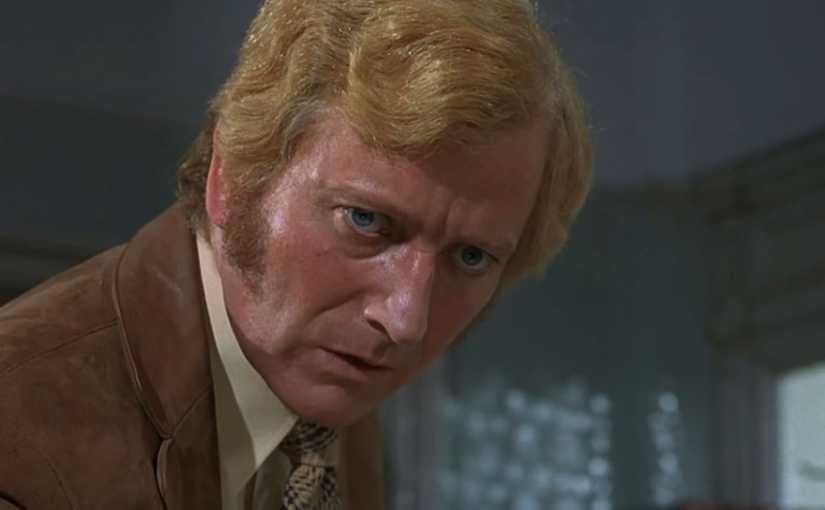
In 1972’s Frenzy, Alfred Hitchcock hearkened back to his killer classic themes remembered from Psycho. Only this time he is much more macabre with his material. Frenzy is Hitchcock’s only R rated film and his first movie to show outright nudity. Naturally, it’s all pretty eye opening, and considering that the film’s killer is regarded as a “sex maniac,” necessary as well.

Richard Blaney (John Finch) is not doing so well. He’s broke and he’s just lost his barkeep job. Subsequent from that he turns to his ex wife Brenda (Barbara Leigh-Hunt), a successful marriage and friendship counselor for comfort. It does not help that Brenda’s secretary overhears Richard violently losing his temper. Nor does it do any good when he has an outburst while dining with Brenda in a crowded restaurant. Why, this could only make him look suspicious of a crime, and the infamous, serial necktie strangler has yet to be caught.

When Brenda turns up dead by means of a necktie around her throat, all accounts point to Richard. Once again, Hitchcock’s protagonist is the Everyman caught up in an unwelcome conspiracy.

Frenzy is thankfully like many of Hitchcock’s best films. It gets straight to the point. Just as the film begins, the naked body of a dead girl floats up from The River Thames. Then it follows through with Richard and introduces likely suspects and or villains including Richard’s friend Robert Rusk (Barry Foster) and his bar waitress co-worker Baba Milligan (Anna Massey)

Hitch goes more horrifying than he might have had the liberty to do so a decade prior to this release. The necktie strangler’s rape and murder of the first victim is quite graphic and disturbing. This is a deranged individual and his victim is rendered helpless.

What keeps viewers interested in a good Hitchcock yarn is the suspense he manufactures for the one who is blamed, as well as for the killer. Hitchcock doesn’t dwell on mystery. Rather, he focuses on what his principal characters are going to do next, now that they are swept up in intrigue. The strangler continues his killing spree but overlooks one thing that could implicate him. The man who is blamed seems to get little help from anyone. Richard is in quite a pickle after all. As well, how will these two people encounter one another to wrap up the storyline?

Humor also comes through quite nicely with Chief Inspector Timothy Oxford (Alec McCowen) who is blessed with a loving wife who relishes analyzing the gruesome details of his investigation while preparing dinner time meals that look awfully worse than the corpses the Inspector encounters; quail with raisins for example. To look at her concoctions will certainly make you wince. It’s great side humor for the suspense at play.

A film like Frenzy hardly explores dimension in its characters. Many of Hitchcock’s films never get weighed down with too much material. The stories he directs are lean, only focusing on the central plot at play. The fun is in the disturbing angles he uses like a woman’s outstretched hand or frozen expression after succumbing to strangulation. Overhead shots of a man imprisoned in a small room can also be jarring. He keeps you engaged as tightly as the fingers of a dead body gripping a significant piece of evidence.

Films like Frenzy or Psycho cannot be made today. There are too many advances in technology and science to undo the developments of simple, yet grossly disturbing stories like this. DNA evidence and cell phones would wrap up any of these plot lines in five minutes. It’s fortunate that we can still transport ourselves to the period when these tales of suspense were originally developed. It doesn’t make it easy for the innocent man, the victims or the killer. I wonder how Hitch would approach today’s conveniences of modern science. If anything, he’d likely make his signature cameo on the wallpaper of someone’s iPhone. Nevertheless, I’m sure he’d find a way to continue to build his suspense. He had such an eye for his camera, his captions and his edits.

Frenzy is a demonstration of classic Hitchcockian thrills.

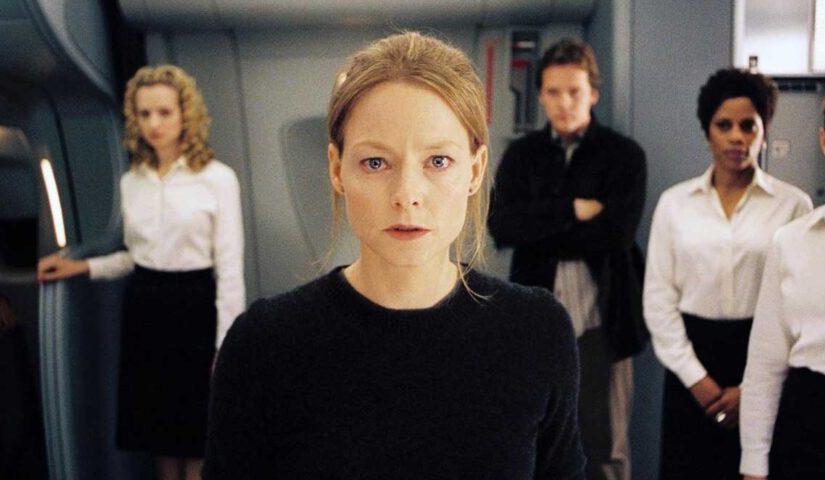
TRANSSIBERIAN (2008)

by Miguel E. Rodriguez

Director: Brad Anderson
Cast: Woody Harrelson, Emily Mortimer, Ben Kingsley, Eduardo Noriega, Kate Mara
My Rating: 9/10
Rotten Tomatometer: 93% Certified Fresh

PLOT: An American couple takes a trans-Siberian train ride across Russia, but things take an odd turn when they meet another mysterious young couple.


One of the reasons I like writing about movies is that it gives me the opportunity to talk up great movies that I’ve discovered off the beaten track.  Movies like the stunning stop-motion film Mary and Max (2009), or Sunrise (1927), hands-down the greatest silent film I’m ever likely to see, or Wild Tales (2014), an Argentinian anthology film that plays like The Twilight Zone crossed with Quentin Tarantino.

Or Transsiberian, a virtually unknown film from 2008 that is one of the finest examples of Hitchcockian suspense in the modern era.  It was an international co-production of – get this – Germany, the UK, Spain, and Lithuania.  It was co-written and directed by Brad Anderson, a man who’s directed a LOT of episodes of various television shows, and so has a good sense of efficiency and economy in his style and pacing.  It has yet another stunning Ben Kingsley performance as a Russian narcotics detective.  And it turns the screws on the heroine of the story in such a way that you can tell exactly why she’s doing what she’s doing, when every good instinct says she should be doing the exact opposite.

After a brief prologue involving a police investigation in Vladivostok, we meet Roy and Jessie (Woody Harrelson and Emily Mortimer), a married couple traveling home from China after a faith-based missions trip.  They decide to take a 6-day train trip across the Russian continent because Roy feels it would be nice to take an adventure…plus, he LOVES trains.  He’s one of those enthusiasts who don’t realize when they’re boring you with talk of gauges and coal-burners and cow-catchers. (Sheldon Cooper would have loved this guy.)  Jessie seems like a nice woman, but she seems to be keeping this adventure at arm’s length; you can tell she’d rather be flying coach than spending six days in a double-berth cabin.  I empathized with her right away.  They make a good couple, even though he wants kids and she doesn’t, she smokes and he’d like her to quit, he drinks and she doesn’t, et cetera.  Pretty normal.

A little while into their trip, Roy and Jessie meet the couple they’re sharing a cabin with, Abby and Carlos (Kate Mara and Eduardo Noriega).  Abby seems much younger than Carlos, but Jessie lets that slide, especially because Carlos seems to take an immediate interest in Jessie, and he doesn’t seem too concerned about hiding it.  Abby seems annoyed, but says nothing.  Roy is too jazzed about being on trains and interacting with the locals to really notice.  Carlos also seems to be pretty cagey about the souvenirs he’s carrying around in his suitcase.

At one of their scheduled stops, both couples leave the train to stretch their legs.  When the train leaves for the next leg, Jessie suddenly realizes something: Roy’s not on the train.  She didn’t see him get back on.  In fact, no one can recall seeing Roy re-board the train.  The movie plays a little by making us think one thing has happened, when it may or may not have…we can’t be sure.

And then, in true Hitchcock fashion, things start to spiral into one unexpected development after another, until the movie becomes about something entirely different than what you thought it was going to be.  Without getting into too many other details, Jessie finds herself trapped in a lie that she absolutely cannot back out of, no matter how much she wants to, because doing so would cause more harm than good.  Even when she’s presented with a life or death situation, she still can’t go back on it, and the story is constructed so tightly that it’s never for a moment unclear on her motivations.  You always see the “why” to her actions.

This other level to the movie is what separates it from the pack and places it in a higher weight class.  The screenplay is a masterpiece of suspense.  There’s a scene involving her camera that had me yelling, “Oh, NO!” at the screen…and I’ve SEEN the movie before.  You won’t believe the amount of suspense that will be generated with a slightly-open camera bag, or the fact that there’s never a garbage can around when you need one, or just the absence of a train stewardess.

This movie stands apart in its genre because the characters behave EXACTLY as they should, with perfect logic, and it never feels forced.  The bad guys are never too stupid, and the good guys are never too smart.  (They get pretty lucky a couple of times, but what are you gonna do?)  I don’t think I’m giving anything away by saying that, by the end, some characters are happy and others are not quite so much, but I don’t think you’ll be able to guess who will last that long.

This is a treasure of a film to be sought out and…uh, treasured.

US (2019)

By Miguel E. Rodriguez

Director: Jordan Peele
Cast: Lupita Nyong’o, Winston Duke, Elizabeth Moss
My Rating: 9/10
Rotten Tomatometer: 94% Certified Fresh

PLOT: A family’s beach vacation turns sinister when a group of doppelgängers begins to terrorize them.


[SPOILER, SPOILER, MOST CERTAIN SPOILERS TO FOLLOW]

It’s abundantly clear after two films (with hopefully many more to come) that Jordan Peele was and is an enormous fan of The Twilight Zone, that legendary TV show that presented tales of strange and the weird situations that very often turned into legitimate horror stories.  For me, that’s what Us is: a feature-length episode of The Twilight Zone, with everything amped up to 11, including the ambitious nature of the ending which, I think, bit off a little more than it could chew.

However, the ending is not what makes this film special, it’s how we get there.  And the events leading up to the end of the film make for one of the most unsettling movie experiences I’ve ever had.

I cannot stress the creepy nature of this story enough.  A family’s beach vacation is interrupted when intruders invade their home, and the intruders turn out to be…their doubles.  Doppelgängers.  Virtually identical except for disturbing aspects, like an additional scar or a perpetual smile or a cloth mask.  When these “others” faced their victims inside the house, I was indescribably terrified.  I found myself asking, what would I do in this situation?  If I found myself sitting across from an exact duplicate of me, a duplicate who never spoke but just stared and smiled and made weird clicking noises instead of talking?

I’d s**t myself, that’s what I’d do.

The story takes some interesting twists and turns, and it doesn’t follow traditional genre convention when it comes to who lives and who dies.  Whenever I expected one thing to happen, the movie neatly sidestepped my expectations ingeniously.

There’s also unexpected comedy, especially when someone tries to use their automated personal assistant at a crucial moment.  Think of all the times Siri has misinterpreted your questions.  Yeah.  It’s one of THOSE moments.

The movie is an amalgam of the best moments of Rod Serling, M. Night Shyamalan, Alfred Hitchcock, John Carpenter, and even a little Spielberg here and there with the comedy moments.  It’s clear that director Jordan Peele has digested the best films from these directors and crafted his own take on the horror/suspense genre, using those masters as a guide.  (I’m referring to Shyamalan’s EARLIER films when I call him a master, because they WERE masterful…not his later stuff, which is…not great.)

I, for one, found myself sucked into the story, hook, line, and sinker.  It did become clear, however, that the underlying reason for the existence of these doppelgängers was, inevitably, going to be a LITTLE disappointing.  Science experiment gone awry?  Space aliens?  Results of a newly-emerging virus?  As the movie entered its final stages and the meaning behind the doubles’ existence was revealed, I did find myself a little disappointed.  Like when someone shows you how a stunning magic trick was accomplished with a simple fake thumb.

Would it have been more interesting to leave the existence of these doubles unexplained?  To make it a TRUE Twilight Zone episode and leave the audience with a mystery instead of a true resolution?  I think it would have been more interesting that way, so instead of shaking my head at the almost banal nature of the doppelgängers, I would have left intrigued.  After all, John Carpenter never explained how Michael Meyers vanished after being shot several times at point blank range.  But it was CREEPY, brother.

So, there you go.  I loved it, the ending was a little disappointing, but not disappointing enough to kill the movie for me.  The journey was more important than the final destination, in my book.

I CONFESS

By Marc S. Sanders

Alfred Hitchcock’s 1953 film noir I Confess is an absolute must see. An underrated film that held my attention all the way to the end. Perhaps because of its subject matter and setting within the Catholic Church it didn’t hold the reputation of Hitch’s other more well known classics like Psycho, The Birds and North By Northwest. Those films played with their suspense. They had fun with humor and special effects to carry their adventures and horror. I Confess has a little more serious weight to its story, as it examines the scruples of its characters within a murder yarn.

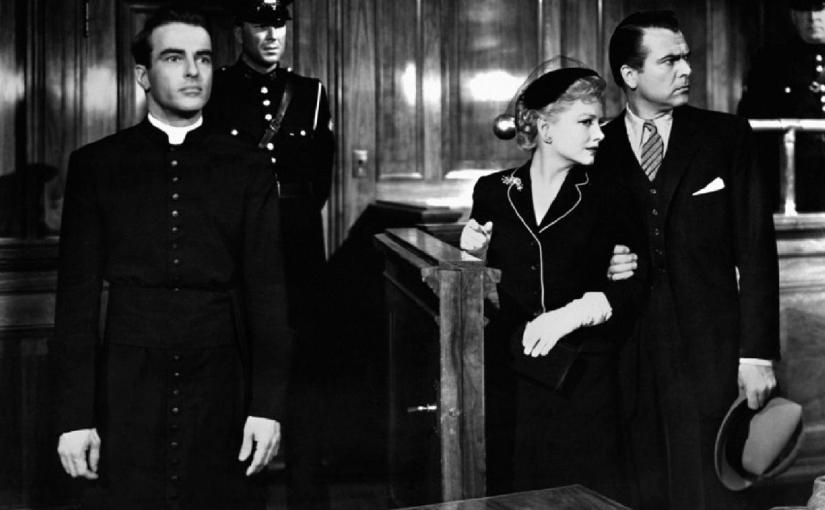
Montgomery Clift portrays Michael Logan, a Catholic Priest, who hears the confession of a murder from the church’s maintenance man (O.E. Hasse), late one night. Only now, sworn to his oath of confidence, he must keep it undisclosed. That might be a little challenging when it is gradually revealed that Fr. Logan might have a connection to the victim, a well known attorney.

Anne Baxter plays Ruth Grandefort, the wife of a politician, caught speaking with Logan just outside of the scene of the crime the next morning. Inspector LaRue (Karl Malden) has reason to follow up on these people. Immediately, your mind will likely go somewhere. When a man and a woman are caught whispering to one another in any murder mystery, well, what are you gonna think? Still, could it be something else entirely? Alibis are not quite solid and unlikely suspects are caught together. Why? What do they know? What’s the connection?

Hitchcock shoots a mystery turned inside out. You know who the killer is in the first five minutes. From there he pursues the red herring until it’s conclusion. The mystery isn’t really the issue here. The question is whether Logan and Grandefort will avoid a frame up. Can Fr. Logan maintain his oath while maintaining his innocence? Det. LaRue has every reason to believe he’s got his culprit, and yet he doesn’t.

Film noir set in Quebec sidles up to questions of morality beautifully here. I was truly wondering whether Logan was going to get exonerated. Hitchcock applies the suspense in that perspective. It’s a great twist on the traditional Agatha Christie motif. He’s got a great tracking shot (actually he was probably carrying the camera and walking on his own two feet) of the maintenance man walking at a fast pace alongside Logan down a hallway, reminding him of his commitment of confidentiality. “As long as you’re a priest…”. Hitch got my pulse racing at this moment.

The three principal players (Clift, Baxter and Malden) are very good here. None of the performances feel dated. As well, Hasse as the murderous German caretaker makes for a good, creepy foil, always looking in from the outside to make certain the investigation never sways away from Logan.

The set up is really well executed from Hitchcock using a script by George Tabori & William Archibald, adapted from an early 20th century play by Paul Anthelme. It’s a little surprising to see a priest caught up in a murder and perhaps some other sinful acts in a film from 1953. There were actually aspects of the original script that Warner Brothers insisted be excised.

However, had this film been made today, there’d likely be an uproar over a Catholic Priest being considered for murder or even participating in a possible affair.

The shock of it all still works in I Confess. A priest is a prime murder suspect? Never! How could it be? Yet, that’s what engaged me. We all are capable of carrying out the worst acts imaginable. The same could be said that we are all capable of holding true to our moral character. Our capabilities are embedded in our human mindset. The question is what is everyone willing to believe.