THE SUBSTANCE

By Marc S. Sanders

It’s no surprise that a science fiction gore fest would make its way on the silver screen intent on enhancing our lives as we grow out of adult youth.  Plastic surgery and bust enhancements, unwanted hair removal, butt lifts and Botox are common vernacular discussed in magazine articles, infomercials and talk shows.  Well known actors rely on beauty preservations and enhancements to uphold their careers or give themselves a needed boost to stay relevant.  I mean come on, Tom Cruise wouldn’t naturally look like that.  Still?  Let’s get real.

What I admire about Coralie Fargeat’s The Substance is how she applies her updated Frankenstein experiments within the boundaries of Hollywood glitz and glamour.  Her film starts out ironic, then reflective and concludes on B level satire.  Wasn’t this how The Toxic Avenger came to be?

Fortunately, the brains of the writer/director overcome the beauty that’s attempted.

Elisabeth Sparkle (Demi Moore) is an obvious nod to Oscar winner Jane Fonda.  She is unbelievably gorgeous and physically fit, especially for a fifty-year-old award-winning starlet. (Incidentally, Demi Moore is over age 60.) She has found a second career success as a daily TV workout video hostess. Yet, she senses that her expiration of youth is quickly approaching.  It could not be more apparent from what her sleazy producer Harvey shares with her.  This jerk has no filter and tells it like it is. Audiences want younger and curvier, and Elisabeth ain’t it.  Harvey is played by Dennis Quaid and Farageat is not shy about presenting this guy with every priority of superficiality.

Elisabeth gets axed from her show.  Fortunately, she comes upon a possible remedy for her aging dilemma known as The Substance.  After some toiling about, Elisabeth agrees to try this clandestine idea out promising a better, more improved version of herself.  

The kit to make this all happens is delivered.  First is a needle injection and further instructions mandate without compromise that every seven days Elisabeth must return from the alter ego that spawns from her.  Except this is not so much an alter ego as it is alter body.  Literally from behind Elisabeth’s back enters Sue (Margaret Qualley).  Both Elisabeth and Sue are reminded by the mysterious voice on the phone that they are “one,” and they must use the contents of their kits to nourish one another’s bodies daily plus, and without fail, surrender to a seven-day hibernation while the other roams the earth.  Every seven days they must alternate.

Sue, with Elisabeth’s psyche, gets the job as the replacement hostess and Harvey goes nuts for her as the ratings and her popularity soars.  The Substance is serving its purpose.  

Yet, what happens when the two egos do not cooperate with the program’s mandates?  Well, you find out with an assortment of grotesque and ugly side effects that develop both mentally, and especially physically.  The Substance tackles some extraordinary consequences ranging from multiple personality disorders that joust with one another, and insecurities that even beauty enhancements could never resolve.

Amid all of the ugly gore of blood and fluids and stitching and rotted, infected skins is a jaw dropping performance from Demi Moore.  The Substance is deliberately not big on dialogue as it depends more on perception and facial response.  The best example is when Moore as Elisabeth prepares herself for a date and builds up an unnerving frustration as her character focuses on her reflection in the mirror.  I read that Demi Moore slapped and rubbed the skin of her face raw while shooting this scene in take after take.  Her commitment to the scene could not be more evident.  A later scene with her adorned in offensively aged makeup is at least as aggressive for the actress.  A food binge goes maniacal, and Demi Moore is sensationally focused on its messiness and engorgement.

The Substance is very smart from beginning to end.  Yet, the conclusion is outright ridiculous, and Coralie Fargeat clearly wants it that way.  It’s not only that Elisabeth and Sue suffer at the punishments of their own hubris, but Harvey and those that put appearances over any kind of, well, substance must succumb to their own superficial priorities.  Fargeat takes what could have been a comparable messy Three Stooges pie in the face route where everyone’s dignity has to be shed.  The blinders of beauty get washed away in an overwhelming deluge.

The Substance is elevated to an absurd narrative as quick as it begins.  No one is glamorized even if this is Hollywood.  We get close ups of Harvey gorging himself on sloppy, saucy cocktail shrimp while Elisabeth watches in disgust.  Later, the physical side effects go by way of famous makeup artist’s Rob Bottin’s work on films like John Carpenter’s The Thing.  The director tosses obvious nods to Stanley Kubrick’s The Shining with a ghastly orange hallway and reminiscent geometrically zig zag carpeting.  Even a men’s room designed in cherry blood red harkens back to that film.  Food is repulsive in this film that focuses on body image.  Colors of all kinds are loud, garish, and bright.  The director doesn’t want you to wince at only the very graphic details of Elisabeth and Sue’s ongoing transformations.  If these characters are going to feel or behave ugly, then the world they live will feel at least as repulsive.

A friend of mine who takes to curious kinds of horror and fright fests was eager to see The Substance.  She watched the night before I did and was angered by the ending that she found ridiculously over the top.  Definitely no argument there.  Yet, because this is satire offering a reflection of truth, as gross as the film is and as absurd as the ending gets, it logically adds up.  

We can try all we want to hold on to our youth and outer appearances.  However, either we must learn to become satisfied with the limitations that science can offer or we will pay penalties for defying what is instructed of ourselves.  The Substance is beyond any sense of science.  This film tosses hints at the viewer that Elisabeth, and later Sue, should think twice about what they choose next.  Then again, whoever thinks twice in one these B movie schlock fests, anyway?  

I even think this film goes a step further.  In cancer patients, chemotherapy remains the leading remedy for treatment of the illness.  We turn to its resolve despite the sickening side effects that stem from its program.  We want to live and we will compromise our ways to go on living.  Elisabeth Sparkle needs to remember though that she does not suffer from cancer.  She’s an insecure woman who isn’t ready to face change.  I’m not minimizing how the character feels.  I can relate.  She is facing a hard, agonizing truth from her perspective. I took steps in my lifetime to enhance my appearance and mentally and physically it was not the best option for me.  

It’s fortunate that Demi Moore allows me to relate to what’s traumatizing her.  Margaret Qualley does well holding up the other half of the picture as her side of this one personality gets drunk off the attention and perfection she’s entered into this new world.  

Commonly speaking, I also thought of the Queen from Snow White And The Seven Dwarfs.  An elegant woman so insecure with her beauty against that of a young girl and she sees no other way to come out on top than to change into an ugly, old hag.  Like Elisabeth in The Substance, the Queen in Snow White will accept a notion of looking worse before it gets better.  Since this film is satire, don’t we all go through experiences like this at one time or another?

Some of us learn.  Some of us persist and persist though.

WALL·E

By Marc S. Sanders

There are some movies that seem to accurately predict what we can expect of our planet’s future.  Paddy Chayefsky was one such prophet with his script for Network and the rampant consumption of television influence and addiction.  Author Phillip K Dick might have also been a Nostrodomus of sorts when his writings were adapted into such films as Total Recall, Minority Report and Blade Runner which offered convincing convenience to lifestyles and evolved productivity.  Perhaps the imagineers behind PIXAR are also on to something because their adorable, futuristic WALL·E does not seem so farfetched.  

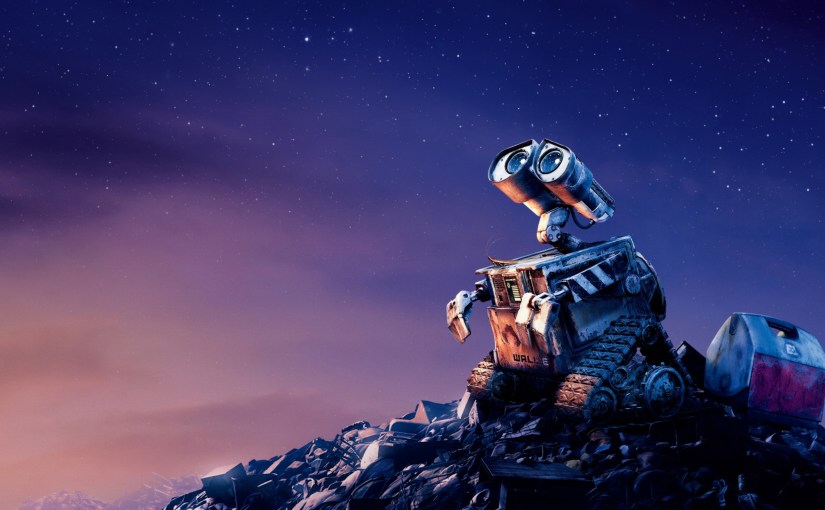
The robot title character is a trash collector on an abandoned planet Earth seven hundred years into the future.  A Wal-Mart/Sam’s Club amalgamation known as the fictional Buy N Large appeared to have become the main resource for any immediate need of the human population that once existed; what the coming of Amazon is turning into. This monopolized interpretation of absolute capitalism was run by a CEO and maybe Commander In Chief of the free world, played by Fred Willard, the one major flesh and blood actor to appear in this picture. 

WALL·E, along with a faithful cockroach, roams the wastelands.  The puppy dog, bug eyed robot wheels around on his tractor legs collecting the endless amounts of leftover trash and compacting it into neat, stackable boxes.  Piled on top of each other, these boxes get as high as skyscrapers.  These are the remnants from what Buy N Large left for the planet.

One day a rocket ship arrives and drops off a highly sophisticated and glossy white droid that we come to know as EVE.  For WALL·E, it’s almost love at first sight even though EVE has a treacherous laser cannon for an arm and intimidating blue cyborg eyes.

Eventually, the two bots hitch a ride into space when the rocket returns to pick up EVE.  They arrive on a galaxy cruise liner that’s floating through the solar system.  While the two get into a bunch of Looney Tunes shenanigans running through the corridors and piping of the ship, the audience bears witness to what exactly happened to planet Earth, and who has survived to carry on.  At this point a prophecy seems to be declared by writers Andrew Stanton, Pete Docter and Jim Reardon (all PIXAR regulars at the time).

Humans aboard this liner have become oversized, lazy blobs with no neck, fat arms, fingers and legs, and reclined to permanent seats while robotics cater to their hungers and comforts.  These people are cheerful but happily lazy and unproductive.  Remember when your mother would tell you to clean your room?  Well, the wasteland universe of WALL·E bears justification for mom’s aggravation and constant pestering.

The computerized animation of this PIXAR romantic adventure is dazzling in details and character expression.  There’s an unattractive sand like and earth tone mood to anyplace we explore on Earth.  Yet, the industrial sheen of the cruise liner appears to have all the comforts imaginable.  You can practically taste the colors and feel the balmy air conditioning within this ginormous vehicular city in space. Yet, the telling story of WALL·E has no problem convincing me that this is not right.  This is not a future I’d want to be a part of.

Disney and PIXAR follow that mentality of ensuring a soul of emotion drives their characters of fantasy and it’s easy to fall in love with the clunky lead robot.  You want WALL·E to be safe from sandstorms, while also keeping his only friend, the cockroach, by his side for companionship in an entirely lonely world.  His only other source of cheerfulness comes from watching the musical Hello, Dolly! on an old TV. Even playing ATARI’s Pong is not stimulating enough for this little guy.

Sound Effects Wizard Ben Burtt, who pioneered staple sci fi elements with the Star Wars films, performs the vocal expressions of chirps and beeps for WALL·E’s innocence.  There’s a language to the little fella and it’ll leave a lump in your throat when he calls for EVE.  Elissa Knight brings a more experienced, technologically up to date personality to EVE.  We worry when an organized entity like EVE robotically screams for WALL·E when she thinks he’s in danger.  She’s only supposed to follow a program, but the manufactured mind lends to a side effect of genuine emotion.  As the two get acquainted with each other, there’s a touching chemistry to them both.  A floating dance through space is as much silly as it is adorably romantic.  You cannot help but smile because by this point you are invested in this relationship as much you’d buy Rick and Ilsa’s affections towards one another, or Harry and Sally’s.

I really embrace the childlike love story connecting these two non-living beings.  Set against what appears like an apocalyptic wasteland, there are layered dynamics to this animated film, one of PIXAR’s best.  

I have to also salute the film’s nods to classic science fiction that also offer not so unrealistic possibilities.  An antagonist comes in the form of a robot similar in appearance to HAL-9000 from Kubrick’s 2001: A Space Odyssey.  He’s a nasty bugger with an all too familiar blood-red eye. It’s also a delight to recognize Sigourney Weaver’s voice as the cruise liner’s computer, a sort of slap in the face to monochromatic computers that would countdown a certain doom for the actress’s most famous role of Ellen Ripley in the Alien films.  PIXAR has always been brilliant with their wink and nod delights.

The film was released in 2008, a near generation ago maybe, when iPhones and Androids were not even as entirely sophisticated as today.  Yet PIXAR could telegraph what was to come.  The environments on Earth and on the cruiser tell us just how overly reliable we’ve become on technological conveniences for socializing or even one stop shopping.  

We are getting to a point where we might not even procreate with one another.  It’s a sad irony that it will take two self-thinking, yet designed for programing, robotic appliances to remind us how valuable the human touch is and what a purpose to life really serves ourselves and those we have to interactively live with.  

You might be embracing that cell phone tight in the palm of your hand, but will that device ever hold your hand in return?

ALIEN: ROMULUS

By Marc S. Sanders

To make an effective horror film requires the necessary scares to startle an audience, but it doesn’t stop there.  The story has to work. Still, it doesn’t stop there.  You also have to care about the characters of the piece.

I guess one out of three is not bad for a new installment in a nearly fifty-year-old science fiction/monster movie, horror franchise.  However, with Fede Alvarez’ Alien: Romulus, I left wanting more.

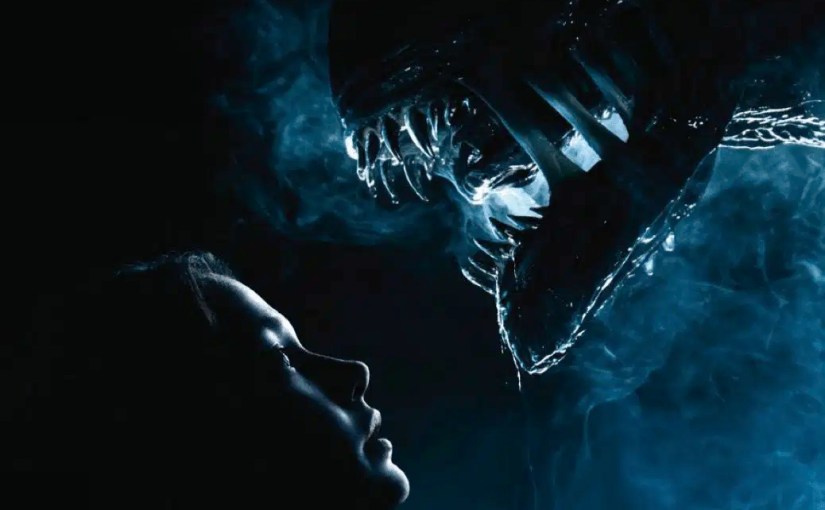
I have no doubt I was the loudest, perhaps most frequent screamer in the Dolby theater last night.  Knowing what I know about Alien, I still get terribly nervous when watching a picture of these grotesque-like creatures, originally designed by H. R. Gigar.  The assortment of Xenomorphs in this film is a faithful treatment to what the monsters should look like.  Teeth, slime, black skeletal frames with scaly limbs and tails.  What these monsters do is another story. It is primarily the same old routine of the creatures from the other films.  Their quiet behavior ahead of their ritual attacks leaves me very nervous and anxious.  I’ve gotta scream at the screen to help me overcome what scare tactics Alvarez and his crew have in store for us.  

Alien: Romulus follows a Michael Myers/Friday The 13th blueprint.  In basic terms, a handful of twentysomethings board a deserted space station as a means to getting off a mining colony overseen by the franchise corporate antagonist Weyland/Yutani.  An audience familiar with the franchise knows this is not going to go well, and soon will expect the clawlike facehuggers, phallic shaped chestbursters and fully developed aliens, aka Xenomorphs, to run around trying to slash, eat, cocoon and build up their population.

Upon attending a screening with my Cinemaniac pals, the guys will testify to my shock and horror at what popped out on screen.  I was terrified for what was coming out of Fede Alvarez’ dark and disturbingly silent settings.  I was nervous when the cast crawled through narrow crevices or stepped into various labs, only to get stuck behind a jammed door or commit a clumsy trip into knee high, unclear water.  Cocooned bodies representing an aftermath of violent carnage sent a doomed message too.  The atmospheric sets alone work well at being terrifying.

Yet, for all of these technical achievements in luridly dark scenic design, jump scare editing, gross looking attacks along with alien “deliveries” and terrifying pursuits and chases, my friend Anthony said it best.  He didn’t care about one single character.  Same for me.  I can’t deny how accurate he is. Like a slasher movie, I could care less if any of the players lived or died.  Even with a periodic countdown during the course of the film, I also didn’t care if they got away from the deserted ship.  So, the suspense never sustained. I was only anxious for when the next monster was going to make an appearance. In the third act, many of the jump scares were nil and upstaged by machine gun shooting and acid (for blood) splashes.

I also didn’t care for the expository scenes either because the information presented was nothing new.  Anything that this gang learns they are suddenly up against has been told to me in all of the other films.  There’s some wink and nod material to salute the other pictures with famous line send ups and even one broad character salute.  It’s fun for a moment but what about this movie and this story

I was also quite bothered by the convenient “just made it out alive” encounters that the main character played by Cailee Spaeny survives over and over.  Anytime danger was knocking at her door her means of survival were not consistent with the long-established fiction of the Alien science of it all.  When I wasn’t screaming, I was asking myself, how is she getting away.  That’s the script not respecting the story elements, the universe or what is presented to an audience, and what they clearly know after almost a dozen pictures.

None of the characters have a personality.  One is Asian with a buzzcut, two are English, and one is pregnant.  The only interesting portrayal is an android named Andy (David Jonnson) who is a sidekick “brother” to Spaeny’s character, and behaves like an autistic savant, until a change comes over him, causing him later to operate like HAL 9000.  Jonnson is really good in this role, and it is unfair that his cast mates were not as fleshed out like most of the other franchise films depicted in portrayals by such actors Ian Holm, Yaphet Kotto, Paul Reiser, Bill Paxton, Lance Henrickson, Charlize Theron, Noomi Rapace, and of course Sigourney Weaver. The characters in this new picture are entirely forgettable and carry no value.

Jump scares with things that come out of dark corners or when crusty hive like walls come alive only go so far.  To effectively win over horror, I need to also care when the next victim is taken down, or about to go through a near death experience on an even playing field.  Romulus comes up short in that department.

Alien: Romulus is decent, but not great as it opts to only think with one side of its brain primarily focused on sneaking up to shiver you in hopes that you’ll pee a little.

NOTE: I knew what not to expect out of this film.  My wish was to see a book end to the last two films that Ridley Scott helmed (Prometheus and Alien: Covenant).  Questions were presented within those films that seemed to promise answers with a later film installment that has yet to come to fruition.  So, the production company seems to have abandoned what they started in response to lackluster box office revenue and a divisive audience response.  Therefore, reinvention came into play once more.  I was always on the enthusiastic side of the divide with those two films. I carry great appreciation for what was done with them, and I was eager for how a prequel trilogy (now remaining incomplete) would wrap up. Alas…

As well, at close to fifty years, if you’re going to keep this up, I believe it’s time to reveal more about the villainous puppet masters, namely “The Company” or to be more specific, Weyland/Yutani.  It has always been supposed how people who work for them may be expendable. Researching and controlling weaponized biological organisms is the company’s main priority.  Yet, how, who and why are these ideas being set in motion?  Does anyone at the top question the company’s practices and look at the moral and ethics of their functions?  Even the Marvel Cinematic Universe has approached these kinds of angles already.  Star Wars as well.  Regrettably after several decades though, the Alien franchise segues away from those perspectives.  This is my take only of course. Yet, I think it’s time to show who else is performing within this house of horrors universe.  Prometheus and Covenant were moving in that direction but sadly they seemed to run out of road. 

FURIOSA: A MAD MAX SAGA

By Marc S. Sanders

George Miller has never gone deep with his Mad Max movies.  The director treasures the inventions of his auto chases and the tricked out diesel junk contraptions that participate in high speed pursuits through his apocalyptic desert wasteland.  The more outrageous the vehicles and the crazier the stunts are, the more fulfilled Miller appears to be with his filmmaking.  However, the fifth film within this gonzo world of barbaric S & M dressed drivers invites us to explore the past of a surprisingly treasured character,  introduced in the prior film.  Her name is Furiosa and this time we see what she experienced as a young child (Alyla Browne), followed by what she learns as a young adult (Anya Taylor- Joy).  This fifth film in the franchise serves as a prequel to the last film, Mad Max: Fury Road.

As a pre-teen, Furiosa is abducted by the bandits who serve under the pompous and proud Dr. Dementis (Chris Hemsworth, playing his Thor role as if the Marvel character was a celebratory villain). A thrilling prologue covers this sequence of events with rescue efforts from the would-be heroine’s mother to save Furiosa and bring her back to their secret home of green vegetation located beyond the desert plains.  There are heart stopping motorcycle chases with the warrior mother bearing a sniper rifle and fighting with her last breath through the whole sequence.  Charlee Fraser portrays the title character’s mother. Thanks to her performance, she had me convinced me that the rescue will deem successful, accompanied by Miller’s reliable direction.  An absolutely thrilling opening.

Dementis rides his esteemed tri-motorcycle chariot steed, inspired by the sword and sandal adventures of Ben Hur and Gladiator.  A hilarious over the top vehicle to see Chris Hemsworth piloting.  His biker gang is in tow along with young Furiosa as they journey to the Citadel, first seen in Fury Road.  Dementis puts his conceit against that of Immortan Joe (Lachy Hume) the skeleton masked ruler of The Citadel for a chance at…what else?  Conquest and power.

Furiosa grows up a few years and gets mentored by a trucker named Praetorian Jack (Tom Burke).  I still love these character names by the way.  The truck chase is the highlight of the picture, with paragliding motorcycle riders swooping in like large attack birds trying to sabotage the weaponized rig full of delightful surprises that’ll make you shout “OH!!!” in the middle of the theater.  It is sequences like this that audiences adore in the Mad Max pictures. 

Unlike the other films though, Furiosa gets a little lethargic during the story set ups which are angles that never anchored the other better installments, The Road Warrior and Fury Road.  Reintroducing the Immortan Joe character is not as interesting this time and this desert picture gets a little too waterlogged when he enters the story.  He just doesn’t feel very necessary.  The two younger Furiosas and the self absorbed Dementis are plenty with just enough story opportunities to make a solid movie.  Retreading on other characters slow this fifth installment down a bit.

The whole cast looks great.  Anya Taylor-Joy is the best bad ass version of a younger Charlize Theron, who originated the role.  She hardly has any lines but her expressions on camera beneath the war paint, grease, dirt and long hair extensions look awesome.  Though the lead actress is hilariously dwarfed by Hemsworth’s Dementis, they make for a great dichotomy of hero vs villain.  She’s the quiet reserved David.  He’s the proud Goliath.  This is a dream casting pair.

Practical stunts are done once again and George Miller does impressive work with his camera.  His tactics for filming action scenes demonstrate why a Michael Bay normally fails.  Nothing is a quick take edit.  You watch these motorcycle riders and Furiosa hold onto to the bottom of the speeding truck and Miller will circle the camera, with no cuts in the take, so we see what is happening next to both sides of her profile.  The camera will then swoop up to see who’s running and holding on to the top of rig or who is parasailing from a great height while tethered to some kind of buggy vehicle below.  Amazing work.

However, seeing Furiosa on a large Dolby screen, it’s not hard to see a computer enhanced finish applied to the photography.  It’s very glossy and nowhere is it grainy like the very early Mad Max films from over forty years ago.  Yet, as dirty as these vehicles and characters are, the cleanliness of the cinematography sometimes does not clash well with what’s on the screen.  It’s a little distracting honestly and that was a surprise to me considering how perfect Fury Road looks on my 65-inch flat screen at home.  This one looks a little too perfect.  This might be that film where less may have been more.  

The background story work on Furiosa is not a terrible grievance.  The final print of the picture is acceptable.  All of it is definitely worth watching and I hope box office picks up following a sluggish opening weekend because I encourage anyone to see Furiosa: A Mad Max Saga on a big screen first.  I just think George Miller and company may have leaped much further than necessary this time around.

MAD MAX: FURY ROAD

By Marc S. Sanders

After watching Mad Max: Fury Road, you will feel like you need a shower.  Strike that, you will need a shower in aloe first, then a traditional shower and then a weeklong bath in aloe.  It’s a baked in environment that gives you the feel of grainy sands and burning sunbeams.

George Miller’s return to the gonzo, apocalyptic diesel future franchise is exciting from the moment the Warner Bros logo appears with the vroom vroom blaring through your sound system’s speakers.  Miller hardly surrenders the breakneck speed of his two-hour picture to let an audience catch a breath, and because the director is so unforgiving it makes this a tour de force of action entertainment that other adventure films can only strive to at least match.  Still, the movie has next to no story, and that’s fine.

Up until this 2015 reinvention, Mel Gibson was the Aussie Road Warrior donned in leather fighting to survive against lawless bandits coming from any direction in the sand swept plains of an earth afterlife.  Now Tom Hardy takes over the role.  Frankly, it could have been anyone who got recast in the part.  Hardy has few lines and for half the film his face is caged in a grotesque, steel bar mask while he is strapped to the front of a hot rod, gear grinding, amalgamation of a vehicle, simply to be a kind of three-dimensional hood ornament.  This Max is suffering through high-speed chases with his head trapped in animalistic headgear and his arms and legs bound behind his back while he’s tethered to this four-wheeler.  It’s brutal and we can feel how tortuous it is for Hardy’s character.  Yet, we love it!!!!  Keep it going, George!

The real star of Fury Road is Charlize Theron as a one arm rebel caked in black grease with a shaven head.  Her name? Imperatour Furiosa.  What a name!!!!!  Furiosa attaches a steering wheel to the driving hilt of an 18 – no 20, maybe 24-wheeler (it could even be 36) big rig with a big ball of fuel hitched to the back. She detours away from a band of outlaw drivers ruled over by Immortan Joe (Hugh Keays-Burn).  Yes!  His name is Immortan Joe. 

In tow with Furiosa are Joe’s pregnant concubines whose fetuses are declared his property.  These lovely lasses dressed only in bed sheets have names like Capable, Cheedo The Fragile, The Dag, Toast The Knowing and The Splendid Angharad (Riley Keogh, Courtney Eaton, Abby Lee, Zoë Kravitz and Rosie Huntington-Whitley).  What is the point of listing off these ladies’ identities? Well, the script for the film doesn’t do so. Yet, the end credits do in a heavy metal kind of font, and it is clear that George Miller is proud of every name, every piece of junk that flies through the air in one crash and bash after another, and every flame that exhausts out of a pipe or even a death metal rock guitar orchestrated by a guy simply known as The Doof Warrior (played by a musician named Iota).  Incidentally, The Doof Warrior is garbed in red long johns and tethered by chains to a big rig with the biggest, blastiest speakers known to man.  The Doof Warrior serves no purpose except to scratch on the guitar while flames shoot out of the stem.  I’m laughing as I type this all out.  This whole display is thankfully ridiculous while all of these figures have the most outlandish and greatest names of all time!!!!

When Furiosa diverts away in the mighty big rig with the pregnant women, Joe follows suit with his endless band of albino crazies in one tricked out vehicle after another.  One car has the chassis of a Mercedes wedged on to the fattest wheels ever conceived.  Another is a Chrysler (I think) resting atop a pair armored tank tracks.  Joe’s automobile looks like it got disqualified from a monster truck rally because it was caught taking diesel steroids. 

Anyway, Mad Max eventually catches up with Furiosa and the ladies.  His last name is not something simple like Jones, Smith, Sanders or Rodriguez.  It’s ROCKATANSKY!!!!!  BOOM! That is awesome!!! A one-time underling of Joe’s, named Nux (Nicholas Hoult), eventually sways over to the heroes’ side as well, and the pursuit carries on.  Furiosa’s destination is a location of green, beyond the desert wasteland.

It’s a wonder that Mad Max: Fury Road was applauded so much in 2015.  However, take a moment to consider the construction of this two-hour operatic noise fest and you cannot help but salute all the merits that went into the final product.  First the nominated visual effects are primarily practical with little to no CGI.  If George Miller is going to make another Mad Max film, he’s going all the way.  The cinematography is gorgeous in a tan, orange, and yellow sun burning desert, while the night scenes are unhidden due to a pure, bright blue.  The interior of the truck seems cramped and uncomfortable, and yet Miller leaves enough room for the viewer to sit inside and uncover every hidden firearm plus get up close with the driver and the lady passengers.  There’s even a cool weapon found in the stick shift.  Wait until you see that!  The editing is relentless with perfectly captured close ups of so many character drivers and passengers all in a matter of seconds.  Plus, wide overhead shots and extended ground captions make it easy to understand just how many vehicles are included in this endless demolition derby.  I’m talking hundreds of monster machines ready for weaponized destructions. The choreographed action scenes of gun shots firing and vehicular collisions is like a ballet of a perfect derby show.  Monster razor blades are given their due, along with an assortment flame throwers. Also, kamikaze suicidal albinos are ready to act like destructive grenades.  Not one scene or shot in a Transformers CGI picture of metal vomit comes close to a millisecond of George Miller’s craft.

No other film could be as deserving of Academy Awards for sound, cinematography and editing as well as nominations for Best Picture and Best Director.  Even the warped-out S&M costume designs and make up are eye popping; merits that also earned Oscars.  You might have a fondness for art house cinema like Fellini or perhaps a Daniel Day-Lewis piece that invests in the method of caliber acting performances, but you cannot deny the artistic efforts vested by George Miller, his editor wife Margaret Sixel, and the rest of the crew. Mad Max: Fury Road was placed on so many top ten lists in the year 2015, and its because the film succeeds in the best of technical achievements. 

George Miller operates like that nasty kid named Sid from the Toy Story pictures.  He assembles his set pieces in the most tricked out, ugly and grotesque combinations of auto body parts, gives them engines that breathe fire and roar like vicious beasts that smell like diesel and then collides them altogether in a wide open plain.  Try to imagine Miller as a young child with his Matchbox cars on his bedroom floor.  His parents might have had some concern while observing his play activity.  What’s appreciated though is that this director never settled for simple with his Mad Max films and he never repeated what he’s already demonstrated.  No car crash looks the same.  No single shot is  repetitive.  This is how a director of any film genre should operate.  When they take attentive care to every frame they capture with their camera, then they get a Mad Max: Fury Road

One of the best films of the twenty-first century!

NOTE: I originally saw this film in 3-D in the theaters.  Wanna know my sentiments towards 3-D? Well, I hated this film after I saw it.  I gave up five minutes into the piece because the 3-D was unforgiving in distraction and dark beyond comprehension and measure.  Watching Mad Max: Fury Road again, a number of years later in a standard 4K on my 65-inch flat screen, you can likely tell by my write up that my sentiments have drastically changed for the picture.  It’s also telling to note that the new prequel film Furiosa is not being presented in 3-D.  Unless it is a James Cameron film or a special exception like Ridley Scott’s Prometheus, modern 3-D is as big a failure as the new formula Coke was back in the 1980s. 

KINGDOM OF THE PLANET OF THE APES

By Marc S. Sanders

The revival of the Planet Of The Apes films within the last decade and a half remain impressive.  Moreover, the first film, Rise Of The Planet Of The Apes, led to a global epidemic that wiped out most of humanity, well before we ever heard the term COVID, or used the word pandemic in our everyday vernacular.  That first film was guided by James Franco with fast food science summarization, but it was a thrilling film in context of storytelling and most especially in the visual effects delivered by WETA (who worked on Peter Jackson’s Tolkien films) convincing audiences that apes inherited a superior intelligence to overthrow the dominant human species.  A chimp character named Caesar led the rebellion and he was masterfully played by Andy Serkis.  Caesar did for the retelling of Planet Of The Apes what Wolverine did for X-Men.

In this 2024 fourth installment titled Kingdom Of The Planet Of The Apes, Caesar has now passed away and this universe jumps many generations into the future.  The new ape hero is Noa played by Tampa native Owen Teague.  The mannerisms of Noa are just as convincing as what we saw in Caesar, even if the character is not written with as much nuance or magnetic care that we found in Serkis’ performance over the prior three films.

In this film, practically all of humanity is wiped out.  This ape population, Earth location unknown, has formed a bond with the bird community and Noa and friends find adventure while retrieving eggs from high birds’ nests to be used for a symbolic ceremony within their village.  

However, just as real-life human history teaches us, other ape factions adopt man’s nature to control and conquer.  Noa finds himself on a horseback sojourn to rescue his village members who were harshly taken from camp.  Along the way he meets wizened orangutan Raka (Peter Macon) who apprises Noa of the legend of Caesar.  Curiously, a mute teen girl (Freya Allen) is found as well.  They engage in a united trek that will test them as encounters with danger present themselves.  In particular, they come upon the sadistic tribe overruled by the mighty gorilla Proximus Caesar (Kevin Durand).

All of these ape portrayals are marvelous to observe.  The expressions and change in facial features plus the flex of limbs and torsos with involuntary motion are unbelievable to see as the characters deliver their dialogue and converse or debate with one another.  The hand-to-hand combat interactions are perfectly enacted. You remain impressed through the course of the entire film, even if the picture is unnecessarily longer than it needs to be.

Kingdom moves episodically through Noa’s eyes.  The movie begins with one story.  Then as additional characters are introduced it moves on to something else until it gets to a mildly sinister (PG fare, really) telling of Proximus forcing his chimp followers to heed his command by opening a large steel vault door of a beached ocean cruiser from the long-lost days of human occupation.  What’s in the vault?  Well, I was never expecting much, but Proximus believes the contents to be revolutionary. By commanding under a misleading guise of what the original Caesar stood for, he’s a vicious figurehead to the apes he holds hostage.

The interesting aspect to Kingdom is by this fourth film we know who the real Caesar was.  Though, Noa was never educated on the messianic purpose of that leader.  So, we find Proximus to be a deceitful evangelist to his underlings. While it’s not a major requirement to know what occurred in the prior films, it helps to know what Caesar stood for versus how he is regarded in this further future.  Ministers deceive biblical teachings and the figures within the holy text to capture their congregations’ impressions.  Proximus functions in a similar way.

The prior films kept a divide between the apes and the few human survivors as a means to set up conflicts.  With Kingdom, we witness beyond what Caesar oversaw generations later, and how divisions within the ape species serve only to live quietly or govern with a domineering crown and the symbol of a legend to deliver an updated mantra.

Socially speaking, like the best Ape films and going back to the French novel adaptation from Pierre Boule (known for also writing The Bridge On The River Kwai), these stories work when they explore new aspects of intelligent developments within the ape communities.  Some function with selfishness and a need for power.  Others lean towards love, friendship and a moral compass.  Blend these ideals together and in turn comes conflict – the nucleus of effective storytelling.

Kingdom Of The Planet Of The Apes is perhaps the weakest of the four most recent films.  The film is too long with unnecessary exposition.  Noa is not the hero that Caesar was. Though some turn up, humans are primarily absent from the whole film, and they are still the best opponents against the ape communities.  

The cliffhanging ending keeps me excited for more subsequent tales because I’ve not grown tired of this franchise yet.  These films are more dazzling than James Cameron’s two Avatar films combined.  

I must confess I was hoping this movie would address some hanging threads that stem all the way back to Rise Of The Planet Of The Apes.  Still those topics have regrettably not been addressed and I hope those moments were not just some random wink ‘n nod.  Specifically, I’m referring to the rocket that astronauts launched in the direction of Mars just before the virus spread across the planet and Caesar’s band took over Earth.

There’s a good story in Kingdom Of The Planet Of The Apes.  I was just hoping for a few other angles than some of what were offered up this time around.

SILENT RUNNING (1972)

by Miguel E. Rodriguez

DIRECTOR: Douglas Trumbull
CAST: Bruce Dern, Cliff Potts, Ron Rifkin, Jesse Vint
MY RATING: 5/10
ROTTEN TOMATOMETER: 71% Fresh

PLOT: In a future where all plant life on Earth is extinct, an astronaut works to preserve the last of Earth’s flora, kept in domed greenhouses aboard a spacecraft.


Silent Running was directed by Douglas Trumbull, a visual effects specialist whose VFX credits include Close Encounters of the Third Kind, Star Trek: The Motion Picture, and Blade Runner.  In 1968, he worked with Stanley Kubrick as the Special Photographic Effects Supervisor on 2001: A Space Odyssey.  Shortly thereafter, he was given the opportunity to direct his own film.  With a script by Michael Cimino and Deric Washburn (who would both later go on to fame with The Deer Hunter), Universal Studios offered him a limited budget and final cut (!) as part of a project to encourage independent filmmakers in the wake of the success of Easy Rider in 1969.

With a crew of mostly college students as modelmakers, and with no directing experience whatsoever, Trumbull created a sci-fi parable that has some grand ideas, but it never quite achieves liftoff.  I don’t know how Silent Running reads at the screenplay level, but on its feet and on the screen, it slogs.

In an unspecified future, Bruce Dern plays Freeman Lowell, one of four astronauts living semi-permanently on a massive, mobile space station, the Valley Forge.  It’s part of a small fleet of similar spacecraft, each bearing several greenhouse domes housing the last remnants of Earth’s botanical ecosystem, including plants, trees, and small forest animals like squirrels, rabbits, frogs, etc.  The astronauts are tasked with protecting these greenhouses until the eventual call back to Earth (they’re currently in the vicinity of Saturn).

[Note: there is more than a passing resemblance between this plotline and that of Pixar’s Wall*E, but I’m sure that’s homage, not plagiarism.]

When the call comes, however, it’s not what they expect.  They’re ordered to detach the greenhouse domes from their ship, detonate them, and return home immediately.  No explanation is given.  These orders do not sit well with Lowell, and before long he’s alone on the Valley Forge with one dome left and only the ship’s waddling repair drones for company as he heads for the dark side of Saturn.

That’s about it for story.  Once he’s alone, there’s not much left for Bruce Dern to say or do except have one-sided conversations with the repair drones while he tries to teach them to play poker.  It’s clear that Trumbull’s focus was on putting his visual effect concepts on the screen in a way that would evoke 2001, but he did not appear to lose much sleep over pacing or plotting.  For a movie that clocks in under 90 minutes, there are endless shots of Lowell tending to plant and animal life, programming and reprogramming the drones, staring at the stars while confronting his guilt over his actions.  It’s almost a relief when he is forced to administer mechanical first aid to a drone that gets accidentally run over by an offroad go-cart.  (You read that right.)

There are too many other movies out there about castaways and solo adventures that were way more successful for me to give Silent Running a pass just because of its cult status.  There was never one exterior shot of the spacecraft that did not look like a model.  Explosions in space consist of a bright flare of light that dissipates quickly.  Bruce Dern’s acting is nothing to sneeze at, but it’s put to no good use.  It’s clear that Trumbull was counting on the effects to do a lot of the heavy lifting from a story-telling perspective, but they looked so fake that I was taken out of the story whenever they took front and center…which is a lot.

As a bookmark in VFX history between 2001 and the game-changing Star Wars, I suppose Silent Running does have some historical significance.  It’s clear the movie was made with tender loving care.  But from a cinematic perspective, it’s dull, dull, dull.

[Second Note: the film’s score was composed by Peter Schickele, a rather brilliant musician/comedian who is better known as P.D.Q. Bach.  The score is nothing memorable, but it includes two original songs sung by Joan Baez.  Yes, Joan Baez.  It’s a VFX-heavy sci-fi parable with two musical montages.  It takes all kinds…]

THE INCREDIBLE SHRINKING MAN (1957)

by Miguel E. Rodriguez

DIRECTOR: Jack Arnold
CAST: Grant Williams, Randy Stuart, April Kent, William Schallert
MY RATING: 8/10
ROTTEN TOMATOMETER: 83% Certified Fresh

PLOT: After being exposed to an ominous mist, Scott Carey starts to shrink in size, baffling medical science and subjecting him to unanticipated dangers.


I appreciate the seemingly endless string of 1950s sci-fi/monster movies in the same way I appreciate the short films of Georges Méliès: I acknowledge their place in movie history and their influence on the films of today, but I have no overwhelming desire to hunt them down and watch them.  If that makes me a dilettante, so be it.  I remember watching some of those ‘50s films as a boy on Saturday afternoons, although the titles elude me.  (One of them was in 3-D, requiring a trip to the local 7-11 to get a pair of those funky cardboard glasses.)  As young as I was, I could already see that these were not exactly Hollywood’s best films.  The plots were creaky and repetitive, the special effects were barely passable, the scripts were hammy and the acting even more so.  The ideas behind the stories were more compelling than the movies themselves.

Imagine my surprise, then, when I sat down to watch 1957’s The Incredible Shrinking Man, directed by Jack Arnold, the man behind a few of the most famous entries in the sci-fi/horror craze at that time: It Came from Outer Space, Creature from the Black Lagoon, This Island Earth, and Tarantula.  Even though Shrinking Man appears on the National Film Registry as well as the invaluable list of 1,001 Movies You Must See Before You Die, I was prepared to be mildly bored with cheesy effects and overwrought acting.  Instead, I was genuinely thrilled by the adventures of Scott Carey, an everyman whose body inexplicably starts to shrink and shrink, until one day a housecat poses a mortal threat and a household spider – well, a tarantula – becomes as symbolic as anything from Hemingway.

A plot summary seems mildly superfluous: while boating one day with his wife, Scott Carey unwisely remains topside as a mysterious cloud of mist passes over their boat, leaving his body coated with somehow ominous glitter.  Six months later, he starts to notice his clothes aren’t fitting as they should.  His wife, Louise, barely has to stand on her tiptoes anymore to kiss him.  Doctors are baffled, but promise to do whatever they can, spouting pseudo-scientific nonsense about phospholipids and a “deadly chemical reversal of the growth process.”  There is some unintentionally (?) suggestive dialogue as Scott expresses his concerns to Louise: “I’m getting smaller, Lou.  Every day.”  And: “You love Scott Carey.  He has a size and a shape and a way of thinking.  All that’s changing now.”  Not exactly Michael Crichton, but I rolled with it.

One of the things that sells the movie and the story is the ingenious production design that kicks in when Scott reaches about 36 inches in height.  As he walks around his living room, everything has become larger than life.  When he sits in an easy chair, his head doesn’t even reach the top of the back.  A pencil is larger than a baseball bat.  He despondently visits a diner, where a cup of coffee is as big around as a beer barrel.  This aspect of the film seemed reminiscent of, say, a Disney movie.  It seems obvious at first, but it’s done so well that I was drawn into the illusion completely.  Some clever trick photography manages to put the shrunken Scott in the same frame as the full-size Louise many times.  Even my experienced eyes couldn’t see the “splice” without a lot of searching.

Scott eventually shrinks to just a few inches tall and must resort to living inside a literal dollhouse, another triumph of production design.  This sets up the first major set piece of the movie as their housecat sees the tiny Scott as a tiny morsel and attacks the dollhouse.  Scott winds up in the cellar, Louise comes home and assumes the cat has eaten her beloved husband, and Scott, unable to climb the now-inaccessible staircase, must navigate the menacing wasteland of a dimly lit cellar in search of food and water.

This central portion of the film is what sets it apart from most other similar films of its era.  The screenplay was written by Richard Matheson, based on his book.  Matheson also wrote I Am Legend, and in both stories, there are long passages where a solitary character is alone with his thoughts and must solve life-or-death problems with no one to talk to.  The silence of Shrinking Man during Scott’s adventure in the cellar is striking.  The film started with narration, and I expected it to last throughout the cellar sequences, but the filmmakers wisely decided to keep it minimal and focus instead on Scott’s actions, allowing the audience to think along with him instead of telegraphing what he was thinking.  I was reminded of Cast Away (2000), although poor Scott never gets a Wilson.  Instead, he’s stuck with the resident tarantula that becomes his nemesis.

I should mention the subtext of the story, even though it’s not something that occurred to me while watching.  I’m told in various documentaries that Matheson wrote his novel The Shrinking Man in 1956 during a bout of depression and insecurity as a new father.  Scott’s shrinking reflected Matheson’s own sense of insignificance under the responsibilities of a father and husband in an age of accelerating technology and the fears of the Cold War.  This is something that might have been far more obvious to audiences of the time than it is to a member of Generation X, but in hindsight, it’s an intriguing added level to a story that is compelling enough on its own.  If I wanted to, I could connect this story with Michael Crichton’s Jurassic Park with its ravenous dinosaurs paired with a warning to the scientific community about the dangers of unchecked progress.  Pretty neat.

As fascinating and, at times, terrifying as the cellar sequences are, what really sets Shrinking Man apart from its contemporaries is the ending.  In virtually every other ‘50s monster film, the story ends on some kind of positive resolution where the threat is removed due to some new scientific discovery or an unexpected ally (the germs in The War of the Worlds come to mind) or, like Godzilla, it just disappears into the sunset.  This movie sidesteps that cliché by presenting the audience with an existential statement about the vastness of the universe on both a cosmic and an infinitesimal scale.  I know that sounds dry as hell, and the final monologue flirts with hokeyness, but listen to it carefully, and the ideas in it are grand and mystifying.  It mentions “God” here and there, but if you think of God, not as THE God, but as the unknowable engine of fate and/or the cosmos, the sentiments expressed have thought-provoking implications.  Scott’s last words in the film may sound simplistic, but they’re loaded with meaning, and can be applied to his own situation or to anyone struggling with the meaning of their own existence.  Pretty heady stuff for a sci-fi/special effects genre movie.

Where other films of its kind attempt and fail to ascribe grand themes to their kitschy stories and rubber-suited big-bads, The Incredible Shrinking Man actually made me think.  That’s an accomplishment.

GHOSTBUSTERS: FROZEN EMPIRE

By Marc S. Sanders

When you make a new installment in a long-celebrated franchise, going on forty years, you have to reinvent the base material to keep it fresh and new.  I think the Jurassic Park/World movies are fun, but don’t they also feel like carbon copies of each other by this point?  I mean how much can you broaden the adventures that come with dinosaurs? The roar, they run, they eat.  

With the Ghostbusters films, there’s more flexibility in what you can do.  You can replace Saturday Night Live players with a fun, lovable leading man like Paul Rudd and he can team up with some brainy kids to fend off ghosts in the best movie jungle there is, New York City.  However, why drain all of the comedy out of the burger?  

The ongoing teenage troubles of the latest reinvention of the Reitman/Ramis/Aykroyd property hinges on so much teen angst that ghosts and ghouls only appear after we’ve endured one Breakfast Club moment after another.  Sadly, there aren’t many spooky critters roaming around the metro area anymore.  Who you gonna call? Doesn’t feel like we need to call anybody, really.

Here’s the pyramid food chain of Frozen Empire.  1) Sad, frustrated teens 2) Inevitable cameos of the celebrated heroes of the first two movies 3) Ghosts.  This movie needs to reexamine its priorities.  

The main storyline is carried by McKenna Grace as Egon’s granddaughter Phoebe who is grounded by Walter Peck aka Mr. Pecker aka Dickless (William Atherton).  I’m referencing what this guy is remembered as because the movie fails to do so. Phoebe is a minor.  Therefore, she can’t hunt after ghosts and thus builds a relationship with a sixteen-year-old friend named Melody (Emily Alyn Lind) who appears in the form of blue supernatural lighter fluid.  Melody died in a fire.  Sooooooo…much of these two young ladies’ sad sleepover conversations populate the film.

Then there is Dan Aykroyd returning as Ray to enlighten some back story on the main monster we can expect to appear in the third act.  He’s performing like an R.L. Stine adult in a second-rate Nickelodeon kid’s picture though.  Ray Stanz was always the guy who had loony science on his mind, but the comedy of the character shown through with Aykroyd’s boyish naïveté.  Remember how excited Ray was to go down the fire pole or when he thought up the giant marshmallow man?  What about when he talked back to the pink slime in the first sequel? It was downright ridiculous and now Ray is a midlife crisis depressant.  

Bill Murray is collecting a paycheck again.  The character is the same with the comedian’s special sarcasm, but if he’s in this film longer that ten minutes it’s a lot and he utters no more than five lines.  He serves one purpose to Frozen Empire – to be in the advertisements and draw a crowd.  Paul Rudd and Bill Murray have done two Ghostbusters and an Ant-Man movie together and somehow, they still have yet to share a great exchange of dialogue.  For the third time in four years, Rudd and Murray seem to be unaware that they are both members of SAG working on the same project.  If I ever need to deliver the argument that there is a lack of good writers working today, I’ll use these missed opportunities as an example of what I mean. 

Annie Potts wears the nerdy glasses, but I don’t remember a thing she says.  Ernie Hudson as Winston plays the financier of the modern Ghostbusters, but there’s nothing special going on with him.  Even the librarian from that fantastic opening of the 1984 film appears.  He talks to Ray for a moment and that’s it.

Why are these people here?  Just so we can say “Uh!  Look who it is!!!”  C’mon!  Surely, there’s something better to be spun here.

Part of the plot involves the threat that the storage container of all the ghosts ever captured over the years will be breaking down soon and set all of the paranormal prisoners free.  That’s brilliant!!!  Yet, why doesn’t the movie capitalize on that????? We are threatened by this terrible scenario over and over with music of impending doom and glances at a digital monitor.  Can the thing just break already?  

We see the slimer green ghost blob under a pile of candy wrappers in the attic.  Not bad.  Where are the other ghosts we had become familiar with?  Remember the cab driver, or the angelic apparition that seduced Ray in his sleep?  Where are they?  I’d rather see these guys than a boring Dan Aykroyd in a jean jacket.

The best parts of Frozen Empire occur in a turn of the century prologue with frozen characters in a formal dining room.  There’s also a fantastic pursuit following that scene showing all the cool tricks of the updated ECTO mobile as it races through the streets chasing after an eel like monster.  During the sequence a drone trap launches off the roof of the hearse!  That’s awesome.  The last good scene occurs midway when one of the stone lions outside the NYC public library comes alive. Everything else in this sleepy picture is very bland, however.

The original, and even Ghostbusters II and the Paul Feig lady comedienne reinvention worked as comedies like the franchise became known for.  I wasn’t crazy about those two sequels but at least the ghosts were the punchlines.  Now the main ghost needs therapy and so does the lead character.  It’s so dreary.  

Where’s the funny?  There is no longer a silliness or loony tune appeal to these monsters.  As well, there are no more jokes to tell about The Big Apple.  Don’t forget that Ghostbusters showed us that ghouls can pop out of drainpipes, drive cabs, gorge themselves on room service meals and hot dog stands and even cause the ghost hunters to wreck a posh banquet hall all in the service of the greater good.  The well of laughs that stem from New York cannot be all dried up just yet.  There are subways and buses to haunt. Broadway theatres. Cell phones. Parades. Ferrys. Morning News Shows.

I left Ghostbusters: Frozen Empire feeling morose and melancholy.  When I got home, I knew for the first time that Zuul could never be living in my refrigerator and suddenly I was as sad as Melody and Phoebe.  If this movie is depressing, then is it me or is it the Ghostbusters of today?

AQUAMAN AND THE LOST KINGDOM (2023)

by Miguel E. Rodriguez

DIRECTOR: James Wan
CAST: Jason Momoa, Patrick Wilson, Yahya Abdul-Mateen II, Amber Heard, Nicole Kidman, Randall Park, Temuera Morrison, Dolph Lundgren
MY RATING: 7/10
ROTTEN TOMATOMETER: 35%

PLOT: When Black Manta seeks revenge on Aquaman for his father’s death, Aquaman forges an uneasy alliance with his imprisoned brother to defend Atlantis and his family.


“They say everybody’s good at something.  Me?  I talk to fish.  …Some people think that makes me a joke.  But I don’t care.”

Those lines, spoken in narration by Aquaman at the beginning of Aquaman and the Lost Kingdom, admirably sum up just about every comic book fan’s opinion of Aquaman and his dubious powers over the course of his existence.  The genius move on the part of the DC Extended Universe was casting Jason Momoa as the King of Atlantis.  As I wrote in my review of Aquaman (2018): “Hell, I wouldn’t laugh at a guy who looks like that.  ‘You talkin’ to fish?  Ping away, Muscles!’”

So, you’ve got the right guy for the role, no worries there.  The problem now is how to use him.  Based on Aquaman and the Lost Kingdom, it would seem they used up all the best ideas in the first movie.  I wouldn’t call Lost Kingdom a rehash of Aquaman, necessarily, but it doesn’t exactly stake out new territory.  (Well, except for when they visit the underwater version of the Star Wars cantina, complete with a live band, seedy characters, and a pirate overlord who looks like Jabba the Hutt with fins for hands.  That was new.  I mean, sort of.)

Putting it another way, Aquaman and the Lost Kingdom does not transcend, or even seem to ATTEMPT to transcend, the boundaries of the comic-book-movie genre.  The filmmakers did add some witty banter between Arthur and his imprisoned brother, Orm (Patrick Wilson), that was a nice source of comic relief.  Orm’s almost complete ignorance of life on the surface world leads to some funny scenes involving such basic concepts of what to eat and how to run.  But aside from that, a rundown of the plot seems redundant because you’ve heard and seen it all before.  “Bad guy from first movie shows up, more powerful than before, threatens life on Earth for personal vendetta against good guy.  Good guy learns to get along with semi-bad-guy brother to defeat good guy.”

With that in mind, though, knowing full well that the movie followed the comic-book-movie formula step-by-step…I must truthfully report that I had a good time.  I enjoyed it.  I could intellectualize endlessly about the bankruptcy of the story, the bloated visual effects, the overly-preachy finger-wagging to climate-change deniers (Black Manta’s plan is to raise global temperatures in order to release an army of mutant henchmen from their icy prison in Antarctica; he has a line where he says something like, “I’m only continuing what we’ve been doing for decades.”  Shaaaame on us).  But…again, I must admit, I had fun.

At some point, when it comes to comic book movies, I have to start asking myself: what more do I want from a comic book movie?  If I expected every single comic book film to be as good as Superman or The Dark Knight or The Batman or even the first Shazam!, I would be sorely disappointed.  It’s impossible to have that kind of track record, quality-wise.  To be sure, there have been disappointments (Black Panther: Wakanda Forever, Venom, Wonder Woman 1984, and many others).  But none of those films were even close to being as much fun as Aquaman and the Lost Kingdom.  Others will no doubt disagree.  Understandable.

But I still had fun, and no amount of critical dismantling of the plot will change that.