THE RUNNING MAN (2025)

By Marc S. Sanders

Everything you see in the remake of The Running Man belongs.  So why doesn’t any of it work?  I think director Edgar Wright needs to have his feet held to the fire.  He made this movie with his eyes closed and his ears muffed.

Like the Stephen King (or under his pseudonym, Richard Bachman) story and the original 1987 picture with Arnold Schwarzenegger, a violent game show called “The Running Man” occupies the airwaves in a dystopian future.  Modifications from the first film are done to separate this picture from that one.  In the last film, contestants were violent criminals on the run to win freedom from incarceration.  Here, anybody can try out to win the cash prize of a billion dollars.  I’m not sure which is more faithful to King’s novella.  

Ben Richards (a name which always gets me thinking of The Fantastic Four; Ben Grimm, Reed Richards) is played by Glen Powell with a handsome athletic build but not the muscular physique of Schwarzenegger.  Powell looks more like an Everyman who auditions for one of this future’s various twisted game shows, hoping to win cash prizes that will rescue his wife and sick baby girl from poverty.  He never intended to get thrust into the ultra-violent “Running Man” though.  The object is to outlast and survive for thirty days while sadistic headhunters attempt to find him and deliver a gruesome televised slaughter.  The producer, Dan Killian (Josh Brolin), foresees a ratings bonanza with Richards as his most wanted runner.

Glen Powell needs to enhance his career with his sudden popularity.  Between this film, Twisters and Top Gun: Maverick he is playing pick-up sticks on resurrected franchises, and he ends up being completely unmemorable and uninviting.  Other than a square chin, there’s nothing special about this guy and I never once felt empathy for his role here.  He does not convey fear or anger or humor like a Bruce Willis, a Tom Cruise or even an Arnold Schwarzenegger.  He’s boring.  Edgar Wright’s script with Michael Bacall does not help the actor either as The Running Man is neither quirky or offbeat like a dystopian action picture or a standard Edgar Wright piece (Scott Pilgrim Vs The World) should promise.

The most exciting ingredient is Coleman Domingo, one of my favorite actors working today.  He is so magnetic in anything he does that I can practically guarantee whatever pizzazz he brings as the larger-than-life game show host, Bobby T (Yes!  That’s his name!), carries no impact.  This script gives him nothing to do other than wear a purple sports jacket while belting out “WELCOME TO THE RUNNING MAN!!!”  If he was simply given all of Richard Dawson’s dialogue from the first film, Domingo could have elevated this drippy picture into something engaging and fun.

Lee Pace (The Lord Of The Rings) is fully masked until the third act and has little dialogue as he’s the hero’s main hunter.  Why waste such a charismatic actor?  He’s dressed in black with a black mask.  What’s fun about that? Josh Brolin sits behind a desk as the puppet master producer.  He plays his part like Josh Brolin on a press tour stop on The Today Show.  He’s really not acting at all.

It’s an eye-opening surprise to see Sean Hayes (Will & Grace) make an early appearance as another game show host for a different show.  This should offer magnificent promise.  Brilliant casting for an over-the-top comic performer.  I was waiting for Hayes and Domingo to get into a sparring match of egos for attention in this television world.  You know what happens, though? Sean Hayes is never seen again following his appearance ten minutes after the film begins.  Another overlooked waste of talent.

William H Macy is a good character actor for this kind of film.  Too bad he’s also given little to do other than to tell the hero to go see the guy played by Michael Cera.  Why not cut out the middle man and let Ben Richards just deal with Macy’s character? The Running Man is far from the leaner film it could have been.

Some of the action scenes in this violent tale work, and some don’t.  When Ben Richards catches up with Cera’s character, a run/hide shoot out in a two-story house plays like a video game with bannisters that come apart and rapid machine gun fire.  It’s edited quite well.  Later though, there’s a battle that occurs in the cockpit of a jumbo jet.  Gravity is disabled while gunfire and fisticuffs are at play and everything shakes and bounces so much that it’s hard to tell who gets the gun and who is shooting who.  This looks like the filmmakers were pressed against a deadline and just didn’t clean up or tighten the scene into something coherent.  I just stopped trying to focus on the film and waited for the scene to end with another escape by the dashing Ben Richards.

This screenplay feels like it was made up on the fly.  Glen Campbell is awarded several scenes to speechify melodramatic gargle.  Is there a noble cause that we are to learn about from The Running Man? Just as the third act is about to start, he hitches a ride with a young girl who we have never seen before.  Nor has she been referenced anywhere thus far.  Yet, she’s got something to say with some kind of cause on her mind as well.  This nameless sidekick takes over the movie for the next twenty minutes and then parachutes into open sky never to be seen again.  What was the point of this detour? Moreover, what the hell was she ever talking about?

This Running Man had all the ingredients to work with a stellar collection of fine actors who were up for the task of wit and satire amid ridiculous violence and totalitarianism.  With Edgar Wright at the helm, the new Running Man could have been a harkening back to Paul Verhoven’s ultra-violent tales of gonzo media silliness found in his movies like Robocop, Starship Troopers and Total Recall.

Sadly, Glen Powell is uninteresting, and the more amazing talents of the supporting cast were handed lackluster and witless material.  

The Running Man marches at a speed of sluggishness.  Better to turn off the TV and read Carrie or Misery.

TRON: ARES (2025)

by Miguel E. Rodriguez

DIRECTOR: Joachim Rønning
CAST: Jared Leto, Greta Lee, Jeff Bridges, Evan Peters, Jodie Turner-Smith, Gillian Anderson
MY RATING: 8/10
ROTTEN TOMATOMETER: 56%

PLOT: A highly sophisticated AI program goes rogue against its programmers to defend a scientist who may hold the key to something called “permanence.”


For those who are not fans of the original Tron (1982) or its high-tech sequel Tron: Legacy (2010), let’s clear the air right away: Tron: Ares is not likely to convert you.  Period.  I see you and I understand you.  No hard feelings.  Heck, I’m a fan of both movies, and I heard the terrible advance buzz for Ares and saw the low ratings on Rotten Tomatoes and IMDb and thought, well, the franchise had a good run.  If it’s gonna suck, it might as well suck on the biggest screen I can find, in Dolby 3D, sixth-row center, to make the most of that Nine Inch Nails soundtrack/score and the slick CGI.

And…I gotta be honest.  Tron: Ares surprised me.  Admittedly, my opinion may be slightly influenced by the Dolby sound system that turned the synth- and bass-heavy score into a near-religious experience.  But Ares seems to have learned from the mistakes of its predecessors (earlier builds?), even going back to the original film.

First, the story is not nearly as cluttered as Tron: Legacy.  The first sequel threw in metaphysical content about spontaneously generated AI programs (the so-called ISOs), long conversations about the responsibilities of a creator/father to his creation/children, and duplicitous club owners (yep), and so on.  Tron: Ares, by comparison, is as straightforward as they come.  A MacGuffin is established early, as are the ground rules for how and why computer programs can exist as tangible entities in the real world, the bad guys are clearly identified (not all of them are in red), and once the pieces are set in motion, the movie only pauses the action when absolutely necessary.  It’s not Shakespeare, but it’s efficient.

Second, Tron: Ares makes a significant departure by moving the story between the “grid” and the real world multiple times.  The first two films, as you may remember, started with an expositional prologue in the real world, after which the hero is zapped into the grid for most of the rest of the film.  Ares starts in the grid, moves to the real world, gets its human hero into the grid, gets her AND Ares back out, then goes back into the grid again, and so on.  It introduced a rhythm that was missing from the first two films, and it broke up the visual palette so that neither one became boring.  Pretty slick.

Third…and this is something I just wrote about Brian Blessed’s character in Flash Gordon (1980)…Tron: Ares reintroduces an element from the first film that was virtually absent from the second film: a sense of fun.  It doesn’t introduce a wise-ass Kevin Flynn character or anything like that, but Jared Leto as Ares is given some genuinely funny dialogue that brought some much-needed laughs to the film.  Particularly when it comes to his preference for ‘80s synth-pop with catchy hooks.  Note: I’m not claiming it’s a laugh riot.  But the humor is very welcome when it arrives.

Another big factor in this movie’s favor is the huge Easter Egg that has not even been hinted at in the trailers, and thank God for that.  No, I’m not talking about the presence of Jeff Bridges, smart guy.  It’s so big (in my opinion) that the less said about it the better.  But I’m here to tell you, I haven’t geeked out that much in a movie theater since Ready Player One (2018).  Moving on…

And the score…!  I learned that Disney apparently insisted that the score be credited to “Nine Inch Nails” instead of “Trent Reznor and Atticus Ross.”  Good choice.  Their booming bass and synthesized soundscapes are the equal to the other two films in every way, if not superior.  (And I LOVED the Daft Punk music from Legacy.)  There’s even a song or two with vocals from Reznor!  What?!  Not content with nostalgia bombing us with random easter eggs from 40 years ago, Ares throws in a musical bomb from 30 years ago.  And it really, really fits the story.  Hand to God.

Overall, there is a nostalgic sheen to Tron: Ares that made it feel like I was watching a souped-up version of a really good ‘80s film.  That might be the highest praise I can give it.

If you’re a sucker for well-crafted nostalgia, you could do a lot worse than picking up a ticket for this movie before it gets pushed out of the cineplex by the Wicked sequel, if not sooner.  Bad buzz?  Whatever.  I had a good time.

FLASH GORDON (1980)

by Miguel E. Rodriguez

DIRECTOR: Mike Hodges
CAST: Sam J. Jones, Melody Anderson, Max von Sydow, Topol, Timothy Dalton, Brian Blessed
MY RATING: 2/10
ROTTEN TOMATOMETER: 83% Certified Fresh

PLOT: A hotshot quarterback for the New York Jets, an aviophobic travel agent, and a borderline-mad scientist try to save the Earth from the evil cosmic emperor Ming the Merciless.


I could try to intellectualize myself into analytical knots to explain why Flash Gordon is not a good film, but that’s not really in question, even to its fans.  Aficionados readily affirm its badness, its cheesiness, its willingness to go so far over the top it’s on its way up the other side.  That’s WHY they like it.  “I enjoy it for what it is,” a fan told me recently.

Well, after watching it for a third time, mildly against my will, I can easily say that I know and understand what Flash Gordon is, but I still can’t find it in myself to enjoy it the way so many others do.  I remember being amazed by it when I was 10 or 11, but that was a very long time ago, and watching it now gives me no more enjoyment than what I might get from eating a stick of Fruit Stripe® chewing gum.  I get a burst of flavor when I hear the iconic Queen score and/or theme song, but the rest is like chewing on a wad of overdone steak. That this movie came from the same director as the gritty Get Carter (1971) is flabbergasting.

Do I really need to summarize the story?  No.  I’m sure anyone who’s taking the time to read this has already seen the movie, so I’ll just assume we all know how cheesy the plot is.  I was informed by a fellow Cinemaniac that what we see on film is all taken from the first, and only, draft of the screenplay.  Brother, I believe it.

The only thing worse than the so-called dialogue is the quality of the so-called visual effects.  Now, I’m prepared to forgive low-quality VFX from older films when there’s a story I can care about, but when Flash Gordon’s filmmakers ask the audience to suspend their disbelief when a supposedly distant city is being bombarded by what looks like Roman candles, or any number of equally absurd VFX shots…I can’t do it.  I laugh, and not in a “I’m-having-fun” kind of way.

Before you ask, yes, there ARE bad movies that are SO bad that I actually recommend them to people simply BECAUSE of their badness.  Birdemic: Shock and Terror (2010), for example, which features a scene where the heroes are being attacked by a huge number of Windows Clip-Art.  Or the uber-terrible Troll 2 (1990), which gives new meaning to the word I just made up, “corn-ography.”  However, some films either cross an invisible line or fall short of it, I don’t know which, and are so bad that I can’t enjoy or recommend them.  For example, the infamous The Room (2003), which was such an unpleasant viewing experience that I didn’t even enjoy the movie about its making, The Disaster Artist (2017).

That’s where Flash Gordon sits for me.  It’s terribly cheesy and campy, but it’s either not cheesy enough, or it’s TOO cheesy, for me to enjoy myself while watching it.  There may be a cerebral, intellectual way for me to try to parse the reaction I have to it, but if there is, I can’t think of it.

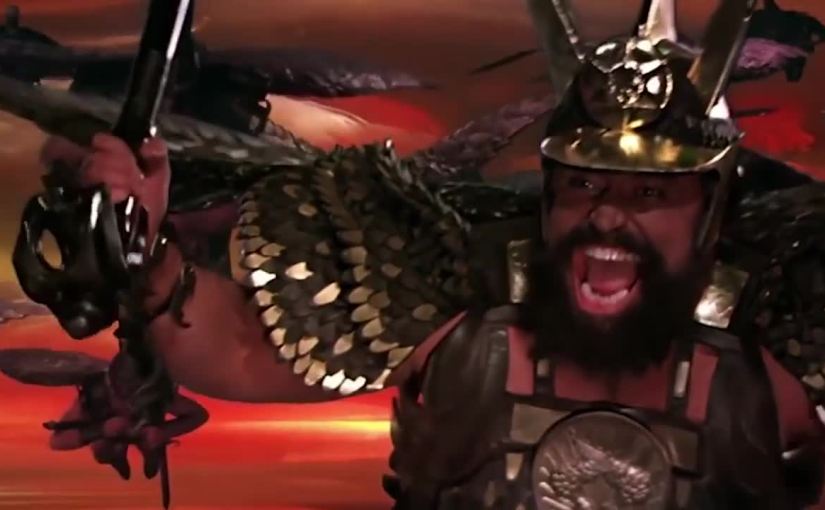
I will say that I thoroughly enjoyed watching one actor out of the entire cast, who seemed to be having way more fun than was needed or expected.  No, not Max von Sydow, whose sneering turn as Ming the Merciless is a master-class in remaining professional in the face of lunacy.  (Timothy Dalton deserves kudos for doing the same as the stoic Prince Barin.)  No, I’m referring to Brian Blessed as Prince Vultan, whose screeching battle cry will forever be stored in my memory banks: “Hawkmen…DIIIIIIIIVE!!!”  Examine his performance next time you watch the movie.  Look at his face, his eyes, the canyon of his mouth when he laughs.  There is a sparkle of delight that, to me, reveals someone who has realized the only way to stop himself from firing his agent is to go completely, full-blown, bull-moose gonzo.  Everyone else is playing it straight, or attempting to.  Brian Blessed is the only one who seems to be having any fun.  What a different movie this might have been if EVERYONE had taken his cue.  Alas.

To the fans of this film, I don’t apologize for my point of view, but I do admit to a tiny, VERY tiny, twinge of regret that I can’t see past its shortcomings enough to enjoy it the way its fan base does.  For me, it’s two hours of tedium enlivened only occasionally by a random chuckle or a smile when Queen’s music makes an appearance.  And by Brian Blessed’s manic smile.  DIIIIIIIIIVE!!!

[editor’s note: this review appears only by special request from the author’s best friend.  You’re welcome, Marc.]

A CLOCKWORK ORANGE

By Marc S. Sanders

What is Stanley Kubrick attempting to demonstrate with A Clockwork Orange, arguably the most controversial and shocking film of his career?  The film is considered an almost precise adaptation of Anthony Burgess’ novel.  I never read the book, but the sources I found on Wikipedia and IMDb are consistent with their claims.  Kubick’s vision is never not odd or strange.  It’s almost always repulsive and I have to believe the director is proud of the finished accomplishments left in every caption and scene.  Yet even Kubrick was disgusted by some copycat attempts that spawned from what the story’s protagonist troublemaker executes within this context.  Regrettably, in 2025, it would be easier to ask what did you expect Mr. Kubrick?

In a dystopian future of England, young Alex (age 17, but 15 in the book) relishes on walking the streets each night, accompanied by his three droog companions, committing the worst atrocities imaginable.  They beat up a homeless beggar, engage in gang brawling, and brutalize and rape a wealthy couple in their own home to the celebrated tune of Singin’ In The Rain.  I’m curious how reminiscent A Clockwork Orange is to people who only wish to watch the cheerful and innocent fare of Gene Kelley.  Is their subconscious intruded by Malcolm McDowell as naughty boy Alex with the one eyelash, bowler hat, protective jock strap and erection mask?

Mayhem is the specialty of Alex and his degenerate friends.  However, Alex who is the leader of the pack is challenged to uphold his command on the gang of four, and once the others betray him, the poor boy is sentenced to a militaristic, concentrated prison where he must don an academy uniform while studying the gospel of the Bible.  

What happens though if the student sees himself more as the Roman with the harsh whip, and less as the savior willing to die for our sins?  Are people like Alex only inherently wicked, vile, and perverted?  Can nothing change their insatiable appetites for harm and evil doing?

I thought about One Flew Over The Cuckoo’s Nest while watching A Clockwork Orange.  McMurphy fakes an impression of insanity to be institutionalized. He operates under the presumption the circumstances will be more accommodating than a jail cell.  Alex campaigns to be a guinea pig for a new kind of therapy believed to eliminate all temptations of violence and cruel sexual escapades. This could be a means to free him from a forty-year prison sentence. I never believed he wanted to be liberated from his appetite of rape, torture and murder, though.

Following an abundance of sickening, visual exposition, Stanley Kubrick is ready to test some possible outcomes by forcefully prying open the subject’s eyes to witness footage of violence, extreme rape, harsh pornography, and Nazi propaganda.  Will this overexposure repulse Alex away from being the monster he used to be?

I’m not sure A Clockwork Orange provides any definitive answers but the weirdness of this off scale and ugly England is nothing but apparent.  Nothing is normal looking or relatable in this film.  Everything from the colors to the costume wear to the slang verbiage of the dialogue and even the furniture is completely twisted.  Kubrick would offer a similar approach in The Shining. No director is louder and more offensive with colors in a film. A green bedroom ceiling or a blue typewriter or even a glass of milk and stark white sexually posed mannequins used as furniture pieces in a hangout joint are so much more than discomforting.

Even the infamous rape scene is uncharacteristically done.  The Droogs happily sing while brutalizing this couple.  Before Alex commits his “push in, push out” he scissors the woman’s red jumpsuit around her individual breasts before cutting her out of the fabric to be entirely nude.  I’ve seen plenty of staged rape scenes but then there is what Kubrick envisions. Not to mention, how notoriously redundant he is with repetitively shooting his scenes over and over again. Kubrick is an auteur filmmaker but his desire for perfection in his shots are as twisted as many of his films.

A woman is brutally killed by being pummeled with a sculpture of a penis/taint/anus piece. (I don’t know what else you call this!) A typical baseball bat, stick or hammer is not the bludgeoning weapon of choice. Stanley Kubrick wants to ensure this perverted item of art owned by a wealthy woman is used to commit the crime. A mix of sinful natures ranging from sexual to violent.

Why go to all of these lengths to be so unusual?

A Clockwork Orange is deliberately shocking and thus everything on display is disorienting.  With all the movies and TV shows I’ve watched, on top of some of the most unusual fetishistic material I’ve witnessed, I imagine I’m like most viewers where I’ve grown accustomed to the violent and sexual debauchery on display.  I’ve seen so much I am practically desensitized to it all.  When I read about another school shooting in the news, regrettably and with sick sarcasm, I’ll think to myself, “Huh!  Must be a Tuesday.”  It feels so wrong but there is truth in this ongoing epidemic. Stanley Kubrick, back in the early 1970s, had to work that much harder to grab the attention of the viewer.  Nothing can prepare you for an initial viewing of A Clockwork Orange. Back in 1971, I’d argue no one was prepared for this film’s content. It’s a pioneering document of extreme violence and sexual perversion. Filmmakers, like Martin Scorsese, David Lynch, and Brian DePalma hereafter would push their own limits while bridging these activities with the natures of their challenged characters.

Is there a confidence to seeing if a heathen like Alex can be cured of his original nature? Can he be returned to a society where his once menacing threat is nonexistent?  Plus, can Alex live a peaceful and nurturing life?

Alex is not the only villain to this piece.  While we do not get to know his parents well enough, how sadistic are the individuals behind his therapy process? Alex’ “recovery” becomes politicized and treated like scientific doctrine at the expense of his own humiliation. He is used to prove a point by beating him up publicly and forcing him to lick the bottom of a man’s shoe and exposing him to a naked woman, as well. Those that he encounters again, like former victims and fellow Droogs, following his therapy are not perfectly complimented to this new Alex. Scenarios that re-introduce him to society imply that Alex’ conditioning process might have overlooked what was to come following his release. Were they truly “healing” their patient?

A Clockwork Orange is never a refreshing film.  It’s always alarming right down to its final frame.  The picture certainly does not endorse the merits of psychotherapy or psychological reform.  Maybe, that’s why I believe that anyone specializing in the field of mental health should watch the picture. See what works and what doesn’t. Kubrick is uncompromising with getting his cast to do what he wants, no matter how off putting the material is. If anything, I wonder if this movie is more relevant today. Can anyone who traps themselves in an impersonal and isolated environment of social media influence attain the capability to shed their destructive proclivities for a natural desire to live, care and cherish fellow human beings?

Like most of Kubrick’s films, A Clockwork Orange is not an easy watch.  I know a friend who describes the movie as a comedy.  I know what she’s talking about and why. Still, how can anyone allow themselves to guffaw at someone who is an agent of death, torture, destruction and chaos? 

I don’t know what else I can say about A Clockwork Orange.  I do not recall asking so many questions in one review as I demonstrate here. Watch the film on mute or with Alex’ voiceover against an assortment of classical music as Kubrick intends simply because Alex’ only friend, only ally, is “Ludwig.”  No matter how you observe the piece, it is likely your jaw will drop, and your eyes will wince.  You will cringe and you will unquestionably test your tolerance.  You may just turn the movie off.

Regardless of how you respond to the picture, be assured that Stanley Kubrick successfully completed what he set out to do.

SPECIAL GUEST REVIEW: THE ROCKY HORROR PICTURE SHOW (1975)

by Ronnie Clements with Screen Gems

Screen Gems reflects on The Rocky Horror Picture Show (1975)… Review by Ronnie (Dorian) Clements on his FB page Screen Gems http://www.facebook.com/screengemsbyronnie


On 14 August, 1975 (50 years ago), The Rocky Horror Picture Show opened at the Rialto Theatre in London. Rocky is still the longest running movie in theatrical history and the biggest cult movie of all time! I doubt if any other film will ever “usurp” it. 

[And whatever you do, forget the 2016 made-for-TV remake. It’s a pale imitation, woefully flat and best left in the vault or preferably down the pooper!]

Screen Gems 70’s Flashback …

The Rocky Horror Picture Show (1975).

A Look Back at the OG (totally re-written for the masterpiece’s 50th anniversary) …

Two of the most unforgettable Saturday afternoons of my life were spent watching live matinee performances of The Rocky Horror Show; years apart, yet equally electric. While the film adaptation, The Rocky Horror Picture Show, has rightly earned its cult status, nothing compares to the raw energy of the stage. Still, the movie captures the essence and outrageous brilliance of the original, preserving it for eternity.

As a screen adaptation of musical theatre, Rocky stands alone. There’s truly nothing else like it. The score is wildly eclectic, veering from tender ballads to glam rock anthems, and yet not a single dud among them. It’s a sonic rollercoaster that defies genre and expectation.

The plot? A delicious mash-up of horror and sci-fi tropes, with a heavy nod to Frankenstein. But what emerges is something wholly original: a campy, chaotic celebration of identity, desire and rebellion.

Written by Richard O’Brien, The Rocky Horror Show premiered at London’s Royal Court Theatre Upstairs on June 19, 1973. The original cast: Tim Curry (Frank-N-Furter), Richard O’Brien (Riff Raff), Patricia Quinn (Magenta), and Nell Campbell (Columbia), all reprise their roles in the film, bringing their eccentric brilliance to the screen.

The stage show holds the record as the longest-running theatrical production in history and it’s still performed around the world. The film, after flopping on its initial release, found new life through midnight screenings in the mid-70s. Word of mouth turned it into a phenomenon. 

Since 1975, it’s been shown continuously in cinemas — the longest theatrical run ever. Every Friday or Saturday night, somewhere in the world, fans gather in costume, props in hand, ready to shout, sing and surrender to the madness. I’ve never attended a midnight screening myself, but I’m told it’s a surreal, unforgettable experience.

The Story …

Brad (Barry Bostwick) and Janet (Susan Sarandon), two squeaky-clean newlyweds, find themselves stranded on a stormy night. Seeking help, they stumble into the gothic lair of Dr. Frank-N-Furter, a self-proclaimed “sweet transvestite from Transsexual, Transylvania”, and his bizarre entourage. What follows is a wild descent into seduction, science and spectacle as Frank unveils his latest creation: the perfect man, built for pleasure.

Does the plot make sense? Not really. But that’s beside the point. It’s pure fantasy, a glitter-drenched fever-dream, powered by a magnificent score and unapologetic theatricality.

Tim Curry was born to play Frank-N-Furter. His performance is iconic, seductive, menacing and utterly magnetic. The rest of the cast delivers with equal flair. The film’s comic book aesthetic (garish lighting, bold colors, exaggerated performances) only heightens its surreal charm.

Themes Beneath the Fishnets …

At its heart, Rocky Horror is a battle between conservatism and counterculture. And, as in life, the establishment unfortunately wins! Frank-N-Furter and Rocky are killed … but … Brad and Janet return to their “normal”, mundane lives. However, the film leaves us questioning what “normal” really means and whether conformity is truly a happy ending! 

EQUILIBRIUM

By Marc S. Sanders

It’s amazing what drugs can do to you.  Take them on a regular basis and perhaps you can maintain focus and discipline as an enforcer to a dystopian humanity.  Then again, if you stop taking the medication, maybe you’ll open your eyes wider with an ability to nurture, care and appreciate.

This is the set up to writer/director Kurt Wimmer’s futuristic sci fi tale, Equilibrium.  The immense action scenes look like a modified springboard off of what The Matrix provided.  Be that as it may, at least the story stands on its own with an Orwellian inspiration to give it legs. It actually looks like an elder stepbrother to that Apple Super Bowl commercial directed by Ridley Scott.

The best of a specialized police force is the Grammatron Cleric, John Preston (Christian Bale).  Within the bustling city of Libra, large monitors periodically remind commuters to take their routine Prozium.  This allows emotions and feelings to be suppressed.  Thus, order is upheld.  Jealously, for example, is ostracized from this community. The Clerics must heed to this program strictly as a means to live by example.  

Still, even with most of the world population wiped out, there are factions and individuals who do not abide by this governance.  Preston, along with large squads of heavily armed militia seek out these offenders and often discover their fix for stimulation coming from sources of art, literature, and music.  Apprehend the criminal(s), and destroy the contraband they conceal under floor boards and behind plastered walls.  The actual Mona Lisa becomes an early casualty of legal property possession. 

If the culprits take up arms, they’ll be no match for the Clerics, especially the best of this class, John Preston.  

Yet, what happens if John opts not to continue his dosage?

Equilibrium does very well at teaching this unfamiliar science fiction before exploring how it all crumbles.  The expository opening presents an exciting scene of Preston’s methods.  Later, it follows how the system malfunctions.  

Miguel warned me ahead of time because about the only thing I feign at seeing in a movie is any kind of harm to a dog.  A disturbing moment occurs as John experiences his “awakening,” and considering the value I have for a dog’s affection I cannot deny how necessary the moment plays here.  It lends to the change in the protagonist’s character arc.  It is a cruel scene but with anything that feels unjust, within reality or fiction, an event has to occur to pull our heads out of the sand.

The action scenes have a unique flair to them as the Clerics reveal firearms that dispense from under the uniformed sleeves ready to use for firing, but with a martial arts kind of gloss.  While you watch it’s just plain cool, and Christian Bale looks great doing the stoic, less is more exertion to the moments.  He’s such a good actor at performing choreographed dances of shoot ‘em up violence while struggling to maintain an uncompromising mentality this character is expected to be accustomed to.

On the other hand, his new partner, Brandt, is either drafted incorrectly in the script or miscast with Taye Diggs in the role.  He’s a Cleric in training and an admirer of Preston. If the Clerics are supposed to be devoid of emotion, then why is his envy of this man so apparent.  It’s Taye Diggs stepping off his familiar Broadway stage.  However, I do not believe that’s what Equilibrium is expected to offer.  Brandt seems to possess too much pleasure for his calling.  Ultimately, Brandt becomes the antagonist who serves the greater power as his suspicions grow about Preston’s “withdrawal.”  Taye Diggs and Brandt feel like they belong in another film.

Preston had a wife who disappeared mysteriously as well, and he’s left with two children who are being designed to perform like him.  I found the kids to be too much excess for Wimmer’s script though.  Yes, the son turns up at a crucial moment of discovery.  However, after the children appear early in the film, their father does not associate or see them again until close to when the story is wrapping up.  I’m certain the daughter had no more than one line of dialogue. I think it would have been better to excise this storyline altogether.  It has no urgency, nor is it fleshed out enough.  Why must John Preston be a father?  

Equilibrium is an interesting sci fi amalgamation of George Orwell and Phillip K Dick constructs.  There are some disturbingly decent ideas here and if you’re not careful you may find yourself comparing its designs to what some worldwide political climates feel like today.  Don’t overthink it though.  

It has some faults, but the action is entertaining.  Fortunately, Christian Bale occupies the whole of the piece.  The guy is just too dang cool, dressed in black garb with surprise weapons appearing from nowhere at his will while he twirls through the air with his arms outstretched and ready for fast moving combat.

Let’s see John Preston face off against Neo from The Matrix next.  My god, that’ll make the John Wick movies feel like nursery rhyme programs.

Think about all the artillery and jiu jitsu. 

I gotta lie down.  The headrush is making me feel like I overdosed on Prozium. There was a time when I got emotional over things, wasn’t there?

JURASSIC WORLD: REBIRTH

By Marc S. Sanders

You’ve seen this movie before.  You likely saw it when you saw the trailer.  

The Jurassic films spawned from Michael Crichton’s ingenious best-selling novel, Jurassic Park (my favorite book of all time), stampede on and on, going on thirty-two years now.  Here is the seventh installment.  Once again, reinvigorated with a new cast and a bankable headliner/former Marvel Avenger.  

All year long, just like the last five films, I’m asking myself again why any of these people are going back to these islands.  Well Rebirth lends as good an answer as any.  Somehow the DNA from three different prehistoric mutated mega beasts will lead to a cure for heart disease.

Reader, from the outset I recognized the familiar pattern.  I knew precisely who was going to survive and who was going to perish before the closing credits arrived.  I got a perfect score, by the way.  Likely, you will too and thus the suspense is very watered down in Jurassic World: Rebirth. Seven times on the merry go round, you should know by now which direction this ride is moving.

Nevertheless, I was hoping against hope that the cure for heart disease will make it for the eventual consumption of human civilization.  The vials of Dino-DNA are collected and stored in an airtight briefcase.  So, while the scant cast of people screams, runs, tip-toes, swims, climbs and falls all over this tropical island, located close to the equator, my eyes were fixated on this medical breakthrough.  

Where are your priorities people? On the kid and her toddler dinosaur friend named Delores?  Come on!!!!! There’s much more at stake here than that or Scarlett Johansson and two-time Oscar winner Mahershala Ali. 

Gareth Edwards (Rogue One: A Star Wars Story) is new director in the franchise and I wouldn’t have it any other way.  The visuals of his dinosaur adventure are marvelous if not as impressive as they used to be.  Just like David Koepp’s script shamefully admits, the world no longer cares about dinosaurs as much.  Much of Jurassic World: Rebirth feels like a retread of the same old stuff.  At best, the only inventions left to tackle is to mold new monsters that are of a Frankenstein product.  The animals look fiercer and meaner and toothier and bigger…like way, way bigger.

Edwards and Koepp put the creatures in the ocean and in nestled caverns that have not been depicted as much before.  The sequences are done well but still I felt as if I had seen this movie before.

Not much can be said about Johansson or Ali’s performances.  She’s a high priced, skilled mercenary.  He’s the charter boat captain.  The rest of the cast is just the rest of the cast which includes some ready-to-sacrifice nameless folks gifted with screams to edit within and about five or six lines (one guy is privileged to share his French fluency), a pair of teenagers, an adorable kid and the resident greedy industrialist.  You know who I’m talking about, right?

I’m amused by those who rank the Jurassic movies.  How can you decide what is best or worst anymore?  The blueprints are so identical and the Dino gobbles and Dino chases and Dino roars all blend together for me by now.  If it was a Jeopardy category to identify which movie any scene was from, I’d lose big time and wager little on the Daily Double.

Beyond the first film from Spielberg none of these films are as special to me.  Like Chinese food, I fill up and I go back for more but that’s it.

Still…

Go to the movies.  Keep the cinema alive.  See the new Jurassic World movie and have fun with this new iteration of people going to the restricted island where dinosaurs romp and play.  I enjoyed it even if I never felt overwhelmingly stimulated.  At the very least I enjoyed watching my wife clap when she learned that one character survived.  

Me? 

…and 3…2…1… of course!

THE WILD ROBOT (2024)

by Miguel E. Rodriguez

DIRECTOR: Chris Sanders
CAST: Lupita Nyong’o, Pedro Pascal, Bill Nighy, Stephanie Hsu, Ving Rhames, Mark Hamill, Catherine O’Hara
MY RATING: 10/10
ROTTEN TOMATOMETER: 97% Certified Fresh

PLOT: An intelligent helper robot winds up stranded on an island populated only by wild animals.  To survive its new environment, it adjusts its programming, with unexpected results.


Just days after watching Flow [2024], a dialogue- and human-free animated film about animals struggling to survive after a cataclysmic flood, I watched The Wild Robot, also human-free, also starring mostly animals, and also about the struggle for survival, but it adds conventional dialogue and an intelligent robot in search of its purpose.  In broad, REALLY broad strokes, they are similar, but don’t bother asking me which one is better.  I give them both a ten-out-of-ten, each for different reasons from the other.  Flow may be literally unique, at least in my experience, but The Wild Robot tames its genre and bends it to its will, creating one of the most heart-tugging movie experiences since Wall*E [2008].  If you’re prone to crying during a movie, this is a three-hanky film, at least.  (Penni went through five, herself.)

On a dark and stormy night, a mysterious container washes up on the shores of an uninhabited island.  Inside is Rozzum 7134, an intelligent helper robot with exceptional physical capabilities and the speaking voice of Lupita Nyong’o.  Hope she gets her royalty checks.  Upon escaping her would-be watery coffin, Rozzum searches the island for the one thing that will give her existence meaning: a task to complete.  The opening scenes get us off to a hilarious start as she tries to complete tasks for various animals, to no avail.  In an intelligent bit of screenwriting, she powers down for a couple of days and, through passive listening, effectively learns the language of the animals around her.  In a lesser movie, this feat might have been handled with the push of a button.  I liked the fact the writers went for something a little easier to swallow, science-fiction-wise.

Through circumstances which I will not reveal, Rozzum winds up as the guardian for a newly-hatched gosling, and as the unlikely friend of a fox named Fink (Pedro Pascal, whose voice was utterly unrecognizable; I thought it was Matthew Broderick).  The gosling imprints on Rozzum, which she finds bothersome.  A helpful mom opossum, Pinktail (Catherine O’Hara), warns Rozzum that the gosling must learn to feed itself, swim, and fly by the next fall so he can migrate with the other goose; otherwise, it will starve during the harsh winter.  Presto…a task!

Eventually, Rozzum is shortened to Roz and she names the gosling Brightbill (Kit Connor).  As she undertakes her task of raising the gosling, Roz’s programming…evolves.  She starts to actually care for the little guy.  She starts asking questions that robots aren’t supposed to ask.  She exhibits all the early warning signs of helicopter-momism.  And all the while, she debates whether to activate the internal beacon that will let her makers know where she is…

Because the plot is so dependent on tugging those heartstrings, that’s all I’ll say about it.  Let me talk instead about Wild Robot’s visual style.  The backgrounds and characters are gorgeous, sumptuous, evocative of oil or acrylic paintings.  I could mention two or three specific shots right now that contain some of the most beautiful animated imagery I’ve seen since Pinocchio [1940], but I don’t want to give anything away.  (Hint: butterflies and geese.)  In this way, among others, it shares a lot of DNA with Flow, whose backgrounds and characters also resembled hand-painted objects.  I don’t even want to think about how long it took to create such a painterly style and make it look so effortless and organic.

I also liked the way Wild Robot used its story to make a pointed commentary, but not in the direction I thought it would go.  From the trailers, I assumed it would be yet another paint-by-numbers story about preserving nature or life, which was already covered as well as it possibly could be covered by Brad Bird’s The Iron Giant [1999].  Instead, Wild Robot makes some eloquent statements about the terrifying task of parenthood.  At one point, Roz, who is programmed to solve problems, discovers the task she’s undertaken – raising a gosling, i.e., being a parent – is a task that could potentially never end.  She experiences the fear of almost losing a child.  The joy of watching Brightbill learn to fly, while at the same time realizing that means he will one day migrate.  As I list the plot points here, it sounds like the movie is composed of cliches, but I can assure you, it’s not.  All of these nuances, and many more, are allowed to occur organically without the slightest hint of being nudged along by the screenplay.

DreamWorks has created possibly their best animated film since…gosh, I’ll go all the way back to The Prince of Egypt [1998].  It’s a crowd-pleasing adventure with a point, which is a hallmark of only the best science-fiction movies/stories.  There are real stakes on the line.  There are some actual deaths in the story, which surprised me for some reason, but there you are.  It looks sensational.  It’s smart.  I can’t say enough about it.  The Wild Robot was one of my most favorite films of 2024.

THE SUBSTANCE

By Marc S. Sanders

It’s no surprise that a science fiction gore fest would make its way on the silver screen intent on enhancing our lives as we grow out of adult youth.  Plastic surgery and bust enhancements, unwanted hair removal, butt lifts and Botox are common vernacular discussed in magazine articles, infomercials and talk shows.  Well known actors rely on beauty preservations and enhancements to uphold their careers or give themselves a needed boost to stay relevant.  I mean come on, Tom Cruise wouldn’t naturally look like that.  Still?  Let’s get real.

What I admire about Coralie Fargeat’s The Substance is how she applies her updated Frankenstein experiments within the boundaries of Hollywood glitz and glamour.  Her film starts out ironic, then reflective and concludes on B level satire.  Wasn’t this how The Toxic Avenger came to be?

Fortunately, the brains of the writer/director overcome the beauty that’s attempted.

Elisabeth Sparkle (Demi Moore) is an obvious nod to Oscar winner Jane Fonda.  She is unbelievably gorgeous and physically fit, especially for a fifty-year-old award-winning starlet. (Incidentally, Demi Moore is over age 60.) She has found a second career success as a daily TV workout video hostess. Yet, she senses that her expiration of youth is quickly approaching.  It could not be more apparent from what her sleazy producer Harvey shares with her.  This jerk has no filter and tells it like it is. Audiences want younger and curvier, and Elisabeth ain’t it.  Harvey is played by Dennis Quaid and Farageat is not shy about presenting this guy with every priority of superficiality.

Elisabeth gets axed from her show.  Fortunately, she comes upon a possible remedy for her aging dilemma known as The Substance.  After some toiling about, Elisabeth agrees to try this clandestine idea out promising a better, more improved version of herself.  

The kit to make this all happens is delivered.  First is a needle injection and further instructions mandate without compromise that every seven days Elisabeth must return from the alter ego that spawns from her.  Except this is not so much an alter ego as it is alter body.  Literally from behind Elisabeth’s back enters Sue (Margaret Qualley).  Both Elisabeth and Sue are reminded by the mysterious voice on the phone that they are “one,” and they must use the contents of their kits to nourish one another’s bodies daily plus, and without fail, surrender to a seven-day hibernation while the other roams the earth.  Every seven days they must alternate.

Sue, with Elisabeth’s psyche, gets the job as the replacement hostess and Harvey goes nuts for her as the ratings and her popularity soars.  The Substance is serving its purpose.  

Yet, what happens when the two egos do not cooperate with the program’s mandates?  Well, you find out with an assortment of grotesque and ugly side effects that develop both mentally, and especially physically.  The Substance tackles some extraordinary consequences ranging from multiple personality disorders that joust with one another, and insecurities that even beauty enhancements could never resolve.

Amid all of the ugly gore of blood and fluids and stitching and rotted, infected skins is a jaw dropping performance from Demi Moore.  The Substance is deliberately not big on dialogue as it depends more on perception and facial response.  The best example is when Moore as Elisabeth prepares herself for a date and builds up an unnerving frustration as her character focuses on her reflection in the mirror.  I read that Demi Moore slapped and rubbed the skin of her face raw while shooting this scene in take after take.  Her commitment to the scene could not be more evident.  A later scene with her adorned in offensively aged makeup is at least as aggressive for the actress.  A food binge goes maniacal, and Demi Moore is sensationally focused on its messiness and engorgement.

The Substance is very smart from beginning to end.  Yet, the conclusion is outright ridiculous, and Coralie Fargeat clearly wants it that way.  It’s not only that Elisabeth and Sue suffer at the punishments of their own hubris, but Harvey and those that put appearances over any kind of, well, substance must succumb to their own superficial priorities.  Fargeat takes what could have been a comparable messy Three Stooges pie in the face route where everyone’s dignity has to be shed.  The blinders of beauty get washed away in an overwhelming deluge.

The Substance is elevated to an absurd narrative as quick as it begins.  No one is glamorized even if this is Hollywood.  We get close ups of Harvey gorging himself on sloppy, saucy cocktail shrimp while Elisabeth watches in disgust.  Later, the physical side effects go by way of famous makeup artist’s Rob Bottin’s work on films like John Carpenter’s The Thing.  The director tosses obvious nods to Stanley Kubrick’s The Shining with a ghastly orange hallway and reminiscent geometrically zig zag carpeting.  Even a men’s room designed in cherry blood red harkens back to that film.  Food is repulsive in this film that focuses on body image.  Colors of all kinds are loud, garish, and bright.  The director doesn’t want you to wince at only the very graphic details of Elisabeth and Sue’s ongoing transformations.  If these characters are going to feel or behave ugly, then the world they live will feel at least as repulsive.

A friend of mine who takes to curious kinds of horror and fright fests was eager to see The Substance.  She watched the night before I did and was angered by the ending that she found ridiculously over the top.  Definitely no argument there.  Yet, because this is satire offering a reflection of truth, as gross as the film is and as absurd as the ending gets, it logically adds up.  

We can try all we want to hold on to our youth and outer appearances.  However, either we must learn to become satisfied with the limitations that science can offer or we will pay penalties for defying what is instructed of ourselves.  The Substance is beyond any sense of science.  This film tosses hints at the viewer that Elisabeth, and later Sue, should think twice about what they choose next.  Then again, whoever thinks twice in one these B movie schlock fests, anyway?  

I even think this film goes a step further.  In cancer patients, chemotherapy remains the leading remedy for treatment of the illness.  We turn to its resolve despite the sickening side effects that stem from its program.  We want to live and we will compromise our ways to go on living.  Elisabeth Sparkle needs to remember though that she does not suffer from cancer.  She’s an insecure woman who isn’t ready to face change.  I’m not minimizing how the character feels.  I can relate.  She is facing a hard, agonizing truth from her perspective. I took steps in my lifetime to enhance my appearance and mentally and physically it was not the best option for me.  

It’s fortunate that Demi Moore allows me to relate to what’s traumatizing her.  Margaret Qualley does well holding up the other half of the picture as her side of this one personality gets drunk off the attention and perfection she’s entered into this new world.  

Commonly speaking, I also thought of the Queen from Snow White And The Seven Dwarfs.  An elegant woman so insecure with her beauty against that of a young girl and she sees no other way to come out on top than to change into an ugly, old hag.  Like Elisabeth in The Substance, the Queen in Snow White will accept a notion of looking worse before it gets better.  Since this film is satire, don’t we all go through experiences like this at one time or another?

Some of us learn.  Some of us persist and persist though.

WALL·E

By Marc S. Sanders

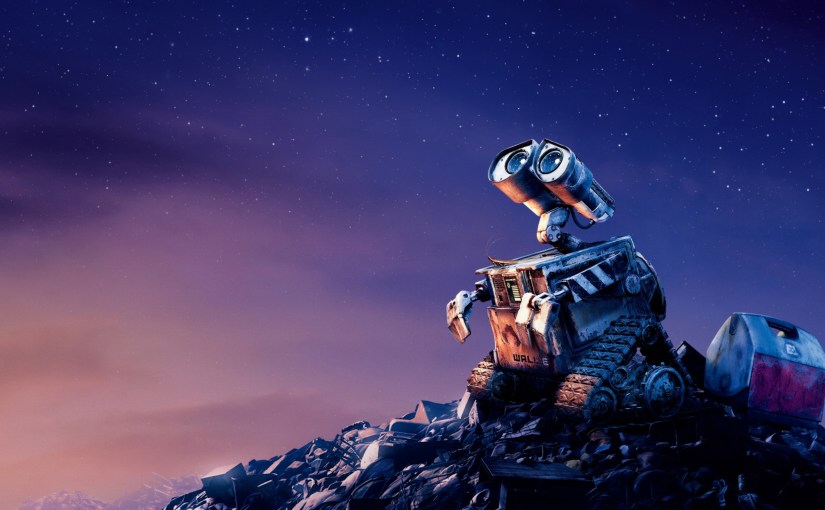
There are some movies that seem to accurately predict what we can expect of our planet’s future.  Paddy Chayefsky was one such prophet with his script for Network and the rampant consumption of television influence and addiction.  Author Phillip K Dick might have also been a Nostrodomus of sorts when his writings were adapted into such films as Total Recall, Minority Report and Blade Runner which offered convincing convenience to lifestyles and evolved productivity.  Perhaps the imagineers behind PIXAR are also on to something because their adorable, futuristic WALL·E does not seem so farfetched.  

The robot title character is a trash collector on an abandoned planet Earth seven hundred years into the future.  A Wal-Mart/Sam’s Club amalgamation known as the fictional Buy N Large appeared to have become the main resource for any immediate need of the human population that once existed; what the coming of Amazon is turning into. This monopolized interpretation of absolute capitalism was run by a CEO and maybe Commander In Chief of the free world, played by Fred Willard, the one major flesh and blood actor to appear in this picture. 

WALL·E, along with a faithful cockroach, roams the wastelands.  The puppy dog, bug eyed robot wheels around on his tractor legs collecting the endless amounts of leftover trash and compacting it into neat, stackable boxes.  Piled on top of each other, these boxes get as high as skyscrapers.  These are the remnants from what Buy N Large left for the planet.

One day a rocket ship arrives and drops off a highly sophisticated and glossy white droid that we come to know as EVE.  For WALL·E, it’s almost love at first sight even though EVE has a treacherous laser cannon for an arm and intimidating blue cyborg eyes.

Eventually, the two bots hitch a ride into space when the rocket returns to pick up EVE.  They arrive on a galaxy cruise liner that’s floating through the solar system.  While the two get into a bunch of Looney Tunes shenanigans running through the corridors and piping of the ship, the audience bears witness to what exactly happened to planet Earth, and who has survived to carry on.  At this point a prophecy seems to be declared by writers Andrew Stanton, Pete Docter and Jim Reardon (all PIXAR regulars at the time).

Humans aboard this liner have become oversized, lazy blobs with no neck, fat arms, fingers and legs, and reclined to permanent seats while robotics cater to their hungers and comforts.  These people are cheerful but happily lazy and unproductive.  Remember when your mother would tell you to clean your room?  Well, the wasteland universe of WALL·E bears justification for mom’s aggravation and constant pestering.

The computerized animation of this PIXAR romantic adventure is dazzling in details and character expression.  There’s an unattractive sand like and earth tone mood to anyplace we explore on Earth.  Yet, the industrial sheen of the cruise liner appears to have all the comforts imaginable.  You can practically taste the colors and feel the balmy air conditioning within this ginormous vehicular city in space. Yet, the telling story of WALL·E has no problem convincing me that this is not right.  This is not a future I’d want to be a part of.

Disney and PIXAR follow that mentality of ensuring a soul of emotion drives their characters of fantasy and it’s easy to fall in love with the clunky lead robot.  You want WALL·E to be safe from sandstorms, while also keeping his only friend, the cockroach, by his side for companionship in an entirely lonely world.  His only other source of cheerfulness comes from watching the musical Hello, Dolly! on an old TV. Even playing ATARI’s Pong is not stimulating enough for this little guy.

Sound Effects Wizard Ben Burtt, who pioneered staple sci fi elements with the Star Wars films, performs the vocal expressions of chirps and beeps for WALL·E’s innocence.  There’s a language to the little fella and it’ll leave a lump in your throat when he calls for EVE.  Elissa Knight brings a more experienced, technologically up to date personality to EVE.  We worry when an organized entity like EVE robotically screams for WALL·E when she thinks he’s in danger.  She’s only supposed to follow a program, but the manufactured mind lends to a side effect of genuine emotion.  As the two get acquainted with each other, there’s a touching chemistry to them both.  A floating dance through space is as much silly as it is adorably romantic.  You cannot help but smile because by this point you are invested in this relationship as much you’d buy Rick and Ilsa’s affections towards one another, or Harry and Sally’s.

I really embrace the childlike love story connecting these two non-living beings.  Set against what appears like an apocalyptic wasteland, there are layered dynamics to this animated film, one of PIXAR’s best.  

I have to also salute the film’s nods to classic science fiction that also offer not so unrealistic possibilities.  An antagonist comes in the form of a robot similar in appearance to HAL-9000 from Kubrick’s 2001: A Space Odyssey.  He’s a nasty bugger with an all too familiar blood-red eye. It’s also a delight to recognize Sigourney Weaver’s voice as the cruise liner’s computer, a sort of slap in the face to monochromatic computers that would countdown a certain doom for the actress’s most famous role of Ellen Ripley in the Alien films.  PIXAR has always been brilliant with their wink and nod delights.

The film was released in 2008, a near generation ago maybe, when iPhones and Androids were not even as entirely sophisticated as today.  Yet PIXAR could telegraph what was to come.  The environments on Earth and on the cruiser tell us just how overly reliable we’ve become on technological conveniences for socializing or even one stop shopping.  

We are getting to a point where we might not even procreate with one another.  It’s a sad irony that it will take two self-thinking, yet designed for programing, robotic appliances to remind us how valuable the human touch is and what a purpose to life really serves ourselves and those we have to interactively live with.  

You might be embracing that cell phone tight in the palm of your hand, but will that device ever hold your hand in return?