BLACK ORPHEUS (France, 1959)

by Miguel E. Rodriguez

DIRECTOR: Marcel Camus
CAST: Breno Mello, Marpessa Dawn, Lourdes de Oliveira
MY RATING: 8/10
ROTTEN TOMATOMETER: 88% Certified Fresh

PLOT: The Greek myth of Orpheus and Euridice is translated into a modern-day story (with an all-black cast) set in during Carnaval in Rio de Janeiro.


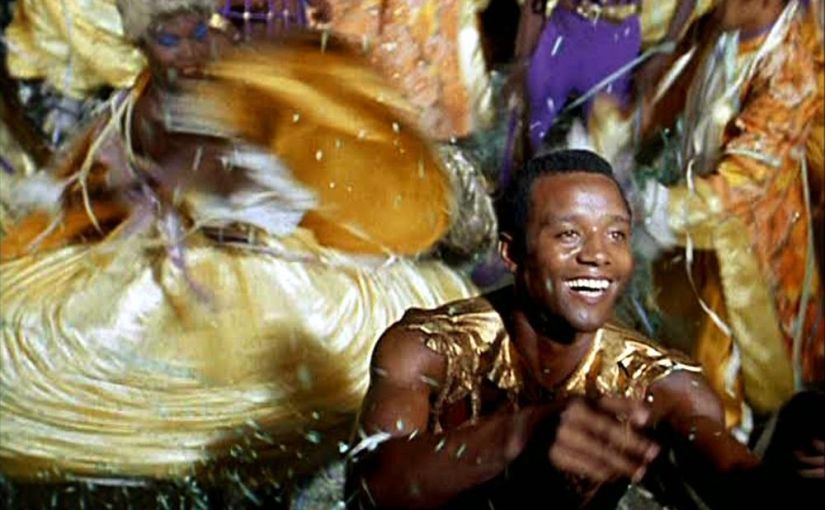
In the first two-thirds of Black Orpheus, there are scarcely more than 2 minutes strung together at a time without some kind of music or sound effects thumping away in the background.  This gives the film a subtle real-world backdrop, which is good, because Black Orpheus is a fantasy through and through.  Critics, now and at the time of its release, complained that French director Marcel Camus ignored the reality of the Brazilian favelas, or slums, in favor of depicting Rio as a non-stop party.  This is a valid point.  However, I believe that, in this movie, reality has no place.  This is a love story, a myth, a tragedy, and a travelogue all rolled into one.  Reality must take a back seat in movies like this.

(And, heck, somebody must have liked it because it won both the Palme d’Or at Cannes AND the Best Foreign Film Oscar that year, a rare feat.  True, there were extenuating circumstances [numerous French critics had problems with the emerging French New Wave], but let’s not turn this into a classroom, shall we?)

If you’re familiar with Greek mythology, then the plot of Black Orpheus is nothing new.  Orfeu (Breno Mello, a non-professional actor) is a streetcar conductor engaged to the sexy, vivacious Mira, but he is not exactly thrilled about it.  Meanwhile, Eurydice (Marpessa Dawn, who actually hailed from Pittsburgh, not Brazil) gets lost in the city on the way to visit her cousin, Serafina, who lives in a ramshackle favela neighborhood.  She asks Orfeu and his boss, Hermes, for directions, and for Orfeu it’s love at first sight.  The rest of the movie will involve Orfeu wooing Eurydice, who worries about a strange man who might be following her, while trying to ditch Mira, with Serafina’s help.  Also assisting Orfeu, while acting as a Greek chorus in miniature, are two street urchins, Benedito and Zeca, who envy Orfeu’s lovely guitar playing, which Orfeu claims is what makes the sun rise every morning.

Apart from the story itself, the things I noticed at the outset were the presence of riotous colors in the costumes and the Brazilian countryside, and the music.  Lots and LOTS of music, but not a great deal of songs.  Black Orpheus is billed as a musical, but I’d have to say it’s a quasi-musical.  In a standard musical, characters break out into song, and no one notices because otherwise we’d be watching a play.  In Black Orpheus, every song is diegetic…someone asks Orfeu to play a song on his guitar, for example, or the Carnaval participants sing a rousing song while on parade or at a huge dance.  And I want to mention again that, while Orfeu is singing a quiet song to Eurydice, the constant percussion of the Carnaval pulses behind it, completely at odds with his song.  You would think it would become a cacophony, but it doesn’t.  It makes his quiet song much quieter, which may sound counterintuitive, but it works.

The mythic tone of the story keeps the film from flying off into ridiculous territory amid all the revelry.  Without mythology, Black Orpheus would be a soap opera.  A pivotal scene occurs during a massive dance contest, as Eurydice has disguised herself as her cousin, Serafina, so Mira doesn’t recognize her.  But Mira sees through the disguise and threatens to kill Eurydice.  Mira chases her, and unseen by anyone else except Eurydice, a man dressed all in black wearing a skull mask follows them both.  This is Death.  Earlier he had nearly chased Eurydice off a cliff, but Orfeu had saved her.  “I am not in a hurry,” he said, “we shall meet soon.”  With that in mind, his presence during this second chase is tinged with suspense.  It’s a very Hitchcockian element, the threat of danger juxtaposed with a dance or a party.  Good stuff.

So, it’s fair to say I enjoyed this movie a little more than I expected to.  But the bonus features on the Blu-ray brought up an interesting point.  Detractors of the film pointed out that, despite taking place mostly in a slum, the actual reality of those slums (both then and now) is anything but festive, no matter how much bossa nova music you play or how many songs you sing.  It’s highly unlikely these people would have had the wherewithal to create such stylized, colorful costumes while having to deal with the reality of poverty, all while looking down the mountainside at the distant concrete high rises of the higher classes.

Does Black Orpheus ignore reality?  Well…yes, it does.  Myths, by definition, have little to do with reality in the first place.  Would it have been possible to tell this mythical story, retaining its coincidences and absurdities and supernatural elements [especially towards the end], while also keeping its feet firmly on the ground and making a socially conscious statement about the horrible living conditions in Brazil?

I don’t think so.  Or, if you did, it wouldn’t be held together very well.  Black Orpheus is simply re-telling a very, VERY old story and re-imagining it as if the Greek gods had lived atop Sugarloaf Mountain instead of Olympus.  When you start with that kind of premise, reality goes out the window.  You have to focus on the story’s emotional beats, the pleasant assault on the senses and, occasionally, logic.

This opens a whole separate argument: is it a film’s responsibility to BE authentic, or just to FEEL authentic?  For example, Titanic [1997] feels authentic to me, a layman, but I’m sure historians and other experts could point to any number of things that were simply not true in the film.  Fair enough, but that doesn’t affect my enjoyment of the film as it was presented to me.  It FELT authentic, and that’s enough for me.  The only way to make a movie like that 100% authentic would be to turn it into a documentary.

Black Orpheus FEELS emotionally authentic to me, a layman, who is not a social anthropologist.  I look at the colors and vibrancy on display, visually and in the story itself, and while a small part of me acknowledges, “This isn’t real life”, another part of me says, “Well, if I wanted real life, I wouldn’t be watching a movie, would I?”

CARMEN JONES (1954)

by Miguel E. Rodriguez

DIRECTOR: Otto Preminger
CAST: Harry Belafonte, Dorothy Dandridge, Pearl Bailey, Brock Peters, Diahann Carroll
MY RATING: 8/10
ROTTEN TOMATOMETER: 75% Fresh

PLOT: The Bizet opera Carmen is translated into a modern-day story (with an all-black cast) of a sultry parachute factory worker and a GI who is about to go to flying school during World War II.


Otto Preminger’s Carmen Jones will be (or OUGHT to be) remembered for many things, but the thing I will remember it for the most is the dynamic presence of the sexy, sultry Dorothy Dandridge in the titular role.  She may not have done her own singing – nearly all the major characters’ singing voices were dubbed by opera singers – but, by God, she knew how to own a role.  In the first five minutes, she steals the movie lock, stock, and barrel when she performs that first aria in the mess hall.  It’s like watching a Marilyn Monroe film: everything around her pales in comparison to her sheer magnetism, although with Dandridge (at least with the character of Carmen), you can see an intelligence behind the sexiness.  Dandridge thoroughly deserved her Oscar nomination.  A quick Google check shows she had some stiff competition that year: Grace Kelly, Judy Garland, Audrey Hepburn, and Jane Wyman…although how Kelly pulled out a win over Dandridge AND Garland will forever remain a mystery to me.

ANYWAY.

In this modern retelling, Carmen Jones is a factory worker during World War II, making parachutes for the war effort.  During the opening aria, she sets her sights on Joe (Harry Belafonte), a naïve GI in love with a country girl, Cindy Lou, from his hometown.  If I’m being completely honest, nothing in the film matches the simmering sexual energy of this opening number.  Carmen slinks from table to table in the mess hall, modestly dressed, but with complete knowledge of exactly how to work with what’s available.  She flirts shamelessly with Joe, right in front of Cindy Lou.

Later, Carmen gets in a knock-down, drag-out catfight with Frankie (Pearl Bailey, the only principal actor whose singing voice WASN’T overdubbed) and is arrested by the MPs.  Joe, who was just about to elope with Cindy Lou, is ordered to drive Carmen to a town some 50 miles away, since the Army can’t put civilians in jail.  This sets up another opportunity for Carmen to flirt with Joe, as she does everything but unbutton his pants during their drive.  The more he resists, the more she wants him.

…but I don’t want to simply summarize the plot, which was a mystery to me since I have never seen a production of Carmen.  (The ending is mildly pre-ordained, because, hello, it’s an opera.)  I want to express my admiration of this film, particularly for its ambition.  I’m no film scholar, but I’m prepared to bet that in 1954, there weren’t an awful lot of big studio films being directed by A-list directors featuring an all-black cast.  The fact this film exists at all is, I think, a minor miracle.  I won’t attempt to put words in the mouth of anyone in the black community, but at that time in cinematic and American history, I have to believe this was seen as a giant leap forward, AND a giant risk.  (There is probably MUCH more to this story, but I do not want to turn this article into a research paper.)

Otto Preminger’s directing style in Carmen Jones also deserves recognition.  A factoid on IMDb trivia states: “This film contains just 169 shots in 103 minutes of action. This equates to an average shot length of about 36 seconds, which is very high, given the 8-10 seconds standard of most Hollywood films made during the 1950s.”  This is important because those longer shots create, in many places, an illusion of watching a stage performance.  For instance, if I remember correctly, that opening aria that I keep going on about – Dandridge is SMOKING – runs for about 4-5 minutes and has only three total shots.  Towards the middle of the film, there’s an astonishingly long take that travels from a bar across the room to a table, following a group of five people, all singing simultaneously at multiple points.  The shot lasts just under five minutes, but it feels much longer.  It’s a brilliant piece of work.

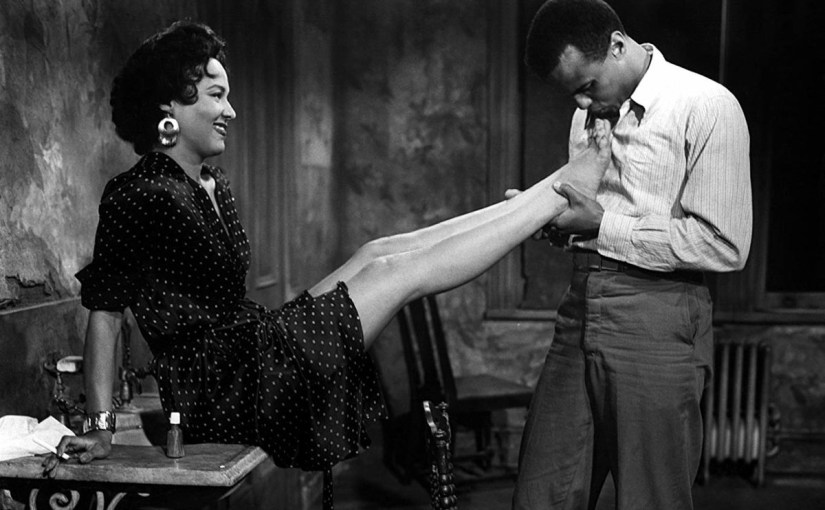
The tragic arc of Carmen Jones may seem inevitable, as I said before, but it remains an entertaining watch.  You can see the dominos falling, and you bemoan the choices Joe makes as he falls under Carmen’s spell, but I mean, LOOK at her.  There’s a scene that I’m sure would bear the Tarantino stamp of approval as Carmen paints her toenails and coyly asks Joe to blow on them for her so they can dry faster.  Dayum.  Show me a straight man who wouldn’t fall for that kind of treatment from a woman who looks like Dorothy Dandridge and I’ll show you a dead man.

If I wanted, I could get nitpicky about Carmen Jones.  Has it aged well?  Not exactly.  Does it feature great acting aside from Dandridge?  Not exactly.  Does it look natural to hear an operatic tenor burst forth from Harry Belafonte’s mouth?  Not exactly.  But Carmen Jones is a landmark of black cinema in an era when schools and government buildings still had segregated water fountains and restrooms.  Based on that fact alone, I consider Carmen Jones to be a vital step in Hollywood’s painfully slow racial evolution. (It is also a painful reminder of a career that might have been; Dandridge died 11 years later at only 42.)

THE SECRET OF MY SUCCESS

By Marc S. Sanders

Reader, it has been a hard week.  Hard because my flat screen has been on the fritz.  Finally, today at last, the Best Buy Geek Squad will be paying me a visit and working on a repair. In the meantime, I have had to relegate myself to one of the smaller flat screens within the household.  I feel dirty.  Cheap.  I can’t even look at myself.  Just look away!!!!  Considering the dire circumstances, I could never look at my next big film to review during the absence of my 9.0 sound system and 65 inches of viewing pleasure.  It would be a sin to watch a Christopher Nolan or Steven Spielberg piece anywhere else (unless it’s in the cinema).  Therefore, I settled, and I hit rock bottom.  I opted to for Netflix meh! 

All I have, all I can give you, all I can offer, all I can claim for you during this dark, sad time is Herbert Ross’ attempt at shaping a Michael J Fox thirty second MTV style 1980’s music video into a film.  The “film” is The Secret Of My Success

I recall seeing this movie at age 14 during a field trip to Washington DC with my eighth grade Yeshiva class.  Every time the dimply cute yuppie Canadian sensation from Family Ties and Back To The Future graced the screen, the girls in my class screamed with puppy love glee.  I liked Fox at that time.  I still do.  He was a bright guy and while not an actor like Brando or Olivier, he had a unique charm that defined the clean cut 1980s with knit ties and Benneton sweaters.  His unforgettable Alex P Keaton was the fictional cheerleader for the era of Ronald Reagan, and no one protested.

I recall the promise of The Secret Of My Success as being the vehicle that would elevate his tv persona to the big screen since he already had luck with Marty McFly and a healthy B-movie following with HBO airings of Teen Wolf (a much better movie than it ever deserves to be). Regrettably, this film never landed.  It’s most glaring failure is that it never even lives up to its title.

The assembly of Herbert Ross’ romantic, New York, yuppie comedy occupies itself so much with music montages.  It’s as guilty of its own indulgence as Rocky IV.  How many times must we see a grinning Michael J Fox hustle through the concrete jungle of the city and then through skyscraper cubicle hallways within a white collared business world?  Night Ranger is the ‘80s hair band who provides most of the movie soundtrack and they owe much to Michael J Fox as the face that accompanies their work with trinkling keyboards and electric guitars with the raspy roar of their lead singer.  If Michael J Fox is not walking down streets where apparently supermodels live to turn their heads (I saw you Cindy Crawford), he’s got a pen wedged between his teeth and he’s pulling huge three ring binders off of shelves while doing an all nighter.  This is oh so boring.  In 1987 however, it is all a couple of Teen Beat readers needed in their lives.  I can watch Meryl Streep or Gary Oldman read a three-ring binder.  Michael J Fox just doesn’t have a knack for this skill.

Fox plays Kansas farm boy Brantley Foster.  Now that he has earned a business degree, he has enormous aspirations to climb the top of the New York corporate ladder and make a success of himself with a “beautiful secretary.”  Because, you know, you can’t make it without a secretary, much less a beautiful secretary. 

Upon relocating into a roach infested apartment, Brantley’s plans fall through, and he has to beg his super rich Uncle Howard (Richard Jordan) into giving him a job in the mail room of his building.  Brantley encounters a beautiful blond executive named Christy (Helen Slater) amid a sea of uptight middle-aged men.  The depth of this attraction only goes so far as fantasizing about her walking towards him in a cheesy, glittery pink evening gown with a keyboard and saxophone chiming in.  On the side is Howard’s bored trophy wife Vera (Margaret Whitton) crowding young Brantley in an illicit Mrs. Robinson kind of affair.  Let me clarify.  Vera is married to Brantley’s Uncle Howard.  So, Brantley is being terrorized by Aunt Vera.

For the purposes of ridiculous farce, that might be funny for a moment.  However, The Secret Of My Success takes forever to arrive at the farce it could have hinged on.  Instead, Brantley has to discover a way into the white-collar world when he comes upon an empty office and bears the fictional name of Carlton Whitfield to justify his suits and his motivation to work in the heart of the corporate world.

I noted that the film does not live up to the title.  When Brantley is working the persona of Whitfield, we never get an idea of his brilliant ideas for business success and operations.  We never learn what turned Uncle Howard’s high-rise building into the towering reputation it apparently stands upon.  We never understand the threat of a shareholder’s takeover that Howard and his team fear is imminent.  Where’s the value in anything that Brantley is doing to be that corporate hero and what is he trying to improve or salvage?

Instead, we are left with a very poor chemistry pairing between Helen Slater and Michael J Fox.  Slater is flat out boring with no dynamic to her.  If you want to see how to deliver any variation of a line in a flat, monotone way, then observe what she has to offer.  Fox is on another level of energy that Slater cannot match and Herbert Ross and the script from Jim Cash and Jack Epps Jr (Top Gun, Legal Eagles) chooses to occupy itself more with this romance than the corporate world at play.

The following two years after this film’s release would do better for this hustle and bustle setting with Oliver Stone’s cynical Wall Street and Mike Nichols romantic comedy Working Girl.  The latter film follows a near exact blueprint of The Secret Of My Success.  Yet, it wins because we actually see the main character, portrayed by Melanie Griffith, actually demonstrate her prowess for the cutthroat world of business power and politics.  By comparison, Michael J Fox just wants to play hooky and make out in the back of a limousine.

A last-ditch effort is made though when the big wigs assemble for a weekend getaway. What seems like an attempt at bedroom farce barely gets started with the players climbing staircases and tip toing behind doors and hopping into bed together and blah blah blah.  It doesn’t serve, however, because the idiot plot intrudes where everyone has to act as if they have no idea of who is sleeping with who and who is Brantley and who is Whitfield amid the fast-talking dialogue edited within.  You want to scream at the screen and tell everyone to shut up because this can all be explained in sixty seconds.

Again, as Mike Nichols’ Oscar nominated film eventually proved, there was a better film to be made here for Michael J Fox.  It could have included all of the cynical realities that go with the natures of a corporate American beast.  Instead, The Secret Of My Success relies on music video montages with the teardrop keyboards and the yearning saxophone that seemed like a requisite for the adoring Michael J Fox of the 1980s. 

Enough already!!!!  I need to cleanse my palette.  GEEK SQUAD, WHERE ARE YOU????? 

BREAKFAST AT TIFFANY’S

By Marc S. Sanders

Holly Golightly.  

Name sounds almost whimsical with a noun, a verb and an adverb.  Holly go lightly!  Puts a smile on my face.

Actually, the creation of this character from Truman Capote might follow the advice that her own name implies, and Audrey Hepburn portrayed the young self-inventive socialite – well let’s be honest as it is no longer 1961 and say “call girl” – with an enthusiasm for living better than anyone expected or could have imagined.  Hepburn was self-conscious of her portrayal.  Capote insisted on casting Marilyn Monroe.  None of it matters as Audrey was endearingly perfect.

Blake Edwards adapted Truman Capote’s novel Breakfast At Tiffany’s, and while I never read the source material I can recognize the director overstepping for sight gags, slapstick and exaggeration before he gains focus with a need to conclude his film on a turned character arc. 

I’ve had mixed feelings on Edwards career.  Days Of Wine And Roses was a rare drama for the filmmaker and yet I believe Jack Lemmon soars way over the top in his alcoholic performance.  The Great Race? Let’s just say there always needed to be “More pies!  More pies.”  I have tried multiple times to get through Victor/VictoriaThe Pink Panther was where Blake Edwards was most suitable.  However, with Breakfast At Tiffany’s he initially shoots for the silliness of Holly Golightly’s carefree life. She lives off of other people’s money while they obtain an increase in social stature for just being in the same room as her.  Holly was one of the pioneers of social media influencers.  Before a single Kardashian was ever born, there was Holly Golightly.  In an updated time, Holly would be on every reality show with countless podcasts, and a talk show hosted out of her own apartment where she’d lift her Tiffany blue sleep mask and wake up just as you turned to your Instagram account or Facebook string.

Paul Varjak (George Peppard) is Holly’s new neighbor who is on the brink of being a successful novelist with a little help from a middle age wealthy man’s wife who pays him for favors in return.  For Paul, Holly appears so foreign to him, and yet he’s living by the means he earns from what others leave on his night table.  Holly and Paul’s trajectories are quite paralell.

Capote’s film adaptation is appealing because of how air headed the picture seems at first.  Later though, it makes way for a sincere account of a young woman lost with no direction and full of lonely despair within the very large city of New York.  It makes sense that Holly Golightly finds simple solace from her need to tread in social gatherings and in the arms of wealthy men by visiting the window displays of the Tiffany jewelry store on 5th Avenue. 

We don’t yet know why but as the film begins with Henry Mancini’s Oscar winning Moon River (one of cinema’s greatest songs), Holly exits a cab in front of Tiffany, just as the sun is rising to consume a pastry with her cup of coffee.  The honest girl hides behind her thick sunglasses, a done-up hair do and a little black dress.  It’s an iconic scene in film, maybe the greatest that Blake Edwards ever shot, but what does this introduction truly mean?  Even Holly Golightly yearns for isolation from a crowded metropolitan city of eight million people, and the window display at Tiffany is her hiding spot. It is only for her to occupy all by herself on a brisk morning after sunrise.

A far cry from this opening scene soon occurs.  Holly crams at least fifty people into her apartment shortly after Paul arrives.  He witnesses the silly swinging attributes of the people who are welcomed to this social gathering of drinking and joyfulness.  He is puzzled that no one takes notice of Holly’s cigarette setting a woman’s hair on fire (typical Blake Edwards silliness) only to be put out by Holly when she is unaware she spilled her drink and doused the flame.

Later, an honest past comes back to haunt her, and Paul begins to see through the charade of her proud debauchery.  Further on, tragedy strikes and the gleefulness of life is no longer realized.  Misfortune will come upon all of us no matter how Holly Golightly we could ever be. 

Breakfast At Tiffany’s seems like a film meant to be light as a feather.  Yet, it’s not so easy to grasp the story’s purpose right away.  Capote, however, wrote an insightful observation of a young twenty something character occupying a world and a past that is much larger than she could ever handle at her young age. Turns out she is on her own with no financial means or purpose in life to show for her identity.  Holly will host a crowd in her tiny apartment, but she dresses in her bed sheet.  Fashionably dressed of course, but why a bed sheet?  She takes in a cat, but the cat has no name.  It’s just called cat.  Holly Golightly is devoid of depth or basic means, but she’ll still celebrate herself among the masses while trying to live off the wealth of others.

I appreciate what’s gained from watching Breakfast At Tiffany’s all the way to its ending. Holly appears to be crumbling beneath the weight of life that she’s ill-prepared to accept.  Just ahead of the epilogue, new and unexpected problems arise. There’s little option for escape.  Her one true blessing is Paul, the man who also evolves to grow up before Holly is ready to do so. Part of his maturity, progressed very well by the actor George Peppard, entails guiding his darling friend Holly along the way.

Holly Golightly is a tragically lost character.  Yet she’s a lot of fun thanks to Blake Edwards and Truman Capote, and most especially to the enormously engaging talents of Audrey Hepburn.

NOTE: Sadly, a terrible stain exists on Breakfast At Tiffany’s final cut, due to arguably the worst casting decision and worst written character in film history.  Mickey Rooney as Holly’s frustrated Japanese upstairs neighbor Mr. Yunioshi.  This is where Blake Edwards once again oversteps in his need for unnecessary slapstick.  It’s not enough that the character serves no purpose to any of the storylines.  He repeatedly bookends scene changes with unwelcome goofiness as Yunioshi endlessly bumps his head, startles himself or pratfalls in his bathtub, complete with overexaggerated buck teeth sticking out from beneath his upper lip.  These are unfunny Three Stooges gags. 

What’s way worse is that a Caucasian well loved character actor of legendary status was cast to invent buffoonery that apparently exists within Japanese culture.   A truly insulting and unfair representation of an entire people.  Poor Mickey Rooney. The existence of this character along with who occupies the role is the most egregious of film appearances ever put on screen.  Politically speaking, we are much more attuned and sensitive to all races and nationalities today.  Yes, many still have a lot to learn, but even in 1961 this was a horrible slap in the face taking pop culture back to the ill-conceived material that might have been found in Amos N Andy routines or even a Little Rascals Buckwheat personalization. 

I guess Blake Edwards and screenwriter George Axelrod must have thought the Japanese were due for a stooge.  Boy, were they ever wrong!

GHOST

By Marc S. Sanders

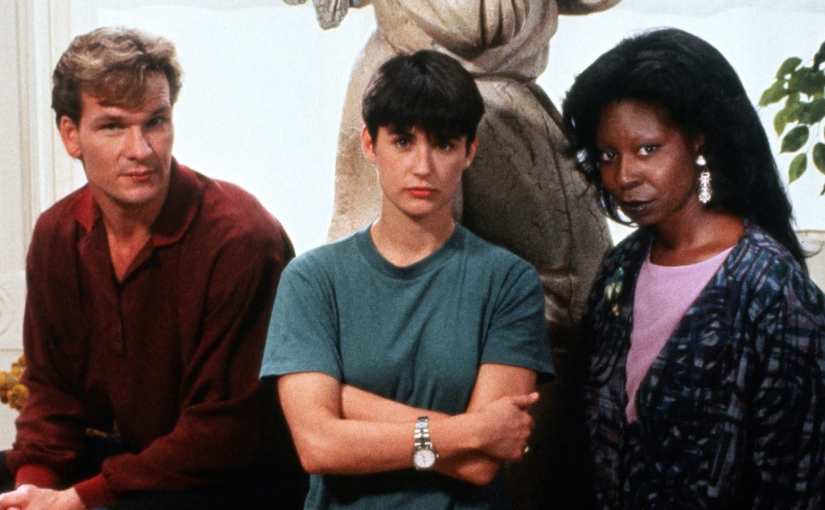
For a perfect blend of the supernatural, suspense, mystery, drama, romance and comedy, the first film that will always come to mind is the surprise hit film Ghost from 1990.  One of the zany Zucker brothers, Jerry to be more precise, who introduced the world to slapstick spoof (Airplane!, The Naked Gun) directed this film turning Demi Moore into a ten-million-dollar actress, placing Patrick Swayze ahead of his Dirty Dancing looks and earning Whoopi Goldberg a very well-deserved Academy Award.  Ghost was a film for all kinds of movie goers.

Sam Wheat (Swayze) is an up-and-coming New York City business executive who loves his new live-in girlfriend, Molly (Moore) even if he can only say “Ditto!” when she tells him she loves him.  Shortly after the picture begins Sam is gunned down following an evening at the theatre.  Unbeknownst to Molly and anyone else living on earth, Sam’s spirit lives on though, and he realizes that he was not the victim of some random mugging/murder.  Now, Sam must find out who arranged to have him killed and why, while also protecting Molly from becoming a victim.

Along the way, Sam crosses paths with a phony con artist, working as a medium, named Oda Mae Brown (Goldberg) who turns out to be the real thing when she can actually hear Sam’s voice and communicate with him.  Sam must recruit Oda Mae to be a go between for him with Molly and everyone else necessary to follow up on in order to resolve the mystery of his sudden death.

Ghost succeeded in every category of filmmaking.  Rewatching the film decades later, I believe Demi Moore should have gotten an Oscar nomination.  Her close ups on camera with beautiful, muted colors from Adam Greenberg’s cinematography are masterful.  Greenberg should have been nominated too.  He’s got perfect tints of pearl whites both on the cobble stone streets of New York with the outer architecture of the apartment buildings, as well as within the studio apartment where the couple lives.  He strives for an ethereal look with his lens. Gold often occupies Molly’s close ups with dim lighting.  Blues and blacks and steel glinting shines follow Sam’s trajectory. 

Look at the lonely scenes that Moore occupies in the couple’s apartment.  There’s a haunting image of isolation with no dialogue capturing the young actress at the top of a staircase when she eventually rolls a glass jar off the top and it shatters below.  It’s one of the moments that defines a sorrowful character, and not many cry on screen better than Demi Moore.  Later, Sam is engaging in a pursuit through the subway system and races down a steep blue escalator in the dead of night.  Zucker places Greenberg’s camera at the bottom of the escalator to show the depth of hell that Sam may be risking continuing his chase.  The images and transitions of this whole movie from scene to scene are stunning.

I mistakenly recall Whoopi Goldberg as just a comedienne doing her stand up schtick in this film.  Not so.  Goldberg looks radiant on film and while she starts out comically as the script calls for, she eventually resorts to sensitive fear of what her paranormal partner demonstrates as real within this fantasy.  There are so many dimensions to this character.  She’s silly.  She’s exact in her nature for what’s at stake and the dialogue handed to her from Bruce Joel Rubin’s Oscar winning script compliments the actress so well. Goldberg never looks like she’s working for the awards accolades. Yet, she earned every bit of recognition that followed her.

Patrick Swayze makes more out of the straight man role than what could have been left as simple vanilla.  His spirit character uncovers more and more about his afterlife and what happened to him as the film moves along. With each discovery, you’re convinced of Sam’s surprises and what he becomes capable of as a ghost.  Long before superhero films became the novelty, Sam Wheat operates like one who has to learn of his origin and then acquire his new talents and powers to fend off the bad guys.

Jerry Zucker, working with Rubin’s script, Greenberg’s photography and Oscar nominated editing from Walter Murch, along with haunting yet sweet scoring from Maurice Jarre, builds a near perfect film.  The narrative of Ghost shifts so often from comedy to crime to drama to romance and the various natures of the piece hinge so well off each other.  That’s due to storytelling and the editing necessary to smooth out any wrinkles.  You become absorbed in Jerry Zucker’s direction, especially with the movie’s most famous scene where Demi Moore and Patrick Swayze are sensually doing pottery together accompanied by Bill Medley’s rendition of “Unchained Melody.”  Watch that scene with someone you love or take it in on a late Saturday night by yourself with no one to distract you with cackles and eye rolls.  You’ll see how effective Zucker’s work is along with Swayze and Moore upholding the scene in a dark, empty apartment.  Take it as seriously as the scene was originally constructed.  (Then go watch Zucker’s Naked Gun 2 ½ for a chuckle.)

The mystery of Ghost works well with surprises if you are watching it for the first time.  You build trust with a character only to realize it is a ruse for something else.  I do not want to give too much away.  For viewers who have never seen the film, maybe you’ll see an early twist as soon as the film begins.  Maybe not.  Either way, Ghost performs very naturally, unlike a forced kind of twist that M Night Shyamalan too often relies upon.  I do advise that you not watch the trailer that was used for Ghost as I believe it deals out too many of the film’s secrets.

There are movies that I watch over and over again because I love to relive the special moments they offer.  Ghost has those kinds of gifts and yet I have not seen it in ages.  I’m glad.  To experience the picture again was such a treat.  While I recalled all of its secrets, this time I was able to take in the various technical achievements and the assembly of the piece, along with outstanding performances. 

I have no problem saying that Ghost possesses the best performances within the vast careers of Demi Moore, Patrick Swayze and Whoopi Goldberg.  Ghost still holds up. It deserves a rewatch and an introduction to new generations.

NO HARD FEELINGS

By Marc S. Sanders

Jennifer Lawrence goes the route of Farrelly Brothers comedy with No Hard Feelings.  She’s a thirty something gal named Maddie Barker who gets by sleeping around with the men of Montauk, New York while being an Uber driver and a bartender on the side.  It’s easy enough to do because her mother left her with a completely paid for house.  What she didn’t account for was taxes, and now that her car has been towed away (and shortly after totaled – just watch) and the past due bills start arriving, she’s got to find some means to uphold her Uber career so she doesn’t lose her house.  Problem is the best Uber drivers drive cars.

A seasonal annoyance of Montauk occurs when the ultra-wealthy WASPS come to reside in their summer homes.  A lot of these folks are helicopter parents for their spoiled kids who have futures awaiting them at Ivy League universities.  One such couple is portrayed by Laura Benanti and an especially flaky Matthew Broderick.  (Yes!  Ferris Bueller!)  Maddie answers the ad to literally get their dweeby son primed and ready for Princeton college life by sleeping with him and breaking him out of his shell of just video games and volunteer work at the homeless pet shelter.  In return, they will transfer the title over to a run-down Buick sedan that Maddie can own outright and catch up on her bills.  If life were only this easy.

The kid is Percy Becker played by newcomer Andrew Barth Feldman.  He’s quite good in this role and I imagine when he started on the first few days of filming he felt as awkward as he appears next to the confidence and experience emulating from Oscar winning Jennifer Lawrence.  You could never imagine pairing these two up in a film.  I mean, like they wouldn’t even work as a brother and sister.  Still, the comedic premise is so absurd like a Farrelly Brothers movie, that you just have to go with what this picture offers. Thankfully, the situations are hysterical.

It’s not easy for Maddie to break Percy of his introverted personality.  Poor kid doesn’t know how to drink or how to dress at an island bar.  He has no friends. He definitely doesn’t know how to talk to girls and even a naked Maddie accompanying him on an empty beach in the middle of the night for skinny dipping has disastrous results. 

Like a lot of romantic comedies, Maddie believes she just has to quickly lay this kid, collect the prize car and no feelings of love or like will ever get in the way.  Not so fast.  Soon, we get to see the attributes Percy possesses, and he’s hard to get off Maddie’s mind.  I read that Feldman played the title character in Dear Evan Hanson on a stage tour for a year. I can completely envision that after witnessing Percy perform a sultry rendition of Hall & Oates “Maneater” on the piano.  Close ups go over to Lawrence watching from across the room and I don’t believe she was acting.  This kid is a talented performer.  Suddenly, Lawrence and Feldman are great scene partners doing some very fine work together.

I hope to see Andrew Barth Feldman in more films.  He can do both drama, and of course comedy.  Moreover, Jennifer Lawrence has officially widened her range.  Her resume is certainly eclectic and this film only enhances her record.

The premise of No Hard Feelings is near impossible to swallow.  Fortunately, the gags that follow and especially the chemistry between the two leads allow for a sweet story with broad, raunchy,  slapstick R-rated material.  Many of the more successful comedic films followed this formula like Coming To America and There’s Something About MaryNo Hard Feelings has just enough substance to be grouped within that fraternity. 

THE BITTER TEA OF GENERAL YEN (1932)

by Miguel E. Rodriguez

DIRECTOR: Frank Capra
CAST: Barbara Stanwyck, Nils Asther, Toshia Mori, Walter Connolly
MY RATING: 10/10
ROTTEN TOMATOMETER: 86% Certified Fresh

PLOT: During the Chinese Civil War, an American missionary is gradually seduced by a courtly Chinese warlord holding her captive in Shanghai.


When I hear people talking about the “pre-Hays-Code era” of Hollywood, I conjure up seldom-seen images of nearly-nude starlets bathing or swimming or dancing in unison, as filmmakers and studios took advantage of the proven formula: Sex Sells.  But it never really occurred to me that some filmmakers would be able to use that freedom to make films that not only showed a little bit of skin, but also took the time to tell a story that appealed to mature adults in ways that seem fresh and alive nearly a century later.

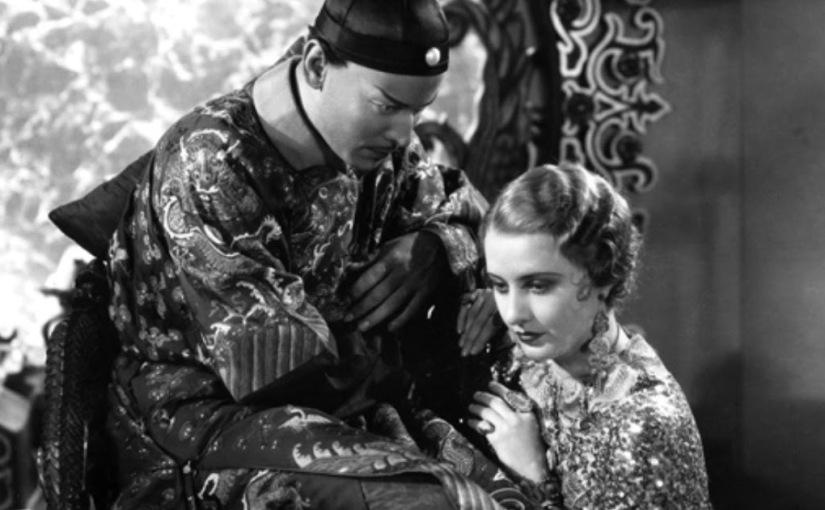
Frank Capra’s The Bitter Tea of General Yen is a contemporary “Beauty-and-the-Beast” tale of an American missionary, Megan (Barbara Stanwyck), who travels halfway around the world to Shanghai to marry her childhood sweetheart, Bob (Gavin Gordon), also a missionary.  It’s set in an unspecified year during the Chinese Civil War [1927-1949] when turmoil rocked the city and hundreds of thousands of refugees filled the streets.  A remarkable opening shot shows hundreds of extras flowing past the camera as Shanghai burns in the background, while a houseful of Americans prepares for Megan’s wedding, untouched and unbothered by the human misery thirty feet from their doorway.  (I was reminded of the idyllic family scenes in Spielberg’s Empire of the Sun where English families held birthday parties oblivious to the impending chaos in Japan leading to World War II.)

Bob insists on postponing his wedding to Megan so he can help rescue some orphans stranded in a burning section of the city.  During the rescue effort, they are separated; in a surprisingly violent scene, Megan is struck on the head by an angry civilian and is knocked unconscious.  She wakes up on a train and finds herself under the care of General Yen (Nils Asther), a famous warlord, reputed to be more bandit than soldier, but who is unfailingly courteous and polite to Megan, even as he informs her that he is unable to return her to Shanghai for security reasons, effectively making her his prisoner.

This scene on the train is a masterpiece of visual storytelling.  Yen sits in a chair and is tended to by Mah-Li (Toshia Mori) who seems to be more than just Yen’s servant.  In an unspoken passage, Mah-Li puts a pillow under Yen’s head, covers his legs with a blanket, and reclines on a chaise.  Megan, with her head bandaged, observes this ritual, then notices Yen staring intently at her.  She becomes acutely aware that she is showing a small patch of bare leg through her covers.  As slowly as possible, she gently pulls the covers up to cover her leg.  Mah-Li observes all of this, Megan watches Mah-Li, and they all go to sleep, each one of them knowing exactly what has been stated without saying a word.  Brilliant.

In a bold move, once Megan is under Yen’s care/protection/whatever, the film never cuts back to her fiancé or to any of the missionaries.  In fact, Yen refers to a Chinese newspaper article which states that Megan is missing and presumed dead.  So that takes care of that.

In another scene of startling violence for its time, Megan wakes up one morning in her private room to the sound of gunfire.  Yen’s soldiers are executing prisoners in a courtyard across the way.  Megan is horrified and complains to General Yen, who promptly orders the soldiers away: “They are taking the rest of them down the road, out of earshot.”  Megan calls him cold-blooded, but he reasonably says he has no rice to feed any prisoners: “…isn’t it better to shoot them quickly than let them starve to death slowly?”

The theme of the film establishes itself in this and other scenes.  Megan, a Christian missionary who believes that people can and must be good for the sake of their souls and their fellow man, finds herself at odds with (and strangely attracted to) a soldier who is brutal by necessity and has no illusions about any innate goodness to be found in any man during a time of war.  There is a powerful scene when she argues with Yen, and in a heated moment utters a racial slur, and as soon as she says it Yen goes silent and squints at her, and she realizes she has crossed a line.

This is not the kind of moral and ethical complexity I expected from a melodrama made only five years after the advent of sound.  I saw the name of Frank Capra and the weirdly evocative title, and I imagined a potboiler with outdated attitudes and cheesy dialogue and racial stereotypes galore.  I could not have been more wrong.  Yes, the title character is played by Nils Asther, a Swedish actor in “yellowface,” but I had to remind myself that, in the time the film was made, this was de rigueur for most films dealing with Asian characters (the highly popular Charlie Chan films starred white actors in the role for years).  I don’t endorse the practice, but it is a fact that must be acknowledged.  And, it must also be said, Nils Asther’s performance as a Chinese man is quite convincing.

The Bitter Tea of General Yen gives us espionage, intrigue, forbidden romance, high melodrama that teeters on the verge of soap opera but never gives in to that temptation (not like Gone with the Wind would do in 1939 with, let’s face it, a rather similar character arc for the two romantic leads).  It’s a film that could be remade today, almost word-for-word, and I have no doubt it would feel right at home with today’s hip audiences.  So many other films of that era feel obviously dated by their dialogue or their performances.  The Bitter Tea of General Yen suffers none of those drawbacks.  It’s a modern classic that just happens to be over 90 years old, that’s all.

[Author’s Note: there is, in fact, one sequence which I’ll call “The Dream Sequence” that feels uncomfortably over-the-top in its depiction of the vilest racial stereotypes associated with Asians.  However, given the context of the scene, who’s having the dream, why they’re having it, and the dream’s resolution, it fits perfectly with the story.  I can’t find it in myself to “cancel” this film based on this sequence.  Just in case anyone was wondering.]

THE MAN IN THE MOON (1991)

by Miguel E. Rodriguez

DIRECTOR: Robert Mulligan
CAST: Sam Waterston, Tess Harper, Reese Witherspoon, Jason London, Emily Warfield
MY RATING: 10/10
ROTTEN TOMATOMETER: 91% Fresh

PLOT: A 14-year-old girl in 1957 comes of age when she develops a crush on a handsome neighbor…who only has eyes for her older sister.


The Man in the Moon has a plot that sounds like a high-concept pitch somewhere between an ABC After-School Special and a third-tier soap opera.  But somehow, magically, it transcends the trappings of soap opera and veers towards the truly operatic, touching on grand emotions while keeping itself grounded in reality.  I watched the movie in awe, wondering how something so sappy was holding my interest the whole way through.  Afterwards, I came up with two overarching reasons: the spectacular debut performance of a 14-year-old Reese Witherspoon, and the sure-footed direction from one of Hollywood’s old masters, Robert Mulligan, who cut his teeth on stage plays for television in the 1950s before directing his masterpiece in 1962, To Kill a Mockingbird.

Like Mockingbird, The Man in the Moon takes place in the deep South.  The time is 1957, when Elvis was king and children were still encouraged to say “Yes, ma’am” and “No, sir” to their parents.  Dani Trant (Witherspoon) is still young and tomboyish enough to escape her Sunday chores by dashing off to the local swimming hole after church.  Her older sister, Maureen (Emily Warfield), is set to start college at Duke in a few months.  Their close relationship is established in a sweet opening scene where they sit in their outdoor, screened-in bedroom, doing each other’s hair and talking about life and Maureen’s doubts and how Dani envies Maureen, and so on.  Like in real life, the conversation touches on deep topics, but never really resolves anything.  It just feels good to talk, to know the other person is really listening.  This scene is mirrored in the movie’s final scene in a fantastic bit of screenwriting where the conversation is very different, but the emotions being discussed are more or less the same.

One day, Dani goes skinny dipping in the watering hole and finds an unexpected visitor: Cort Foster (Jason London), 17, whose mother and younger brothers have just moved back to their old farm next door.  Turns out Cort’s mother, Marie, is an old friend of Dani’s mom, Abigail.  This is the kind of stuff soap operas thrive on, but even at that point, even though I was aware of the contrivances of the story, I never felt overly manipulated.  It all just felt very…real.  Once again, it’s a testament to the director’s skill in making sure nothing gets punched up unless there’s a reason for it.  It’s never bland, don’t get me wrong.  But it never feels fake.  I don’t like the word “organic” in connection with acting or directing, but that feels like the right word to use here.

Things move swiftly.  Dani and Cort become quick friends, but when things get a little too flirtatious at the swimming hole, Cort backs away and admonishes Dani.  “You almost got more than kissed, little girl.”  Dani asks Maureen for tips on kissing boys.  It looks as if Cort is always on the verge of making a bad decision, but he has the good sense to put on the brakes.  The film is making you think the movie is going to be about one thing, but then there’s a family crisis, and in the hubbub, Cort meets Maureen, there’s an instant attraction, Dani feels left out…

But that’s enough summarizing.  Based on what I’ve written, you may already think you know the arc of the film, but I can assure you, you’re wrong.

Let’s talk instead about Reese Witherspoon’s performance.  It must be seen to be believed.  It belongs in the pantheon of the greatest debut performances of all time.  She is as self-assured and confident and natural as she was in her Oscar-winning performance in Walk the Line.  It’s almost like watching some of the early films of Marilyn Monroe; the screen just seems a little brighter when she’s present.  Watch her facial expressions when Cort realizes who she is after their first encounter at the swimming hole.  Watch her smile after her first kiss.  Look at her self-control when she tells her father she understands why he had to take the strap to her (that’s a long story that I won’t spoil).  For the most part, I just watched her performance in awe, but once or twice I turned on my analytical mode and tried to see if I could “catch” her acting.  Couldn’t do it.  The fact she wasn’t at least nominated for an Oscar for this movie is a complete freaking mystery to me.

For that matter, the whole movie is a mystery to me.  Before watching it, I had only heard about it from a rave review by Roger Ebert.  I couldn’t find it streaming anywhere so I had to pay a relatively pretty penny to get it on Blu ray, sight unseen.  (Spoiler alert: it was worth it.)  Yet here is a brilliant gem of a film that tells a simple story of love and sadness and doubt and everything in between.  There are some plot surprises – I won’t say twists, exactly, it’s not a Shyamalan movie – that I absolutely did not see coming.  In retrospect, maybe I should have, but the storytelling kept me engrossed in the moment.  It kept me focused on the here and now, so I never felt the need to try and guess what was around the corner.  I hesitate to use this word, too, but it was mesmerizing.  To tell a story this cornball (on the surface!) and keep it fresh and alive is some kind of miracle.

It’s been said that no good movie is too long.  The Man in the Moon clocks in at just under 100 minutes with credits, but I was prepared to stick with it for at least another half hour, just to see what these characters would do and say, and how they would deal with the next challenges life throws at them.  When the movie ends, it doesn’t feel like an ending.  It has the good sense not to make things too final, as if the solutions to all the issues in the film could be wrapped up in a bow.  All that remains is the bond between two sisters, and if they have that, that’s all that matters.

LEAP OF FAITH

By Marc S. Sanders

You never know when God may come knocking.  You never know when Jonas Nightengale may come knocking either.  If you’re fortunate enough to reside in small town Rustwater, Kansas, you sir, or you ma’am, or you dear child may be blessed by the healing powers of Reverend Nightengale. 

On the surface, Jonas appears like a comedic role for Steve Martin, but in actuality it is not aiming for laughs at all.  When it comes to the confidence scheme that Reverend Jonas offers the townsfolk of Rustwater, Steve Martin plays the phony preacher with nothing but a serious operandi. 

Jonas and his crew travel the states from one big city to the next where he preaches his gospel of deceitful hope in exchange for donations to his traveling church that supposedly serve the almighty lord.  When one of their trucks breaks down in Rustwater, Jonas and his top aide, Jane (Debra Winger) use it as an opportunity for easy cash.  This Kansas town relies on harvests and the infrequent rain that feeds the crops.  Otherwise, this sleepy town has one diner, a movie theater, and a sheriff named Will (Liam Neeson) who is out to reveal the false Oz behind the curtain.  At the same time, Will is romancing Jane who has been eagerly seeking out a flame that never had a chance to flourish because she is on the road so often.

Jonas is wooing Marva (Lolita Davidovich), a waitress at the diner who is also skeptical of the whole act and is protective of her younger handicapped brother, Boyd (Lukas Haas) who suffered a permanent leg injury in a car accident that killed their parents.  Boyd was once told by a preacher that there is not enough faith in his heart for him to be the receiver of healing powers.  Lukas Haas was not just cast because he’s a talented actor.  He also has that angelic face that suggests he’s never committed a sin.

The tricks of Jane and Jonas’ trade are all revealed here.  Jane hides in the back feeding information about certain audience members and their ailments into Jonas’ earpiece.  Eavesdropping by the crew (including an early appearance by Phillip Seymour Hoffman) ahead of the show provides Jane with all the data.  It’s neat to see and it is likely how these outrageous televangelists pull off their miraculous “gifts.”

There’s an interesting argument to Leap Of Faith.  Jane defends Jonas’ façade to Will by him just selling fairy tales that make people feel good and fulfilled.  Will sees the obvious moral dilemma.  Jonas offers another defense.  Is this any different than a circus act that presents the fantastic for an audience to witness. Personally, I think Jonas and Jane’s defense is a bunch of hooey.  Yet, the residents of Rustwater buy into the act and soon people from all over the Midwest are lining up to listen to the gospel and witness the miracles of Reverend Nightengale. 

Jonas has a dilemma himself though.  He has a fondness for Marva, and he likes Boyd.  Boyd is not a plant in the audience to go along with the healing power showmanship.  So, how is Jonas going to explain his position?  He’s quick on his feet to fend off public accusations from Will, but how can someone who is not a miracle worker perform a miracle while maintaining his illusion.

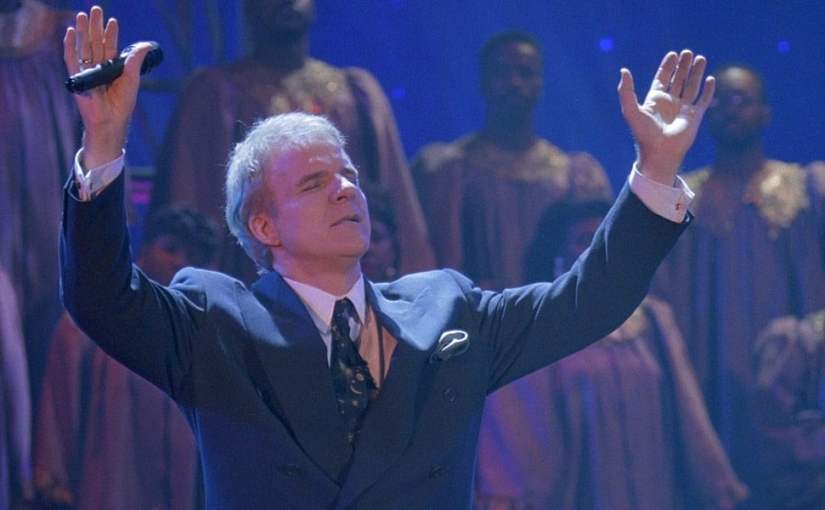
I like the set up and questions that Leap Of Faith asks.  It’s the story of the arriving snake oil salesman which I do not see too often in films.  The showy pieces of the movie are wonderful with terrific singing from the choir under the big top circus tent with the enormous crucifix of Jesus in the center.  There’s also an enthusiastic supporting cast from Phillip Seymour Hoffman, as well as Meat Loaf as the church keyboardist.  The crowd extras are wonderful with their vocal responses.  I also especially love how Jonas ups the ante with a terrific sight gag to silence his biggest doubter, namely Will. 

The film is different, especially for Steve Martin.  He’s a ball of energy on the stage. He does his one-foot slide that was often seen on Saturday Night Live and his stand-up acts, but here it is not done for laughs.  Instead, Martin’s recognizable schtick upholds the public persona of Judas, and it works. 

Still, I do not think I got what I would have prayed for from the film.  I could not get past how Liam Neeson does not work as a Midwest sheriff in this Podunk town.  His boyish good looks from the early 1990s are right for the romance, but he makes no effort to hide his native Irish dialect.  He just doesn’t blend into the Americana canvas very well.  Debra Winger is great and it’s a shame I do not see her in enough films.  Almost everything she does I like.  She just has a natural vibe about her.  She has good scenes with Neeson, but just like his character, their storyline belongs in another movie very distant from the prime directive of Leap Of Faith.

The romance between Martin and Davidovich does not amount to much either. Frankly, it feels as if the story editors opted to abandon this angle midway through the making of the film. I do not recall how the relationship resolved itself and the ending certainly does not generate any kind of response for how either character regards one another. 

Towards the end of Leap Of Faith, the unexpected occurs twice, sort of like what happens in the end of Magnolia.  I found it interesting, but then the credits roll and the gospel choir sings on until the screen goes dark.  I’m leaping from my chair asking but wait, what about this and what about that.  Nevertheless, the choir keeps on singing, deafening my concerns.  Janus Cerone’s script seems to paint itself into a corner just when a brilliant irony arrives and hardly an acknowledgement, and certainly no explanation, is offered for the new phenomena that occurs. 

Leap Of Faith begins with a prologue between Jonus and a traffic cop.  It’s a brilliant scene demonstrating right away how smooth this “preacher” is when it is a one on one grift.  (Celebrated trickster and former con man Ricky Jay was a consultant on the film.) Later, we see how mesmerizing Jonus is in front of hundreds of people.  I was very excited during the first hour and a half of the picture, but then the movie gives up on itself.  The best way to describe this viewing experience is to say that Leap Of Faith simply loses faith in itself.

THE MAJOR AND THE MINOR (1942)

by Miguel E. Rodriguez

DIRECTOR: Billy Wilder
CAST: Ginger Rogers, Ray Milland, Rita Johnson, Robert Benchley
MY RATING: 9/10
ROTTEN TOMATOMETER: 100% Fresh

PLOT: A frustrated city woman disguises herself as a 12-year-old girl to get a cheaper train ticket, but her plan backfires when she winds up befriending a very adult Major on the train.  Risqué hilarity ensues.


Billy Wilder’s The Major and the Minor, contains big laughs, true love, and comic/cosmic misunderstandings – in other words, it’s a classic farce from the fledgling career of one of Hollywood’s true legends.  However, there are certain plot elements that I suspect would make this movie virtually unfilmable today, at least not without tinkering with the structure here and there.  I think the plot points in question will be glaringly apparent to any reasonable viewer, so if I acknowledge them with only the occasional eye roll in my review, I hope readers will forgive me.  It is not my intention to prepare a compare/contrast treatise on prevailing attitudes towards women during the 1940s versus today.  You don’t need me to tell you that the very concept of an adult male bunk-bedding with a strange 12-year-old girl he just met (among other plot devices) raised my eyebrows.  It is firmly a product of its more innocent time. But the whole endeavor is so breezy and carefree that I think it would be a shame to give this film a pass without hearing more about it.  So, here goes.

Ginger Rogers plays the lead, Susan Applegate.  Having only seen Rogers in the occasional dance film with Fred Astaire, I was bowled over by how naturally comic she is.  Based on this movie alone, she could have given Lucille Ball or Rosalind Russell a run for their money.  Anyway, Susan Applegate is fed up with living in NYC.  Tired of being besieged by lechers at every turn, she quits her job – her 25th in a year! – and tries to buy a train ticket back home to Iowa.  When she finds herself short on cash, she dresses up as a 12-year-old girl to get a ticket at half price.  Her real troubles begin when the train gets underway, as the conductors are not movie-dumb enough to fall for her act.

She winds up hiding in the compartment belonging to Major Philip Kirby (Ray Milland in a mildly uncommon comic role).  Because he has a bum right eye, he falls for Susan’s story (she calls herself Su-Su to complete the façade) and takes it upon himself to be her impromptu guardian.  Through an unfortunate series of events – a blocked train track, the unexpected arrival of Kirby’s beautiful fiancé, Pamela, and some ill-timed misunderstandings – “Su-Su” finds herself being whisked away to a military school with Major Kirby promising to get her on the next available train back to Iowa.  Trust me, it all makes sense, I’m leaving a lot of details out, otherwise we’d be here all night.

The rest of the film involves Su-Su’s misadventures on the military school campus, surrounded by three hundred school-age boys who are inexplicably attracted to this girl who somehow has the presence of an adult woman.  They like her, but they’re not quite sure why.  The same phenomenon begins to afflict the Major himself, which makes him extremely uncomfortable (understandably so), which makes things more complicated for Susan because SHE’S beginning to fall in love with HIM, and meanwhile Kirby’s future sister-in-law sees right through Susan’s disguise and wants Susan to help her break up the impending marriage, and 20 different cadets show up to escort Su-Su to the school dance, and so on and so on and so on.

This was only Wilder’s second film, but already we can see ideas and situations that he would return to in some of his future films.  The woman disguising herself as a girl is a funhouse-mirror version of the men disguising themselves as women in Some Like It Hot.  We get the reverse situation, a girl becoming a woman, in Sabrina.  The idea of how tough it is to live in the big bad city is echoed in The Apartment.  And if you really squint, you might even see an early forerunner of Norma Desmond in Major Kirby’s beautiful but devious and controlling fiancé…it’s a stretch, but I think it’s valid.

The performance by Ginger Rogers in this movie was a revelation to me.  I had absolutely no idea she could play this kind of character.  She plays everything so believably, whether she’s Susan or “Su-Su.”  In scenes where she’s near Major Kirby, her longing for him is palpable, but her outward reactions are perfectly subtle: a slight pause before a reply, a constant gaze, only occasionally a little mugging when he’s not looking at her, and always making sure to keep her brassy voice in a higher register to sound more girly.  I learn from IMDb that she was anxious to play this role because she was able to draw from her own experiences: as a younger woman, when she toured vaudeville halls with her mother, she would often make herself appear younger to get cheaper train tickets.  Who knew?

Ray Milland had a trickier time of it in this movie.  He manages to pull it off, but imagine the minefields he had to navigate.  He plays a grown man who is the self-appointed guardian of a 12-year-old girl who, by his own admission at one point, looks like a full-grown woman in the right light.  There’s a scene where he feels compelled to at least try to explain the facts of life to Su-Su so she’ll understand why all the cadets are attracted to her like a moth to a light bulb.  (In one of the less-enlightened moments of the film, he advises her: “Maybe if you made yourself a little less attractive…”  HUGE eye-roll.)  Now, we as audience members know there’s really no problem with his mild flirtations because, of course, Su-Su is really Susan.  But HE doesn’t know that.  Wilder has the good sense to pull everything back from the brink before anything unsavory occurs.  It’s one of the best high-wire acts I can think of in a comedy.

(I’m itching to relate all the hilarious Wilder-esque bits peppered throughout the movie, like finding the occasional burnt end in a delicious brisket, but I am anxious to avoid spoilers.  There’s the tap dance, the Veronica Lake look-alikes, “the Maginot Line”, the cigarette on the train…oh, too many to list.  They’re wonderful.)

As with the best farces, a crisis occurs and it seems as if all is lost, but fear not.  Wilder is not known as a genius for nothing.  If you think this romantic comedy from the early forties is not going to have a happy ending, you need to see more movies.  The Major and the Minor is a delight from start to finish.  And if the last line doesn’t quite come up to the standards of “Well, nobody’s perfect!”…well, I mean, what does?

[Note: It’s also interesting to know that The Major and the Minor was filmed and released in 1942, it’s set very specifically in May of 1941, before Pearl Harbor.  Here and there are in the movie are references to Kirby’s desire to be stationed abroad in case war breaks out.  There’s a moment when he confesses that no woman would want to marry a military man stationed overseas, only getting a letter from him once every two weeks.  The reply he gets is very direct, clearly indicating where Wilder stood on the matter: “I think you underestimate us, Mr. Kirby.  Perhaps all a woman wants is to be a photograph a soldier tacks above his bunk or a stupid lock of hair in the back of his watch.”  Sexist?  Or patriotic?  Discuss.]