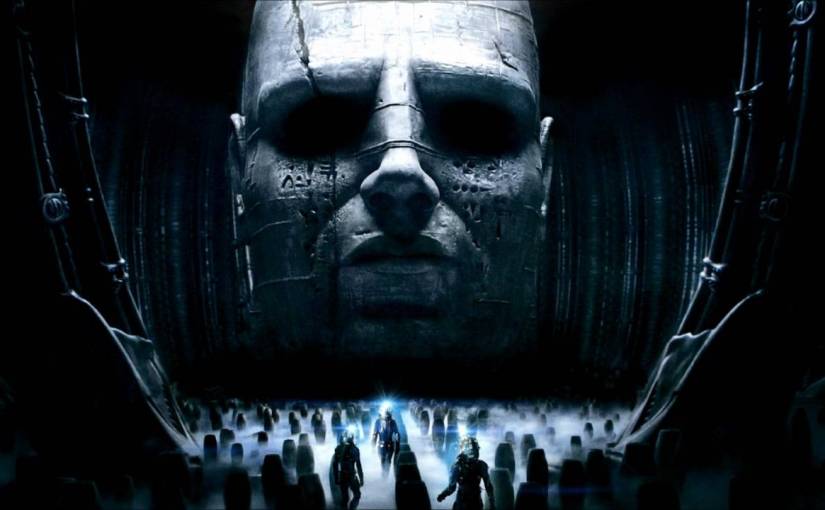
PROMETHEUS

By Marc S. Sanders

In 2012, Ridley Scott was well established as an elite film director that I’d argue could pick and choose what projects he would want to work on.  So, the question is was it worth the opportunity to return to the Alien franchise that had been established back in 1979?  Following its just as magnificent sequel, Aliens helmed by James Cameron, none of the other subsequent installments (including the Predator mish mash stuff) lived up to the first two films. Not even close.  So, was it worth another go at exploring the world of Alien under Ridley Scott’s leadership?  Yes.  I believe it was worth every effort exhausted into making the prequel/side story picture known as Prometheus.

The movie begins with an odd prologue where an unusual looking strong man consumes a black liquid while standing at the precipice of a wild waterfall, while an unidentifiable shadow looms above, darkening a blue sky.  Shortly after his drink, the man seems to violently implode, and a graphic of his DNA strand explodes apart while what is left of him descends into the bottom of the falls.  The natural waters are now contaminated.

Afterwards, in the year 2089, an exploration crew of scientists uncover a hieroglyphic on the wall of a cave in Scotland, and then the film follows Prometheus, a large technologically advanced spaceship (a very cool looking spaceship I might add), on a trajectory into deep space four years later.  An elderly man named Weyland (Guy Pearce) is uploaded on a video and describes the mission to the ship’s crew.  He explains that he is now dead and that the lead scientists, Shaw and Holloway (Noomi Rapace, Logan Marshall-Green), have discovered a link between what they found in Scotland to similar hieroglyphics uncovered in other parts of Earth.  Coordinates lead to this particular planet where Prometheus will make its landing.  Their goal is to research what made them–the human race in other words.

Prometheus works like a sci-fi/monster fest of course, like the other Alien films.  However, I admire the intelligent questions it asks even if it is all based on fiction.  For example, I look at the film as continuously testing whether technology can overcome man, or religion, or even the theory of Darwinism.  A significant character in the piece is an android known as David (Michael Fassbender, doing an uncompromisingly sterile performance).  As the ship embarks on its four-year journey, with the crew resting in cryo-sleep, David continues to collect data including studying the film Lawrence Of Arabia and looking over visuals of Dr. Shaw’s dreams.  Both sources seem to offer a tolerance to live (“The trick…is not minding that it hurts.”) and die.  The latter option depicts a pre-adolescent Shaw inquiring of her father about the death of her mother.  David is a mechanical creation that never stops pursuing advancement even beyond what the science of humanity allows.

Upon arrival on the mysterious planet, the crew enthusiastically approaches a structure to explore.  Finally, they will receive answers to life’s greatest mysteries.  It’s not hard to realize that things will not go as planned, however.  It’s also not worth detailing everything that happens within the confines of this column.  I’ll let you absorb the imaginative visual feast of horrors and effects for yourself.  Most interestingly is that Dr. Shaw shares with her lover/scientist partner that the strong men, which they identify as “Engineers,” possess the same DNA as humans.  That’s an interesting observation.  Is it disappointing though?  Should it be grander for this long hike into outer space?

In many films like Prometheus or Alien, not everything cooperates as the characters expect.  None of that is surprising but it is welcome for the entertainment of suspense and thrills.  However, what I took away from the picture is where technology duals against religion and biology.  A pertinent blink and miss moment occurs following a traumatic event for Shaw.  David the android removes the cross around her neck.  Is there sound reason any longer to believe in God or the biblical teachings she was raised on if Shaw found the origin of herself and fellow humans?  Is her faith now a moot point?

On a scientific level, we learn Shaw is incapable of bearing children.  Yet, through a set of circumstances David informs her that she is suddenly three months pregnant.  The high-tech invention of David may have had a hand in this development by the way, and this is not some normal kind of pregnancy either.  Technology lends to a horrifyingly memorable scene where Shaw “delivers” her offspring. 

I’m sure we all question our beginnings.  Did it begin in six days by God, with Adam and Eve, as initial products?  Was there a big bang that just started it all?  I’d argue these questions will likely never be answered in our lifetimes.  Thus, the debates rage on because we have nothing better to do with our lives.  Cynical, right?  Well movies like Prometheus try to offer suppositions on possibilities.  In fact, there’s one pessimistic crew member on the ship who questions Shaw and Holloway’s goals of undoing a century of Darwinism on some distant planet, billions of miles away from Earth.

As the film reaches its climax, I found it even more interesting that Shaw puts on her cross necklace again, and David asks her if its even necessary at this point. 

The visuals of Ridley Scott’s film are impressive, though the planet surface and space travel doesn’t look any more creative than other science fiction films.  Frankly, it doesn’t need to reinvent the wheel.  The cast is quite diverse in personalities from a space pilot captain portrayed by Idris Elba, to a nothing but business professional played by Charlize Theron.  Other cast members are there for the casualty line up.

How Prometheus relates to the universe of Alien is fun, but the film still stands on its own. This movie does not require knowledge of the other films to follow this storyline.  Yet, if you’ve seen the other pictures, it is fun to uncover a few wink and nods here and there.

Jon Spaihts and Damon Lindelof (writer of the TV series Lost) deserve more credit for the construction of Prometheus because of the subtle debates ingrained in the monster movie themes of the picture.  Would an emergency C-section be considered a natural way of giving birth?  Would a belief in an “Engineer” supersede someone’s faith in a higher God-like power?  Should technological advancement overcome what’s destined for humanity?

As I close this article, you know what?  I’m going to say yes to all those questions.  Whatever put people on the planet Earth to live and occupy, granted us the capabilities to find alternatives to biological functionality.  Alternatives of religion preach a variety of different content that all humans choose to believe (yes even atheism, because if it’s got a name then it is some form of belief).  The science and engineering capability of technology did not arrive and develop without tests and experimentation, and it will forever proceed that way.  Dr. Frankenstein toyed with invention that did not go as expected.  Ridley Scott’s film suggests that the characters of Prometheus had a similar experience.  The point is we never advance unless we try and unless we fail before we hopefully succeed.
THE SENTINEL

By Marc S. Sanders

You know those movies where in the first twenty minutes you learn that there is a mole in the department?  The department could be the police or the FBI or the Starship Enterprise.  In the Presidential assassination thriller, The Sentinel, the mole is someone within the Secret Service.  Having read several John Grisham and Brad Meltzer novels in my day, I have a weakness for assassination plotlines within the hallowed halls of the White House or on-board Air Force One.  However, if the object is to uncover who is framing the hero, in this case that’s Michael Douglas, and more importantly to reveal the mole, then at least give me more than one possibility. 

Director Clark Johnson works adequately with the sunglasses, dark suits and ties adorned by Douglas and his antagonist former colleague and friend played by Kiefer Sutherland.  Douglas portrays Pete Garrison, an elder agent who has commendations for heading off the Reagan assassination.  Amazing that President Reagen was even shot because on top of Michael Douglas, I believe Clint Eastwood and Kevin Costner were also there on that fateful day.  Sutherland is Dave Breckinridge. He wasn’t there because he was just a teenager in 1981.

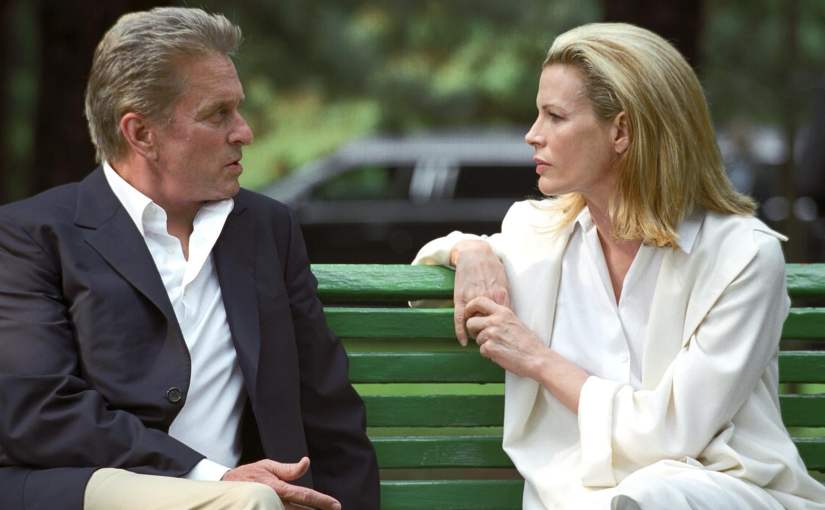
There’s troubling bubbling up in this Presidential cabinet, particularly because black and white photographs have mysteriously landed on Garrison’s desk depicting his clandestine tryst with the First Lady, played by Kim Basinger.  An agent partner of Garrison’s is shot dead on his front porch.  Then Marine One is taken out by a missile.  Obviously, someone has the President (David Rasche) in their sights.  Therefore, it must be a mole.  Who’s the likely traitor?  Pete Garrison is suspect numero uno, and so Michael Douglas is in the spotlight doing a subpar Jason Bourne treatment of resourcefulness to prove his innocence and uncover who framed him.

The Sentinel is not a terrible movie by any means.  It’s just this flavor of film has been done countless times before it came out in 2006, and thereafter.  Eva Longoria plays a former student of Garrison and now partner to Breckinridge and together with Sutherland they do the staple run with guns drawn down the streets of D.C. and the black sedan daytime drives while trying to stay hot on Garrison’s trail.  For some extra spice, Pete and Dave had a falling out some time ago and when we discover what that’s about it’s not very savory.

What keeps Johnson’s film from entering the lexicon of other grade A thrillers is that the true bad guy is completely apparent long before the plot unravels itself.  You know who’s spiking the voodoo doll within the first five minutes of the picture.  Why did Clark Johnson have to give this character the most oblivious close up?  That’s a failure on the director’s part, I’m afraid.  The Sentinel is short of plausible red herrings.  Someone told me recently that the best part of a magic trick is when you forget you are watching a magic trick.  Well in this movie, you know how the rabbit pops out of the hat.

There are obligatory shootouts. There’s also the big speech the President gives at the end when the bad guy is about to make a deadly move at the podium. As well, naturally there’s another typical Michael Douglas affair in a long line of on-screen Michael Douglas affairs.  Kim Basinger, I’d like to introduce you to Sharon Stone, Demi Moore, and Glenn Close.

Michael Douglas and Kiefer Sutherland (more or less doing his Jack Bauer schtick) have a magnetism on screen that’s upheld their long careers.  However, The Sentinel is not evidence of their worthiness.  Watch this film after you’ve exhausted all the other movies belonging in this category, and you just need to see who Michael Douglas is sleeping with this time, while the President gets saved one more time.   

THE KING’S SPEECH

By Marc S. Sanders

A man can carry the title of Duke Of York, but that doesn’t make him a super man.  After all, he is just a man like any other, and he can possess annoying hinderances like a stammer for example.  However, when you are part of the Royal Family with a historical lineage of thousands and thousands of years, celebrated and honored in majestic paintings and medals, the inconvenience is never acceptable. 

Colin Firth is Prince Albert George (and forgive me but he has assumed two or three other first names as his birthright that I can not recall.  Phillip, as well I think).  The King’s Speech opens when Albert has been tasked by his father, the King of England, to deliver a speech at Wembley Stadium.  Director Tom Hooper never made a small staircase, a microphone or an audience appear so fearful.  As Albert addresses the crowd, the words do not come out and the only one who can lovingly empathize with him is his devoted wife Elizabeth (Helana Bonham Carter).  The archbishop (Derek Jacobi) puts his head down in disappointment along with all the other formally attired spectators.  It’s a heartbreaking beginning of a story for a well-dressed crippled hero.

Following advisors and doctors who offer ridiculous remedies that allow no alleviation, Elizabeth finally finds an Australian speech therapist who just might be the best last resort for her husband.  Albert is stubbornly reluctant to visit with Dr. Lionel Logue (Geoffrey Rush) who insists that their sessions occur in his office.  Albert does not like that he will also not be addressed formally by Dr. Logue.  Lionel will call him Bertie. 

An unorthodox approach, at least for royalty, is what Lionel insists will aid Bertie.  It is certainly better than his doctor’s recommendation of smoking cigarettes directly into his lungs.  Bertie will lie and roll on the floor.  He’ll hum and bellow unusual noises.  He’ll have to loosen up his physique and even allow Elizabeth to sit on his belly to help him with breathing exercises while working his diaphragm.  The art of swearing is especially helpful.

An interesting fact that Lionel shares with Bertie is that no infant is born with a stammer.  It develops from another source.  Perhaps it is abuse or neglect as a child.  When you are a child of royalty you are not necessarily loved directly by your parents.  A nanny is likely closer to you; maybe even more abusive. 

The King (Michael Gambon) is respected by Bertie, but he is fearful of the future of his monarchy.  The older son, David (Guy Pearce) is next in line to assume the throne, but he is an immature bedhopping playboy, and the threats of Hitler and Stalin are becoming more prominent.  The King begins prepping his Albert by insisting he deliver radio addresses.  The father is not the encouraging type, though.  His disdainful demands are not the cure for Albert’s debilitation.

The King’s Speech advances a couple years during the 1930’s towards the precursors ahead of World War II.  The King has died.  David is behaving just as expected and Albert still suffers with his ability to speak, but Lionel has therapeutically made advances with his student and friend.  He just can’t lose his student.  Otherwise, Bertie will not overcome.

The film’s strength relies on a solid friendship that develops between a common civilian and a man of Royalty.  Geoffrey Rush and Colin Firth work marvelously together.  They are very different personalities with backgrounds that could not be more apart from each other.  The chemistry is a beautiful duet of dialogue from an Oscar winning script from David Seidler. This was Seidler’s first script he ever wrote at the age of eighty. 

The entirety of the picture has a set design from Eve Stuart and Judy Farr that is absolutely grand.  Every room of the palace has the most beautiful furnishings and wallpaper designs.  Tom Hooper uses wide distant lens’ that show the enormities of each room of the castle as well as Prince Albert’s home.  Sometimes he shoots from the floor above, pointing his camera at Albert and Elizabeth.  The majesty of royalty looks down upon the Prince and his speech impediment.  It’s an absorbing setting for the film.  Exterior shots also look authentic with the cars and the dreary coldness of the country and London cobblestones.  I love the hardwood floors that the characters walk upon in the picture, particularly in Lionel’s office.  The resonances of their dress shoes speak more clearly than the Prince. It all seems to echo the overwhelming conflict that our protagonist must overcome, and Colin Firth is terrific at demonstrating his frustrated insecurities.  It’s an Oscar winning performance not only earned for the well-timed stammer but also the mournful facial expressions that are caught in close ups.

The triumphant moment at the end of the film occurs after Albert has succeeded the throne from his incapable brother. He is obligated to address his country in a world-famous speech that eventually brought a defiant England into the second world war to fight off Hitler’s undoubted tyranny.  Tom Hooper’s camera follows a strong hearted, yet nervous Colin Firth walk from one room of the palace to the next until he finally reaches the small makeshift studio where his friend Lionel accompanies him to offer assurance as he speaks to his people and allies across the seas.  I don’t simply see a coach or one who lends confidence.  I see a friend working with another friend.  Again, Geoffrey Rush and Colin Firth make a wonderful pair in a long line of cinematic mentors and their students.

As history has taught us, the King’s speech was simply the beginning of a very dark and bloody experience.  The speech itself became a success, but the real challenge was yet to come.  However, confidence is what allowed a generation to survive.  The irony of The King’s Speech is that the hero a people needed lacked confidence in himself.  By the end of this picture, he is sending his faith, his trust, and his own assurance over to his constituents, who needed it the most in spite of a hindering stammer.  It’s a doubly blessed occasion that a lifelong friendship formed out of a troubling time.

FIELD OF DREAMS

By Marc S. Sanders

Fantasy can be a real challenge.  The audience must convincingly accept what could never possibly be real.  The Wizard Of Oz from 1939 will always be the best of all fantasy films.  The most visually significant element was bookending the film in black and white, with illuminating color in the center for the Land of Oz to come to life.  You feel transported.

Phil Alden Robinson’s screen adaptation of W.P. Kinsella’s novel, Shoeless Joe, had a big challenge.  The film became known as Field Of Dreams.  How would any of us believe that an Iowa corn crop farmer hears voices and gets the inspiration to throw all common sense out the window and build a baseball field in the middle of his property?  It’s absurd.  Maybe only Kevin Costner, a modern-day innocent Jimmy Stewart of the time in the late 1980s, would convince any of us that this is something that needs to be accomplished.  Robinson’s script offers no logic that any of this should be done.  Re-watching the film, I was still skeptical of accepting the outrageousness.  Then again this is Kevin Costner in his mid-thirties with a toothy grin on his face, chestnut hair, beat up jeans, and an adorable 8-year-old Gaby Hoffman for a daughter and a spitfire Amy Madigan for a wife.  I can’t explain it any more than Ray can explain to his wife why he needs to tear down acres and acres of valuable crops for a baseball field that’ll run him into enormous debt. You just gotta roll with it, I guess, even if your suspension of disbelief isn’t there. 

Thankfully, the authenticity of the fantasy welcomes itself as Field Of Dreams moves on. 

Costner plays Ray Kinsella who had a very estranged relationship with his father who only briefly played in the minor leagues before aging quickly and working himself towards a premature death.  Ray went on to Berkeley in the ‘60s and got caught up in the hippie movement leaving his father’s baseball heroes of Ty Cobb, Rusty Miller and “Shoeless” Joe Jackson behind. 

After Ray builds the beautiful field and waits months and months for something, anything, to happen, the ghost of “Shoeless” Joe Jackson, (Ray Liotta) donned in his White Sox uniform, appears.  Jackson was part of the infamous Black Sox scandal and was denied of ever playing professional baseball again, following being caught accepting bribes to fix games with seven other teammates.  Ray spends the evening with Joe pitching and fielding together.  Now, whatever hasn’t made sense to the viewer suddenly presents some light on this outrageous feat we’ve been witnessing.  Dorothy has met the Scarecrow.

Ray has dreams to find a recluse author named Terance Mann (a superb James Earl Jones who should’ve gotten an Oscar nomination; just an astonishing actor).  Later, he meets a ball player who only played one inning in the major leagues, Archie “Moonlight” Graham – portrayed charmingly by an elderly Burt Lancaster and a spry Frank Whaley.  How they both play the role is a surprise I’ll withhold from this write up.

I share this summary because Field Of Dreams improves itself as it progresses.  The ghosts, the fantasy, and the sheer nerve that Robinson (director and writer) grants to Costner and the cast send you into the imaginary.  You’ll be twenty minutes into the picture and ready to give up.  Thankfully, the storyteller who made the film introduces something unworldly that encourages us to learn more and more.  That’s what happens every time you watch The Wizard Of Oz.  Not just the color, but the décor and strangely adorable munchkins draw you in with curiosity and you want to discover more about this place you’ve never visited before. 

With Field Of Dreams, you don’t have to know anything about baseball.  What you need to understand is that people of a past enter Ray’s life when he never expected them. Now, he’s destined to aid them in fulfilling what they were denied of during a time gone by. 

We all wish to take advantage of our dreams gone by.  Fantasy makes that possible.

Perhaps Ray Kinsella was denied an experience, as well.  You’ll have to watch Field Of Dreams to find out.

THE ROAD WARRIOR

By Marc S. Sanders

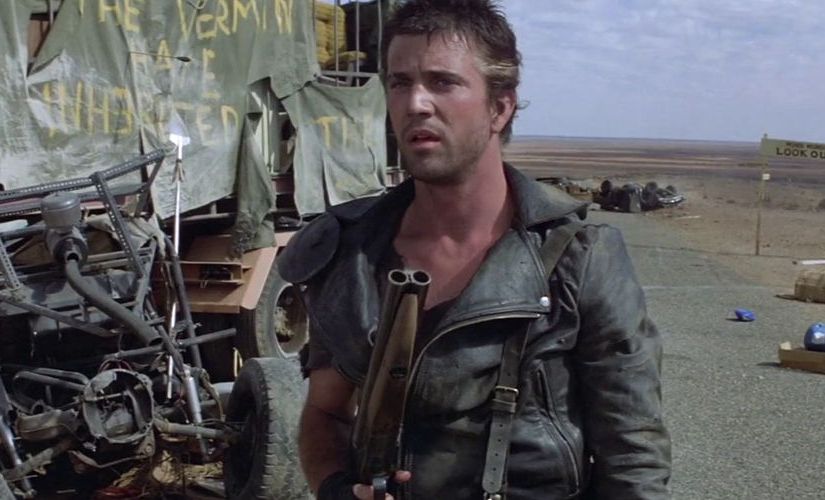
An Australian post-apocalyptic desert wasteland is the setting of George Miller’s B movie classic The Road Warrior.  It’s a film deliberately short on depth, but big on mash ‘em up, bash ‘em up high-speed hot rods, muscle cars, motorcycles and one big rig truck.

Mel Gibson returns as Mad Max, the leather wearing drifter driver who patrols the endless roads.  A brief narrative at the beginning recaps some of the events of Miller’s first film in this series, Mad Max, explaining that the governments worked against one another, riots ensued, and a nuclear holocaust left little of the population to survive with a shortage on the most precious commodity, fuel.  Max was a policeman whose wife and child were slaughtered by the way, but that’s not relevant here.

The center of the film focuses on a small community of people dwelling in maybe the last known functioning oil refinery.  However, barbarians led by The Humungous (Kjell Nillson) who wears a hockey mask and S & M straps over his bare body are intent on taking over the precious area.  The Humungous’ second in command is a red mohawked freak named Wez (Vernon Wells).  Everyone else in the gang is dressed in the same thematic sex play costume wear with their ass cheeks on display. 

Following some episodes of havoc, Max, along with his dog named Dog, form a contract with the oil refinery dwellers to get the big rig, fuel it up and attach it to a tanker for a journey across the wasteland towards a paradise of ocean blue oasis.

Max has sixteen lines in the whole film.  I’ve expounded on this movie more than he ever could.  In fact, Dog has more dialogue. George Miller knew he wasn’t writing anything of multi dimension or fleshed out characterizations.  You can hardly understand anything that The Humongous has to say or bellow.  It doesn’t matter.

What’s important is the demolition derby footage contained in The Road Warrior.  It’s thrilling.  Bodies get bashed by metal and caught in barbed wire.  Explosions go off in huge fireballs against a scorching sun.  Max fires his sawed-off shotgun at these gonzo gangsters.  They fire crossbow arrows in return.  Some of them use inventive gladiator kinds of weapons with sharp blades and spikes. 

Miller’s frames per second accelerate the various chases.  Multiple collisions end up in a sand dune or turning someone’s ugly sunburned face into hamburger.  The editing of these scenes is magnificent.  Every crash is pieced together cohesively.  Zoom in close ups are spectacularly orchestrated and the cinematography holds up for welcome daylight action where you can easily make out who is who and what is where. 

The inventions of these junk machine jalopies are quite fun too.  Syd from Toy Story must have taken inspiration from this movie when he assembled his freakazoid toys that tormented poor Woody.  Other than Max’s black muscle car and some motorbikes, everything else looks drilled and fused together for relentless mayhem.  Sedans, SUVs, and station wagons would never survive.

George Miller’s world may seem a little prophetic these days.  It’s not that there’s such a rarity of gas, but the need among the masses to hoard fuel is there considering the inevitable price hikes spread around the globe.  Oil will always be a precious dependent.  Environmentalists, I feel for your crusade but be damned. Oil powers so much in and out of this planet.  Electric cars and the few power-up stations are not the dominant alternative yet and won’t be for a while.  Their longevity has not been proven.  Even the disposal of their expired parts has not yet been considered.  So don’t hate me Elon Musk.  I’ll happily eat my words one day, though, I’m sure.

As thin as the storyline may be, George Miller created this dystopian era for Mad Max to drift through and I commend the imagination of the MacGuffin.  Oil is what we rely on, and the setting of The Road Warrior may not be so far-fetched if it ever came to be that we were short on it.  However, I’m not running out to get my masochistic leather body armor just yet.

Wez, The Humungous and their bandit barbarian warlords may be fearless nut jobs, but I get their motivation.  You never know when rush hour may rear its ugly head in a post-apocalyptic age.  So, you better fuel up your Harley, BMW and Toyota because the boss is still gonna want you sitting at your desk by nine.

MURDER ON THE ORIENT EXPRESS (1974)

By Marc S. Sanders

When considering Sidney Lumet’s admirable body of work, many would likely connect him with covering corruption within police precincts and the legal jargon of courtrooms.  Fortunately, on occasion, he experimented outside of those genres, and we are all the better cinematic viewers because we were treated to an all-star cast, devouring up the scenery in an adaptation of Agatha Christie’s celebrated mystery Murder On The Orient Express.

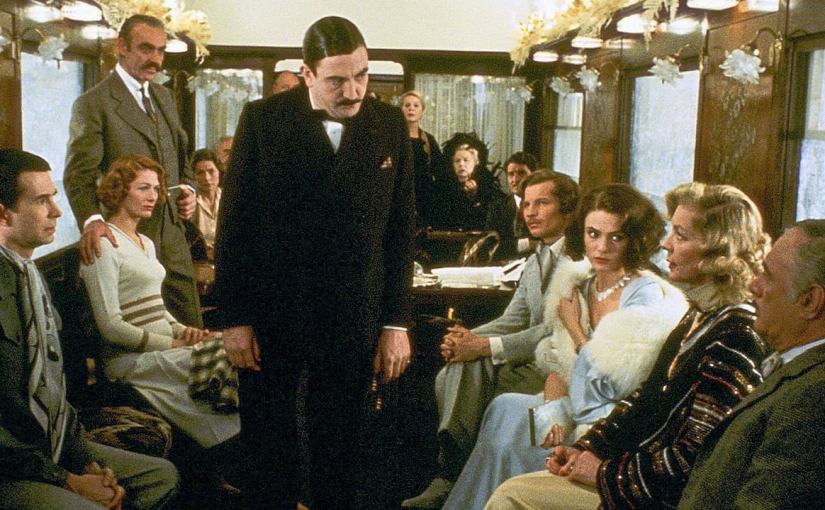
Lumet abandons his penchant for the metropolitan jungles of conflicted souls and high stakes drama to offer up a deliciously fun who done it, with Albert Finney gleefully playing the oddball, mustached Belgian (not French) detective, Hercule Poirot.  Despite a cast that features Sean Connery, Lauren Bacall, Jacqueline Bisset, Vanessa Redgrave, Martin Balsam, Richard Widmark, Michael York, John Gielgud, Anthony Perkins, and an Oscar winning performance from Ingrid Bergman, it is Albert Finney who makes the film wonderfully delightful.  His stature that seemingly hides his neck within his stout torso, along with a shoe polished, flattened hairstyle and a thick, echoing dialect tempo are an absolute combination of pleasure.  He makes the glossary of Tim Burton’s bizarre characters seem rather straightlaced.

He’s strange, but funny.  Before the expected murder gets underway, we observe an unrecognizable Finney performing Poirot’s nightly routines, including applying cream to his hands and unique mustache, as well as donning a kind of strap beneath his nose to keep his signature trait in its proper shape.  Batman maintains care of his cowl.  This crime fighter must preserve his facial hair.  It’s completely normal for Hercule.  While these mundane tasks of his are executed, the great inspector is also alert to several rumblings and bustles going on in the nearby cabins aboard the famous train in the title. Lumet ensures we see how smart and observant Mr. Finney chooses to portray Poirot; unique, and instinctively wise without limits.

An impolite and bossy man named Ratchett (Widmark) is discovered dead with multiple stab wounds to the chest.  It doesn’t make much sense considering the other passengers should all be complete strangers to one another.  Or are they?  Each one has an alibi, and their respective personalities couldn’t be more different.  Who would have the motive to kill a stranger aboard a moving train?

There appear to be twelve suspects for Poirot to consider.  That’s quite a list.  The standouts for me include Bergman, Bacall, and Perkins, but Lumet allows at least a scene or two for each celebrated actor to shine.

Ingrid Bergman dresses down to portray a shy, nervous, homely Swedish woman.  Sidney Lumet knows to back off on directing inventions when working with talent of such magnitude.  In one uncut take, Bergman controls an interrogation scene with Poirot and the camera stays fixed on her never diverting away and very subtly tracking behind Finney to stay with the actress’ nervous portrayal and expression.  The question is, should we trust this person? If Ingrid Bergman is putting on a façade, she’s awfully good at it.

Lauren Bacall carries such a strength on screen.  She walks with square shoulders and utter confidence that makes it seem like she’ll be impenetrable to Poirot’s inquiries.  Bacall’s booming signature voice would make me back down at any given moment.  She commands the supporting cast and appears to defy intimidation.

This film was made fourteen years after Psycho and yet Anthony Perkins portrays Mr. McQueen, a secretary of the murder victim, with youthful naïveté.  His stutter is perfectly timed and authentic, and he’s got body language that flails from one direction to the next when put to the test, not just by scenes he shares with Albert Finney, but anyone else in the cast as well.  His character is clearly unrelaxed.

I decided to watch this picture for reference.  In September of this year, I will be portraying Hercule Poirot in a stage adaptation of Agatha Christie’s story, written by Ken Ludwig.  My colleague Miguel Rodriguez is in the production as well, occupying Martin Balsam’s role.  They’re brilliant with magnificent energy by the way; Balsam and Rodriguez.  I had to watch Lumet’s film twice to appreciate the gleeful nuances he offers with this celebrated cast, including the actual train which serves as not only a claustrophobic setting but a character as well, stuck in a snowdrift, trapping the guilty party with no means to escape.  The dialogue flies fast and many of the various accents (Belgian, Russian, Scottish, Italian, Swedish, Hungarian) are challenging to decipher on a first watch, particularly Finney’s performance.

On a second watch, I was more wide-eyed to the detective’s behavior and how he breaks down a suspect during an interrogation.  No two interviews of suspects are even remotely similar.  Finney alters his way of approaching a scene partner each time.  I’ll credit the screenplay’s dialogue from Paul Dehn for that achievement as well. 

When a cabin door is opened to reveal the deceased victim, Finney’s odd mannerisms drastically change as he enters the room knowing what to say and look for immediately.  Sidney Lumet characteristically will position his camera pointing up at his actors, so the audience is the perspective of the subject being looked upon.  Albert Finney is gifted a wide scope within a narrow quarter to react as the famed detective.  This filming technique was an inspired choice by the director. Hercule Poirot is built up to be the foremost detective and now we see him demonstrating his specialty for examining a crime scene, and thus where to begin with his examination.  Albert Finney received an Oscar nomination for this role and it’s because of the skills he orchestrates under a guise of heavy makeup with a thick incomprehensible dialect.  All are meant to be taken as winning compliments from me.

The art design of the train is breathtaking.  The exteriors are magnificent too, particularly the train station located in Istanbul where the Turkish merchants crowd each cast member as they enter the film for the first time ready to board the Orient Express.  In one spot, a steward is inspecting the food cargo.  Another area has a merchant spilling over a carriage of oranges.  Locals crowd Bacall, Bissett and York with trinkets to buy.  Lumet captures the whole exotic tapestry.

Richard Rodney Bennett’s musical score is unforgettable.  A sweeping, romantically uplifting waltz accompanies the locomotive’s ongoing trajectory.  Then it gets more brooding when the journey comes to an unexpected halt in a chilling snowdrift, with the thought of a dangerous killer nearby.

Sidney Lumet is to be applauded for stepping back to allow his who’s who of legendary cast members play with Agatha Christie’s famous mystery.  He’s done this on other occasions including his outstanding cast in Network and Paul Newman’s career best performance in The Verdict

Those who are not familiar with the Agatha Christie’s tale are fortunate to experience the wonderfully twisted ending that serves the story’s continued appreciation.  Lumet deserves credit for the final touch though.  It’s not often that a film boasts such a collected caliber of talent together.  So, the best way to cap it off is with a charmingly giddy champagne toast.  It’s Sidney Lumet’s perfect little garnish to wrap one of greatest literary mysteries to ever be published and adapted for the stage and screen.

THE BIG CLOCK (1948)

by Miguel E. Rodriguez

DIRECTOR: John Farrow
CAST: Ray Milland, Charles Laughton, Maureen O’Sullivan, George Macready, Elsa Lanchester, Harry Morgan
MY RATING: 10/10
ROTTEN TOMATOMETER: 100%

PLOT: A harried magazine editor finds himself in the unique position of trying to track down the person who murdered his boss’s mistress…when all the clues lead back to him.


I have been a fan of 1987’s No Way Out since first seeing it on cable umpteen years ago.  The marvelous twists and turns in the script – yes, including that improbable ending – kept me guessing from the moment of the murder to the final pull-away shot.  Having seen it multiple times, I always noted the fact that it was based on a book with an odd title: The Big Clock.  Since No Way Out takes place mostly at the Pentagon, I always wondered what the story has to do with a clock, but I wasn’t motivated enough to track down the book, so I just let it go.

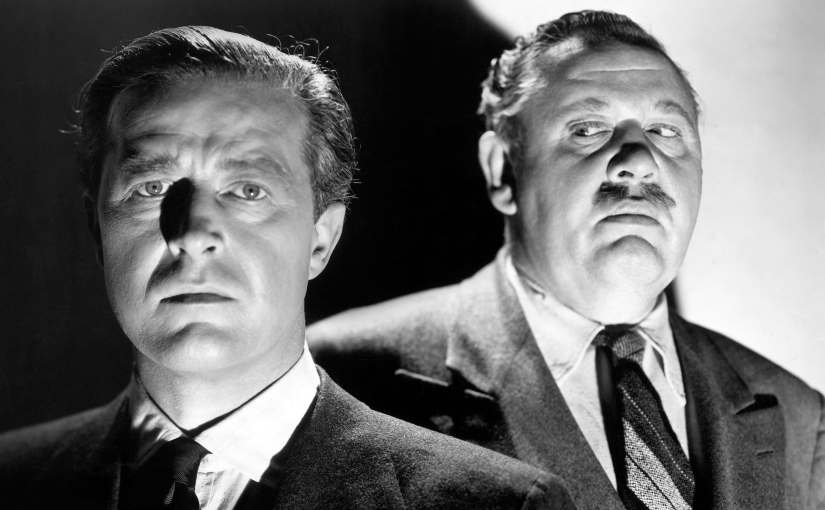
Imagine my surprise when years later, I discovered that No Way Out is not just based on a BOOK called The Big Clock, it’s also a reboot of an earlier film-noir from 1948, also called The Big Clock.  For years I had never been able to track down an affordable copy of the movie until recently.  I just finished watching it a couple of days ago, and wow.  It has all the snappy pacing of a Howard Hawks screwball comedy, the witty dialogue of a Thin Man film, and the coiling suspense of Hitchcock at the height of his powers.  The Big Clock is a forgotten film that deserves to be rediscovered by the public.

The story opens in typical noir fashion with our hero, George Stroud (the dour-but-likable Ray Milland) avoiding security guards before hiding inside a giant mechanical clock located in the lobby of the office building where he works.  His voice-over narration wonders how he got into this mess and tries to figure out where it all began…and we’re on our way.  So far, pretty stereotypical, not very promising.  But once the prologue ends, the surprises start rolling in.

George’s boss is Earl Janoth (Charles Laughton), a clock-watching, penny-pinching tyrant who doesn’t hesitate to fire an employee who leaves a light on in a broom closet, for example.  George is the editor of a magazine called Crimeways, one of many magazines in Janoth’s publishing empire.  Crimeways specializes in investigative reporting like tracking down murder suspects, allegedly to assist law enforcement, but mostly so they can publish attention-grabbing headlines about captured criminals to boost circulation.

Through a series of events too circuitous to list here, George winds up missing a very important train (he was supposed to finally give his wife a long-delayed honeymoon) and spends a drunken night carousing with Pauline York (Rita Johnson), a blonde bombshell who also happens to be Janoth’s mistress.  He winds up passing out on her couch at her apartment (having NOT slept with her, mind you), but is forced to skedaddle when Janoth unexpectedly shows up.  Janoth catches a glimpse of George in the hallway but cannot see his face.  When Janoth confronts Pauline, things get heated, and Pauline winds up dead.  Instead of going to the police, Janoth confides in his second-in-command, Steve Hagen (George Macready, whom you may or may not remember as the slimy general in Paths of Glory [1957] who charges three men with treason for not following a suicidal order).  Hagen returns to the scene of the crime, “amends” the crime scene, and comes up with a brilliant plan: use the magazine’s considerable resources to track down the mystery man Janoth saw outside Pauline’s apartment.

And who better to lead the investigation than George himself, whose investigative skills are second to none?

There is a delightful thrill of suspense when George receives his assignment and realizes that he cannot reveal the truth of his whereabouts without implicating himself, but he is compelled to lead the investigation as thoroughly as possible.  There is an amusing but highly-charged moment when an investigator reaches a witness on the phone and starts dictating the suspect’s vital features…and they match George almost to a T.

The beauty of the film is the head-fake.  We are shown the details of the drunken night George spend with the dead woman, but we are never tipped off that what we’re watching will eventually come back to haunt him.  Green mint martinis.  The hunt for a green clock.  A sundial.  An antique painting.  An eccentric painter.  A radio actor.  All disparate elements that are almost thrown away while they’re happening, but all of which come back to neatly bite George in the ass at just the wrong moments.

I cannot stress enough how ingeniously the screenplay is constructed.  One of the greatest joys of watching The Big Clock is admiring how airtight it is, how George is forced to fly by the seat of his pants from one moment to the next, putting on a show of doing his job while simultaneously trying to find a way to sabotage the investigation without showing his hand in any way.  I won’t give away how he manages this high-wire act, but it’s brilliant screenwriting.

Eventually, the building gets locked down with George still inside and two or more witnesses who can identify him prowling the hallways, including one who is drawing a sketch of his face.  At this point, even though I’ve seen No Way Out many times, I was 100% sucked into the story: “How can this guy possibly get out of this?”  The answers will be just as unexpected to you as they were to me.

(I should mention a small role played by an impossibly young Harry Morgan.  It’s one of the most sinister performances by a mute character that I’ve ever seen.  One shot in particular feels out of time, like it was shot in a movie from the ‘60s or ‘70s.  Creepy stuff.)

The Big Clock deserves a place among the great noirs like The Maltese Falcon, Out of the Past, and The Big Sleep.  It’s filled with great performances, the visuals are suitably moody and shadowy when necessary, and the plotting is impeccable.  What more can you ask from a great film noir?

HAUNTED MANSION (2023)

by Miguel E. Rodriguez

DIRECTOR: Justin Simien
CAST: LaKeith Stanfield, Rosario Dawson, Owen Wilson, Tiffany Haddish, Danny DeVito, Jamie Lee Curtis, Jared Leto
MY RATING: 6/10
ROTTEN TOMATOMETER: 40%

PLOT: A single mom in New Orleans hires a grieving tour guide, a dubious psychic, a shady priest, and an unhinged historian to help exorcise her newly bought mansion after discovering it is inhabited by ghosts.


Writing even a mildly negative review of Disney’s Haunted Mansion feels a little like hitting “dislike” on a picture of a 3-legged puppy.  The puppy is just being a puppy.  It doesn’t know or care that it’s missing a leg.  It just is what it is.

So it goes with this new attempt at a movie based on a popular Disney ride.  It’s chock-a-block full of inside jokes and references to the ride, some in plain sight, some tucked away in the corners of the screen.  As a fan of the ride at the Magic Kingdom in Orlando (I’ve never been to the Disney parks in Anaheim), I enjoyed these little Easter eggs.  Truthfully…I enjoyed them a lot.  I especially liked the chair shaped like a Doom Buggy, and the room that stretches, and the hitchhiking ghosts, and on and on.  This movie is basically Ready Player One revolving around just one IP instead of hundreds of them.  (That’s “Intellectual Property” for all you non-nerds out there.)

But aside from all the cool references, there’s not much else to recommend, especially not for those few poor souls who are not as thoroughly familiar with the Disney ride as I and many others are.  For those people, I would imagine Haunted Mansion plays a little bit like a de-fanged version of the original Jumanji [1995] or Jon Favreau’s criminally under-appreciated Zathura [2005].  There’s a heart-tugging sub-plot about the grieving tour guide, Ben, played by LaKeith Stanfield.  (Stanfield deserves recognition for playing the absurd material absolutely straight, even pulling out the emotional stops for a touching moment as he describes his late wife, in a scene that features an absolute scene-stealing button from Danny DeVito.)  Travis, son of single mom Gabbie (Rosario Dawson), has problems with bullies at school, even when he isn’t troubled by the ghosts who have latched onto him like lice.  Then there’s the issue of who all the resident ghosts are REALLY afraid of, a big-bad known only as the hatbox ghost (Jared Leto).

(I was reminded here of Peter Jackson’s The Frighteners [1996] in which a host of ghosts were terrified of a being that can actually kill a ghost.)

The movie has all the requisite creepy hallways and creaking doors and one or two jump-scares, but everything is done so tongue-and-cheek that it’s never truly horrifying…which was, I’m sure, the aim of the filmmakers.  Certainly you don’t want to make a film, based on a theme park ride, as scary as The Exorcist.  So, to that end, the filmmakers succeeded.  The movie is harmless, even a little fun at times, Owen Wilson gets to deliver some of his trademark dry observations, and DeVito gets to play some notes that I haven’t seen him play in a very long time.  If pressed, I would be forced to conclude that, for non-fans of the ride, this movie would most likely be a bit of a slog.

…but it is cute, despite missing that one leg.

OPPENHEIMER

By Marc S. Sanders

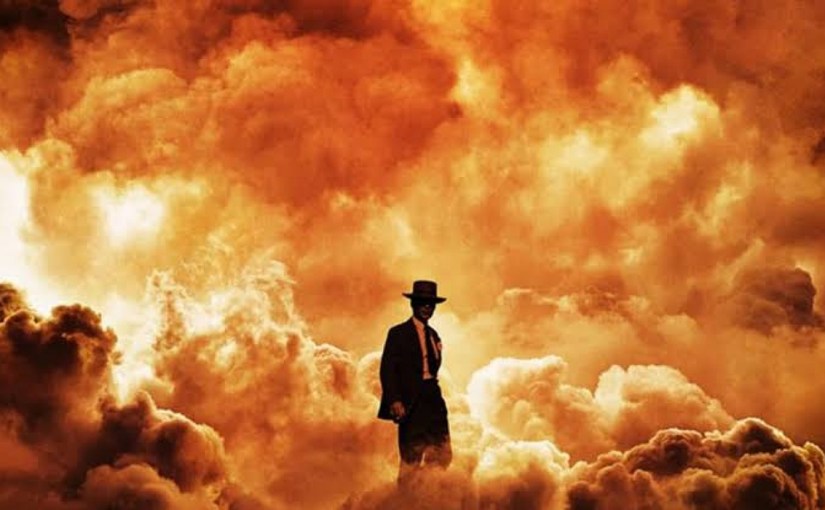
Christopher Nolan is one of the modern-day directors that you can rely on for brainy science fiction whether they are in embedded in dream subconsciousness, intergalactic space travel, transcendences of time, or even putting a fresh polish on a favorite superhero.  With Oppenheimer, he triumphs with exploring the actual prophets of science in the twentieth century, particularly its title character J Robert Oppenheimer, the brilliant physicist played convincingly well by Cillian Murphy.  Nolan doesn’t just stop at the assembly and discovery of science though.  He uncovers the consequences of Oppenheimer’s innovation and genius insight.  Dr. Oppenheimer might have been the man who knew too much and arguably that cost him quite a bit, personally.  Additionally, the so-called lab rat of his atomic bomb, namely the planet Earth, suffered the expense of a, at the time, troubling present day, and a still ongoing future. 

This movie seems to start right in the middle of its story and as a viewer you need to claw your way through the dense foliage to find its beginnings and what comes afterwards.  The first two scenes of the movie are titled “Fission” and “Fusion.”  There are no time periods specified by a font caption, however.  The differences in various points in history are distinguished by where J Robert Oppenheimer is located during select points in his life.  For seconds at a time, the film will change its photography from vibrant color to black and white, for example.  The characters will either look more aged with grey hair and some wrinkles or during more youthful time in their lives.  At one point Oppenheimer is being recruited by Lewis Strauss (Robert Downey, Jr) to head the department of a new kind of weapon development.  Work the science to make a difference.  There’s another time period where he’s being interrogated in a small room by a governmental suit and tie committee.  Oppenheimer is also in his classroom or debating and working with colleagues.  Another story observes his progress with building the atomic bomb among a collection of other engineers and scientists in a desert town, Los Alamos, specifically built at his own request, under the order of the nothing but militant Colonel Leslie Groves (Matt Damon), to conduct his work and research while hiding in plain sight. 

The film also covers Oppenheimer’s association with possible suspects of the Communist Party during the stressful pre-cold war era of McCarthyism.  Questions arise if his reliable brother Frank (Dylan Arnold) is a communist or even his mistress (Florence Pugh).  Does that in turn make Oppenheimer a communist as well?  If that is the case is J Robert Oppenheimer, the man tasked with ultimately ending World War II in favor of the Allies, sharing secrets with Russia and/or the Communist Party?

Nolan’s film gets easier to watch as it moves along, but you must get used to his pattern of filmmaking.  If you have never seen a Christopher Nolan film, I do not recommend you start with Oppenheimer.  His work is recognized for fast paced edits of different time periods and conversations.  There is much information to decipher. As well, there’s a very large collection of welcome characters to sort through, who worked with or against Oppenheimer.  Having only seen it once, I was captivated with the picture, but I know that I need to see it again.  The quick edits, working beautifully against the soundtrack orchestrations of Ludwig Göransson (nominate him for an Oscar, please), happen a mile a minute.  I appreciated this method because it enhanced the urgency of Dr. Oppenheimer in the eyes of the world, first as the savior of the united Allies against the last remaining superpower of the Axis countries, Japan. Then later focus is on whether it is in the United States’ best interests for the regarded physicist to have security access to the country’s most secret weapons and technological progress in a post war age.

People have been cajoling about how they know the ending to Oppenheimer.  They drop the bomb, of course!  (Twice actually.)  However, they do not know the entire story adaptation that Christopher Nolan as director and screenwriter presents. 

Cillian Murphy is perfectly cast. Give him an Oscar nomination.  He serves the confident, assured scientific leader who becomes envious of competing powers who achieve the impossible, like splitting the atom, while also admiring peers and mentors like Niels Bohr and Albert Einstein (Kenneth Branagh, Tom Conti).  All these men are interested only in what can be accomplished.  The superpowers that fight in war, though, are interested in how these accomplishments of modern science can be used to their advantage at a cost of collateral damage.  It is these conflicts of interests that Nolan admirably demonstrates over the course of the film. 

A telling scene for me, that I won’t forget, is when Robert Oppenheimer meets Harry Truman (Gary Oldman, doing an unforgettable cameo).  As the physicist exits the Oval Office, having shared his concerns and scruples with the Commander in Chief, Nolan includes a throwaway line delivered by the President, that I won’t soon forget.  It will not be spoiled, here.  Yet, the dialogue speaks volumes of what the United States held important regarding the servants who did the country’s bidding.  The scene closes like a stab in the heart, and suddenly science is no longer just facts within our planet.  Science is now questioned on whether it should ever be acted upon. Those questions certainly have remained as long as I’ve been alive to read about our never-ending world climate.  These inquiries will be here for many generations after I’m gone as well; that is if men and women’s recklessness with science doesn’t destroy the Earth before then.  At one point, Oppenheimer shares a small fraction of possibility for the end of the world when they activate and test their first atomic bomb. Matt Damon’s Colonel Groves’ asks for a reiteration of that observation.  Is this finding worth even the smallest, most minute risk?

Emily Blunt portrays Kitty Oppenheimer.  She’s marvelous as a lonely alcoholic wife to Robert, and a mother minding a home built in the desert while her husband serves an important purpose.  I didn’t take to her presence in the film until her grand moment arrives during an interrogation scene.  As the character gives her testimony regarding Oppenheimer’s communist ties, Blunt locks herself in for a wealth of awards in late 2023/early 2024.  Once you’ve watched the movie, you’ll likely know which scene I’m referring to and you can bet it’ll be that sample clip shown on all the awards programs.  This might not be Blunt’s best role, because it is rather limited within crux of the film, but I’d argue it is her greatest scene on film that I can remember.

Oppenheimer is a three-hour film, and it demands its running time.  There are so many angles to the man that few really know about.  Many know it was he who instrumentally built the atomic bomb that to date has only been used twice within a period of four days.  Thankfully never since.  Nolan emphasizes how unaware we are of how carefree the doctor’s government supervisors performed with the weapon he agreed to build.  Don’t just drop the bomb once.  Send a message to Japan by dropping it twice so they know to no longer engage in this ongoing war.  Choose the area where an army/government official didn’t honeymoon though.  It’s too beautiful a region.  Tens of thousands of men, women and child civilians perished immediately following the strikes.  Many others died weeks later following exposure to the nuclear effects that followed.  All issued as a horrifying cost to end a war that was already being won now that Hitler was dead.

Mechanically, Christopher Nolan does not disappoint either.  I watched Oppenheimer in a Dolby theater and I highly recommend it over a traditional one.  However, beware of the sound.  It is a LOUD!!!!!  Your seat will rattle early in the film when Cillian Murphy is shown in close up imagining the collision of atoms, protons, and neutrons.  How a star naturally dies in space runs through Oppenheimer’s consciousness as well, and then we see how a black hole forms.  Nolan offers a Cliff’s Notes edit of science doing its job.  Murphy performs so well when he’s not speaking and cut against the quick edits of Nolan’s visual and sound effects of science at play.  It shows how an educated scientist thinks beyond what is documented on a chalkboard or in a textbook.  J Robert Oppenheimer used to teach about the building blocks and natural destruction that occurs within the universe.  Regrettably, what he learned about natural function soon becomes manufactured capability when the professor accepts the task of building scientific destruction with his bare hands. Man stole fire from the Gods.

Oppenheimer is so dense in the scope of science and the scientist behind it.  That’s a huge compliment.  It’s an engaging film with much to tell, and a lot more to think about afterwards.  It accomplishes what the best movies do.  It leaves you thinking long after the film has ended.  More importantly, it’ll leave you frightened for the future based on the behavior of this planet’s past. 

Oppenheimer is one of the best films of the year.

BARBIE

By Marc S. Sanders

Having just returned from donning my pink t-shirt to watch Greta Gerwig’s box office smash Barbie, I am certainly relieved that I watched the film with my wife.  Just when I thought I understood everything I was watching in the movie, my better half explained to me that my perception was wrong.  Yet, I still believe Barbie was a magnificent experience that allowed me to reminisce about my pre-teen years occupied with my favorite toys (Kenner’s Star Wars figures and playsets).  I applaud this film for going even deeper than that though.  Barbie reflects on the patterns between men and women primarily in the fields of career, objectivity, and social stature.  As pink as the film is, and it is pinker than a truck load of Pepto Bismol, it is also observant and telling.

Someone commented on a Facebook post when I announced that I was seeing the film that Barbie is a “woke” movie.  I am so sick of that term, honestly, and it has nothing to do with which side of the political aisle I sit on, because I no longer sit on any side.  While watching Margot Robbie as the main “Barbie” of a whole community of “Barbies” in Barbie Land, I never recognized said “wokeness.”  Only afterwards did my wife have to explain where it likely exists within the film.  I still don’t think it’s a fair observation though.  Barbie and Ken dolls, Skipper and even the pregnant Midge doll and the lonely Allan doll and all their accessories are marketed by Mattel to a demographic for young girls.  Greta Gerwig’s script though questions what could threaten a Barbie Land.  Frankly, the only thing imaginable (besides opening the film on the same day as a biographical film about the man who invented the atomic bomb), is if the world of Barbie was no longer Barbie & Ken, but rather Ken & Barbie and a male dominated finish conquered Barbie Land following Ken (Ryan Gosling) reading up on some books about horses and machoism.  Very inventive, as well as comedically endearing to watch how Barbie and all the other Barbies undo what’s been done by Ken and all the other Ken variations.

A second storyline is really what rang true to me.  America Ferrara portrays Gloria, a mother in the Real World who has lost a bond with her daughter Sasha played by Arianna Greenblatt. Sasha has long outgrown spending time with Gloria and playing with Barbies together.  Sasha is a typical moody teenager.  This is crushing to Gloria and real-world thoughts enter the mother’s mind by the will of nature, including the uncertainty of death and even worse…cellulite.  Barbie (Margot Robbie) realizes the effect it has on her and with guidance from Weird Barbie (Kate McKinnon) embarks on a journey to the Real World to right what is wrong with the girl who plays with her.  Barbie is in for a surprise though. 

One day I will weave into one of my original plays about the time I showed my father my brand-new Star Wars TIE Fighter ship.  I demonstrated for him how the wings pop off.  His response was an artificial “Oh wow!” and then a return to his dinner with further discussion about his workday.  At six years old, I could even identify how uninterested he was.  This moment from so many years ago came back to me as I observed Ferrara’s emptiness.  The mother has lost her daughter, the same way my young self lost my father. 

Toys can draw out nurturing emotions of happiness, and perhaps disappointments, when we are young and imaginative.  As adults, a desire for a recapture of youth can blossom.  My generation yearns for the toys they played with and are even willing to pay enormous amounts of money for that tangible memory with what are now considered antiques.  Toys have always been a part of my life.  I was never an athlete.  I got much more pleasure out of playing with my action figures and my made-up car chases and shootouts in my bedroom. 

Gerwig’s script, co-written with Noah Baumbach, is quite intuitive.  Barbie and Ken (Robbie, along with wonderfully sweet and naïve Ryan Gosling) try to perfect what is imperfect about themselves and end up making things drastically worse for their respective existence within the Barbie World.  Barbie may fear bad breath and try to escape death, but how will that affect the pink, plastic world she stems from?  Ken tries to learn more from the Real World to enhance his noticeability with Barbie and deal with his insecurities against the other theatrical Kens he exists with. Does learning change Ken into a better version of himself, though?  Experience and exposure to foreign situations are necessary to enhance oneself but go a little too far and it might become a reminder to be careful what you wish for.

Mattel is even spoofed by means of Will Farrell and his posse of dark suit executives and the office’s grey cubicles representing white collar corporate America.  What Barbie and Ken have unleashed could have drastic consequences on the commodity of their bestselling dolls and playsets.  Honestly, I was waiting for an appearance by He-Man to enter the fold.  How would this carry over to the Masters Of The Universe??????

Barbie is more complex than the cheerful advertisements, the toy brand or even the bubbly appearances from Robbie, Gosling, McKinnon and the rest of the cast may appear to be. I’ve already heard it described as strange, and definitely not a movie for kids.  There’s a reason it is PG-13.  Mature themes are at play amid the sunniness of President Barbie, Astronaut Barbie, Supreme Court Justice Barbie, Mermaid Ken and Beach Ken.  Greta Gerwig didn’t want to settle for a just a happy go lucky fantasy.  The Barbie doll has existed for over fifty years and by now, nearly a quarter of the way into a new century, she better serve more purpose than a perfect smile, arched feet, and cheerful shades of pinks and yellows.  Gerwig sought to uncover the role Barbie has for girls and women at age 5, 8, 15, 30, 50 and on and on. 

I must recognize some of the attractions contained in the picture.  An inspired opening of the film had me rolling as Barbie answered the call of Stanley Kubrick’s classic 2001: A Space Odyssey.  (Makes me sad that I was the only one laughing in a full theater.)  Gerwig also took wise advantage of the multitalented Gosling with a collection of musical song and dance numbers.  I never really cared for the song “Push” by Matchbox Twenty, until Ryan Gosling and his Ken mates applied it as a substitute to Robbie’s Barbie and her Barbie gals’ adoration for “Closer To Fine” by the Indigo Girls.  Gosling puts such energy into his performance.  He’s certainly the go-to actor for musical films like Barbie and La La Land.  Those days on The Mickey Mouse Club truly paid off.

Barbie is a vibrant and very smart film.  I’m just not sure everyone will respond to it like I did.  It is no surprise that moviegoers resent that it is not catered for young children or that there’s an oddness to some of the stories.  You may not care for it.  Who knows?  Maybe you’ll find it to be “woke,” but I hope you’d look deeper than that.  I appreciate it on a personal level however, remembering back to my time as a kid with a toy or two that were more than just pieces of molded plastic.  Rather, my Boba Fett and Han Solo figures were often the best friends to spend time with and it’s only sad that dad may have missed out on what was truly special for his son. Still, even Barbie reminds me that none of us are perfect and that’s okay.