
by Miguel E. Rodriguez
DIRECTOR: John Sturges
CAST: Spencer Tracy, Robert Ryan, Anne Francis, Walter Brennan, Ernest Borgnine, Lee Marvin
MY RATING: 9/10
ROTTEN TOMATOMETER: 97% Fresh
PLOT: Shortly after the end of World War II, a one-armed stranger arrives in a tiny desert town whose residents, for no apparent reason, behave in a hostile way towards him.
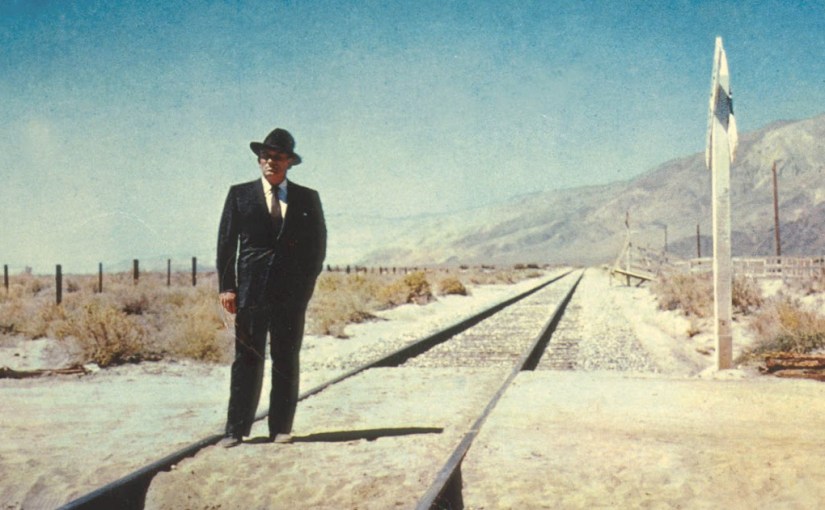
A stranger arrives by train at a small desert town. The conductor tells him it’s the first time the train has stopped there in four years. The stranger carries a briefcase in his one good arm. The residents are apprehensive about him, hostile towards him, and do everything short of pointing a gun at him to force him back wherever he came from. Who is he? Why is he here? And why does everyone get nervous when he asks how to get to a place called Adobe Flat?
This sounds like the setup for one of Clint Eastwood’s “Man-with-No-Name” spaghetti westerns, and if those films weren’t at least subtly influenced by this one, I’d be extremely surprised. John Sturges’ Bad Day at Black Rock is a mystery-thriller as lean and mean as you can possibly get. With a running time of a scant eighty-one minutes, this is one of the best examples of a film that wastes no time on side-plots or unnecessary filler. Get in, get out, nobody gets hurt. Well…in this case, that’s not entirely true…
The story takes place in October, 1945. Spencer Tracy plays John J. Macreedy, a military veteran – he lost the use of his left arm in Italy – even though he looks a bit old to have been a combat soldier. But I’m willing to believe he was an officer of some kind. The locals, including Reno Smith (Robert Ryan) and his heavies, Coley (Ernest Borgnine) and Hector (Lee Marvin), wheedle and needle him non-stop, trying to get a rise out of him. At first, I wrote this off to the Hollywood convention of the backwater burg whose citizens simply don’t like strangers for no reason at all. As the movie plays out, the reason for their behavior becomes clear…a depressingly relevant reason still today.
Because the movie is so short, and because the plot turns so decisively on the revelation of what Macreedy is doing in Black Rock, I can’t divulge any more plot details. But I admire the movie’s methodology. Enemies become allies, and vice versa. Some of the dialogue is reminiscent of Mamet. Some examples:
- “I’m half-horse, half-alligator – you mess with me and I’ll kick a lung outta ya!”
- “She must have strained every muscle in her head to get so stupid.”
- “You’re not only wrong. You’re wrong at the top of your voice.”
There’s a kind of poetry there that I usually only find in films-noir. I don’t think Bad Day at Black Rock qualifies as noir, but I guess someone forgot to tell the screenwriter. I have no problem with that.
I also admired the plot revelation concerning Macreedy’s business in Black Rock. I’m no film historian, but I’m willing to bet there weren’t very many movies in the years immediately following World War II that dealt specifically with this issue. The fact that this one was made by a top-tier director with such a powerhouse leading man surrounded by a talented ensemble, in CinemaScope…I’d love to do some more research to learn the general public’s reaction to the picture and its message. I know it’s critically acclaimed now, but I just wonder…
Bad Day at Black Rock is best experienced in a vacuum. If you’ve read this far, don’t read anything else about it before seeing it. Let the story come to you organically with no pre-conceived notions. This is a great film.





 2 UNPAID MOVIE CRITICS!!!!