WICKED PART ONE

By Marc S Sanders

The blessing of film is that it provides a channel to forms of entertainment that not everyone necessarily has access to.  I was never fascinated with the Tony Awards so much (even though I attended three live ceremonies) because the nominees were exclusive to what was performed in the last year on Broadway in New York City.  How can I or the rest of the country get enamored with the best of the best when we hardly have access to see any of the performances?  With movies, well you just go to the movies!

Wicked is one of the few musicals in the last twenty years that has taken on a worldwide fascination.  It was a very long novel before it became the touring stage production following a massive debut on Broadway. Perhaps because the story returns to a familiar setting, the fantastical land of Oz, the book and show carried a strong appeal.  Wicked arrived with an established brand.  Who doesn’t know The Wizard Of Oz?  Nevertheless, Wicked never needed magical ruby slippers (or rather silver as author L Frank Baum intended) to find its footing.  It’s always been worthy of its accolades apart from any other properties.  The new film, directed by John M Chu, will become a timeless classic all by itself.  Despite some technical issues, this cinematic adaptation is wondrous.

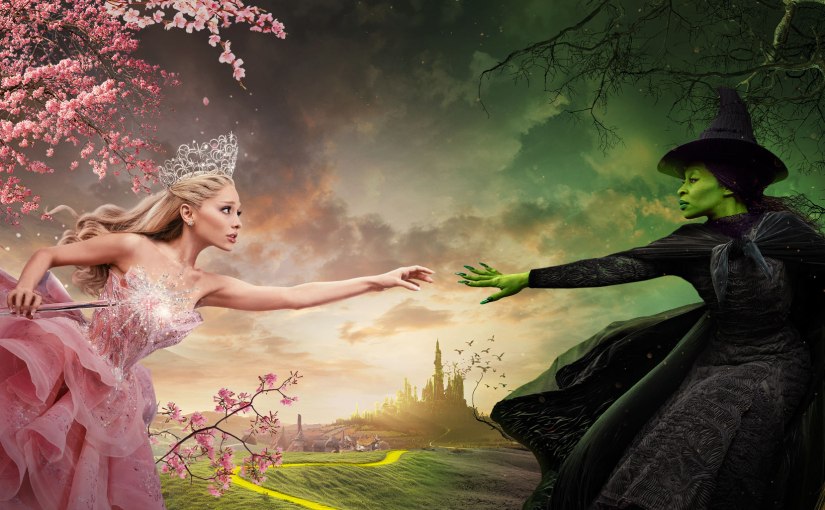
Elphaba (Cynthia Erivo) is the green skinned awkward teen, who was rejected by her father and only served a purpose to tend to her wheelchair bound sister Nessarose (Marissa Bode).  She accompanies them to drop her sister off at the esteemed magical school known as Shiz.  However, the headmistress of the institution, Madame Morrible (Michelle Yeoh), requests that Elphaba stay on as a student that she will personally teach as well.  Elphaba is roomed with the self-absorbed Galinda (Ariana Grande), where their relationship is frictional at first and later adoringly empathetic.  Eventually, we come to realize the destinies of these young ladies will develop into what is all too familiar in L Frank Baum’s eternal The Wizard Of Oz – Elphaba becomes The Wicked Witch Of The West while Galinda is recognized as Glinda, the pinkishly tender Good Witch Of The North. 

This Part One iteration of Wicked is very faithful to the stage production.  Every recognizable number is included from the operatic “No One Mourns The Wicked” to the giddily cheerful “Popular” to the climaxing, fist pumping, take charge “Defying Gravity” that closes out Act One.  The latter number is arguably one of the most well recognized and beloved theatrical songs of the twenty-first century thus far.  The edits and choreography of every number is magnificent, full of energy, and the harmonies work like natural dialogue as opposed to something like West Side Story where it’s not crazy to ask exactly why rival street gangs suddenly break out into song while trying to knife one another. 

John M Chu makes sure that his cast use every prop and set piece available.  You can’t help but grin while Ariana Grande does a circular swan flight from a chandelier while making a case for why it’s best to be popular.  “One Short Day” is a massive declaration within narrow school courtyards and corridors that berth out toward wide open endless fields into a vast blue sky for Elphaba to declare what she yearns for.  Cynthia Erivo has that knack to sing and perform personally to her character’s own subconscious when she’s in these intimate, private moments.  She then bursts out with confident volume to show that as repulsive as she might appear to everyone around her, the soul inside is what is beautiful.  In order to cast Elphaba, you really need one of the most beautiful singing voices in the world because the character is most stunning when she is expressing herself vocally. 

Ariana Grande is good. Though I still prefer the two iterations of the character that I saw on stage prior to this film.  Her performance is a different interpretation than what is traditionally in a live production.  I especially noticed that change when her character attempts to explain how to properly pronounce her name of Galinda.  The stage version of this memorable moment induced the laughs from me more.  As beautiful as Grande is in her characterization and singing, she’s not so humorous as the live stage performances.  So, the humor of Galinda, the self-entitled spoiled rich girl with everything, is not as strong.  As well, at the top of the film, I had an issue with understanding precisely what Ariana Grande was singing at first.  Was she harmonizing or was she singing dialogue?  Perhaps, that is not so much a fault of the actress as it is the recording.  Yet, the issue does not last long, and soon you are treated to Galinda laying it all out there.  She might not be as funny this time, but she’s incredibly charming and loved by her surrounding entourage of student followers, especially from Bowen Yang (Saturday Night Live) and Bronwyn James. 

The sets are spectacular and I learned afterwards that they are mostly physically constructed.  So, there is a texture to the schoolgrounds of Shiz with bridges and babbling brooks as well as regal castle-like architecture.  This is a Universal picture and many may presume that Disney would have produced something like this musical fantasy.  However, in Disney’s hands, much of this film would have been polished in a grandiose, yet artificial, CGI.  John M Chu and his crew went the smart route and diminished the cartoon sheen that comes with CGI.

My issue though is in the cinematography.  Regrettably, I could not see Wicked in a Dolby cinema.  So, we settled for a traditional theatre at AMC which was fine.  Yet, I was wondering at first if there was something wrong with the projector.  A lot of the scenes taking place in the daytime seemed washed out, especially with close ups on Ariana Grande and her complexion.  Then I concluded that John M Chu’s cinematographer relied on a lot of blaring sunlight for many of the scenes.  I imagine it was used to contrast the dark green complexion of Elphaba, emphasizing how much she doesn’t belong in this environment and amping up what an eyesore the character must feel like within the world of Shiz.  When Elphaba dominates a scene or a caption or when the film arrives at the Emerald City, the photography is just right.  Elsewhere at Shiz, it’s very oversaturated with a fuzzy kind of look to it.  Was I wearing the wrong spectacles?  Wait, I don’t wear glasses or contacts!  I could not get past this for much of the film. There was just too much white light, and it didn’t compliment the pinks and pales that accompany Galinda and some of the environments and extras.

My wife and I agreed we are going to see it in theatres at least one more time within a Dolby surround sound.  You should too.  We missed the surround sound of the winning music blaring through the entire theatre.  In a traditional theatre, the sound feels as if it is only coming from the front, or behind the screen.  Dolby or IMAX enhance the audible as if your mind is right at the center of an orb with the most gorgeous, pitch perfect sounds accompanying you.  Dolby and IMAX will also enrich the colors, and Wicked is most certainly vibrant.  Every scene looks like a completed coloring book, despite my one noted imperfection.  A year after Barbie, and pink is still in.  Greens and blacks are just as impactful.

Wicked is magnificent entertainment, worth seeing again.  The music is enchanting and easy to catch on to.  It’s fun and dramatic and every lyric works to shape the characters.  The story is magnificent as well with eye opening twists while allegorically adopting a message demonstrating the harm of prejudice.  There’s also opportunity to show where life can be a disappointment at times when you encounter false idols and learn truths about yourself and those you have grown close to.  I speak in vague terms on these accounts so as not to spoil what this powerful story delivers.

The film is smart in invention as well.  There are good, solid moments that were never staged in the live performances, but thanks to the art of filmmaking new ideas seem totally appropriate where the classic 1939 film, The Wizard Of Oz, are referenced.  Though, I have yet to see Part Two, I can confidently say Wicked works as a solid prequel.

I was one of the skeptics who believed breaking this film into two parts was a shameless studio cash grab.  It certainly seems that way and maybe it is, but considering how good this new musical film adaptation is, I am eager for another installment.  So, I will happily fork over more admission money a year from now and I am confident that I’ll wholeheartedly enjoy Wicked Part Two.  This is a brilliantly creative story with a strong cast, sensational music and eye-popping invention.  I may know what becomes of the characters and how this story ends, but I can’t wait to see it reenacted for its latter half, and I am eager to see what new creations present themselves in its next chapter. 

Wicked is one of the best films of the year.  A triumphing soar through the skies on a magical broomstick.

A HARD DAY’S NIGHT

By Marc S. Sanders

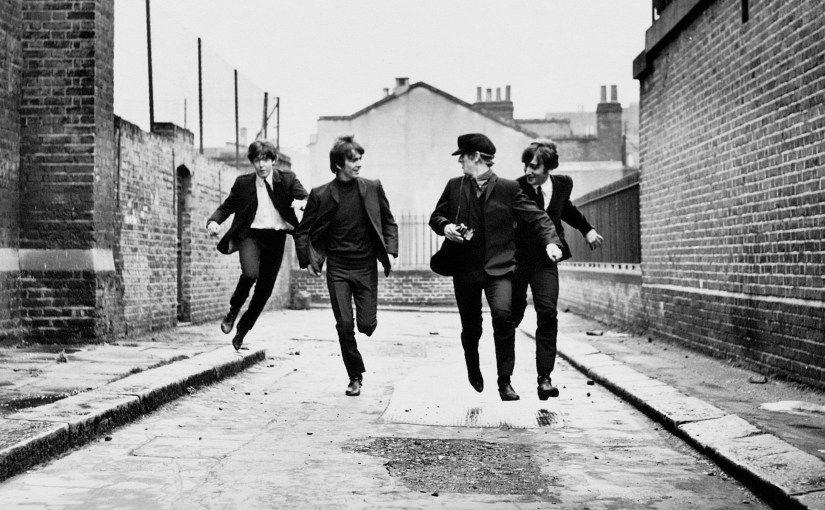
Before there were Swifties or Dead Heads or Parrotheads or Beliebers or Fanilows, there were Beatlemaniacs.  Everyone was screaming for and chasing after The Beatles – John Lennon, Paul McCartney, George Harrison and Ringo Starr.

The musical mockumentary, A Hard Day’s Night, captures the famous foursome from Liverpool over a two-day period, during their time of matching suits and mop top haircuts when they were taking the world by storm with their harmonizing vocals of innocent love and fancy-free celebration.  Richard Lester (eventual fill in director of Superman II) directed with a loose documentary like camera while the young men carried themselves in lighthearted and silly situations that served as a visual vehicle for their hit songs like Can’t Buy Me Love, All My Loving, and I Love Her.  The title song was featured too of course.  Along with Billy Joel and Barry Manilow, I grew up on this music and it helped me appreciate the loose construction of Lester’s film. 

Silly scenarios are set up with McCartney’s supposed “grandfather” (Wilfred Brambel) getting into all kinds of mischief while the guys circumvent through media conferences with improvised dialogue like:

REPORTER: Are you a mod or a rocker?

RINGO: I’m a mocker.

I’m not sure I understand the humor or the existentialism of this exchange, but it had fans, including famed critic Roger Ebert, going ga ga over it.  It even made it on to Premier Magazine’s Top 100 movie quotes of all time.  Then again so did “Plastics!” from The Graduate.  These are the vernaculars of the time.  It’s gotta have something to do with devoted fandom.  Right?

I recall seeing the music documentary U2: Rattle And Hum in the theaters upon release, and there was a moment where The Edge was sitting quietly next to Bono in an interview and snapping his palm on his knee, and the die-hard fan I saw it with could not stop laughing with appreciative glee.  I’m just as guilty.  If someone says in simple conversation “I have a bad feeling about this,” my Star Wars man child wakes up like a dog seeing a squirrel.  It can be politicians, rock stars, movie stars, preachers, athletes or even our parents that center us on an obsession that we respond to.  There’s no denying the Beatles had this kind of magnetism.  With half the band gone, the appeal still upholds much like it does for Elvis Presley and Michael Jackson.

A Hard Day’s Night serves a visual extension of the band beyond just what we would receive audibly over the airwaves and on vinyl.  They had recently finished performing on The Ed Sullivan Show, during their first arrival in America. Their charm, good looks, witty intelligence and even their quiet sensitivity enhanced the worldwide significance of the band.

Richard Lester finds opportunities to show the Beatles being performers of themselves behind the scenes, though most of what is shown in A Hard Day’s Night seems staged.  After all, we famously get to see John acting silly in a bubble bath and when his frustrated manager drains the tub and the suds dissipate, John is nowhere to be found.  A cute gag, much like we would find in music videos on MTV, twenty years after this film’s release.

There is a blend of overhead and wide ground level shots of the four prancing and dancing in an open field while Can’t Buy Me Love echoes through a scene.  It’s silly.  It means nothing.  It’s simply sophomoric fun begging us to appreciate their harmless, mad cap shenanigans.

Each bandmate is given room to shine, but Ringo surprisingly stood out to me the most.  He seemed like the little brother to the other three who was never taken seriously.  Paul’s grandfather even tells Ringo to give up music. He should be “parading.” Suddenly, just before a practice warm up for a television program, Ringo is missing.  The fourth Beatle has seemingly run away.  If I could find character dimension anywhere in this Oscar nominated script by Alun Owen, it surprises me that it came from Ringo; the one who was occasionally considered the least celebrated of the Beatle craze.  At the time, he wasn’t a songwriter.  He sat in the back with his drums.

A Hard Day’s Night is enjoyable simply for the innocence shown of the four guys from Liverpool.  They’re happy with themselves and to be with each other.  It’s very natural and yet it’s a little sad too.  This film predates what was never expected to come of them over the next decade and a half with break ups, marriages, controversies, new career trajectories, and even a sudden death of one of their own, occurring on December 8, 1980.

I can only imagine that in the moment of Beatlemania, A Hard Day’s Night was a celebration of happiness and cheerfulness.  They had a rebelliousness to them, yes.  However, there was never anything like them.  Today, the film serves as a reflection of my earliest appreciations for infectious song lyrics and music.  As a middle-aged man, with two members of the band gone, the picture works like a home movie for me.  It’s like watching archived footage of family members who have long passed away.

When you watch A Hard Day’s Night and sing along to the songs as they enter the picture, the words and the melodies return. You’ll likely find yourself thinking back as if to ask yourself “Remember When…?”

GENTLEMEN PREFER BLONDES (1953)

by Miguel E. Rodriguez

DIRECTOR: Howard Hawks
CAST: Jane Russell, Marilyn Monroe, Charles Coburn
MY RATING: 7/10
ROTTEN TOMATOMETER: 88% Certified Fresh

PLOT: A couple of showgirls on a cruise to France get themselves involved in a plot involving a private detective, a diamond tiara, and the occasional musical number.


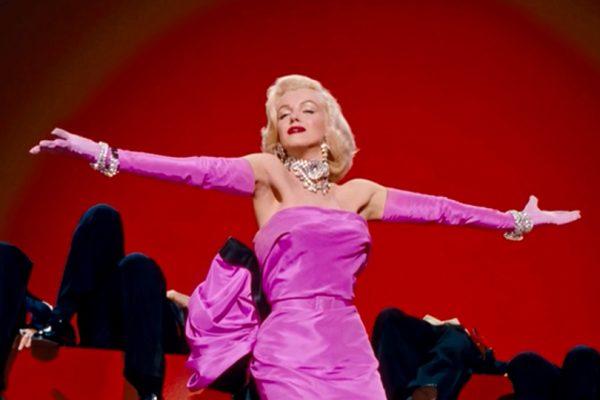
Why did I watch Gentlemen Prefer Blondes, a musical from 1953 featuring Jane Russell and Marilyn Monroe?  Well, it happens to be listed in the movie compendium 1,001 Movies You Must See Before You Die, for one thing.  And there’s the uber-famous production number “Diamonds Are a Girl’s Best Friend” performed by Marilyn Monroe in that iconic pink dress that showcased her shimmy like nothing else I can think of.  And it’s directed by Howard Hawks, one of my favorite directors from Hollywood’s golden years (His Girl Friday, The Big Sleep, Bringing Up Baby, many others).

While the song and the actors and the direction are competent, I didn’t quite get involved in the story as much as I hoped I would.  There’s no denying the wattage generated by Monroe whenever she’s on screen, and the screenplay by Charles Lederer provides some amazing little zingers, some of which I’m shocked got past the 1953 censors.  (When a man is asked which girl he would save from drowning first, Russell or Monroe, the man replies in admiration, “Those girls couldn’t drown.”)  But the plot, which I won’t even bother describing here, is merely a nail on which to hang those visuals of Jane and Marilyn strutting their stuff in exuberant Technicolor dresses and the occasional song or three.  Make no mistake, from a narrative standpoint, Gentlemen Prefer Blondes is pure farce, top to bottom.  (And no wonder, it’s based on a stage musical.)  You either give in to the formula or you don’t.  And I’ll admit, there were times when I didn’t.  There’s a song and dance number at a Parisian café which I thought was unnecessary, and the tortuous route traveled by the tiara, especially its final hiding place, stretched the logical part of my brain to the limit.

But, on the other hand…yeah, it was fun.  Set logic aside and surrender to the sights and sounds, and Gentlemen provides substantial eye and ear candy.  And there are some genuine laughs.  Like the subplot about Monroe looking through the passenger manifest looking for gentlemen traveling “with valets”, who must therefore be rich.  She finds one, Henry Spofford III, and arranges for him to be seated at her dinner table.  The revelation of Mr. Spofford’s true nature is one of the comic high points.

Or the bit towards the end where Jane Russell gets to have her cake and eat it, too.  Thanks to the machinations of the plot, Russell not only gets top billing for the movie, but she also gets to lampoon her sexy costar by impersonating Marilyn Monroe.  (In fact, if I didn’t know any better, I’d say that her appearance in a courtroom wearing a fur coat that conceals all until she crosses her fishnet-clad legs may have provided at least SOME inspiration to that one scene in Basic Instinct.  YOU know which scene I’m talking about, perv.)

But when it comes down to it, if for nothing else, you’ve got to watch Gentlemen Prefer Blondes just to see Marilyn Monroe singing “Diamonds Are a Girl’s Best Friend.”  She may play ditzy and dumb for the whole rest of the movie, but in this number, Monroe is totally and fully in command of her body, the camera, and the audience in that strapless pink dress which looks like it’s held up by sheer willpower.  For several minutes, she coos, struts, bumps, shimmies and shakes, and there’s nothing you can do but just watch in awe.  Almost as much as she did in Some Like It Hot, she simply embodies sexual…sexual…you know what, she just embodies sex.  I suppose there’s a more literary way to describe it, but I’m too tired to think of it.

Gentlemen Prefer Blondes may not feature the dancing feet of Gwen Verdon or Gene Kelly, or the vocal stylings of Debbie Reynolds or, well, Gene Kelly, or the literary complexity of West Side Story or A Star Is Born.  But when you have a song and dance number that is literally inimitable (sorry, Madonna, nice try), who cares?  I can think of plenty of worse ways to spend an evening than watching Jane Russell and Marilyn Monroe for 90 minutes.

[Side note: Penni was NOT a fan of how Monroe’s character constantly called her fiancé “daddy.”  Not sure why I’m mentioning that, but it just made it funnier to me every time Monroe said it.]

FUNNY GIRL (1968)

by Miguel E. Rodriguez

DIRECTOR: William Wyler
CAST: Barbra Streisand, Omar Sharif, Kay Medford, Walter Pidgeon
MY RATING: 7/10
ROTTEN TOMATOMETER: 94% Certified Fresh

PLOT: Barbra Streisand elevates this otherwise rote musical melodrama with her ultra-memorable star turn as real-life stage performer Fanny Brice.


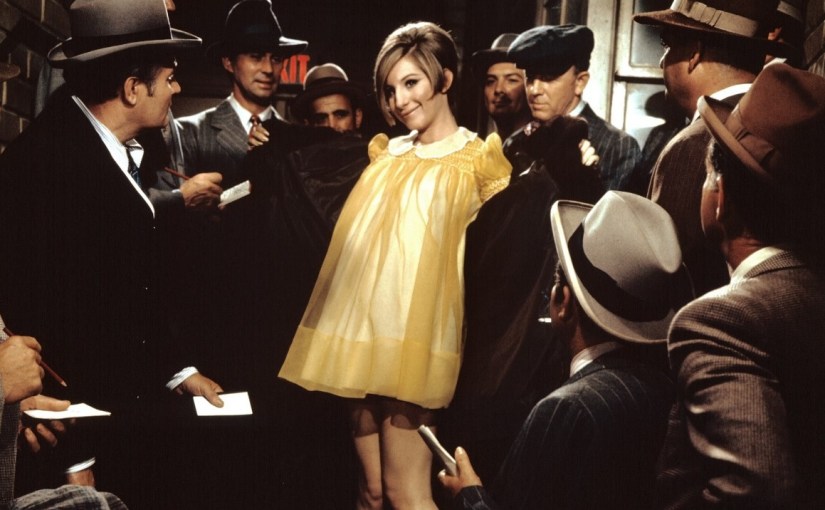
There is nothing wrong with Funny Girl that couldn’t have been fixed by the film not taking itself so seriously.  With its widescreen compositions and scores of extras and lavish stage productions featuring flocks of Ziegfeld girls in the most extravagant costumes imaginable, this should have been a romp, even with the serious bits in between.  Instead, the movie sinks under the weight of its pretentiousness, short-changing the funniest bits and wallowing in pathos way more than is necessary.  Thank goodness Barbra Streisand is there, giving a debut performance for the ages that is part Groucho Marx, part Debbie Reynolds, but mostly just Barbra.  Come for the spectacle, stay for the songs.

The story begins with Fanny Brice (Streisand) walking backstage at a theater and delivering her immortal opening line to a mirror: “Hello, gorgeous.”  From there, the rest of the movie is a flashback to the rise and rise of Fanny Brice, a plain-ish vaudeville chorus girl who is discovered by a roguish playboy, Nick Arnstein, played by Omar Sharif, who looks like a man whose last name would be anything BUT Arnstein.  He cleverly gets her boss to raise her pay to $50 a week (about $800 in today’s dollars, so not bad), and in the process captures Fanny’s heart.  Shortly after that, she’s invited to join Florenz Ziegfeld’s legendary troupe of dancing girls, where she manages to tweak his authority in probably the funniest number in the movie, “His Love Makes Me Beautiful.”

It’s in this number where the first tonal tug-of-war takes place between Streisand’s playfulness and the movie’s urgency to look “important.”  There is an earlier number, “I’m the Greatest Star”, that really showcases Streisand, but the movie never gets that tone right for the rest of the movie.  In “His Love Makes Me Beautiful”, she has these wonderful glances and occasional throwaway lines, but most of them are lost in medium or long shots that emphasize the extravagant Ziegfeld costumes and the expensive-looking set dressing.  It’s like watching a play where the lights are shining everywhere except the stage.

Arnstein comes and goes, sometimes for weeks or months at a stretch, always making sure to see Fanny when he’s in town but repeatedly pointing out that he doesn’t want to be tied down by a relationship.  Their “courtship” lasts through “People”, a song most people know without knowing what it’s from, and a curious number where Arnstein invites her to dinner in a private room upholstered entirely in red velvet, and we know and Fanny knows what’s going to happen, and she has a funny argument between her lust and her manners in “You Are Woman, I Am Man.”  The song also contains a duet with Arnstein, and brother, if you haven’t seen Omar Sharif crooning, you haven’t lived.

Everything comes to a head at the finale of Act One when Fanny learns Arnstein is sailing to Europe and decides to join him instead of going to the Ziegfeld girls’ next port of call.  Here is where Streisand really pours it on, proving her virtuosity with the classic “Don’t Rain on My Parade”, belting out note after note and ending on the iconic shot of her standing on a tugboat as it passes the Statue of Liberty.  If anyone ever doubted she was the real thing before that moment and this movie, their doubts were certainly erased by intermission.

Alas, all good things come to an end, and Act Two falls into a predictable series of economic rises and falls as Arnstein’s volatile income stream finally goes south permanently, while Fanny’s career continues arcing upwards without looking back.  It’s here where the pretentious sensibilities of the filmmakers finally take over for good.  In a second number that could have been downright hilarious, “The Swan”, the movie once again keeps its distance from Streisand’s (appropriate) mugging, asides, and pratfalls…although, being a ballet, it is interesting to see her doing all the dancing herself.

I found myself committing a critical sin by comparing this movie to another widescreen, elaborate movie musical from around the same era, My Fair Lady.  Here’s a movie shot on a grand scale with huge sets, lavish costumes, and big musical numbers, but instead of feeling ponderous, there is a lightness to it.  It zings along, even during the long stretches between songs, thanks to its crackling pace, and gives us just enough pathos to appreciate why we need glee and glamour.

Everything that’s wrong with Funny Girl could have been fixed by just lightening the mood, man.  You’ve got a star-making performance by an experienced theatre actress (Streisand is actually reprising the role she played on Broadway), you’ve got one of the most legendary directors of the time at the helm, William Wyler (Ben-Hur, Roman Holiday), and you’ve got some above-average songs that people can still hum over fifty years later.  Why cloak everything in this gloomy overcoat of affectation and heavy-handed emotional beats that we can see coming a mile away?

When all is said and done, Funny Girl is by no means a bad film.  Streisand is too good at what she does to let this movie fall by the wayside without recognition.  But without her, it’s easy to imagine this movie sinking into near-obscurity, yet another maudlin melodrama that crams 100 minutes of story into a 2-hour-and-35-minute film.  So, rather than mourn what could have been, let’s instead give thanks for what we’ve got: one of the last of the old-fashioned Hollywood musicals with a 24-karat-gold star at its center and a handful of memorable songs.  I suppose it could have been worse.  [insert shrug emoji here]

THE LITTLE MERMAID (2023)

By Marc S. Sanders

Film remakes can go either way.  It’s even more of a challenge for it to succeed artistically if the original interpretation is such a favorite among the masses.  The 2023 updated version of Disney’s The Little Mermaid directed by Rob Marshall is fair, but it also never overcomes the challenge.

The new film primarily repeats the same story that many are familiar with.  A youthful mermaid girl named Ariel dreams about living among the humans above the surface.  Her father refuses the idea as he finds humans to be vile and dangerous.  Ariel makes a deal to trade in her beautiful voice to Ursula, the sea witch, in exchange for becoming a human.  She is granted three days to fall in love with Prince Eric.  If at the end of the three days she has not kissed the prince with a means of true love, she will turn back into a mermaid and will remain a prisoner of Ursula forever.

To call this new film adaptation of the Hans Christian Anderson fairy tale a live action film is only partially true.  If we are to witness the undersea life of mermaids and talking fish, well then, it’ll have to be animated somewhat, even if it is done digitally.  Therefore, to have the freedom to animate the sequences set to unforgettable numbers like “Part Of Your World” and “Under The Sea,” I wish the filmmakers were paying a little more attention. 

Consider some lyrics to “Under the Sea:”

Down here all the fish is happy…

Up there all the fish ain’t happy

They’re sad, cuz they’re in the bowl

It doesn’t win my attention if Sebastian the singing crab is singing about fish while the heroine of the story, Ariel, is swimming among dolphins who are scientifically regarded as mammals!!!!!!  You can show me any number of different colorfully prancing ocean dwellers, and you show me dolphins?????  In a musical number, the choreography must serve the purpose of the song.  In the original 1989 film, every animated image of any particular song lines up with the lyrics of numbers written by Alan Menken and Howard Ashman.  Regrettably, Rob Marshall seems to have turned the sound off while reinventing this moment. 

Sadly, I didn’t care for the updated composition of “Under The Sea” (an Oscar winning number) or “Part Of Your World.”  Why alter the notes and vocal delivery of some of the most famed pieces in Disney’s musical library?  Steven Spielberg’s update of West Side Story didn’t do that.  Spielberg knows that if ain’t broke, don’t fix it.  These are favorites!!!!  I can’t be the only one who doesn’t like it when the artists change everything about his/her/their greatest hits when I’m at their concerts.  The same accounts here. 

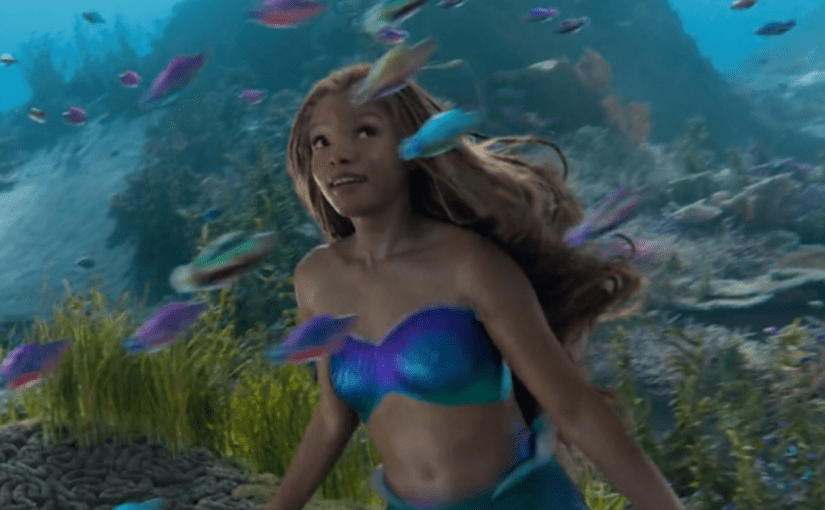
Still, it’s not all bad in this new The Little Mermaid.  Most of the cast is quite good.  Newcomer Halle Bailey (sure to be memorable in the upcoming musical version of The Color Purple) is sensational and she’s wonderful to look at as either the mermaid or the human version lacking a voice.  She has a wonderful singing voice and she’s a terrific actor against a CGI world of complicated water shots and imaginary creatures serving as her companions.  Melissa McCarthy is unrecognizable as Ursula, the sinister squid sea witch.  Her voice has a gruff intimidating edge to it and her torso and head donned in purple texture flow nicely with the CGI tentacles.  Javier Bardem is not doing his best work here because the script doesn’t demand it of him, but he fits in nicely as Triton, king of the undersea and father to Ariel.

Jacob Trembley lends a preteen personality to Flounder whose role is significantly diminished in this update.  That’s a mistake.  Instead, we get more of Scuttle who doesn’t look like a pelican any longer but is a bird who can somehow hold his breath under water for long periods of time to carry on panicked conversations with her pals.  Awkwafina voices Scuttle, and though I heard some laughter from the audience in response to her performance, it just didn’t win me over.  I found this Scuttle to be a nuisance that took me out of the film with each appearance.  The hip hop rap number (written by Lin Manuel Miranda) she performs was a very underwhelming substitute for comedy.  What was sacrificed was the hilariously silly, slapstick number from the original, where the French chef enthusiastically sang “Les Poisson,” as he torments poor Sebastian in a kitchen full of knives, boiling water and searing hot stoves.

Sebastian, the well-known sidekick, is just okay.  Daveed Diggs is a talented vocal performer, but I don’t think the final product served him well.  Often, I looked at this little guy and was not impressed, as remembrances of disappointment came back to me when I saw Jar Jar Binks for the first time.  Just like that Star Wars character, the googly eyes are detached from the head and Sebastian only evokes expression in that one area.  Nothing is done with the tiny mouth or cheekbones or ears.  Not even his claws or tiny legs offer much to do.  This crab lacked life.  As my colleague Miguel simply put it, the crab was not funny.  He just wasn’t funny in the slightest. 

A nice surprise comes from Jonah Hauer-King as the dashing Prince Eric, rescued from a shipwreck by a mysterious woman with a hypnotically, sensuous voice.  Eric’s role is thankfully expanded with the inclusion of his mother the island Queen (Noma Dumezweni).  Grimsby, the Prince’s aid, is also a welcome appearance (Art Malik) with more to do this time around.

I know for sure that I preferred the second half of the film over the first where new surprises are offered.  Rob Marshall’s film switches the influence of the story to a calypso/Caribbean vibe which is different from the slightly implied Greek environment of the 1989 piece.  This change allows a variety of different people of color and cultures to blend nicely together with believability.  After Ariel transforms into a human and Eric guides her across the island for a day of fun and escape, the story and settings come alive in color and calypso harmony.  In this area of the picture, much of the script is concentrated on Eric and his debates with his mother and her disapproval of the undersea colonies.  Confidant conversations also arise between Eric and Grimsby that I liked.  There’s more innocent flirtations between him and Ariel.  Hauer-King has good scenes with all of his co-stars from Halle Bailey to Noma Dumezweni and Art Malik.  The first half of the film is where much of the underwater life takes place, and it only convinced me so far, really taking me out of the film with the reinvention of the movie’s most famous songs.

Ultimately, like the live action interpretations of Aladdin and Beauty And The Beast this new version of The Little Mermaid is not a must watch and as much as I’m impressed with Melissa McCarthy, Halle Bailey and Jonah Hauer-King, I can’t recommend seeing it at $15 a ticket.  Why should you when the easily accessible and wholly original film is available?  This is just an unnecessary venture.

I’ve grown up as a Disney fan, but once again the Mouse House is demonstrating a lack of will to broaden its imagination.  They’d rather run in with another cash grab at the box office by issuing a substandard product repeat. 

CHICAGO

By Marc S. Sanders

When you are a sexy, sultry lady killer, infamy can just about save you from a hanging.  That’s what Rob Marshall’s Oscar winning adaptation of Bob Fosse’s Broadway jazz musical capitalizes on in Chicago. The movie is hot, steamy, dazzling and blazing with magnetic song and dance numbers that are easy to follow while getting your pulse racing.  The design, direction, music, and choreography are magnificent.  The cast is outstanding too.

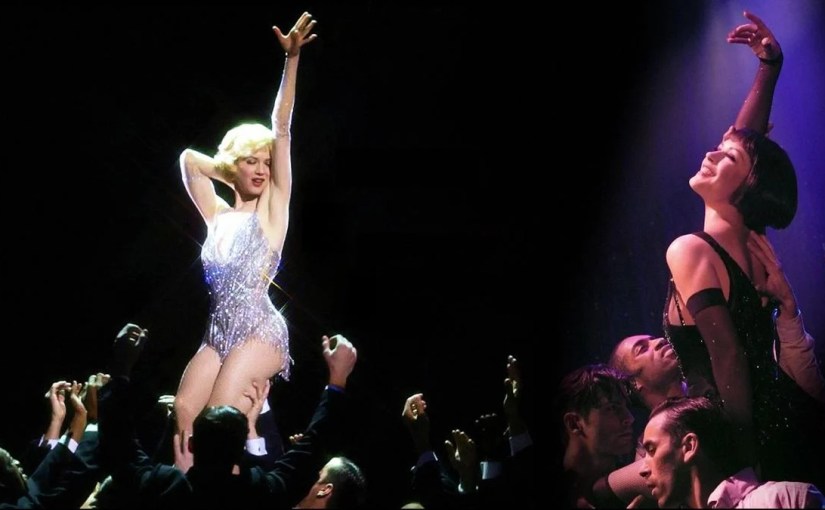
During the glitzy 1920’s in the Windy City, Roxy Hart (Renée Zellweger) is a wanna be night club performer who gets arrested for the murder of her extra marital lover (Dominic West).  She’s thrown in the pokey where the well known warden Matron Mama Morton (Queen Latifah) oversees all of the other murderesses, and often profits off of their sensationalistic crimes.  Roxy’s loser schlub of a husband, Amos (John C Reilly), manages to hire the hottest defense attorney in town, the handsomely slick and underhanded Billy Flynn (Richard Gere), to represent Roxy at trial.  Billy has never lost a case because his specialty is to manufacture drama for his accused clients, generating sympathy in the papers and among the jury.  In the film, there is a scene where Billy is literally pulling the strings on his puppets, particularly a marionette appearance of Roxy on his lap while he does the obvious ventriloquism.  A memorable moment for both Gere and Zellweger.  On the side is Velma Kelly (Catherine Zeta-Jones), a double murderer of her husband and performing partner/sister.  Velma owned the public outcry until Roxy’s name was splashed along the headlines.  Now, the spotlight is quickly moving away from Velma.

Rob Marshall choreographed and directed Chicago.  He demonstrates the fun that can be had with murder.  Call it a new kind of excitement that normally we take jubilant delight with episodes of Murder She Wrote or Agatha Christie tales. 

The theme of this picture is how the story is narrated in a colorful reality.  On a parallel level it is performed on a stage nightclub with a bandleader (Taye Diggs) introducing the players who then breakout into their own testimonial song amid large choruses and dancers to enhance the attraction of headlines and sleazy, operatic narratives.  Christine Baranski is the reporter whose front and center, trying to collect the next big chapter development of whoever leads the hottest storyline at any given moment. 

Marshall will turn a courtroom proceeding led by Billy Flynn into a three-ring circus, while at the same time he’ll cut away to the nightclub.  Billy will be on stage, but he’s now wearing a glittery three-piece suit and doing a ragtime song and dance with a chorus of scantily clad, Burlesque women to apply a little Razzle Dazzle for the judge and jury.  Richard Gere is not who you think of for stage musicals, but he is positively charming.

Queen Latifah has a scene stealing moment to show off her entrance into the picture.  Mama Morton is in a skintight evening dress, complete with a swanky boa while performing When You’re Good To Mama on stage at the nightclub. Frequent cut aways have her dictating her powerhouse tune to the inmates.  John C Reilly performs Mr. Cellophane. He lays out certainty that there’s nothing inauthentic about the pushover loser husband he really is.  Both actors got well deserved Oscar nominations.

Catherine Zeta-Jones and Renée Zellweger are a perfect pair of competitors.  They each have their individual moments and they act with such solid gusto; tough broads not to messed with.  The confidence they exude on screen with character acting, singing, and dancing is second to none.  The script will offer moments when Roxy and Velma think they are high and mighty, and winning the court of public opinion.  Then it will be undone when their hotshot attorney, Billy Flynn, knocks some sarcastic sense into them and a dose of reality sets in.  Roxy isn’t so fond of wearing a conservative black dress with a white collar in court until she sees a fellow cellmate lose her last motion of appeal, and there’s nothing left but to be punished by hanging.  She might be putting on a helluva performance, and signing autographs while souvenir dolls of her likeness are selling on the streets, but none of that ain’t gonna mean a thing if the jury finds her guilty of murder.

Just like I began this article, infamy is the word that kept coming back to me while watching Chicago.  Infamy bears celebrity.  Granted, it’s enhanced for a lively musical motion picture and stage show.  However, there’s a very, sad, and no longer surprising truth to that ideal.  A few years back, I recall news reports about a criminal’s sexy mug shot where he had donned a tattooed tear drop below his eye.  This guy was prime for runway modeling.  However, he was proven to be a violent car thief. He actually got signed by a talent scout following his bail out.  (I think the agent posted the bond.)  Later, he got arrested for some other crime. 

I never saw the reality program Chrisley Knows Best, about a God loving family who proudly live among the finest that money can buy.  Recently, the ultra-vain mother and father were sentenced to over a decade in federal prison for fraud and tax evasion.  Yet, their brand is stronger than ever, as the gossip columns can’t get enough, and their adult daughter’s podcast has millions of listeners.  Word is that a new program is being designed as a follow up to their prison sentences. 

Infamy bears reward.

Chicago pokes fun at the obsessions adhered by the media, the public, the courts and within the penal community.  The well known musical is now decades old, but the topics contained within clearly identify how news is not reported in a simple, objective Walter Cronkite kind of way, anymore.  Everything is heightened.  Everything is dramatized.  It’s not enough that Roxy kills her lover.  That will get her only so much mileage, until the next lady killer comes along (in the form of Lucy Liu, for example).  Roxy must stay relevant.  Announcing she’s pregnant will keep her on the front page (It could help that she faints while doing it). Velma knows all too well that the public favoritism she once had, accompanied with Billy’s sleazy promotion, is even further away. 

Rob Marshall presents a film where any song can be pulled out of context just for its sizzling entertainment.  Try not to forget the Cell Block Tango with solos from Zeta-Jones, as well as her fellow inmate chorus girls, each proudly describing how their guy “Had it coming!!!”.  All That Jazz is arguably one of the best opening numbers to a show, and Catherine Zeta-Jones owns the performance.  Individually, these songs and the performers win my attention in the car or the shower or during a workout.  Assemble them together with the overall storyline, and Chicago becomes a fast paced, kinetic roller coaster that makes you think while you smirk at all the scruples and vices being dismissed. 

The last time I saw Chicago was in theaters in 2002.  I had also seen a stage production of it before then.  I loved it both times.  Rewatching it recently gave me such a jolt of energy.  It is why theatre is a vital source of escapism. Here is an example where you can feel positively entertained while reflecting on a sad truth.  It might be sad, but you’re smiling all the way through while you mouth the brilliant lyrics and tap your feet.

Roxy Hart, Velma Kelly, Billy Flynn and the rest of the cast of characters make Chicago red hot and gleefully sinful.

SINGIN’ IN THE RAIN

By Marc S. Sanders

Reader, I’ve been having a hard week.  My beloved puppy dog, Falcon, has not been feeling well and my family and I are so worried for him.  It’s just been a long week having to deal with reality.  Nevertheless, when I watch a classic musical like Singin’ In The Rain, it’s impossible not to smile and catch on to the energy that drives the film from the talents of Gene Kelly, Debbie Reynolds and Donald O’Connor.  This trio are not just sensational dancers and singers.  They’re adoring comedians that set a standard for facial expressions and endless entertainment variety. 

A simple, but informative story sets the spine of the picture.  Talking films like Al Jolson’s The Jazz Singer are catching on in Hollywood movie houses and the silent pictures are quickly becoming archaic.  Established talents like Don Lockwood (Kelly) and Lina Lamont (a scene stealing Jean Hagen) are being threatened with becoming extinct unless they can adapt to the use of their voices in the romantic cinematic roles they are known for.  Don will adjust.  Lina is another story.  Her alluring blond bombshell looks are recognized everywhere.  However, none of that will line up with her natural, squeaky, ear piercing vocals.  She’s a hopeless case for the best vocal coaches that money can buy.  Don and Lina are star attractions with contracts to guarantee them work, but Lina’s voice could put the movie studio out of business. 

Fortunately, Don just happens to land smack dab into the passenger seat of Kathy Selden’s (Reynolds) car.  Kathy has the voice, and soon Don and his trusty songwriting companion and pal, Cosmo Brown (O’Connor), will realize the acting talent to boot.  In the meantime, though, Kathy’s voice will dub in for Lina’s on screen.  There are great gags at Lina’s expense as she tries to work with a microphone for the first time.  This is Lucille Ball material of the finest, comedic polish.

In between all these story developments reside some of the greatest musical song and dance numbers to ever grace a screen.  Few, if any, films have matched the rubber faced hyperactive quick steps of Donald O’Connor during his rendition of “Make ‘em Laugh!” What he does with this cutaway scene looks like a superpower of marvelous agility.  Jim Carrey could never stand next to Donald O’Connor.

Gene Kelly’s accompaniment with O’Connor and their silly, tongue twisting “Moses Supposes” is magnificent to watch.  You could be on your death bed, looking at this scene, and I truly believe you’ll think nothing is so bad in life while you watch this moment.  The pair are masters with their physicality of jumping on and off desks and chairs, while they toss around a stuffy, glass eyed linguist caught in the middle of their shenanigans.  Every prop and set piece are given functionality, be it a lamp shade, office supplies or stacks of paper.  Then there are the lyrics.  How do you so fluently utter words like “Moses” and “supposes” and every other imaginable piece of vocabulary that phonetically sound like them to seem like it is as natural as saying grace? And they do it all while bouncing all over the place with two stepping in perfect sync.  It’s like nothing I’ve ever seen before.  These guys are functioning on one motor.

To add further compliment, I must emphasize that the camera pointed at these magnificent players hardly ever cuts away.  There are long sequences where the guys are literally walking up walls and back flipping over.  It’s all done in one shot.  There’s only frequent edits away for a close up or another angle.  Otherwise, Gene Kelly and Donald O’Connor are defying the impossible to show breathless choreography.  They seem to defy physics, and the props they use cooperate with every step, leap, run or jump taken.

The same goes for when Debbie Reynolds makes it a trio during another unforgettable number called “Good Morning.”  The furniture pieces are choregraphed to work with the three dancers.  All three race towards a sofa, step on to the seat cushions in unison and then walk onto the back of the sofa, allowing it to flawlessly tip over so they can continue their stride.  Just writing about this, I think about how amazing and wondrous this scene is.  Lightning in a bottle!

All of the material contained within Singin’ In The Rain is incredibly cheerful, full of color and humor and tremendously likable characters.  Yet, it does not ever teeter on being hokey or cheesy.  The musical doesn’t feel dated.  This film transcends generations like The Wizard Of Oz or Star Wars.  No matter the age, anyone should be able to like this movie. 

I love the irony of the number “Singin’ In The Rain” that lends to the title of the picture.  Just think about the word “rain.”  Often it is associated with gloominess and sorrow and mood.  However, the tempo of Singin’ In The Rain as a full length film invites happiness and glee no matter the situation.  Gene Kelly’s clownish activity with an umbrella, a large smile and a rain soaked street corner becomes one of the most delightful moments ever to grace a screen. He stomps, skips and splashes in the large puddles while taking a leap on to a streetlamp just to express all of Don Lockwood’s glorious bliss and adoration for his new love Kathy Selden.  A hat becomes its own character as gushing rain drains out of a storm pipe soaking Don’s head.  The brim of the hat seems to develop its own form of jubilation.

I’ve read that Gene Kelly was a viciously strict co-director (with Stanley Donen) and choreographer on this film.  Debbie Reynolds has testified to long sessions of endless starts and stops.  It was tortuous at times.  If just a toe or a hand was out of place in any of the choreography, Kelly would not stand for it.  It had to be perfect.  I can’t imagine Kelly in a demanding or authoritative capacity.  He is just so cheerful and lovable on screen and so is the entire company of performers.  I guess the contrast with his character lends to how impressed I am with the final product.  However, to make a picture like Singin’ In The Rain this exact and eye popping requires astute examination.  The assembled rhythm of the three dancers and the chorus behind them at least matches some of the most refined military assembly marches I’ve ever seen. 

Watch Singin’ In The Rain for a glimpse into the evolution of Hollywood and cinema.  Watch it for a simple, yet funny story.  Watch it for the characters and set pieces.  Most of all, watch Singin’ In The Rain to discover how grand and wonderful life can be.  It’s likely that none of my readers can do what Kelly, Reynolds or O’Connor accomplish in this film, but I can guarantee that you’ll feel just as joyous as they do while they are putting the show on for you.

Singin’ In The Rain is why movies are so important for our emotional lexicon of escapism.  It lends to good health to watch Singin’ In The Rain.  It’s a film we all need.

Singin’ In The Rain is a reason to live.

CAMP (2003)

by Miguel E. Rodriguez

Director: Todd Graff
Cast: Daniel Letterle, Joanna Chilcoat, Robin De Jesus, and introducing Anna Kendrick
My Rating: 8/10
Rotten Tomatometer: 64% Fresh
Everyone’s a Critic Category: “Watch an Early Film of a Famous Actor or Actress”

PLOT: Teen drama enthusiasts attend a summer drama camp and perform in several productions while dealing with an alcoholic musical director and their own messy lives.


Todd Graff’s film Camp plays like Meatballs [1979] crossed with Waiting for Guffman [1996].

A bunch of theatre-geek teens attend Camp Ovation, a summer drama camp where the campers rehearse and perform a different show every two weeks.  And I’m not talking Aladdin Jr. or Annie.  Among this camp’s productions are Follies, Promises Promises, and a color-blind presentation of Dreamgirls.  (It’s exactly as weird as it sounds.)

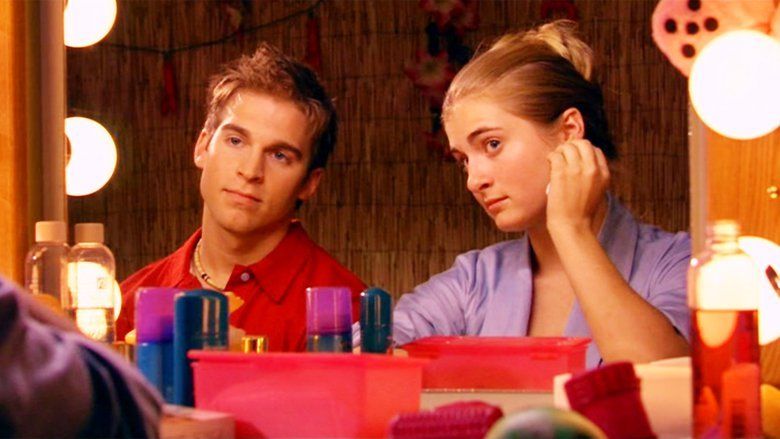
A brief prologue introduces the main characters, including Michael (Robin de Jesus), a gay boy who gets beaten up by classmates when he attends his junior prom in full drag.  Ellen (Joanna Chilcoat) is a plain-but-pretty girl with a self-image problem exacerbated by the fact she has to beg her brother to be her date to her own prom.  The appropriately-named Vlad (Daniel Letterle) is a handsome young man who doesn’t seem to have any overt personal problems.  At his camp audition, when he accompanies himself on guitar while crooning “Wild Horses”, one of the camp counselors is beside herself: “An honest-to-God STRAIGHT boy!”

There’s also the introduction of a mousy young lady named Fritzi, played by a 16-year-old Anna Kendrick in her film debut.  We all know how attractive she is in real life, but when we first meet her, she is in complete “Princess Diaries” mode: long straggly hair, flannel skirt, and acting as personal flunky for Jill, the blond camp floozy who doesn’t let anyone forget how pretty and talented she is.

Vlad is the eye of the storm at Camp Ovation.  Ellen is attracted to him, Jill wants to make out with him, Michael is burning to know if he’s gay or straight, and he’s not afraid to speak his mind.  He’s also an emotional demon-child, an incurable flirt in both directions, so everyone is off-center around him.  That’s the “A” story.

One of the flaws of Camp is that there are one too many “B” stories.  Maybe two too many.  There’s Bert Hanley, who composed a musical decades ago that is still performed today, but who has not written anything since.  He’s coming in to assist with the camp’s productions, but things look grim when he shows up two days late, drunk, and with a suitcase full of booze bottles.

There’s Michael’s ongoing issues with getting his unsupportive parents to attend one of the camp’s performances.  One of the movie’s high points occurs when Michael is performing in Romeo and Juliet, sees the empty chairs in the audience where his parents are supposed to be, and launches into his own interpretation of Shakespeare’s tale.  Bernstein and Sondheim would have approved.

There’s a hilarious subplot that is never fully explored where the camp introduces a sports counselor.  At a drama camp.  This bit is granted two brief scenes, then never heard from again.  Alas.

There’s Jenna, a young girl whose parents wanted her to attend “fat camp” instead of drama camp, so they compromised: Jenna will attend Camp Ovation with her jaws wired shut.  I will leave it up to you to discover how she performs onstage through clenched teeth.  (This subplot does get a very satisfying resolution by movie’s end, it must be said.)

Most of these subplots are good enough to support an entire movie by themselves.  In Camp, however, you get a little whiplash going from comedy to drama to teen angst to revenge back to comedy to performance and so on and so on.  While watching it again, I noticed more than ever how many times the editing seemed to be working around chunks of dialogue that probably had to be cut for time.  Somewhere out there is Todd Graff’s 3-hour director’s cut of this movie, in which every story is given enough time to breathe, expand, and evolve.

So…why do I give this movie an 8/10 rating with so much not going for it?  Purely personal reasons.

Camp is a movie about theatre geeks, made by theatre geeks, for theatre geeks.  The film’s director, Todd Graff – who coincidentally played “Hippy” in The Abyss [1989] – was a drama camp counselor himself, and the film is loosely based on his experiences.  There is virtually zero crossover appeal for this film.  Near the beginning of the film, Fritzi is trying to jog Jill’s memory where they’ve met before: “We were in Night Mother last summer, remember?”  That joke only lands if you know how many people are in the cast of Night Mother, and what the plot is, and how ludicrous it is to imagine that show being performed at a summer camp.

For all his shortcomings, Vlad has a scene that speaks directly to me.  He confesses to Michael that he has OCD.  Without medication, he counts the letters in the words in people’s sentences.  (I count syllables.)  He talks about how his affliction is “always there.”  But when he’s performing onstage…it’s not.  Not only does that speak to me directly regarding OCD, it’s also a metaphor for anyone who has felt like an outsider for some reason or another.  Offstage, you might have self-image problems or obsessive behavior or shyness.  Onstage, those things magically fall away.  I don’t use that term lightly: “magically.”  I don’t know how else to describe what happens in that boundary between offstage and onstage.  Anyway, that’s cool to me, personally.

The movie has a suitable climax, but for me, the real centerpiece of the movie comes when a group of the kids and some of the adult band members meet in secret to rehearse and perform a song that Bert Hanley (remember him from earlier?) wrote but never published.  As they perform, the cynical Hanley overhears it and struggles with himself whether to let them play or to walk in and stop the performance.  It’s a cliched moment, to be sure, but the song itself is rousing and borderline inspirational, and when the scene’s payoff occurs, it’s almost cheer-worthy.

And let’s not forget what happens between Fritzi and Jill.  After some harsh words are said, Fritzi exacts her revenge and performs a show-stopping number from a Sondheim musical.  It’s here where Anna Kendrick’s screen and stage presence are both on full display.  For years afterward, Penni and I would see her in other movies and recognize her based solely on her performance in this movie, and particularly this scene.  (Of course, we couldn’t remember her name for a while…she was always “that girl from Camp.”  It wasn’t until after she appeared in Scott Pilgrim vs. the World [2010] that her name finally stuck.)

And, of course, there’s that cameo from a surprise audience member at the camp’s final production.  (Hint: their car’s license plate reads 4UM.)

Camp may not have the name-recognition of so many other teen comedies, but this one speaks to me directly.  I’m not any one of those kids at this camp, but there’s a part of me in all of them.  I loved the musical numbers.  I enjoyed the theatrical in-jokes.  (“There’s this new thing called ‘drums,’ you’ll love it.”)  And maybe there’s also a part of me that wishes I had attended one of these camps in the summer instead of Bible camp two years in a row.  Just sayin’.

THE LITTLE MERMAID (1989)

By Marc S. Sanders

What I hearken back to most when I watch The Little Mermaid is my junior year of high school in 1989.  If you were around at that time, then maybe you realized how much of an impact the characters of Ariel, Sebastian, Flounder, Scuttle and Ursula The Sea Witch had on kids, but teen pop culture as well.  Batman was big that year.  Disney’s underwater, romantic, musical adventure was at least as large.  Driving home from school, everyone I knew were singing along to celebrated numbers like Kiss The Girl, Les Poisson, Under The Sea and Part Of Your World.  My drama class couldn’t get enough of Poor Unfortunate Souls.  Oh, how overdramatic we would get in Mr. Locklair’s class while emulating Pat Carroll.  I still harmonize Ariel surrendering her voice.  Yes!  I can hold the tune!!!!  There is no denying The Little Mermaid cast a spell over the student body at Berkeley Preparatory School in Tampa, Florida.

The Little Mermaid is an important entry in the Disney lexicon.  Disney films were considered substandard, tired and stale before this release.  However, the adored fable based upon a story from Hans Christian Anderson awakened something that still carries on.  The music within the film from beloved writers Alan Menken and Howard Ashman were delivered like Broadway showstoppers.  The quality of the songs was elevated with gorgeous calypso and reggae harmonies, and vocal characterizations as colorful as the underwater life depicted on screen.

Ariel (Jodi Benson) is the title character who dreams of what life is like above the surface.  Her father, King Triton, strictly forbids her from going above the water.  In his eyes, humans are ghastly.  That’s a problem because his daughter is enamored with handsome Prince Eric (Christopher Daniel Barnes).  Like a sixteen-year-old who sneaks out of the house through a bedroom window, Ariel visits the nefarious and alluring sea witch, Ursula (a rapturous Pat Carroll in one of the best fantasy villain roles to ever appear in the movies).  The deal is Ursula will turn Ariel into a human for three days.  In exchange the little mermaid must surrender her gorgeous singing voice.  If Eric does not give Ariel a kiss of true love by the time the sun sets on the third day, then her soul belongs to Ursula for all eternity. Ariel gets some help from Sebastian the crab (also a sea-life orchestral conductor), innocent Flounder, and a zany seagull named Scuttle (Buddy Hackett).

The animators at Disney use everything at their disposal to burst wondrous color within the film.  There’s life brought to the sea life within the backgrounds from a blowfish who BLOWS, to the Octopus and the shrimp and swordfish.  Even the random bubbles that float around are marvelous to look at. Nothing is off limits and life under the sea seems so much more enticing compared to the ho hum activities that we humans endure each day with traffic jams and junk mail.

Other Disney productions like Alaadin and Beauty And The Beast that followed, offer some life lessons for the protagonists to consider.  The Little Mermaid doesn’t actually.  It rests upon wishes and dreams for Ariel.  I’m thankful for that.  It’s such a glorious picture that I coast through on the fantasy of it all.  Ariel takes me on adventures to explore shipwrecks and her grotto where her human collectibles are stashed.  I get to carefully approach the dark imagery of Ursula’s caverns where countless, slimy, pitiful souls suffer, while the tentacled monster delights in her vanity with Pat Carroll’s gleeful voiceover.  It’s just enough for me.  Disney doesn’t always have to preach, and I think it’s why The Little Mermaid is my favorite of all of their films. 

Every moment is beautifully drawn in shape and color.  Still for a film that came six years before the Pixar evolution, the expressions of the characters come off so naturally.  Look at Sebastian’s fear and frustration as he tries to keep up with an independent Ariel.  Pay attention to Ariel’s nervous reaction when she encounters Eric on the beach after she’s become human.  She’s animated to try and straighten her hair and grin her teeth because its as if the popular kid in school is walking across a disco lit gymnasium to ask her for a dance.  The animation is purely inspired by natural, human behavior that we are all too familiar with.  When drawn like this, we can’t help but be impressed.

The songs are the highlights though.  The compositions are so lively and easy to pick up and sing along to, like we all did in high school.  The lyrics are equally impressive like the most brilliant of dialogue.  When Ursula makes her campaign for why this trade would be advantageous for Ariel (Poor Unfortunate Souls), I can’t help but believe her.  She’ll have her looks and pretty face.  It’s only her voice!  You got a point there Ursula.  The best villains always have the most sound reasonings behind their motivations.

Sebastian (Samuel E Wright) makes a strong argument for why life Under The Sea is so much better than living on land.  His enthusiasm in song is completely convincing.  Life under the sea is nothing but a party.  Let’s go.

Jodi Benson gives a strong voiceover performance as Ariel.  I’m hearing a firm and independent young woman who stands her ground and will defy any orders to go after what she desires.  Her rendition of Part Of Your World is one of Disney’s most treasured and celebrated moments in film history when accompanied with the setting of Ariel’s towering grotto of props that we humans take for granted like fish hooks and dining utensils, especially a dinglehopper…you know…a fork!  This is what a kid dreams of becoming when alone in her room with no one there to judge her true feelings and desires.  It’s truly glorious.

The one scene that does give me pause is the dramatic discovery King Triton has of Ariel’s secret vault of collectibles.  By the end of the moment, his temper has grown so big, that he unleashes the power of his trident to destroy everything she’s treasured.  I’ve always said this looks brutally familiar to how a father might take a baseball bat to a kid and her room, teetering on domestic violence.  The scene is memorable but unnerving all the same.  Still, I have to remind myself that this is a fantasy, and this is only a movie. 

Nonetheless, The Little Mermaid is a timeless film filled with magic and whimsy and daring escapes and big laughs that are not just relegated for eight-year-olds.  As adults, we remember those butterfly feelings of our first crush and what held us back from pursuing it further.  We can relate to what the characters do for, and towards each other.  Again, everyone from the deliciously wicked villain down to the defiantly brave protagonist and her sidekicks have a point and very human understandings for why they exist and what they want out of life.  Being a mermaid or a crab or a sea monster doesn’t make any of these people any less human. 

THE WIZARD OF OZ

By Marc S. Sanders

The Wizard Of Oz will always be one of the greatest films ever made.

It’s a visually spectacular marvel of filmmaking and creativity. The accomplishments it achieves in performance, fantasy and musical tones work on any generation who has seen it since its debut on August 15, 1939.

Victor Fleming directed the adaptation from L Frank Baum’s successful series of books. Wisely, the picture opens in black and white where we meet Dorothy, one of the best cast roles in film history with the legendary Judy Garland. She lives on her Kansas farm with her dog Toto and her Auntie Em and Uncle Henry, along with some friendly farmhands called Huck, Hickory & Zeke. Following an unexpected twister, Dorothy and Toto are sent into the heavens while in their farmhouse. When the house finally lands, Fleming has Dorothy open the door to a kaleidoscope of wondrous color. Dorothy has arrived in Munchkin land located in the Land of Oz. The adventure begins.

Nearly any film of fantasy and adventure can be traced back to The Wizard Of Oz. It features the thoughtful mentor with Glinda The Good Witch, and the lovable sidekicks that Dorothy encounters known as the Scarecrow (Ray Bolger), the Tin Man (Jack Haley) and the Lion (Bert Lahr). It also has one of the greatest on screen villains of all time, The Wicked Witch of the West (Margaret Hamilton). The story pursues objects (ruby slippers, a brain, a heart, courage and a broomstick) for the heroes to acquire, years later to be identified by Alfred Hitchcock as “MacGuffins.”

Victor Fleming with Baum’s ingenuity inspired great storytellers of a future in movies yet to come. Authors like JK Rowling and JRR Tolkien or CS Lewis absorbed the will to compose never before conceived imagination thanks to The Wizard Of Oz. So many moments throughout the land far away from Kansas are so inventive. There’s endless the candy colored scenery of Munchkin land, along with a dark forest where trees come alive to argue and throw apples at you. The Witch’s foreboding castle with the crystal ball is ominous and frightening. The Emerald City where the great and powerful Oz resides is spectacular in life and cheerfulness. I still look in awe at the scenic design of the film questioning how it was all done. Matte paintings of endless depth for background give off the vastness of the land as the famous Yellow Brick Road stretches infinitely over rolling hills behind Dorothy and her friends as their journey continues.

The Wizard Of Oz is also an inspiration for the movie musical. Every song is unforgettable. Is there a greater song in film history than “Somewhere Over The Rainbow?” Dance sequences are totally engaging. Try not to love the ease of watching Dorothy skip along the road to “We’re Off To See The Wizard.” Ray Bolger’s rubber legged straw man clumsiness during his first scene with “If I Only Had A Brain,” seems to defy the limits of what a human body can do. Bert Lahr’s “If I Were King Of The Forest” is comedically inspired; the number that pauses the story for a moment as an escape among the characters’ adventure. As a kid I loved to roll my tongue on the word “forrrrrrrrrest.”

Margaret Hamilton’s green skinned wicked witch dressed in black with the pointed hat set a standard in villainy. It instilled some of the first fears many children ever experience to this day. Hamilton’s evil cackle with her determination to obtain Dorothy’s ruby slippers never leaves your mind once you see the performance. The Witch inspired any kind of horror film, and terrible villains we love to hate like Darth Vader, Maleficent, Hannibal Lector or Lord Voldemort. Evil queens and bad guys from the Disney vault only began from the seeds that Hamilton laid out.

So many of the greatest achievements in film history are contained in The Wizard Of Oz. It’s an outstanding musical, an incredible adventure and a brilliant fantasy. It’s beautifully cast and so creative on every technical level necessary for its flights of fancy.

More than any other film ever made, every person should see The Wizard Of Oz at least once in their lifetime.