WICKED FOR GOOD

By Marc S. Sanders

Wicked For Good is a crowning achievement in fantasy and musical wonder.  It soars across a wide expanse of never-ending settings within the wonderful world of Oz and delivers a series of messages to walk away with.  Try not to think about Wicked the next time you turn on CNN or FOX News.

Jon M Chu directs again after Wicked Part One.  Both films were actually shot as one large project but then divided.  I was suspect when I heard this was how the Broadway musical was going to be done for film.  Was there that much material, interesting enough for two full-length movies?  With a pair of new numbers drafted by original composition writer Stephen Schwartz, the answer is a profound yes.  This may be Act II of the musical but it does operate as a sequel. The new film leaps in time from when our host of characters were young students at Shiz Academy.  All are adults now with respective responsibilities and therefore they’ve grown and changed.  Sadly, but wisely, the film moves in directions that are parallel to many current events happening today. 

The wise animals of Oz are being oppressed.  The first film hinted that animals should be seen not heard.  The second part of the story executes that mantra all too realistically as they lose their power of speech and are destined not to be free but rather caged like in internment camps.  Those that have not been taken are performing mass exodus under the newly constructed yellow brick road. 

Untrue propaganda sweeps through Oz as Madame Morrible (Michelle Yeoh) uses the false influence of The Wizard (Jeff Goldblum) to unite the kingdom into believing the empathetic green skinned Elphaba (Cynthia Erivo) is the Wicked Witch of The West, on mission of terror.  Citizens of Munchkinland and the Emerald City believe the lies and live in fear of her presence.  Glinda (Ariana Grande), decked in beautiful pinks with a sparkly wand and a convenient flying bubble craft, serves as a poster girl for hope with the illusion of having enchanting powers to protect.  Elphaba’s sister Nessarose (Marissa Bode) succeeds as the governor of Oz following the death of the girls’ father.  Nessarose has grown coldhearted, particularly to her one true love Bok (Ethan Slater), who by decree must remain held captive under her authority.  He’s literally forbidden to immigrate by train. These are not the students of Shiz that we grew up with. 

I hate to use Wicked For Good as a metaphor for political purposes, but that’s exactly where my mind went to, and I’m grateful for it.  I believe there is much wrong occurring each day in the United States and throughout the world. I’m at least thankful that artistry like cinema and stage prevents us from burying our heads in the sand.  Conveniently, there’s a triggering and emotionally engaging storyline to hold on to.

Wicked was spawned off of L Frank Baum’s classic fairy tales. Part of the fun is seeing how these new stories are threaded towards his classic story of a girl from Kansas who arrives in Oz and befriends three unusual charmers while on her journey to meet The Wizard.  I’d argue that more people are familiar with the classic Warner Brothers film from 1939 than Baum’s series of books, and this Universal picture seems to adhere to the original production especially.  Elpheba delivers a new song called “There’s No Place Like Home” that’s woven beautifully into the picture.  Glinda sings about “The Girl In The Bubble” to emulate her personal conflict with how she is meant to serve.  Classic lines like “I’m off to see The Wizard” are provided.  Hints at a lion (voiced by Coleman Domingo) being fearful, along with a character’s heart becoming too small are referenced with weighty importance.  Another character is asked if he’s lost his mind.  It’s satisfying how original the Wicked properties are while being comfortably familiar.

The cast is sensational.  Cynthia Erivo is a wonderful performer who hides in her role with an American accent and her Broadway voice to belt.  She performs so convincingly that it becomes easy to look past the green skin and watch the woman who is challenged.  Michelle Yeoh and Jeff Goldblum have those unusual appearances and distinct personalities that serve a fantasy world like Oz.  Marissa Bode demonstrates tremendous strength as the disabled character who probably traverses through the biggest change of the whole cast.  Ariana Grande is a terrific actor and a lovely singer.  As I noted about the prior film, her Glinda is not my favorite, though.  The three others I saw on stage performed with a bubblier delivery and did not rely so much on Grande’s hair flip.  Jonathan Bailey is a dashing and charming hero, carved out for the prince of fantasy.  Ethan Slater’s Bok suffers through unwinnable oppression, and thus his character is more tragic this time.  It’s crushing to see, but his performance is completely relatable.

I watched the first film as a refresher ahead of seeing For Good and it occurs to me how triumphant these films are.  This whole story could have been contained in a ninety-minute Disney blueprint.  Yet, Jon M Chu, along with Stephen Schwartz want to entertain the audience through the narrative. So, it will stop where we are reading the movie, allowing us ample time to witness the world around us and what these characters of fantasy endure.  It’s odd sometimes to see the street toughs of West Side Story break into song as they are trying to knife one another in the streets.  In Wicked, it is never strange to see a witch or a munchkin or a prince break out into harmony to express their happiness, anger, sadness or wickedness.  The music and vocalizing build the vivid textures of the sets into grander designs. 

I can be told what happens next in the further adventures of Elphaba and Glinda and just move to the next chapter until they live happily ever after.  It’s better if the characters take their time to share as many thoughts and emotions as they can through song, dance, visual effects and action.  That’s what sets musicals apart from other fares of drama and comedy.

The Wicked films, and more importantly the musical, will remain timeless as much as Star Wars, Star Trek and Harry Potter.  They will never be dated.  They will only capture the hearts, laughs, tears and harmony of further generations to come decked in their favorite shades of green and pink.

42nd STREET (1933)

by Miguel E. Rodriguez

DIRECTOR: Lloyd Bacon (with choreo by Busby Berkeley)
CAST: Warner Baxter, Bebe Daniels, George Brent, Ruby Keeler, Una Merkel, Ginger Rogers, Dick Powell
MY RATING: 9/10
ROTTEN TOMATOMETER: 92% Fresh

PLOT: The unglamorous side of life on Broadway is laid bare in this unexpectedly enthralling musical from Hollywood’s golden years.


I’ll admit it: I was a victim of my own expectations.

For decades, I assumed that Lloyd Bacon and Busby Berkeley’s 42nd Street was your standard Hollywood fluff musical from an era when the genre had been beaten nearly to death, filled with wall-to-wall corny songs and even cornier story lines.  I was aware of the famous line from the film: “Sawyer, you’re going out a youngster, but you’ve got to come back a star!”  I was certain I knew everything I needed to know about the movie right there.  Unknown chorus girl gets a lucky break, becomes a star, a little song, a little dance, happy endings for everyone.

I’ve said it before and I’ll say it again: I love it when I’m wrong.  42nd Street defied all of my expectations, and even when it felt like it was caving to the genre, it did it so exuberantly that I caved into it myself.

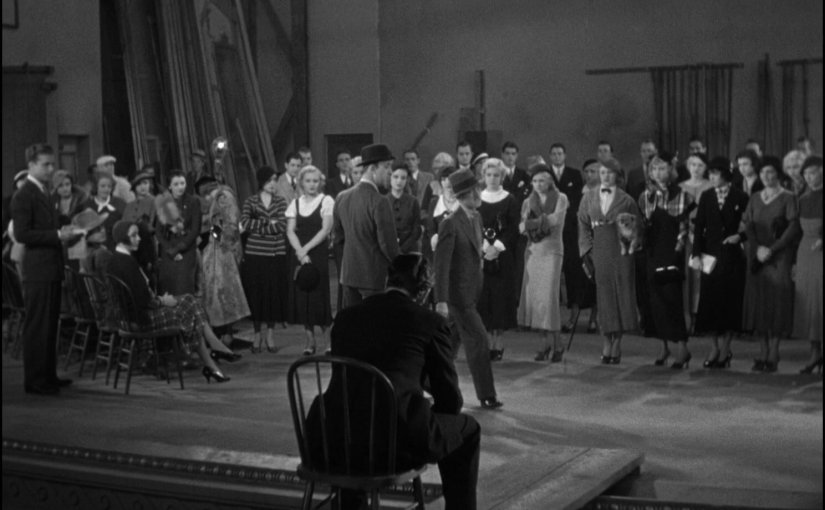
The story is ancient: A Broadway show is holding auditions at an unnamed theater on New York’s famed 42nd Street.  A rookie actress, Peggy Sawyer (Ruby Keeler), is one of scores of hopefuls at the cattle call, among them seasoned veterans Lorraine Fleming (Una Merkel) and Ann Lowell, played by Ginger Rogers the same year she was first paired with Fred Astaire in Flying Down to Rio…a legend in the making.  The show’s director, Julian Marsh (Warner Baxter), is a taskmaster who wants this show, “Pretty Lady”, to be his final masterpiece before he retires on advice from his doctors.  Then there’s Dorothy Brock (Bebe Daniels), the diva whose sugar daddy ensures she will get the plum role; Pat Denning (George Brent), Dorothy’s penniless paramour; and Billy Lawler (Dick Powell), the show’s “juvenile”, aka “mangenue”, who takes a shine to Peggy Sawyer when she interrupts him in his underwear in the dressing room.  Long story.

So, all the stock characters are here for a plot that was probably old even before the introduction of sound.  But 42nd Street subverted my assumptions by doing several things.

First, it is definitely NOT wall-to-wall with song and dance.  In fact, before we hit the final tune-filled 15 minutes, only one full number is performed.  Everything else is rehearsals, endless rehearsals with masses of dancers in their practice clothes or solo singers at the piano.  The backgrounds of the main characters are fleshed out in several scenes outside the theater, but the filmmakers were smart enough to keep those scenes to a minimum.  The real drama is on the stage, where it belongs.

(I loved those rehearsal scenes.  As an amateur actor in community theater myself, I had all sorts of flashbacks to my first shows as an ensemble member of big shows like The Music Man and Camelot, going through endless repetitions of musical numbers or just SEGMENTS of musical numbers until the director was satisfied.  I particularly loved one number being rehearsed on stage while the camera showed most of the cast and crew watching from the wings.  Pitch perfect.)

Second, the screenplay was not as cornball as the plot summary makes it sound.  I expected kitsch, but instead I got unexpected drama and grittiness, interspersed with comic relief and some outstanding zingers.  (“It must have been tough on your mother, not having any children.”)  Peggy Sawyer, the rookie, faints during rehearsal; Julian, after first making sure she’s not dead, yells at the stagehands to remove her from the stage so rehearsals can continue.  And they do.  When Julian learns of Dorothy Brock’s affair with Pat Denning, an affair which could jeopardize her participation in the show, he reaches out to an unsavory connection who agrees to rough Pat up as a warning.  Granted, this is all handled with a light touch, but this is serious business.  Putting a “hit” on someone?  Would a Broadway director ever actually do such a thing?  (Spoiler alert: probably.)

Third, by easing off the musical numbers until the last reel, 42nd Street positively had me eager for a full-blown song and dance.  And, brother, does it deliver.  The mythical Busby Berkeley pulls out all the stops for three sensational numbers that begin within the confines of a Broadway stage, and then magically “open up” into a cinematic tour de force.  I especially enjoyed the number where Ruby Keeler is clearly doing a complicated tap dance for real, but the best of the three is the film’s namesake, “42nd Street”, which is basically a travelogue of NYC, and which contains wild mood swings and some show-stopping choreography.  Watch for the moment when a young woman escapes a bad situation in her tenement apartment by running to the 3rd floor fire escape and then leaping to the street below.  I’m sure there were safety measures in place just out of camera range, like Harold Lloyd dangling from that clock, but in the moment, it genuinely looks like the cameras captured an actress leaping to her death.  Not to mention the sequence where the chorus transforms into the NYC skyline.  (In fact, I’d say the movie’s worth watching just for that final dance sequence…it’s astonishing.)

Fourth, the very end of the film took me totally by surprise.  At the risk of spoiling it, I’ll say that it takes place after I thought the movie WOULD end, and that it perfectly captures the combination of emotions that go through a stage director’s mind and soul after a show goes up and is an apparent success.  It’s another moment that felt absolutely real, with no overcooked dialogue or mugging.

It’s said that, before the release of 42nd Street, the movie musical was dead in the water.  Too many musicals had come before it, musicals that overdid the song and dance or had a half-baked story, etc.  Not only did 42nd Street singlehandedly revive the genre for decades to come, it also apparently saved Warner Bros. Studios from bankruptcy.  As someone who is not a particularly huge fan of older movie musicals, I wholeheartedly recommend this movie to anyone who is like me and has put off watching it because you think you already know everything about it you need to know.  I’m here to tell you: you probably don’t.  (And I especially recommend it to theatre aficionados who are familiar with the stage musical “42nd Street”, which pads the running time with dozens of additional songs, most of which were taken from Gold Diggers of 1933 [1933].)

SPECIAL GUEST REVIEW: THE ROCKY HORROR PICTURE SHOW (1975)

by Ronnie Clements with Screen Gems

Screen Gems reflects on The Rocky Horror Picture Show (1975)… Review by Ronnie (Dorian) Clements on his FB page Screen Gems http://www.facebook.com/screengemsbyronnie


On 14 August, 1975 (50 years ago), The Rocky Horror Picture Show opened at the Rialto Theatre in London. Rocky is still the longest running movie in theatrical history and the biggest cult movie of all time! I doubt if any other film will ever “usurp” it. 

[And whatever you do, forget the 2016 made-for-TV remake. It’s a pale imitation, woefully flat and best left in the vault or preferably down the pooper!]

Screen Gems 70’s Flashback …

The Rocky Horror Picture Show (1975).

A Look Back at the OG (totally re-written for the masterpiece’s 50th anniversary) …

Two of the most unforgettable Saturday afternoons of my life were spent watching live matinee performances of The Rocky Horror Show; years apart, yet equally electric. While the film adaptation, The Rocky Horror Picture Show, has rightly earned its cult status, nothing compares to the raw energy of the stage. Still, the movie captures the essence and outrageous brilliance of the original, preserving it for eternity.

As a screen adaptation of musical theatre, Rocky stands alone. There’s truly nothing else like it. The score is wildly eclectic, veering from tender ballads to glam rock anthems, and yet not a single dud among them. It’s a sonic rollercoaster that defies genre and expectation.

The plot? A delicious mash-up of horror and sci-fi tropes, with a heavy nod to Frankenstein. But what emerges is something wholly original: a campy, chaotic celebration of identity, desire and rebellion.

Written by Richard O’Brien, The Rocky Horror Show premiered at London’s Royal Court Theatre Upstairs on June 19, 1973. The original cast: Tim Curry (Frank-N-Furter), Richard O’Brien (Riff Raff), Patricia Quinn (Magenta), and Nell Campbell (Columbia), all reprise their roles in the film, bringing their eccentric brilliance to the screen.

The stage show holds the record as the longest-running theatrical production in history and it’s still performed around the world. The film, after flopping on its initial release, found new life through midnight screenings in the mid-70s. Word of mouth turned it into a phenomenon. 

Since 1975, it’s been shown continuously in cinemas — the longest theatrical run ever. Every Friday or Saturday night, somewhere in the world, fans gather in costume, props in hand, ready to shout, sing and surrender to the madness. I’ve never attended a midnight screening myself, but I’m told it’s a surreal, unforgettable experience.

The Story …

Brad (Barry Bostwick) and Janet (Susan Sarandon), two squeaky-clean newlyweds, find themselves stranded on a stormy night. Seeking help, they stumble into the gothic lair of Dr. Frank-N-Furter, a self-proclaimed “sweet transvestite from Transsexual, Transylvania”, and his bizarre entourage. What follows is a wild descent into seduction, science and spectacle as Frank unveils his latest creation: the perfect man, built for pleasure.

Does the plot make sense? Not really. But that’s beside the point. It’s pure fantasy, a glitter-drenched fever-dream, powered by a magnificent score and unapologetic theatricality.

Tim Curry was born to play Frank-N-Furter. His performance is iconic, seductive, menacing and utterly magnetic. The rest of the cast delivers with equal flair. The film’s comic book aesthetic (garish lighting, bold colors, exaggerated performances) only heightens its surreal charm.

Themes Beneath the Fishnets …

At its heart, Rocky Horror is a battle between conservatism and counterculture. And, as in life, the establishment unfortunately wins! Frank-N-Furter and Rocky are killed … but … Brad and Janet return to their “normal”, mundane lives. However, the film leaves us questioning what “normal” really means and whether conformity is truly a happy ending! 

THE WIZ

By Marc S. Sanders

It always surprised me that Sidney Lumet is the credited director of The Wiz, the black cultured musical interpretation of L Frank Baum’s celebrated fantasy The Wizard Of Oz.  Now that I’ve seen it with adult eyes and a tremendous appreciation for the director, it’s template makes sense knowing that I’m looking through the lens of Lumet.  Dorothy might arrive in the land of Oz, but Oz sure looks like a journey through the five boroughs of New York City, and of course Sidney Lumet is one of the all-time great storytellers of what happens within one of the greatest cities in the world.

With electrifying music penned by Quincy Jones and a screenplay by Joel Schumacher, The Wiz follows the step-by-step moments of the beloved tale.  However, everything looks like a new invention. 

Diana Ross was a sensation at the time this film was in the making and she campaigned so hard for the role of Dorothy that the script modified the age of the character to 24, thus allowing a thirty-something to convincingly play the role of an unsure kindergarten teacher with an opportunity to move on to high school academics.  On a snowy Thanksgiving night, our heroine is cast off in a twisting blizzard, landing in the Munchkinland of Oz.  Toto, a gray schnauzer, has accompanied her.  These munchkins are graffiti figures who come alive out of the concrete walls of a Harlem basketball court and neighborhood park.  It’s a brilliant invention of set design that deviates from the familiar.  The Wiz opts to maintain an urban theme.

Michael Jackson is the Scarecrow, though made of paper garbage, not straw.  A peanut butter cup wrapper enhances his nose.  He’s heckled by street guys garbed in crow likenesses when Dorothy comes upon him.  Lumet maintained a 70’s vibe to this film to fall in line with Jones’ music.  All of this design works, including the cartoon like cabs that ritually appear and abandon the characters as they embark on the Yellow Brick Road with the Chrysler Building rising in the distance.

The Tin Man is portrayed by Nipsey Russell.  He’s discovered in an amusement park junkyard where he’s crafted out of rickety old junk.  Terrific makeup here.  Ted Ross breaks out of the lion shelled statue famously erected outside of the New York Public Library.  Within the land of this Oz, a New York flavor answers for all of Baum’s familiar creations. 

Not everything works so well in The Wiz.  I’m impressed among these great talents of black entertainment that Lena Horne is cast as the Good Witch Of The South, but her one true moment at the end of the film is wasted with baby angels floating in the background of a very false looking starry backdrop.  Lena Horne is shown for the briefest of moments as Dorothy crash lands in Oz but then does not come back until the end of the film.  She sings a message to Dororthy about believing in herself.  It’s an awful moment and drains a lot of the energy from the film. Cheesy and awkward.

The course of the movie is invested so well by hundreds of costumed extras along with Diana Ross and Michael Jackson.  Nipsey Russell keeps up just fine. Ted Ross could have done more as he transferred from the live stage to this film.  His portrayal is not a standout from what Burt Lahr did with the role of the Cowardly Lion.  Diana Ross with Jackson are the leaders with nonstop energy, though.  Michael Jackson’s performance is clumsy but falls beautifully in line with all of the music.  His physical prowess in dance is part of what made him a star.  Diana Ross does not stop.  She never looks out of breath, and she puts such gusto into leading this company of musical performers.  It’s such a joy to watch both of them strut to Ease On Down The Road and Everybody Rejoice/Brand New Day.  These are two of the best and most memorable songs in the picture because of what Diana Ross does on screen with the numbers.  I especially love Brand New Day.  I’m hearing it now in my head as I write and fondly recall the wide shots that Lumet devotes to the enormous feats of choreography.  May be the best scene in the film.

Lest I forget Mabel King, as Evillene – this story’s Wicked Witch.  She is not introduced until after the great Wiz orders the four travelers to kill her.  When she does arrive, in her home based “Sweat Shop” it’s an amazing moment.  Mabel King is best known as Raj and Dee’s strict mother on the TV show What’s Happening!!!  Growing up, I’ve always been a fan and Mabel King is a sensational performer.  Her vocals give off such power and demand during her song Don’t Nobody Bring Me No Bad News.  Evillene marches down the stage in her puffed-up costume wear of glittered red with a large updo to command her little Winkees.  She certainly hijacks the picture from Diana Ross and Michael Jackson.  This is a performance that is Oscar worthy.  An absolute scene stealer.

As for The Wiz himself, it is Richard Pryor.  He’s cute in what was supposedly his first film where he donned his familiar mustache.  He’s silly but not so much fun.  Sometimes he’s just garbling like he forgot his lines and does his Richard Pryor schtick that he’d later rely on in The Toy and Superman III.  What impresses me is the costume choice for the character.  He’s eventually revealed to be the phony Wiz who operated the giant intimidating head, and he’s dressed like a literal homeless person from the streets of Harlem. 

Sidney Lumet worked with Jones and Schumacher to help us envision a modern New York as a world of urban, but colorful, fantasy.  The Yellow Brick Road goes down into the subway tunnels for some threatening moments of suspense as well as through an old amusement park, maybe located in Coney Island.  The Emerald City appears on the other side of the Verrazano Bridge, and it is Manhattan lit up in green.  The centre of the city is Lincoln Center where the inhabitants dance in red, yellow and green depending on the traffic light raised high above the famous circular fountains.  I believe the mysterious Wiz is located at the top of one of the Twin Towers.  Lumet used what he knew and applied a colorful brush of fantasy over the entire Metropolitan area.  I say it is brilliant.  Familiar like it should be, but still a fresh idea as Dorothy leaves her home of Harlem for the more extravagant of locales where she seeks out the famous Wiz hoping for a way home.

A Broadway and touring stage company of The Wiz is performing currently and I hope not too much of what is featured in this film has been washed over. 

The Wiz is dated to a disco era but most of the songbook still works with high energy and passion.  A strong appreciation remains, and maybe that’s because L Frank Baum’s original story is so timeless.  This cast along with Quincy Jones and Sidney Lumet, plus creative inventions in makeup from Stan Winston still hold up.  You’ll tap your foot if you turn this soundtrack on your radio or you opt to take in the visuals of this kaleidoscope of color and sound on your flat screen.

SINNERS

By Marc S. Sanders

Ryan Coogler is one of the most inventive writer/directors working today.  This is a filmmaker who will assemble a hundred different ideas into one body of work. All of it makes sense when blended together.  A movie musical sourced in blues and grassroots instruments like banjo, piano, harmonica, foot stomping and guitar stitched together on to a horror film?  Once the wheels get turning, Coogler can’t see it any other way and so he lands upon October 15, 1932, one day and one very long night in Clarksdale, Mississippi where Sinners takes place. 

The smokestack twins – Smoke and his brother Stack – return from working with Al Capone in Chicago.  They’ve got lots of money and big plans to open up the Juke Joint when the sun sets.  Michael B Jordan plays the charming gentlemen. Smoke is donned in blue accents, while his brother Stack is identified primarily in red.  Jordan is such a skilled and aggressive actor in everything he does. I truly did not realize he was playing both roles until about a third of the way through the picture.  His performances are so tantalizingly unique and memorable that Jordan has to be a contender for an Oscar nomination.

The boys circumvent the Clarksdale area. First they purchase a barn and the land it dwells upon.  With their pistols at the ready, their purchasing agreement is that the seller’s Klan associates do not come around here.  They go to the train station to recruit Delta Slim (Delroy Lindo) for the piano and harmonica.  Smoke visits Ruthie (Andrene Ward-Hammond) to prepare the most delicious crawfish and shrimp.  Ruthie is also the mother of Smoke’s deceased infant child and they need to catch up on some history that was not tied off.  Stack needs to contend with Mary (Hailee Steinfeld), his sultry lover from the past who was also left behind unexpectedly. 

Most impressive is a debut performance from Miles Caton as Sammie Moore, the local preacher’s son, and the kid who can strum a mean guitar in the back seat of a car or down at the joint.  Sammie looks up to the twins. They will show him how to carry himself.  There’s a history to everyone the men encounter.  Sometimes they are welcome.  Sometimes they’re not, like the Klan, and sometimes they’d rather avoid who they come across as they continue to spread the word about the Juke Joint celebration that’s too come with all the liquor, food, and music they can imagine. 

Michael B Jordan and Miles Caton are definitely Oscar worthy; two very hot properties.  Caton can do it all.  He can sing and act.  He’s as big a surprise as Mikey Madison was with Anora.  You can’t take your eyes off of him and if the guy goes on tour, I’m buying a ticket to see him. 

A prologue narration followed by a disturbing, eye-opening epilogue scene within a town church opens Sinners.  Something unfathomable must have happened at the Juke Joint on this particular night. 

I went into this film having not seen a trailer, a commercial or even reading an article about it.  I was not aware of the blazing bluegrass root music that populates this film, nor of the surprise monster fest that eventually takes overtakes the story.  It was a better viewing experience for me than I imagine had I known some of the details of Coogler’s film.  This gorgeous film accompanied by magnificent sound and visual details with award caliber editing and direction steers into so many different curveball surprises and genres.  Sinners is a film that you go see in the movie theater.  The Juke Joint alone is worth the price of admission.  As memorable a setting as Rick’s Place in Casablanca, the Cantina in Star Wars or Jack Rabbit Slim’s in Pulp Fiction

You read it here first!  The Juke Joint is sure to be a haunted house at Universal’s Halloween Horror Nights.  I promise you.

That being said, my love for the two-and-a-half-hour film dwindled during its last third when the monsters are revealed and the picture spirals into a blood fest battle between heroes and villains with spurting blood, fiery Molotov cocktails, guns and screaming and wrestling and chases upstairs and out the doors and off the balconies.  I’ve seen all of this a hundred times before and as well constructed as a film this is, nothing was surprising me anymore.  Nothing was giving me jump scares. 

For such an imaginative picture, the inventions went into neutral.  The dialogue starts to drain in lieu of schlock gore and the intelligence of this abundance of characters checks out at the door.  Some of what you see looks like material that could have been in Friday The 13th Part 14.  And, well, a lot of the material is a rehash of Robert Rodriguez and Quentin Tarantino’s very proud B movie From Dusk Til Dawn.

Until the final act of Sinners, Ryan Coogler incorporates so much researched and genuine attention into this Jim Crow era film.  I read that while he was making the Creed and Black Panther films, he was feeling withdrawn after a favorite uncle passed away.  This uncle told stories of this Mississippi area, complete with a small immigration of Chinese populace.  Coogler capitalized on that idea and a well-drawn couple named Bo and Lisa Chow (Yao, Helena Hu) are weaved into this story to supply food and drink for the party that’s to come.  No one would ever question if these two were not part of this cast.  They could have been two black actors or even a pair of whites, but Coogler ensures additional flavors are worked into the film with the authenticity to back it.  These are not even walk on roles.  They own two different mercantile stores within the heart of town. 

The best idea to Sinners is when the music is most entertaining at the Juke.  Ryan Coogler has fun with the clay he infinitely molds.  A long Steadicam shot is the centerpiece of the film as it travels through the whole barn that has been transformed into the Joint.  Coogler seamlessly goes for an ethereal or maybe spiritual feel as the sweaty, sexy and rhythmic performers and their music blends into all kinds of jazz, rap and soul found within the future generations of this community.  A turntable scratcher is positioned next to an acoustic guitar player or a banjo, and as deliberately anachronistic as this seems for 1932, it all belongs together within this seasoned stew.

Outside the Juke Joint are the monsters priming for their own celebration to come with Celtic harmonies, clogging and river dancing to get their appetites drooling, literally drooling.  Two communities will clash and it will be for more than just than standard prejudices found along the cotton fields of Jim Crow Mississippi.

This was not an easy review to write.  I do not want to disclose the surprises and turns that Sinners takes.  As well, my experience with the film is a mixed bag.  There is so much new and fresh material found in Ryan Coogler’s picture, but there’s also a lot of staple work that’s all too familiar as well.  What I recognize is not the least bit surprising and it is frankly uninteresting to me.  Sinners needed the creation of a new kind of cinematic monster to uphold its inventions. 

Especially considering that the body horror film The Substance and Jordan Peele’s terrifyingly smart Get Out earned tons of accolades recently, it will not be a surprise if Sinners earns a lot of end-of-the-year nominations as well.  The direction, editing, art design and costume design are equally worthy of large appreciation.  Sinners has likely clinched a spot for Best Picture nomination.  Only the wrap up will deny itself of the trophy though. 

I must end with a long overdue BRAVO to horror.  Often the genre does not get deserved recognition, because so much of it runs on cheap gross out junk or jump scares with no sensible reasoning behind any of it.  Guys like Coogler and Peele are finally working on the braininess which can be found in this area of storytelling and craftmanship.  They know there are scarier things to imagine than a foreboding hockey mask. 

THE MAGIC FLUTE (Sweden, 1975)

by Miguel E. Rodriguez

DIRECTOR: Ingmar Bergman
CAST: Josef Köstlinger, Irma Urrila, Håkan Hagegård, Birgit Nordin
MY RATING: 8/10
ROTTEN TOMATOMETER: 91% Fresh

PLOT: Valiant prince Tamino and his zestful sidekick Papageno are recruited by the Queen of the Night to save her daughter from the clutches of evil.


Here lies the noble, magical illusion of the theater.  Nothing is; everything represents. – Ingmar Bergman

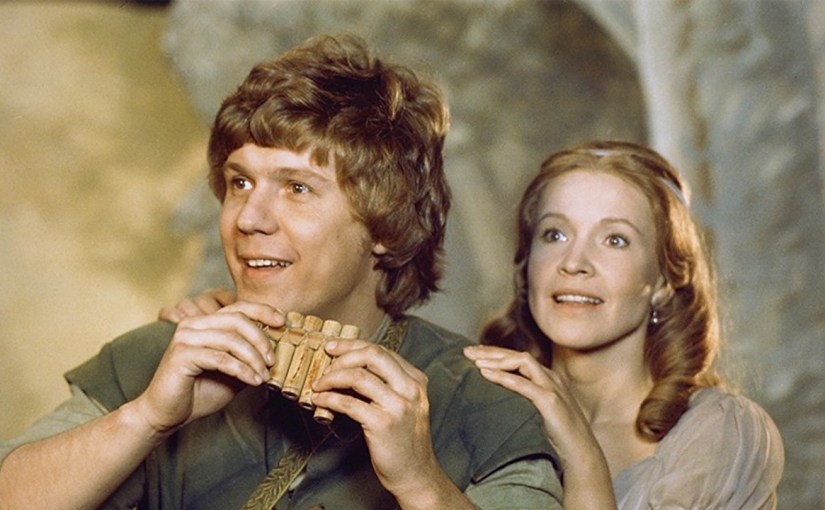
Ingmar Bergman’s whimsical staging of Mozart’s opera The Magic Flute is a movie made by a theater fan, for theater fans…and to a certain degree, it’s about theater fans.  I use the word “staging” instead of “film of” because, throughout the movie, Bergman never once lets us forget that we’re watching a staged production.  The opera’s overture plays over shots of the audience members, and at intermission we watch actors passing the time by playing chess or smoking where they shouldn’t be.  Once or twice, we see the hands of the stage crew as they move from one “cue card” to the next.  Fishing wire is clearly visible when objects “float.”  But the very artificiality of the production is what makes it so charming.  It celebrates artifice and scorns reality.  It wouldn’t surprise me if this were one of the favorite films of Tim Burton or Terry Gilliam.

Since my only previous knowledge of the story of The Magic Flute comes from a precious few scenes in the film Amadeus (1984), here’s a brief summary for anyone else who knows as much about opera as I do.  The brave, handsome prince Tamino and his enthusiastic sidekick Papageno are recruited by the Queen of the Night to rescue her beautiful daughter, Pamina, from the clutches of the evil Sarastro.  Before the opera is over, there will be revelations, separations, reunions, laughter, tears, semi-divine intervention, and even an operatic strip-tease.  There are monsters, woodland creatures, villains, three angelic young boys in a hot air balloon, and, of course, a magic flute.  And it’s all portrayed as it might be seen if we were watching it on a real stage in a real theater, with some obvious cinematic licenses taken with time and space.

I’m gonna be brutally honest: having never seen an opera, I had moderate-to-low expectations of how much I would enjoy it, even if the music is by my second-favorite classical composer of all time.  (Beethoven is the king, and that is that.)  But Bergman’s film sidestepped my expectations by not trying to present anything in a realistic way, or by simply staging a live production and just filming it from multiple cameras.  By keeping everything clearly artificial, clearly staged, and occasionally using clever movie tricks, The Magic Flute held my attention, making me curious about what other tricks Bergman might have up his sleeve.

For example, he’ll start a scene with a wide shot, showing the entire stage with the flats and fake backdrops, then cut to a medium shot, making us think we’re in the space we just were, then panning over to reveal a completely separate set that was invisible before.  But because it’s been established that we’re in the realm of theater, this kind of spatial paradox isn’t jarring, it’s almost expected.  You can get away with certain things in theater, especially opera, especially in a fantasy, that would never fly in a regular movie.  In The Magic Flute, a person’s face can be completely made over with a simple edit.  A picture in a locket can come to life.  A journey through a fantastic hellscape can be suggested by clever editing and careful camera placement.

But what if you simply don’t like opera?  Is The Magic Flute enough to convert you?  I mean…maybe?  If you’re a fan of the films of Terry Gilliam, particularly Brazil (1985) and The Adventures of Baron Munchausen (1988), then this movie is going to be right up your alley.  They share the same visual strategies and production design sensibilities.  Even if you believe you don’t like opera, The Magic Flute could still win you over for at least this one movie, simply because it’s such fun to look at.

Looking back over what I’ve written so far, I don’t believe I’ve accurately conveyed how the deliberate “fakeness” of the film enhances its effectiveness.  Live theater has the ability to get audiences to suspend their disbelief in a way that film cannot always achieve.  I’ve seen community theater productions where, for example, the walls of a café are supposed to “fly” off the stage revealing a night sky, and the effect was accomplished by simple lighting tricks.  A clubhouse foyer can be magically transformed into a golf course with a green carpet and some more selective lighting.  In live theater, the audience is constantly aware that it’s fake, but when they’re in the grip of a good story, their mind fills in the blanks.  That’s the effect Bergman is going for in The Magic Flute, and it works.

So, in the end, what you have here is a love letter to the stage, to opera, to Mozart, to fantasy.  Throughout the film, Bergman will cut to the face of young girl, an audience member, who watches with rapt attention and an almost Mona Lisa-esque smile.  Not only is he reminding us, the viewer, that this is a staged production, but maybe he’s also sending a reminder to filmmakers to never forget that, for a movie or play or opera to work, you have to remember who you’re making it for: the paying audience.  Speaking as an occasional audience member myself, I know that, when I buy a ticket, I want to be taken out of myself.  I want to believe that a man can fly, or that a wooden puppet can come to life, or that a valiant prince can overcome three tasks to win the heart of his beloved.  The Magic Flute is a tribute to the magic-makers and the storytellers, to the genius of Mozart, and to the people out there in the dark who make it all possible.

EMILIA PEREZ (FRANCE)

By Marc S. Sanders

I never watched a telenovela from start to finish.  At best, the only footage I’ve seen are on GIF scenes that tease at the over exasperated expressions (bulging eyes, big teeth, big hairstyles, lots of lipstick) of the actors and the characters they are portraying.  The Funny Or Die You Tube clips draw their comedy by having the straightest voiceover summarize a season of these miniseries. The stories were not meant for humor, but on the surface, I can’t help but think they are operating with a Naked Gun tongue firmly in an Airplane! cheek. 

Emilia Pérez looks like a telenovela compiled into a two-hour film, but as outrageous as the storyline and the sequence of events play out it’s anything but silly.  I held an appreciation for the circumstances that writer/director Jacques Audiard set up so that the insurmountable conflicts appeared convincing, and most especially overwhelming.  Emilia Pérez performs like an episode of Three’s Company – the one with the misunderstanding – but there are complications that border on bloody violence, life, and death.

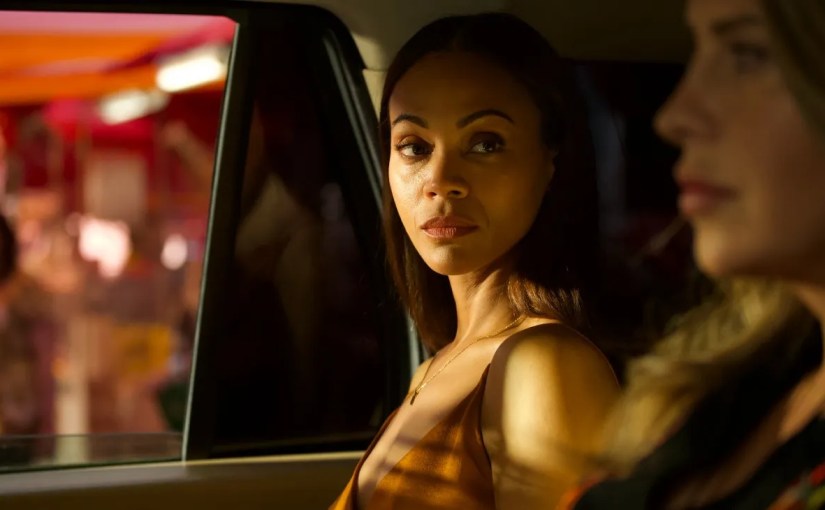
Zoe Saldana portrays Rita, a defense attorney for Mexico’s worst criminals, and she despises the purpose she serves for the murderous scum she represents as she assists in getting one thug exonerated after another.  Early on in the picture, Saldana espouses her remorse through song and dance all within the middle of a courtroom, because as you quickly learn Audiard’s film is a movie musical. 

Shortly after the opening number Rita is summoned by Manitas, the most powerful head of the Mexican drug cartel.  He has unlimited resources and cash, and he hires Rita to do a worldwide search for the finest physicians to complete his sex change operation.  Once that is complete, the two will arrange the publicly known death of Manitas, send his wife Jessi (Selena Gomez) and their two children off to hiding in Switzerland, and the drug czar will be replaced by the woman Emilia Pérez.  Emilia and Manitas are portrayed by real life trans actress Karla Sofía Gascón.

Four years jump by, and Emilia catches up with Rita, who remains the only person to know of the ruse that took place.  Emilia wants Rita to deliver Jessi and the children back to her.  The former father will now pose as the wealthy aunt and they will live together in Mexico, going forward. 

Rita discovers a new kind of respect for Emilia as the bloody past of this individual have ceased since her sex change.  As such, Emilia recalls that her former self was responsible for countless murders and kidnappings, many of which took place under her command.  Now she seeks redemption by making herself public with a well-funded campaign that will focus on the recovery of missing people and set up proper burial arrangements so next of kin can have closure.  Emilia reveals a common burial site where hundreds of bodies were secretly laid to rest.  No one questions how she knows of this area.  Yet, she becomes a philanthropic woman who has earned the respect of millions within Mexico.  The irony is that she recruits other cartel lords to make sizable donations to this cause.  If anything, it makes them look more noble in a public eye.

Elsewhere, simplicity does not hold for her relationship with Jessi.  I won’t reveal what occurs because it lends to an ending you might expect.  All three leads embrace different perspectives of this storyline, and it only heightens the complexities of the film.

Jacques Audiard is of French descent, and after seeing the film I learned that many have taken issue with him overseeing this project.  He does not speak Spanish, has no Mexican heritage and according to many has not embraced a true account of Mexican culture or activity.  The movie was also submitted for Oscar contention as the French candidate in the Best Foreign Film category. I’m glad I did not learn of these objections until after seeing Audiard’s film, though.  It did not interfere with my take on the picture, and I believe it should not cloud your viewpoint if you intend to see it.  (It’s currently showing on Netflix.)  There were moments in the film that I predicted would occur such as where a boy on a bicycle is heading with a plastic shopping bag in tow.  By that moment, I knew what was to be revealed inside the bag. 

The film is soap opera like, especially with the musical numbers that are included.  I’d think the songs were composed by Lin Manuel Miranda if I didn’t know better because the lyrics work like dialogue much like you would see in Hamilton or In The Heights.  I was taken with the singing performances of Saldana, Gascón, and of course Gomez who works part time as a professional singer anyway.  It’s almost operatic how they and other cast members express their conflicting feelings in character.  Out of context of the film, I don’t think any of these songs work or would draw an attraction to leave the radio tuned in.  The songs are storytelling, but not memorable or catchy with chorus versus.

While I did not mind the song portions, I never missed them when scripted dialogue, primarily in Spanish with English subtitles, was being played.  I guess you could say the music makes the film different.  A different kind of telenovela, a different kind of crime drama, a different kind of soap opera, and certainly a different kind of musical.  Whether you take to the assembly of the film or not, you cannot deny that Emilia Pérez stands out within any one of these categories.

The film is up for the most Oscar nominations in the year 2024, thirteen in total.  One thing that is odd though is that Zoe Saldana is competing in the Best Supporting Actress race while Karla Sofía Gascón is up for Best Actress.  Even though Gascón plays the title character, I insist it should be the other way around. Saldana occupies most of the running time of the film and as complicated as the character Emilia Pérez is, I found Saldana to be more conflicted as Rita, the outsider looking in with all the secrets held tight in her subconscious.  The best way to share her struggles with the audience is to sing them aloud.  The long-time action movie star (Guardians Of The Galaxy, Avatar) sets the stage for the whole movie, as soon as the five hundred million studio logos get their street cred at the beginning of the film.  (I empathize with Peter Griffin on Family Guy.) Saldana is marvelous in this picture.  A stunning performance.

As Emilia Pérez, Karla Sofía Gascón pulls off an intricate stretch as she convincingly plays two very different roles.  Had the film not told me, her character could have easily been the second coming of The Crying Game. Unlike Saldana though, once Emilia is brought into the film I didn’t so much see a performance as I heard the problematic narrative that came from the script.  I don’t recall any special moments or scenes that wowed me to the point of an Oscar nomination.  It’s certainly one of the most unique roles to come along in films lately.  So I guess that’s where the justification for special recognition stems from.

Selena Gomez is a powerhouse in her role.  She was worthy of a nomination that regrettably did not come.  As I understand she cannot speak Spanish fluently and was challenged at times with the dialogue and the singing involved.  Beyond Saldana’s introductory number, Gomez has the standout song with her portion of El Trio.  Gomez has so many dimensions to this character, as the bubbly airheaded and spoiled wife of the drug czar, who then transitions to a sorrowful and cold caricature after time has passed since her husband has been killed, and later she is vengefully outraged.  This is such a standout performance from her lighter material found in Disney programming and Only Murders In The Building.  She’s quite fierce.

I liked Emilia Pérez.  Artistically speaking, I question the worthiness of some of the recognition though.  It’s up for Best Cinematography.  Often the picture is grainy, which I believe was deliberate, but intent does not imply the highest order of artistic measure.  Maybe it is earning praise due to the transitions during the musical numbers.  Nevertheless, this film does not look as sharp as Dune, Alien: Romulus or The Brutalist

As well, I did not find anything special for its nomination in Sound.  Perhaps the sound lends to the music embedded throughout the film.  I don’t know.  I can’t figure what was merited here, when there are arguably dozens of other films that likely deserved more recognition. 

The creative licenses are where the strengths lie in Emilia Pérez.  The editing and directing are good with expansive footage of Mexican locales, and transitioning film work during the song and dance portions.  It has a screenplay that grabbed me right away.  The compounded conflicts that arise feel fresh as one new development introduces itself after another. None of the material is so much for shock value like you would find in a telenovela.  The crises all seem to make sense. 

It’s not easy once a gender transition is complete, especially for a murderous drug lord.  Likewise, it’s not going to be easy for the immediate family or the one person who carries all the secrets that no one else does.  Regardless of his background, Jacques Audiard’s film lays enough groundwork and attention for each of these women’s perspectives.  He’s simply a storyteller who triumphs with impressionable tales to unfold. 

A COMPLETE UNKNOWN

By Marc S. Sanders

A drifter hitches a ride into New York City with a guitar on his back looking for Woody Guthrie.  He only comes to realize that his musical idol is in a New Jersey hospital ward with a debilitating illness. The drifter just came from Jersey.

The young stranger eventually catches up with the legendary folk singer, and a friend named Pete Seegar.  He plays a song he wrote for the ill and mute Mr. Guthrie and the men are dazzled by this young man.  This is Bob Dylan, and he writes music and lyrics as quickly as he breathes.  But where did this wunderkind stem from?  To everyone that encounters Bob Dylan, he’s simply A Complete Unknown.

Timothée Chalamet delivers a blazingly convincing performance as Bob Dylan, surely a front runner for the Best Actor Oscar.  The appearance is easy to get used to. The dialect and expressions of what I’d like to think is the summit of what most of us know about the musician never falters from an apathetic expression or that mumbling hoarseness we all know.  Everything from the clothes to the shaggy brown hair to the sunglasses and motorcycle he confidently rides perfect this embodiment. In James Mangold’s latest musician biography (prior credits include the Johnny Cash bio Walk The Line), with Timothée Chalamet in this role, I was truly watching a Bob Dylan of the early to mid-1960’s.

Any movie has a conflict for its story to work around.  There’s more than one conflict in A Complete Unknown, but Bob Dylan would not know that.  He’s content with doing what he does and has not one care for what anyone else wants him to be or wants him to share.  Bob lacks much concern for the tumultuous times of the mid twentieth century either.  JFK and Malcolm X are assassinated.  The Vietnam War persists.  The Cuban Missile Crisis terrifies everyone.  Yet, Bob only focuses on his songwriting.  He’ll make connections with Pete Seegar (Edward Norton) and develop a sometimes-romantic tryst but mostly singing partnership with Joan Baez (Monica Barbaro).  He also gets involved with Sylvie Russo (Elle Fanning), one of his first fans.  However, no matter what they might expect of the performer, he’s only going to follow the path that drives him.  Therefore, that will be their own respective problems to contend with, not his.  Bob is only going to follow that path that he chooses.

Sylvie wants to know more about her live-in boyfriend who only tells tales of when he moved with a travelling carnival.  Joan wants to know where he learned to play guitar or even how he developed a knack for poetic lyricism.  Later, she’ll want to play the original numbers that solidified their friendship on stage despite his stubbornness not to agree.  It becomes curious when photo albums are delivered, addressed to a Robert Zimmerman.  Pete and his other peers want Bob, a now marquee name, to hold on to the grassroots of folk singing.  Bob will not acquiesce though.  Like other masterful musicians such as Prince or John Lennon and Elton John, Bob Dylan is going to continue to reinvent himself. 

In a matter of months, the signer becomes a nationwide superstar and he can’t walk the streets without getting bombarded; something he never wanted.  He performs with a passion for the music he’s written and he persists in making the next new thing with his talents as he transitions from acoustic to electric guitar and incorporates keyboards and drums to accompany his performances.  His friend Pete sees a berth becoming wider from the folk music he parades at annual festivals in Newport, Rhode Island and what Dylan insists on only playing.  Record producers (primarily represented by actor Dan Fogler) beg the singer to perform his older familiar tracks, but Bob Dylan only wants to move on to what is new and fresh. 

A Complete Unknown is full of such energy because it delivers what was produced by the guy who composed all of these magnificent and magnetic tracks from Song To Woodie to Blowin’ In The Wind to Like A Rolling Stone and to The Time’s They Are A Changing and A Hard Rain’s A-Gonna Fall.  You might not know or even understand all the verses by heart, but you quickly catch on to the choruses. To hear these newly composed songs pulled out of a dusty attic for an updated biography, performed by Timothée Chalamet in underground bars, at concert festivals or even in messy apartments is addicting.  You don’t want the actor to stop the song.  You don’t want the film to cut away from any of the numbers and you wish the concert would never end.  Like Joan Baez, Bob Dylan’s works stay with you.

I’ve become a huge admirer of James Mangold.  He’s a writer/director who does not criticize his subjects.  He empathizes with them and respects their boundaries.  We might find frustrations in people like Bob Dylan or Johnny Cash, but Mangold does not compromise the biography.  He finds reasons for you to like these men even while those who stand in their circles might not care for their attitudes. 

The director is also skillful at showing the history of the time.  Like the last Indiana Jones film he covered, the settings are so authentic.  New York City in A Complete Unknown is depicted down to the finest detail including the yellow street signs within the small boroughs of damp Brownstones and city streets that Bob Dylan navigates. The musty interiors of Woody Guthrie’s hospital room or Pete Seegar’s cabin home are shot with a hazy photography.  The Newport music festival, full of concert spectator extras feels like it was pulled from a documentary; what maybe a calm and relaxing Woodstock might have looked like.

Beyond Timothée Chalamet, the cast of this film is superb.  Elle Fanning need not say a word as James Mangold provides an assortment of close ups depicting her pain of wanting to love Bob Dylan but knowing she just can’t.  Her complexion turns into a weeping pink without one tear shed.  Monica Barbaro is on the cusp of becoming a marquee name in films.  The actress who was recently in action material with Tom Cruise and Arnold Schwarzenegger hides so well under the folk appearance of Joan Baez and she carries an immense stage presence. Scoot McNairy is Woody Guthrie who never speaks and only stares straight ahead during visits from Bob and Pete. Yet, the silent performance offers the only character who truly understood the value of an enigmatic Bob Dylan. Edward Norton has given a new range as a liberal and calm Pete Seegar who uses folk music as an escape from the turmoil of the times and not as a harbor to protest or fight an authority with aggression and violence.  He might wish for his friend Bob Dylan to uphold the value of folk music, but he knows he can’t keep a bird caged in one place either.  Norton’s introductory scene in a courthouse with a banjo in hand is unforgettable.  The casting is simply perfect in A Complete Unknown.

Since I saw this film on Christmas Day, I have not stopped thinking about it, and I think I want to see it again in a theater with a speaker system that amplifies the power of Bob Dylan’s guitar and mumbly vocals.  Right now, nothing sounds better.

A Complete Unknown is one of the best films of the year.

BLACK ORPHEUS (France, 1959)

by Miguel E. Rodriguez

DIRECTOR: Marcel Camus
CAST: Breno Mello, Marpessa Dawn, Lourdes de Oliveira
MY RATING: 8/10
ROTTEN TOMATOMETER: 88% Certified Fresh

PLOT: The Greek myth of Orpheus and Euridice is translated into a modern-day story (with an all-black cast) set in during Carnaval in Rio de Janeiro.


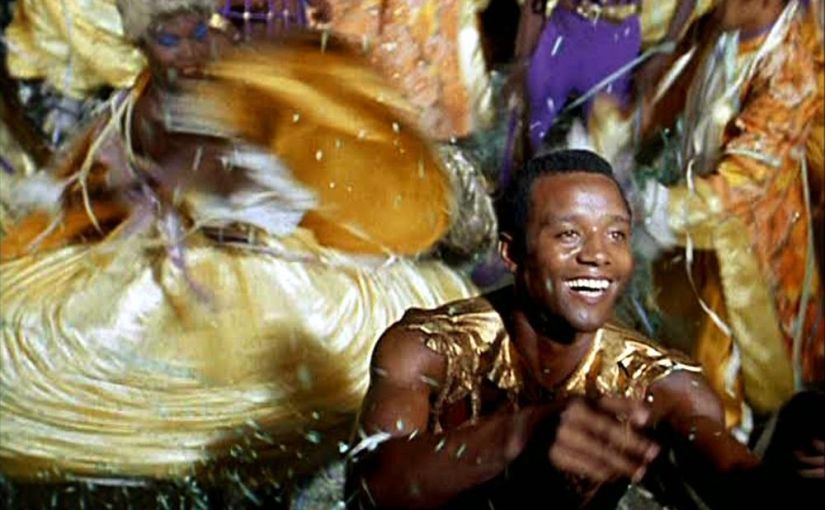
In the first two-thirds of Black Orpheus, there are scarcely more than 2 minutes strung together at a time without some kind of music or sound effects thumping away in the background.  This gives the film a subtle real-world backdrop, which is good, because Black Orpheus is a fantasy through and through.  Critics, now and at the time of its release, complained that French director Marcel Camus ignored the reality of the Brazilian favelas, or slums, in favor of depicting Rio as a non-stop party.  This is a valid point.  However, I believe that, in this movie, reality has no place.  This is a love story, a myth, a tragedy, and a travelogue all rolled into one.  Reality must take a back seat in movies like this.

(And, heck, somebody must have liked it because it won both the Palme d’Or at Cannes AND the Best Foreign Film Oscar that year, a rare feat.  True, there were extenuating circumstances [numerous French critics had problems with the emerging French New Wave], but let’s not turn this into a classroom, shall we?)

If you’re familiar with Greek mythology, then the plot of Black Orpheus is nothing new.  Orfeu (Breno Mello, a non-professional actor) is a streetcar conductor engaged to the sexy, vivacious Mira, but he is not exactly thrilled about it.  Meanwhile, Eurydice (Marpessa Dawn, who actually hailed from Pittsburgh, not Brazil) gets lost in the city on the way to visit her cousin, Serafina, who lives in a ramshackle favela neighborhood.  She asks Orfeu and his boss, Hermes, for directions, and for Orfeu it’s love at first sight.  The rest of the movie will involve Orfeu wooing Eurydice, who worries about a strange man who might be following her, while trying to ditch Mira, with Serafina’s help.  Also assisting Orfeu, while acting as a Greek chorus in miniature, are two street urchins, Benedito and Zeca, who envy Orfeu’s lovely guitar playing, which Orfeu claims is what makes the sun rise every morning.

Apart from the story itself, the things I noticed at the outset were the presence of riotous colors in the costumes and the Brazilian countryside, and the music.  Lots and LOTS of music, but not a great deal of songs.  Black Orpheus is billed as a musical, but I’d have to say it’s a quasi-musical.  In a standard musical, characters break out into song, and no one notices because otherwise we’d be watching a play.  In Black Orpheus, every song is diegetic…someone asks Orfeu to play a song on his guitar, for example, or the Carnaval participants sing a rousing song while on parade or at a huge dance.  And I want to mention again that, while Orfeu is singing a quiet song to Eurydice, the constant percussion of the Carnaval pulses behind it, completely at odds with his song.  You would think it would become a cacophony, but it doesn’t.  It makes his quiet song much quieter, which may sound counterintuitive, but it works.

The mythic tone of the story keeps the film from flying off into ridiculous territory amid all the revelry.  Without mythology, Black Orpheus would be a soap opera.  A pivotal scene occurs during a massive dance contest, as Eurydice has disguised herself as her cousin, Serafina, so Mira doesn’t recognize her.  But Mira sees through the disguise and threatens to kill Eurydice.  Mira chases her, and unseen by anyone else except Eurydice, a man dressed all in black wearing a skull mask follows them both.  This is Death.  Earlier he had nearly chased Eurydice off a cliff, but Orfeu had saved her.  “I am not in a hurry,” he said, “we shall meet soon.”  With that in mind, his presence during this second chase is tinged with suspense.  It’s a very Hitchcockian element, the threat of danger juxtaposed with a dance or a party.  Good stuff.

So, it’s fair to say I enjoyed this movie a little more than I expected to.  But the bonus features on the Blu-ray brought up an interesting point.  Detractors of the film pointed out that, despite taking place mostly in a slum, the actual reality of those slums (both then and now) is anything but festive, no matter how much bossa nova music you play or how many songs you sing.  It’s highly unlikely these people would have had the wherewithal to create such stylized, colorful costumes while having to deal with the reality of poverty, all while looking down the mountainside at the distant concrete high rises of the higher classes.

Does Black Orpheus ignore reality?  Well…yes, it does.  Myths, by definition, have little to do with reality in the first place.  Would it have been possible to tell this mythical story, retaining its coincidences and absurdities and supernatural elements [especially towards the end], while also keeping its feet firmly on the ground and making a socially conscious statement about the horrible living conditions in Brazil?

I don’t think so.  Or, if you did, it wouldn’t be held together very well.  Black Orpheus is simply re-telling a very, VERY old story and re-imagining it as if the Greek gods had lived atop Sugarloaf Mountain instead of Olympus.  When you start with that kind of premise, reality goes out the window.  You have to focus on the story’s emotional beats, the pleasant assault on the senses and, occasionally, logic.

This opens a whole separate argument: is it a film’s responsibility to BE authentic, or just to FEEL authentic?  For example, Titanic [1997] feels authentic to me, a layman, but I’m sure historians and other experts could point to any number of things that were simply not true in the film.  Fair enough, but that doesn’t affect my enjoyment of the film as it was presented to me.  It FELT authentic, and that’s enough for me.  The only way to make a movie like that 100% authentic would be to turn it into a documentary.

Black Orpheus FEELS emotionally authentic to me, a layman, who is not a social anthropologist.  I look at the colors and vibrancy on display, visually and in the story itself, and while a small part of me acknowledges, “This isn’t real life”, another part of me says, “Well, if I wanted real life, I wouldn’t be watching a movie, would I?”

CARMEN JONES (1954)

by Miguel E. Rodriguez

DIRECTOR: Otto Preminger
CAST: Harry Belafonte, Dorothy Dandridge, Pearl Bailey, Brock Peters, Diahann Carroll
MY RATING: 8/10
ROTTEN TOMATOMETER: 75% Fresh

PLOT: The Bizet opera Carmen is translated into a modern-day story (with an all-black cast) of a sultry parachute factory worker and a GI who is about to go to flying school during World War II.


Otto Preminger’s Carmen Jones will be (or OUGHT to be) remembered for many things, but the thing I will remember it for the most is the dynamic presence of the sexy, sultry Dorothy Dandridge in the titular role.  She may not have done her own singing – nearly all the major characters’ singing voices were dubbed by opera singers – but, by God, she knew how to own a role.  In the first five minutes, she steals the movie lock, stock, and barrel when she performs that first aria in the mess hall.  It’s like watching a Marilyn Monroe film: everything around her pales in comparison to her sheer magnetism, although with Dandridge (at least with the character of Carmen), you can see an intelligence behind the sexiness.  Dandridge thoroughly deserved her Oscar nomination.  A quick Google check shows she had some stiff competition that year: Grace Kelly, Judy Garland, Audrey Hepburn, and Jane Wyman…although how Kelly pulled out a win over Dandridge AND Garland will forever remain a mystery to me.

ANYWAY.

In this modern retelling, Carmen Jones is a factory worker during World War II, making parachutes for the war effort.  During the opening aria, she sets her sights on Joe (Harry Belafonte), a naïve GI in love with a country girl, Cindy Lou, from his hometown.  If I’m being completely honest, nothing in the film matches the simmering sexual energy of this opening number.  Carmen slinks from table to table in the mess hall, modestly dressed, but with complete knowledge of exactly how to work with what’s available.  She flirts shamelessly with Joe, right in front of Cindy Lou.

Later, Carmen gets in a knock-down, drag-out catfight with Frankie (Pearl Bailey, the only principal actor whose singing voice WASN’T overdubbed) and is arrested by the MPs.  Joe, who was just about to elope with Cindy Lou, is ordered to drive Carmen to a town some 50 miles away, since the Army can’t put civilians in jail.  This sets up another opportunity for Carmen to flirt with Joe, as she does everything but unbutton his pants during their drive.  The more he resists, the more she wants him.

…but I don’t want to simply summarize the plot, which was a mystery to me since I have never seen a production of Carmen.  (The ending is mildly pre-ordained, because, hello, it’s an opera.)  I want to express my admiration of this film, particularly for its ambition.  I’m no film scholar, but I’m prepared to bet that in 1954, there weren’t an awful lot of big studio films being directed by A-list directors featuring an all-black cast.  The fact this film exists at all is, I think, a minor miracle.  I won’t attempt to put words in the mouth of anyone in the black community, but at that time in cinematic and American history, I have to believe this was seen as a giant leap forward, AND a giant risk.  (There is probably MUCH more to this story, but I do not want to turn this article into a research paper.)

Otto Preminger’s directing style in Carmen Jones also deserves recognition.  A factoid on IMDb trivia states: “This film contains just 169 shots in 103 minutes of action. This equates to an average shot length of about 36 seconds, which is very high, given the 8-10 seconds standard of most Hollywood films made during the 1950s.”  This is important because those longer shots create, in many places, an illusion of watching a stage performance.  For instance, if I remember correctly, that opening aria that I keep going on about – Dandridge is SMOKING – runs for about 4-5 minutes and has only three total shots.  Towards the middle of the film, there’s an astonishingly long take that travels from a bar across the room to a table, following a group of five people, all singing simultaneously at multiple points.  The shot lasts just under five minutes, but it feels much longer.  It’s a brilliant piece of work.

The tragic arc of Carmen Jones may seem inevitable, as I said before, but it remains an entertaining watch.  You can see the dominos falling, and you bemoan the choices Joe makes as he falls under Carmen’s spell, but I mean, LOOK at her.  There’s a scene that I’m sure would bear the Tarantino stamp of approval as Carmen paints her toenails and coyly asks Joe to blow on them for her so they can dry faster.  Dayum.  Show me a straight man who wouldn’t fall for that kind of treatment from a woman who looks like Dorothy Dandridge and I’ll show you a dead man.

If I wanted, I could get nitpicky about Carmen Jones.  Has it aged well?  Not exactly.  Does it feature great acting aside from Dandridge?  Not exactly.  Does it look natural to hear an operatic tenor burst forth from Harry Belafonte’s mouth?  Not exactly.  But Carmen Jones is a landmark of black cinema in an era when schools and government buildings still had segregated water fountains and restrooms.  Based on that fact alone, I consider Carmen Jones to be a vital step in Hollywood’s painfully slow racial evolution. (It is also a painful reminder of a career that might have been; Dandridge died 11 years later at only 42.)