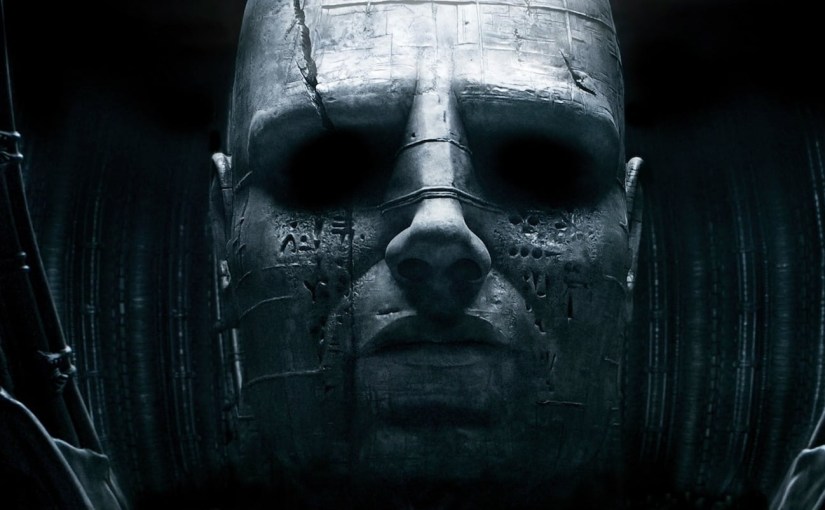
PROMETHEUS (2012)

by Miguel E. Rodriguez

Director: Ridley Scott
Cast: Noomi Rapace, Michael Fassbender, Charlize Theron, Idris Elba, Guy Pearce, Logan Marshall-Green
My Rating: 10/10
Rotten Tomatometer: 73%

PLOT: A deep-space research vessel arrives at a distant moon, searching for clues to the origins of mankind.  What they find instead threatens their lives and the lives of everyone back on Earth.


I am at a loss to explain the mediocre Tomatometer score for Prometheus, Ridley Scott’s long-awaited return to the universe he created in Alien [1979].  Intellectually, I can hear the arguments:

  • “Where’s the Xenomorph?”
  • “So did the ‘Engineers’ create humans or what?”
  • “Is that planet at the beginning supposed to be Earth?”
  • “Where’s the Xenomorph?”
  • “Why did that idiot scientist approach the snake-looking creature?”
  • “How is the android able to break almost all of Asimov’s Laws of Robotics?”
  • “What’s with the open-ended ending that provides no resolution?”
  • “WHERE’S THE XENOMORPH???”

I get it.  You hear Ridley Scott is making a prequel to Alien and you build up a lot of expectations, especially after watching some of the sorrier sequels that piled up after Aliens [1986].  When you go into a movie expecting one thing and get another, people get hacked off.  I feel you, bro.

But to those people who dismissed Prometheus because it didn’t deliver what they expected to get, all I can say is: your loss.  Because Prometheus is one of the greatest sci-fi movies of all time, in my humble opinion, and it’s mostly for the very same reasons that people disliked it in the first place.

After a brief prologue set in an unknown time in an unknown place, we jump to the year 2093, when a deep-space research vessel arrives at a far distant moon, searching for clues to the origin of mankind.  Dr. Elizabeth Shaw (Noomi Rapace) says they were led to this specific moon by “Engineers”, humanoid beings who are visible in ancient cave drawings from across the globe.  She believes the Engineers can provide an answer, THE Answer, to Life, the Universe and Everything. (Apologies to Douglas Adams.)

Instead of Engineers, Dr. Shaw and her expedition discover miles of underground caverns and a room full of canisters that turn out to contain a horrifying contagion that attack the body at a cellular and/or genetic level, creating painful mutations that, if they don’t kill the host outright, turns them incredibly violent.  We also get a glimpse of the famous “space jockey”, the fossilized alien creature seated in some kind of contraption inside the spaceship in Alien.  So at LAST we’re in familiar territory.

But still no Xenomorph.

The story progresses, the shipboard android turns out to be less than trustworthy, people die in creative and horrifying ways, an Engineer actually turns up, we get a couple more visually spectacular tie-ins to the first Alien…but by the time we get to the end, what gives?  The movie’s obviously over, but we haven’t gotten any answers to the burning questions: Who are the Engineers?  If that was an Engineer in the prologue, was that supposed to be Earth?  If it WASN’T Earth, why even HAVE that prologue?  And don’t try to tell me that was a Xenomorph at the end…

Well, here’s my two cents.

First, of all, expectations are tricky.  They can color and compromise your entire movie-watching experience.  When I went to see Prometheus, I did have my own set of expectations, but as the movie settled in and it became clear that the movie had other designs, I had to consciously shake myself loose of my expectations and embrace what was being presented to me.

Second of all, the visuals are stunning.  I happened to see this in 3-D, and it’s one of a handful of movies where the technology was used PERFECTLY.  No gimmicky shots of spears or harpoons or whatever being pointed out of the screen.  It was used as it should always be used: as a tool to further immerse you into the world of the film without overloading you or being ridiculously obvious.  The gorgeous landscapes during the prologue and during our heroes’ descent to the surface are awe-inspiring.

And then, the story.  I was completely okay with the open-ended nature of the story, and I’ll tell you why.

There are some films out there that play Prometheus’s game of asking questions and not answering them.  One of the most famous examples is Stanley Kubrick’s adaptation of 2001: A Space Odyssey [1968].  If you’ve never read the book, I defy you to provide a concise explanation of the last thirty minutes of that movie.  But that didn’t bother people, because the goal was to get the viewer to ask questions, to provoke discussions about the movie that would eventually get around to some of the same questions asked in Prometheus: Why are we here?  What is our purpose?

And then there are other films that play that open-ended game and fail.  The one that comes immediately to mind is Darren Aronofsky’s The Fountain [2006].  By the end of that movie, my head was locked in a tilted position like a cocker spaniel hearing a strange noise.  If I had been a cartoon character, the word balloon over my head would have been all question marks.  I once read a full description of what was really going on in that film, but to the degree that I understood it, I simply didn’t care.  If I have to go that much work to “get” a movie, the movie didn’t do its job.

There are those who say that’s what Prometheus did, throwing us in the deep end and making us do some mental heavy lifting with no payoff.  But I disagree.

I think, for me, it has to do with the very nature of the questions Prometheus is asking.  “If we could discover the answers to the riddles of our existence, to what lengths would we go, or should we go, to get those answers?  And do we even want to know the answers?  Are we better off NOT knowing?”  These are questions that, almost by definition, can’t be answered in any satisfying way.  So Prometheus presents a possible answer, but then teases it away so there is still some mystery in the story.  If the characters in Prometheus had discovered some kind of document that laid out the Engineers’ plans in detail, I would have felt cheated.  It would have been woefully anticlimactic.  I liked it better that the biggest questions went unanswered, so I could formulate my OWN theories about the Engineers, their plans, their methods, their history, their future, etcetera.  It’s much more stimulating to let my imagination run riot.

(Granted, some of those questions are answered in Alien: Covenant [2017], but that movie still had the guts to leave some things to the imagination by the end.)

Prometheus couches deep philosophical riddles about our very existence within a crackling good thriller with spectacular visuals from beginning to end.  It stands tall as one of the best prequels ever made…Xenomorph or no Xenomorph.

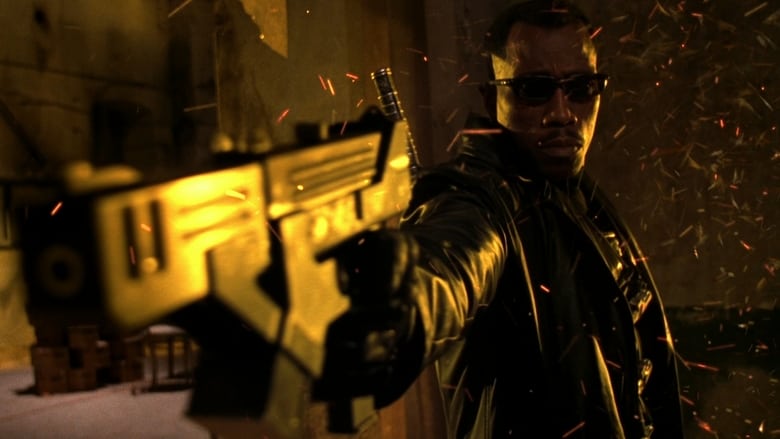
BLADE II (2002)

by Miguel E. Rodriguez

Director: Guillermo del Toro
Cast: Wesley Snipes, Kris Kristofferson, Ron Perlman, Norman Reedus, Donnie Yen
My Rating: 9/10
Rotten Tomatometer: 57%

PLOT: Blade, half human/half vampire, forms an uneasy alliance with the vampire nation in order to combat a new breed of monster, the Reapers, who are feeding on vampires and humans alike.


Why don’t more people like this movie?  It’s like someone took the best fight scenes from The Matrix, removed the pretentious plotting, added a crapload of gore, and created one of the best villains in the history of vampire movies: the Reaper, an evil-looking creature whose lower jaw splits wide down the middle to reveal a blood-sucking appendage that might even give the Xenomorph nightmares.

Blade II is lean and mean.  Director Guillermo del Toro has gone on record as saying this was not exactly the movie he intended to make, as it doesn’t keep precisely to the Blade “canon” (in case you didn’t know, Blade is a lesser-known Marvel comics character who is scheduled to eventually make an appearance in the Marvel Cinematic Universe).  However, despite his misgivings about this film, del Toro nevertheless created an action-horror masterpiece.

If you’re a fan of action films, what do you like?  Because it’s all here.  There are five great fight scenes, including a doozy in Blade’s own lair between Blade and two vampire ninjas wearing elaborate headgear that makes them look like humanoid bugs.  You like a great villain?  Here’s Jared Nomak, the vampire who carries the Reaper virus, whose wounds heal by themselves almost instantly, and who carries a dark secret.  His fighting skills are equal to those of Blade himself, who must learn to use more than brute force if he’s going to defeat Nomak.  (And let’s not overlook the cameo by Asian superstar Donnie Yen.)

You like a good story?  We got that, too.  Blade’s sworn enemies, the vampire nation, are forced to approach Blade for help when it becomes apparent they are no match for the Reapers.  Blade HAS to help, because who will the Reapers go after once they dispatch all the vampires?  Humans.  So you have the whole “uneasy alliance” going on, with no one more uneasy than Reinhardt, a vampire played by a deliciously malevolent Ron Perlman.  Reinhardt goes along with the plan, but can’t resist poking the tiger by asking Blade, “…can you blush?”  Blade’s response gives a whole new meaning to the term “kill switch.”  Game, set, match.

This is also a horror film, let’s not forget.  You like scares?  How about the part where a Reaper gets pinned to a wall with a ninja sword through its stomach…but escapes by crawling backwards up the wall, forcing the sword to slice through his body as he skitters away, unfazed by the damage?  YIKES.  We got gore, too.  Blade and company perform an autopsy on a dead Reaper.  I haven’t seen that much detailed gore since the autopsy in John Carpenter’s The Thing.

I mean, seriously.  This movie has everything I want in an action movie that’s also a horror film.  It covers ALL the bases.  (I could’ve done without the quasi-love-story, but it’s not dwelt on too much, so I can live with it.)  What more could anyone ask for?

(Also, it’s great to listen to on a bad-ass audio system…BOOMING bass and sound effects.  Great stuff.)

DRAG ME TO HELL (2009)

by Miguel E. Rodriguez

Director: Sam Raimi
Cast: Alison Lohman, Justin Long, Dileep Rao, David Paymer
My Rating: 8/10
Rotten Tomatometer: 92% Certified Fresh

PLOT: Christine Brown has a good job, a great boyfriend, and a bright future. But in three days, she’s going to hell.


Re-read that plot description above.  That’s pretty much the movie in a nutshell.  And it was directed by Sam Raimi getting back into his grindhouse-y horror zone after five years of hobnobbing with Columbia Pictures and their Spider-Man franchise.

In other words, it’s a movie showcasing a director getting back to what he does best.  And it is nothing if not effective.

Christine Brown (Alison Lohman), a loan officer at a bank, tries to impress her boss by refusing to extend the home loan of an elderly woman, Sylvia Ganush, who is facing eviction.  Later that night, Mrs. Ganush accosts Christine in a parking garage (one of the movie’s many exceptionally effective scare sequences).  As revenge for rejecting her loan extension, Mrs. Ganush bestows a curse upon Christine: in three days, a demonic spirit will come for Christine’s soul, and there’s nothing she can do to stop it.

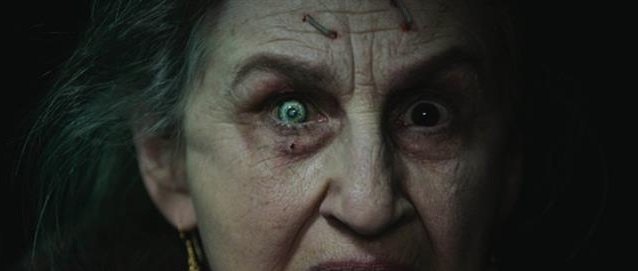
(We have already received a glimpse of what potentially awaits Christine during a horrifying prologue…and it is not good.  Helpful Tip for a Longer Life: Never piss off an old woman with a glass eye.)

Drag Me to Hell is not really trying to be “great”.  It’s a D-list story filmed by an A-list director.  It’s not concerned with the thematic dichotomy of good versus evil, or anything like that.  It is simply a delivery device for scares intended to jolt people out of their chairs every 5 or 10 minutes.

And, MAN, does it deliver.  There are sequences of poor Christine alone in her house, while something sinister prowls around outside, and eventually gets into the house…and I haven’t been that scared since I saw John Carpenter’s Halloween on VHS for the very first time.

There’s a creepy scene involving a single fly buzzing around Christine’s head while she sleeps, and then it alights on her face and crawls INSIDE HER NOSTRIL and then OUT THE OTHER ONE.  <shudder>  But then it moves towards her lips and starts to force its way INTO HER MOUTH…and it just makes your skin crawl in a way that’s hard to describe.  Accomplished with no blood or gore, just…eeyuck.

Mrs. Ganush herself makes a few encore appearances, just to keep things interesting, and then there’s a climactic séance at the house of a celebrated medium who once battled this particular evil spirit before.  This will certainly go down in movie history as one of the scariest/most gonzo séances EVER.  Without going into too many details, let me just say this: I could tell you the scene involves, at one point, a talking goat, and you might laugh, because what’s funnier than a talking goat, and it IS funny for the first couple of seconds…but that laughter will fade as soon as you see what happens next.  The word “bizarre” was invented for the séance in Drag Me to Hell.

That right there sort of encapsulates the general mood of this movie.  In all of his horror films, Sam Raimi’s sense of humor was always evident, most especially in Evil Dead 2 [1987] and Army of Darkness [1992].  In returning to the genre that started his career, he retains that gleeful, mischievous tone.  As horrifying as Drag Me to Hell is, it’s also pretty damn funny, even while we’re getting the bejeebers scared out of us.  (It’s hard to explain without getting into spoilers, but you’ll see what I mean when you watch it.)

So there you go.  It’s a horror movie that will make you laugh and shriek at the same time.  I thoroughly enjoyed it.

…but I would advise checking your doors are locked before starting it. Just saying.

DOCTOR SLEEP (2019)

by Miguel E. Rodriguez

Director: Mike Flanagan
Cast: Ewan McGregor, Rebecca Ferguson, Kyliegh Curran
My Rating: 9/10
Rotten Tomatometer: 76% Certified Fresh

PLOT: Nearly forty years after the events of The Shining, an adult Danny Torrance makes contact with someone else who can “shine”, and is soon drawn into a war with a band of people who hunt gifted people like himself.


If you had asked me a year ago to list movies will never get a sequel, Stanley Kubrick’s 1980 adaptation of The Shining would have been near the top of that list.  As adaptations go, it has its share of fans and detractors, but as a stand-alone horror movie, it’s a stone-cold masterpiece that has never been equaled.  When I heard that they were actually making a sequel based on Stephen King’s own sequel to The Shining, I was extremely skeptical.  The last time someone made a follow-up to a Kubrick film was 2010 (1984), and while that film was a decent sci-fi flick, it didn’t come close to the spectacle of Kubrick’s 2001: A Space Odyssey (1968).  So my expectations were, as they say, tempered.

After watching Doctor Sleep earlier tonight, I can say, unequivocally, that while the film is not perfect, I could not have asked for a better sequel to The Shining.  It’s a treasure trove for fans of the original, and also for fans of the extended universe that King has created for his novels, starting with the Dark Tower series forward.  (For those particular fans, you’ll be glad to see a very specific two-digit number making a conspicuous cameo…)

To begin with, the story is classic King.  Danny Torrance has grown into an irresponsible adult with a drinking problem, marking an unfortunate parallel with his father, Jack.  He hits bottom and takes up residence in a sleepy New Jersey town, joins AA, and works as an orderly at a local hospice.  Up to now, he has done everything in his power to keep his “shine” in check, but he finds a pragmatic use for his gift working with terminal patients, with the help of an inscrutable cat who can sniff out which patient is going to die next.

Eventually he comes into contact with a young girl named Abra, who lives in another part of New Jersey, but who can “shine” like he can.  And then there’s this nomadic group of people, calling themselves The True Knot, who are apparently hunting down other people with the “shine” for their own nefarious purposes.

It all wraps and weaves into a thrilling tale that skillfully retains the feel of Kubrick’s film.  Doctor Sleep works on its own merits, but the more you know about The Shining, the more thoroughly you’ll enjoy this new film.  Sharp-eyed cinephiles will be amazed at how many times, and in how many different ways, Kubrick’s style is echoed and referenced in this sequel.  These include liberal use of fade transitions, lots of static shots, Steadicam shots, use of natural lighting, those shots with the axe (!), even the aspect ratio that the film was shot in.  I got a giddy little swoop every time I saw how carefully the director, Mike Flanagan, was working the master’s craft into his film.  It was like watching a very subtle Kubrickian version of Ready Player One.  And it never comes off as plagiarism…it’s definitely homage, not theft.

Another aspect I really enjoyed was how the movie doesn’t rush through anything.  It’s two-and-a-half hours long, longer than average these days, which is yet another echo of The Shining.  When it works, that kind of pacing and running time gives the viewer the luxury of settling into the rhythm of the characters, makes them feel more like real people instead of cardboard cutouts hurrying from one milestone to the next.  For example, there’s a scene where one character performs a kind of astral projection to find someone.  There is a rather long series of shots showing her traveling through space that I can easily imagine would have been truncated in a lesser film.  Doctor Sleep, instead, gives us a good long look at her journey, to really feel the distance involved.  It’s quite a beautiful sequence, in fact.

This was a much better movie than I anticipated, which is good, because I never believed it was necessary.  It’s a relief to see that the continuation of Danny Torrance’s story has been handled in such a respectful manner, both towards the first film nearly 40 years ago and towards the viewers and fans.  It’s not perfect (I could pick nits about one particular aspect of the finale if I wanted to), but it’s a worthy successor to Kubrick’s masterpiece.  This belongs on the list of the best Stephen King adaptations along with It (2017), The Green Mile, and The Shawshank Redemption.

P.S. The blu-ray edition of Doctor Sleep contains a director’s cut that extends the running time by thirty minutes, adds more details about Abra’s powers, among other things, and inserts “chapter breaks” that almost make it feel like a miniseries.

SCARY STORIES TO TELL IN THE DARK (2019)

by Miguel E. Rodriguez

Director: André Øvredal
Cast: Zoe Margaret Colletti, Michael Garza, Gabriel Rush
My Rating: 3/10
Rotten Tomatometer: 80% Certified Fresh

PLOT: In order to save their lives, a group of kids face their fears as manifested by a haunted book of stories that write themselves.


I learn from Wikipedia that Scary Stories to Tell in the Dark is based on a popular series of horror stories from the ‘80s, written for a young-adult audience, much like the Goosebumps books, I would imagine.  (I have to imagine, because I have never read a single Goosebumps book.)  If the stories are anything like the trilogy of so-called terror presented in the film, they must be scary indeed.  At least on paper.

The plot: a group of teenagers in 1968 – why that year, specifically?  No idea – discover a book in a local haunted house, a REAL haunted house, that is supposedly filled with stories that a crazy woman would read to local kids through the walls of her basement where she was kept prisoner by her family.  They unwisely take the book from the house and should therefore be unsurprised when the stories in the book start to play out for real.

As a film, Scary Stories delivers occasional shocks without suspense.  You know what I’m talking about, right?  The scene where something jumps at the screen and the soundtrack goes DA-DUM!!!  …and it’s just a cat.  The entire movie is like that.  There are attempts to build suspense, but they fail to do so.

Ironically for a film with “Stories” in its title, I think the problem lies with the storytelling.  The stories on their own are fairly creepy, and seem like they could provide material for a much scarier film.  A scarecrow that comes to life?  A creepy-looking woman who just keeps walking closer and closer to you no matter what you do?  An animated corpse wondering who stole its big toe?  (Okay, maybe not that last one, but you get the idea.)  These would indeed be great stories to tell in the dark, preferably around a campfire or at a slumber party with the lights out and the doors and windows unlocked.

But the film stumbles, and it’s hard for me to pinpoint exactly what happened.  Maybe it rushes through the “in-between” material, the filler between the episodes of terror.  By rushing through those scenes, we really don’t get to know enough about the children who wind up in peril, and consequently we don’t care when they’re being stalked by monsters, etc.

Maybe it’s the fact that these stories, scary as they are on their own, are re-treads of classic horror tropes that we’ve seen over and over and OVER again.  But it can’t be that because, honestly, I have no beef with old tropes, as long as you tell the story well.  (Some might call that “putting old wine in a new bottle”, but if it’s a snazzy enough bottle, I’ll give it a pass… Avatar, anyone?)

So it has to be the storytelling.  The shocks were only periodically effective, and there are some disturbing visuals.  (My favorite involves the creepy-looking woman who keeps getting closer and close, which reminded me of a better film, It Follows.  For that matter, if you want a GREAT horror movie centered on a book, beg, borrow, or steal (not really) The Babadook.  Now THERE’S a scary story.  But I digress.)

There are some disturbing visuals, but the film just felt like it was keeping everyone at arm’s length.  Instead of getting sucked into the stories, I felt like I was watching it from inside the concession stand at a drive-in.  I was a distant observer.

You wanna know what the best part of the movie was?  The full trailer for Zombieland: Double Tap before the movie even started.  Not a great sign.

MIDSOMMAR (2019)

by Miguel E. Rodriguez

Director: Ari Aster
Cast: Florence Pugh, Jack Reynor, Vilhelm Blomgren
My Rating: 6/10
Rotten Tomatometer: 82% Certified Fresh

PLOT: A couple travels to Sweden to visit a rural hometown’s fabled mid-summer festival, but what begins as an idyllic retreat quickly devolves into a series of increasingly bizarre rituals at the hands of a pagan cult.


There is a lot to like in Midsommar, the second film from Ari Aster, director of last year’s masterful Hereditary.  It clocks in at 2 ½ hours, and the vast majority of that running time is devoted to creating and maintaining an atmosphere of unsettling oddness, where I was constantly asking myself, “Okay, what the hell is going on here?”  That’s a tricky task, because if you get it wrong, you wind up boring your audience.  And I was never bored during Midsommar.  So there’s that.

The plot: a young woman, Dani, suffers a terrible tragedy and turns for comfort to her boyfriend, Christian, who, truth be told, had been looking for an excuse to end things with Dani before the aforementioned tragedy struck.  But he stays with her more out of duty than real love, and they wind up going to Sweden with a bunch of friends on the recommendation of a college classmate of theirs who tells them of a marvelous nine-day solstice celebration held in his hometown, a quaint country village in the middle of nowhere that doesn’t seem to have or need electricity.

This place is…strange.  In scenes of ordinary behavior that nevertheless manage to somehow give you goosebumps, we observe the villagers performing tasks that would be at home in Amish country: folding clothes, preparing meals, gathering flowers, and the like.  Everything is brightly lit due to the perpetual sunlight at that time of year in that part of Sweden, and all that light somehow, instead of draining the scenes of suspense, actually increases it.  It’s very hard to describe accurately.  (Even the architecture contributes to this sense of unease, with a couple of buildings built with the kind of angles that would have been at home in a Tim Burton film.)

The film takes its time establishing this bright, passive weirdness.  One of the college friends asks the purpose of one of the strange buildings and is told it’s a temple…but no one is allowed there.  There are plainly crops in a field…but it’s difficult if not impossible to tell what’s being grown.  There’s a large bear in a wooden cage that the villagers seem not to notice or care about.   Some of the young village women openly admire Dani’s strapping boyfriend, much to Dani’s annoyance.

Then there’s a bizarre ceremony that starts out with a ritualized dinner, and then two of the older villagers are taken to a high cliff on the edge of the village, and…

Well, that’s when things REALLY start to get weird.  And bloody.  And even more trippy.  I think that’s where I have to stop describing events in the movie.

So.  Like I said, the film does a great job at creating this superbly unsettling atmosphere and maintaining it.  I couldn’t wait to see what was coming up next. But then the movie reached a point where it became obvious how it was going to end…

SPOILER ALERT, SPOILER ALERT, I SAY AGAIN, SPOILER ALERT.

When it became clear that this was NOT going to have a Hollywood ending, I didn’t mind at first.  I mean, Hereditary doesn’t end happily, and I thought it was brilliant.  (Well, I didn’t at first, but I do now.)  But…ugh.  In the last five minutes or so before the credits, instead of sucking in my breath at the audacity of this ending, I was instead shaking my head, saying to myself, “What the f***…?”  And not in a good way.  Midsommar ends with a whimper, not with a bang.

Which is so disappointing.  For 135 minutes, I was breathless with anticipation for the next scene.  And they lost me in the last five.  I HATE it when that happens.

I’m sure there are levels to Midsommar that make it more than just a horror movie.  No doubt there are all sorts of psychological – psychiatric? – parallels between the rituals of the village and the relationship between Dani and her boyfriend.  No doubt.  But when a movie loses me that badly at the end, all the poetic symbolism in the world won’t make me change my opinion.

Midsommar is a long ride for a short day at the beach. A crowded beach with no lifeguard and lots of seaweed.

SUSPIRIA (2018)

by Miguel E. Rodriguez

Director: Luca Guadagnino
Cast: Dakota Johnson, Tilda Swinton, Chloë Grace Moretz
My Rating: 8/10
Rotten Tomatometer: 66%

PLOT: Berlin, 1977 – A young American woman (Johnson) joins an elite ballet troupe run by Madame Blanc (Swinton), but sinister events occur that lead her to believe that not all is as it seems…


[SOME SPOILERS FOLLOW – CONSIDER YOURSELF WARNED]

In 1977, Italian director Dario Argento released a horror film called Suspiria.  I have never seen it, but I am aware of its place in film history.  A brief scan of Wikipedia provides these tidbits:

  • It’s #18 on Entertainment Weekly’s list of the 25 scariest films ever.
  • One website called it “the closest a filmmaker has come to capturing a nightmare on film.”
  • It is frequently cited for its use of vibrant colors, particularly when it comes to the copious amounts of blood present.
  • It is director Argento’s highest-grossing film in the U.S.

I mention all this to reassure readers that, even though I have NOT seen the original, I am aware of its legacy.  I also want to stress that I do not believe a thorough knowledge of the original is necessary for enjoyment, because this was one of the most supremely disturbing horror films I’ve ever sat through.  I don’t know how closely it follows the original, but who cares?

The movie is entertainment, but portions of it are so grotesque that I found myself wondering, “Should I be enjoying this?  What’s wrong with me if I am enjoying this?”  I have a couple of issues with the ending, which I can’t discuss without spoiling some key plot developments, but aside from that, this was a riveting film…but, again, a very disturbing one.

The plot: A young woman, Susie, travels from Ohio to join an elite ballet troupe in Berlin, run with an iron hand by the imposing Madame Blanc, played by the shape-shifting Tilda Swinton.  Susie thoroughly impresses Swinton at the audition, and is hired almost immediately and shown to her dorm room (all the dancers and instructors live under one roof).  The next day, a fellow dancer, Olga, storms out of a rehearsal after expressing concern about Patricia, another dancer who has gone missing, and suggests Madame Blanc had something to do with her disappearance.

This sets up the first of several intensely disturbing sequences in the movie.  Olga tries to leave the dormitory, but gets turned around and winds up trapped in a small rehearsal space, one floor below the main rehearsal space.  Blanc asks the new girl, Susie, to dance a particularly demanding routine.  As Susie throws herself into the dance (with some striking choreography), Olga, one floor below, suddenly finds herself flung through the air by unseen forces, apparently in concert with Susie’s movements above.  She gets tossed around like a life-size voodoo doll, from one wall to the other, down to the floor and up again, and I found myself thinking of poor Chrissy Watkins from Jaws as she was shaken from side to side before being eaten alive.

I haven’t even mentioned the grotesque things that start happening to her limbs.  Or how the dance instructors use meat hooks for clean-up afterwards.

And that’s just in the first two acts of the movie.

A sense of foreboding suffuses nearly every shot of Suspiria.  It’s a stress sandwich that doesn’t have the kind of cathartic scream moments one might expect from the horror genre.  With Suspiria, it’s all about the slow burn, followed by moments of revelatory horror and eye-popping imagery, particularly when it comes to Susie’s dream sequences and the final revelation of what happened to Olga and Patricia.

But I STILL haven’t mentioned the climax.  [AGAIN…SPOILER ALERT.]

All of the quease-inducing tension and visuals are nothing, NOTHING, I say, when compared to the finale, a grand guignol nightmare of blood, violent death, disembowelment, and gratuitous female nudity.  It was at that point that I realized: this is one of those films that you dare each other to watch, just to see how long the other will last before turning it off or throwing up.  The first couple of minutes of the climax involve more blood and off-putting makeup than any two Saw movies.  And then, just when you think it’s over, the REALLY bloody part begins.

(There is a key question to which I did not get a satisfactory answer, thus my rating of 8 instead of 10.)

I honestly don’t know who to recommend this to.  Horror aficionados, obviously, though many of them may be purists with no desire to see a 40-year-old masterpiece of the genre get the modern treatment.  I stress again that I don’t believe knowledge of the original is necessary to enjoy (if that’s the right word) this movie.  If it were made in a vacuum, with no original from 1977, I believe Suspiria would be able to stand alone as a new horror classic.

Just don’t eat anything before watching it.

NIGHT OF THE LIVING DEAD

By Marc S. Sanders

There’s no question that George A. Romero’s 1968 classic Night Of The Living Dead is a pioneering film in horror and suspense. Without it, we don’t get The Walking Dead or World War Z or Pride & Prejudice & Zombies or endless shoot em up gore filled video games that turn our minds to mush.

Romero’s film is not a favorite of mine but I can’t deny its importance or the merits that got the film into the National Film Registry.

A young couple approach a grave to pay respect and leave flowers. In the background is a man walking oddly who then unleashes a terrorizing pursuit of them. One of them manages to get away and eventually take refuge with others in a nearby isolated house.

The leader of this group known as Ben, manages to board up every door and window. Fortunately, the television works and newscasts inform us of a government response to an epidemic of mass killings from “flesh eating ghouls” otherwise known as the dead coming back to life. The word “zombie” is never used in this film (though I do recall a dame calling The Three Stooges zombies in one of their classic shorts). Debates then arise as to whether these survivors make a run for it, stay put or hide in the basement.

Romero really could care less about any of his characters. He cares most about his new invention of monster; not a vampire or a mummy or even a creature from the black lagoon. The most developing dimension he offers is to go from showing one ghoul to showing 50 ghouls all at once with the barriers of the house coming apart and the attempts at escape unexpectedly coming undone.

He also doesn’t much care for explaining the science of this horror. Sure the ghouls eat flesh but did you know what else they do? They pick up rocks to break windows and stab their prey with gardening tools. Go figure!

It all works, especially with the government news footage set against a Washington DC backdrop. Look! The Capital! Put an actor in a military uniform, carrying a briefcase and have him get in and out of a black sedan, and now you’re convinced this is some serious shit you’re dealing with here.

I imagine it especially worked more effectively in 1968 amid the fears of a nuclear apocalypse and presidential assassinations, along with men in space and on the moon covered by monotone news reports. Then again, maybe this was just drive in movie escapism spoof from all that serious stuff. If Romero had the unlimited funds, he might have coaxed Walter Cronkite to headline the intermittent news stories and updates. Cronkite would have advised us best on how to dispatch an undead marauder. “A single shot to the head is what the General advises,” Cronkite would have emphasized.

For film aficionados and students, Night Of The Living Dead is necessary material to cover. Much of fear and suspense is simply covered by crowding a caption with people in dirty, loose fitting clothes (monster makeup was too expensive for Romero’s budget). Since it’s a black and white film, go with chocolate sauce for blood like Hitchcock did, and have your monster chomp on a turkey leg. Yup! The audience will buy that is an elbow or a knee, perhaps.

Night Of The Living Dead is also a significant piece for its main protagonist, Ben, played by Duane Jones, one of the first African American heroes to lead a film. Race is never acknowledged here which is hard to believe amid the prominent racial tensions of the sixties. Yet here is a character (albeit two dimensional like everyone else in the film) that audiences of the time accepted without any consideration for his appearance despite being the only black character in the film. The zombie plague seems to have only affected the white populace of Pennsylvania. It’s refreshing to see Jones carry through with the role. He takes it all seriously, and you pay attention to his commitment even if he’s just hammering a nail into a board.

The other surprise to me is that I’d never heard a mention of the ending to this film. It comes out of nowhere and is certainly never implied and yet your jaw drops. You’re either gonna die laughing at it, or maybe you’ll think it’s tragic, or maybe you’ll hate it. One thing for sure it reminds me again that Romero loves his flesh eating ghouls much more than he ever cared for his heroes.