APOCALYPSE NOW

By Marc S. Sanders

Francis Ford Coppola’s Vietnam War masterpiece, Apocalypse Now from 1979, focuses on a madman assigned to find another madman and assassinate him.  I look at the film as a spiral into a dark, demented psychosis.  Each section of Coppola’s film appears like some variation of insanity within an environment and period of time where there was no end in sight for a war that was going out of control.

Captain Benjamin Willard (Martin Sheen) is first shown in a hotel room that he has ransacked during a drunken rage, going so far as to smash his fist into a mirror.  His voiceover explains the horrifying experiences he has already endured.  Now he is at a point where killing is all he is capable of performing. He is summoned to a General’s lunch where he is assigned to seek out a highly decorated Special Forces soldier named Colonel Walter Kurtz (Marlon Brando).  Kurtz has taken his squad over to Cambodia without authorization.  It is believed that he has gone insane with his will to harbor people over there into a cult that he controls while engaging in his own actions against the Vietcong.  The army needs this problem contained and Willard has been selected to terminate Kurtz.

Apocalypse Now is primarily about the journey, rather than its destination.  Willard is to be escorted by patrol boat up the Nang River to find Kurtz and complete his mission.  Along the way he will encounter a variety of scenarios and characters. 

The standout character is Lt Colonel Kilgore (Robert Duvall) the commander of a helicopter calvary battalion.  Willard meets up with Kilgore early on as he will provide an opening on the river for the long journey to begin.  This is the most memorable section of Coppola’s film.  Robert Duvall is truly maddening as he relishes in the destruction he commands.  Kilgore is amused to blare Wagner’s The Ride Of The Valkyries as his choppers blast the shore line where Vietnamese villagers and farmers reside.  Duvall almost seems god like during this sequence because he does not even flinch as explosions and armory are set off mere inches away from him.  He’s crazed enough to even send his troops out into the ocean to surf while the mayhem is still occurring.  When he takes off his shirt while proudly wearing his calvary hat, sunglasses and yellow scarf around his neck, he utters the famous line “I love the smell of Napalm in the morning.”  There is no hint of sarcasm in that line.  Kilgore truly means it.  The commands of war are his absolute pleasure.  The only human feeling that Kilgore shows is when his personalized surfboard turns up missing.  Otherwise, the carnage he leaves behind is a job well done.

Why do I focus on this sequence so much?  First, it is a perfect construction of filmmaking and acting combined.  Coppola’s clear daylight shots of the choppers advancing on the surf are an amazing sight to behold.  To have that much control of so many vehicles in the air so that a select number of cameras can take in the sequence amazes me.  It is feats like these that show why I love movies so much.  The moment is more enhanced with Wagner’s piece accompanying it.  This could all be appreciated as simple documentary style filmmaking.  However, when you combine the mayhem Coppola stages with the proud march of The Ride Of The Valkyries, and Duvall’s crazed glee of commanding this episode of mass destruction, you start to see a pretense.  The hypocrisy of all the elements contained in this sequence tells the story. This country and its people are being obliterated by a crazed individual arriving from the heavens above.  As the scene progresses, my mind returned to the overall plot of the film; the mission of the protagonist which is to kill a lunatic.  At this point in the picture, I have yet to meet Colonel Kurtz.  So, how much of a madman must Kurtz be when compared to a maniac like Kilgore?

Later sequences carry on the insanity theme.  A trio of Playboy playmates are brought in to entertain the troops during one of Willard’s stop overs.  Yet, the crowd of soldiers gets out of control and the entertainers are forced to flee by helicopter with some of the men grasping on to the chopper as it takes flight.  My thoughts were you must be insane to continue hanging on while it gets higher into the air.  Let go for heaven’s sake before you plummet to your death.  Nevertheless, these half naked women are the purest, most angelic thing that these boys have ever seen since being recruited into this hellish nightmare. 

Willard’s crewmen on the patrol boat seem too green with the impacts of war.  They are not as battle weary as Willard.  There’s a guy named Lance (Sam Bottoms) who seems happy go lucky to play the Rolling Stones.  There’s a chef by trade (Frederic Forrest) and a young kid who goes by the name of “Clean” (Laurence Fishburne).  Chief Phillips (Albert Hall) drives the boat.  Willard must keep his mission classified.  These men are only supposed to get him to his destination no matter how far up the river it takes them.  These soldiers are riding into the unknown, escorting a crazed fellow who knows that a positive outcome is not likely.  Coppola provides moments where the men lose control of their senses.  These boys don’t come as informed about what is right and wrong within the parameters of war.  Innocent lives are taken as the patrol boat continues its horrifying tour.  Their lives might be taken as well.  The question is what is the worse cost?  Death, or the horrors they encounter, act upon, and live with thereafter?

It’s notable to watch Frederic Forrest’s performance as he transitions into a mindset with no other option but to slaughter as he dons camouflage makeup later in the film.  Albert Hall’s performance lends some sensibility to the picture.  However, how does Chief Phillips’ receptivity measure up to the crazed obsession that Willard has for completing his assignment?  It’s all quite tragic as the film moves from one moment to the next.

As expected, the third act of the film focuses on Willard’s encounter with Kurtz.  Before all of this, we follow along as Willard reads through the extensive files of Kurtz’ history and career.  This man seems like a giant among giants and in 1979 it seems only befitting that a giant of an actor portrays the mysterious Colonel.  So, that actor had to be none other than Marlon Brando.  Oddly enough, this portion of the film is where the film starts to wear out for me.  Kurtz is insane in a quiet and dark way.  Coppola shoots much of Brando’s performance in darkness.  I’m aware of the purpose with that kind of filmmaking, but it is a long section of film to watch an actor move in and out of the light.  Brando comes off mysterious with lines of dialogue that make little sense at times.  Some allegories work as he describes Willard’s purpose as that of a clerk delivering groceries.  Yet, Kurtz seems the least crazed of all the crazies provided within Coppola’s film. 

A babbling, hippie photographic journalist (Dennis Hopper) greets Willard upon his arrival.  He’s talking in circles with envy for Kurtz, his leader, who resides within the tomb like structure along the banks of the river.  The natives also seem to heed towards Kurtz’ influence.  Willard is taken captive and tormented.  Still, when Kurtz speaks he doesn’t come off so kamikaze like the others we’ve seen before.  I can only presume there are levels to insanity.  Madness is not a well-defined ailment.  I find it ironic that Kurtz, the great soldier and decorated war hero, is deemed the greatest threat to the armed forces’ image within this conflict.  Kilgore, on the other hand, has free reign to slaughter helpless women, children, and farming communities all in the name of victory while commanding his underlings to surf along the coastline. 

What is so mystifying about Apocalypse Now is how thematic the movie seems to be.  It follows this common pattern demonstrating how crazed the effects of war can have on people.  The killing and bloodshed are the most apparent of course.  However, the military declares early on that there is a loose cannon within their ranks that must be contained.  The only option is to kill this man, who has done his bidding for the progress of its army for so long.  This man, Colonel Kurtz, has sacrificed promotions in ranking and a return to a quiet life with his wife and children, so that he can continue with carrying out the agendas administered by his government.  Yet somehow, he crosses a border, and he no longer kills the way his superiors want him to, and now he must be terminated.  The hypocrisy is to send a madman to do a madman’s bidding, as if that will preserve some sort of sanity within this out-of-control conflict.

I could not get away from that impression during the whole three-hour running time of the film.  Practically every caption, scene, expression, or scenario is rooted in madness.  Francis Ford Coppola wrote the script with John Milius and it’s been said that much of the filmmaking was done on the fly.  Still, with Coppola’s direction along with a strong cast, particularly from the quietly, reserved Martin Sheen, the message comes through clearly.  War begins with a difference in politics and a need for further control.  Pawns are the collateral damage used at will to settle the argument.  Rules of engagement may appear formally on paper.  However, is anyone with a gun in his hand or facing the end of a loaded barrel going to pause and consider what’s just and appropriate before taking action? 

Apocalypse Now speaks to an end of days where the soldiers sent to do the bidding of others respond by doing what they ask of themselves.  Therefore, I’ll end this piece on a vague note. 

There is no organized effort when it comes to war.

NOTE: This article is based on my viewing of Coppola’s third iteration of his film, entitled Apocalypse Now: The Final Cut.
A BRIDGE TOO FAR (1977)

by Miguel E. Rodriguez

DIRECTOR: Richard Attenborough
CAST: Sean Connery, Ryan O’Neal, Gene Hackman, Michael Caine, Anthony Hopkins, James Caan, Maximilian Schell, Elliott Gould, Denholm Elliott, Laurence Olivier, Robert Redford, and MANY others
MY RATING: 7/10
ROTTEN TOMATOMETER: 63% Fresh
Everyone’s a Critic Category: “A Movie Set During an Historic War”

PLOT: A detailed account of an overly ambitious Allied forces operation intended to end the war by Christmas of 1944.


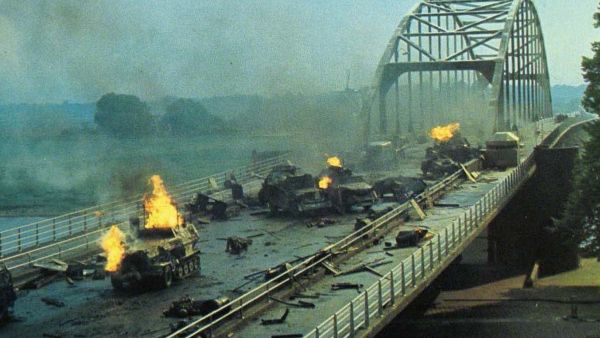
In September of 1944, in an attempt to land a finishing blow to Germany following D-Day, Allied forces launched Operation Market Garden, a bold offensive that would drop over 30,000 soldiers behind enemy lines.  The objective was to capture and hold three strategic bridges in the Netherlands, over which a massive column of British tanks would then roll straight into the Ruhr, the heart of Germany’s industrial complex.  Neutralize the Ruhr, and taking Berlin would be inevitable.  However, as with so many other simple plans in history, multiple factors led to the operation getting bogged down at the third bridge, and after massive Allied casualties, the offensive was abandoned.

Based on a bestselling novel by Cornelius Ryan (who also wrote the novel The Longest Day), the movie of A Bridge Too Far resembles the actual Operation Market Garden, not just in appearances, but also in its ambition, scope, and ultimate failure to achieve its goal.  However, as a pure combat movie, I give it credit where it’s due.

First off, look at this cast.  There had not been an assemblage of so many of Hollywood’s leading men since 1962’s The Longest Day (“42 International Stars”, that movie’s posters proclaimed).  Naturally, most of the actors are pitch perfect in their roles, with one glaring exception.  Whoever thought Gene Hackman was just the right guy to play a Polish general was either desperate or foolhardy, or both.  Hackman is a talented actor, without question, but his attempt at a Polish accent is a MAJOR distraction from whatever he’s saying.  Every once in a while, it even pulls a disappearing act, not that it matters.

ANYHOO.  The all-star cast.  To offset the lengthy running time, the story is told in semi-episodic fashion, which makes me wonder if someone hasn’t thought about rebooting this movie as a Netflix/HBO/streaming miniseries.  I’d watch it.  Within each of these episodes, it helps if we remember right away that Michael Caine is the leader of the tank column, Sean Connery is heading up one of the ground units, Anthony Hopkins is holding the bridge at Arnhem, and Elliot Gould is the cigar-chewing American trying to get a temporary bridge put together, and so on.  It’s a rather brilliant way of using visual shorthand to keep the audience oriented during its nearly three-hour running time (including an intermission at some screenings).

There is one “episode” featuring James Caan that has literally – LITERALLY – nothing to do with the plot.  He plays an Army grunt who has promised his young captain not to let him die.  After a grueling ground battle, Caan finds his captain’s lifeless body and, after improbably running a German blockade, holds an Army medic at gunpoint, forcing him to examine his dead captain for signs of life.  I read that, unlikely thought it may seem, this incident really did happen as presented in the film (more or less).  All well and good.  But what does it have to do with capturing bridges?  I’m sure the story is in the novel, but the movie takes a good 10-to-15-minute detour from the plot to follow this bizarre story.  Did director Richard Attenborough think we needed comic relief or something?  I remember liking that story as a kid, but watching it now…is it necessary?  Discuss amongst yourselves, I’ll expect a summary of your answer at tomorrow’s class.

I want to mention the combat scenes in A Bridge Too Far.  First off, I never served in the armed forces.  Well, never in combat.  I was in the Air Force for about a week.  (Well, Air Force boot camp in Oklahoma for about a week…LONG story.)  So, my observations of the combat scenes are less about historical accuracy and more about how they compare to other films.  While some of the combat portrayed is rightfully horrific in its own way – the river crossing in those ridiculous canvas boats, the slaughter of the paratroopers, the seemingly endless holdout at Arnhem – a lot of the combat, particularly the tank shelling and the skirmishes at Arnhem, is…I have to say, it’s kind of fun to watch.  There’s something, I don’t know, charming about it all.  It reminded me of how I used to play with my army men and Star Wars figures, or how I used to run around with neighborhood friends wearing plastic helmets and pretending we were “good-guys-and-bad-guys” while throwing dirt clods at each other and making fake explosion noises.  It was movies like A Bridge Too Far that shaped my young impressions of what wartime combat was like, and whether it was realistic or not was irrelevant.

Anyway, enough nostalgia.  Here’s the sad truth: A Bridge Too Far, despite its thrilling combat and all-star cast, falls short of delivering a truly meaningful war film.  There are half-hearted attempts to drum up some dramatic impact with scenes in a makeshift field hospital and a speech in Dutch from Liv Ullman wearing her best “isn’t-war-awful” expression, but for some reason those scenes fall flat.  (I did like the “war-is-futile” scene with that one soldier who runs out to retrieve the air-dropped canister, only to discover…well, I won’t spoil it, but it’s a good scene.)

After writing almost 1,000 words, I’m no closer to explaining why A Bridge Too Far falls short.  It’s still an entertaining watch, but I’ve really got to be in the mood for it.  It’s rather like reading a historical novel that isn’t particularly thrilling like a Crichton or a Clancy, but it does deliver some eyebrow-raising information.  It doesn’t hit me in the heart, but it does feed my brain.  Maybe that’s not such a bad thing in the long run, but if movies are about stirring emotions, I must say: A Bridge Too Far is no Saving Private Ryan.

(Sure, I probably could have just said that instead of writing this long-ass review, but where’s the fun in that?)


QUESTIONS FROM EVERYONE’S A CRITIC

Best line or memorable quote:
“Remember what the general said: we’re the cavalry. It would be bad form to arrive in advance of schedule. In the nick of time would do nicely.”

Would you recommend this film?  Why or why not?
Ultimately, I would recommend it to film buffs who have not yet seen it.  If nothing else, it’s an interesting time capsule movie.  This would be the last time for a VERY long time that anyone would attempt to make an epic film with a truly all-star cast.  …come to think of it, I can’t think of a major, epic drama since A Bridge Too Far with an actual A-list cast.  Can you?

THE BANSHEES OF INISHERIN

By Marc S. Sanders

You ever hear of the modern term “ghosting?”  Normally, it applies to social media, like with Facebook, Instagram and every other brain cell sucker app we occupy ourselves with on our electronic devices.  It’s where suddenly, for no reason at all, a friend or acquaintance will stop speaking to you.  They will ignore your attempts to talk.  If they do talk to you, they simply will say stop talking to me and do not call me again. They will never share a reason for this new perspective they have for you.  They just want to continue with their lives without you being a part of it.  I have been ghosted on two separate occasions.  It hurts.  It really hurts, and I constantly must remind myself not to dwell on these people.  They don’t care.  They lack any further regard.  It’s just unbelievably puzzling when it happens.

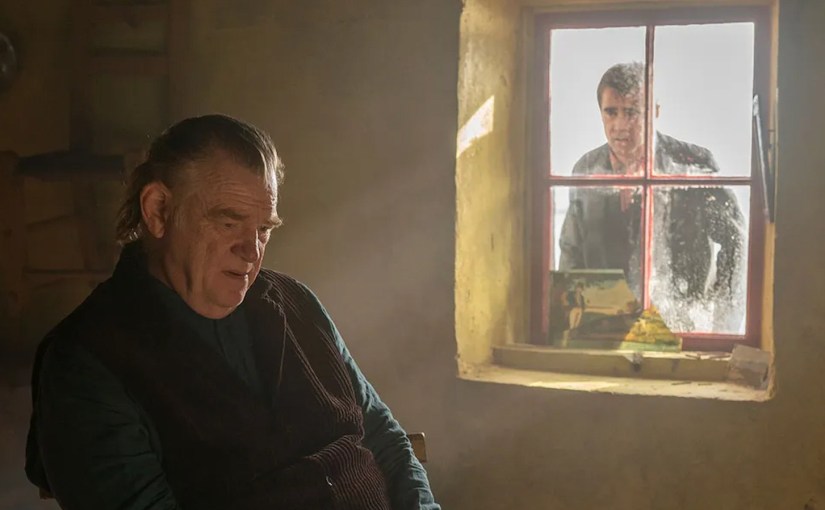
With The Banshees Of Inisherin, director Martin McDonagh reunites Colin Farrell and Brendan Gleeson, who shared the screen together in the well received In Bruges, to portray these two former friends.  Farrell plays Padraic.  Gleeson is Colm.  The film takes place in 1923 on the fictional Irish coastal island of Inisherin.  Padraic strolls over to Colm’s house to walk with him to the pub for their daily 2pm pint together while they chat.  Upon arrival, Colm is seen sitting in his home, ignoring Padraic’s knocks on the door and window.  It’s odd and unexpected. 

When Padraic shows up at the pub alone and later Colm arrives, the other regulars ask Padraic if the two lifelong friends are “rowing.”  Not to Padraic’s knowledge.  Maybe this is an April’s Fools joke?!?!

Colm holds true to his new position.  He explains to Padraic, with no uncertain terms, that he no longer wants to speak with him.  Padraic makes attempts to open up to Colm hoping they can hash this out, but there is nothing penetrating Colm’s stance.

What lends to the sustenance of the near two-hour film is the setting that Padraic resides within.  An island in the middle of nowhere where he has no interests or hobbies or specialties for anything.  He really has only happily lived with his friendship with Colm, which is now suddenly yanked away from him.  He lives well with his sister, Siobhan (Kerry Condon), and his adoring miniature donkey, Jenny.  Siobhan truly loves her brother, but not Jenny or the other animals who reside on their property.  As the Irish Civil War is coming to a close, an educated Siobhan is ready to move on from the nothingness of Inisherin.  Padraic is not.  He’s lived so comfortably on the Irish coastal island his whole life.

Colin Farrell is an actor you want to embrace in this film.  As I’ve experienced something similar to what Padraic endures, I can relate to what stuns him at his sudden loss of friendship.  Padraic is a good man.  Colm knows this which is seemingly why extremes needs to be undertaken to stress exactly how Colm feels about Padraic going forward.  Colm cannot simply plead for Padraic to move on.  He first makes the request.  Later, he has to do something else to deliver his point.  When I say extremes are taken, you can not even imagine what occurs.  It’s shocking, but believable. 

Brendan Gleeson normally offers an intimidating presence on screen.  He falls into roles of men you’d likely only cautiously approach.  The same goes for his character of Colm here.  McDonagh wrote the character with no compromise. Only when a significant turn occurs, does Colm violate his feelings with how he regards his former friend.

Kerry Condon should get an Oscar nomination along with Gleeson and Farrell. Siobhan is both a loving sister but while she’s the younger sibling, she is also the more sensible.  As Siobhan, Condon’s timing for losing patience in the part is well paced.  Condon is awarded with some of the best dialogue in the script.  McDonagh could have written this film from the perspective of her role, rather than Padraic’s, and I bet it would still work thanks to what she lends to the piece.

Barry Keoghan plays a young regular around Inisherin named Dominic.  Kind of like a local idiot who is undeservedly abused by his policeman father.  Keoghan’s role is a side story, but he plays it so well.  Despite Siobhan’s protests, Padraic takes Dominic in.  He’s not meant to replace the void that Colm left in Padraic’s life but it further reminds you of the kindness of Farrell’s character.  It begs the question why someone would ultimately stop speaking with a good person like Padraic, at a given instant.

My wife was not interested in watching this film and asked me to give her a rundown of what happens from beginning to end.  When you describe The Banshees Of Inisherin out loud, you sound ridiculous even though you’ve appreciated some of the surprising moments you just watched.  I told my wife; you have to see it to understand.  I understand Padraic’s yearning for the friendship he once had.  I understand the measures he takes in response to the one thing he valued beyond his sister and his pet donkey.  When you live in a low populated island town with little stimulation beyond the people who have been a part of your entire life, to suddenly lose that is devastating.

Martin McDonagh has crafted an unusual script.  Often, break ups in films go the traditional route of the loving relationship going through a split.  If it’s a friendship, I’d argue I’ve seen it occur more often between two women.  McDonagh’s film acknowledges the impasse among two grown men.  His script could have been occupied only with dialogue constructed of standard duet scenes between two very strong actors.  Fortunately, he doesn’t just rely on that.  McDonagh stretches his imagination further to drive home the point of how these two men respond to this unfortunate outcome.  The actions they take are startling, but as I reflect on the script for the film, I cannot deny how alert McDonagh is with crafting the motives of his characters. At the very least, I’m empathetic for poor Padraic who struggles with the loss of a friend. 

To lose a friend is to lose a part of your soul. What can I say? I’m an overly sensitive guy.  It’s always been my Achille’s heel.  How do I survive, though? I think back to what my father once told me.  He said “Marc, if you have one friend in life, then you’re the luckiest guy in the world.”  Thankfully, I’m rich in many friendships.

Forgive my digression though.  It’s important to know The Banshees Of Inisherin is a very good and a very sound film.

BABYLON

By Marc S. Sanders

Director Damien Chazelle has come a long way since his first major motion picture, Whiplash, a small film about a young, tortured drummer.  Since that accomplishment, he seems to get more and more elaborate with each project.  Babylon certainly exceeds ambition in any select 3–5-minute scene it offers within its grand opus.  The main title card doesn’t appear on screen until after the first thirty minutes and by then you are exhausted, yet completely awakened.

Babylon begins in the mid-1920s, during the pioneering times of Hollywood filmmaking where silent films were fresh and were regarded outlets for escapism and entertainment.  Big studios like MGM were not quite on the scene just yet and movie makers experimented with their films having no regard for rule and caution while constructing them.  On a busy day of shooting at around 3:15pm, an open field sword and sandal battle might turn up an extra in an accidental death with an impaled spear.  No matter.  Must keep shooting before daylight is lost and everything runs off schedule. 

It was at this time that a star like Jack Conrad (Brad Pitt), rugged with a square jaw and dashing with a pencil thin mustache, offered greatness in movie houses that showed silent pictures.  A new discovery like Nellie LaRoy (Margot Robbie) who seemingly came in off the street captured producers and patrons alike with her wide-eyed expressions and lanky, yet appealing posture.  These were the first celebrities of the advancing twentieth century.  They were starlets that brought people back and back again to the cinemas to witness battles of roman conquest or dancing on top of a bar while batting their long eyelashes for a mug at the camera.  The filmmakers loved to work with them. 

These performers ruled Hollywood until the Talkies appeared on the scene.  Movies with sound revolutionized the industry, but these famed individuals couldn’t keep up with the evolution.  Audiences and filmmakers couldn’t accept a compatibility.  Try to imagine a Jack Conrad listen to a packed movie house chuckle at one of his romantic speaking scenes.  It’s heartbreaking to watch.  He was admired, but now he’s a joke.

When the sun would set, the parties soaked–make that drenched–in orgy and debauchery would begin and nothing was off limits.  Naked women would happily get high and drunk and tossed over a large crowd.  Prop penises would be inserted into one partygoer and then another and then another.  Fat ugly men would happily accept getting urinated on.  Endless amounts of liquor and especially cocaine would be gulped and snorted and the greatest dares imaginable would always try to top themselves.  Have you ever heard of a party getting so out of control that someone would go so far as to wrestle a rattlesnake in the middle of the desert?  Jack happily watched all this decadence go down.  Nellie joyfully became the outrageously intoxicated and fearless ringleader. 

I have offered only a sliver of description for Chazelle’s over three-hour film.  To sum up, Babylon offers a hard-edged response to the family friendly interpretation found in Singin’ In The Rain.  Both films delve heavily into the transition of silent filmmaking to talking pictures and those who were left behind.  Gene Kelly and Stanley Donen’s G rated picture will have you giggle at their Lina Lamont with the squeaky voice and pratfalls who’s all wrong for the next phase.  The heavy R rated dramatic interpretation is offered in Chazelle’s script with Margot Robbie’s Nellie LaRoy and her Jersey accent, accompanied by unrefined posture and behavior.  Her drug binges are no help either.  Margot Robbie is fearless in her performance.  She is messy, sloppy, harsh and frenzied with her character.  One thing that came to mind as she is snorting line after line of coke is that at that time, there was no such thing as a means for rehabilitation like today.  No one was even looking out for the harm that drugs and alcoholic binging could have on people.  People were left to their vices to just drown in their poison of choice.  For silent pictures, you could plaster them in makeup and costume and let them mug and bat their eyes for the camera.  It didn’t matter if their speech was slurred.  Talkies required much more concentration of their performers.

The main player of the film is newcomer, Diego Calva, as Manny Torres.  A Mexican who inadvertently finds himself in the Hollywood nightlife while pushing an elephant up a steep hill only to get shit on.  (The elephant serves no purpose except to make an appearance at one of these crazy parties.)  Manny has an instinct for what’s to come in the movies and builds himself up into a studio executive.  While he’s dangerously falling in love with Nellie, he’s also discovering next big things like a Negro entertainer who’s magnificent with a trumpet, Sidney Palmer (Jovan Adepo).  Manny is a good man who swims above the dangerous life of Hollywood partying and decadence.  He’s an innovator that’ll never receive credit for what he uncovers.  That’s for the white executives to profit from.

A minor but welcoming story is Sidney’s.  He’s soon hung on posters outside movie houses, and performing with big bands.  Hollywood awards him with riches he could never imagine and never asked for.  However, ironically, his complexion comes off too white against some of his other band players and the idea of caking himself in charcoal makeup is insisted.  How will Sidney respond to this humiliating request? The wealthy also have a particular regard for him.  His status as an entertainer.  Do they see him as a showboat clown or the artist he values himself to be?  How does Sidney want to be considered?

With all of the parties and drinking and drug use to go around, Babylon goes off in a hundred different directions before it finds an even keel outline that switches storylines from Jack to Nellie to Manny and Sidney.  Chazelle strives to one up what other filmmakers before have attempted.  I could not help but think about Paul Thomas Anderson’s Boogie Nights which follows the porn industry in the late 70s and early 80s.  Happiness abounds until time and technology and constant self-abuse cause everything to unravel.  Babylon follows a very similar trajectory.

A friend of mine found Babylon too be overly gratuitous.  She’s not wrong, but while she took it as a complaint with the film.  I take how superfluous the movie is as a major compliment.  There are long scenes where Chazelle will not surrender for the audience.  He shows how drug raged Nellie is when no one will fight that rattlesnake by having her violently pick it up, swing it around and thus it will eventually latch on to her neck while she’s running around amid a gang of naked partygoers.  Then we get to see another starlet cut the snake off below it’s head, rip its fangs out of Nelly’s skin and proceed to suck the venom out.  Oh, you’ll squint and squirm through the whole scene.  What do we learn from this?  Drugs are bad.  Really bad, and they will delude you into acting with no vices or boundaries.  So, let’s be completely honest about it.

When Nellie is recruited for a talking film, we see take after take after take of her trying to make her mark while it is shouted over and over again to the crew to shut the fuck up.  There can be absolutely no noise from anywhere that the mikes can pick up and it doesn’t matter if a crewman is getting dangerously overheated in a soundbox.  (No air conditioning could be allowed because the hum would be picked up by the microphones.)  It’s a brilliantly, well edited, long and tortuous scene of flaring tempers, sweat, heavy light and stress.

I remember reading an interview with Henry Hill, the mobster who was the focus of Martin Scorsese’s Goodfellas.  Hill said with no uncertainty that the characters portrayed by Joe Pesci and Robert DeNiro were not even close to how frightening and violent their real-life counterparts were.  So maybe even Scorsese glossed over how harsh that world ever was.  Damien Chazelle is a relentless filmmaker with Babylon.  Nothing is whitewashed.  Most of what you see is shock value, but that’s the message he’s conveying and per his research he must be convinced the life of this era was actually this outrageous and way over the top. He’s certainly not forgiving with how manic these people lived, particularly with Margot Robbie’s character.

At the same time, he calms the film down to offer a harsh truth to a quickly becoming has been like Jack Conrad, Brad Pitt’s character, no longer in his prime.  Jean Smart portrays a gossip columnist reminding Jack that the height of his career is long gone, but fifty years from now, new generations will be rediscovering his achievements.  He will be a legend for all eternity.  Chazelle is speaking to us, those that appreciate what Turner Classic Films and other formats like videotape and DVD offer to see the first of these kinds of pictures where it all began with legends like Jack and maybe Nellie and especially Chaplin. Chazelle was an important student of this later generation.  This is the best scene of the picture with a magnificently written monologue, and I won’t be surprised if Jean Smart gets an Oscar nomination that no one ever saw coming.  I’m inclined to declare she should just get the award.  It’s such a telling moment for all kinds of movies.

Chazelle loves to make films.  The epilogue to Babylon demonstrates his affection as his story jumps to twenty years later, and an older Manny watches Singin’ In The Rain in a theatre. From what he inadvertently brought to the fold all those years ago, movies have evolved and continue to develop into bigger scales of what we could never have thought possible.  Chazzelle edits in a sequence where it started with silent films like A Trip To The Moon and Keystone Kops over to grand musical ensembles and adventures like Ben-Hur and then on to special effects with quick cuts of Raiders Of The Lost Ark, Terminator 2, and Avatar.  Flashes of color appear on the screen and then quickly cut back to these captions in celebrated films and film stock.  I don’t believe any of this spoils anything of the film, but I like to recognize how Chazzelle takes inspiration from Stanley Kubrick’s bewildering conclusion to 2001: A Space Odyssey.  Movies are going on and on and on.  Whoever is hot now and presently significant will have to adjust to an ever-changing industry.  Once celebrated puppeteers working for guys like George Lucas have no value in an age of computer graphic engineering.  Big box office stars might not be able to uphold their careers during a time of streaming films that come to us by means of our flat screen TVs we can affordably buy at Walmart.  Kardashian girls are more widely recognized than maybe a Jack Nicholson or a Meryl Streep.  (Someone I know had no idea who Carol Burnette is.)

It’s hard to sum up everything captured in a film this big and ambitious and yes, gratuitous.  Perhaps, the best I can tell you is simply that a hard truth to accept is that casualties come from discovery in a film like Babylon

THE WHALE

By Marc S. Sanders

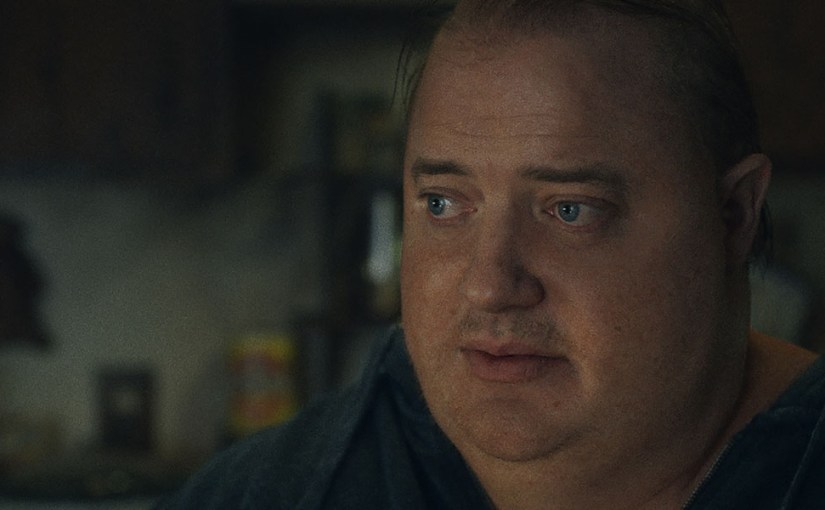
I still have a lot of catching up to do, but arguably the best performance by any actor in 2022 comes from Brendan Fraser in Darren Aronofsky’s The Whale, an adaptation of the stage play written by Samuel D. Hunter.

Fraser plays Charlie, an intelligent online writing professor.  His course is done online as he has become an enormously overweight recluse, following the loss of his boyfriend, circumstances to be revealed over the course of the film.  Charlie is so obese that he can barely walk, and he confines himself to the left side of his sofa with the television in front of him and his laptop nearby to conduct his courses or to pleasure himself with gay pornography.  He has a walker to get himself on to his feet and carry his bulk, but showering is not easy.  Even picking a key up off the floor is an impossibility.

He receives visits from his only friend, a nurse named Liz (Hong Chau).  When she arrives on Monday, she discovers that his blood pressure is indicative of congestive heart failure and urges him to go to the hospital.  He insists he can not afford the bills and has no insurance.  He also receives unwelcome visits from a young man named Thomas (Ty Simpkins) spreading the word of God with brochures from the local church.  Lastly, the visits Charlie treasures the most are from his cruel and mean-spirited daughter Ellie (Sadie Sink) who takes no reservations with berating Charlie as a deadbeat dad and only comes to him because she practically demands he write her essays to avoid dropping out of school.  She also rudely takes pictures of Charlie at any given moment.  Each time she raises her cell phone for a click, it feels like she is giving her father the harshest middle finger imaginable.

Much like an earlier film, known as The Wrestler, Darren Aronofsky explores what comes after the main character has tormented himself into a destiny difficult to escape or be rescued from.  Aronofsky is frank about offering up helpless souls only now living with everyday ongoing pain both physically and, as we discover, more importantly, mentally.  Highlights of Charlie’s day are when the pizza is delivered and he shouts through the door that the money is in mailbox.  The delivery guy knows the routine all too well by now and the best he can offer is to ask if Charlie is okay while never seeing his grotesque appearance.

Aronofsky doesn’t offer much variety on the surface.  The film takes place entirely in Charlie’s apartment.  Sometimes we go down the hallway and see another room or we get a conversation between Liz and Thomas on the front porch.  The cast only boasts seven actors.  Yet, Hunter’s screenplay is not limited to what Charlie is having to endure.  There is also an unexpected backstory to Thomas and there’s more to uncover with Liz and Ellie. The pizza delivery guy, who we never see, even discovers something.  One particular essay about Moby Dick that Charlie desperately urges Thomas to read out loud early on has a surprising significance that I didn’t see coming. 

Still, the film belongs almost entirely to Brendan Fraser and how he enhances the performances of his cast mates, particularly Sadie Sink.  Their scenes are so well performed.  She is an outstanding young actor working on a manic level.  I imagine Sadie Sink had to come down from the hyper activeness of her scenes.  She is uncompromisingly mean. When the director yells, there is no way she could just turn that characterization off.  I bet she walked away from the set to catch her breath.  Opposite her, Fraser’s character has no choice but to be more restrained.  Physically, it is hard for him to breathe and therefore speak at times at a high octave.  He cannot stand up very well and rush to embrace his daughter even if he wanted to try.  She is mean enough to challenge him though.  The outcome of that moment will have you hate her character for sure.  Yet, you don’t forget she’s a kid and her current state is a product of something else, perhaps from Charlie’s past misgivings.

Timewise, they are also on uneven playing fields.  Hunter’s script counts down the days as the top of some scenes depict it as Monday and then Tuesday and so on.  Charlie is running out of time and has a lot of hanging threads to tie off.  Ellie has an entire life ahead of her to name call and scream at him and hurt him, but Charlie cannot afford to upset someone and work on apologies later.  The best he can take advantage of right now is to appeal for all the wrongs he’s committed or been accused of.  Most importantly, can he fix his relationship with his daughter?

Liz is a health care professional by trade and knows what is best for Charlie, but likely also knows it’s too late and rather hopeless, considering his current condition.  So, it only makes sense to surrender to his needs by bringing him meatball subs and barbecue ribs.  What she is determined to do is to keep his daughter and ex-wife away from him.  It’s a conflict that Charlie has no choice but to allow.

Thomas is that last new person to ever enter Charlie’s life.  Yet, what is his gospel of God and salvation going to do for Charlie now?  Charlie can’t keep this kid from coming over, but is he really going to listen and take any of it seriously? 

Brendan Fraser’s performance is so limited to the setting of the film and the physical restraint of being a large man with no flexibility.  However, he provides so much in the pain his character has suffered long before the current week captured on screen.  It’s an astonishing achievement in acting.  Within the bulbous head depicted in so many closeups are tired eyes that have gone through so much like toiling with leaving a marriage in exchange for a homosexual relationship, and weakening a connection with his child.

Beyond the enormous weight he lives with, Charlie also lives with an unhealthy food addiction.  Just ahead of the last act of the film, Aronofsky is relentless in showing how Charlie responds to personal suffering, not physical, by drowning himself in enormous amounts of sloppy and messy food as Fraser guzzles everything into his mouth.  Charlie suffers from so much more than just being morbidly obese.  He could live with that.  It’s other moments and people and losses in his life that are hard to continue to live with.  The difficulty of those things is cursed upon by Charlie with uncontrollable amounts of food.  Some people who suffer with difficult matters might hide in bed all day or binge watch television for an entire week.  Some turn to drugs and alcohol.  Charlie binges on food.  He doesn’t love his food.  He only uses it to drown out his pains.

I imagine it’s hard to learn about people like Charlie who are held down by the challenge of extreme obesity.  They have become so physically large that they literally can not get up from their sofa without help and therefore never leave their homes.  Because they never go outside, we are unaware of people like this.  I once had a neighbor that I never, ever saw.  I could hear their TV in the apartment next door but I never saw them.  How is that possible?  Why is it that they never revealed themselves?  There’s a story there.  Maybe a terrible or uncontrollable dilemma.  Darren Aronofsky, Samuel D. Hunter and Brendan Fraser offer a glimpse into what goes on behind this closed door.  It’s heartbreaking. 

Maybe it is so tragic because of why Charlie is shown within his confines by Aronofsky, written within the circumstances that Hunter offers and most importantly demonstrated by Fraser as a man ready for his life to end.  If only he can resolve a final digression with his teenage daughter suffering from a pain of anger likely instigated by him. 

Again, Brendan Fraser’s performance is the best one I have seen this year, and with no doubt in my mind, he should absolutely win the Oscar.  This could go down as the best accomplishment is his colorful career. 

IT’S A WONDERFUL LIFE

By Marc S. Sanders

I have finally righted a serious wrong and watched Frank Capra’s It’s A Wonderful Life, and what a pleasurable experience it has been.  Reader, if this movie lover who gets hopped up on science fiction gobbley gook with laser swords and spaceships can watch an old black and white movie feeling sorrow for its main characters, and elation when the film finishes, then it’s easy to understand how timeless and impressionable Capra’s classic film truly is.

I recall when I had finally seen It Happened One Night, originally released in 1934 and arguably the pioneer of the romantic comedy genre.  I could not help but connect certain moments and pieces of dialogue to the films released while I was growing up, like When Harry Met Sally… and Bull Durham.  Those films took inspiration from Capra’s comedy with Clark Gable and Claudette Colbert.  Capra pioneered storytelling once again with It’s A Wonderful Life.  As my wife and I watched the movie late last night until nearly two in the morning, I said to her this is like Back To The Future.  My wife said A Christmas Carol.  Both true statements.  So perhaps while Capra was revolutionary with his own storytelling, he might have been adopting some inspiration from what came before as well.  Regardless, I applaud his approach.  Frank Capra is a tremendous gift to the cinematic medium.  If there was a Mount Rushmore for filmmakers, Capra would most certainly be sculpted alongside the likes of Hitchcock, Chaplin and Disney.

George Bailey (James Stewart) has big dreams of leaving his sleepy little town of Bedford Falls and building grand designs of skyscrapers while also exploring the world, beginning with Europe and Alaska and whatever else needs discovering.  Like any of us, our yearning for adventure and the destinies we wish for get interrupted. Before you know it, we ask ourselves if life has passed us by.  It takes a guardian angel named Clarence (Henry Travers) to remind George that life has been with him all along; maybe not the life he envisaged, but certainly a life of purpose and significance beyond just himself.

George watches as his high school chums go on to grand accomplishments that pay off in enormous amounts of wealth.  His younger brother Harry (Todd Karns) goes to college, gets married and becomes a celebrated war hero.  However, George remains in Bedford Falls offering loans to his fellow townsfolk that he can’t afford to honor with a business he inherited from his father.  To lend and support comes involuntary to George.  He’s just a good man. 

On the other end of the spectrum is the mean, wealthy miser Mr. Potter (Lionel Barrymore).  Barrymore plays Potter like one of the worst villains in the history of cinema.  An unforgiving, jealous wretch of a man.  His cruelty is long and unmatched, even if he is relegated to a wheelchair.  He knows how destitute George is, despite his unending generosity, but Potter won’t tolerate the admiration George receives.  To squash George’s stature, he’ll buy out his business.  He’ll make every effort to silence George Bailey’s influence.  Potter will even try to take George under his wing where he can maintain complete authority as a big fish in the small pond of Bedford Falls.  Yet, Potter’s never-ending wealth cannot crush the love for George’s humbleness and giving nature.

A favorite device of mine in movies is when the filmmaker can turn the story’s setting into a character all its own.  Examples of this are shown in pieces like Spielberg’s Schindler’s List where the use of thousands of extras and piles of rubble bring testimony to the atrocities of the Holocaust.  In James Cameron’s Avatar (which I just watched as a refresher for the just released sequel), an imaginary neon glowing planet awakens our senses, and we learn that its inhabitants form a symbiont circle with the plant life and animals that dwell there.  In many films, the time and place speak to the viewer.  Bedford Falls is a main character to the story.  Capra makes wonderful use of the Main Street where each business building quickly becomes very familiar as if we have walked into these small town structures a hundred times.  It hearkened me back to my time in Fair Lawn, New Jersey where I would accompany my grandmother on her daily errands to the bank, the kosher deli and the Woolworth’s.  Wherever she went, everyone knew Helen.  In Bedford Falls, the pharmacy with the soda jerk doesn’t look new to me.  It appears like I’d seen it a hundred times before.  Martini’s, the bar, felt like I knew every hob knobber in the joint.  I could smell the ink and feel the creak of the wooden floors in Bailey Building and Loan. 

The townsfolk are also assembled wisely by Capra.  An old man sitting on his porch at night takes in the flirtations that George and soon to be wife Mary (Donna Reed) exchange with one another.  This man represents Bedford Falls taking stock in what’s to come next for our protagonist.  The people in this town have a rhythm to their gatherings.  Capra offers a magnificent shot where the camera is overhead behind George, wearing his overcoat and hat, and the townspeople are facing him at the other end of the sidewalk.  They expect of George, but does George have anything left to give?  I can only see the back of Jimmy Stewart, but I know all too well the expression he’s sending to the people opposite him.  Look at the scene where they march over to George Bailey’s business demanding their monies back.  How one delivers a line followed by another is perfectly timed to James Stewart’s despair.  The ending is beautifully cut as these same folks come into George’s home to offer their sense of giving during a desperate hour of need for George. 

I always knew the story of It’s A Wonderful Life.   Years ago, I saw a stage production where Miguel portrayed George opposite his girlfriend in the role of Mary.  Yet, I was not familiar enough with the surprises that Capra’s film offers.  I just didn’t realize how much fantasy is embedded in the movie as Clarence is meant to be a naïve angel who has yet to earn his wings.  Seems a little too childlike for me on the surface.  I’ll admit I didn’t take to the angels represented as blinking stars early in the picture.  That’s hokey!  However, when Clarence is personified in the latter half of the film, Henry Travers brings a sense of clarity to the purpose of life when he forces George and maybe anyone watching the movie to imagine what things would be like had they never been born.  Reader, I think I’ve seen story adaptations like this on episodes of Family Ties and The Golden Girls.  In this movie, it becomes frightening as we realize the actions we take carry impacts with them.  Had George not rescued his brother Harry from a skating accident, what would have happened to a squadron of soldiers during the war?  Had George not had the nerve to dance with Mary at his high school dance, what would have happened to her?  Had George not existed, then he wouldn’t be available to lend monies to people and what would have happened to a beautiful collection of new homes that would never be erected?  These questions are incorporated into roughly a thirty-minute last act that remind you to appreciate all that you saw earlier in the film.  I want to say its cheesy, but Travers and Stewart really don’t make it that way.  The sequence comes through with forthright honesty from Travers, never going big or outlandish, and genuine anguish from Stewart who convincingly appears like he’s lost everything when earlier he felt like he had nothing. 

I read that Jimmy Stewart did this film shortly after returning from serving in World War II.  He was suffering from PTSD and much of the torment and agony that George exhibits was coming through naturally on film.  This has to be one of the all-time greatest performances on screen.  Jimmy Stewart’s timing in practically every scene of the picture is perfection.  He’s a wide eyed optimist with big enthusiasm to get his life going.  Then he transcends into a teasing flirt with the girl he was not expected to hook up with.  When George tells Mary he wants to throw a lasso around the moon and give it to her, I really believe he could do it.  We have Jimmy Stewart to thank for that.  Later, he’s unexpectedly frightening as he is on the verge of being charged with fraud and penniless.  Stewart is uncompromising in front of Donna Reed and the young actors playing his children.  When he kicks over the table with the train set and gifts, on Christmas Eve, it’s terribly shocking.  Sadly, it’s relatable.  A film from 1946 presents personal problems and struggles that exist today.  That is why It’s A Wonderful Life is such an important piece.  We struggle to live with our struggles.

Frank Capra’s film is necessary to remind each of us to never give up, no matter how hard it gets.  We have value.  We have importance to ourselves and to others.  We are loved.  Yes, it’s only a movie and it conveniently solves itself in its made-up fantasy.  However, those that enrich and occupy space in our daily lives are real and they are folks who depend on us for their fulfillment and happiness.  We are necessary to making their lives better and sustainable.  Reciprocally speaking, they are just as important to mine and your satisfactions.  It might be drippy to claim that Frank Capra’s film is a “feel good movie,” but I prefer to believe that the writer/director, along with Stewart, Reed, Travers and the rest of the company served a higher purpose. They demonstrate that we have all been blessed with an enormous gift filled with the riches of love and friendship that life absorbs and treasures. 

Happy Holidays!!

JEANNE DIELMAN, 23, quai du commerce, 1080 BRUXELLES

By Marc S. Sanders

You ever see a movie that feels like utter torture while watching it, and then when you have time to reflect on it later, you at least appreciate the message it delivered?  I guess this can apply to my experience with Sight & Sound’s recent selection of Jeanne Dielman, 23, quai du commerce, 1080 Bruxelles as the greatest film of all time; number one on their list of the best 100 films of all time.  This picture usurped other achievements like Citizen Kane (number one for close to five decades) and Vertigo (which held the top spot since 2012).

Chantal Ackerman directed this feminist film in 1975, produced in Belgium, about a widow named Jeanne Dielman (Delphine Seyrig) who lives a very mundane life.  The running time of 3 hours and 21 minutes positions a still camera depicting her everyday activity over three ordinary days.  We see Jeanne boil potatoes, prepare soup, and escort gentlemen callers behind her closed bedroom door.  One man per afternoon.  In the evening, her non talkative adult son Sylvain (Jan Decorte) arrives home and she serves him soup and dinner.  The viewer watches them eat their whole meal with Jeanne barely able to hold conversation with her son who remains mostly unresponsive.  After dinner, the sofa in the living room is unfolded into a cot for Sylvain to prepare for bed.  The following morning, Jeanne takes time to fold her son’s pajamas and shine his shoes.  Jeanne will then run errands like seeking out a particular color of yarn for sowing, or a button to replace on her coat.  She also waits for a colleague (maybe another woman in her line of work) to drop off her baby to be watched for a short period of time, before Jeanne’s next afternoon appointment with another gentleman.  After the appointment, she will fold up the little towel in the center of the bed for where her customer positioned himself.

This is a very tedious film to watch with little dialogue that is delivered in French with subtitles.  There is insight to be gained however, and as I reflect on the film, it mostly comes through in the deliberately long running time.  I believe Ackerman was attempting to make a viewer’s experience with the piece feel as lonely and mundane as the main character.  There are very few cuts in the film.  Often, for long periods of times, maybe as long as four or five minutes, we are watching Jeanne sit in a chair staring into space.  We will watch her walk down her hallway or across the street to the post office.  We will watch her button every button on her coat or house robe.  We observe her take a routine bath.  We see her peel potatoes.  We watch her enter the kitchen to find a utensil and then leave while turning off the light.  She’ll then return to the kitchen for something and turn the light back on.  Near the end of the film, she receives a package and has trouble with a knot while undoing it.  After nearly three hours of this routine kind of activity, I knew she would leave the room, walk down the hall, enter the kitchen, pull open a drawer and look for a pair of scissors. There is nothing special in any of this, but it remains in the final print to be witnessed.  Nothing you see in this film is enhanced with stimulating devices like dialogue, music cues, lighting effects, close ups or strategic editing.  Even the title of the film, Jeanne Dielman, 23, quai du commerce, 1080 Bruxelles, is very, very boring and ordinary.  We are simply watching how a lonely widow lives from day one to day two and on to day three.

I am one of four members of a movie watching group of friends who get together (hopefully once a month, if our schedules allow it) to watch three movies on a Saturday or Sunday.  One member selected this film out of curiosity with Sight & Sound’s notable recognition of late.  (We also watched Shane Black’s Kiss, Kiss, Bang Bang and Doug Liman’s Go.)  While we are watching these selected movies, we respond like any audience member should to a film.  We’ll laugh or scream.  We’ll comment in moments that seem appropriate and keep the mood lively.  Much commentary was tossed around among the four of us while watching Jeanne Dielman, 23, quai du commerce, 1080 Bruxelles.  At times we sounded like locker room boys.  On multiple occasions I told my good friend Anthony how much I hate him for selecting this slog of a picture to watch.  We even started to look for symbolism or inconsistencies in the film.  On several occasions, we see Jeanne enter the kitchen and there is only one chair positioned at the table.  She walks out of the room and when she returns there will be two chairs, only we never saw her or Sylvain bring in a second chair.  What could that mean?  Is this film suddenly going to reveal itself with a supernatural characteristic?  Could there be someone else in the house?  Will Sylvain and Jeanne have dinner at the kitchen table tonight, instead of in the dining room.  Is there something symbolic about this disappearing and reappearing kitchen chair?  I’ll save you the trouble, Reader.  It means nothing.  I could only draw that it is an error in editing or continuity.  Yet, that is where our minds would go to, as we absorbed these long moments of ordinary life.  Blame us for yearning for the quick fix that most movies offer.  We are simply weak, very weak, men.

Bear with me as I tell you that to watch Jeanne Dielman, 23, quai du commerce, 1080 Bruxelles is sheer torture.  To listen to a faucet drip into an empty tin pan or watch a strand of grass grow in real time is at least as entertaining.  Movies serve to make us laugh or cry or scream in fear and heighten our suspense.  Movies serve messages that we choose to agree or disagree with.  Movies teach us about a kind of person or industry we may never come across and movies allow us into the mind of an artist’s own imagination.  Movies can disgust us.  Movies can anger us, and movies are also there to frustrate us, like Jeanne Dielman, 23, quai du commerce, 1080 Bruxelles.

To think back on this film, I’m taken with Jeanne, the character, and what she ultimately does before the film concludes.  I’d never spoil the movie’s ending.  However, it stands as the most memorable moment in the picture.  It’s a scene I won’t forget and it certainly is the most eye opening.  Most importantly, it’s understandable having lived as a witness to Jeanne’s seemingly worthless and boring lifestyle. We’ve all endured boredom.  I’d argue at times we’ve all felt a lack of worth to ourselves and those around us.  I certainly have questioned my value on this earth more times than once.  Therefore, to really feel how hollow Jeanne is with whom she caters to each day, like an unresponsive son or gentlemen callers that lack loving affection while they pay for a quick tryst, a viewer must endure the long running time of the film.  It’s the most assured way to embrace the authenticity of Jeanne’s empty livelihood.  The most important element to Chantal Ackerman’s film is likely the running time.  How else to truly understand how mundane a lonely widow is than to live through a near full three days with her?  Therefore, Ackerman is successful in getting across what she wanted to with her film.

Credit should be recognized for the actress Delphine Seyrig.  To simply sit in a chair staring into space with a camera (likely positioned on a tripod) at the other end of the room and not break character for long periods of time requires extreme concentration and endurance.  To share a scene with another actor that does not respond to anything you are doing, is equally challenging.  Seyrig is a professional actress, whose career I’m not familiar with.  She has likely portrayed more stimulating characters with more hyperactivity in other pieces of work.  To bring a performance down to a level of this most extreme kind of monotony is certainly dexterous while requiring complete focus. 

I’ll likely never watch Jeanne Dielman, 23, quai du commerce, 1080 Bruxelles ever again.  I don’t need to.  I won’t gain anything new on a second or third viewing.  I won’t ever forget the film, however.  It stands apart from most other films I have watched because the construction of the piece is intentionally unexciting and the performances are deliberately ho hum.  There are people who live completely uninteresting lives, and it is certainly sad to acknowledge that.  Movies will tell me that a deranged man will kill people.  They will also tell me that heroes go searching for treasure or that employees have a desire to exact revenge on their boss.  Movies will demonstrate how families will love each other or how two people fall in or out of love.  Movies will also explain how sorrowful it is for a person to experience loss.  Movies will also tell me that people live within a mind that offers no self-worth while their heart beats and beats from one mundane and ordinary day to another.  The best example of that is Chantal Ackerman’s Jeanne Dielman, 23, quai du commerce, 1080 Bruxelles.  An admirable accomplishment for a film dependent on the study of a woman’s sheer emptiness. 

THE FABELMANS

By Marc S. Sanders

Often, coming-of-age stories are narrated through the eyes of the child on the cusp of becoming a teenager or a grown up.  It’s important you realize that I say through the eyes, however.  It’s what the protagonist observes that allows him or her to appreciate, and comprehend.  Steven Spielberg will tell you he came of age by learning how to make movies.  It stands to reason however, that he did not come of age by looking with just his eyes, but rather with his 8mm and 16mm cameras.  The Fabelmans is a fictionalized, loose interpretation of how the celebrated filmmaker transitioned from adolescence into young adulthood with dreams of telling stories with movie making inventiveness.

Sammy Fabelman (Gabriel LaBelle, the older version; Mateo Zoryan, the younger version – both performances are magnificent) is escorted for the first time to the movies by his parents Mitzi and Burt (Michelle Williams and Paul Dano) on a wintery New Jersey night in 1952, where he sees The Greatest Show On Earth.  For eight year old Sammy, what starts out as nervous fear of what to expect in a dark theater with a giant screen turns into exhilaration as a car does a head on collision with a locomotive.  Shortly thereafter, a series of eight Channukah gifts assemble a Lionel train set for Sammy.  It’s exciting to see it go around on an oval track.  It’s more electrifying to preserve it on film with a toy car driven by a Mordecai figurine crash right into the steam engine and the boxcars hitched to it.  That was Mitzi’s idea to capture it on film.  That way Sammy can get a thrill out of watching the accident over and over again without causing any further damage.

Sammy only progresses from there.  When Burt gets a job promotion, the family moves to Arizona.  The desert allows a teenage Sammy to continue with his love of filmmaking by shooting his family during the cross country trek and then making westerns and war films with his Scout Troop pals as the actors.  He sets up tracking shots by propping his camera on a baby carriage rolling along cardboard laid out on the ground.  Ketchup becomes blood.  Sammy is even inventive enough to poke holes in the actual film strip at precise moments when his sheriff and outlaws fire their six shooters.  Now it really looks like the cowboys are shooting real rounds of gunfire.  Mom and dad, his sisters, his teachers, and friends are all impressed. 

His Uncle Bennie (Seth Rogen) is also dazzled by Sammy’s natural talent.  Bennie is Burt’s best friend and co-worker, and per Mitzi’s insistence he moves to Arizona with the family.  By use of his camera and editing machine, Sammy will soon learn that Bennie actually means more to Mitzi than he does to Burt. 

With a script that Spielberg constructed with Tony Kushner, the director/writer depicts a kid, much like he was, who expressed his honesty and learned the truth about the people around him when his projector was on.  The camera doesn’t lie, ever.  A motion picture camera will even hold on to the final beats of a person’s pulse before they finally expire.  That one moment in time where there’s life and then suddenly there’s death can be eternalized on film, forever.  It’s through this storytelling device that allows The Fabelmans to stand apart from other coming-of-age films like Rebel Without A Cause or Splendor In The Grass or any of the John Hughes brat pack films.  The childlike quality yearning for adventure and fantasy shines through with Sammy’s westerns or John Wayne inspired war pictures.  Sammy also realizes though that he can pick up on real life and emotion with his 8mm, like on a family camping trip.

Michelle Williams gives an outstanding, sometimes ethereal performance.  It’s real.  She’s not doing fantasy.  Yet, she lives for the fantasy and adventure.  I recall a well known anecdote of Spielberg where he described in his youth, his father woke up the family in the middle of the night to watch the skies for a meteor shower.  (Watch The Skies was the original title for his film Close Encounters Of The Third Kind.)  In The Fabelmans, Mitzi enthusiastically takes her children in the car to pursue a tornado.  Later moments will have her dancing freely in her nighty in front of the car headlights while the family is camping; uncaring over the fact that her dress is see through.  Sammy will notice how awkward his father Burt feels, while at the same time seeing how enamored Bennie is at the sight.  Williams has a beautiful balance though of a woman trying her best to appear happy and collected for the sake of her children and husband, but not living the story she wants.  This will influence Sammy as he maps out his own future.  He’ll live the life he wants.  Learning the merits of algebra will never hinder his destiny to make movies.

Later occurrences will show evidence as to how well Sammy can capture reality with his camera.  Following a series of bullying and antisemitic teasing after the family transitions to northern California, Sammy is welcomed to shoot the senior ditch day at the beach.  A telling moment occurs when the film is shown at the prom.  The taller bully is overwhelmed by how championed he’s depicted in the film.  He’s bordering on furious with Sammy, though.  The mean kid knows he’s cruel to the scrawnier, Jewish Sammy, and it immediately eats away at him with guilt over his past treatment.  Sammy’s film has changed and disrupted this kid.  Another kid bully is shown to look like the jerk he is and nothing else.  He walks alone on the beach.  He’s not an athlete.  He’s nothing but a no talent, unlikable antisemitic jerk.  This kid is also changed because now he can see what he truly is as the viewer looking at his own cruel behavior shown on film for the whole world to see.  Movies will bring out what we harbor deep down, inside. 

Ironically, Sammy is so well versed with camera work and follow up editing that he is practically unaware of how durable his theme of honesty through the lens truly is.  What Sammy captures comes without even trying and it sends a raw emotion to the viewer, whether it’s a mean-spirited bully or even his own mother watching.

Steven Spielberg could never be anything else except a movie maker.  Yet, after over five decades he’s still introducing audiences to new kinds of accomplishments.  He started as a director with adventure and fantasy on his mind with the likes of monster trucks, killer sharks as well as swashbuckling treasure seeking and visitors from outer space.  Later, he had to reinvent his craft and think outside his fanciful dreams to show brutality and hope through horrifying moments in history like the abuses endured by black southern plantation dwellers, slavery, the Holocaust and the unglamorized harshness of war, political unrest, and terrorism.  Further on, he carried out the romance of stage musical performance and even learned to poke fun at his own past accomplishments.

In the short period of time that we get to know Sammy Fabelman, we see transfers of perspective in this young boy’s outlook through a camera.  Sammy goes from making silly mummy monsters of his sisters to intimate hand holding shared by his unhappy mother and the man she truly loves, a man who is not his father. 

Whether he is watching his own films, or it is his friends, or his mother, his father or even his tormentors at school, Sammy realizes that a film will always do one thing and never falter away from that one thing.  His camera will always, always, always tell the truth. 

Thankfully, a truly inspired epilogue moment, which left me with a big, enthusiastic grin, has Sammy still learning that as frank as his filmmaking may be, it’s important that it is also never boring.  I don’t think I have ever been bored with a movie made by Steven Spielberg.

THE WORST PERSON IN THE WORLD (Norway, 2021)

by Miguel E. Rodriguez

Director: Joachim Trier
Cast: Renate Reinsve, Anders Danielsen Lie, Herbert Nordrum
My Rating: 9/10
Rotten Tomatometer: 96% Certified Fresh Fresh
Everyone’s a Critic Category: “Watch a Film with Subtitles”

PLOT: The chronicles of four years in the life of Julie (Renate Reinsve), a young woman who navigates the troubled waters of her love life and struggles to find her career path, leading her to take a realistic look at who she really is.


I love “what-if” scenarios.  There is a whole line of comic books, Marvel and DC, dedicated to intriguing “what-if” questions.  What if Peggy Carter took the super-soldier serum instead of Steve Rogers?  What if Bruce Wayne’s parents had not been killed?  And so on.

Joachim Trier’s The Worst Person in the World is a what-if scenario for film geeks.  What if…Woody Allen wrote a romantic comedy about a woman in her 30s on a road to self-discovery?  And then what if Ingmar Bergman took a crack at the screenplay and decided it was too happy, so he added some material about death?  And then…what if David Fincher directed it on 35-mm film with the bare minimum of CG effects?

Julie (Renate Reinsve, who won Best Actress at Cannes for this role) is a 30-something woman who cycles through career paths before finally settling on photography.  She meets, falls in love with, and moves in with Aksel (Anders Danielsen Lie), a comic-strip creator and author in his 40s.  They are happy together, share deep conversations, discuss kids (he wants them, she doesn’t), and spend time with his family at their lake house.

But then one night Julie walks home from a business function with Aksel and, for reasons she doesn’t quite understand, crashes a fancy party.  Here she meets Eivind (Herbert Nordrum), a charming fellow with a broad smile.  They talk.  There is a clear connection, but they are both in committed relationships.  They decide they will not cheat.  But…what defines cheating?  Does drinking from the same bottle of beer constitute cheating?  What about sharing a secret?  What about smelling each other’s sweat?  How far this little game goes, I will not reveal, but it did not end where I thought it would.  Their meet-cute ends with them walking home in opposite directions, neither giving the other their last names so they won’t be tempted to search for each other on Facebook.  Will they meet again?  Don’t make me laugh.

The Worst Person in the World is brain candy.  I am on the record as stating that I have been, somewhat unsuccessfully, avoiding films with heavier subject matter over the years.  (I can think of no situation in which I would willingly sit and re-watch The Conformist [1970], for example, to see what I missed the first time I slept through it.)  However, over the years I have seen and reviewed some heavy films that were highly rewarding: Amour [2012], Incendies [2010], and Nomadland [2020], to name a few.  The Worst Person in the World is not quite as gut-punching as those other films, but it was intelligent and funny and startling in all the right places, and what more could you ask for in a romantic comedy/drama?

The David Fincher element I alluded to earlier comes from the visual style of the film.  Director Joachim Trier loves to include primary colors, especially white, in his compositions, which is apparently a big no-no when it comes to cinematography.  The result of this choice is that anything containing colors of any kind really <pops> on the screen, while lending a kind of antiseptic feel to some of the scenes, as well.  For some reason, I associate that combination of clinical distancing with popping colors with Fincher.  (The Girl with the Dragon Tattoo [2011] comes to mind.)

There’s also a celebrated sequence in which Julie, still in a relationship with Aksel but unable to stop thinking about Eyvind (especially after bumping into him again unexpectedly), conjures a fantasy in which she runs to meet him where he works while the entire world around her remains frozen in place.  The effects in this sequence are flawless, especially when you realize that the only CG effects were those removing visible supports that kept a couple of bicycles and human limbs suspended in midair.  Everything else was done 100% real, in-camera, with real people simply frozen in place.

The effect of this scene is magical.  It evokes that giddy period we (hopefully) all remember when a brand new love has taken hold of us, and the rest of the world goes on hold while we hold hands and kiss and share a sunset and talk and walk and kiss again and time stands still, or goes too fast, depending on your point of view.  The brilliance of this movie is that it evokes those glorious feelings…and the whole time, in the back of the viewer’s mind, is that reminder: “But they’re cheeeatiiiing…”

The movie’s title immediately made me think Julie was the titular “Worst Person”, and for a while it seems to be true.  She can’t decide on a career, she knows she doesn’t want kids with Aksel but can’t really explain why, she impulsively flirts with Eyvind, she writes an internet-famous/infamous article wondering how a woman can be considered a feminist if she engages in oral sex.  But after watching the movie, I don’t believe that’s the movie’s intent.  I think we’re supposed to see how other people, including myself, might make the mistake of thinking Julie is a terrible person.  On the contrary, she’s just as confused and inarticulate about relationships and feelings as I am, as any of us are.  As she breaks up with someone, she makes what might sound like an emotionally cruel statement: “Who knows?  Maybe we’ll get back together again in the future.”  But in reality, she’s just refusing to rule anything out.  Badly phrased?  Perhaps.  But she is being as honest as she knows how to be.

(I haven’t even discussed the sequence where Julie ingests some “magic” mushrooms and goes on a drug trip for the ages, involving cartoon characters, aging, a touch of body horror, and the kind of face painting you’ll NEVER see at a theme park.  The movie even pokes fun at the shock of some of this imagery by inserting a shot of a movie theater full of people visibly cringing…a neat bit of meta-humor/commentary on the value of shocking your audience.)

The Worst Person in the World is worth your time if you’re a fan of love stories that don’t pander in any way, shape, or form.  Director Joachim Trier has gone on record as saying it’s a “romantic comedy for people who hate romantic comedies.”  That’s about right.  Don’t look for a conventional happy ending or a conventional main character.  These are just people searching for connection, who even when they’ve found it, never stop looking.  For better or worse.


QUESTIONS FROM EVERYONE’S A CRITIC

Best line or memorable quote?
JULIE: If men had periods, that’s all we’d hear about.

How important is it to you to watch a film in its native language?
Very. But not always. For example, I would not have wanted to watch a dubbed version of The Worst Person in the World. However, I have no issue with watching a dubbed version of something like Akira [1988] or Spirited Away [2001]. It comes down to the medium. For live action, I feel it’s most important to know the precise meaning behind what the characters are saying, and it’s difficult to get that from watching someone’s lips not moving in synch with the sounds coming out of their mouths. However, with animation, I want to drink in the visuals as much as possible, and that’s not as easy to do when you’re trying to read subtitles.

Do you feel subtitles lessen the overall movie experience?
Not at all. Look at Tarantino’s Inglourious Basterds [2009]. In that film, subtitles were absolutely essential to the plot, especially the opening sequence at that French farmhouse. There are those who disagree, but that’s my opinion. (But don’t get me started on those who insist on watching English films with English subtitles on…that’s another story.)

GLENGARRY GLEN ROSS

By Marc S. Sanders

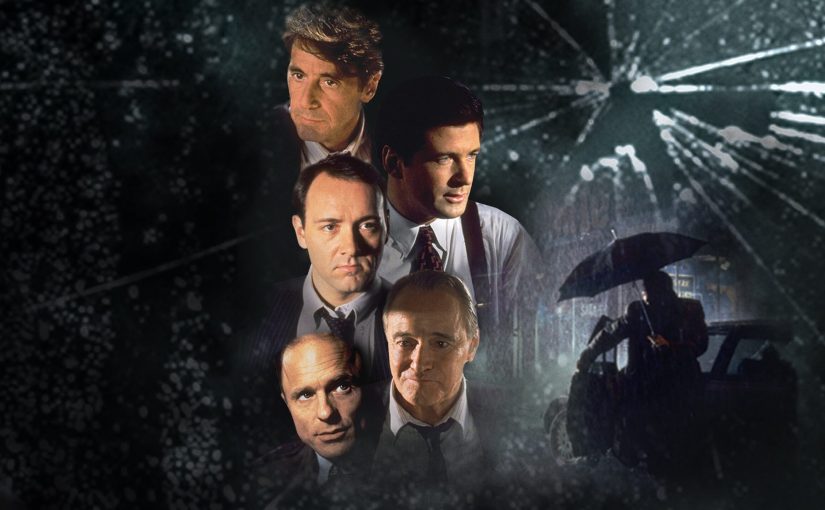
The characters in David Mamet’s Glengarry Glen Ross are under terrible pressure.  They are salesmen who are consistently chasing insurmountable sales goals in real estate properties.  One of them has an ill daughter in the hospital.  Another has a temptation to rob his office as a means of earning some fast cash.  Another is in despair of his self-worth.  To be a salesman, of any kind of commodity, is a tough life to lead.  The payoffs can be enormous when a sale is successful.  However, once a transaction is complete, the response is often “what have you done for me lately?”  These guys are never happy.  However, they are also some of the cruelest, most insensitive, and thoughtless people you will ever meet.  They have no other choice but to behave that way.  It’s the nature of the business.

The film adaptation of Mamet’s Pulitzer Prize winning play contains a collection of outstanding actors doing some of their best work.  They embrace the brutal dialogue the screenplay hands over to them with relentless cursing and flaring tempers.  Glengarry Glen Ross has you believe that you run your sales career on your own with little help or encouragement from the people you slave for. 

Early in the film, Alec Baldwin, known only as a man named Blake (based on the end credits) visits the office where these salesmen are based out of.  He delivers an unforgiving and harsh reality of what these men must do.  They either get their sales numbers high on the board, where they can win a new Cadillac, or they settle for a set of steak knives for second place.  After that, they are fired.  Regardless of where they currently stand though, they should not even be pouring themselves a cup of coffee.  Coffee is only for closers.  The office manager, known as Williamson (Kevin Spacey), only provides the men with sales leads that have already been exhausted with rejection and hang ups. 

Director James Foley does a wise technique with color.  The first half of the film appears in drabs of greens and greys amid an evening of torrential rain downpour.  Before Blake finishes his threatening presentation, he dangles new leads, the “Glengarry Leads,” in front of the men saying these are not for them, because they are only for closers.  The old leads that Williamson hands out are on green index cards, nothing flashy.  Blake’s leads are bright pink with a gold ribbon tied around them.  Foley makes sure that even a prop tells a story.

The salesman that gets the most attention is perhaps Shelley “The Machine” Levene played by Jack Lemmon.  He’s elderly and past his prime with no numbers currently on the sales board.  Frequently, he is making calls to the hospital for an update on his daughter who is due for surgery, but if he can’t make a payment, then the procedure is likely not to happen.  Lemmon is fascinating in maybe the best performance of his career.  Many of his scenes are toe to toe with Spacey as he shifts from pleading to demanding to disingenuously threatening and ultimately bribing Williamson for the new leads. Levene is so out of touch now that he can’t even sell Williamson on helping him out.  Spacey as Williamson is terrific in his defiance to not lend any sort of aid to Shelley.

David Mamet added additional material to the script, not found in the stage play.  The Blake character is new to the film, for example, and I think it is a better, more fleshed out story because of it.  As well, Foley is able to go outside of the reserved settings of the bar and office, as he follows Levene making a knock-on-the-door sales call in the middle of the rainy night to a family man.  This may be Lemmon’s best scene of the film as he weasels his way into the home to quickly get his raincoat and hat off and get a seat on the sofa as he begins his “once in a lifetime” opportunity that the potential customer may miss out on.  It’s a sales pitch, despite Lemmon’s charm, and the patron can see right through Levene’s performance.  As the door closes on Shelley, you’re terribly sad for his desperation and failure.

On the other end of the spectrum is the current, most successful salesman named Richard Roma.  He’s played by a showy looking Al Pacino who initially doesn’t perform in the broad strokes he’s become recognized for as an actor.  Pacino does a quiet, delicate approach to his character’s sales presentation as he shares a table with a sap (Jonathan Pryce) who is weeping into his liquor glass.  Roma stretches the rainy evening out in the bar with this guy, talking about vague anythings, until he can subtly pounce on him with a brochure that’ll get his signature on a contract. 

Two other salesmen, Moss and Aaronow (Ed Harris, Alan Arkin) vent their frustrations elsewhere in the bar as they eventually segue into an idea of burglarizing the office for those tempting new leads.  However, are they working together as a team on this idea, or is one working something over on the other?  Mamet’s dialogue is chopped up perfectly with utterances and interruptions, that before a character reveals his intentions, you are left flabbergasted.  What is demonstrated here is that a skillful salesman is also an efficacious manipulator.

The second half of the film is set on the following morning where the sunlight has come through.  New revelations following the stormy night from before will present themselves as the men gradually arrive at the office to find it actually has been robbed.  The obvious of circumstances are there.  However, Mamet sets up an ending that’ll leave you breathless.  It did for me the first time I watched the film.  Just when you think you are watching a protagonist throughout the film, something else entirely comes up.

Glengarry Glen Ross has been regarded as a modern-day Death Of A Salesman.  Maybe it is.  I’ve worked in this kind of field before. There were months where I was good at it, and like everyone else, I would brag about my success with recaptured anecdotes and celebratory curse words flying out of my mouth.  There were also months where I would gripe about how uncompromising this life is. When I didn’t want to do sales any longer, I spent twelve years as an assistant to sales representatives.  They are not your friend.  They are only focused on the next contract to be signed and booked before month end, and they will ask anything of you with a seething f-word attached to their request.    Are we so terrible if we can not make an unreachable goal with tools that offer no help and supervisors that lend no encouragement or forgiveness?  To be a salesman means that any of your past accomplishments or education do not define you.  You are only identified as the one who must acquire the next thing, and then the next thing after that.  It will change your attitude about yourself and how you treat others.  It’ll alter your dialogue which is so vitally apparent in Mamet’s story.  It will even influence you to take measures you never thought you’d be capable of.

James Foley enhanced an already electrifying script from David Mamet.  He knew that if he was going to show how hard and challenging it is to be a salesman of boring, uninteresting, and practically intangible parcels of land, then he was going to have to be relentless in the art direction and settings contained in the film.  The first half of the film never, ever lets up with the rain storm going on outside in the city street.  The evening is as black as can be, and yet Williamson casually will ask Levene if he is going out tonight. Who in the dead of night in the rain is going to want to talk to a droning salesman about anything?  Yet, that’s what is expected of this life.  The office setting is unfriendly, decorated with ideals that hang from the walls with phrases like “A man must embrace further than what he can reach.”  Little touches like this only add to the uncaring and selfish nature the men really have for one another. 

Glengarry Glen Ross depicts a hard life for the man in a suit.  You may dress like what is expected of a professional, but you are also always scraping the bottom of another bottom.  The cliché that money can’t buy happiness is personified in a film like this.  You may get to the top and score a nice commission, but it’ll soon be forgotten and nothing you’ve done before will lend to your current state.  Next month, someone else will be standing where you are standing.  Worse, you may never be standing on top again, and then what will you do?

Sadly, I believe that Glengarry Glen Ross reflects what many people experience at least at one point in their lives.  We are all salespeople to a degree whether we are doing a job interview or even trying to impress the parents of someone we are dating.  It doesn’t always work out.  The question is where do any of us go from that point.