AMERICAN SNIPER (2014)

by Miguel E. Rodriguez

DIRECTOR: Clint Eastwood
CAST: Bradley Cooper, Sienna Miller, Luke Grimes, Jake McDorman
MY RATING: 9/10
ROTTEN TOMATOMETER: 72% Certified Fresh

PLOT: Real-life Navy S.E.A.L. sniper Chris Kyle becomes the most lethal sniper in American history during four tours of duty in Iraq, but he finds it difficult to leave the war behind when he finally returns home.


I once called Katherine Bigelow’s award-winning The Hurt Locker the Deer Hunter for the Iraq War generation.  Having just seen Clint Eastwood’s masterful American Sniper for the first time, I must now amend my statement.  American Sniper presents its story concisely, almost tersely, states the facts of the matter, and leaves the audience to draw its own conclusions when the credits roll.  For myself, I was once again struck by the sacrifices of those men and women who have ever made, and will ever make, the choice to serve their country, for whatever reasons.

Chris Kyle’s reasons are made clear at the outset.  30-year-old Kyle (Bradley Cooper) is a skilled cowboy and rodeo rider when he decides to enlist in the military after seeing footage of the embassy bombings in 1998.  In a marvelously edited prologue (resembling a Scorsese film), we see Kyle’s father impress upon a school-age Kyle how people are either sheep, wolves, or sheepdogs.  Wolves attack the sheep, and the sheepdogs protect the sheep.  Kyle has lived his entire life with a sheepdog mentality and badly wants to do his part to protect his country against what he feels are the forces of evil.

Kyle enlists in the Navy S.E.A.L.s and, after a brutal training process, becomes a skilled sniper.  Shortly after graduation, he meets and falls in love with Taya (Sienna Miller).  The abbreviated exposition of their courtship and marriage contains little details that give a ring of authenticity that even The Deer Hunter lacks at times.  (After their first meeting in a bar, for example, Taya has to run outside and throw up after doing one too many shots.  Kyle follows and discreetly holds her hair back, as every gentleman should.  It’s the kind of scene you would normally see in a mid-level rom-com, but it feels as real as an autobiography.)

Kyle’s and Taya’s relationship at home is an important factor in the film, but the bulk of the story shows us Kyle putting his unique skills to use in Iraq, where he is sent shortly after the 9/11 attacks.  These scenes belong in some kind of war movie Hall of Fame.  Kyle’s first kills occur when he has to make a command decision whether or not to shoot a young Iraqi boy holding a grenade and running towards a US convoy.  The scene takes on an even more horrific dimension when the mother tries to pick up where her young son failed.  This horror is echoed in triplicate in a later scene when an even younger boy approaches an abandoned rocket launcher and appears ready to fire it at American troops.

Kyle goes on to much more “conventional” warfare later on (including a virtual duel between himself and another similarly skilled enemy sniper), but it’s scenes like the ones I mention above that elevate American Sniper into a masterpiece.  Watching them, I could not help but remember that this movie is based on a real person who went to real war zones during his lifetime.  I have no idea whether Kyle really did make those choices in real life, but the idea remains: whether Kyle did or not, it’s a foregone conclusion that someone had to make similar decisions at one time or another, not just in the Iraq War, but in other wars, many wars, ALL wars.  (I was perversely reminded of another superior war film, also based on fact, Jarhead, where the main character is also a sniper, except he never gets to fire his weapon in combat.  My respect for that character is no less profound.)

Speaking for myself, I don’t know if I have it in me to make that kind of call.  I have nothing but admiration and respect for those people who are making those calls every day in wartime, who are asked to put their lives and mental health on the line and do their duty no matter what.

Kyle’s compulsion to be a protector leads to his decision to become part of the teams “clearing” houses on the ground, as opposed to being the “overwatch” who protects them from the rooftops.  He sees too many squads being cut down by enemy soldiers inside the houses where he can’t see them from above.  “If I can’t see them, I can’t shoot them.”  One of his comrades disagrees with this decision.

“All these guys?  They know your name, and they feel invincible with you up there.”
“They’re not.”
“They are if they think they are.”

His decision puts him in even greater danger than before, but he can’t help himself.  Every death that he feels he could have prevented haunts him.  In another echo of another shattering war film, I was reminded of Oskar Schindler’s last scene in Schindler’s List when he breaks down thinking of how many more Jews he could have saved, instead of focusing on the ones he did save.  It’s impossible to say exactly how many lives Chris Kyle may have saved with his actions in Iraq, but in his mind, he was just doing the right thing, not the heroic thing, so he never felt comfortable accepting the title bestowed upon him by his grateful comrades: “The Legend.”

American Sniper is also very careful to depict the cost Kyle faced as the result of his job.  For one, the Iraqi insurgents put a $180,000 bounty on his head, making his job even more dangerous than it already was.  For another, he witnesses some things firsthand that would give Quentin Tarantino nightmares.  At one point, he tracks down an Iraqi enforcer nicknamed “The Butcher” who uses a drill to punish anyone who collaborates with American soldiers.  When Kyle raids his compound, he finds a freezer full of the Butcher’s “souvenirs.”  This is all on top of the various times he sees his teammates cut down by enemy fire, sometimes right in front of him.

The other cost comes during the brief periods at home between tours.  He loves his wife and children, but he finds it impossible to share the details of what happened to him in Iraq.  This reticence threatens his marriage to the point where Taya tells him flat out: “If you leave again [for another tour of duty], I don’t think we’ll be here when you get back.”  This kind of plot point is hardly new, but again, there is a ring of truth to it in this movie that makes it much more poignant than it normally is.  Kyle’s internal code can’t allow him to let someone else go to a war zone and do a job that he is eminently more qualified than anyone else to do.  “I have to serve my country.”  And that’s that.

(The film does have one drawback that compels me to score it as a “9” instead of a “10.”  There are scenes later in the film depicting more of Kyle’s troubles at home and as he speaks to a psychiatrist who recommends he go down to the VA and meet with disabled veterans as a way of “saving” soldiers without being in combat.  While these scenes are invaluable in terms of shedding even more light on Kyle’s character, even this late in the film, I did feel like there could have been a little more time spent with Kyle and those veterans so we could flesh that issue out just a little more.  There’s much more to it than could possibly be explored in just the last fifteen minutes of a movie.  I’m not saying it should have become Coming Home, but…that’s my opinion.)

In the event you don’t know Chris Kyle’s ultimate fate, I won’t spoil it here.  I had forgotten about it, and when the movie sprung it on me, it was as surprising as any other plot twist I can think of.  American Sniper proved to me, as if it needed proving again, that the people in our armed forces, especially those in combat zones, face unthinkable decisions, sometimes on a daily basis.  The morality of those decisions can, and will, be debated from now until such time (God willing) that armed forces are no longer necessary in this world.  This movie doesn’t pass that kind of judgement.  It merely says, “Here is what happened.  What do you think about it?”  How you answer that question is what the movie was really about.

THE LOST WEEKEND (1945)

by Miguel E. Rodriguez

DIRECTOR: Billy Wilder
CAST: Ray Milland, Jane Wyman, Phillip Terry, Howard Da Silva
MY RATING: 8/10
ROTTEN TOMATOMETER: 97% Certified Fresh

PLOT: The desperate life of a chronic alcoholic is followed through a four-day drinking bout.


I don’t drink.  Like, at all.  I’ve never taken drugs, and I’ve never smoked a cigarette.  Luckily, I have never been gripped in the throes of a crippling addiction, unless collecting movies counts as an addiction, in which case I plead the fifth.  I say this, not to brag, but because a lot of my first impressions of Billy Wilder’s The Lost Weekend are tinted by the fact that I don’t know the first thing about being drunk or what it means to suffer from an addiction so crippling that it would force me to hang a liquor bottle outside my window to hide it from my brother.

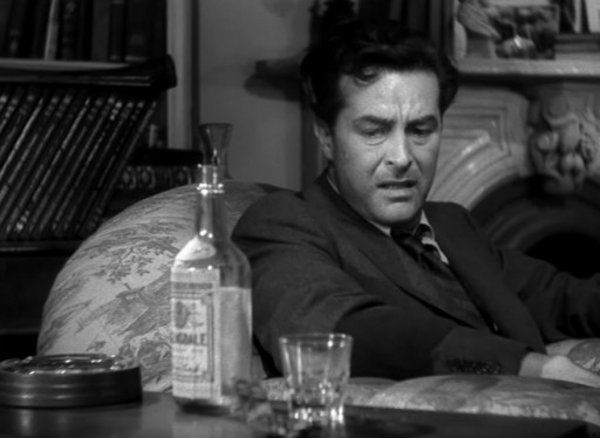
As it happens, Don Birnam (Ray Milland) DOES suffer from this kind of mid-to-late-stage alcoholism.  We first meet Don as he and his brother, Wick (Phillip Terry), are packing for a long weekend to get away from everything and everyone, including alcohol.  Don is a would-be author who needs a break from…something.  (Whatever he went through is never specified, only hinted at: “It’ll be good for you, Don, after what you’ve been through.”)  Don’s plan to surreptitiously pack the hidden bottle of liquor falls through after the arrival of his almost unbelievably good-hearted girlfriend, Helen (Jane Wyman).  No matter.  He still has a plan, which he confides to the long-suffering but increasingly annoyed bartender, Nat (Howard Da Silva).  He’s bought two bottles of rye.  He’ll hide one badly in his own suitcase and another in his brother’s suitcase.  When Wick discovers the badly hidden bottle in Don’s suitcase, he’ll chew Don out, Don will act suitably contrite, and Wick won’t think about searching his OWN suitcase for a second bottle.  What could go wrong?

During these first few scenes, when Don lies and lies and drinks shot after shot in a bar and winds up missing the train for his getaway weekend, I found it difficult to sympathize with him.  Oh, he’s clever and loquacious when he’s either about to drink or while he’s drinking.  He has enough knowledge to quote Shakespeare at the right times and wittily proposes to Nat the bartender: “I wish I could take you along, Nat.  You and all that goes with you.”  Under the right circumstances, Don is a fun guy, always good for a laugh…until his seventh or eight or ninth shot of bourbon.  Then the other Don shows up, Don the drunk, Don the liar, the Don who gets so desperate for cash that he’ll walk 70 or 80 New York City blocks trying to find an open pawn shop so he can hock his typewriter for drinking money.

For some reason, it was harder for me to empathize with Don Birnam than it was to empathize with any of the main characters in Darren Aronofsky’s Requiem for a Dream (2000).  In that film, not a single leading character escapes the ravages of addiction, and yet even as they made their mistakes, I empathized with them and grieved when their bad decisions made things worse and worse.  With Don Birnam, however, every bad decision he made just made me like him less and less.  I remember thinking at one point, “He’s brought this all on himself, he deserves what he gets.”  Not a very Christian attitude, but I’m not gonna lie about it: that’s what I felt.

And his girlfriend, Helen…wow.  It’s almost like she needs as much of an intervention as he does.  She loves Don so unconditionally it’s almost unbelievable.  What’s the attraction?  Perhaps it’s symptomatic of the era in which The Lost Weekend was made.  She discovers Don’s alcoholism late in their 3-year dating relationship.  (What did people think in 1945 of someone who dates a man for 3 years?)  Instead of breaking up with him or giving him ultimatums, she devotes herself to “fixing” Don.  Not precisely the course of action I would recommend myself in today’s world, but there you have it.

Director Billy Wilder presents this first half of the movie in a very uninflected tone with little-to-no comic relief.  This flat tone becomes very effective at simply presenting the information without directly commenting on it one way or the other.  There are moments up to this point where the movie seems to side with Don (his struggle to find a bottle whose hiding place he’s forgotten is particularly pathetic), but it’s still not really passing judgment or giving him a pass.

And then…the turning point.  Don accidentally falls down a flight of stairs and knocks himself out after finagling some drinking money out of a young lady he flirts with at his favorite dive.  When he wakes up, he’s lying in a bed in the Alcoholic Ward of the local hospital, face to face with one of the strangest characters I’ve ever met in a Billy Wilder movie, and that’s saying something.  He’s a nurse.  “Name of Nolan.  They call me Bim.  You…can call me Bim.”  The closest I can get to describing Bim’s weirdness is to imagine an evil Waylon Smithers from The Simpsons as a male nurse.  On quaaludes.  To Don’s slowly increasing discomfort, Bim lovingly describes what Don is in for during his stay on the Alcoholic Ward, giving the inside scoop on the various repeat offenders and what to expect during his D.T.’s: “You know that stuff about pink elephants?  That’s the bunk.  It’s little animals.  Little tiny turkeys in straw hats.  Midget monkeys coming through the keyholes.”  This Bim…he has NO bedside manner, man.  “Prohibition…that’s what started most of these guys off.  Whoopee!”  (Nice little social commentary there…classic Wilder.)

Don manages to find his way home once again, having not had a drink for almost a day-and-a-half, if my memory is correct.  And it’s at this point that the movie, Billy Wilder, and Ray Milland finally got me in Don Birnam’s corner.

SPOILER ALERT, SPOILERS COMING.

Don finally has a bout of the D.T.’s.  It’s not turkeys or monkeys or elephants, though…it’s a rat.  A single rat chewing its way out of the wall in front of him.  Then, out of nowhere…a bat finds its way into the apartment and flutters around the room.  Don is understandably distressed.  But then the capper: the bat swoops down to where the mouse’s head is poking through the hole, there is a terrible squealing sound, the bat sort of trembles and scuffles…and a stream of thick blood starts to dribble out of the hole where the bat is presumably chewing the rat’s head off or something.

To say I was surprised is an understatement.  Don starts screaming his head off…and at long last I finally empathized with Don’s situation, and I no longer wanted him to wind up penniless and/or alone and/or dead.  I wanted the movie to find a way to fix him, like Helen tries desperately to do through the entire picture.  From then on, I was on his side, or Helen’s side, or whoever’s side, it didn’t matter, as long as he figured out a way to get out from under the disease that was slowly killing him.

I would not dream of revealing exactly how the movie ends.  It might go the way of Leaving Las Vegas (1996).  Or it might go the way of the vastly underseen Duane Hopwood (2005), featuring David Schwimmer as an alcoholic father on a path of self-destruction, but who manages to turn things around.  (Sorry if I spoiled that for you, but I’m betting it’s not a movie most people will want to seek out.)  I will say that it’s the ending of The Lost Weekend that really showcases the era in which it was made more than anything else.  But it could just as easily have gone the other way and still been just as successful.

The Lost Weekend cleaned up at the 1945 Oscars, winning awards for Best Picture, Best Director, Best Actor, and Best Adapted Screenplay (it was based on a novel).  At the time, it was the most unglamorous movie ever made about alcoholism.  Up to that point, drinking in movies rarely if ever led to hangovers and the D.T.’s and spending the night in the Alcoholic Ward.  It certainly belongs to be mentioned with Wilder’s greatest films.  But you’re gonna wanna watch something a little lighter afterwards.  Stalag 17, maybe.  Or Some Like It Hot.  A laughter chaser.

SHE SAID

By Marc S. Sanders

I get high off movies about journalism.  All The President’s Men and Spotlight are at the top of this pillar.  The main characters seem to be moving a hundred miles per hour even if they are reserved to their cluttered desks and phones, or if they are talking delicately, and slowly, with empathy as they carefully approach a potential, yet frightened source.  She Said is a 2022 film about how the New York Times reporters, Megan Twohey and Jodi Kantor (Carey Mulligan, Zoe Kazan), exposed the systemic process of sexual harassment and rape that was running rampant through Miramax Films.  The accused was always its CEO, Harvey Weinstein.

It’s extraordinary that this film got produced so soon after the MeToo movement and Weinstein’s downfall occurred.  All of it seems like it just happened yesterday.  In fact, Harvey Weinstein is still going through court procedure and trials for sexual crimes he’s accused of that occurred in London, New York and Los Angeles.  There might even be more locations.  New developments hit the internet all the time.  This guy just never stopped.  So, there’s much for the courts to process and try.  This was a terrible black eye, not only for Miramax’s reputation (at the time owned by Disney), but on the entire film industry in Hollywood.

She Said explores not only Twohey and Kantor’s relentless pursuit of the truth and various descriptions of Weinstein’s method with young women, but also how corrupt non-disclosure agreements (NDAs) were used.  The NDAs contained unreasonable demands for hush money provided.  Mandates such as speaking with a therapist or other professionals and close-knit relatives were never allowed lest they suffer consequences.  The victims would get paid, but would also be denied of a copy of the contract, and thus Weinstein found a way to allow his constant grooming and sick pleasures of perversion to carry on. 

The reporters concluded that these victims had no money or resources to stand up to the kind of bullying and harassing that Weinstein’s power exerted.  Quitting or getting fired for fighting for their rights or just refusing his advances left these women out of an industry in which they were trying to elevate their careers.  They lacked proof of the occurrences.  They had to fight a he said/she said scenario.  They were victimized by a man who associated with some of the most powerful people in the world.  It happened to known actresses like Rose McGowan and Ashley Judd (who plays herself in the picture).  It nearly happened to Gwyneth Paltrow (providing her own voice on the phone) as well.  Even worse, it happened to women who didn’t even have the luster of celebrity brand name recognition to help them in their cause.    Nevertheless, it practically destroyed McGowan’s reputation in Hollywood altogether as she was labeled a crazed pariah for declaring her truth.  The tolerance and strategic payoffs were perhaps just as overwhelming as the attacks by Harvey Weinstein.  (Forgive me, I say perhaps because there is no way I am qualified to empathize, measure, or relate to what these victims endured or continue to survive through.)

Maria Schrader’s film does a good job at explaining the risks these reporters take.  A brief prologue shows Megan Twohey getting death threat calls for her write up of Donald Trump’s accusations of sex crimes.  A very convincing Trump vocal impersonator even calls her to tell her she’s a disgusting human being and how he must be innocent simply because he does not know any of these women.  Reader, it bears repeating that many rapists and harassers never know their victims.  When Twohey teams up with Kantor, the intimidations don’t stop and their supervisors and editors in chief (Patricia Clarkson, Andre Braugher) lend support.

Paltrow’s ex-boyfriend, Brad Pitt, was a producer on this film and it’s gratifying to see him lend the support.  I recall reading how he confronted Weinstein following attempts of harassment upon Paltrow shortly after they began dating and making the film Seven together.  Looking back to those years of the mid-1990s, I’d argue that Pitt and Paltrow were taking enormous risks with their careers.  They were just becoming marquee names. Yet, they could have still been ruined within the industry.  This is an environment synonymous with putting blinders on to systemic offenses that occur while lending praise to those that’ll eventually grant them potential Oscar winning roles or twenty-million-dollar paychecks.  

When Matt Damon, Ben Affleck, George Clooney, and Quentin Tarantino say in interviews that I’ve seen that they had no idea what was occurring with Harvey behind closed doors, my reaction has always been skeptical to these claims.  At one point in this film, Twohey and Kantor refer to Harvey’s antics as the worst kept secret in Hollywood. It is sad to say that these marquee names will always owe their careers and success to Harvey Weinstein, criminal rapist or not.

I do have some reservations with She Said, though.  Often the reporters are typing and quick close ups or glances at their monitors are edited into the film, but I can’t read what they are documenting, and I believe the film was assuming I could.  At one point, Braugher’s character announces that Weinstein spoke to Variety magazine and another competitor to share his side of the story and declares “This is bad.”  Yet, we never find out what Weinstein said, and we just get the “Oh shit!” expression from Twohey and Kantor.  Why leave us in the dark on subjects like this?  Why is this so bad? 

The film is fast paced, but many of the scenes are identical to prior ones.  As the reporters speak with victims, they break down their own story.  I believe Weinstein practiced a similar method each time, but the dialogue in these accounts seems redundant.  I get that we are to understand how excessive his predatory actions were, but I was hoping for fresh angles to their ongoing investigation.

The cast is spectacular, particularly Mulligan and Kazan who make a great pair. I really like the dialogue written and delivered by Andre Braugher.  I always thought I don’t see that actor enough in films.  He’s sensational in everything he does, and he carries a real strength to his authority in the New York Times offices.  A championing moment occurs when he cuts in on Harvey’s call with the reporters to give an ultimatum and hangs up.  He just told Harvey, “ENOUGH ALREADY!”

She Said relies on prior knowledge that you must have before watching the film.  You must know who Harvey Weinstein was and the large space he occupied within Hollywood and the film industry.  You need to know who these actresses were, and you have to be familiar with the overwhelming female response to Donald Trump’s agendas which set up the picture.  Unless you’ve been hiding under a rock, it’s hard not to be aware of what’s occurred in the last 5-6 years. 

However, as this film is discovered by future generations, long after Weinstein and Trump, and these victims are passed on, future generations like our children’s children may not fully understand the terrible conspiracies that transpired. 

She Said is a good movie and it holds significant importance.  However, I imagine the book written by Twohey and Kantor provides more details and exposition that I wish the film adaptation offered.  The pace and performance of the picture work very well.  I’m just afraid the script relies a little too much on assuming we know the whole backstory as the film carries on to its triumphant ending.

Watch it anyway, though.  It’s a bravely daring film to say the least.

THE LOST WEEKEND

By Marc S. Sanders

Ever wonder why I write so many reviews?  It’s because I yearn to be a successful playwright/screenwriter.  I’ve directed three original plays that I’ve written over the years.  I will be directing a fourth for the holiday season later this year.  Had a few short plays I wrote performed locally as well.  Still, I suffer from a terrible ordeal that often grinds me into bouts of depression and internal rage.  Writer’s block! 

My father always told me that he stayed away from gambling and casinos. He said it was because he could have an addictive personality and he was not confident he could stop if he started.  I know what he means.  I have an addiction.  One that’s not commonly recognized, but I obsess over something every single day. Without fail, every damn day.  It’s my weakness.  Sorry.  I must keep that to myself, though.  Yet my pursuit of what preoccupies my mind taxes on my motivations to write and stretch the imagination needed for churning out one script after another.  So, a remedy is to write about movies that speak to me in lieu of my next great play. 

Billy Wilder’s Oscar winning drama The Lost Weekend demonstrates a writer’s inability to exercise his talent when an endless need for alcohol consumes his every waking moment.  Ray Milland delivers an Oscar winning performance as Don Birnam, an alcoholic wannabe writer of the worst kind.  When Wilder’s film opens, Don seems healthy and spry.  He’s clean shaven, well dressed, and ready to pack a bag for a weekend getaway that his brother Wick (Phillip Terry) has arranged for him along with Don’s girlfriend Helen St. James (Jane Wyman).  Wick implies to Don that this trip is just what his brother needs after what he’s recently been through, and he’ll have his typewriter with him to write in calming solitude.  Eventually we get an idea of what Wick has been referring to as Don attempts to sneak a bottle of rye that is strung outside the window of his New York apartment.  Wick catches Don in the act, pours the bottle down the drain and assures him that he won’t find another drop of liquor anywhere.  He doesn’t even have money to go to the corner bar.  So, Wick and Helen leave Don alone for a few hours before it’s time to depart. Don gets ahold of some cash though, and thus begins a spiral into a drunken binge over a four-day weekend.

I read that when this film was released, test audiences laughed at it.  I guess in 1945 people were not attuned or prepared to witness an account of a very real disease like alcoholism.  I’m not certain it was even diagnosed as a disease at that time.  Surely, the addiction was an ailment though, and Billy Wilder uses some effective cinematic devices to demonstrate the journey into madness and desperation for even just a tiny shot glass of gin or rye. 

A repetitive device is to show a tormented performance from Milland within the shadow of bars or fences.  He’s trapped in his own need for swill.  A telling moment occurs when Don is desperately trying to pawn off his typewriter just for some money to buy more alcohol.  Every store in the city is gated and closed on this particular Saturday though.  It’s the Jewish holiday of atonement for past sins, Yom Kippur.  I found that little detail to be interesting.  Surely, it’s a sin to harm yourself whether by alcohol or suicide, for example, and the holiday is a time for speaking to your inner self and Hashem (G-d) for your past transgressions.  Yet, that is no matter to Don.  He’s not ready or wanting to climb out of his dark hole.

Inanimate objects or props are also given much focus.  Early on, Don is seen at the local bar and Billy Wilder brings an inventive visual to explain just how much this character has consumed in under two hours.  The camera focuses on the wet rings on the bar top left by Don’s shot glass.  First there are two rings, then four and soon, fifteen.  Wilder also zooms his lens into the very bottom of the small glass filled with liquor to show how much the audience will drown in Don’s despair over the course of the film.

Other props also work towards Don’s paranoia such as a ceiling lamp bearing the shadow of a hidden bottle.  Milk bottles left in front of his apartment are not collected from one day to the next showing the passage of time for this weekend, and how even the most basic chore is dismissed so Don can extend his stupor.  A lady’s unguarded purse offers temptation.  A tossed lamp shade seems to glare at Don like a hole that he’s in, as he gets weaker and weaker. 

A magnificent scene, one that I can envision a skilled director doing today with quick cuts on digital film, occurs as Don recalls sitting in a crowded opera house watching the toasting scene of La Triviata; one of the most recognizable operas of all time.  Don is one of many in the audience, and yet he’s the only one alone with the production’s props of various drinking glasses and champagne bottles being used on stage that are mere inches away.  Very quickly into the scene, Billy Wilder skillfully draws focus from the opera singers and diverts towards the immense amount of liquor adorning the stage and the cast with quick cuts of Don salivating and perspiring alone in a chair of a crowded theater.  Everyone else is watching the performance.  Don is gazing at the alcohol.  I wouldn’t be surprised if Martin Scorsese had much admiration for such a sequence.

Phillip Terry is very good in his performance.  I’m surprised he’s not promoted as much as the other two stars of the picture.  Wick cares for his brother, but he’s ready to give up on him after six years of this ordeal, with one more transgression played out. He’s exhausted from lying to cover for Don’s weakness.  He represents the outsider of the dilemma who’s been affected by someone else’s ailment. Jane Wyman as Helen serves a nice purpose as well.  The one last hope for Don.  She’s the only one left who holds on to the faith that she can pull Don out of this nightmare.  Wilder presents these characters as side effects in the Oscar winning script written by him and Charles Brackett. 

Another haunting, but effective dimension comes when Don finds himself in the alcoholics’ ward at Bellevue Hospital, shot on location, and the first film to ever do so.  With an eerie use of a theremin in the soundtrack from Miklós Rózsa, Don is surrounded by dark shadows and tormented victims suffering from drying out just like him.  A nurse explains that he still has the DTs to experience like envisioning being surrounded by horrifying images like bugs crawling on him or something comparatively worse.  I recall from childhood seeing this symptom used on an episode of M*A*S*H.  Wilder invents his own kind of imagery and it’s pretty shocking in its grotesqueness.

I ask for forgiveness when I say that The Lost Weekend seems a little melodramatic. Maybe that’s because movies have built themselves into much more graphic and honest depictions of alcoholism since 1945.  The ending seems to welcome a stringy violin to accompany Ray Milland’s final scene with Jane Wyman.  However, I’m completely impressed with how pioneering this movie must have been for its time.  Billy Wilder didn’t shy away from the dramatic side of drinking. 

The Lost Weekend is certainly an effective and important piece on the study of alcoholism.  I’d recommend it as a visual reference to what can happen to the one who suffers, as well as those around him, including the bartender who deals with the regulars he easily knows by name.  While it’s certainly a movie of its time, the message remains the same.  Though I’m no expert on the effects of alcohol, I’ve seen enough friends who deal with the problem to know that the message in Wilder’s film still rings true.  An addiction to drink will dominate a life.

I always say that movies offer another valuable avenue to learn from.  There’s much to learn from The Lost Weekend.

THE IMPOSSIBLE (Spain, 2012)

by Miguel E. Rodriguez

DIRECTOR: J.A. Bayona
CAST: Naomi Watts, Ewan McGregor, Tom Holland, Geraldine Chaplin
MY RATING: 9/10
ROTTEN TOMATOMETER: 81% Certified Fresh

PLOT: The story of a tourist family in Thailand caught in the destruction and chaotic aftermath of the 2004 Indian Ocean tsunami.


The Impossible, directed by J.A. Bayona (The Orphanage, Jurassic World: Fallen Kingdom), is one of the best true-to-life survivor stories I’ve seen since Touching the Void.  No doubt some liberties were taken here and there at the screenplay level, as always happens with movie adaptations, but while the film played out, the story was as gripping as any book by John Krakauer.

It’s 2004, and the Bennett family is on Christmas vacation in Thailand, at a beautiful beachside resort that has only been open for a week.  (In a nice little detail, we see that the protective plastic film has not yet been removed from their light switch panels.)  Henry (McGregor) and Maria (Watts) enjoy Christmas Eve and Christmas day with their three sons, Thomas, Simon, and Lucas (Tom Holland in his cinematic debut, already doing cartwheels and backflips on the beach).  On the morning of December 26th, an unthinkable catastrophe occurs when a tsunami, triggered by a massive seaquake offshore, slams into the beach.  The visual effects during this sequence are as convincing and terrifying as anything I’ve ever seen.  As the wave sweeps over everything in its path, the Bennett family is separated.  Maria and her son Lucas manage to find each other in the immediate aftermath, but there is no sign of Henry and her other two sons.

What follows is a story that gives new meaning to the words “hopeless” and “hope.”  While the outcome is somewhat predictable – SOMEONE survived to tell this story, after all – the filmmakers have managed to put together a film that generates suspense and cheers despite what we may or may not know about this family.  There are scenes of people missing each other in hospital hallways by seconds.  In a lesser film, it might have been comic.  In THIS movie, those scenes generated groans of empathetic frustration from the audience (that is, me).  By that time, we had followed various Bennett family members through many highs and lows, and I desperately wanted the right people to be found at the right time.  It was unexpectedly effective.

That sentiment applies to the movie as a whole, not just that one scene.  I have seen so many disaster movies that I was primed to expect certain cliches and tropes, even though this movie was highly rated and recommended when it came out.  To be fair, this movie does indulge in those tropes.  I mean, by nature, it HAS to.  The difference with The Impossible is that these stereotypical events and scenes all felt way more real than expected.  Credit to the screenwriter and director for molding these cliches into something more compelling than yet another reworking of The Day After Tomorrow.  When the finale of The Impossible arrives, it feels uplifting and inspirational instead of hackneyed and obvious.  It’s a neat little magic trick that I wish I could explain better.

An interesting self-reflective thought occurred to me during this movie.  There is a scene where Henry, the father, is huddled with a group of English-speaking survivors in a bus station.  Someone offers Henry his cellphone, even though he is trying to save his battery in case his own family tries to reach him.  Henry reaches someone in England, but because he still cannot find his wife, he breaks down and hands the phone back to the stranger.  The stranger looks at Henry, looks at his phone, and hands it back to Henry: “You can’t leave it like that.  Call him back.”

My entire life, my favorite sub-genre of science fiction has been anything dealing with an apocalypse or set in a post-apocalyptic future, like The Matrix or World War Z or the superlative HBO series The Last of Us.  One of the things many of the movies in that genre have in common is the inherent tendency for humans to turn on each other or behave selfishly when the chips are down.  You know what I’m talking about, right?  Somebody finds water in the desert, and instead of helping mankind, they sell it to the highest bidder.  Or someone discovers that the invading aliens will give them preferential treatment if they help round up more humans themselves.  That kind of thing.

Well, here is The Impossible, based on a true story, and here is a man who desperately needs to save the battery power on his cellphone, but whose compassion will not allow him to let Henry’s short conversation go unfinished.  “You can’t leave it like that.”

I have no way of knowing if this moment really happened or if it was manufactured.  All I can report is that scene, in a movie full of hard-hitting emotional beats, is probably my favorite scene.  Here is an apocalyptic situation in the truest sense of the word.  Here is a person who could have been justifiably selfish, but his empathy won’t allow him to turn his back on someone who is suffering.  It even got me wondering: would I do the same?

If this scene was taken from real life, then maybe all those post-apocalyptic movies got it wrong.  Maybe, when the chips are down, people are inherently good.  Is it possible?  I’d like to think so.  I’d like to think I’d do the same.

Long story short: The Impossible takes you on an unforgettable ride made even more remarkable due to it being based on a true story.  It’s full of great performances and astonishing visuals, but you may never want to stay at a beach resort again…

P.S.  According to the real-life woman played by Naomi Watts, the biggest “lie” in the movie was the color of the ball her children were playing with just before the tsunami struck…it was yellow, not red.  Do with that information what you will.

MARTHA MARCY MAY MARLENE (2011)

by Miguel E. Rodriguez

DIRECTOR: Sean Durkin
CAST: Elizabeth Olsen, Hugh Dancy, John Hawkes, Sarah Paulson
MY RATING: 10/10
ROTTEN TOMATOMETER: 90% Certified Fresh

PLOT: Haunted by painful memories and increasing paranoia, a damaged woman struggles to re-assimilate with her family after fleeing an abusive cult.


My feelings about Martha Marcy May Marlene are all over the map right now.  It angered me, shocked me, mesmerized me, saddened me, and thrilled me, all at once.  A despicable cult lies at the center of it, and having recently watched the second season of HBO’s The Vow, I noticed it shared many similarities with NXIVM, an even MORE despicable cult, which just angered me even more.  The movie’s saving grace is Elizabeth Olsen’s character, Martha, who escapes the cult after the opening credits and tries her best to adapt into real life after being brainwashed for two years.  But even with Martha as the star (and it’s a terrific performance from Olsen, by the way), Martha Marcy May Marlene dances recklessly on the verge of being a movie featuring people so abhorrent that I wanted to turn it off.

I’m glad I stuck with it, though, don’t get me wrong.  It’s a powerful, provocative film that asks lots of questions, and had me wondering about myself.  If my sister disappeared for two years, then wandered back into my life with no money and no home, then behaved erratically and sometimes dangerously around my friends and loved ones…how much of that could I take before I started making inquiries about psychiatric institutions?

Martha’s sister, Lucy (Sarah Paulson), does her dead level best to make Martha comfortable and keep the peace between Martha and her husband, Ted (Hugh Dancy), who does his best, but resents her for “invading” his 2-week vacation.  Lucy knows Martha is hiding something, but she senses it’s unwise to try to drag it out of her.  But every time the opportunity arises for Martha to give some insight, she either backs away or turns it into a verbal attack.

This was one of the things that infuriated me during the film.  I even paused the movie and asked Penni about why it made me so mad, thinking I needed a woman’s point of view.  Why, oh, WHY does this young woman, who has clearly been traumatized in some way, not implicate the people who mistreated her for so long?  Clearly, I’m not a psychiatrist.  I’m sure someone would be able to provide me with a concise answer that makes Martha’s behavior understandable.  The movie, however, does not provide such an answer.  Ultimately, that’s one of its strengths.  If it had ended with a Psycho-style expository monologue that gave clear-cut reasons for everything Martha does, it would have felt anti-climactic.

Patrick (John Hawkes), the cult’s leader, is not movie-star handsome by any stretch of the imagination, but he possesses that innate, infuriating ability to say exactly the right things at the right time.  One trick is to give all the women new names; he re-names Martha “Marcy May” the first time he meets her.  As a result, every woman in the compound is devoted to Patrick.  How devoted?  Whenever a new female member is introduced to their “family”, one of the first things the older members do is feed her a shake with a sleeping pill blended into it.  Then, when the new girl falls asleep, Patrick can come in and rape her while she sleeps.  The word “disgusting” doesn’t begin to approach this tactic.  But the fact that the women will talk with the new member after that first encounter, and convince the newbie that it’s all good, it’s all fine, we wouldn’t be here if it was bad, you’re sooo lucky…I mean, if I had popcorn, I would have thrown it at the screen, I was so mad.

Martha Marcy May Marlene is not just about the rage it instilled in me, though.  It asks us to empathize with Martha, and it succeeds, even when she behaves unpredictably.  One night, Martha crawls into Lucy’s bed…while Lucy’s having sex with Ted.  Lucy and Ted are understandably freaked out, but Martha seems dazed by their anger.  “Why would you do that, Martha?!”  Her reply: “I couldn’t sleep.”  At that point, I could clearly see both sides of the situation.  Lucy and Ted had every right to be angry, but Martha simply didn’t know any better.

The flashbacks to Martha’s days with the cult start out fairly normal, but as the movie progresses, we finally start to see some of the other incidents that finally drove her to run away.  One particularly ominous scene shows Martha and another girl having target practice with one of the other young men in the cult.  Patrick shows up with a live cat in a sack and abruptly tells Martha to shoot the cat.  When she refuses, he tells her to shoot the young man.  The man starts to walk away, and Patrick, in a voice raised ever so slightly, tells him, “Don’t you walk away from me.”  And he stops.

The cult members practice periodic home invasions to gather needed supplies, since the farm they’re working on isn’t fully functional yet, and you can only get so much money by selling blankets in town.  They do their utmost to avoid contact with the residents, but sometimes, things just…don’t work out the way you want them to, you know?

Martha Marcy May Marlene qualifies as a great film because it simply presents the facts of the story and doesn’t editorialize, doesn’t preach.  I can report that it’s a stunning character study/thriller, and I can tell you that the performance from Elizabeth Olsen is superb (her movie debut, by the way).  I can say that the filmmaking strategy is on point – kudos to director Sean Durkin.  And I congratulate it on eliciting the kind of emotional response from me that I’ve only felt once in my entire life.  It may not be the same for you.  But there you have it.

SOPHIE’S CHOICE (1982)

by Miguel E. Rodriguez

DIRECTOR: Alan J. Pakula
CAST: Meryl Streep, Kevin Kline, Peter MacNicol
MY RATING: 10/10
ROTTEN TOMATOMETER: 78% Certified Fresh

PLOT: Sophie, a survivor of Nazi concentration camps, has found a reason to live with Nathan, a sparkling if unsteady American Jew obsessed with the Holocaust.


I have not seen a movie as stirring, as affecting, or as emotionally shattering as Sophie’s Choice in a very long time.  For years, I was aware of the film’s cachet and of Meryl Streep’s Oscar-winning performance, but the opportunity to watch the movie never presented itself until very recently.  I was intellectually aware of the slang usage of having to make a “Sophie’s choice”, meaning that one had to choose between two equally undesirable options.  I knew it had to do with the movie of the same name, but I had no other context.  And for decades, the real context of Sophie’s choice had remained unknown to me until now.

That fact is one of the reasons Sophie’s Choice had such a devastating impact on me.  The screenplay is another, and naturally, there’s Streep’s landmark performance.

The story opens with an older man’s narration while we watch his younger self onscreen.  This is Stingo, played as a young man by Peter MacNicol.  He’s an aspiring author, and he’s just moved into a large pink boarding house in a Brooklyn suburb shortly after the end of World War II.  On his first day there, he encounters the two people who will irrevocably change his life, Sophie (Streep) and Nathan (Kevin Kline in his film debut).  They appear to be a couple, but they are in the middle of a brutal verbal argument on the stairs, with Nathan yelling awful things to Sophie, calling her a Polack, saying how much he doesn’t need her.  He leaves in a huff, Sophie is in tears, Stingo instinctively goes to comfort her, they get to talking, and the next morning Nathan returns, utterly contrite, at first suspicious of Stingo, but when Sophie assures him Stingo is just a friend, Nathan is all charm and goodwill and has nothing but good things to say about Sophie.

At this point, in my head, I had the movie all planned out.  Okay, so we’ve got a love triangle with a writer/narrator coming between an unattainable beauty and the capricious brute who loves her.  And this, I imagined, is what Sophie’s choice would eventually come down to: the penniless aspiring writer who is “safe” or the roguish charmer with the turn-on-a-dime temper.  Ho hum, been there, done that, I thought, but wow, is Meryl Streep’s Polish accent spot-on or WHAT?  Guess I’ll keep watching just so I can say I watched it.

That’s the ingenuity of the screenplay I mentioned earlier.  It strings you along for close to an hour, making you believe it’s about the romantic relationship among the three leads.  And then the movie springs one of the greatest head-fakes in film history.  What started as a soapy melodrama becomes a character study of the limits of human endurance, with scenes as fraught with tension as anything written by Hitchcock or Tarantino.

(I am going to have to write very carefully from here on out because I want to convey how effective the movie is while preserving its revelations.  It worked so well for me precisely because I knew very little about the plot, and I want to make sure you have the same experience, dear reader.)

Any appreciation of Sophie’s Choice must include a discussion of Meryl Streep’s performance as the title character.  She reportedly begged director Alan J. Pakula for this role, even after he had lined up a Polish actress for the part.  We can all thank the cinema gods Pakula went with Streep instead.  This is, without a doubt, one of the top three or four performances I’ve ever seen by any actor, living or dead.  Even leaving aside her mastery of the Polish accent…well, actually, let’s talk about that for a second.  She learned to speak with a flawless Polish accent.  Then there are scenes where she had to speak fluent Polish, so she learned Polish.  Then there are scenes where Sophie also speaks German, so she learned how to speak fluent German with a Polish accent.  I mean…it took me two weeks to learn two sentences in French and say them fluently.  If there were a fan-fiction theory that Streep is really a magical drama teacher at Hogwarts, I’d believe it.

At times during Sophie’s Choice, Pakula’s camera simply stops and stares at Streep while she delivers a monologue about her days before the war, or about how she survived as a personal secretary to the chief commandant of Auschwitz.  Her delivery during these scenes feels about as naturalistic as you can get.  You don’t feel like you’re watching an actress give a performance anymore.  It’s more like you’re watching a documentary about a Holocaust survivor.  It’s a performance that simply must be seen to be believed.

Next to Streep, Kevin Kline as her beau, Nathan, is almost overdone, stagey, far too full of ebullience and rage and earnestness.  Nathan is Jewish, and he is obsessed with the idea of tracking down the Nazis who escaped justice after the war.  However, his antics are balanced by Sophie’s serenity and unconditional forgiveness.  I look at it as a yin/yang kind of thing.  It works.

There are questions, though, about their relationship, especially as the movie wraps up.  Why does Sophie put up with this lout who whispers sweet nothings to her and impulsively proposes marriage in one moment, and in another moment is given to vicious accusations of infidelity and collaboration with the Nazis, then swings back again in a fit of contrition?  Perhaps she was wracked with survivor’s guilt.  Her parents, husband, and children never emerged from the concentration camps.  Perhaps she felt it was her duty somehow to prop someone up and latch on to a soul like Nathan, someone whose outward cheerfulness masked internal demons.  Perhaps being a helpmate for such a person keeps her own demons at bay.  Just a thought.

When I’m watching a movie on my own, I can measure how effective it is by how many times I talk to myself or yell at the screen while it’s playing.  With Sophie’s Choice, I didn’t do a lot of yelling until it performed its head-fake and veered into territories not even hinted at previously.  After that, there was a lot of my Gods and holy craps and oh Jesus-es.  The end of the movie is a roller-coaster that may not end in the happiest place ever, but it’s the kind of earned emotional catharsis that doesn’t happen very often at the movies.  A movie like this is a treasure.  I hope, if you’ve never seen it, you’ll make it a point to hunt down a copy and see for yourself what all the fuss is about.

And don’t let anyone spoil it for you.

DON’T LOOK NOW (United Kingdom, 1973)

by Miguel E. Rodriguez

DIRECTOR: Nicolas Roeg
CAST: Julie Christie, Donald Sutherland, Hilary Mason, Clelia Matania
MY RATING: 8/10
ROTTEN TOMATOMETER: 94% Certified Fresh

PLOT: In Venice, a married couple grieving the recent death of their young daughter encounter two elderly sisters, one of whom is psychic and brings a warning from beyond.


I’ve only seen two films from director Nicolas Roeg.  The first was Walkabout, which I’ve now seen three times in an effort to “get” it.  While I admire Walkabout’s visual strategy, that film has always left me cold and frustrated, and I do not imagine that will ever change.

However, Don’t Look Now, Roeg’s adaptation of a Daphne Du Maurier short story, is about as expertly made as any supernatural thriller could be.  While the story may feel a little thin when all is said and done, this is yet another case of a movie not being what it’s about, but how it’s about it.  The entire film utilizes an editing and cinematographic strategy to convey an aura of dreamy dread and paranoia.  Of course, the performances from the two leads, Julie Christie and Donald Sutherland, are exceptional, but the direction, editing, and cinematography are really what make Don’t Look Now so disturbing and compelling.

Christie and Sutherland play married couple Laura and John Baxter who are grieving the death of their daughter, Christine, who drowned in the pond behind their cottage.  The scene of her death which opens the film showcases the visual and editing strategy that will come into play so heavily later in the film.

They relocate to Venice, leaving their other child, a son, behind in England in a boarding school.  In Venice, John works on restoring an old church while Laura…well, it’s not clear what Laura does to pass the time in Venice.  One day she bumps into two old women in a café restroom, one of whom is a blind psychic.  The psychic abruptly tells Laura that she’s seen Christine, happy and laughing, and wearing the red raincoat in which she drowned, information the psychic could not possibly have known beforehand.

Later, as John wanders the Venetian streets at night, he gets a brief glimpse of a small figure darting among the buildings ahead…wearing a red raincoat.  When Laura visits the psychic again, the psychic warns Laura that she and her husband are in danger and must leave Venice as soon as possible.  Meanwhile, a body is discovered in the canal near their hotel…

Because the film’s effectiveness relies so heavily on its visual style and editing, I’m finding it difficult how to convey how strongly I recommend searching this movie out, while simultaneously acknowledging the story itself is not as “meaty” as, say, a thriller from David Fincher or Alfred Hitchcock.  I was actually reminded more of the films of Brian De Palma and David Lynch, two directors whose visual and storytelling styles were clearly influenced in one way or another by Don’t Look Now, which was itself clearly influenced by the early films of Dario Argento (The Bird with the Crystal Plumage, Suspiria), though without quite so much bloodshed.

Making a movie like this is tricky.  Use too much cross-cutting and non-sequitur edits, and you risk simply confusing the audience.  One plot point involves John putting Laura on a plane back to England, but hours later he clearly sees her on a funereal gondola in Venice.  Convinced the two elderly women are somehow behind it, he tracks down their apartment, only to find it abandoned.  Quick cut to the sisters in another hotel somewhere…laughing.  Are they involved in some kind of sinister plot?  Or is he having a breakdown?  Is this the director just yanking the audience’s chain simply because he can?  One could make the argument, but the process and style of the storytelling kept me intrigued rather than confused.

All sorts of small details become ominous.  A single glove abandoned on a windowsill.  A child’s plastic baby doll left on the steps leading down to a canal.  Old family portraits on a table.  The lingering glance of a stranger in a police station or a café.  In one scene, John visits the police, convinced the two sisters have kidnapped his wife.  IMDb trivia reveals that the Italian actor playing the captain had no knowledge whatsoever of the English language, so he simply read the lines phonetically without understanding what any of it meant.  As a result, his dialogue with John sounds oddly stilted and detached, almost menacing.  Is he part of some kind of conspiracy?  During their conversation, he actually sees the two sisters walking outside his window but fails to mention this fact to John.  Is he in on the conspiracy?  Or does he simply not recognize the two women?

After a few more plot developments and a couple more sightings of the small figure in the red raincoat in the distance and the discovery of yet another murder victim, everything finally gets wrapped up in a way that I found satisfying even though it didn’t exactly bring the kind of closure I was hoping for.  However, it does bring all the story threads together, including the possibility that John himself might be psychic without realizing it.  Don’t Look Now doesn’t pack quite the punch of Psycho or Mulholland Drive, but it is exquisitely well-made, well-acted, and well-directed.  Watch closely, and you can see how many other filmmakers have been influenced by this movie decades later.

LAWRENCE OF ARABIA

By Marc S. Sanders

The moment finally arrived where I was able to see David Lean’s epic, also regarded as my colleague Miguel’s favorite film, Lawrence Of Arabia.  It truly is an eye-opening spectacle, and one of the most beautiful pictures I have ever seen, especially enhanced by an up-to-date Blu Ray restoration.  With a near four hour running time there is hardly an element or sliver of film that does not appear out of place.  Far ahead of the conveniences of dazzling special effects and CGI to arrive later in the twentieth century and beyond, Lawrence Of Arabia must be one of the greatest cinematic achievements ever created. 

When you factor in what David Lean made with an earlier picture, The Bridge On The River Kwai, it is fair to say that he was the James Cameron of his time – a bold, daring film director who did not surrender until every shred of a masterpiece was included in a final cut.  What puts a man like Lean ahead of Cameron perhaps, is that he depended on the resources of thousands of human extras and animals, broad desert landscape locations, painstaking architecture to set designs and buildings, along with authentic explosions and battlegrounds while delivering the story of British Lieutenant T.E. Lawrence and his efforts to aid an Arab nation into battle against the Turks during World War I. David Lean was persistent in bringing as much natural quality to his finished product as possible.  In fact, Miguel informed me that Lean was seeking out any possible way to point his cameras at the desert sun to heighten the feeling of the sweltering, unimaginable heat endured by his cast of characters.  It likely pained Mr. Lean that he had to settle for an optical illusion.  Nevertheless, when I was watching the movie, it did not occur to me once.  I was still appreciating his strive for absolute authenticity.

Peter O’Toole is the title character in his unforgettable film debut.  A daring, handsome, charming blond leading actor poised for adventure.  Lawrence is assigned to ally with the Arabs during the war to hold on to the necessary access of the Suez Canal which is a through way for oil, supplies and territory.  His determination for crossing wide, endless desert plains under a sun drenched open blue sky turn him into a leader, and a hero to the Arab soldiers, particularly represented by Sherif Ali (Omar Sharif).  They are a small band of fifty men, but Lawrence proceeds with the intent of gaining fifty more as he begins a long trek from one side of the desert to the other with persistent walking or by riding camel.  Lawrence won’t even leave a single man behind.  His resolve is courageous but could be costly later.

The technical construction of Lawrence of Arabia is likely what many notice and remember first, but the film comes with a well-set character arc for its protagonist.  Peter O’Toole was a perfect casting selection for this role.  Lawrence changes over the course of the film and it’s not a celebratory transformation.  Oft times, it seemed ironic to consider him the villain; perhaps a hero who falls from grace.  His derring-do is impressive, but likely also his undoing.  Lawrence allows strength and confidence to awaken a weak Arab nation who only survived for themselves with what little they held onto before their encounter with him.  Yet, the monster Lawrence creates within his own psyche may have also spawned a challenging threat from the Arabians for many years to come, long after this war is over and further generations come into play.  Bless a people with power but be aware of how that gift is used thereafter.

Lawrence accomplishes what has been regarded as seemingly impossible and now the Arabs adorn him in heroic white cloths (which must be one of the memorable costumes in film history).  He is who they look up to as the giver of their strength and confidence.  However, like most heroes that we find in the best of stories, T.E. Lawrence is weighed by fault, particularly his own hubris.  After his conceit gets him captured and tortured, it is not so easy to return to his home country who insist he continue to carry out his leadership.  Madness is invading his mindset and the hero we have borne witness to for well over two hours of film is now significantly diminished.  Parallel to that is the overconfidence and newfound freedom a political leader like Prince Faisal (Alec Guinness) absorbs for his Arabian people.  The end of David Lean’s film seems to imply what came of T.E. Lawrence’s contributions to the Arabs.  Was the world better or worse for what he achieved with his pioneering, yet dedicated military efforts?  What about Lawrence?  How did he fare, personally?

Forgive my incessant urge to compare David Lean to James Cameron.  I look at a film like Avatar and I see the monies and efforts invested to make that piece.  Yet, I feel like I walk away with little substance.  The films of Cameron not only fall short of story, but often lack texture as well.  I could never reach out and shake the hand of a “Pandoran.”  When I see Lawrence Of Arabia, though, I can feel the sweat and heat that O’Toole and Sharif experience.  Both are big films, not made on the fly. Rather, time and stress and a means to improve and show what’s never been seen or done before are offered.  David Lean might have been given all the monies in the world or the keys to kingdom to make his masterpiece.  However, it’s how he used these resources to painstaking perfection that lend to longevity in reputation for his career and Lawrence Of Arabia.

A train explosion near the start of third act is very impressive.  Lawrence and his men detonate a planted bomb on the tracks, and we see the locomotive derail onto its side, plowing into the hot desert sand.  We feel the immense weight of that steam engine.  We can detect the sand cloud that forms from the crash.  The collision of the cars being ripped apart and burned black thus create a new setting as Lawrence’s Arab followers rush to loot the train.

Grand battle scenes on horse and camel backs are meant to be seen at least ten times over in order to capture every piece of activity from the numerous extras and animals occupying a thousand different corners of the screen.  The bigger the screen, the better enhanced is the viewing experience. 

Long walks and camel rides in the desert may seem tedious for some, but not for me.  I was accompanying T.E. Lawrence and Sherif Ali on this journey.  This is another film where its running time affects what Lean set out to accomplish.  A trek through the desert is impossible to rush and this film is a testament to that notion.  I can’t say I’ve hiked through a desert plain that bears no end in near sight, but now I can lay claim that I’ve watched Lawrence Of Arabia.

Having only seen David Lean’s picture once thus far, I know that on repeat viewings I’d likely see something new each time hereafter.  This film is so alive of its period setting and backdrop and the unforgettable original score from Maurice Jarre give definition to the sweeping adventure that awaits with T.E. Lawrence’s travels.  The cast is marvelous as well.  Peter O’Toole is positively engaging.  Omar Sharif and Anthony Quinn are scene stealing character actors, much like Robert Shaw would become known for a decade later with Jaws.  Alec Guinness may be doing a brown face appearance as an Arab leader, but I’ll just salute the performance.  A charming actor of grand, yet subtle, skill.  I’m glad I’ve discovered him all over again from beyond …River Kwai and Star Wars.

Movies like Lawrence Of Arabia must remain at the top of the broad lexicon of films to watch.  It’s length and scope may be challenging, but its edits, its score, its immense visuals, and the performances therein, are unmatched by most anything else available to watch. 

MIDNIGHT COWBOY

By Marc S. Sanders

There’s an irony to John Schlesinger’s Midnight Cowboy.  At first, the film centers on a Texas bumpkin eager to relocate to New York City and succeed as a hustler.  Upon his arrival though, he could not appear any more virginal.  The cowboy’s name is Joe Buck, portrayed by Jon Voight in his Oscar nominated breakthrough role.

The first act of the film follows Joe on his long cross country bus ride.  He’s dressed in his finest country western shirt, stitched with floral patterns.  He’s got his black leather cowboy boots and of course the cowboy hat.  His origin bred Texas twang completes his image.  He meets a variety of comers and goers on the bus and then finally he reaches his destination. 

Schlesinger’s camera follows Voight as he treks through the city.  A man is passed out (heck, maybe he’s dead) on the street in broad daylight.  My Cinemaniac pals that I watched the film with noted how it’s funny that the streetwalkers don’t take one look at the poor fellow.  Rather they’re looking at Joe’s get up as he clearly stands out among the masses. Joe is the only one looking at the guy on the street.

Interspersed within Joe’s travels and entry into the city are quick flashbacks to where he stemmed from.  It does not look like a favorable upbringing spent with his grandmother.  There are flashes of Joe being victimized by possible sodomy.  There also appears to be a gang rape that he might have participated in.  None of it is made completely clear.  Though, it is evident that Joe has been trying to escape that environment for good. 

Eventually Joe encounters a sleazy, squat fellow who calls himself Rico Rizzo (Dustin Hoffman), addressed by others as Ratso.  Joe is so naïve that he’ll trust Ratso to get him some action where he can earn some money.  In exchange, Joe is completely willing to surrender the cash in his wallet.  He’ll learn from that mistake once he’s drained of everything but a few coins, locked out of his hotel room he can’t pay for and denied of his cow skinned suitcase that contains his possessions.  Eventually, he has no choice but to live in a condemned tenement building with Ratso. Joe Buck is about to lose a second virginity as he experiences how hard it is to live within the city.  He’ll also realize the value of friendship as he sees no choice but to take care of Ratso who is very sick.  Hoffman’s appearance shockingly changes as Ratso’s health submits to a harsh, unknown illness.  The sweat all over his face is palpable.  The chilling, sickly feeling he exudes is clearly felt.

Waldo Salt’s award-winning script, based upon a novel by James Leo Herlihy, explores the good nature found within two different walks of life despite the dodgy pasts that follow them. Ratso and Joe are one of the oddest couples in cinematic history.  There’s no way these two would want to be together unless one was trying to take advantage of the other or one was left with his guard down, open to being taken for and deceived.   Jon Voight has a tall youthful stature, a handsome man.  Dustin Hoffman is scrawny and significantly shorter with greasy hair, an uneasy limp and a weird squawk to his voice.  The often-times method actor seems to make himself increasingly hideous. 

Perhaps I needed to see Midnight Cowboy at the time of its release.  It surprises me the film merited the prestigious accolades it collected, including Oscars for Best Picture, Director, and Screenplay.  The two actors also received Oscar nominations.  It remains an honest film of its time in the year 1969.  Yet, it is disturbing and ugly too as it captures the seedy side of New York with experimental drug use and Joe’s victimization for sex.  He gets ripped off by who he thought was a kind woman (Sylvia Miles) looking for an intimate evening with his hustler capabilities.  Later, he’ll surrender himself to a man looking for oral pleasure in a movie theatre.  It’s not the typical glamourous epic of a Hollywood yesteryear.  In fact, for a time it was the only film to be recognized for winning Best Picture with an X rating.

The celebration of Midnight Cowboy’s achievements falls upon the relationship between Joe and Ratso.  Had Joe not been so naïve to how lowlifes operate and had Ratso not become so ill, yet welcoming to Joe when he needed a place to stay, then a friendship would not have gradually developed. 

The ending to Schlesinger’s film is touching, though sad.  As the story began, it also ends on a bus heading towards a new destination – another new way of life, different from what Joe experienced in small town Texas or New York City.  The two characters sit together in the back seat and the other passengers eventually observe them like they had on Joe’s first journey.  Either individually or together Ratso and Joe are simply strange to any sort of environment.  Yet, they’ll learn from each other and that’s where Midnight Cowboy triumphs.