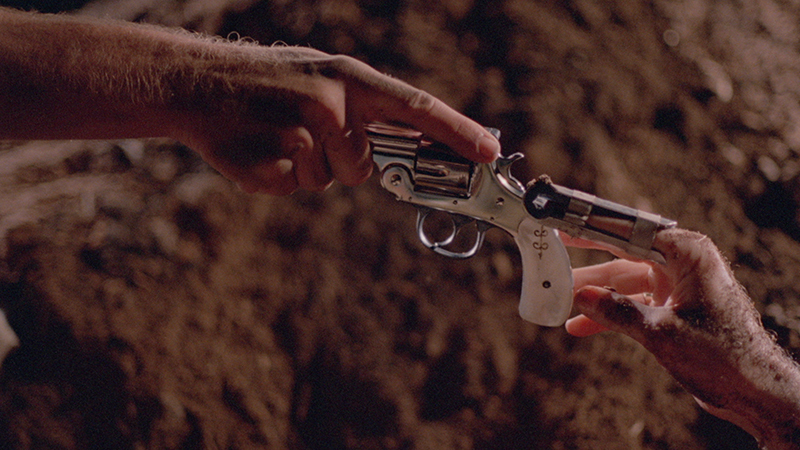
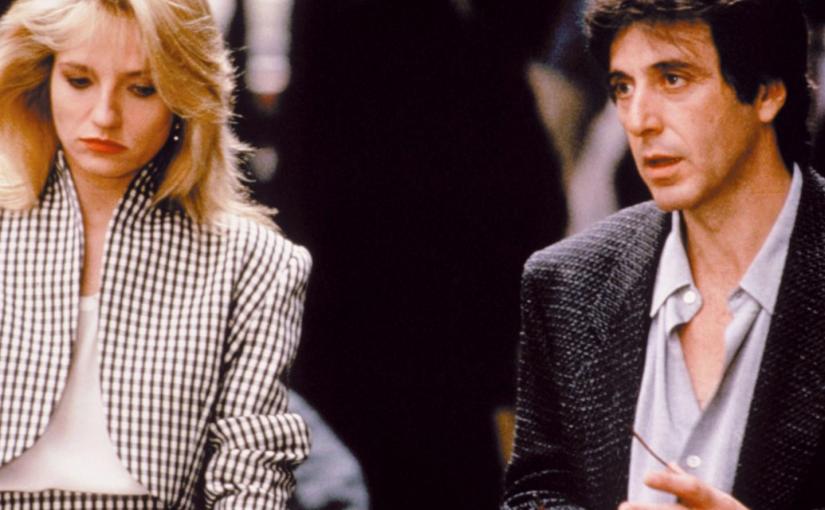
TRUE BELIEVER (1989)

by Miguel E. Rodriguez

DIRECTOR: Joseph Ruben
CAST: James Woods, Robert Downey Jr., Margaret Colin, Yuji Okumoto, Kurtwood Smith
MY RATING: 7/10
ROTTEN TOMATOMETER: 96% Fresh

PLOT: A cynical former civil liberties attorney, now reduced to “specializing” in defending drug dealers, becomes transformed by an eight-year-old murder case.


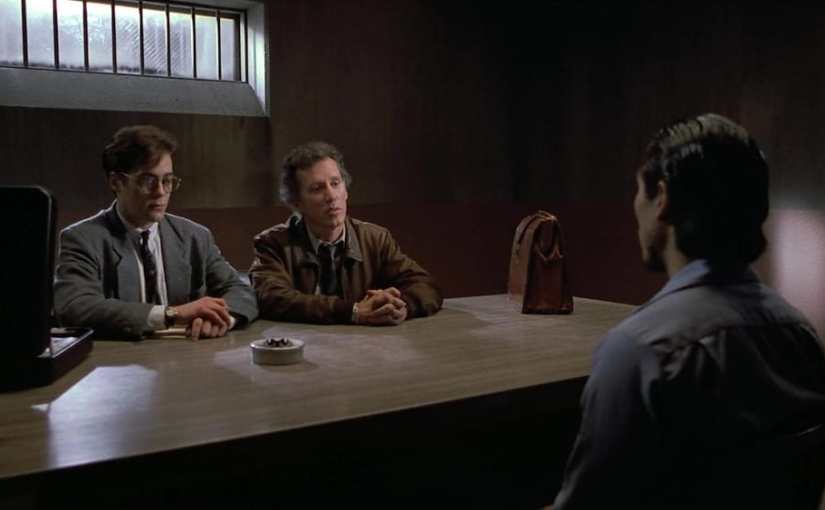
I don’t know if True Believer counts as a “forgotten” film in today’s world, but it’s certainly not a movie that I hear mentioned anymore.  Directed by genre-hopping journeyman Joseph Ruben, whose films are more recognizable than he is (Dreamscape, The Stepfather, Sleeping with the Enemy), and anchored by James Woods and Robert Downey Jr., True Believer is a solid entry in the crime/courtroom drama/thriller arena, at least in broad strokes.  However, there are momentary lapses of logic that strain credulity, and despite the momentum of everything around them, they were enough to affect my opinion/impression of the movie.

After a flashback and prologue that introduces us to his future client, we meet Eddie Dodd (James Woods), a fiery former civil liberties attorney who once defended Black Panthers and other social revolutionaries in the 1960s.  Now, at the tail end of the ‘80s, in the waning days of the “Me Generation”, he specializes in defending drug dealers and/or distributors under the guise of painting the government’s use of wiretaps and undercover agents as invasions of privacy…a shabby attempt at investing his sleazy client list with some sort of social nobility.  Into his life comes an aspiring attorney, Roger Baron (future Oscar-winner Robert Downey Jr., looking fresh and innocent during what must have been one of his infamous rough patches).  Roger idolizes the old Eddie Dodd, the idealist, and is severely disillusioned by the current Eddie, the opportunist.

Things change, though, when a Korean mother and daughter track Eddie down and ask him to defend their son and brother, Shu Kai Kim (Yuji Okumoto, The Karate Kid Part II, Better Off Dead), who is eight years into a prison term for a murder they say he didn’t commit.  The daughter says she tracked him down by going to all the courthouses: “They all speak of you, and they all say the same thing…you do cases cheap.”  He dismisses them with a vague promise to “review the material,” but after some predictable prodding from Roger, his new conscience incarnate, he takes the case.

What follows is a well-directed, well-paced mystery-slash-courtroom thriller.  It’s not fancy or especially slick, but it held my interest, which is all I ask of a mystery where I’m expected to keep track of a lot of information.  And there is a lot of information to keep track of.  Eddie and Roger, with the assistance of their P.I., Kitty (the invaluable Margaret Colin), uncover inconsistencies in witness accounts, inconsistencies from their own client, the involvement of the Aryan Army, a bona fide conspiracy theorist who believes the phone company killed Kennedy, and a possible link to an 8-year-old drug bust.  (That’s about all I can say about the plot without ruining the surprises of the evidence chain.)

As I said before, the movie is solid, but they made one major misstep: casting the talented Kurtwood Smith as opposing counsel, D.A. Robert Reynard.  From his first scene, no matter how nicely he smiles or how friendly he seems, he is obviously the bad guy, because it’s Kurtwood Smith.  Because of his mere presence, you know he’s not to be trusted and must be brought low, no matter how logical his courtroom arguments are.  He is clearly the villain, even if he’s not doing anything truly wrong.  So right away, any possible objectivity about who’s right and who’s wrong is skewed.  It would have been more interesting if the ostensible bad guy had been cast by someone who is at least a little ambiguous.  Just my two cents.

There are other issues.  As the investigation progresses, there is an anguished speech from Eddie to Shu Kai Kim that spells out exactly where the title of the movie comes from and ends with some tortured dialogue that must have looked good on the page, but just doesn’t feel right coming out of James Woods’s mouth.   In another scene, Eddie walks away from two armed men who have every reason to shoot him in the back but inexplicably choose not to, presumably due to a sudden attack of conscience.  Given what these two men had done just previously, this inaction seemed wildly improbable.  Then the D.A., whom we have seen is highly intelligent, allows himself to get cornered in the courtroom when he absolutely should not have.  Not the actions of a smart man…but certainly the actions of the clear villain, because it’s Kurtwood Smith.

Because of these inconsistencies, True Believer will probably never be mentioned in the same breath with Jagged Edge or The Verdict or any other great courtroom thriller.  But the performances from the leads are more than adequate (despite James Woods’s incongruous ponytail), and the mystery is fun to unravel, and Joseph Ruben’s direction is competent if not splashy.  In other words, it’s your slightly above-average ‘80s genre movie.  (And I am sometimes a sucker for ‘80s nostalgia, so…there you go.)

BLACK MASS

By Marc S. Sanders

Black Mass tells the story of an FBI agent, and his two childhood friends who are brothers.  One brother is Billy Bulger, a Massachusetts state senator.  The other is notorious Boston gangster James “Whitey” Bulger.  The script has a lot of elements to make for a great crime drama, but I wonder what Johnny Depp is doing here made up to perform like a crazed ghoul.

The FBI agent is John Connolly (Joel Edgerton) who turns to Whitey (Depp), a fearful leader of the Irish mob in South Boston during the nineteen seventies through eighties to work as an informant, providing intel on the competing Italian Mafia.  It’s no secret about Whitey Bulger’s dealings or what territory he covers.  Agent Connolly does his best to protect his friend, so long as he collects pertinent information that leads to arrests.  However, what’s the limit to Bulger’s activities, and how does this reflect on a public figure like Whitey’s politician brother, Billy (Benedict Cumberbatch)?

Much of Black Mass reenacts recorded testimonies after everything has shaken out.  Guys who survived Whitey’s violent crew (Jesse Plemmons, Rory Cochrane) offer information on the gangster’s activities and what he compelled his captains to carry out.  Mixed in with these voiceovers are how Connolly responds to the progress of his operations.  Time and again, his superiors (first played by Kevin Bacon and later by Corey Stoll) question Connolly about how beneficial Bulger can be if the crook always has his finger on the trigger, killing those that might rat him out.  Black Mass is told from an assortment of different perspectives and sometimes that muddies the water.

The most interesting storyline is how Connolly uses and protects his criminal friend, while also stepping away from getting blood on his hands.  Joel Edgerton gives the best performance of the film as an FBI guy who turns a blind eye to Whitey’s crimes. Connolly thinks he can continue his own corruption while Whitey cooperates and leads him to big, heroic indictments of the Italian mob.  As long as the arrangement upholds, the corrupt agent will always have an answer for his actions and stay ahead of the ethical lines he knows he’s crossing.  More importantly, even if his wife protests, Connolly is getting prestigious promotions and collecting substantial paychecks for his progress.  Scott Cooper directs Edgerton with conflicts of overwhelming complications.

One problem is that Whitey Bulger is a loose cannon who is never intimidated, not even by the Feds, especially not by his childhood friend.  His brother Billy looks away to maintain a clean political image.  Therefore, it is quite easy for Whitey to gun down a rat associate in broad daylight in the middle of a wide-open parking lot, shotgun and all.  The killer doesn’t even need to run away from the scene of the crime.  This is Whitey Bulger.

Johnny Depp is great in the role, but does his portrayal belong in this film?  Depp’s career is widely celebrated for the quirky, makeup clad parts he plays such as Jack Sparrow and Edward Scissorhands.  Even Ed Wood is delightfully weird.  In Black Mass, the actor dons steel grey eye contacts, white slicked back hair making him appear almost bald, and skeletal teeth beneath a near albino complexion.  He looks like Skeletor without the hood.  Throw in a brooding, deep Bostonian accent and you have the ghoul I referred to earlier.  Is this Whitey Bulger?  Online photos of the real guy do not seem consistent with the film’s appearance.  Depp’s delivery of dialogue and even his wicked Freddy Krueger laugh seem too far beyond the realm of this crime drama.  The actor is working on another plane than everyone else in the cast who wear hairpieces, three-piece cotton suits and cheesy off-the-rack polyesters and denims to populate this time period from forty years ago. 

A scene showing Bulger dining on steaks with Connolly and his FBI partner (David Harbor) was famously used in preview showings ahead of the film’s release.  Take this scene out of context like the trailer did and Depp looks scary good as he terrifies Harbor for doing something as simple as revealing a long-time secret family recipe.  Afterwards, Whitey goes upstairs to harass Connolly’s wife (Julianne Nicholson) at the bedroom door.  The dinner scene sold me on getting a ticket for the movie as soon as it was released.  However, put it back into the framework of the script and I feel like Black Mass is diverting itself from a complex crime drama to a vampire in a Member’s Only jacket.  As good as Depp is with his makeup and his vocal inflections and pace, it just doesn’t seem to belong in this particular film.  Marlon Brando as Don Corleone with the shoe polish in the hair and the cotton in the mouth? That works.  Johnny Depp as Count Dracula in Sergio Valente skinny jeans is not as effective.

Because the script changes hands from one perspective to another and then another, I found the reenactments of Connolly and Bulger’s reign of crimes to be a little inconsistent.  I found much potential for Benedict Cumberbatch’s purpose as Whitey’s brother, but there is too much diverted away from that character because the picture is trafficked with what everyone else is doing and seeing on top of giving Johnny Depp a lot of scenery to chew.

Black Mass pursued the potential for a very interesting gangster picture like Goodfellas or Donnie Brasco, but it wants to capitalize too much on the latest Johnny Depp routine.  I think James “Whitey” Bulger is an interesting twentieth century bad guy with a violently daring and checkered background.  He had associates within his family and gang to color in a movie that’ll grab you.  The tainted lawmen who were involved are also intriguing.  Scott Cooper and the screenwriters knew this, but often they opt to go in different directions.  

Now that a loose interpretation of Bulger has been played by Jack Nicholson in Martin Scorsese’s Oscar winning The Departed and again here, it’s time to tell the cold-blooded killer’s story once more.  Just go simpler without all the clownish theatrics.

THE VANISHING (Netherlands, 1988)

by Miguel E. Rodriguez

DIRECTOR: George Sluizer
CAST: Bernard-Pierre Donnadieu, Gene Bervoets, Johanna ter Steege
MY RATING: 9/10
ROTTEN TOMATOMETER: 96% Fresh

PLOT: A young couple, Rex and Saskia, stop at a service station during a road trip.  Saskia vanishes without a trace, prompting a years-long search by Rex…while an unassuming family man monitors his progress.


[WARNING: This review contains unavoidable spoilers.  If you have any plans to see this movie, trust me…stop reading now.]

I went into The Vanishing absolutely cold.  I knew nothing about it aside from the name of the director, the bare outlines of the plot (a young woman vanishes while on vacation), and the fact it was a critically acclaimed foreign film, remade in America with Jeff Bridges and Kiefer Sutherland, which I never saw because it was, quote, “laughable, stupid and crude” (Roger Ebert).

With absolutely no gore, no unnecessary side plots, and no clichéd final chase between the killer and the cops where the outcome is a foregone conclusion, director George Sluizer has crafted one of the most compelling, creepiest abduction films I’ve ever seen.  By not showing the actual abduction when it happens, by focusing on the boyfriend’s frantic attempts to track her down immediately afterwards, and by abruptly shifting gears twice in the first hour, the viewer is kept constantly off balance (in a good way).  If she was abducted, how did the kidnapper accomplish his task in broad daylight?  WAS it even an abduction?  We get a good look at the person who most likely committed the crime, but his process looks almost comic…how did he pull it off?

We first meet Rex and Saskia as they’re driving to France to do some cycling.  After Saskia relates a recurring nightmare to Rex (she dreams of being trapped inside a golden egg floating through space), there is an early crisis when their car runs out of gas in the middle of a long tunnel.  We get an early, incisive look at their relationship when Rex elects to walk back for gas, while Saskia stays behind frantically looking for a flashlight she insists they will need.  Later, at a crowded service station, they kiss and make up.

This scene at the service station looks entirely mundane at first, but it is interrupted by a sequence in which we are shown the man who pretty clearly is about to commit a kidnapping.  When we cut back to Rex and Saskia, their interactions become charged with tension.  They talk and tease and kiss, while we are suddenly hyper-aware of their surroundings.  Director Sluizer fills the background with extras, and we start scrutinizing them to see if any of them might be the kidnapper.  Or perhaps there will be a clue later, a Hitchcockian callback which relies on our recall of the crowd scenes.  Rex takes a random Polaroid as a blue semi rolls past the lens, obscuring the front of the store.  Sluizer’s camera lingers on the semi, and we immediately wonder if there is any significance.  (There both is and isn’t.)

The creepy effect of these scenes cannot be overstated.  I can easily imagine some people watching this movie and immediately changing their travel habits.  Never go into a crowded store alone.  Carry mace.  If you must separate, stay in touch with your cellphone until you meet up again.  Stanley Kubrick knew what he was talking about when he told Sluizer that The Vanishing was the most terrifying movie he’d ever seen.

After Saskia’s disappearance, there are the nominal scenes of Rex searching the store and grounds for her, asking if anyone has seen her, giving her description, and so on.  Interestingly, we never get a scene of Rex being interviewed by the police as the day drags on.  Looking back on it now, I get the feeling that Sluizer perhaps thought those scenes would be way too familiar for audiences who have sat through any number of police procedurals in the movies and on TV.  Better to stay with the matter at hand and keep the story moving.

It’s at this point that the movie makes its first abrupt shift in tone and focus.  With no warning, we suddenly spend a good 20-30 minutes, not with Rex’s search, but with the apparently happy family life of the man we got a good look at earlier in the film, the man who appeared to be prepping for a crime.  These scenes are even creepier than the earlier scenes at the service station because we are pretty sure this is the kidnapper, but his home life seems stable: a wife, two daughters, a well-paying job as a chemistry teacher, and the financial wherewithal to buy a large farmhouse in the country…where we discover, in an INTENSELY creepy moment, that no neighbors will hear any screaming.

The decision to focus on this man was jarring and disturbing to me, but in that good way achieved only by the best crime thrillers.  We get more details about his life and his “preparations” that I won’t spoil here.  The film almost seems to have forgotten all about Rex and Saskia; this man is now the primary character.  (In fact, this actor gets top billing in the credits).  He has the kind of forgettable face and unimposing persona that would fly under anyone’s radar.  By showing us the fact that he has two sides to his personality, we come to the uneasy realization that evil could easily lurk behind the cheerful facades of just about anyone we meet.  This concept is far more terrifying to me than a slasher wearing a mask.

But The Vanishing has two more tricks up its sleeve.  It takes yet another dramatic shift when we abruptly jump forward three years.  Saskia is still missing.  Rex has a new girlfriend, but he still posts flyers asking for any information on Saskia.  He makes appearances on local news programs, pleading for the perpetrator to step forward, promising not to press charges; he just has to know whether Saskia is alive or dead.  He craves closure more than anything else.  It has consumed him.  And…he has received several anonymous postcards from the kidnapper asking to meet in a public place, but whenever Rex arrives, the kidnapper has never shown himself.

This creeped me out even more than I had already been.  But the screws get tighter still.  At one point, the kidnapper offers Rex a choice: turn me in, in which case you’ll never find out what happened to Saskia, or I show you what happened to her…by going through the same ordeal she did.

This has all SORTS of psychological implications that I don’t feel fully qualified to sort out.  I have to wonder about those families and friends who have suffered through the disappearance of a loved one.  (I looked up the statistics on missing persons on a whim…they are horribly depressing.)  I can only imagine what those people would do to finally get closure on what happened.  Would they accept this kidnapper’s offer?  Even if it means they might possibly die?  What price would they be willing to pay to finally get an answer after years of searching?

I hope I never have to answer that question.  Rex goes back and forth in agony before finally making his choice.  His decision leads to an ending that was probably inevitable, but which still took me by surprise.

In an interview with the actress who played Saskia (Johanna ter Steege), she states that when the movie was finally released, she was deeply disturbed.  She went to George Sluizer and asked him, “What is the point of this movie?  What do you achieve by telling this kind of disturbing story?  What are you trying to tell the audience?”  If I had to answer that question, I would say that the first motive was to make an entertaining crime thriller, which it is.  But perhaps there’s also a deeper statement about the banality of evil.  One does not have to wear a black hat and twirl his mustache to be the bad guy.  Sometimes you just have to blend into the background.  The film opens and closes with shots that include a praying mantis, a creature that relies on stealth and speed to capture its prey.  The kidnapper in The Vanishing has learned that lesson in spades.

GET CARTER (United Kingdom, 1971)

by Miguel E. Rodriguez

DIRECTOR: Mike Hodges
CAST: Michael Caine, Ian Hendry, Britt Ekland, John Osborne
MY RATING: 8/10
ROTTEN TOMATOMETER: 87% Fresh

PLOT: When his brother dies under mysterious circumstances, London gangster Jack Carter travels to Newcastle to investigate.


While watching 1971’s Get Carter (Caine, not Stallone), I was reminded of so many other later films that I began to wonder what gangster/crime films weren’t influenced by Get Carter.  Throughout the picture, I could see hints and whispers of Bugsy, Beverly Hills Cop, Carlito’s Way, and the John Wick franchise, among others.  I probably missed some.  Maybe I’m wrong.  Maybe those films weren’t paying homage to the best British film ever made (according to a 2004 poll), at least not consciously.  But its DNA is there for anyone who knows where to look.

(To be sure, Get Carter was itself influenced by earlier authors and films.  In very broad strokes, the plot of Get Carter resembles The Big Sleep.  In both films, a hard, cynical man tries to get to the bottom of a mystery that no one else is particularly interested in solving.  They both even involve pornography, though to be sure that was more implied in the older film, while in Get Carter we are left in no doubt.)

The tone of Get Carter matches its protagonist: cold, flat, uninflected, violent only when it has to be.  Michael Caine’s performance is a masterpiece of understated, simmering viciousness.  He only gets really angry a few times in the film, and he doesn’t smile, not genuinely, until the very end.  I read on IMDb that Caine’s intention was to show a more realistic, less sensational kind of violence than had been seen in earlier gangster films, “never using thirty punches when one would do.”

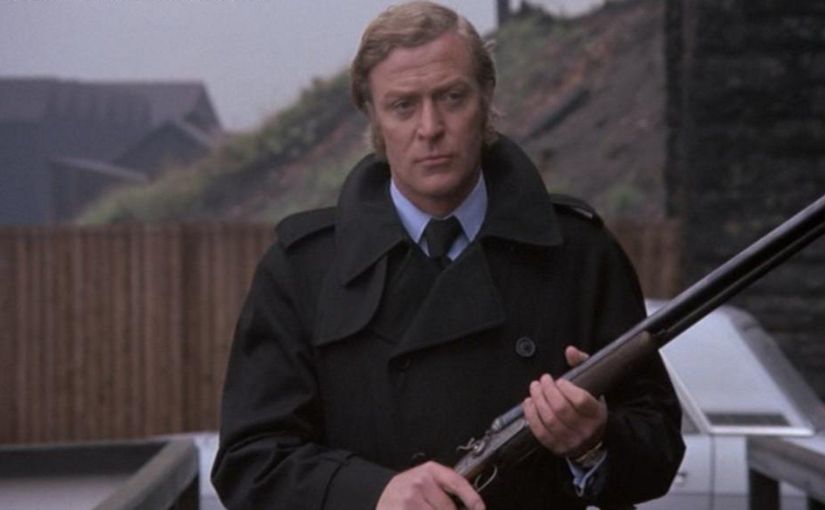
This is also an echo of a French film, Le samouraï, in which a professional killer shows absolutely no expressions the entire film, even with a gun in his face.  Carter is equally cool under pressure, as in the scene when he is surprised in the act of “lovemaking” (love has nothing to do with it) by two gangsters.  He registers surprise and little else, pulling a double-barreled shotgun from under the bed and, while stark naked, marching his would-be attackers out of the flat at gunpoint.  In a movie with little to no humor, there is a welcome double-take from the nosey next-door neighbor, not to mention the children’s parade taking place down the street.  (In this scene, there is something very Bond-like about Carter, mixing deadly danger with borderline slapstick.)

1971 was not a year for shrinking violets at the movies.  It saw the release of Dirty Harry, A Clockwork Orange, and The French Connection, among others.  Into this mix comes Get Carter with its casual violence and frequent female nudity, profanity, and so on.  Even so, there were a couple of moments that got a little shock out of me.  One was when a car is disposed of while Carter knows what precious cargo is in the trunk, but the bad guys do not.  Watch Carter’s utter impassiveness; he could have raised a warning, but he doesn’t.  There’s cold, and then there’s cold.  Another shocking moment is when Carter absentmindedly turns on a film projector and watches the amateur porn film displayed on the wall.  Watch his face again as he slowly realizes the identity of one of the actresses in this tawdry film.  A tear rolls down his face.  Because of what we already know about Carter, that tear doesn’t just mean he’s grieving.  He’s so boiling mad that I feared for the life of the woman in the next room.  It’s a great moment because of how rarely we see emotion on his face.

Get Carter is classic noir, just in color and with more adult situations.  Carter may not be a cop, but he has a code, nonetheless.  He absolutely will not stop digging until he solves the question of his brother’s death.  He defies his own bosses in London, ignores many warnings, survives several attempts on his life, but he just can’t help himself.  His obsession trumps everything else, just like Bogey in The Big Sleep or William Hurt in Body Heat.  There are hints of tragedy at every turn, but Carter presses on, whatever the cost, even if he thinks he might not like what he finds.  These are the qualities of any great noir hero, and Carter exemplifies them all.

***SPOILER ALERT AHEAD, YOU HAVE BEEN WARNED:***

I feel obligated to mention my reaction, at least briefly, to the film’s ending.  At first, I threw my hands in the air, much as I did at the ending of…well, another very different film from the late ‘60s.  But as I thought back to the events of the film leading to this moment, I had to shrug and say to myself, “Well…it’s not like they didn’t warn him.”  At least it’s motivated by something, and not just random fate.  I can accept it.  It’s not something you would see in a conventional Hollywood film today, that’s for sure.  Look at John Wick.

FARGO

By Marc S. Sanders

The seeds of a crime begin in the dead of winter, in a saloon, located in Fargo, North Dakota.  A car salesman requests two thugs kidnap his wife so that they can demand an eighty-thousand-dollar ransom from his wealthy father-in-law.  The salesman will split the monies with the crooks and all will be well.  Hold on there!  It’s not as simple as it looks.

The Coen Brothers (Joel and Ethan) completed some of their most legendary work when they opted to “adapt” a supposedly true story that sheds blood over the snow-covered plains of northern Minnesota when all of the characters involved choose not to cooperate with one another.  The unpredictable is what keeps their film Fargo so engaging.  With each passing scene, you ask yourself “What next????”

Jerry Lundegaard (William H Macy, in my favorite role of many good ones from him) is the salesman who gets in over his head.  This cockamamie scheme of his stems from a need to land a get rich quick investment, but he doesn’t have the money and his father-in-law Wade Gustafson (Harve Presnell) certainly won’t lend it to him.  Steve Buscemi and Peter Stormare are the hired criminals, Carl and Gaere.  As quick as the agreement is made, Jerry wants to call off the arrangement, but things are already set in motion.  The kidnapping occurs, albeit sloppily, and a late-night pullover on a dark, snow covered back road leads to the bloody shootings of three people. 

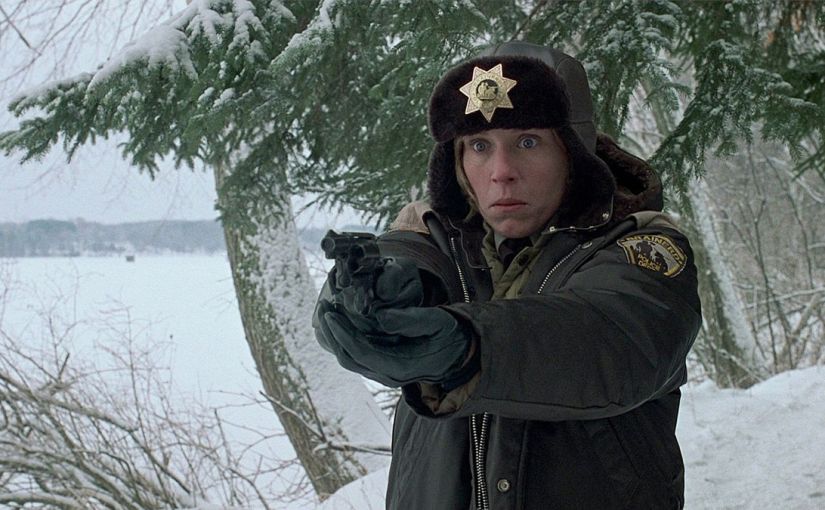
Marge Gunderson (Frances McDormand, in her first Oscar winning role) is awoken early in the morning.  Her sweet husband makes her a quick breakfast and she’s off in a jiff to inspect the crime scene of the three murders.  She is seven months pregnant, but she’s got a job to do.

Murder, kidnapping, fraud, and embezzlement piece together the Coens’ Oscar winning script.  What makes Fargo special though is how out of frame it all seems among these odd and quirky characters.  The Minnesotan dialects and vernacular (“You betcha!!” “You’re darn tootin’!” “Oh, for Pete’s sake!!!”) from Marge and Jerry do not seem standard in a story like this.  Even their names – Lundegaard and Gunderson – seem totally out of place here.  However, the pregnant, sweet natured police officer should not be underestimated, and the puppet master behind this plot should have known better.  In fact, other than Marge, no one should be doing what they’re doing, and yet that’s exactly what spins everything off the rails.

The Coens humanize the characters of their film.  Marge must stop inspecting the grisly crime scene because her morning sickness is about to overtake her.  “No, I think I’m gonna barf!” It is not the blood or the cold winter that’s holding her back.  Natural pregnancy gets in the way.  When clues lead her to Minneapolis for an overnight stay, she takes advantage of meeting with a high school friend.  Their meet-up has nothing to do with the central plot, but the writers insist on showing Marge during her off hours.  It’s a hilarious scene and Frances McDormand’s timing is naturally comedic with a guy who just has an overenthusiastic way about himself.  Marge is not just a smart cop.  She’s got a life outside of her career as a loving wife, friend and soon to be mother.

As well, Jerry insists to Wade not to contact the police and let him deal directly with the kidnappers when they call.  Wade isn’t just going to sit by for long though.  He got to the top of his powerful pyramid by taking things head on.  Jerry just doesn’t have the instinct to realize this is how the cards will fall.  Wade was not to be involved, under any circumstances.  Yet, that’s exactly what is happening.  This is not good Jerry.

Carl and Gaere (These names!!!!  I’m telling ya.), as crooked hoods, have no honor among themselves.  One might betray the other and that could lead to another gory, very gory, yet inventive moment. 

Other than Marge, either no one is particularly smart in Fargo, or they are just not seeing the possible outcomes all the way through.  Still, even the dumbest of folk can make a turn of events gone awry so fascinating.  When one tiny detail gets out of place, then the players improvise. That only twists several other expectations to go off kilter and the dominoes begin to tumble.  Very quickly, as everything has unraveled, it is any wonder how this all began in the first place. 

Fargo demonstrates that crime is hardly committed with a perfect plan.  Fortunately, the imperfections are at least as entertainingly curious as the perfections found in so many other films.  Oh, you betcha!!!!! 

ANATOMY OF A FALL

By Marc S. Sanders

Was Samuel Maleski pushed or did he commit suicide? It appears he fell from the balcony of the French chalet he shares with his wife Sandra Voyter (Sandra Hüller) and their blind son, Daniel (Milo Machado Graner).  That is the focus of Anatomy Of A Fall, one of the films to be recognized in several Oscar categories for 2023 including Best Picture, Best Director for Justine Triet, Screenplay, Editing and an acting nomination for Hüller.

Triet’s film kept my attention right from the start because this newsworthy story has all the elements many would look for in a Netflix documentary or a Dateline program.  New details are introduced in nearly every scene whether it stems from conversations that Sandra has with her attorney Vincent (Swann Arlaud) or as part of the witness interrogations during the thrilling trial scenes that take place a year after she has been indicted for causing her husband’s death.

Sandra is German.  Samuel (Samuel Theis) is French.  To stay on a common ground, they speak to one another in English.  We learn this as the film flashes back to conversations and arguments the pair have prior to the deadly scene that occurs soon after the film begins.  The inconsistency in how they communicate as a married couple will have one ponder how pertinent it is when Sandra is considered a prime suspect in her husband’s death.  Also, it’s curious that Samuel suddenly decided to record a number of their disputes.  More evidence is revealed as the story carries on.

On the surface, the story plays like a typical Law & Order episode.  However, there’s a fresh quality to this kind of supposed crime drama.  A large portion of Triet’s screenplay (co-written with Arthur Harari) takes place in a French courtroom and it’s interesting to see how the procedures of witness questioning varies from what American audiences are accustomed to.  For example, an expert on blood splatters gives testimony and conclusion. While he is still on the stand awaiting further questioning, the Procureur will divert questions directly at Sandra, the accused, for explanations. 

The material witness for both sides is Daniel. After returning from a nature walk with the dog, Snoop, he comes upon his deceased father lying in the snow with blood gushing from the side of his head.  The blind son is thoroughly questioned about if he could hear arguments coming from his parents while loud music was blasting from his father’s upper-level workspace.  He’s probed about his parent’s relationship and how he got along with his mother and his father respectively.  Daniel is also put to the test of reenactments on the day in question.  While he is outside with Snoop, could he hear the argument his parents were having over the loud volume of the music from 50 Cent playing.

A sort of competition between Sandra and Samuel is also noted, as she is a published author. He has been insecure of becoming a writer himself after giving up his job as a literature professor and moving the family into the mountains to restore this chalet as a personal project. 

The performances in Anatomy Of A Fall are outstanding, especially from its lead Sandra Hüller, whose role was specifically written with her in mind.  Of the many great dramatic moments, there’s a specific flashback scene introduced as evidentiary recording.  It is a telling argument between Sandra and Samuel in the kitchen.  Justine Triet directs this long scene as a common occurrence among most marriages but then it begins to elevate.  Just when you think the two spouses are winding down, the intensity cranks back up again only it goes from a lower pitch to a much more aggressive state very quickly.  Their quarrelling becomes erratic, and while we are watching the flashback, it cuts away the moment it gets physical. Triet wisely returns the film to the courtroom observing Sandra listening to her memory all over again while the packed audience focuses.  In particular is the boy Daniel who is learning more about what weighed on his father and mother both individually and as a married couple.  When the argument gets physical the viewer of the film is in the same position as everyone in the courtroom, or more specifically blind Daniel, left to only imagine who breaks what dish and who slaps who.

Vincent, Sandra’s attorney, reminds his client early on that there is the truth and then there is what a jury and a court of public opinion will believe.   Swann Arlaud is not an actor I’m familiar with.  (Actually, I’m not familiar with anyone involved in this film.)  Arlaud is a standout though.  I like how he listens and asks well timed questions of Sandra as she recounts what occurred the day of the incident; where Samuel was and what he was doing along with where she was, interviewing someone about one of her books, on the floor below.  Swann Arlaud has a dubious expression as he absorbs all the information.  Even he knows this could have gone several different ways.  Maybe Samuel did intentionally jump to kill himself.  Perhaps the aggravation that Sandra endured of her husband motivated her to push him over or to hit him bluntly on the head causing his fall over the balcony railing.  There’s evidence to suggest a number of different outcomes. 

Anatomy Of A Fall succeeds on the examination of a crime and how it is tried, particularly in a French court of law.  Fortunately, the script does not offer many definitive answers when it concludes.  There are hanging threads left to consider and wonder.  Yet, it goes in depth with analysis so that when the verdict arrives, I could accept either decision of guilt or innocent.  It’s unfair, but in a murder trial, especially if there’s a possibility that the accused is not guilty, then the victim is somewhat put on trial as well.  Anatomy Of A Fall lends a case for either party.  This film deserves its accolades for its fair and thought-provoking writing as well as the performances of the cast which include a main character that you might or might not find believable.

BLOOD SIMPLE.

By Marc S. Sanders

 “blood simple” is a term coined to describe the addled, fearful mindset people are in after a prolonged immersion in violent situations.

         IMDb – originally located in the book Red Harvest by Dashiell Hammett

The Coen Brothers’ first of several legendary and unique films is a seedy noir thriller called Blood Simple.  Joel Coen is the director.  Ethan Coen is the producer.  They wrote the script together and collected whatever pennies they could find door to door from anyone willing to invest in the picture.  You see how shoestring the budget was for this small film, but that’s exactly why it works so effectively.  The lowlifes of their script are not the sophisticated type like Hannibal Lecter or Harry Lyme.

This is a condensed piece, just over ninety minutes, with four principal players who inadvertently cause themselves to get tangled in a bloody web of gory crime.  The fun part is that none of the four know the whole picture of what’s occurring, or how, or why.  I’m satisfied the audience is in on the whole thing, though.

Without giving too much away, Dan Hedaya is Marty, the owner of a sleazy Texas saloon.  A private investigator provides evidence of Marty’s wife, Abby (Frances McDormand, in her debut performance), having an affair with one of his bartenders, Ray (John Getz).  Marty hires the P.I. to murder the two lovers.

Simple enough, right?  Wrong, because the Coen Brothers wisely have their players color outside the lines and soon there’s blood all over the floor, as well as in the back seat, and maybe something important was mistakenly left at a crime scene.  Perhaps someone who was thought to be dead is not, and maybe what you thought occurred is something else entirely.

Blood Simple. works because it operates beyond convention.  The characters are so unaware of what to do next or what precisely has happened that it introduces one layer of confusion and misunderstanding after another.  This is nowhere near a common episode of Three’s Company.  What’s even more appreciative is that once the end credits roll, those that survive this lurid tale will still never have a complete grasp of what’s happened or when or where the convolutedness began.  It’s satisfying that all of the answers are at my disposal. It gives me a sense of omnipotence.

M Emmet Walsh is the scuzzy private investigator.  You’ve seen this celebrated character actor countless times before.  It is this performance that might be the one where you would no longer recognize him as “What’s that guy from?” because now you’ll never forget his name. He’s a villain who pounces on a genius opportunity, covering all bases, until there’s one minor oversight.  The Coen Brothers inventively have this guy circling the waters of the whole film, and yet only one other character is aware of his existence.  Still, this guy is vital to the assorted conflicts uncovered in this sort of graphic novel pulp fiction.

Blood Simple. sets up scenes  that can be bridged together by what if scenarios. How can two windows mere inches away from each other lend to a painfully agonizing, thrillingly welcome moment of terror and suspense? When this scene arrives, does it make sense for how the characters play it out?  You bet it does.  

The film is strong due to its lack of dialogue too.  We watch what these characters do much more than we listen to anything they have to say.  Important props and locations seem to tell us more than any of the actors, and that’ll allow you to think like the character.  You read their minds rather than feeling a need to have everything explained to you.

Blood Simple. is an inspired nod to some of Hitchcock’s bewildering best like Dial M For Murder and Strangers On A Train.  It succeeds because of the twists it offers as nothing ever goes according to plan.  You’ll watch it once and then you’ll want to see it again to follow the breadcrumbs that trail off the path.

SEA OF LOVE

By Marc S. Sanders

Al Pacino is a twenty-year veteran New York City cop, working out of Manhattan, on the trail of a serial killer in Sea Of Love.  The profession is nothing new to Pacino’s repertoire of roles, but the portrayal is unique thanks to a smart and suspenseful script from Richard Price and intense directing from Harold Becker.

The killer leaves a calling card.  A 45 LP record of Phil Phillips ’50s classic crooner, “Sea Of Love,” spinning on the turntable.  The victims are naked men lying face down in bed with a bullet to the head.  Turns out that a cop from another precinct played by John Goodman has uncovered a similar crime scene in Queens.  So, the two team up.  They believe the murderer is a woman.

All the victims have posted a Lonely-Hearts Club blurb in a magazine. The invitation for a date stands out because the text rhymes.  The detectives decide to post their own ad in the same kind of format, meet the women who respond and hope to nab the killer.  It gets complicated when Pacino encounters a breathtaking and sultry woman played by Ellen Barkin. 

Pacino’s cop is a smart guy.  He’s got instincts.  Yet, perhaps due to his constant drinking, insomnia, and the bitterness he carries now that his partner (Richard Jenkins) has hooked up with his ex-wife, he’s also quite vulnerable.

The mystery is strong, and the tension builds as Sea Of Love moves on.  Barkin has Pacino and the audience convinced that she’s the prime suspect.  Still, he lets his defenses down because he’s easily getting seduced by her advances.

Whether you’re watching Al Pacino share scenes with John Goodman or Ellen Barkin, the execution is fantastic.  Great performances from the three.  Pacino and Goodman have a natural exchange with one another. Often humorous, but the guys always talk like cops.  When Pacino admits to tossing away a fingerprinted glass from Barkin, Goodman suggests lifting the prints from something- ahem – more personal of his.  A cute wink and nod exchange.

More important to the film is the erotic chemistry between Barkin and Pacino.  Harold Becker uses a late-night supermarket visit in the vegetable aisle to evoke the risky and irresistible nature the two characters develop for one another.  Other scenes build well on the relationship between these two lonely strangers who’ve only recently met. 

Moments of isolation and drunken stupors also work towards fleshing out Pacino’s burned out cop.  He’s got a schleppy posture to him and an exhausted expression with his sullen eyes and shaggy black hair.  At the same time, his character’s twenty years of experience seem to uphold his alertness.  This cop knows he’s letting his guard down. Without any dialogue, you see the internal struggle Pacino has with what should be done against what he is deliberately neglecting.

This film was Ellen Barkin’s breakthrough role.  She received rave reviews as someone who takes care to uphold a New York City trendy appearance by day as a shoe salesperson in contrast to a woman looking for some carefree lust in the evening.  For Pacino, Sea Of Love reinvigorated a career slump following a series of poorly reviewed films.  Together, they make for a sexy yet untrusting pair.

Circumventing this relationship is the mystery.  Is Barkin the culprit? She seems to have a dark way about her that may not surprise you.  Price, Barkin and Becker designed the character quite well for her to at least have the potential to be a killer of men.  Is she setting Pacino up to be the next victim?

New York City from the late 1980s looks great, even though interiors were shot in Toronto.  Trevor Jones offers a nail-biting soundtrack to keep the suspense heightened at just the right beats of the picture with Becker’s camera pointing down dark hallways or when new clues are discovered.

I’ve seen Sea Of Love a few times and even with knowing the surprise ending, the film still holds up thanks to the performances from its three stars, along with its taut editing, well-paced writing, and smart direction. 

This is a good erotic murder mystery.

THE MEAN SEASON

By Marc S. Sanders

I get caught up in movies focused on serial killers.  As an actor, I imagine it must be fun to portray a deranged psychopath like Norman Bates or Hannibal Lector, or maybe even John Doe from Seven.  On the other hand, maybe not because an effective screenplay needs to be nearby.

The Mean Season from 1985 has an effective premise but that’s where the positives of the picture stop.  Kurt Russell portrays Malcolm Anderson, a burnt-out reporter for the The Miami Journal.  He is the paper’s most reputable writer but just as he is ready to resign and move to Colorado with his loving girlfriend, Christine (Mariel Hemingway), he’s tasked with writing an article about the murder of a teenage girl on the beach.  Soon after, he’s getting phone calls from the killer himself, played by Richard Jordan whose face is concealed through most of the film by his hand holding a telephone.  The killer insists on only maintaining communication with Malcolm and no one else, especially not the cops.  He relays that the city of Miami can expect four more murders.

The title of the film stems from south Florida’s well known weather variations that occur at the start of hurricane season, primarily in July.  That does nothing for me, but the title alone sounds marketable enough for a thriller.  Almost sounds like a Stephen King novel.  The Mean Season!!!!!  Unfortunately, that’s all that this movie has to rely on, even if Kurt Russell is doing his best like he always does in better suspense movies like Unlawful Entry and Breakdown.

The fault with The Mean Season resides with the director’s amateurish approaches.  Fifteen minutes into the film, with the story hardly in motion, a nude Christine is taking a shower.  The haunting music begins and suddenly the shower curtain is pulled for Malcolm to deliberately startle his girlfriend.  So, we have the Psycho salute.  Check!  Later, following an argument between the two lovers, Malcolm gets in his car and is startled by Christine coming up from behind in the backseat. Ha!!!! Okay and there’s the Halloween nod.  Another check!  I bet these cheap tactics were not even written in the script.  Director Phillip Borsos (never heard of this guy before; doesn’t surprise me) must be so insecure in his skills behind a camera that he just goes for duplicative tripe.

Threats to the couple elevate as the film moves on and when Malcolm gets wind of Christine being in danger, he’s in his Mustang racing to her.  The cops (Andy Garcia, Richard Bradford) are right behind him, and no one thinks of summoning a squad car to where Christine is expected to be?  Of course not.  If they did, then we wouldn’t be treated to a clumsy sequence where an elevated bridge gets in Kurt Russell’s way forcing him to make a leap across the gap and come down on the steep other side and continue his foot race.  Kurt Russell really looks stupid in this moment, and I’m sure he was thinking I can not believe I agreed to this.

As with any of these movies, there is a just when you think the bad guy is dead, there he is again.  No wonder we didn’t get a long enough closeup on the corpse found in the dense Everglades.  However, we get treated to seeing a long, meaningless sequence of Kurt Russell being a passenger on a swamp buggy.  Big deal.  Does this enhance any kind of suspense?  Does it move the story along?  The director got access to a couple of swamp buggies and a day of shooting in the Everglades and said we gotta get this in here.

The final fight is as moronic as the rest of the picture.  Richard Jordan and Kurt Russell are going at it in the living room while a hurricane rages outside.  Mariel Hemingway just sits on the sofa and watches.  She just watches.  She doesn’t reach for a kitchen knife or a vase to smash on the bad guy’s head and help her poor boyfriend.  We just get a sad excuse of a damsel who is not in distress. 

Thankfully, Kurt Russell’s career survived this junk of standard jump scares and shortness on intellect. 

As I’ve said before in other columns, there was a better movie here.  There could have been a movie that explored the endless hours that an investigative reporter must endure.  His editor and photographer (Richard Masur, Joe Pantoliano) could have shared the heightened fear and suspense.  The cops on the case could have applied more pressure and/or assistance to the reporter.  They don’t even tap his phone to trace where the calls are coming from.  In 1985, I think they already had the technology to do that.  A tape recorder was used though, and the audience not only gets to listen to the conversations once as they are happening but then again as the characters listen to the tape.  Why?  Is there something I missed the first time I heard Kurt Russell say hello?  This is filler crap. 

A better movie would have pursued what motivates this killer we hardly get to know.  We should have learned more about this guy because he’s the one making the phone calls.  So, it is obvious he wants to be heard.  However, the guy has nothing to say of any significance.  Even a psychologist who’s recruited for one scene doesn’t make any observation that gives me, or the characters in the film, pause. 

The Mean Season is an “I got it!” film.  It’s where the director gets his big break and declares “I’ve got it!!!!  We’ll do Psycho and then we’ll do Halloween.  Gotta make sure we see Marial Hemingway topless.  That’s definitely at the top of the list. Oh yeah, and then we’ll get swamp buggies and can we get some wind and rain machines for a really, really, really mean—I mean very mean—season!”

THE LEGEND OF BILLIE JEAN

By Marc S. Sanders

Growing up as a teenager, in the dog days of summer, and living in a new town with few friends at the time allowed a lot of binge watching of movies on Showtime.  Top Gun must have been shown twelve times a day.  So was Back To School.  The other movie on constant repeat was The Legend Of Billie Jean – a movie of few merits and yet the heroic sweep of the fugitive rebel on the run with her trailer park gal pals and her little brother was addicting.  It’s a brisk ninety-minute film, but each time I’d watch the movie it felt like the title character raised even more awareness and support for her cause than the last time I watched, which was likely four hours earlier in the day, during breakfast.

Helen Slater is Billie Jean.  Her younger brother is Binx played by Christian Slater, in his first film.  NO RELATION!!!! 

Under a hot sun-drenched setting in Corpus Christie, Texas, the siblings are bullied by Hubie (Barry Tubb).  Binx gets beat up.  Even worse, his shiny maroon motor scooter is stolen and trashed.  When Billie Jean approaches the bully’s father, Mr. Pyatt (Richard Bradford), to collect the six hundred dollars for the cost of the bike, she narrowly escapes a rape after Binx shoots the scumbag in the shoulder.  Now the kids are on the run with Ophelia and Putter (Martha Gehman and Yeardley Smith – eventual voice of Lisa Simpson).

A firestorm starts to spread with a loyal underground following for Billie Jean and her band, and they receive assistance from the District Attorney’s (Dean Stockwell) son Lloyd, played by Keith Gordon.  The cop on their trail is played by Peter Coyote.  Wait!  I’m not being fair.  This cop is never on their trail.  Somehow every kid in the state of Texas can find and help Billie Jean, except the cops.  Even with the DA’s son in tow, these fugitives cannot be located by one single, solitary police cruiser.  Yet, the kids on the playgrounds make no effort to find Billie Jean, Binx and the others.  Yes.  You shake your head at the whole thing.  When you are age fourteen though, you get caught up with Helen Slater, one of your first celebrity crushes, and the accompanying soundtrack of Pat Benatar’s rebellious anthem “Invincible.”

The Legend Of Billie Jean is a stupid movie.  I don’t think anyone can argue with me.  I mean think about this for a second.  Peter Coyote’s cop finds their getaway car with Putter and Ophelia.  Still, he doesn’t choose to search the vehicle for a significant clue to the hero’s whereabouts until the next day.  Isn’t this sloppy investigative fieldwork?  As well, during the climax a brushfire is started by Billie Jean and no one runs or calls for a firetruck.  The DA, the cops, the kids – they all just stand there watching in deep thought like they were directed.  I can only imagine the director with his megaphone yelling out the command to stare straight ahead at the growing flames.  Mind you, this isn’t a control burn firepit.  This is a BRUSH FIRE with hay and wood and clothes as accelerants.

Nevertheless, the movie is an only slightly embarrassing guilty pleasure.  It’s not as hokey as it looks on the surface.  The acting isn’t terrible because the young cast is embracing the absurdity of the whole situation.  It stands, albeit wobbly, on the same plotline of an eventual and exceedingly better film called Thelma & Louise.  More importantly, Helen Slater makes for a good lead role and heroine.  When she tells Mr. Pyatt “No,” and cries her anthem of “Fair is fair” you root for her.  Slater’s performance is far grander than the script she is working with. 

The Legend Of Billie Jean performs like an afterschool special without dubbing out the cursing. The cause of these kids’ plight enhances as the film progresses.  What starts out as a simple bullying story and a demand for monetary damages of only six hundred dollars turns into a fight for respect and honor from the adult males within a small, southern local community.  However, there is little to feel inspired by, and I’m afraid Billie Jean’s supposed legend unfolds into only a slightly miniscule smidgen of Legendary