WALTZING WITH BRANDO

By Marc S. Sanders

You think you know someone, but then you learn a whole other side about the person.

I only know Marlon Brando from his achievements in The Godfather, Superman, A Streetcar Named Desire and On The Waterfront.  There’s also his final picture, The Score, with his Vito Corleone counterpart, Robert DeNiro.  I’ve seen him spoofed on Saturday Night Live and know that he’s even poked fun at himself in a film like The Freshman.  He was notoriously and proudly quirky.  I guess Brando was so content to appear odd to everyone else beyond the island of Tahiti, which became his escape to paradise, away from autograph hounds, environmental abuse and Hollywood barbarianism.  Brando simply endured his greatness as one of the most incredible movie actors ever to subsidize how he really wanted to live in utopian isolation.

Billy Zane seamlessly inhabits the persona and physical appearance of Marlon Brando in Waltzing With Brando.  The film presents a slice of the actor’s uncompromised efforts to build an ecological home, and maybe a hotel, on an uninhabited island next to Tahiti.  To bring this idea to fruition, Brando recruits a young, undaring Los Angeles architect named Bernie Judge (Jon Heder) to helm the project.  This will be an undertaking that Bernie could never expect and can hardly circumvent around impossible challenges in the face of proven scientific engineering, chemistry, and physics.  Brando seems to have an answer for everything though.

By breaking the fourth wall to speak to the viewer along with voiceover narration, Heder is charming about his unexpected adventures.  The white-collar shirt and necktie of city life is abandoned for shorts and conch shell necklaces.  Actually, as Brando demonstrates its better and less inhibited to just be nude like the rest of the cheerful islanders.  Despite his reservations, Bernie gets more and more accustomed to Brando’s perceptions but still he has to find ways to be practical to complete this unconscionable project.

Drinking water is needed.  Marlon’s answer is to filter it from his own urine.  Electricity needs to be installed on the island.  Though, is Marlon truly serious when he suggests that energy stem from a power source like electric eels?  Bernie soon learns that there will never be a client as unpredictable as Marlon Brando.  Money is not an obstacle he cares about.  Oscar trophies serve a menial, floor level purpose that is only a little more useful than resting on a mantle.  An upcoming gangster movie is not really his thing.  A paradise devoid of man-made contamination and pesky societal intrusions is where his focus lies.

Watching Bernie Judge struggle with being away from his wife and daughter, while working with islanders to start at the basics like building an airplane landing strip first, I was reminded of The Brutalist, the fictional period piece that centered on building a grand, outrageously expensive structure within a mountaintop.  That film watched its architect wither away into haunting madness.  The Mosquito Coast with Harrison Ford also came to mind.  Thankfully, Waltzing With Brando does not take these directions.  I know nothing about architecture or engineering or practically any kind of science.  Yet, I know that whatever Marlon Brando conjures up seems unheard of and impossible.  Brando’s friend, Bernie Judge, did not allow these considerations to stop him though.  Why shouldn’t we explore our ideal paradise no matter how exuberant it seems? (Mosquitos are also a problem to deal with and Brando frowns on using pesticides.  Hmm. What can be done?)

Still, we have to be realistic.  Richard Dreyfuss plays Brando’s money manager and represents the challenge of making resources obtainable.  Brando has to go back to work.  Judge needs more and more funds for material and labor.  He takes daring personal risks.  Even the banker does.  Utopia is expensive and never merciful. 

Director Bill Fishman wrote and adapted Bernard Judge’s biographical tales of his encounters with Marlon Brando.  His film is lighthearted, hardly stressful in any kind of dramatic weight.  Perhaps that is because Bernie Judge did not respond to Brando’s ideas with frustration like The Brutalist would have you believe.  While I was not entirely fond of the voiceover narration because I did not recognize its necessity, Jon Heder is magnetically likable.  He’s a cheerful friend telling a bedtime story that took place in a small corner of the world.  Most people never explored these crystal waters and white sands traversed only by Marlon Brando and the native islanders.  This is a civilization unaware of the burden of conflict and pressure. 

Billy Zane does not go over the top with his portrayal of Marlon Brando.  The more subtle and aloof he is in each scene, the more convinced and accustomed I became to his peculiarities.  With Fishman’s script, Zane delivers a handful of dynamics to Brando.  Early in the film, Brando tells Judge that his desire is to live in this Tahitian paradise forever.  He knows however that he must continue to make movies to eventually fund this lifestyle permanently.  Later in the film, it is easy to surmise why Brando feels that way.  While filming The Last Tango In Paradise, he is trapped in a phone booth where his fan base recognizes him.  It’s one of the few times when Billy Zane performs on Marlon Brando’s genuine discomfort, and it is terribly unsettling.  It’s awkwardly ironic that the most famous actor in the world is out of his element among a worldwide community of followers and devotees begging for pictures and autographs.

Like Marlon Brando and an eventual Bernie Judge, Waltzing With Brando wants you to leave the theater with a smirk on your face.  An attempt at achieving the impossible with absolute content does not have to be a miserable journey.  An effort to find ways to overcome challenges can deliver lifelong friendships and personal experiences that belong only to you.  Bernie Judge learned this through his friendship with Marlon Brando.

Waltzing With Brando is a thankfully rewarding experience, a brush with perfect happiness.

NOTE: Stay through the end credits because this “Marlon Brando” has a few treats in store for you.

CIAO, MAMA

By Marc S. Sanders

I’ve been listening to a podcast covering Martin Scorsese’s Goodfellas, and one of the commentators pointed out that too often Italian Americans are only depicted within a vacuum of mobster mentality.  Wracking my brain, I couldn’t disagree.  However, a small film written and directed by Luca Perito called Ciao, Mama sways away from that stereotype.  The mama of the title, whose name is Gloria, has passed on.  Family and friends gather in upstate New York to celebrate her life.

The film primarily focuses on Tony (Micah Joe Parker), the son who went to Hollywood with an ambition of becoming a successful actor.  Away for nine years and the best he’s doing is trying out for Cop #3.  He gets a call from his one-time girlfriend Danielle (Rebecca Radisic) that his mother has passed away from cancer.  Tony was never supposed to know until she was gone.  Gloria specifically told Danielle and his childhood friend Marco (Johnny Wactor) to keep her illness a secret.

Back in New York, the house is full of all who knew Mama, including her husband who is experiencing early onset dementia, plus Marco and Danielle, but Tony cannot bear to go inside.  It’s clear he is shell shocked by this news and holds his internal vigil in the backyard while nursing a beer.

Ciao, Mama needed to be a longer film, clocking in at roughly only an hour and fifteen minutes.  Especially because I quickly grew to love this collection of characters.  The problem is I did not learn enough.  What is fortunate is that I grew to love Mama (Alessia Franchin) through flashback. 

Perito’s film, adapted from his one act play, demonstrates how full a home is with the matriarch there to connect all who enter through its front door.  The past life moments of Franchin’s character makes whoever she is talking to the most important person in the world at any given moment.  A touching scene shows her being the inquisitor as she interrogates Danielle and then later Bianca, Marco’s girlfriend (Emily Alabi), on their favorite color, favorite drink, what makes them happy, what makes them sad and so on.  The natural chemistry of the two young ladies in front of this middle-aged woman set on a tranquil patio setting is so comfortable.  The girls enjoy her presence.  They want to be nowhere else and Mama does not have desire to do anything other.  I wanted Mama to question me next.

Shortly after, the temperature changes and Marco is learning that Mama’s cancer is getting worse and treatment is too expensive.  This lifelong friend of the family insists on paying for her medical bills.  I’ve seen conversations like this before.  It’s in every WB drama or Hallmark film.  I know where it always goes and what notes it hits.  However, Johnny Wactor, as Marco, with Alessia Franchin strike a special chord.  This is one of the few scenes they share in this short film, and I feel like I’ve seen a whole relationship.

Michah Joe Parker as Tony does good work as the anguished son who seems to be ten steps behind everyone else when he returns home.  His early confrontations with Marco are peppered with the f-word and angry roughhousing in the grassy backyard.  Wactor and Parker have good chemistry.  I do wish there was more substance to their conflicts, however.  When a film takes place over one afternoon into night with less than ninety minutes of running time, it’s important to be economical with these exchanges of dialogue.  Before Tony reveals that he hooked up with Marco’s sister, Danielle (Rebecca Radisic), what was truly eating away at these childhood best friends? Good scenes but there is definitely some treading water in a pool of f-bombs and not much else. I needed more back story for these two guys.

I also wanted to learn more about Danielle and Tony and what drew them together.  There’s an adorable flashback scene where they finally attack one another with passion only to get interrupted by Gloria, who has no serious objection. However, then not much else is shared beyond Danielle consoling Tony after the funeral and trying to fence off her inebriated brother Marco.

Great humor comes from the minister (Pete Gardner).  In between confrontations or flashbacks, the film cuts back to Father O’Malley in the kitchen, near the buffet table, savoring the delicious Italian food while chiming in with terribly inappropriate jokes.  To see a priest declare that he hates funerals…because he’s not a mourning person is hysterically ill timed.  To further see him roll his eyes to the back of his head and lose his footing while he chows down on lasagna with one hand and homemade brownies in another introduces a whole other dynamic.  Whenever Gardner shows up on screen, I fell in love with Perito’s film all over again.  This priest should be containing himself more with decorum. Yet, it’s hilarious that he does not.  This was a such a wise choice of Perito to uphold this side bit because it also welcomes an appreciation of Italian culture and cuisine…from an Irish minister.

It’s a terrible sadness to learn that Johnny Wactor was tragically murdered just before this film was completed.  Marco is a tormented soul plagued by addiction and pain, while appearing like he has it all together.  Wactor beautifully sets up a lot of different dimensions from Perito’s script of effective dialogue. I would have liked to see Johnny Wactor’s career flourish.  My wife watched him on General Hospital, a young actor with such promise.  Thankfully, he can be seen here in a delicately sensitive and unstable character performance. I welcome a sequel, perhaps at Marco’s funeral, where Wactor’s invention of the character can be celebrated next. Because of the short length of Ciao, Mama there is definately more to tell about this family and the surrounding community.

An adjustment I wish was considered was the instrumental soundtrack.  Often it is intrusive and unnecessary. Rather than amplifying any given scene, it is used as a crutch to build up emotions.  I found it too loud. On occasion, it was hard to hear the actors’ dialogue.  More importantly, this cast is very capable already.  So, I did not need a soundtrack to feel a connection.  These actors and this script had me already. 

Ciao, Mama is worth the watch, but again it begs for more.  There’s a lot of good, substantial baggage offered, but the film requires additional material to breathe and cover the promising stories that I was not ready to let go of. I was taken with the piece all the way through until its conclusion when a final farewell from Mama is read to Tony on a north shore beach. Otherwise, Ciao, Mama is a beautiful film.

AMERICAN BEAUTY

By Marc S. Sanders

Lester Burnham declares in less than a year he’ll be dead.  When we meet him, he’s masturbating in the shower, sleeping in the back of the family vehicle on the way to work, and declaring that his wife Carolyn used to be lovely.  Heck, he’s acting like he’s dead already.  His life has nothing new or exciting to pursue.  His daughter, Jane, doesn’t give him the time of day.  He’s threatened with being laid off from his magazine call center job that he’s held on to for nearly twenty-five years.  What’s to live for anymore? 

I guess what’s complimentary about poor Lester is that at least he’s honest with himself.  All the other neighbors, except for the gay couple known as Jim & Jim, are just as unhappy it seems and might as well be dead too.  A common theme running through the suburban landscape of American Beauty centers on a sense of mental awakening. Who revives sad, lost folks like Lester and Carolyn?  Perhaps it’s the generation sneaking up behind them, who are on the cusp of taking their place in young adulthood. 

Lester is played by Kevin Spacey, in his second Oscar winning performance.  Carolyn is portrayed by Annette Bening who is way overdue for a trophy.  Jane the daughter is played by Thora Birch.  The headliners of this cast are outstanding in how different and disagreeable they portray a broken family that is forced to live in an unstimulating home while trudging through a lifeless marriage.  Look at the set designs within this film.  There’s an endless amount of blank walls within the interiors of the homes.  Almost no artwork or pictures are to be found. 

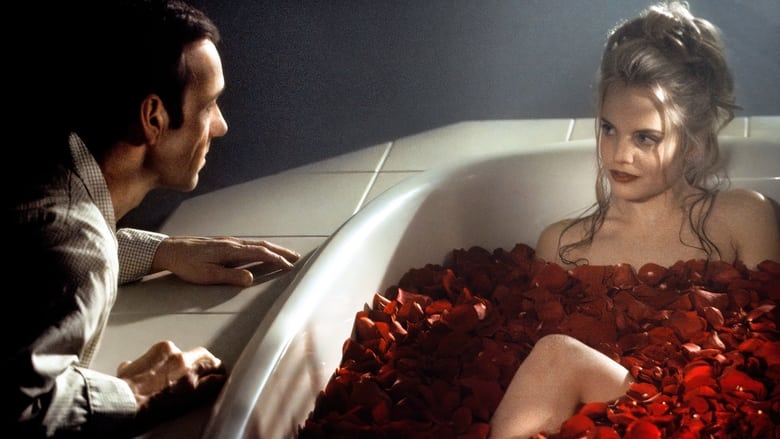
Lester pines and fantasizes about Jane’s best friend Angela (Mena Suvari) getting rained on with red rose petals while she lies naked in a pure white bathtub.  Carolyn, the real estate agent who can’t make a sale, sidles up to the dashing Buddy Kane (Peter Gallagher), her competition. Next door is Chris Cooper in a hospital cornered role as retired Marine Colonel Frank Fitts, with his near comatose wife Barbara played by Allison Janey, and their eighteen-year-old resourceful drug dealing son, Ricky (Wes Bentley). He takes advantage of his camcorder at any opportunity to collect the beautiful images found within the world he occupies and observes.  That could mean he’s capturing Jane in her bedroom window which faces his own.  Later, he’ll show you the freedom of a plastic shopping bag dancing within an autumn breeze.  An old shopping bag has more life among a breeze and brown leaves than Lester, Carolyn, Frank or Barbara.

There is a mystery to American Beauty that seems quite odd.  We know that Lester will die soon, but how and why? Maybe there’s a twist, because that outcome seems more and more impossible as we see Lester discover a spirited mindset to go after what he wants, when he wants and declare that he’s not going to allow himself to take shit from anyone particularly in his boring dead end job or from his unaffectionate wife.  Ricky, the kid with tons of money and electronics equipment, has nothing to lose because he’s not committed to anything at age eighteen and he can just quit an ordinary table-waiting job at any given moment.  Why didn’t Lester have the gumption to ever be like Ricky?   It seems so simple.

There’s a blink and miss it sign hidden in plain sight.  Pinned to the wall of Lester’s work cubicle is the message “Look Closer.”  Director Sam Mendes and writer Alan Ball gives the audience a subtle wink to dig within the cracks of suburban life sidewalks.  These homes may appear perfect on the outside, with neighborly neighbors, but if you watch with a more critical eye you’ll find an emptiness that has been unfilled for too long.  The filmmakers make it easy for you to uncover what eats away at the upper middle-class way of living.  Dinner with Lawrence Welk playing in the background is anything but uplifting.  It’s imprisoning.

When one member of this community opts to seize his moment, no matter if he’s motivated by a kid’s rebelliousness and the drugs he buys off of him, or the fact that he thinks a beautiful teenage blonde has the hots for him, he sets out to change.  He exercises and builds up his body, buys the dream sports car he’s always wanted, quits his job and grows to not caring how this may disturb his unloving wife. 

American Beauty seems to remind us how alive we can be when we are younger and not as restrained by the commitments it takes to live like adults with debts and parenthood and jobs and marriage.  Look closer though because couldn’t we live as well or more aggressively when middle age arrives?

The irony of Alan Ball’s script is that a boring guy like Lester Burnham discovers exciting things about himself just as the end of his life is approaching.  All he needed was stimulation.  He never saw his death coming, and you might forget he told you he will soon be dead, but American Beauty works to show how necessary it is to live each day to the fullest. 

I sound hokey.  I know.  Yet, that’s the direction of this film’s trajectory.  On the side, you observe those people who do not pursue what will fulfill their own lives and desperately need a modification.  Lester was limited to branch out. So is Colonel Fitts and his very sad wife.  So is Carolyn, and Jane and Angela, and maybe so is Ricky.  All of these people uphold facades about themselves to preserve a happiness on the outside when they really feel worse within. 

Sam Mendes is brilliant at drawing upon the subtle messages and insecurities of Alan Ball’s neighborhood characters.   About the only people that Sam and Alan do not dig deeper with is the gay couple.  I guess since they are happily out of the closet, what is left for them to conceal?

I could not help but compare Mendes’ Oscar winning film to Robert Redford’s.  American Beauty is more forthright than Ordinary People. Redford’s film draws out the ugly honesty of the family nucleus when an unexpected tragedy interferes.  Then it takes the entire film before the spouses take off their masks and truly declare how they regard each other.  It’s crushing to realize a sad truth. 

American Beauty rips off the layer right at the beginning, though.  A tragedy does not awaken these people to the natures that embarrass them.  Simply a hellbent, fed up mindset gets one guy going, and if that one member opens his eyes, then so will others because a simple disruption in ordinary life is next to impossible to live with.  Both films are so wise in how they criticize the very people these films were likely catered for.

What do these two Oscar winners say?  They tell the middle class, middle age American to simply look closer.

WEEKEND (France, 1967)

by Miguel E. Rodriguez

DIRECTOR: Jean Luc Godard
CAST: Mireille Darc, Jean Yanne
MY RATING: 8/10
ROTTEN TOMATOMETER: 93% Fresh

PLOT: A married couple go on the road trip from hell to visit the wife’s parents, intending to kill them for her inheritance.


You don’t risk the time it takes to do this…unless the act itself has meaning. – Detective Somerset, Se7en (1995)

In my personal opinion, there are few things more dangerous than a skilled director who genuinely has something to say.  Oliver Stone.  Stanley Kubrick.  Martin Scorsese.  Spike Lee.  Even Kevin Smith (Dogma, 1999), among many others you or I could name.  Give these guys a finished script and a camera and watch the fireworks from a safe distance.

In 1967, iconoclastic filmmaker Jean Luc Godard became disgusted or disillusioned or just plain pissed off about the class division in France and around the world, especially with how the middle class/bourgeoisie had forsaken human connection for the accumulation of material wealth.  So, he dashed off a screenplay, gathered up a crew and some actors (including a lead actress that he specifically did not like, because he needed her to play a CHARACTER he did not like), and made a film that defies classification or genre.  Is it a comedy?  A drama?  Satire?  I’m still not sure.  All of the above?  None of the above?  Weekend stands stubbornly apart from anything I’ve ever seen, thumbing its nose at the world with one hand while flipping the bird with the other.  It is many things, but timid it is not.

The movie begins with a simple enough scene, interrupted by title cards that say things like, “A FILM FOUND IN A DUMP”.  A husband and wife calmly discuss their plans to murder her parents so she can get her inheritance.  They might as well be talking about what movie to see tonight.  When the husband leaves the room, the wife takes a call from her lover.  In the driveway of their house, a fight breaks out among three people about…what?  Doesn’t matter, they’re never seen again, and the husband and wife observe the fight without commenting on it or making any attempt to stop it.

This is followed by an extraordinary scene, in a film full of extraordinary scenes, in which the wife, apparently speaking to her analyst, describes, in graphic detail, a sexual encounter she had with a strange man and his other mistress.  Meanwhile, Godard’s camera does a slooow zoom in to the woman’s face, then a slooow zoom out to reveal she’s in her bra and panties, then another slooow zoom in, and out, and in, and out, and you get the idea, right, wink, wink, nudge, nudge?

Is Godard being too obvious in this scene?  Clearly.  So, what is he trying to say here?  By being so blatantly obvious, is he parodying earlier French New Wave and Italian neo-realist films, some of which invested a lot of screen time in long conversations about nothing?  Sure, let’s go with that.  What’s with that in-and-out camera move that I read someone describe as “masturbatory” that occurs during the explicit discussion?  Is he also poking fun at other filmmakers who lack subtlety?  Yep, that works, too.  In a weird way, I was reminded of Tarantino’s Kill Bill cycle, movies that took every kung fu trope imaginable, turned the volume up to eleven, and then turned it up some more.  That’s what Godard is doing here.  Why?  As Robin Williams once said, “Because we’re French.”

That’s just the first two scenes.  Later, there is a justly famous tracking shot (really two or three that are spliced together) that lasts for nine minutes and covers 300 meters of ground.  It tracks past an endless traffic jam as our “heroes” try to get around them on their way to kill her parents.  The camera passes cars, convertibles, trailer trucks, a flatbed with two caged lions and a monkey on a leash, horns honking, people yelling at each other.  THIS part reminded me of some of the best “Family Guy” gags where something is spun out for a ridiculously long time, where the duration of the event becomes the gag, instead of the gag itself.  In the film, it actually did become kind of funny…until finally, nine minutes later, we see the cause of the traffic jam, and my jaw dropped.

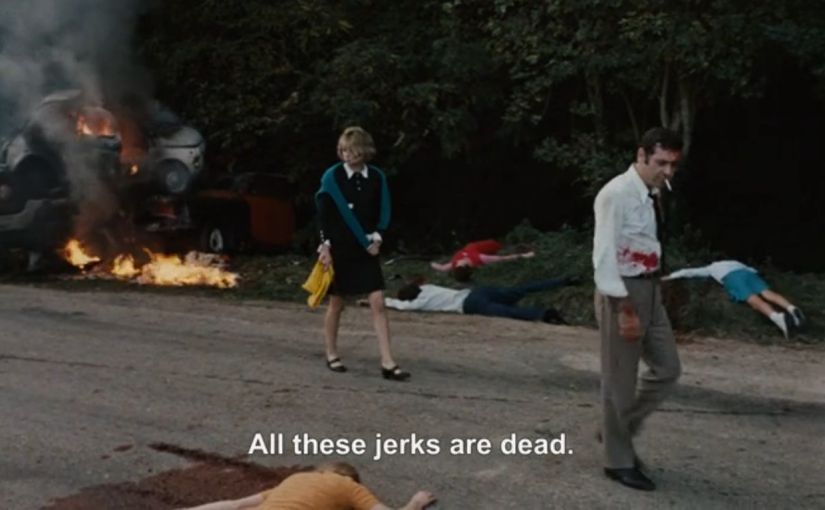
Car accidents are a recurring motif throughout the film.  Perhaps they represent Godard’s assertion that his country was, at the time, more or less a trainwreck.  With other filmmakers, showing just one or two car wrecks would get the point across.  Not Godard.  They’re everywhere.  And you don’t get just twisted and burning metal; there’s also broken and bloody bodies adorning the wrecks and the roadside.  And through all of this (and more), our main characters walk or drive, apathetic to the chaos, asking everyone – even the dead bodies – how to get back to the main road, blind to the madness around them.

Godard adds intertitles at random intervals, some of which are laden with French cultural references that escaped me.  Some of them didn’t even get translations on my Blu Ray.  One of them says “THE EXTERMINATING ANGEL”, which is the title of a famous film by Luis Buñuel…sly wink to the cinemaniacs in the audience.  Go Godard, celebrating geek culture before it was cool.  Some of them are repeated while the film backtracks as if the projectionist is having a spasm.  At one point, the film jumps and skips forward as if there was a bad splice in the reel. At another, a scene occurs in a field full of abandoned cars. Then, JUMP CUT, and the cars are now a flock of sheep. Take THAT, audience expectations!

At every stage, Godard is constantly reminding the viewer that they’re watching a movie.  One of the characters even says, “What a rotten film, all we meet are crazy people.”  Later there are scenes that approximate some kind of revolution.  Battles are fought.  The gunplay looks curiously amateurish.  There’s a scene with a pig.  I don’t want to give too much away, but let’s just say that it was definitely harmed in the making of this movie.  Same with the chicken.

The chaotic nature of the movie was mesmerizing, like…a car accident that you can’t turn away from.  To fully analyze every historical, literary, and cinematic reference would be like trying to catalog every single pop culture reference in Ready Player One [2018], and that’s something for which I have neither the time, the inclination, the education, nor the space to do.  Weekend is not for everyone, he said, blatantly stating the obvious.  But I ultimately enjoyed it because it’s not that often I get to listen to the voice of a really angry filmmaker.  I may only understand the basics of what Godard is angry about, but that doesn’t diminish the power of his statement.

A REAL PAIN

By Marc S. Sanders

Sometimes I take notice of how the title and credits appear in a film.  The director or the title supervisor had to put some thought into how the font and lettering appears on the screen at the start of a film.  Woody Allen was always very simple with his basic white lettering centered on a black screen.  Star Wars jumps at you across a galaxy of stars and then zooms away from you.  The Godfather appears with that hand grasping strings of a marionette.  I imagine writer/director Jesse Eisenberg opted to put the words A Real Pain to the left of Kieren Culkin’s closeup shot as the film begins.  When it concludes, the title again appears but now it is to right of a nearly identical pose of the actor.  During a five-day guided tour through Poland, we are accompanying the two leads, and we will uncover what defines a real pain all the way from left to right.

Eisenberg and Culkin portray Jewish cousins, David and Benji, who are reconnecting during their adulthood by joining a tour group in Poland that is focusing on historical locations related to the Holocaust.  Their grandmother recently passed away and earmarked monies for them to take this trip and visit her childhood home that she lived in before the Nazis took over and erected the Warsaw Ghetto along with concentration camps that killed millions of Jews and Europeans by the command of Adolf Hitler. Their tour guide promises an informative but likely triggering experience for the men and the four others who are accompanying them.  What becomes concerning though is that Benji wildly expresses himself during unexpected and inconvenient moments.

Even if David is uncomfortable with his cousin’s behavior, Benji is at least funny at first as he upstages James the tour guide (Will Sharpe) and gains a quick influence over the group.  Later though, Benji will alarm and frustrate everyone.  His grandmother was the most treasured person in his life.  Now that she’s gone, there’s a deep void left for him, and he has been exceedingly hyperactive and perhaps harmful to himself.  A train ride in the first class section is declared inappropriate to Benji as he reminds everyone of the purpose of this little vacation and journey into the dark times of Polish history.  Should they be able to live so comfortably, eating the finest delicacies as they journey to places mired in deep suffering from a horrible past?  David will eventually share what truly disturbs him personally, when he thinks about his cousin.  

Kieren Culkin delivers one of the best performances you’ll find anywhere in 2024.  His timing is so rhythmic even if you cannot predict when Benji is going to detract focus from the tour, and over towards what tremendously irks him.  The comedy he delivers, from Eisenberg’s very intuitive and sensitive script, is quite amusing but it all stems from an anger and sadness that the character cannot contain.  I can’t think of many actors who could play this kind of part.  It’s like watching Robert DeNiro in one of his manic roles that he performed under Martin Scorsese, like in The King Of Comedy or Taxi Driver.

Jesse Eisenberg is worthy of accolades as well.  He directs a heartbreaking monologue of his character trying to explain his cousin’s unhinged behavior.  His focused composure eventually is shaken as he directs his camera to zoom in closer and closer to him, across a dinner table.  David may have a sustained foundation of life with a loving wife and child back home, but he carries a pain that resides within his first cousin.  Eisenberg’s script compliments his well-planned direction, and he handles every perfect beat of the man he plays from the schlubby way he dresses to the baseball cap he wears over his bushy hair.  Despite their thirty-something ages, David and Benji connected as kids with their grandmother there for them.  Now that she’s gone, the sorrow normally found in a kid does not live as comfortably well in an adult body.

A Real Pain will motivate you to book a flight to Poland.  Eisenberg’s film works like a vivid travelogue and every backdrop is rich in color and restored history. That is until the tour group arrives at the Majdenak Concentration Camp.  The horrors that played out here are preserved so that visitors will realize the most absolute cruelty that man is capable of.  Other than the footsteps of the actors and the whisper of green nature on a sun-drenched day, no one speaks other than a few comments from James.  We see a caged collection of old shoes that belonged to men, women and children who were imprisoned and died at this location.  Eisenberg shows us the showers that gassed so many people to death.  The walls are splotched in blue smears.  Watch the film and you will discover their significance.  Life size ovens are also on display.  It’s terribly overwhelming.

What you may believe was a real pain in Benji no longer compares when the film arrives at the camp.  It’s not so much that Benji is a pain.  He only carries the pain that his grandmother and ancestors endured and witnessed.  

Reader, just writing this out leaves me shaken, quite frankly.

There’s a wholesome feeling when the boys, who are now men, arrive at their grandmother’s childhood home.  A spirit seems to talk to the pair and they share some dialogue but Jessie Eisenberg’s film also seeks some closure for his characters.  I will not reveal what they do at the front door. Once I finished watching the picture, I read an insightful quote from Jesse Eisenberg regarding this scene.  He says he was looking for David and Benji to do something that might have been most appropriate during a time when their grandmother lived here as a child, but now, nearly ninety years later, the gesture only serves as an inconvenience or a hazard.  I could relate.  History changes the course of how we live and abide. What seemed right to do at one point in life can no longer be accommodating at another time, regardless of if the sentiment was meant with noblest intention.

A Real Pain could be considered a coming-of-age film.  The characters resort to sneaking on to rooftops to smoke pot or hitch a train ride without paying, or travel with the most basic duffel bags for a European trip.  They dress like high school or college kids.  One dresses primarily in blue and the other in red until a well-timed turn of events has the characters switch colors. Benji speaks with what appears to be a lack of respect for his elders, despite the intelligence and sensitivity in the points he makes.  This trip allows the former boys to grow up, according to their grandmother’s design, long after her death.

Some people have told me they were unsatisfied with the open-ended conclusion to A Real Pain.  Not me.  Like the positioning of the film’s title at the beginning and end, I feel like I went on a journey from point A to point B; from left to right.  I looked back in history and for a short while lived among a present period, in a different part of the world.  These experiences are with me now.  Yet, for a guy like Benji, he should not be less lonely or less melancholy or less of whatever he feels on any given day.  His pain has not subsided.  Maybe though, it feels more reasonable and accepting.  I still carry empty places in my heart now that my parents are gone, and I’ve had to accept the surprising loss of a close friend. The way Benji or any of us learn to carry on is to find a justice for the pain and sorrow we carry under a new kind of normal. 

David returns to the loving welcome of his wife and child.  Only now, he has a better understanding of the real pain his cousin is experiencing and what his grandmother survived.

A Real Pain is worthy of more than just the two Oscar nominations it received (for Culkin’s performance and Eisenberg’s screenplay).  It is one of best and most engaging films of the last few years.  A triumph in natural dialogue and thought, while serving as a visual masterpiece in silent anger, sadness, and sensitivity.

What is especially evident is that Jesse Eisenberg is an accomplished director, and an even better writer. In addition, Kieran Culkin is a blazing dynamo of both comedic and dramatic talent. In A Real Pain, he wears both masks exceptionally well.

TEACHERS

By Marc S. Sanders

I grew up watching the television show M*A*S*H with my mother and brother.  Don’t hate me but I have yet to see the Robert Altman film.  Perhaps that is because I was afraid of major disappointment.  The formula for many of the episodes and seasons of the TV show work so well at blending tidbits of comedy within a setting that is nothing else but bloody turmoil.   For those characters to survive required all of them to laugh and lampoon into the face of an uncontrollable situation where their lives could end at any time while they live in misery.

These thoughts came back to me as I watched an unsung and forgotten film from 1984, Teachers directed by Arthur Hiller.  John F Kennedy High School is only going in one direction which is very far south beyond the gates of hell.  A gym teacher is getting students pregnant, a kid shows up at the principal’s office with a stab wound in the arm, and the school psychologist has just lost her marbles because the old fart tenured teacher hogs the ditto copy machine (Remember those?  You could get high off the ink on the paper.).  A mental patient has managed to worm his way into a comfortably welcome substitute teacher position.  The driver’s ed car has been stolen and one student terrorizes another teacher in an assortment of ways beginning with biting and then moving on to theft.

Alex Jurel (Nick Nolte) is the admired social studies teacher who has lost his passion for the profession.  It’s not so much that the student body or the teaching staff is out of control.  The whole administration has taken to a new mentality of profit over proficiency.  The merits that come with an education are all but dismissed.  The assistant principal (Judd Hirsch) used to care as well.  Now, his job is to maintain a façade for the school and churn out one student body after another year after year.  The principal only knows to answer any questions with a genuine “I don’t know.” reply.  Bottom line is no student should ever be flunked from John F Kennedy High School.  If they can read enough, then it’s enough to get the diploma.

A former student of the school is Lisa Hammond (JoBeth Williams), now an attorney and representing a graduated student who is suing the school claiming he is an illiterate who cannot find a job or begin a future due to the negligence of the school. Lisa is a crusader.  She’s not here for the money to be earned from the case.  She’s here to make a change and her lynchpin deposition will come from Alex who will testify about the truth that’s occurring. Hopefully, he will also recruit other teachers in tow to back up the claim.  Naturally, as his former student with the nice ass, Lisa becomes involved with Alex on the side.  Like most movies, this one also does not question the conflict-of-interest circumstance.  We just have to roll with it.

I really take to the dilemma of the school and I understand both sides of the argument.  Now, more than ever, over forty years after the release of this film, I think our educational system is in dire straights with minimal funding, lack of support and respect for a teaching staff, parents who exonerate themselves of being responsible for their children’s lack of progress and behavior, and then of course there is the very real epidemic of school shootings and on campus violence. 

However, school is a necessary element to our society and its where all of us begin.  To uphold a reputation will involve both losses and wins.  Not every student will make it.  Not every student will miss out either.  As Judd Hirsch’s character insists, half of these students will not graduate with a proper education but half of them will.

Okay.  Enough arguing!  How about Arthur Hiller’s movie? Teachers has much to stand on and I wish it had garnered more attention.  It’s undoubtedly worthy of it. 

Like M*A*S*H, there’s organic comedy that comes from the film and a variety of teachers and students appear like they have been cut from familiar cloths.  Most of the comedy works especially well.  I love the ongoing joke of the one teacher who sits at the back reading his paper and dozing off, with the students facing away from him while they complete an assignment during the period.  The punchline to this joke may be predictable, but I’m still allowed to laugh as I watch it play out.  It’s funny. 

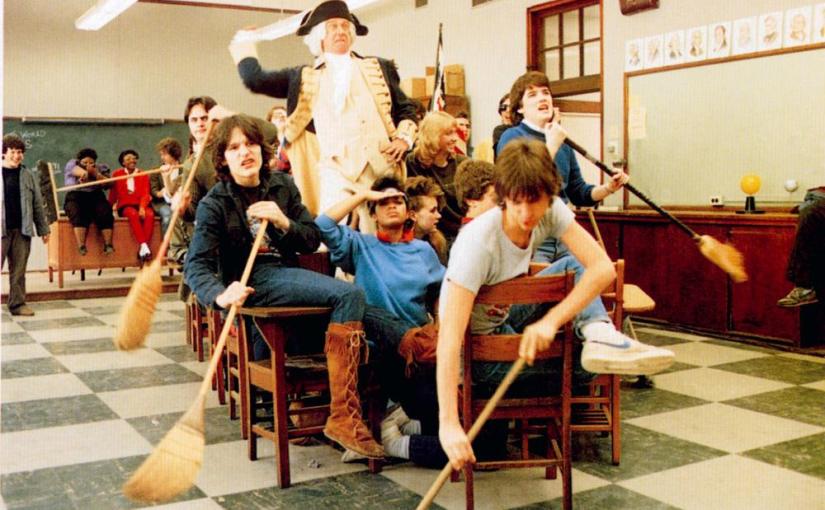
Richard Mulligan (Empty Nest) plays a mental patient that ironically engages his students when he conducts his classes dressed as famous historical figures like Lincoln and Custer.  Watch him reenact George Washington’s crossing of the Delaware with his students “rowing” the boat.  It’s an image I will not forget.  Nor will I forget his final scene in the picture as he encounters Nolte’s character in the hallway.

Where the film falls short is in the one student that is primarily focused on, played by Ralph Macchio, shortly after coming off his first Karate Kid movie.  Just like in The Outsiders, which I recently wrote about, Macchio relies on his dark complexion, stylish black hair, blue jeans and that popped up jacket collar again.  There’s also that strut he always has.  Forgive me for beating up on the kid, but too often I see Macchio donning the same image – that cool kid pose needed for the cover of Teen Beat Magazine.  Nick Nolte shares a lot of scenes with the actor playing the troubled kid with a sixth grade reading level.  However, Nolte is the only one working most of the time.  Another actor in this role would have served better.  It’s a necessary role as it attempts to awaken Nolte’s teacher character to try saving another kid before he gets lost.  Back then, maybe Emilio Estevez or Lou Diamond Phillips would have been more suitable.  Instead, we get Ralph Macchio being Ralph Macchio all over again.

Teachers is a comedy drama that mostly works.  It’s easy to get caught up in the comedy and, sadly, the absurd truth of what goes on in a metropolitan public school system back in the 1980s.  There’s also very dramatic and heavy elements to the film that stay with you.  Before school shootings no longer became shocking (a sad and current truth), Teachers explored the trauma of school bullying and the response the comes with that issue.

Arthur Hiller’s film did not invent the wheel on troubled times within school.  Heck, even The Sweat Hogs from Welcome Back, Kotter were troublemakers too.  Not to mention there are other school dramas to come before, like Blackboard Jungle.  However, Teachers is an very engaging film. I was completely absorbed as soon as the movie began, first in its comedy, and then later in its drama.  A near final scene of the film is eye opening and much like Steel Magnolias will leave you laughing and crying all at the same time.  That happens because you quickly begin to care for most of these characters and the turbulent times they live through as a teacher making next to no money while working under unfair and unreasonable scrutiny.

I think Nick Nolte is delivering one of the best performances of his career.  He has great chemistry with JoBeth Williams, who is good in her role.  The romantic storyline does not go overboard.  It does not get schmaltzy.  It is just enough, and it’s wise to include dialogue where they debate one another from two different sides of a coin.

Teachers also works as a great look back piece.  A lot of well-known, eventual recognizable actors round out this cast including Morgan Freeman, Crispin Glover, Laura Dern, Allen Garfield, and Lee Grant. Anytime Nolte is on screen, he only enhances the scenes he shares one on one respectively with most of these actors.  The moments between him and Macchio only work because of Nick Nolte.  Call Nolte the Alan Alda/Hawkeye Pierce of this picture. 

Teachers might look tame by the turmoil we see today in schools across the country but none of what is seen is untrue or exaggerated either.  Well, maybe except for the mental patient who arguably turns out to be the most engaging and influential instructor of them all.  That’s funny stuff, but you gotta be a little bit crazy to become a teacher nowadays.

A SERIOUS MAN

By Marc S. Sanders

There’s never anything wrong with questioning the Almighty God.  At least that’s what I believe. 

There’s nothing wrong with being faithful to an Almighty God…if you can find comfort and solace in its doctrine.  At least I think that’s what I believe.

The Coen Brothers released A Serious Man in 2009 to solve a great mystery that frankly we should all know can never be solved.

In 1967, Larry Gopnik (Michael Stuhlbarg) is a Jewish family man living in small town Minnesota.  He never steps out of line with his principles or morals.  He attends synagogue regularly.  He’s simply a good Jew; a good husband, father, brother-in-law.  Again, he’s a good Jew. 

Yet, he is also plagued with suffering through the results of what everyone around him commits as sin or violations.  His brother-in-law Arthur (Richard Kind) has overstayed his welcome in the house and is now under suspicion of committing illegal gambling in various bars.  His daughter is swiping money to get a nose job.  His son is listening to Jefferson Airplane in Hebrew school while getting ready to become a Bar Mitzvah.

Most prominently speaking, his best friend Sy Abelman (Fred Melamed) is gently counseling Larry through an unwelcome crisis at home.  Sy is encouraging Larry to agree to a “Get.”  Sy is ready to begin a relationship with Larry’s bitter wife Judith (Sari Lennick), and as they move towards divorce, Sy will need Larry to obtain a “Get” from the Rabbi. The Coens are admirably nervy in their writing because Sy addresses Larry like a child who he’s trying to get to swallow a bottle of castor oil so that he can finally make after two days of constipation.  That’s truly what it feels like.

I never read the book of Job, but I understand that A Serious Man was metaphorically inspired by its contents.  The question residing in both contexts is simply why must all of these unfortunate circumstances occur in Larry’s life? 

For Larry, it is best to get definitive answers.  After all, Larry is a physics teacher which is built on solid formulaic equations and never compromised because it’s a subject of exact science.  His giant blackboard bears the argument of solid answers from top to bottom with endless scribbles, diagrams and numbers.  It looks like incomprehensible gibberish, but at the end of it all, there’s a definite answer.  The proofs do not lie or compromise.

A South Korean student cannot comprehend that wrong answers on a physics test merit a failing grade.  It’s unfathomable because without passing Larry’s physics course, the student cannot obtain a mathematics scholarship.  Larry knows that is true, because how can you study physics without math? The two subjects hinge upon one another.  Larry sees no other way than to fail the student.  He won’t budge on that.  He sticks to his code of ethics.  He’s right all the way. Still, he’s accused of being prejudiced and then an envelope of bribe money is discovered on his desk.  It won’t sway him, but he can’t return it back to the student, if he can’t find him.  So, here’s another thing to weigh on him.

Larry is a healthy middle-aged father and husband, a devout Jew and somehow he’s the one suffering the most from the misgivings of everyone else.  Poor Larry even has to move with nebbishy Arthur into a local hotel.  Sy assures him it’s a lovely place with a pool (the pool is drained empty by the way).  His chance at tenure is also at risk.  There’s the divorce filing from his wife which causes him to hire an expensive attorney (Adam Arkin).  All this “tsouris!”  It’s too much to carry at once.

Midway through A Serious Man, the Coens opt to have their protagonist visit three Rabbis for the exact answers that will tell of his unfortunate circumstances.  The three visits do not so much lend to the story of Larry’s plight as they prove a point.  As satisfying as it might be for a physics teacher to arrive at the exact answer on the right side of an equal sign, one Rabbinical student (Simon Helberg from The Big Band Theory)- filling in for THE RABBI – will tell you to seek the answers you are looking for in an empty parking lot just outside the window.  ?????????

The second Rabbi played by favorite character actor George Wyner (Hill Street Blues, The Devil’s Advocate, Spaceballs) will tell a tall tale of a dentist and his goyish patient that leaves me wanting to know the end all be all.  What’s concluded may leave you shouting OY VEY!!!!

The third Rabbi is the mysterious Rabbi Marshack (Alan Mendall).  He is the elder, maybe the grand prophet, who is concealed in a private office with his long white beard and black hat, sitting behind his desk at the faaaaaarrrrr end of the room.  Will he finally have the answers to Larry’s questions?

This is reminiscent of that animated commercial that asks how many licks it takes to get to the Tootsie Roll center of a Tootsie Pop.  Did Mr. Owl actually have the answers the little boy was looking for?

A Yiddish told prologue that is seemingly unconnected to Larry’s story opens the film and it tells the story of a dybbuk knocking on a couple’s door in the “mitt en drinen” of winter.  The wife sees the curse of this dybbuk – the soul of a dead man meant to haunt them.  The husband does not.  It’s only after you watch A Serious Man from beginning to end that you’ll likely make the connection of a curse that future generations will never be able to escape now that the dybbuk arrived many years prior. Perhaps that is the answer that no Rabbi could clearly define for Larry.  It’s more apt to be my theory but it’s still not entirely clear.  Then again, perhaps it’s just the tale to resort to when a congregant like Larry Gopnik asks his clergymen why his life is in such turmoil.

I adore this film and it might be on a very personal level that others may not appreciate unless they have had an upbringing like mine.  Practically every single character in A Serious Man, all played by relatively unknown actors, look completely familiar to me. 

From Larry’s obnoxious kids (“I’m studying Torah asshole” with a defined middle finger raised), to his bitter wife that I routinely see a caricature of in Shull. Sy Abelman talks like my father-in-law (a great man, who I love by the way) does at Passover Seders, to his co-workers and even Larry himself.  Wearing nerdy black rimmed glasses, he hunches down to scribble on the blackboard with his fat butt sticking out just like my Hebrew teacher Mr. Katz did in my Yeshiva.  It’s all uncannily familiar and easily recognizable. 

There’s a very striking authenticity to A Serious Man that I’d be remiss in not complimenting.  Many may not see it.  You’d have to a be a northern practicing Jew or at least personally experienced with this secular environment to understand. That being said, seek out this unsung Coen Brothers piece and allow your patience to guide you through its various oddities.  It’s Joel & Ethan Coen.  So, you know it’s going to be odd. I expect that it’ll leave you thinking, though.

These actors that you may recognize, but cannot pinpoint what else you’ve seen them in, were meant for these roles. Only a certain kind of Jewish actor could play these people.

For example, no one else but Fyvush Finkle could play a Dybbuk arriving on a doorstep in the mitt en drinen of snowy winter!

BREAKFAST AT TIFFANY’S

By Marc S. Sanders

Holly Golightly.  

Name sounds almost whimsical with a noun, a verb and an adverb.  Holly go lightly!  Puts a smile on my face.

Actually, the creation of this character from Truman Capote might follow the advice that her own name implies, and Audrey Hepburn portrayed the young self-inventive socialite – well let’s be honest as it is no longer 1961 and say “call girl” – with an enthusiasm for living better than anyone expected or could have imagined.  Hepburn was self-conscious of her portrayal.  Capote insisted on casting Marilyn Monroe.  None of it matters as Audrey was endearingly perfect.

Blake Edwards adapted Truman Capote’s novel Breakfast At Tiffany’s, and while I never read the source material I can recognize the director overstepping for sight gags, slapstick and exaggeration before he gains focus with a need to conclude his film on a turned character arc. 

I’ve had mixed feelings on Edwards career.  Days Of Wine And Roses was a rare drama for the filmmaker and yet I believe Jack Lemmon soars way over the top in his alcoholic performance.  The Great Race? Let’s just say there always needed to be “More pies!  More pies.”  I have tried multiple times to get through Victor/VictoriaThe Pink Panther was where Blake Edwards was most suitable.  However, with Breakfast At Tiffany’s he initially shoots for the silliness of Holly Golightly’s carefree life. She lives off of other people’s money while they obtain an increase in social stature for just being in the same room as her.  Holly was one of the pioneers of social media influencers.  Before a single Kardashian was ever born, there was Holly Golightly.  In an updated time, Holly would be on every reality show with countless podcasts, and a talk show hosted out of her own apartment where she’d lift her Tiffany blue sleep mask and wake up just as you turned to your Instagram account or Facebook string.

Paul Varjak (George Peppard) is Holly’s new neighbor who is on the brink of being a successful novelist with a little help from a middle age wealthy man’s wife who pays him for favors in return.  For Paul, Holly appears so foreign to him, and yet he’s living by the means he earns from what others leave on his night table.  Holly and Paul’s trajectories are quite paralell.

Capote’s film adaptation is appealing because of how air headed the picture seems at first.  Later though, it makes way for a sincere account of a young woman lost with no direction and full of lonely despair within the very large city of New York.  It makes sense that Holly Golightly finds simple solace from her need to tread in social gatherings and in the arms of wealthy men by visiting the window displays of the Tiffany jewelry store on 5th Avenue. 

We don’t yet know why but as the film begins with Henry Mancini’s Oscar winning Moon River (one of cinema’s greatest songs), Holly exits a cab in front of Tiffany, just as the sun is rising to consume a pastry with her cup of coffee.  The honest girl hides behind her thick sunglasses, a done-up hair do and a little black dress.  It’s an iconic scene in film, maybe the greatest that Blake Edwards ever shot, but what does this introduction truly mean?  Even Holly Golightly yearns for isolation from a crowded metropolitan city of eight million people, and the window display at Tiffany is her hiding spot. It is only for her to occupy all by herself on a brisk morning after sunrise.

A far cry from this opening scene soon occurs.  Holly crams at least fifty people into her apartment shortly after Paul arrives.  He witnesses the silly swinging attributes of the people who are welcomed to this social gathering of drinking and joyfulness.  He is puzzled that no one takes notice of Holly’s cigarette setting a woman’s hair on fire (typical Blake Edwards silliness) only to be put out by Holly when she is unaware she spilled her drink and doused the flame.

Later, an honest past comes back to haunt her, and Paul begins to see through the charade of her proud debauchery.  Further on, tragedy strikes and the gleefulness of life is no longer realized.  Misfortune will come upon all of us no matter how Holly Golightly we could ever be. 

Breakfast At Tiffany’s seems like a film meant to be light as a feather.  Yet, it’s not so easy to grasp the story’s purpose right away.  Capote, however, wrote an insightful observation of a young twenty something character occupying a world and a past that is much larger than she could ever handle at her young age. Turns out she is on her own with no financial means or purpose in life to show for her identity.  Holly will host a crowd in her tiny apartment, but she dresses in her bed sheet.  Fashionably dressed of course, but why a bed sheet?  She takes in a cat, but the cat has no name.  It’s just called cat.  Holly Golightly is devoid of depth or basic means, but she’ll still celebrate herself among the masses while trying to live off the wealth of others.

I appreciate what’s gained from watching Breakfast At Tiffany’s all the way to its ending. Holly appears to be crumbling beneath the weight of life that she’s ill-prepared to accept.  Just ahead of the epilogue, new and unexpected problems arise. There’s little option for escape.  Her one true blessing is Paul, the man who also evolves to grow up before Holly is ready to do so. Part of his maturity, progressed very well by the actor George Peppard, entails guiding his darling friend Holly along the way.

Holly Golightly is a tragically lost character.  Yet she’s a lot of fun thanks to Blake Edwards and Truman Capote, and most especially to the enormously engaging talents of Audrey Hepburn.

NOTE: Sadly, a terrible stain exists on Breakfast At Tiffany’s final cut, due to arguably the worst casting decision and worst written character in film history.  Mickey Rooney as Holly’s frustrated Japanese upstairs neighbor Mr. Yunioshi.  This is where Blake Edwards once again oversteps in his need for unnecessary slapstick.  It’s not enough that the character serves no purpose to any of the storylines.  He repeatedly bookends scene changes with unwelcome goofiness as Yunioshi endlessly bumps his head, startles himself or pratfalls in his bathtub, complete with overexaggerated buck teeth sticking out from beneath his upper lip.  These are unfunny Three Stooges gags. 

What’s way worse is that a Caucasian well loved character actor of legendary status was cast to invent buffoonery that apparently exists within Japanese culture.   A truly insulting and unfair representation of an entire people.  Poor Mickey Rooney. The existence of this character along with who occupies the role is the most egregious of film appearances ever put on screen.  Politically speaking, we are much more attuned and sensitive to all races and nationalities today.  Yes, many still have a lot to learn, but even in 1961 this was a horrible slap in the face taking pop culture back to the ill-conceived material that might have been found in Amos N Andy routines or even a Little Rascals Buckwheat personalization. 

I guess Blake Edwards and screenwriter George Axelrod must have thought the Japanese were due for a stooge.  Boy, were they ever wrong!

GHOST

By Marc S. Sanders

For a perfect blend of the supernatural, suspense, mystery, drama, romance and comedy, the first film that will always come to mind is the surprise hit film Ghost from 1990.  One of the zany Zucker brothers, Jerry to be more precise, who introduced the world to slapstick spoof (Airplane!, The Naked Gun) directed this film turning Demi Moore into a ten-million-dollar actress, placing Patrick Swayze ahead of his Dirty Dancing looks and earning Whoopi Goldberg a very well-deserved Academy Award.  Ghost was a film for all kinds of movie goers.

Sam Wheat (Swayze) is an up-and-coming New York City business executive who loves his new live-in girlfriend, Molly (Moore) even if he can only say “Ditto!” when she tells him she loves him.  Shortly after the picture begins Sam is gunned down following an evening at the theatre.  Unbeknownst to Molly and anyone else living on earth, Sam’s spirit lives on though, and he realizes that he was not the victim of some random mugging/murder.  Now, Sam must find out who arranged to have him killed and why, while also protecting Molly from becoming a victim.

Along the way, Sam crosses paths with a phony con artist, working as a medium, named Oda Mae Brown (Goldberg) who turns out to be the real thing when she can actually hear Sam’s voice and communicate with him.  Sam must recruit Oda Mae to be a go between for him with Molly and everyone else necessary to follow up on in order to resolve the mystery of his sudden death.

Ghost succeeded in every category of filmmaking.  Rewatching the film decades later, I believe Demi Moore should have gotten an Oscar nomination.  Her close ups on camera with beautiful, muted colors from Adam Greenberg’s cinematography are masterful.  Greenberg should have been nominated too.  He’s got perfect tints of pearl whites both on the cobble stone streets of New York with the outer architecture of the apartment buildings, as well as within the studio apartment where the couple lives.  He strives for an ethereal look with his lens. Gold often occupies Molly’s close ups with dim lighting.  Blues and blacks and steel glinting shines follow Sam’s trajectory. 

Look at the lonely scenes that Moore occupies in the couple’s apartment.  There’s a haunting image of isolation with no dialogue capturing the young actress at the top of a staircase when she eventually rolls a glass jar off the top and it shatters below.  It’s one of the moments that defines a sorrowful character, and not many cry on screen better than Demi Moore.  Later, Sam is engaging in a pursuit through the subway system and races down a steep blue escalator in the dead of night.  Zucker places Greenberg’s camera at the bottom of the escalator to show the depth of hell that Sam may be risking continuing his chase.  The images and transitions of this whole movie from scene to scene are stunning.

I mistakenly recall Whoopi Goldberg as just a comedienne doing her stand up schtick in this film.  Not so.  Goldberg looks radiant on film and while she starts out comically as the script calls for, she eventually resorts to sensitive fear of what her paranormal partner demonstrates as real within this fantasy.  There are so many dimensions to this character.  She’s silly.  She’s exact in her nature for what’s at stake and the dialogue handed to her from Bruce Joel Rubin’s Oscar winning script compliments the actress so well. Goldberg never looks like she’s working for the awards accolades. Yet, she earned every bit of recognition that followed her.

Patrick Swayze makes more out of the straight man role than what could have been left as simple vanilla.  His spirit character uncovers more and more about his afterlife and what happened to him as the film moves along. With each discovery, you’re convinced of Sam’s surprises and what he becomes capable of as a ghost.  Long before superhero films became the novelty, Sam Wheat operates like one who has to learn of his origin and then acquire his new talents and powers to fend off the bad guys.

Jerry Zucker, working with Rubin’s script, Greenberg’s photography and Oscar nominated editing from Walter Murch, along with haunting yet sweet scoring from Maurice Jarre, builds a near perfect film.  The narrative of Ghost shifts so often from comedy to crime to drama to romance and the various natures of the piece hinge so well off each other.  That’s due to storytelling and the editing necessary to smooth out any wrinkles.  You become absorbed in Jerry Zucker’s direction, especially with the movie’s most famous scene where Demi Moore and Patrick Swayze are sensually doing pottery together accompanied by Bill Medley’s rendition of “Unchained Melody.”  Watch that scene with someone you love or take it in on a late Saturday night by yourself with no one to distract you with cackles and eye rolls.  You’ll see how effective Zucker’s work is along with Swayze and Moore upholding the scene in a dark, empty apartment.  Take it as seriously as the scene was originally constructed.  (Then go watch Zucker’s Naked Gun 2 ½ for a chuckle.)

The mystery of Ghost works well with surprises if you are watching it for the first time.  You build trust with a character only to realize it is a ruse for something else.  I do not want to give too much away.  For viewers who have never seen the film, maybe you’ll see an early twist as soon as the film begins.  Maybe not.  Either way, Ghost performs very naturally, unlike a forced kind of twist that M Night Shyamalan too often relies upon.  I do advise that you not watch the trailer that was used for Ghost as I believe it deals out too many of the film’s secrets.

There are movies that I watch over and over again because I love to relive the special moments they offer.  Ghost has those kinds of gifts and yet I have not seen it in ages.  I’m glad.  To experience the picture again was such a treat.  While I recalled all of its secrets, this time I was able to take in the various technical achievements and the assembly of the piece, along with outstanding performances. 

I have no problem saying that Ghost possesses the best performances within the vast careers of Demi Moore, Patrick Swayze and Whoopi Goldberg.  Ghost still holds up. It deserves a rewatch and an introduction to new generations.

LEAP OF FAITH

By Marc S. Sanders

You never know when God may come knocking.  You never know when Jonas Nightengale may come knocking either.  If you’re fortunate enough to reside in small town Rustwater, Kansas, you sir, or you ma’am, or you dear child may be blessed by the healing powers of Reverend Nightengale. 

On the surface, Jonas appears like a comedic role for Steve Martin, but in actuality it is not aiming for laughs at all.  When it comes to the confidence scheme that Reverend Jonas offers the townsfolk of Rustwater, Steve Martin plays the phony preacher with nothing but a serious operandi. 

Jonas and his crew travel the states from one big city to the next where he preaches his gospel of deceitful hope in exchange for donations to his traveling church that supposedly serve the almighty lord.  When one of their trucks breaks down in Rustwater, Jonas and his top aide, Jane (Debra Winger) use it as an opportunity for easy cash.  This Kansas town relies on harvests and the infrequent rain that feeds the crops.  Otherwise, this sleepy town has one diner, a movie theater, and a sheriff named Will (Liam Neeson) who is out to reveal the false Oz behind the curtain.  At the same time, Will is romancing Jane who has been eagerly seeking out a flame that never had a chance to flourish because she is on the road so often.

Jonas is wooing Marva (Lolita Davidovich), a waitress at the diner who is also skeptical of the whole act and is protective of her younger handicapped brother, Boyd (Lukas Haas) who suffered a permanent leg injury in a car accident that killed their parents.  Boyd was once told by a preacher that there is not enough faith in his heart for him to be the receiver of healing powers.  Lukas Haas was not just cast because he’s a talented actor.  He also has that angelic face that suggests he’s never committed a sin.

The tricks of Jane and Jonas’ trade are all revealed here.  Jane hides in the back feeding information about certain audience members and their ailments into Jonas’ earpiece.  Eavesdropping by the crew (including an early appearance by Phillip Seymour Hoffman) ahead of the show provides Jane with all the data.  It’s neat to see and it is likely how these outrageous televangelists pull off their miraculous “gifts.”

There’s an interesting argument to Leap Of Faith.  Jane defends Jonas’ façade to Will by him just selling fairy tales that make people feel good and fulfilled.  Will sees the obvious moral dilemma.  Jonas offers another defense.  Is this any different than a circus act that presents the fantastic for an audience to witness. Personally, I think Jonas and Jane’s defense is a bunch of hooey.  Yet, the residents of Rustwater buy into the act and soon people from all over the Midwest are lining up to listen to the gospel and witness the miracles of Reverend Nightengale. 

Jonas has a dilemma himself though.  He has a fondness for Marva, and he likes Boyd.  Boyd is not a plant in the audience to go along with the healing power showmanship.  So, how is Jonas going to explain his position?  He’s quick on his feet to fend off public accusations from Will, but how can someone who is not a miracle worker perform a miracle while maintaining his illusion.

I like the set up and questions that Leap Of Faith asks.  It’s the story of the arriving snake oil salesman which I do not see too often in films.  The showy pieces of the movie are wonderful with terrific singing from the choir under the big top circus tent with the enormous crucifix of Jesus in the center.  There’s also an enthusiastic supporting cast from Phillip Seymour Hoffman, as well as Meat Loaf as the church keyboardist.  The crowd extras are wonderful with their vocal responses.  I also especially love how Jonas ups the ante with a terrific sight gag to silence his biggest doubter, namely Will. 

The film is different, especially for Steve Martin.  He’s a ball of energy on the stage. He does his one-foot slide that was often seen on Saturday Night Live and his stand-up acts, but here it is not done for laughs.  Instead, Martin’s recognizable schtick upholds the public persona of Judas, and it works. 

Still, I do not think I got what I would have prayed for from the film.  I could not get past how Liam Neeson does not work as a Midwest sheriff in this Podunk town.  His boyish good looks from the early 1990s are right for the romance, but he makes no effort to hide his native Irish dialect.  He just doesn’t blend into the Americana canvas very well.  Debra Winger is great and it’s a shame I do not see her in enough films.  Almost everything she does I like.  She just has a natural vibe about her.  She has good scenes with Neeson, but just like his character, their storyline belongs in another movie very distant from the prime directive of Leap Of Faith.

The romance between Martin and Davidovich does not amount to much either. Frankly, it feels as if the story editors opted to abandon this angle midway through the making of the film. I do not recall how the relationship resolved itself and the ending certainly does not generate any kind of response for how either character regards one another. 

Towards the end of Leap Of Faith, the unexpected occurs twice, sort of like what happens in the end of Magnolia.  I found it interesting, but then the credits roll and the gospel choir sings on until the screen goes dark.  I’m leaping from my chair asking but wait, what about this and what about that.  Nevertheless, the choir keeps on singing, deafening my concerns.  Janus Cerone’s script seems to paint itself into a corner just when a brilliant irony arrives and hardly an acknowledgement, and certainly no explanation, is offered for the new phenomena that occurs. 

Leap Of Faith begins with a prologue between Jonus and a traffic cop.  It’s a brilliant scene demonstrating right away how smooth this “preacher” is when it is a one on one grift.  (Celebrated trickster and former con man Ricky Jay was a consultant on the film.) Later, we see how mesmerizing Jonus is in front of hundreds of people.  I was very excited during the first hour and a half of the picture, but then the movie gives up on itself.  The best way to describe this viewing experience is to say that Leap Of Faith simply loses faith in itself.