DRAGON HEART: ADVENTURES BEYOND THIS WORLD

By Marc S. Sanders

Dragon Heart: Adventures Beyond This World is an ambitious animated film catered towards a young audience, but carrying a lot of imagery and themes designed for an adult crowd.  The film, directed by Isamu Imakake (Cowboy Bebop: The Movie) performs as a Sunday School lesson where the students were never picked up by their parents at the end of the day.  The artwork is incredible and some of the best I’ve ever seen, but there’s a lot of heavy material to weigh here with allegorical visuals that justify a very stern PG-13 rating.

Ryusuke is a middle schooler from Tokyo who spends the summer with his cousin Tomomi.  One day the boy and girl go on a nature walk and get swept away with the strong current of the Anabuki River.  They encounter a wise old man named Ameno Hiwashino Mikoto and a beautiful wide eyed green dragon in flight.  The old man explains to the teens that they are dead and now must sojourn through the spiritual worlds of hell where devious serpents interfere and butchering surgical doctors are thirsty for hacking patients into bloody pieces.  One embodiment dons sunglasses and a tropical shirt.  He cages a frightened Tomomi, while her cousin dodges the god’s attacks with tennis balls in an attempt to rescue her.  I’m not sure of the design options in this particular sequence.  The action is quite engaging, though.

The children’s race to avoid these harsh encounters occupy the center of the picture.  The last act reunites them with Ameno Hiwashino Mikoto who arranges for the kind dragon to escort them to Shambhala, a heavenly locale consisting of a variety of thousands upon thousands of gods. Vishnu, the god of India, is singled out for a select ritual.

In spite of my Jewish upbringing, I do not consider myself very spiritual or religious any longer.  I applaud anyone who safely adheres to what guides them in a positive light of assurance, safety and peace.  The adventure of Dragon Heart serves as a vehicle towards spiritual awakenings from a source of Eastern and Asian culture.  The film seems to expect any disciple to witness the worst in humanity if their soul is ever to discover the best within a realm of the afterlife.  Reader, that is likely you and me and everyone else in the theater.  

I may be speaking vague, but so is the gospel of Dragon Heart.  Naturally, children, who are green at being tested, are selected for going on this adventure.  This mysterious and wise old man entraps them to choose for themselves how to lead their lives and use their souls.  It is their souls that are important because the script tells us that we do not merely live within flesh and bone.  Our soul and spirit live on after our physical body expires.

By the end of the film, I fear that Ryusuke and Tomomi will be knocking on my front door with scripture pamphlets with their bicycles parked on my driveway.  Personally, that does not leave me feeling very comfortable.  It’s the preachiness of Dragon Heart: Adventures Beyond This World that leaves me feeling queasy.

This is a gorgeous picture of radiant color.  Outdoor natures look so absorbing.  Green grass flows naturally in a breeze.  Rivers cheerfully flow and you want to drink from them.  Ryusuke is especially enthusiastic to explore the various mountain landscapes including Everest and thus you want to accompany him.  The skies are bright enough to glide through the air.  

The various dimensions of hell are equally convincing.  In many circumstances, you’re looking at some of your worst nightmares come alive.  In fact, for a pre-teen watching this film might incur a fear of doctors whose bloodthirsty grins emote through their surgical masks as they race at you with chainsaws and curved knives.  Freddy Krueger is like a Disney character compared to these guys.  My wife would never get past the snakes either.

Dragon Heart: Adventures Beyond This World does its job, but perhaps it works too well.  The animated imagery is so powerfully strong in what it shows that it is potentially traumatizing to certain viewers – definitely children and those who embrace the spiritual potential of religion.

While the film intends to conclude on a soaring positive note, it’s the journey to this destination that is quite unsettling.  

Once again, who is this film catered for? I know that god fearing worship is often sermoned by ministers, prophets and scriptures, but should any kind of religion or spiritual guidance put us in therapy too?

THE WILD ROBOT (2024)

by Miguel E. Rodriguez

DIRECTOR: Chris Sanders
CAST: Lupita Nyong’o, Pedro Pascal, Bill Nighy, Stephanie Hsu, Ving Rhames, Mark Hamill, Catherine O’Hara
MY RATING: 10/10
ROTTEN TOMATOMETER: 97% Certified Fresh

PLOT: An intelligent helper robot winds up stranded on an island populated only by wild animals.  To survive its new environment, it adjusts its programming, with unexpected results.


Just days after watching Flow [2024], a dialogue- and human-free animated film about animals struggling to survive after a cataclysmic flood, I watched The Wild Robot, also human-free, also starring mostly animals, and also about the struggle for survival, but it adds conventional dialogue and an intelligent robot in search of its purpose.  In broad, REALLY broad strokes, they are similar, but don’t bother asking me which one is better.  I give them both a ten-out-of-ten, each for different reasons from the other.  Flow may be literally unique, at least in my experience, but The Wild Robot tames its genre and bends it to its will, creating one of the most heart-tugging movie experiences since Wall*E [2008].  If you’re prone to crying during a movie, this is a three-hanky film, at least.  (Penni went through five, herself.)

On a dark and stormy night, a mysterious container washes up on the shores of an uninhabited island.  Inside is Rozzum 7134, an intelligent helper robot with exceptional physical capabilities and the speaking voice of Lupita Nyong’o.  Hope she gets her royalty checks.  Upon escaping her would-be watery coffin, Rozzum searches the island for the one thing that will give her existence meaning: a task to complete.  The opening scenes get us off to a hilarious start as she tries to complete tasks for various animals, to no avail.  In an intelligent bit of screenwriting, she powers down for a couple of days and, through passive listening, effectively learns the language of the animals around her.  In a lesser movie, this feat might have been handled with the push of a button.  I liked the fact the writers went for something a little easier to swallow, science-fiction-wise.

Through circumstances which I will not reveal, Rozzum winds up as the guardian for a newly-hatched gosling, and as the unlikely friend of a fox named Fink (Pedro Pascal, whose voice was utterly unrecognizable; I thought it was Matthew Broderick).  The gosling imprints on Rozzum, which she finds bothersome.  A helpful mom opossum, Pinktail (Catherine O’Hara), warns Rozzum that the gosling must learn to feed itself, swim, and fly by the next fall so he can migrate with the other goose; otherwise, it will starve during the harsh winter.  Presto…a task!

Eventually, Rozzum is shortened to Roz and she names the gosling Brightbill (Kit Connor).  As she undertakes her task of raising the gosling, Roz’s programming…evolves.  She starts to actually care for the little guy.  She starts asking questions that robots aren’t supposed to ask.  She exhibits all the early warning signs of helicopter-momism.  And all the while, she debates whether to activate the internal beacon that will let her makers know where she is…

Because the plot is so dependent on tugging those heartstrings, that’s all I’ll say about it.  Let me talk instead about Wild Robot’s visual style.  The backgrounds and characters are gorgeous, sumptuous, evocative of oil or acrylic paintings.  I could mention two or three specific shots right now that contain some of the most beautiful animated imagery I’ve seen since Pinocchio [1940], but I don’t want to give anything away.  (Hint: butterflies and geese.)  In this way, among others, it shares a lot of DNA with Flow, whose backgrounds and characters also resembled hand-painted objects.  I don’t even want to think about how long it took to create such a painterly style and make it look so effortless and organic.

I also liked the way Wild Robot used its story to make a pointed commentary, but not in the direction I thought it would go.  From the trailers, I assumed it would be yet another paint-by-numbers story about preserving nature or life, which was already covered as well as it possibly could be covered by Brad Bird’s The Iron Giant [1999].  Instead, Wild Robot makes some eloquent statements about the terrifying task of parenthood.  At one point, Roz, who is programmed to solve problems, discovers the task she’s undertaken – raising a gosling, i.e., being a parent – is a task that could potentially never end.  She experiences the fear of almost losing a child.  The joy of watching Brightbill learn to fly, while at the same time realizing that means he will one day migrate.  As I list the plot points here, it sounds like the movie is composed of cliches, but I can assure you, it’s not.  All of these nuances, and many more, are allowed to occur organically without the slightest hint of being nudged along by the screenplay.

DreamWorks has created possibly their best animated film since…gosh, I’ll go all the way back to The Prince of Egypt [1998].  It’s a crowd-pleasing adventure with a point, which is a hallmark of only the best science-fiction movies/stories.  There are real stakes on the line.  There are some actual deaths in the story, which surprised me for some reason, but there you are.  It looks sensational.  It’s smart.  I can’t say enough about it.  The Wild Robot was one of my most favorite films of 2024.

FLOW (Latvia, 2024)

by Miguel E. Rodriguez

DIRECTOR: Gints Zilbalodis
MY RATING: 10/10
ROTTEN TOMATOMETER: 97% Certified Fresh

PLOT: Somewhere deep in a forest wilderness, a solitary Cat barely survives a cataclysmic flood by clambering into a boat with an assortment of other animals; their survival will depend on their ability to help each other.


Nearly twenty-five years ago, Disney released an animated film called Dinosaur [2000] that was touted as being an industry game-changer.  The premise was revealed in a stunning, epic-length teaser trailer that fired my imagination.  Some of you may remember it.  Using state-of-the-art CG animation, and with no spoken dialogue, we watched as a dinosaur egg on prehistoric Earth was flipped out of its nest, carried away by scavengers, dropped into a river, swallowed and regurgitated by a fish, then plucked out of the water by a pterodactyl that soared over magnificent real-world vistas and plains before being dropped accidentally into a jungle canopy where the egg was discovered by a family of, I think, prehistoric lemurs.  A reminder: all with no spoken dialogue.

I remember thinking, wow, Disney is going to attempt the impossible: create a feature-length animated movie with no spoken words.  I was stoked.  What an experiment!  Hasn’t been done since Fantasia [1940]! And if anyone can pull it off, it’ll be Disney, right?  Imagine my disappointment when I went to see the movie, the opening scene plays out exactly as shown in the teaser, the lemurs peek through the foliage at the fallen egg, and one of the lemurs opens its mouth…and talks.  Not just human speech, but with a New York-Brooklyn-esque accent that almost sounded like Bugs Bunny.  Dreams shattered.

I mention that story because Flow, the recent winner of the Golden Globe for Best Animated Motion Picture, promised the same thing in its trailer: an animated film without words, starring only animals on a perilous journey.  I was skeptical.

Until I watched the movie today.  Not only does it deliver on its promise (making Dinosaur look shallow and childish by comparison), it sets some kind of crazy bar for mystical, awe-inspiring visuals that I would put on the same level as Avatar [2009] or Dune [2021].  Yes.  They’re that good.  And, according to IMDb, it was all created using only Blender, a free, open-source animation software tool.  Flow is a remarkable accomplishment.

The story opens with Cat wandering a forest.  None of the animals are named, of course, nor were they named by the animators.  They were all referred to simply by their species or breed: Cat, Whale, Bird, etc.  After being chased by some dogs, including a friendly Retriever, Cat curls up in the top floor of an abandoned, expensive-looking forest cabin with nary a human in sight.  Where are all the people?  No answer is given.

With ominous abruptness, a cataclysmic flood sweeps through the forest, leaving Cat and Retriever stranded at the cabin as the waters steadily rise.  Retriever hops into a passing rowboat occupied by the other dogs from an earlier scene, but Cat understandably passes on this opportunity and eventually finds itself sharing a second boat occupied by a grunting, monosyllabic Capybara.

…but this simple plot summary doesn’t begin to do justice to the experience of simply watching this film.  I am super glad I saw it on the big screen first, 3rd row back, so the screen filled my field of view.  The whole movie reminded me of the best oceanic scenes in Finding Nemo [2003], crammed with detail, lavishly rendered, so that you sort of fall into the world.  There are hints to indicate that the forest and the lands beyond, now flooded, were once populated by humans, but they have all disappeared.  Statues of animals.  Top floors of houses still untouched by water, but not for long.  And, on a distant hilltop, a massive statue of a cat, on which Cat must find refuge at one point.

The look of the film is something I’m not going to be able to describe very well.  Partnered with the smooth CG animation itself, the main animal characters nevertheless have a hand-painted quality to their coats and fur.  The virtual camera moves as if being held by a real cameraman, reminiscent of the best scenes in the first Avatar.  There is a magical, spiritual sequence towards the end of the film (you’ll know the one I mean) that took my breath away and rivals anything from Pixar or Studio Ghibli.  I may not know precisely what it means, but to be honest, I didn’t care then, and I don’t care now.  I just know that it is a spectacular scene.  There are subtle hints that this world may not even be Earth as we know it, or when we know it.  Mystery abounds!  I love it.

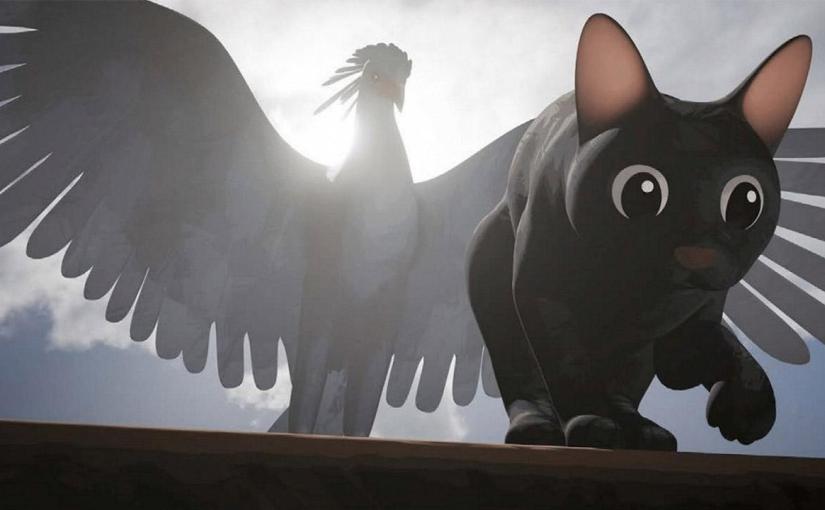
I must give special mention to the animation of the lead character.  Cat has moments of cat behavior so specific and real that, even if you’re not a cat person or watched umpteen cat videos on YouTube, you will recognize it as being 100% authentic.  For that matter, the same could be said of all the animals in the film.  I must be honest and report that there are times when, viewed through a lens of “is-this-realistic”, the animals behave in a way that does not compute with reality.  I highly doubt a capybara would be able to figure out how to work the rudder of a sailboat…and yet, in this movie, it does, and it’s fine.

Which brings me to the one problem I can imagine some folks might have with the film: the ending.  I can’t tell if the right descriptor is “elliptical” or “open-ended” or “inconclusive.”  Perhaps it’s a plea from the filmmakers for cooperation and teamwork in an age where uncontrollable outside forces are doing their best to prevent it; like these animals, we’re all in the same boat.  Or maybe that’s not the message.  The beauty of Flow is that the ending is subject to interpretation, thanks to the lack of dialogue simply telling us what it means.

Frankly, I’m not too fussed about extracting the message from Flow.  I am too grateful that a film like this even exists to lose sleep over its Deeper Meaning.  It is a film constructed out of wondrous sights that harken back to the days of Pinocchio and Fantasia [both 1940], when animators and filmmakers gave equal weight to story and visuals, and it’s one of the best animated films I’ve ever seen.

WALL·E

By Marc S. Sanders

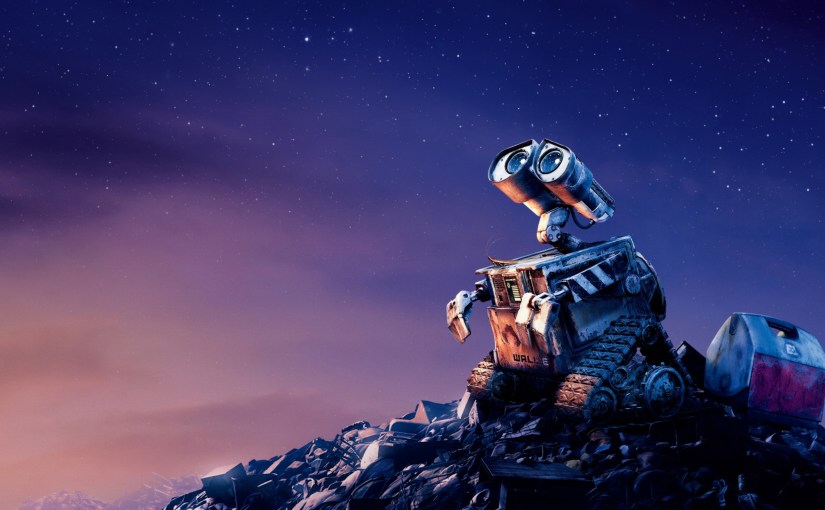
There are some movies that seem to accurately predict what we can expect of our planet’s future.  Paddy Chayefsky was one such prophet with his script for Network and the rampant consumption of television influence and addiction.  Author Phillip K Dick might have also been a Nostrodomus of sorts when his writings were adapted into such films as Total Recall, Minority Report and Blade Runner which offered convincing convenience to lifestyles and evolved productivity.  Perhaps the imagineers behind PIXAR are also on to something because their adorable, futuristic WALL·E does not seem so farfetched.  

The robot title character is a trash collector on an abandoned planet Earth seven hundred years into the future.  A Wal-Mart/Sam’s Club amalgamation known as the fictional Buy N Large appeared to have become the main resource for any immediate need of the human population that once existed; what the coming of Amazon is turning into. This monopolized interpretation of absolute capitalism was run by a CEO and maybe Commander In Chief of the free world, played by Fred Willard, the one major flesh and blood actor to appear in this picture. 

WALL·E, along with a faithful cockroach, roams the wastelands.  The puppy dog, bug eyed robot wheels around on his tractor legs collecting the endless amounts of leftover trash and compacting it into neat, stackable boxes.  Piled on top of each other, these boxes get as high as skyscrapers.  These are the remnants from what Buy N Large left for the planet.

One day a rocket ship arrives and drops off a highly sophisticated and glossy white droid that we come to know as EVE.  For WALL·E, it’s almost love at first sight even though EVE has a treacherous laser cannon for an arm and intimidating blue cyborg eyes.

Eventually, the two bots hitch a ride into space when the rocket returns to pick up EVE.  They arrive on a galaxy cruise liner that’s floating through the solar system.  While the two get into a bunch of Looney Tunes shenanigans running through the corridors and piping of the ship, the audience bears witness to what exactly happened to planet Earth, and who has survived to carry on.  At this point a prophecy seems to be declared by writers Andrew Stanton, Pete Docter and Jim Reardon (all PIXAR regulars at the time).

Humans aboard this liner have become oversized, lazy blobs with no neck, fat arms, fingers and legs, and reclined to permanent seats while robotics cater to their hungers and comforts.  These people are cheerful but happily lazy and unproductive.  Remember when your mother would tell you to clean your room?  Well, the wasteland universe of WALL·E bears justification for mom’s aggravation and constant pestering.

The computerized animation of this PIXAR romantic adventure is dazzling in details and character expression.  There’s an unattractive sand like and earth tone mood to anyplace we explore on Earth.  Yet, the industrial sheen of the cruise liner appears to have all the comforts imaginable.  You can practically taste the colors and feel the balmy air conditioning within this ginormous vehicular city in space. Yet, the telling story of WALL·E has no problem convincing me that this is not right.  This is not a future I’d want to be a part of.

Disney and PIXAR follow that mentality of ensuring a soul of emotion drives their characters of fantasy and it’s easy to fall in love with the clunky lead robot.  You want WALL·E to be safe from sandstorms, while also keeping his only friend, the cockroach, by his side for companionship in an entirely lonely world.  His only other source of cheerfulness comes from watching the musical Hello, Dolly! on an old TV. Even playing ATARI’s Pong is not stimulating enough for this little guy.

Sound Effects Wizard Ben Burtt, who pioneered staple sci fi elements with the Star Wars films, performs the vocal expressions of chirps and beeps for WALL·E’s innocence.  There’s a language to the little fella and it’ll leave a lump in your throat when he calls for EVE.  Elissa Knight brings a more experienced, technologically up to date personality to EVE.  We worry when an organized entity like EVE robotically screams for WALL·E when she thinks he’s in danger.  She’s only supposed to follow a program, but the manufactured mind lends to a side effect of genuine emotion.  As the two get acquainted with each other, there’s a touching chemistry to them both.  A floating dance through space is as much silly as it is adorably romantic.  You cannot help but smile because by this point you are invested in this relationship as much you’d buy Rick and Ilsa’s affections towards one another, or Harry and Sally’s.

I really embrace the childlike love story connecting these two non-living beings.  Set against what appears like an apocalyptic wasteland, there are layered dynamics to this animated film, one of PIXAR’s best.  

I have to also salute the film’s nods to classic science fiction that also offer not so unrealistic possibilities.  An antagonist comes in the form of a robot similar in appearance to HAL-9000 from Kubrick’s 2001: A Space Odyssey.  He’s a nasty bugger with an all too familiar blood-red eye. It’s also a delight to recognize Sigourney Weaver’s voice as the cruise liner’s computer, a sort of slap in the face to monochromatic computers that would countdown a certain doom for the actress’s most famous role of Ellen Ripley in the Alien films.  PIXAR has always been brilliant with their wink and nod delights.

The film was released in 2008, a near generation ago maybe, when iPhones and Androids were not even as entirely sophisticated as today.  Yet PIXAR could telegraph what was to come.  The environments on Earth and on the cruiser tell us just how overly reliable we’ve become on technological conveniences for socializing or even one stop shopping.  

We are getting to a point where we might not even procreate with one another.  It’s a sad irony that it will take two self-thinking, yet designed for programing, robotic appliances to remind us how valuable the human touch is and what a purpose to life really serves ourselves and those we have to interactively live with.  

You might be embracing that cell phone tight in the palm of your hand, but will that device ever hold your hand in return?

WISH

By Marc S. Sanders

Disney’s Wish seems to stand out from many other films within the studio’s vault because the lack of filmmaking confidence appears so obvious.  What does it tell you when a newly original story is continuously guided by winks and nods from past successes?  We see this thing can’t stand on its own two feet.  So, let’s dress a character up like Peter Pan and literally name a random deer Bambi.

A sorcerer trained in the arts of magic oversees his newfound Mediterranean island kingdom known as Rosas.  He is King Magnifico (Chris Pine) and he has attracted people from all over the world to reside under his rule on the condition that he collects their wishes to be held by him in glittering, floating blue bubbles.  The people of Rosas lose all memory of their respective wishes and now live month to month with anticipation that Magnifico will award them the wishes he holds as a kind of equity or collateral.   

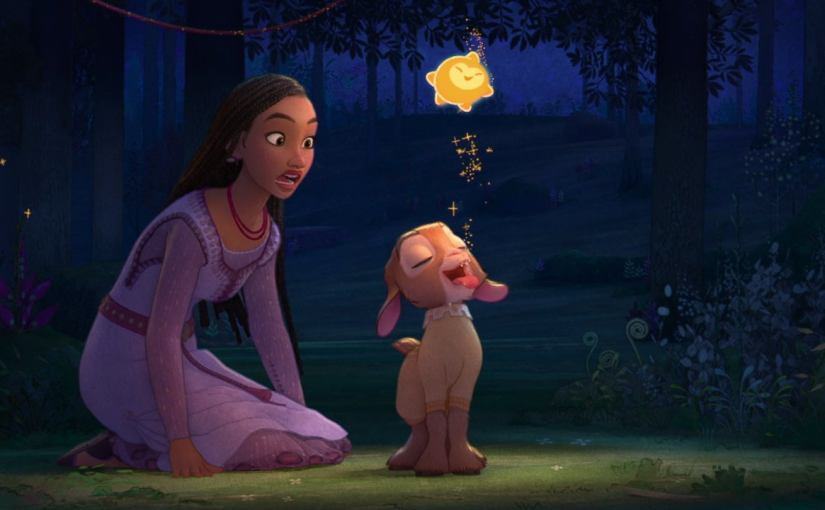
Asha (Ariana DeBose) is a seventeen-year-old who is eager to finally witness her grandfather Sabino’s (Victor Garber) wish come true as his 100th birthday finally approaches.  She also aspires to meet the great sorcerer and hopefully become his apprentice.  As soon as she meets the King though, Asha realizes Magnifico is a greedy, selfish individual who thrives off the admiration of the people of Rosas while savoring the wealth of everyone’s longings.  In other words, Magnifico is a cult leader.

Chris Pine does good voice work here.  He’s gleeful and manipulative and uncaring and evil all at the same time.  Disney’s colorful animation lends to his vocal performance of course with Maleficent inspired glows of green spells which the character conducts.  Yet, my adult mindset could not get past the fact that I’m looking at an animated inspiration of David Miscavage, long time head of the Church Of Scientology.  Magnifico’s wife Amaya (Angelique Cabral) is the quietly naïve representation of David’s wife, Shelly (who has not been accounted for in years).  The poor people of Rosas are the brainwashed disciples believing in this false prophet.  I guess it’s not a terrible concept to apply to a fantasy, but once I see the allegorical connection, Wish makes me feel uneasy.  My fault I guess for watching too many HBO documentaries and listening to former Scientologist Leah Remini too much.

Asha is the hero of this story who makes a wish upon a star.  Actually, a literal character named Star enters the picture.  Star squeaks like a precious darling, ready to be your children’s next plush toy acquisition.  He shoots sparkling trails of gold out of his pointed appendages.  With Star’s help, Asha will reach the standard showdown with the villain by the film’s end and the awakening of the people below.  It’s all trite material that’s been done before.

Wish relies on the vast history of fantastical stories, believing you can fly and be heroic or simply a sidekick tagging along with the protagonist.  Asha has seven friends.  One is referred to as grumpy.  Huh!  How do you like that? Must it be so apparent so often though?  Thanks to Star, forest animals talk and one even makes an inside gag to Zootopia.  You’re practically asked “Get it?  See what I did there?” Magnifico bears a striking resemblance to Jafar and even resides in a similar castle to the Aladdin villain with stone spiral staircases to explore.

The colors and animation are just as engaging as nearly any other Disney film.  A few songs work, but there’s nothing on the level on what was accomplished during the days of Rice and Menken, or even more updated fare like Frozen.  I can’t recall the title of a single number from Wish.  Magnifico sings.  Asha sings multiple times.  The two duet together and it’s not terrible. Ariana DeBose could sing the phone book and I’ll feel swooned.  The supporting people of Rosa sing in choral support as well.

Still, what tainted my experience was turning a very real epidemic of cultish culture into a fantasy catered for all ages to enjoy.  The wishes the people offer up are the endless “donations” that a cult mentality always requests.  While I appreciate being accepted into a fraternity of Disney loving storytelling, I did not need to be banged over the head with so much saluting either.  The end credits contain one classic Disney character after another appearing next to the ongoing scroll.  Hi Dumbo.  Hi Genie.  Hi Peter.  Hi Belle. 

Disney always reminds us to believe our wishes will come true and yet with Wish the studio chose to go with what is blatantly familiar.  It’s time for some fresh ideas again that especially do not source themselves from the reality of harmful sects spreading false doctrines. 

NOTE: I still have a fresh idea from a very popular legendary story that Disney, nor Universal or Warner Bros has yet to touch.  Maybe it’s time I get it down on paper.  Hmm.

MARCEL THE SHELL WITH SHOES ON (2021)

by Miguel E. Rodriguez

DIRECTOR: Dean Fleischer Camp
CAST: Jenny Slate, Dean Fleischer Camp, Isabella Rossellini
MY RATING: 9/10
ROTTEN TOMATOMETER: 98% Fresh

PLOT: Marcel, a tiny talking seashell with big shoes and one googly eye, becomes the subject of a documentary.


Years ago, I went to see Happy Feet.  The premise was absurd – singing penguins, give me a break – but as soon as Nicole Kidman’s character sang the first words of Prince’s Kiss, I remember thinking, “Okay, this movie is only going to work if I just give in to the concept.”  I did, and it did (for the most part).  Some movies are like that.  If you’re the kind of person who brings too much logic to the movie theater, who’s always wondering, when a movie character just orders “a beer” at a bar, how does the bartender know what to bring him…if you’re that kind of person, then Marcel the Shell with Shoes On is not for you.  Trust me.  I’m trying to give a public service message here.  If you watch a James Bond movie and sit there the whole time going, “That couldn’t happen…that couldn’t happen”…then skip Marcel and go find a Werner Herzog documentary.  Cave of Forgotten Dreams is excellent.

However, if you enjoy flights of fancy, fits of whimsy, and a gently aggressive cuteness factor balanced nicely by, not one, but two potentially tear-jerking plot developments – all centered on a talking seashell – then have I got a movie for you.

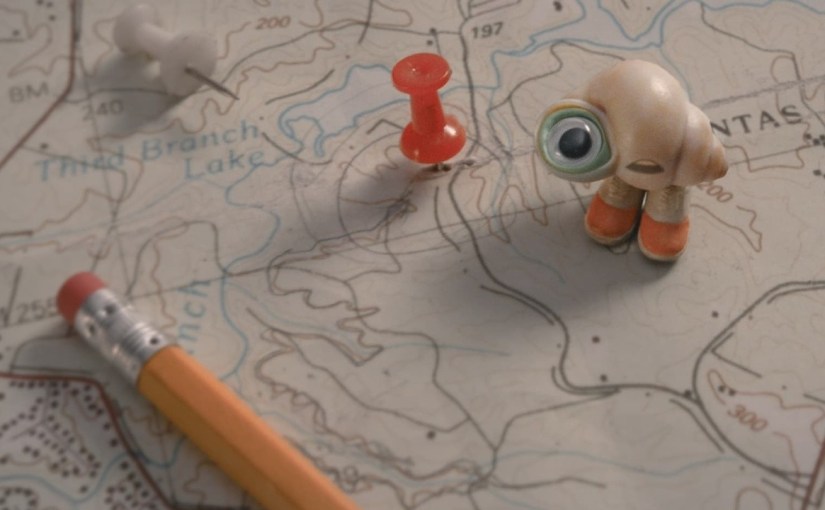
The story: A down-on-his-luck documentary filmmaker (Dean Fleischer Camp) moves into an Airbnb with his dog.  After following some odd clues around the house, he discovers his diminutive roommate: Marcel (voiced by Jenny Slate), a pebble-sized seashell with one eye – a googly eye – and tiny shoes, with a voice that sounds like your favorite childhood puppy was granted the gift of speech.  Dean discovers that Marcel has lived in this house for some time with his grandmother, Connie (voiced by Isabella Rossellini!).  There used to be an entire community, including many of Marcel’s family members, but they all vanished one traumatic night when the couple that used to live in the Airbnb got into an argument and the man stormed off with his luggage…carrying some unwitting passengers.

Now Marcel fends for himself, while Nana Connie helps in the garden.  Dean, the filmmaker, asks some excellent questions.  How does Marcel get around the house?  Why, by traveling inside a tennis ball using it like a tiny hamster ball; it’s okay as long as you don’t mind knocking some things over every once in a while.  What does he eat?  Mostly fruit from the tree growing outside.  How does Marcel get it out of the tree all by himself?  Using the mixer in the kitchen and a long length of rope, of course.  I could explain it, but it’s funnier if you find out for yourself how that works.  How does Marcel reach high places in the house?  Well, if he can’t jump it, there’s plenty of honey in the house, and honey is sticky, and that’s why there are sometimes little footprints all over the walls.  (Marcel asks Dean his own important questions: “Have you ever eaten a raspberry?  Um, and what was that like?”)

This is all unbearably cute.  I’m still not sure why I responded to it so strongly.  This is not normally my kind of material.  But the sight of this little seashell with one eye plopping down in front of the TV to watch 60 Minutes with his Nana just brought a smile to my face.  (Marcel explains, “We just call it ‘the show.’  That’s how much we love it.”)

One of the most charming elements of this movie is how it trucks along giving us one cuteness blast after another, and then it blindsides you with sentiments that are so simple and direct that they hit you in the feels before you even realize what’s happened.  As Marcel recounts the story of his family’s disappearance that fateful night, he sheds a tear or two.  Then he says:

“And then the next day, there was a really sunny day with a good breeze.  And I just remember thinking, if I was somebody else, I would really be enjoying this.”

I don’t know about you, but that statement really hits home with me, for all sorts of reasons that I won’t bore you with.  There are several moments like that in the film.  Here’s another one:

“Have you ever done that before, like, when there’s a party in your house?  Sometimes it’s easiest to rest when you go off by yourself and you can still hear the noise of the party, and you feel safe knowing that so many people are around, that you can have a rest?”

I identified with that so strongly that I can point to events in my life when I did exactly that, literally.  Hearing those words spoken in Marcel’s guileless, childlike tones almost felt…I might be overstating this a little…therapeutic.  It was a mildly bizarre experience for me.

Meanwhile, in events that uncannily mirror exactly what happened with the original Marcel shorts in real life, Dean posts his videos online and starts getting a phenomenal response.  He suggests that Marcel post a plea online to see if the online community can help track down his family.  This leads to some rather unfortunate attention-seekers, but it does provide a motivation for Marcel to take his first trip to the outside world, riding on the dashboard of Dean’s car.  If the idea of a teeny tiny seashell getting carsick and vomiting a teeny tiny little bit and apologizing every time…if you don’t find that even a little cute, I pity you.

Events progress rapidly (the movie is just over 90 minutes long).  There is an incident involving Nana Connie and some hooligans who break into the Airbnb.  The producers of 60 Minutes reach out to Dean and Marcel and ask if Lesley Stahl can come to the house and interview them.  Marcel says no, not until Nana Connie is better.  …and what happens after that I will not reveal, because it involves some of the most heartfelt passages of the film as the depth of Marcel’s relationship with his grandmother is tested, and the grandmother displays the kind of wisdom and sacrifice that would feel at home in an O. Henry story.

When so many films out there celebrate cynicism and snark, what a treat it is to find one that just wants to make you feel a little better.  I could not put it any better than Marcel himself:

“Guess why I smile a lot.  Uh, ‘cause it’s worth it.”

NIMONA (2023)

by Miguel E. Rodriguez

DIRECTORS: Nick Bruno, Troy Quane
CAST: Chloë Grace Moretz, Riz Ahmed, Eugene Lee Yang, Frances Conroy
MY RATING: 9/10
ROTTEN TOMATOMETER: 94% Certified Fresh

PLOT: Framed for a crime he didn’t commit, a knight in a futuristic world reluctantly accepts the help of a shapeshifting teenager to prove his innocence.


Just when I thought the Spider-Verse animated films held the current monopoly on creating cool futuristic worlds, along comes Nimona with its delirious fusion of medieval pageantry with flying cars, cellphones, and annoying TV jingles.  Put aside what some will no doubt call its “woke” agenda/storyline and just drink in the amazing visuals, as knights in shining armor wield swords as they ride hoverbikes into battle.  (There is the occasional horse, naturally…some traditions apparently die hard in this version of the future.)

The pre-requisite prologue explains how a brave warrior queen, Gloreth, defeated a vile monster a thousand years ago.  To maintain vigilance against any future attacks, Gloreth’s subjects erected a wall around their magnificent city and created the Institute, a sort of school-for-knights, to train their protectors from generation to generation.

One thousand years later, the city prepares to matriculate its current class of knights, including, for the first time in their history, a commoner, Ballister (Riz Ahmed), championed by the current Queen Valerin as a symbol of progress.  What matters a knight’s lineage if his heart is brave, and his spirit is bold?  This choice has not gone over well unanimously in the queendom, unfortunately, but she is confident in her choice.  However, in a twist of fate, Ballister’s sword malfunctions during the knighthood ceremony, resulting in the Queen’s death, and Ballister, minus an arm, finds himself a fugitive.

He has exactly two allies.  One is his romantic partner and fellow knight candidate, Ambrosius Goldenloin, a direct descendant of Gloreth herself, who spearheads the search for Ballister in an attempt to keep someone else from killing him outright.  The other is a flighty, impetuous teenager who tracks Ballister down the following night and offers her services as sidekick to what she thinks is the newest villain in town, Ballister the Queen Slayer.  This is Nimona (Chloë Grace Moretz), a shapeshifter who can assume any form she desires, although her favorites appear to be a pink rhinoceros and a giant pink whale.  She likes pink.  And punk, as it turns out.

I imagine one could be cynical and say that what follows story-wise is nothing new: our heroes overcome initial adversities and suspicions of each other, they track down clues, deal with one or two serious crises, and eventually expose the truth of what really happened the day the Queen was killed.  But that’s like saying The Stand is about a bunch of people who survive the end of the world and eventually defeat the bad guy.  Well, duhNimona doesn’t offer anything outrageously subversive in the story department.  What it offers is a fresh new imagination and perspective in how it tells this story, especially when it comes to the character of Nimona herself, the very definition of the rebel outsider who literally doesn’t fit in anywhere.

What makes great kids films work – what makes MOST films work – is how it invites the juvenile audience to identify with the main character.  In Pinocchio, what little kid doesn’t know what it’s like when a lie grows out of control?  In The Wizard of Oz, what little kid has never felt homesick?  In Harry Potter and the Sorcerer’s Stone, what kid has never dreamed that they were special, not really meant for everyday life?

In Nimona, what kid has never felt alienated at some point in their life because of something that makes them different?  They’re not as old as the grown-ups.  They’re not as young as little babies anymore.  They’re in an in-between world where they’re only as strong as the friends they make, if they’re lucky enough to make friends.  What if there is something inherently different about them?  Nimona has tried shapeshifting before, tried to explain her gift, but people immediately think of her as a monster instead of someone who’s gifted.  There are echoes of the X-Men films here, too, but those mutants were lucky enough to find a home at Xavier’s mansion.  Nimona is not so lucky.  So, she decides to embrace the monstrous role society thrusts upon her.  I imagine there are lots of people out there who feel the same to one degree or another.  I’m not a sociologist, but it seems logical.

The real villain of the story (I won’t reveal their identity) does everything in their power to manipulate the narrative in the eyes of the public.  At one point, their scheme is all but exposed, but they discover yet another way to maintain power: turn society on itself.  They reveal the existence of the shapeshifter, explaining to the city that the real monster could be sitting next to you, or playing with your child, or living in your house.  The sinister nature of this ploy made me genuinely angry, mostly because of how effective it is, both in the film and in real life.  When you’re too busy fighting each other, the true villains win.

Enough philosophy.  Nimona stands among the best animated films yet produced by Netflix (Klaus, Guillermo del Toro’s Pinocchio).  There is plenty of humor to go around to leaven the moments when the film goes deep into territories unexplored even in the best Pixar movies.  (Correct me if I’m wrong, but I can’t recall a Pixar film where a character contemplates suicide as an alternative to grief.)  The end credits inform me that Nimona is based on a graphic novel.  Guess what I’m looking for on Amazon in a few minutes.

ELEMENTAL

By Marc S. Sanders

Ember and Wade are perfect for one another.  They truly belong together.  Yet, science dictates that they have zero chemistry.

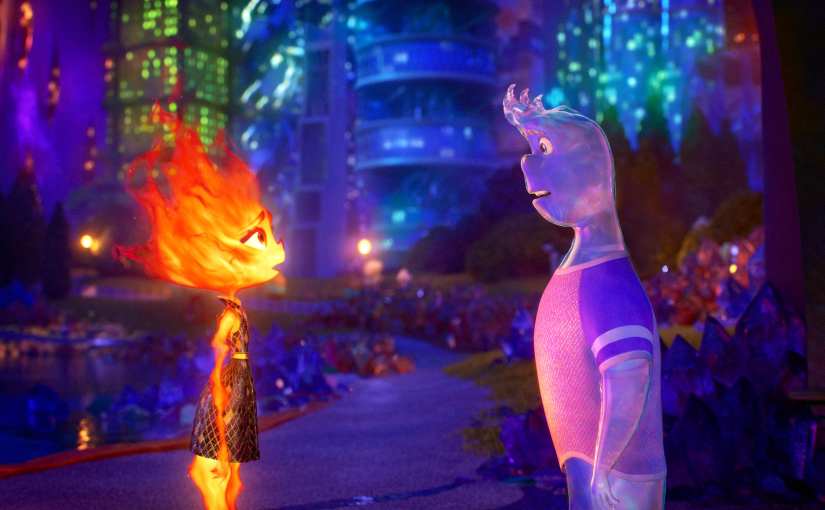
Ember is a figure of fire.  Wade is a bubbling, joyful standing puddle of water.  They reside in Element City along with people of earth and air, respectively.  Pixar with Disney Studios, has transitioned from emoting human feelings in lovably figurative toys, monsters, cars and colorful emotions to the primary elements of our planet.  Hence the title Elemental.  It’s a blessing that the storylines and messages of this digitally animated feature are a winning combination.

Ember (Leah Lewis) is the daughter of her fire immigrant parents, Bernie and Cinder (Ronnie Del Carmen, Shila Omni).  She loves to work with her dad in his mercantile shop that he built from nothing, known as The Fireplace.  She’s hardworking and dedicated, but she can suffer from a short temper that turns her firebrand orange disposition into a raging purple. Suddenly, she’s charred the shop interior and maybe some of the customers.  

Wade (Mamoudo Athie) is a water made building inspector who by unexpected circumstance comes upon the aftermath of a temper tantrum from Ember.  He works as a building inspector for the city and simply by doing his job he cites enough offenses with The Fireplace that could shut down the shop for good.  Now Ember must work with Wade to avoid that from happening, including haphazard water leaks that are stemming from a mysterious source within the city.

Elemental works because while it bursts with magnificent color, it has a story to tell in a brilliantly inventive and functional environment, much like the Monster World in Monsters, Inc. Pixar does not just stop at the marvelous animation. Their products continue working even beyond their well planned stories and conflicted characters.

With this film, the immigrant crisis that is a prevalent problem in the real world is addressed, but simplified for all ages to comprehend.  Fire based citizens, inspired by Asian/Eastern cultures, are typically restricted to only fraternizing within their area of the city, among only their demographic.  They are regarded as harmful and unsafe from the other three elements.

On the other hand, people of water, air and earth live in harmony.  Director Peter Sohn, with a highly informative script from John Hoberg, Kat Likkel and Brenda Hsueh, is consistent with this reflection.  Water, air and earth make up the first three iterations of Element City.  Fire gets no recognition.  Fire was not invented by a higher power.  It had to be discovered.  Therefore, they are sadly treated as a minority.  The film doesn’t go so extreme as segregating the fire community to literal internment camps, but the feeling of isolation seems quite authentic.  

Yet, fire serves an important purpose. Bernie might envision his daughter taking over the business as he is getting older and slower.  Still, with Wade’s help Ember is realizing that she has talents that will make her happier and more fulfilled.  She’s a natural at honing glass sculptures with merits in practicality and art.

At the same time Wade and Ember are becoming friends and maybe there is something more going on in their newfound relationship.  Problem is they dare not make contact with one another.  What would actually happen if fire and water mixed?  Bernie and Cinder would never approve of this relationship either.  As well, poor Wade and Ember may be frowned upon with prejudice if seen in public together.  

My colleague Miguel reminded me that Elemental gets 98% of its science accurate.   I definitely appreciate that.  However, I’m also grateful for the remaining 2% left for my suspension of disbelief that is quelled by insightful imagination.  Ember and Wade are such wonderful characters that they deserve the happiness they long for.  As I watched, I longed for their destinies to outlast the seemingly impossible.

This is a special film from the Pixar factory.  Elemental demonstrates that nothing should limit what any us of yearn for.  No shortsighted policy of any kind should bar us from our pleasures.  There’s a way for anything to work together.  It only takes some thought.  So you know what I say as I root for Ember and Wade?  SCIENCE/SCHMIENCE!!!!

SPIDER-MAN: ACROSS THE SPIDER-VERSE

By Marc S. Sanders

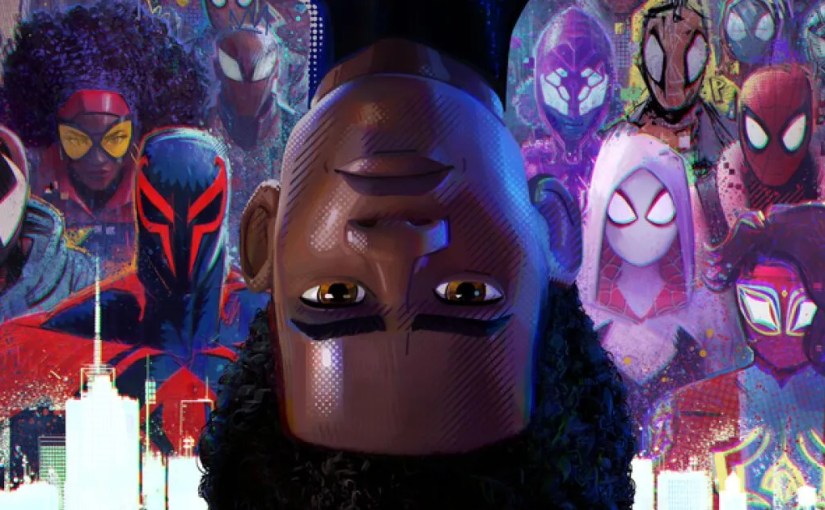
Spider-Man: Across The Spider-Verse is a gorgeous kaleidoscope of color and kinetic energy.  Joaquim Dos Santos, Kemp Powers and Justin K Thompson are a directing powerhouse trio making every scene, moment, or caption completely unique from anything you’ve seen before.  This movie never stops being inventive with itself, all the way down to its end credits.

Within the first half hour of the film, two stories unfold where two “Spider heroes” from different dimensions are struggling with maintaining their costumed alter ego while grasping with lying to their families.  Reader, having just seen the 2023 live action interpretation of The Little Mermaid, I can tell you that in comparison, Across The Spider-Verse is more frank and honest in its characters with what makes them tick and what pains them during their adolescent years.  The acting in this film of various forms of animation is sensational.  Often, animated films don’t let up on the high energy, like the Minions movies for example.  It can get tiring.  This Spider-Man picture allows those quiet intimate moments where it is hard for any teenager to come to terms with his or her parents.  Gwen and Miles are fearful of disappointing those that are close to them.  They’re also reluctant to surrender the secrets they value only with themselves.  Thus, it puts a strain on their respective familial relationships. 

Eventually, the two friends must even come to grips with secrets they’ve kept from one another.  It doesn’t matter that these characters are superheroes.  This is a coming-of-age film on the same level and maturity that writer/directors John Hughes and Cameron Crowe approached with many of their films.  Most teenagers have something unusual in them, and part of growing up is sometimes struggling with whether to ever let our guard down.  The conflicts that Gwen and Miles experience are trying to figure out what is best for themselves and the relationships they have with their parents.  I really felt for them in those quiet moments when the music was turned off and the fast paced scene changes that moved the film’s adventures came to a welcome pause.  Santos, Powers and Thompson know the beats to uphold their story.

Gwen Stacey (Hailee Steinfeld) is known as Spider-Gwen.  Miles Morales (Shameik Moore) is known as Spider-Man, residing in different dimensions of Earth separate from Peter Parker’s interpretation that most people are familiar with.  Complications arise when an inventive new villain causes mayhem in Miles’ neighborhood.  This guy is known as Spot (Jason Schwartzman), who opens holes or portals for him to transport objects like, say an ATM machine from one spot to another as he tries make way with his robbery loot.  Seems like a simple villain of the week, but then Spot gets some ideas and before you know it, Miles is following Gwen into another alternate dimension in pursuit of the dastardly mischief maker. 

Much like we see in time travel films like Back To The Future, if you mess up what was meant to be, it could alter everything else a million fold.  Just one tiny pebble rippling across the water can cause all sorts of trouble, and without even realizing it, Miles’ heroics may have caused a problem that can’t be undone.  This only invites more trouble for the poor kid.

The real treat of Across The Spider-Verse is what Gwen and Miles encounter, which is pretty much the entire history of the most famous Marvel Comics character of all time.  So many different interpretations of Spider-Man eventually lend to this story, and each one serves a purpose within the two-hour film.  My comic book experience allowed me to recognize so much from cartoons of the 1960s to the Saturday morning series of the 80s, and all the way through the various iterations found in newspaper pages and comic magazines. The last 20 years of films are also given their due.  It’s unbelievable how deep the filmmakers go.  Still, you don’t have to know about one single Spider-Man to follow this picture and appreciate all of its frolics.

Beyond a Best Animated Film Oscar, here is an animated film worthy of a nomination in film editing.  Miles and Gwen call it threading.  I love that term!  When they are swinging over skyscrapers and then down into the valleys of the metropolitan city streets alongside the multi lanes of traffic, buses and cabs, through alleyways, over sidewalks, and then up into the skies again, only to run atop an elevated train, the action moves so fast and seamlessly.  It’s a glory to watch it play out.  It feels like a wonderous amusement park ride.  The action is bridged together beautifully in different shades of reds, blues, greys, pinks, and purples.  This is how you assemble a film and take passion in the project.

I did think the movie ran about ten or fifteen minutes too long.  However, the ending packs such a punch.  When the film finishes, I defy you not to hearken back to the first time you saw The Empire Strikes Back, or The Fellowship Of The Ring, or Avengers: Infinity War.  The preview audience that my Cinemaniac pal Anthony and I were a part of roared with cheers at the conclusion of this film with tremendous applause.  Put it this way, reader, sadly the theatre we saw this film at left me wanting a better sound system.  The volume was way too low.  However, it never hindered the thrilling experience we had with this inventive picture story.  (That’s another recommendation.  See Spider-Man: Across The Spider-Verse with the best sound system you can find on the best screen you can uncover.)

Spider-Man: Across The Spider-Verse may be one of the top 10 best films of the year.  I know I’ll be considering it for my list come late December/early January.  Few films get as inventive as this, and it is definitely one of the best Spider-Man films to ever grace a movie screen.

THE MITCHELLS VS THE MACHINES (2021)

by Miguel E. Rodriguez

DIRECTORS: Michael Rianda, Jeff Rowe
CAST: Abbi Jacobson, Danny McBride, Maya Rudolph, Eric André, Olivia Colman
MY RATING: 9/10
ROTTEN TOMATOMETER: 97% Certified Fresh

PLOT: A quirky, dysfunctional family’s road trip is upended when they find themselves in the middle of the robot apocalypse and suddenly become humanity’s unlikeliest last hope.


Discovering The Mitchells vs the Machines feels like finding a discarded lottery ticket that someone threw away.  Intended for theatrical release in 2021, it was instead sold to Netflix when that became unfeasible due to Covid.  I have no way of knowing how many people may have streamed it, but it didn’t exactly take the world by storm.  I happened to find a discounted copy on sale at Target some time ago and have only just now gotten around to watching it.  Written and directed by the writers/creators of the acclaimed animated series Gravity Falls and produced by the minds behind the Jump Street reboots, the two Lego Movies, and Spider-Man: Into the Spider-Verse, this movie is a home run that feels like it has been all but forgotten by the general public.  If you’re a member of that section of the public, and you like great animated films, do yourself a favor and carve out some Netflix viewing time.  You won’t regret it.

The Mitchells are a mildly dysfunctional family with their hearts in the right places, but their quirkiness gets the best of them sometimes.  Aspiring filmmaker Katie Mitchell (voice of Abbi Jacobson) has been accepted into a film school in California, but instead of flying, her father, Rick (Danny McBride), decides to make one last effort at connecting with his daughter by taking the whole family on a road trip in a mid-90s station wagon whose model name is sensible.  As in, that’s the name of the model, the mid-90s Sensible.

The mom, Linda (Maya Rudolph) tries to act as a buffer between Katie and Rick, when she’s not trying to get her family to act more “normal” like their all-too-perfect next-door neighbors (voiced by John Legend and Chrissy Tiegen).  Katie’s younger brother, Aaron, is so obsessed with dinosaurs he calls random people from the phone book: “Hi, would you like to talk to me about dinosaurs?  No?  Okay, thank you.”  They have a pug dog named Monchi that apparently has the IQ of a carrot and looks like he was bred in a bakery.  (“Bred” in a bakery…get it?  Don’t worry, you will.)  Put them all in close quarters and you’d be lucky to get them to survive into the next county, let alone halfway across the country.  And don’t forget that robot apocalypse mistakenly engineered by a tech genius (Eric André) who took the concept of obsolescence one step too far.

What follows is a Pixar-esque journey into self-discovery, industry and pop culture in-jokes, and genuine emotional moments.  Any quibbles I have with the movie have to do with certain physical logistics.  I know I shouldn’t bring the concept of real-world physics into an animated film that includes killer microwave ovens and ominous toasters, but there were a couple of moments that defied logic when everything else was doing so well.  I won’t spoil them, but they’re there.

But that’s a minor, minor quibble.  TMvTM is so delightful and fun, it doesn’t matter.

I loved the visual style of this movie, recalling the eye-catching pyrotechnics in Spider-Man: Into the Spider-Verse.  To emphasize certain moments during the film, the filmmakers added little “flair” on the edges of the screen, or emitting from certain characters like in a comic book, but instead of feeling “comic-book-y”, it felt like a little glimpse into the mind of Katie, the main character, whose mind is constantly in “making-a-movie” mode.

I loved the “big-bad” in the movie because it’s based on the world’s ever-increasing reliance on portable electronic devices.  At one point, the villain shuts down the wi-fi on a global scale.  Humanity predictably loses its mind within seconds.  (My favorite example of this meltdown showed a woman pleading with someone to take a picture of her food.)  Do I advocate for a complete erasure of our devices?  Absolutely not.  But I am on the dad’s side when he insists on no devices at the dinner table.  Everything in moderation, folks.

Underneath the flashy style and effective villains, though, there is a real human story about the father’s desperate need to reconnect with his daughter before she leaves for college.  (Indeed, the film’s original title was Connected.)  The filmmakers took a lesson from Pixar’s playbook and made very sure to include some tender moments and heartfelt speeches that never once felt contrived or schmaltzy.  I don’t have kids, but if I did, I could easily imagine myself shedding a tear when the dad watched old home movies of himself and Katie when she was a toddler.  And I loved the story behind the wooden moose.  The story is diligent about giving everyone a solid, believable back story that fills in the blanks without resorting to lengthy flashbacks.  Not an easy task.

As hidden animated treasures go, this goes on the list with Boy and the World and A Town Called Panic.  It’s streaming on Netflix, so chances are you have access to it right now, so…what are you waiting for?