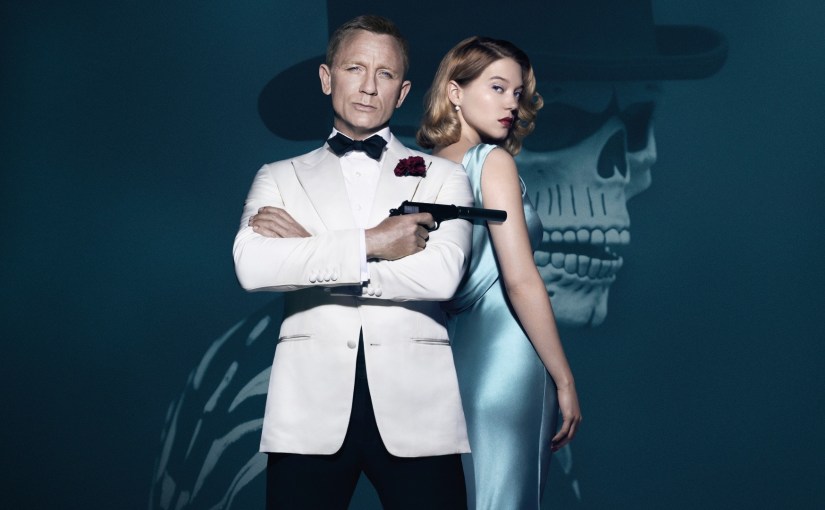
SKYFALL

By Marc S. Sanders

Skyfall is a great James Bond film. One of the best. However, …it has one major shortcoming that always gnaws at me. Regrettably, it has a contrived middle section that steals some of the magic away from the film. Yes, for a moment, my suspension of disbelief is robbed from me.

Daniel Craig’s third outing as 007 has become a favorite among fans and movie goers. Craig is magnificent in a primarily dramatic turn in the part. Following a fantastic action packed opening where Bond pursues an assassin through the streets of Istanbul, Turkey (widely known as a favorite locale of Ian Fleming), the chase involves cars, motorcycles, rooftops, fruit stands and trains for well edited shootouts and fist fights. Alas, the assassin gets away and Bond is left for dead.

Following an attempt on the life of M (Judi Dench in her absolute best portrayal in the role), Bond returns for active duty. However, he’s not what he used to be. His aim is off and his body is worn. The question remains if Bond is ready to be back in the field.

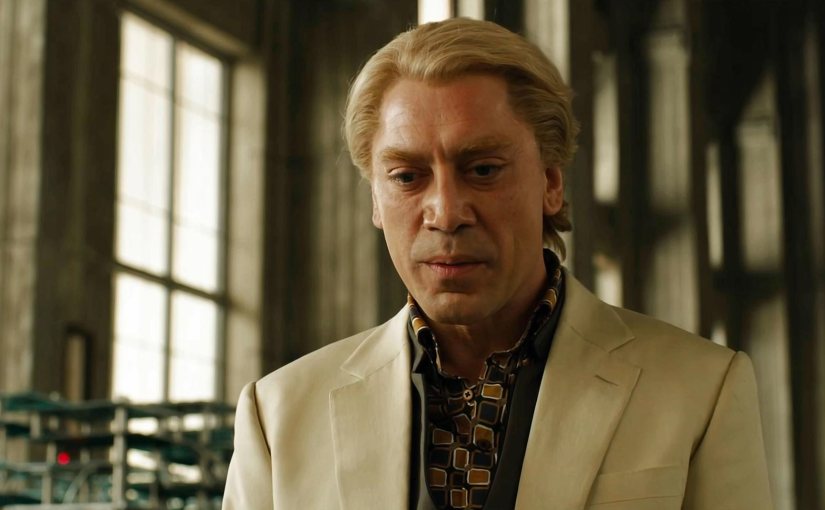
The plot centers on a bitter former MI6 agent named Silva (Javier Bardem in a potentially Oscar worthy performance) out to seek revenge on M for the sins he believes she’s committed.

It’s funny. The Austin Powers films, and even film critic Roger Ebert, would always draw attention to the fact the villain would just longingly speechify when they have all the time in the world to just shoot Bond dead and move on with their devious plot. Silva is a response to that issue. He has a mutual respect for Bond, and you can see he’d rather keep him alive for the time being to allow the game to keep running. It’s not said outright, mind you. Yet that’s what I took away from the character. A superbly written monologue to introduce Silva at the midway point of the film compares him and Bond to the last of two rats surviving a trap. Which rat will win out?

It’s also quite special that Bardem shapes his villainous role with a homosexual tendency. Silva is fashionable and proudly dons a bleach blonde hairstyle. He gleefully rubs Bond’s legs and opens his shirt to examine his scarred chest, pronouncing that Bond must ponder his “training” at the moment. Silva is beyond the typical femme fatale. It’s different and it’s time the Bond franchise acknowledges the differences in people. A welcome trait for a major character.

The plot set up of Skyfall‘s devices are ingenious in simplicity with a basic revenge tale but also with broadening the legacy and responsibilities of the M character. What Casino Royale did for a story arc for James Bond, Skyfall does for M, and with Dench in the role it works beautifully. She must answer to superiors, like a very welcome Ralph Fiennes, for the death of several agents and a bombing of MI6 headquarters. She must resist the pressure of early retirement. This is the most that M has ever had to contend with personally, and it’s here at last.

My one reservation with the film occurs just after the midway point. Silva somehow arranged to get apprehended and then managed to escape, don a police uniform, travel through London’s tube, and time an explosion on a runaway train ready to crash into James Bond who is on his trail. Thereafter, he’s able to locate the interrogation session where M is making a public statement in her defense and try to kill her. There are way too many factors at play that work too conveniently to Silva’s advantage. It’s a tension filled sequence. It looks great. It has great action and effects, but it’s overly contrived. I wish the script from Neal Purvis, Robert Wade and John Logan made this middle section a little more believable.

Sam Mendes (American Beauty) directs a terrific, action-packed film filled with more drama and minimal tongue in cheek that the series is primarily known for. I was grateful for the more serious Bond. Like the other Craig installments as well as the Dalton films, Skyfall offers a different and fresher approach.

Granted the ending plays more like an Arnold Schwarzenegger action piece from the 1980/90s, but it’s highly entertaining, well edited and well shot, nonetheless.

I highly recommend Skyfall for its outstanding cast that also includes Ben Whishaw as a nerdy variation of Q, the gadget man, and Naomie Harris in a secret role that has a satisfying payoff. As well, the standard revenge story works quite well here when you have Bardem, Fiennes, Craig and most especially Dench doing some really top notch acting with terrific dialogue. Mendes is a stage director first, and it shows quite admirably here.

Again, Skyfall is not the best Bond film but it’s at least one of the best.

RAIDERS OF THE LOST ARK

By Marc S. Sanders

Raiders Of The Lost Ark remains as one of the greatest films of all time. There’s nothing not to like about it and the accolades go to Steven Spielberg, George Lucas, Harrison Ford, Lawrence Kasdan and John Williams, along with a sensational cast of still unknown actors that owned their roles with absolute authenticity.

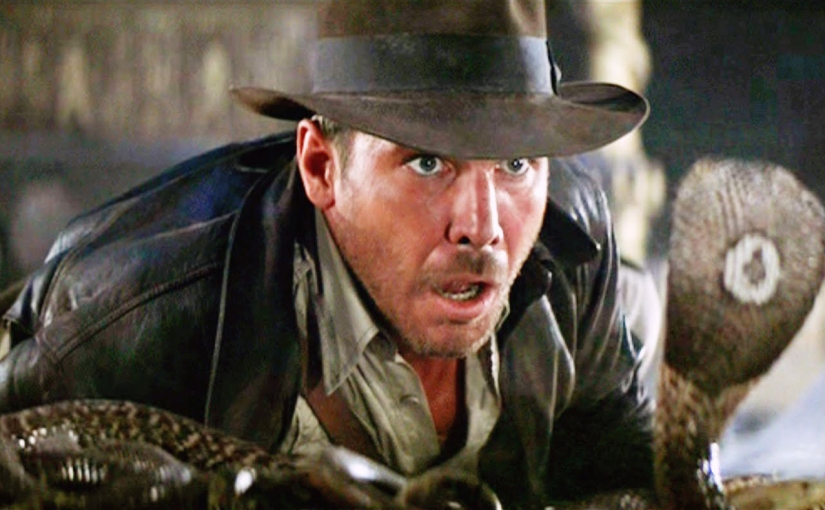
Ford became a great action film star due to Indiana Jones and Han Solo. This film is an example of his best work. He’s the best at facial expression during high action moments. Watch the truck chase during the second half of the film. As he is careening a truck through the sand streets of Cairo, he winces in pain, evokes anger and dons a toothy grin as he shakes Nazis off the vehicle, and throws them through windshields.

He’s got the perfect delivery of lines as he love/hate banters with Karen Allen as tough broad Marion Ravenwood (Jones’ best gal pal of the series). Their chemistry is great because they are two loudmouths who work off insulting and shouting at one another. They are one of my favorite on screen couples; like two Oscar Madisons who belong together.

Recently Ford said no one else can play the role; the role dies with him. He couldn’t be more right. Indiana Jones is not an interchangeable part like James Bond or Batman. Those roles change with the times and technology. Jones remains in history with a trusty whip, a sign of the times fedora hat and a drive to uncover the great unknown. None of these films work unless Harrison Ford is Indiana Jones.

John Williams also needs recognition. Who isn’t familiar with the famous build up horns calling for adventure? His composition just puts a smile on your face. Dialogue isn’t at play much during one of Spielberg’s well orchestrated action scenes. So we rely on the march of Williams’ efforts to relish in the fun of a foot chase through a Cairo marketplace or to thrill at a fast rolling boulder chasing the famed archeologist after he snatches his prized booty.

Spielberg and Lucas always get praise for their brilliant imagination. I venture to guess how many people were aware of the occupation of archeologist before the film’s original release in 1981. Sure, this isn’t what the job realistically entails, but the film opens your mind to what is out there and what we can learn more about from our past.

A great moment in cinematic exposition is when Jones explains the power of the famed biblical Ark of the Covenant. The dialogue works great here, thanks to a winning script from the great Lawrence Kasdan, and it has the audacity to convince an audience that some MaGuffin we read about in Sunday school could actually make Hitler’s Nazi regime invincible. Seriously? What?!?!? When you blend Spielberg and Lucas’ bravado, Williams’ eerily quiet thinking music, and Ford’s professor obsessed role with Kasdan’s efficiency for description all in one scene…yeah…you believe this could be a very, very real threat.

Every scene is different. Snakes, truck chases, spiders, foot chases, bottomless pits, bar shootouts, Nazis, the power of God, and a wide variety of antagonists all used to build the structure of two of the best hours in a film. It’s all brilliantly weaved together with transitioning red lines across a traveling map on screen. This is great editing, people.

Nothing has ever come close to Raiders Of The Lost Ark. Nothing ever will. It is a perfect film.

“Trust me.”

QUANTUM OF SOLACE

By Marc S. Sanders

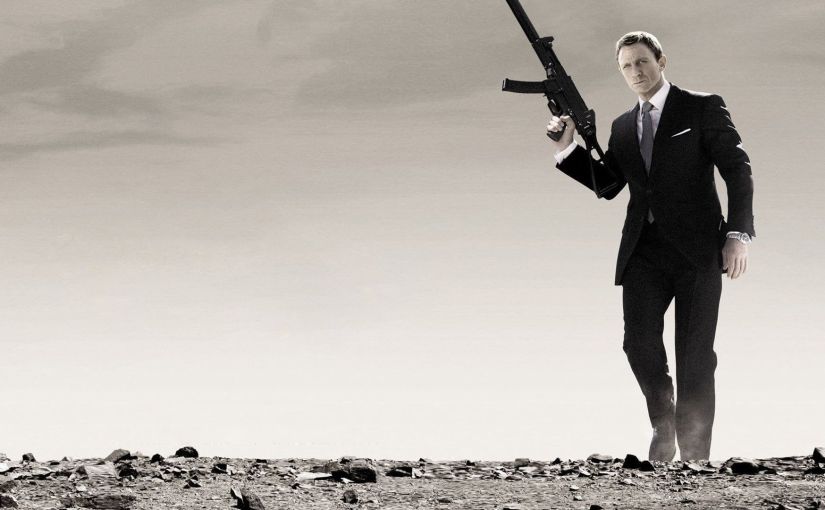
A writer’s strike never bodes well for a film. So the 22nd installment in the James Bond franchise, Quantum Of Solace, suffered because of it. Daniel Craig returns in his second film as Bond which begins as a direct sequel to my favorite film in the series, Casino Royale. Marc Forster (Finding Neverland) directs, but not very well.

Much of the action scenes are very shaky and choppy. Forster seems to have adopted Paul Greengrass’ technique that works so effectively in the Jason Bourne films and United 93. However, Forster does not make clear what is occurring. You can’t recreate Picasso with crayons.

The opening is a rush job of a car chase as Bond races away from enemies in his Aston Martin. Machine guns and heavy traffic and construction sites make way for his car to gradually fall apart but it’s hard to really see how the car becomes damaged in the first place. Just when exactly did the driver’s side door come off? There’s lots of spinning out of control and dirt flying with bombastic gun fire and engine revving. It’s all sensory overload to hide the preciseness in the high speed chase.

Later, Bond is attempting to rescue the girl Camille (boring name, boring girl) played by Olga Kurylenko when she’s held captive on a boat. He jumps into a motor boat and the chase is on. Bond fends off the bad guy by tossing a rope with a hook on it. Just tossing it up. Suddenly the bad guy’s boat flips over. What exactly happened here? How did the rope take out that boat? I didn’t see the connection. Film is visual. So show me the fundamentals from A to Z, please.

The story involves Dominic Greene (Mathieu Almaric) who appears to be an environmentalist with interest in a pipeline in Bolivia. (Bolivia????) At first Bond is under the impression this pipeline must be for oil. Later, it’s realized that Greene intends to charge the country enormous prices as he takes over the water supply. (Roman Polanski’s Chinatown did this all much, much better.). In exchange, Greene will assist a tyrannical Bolivian General in becoming President. This General raped and murdered Camille’s family. Naturally, she wants revenge. As Bond pursues Greene, he comes to learn that Greene is a member of a secret organization called Quantum. Hence the strange title.

Bond follows through with this assignment while trying to determine why his past love (Vesper Lynd from Casino Royale) was murdered, and after MI6 is infiltrated.

The story is kind of all over the place. It has a lot of interesting threads like Bond’s need for revenge, Camille’s need for revenge and a secret organization that MI6, nor the CIA, were ever aware of. Threads remain hanging as threads though if a writer’s strike interferes.

The story for Quantum Of Solace hardly gets fleshed out. We learn nothing of the organization, Quantum. When Bond finishes his mission with Camille, she just gets out of the car and walks away into the middle of nowhere. Where is she going exactly? The climactic battle takes place in a luxury hotel located in the middle of the desert. Unless this is Las Vegas, who goes to a hotel in the middle of the desert? I mean like ever?????

The film is a tremendous disappointment after the creatively artistic success of Casino Royale. Often sequels do not live up to their predecessors, but Quantum really goes off the rails. This film was a make-up as you go.

Craig is fine in the role of Bond; consistent with his first film. Almaric is okay as the villain, but never given much to do. A second woman comes into play, named Fields played by Gemma Arterton, assigned by M to bring Bond out of service. She seems to have a personality that the Camille character lacks, but she’s hardly given much screen time, save for a nightcap with Bond and later an image that harkens back to Goldfinger.

Jeffrey Wright (a great Felix Leighter, that I have not talked about yet) is belabored to share scenes with an obnoxious CIA partner played David Harbour. These two guys seem to be acting in a different movie.

Marc Forster was given a toolbox but didn’t know which end of the hammer to hold with Quantum Of Solace. There are too many things wrong with this film to justify any merits it may have.

Maybe the most interesting moment happens in the epilogue scene as we learn more about Vesper’s past. The scene has next to no relevance with much of the main story beforehand. Still, why couldn’t this film simply stay on this trajectory from the beginning? This is a thread worth pulling on and then tying off.

In other words, Vesper Lynd is far more interesting than the water supply in…ahem…Bolivia. 

CAPTAIN AMERICA: THE FIRST AVENGER

By Marc S. Sanders

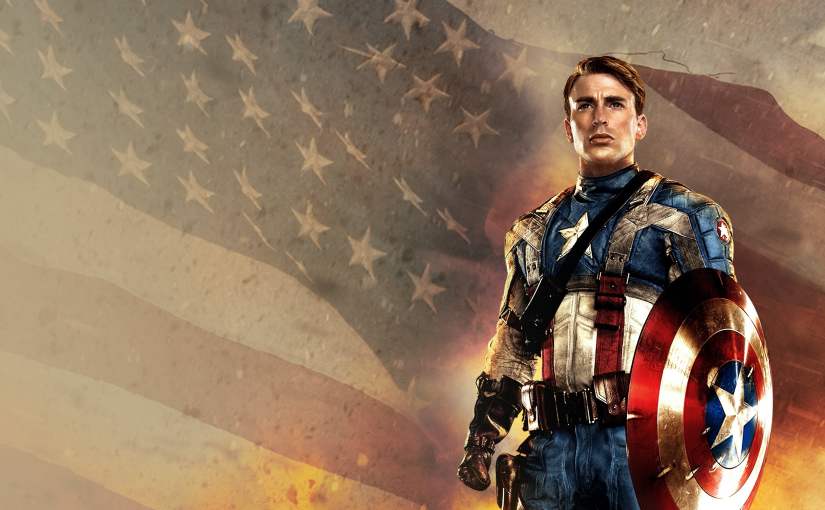
Admittedly, as a kid I read about the star-spangled hero, Captain America, on a frequent basis. In the ‘80s, to me he was nothing special; a guy with a shield, dressed like the flag who was very agile. Not many surprises were left for him to discover on the page. However, in his first MCU installment, Chris Evans, as Steve Rogers the weakling yearning to join the US Army during World War II and kill Nazis, is inspiring.

Director Joe Johnston ably introduces a character before revealing all the goodies. A fantastic special effect of downsizing Evans to a gaunt 95 pounds allows the motivation to become a hero all the more convincing. Following a series of being bullied and being rejected for service, Rogers is given the opportunity to become a lab rat for a “Super Soldier” experiment that will award him with instant fighting skills and strength. Stanley Tucci plays the doctor looking for the right candidate. Why Rogers? Because he sees he has the heart of a man only wishing to do well unto others. The experiment is a success before it becomes sabotaged, but Tommy Lee Jones, representative of the Army, is not entirely convinced. So, Cap only elevates himself to the role of a character logo, forced to sell the idea of buying war bonds across the country and entertaining the troops overseas. A rescue mission finally comes calling, and the boy in blue dons the shield and shows the world who he is and what he stands for.

Chris Evans is great in this part as a guy always on a path of “do good.” Never emoting cockiness, never in service for himself and never one to surrender to illogical and immoral mindsets. This is how Captain America should always be portrayed, a man who stands for the good of country and as the MCU films continue on, the good of the world and, well heck, lets just say the good of the galaxy. With his perfect haircut and clean shaven face, Evans never shies away from that platform.

Tucci is so good in a role that will never define his career. His brief appearance shows no hint of him being in a comic book movie. That’s a huge compliment. He takes the role of a German doctor seriously. He’s the scientist, but the film allows a nice scene for him with Evans showing that he is more so a friend. When his part exits the film, you miss him.

Finally, the MCU gets the female role right following the dismissive nature of characters like Pepper Potts (Iron Man), Betty Ross (The Incredible Hulk) and Jane Foster (Thor). Special Agent Peggy Carter played by the awesome discovery of Hayley Atwell makes the role her own. She plays the part like it is written, never relying on the title character for her cues. Atwell shows determination to stand out as a woman among a sea of men and never regarding herself as any different from those said men. She has some great scenes with Tommy Lee Jones debating the purpose and importance of Rogers. By the end of the film, you are not just paying attention to the fate of Evans’ character, but Atwell’s as well. Peggy Carter is written so well, you could write a TV series about her. Wait….hold on…. anyway I digress. Hayley Atwell remains the best female character of the MCU above those we’ve seen already at this point, as well as ahead of those to come in future installments.

The villain is really just a villain with Hugo Weaving as the Red Skull. The character looks great; looks just like the source material. He’s one bad dude, but not much to him. He stands to be more powerful than Hitler, yada yada yada.

Joe Johnston directs a film with a salute towards director Steven Spielberg. Try to convince me that the opening scene is not reminiscent of the opening to Close Encounters of the Third Kind. Indiana Jones seems to sprinkled about as well. Johnston doesn’t try to get cute with experimental camera shots and blurry CGI action. I think because he follows a paint by numbers approach to this film, it is all the better. He offers lots of good back story to Steve Rogers role, he gives a large cast of characters their own moments to stand out (like Bucky Barnes and the Howling Commandos) and he keeps Captain America likable and a guy to cheer for; a guy to be thankful for.

So, let’s give it up for Captain America!!!!

CASINO ROYALE

By Marc S. Sanders

Casino Royale from 2006 is the one film in the entire James Bond series that gives the MI6 agent a complete character arc, and for that reason alone, it is also the best film to date in the franchise, and another of my most favorite movies.

Bond becomes a different person, and a different agent by the end of this film. It’s a pleasing and unexpected surprise.

Following the misfire of Pierce Brosnan’s Die Another Day, the franchise was wisely reinvented, going back to the origins of 007 and how he earned his well-known license to kill. Fans immediately protested the casting of a blonde-haired Bond with relatively unknown Daniel Craig. Yet, as soon as the film was released, tensions were overall subdued.

Martin Campbell (Goldeneye) returns to direct the EON Production’s adaptation of Ian Fleming’s very first Bond novel. The super spy quickly completes the necessary requirement of two kills to earn his 007 status and is assigned by M (Judi Dench, still so good in her role) to pursue LeChiffre (Mads Mikkelsen), a mathematic genius and money launderer for high priced terrorists. Bond engages in a high stakes’ poker game at the renowned Casino Royale where he must beat LeChiffre’s bluff or monies from his Majesty’s government will have directly funded terrorism. Along the way, Bond falls in love with the treasury agent, Vesper Lynd (Eva Green), who is assigned to fund his poker buy in.

This film offers a James Bond with faults and mistakes to learn from. He’s never completely perfect and he is subject to losing a bluff in more ways than one, albeit at the poker table or in the face of love. As well, Bond doesn’t necessarily think far enough ahead, as his kill ratio continues to rack up. To M’s displeasure, she wishes he’d have some reservations so that they can question who he comes in contact with. Bond doesn’t seem to consider that.

Daniel Craig gives a brilliant performance of a man who believes he is even wiser than the reputation moviegoers have been accustomed to for over 40 years prior. By the time the film reaches its climax in an action paced shootout within a floating building along an Italian strait, Bond’s steely armor is donned against affection or distraction. James Bond becomes humbled by personal betrayal. I never would have imagined. Death will never affect him again. Love won’t either. This James Bond makes mistakes, but never will he make the same mistake twice.

Mikkelsen is a great villain as the bad guy who gets in over his head. He is not trying to dominate the world. He’s only interested in a profitable return from his dealings with terrorists. James Bond can’t interfere. LeChiffre is a new brand of villain, but still written with a trademark deformity of weeping blood uncontrollably, plus a case of asthma. A far cry from metal teeth and hooks for hands. Mikkelsen plays LeChiffre as cold and terrifying, almost like a vampire with a winning hand.

Eva Green is the best Bond girl of the series. There’s a mystery and a dimension to her performance. Something is driving her and it may play against Bond ever succeeding. Green portrays Vesper as lovely, graceful and suave like her partner, but she is incredibly smart too. She is evenly matched with Craig’s Bond. A great moment occurs when James & Vesper first meet for dinner on a train and size each other up. Eva Green is precise in monologue delivery. She is assured and confident. This woman is able to read Bond before Bond is given the opportunity to seduce her.

Campbell puts together real looking and tangible action sequences where 007 pursues a bomber specializing in parkour, a sport of climbing and leaping on and off of objects within a construction area. There’s also a well choreographed fight scene in a hotel staircase.

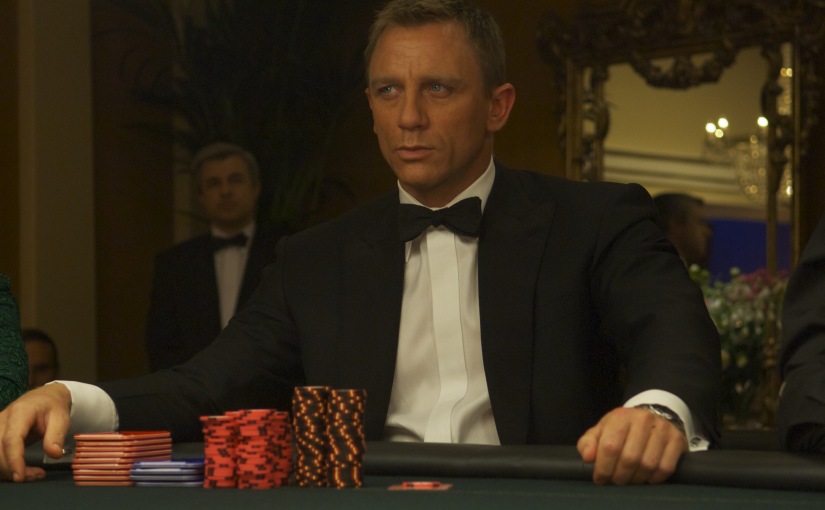
The best moments are reserved for the poker match however. Campbell amps up the tension with these ridiculous hands the players have in a fierce match of Texas hold ‘em. Bond gets sidetracked with sword wielding killers and poisonous drinks, but still manages to return to the table time and again with his tuxedo neatly pressed. The interplay at the table with or without dialogue is mesmerizing.

Daniel Craig went entirely different with his James Bond. The wit is there, but the tongue in cheek is not missed. This James Bond doesn’t give a damn if his vodka martini is shaken or stirred. Most of the prior Bond films had the super-agent without any scruples or demons in his closet. World domination, death and casual sex were just all in a day’s work. This 007, however, comes with a heavy background. Craig is great with his silent, seemingly guilty regard for killing someone whether it be by drowning a thug in a flooded bathroom sink or stabbing another one to death amid a museum crowd.

Screenwriters Paul Haggis with Neal Purvis and Robert Wade write a dramatically induced James Bond story. A tale not easily forgotten. It was time to reinvigorate the franchise that was going off into the absurdity of invisible cars and over the top gadgets. The puns are still here, but they serve more as a cover of a necessary internal pain for Bond, rather than disregard for his actions.

Casino Royale is one of the best films ever made. No qualms about me saying that. It’s hard to find great relationships among characters with huge risks at play, and magnificent chemistry for one another, as well as the story that serves them.

Casino Royale is an absolute winning hand at any table.

THOR

By Marc S. Sanders

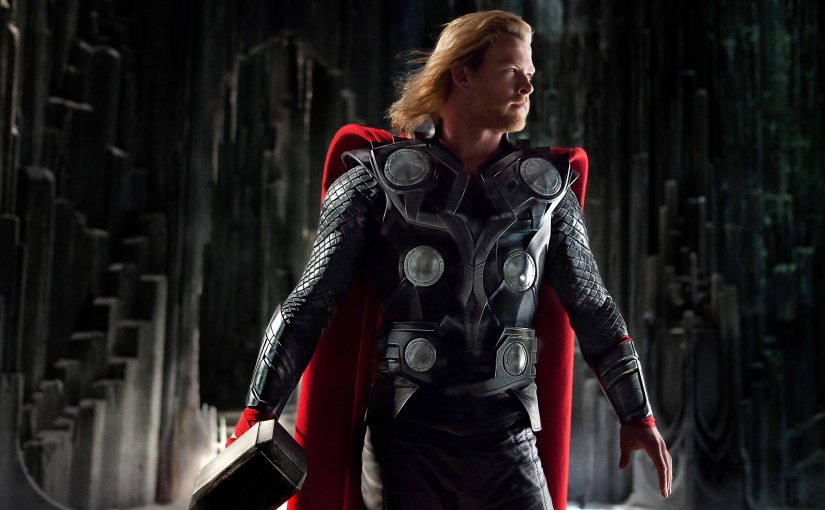
Chris Hemsworth is the God of Thunder who must learn to grow up if he is to inherit the throne over the land of Asgard from his father Odin (a welcome Anthony Hopkins), and more importantly become worthy of lifting his mighty hammer. Hemsworth is great; full of cocksure assuredness, humor and heroics. Chris Hemsworth makes you believe he’s the only guy who could play Thor.

Thor’s adversary is the God of Mischief, Loki played by one of Marvel’s best actors, Tom Hiddleston. This is a guy who plays so many different levels. If one didn’t know the story of Thor and Loki, I’d argue they might be shocked at some of the turn of events Hiddleston masterfully orchestrates with simple facial expressions and passiveness that progressively switch over to madness, obsession, jealousy, envy and deceit. Hiddleston effectively spins all the plates perfectly.

Natalie Portman plays the love interest carrying the torch of least significance that Liv Tyler and Gwenyth Paltrow held in prior Marvel films. That’s a pattern the Marvel films will begin to improve upon with the next film in line.

Director Kenneth Branagh is the right guy for this movie. Inspired Shakespearean settings and dialogue overlap with modern day America. Branagh brings a nice balance to it, and he also directs his actors well. A great exchange of dialogue and performance occurs midway through between Hiddleston and Hemsworth. Branagh gets good close ups of both actors as the conniving villain manipulates the naive hero. The camera angles move at a slant almost evoking a necessary confusion between what is true and what is a lie. Moments like this allow Thor to be more than just an action film. There are nice opportunities for acting as well, and because of that Hiddleston especially has become quite treasured among loyal fans.

Compliments must also go towards the setting of Asgard. I normally frown on immersive CGI normally. Not here though. Asgard is as regal as anything Peter Jackson offered in his Tolkien films, complete with a striking rainbow bridge and towering structures. I want to tour through that whole land. It’s that spectacular. Characters also work well with the CGI, especially the fire breathing, metallic Destroyer.

Thor is a great introduction to the legendary comics character. The film offers a character arc of change much like what was captured with Tony Stark in the first Iron Man. The character must grow and learn about his identity over the course of the film in order to have legs for future installments. This film accomplishes that feat, and thus Chris Hemsworth has become a box office draw while his most popular character to date has become a screen favorite.

IRON MAN 2

By Marc S. Sanders

Iron Man 2 is a Frankenstein’s Monster of a film. Director Jon Favreau returns, but not with the same insight he invested into the first Iron Man. This loud, headache inducing sequel is an assemblage of cutting room floor scenes taped together to mask itself as a cohesive narrative brought to life. The movie exists. Yet it has no brain.

Six months have passed since the events of the first film, and Tony Stark (Robert Downey Jr) is ready to open his peace parade Expo in New York. The problems begin here. Stark, who redeemed himself as a born-again, eyes open martyr at the end of the first film, reverts to an obnoxious jerk full of brash, rude cockiness. Downey goes so over the top with his improvisational one liners that you can hardly stand Tony Stark, and this is all before he gets drunk and pees in the Iron Man suit.

Stark is experiencing rapid blood toxicity from the suit and he is unable to find a solution. I might have been concerned at first but after the film is over, the convenient remedy just made me feel cheated. Poor writing offers a convenient get of jail free card.

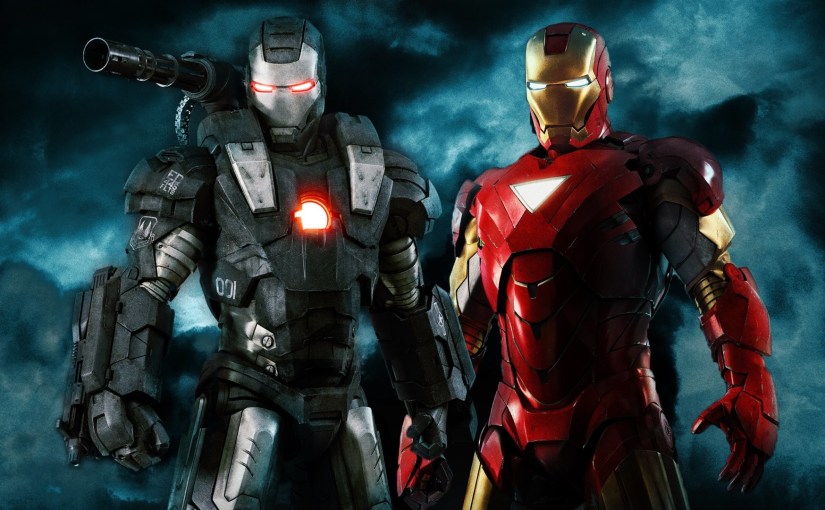
Then there is Stark’s relationship with his friend Rhodey (Don Cheadle). Cheadle shows potential in the part he resumed from Terrance Howard, but he really only serves two sole purposes, to have an armor throw down with Tony throughout the mansion (a stupid fight by the way), and to wear the new War Machine armor. That, I’ll say is pretty cool in charcoal black with red eyes and a shoulder resting machine gun.

Gwenyth Paltrow is back as Pepper Potts, and she just kvetches a lot. Paltrow and Downey’s chemistry are all but gone. Not really the actors’ fault though. More so, it’s the dumb screenplay by Justin Theroux who I guess found it adorable for the two players to squabble amid the action scenes. It’s rather annoying actually.

Theroux makes a lot of misfires here. The great Mickey Rourke appears to have fleshed out a great villain known as Whiplash. A Russian physicist with a grudge against Stark. Rourke offers a scary appearance of long hair, gold teeth and a tattooed muscular body. Oh, and he has a cockatoo as well. Mustn’t forget that. Too much of this film is devoted to this bird that does nothing. Whiplash is insufficiently written. He has a mid-film battle with Stark at the Grand Prix in Monaco, then following a prison escape, he’s harbored by Stark competitor, Justin Hammer, in a factory where he does nothing but build robots. None of this is interesting.

Sam Rockwell plays Hammer as a whiny kid in nerdy glasses and even nerdier three piece suits. He’s not a villain you ever love. He’s a Frank Burns, but his stupidity against Stark and Rourke’s character offers no humor from the stooge that he is.

Side stories focus on anticipation towards the first Avengers film with Samuel Jackson as Nick Fury and Scarlett Johansson’s Black Widow, yet not much is offered. They have nothing to do with anything else going on in this hodgepodge. Johansson finally gets a good fight scene during the climax, but it remains brief.

So there’s really nothing in Iron Man 2. It’s just a mix of things smashed together. The Iron Man suit only has three scenes, one to open the Expo (no fight there), one to have drunk Tony Stark fight with Rhodey while wrecking his house (Belushi did it better in Animal House, as well as the cast of Sixteen Candles), and then finally in a climactic ending against Hammer’s military robots and Rourke’s Whiplash who hardly participates in the moment.

Iron Man 2 is likely my least favorite of all the MCU films. (Actually, Eternals took that top honor, recently.) It offers one redeeming quality and that’s its end credit scene, maybe my favorite of that particular category.

Otherwise, Iron Man 2 is pointless, dumb, ignorant of its product, and flat out obnoxious.

Stan Lee Cameo: Was that Larry King? Really?

THE 355 (2022)

by Miguel E. Rodriguez

Director: Simon Kinberg
Cast: Diane Kruger, Penélope Cruz, Jessica Chastain, Lupita Nyong’o, Bingbing Fan
My rating: 5/10
Rotten Tomatometer: 25% (…oof…)

PLOT: When a highly advanced technological googah falls into mercenary hands, a wild card CIA agent joins forces with three international agents on a mission to retrieve it.


I can’t speak for my colleague, Marc, but sometimes it’s harder for me to write about mediocre films than about films that are either outstanding or truly terrible. It’s harder to muster up the motivation to break down a movie that’s not bad or great, but merely so-so.

That’s the situation in which I find myself, sitting down here to write about The 355, a female-led action-thriller from director Simon Kinberg, whose previous writing credits are like a roll call of woulda-shoulda-coulda superhero movies: xXx: State of the Union, X-Men: The Last Stand, Jumper, X-Men: Apocalypse, the ill-fated 2015 reboot of Fantastic Four, and so on. (Full disclosure: he did write the 2005 comedy thriller Mr. & Mrs. Smith, which I believe is highly underrated, but that might be due more to the onscreen chemistry of Angelina Jolie and Brad Pitt than the script.)

The 355 (the title is explained only in the film’s final five minutes, so be patient) is standard Bond/Bourne stuff: an advanced technological doodad has surfaced and every bad guy on Earth wants it. It’s a fancy-looking USB drive that, once connected to any laptop in the world and properly decrypted, can access literally any network and/or mainframe in existence. As proof, the device’s inventor uses it to first crash a military transport jet flying overhead and then, as an encore, cuts the cable to his house. Personally, I would have reversed that lineup, but that’s just me.

(If this plot device sounds familiar, well, that’s because it is, as anyone who remembers the movie Sneakers will attest…but whatever.)

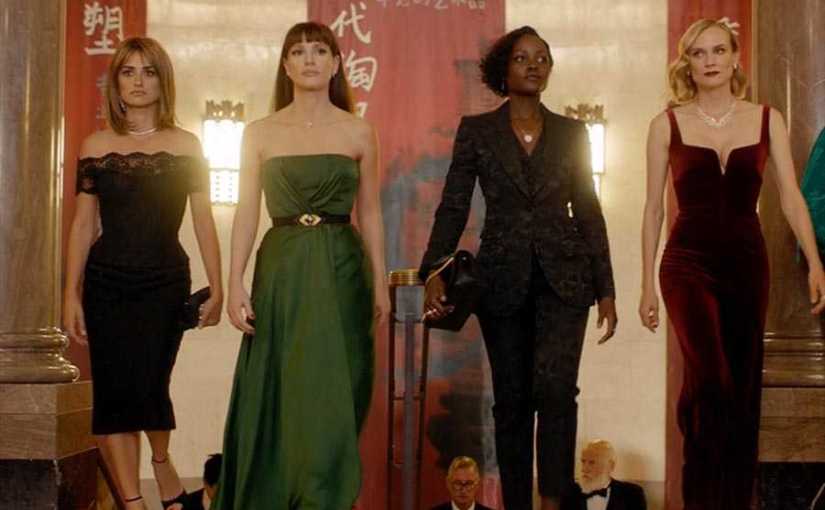
The device is stolen, and the good guys need to get it back before the bad guys do. Enter the main characters of the film: Mason Browne (Jessica Chastain) for the CIA, Marie Schmidt (Diane Kruger) for German intelligence, Khadijah Adiyeme (Lupita Nyong’o) for MI6, and poor Graciela Rivera (Penélope Cruz), a therapist who is in the wrong place at the wrong time. There’s some nonsense about them fighting each other at first, then banding together when they belatedly realize they’re on the same side.

The first major action scene is really well done, I have to say. There’s a foot chase through Parisian streets and subways that is as well done as any similar chase in the Bourne trilogy or any given Bond film. For that matter, ALL of the action scenes are competently executed…but that’s about it. There’s no flash or style, no real sense of originality.

There’s one sequence in particular that takes place in and around a fish-packing warehouse that, after a few minutes, became extremely muddled, and I lost track of who was chasing whom, and why, and how. The camera just seemed to be recording the action without getting me invested. It was curiously bland and detached.

The story itself was vaguely disappointing and unsatisfying, as well. It serves as the very definition of “by-the-numbers.” Virtually every cliche from better spy films are evident. The partner (Sebastian Stan) who’s dead…or is he? The trustworthy boss…or is he? The villain (Bingbing Fan) who lurks in the background…or is she a villain?

Now, there are uncountable films that have used these cliches to better effect, but it’s especially disappointing in The 355 because, throughout the movie, the story felt as if it was on the verge of talking about some truly interesting topics, specifically as it relates to women. There are subplots about how Mason, the CIA agent, has no personal attachments, while Khadijah, the MI6 agent, has a lover, and Graciela, the therapist, has a whole family waiting at home for her. Marie, the German spy, has some REAL problems that I won’t get into here. The story dances around the social perception of what women should or shouldn’t do with their lives. You want to be a secret agent full time? Okay, but you’ll get judged for not wanting to start a family. You want to start a family? Okay, but you’ll get judged for not being as professional or as dedicated as others in your line of work. You want to try to do both? Fine, but just when you think it can work, it doesn’t, so you should have come down on one side or the other. It’s a no-win scenario, and it happens all the time.

The movie dances with exploring this concept further, and then dances away in favor of more cliches and unnecessary plot twists. There’s even a whole sequence that feels as if it was lifted directly from one of the Ocean’s movies. Any one of them, take your pick.

There is also a moment when, out of NOWHERE, the stakes are raised in dramatic and horrifying fashion, so much so that it felt completely out of place. I was reminded, oddly, of a scene in the 2006 remake of The Hills Have Eyes where one of the mutant baddies slowly waves a gun over an infant in a crib. To me, it felt like overkill, and that’s the feeling I got with this off-putting twist. Was it necessary? It was shocking, true, and effective, but was it necessary? I don’t believe it was. I would have believed these women were motivated enough without bringing in outside pressure. And, to be honest, it felt like it was punishing those women who dared to have a life outside of their profession and rewarding those women who didn’t. No doubt there are other interpretations, but that’s how I saw it.

All in all, The 355 wasn’t downright unpleasant or super thrilling. It wasn’t exactly a waste of time, but it didn’t exactly blow my hair back, either. I don’t think it’s quite as bad as that Tomatometer would suggest, but…

Yeah…wait for streaming.

THE INCREDIBLE HULK

By Marc S. Sanders

The Marvel Marathon continued with the most underappreciated installment in the Marvel Cinematic Universe (MCU), The Incredible Hulk.

Edward Norton is the best of the cinematic Bruce Banners. He plays the role smart and desperate, and that’s the purpose of Dr. Banner once he is left to be on the run following his unfortunate encounter with gamma radiation. Norton enhances a script credited to Zak Penn. As such, we are treated to the efforts of Banner to rid himself of the raging green monster within. He communicates with a mysterious “Mr. Blue” by means of encrypted email as he hides out in the stacked, labyrinth tenements of Brazil. This setting presents an early high octave foot chase over rooftops and through narrow alleyways as Banner is pursued by General Thadeus “Thunderbolt” Ross, bent on using the hulk effects as a means to develop an army of super soldiers. Banner knows nothing good can come of this and therefore has to run until he finds a cure. To make things more complicated, Banner must keep his true love, Betty (Liv Tyler), out of harm’s way. Betty is the General’s daughter.

Louis Leterrier directs under a lot of demanding expectations following the unforeseen success of Iron Man, and before that, the disappointing bore delivered by Ang Lee with Hulk. For the most part Leterrier gets it right. Three high stakes action scenes featuring both Norton as Banner and later as a very gritty, very angry and very strongly aggressive nine-foot green monster are well choreographed blends of CGI and principle photography. A well-cast adversary in the form of Tim Roth is great as he willingly gets experimented on to match the power of the Hulk. Roth plays Emil Blonsky as an eager soldier bent on getting superior to the might of the Hulk. Leterrier shoots Roth gradually changing physically, but more importantly in performance. The center of the film shows Roth sprinting across a college campus to confront the Hulk head on. He then demonstrates astounding agility with leaps over the Hulk’s head. It’s a great match up.

William Hurt plays General Ross. I’d never consider him for this part based on Hurt’s previous resume. Yet, if you put him in a camouflage uniform, slap a thick, silver mustache on him, and grizzle his voice, he works well in the part.

Like Jeff Bridges in Iron Man, the villains offered up by Tim Roth and William Hurt are another two of my favorites in the MCU. Again, they are not after world domination. One is motivated by the discovery of advanced power. The other is moved by misguided opportunity.

Not much can be said about Liv Tyler. She screams. She cries. She yells at a New York City cabbie and she gets to kiss Edward Norton.

What I like about this film is the approach from the beginning. The opening credits offer all you need to know, so that it can quickly jump into the action and the pursuit. Penn, Norton and Leterrier dodge the go to origin story to tell us instead where Bruce Banner and the rest have left off. It’s efficient storytelling.

Leterrier also cuts his action and attention to the Hulk quite well. Sure, we all want to see the Hulk but let’s see his ultimate power first. Leterrier recognizes this is part monster movie. So, when an early set piece takes place in a dark soda factory, we are quickly familiarized with the architecture, and we believe the monster to be hidden under cat walks and in dark corners ready to swipe away a thug leaving only a sneaker behind. Eventually you see his silhouette, followed by his eyes accompanied by a Lou Ferrigno growl, and now you are sitting up at full attention. Later, Leterrier sticks to a similar routine by showing an enlarged hand bursting from a gas cloud.

This iteration of the Hulk is the best. He’s dirty and built like a linebacker with shaggy green hair. His expression is one of “STOP BOTHERING ME AND LEAVE ME ALONE.” Compared to the later installments, this version is better. He’s not as clean, not as disciplined, and thus we are more nervous around this Hulk than other Hulks we see in later films.

It’s still disappointing that Norton did not continue on with the role. I believe his “lonely man” interpretation, inspired by the late Bill Bixby’s TV version. A sad man in an unfortunate circumstance. Comparing his portrayal to Mark Ruffalo, the latter seems trapped in unconvincing dramatics. The internal conflict never seems that challenging to Ruffalo like it does to Edward Norton.

Though my only wish was that some unraveled threads (The Leader, The Abomination. Right, Marvel fans?) were not left unresolved in later MCU films. As an actor with several dual personality roles on his docket (Primal Fear, Fight Club, The Score), Norton is the better Banner, and it’s because of him along with Tim Roth and William Hurt that The Incredible Hulk is really one of the better Marvel pictures.

A Favorite Stan Lee Cameo: What happened after he drank that soda????

IRON MAN

By Marc S. Sanders

It’s fair to say in 2008, a new pop culture phenomenon occurred and that was the Marvel Cinematic Universe (MCU). The first of a collection of highly successful crossover films was Iron Man featuring a Robert Downey Jr that was offering little promise in box office and commitment following stints in prison for his personal drug addictions. Director Jon Favreau felt that Downey was right for the title role, also known as brilliant, genius, wealthy playboy Tony Stark. Favreau’s confidence, as it turned out, was right all along.

Iron Man is an origin film. Tony Stark is a man with everything, but because of a lack of surviving family following the deaths of his parents, really, he sadly has nothing.

After being captured by Afghan terrorists, Stark, the world famous weapons manufacturer, has an epiphany and opts to take his billion dollar company in a new direction by halting production on all weaponry. Stark’s partner, Obadiah Stane played by Jeff Bridges, tries to contain Stark’s new campaign, and in turn becomes an adversary to contend with.

This is a summary of a great story, and even better, I have yet to discuss the main attractions of the film, the Iron Man suits. Sci fi and adventure movies work best when the highlighted visuals are not the story, but rather what accompanies the narrative. Iron Man is not so much about the suit. Moreover, it’s about the guy who built and wears the suit.

Downey is perfect in the role. Sure, his sarcasm and impulse to perform off script can get a little tiresome, but Downey also stops to give Tony Stark some heart as he bashfully pines for Pepper Potts played by Gwyneth Paltrow as his adorable sidekick in business. Also, his maturity comes into focus following his will to undo what he’s wrought prior to his captivity. It’s a great character arc of dimension and change.

Jeff Bridges plays one of my favorite MCU villains. At least I think so, because I understand where Stane is coming from. He’s gotta answer to his stockholders. Stark and Stane are in the money business regardless of the products they market and manufacture. He’s not all about global domination. He’s a man of responsibility. Bridges went with the comic book iteration of Stane from the late ‘80s publications by going bald with a devilish goatee. His height and broad shoulders plus his age match well against Downey. Bridges’ stature is intimidating opposite Downey’s reckless lack of care and immaturity through the first half of the film. Stane puts an arm around your shoulder, and you know you’re in trouble. So, it works really well here. Jeff Bridges really ranks as one of MCU’s most overlooked gems, now over 10 years and over 20 films in.

Favreau depicts some all too real and scary moments of terrorism and violence. This is all a step above the fantasy actions later to be seen from the likes of other Marvel villains like Loki, Ultron or Thanos.

It’s sadly ironic. One terrorist kicking a local in the head is harder for me to watch than a godlike giant who eliminates half the world’s population. Still, Favreau takes advantage of Downey’s comic timing and playful chemistry with Paltrow as well. Plus, there’s Terrence Howard as the no nonsense army colonel and friend “Rhodey” Rhodes (played in later films by Don Cheadle). Had Favreau not found that balance of heavy and light, we might not have seen the longevity of this continuing franchise.

The action scenes work well too. The Iron Man and Iron Monger (Stane’s costume) engage in a well edited and choreographed fight scene in the streets and evening skies of Malibu. Stark is plagued with weaknesses to add some “yikes” moments as he faces off against the hulk size Monger with Stane in control. These scenes are not blurry. It’s really what the action scenes of the Transformers films needed.

“Iron Man” foreshadowed a lot of fun material we were meant to see in later films. Blink and you’ll miss a certain patriot’s shield and stay for the first of many legendary end credits scenes that introduces an important character, leading to an eventual hit television series as well as becomes instrumental for all of these fun crossover moments.

Iron Man is an important film in cinematic history. It blazed a trail in big box office that’s given audiences lots of escape. The success of this franchise has attempted to be matched, but no other franchise has yet to come close. Sorry Star Wars and DC Comic films.

For now, the Marvel Cinematic Universe is as bulletproof as the Iron Man.

NOTE: Stan Lee cameo salute….Was that the real Hugh Hefner?!?!?!?