THE SUGARLAND EXPRESS (1974)

by Miguel E. Rodriguez

DIRECTOR: Steven Spielberg
CAST: Goldie Hawn, Ben Johnson, Michael Sacks, William Atherton
MY RATING: 6/10
ROTTEN TOMATOMETER: 87% Certified Fresh

PLOT: A young wife breaks her husband out of prison in 1969 Texas so he can help reclaim their infant from a foster family.  The ensuing media circus takes everyone by surprise.


Watching Steven Spielberg’s The Sugarland Express is like looking at one of those historical medieval tapestries of fierce battles, created by artists who didn’t yet know how to depict perspective.  There is plenty of action on display, but everything looks and feels flat.  The film took an award at Cannes that year for Best Screenplay, probably (at least partly) in recognition of how it shies away from a traditional Hollywood resolution, but even its downbeat ending is reminiscent of earlier, more resonant films like Bonnie and Clyde [1967] or Butch Cassidy and the Sundance Kid [1969].  As a stepping stone in the career of an eventual legend, it’s worth a view.  As a stand-alone film, it never quite achieves liftoff.

Based on real events, The Sugarland Express tells the story of Lou Jean Poplin (Goldie Hawn at her irrepressible, bubbly best), the young wife of prison inmate Clovis Poplin (William Atherton).  During a conjugal visit, just four months before Clovis is to be released, Lou Jean boldly busts him out because she needs his help to reclaim their infant, Langston, from a foster home.  Lou Jean herself has just finished serving time at a women’s prison, and the state, probably very wisely, determined Langston was better off with a foster family.  But they need to hurry because “I bet those Methodists are gettin’ ready to move out of state.”  Lou Jean’s delivery of “Methodists” tells you all you need to know about her feelings on the matter.

After Lou Jean breaks him out, a comedy of errors ends up in a situation where she and Clovis have hijacked a police cruiser and are holding a police officer at gunpoint.  They demand to be left alone while they drive to Sugarland, Texas, and retrieve their son, at which point they’ll release their hostage.

Now, this has all the makings of a smart, character-driven “road” movie, instigated by desperate people with no real plans for their end-game.  But for reasons I can’t put a finger on, nothing ever happens in the film that got me on the edge of my seat, figuratively speaking.  I fully comprehended the situation intellectually, but the film never got to me at an emotional level.

Could it be because we never really learn a lot about Lou Jean and Clovis in order to make them more empathetic?  No, I don’t think so, because over the course of the film, we’ll hear all about their past histories and previous brushes with the law.  The very fact they’re executing this plan to essentially kidnap Langston is proof of how unfit they are as parents.

I think part of the problem with the movie is…

…I’ve been sitting here for the last fifteen minutes trying to finish that sentence.  I can report that the film didn’t get to me emotionally, but I am struggling to explain why.  Could it be as simple as I think they’re not such great people, but the film seems to be siding with them as the movie progresses?  I mean, the movie HAS to side with them at least partially in order to make their journey mean anything.  Look at Butch Cassidy and the Sundance Kid.  Bank robbers, lawbreakers, but clearly the good guys because, duh, Paul Newman and Robert Redford are playing them.

So, maybe it has to do with the casting?  The Sugarland Express had one of America’s sweethearts as a woman willing to resort to kidnapping just to commit another kidnapping in the name of maternal love.  So, we’ve gotta root for her, right?  But then we see her behaving in the most inane, brainless way for so much of the movie.  I found it difficult to side with her when I just wanted to, forgive the expression, slap some sense into her.

What about Clovis?  I could side with him.  He appears to have misgivings throughout the entire film, right up to the point of no return.  But the way he willingly goes along with the scheme because, dammit, it’s his wife…something about that also turned me off on him.  There are moments I felt sorry for him, for them both, because I could see where this movie was headed early on.  But that empathy wasn’t enough to make me feel a catharsis of tragic energy at the film’s finale.  There’s just something about Clovis and Lou Jean that wouldn’t allow me to get too worked up over their fate.

I guess I identified most with the kidnapped police officer, Slide (Michael Sacks).  Maybe too much.  From the beginning, Slide is begging them to drop their weapons and turn themselves over to the police.  At first, he looks like he’s just following his training.  But then the movie progresses, and doggone it, he starts to like these two loonies, even though Clovis handcuffs him and even shoots at him a couple of times in the heat of the moment.  He can see where this road ends, and he pleads with them not to do exactly what the Texas state troopers expect them to do, because he doesn’t want to see them dead.  Because Slide never stops imploring the Poplins to see sense and do the smart thing, I guess he’s who I sided with for the entire movie.  (Well, him and his superior, Captain Tanner [Ben Johnson], who also doesn’t want to see them die.)

But…isn’t that the wrong way to approach this movie?  I shouldn’t be siding with the cops, for cryin’ out loud, should I?  At least, not in this movie.  Discuss.

From a technical standpoint, it is pretty cool to see how Spielberg, in only his second film, was able to marshal vast resources to create some arresting imagery.  The sight of what looks like literally hundreds of cop cars following the Poplins is a deceptively difficult feat, logistically speaking.  There’s a tense shootout in a used car lot that would have been right at home in The French Connection.  And everywhere, there’s bits of humor that made me smile.  From the elderly couple abandoned on the road (long story) to the solution of how to get Lou Jean to a toilet while in the middle of an extended police chase, Spielberg constantly pokes us in the ribs.  If this had gotten to the hands of someone like John Landis, it’s easy to see how this could have been turned into an out-and-out comedy with thriller elements, instead of the other way around.

One other aspect I did like was the media circus that blew up around the Poplins’ plight.  I’m sure it is yet another link to previous anti-heroic films, but while I was watching it, I was reminded of only one film: Oliver Stone’s Natural Born Killers [1994].  The outpouring of affection from the general public for these two, let’s face it, outlaws was both funny and sobering at the same time.  It would have been interesting to see a scene or two at the end of the film as an epilogue, so we could get a reading on what the public thought about how the police should have handled the situation.

If comparing The Sugarland Express to most of Spielberg’s later films, it certainly comes up lacking, no question.  As a lifelong Spielberg fan, I am compelled to say it SHOULDN’T be compared to his later films because it was made before he’d had a chance to hone his skills and become the populist/mainstream film icon he is today.  Look carefully at the two-dimensional storytelling and you can see the outlines of what was coming around the bend for this modern-day master.
MAESTRO

By Marc S. Sanders

Bradley Cooper’s second directorial film suffers from the same ailments as his first film.  Like his interpretation of A Star Is Born, Maestro is not as good as the sum of its parts.

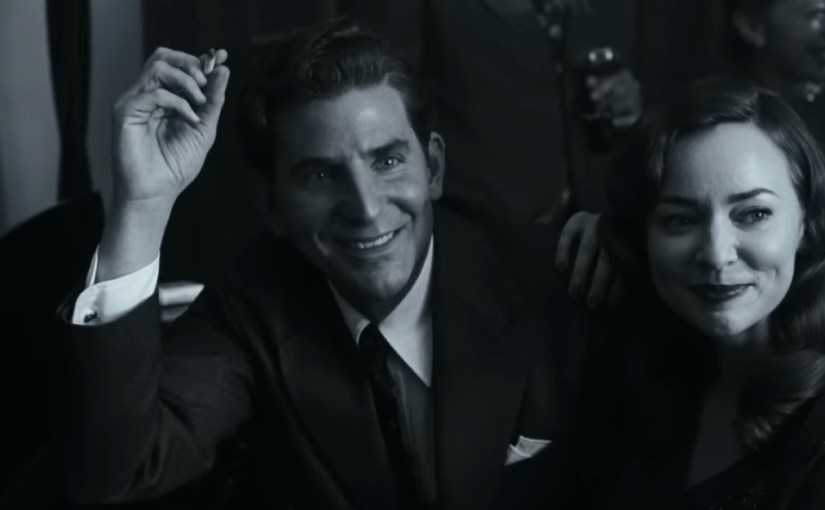
Constructively speaking Maestro is a gorgeous looking picture with a first half in a comfortable, historic black and white followed by its second half in vibrant colors.  The acting from Cooper, as Maestro Leonard Bernstein is well performed.  Carey Mulligan is sensational at no matter what age she is portraying actress Felicia Montealegre, the conductor’s wife.  Within the scenes they share together there is a beautiful rhythmic exchange of dialogue, written by Bradley Cooper and Josh Singer.  Cooper also looks powerful as he reenacts the conductor in front of his choruses and orchestras.  There are also inspiring shots that start out vague and unclear only to come into a full blossom as Cooper’s camera maintains an unbroken focus on an image. 

All that being said, none of it matters because the script from Cooper and Singer is muddied.  While Mulligan and the actor/director are in the midst of marital argument on Thanksgiving day, much is hard to understand as they naturally speak over one another, and what can be made out seems to mean nothing as they fight over people and issues that I do not believe are ever touched upon in the picture.  A scene like this looks like an actor’s dream piece, but it is hollow of substance. 

Like A Star Is Born, there are characters that enter Maestro for long winded scenes and then are never heard from again.  Either Bradley Cooper does not feel the weight of their importance, or he mistakenly presumes the audience will catch on.  An outdoor brunch with Felicia, Leonard, another couple and I believe a mentor or agent of Leonard’s seems well written, but I have no idea who those people are or what kind of influence they carry.  I was hoping to realize later, but those three amount to nothing.  Was the other couple supposed to be Leonard’s parents, and perhaps they were meeting Felicia for the first time?  I’m just not sure.

Bradley Cooper is a master with his camera.  An important moment in Bernstein’s life is when he gets the call to perform at Carnegie Hall when the other conductor calls in sick.  With its black and white imagery, a young and enthusiastic Leonard answers a phone call while a black square, with light from behind, occupies three quarters of the screen.  I was wondering if that was a stage curtain that needs to be lifted.  I was half right.  It’s a window curtain to the apartment Leonard shares with his gay lover.  The film moves into high energy as the would-be composer slaps his lover’s bottom and leaps down the stairs with a quick edit into the theater.  Mike Nichols would be proud. 

Another moment that struck me was Cooper pointing his camera up into the tall reaches of his apartment building staircase.  It’s quite dark.  You may have trouble realizing what you are looking at but then his son drops a paper airplane “good luck” note down to his father on the bottom floor.  These images blossom into something as alive as I would imagine the director/co-writer/actor regards Bernstein.

So, there is much to praise in Maestro.  Unfortunately, the assembly of these shiny, inventive, and magnificent pieces of film do not mesh very well together.  Bernstein led a homosexual lifestyle, even going so far as to welcome a lover into the home he shared with Felicia.  Carey Mulligan is excellent with expressions of resentment towards this other life that her husband follows.  However, the storyline never feels fully fleshed out.  We never get an opportunity to see the value or the menace of the other relationships that Leonard holds on to.  A so-so moment is accompanied by Bernstein’s saxophone opening to West Side Story.  The piece is used as a subtle tool of deceit and ignorant cruelty by Leonard while escorting his apprentice/lover in the home he shares with an angered Felicia in the foreground.  We presume the threat that Felicia likely feels, but it never comes to the surface. 

Bernstein’s career is glossed over as well.  Who pushed him to move on to bigger moments and acquire greater crescendos in his life?  I’d like to think it was Felicia, but I’m not certain.  Felicia has conversations with Leonard’s sister (Sarah Silverman) and other acquaintances, but what is she really alluding to or really talking about?

The most impressive moment in the film is when the Maestro conducts the London Symphony Orchestra at Ely Cathedral.  (I’ll own up and say I looked up what this scene was on IMDb.)  Bradley Cooper does a masterful reenactment of Berstein, dripping in shaggy grey hair sweat, dressed in a three-piece tuxedo with baton in hand.  This is a major multi talent working in films today.  Cooper studied film footage of the scene over a six-year period to get this six-and-a-half-minute unbroken moment caught on film.  It’s positively mesmerizing and I could watch this over and over again.  I’m waiting for the side-by-side comparison to appear on You Tube soon. It is reminiscent of what Rami Malek did as Freddy Mercury at the Live Aid concert at Wembley Stadium in the film Bohemian Rhapsody

Still, this scene much like a lot of the footage in Maestro seems to just be wedged in there.  There’s a balletic flow to some moments in Cooper’s film and then there are times that come out of nowhere and I’m left to wonder how exactly we arrived and what was truly going on in Bernstein’s life when he conducted at this historic moment time.  I’m watching a blazingly fine impersonation of Bradley Cooper doing Leonard Bernstein but I’m lacking the sub conscious dimension a biographical film should have at this point in a historical figure’s life.

Carey Mulligan is laying everything out to portray Felicia and her best moments come in the last third of the picture when the poor woman is struck with breast cancer that has spread to most of her body. We witness how she lives with the illness along with her separated husband by her side.  I’ve seen ill women before in films.  I know I sound crude by saying it’s nothing new.  I’m still allowed to be impressed though.  It’s a huge feat to bring a performance to this kind of level.

The makeup work is marvelous too.  Raw footage of the real Leonard Bernstein is shown before the end credits, and I’m impressed with how much Cooper looks in comparison.  The aging of him and Mulligan over the decades since the late 1930’s all the way through the mid 1980’s is perfectly captured.  At one moment, Carey Mulligan looks just like my mother.  I choked up a little bit when Felicia gazes upon Leonard at the Ely Cathedral.  Same hairstyle.  Same eyes.  Same expression.  Mom would have even worn a soft blue evening gown like that in the mid-1970s.

I wanted to like Maestro more than I did.  I almost feel guilty for not liking it as much.  There is magnificent camera work, sensational acting, wonderous music and perfect impressions on display, but the puzzle just did not have all of its pieces assembled together properly.  Sadly, Maestro lacks the focus it needs, either for the famed conductor’s amazing career or for his relationship with Felicia with his not so concealed homosexual lifestyle on the side.  Bradley Cooper put together a million magnificent moments, but it caused him to overlook the enduring structure of his subject.

INDIANA JONES AND THE DIAL OF DESTINY

By Marc S. Sanders

When a film director, the writers, and producers are trying to make a fifth installment of a franchise that spans over forty years, centered around one of the most iconic characters in history, it is important to consider every factor involved in the process.  My colleague, Miguel, commented that Indiana Jones And The Dial Of Destiny had four writers attached to the project.  Normally, I call that a shortcoming.  When you’re stumped for imagination, turn to yet another writer.  In this case, however, I believe it served to ensure they were providing a fitting send off to the famed archeologist in search of rare antiquities.  Dr. Jones’ final silver screen adventure hits all the right notes thanks to storytellers focused on imagination and sensitivity for the celebrated character.

James Mangold, a director who I don’t think gets enough credit for his accomplishments (Walk The Line, Logan, Ford Vs Ferrari, 3:10 To Yuma) takes over for a busy Steven Spielberg who occupies the producer’s chair this time.  The Dial Of Destiny has a modern Mangold gloss to the cinematography, compared to the distressed, washed out films of Indy’s earlier adventures.  However, it remains a very well-constructed film that should be recognized especially for some outstanding editing.  At the center of the film is a swashbuckling chase through Tangiers on three-wheel scooters and cars. It is as breathless as any of Mangold’s prior work or Spielberg’s pieces.  In fact, all the fined tuned action sequences function so beautifully.   Give the editors an Oscar nomination now!  The DC superhero films need to take a lesson from this esteemed house of Spielberg.

The film has a wonderful prologue worthy of being in the same fraternity with the other films in the series as Indy (a de-aged Harrison Ford) and his colleague (Toby Jones) come face to face with Nazis as Hitler’s reign is quickly collapsing.  The set up of the titled MacGuffin is introduced aboard a high-speed locomotive through German territory.  Flash forward to 1969 in New York City, and it is the eve of Dr. Jones’ retirement being overshadowed by America’s parade celebration of the moon landing.  Circumstances that our hero was never looking for occur and before you know it, Indiana Jones is riding horseback through a subway tunnel after being set up by his long-lost goddaughter, Helena Shaw (Phoebe Waller-Bridge).  Clandestine antagonists are hot on their trail, particularly a professor who goes by the name of Schmidt (Mads Mikkelsen). Then it is on to Morocco, followed by a diving expedition among a school of threatening eels. Sicily is next, and I dare not even reveal where the final destination takes place, but it’s a welcome and very appropriate surprise.  Bravo to the promotion machinists for not even hinting where this new film eventually escorts Indy and his pals.

When George Lucas invented the famed archeologist with the fedora hat, crackling whip, and leather jacket, I believe he was simply looking to arrange with Steven Spielberg to offer an update of the Saturday cliffhanging serials they watched as adolescents.  Indiana Jones was not a character in Raiders Of The Lost Ark.  He was a carving.  Harrison Ford occupied the well-worn image. Spielberg’s silhouettes of the man kept him thankfully recognizable.  Later films gave the world traveler more depth with back stories pertaining to his father (a timelessly memorable Sean Connery) and his one true love Marion (Karen Allen; isn’t she great?).  Indiana Jones is an archeologist by trade. Yet, in an age of advancing technology with television sets in every home during the 1980s and video games being updated quicker than people pay for them, the character is cinema’s greatest historian and one its most adoring adventurers.  The greatest achievement that The Dial Of Destiny offers is an absolutely perfect send-off to the character that movie goers have gotten to know since he first appeared in 1981, when he was the best alternative to James Bond.

Unlike the British secret agent, though, I truly believe only one actor can play Indiana Jones.  All five films demonstrate that Harrison Ford is irreplaceable.  Unlike Bond, who is written to adapt to the respective modern age in which every new film is produced, Ford has aged in line with Jones.  Indiana Jones is a traveler through the history of the twentieth century, researching and uncovering evidence of centuries past.  In his youth he’s fallible, and his improvisation to get out of a tight squeeze remains thematically the same during his elder years.  Time passes and evolves over the twentieth century, but Dr. Jones’ profession and vast intelligence lives in a past before evolution and technological advancement.  

This film features snippets of 60s rock music and references the moon landing.  Jones clearly is grumpily dismissive of these new discoveries.  They are not appropriate in his world. His best skills in the field to fend off what interferes with him are a weapon of ancient times (his whip), some hard-hitting punches and a six-shooter pistol.  Other than his researched knowledge, he doesn’t advance further than that.  So, the character ages physically and out of modern date, just as the man who portrays him does as well.  Ford goes shirtless in one scene.  The wrinkles, grey hair, pot belly and love handles show.

The cast is very welcoming in this latest movie.  Phoebe Waller-Bridge is especially fun and spunky in the same vein as Karen Allen.  She’s smart and instinctual.  Daringly adventuresome too.  I know she’s a newly celebrated screenwriter, but I’d love to see more of her in front of the camera as well.  Toby Jones is that character actor who always looks fitting for a period piece.  Mads Mikkelsen is who casting agents dial up for the quiet, yet scary, villain that the best heroes in film need to face off against.  He’s not doing anything we haven’t seen him do before, but he works well as a smart Nazi stooge.  Antonio Banderas is here, not doing much really.  A kid actor named Ethann Isidore joins the party, reminiscent of the Short Round character, and John Rhys-Davies as Indy’s trusty pal Sallah returns for a few scenes to welcome applause.

The cast is dynamic, and all have their shining moments, but the film belongs to Harrison Ford. I regard his latest performance with a warm smile as a salute to his distinguished career of playing those everyman roles without the bulked-up muscles or tough guy bravado.  He never had the skillful soldier like ease of getting out of any dangerous situation like a Stallone or Schwarzenegger.  Ford steers his characters to those pictures where none of them, including Indiana Jones, ever expect to get caught up in grand adventures.  Yet, when it happens his performances leave you yearning for him to triumph and win out in the end.  The best example is Indiana Jones, of course.  He carries his audiences with the smarts of the character and the pursuit of the unknown and what we can learn more about.  The Indiana Jones series is one of the greatest inventions to ever grace a movie theater.  Because they are born out of history, they will always remain timeless and priceless with each passing generation that discovers these wonderful films.

It’s good to have Indiana Jones back in theaters.  I can’t wait to see this movie again.

THE GOONIES

By Marc S. Sanders

You know how there are some movies designed for that unexpected thunderous rainy, Saturday afternoon?  Maybe a Star Wars flick or an Indiana Jones.  James Bond or Marvel?  For me the best candidate is probably The Goonies, where the rascally kid in all of us comes alive, yearning for adventure like riding our bikes through the paths of the sleepy town we live in over to a hiding spot on the other side of the woods where a once long lost treasure map begins an unknown journey.  Quick on our tales though are the bad guys with the humped back, crooked nose and clicking revolver.

Richard Donner did more for The Goonies than I think a lot of people realize.  It’s no wonder to me that the film is officially inducted into the National Film Preservation Archives since 2017, the same year that pictures like Guess Who’s Coming To Dinner, Ace In The Hole and Titanic also received their recognition.  Maybe Donner had help from producer Steven Spielberg and screenwriter Chris Columbus.  Granted, ahead of the age of cell phone addiction, these guys knew how twelve and thirteen year old kids ticked.  The Goonies bond over insulting each other, shoving one another, telling each other to shut up and freely dropping the s-word.  It’s a rite of passage.  It’s how I bonded with my buddies at that age.  Heck, I still maintain contact with my best friend at the time, Scott, and we still trade barbs like that even if we live over a dozen states away from each other.

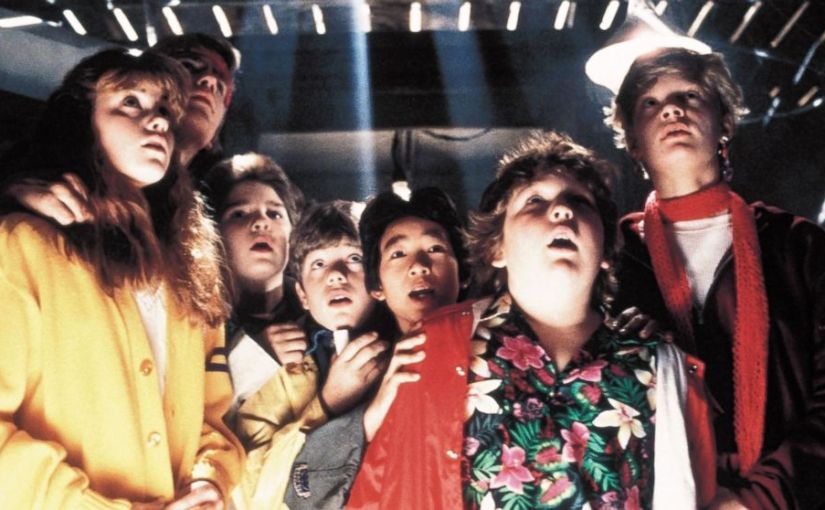
Sean Astin plays the asthmatic leader of the gang, named Mikey.  A son of actors Patty Duke and John Astin, he made his film debut with The Goonies, and I think it holds as one of the best child performances to grace a screen.  He’s such a genuine little guy, who is passionate about making any last ditch effort to save his house and home town from being bulldozed by greedy golf course developers.  On a rainy Saturday afternoon, Mikey’s buddies ritually come over to the house and with his older brother Brand (Josh Brolin, another celebrity son making his film debut) make their way into the attic and uncover a treasure map written by the infamous pirate from the 16th century, One Eyed Willie.  Soon after, Mikey along with Mouth, Data and Chunk (Corey Feldman, Ke Huy Quan and Jeff Cohen) embark on adventure that leads them to the underground caverns of an old restaurant off the Pacific coast.  Two high school girls, Andy and Stef (Kerri Green, Martha Plimpton) join the gang.  Andy and Brand have adorable puppy love crushes on each other. 

One Eyed Willie’s map supposedly leads to a treasure of enormous wealth that Mikey and the gang believe can save their small town of Astoria from being razed.  However, there are inventive booby traps along the way, and the nasty Fratelli brothers with their cranky old mother (Robert Davi, Joe Pantoliano and Anne Ramsey) are hot on their trail.  The Fratellis are straight out of those old Hardy Boys and Nancy Drew mysteries.  They are hilarious with their bickering, and scary at the same time. Anne Ramsey was a special kind of character actor with her ugly appearance and craggily voice. It eventually even got her an Oscar nomination (Throw Momma From The Train).  

We may know how the story will end up, but Donner, Spielberg and Columbus advance with one unpredictable scene after another.  Reader, when I feel the height of suspense in a film, I actually tear up and I get a very nervous laugh.  The shootout scenes in Heat (1995) and Lethal Weapon will do that to me every time.  The lightsaber dual in The Empire Strikes Back and the snake pit scene in Raiders Of The Lost Ark!!!!  I’ve been watching The Goonies since I was the age of most of these characters.  I still get this natural reaction when Andy has to play the correct notes on a skeletal piano to open a passageway.  Each time she plays the wrong note though, a tease of impending doom appears.  It works so well in the ensemble performance of the cast bellowing “Oh no!” and “Oh shit!” and “My God!” and “Hurry up!”  Edited with the quickly advancing villains getting closer, and the pulse beat music accompanied by composer Dave Grusin, and you are so caught up in their escapades now, that it feels like you are there.

All these kids become your best friend quickly.  Data is the inventor with the tripped out gadgets, inspired by James Bond, ready to set his own booby traps.  Mouth is the Spanish interpreter who gleefully causes trouble and mischief, but Feldman the actor is allowed some tender moments as well.  Jeff Cohen is like the Curly of The Three Stooges who gets sidetracked on his own adventure with a monstrous but loving, and sadly rejected son of the Fratellis.  A chained-up ghoul named Sloth (John Matuszak).  Cohen might have the best comedic moments in the film.  When I moonlight in Community Theater, I still must remind myself that just once I’d like to audition with his hysterical crying monologue where he confesses to stealing his uncle’s toupee to use as a beard to dress up as Abraham Lincoln, while another time he used fake vomit to sicken an entire movie house.  Hilarious stuff! 

There are dropping boulders, rattling pipes, a waterfall wishing well, scary skeletons, that creepy piano, and fun water slides to circumvent around One Eyed Willie’s maze onward to his legendary treasure aboard the most spectacular pirate ship ever seen.  Rarely are kid’s adventures constructed like this anymore.  I dunno.  Maybe it’s the script.  More likely, maybe it is the cast of kid actors doing one of the best ensemble performances together on screen.  Their timing could not be more perfect among the seven Goonies. 

The Goonies is a much more honest and transparent look at how kids behave with one another than you might find in a bleached-out Disney flick.  These kids get dirty and unsophisticated, yet thoughtful.  They are not age 21 playing age 14.  They don’t have fashionable haircuts and designer clothing. They are not pop singers trying to be actors.  Most importantly, the conversations among the gang are more natural in pal around rudeness.  You’re not really a friend unless you are telling the kid next to you to shut up and exclaiming “Oh shit!” when another encounter with danger lurks ahead. 

The Goonies is just a fun ride to watch over and over again. It succeeds with its own interpretation of The Little Rascals, and it’ll give you all the feels as you watch Mikey plead with One Eyed Willie for the next clue, or when he stops to remind his Goonies that there’s more at stake than just a play date on a Saturday afternoon. 

My advice is to keep the rose colored glasses off your children’s eyes.  Let them know it’s okay to get in trouble and make mischief.  Make sure your kids know they should be the best Goonies they can be.

THE FABELMANS

By Marc S. Sanders

Often, coming-of-age stories are narrated through the eyes of the child on the cusp of becoming a teenager or a grown up.  It’s important you realize that I say through the eyes, however.  It’s what the protagonist observes that allows him or her to appreciate, and comprehend.  Steven Spielberg will tell you he came of age by learning how to make movies.  It stands to reason however, that he did not come of age by looking with just his eyes, but rather with his 8mm and 16mm cameras.  The Fabelmans is a fictionalized, loose interpretation of how the celebrated filmmaker transitioned from adolescence into young adulthood with dreams of telling stories with movie making inventiveness.

Sammy Fabelman (Gabriel LaBelle, the older version; Mateo Zoryan, the younger version – both performances are magnificent) is escorted for the first time to the movies by his parents Mitzi and Burt (Michelle Williams and Paul Dano) on a wintery New Jersey night in 1952, where he sees The Greatest Show On Earth.  For eight year old Sammy, what starts out as nervous fear of what to expect in a dark theater with a giant screen turns into exhilaration as a car does a head on collision with a locomotive.  Shortly thereafter, a series of eight Channukah gifts assemble a Lionel train set for Sammy.  It’s exciting to see it go around on an oval track.  It’s more electrifying to preserve it on film with a toy car driven by a Mordecai figurine crash right into the steam engine and the boxcars hitched to it.  That was Mitzi’s idea to capture it on film.  That way Sammy can get a thrill out of watching the accident over and over again without causing any further damage.

Sammy only progresses from there.  When Burt gets a job promotion, the family moves to Arizona.  The desert allows a teenage Sammy to continue with his love of filmmaking by shooting his family during the cross country trek and then making westerns and war films with his Scout Troop pals as the actors.  He sets up tracking shots by propping his camera on a baby carriage rolling along cardboard laid out on the ground.  Ketchup becomes blood.  Sammy is even inventive enough to poke holes in the actual film strip at precise moments when his sheriff and outlaws fire their six shooters.  Now it really looks like the cowboys are shooting real rounds of gunfire.  Mom and dad, his sisters, his teachers, and friends are all impressed. 

His Uncle Bennie (Seth Rogen) is also dazzled by Sammy’s natural talent.  Bennie is Burt’s best friend and co-worker, and per Mitzi’s insistence he moves to Arizona with the family.  By use of his camera and editing machine, Sammy will soon learn that Bennie actually means more to Mitzi than he does to Burt. 

With a script that Spielberg constructed with Tony Kushner, the director/writer depicts a kid, much like he was, who expressed his honesty and learned the truth about the people around him when his projector was on.  The camera doesn’t lie, ever.  A motion picture camera will even hold on to the final beats of a person’s pulse before they finally expire.  That one moment in time where there’s life and then suddenly there’s death can be eternalized on film, forever.  It’s through this storytelling device that allows The Fabelmans to stand apart from other coming-of-age films like Rebel Without A Cause or Splendor In The Grass or any of the John Hughes brat pack films.  The childlike quality yearning for adventure and fantasy shines through with Sammy’s westerns or John Wayne inspired war pictures.  Sammy also realizes though that he can pick up on real life and emotion with his 8mm, like on a family camping trip.

Michelle Williams gives an outstanding, sometimes ethereal performance.  It’s real.  She’s not doing fantasy.  Yet, she lives for the fantasy and adventure.  I recall a well known anecdote of Spielberg where he described in his youth, his father woke up the family in the middle of the night to watch the skies for a meteor shower.  (Watch The Skies was the original title for his film Close Encounters Of The Third Kind.)  In The Fabelmans, Mitzi enthusiastically takes her children in the car to pursue a tornado.  Later moments will have her dancing freely in her nighty in front of the car headlights while the family is camping; uncaring over the fact that her dress is see through.  Sammy will notice how awkward his father Burt feels, while at the same time seeing how enamored Bennie is at the sight.  Williams has a beautiful balance though of a woman trying her best to appear happy and collected for the sake of her children and husband, but not living the story she wants.  This will influence Sammy as he maps out his own future.  He’ll live the life he wants.  Learning the merits of algebra will never hinder his destiny to make movies.

Later occurrences will show evidence as to how well Sammy can capture reality with his camera.  Following a series of bullying and antisemitic teasing after the family transitions to northern California, Sammy is welcomed to shoot the senior ditch day at the beach.  A telling moment occurs when the film is shown at the prom.  The taller bully is overwhelmed by how championed he’s depicted in the film.  He’s bordering on furious with Sammy, though.  The mean kid knows he’s cruel to the scrawnier, Jewish Sammy, and it immediately eats away at him with guilt over his past treatment.  Sammy’s film has changed and disrupted this kid.  Another kid bully is shown to look like the jerk he is and nothing else.  He walks alone on the beach.  He’s not an athlete.  He’s nothing but a no talent, unlikable antisemitic jerk.  This kid is also changed because now he can see what he truly is as the viewer looking at his own cruel behavior shown on film for the whole world to see.  Movies will bring out what we harbor deep down, inside. 

Ironically, Sammy is so well versed with camera work and follow up editing that he is practically unaware of how durable his theme of honesty through the lens truly is.  What Sammy captures comes without even trying and it sends a raw emotion to the viewer, whether it’s a mean-spirited bully or even his own mother watching.

Steven Spielberg could never be anything else except a movie maker.  Yet, after over five decades he’s still introducing audiences to new kinds of accomplishments.  He started as a director with adventure and fantasy on his mind with the likes of monster trucks, killer sharks as well as swashbuckling treasure seeking and visitors from outer space.  Later, he had to reinvent his craft and think outside his fanciful dreams to show brutality and hope through horrifying moments in history like the abuses endured by black southern plantation dwellers, slavery, the Holocaust and the unglamorized harshness of war, political unrest, and terrorism.  Further on, he carried out the romance of stage musical performance and even learned to poke fun at his own past accomplishments.

In the short period of time that we get to know Sammy Fabelman, we see transfers of perspective in this young boy’s outlook through a camera.  Sammy goes from making silly mummy monsters of his sisters to intimate hand holding shared by his unhappy mother and the man she truly loves, a man who is not his father. 

Whether he is watching his own films, or it is his friends, or his mother, his father or even his tormentors at school, Sammy realizes that a film will always do one thing and never falter away from that one thing.  His camera will always, always, always tell the truth. 

Thankfully, a truly inspired epilogue moment, which left me with a big, enthusiastic grin, has Sammy still learning that as frank as his filmmaking may be, it’s important that it is also never boring.  I don’t think I have ever been bored with a movie made by Steven Spielberg.

POLTERGEIST (1982)

By Marc S. Sanders

The original Poltergeist holds together based only upon its visual imagination.  The characters?  Well, they’re pretty thin to me. 

The Freeling family are JoBeth Williams and Craig T Nelson as mom and dad, with a teen daughter (Dominique Dunne), a preteen son (Oliver Robins) and an angelic five-year-old girl named Carol Anne (Heather O’Rourke) who speaks to the “tv people” through the white noise channel in the middle of the night.  Following odd occurrences that include unexplainable trickery from the kitchen chairs, a monstrous oak tree comes alive during a violent thunderstorm ready to consume the boy, while little Carol Anne is abducted by her closet into another realm that “exists” somewhere within the suburban house.

Mom and dad recruit help from ghost whisperers to uncover the mysteries that reside in the home and hope to rescue Carol Anne.  Beatrice Straight is the leading scientist of this team.  She introduces dialogue that says their home might be not be so much haunted as it is consumed by a “poltergeist.”  That little nugget to ponder stops there though, and is never explored further.   Who cares, actually?  Poltergeist!  Haunting!  Tomato! TomAto!  The piano is still moving by itself, and the toys are still floating around the children’s room.  Since the unexplainable can never be explained, a psychic is brought in, perfectly played by Zelda Rubinstein as a withered old lady with a kinship for the supernatural.  She knows how mom and dad should direct Carol Anne back to their dimension, and has a pretty good idea how they need to enter the other realm and physically rescue her.

Watching Tobe Hooper’s classic haunted house film from 1982 (rumored to primarily be directed by producer/writer Steven Spielberg), almost feels like I’m touring a warehouse of monster creations at a movie studio with all the lights turned on.  Most of the inventions offer little depth or curiosity.  I could care less about any of the characters like the parents and three kids that make up the Freeling family, or the squat psychic who enters the second half of the picture.  Beatrice Straight is an interesting actress with a humorous shiver and terrified whisper.  She leads two ghost hunter assistants who lack the speak to talk with researched authority.  I run down this list though, and all I get from the movie is an arts and crafts display of the dazzling and grotesque creations spawned from the imaginations of Industrial Light and Magic.  The artistry is to be admired.  Yet, I question if anything I saw ever served a story. 

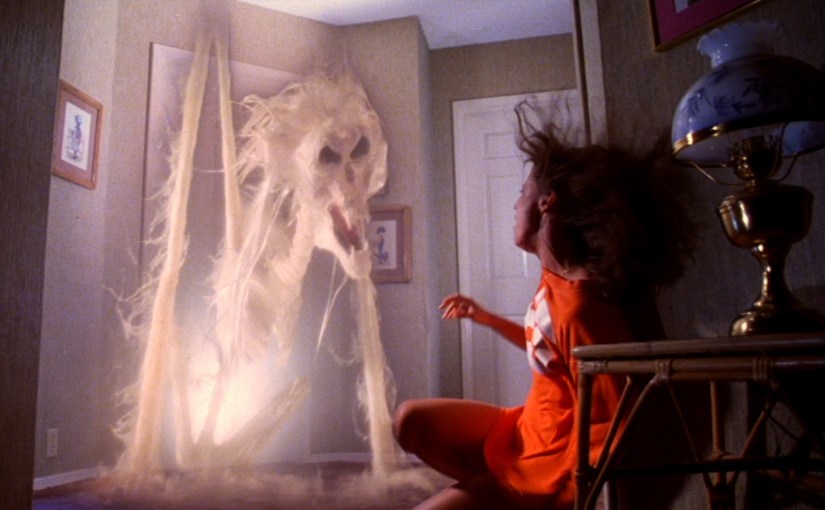
I don’t watch Poltergeist as often as others I know, simply to avoid experiencing the terrorizing clown puppet that dons a wicked tooth like expression and strangles the young boy.  Still very effective.  Coffins burst from the muddy swimming pool to pour out skeletons upon a screaming JoBeth Williams.  A ghostly white phantom guards the door to the children’s room and the closet entrance becomes a gaping, hellish monster mouth ready to swallow what it inhales.  Raw meat crawls across the kitchen counter.  A chicken leg turns into maggots and let’s not forget about the guy who hallucinates in front of mirror while pealing the skin off his face.  These are just lists!  Lists of scary things to do.   

Poltergeist is a simplistic fun house of haunts.  Nothing further.  I appreciate that only to a degree, however.  I wanted more.  An explanation is given for these occurrences in a tiny exchange of dialogue during the terrifying climax.  Beyond that, there is nothing I can say about these characters or what they stand for.  The kids toss cereal at each other at the breakfast table, and the parents smoke pot in bed, but there’s really no affection, or conversely, animosity shared among the family members.

If I were to compare Poltergeist to other fright fests like Hitchcock’s The Birds or even the original Predator or Alien, I would undoubtedly say those are superior films because beyond the monsters that terrorize the characters there’s also room for mistrust and paranoia among the players.  There’s time to devote towards care that those characters may have for one another.  A suburban mom is seemingly expected to want to be reunited with her little girl.  That’s a give in.  It’s standard.  Completely apparent in every way.  Couldn’t some competition from mom and dad come into play though?  Some blame pointing tossed about for example?

I guess I get a little bored with Poltergeist because it doesn’t stop to acknowledge the value of its cast of characters.  There are only a few moments of suspense that come upon me like when I’m trying to figure out where the scary clown puppet went off to.  Another terrifying moment is watching JoBeth Williams hustle as fast as she can to her children’s room while the hallway seems to stretch the bedroom door further and further away from her.  These are all things to look at though.  These are not moments that I connect with emotionally.

Some close friends of mine absolutely love this movie.  They can’t get enough of it.  They recite the lines.  They get caught up in the supposed “Poltergeist Curse.”  They watch all of the making of documentaries and return to the film for the nostalgia.  For me though, I never felt an intimacy with the mystery, or the family being victimized.  On that level, it’s almost on the same plane as a disposable Jason or Freddy movie.  I’d like to shed at least one tear before that teen gets their head chopped off, or the screaming kid gets eaten by the tree trunk.

INDIANA JONES AND THE KINGDOM OF THE CRYSTAL SKULL

By Marc S. Sanders

Indiana Jones And The Kingdom Of The Crystal Skull succeeds on so many levels of storytelling and construction. It stays true to form of its title character protagonist. Indy is not only a hero. He’s also a traveler of history. The film takes place in the year 1957, and director Steven Spielberg delivers visuals that reiterate the time, when the Cold War was on the horizon, and Nazi Germany was behind us. It’s time for the Russians to step up as the big bad.

David Koepp’s script really is quite brilliant as it never loses sight of the times with references to McCarthyism, communist red scare, and flying saucers and aliens directly inspired by the B movie serials of the decade. Even Shia LeBeouf portraying a sidekick to Indy is a model of Marlon Brando from The Wild One.

I’ve mentioned before how simply the silhouette of the famed archeologist with his fedora hat and bullwhip is as recognizable as Batman or Darth Vader or James Bond. Here, Spielberg uses the visual motif against a mushroom cloud of a nuclear bomb test site, and later against a flying saucer. As noted earlier, Dr. Jones moves with time; truly living up to his famous phrase, “It’s not the years honey. It’s the mileage.”

Harrison Ford maintains the character quite well, still skeptical of what is not literal. He’s not prepared to believe in higher powers until he sees it for himself. Ford conveys Koepp’s interpretation very well.

It’s refreshing that he is paired up again with Karen Allen as Marion Ravenwood (from Raiders), the best of Indy’s female companions. Their sparring remains natural. Allen folds back into her role quite comfortably.

Stalin’s top underling is dispatched with recovering a legendary Crystal Skull and revealing it’s true power. Master character actor Cate Blanchett makes for a great Russian bob haircut villain, with uniform physique. She’s smart but she’s got every fighting skill known to pose great threat.

An infamous scene involves Indy sheltering himself in a refrigerator to survive a nuclear blast. Majority despise this scene. The phrase “Nuke The Fridge” became almost as iconic as “Jump The Shark,” simply for the audacity of its imagination. After having witnessed the near-death escapes of his past adventures (parachuting from a plane in an inflatable raft, sliding under a speeding truck, becoming “a penitent man” to cross a cavern), what is so wrong with this moment? Heck, Spielberg knows it’s crazy which is why he offers a close up indicating the fridge is “lead lined.” The scene works because it holds true to Indiana Jones’ series of absurd survival.

Besides all of the periodic references, the set design of Kingdom… is spectacular. Looking at the final act of the film, we are treated to a column that opens itself up with ingenuity as sand must pour out of the column in order for the structure to open with a receding downward staircase. Then, there’s a beautiful open sesame moment before entering a circular throne room.

Another earlier moment stages a hidden chamber that is revealed on a large, stone, tilted disc. All of this collectively speaking is truly one of the best set pieces in all four of the Indy films.

A delightfully fun car/motorcycle chase on Indy’s college campus is great as well as there is jumping from bike to car and back to on to the bike before swerving into the library. The scenic background design has to be admired for showing protest signs to Communism on campus. The film never loses sight of where its story is set. Detractors of this film fail to recognize any of this.

Fans also took issue with LeBeouf. Not me. He’s got an adventurous fun side to him. The smart aleck way of Ford’s younger years, but not the same character background. He has fun with swinging from vines and sword fights, in the same vein of a mine car chase from a prior installment.

The story is moved by clues and maps and deciphering a welcome John Hurt who speaks in a gibberish of riddles that stem from a brainwash his character experiences. This is all good for a great pursuit. Nothing is easily revealed. Mayan writing needs to be interpreted; maps need to be read. Stories of legend need to be told. Indy needs to apply his professional knowledge to move forward through the Amazon to his final destination.

I’d argue that Indiana Jones And The Kingdom Of The Crystal Skull is one of the most misunderstood and divisive films of all time. People gave up on it too easily, I think. They reserved their approval because of either a ridiculous title (a great B movie title), or LeBeouf’s casting, or Ford’s age, or vine swinging and big ass red ants (a great monster horror scene by the way). I say those folks just didn’t get it and failed to recognize where all of this stemmed from. David Koepp, George Lucas and Steven Spielberg were very aware of what to present. If I were them, I wouldn’t have changed a thing.

Again, it’s not the years. It’s the mileage.

SAVING PRIVATE RYAN

By Marc S. Sanders

How much blood needs to be spilled to change the color of an ocean red?  The battle of Normandy during World War II showed quite a bit, and Steven Spielberg more than convincingly duplicates that terrible episode in world history with his war picture Saving Private Ryan

Spielberg earned his second Oscar for direction with this film from 1998.  It’s not only a technical marvel, but it’s a story that tests the nature of humanity when a squad of American soldiers ask themselves if saving the life of one man is worth sacrificing themselves.  Tom Hanks leads the team of recruits.

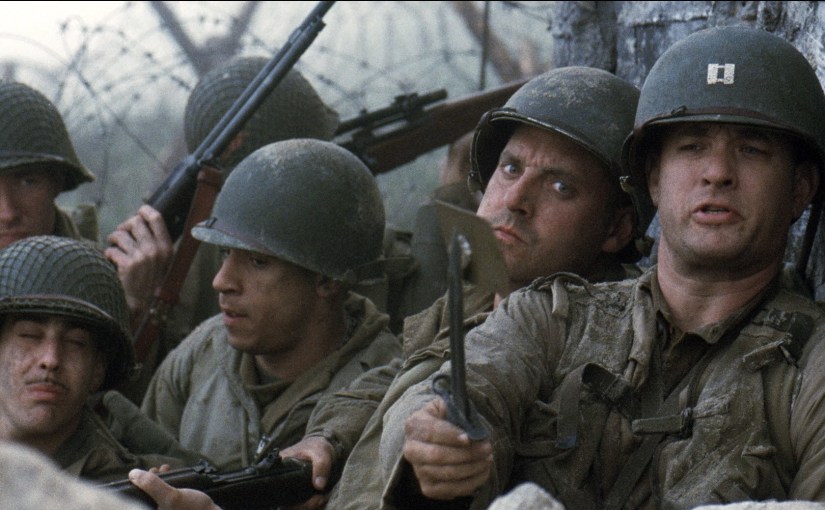
Saving Private Ryan begins on June 6, 1944 when thousands of American soldiers were inevitable sitting ducks as they washed ashore on Normandy Beach to engage in battle with German forces.  Spielberg’s footage is astonishing.  First of note is the cinematography is wisely washed out of color.  The sky is grey.  The ocean water and sand feel frigidly cold.  The most dominant color is blood red.  The fear displayed on the thousands of extras portraying soldiers, who never look mentally ready for battle, is palpable. 

The shots in this roughly thirty-minute opening do not compromise.  A soldier is seen walking around looking for his arm that has been shredded from below his elbow.  Other soldiers will turn over one way out of camera, but when they roll back into frame there’s a smoking hole where their face used to be.  Deadly head shots come out of nowhere.  Army medics have their hands soaked in bright red blood while trying to use scissors and thread to sew up wounds caked in wet sand. 

The action slows down at one point to focus on Hanks.  We haven’t even gotten to know his character yet, but we realize he is exhausted of this violence.  His hearing seems to deafen for a moment while he watches the horror quickly unfold as he puts his helmet back on only to have blood-stained water shower down over his head.  War is not meant for heroics and glamorization.  War only serves chaos and brutal death. 

Following this incredible opening sequence, one of the most impressive ever to start a film, Captain John Miller (Hanks) receives orders to locate the titled character, a paratrooper named Private James Francis Ryan (Matt Damon).  The army insists on sending the young private home to his grief-stricken mother, who has recently lost her other three sons in the conflict.  So, Miller recruits a handful of men consisting of fantastic actors like Tom Sizemore, Edward Burns, Vin Diesel, Adam Goldberg, Barry Pepper, Giovanni Ribisi and Jeremy Davies to make the trek across war torn Europe and rescue Private Ryan before he perishes as well.  How is that really fair though?

Any one of these men are sons to a worried mother back home.  The script for Saving Private Ryan by Robert Rodat has the men question why should they risk their own lives to find this one kid?  What makes him more special than any one of them?  Is the United States Army being fair?  Are they using this special mission as a means of propaganda?  Questions like this are irrelevant to the war department.  Just get him the hell out of there.

The journey of Miller’s squad is not just a simple hike.  At any given moment, they will come across a bombed-out town or another regimen who has just experienced their own kind of hell.  Further questions are asked when Miller recognizes an opportunity to take out an enemy battalion.  His own men suggest circumventing around this potential battle.  Miller won’t hear of it.  He’s a soldier.  Yet, after it is done, there is loss of life.  Should he have listened to their warnings or was he right to engage the enemy to avoid another team of allies suffering a terrible fate? 

Other dilemmas also come into play.  Should they escort a family and their young children who have lost their home?  The brutal dialogue of the script says that’s not their job.  Their goal is to take out the enemy and eventually rescue this one man.  Should an unarmed German prisoner be forced to dig his own grave and later be executed for the atrocities he’s committed?

War tests the ultimate limits of man.  What has to be done to allow us to finally, ultimately and justifiably shed ourselves of our humanity?  A correct answer is never provided in Saving Private Ryan.

Amid a series of astonishing battle scenes and images, two parts of the film stand out for me.  Following the loss of one of their comrades, there is disorder within the ranks.  This is where Tom Hanks takes control of a chaotic scene.  John Miller knows his soldiers have placed bets on what he does for a living back home.  Considering the strategist that Miller shows himself to be, its quite startling to find out what his occupation is.  It’s so surprising that Hanks as Miller uses it to temper his men which segues nicely into why Miller honors the mission assigned to him, even if it means risking his own life.  It’s not the best answer to why one man is more valuable than any other, but it’s the only one we are going to get. 

An even more powerful image comes to mind in the third act.  Jeremy Davies plays a Corporal assigned to the team to be a German and French interpreter.  He’s a soldier in this war, but he’s the last one you would want in combat.  As the American forces await the inevitable arrival of a German tank and a large number of troops to arrive, the men assign Davies to hold on to the long chains of ammunition and artillery.  He is draped in bullets around his neck and shoulders.  As the battle engages, shots are fired in all directions, men are quickly dispatched and Spielberg wisely has his cameras follow a helpless, weeping Davies do nothing but run from one end of the street to the other and up the stairs of a blown-out building.  He has all of the power in the world but he lacks the muster to kill and destroy which is what the nature of war demands.  He can even hear a man slowly die by stabbing in the floor above him. Yet, the Corporal can’t even rush to rescue his friend, and slaughter the enemy.  War destroys, but it also paralyzes man to act beyond an intrinsic nature of peace.  Each time I watch this scene, I can’t get past what this poor young man is truly capable of while being utterly helpless at the same time. 

I found Spielbergian techniques in Saving Private Ryan that hearken back to other celebrated moments in his film repertoire.  Tom Sizemore engages an enemy, only for both of them to run out of ammunition.  So, they wind up clumsily throwing their helmets at each other.  Indiana Jones might have done something like this for the sake of some form of slapstick.  Spielberg applies desperation to this scenario however.

The German tank at the center of the third act is somewhat reminiscent of the shark from Jaws.  Before we get an opportunity to see it, a focused Barry Pepper in a sniper’s bird’s nest gives a visual description of how big it really is and what accompanies it.  Later, Miller and Ryan have taken cover in a trench of rubble only to be overtaken by this beast as it careens over them.  The mouth of its cannon seems to come alive just before it blasts out a tower.  It’s just as scary and shocking as even Spielberg’s pictures of fantasy and adventure came before the release of this picture.  Every shot Steven Spielberg provides in any one of his films build towards an intrinsic and organic response from his viewers.  He always works with that goal in mind.  The tank is the tool used here.

The art direction is fascinating in this film as well.  A knocked over chair is picked up before a soldier stands it up as sturdy as he can on top of splintered wood and crumbled stone.  Sand on the beach is blasted up and out, sometimes splattering the lens of the camera.  Ocean water too.  Pockets of afterburn flames will be seen in the distance of a war-torn area.  The tangibility of these set pieces works cohesively with the distressed colors of a weathered and battle-stricken Europe. 

As chaotic as Spielberg demonstrates war to be, the editing is also commendable.  A war movie like this is not an action picture for the sake of escapism.  We don’t need to see the gun that fired the bullet that pierces the skull of a person.  We just need to see the person get a bullet that penetrates his helmet only to blow his head off to understand the unforgiving nature of war.  A man might be dialing up headquarters requesting air support, but he suddenly will not finish the conversation.  Editing allows the unexpected to become all too common in the midst of battle.

Saving Private Ryan is one of the best films ever directed by Steven Spielberg.  He had already shown real brutality not embedded in fantasy with films like The Color Purple, Empire Of The Sun and especially Schindler’s List.  Yet, with this picture, small factions of men, seeking world conquest, might have started this terrible conflict, but the movie does not concern itself with those instigators.  Instead, we witness the pawns at the disposal of war.  We see the collateral damage that suffer and die at the hands of unseen powers that be.  With Robert Rodat’s script, Steven Spielberg questions the value of one man versus a collection of men, and how any man, who may physically endure this terrible period in time, can also mentally survive long after it is all over. 

WAR OF THE WORLDS (2005)

By Marc S. Sanders

There’s a harsh reality to science fiction in the 21st century.  When the aliens arrive on Earth, a little girl will ask her dad “What is it?  Is it terrorists?”  Steven Spielberg’s interpretation of H.G. Wells’ War Of The Worlds covered that territory when it was released four brisk years after 9/11.  All these years later and there’s still some legitimacy to that sadly reasonable question.  I find it interesting that one of the most pioneering novels in sci fi was published just ahead of the twentieth century paving the way for endless approaches to alien arrivals and attacks on Earth.  When Spielberg approaches it on his third try, the trope may have been done to death, but now the reality of the response is updated and all too real, and brutally disturbing.

Tom Cruise is the lead in this adaptation, and he is arguably in the most vulnerable role of his career.  He plays a storage bin dock loader, only regarded as a half caring deadbeat and divorced dad to his teenage son (Justin Chatwin) and 10-year-old daughter (Dakota Fanning). After his ex-wife (Miranda Otto) drops the kids off for the weekend, there’s an uncomfortable game of catch in the backyard followed by the beginning of the mayhem.  What appears like a lightning storm evolves into dead batteries and no electricity along with odd wind currents and hammering echoes.  When the people all around the main characters in their New York neighborhood get vaporized, then naturally their first instinct is to think it’s terrorists.  In today’s science fiction, terrorists are real and aliens are not.

Later, once the extra terrestrials (not the friendly kind who consume Reece’s pieces) have viciously introduced themselves, Spielberg’s film resorts to demonstrating mass exodus of the people of Earth.  Military units advise folks to “keep movin’.”  When the attacks happen, people scatter in different directions.  When a ferry is leaving the mainland, helpless folks rush for the dock, desperately climbing over the gates and leaving loved ones behind.  Spielberg hasn’t forgotten about the unlawful occupations from world history.  He simply applies it to a Tom Cruise action piece.

Tim Robbins shows up as a crazed man hiding in a farmhouse basement with a shotgun ready to begin a one-man revolution.  Cruise tries to contain the hysteria.  A scene like this could have had Nazis or aliens circumventing on the floor above, as the central characters remain as quiet as the Jews used to do in the basement below.  The parallels are eerily the same. 

Still, I respect the reality of the piece.  For one thing, much of the film, scripted by Josh Friedman and David Koepp is pulled right from H.G. Wells’ pages, including the nice and tidy ending that eventually arrives.  Don’t knock it.  That’ how Wells wrote the story to begin with.  Spielberg and crew don’t invent their own new image of the invaders.  They are still the tall three-legged tripods towering over the people of Earth and blasting them with their “heat rays.”  My favorite touch of this film is using Morgan Freeman’s vocals as the bookended narrator reciting Wells’ novel text, nearly word for word.  It’s a welcome salute to the memorable radio show that Orson Welles lent to the story decades before. 

I consider this adaptation of War Of The Worlds to be an observational picture or a reactionary film.  Cruise is not super skilled with fighting techniques and weapons handling.  All he can do is watch and react.  He’s an everyman here, which is actually quite unusual for him when you gloss over his resume.  This is not Maverick or Ethan Hunt: Superspy.  His purpose is to watch and return his kids to their mother in Boston, assuming she is still alive.  The success of the mission here only depends on getting the kids back to mom. 

Dakota Fanning and Justin Chatwin go against the grain of so many other Spielberg kid characters.  They are not intuitive or inventive.  Especially for Fanning’s character, she is just a scared little girl.  Not a Goonie and not like Gertie, who is scared for the sake of humor with precocious one liners.  If aliens were attacking the Earth, this is how my kid would react. 

Once it is established that this movie is a Spielberg running man film, then you may be grateful for the realistic mentality of the story’s community.  You’ll also appreciate the amazing set pieces accompanied by John Williams’ original score that plays like a drive-in monster movie or a Twilight Zone episode.  The aftermath of a plane crash on a Jersey suburban neighborhood is very convincing.  A runaway train set ablaze intrudes upon the cast with great surprise.  A cracked piece of concrete that gets swallowed up below only to immediately vomit a tripod in the air for instant attack is eye popping. 

War Of The Worlds is a well-crafted film, and the thought was definitely invested in its approach ahead of making it.  Yet, I won’t say it’s fun escapism.  It’s a reminder of the unrelenting realities we live in now.  Sadly, it’s not reaching to say that maybe we live in a time where it is in fact every person for themselves.  Even Cruise’s son insists on going off on his own, abandoning both him and his sister with nary a care at all.  Unlike Close Encounters or E.T., there’s not much to laugh or grin at in this Spielberg alien film.

The 2005 adaptation of War Of The Worlds is certainly loyal to H.G. Wells.  It may be realistic in the human nature of its science fiction, but in the end, it is also a very bleak film.  There’s much to marvel at, but once the movie is over, as my colleague Miguel and I often recommend to one another, it’ll likely be best that you get outside and bathe in the warm sun under a blue sky, roll around in the grass with your dog, and taste an apple for the first time all over again.  It’s about all we have left to embrace what little is left of our sanity.

THE LOST WORLD: JURASSIC PARK

By Marc S. Sanders

The Lost World: Jurassic Park contains a batch of characters making a lot of stupid decisions all in the name of being stupid for stupidity’s stake.  That doesn’t make it a bad movie though.  Just somewhat…unsophisticated…and stupid.

In the sequel to the monster smash adaptation from Michael Crichton, Steven Spielberg reunites with Jeff Goldblum, now at the top of the credits list, as smarmy mathematician Dr. Ian Malcolm.  It really doesn’t matter if the guy is a doctor of any kind of specialty though.  Malcolm doesn’t utter one scientific fact or theory or observation this time around.  Whatever shred of debate regarding the resurrection of dinosaurs that existed in the first film is completely abandoned this time around.  Carnage, mayhem and outrageous ridiculousness take center stage, stage left, stage right, downstage, upstage, off stage, and over a high cliff.

In an early scene, Malcolm is summoned by wealthy entrepreneur John Hammond (Richard Attenborough, in a welcome cameo).  Hammond tells Malcolm that his paleontologist girlfriend (isn’t that a coinkidink), Sarah (Julianne Moore) is on a nearby island to the original one from the first film, and studying the behaviors of the dinosaurs that were developed there.  She will soon be meeting up with a photographer (Vince Vaughn) and another associate (Richard Schiff; I don’t recall the script explaining his specialty).  So, Malcolm sees no choice but to go after Sarah and rescue her from the island.  This is one Daring Mathematician.

One point of order, because this is a Spielberg adventure, a kid has to be involved.  Malcolm’s pre-teen daughter and gymnast extraordinaire Kelly (Vanessa Chester) stows herself away on the excursion. Thank god she’s gymnast.  That may come in handy.

At the same time, Hammond’s greedy nephew, Peter Ludlow (Arliss Howard) is leading a large expedition crew on the island to recover representatives of each breed of animal to bring back to the mainland in San Diego for show and tell.  The leader of this pack is also the best character in the whole film.  He’s a game hunter named Roland Tembo (Pete Postlethwaite).  Tembo’s price is to hunt down one Tyrannosaurus-Rex for his own game pleasure.  Aaaaand that’s where the story stops. 

I just ticked off a lot of actor names, didn’t I?  Well, this is a sequel and in a monster movie sequel there’s a demand for more casualties of course.  If that’s what you are looking for, you won’t be disappointed. 

You also won’t be disappointed in the assortment of dinosaurs on hand.  This time there are two T-Rex’s and they are used beautifully in a very daring, albeit long for the sake of maximum suspense, scene that involves our heroes dangling within a double RV trailer that has been pushed off a cliff.  When Sarah lands face first on the back windowpane of glass, try your best not to bite your nails.

Another exceptional scene is when the expedition runs into a tall grass raptor nest.  This is like Jaws on land.  With the help of much CGI, but also puppetry from Stan Winston’s imagination factory, Spielberg gets great overhead shots of fast forming black lines that quickly cut through the meadow taking out one poor soul after another where beast overcomes man. These moments occur in the large second act of the film where it’s nothing but action done with Spielberg’s skill to oversee. 

The third act is questionable, but I found a nostalgic admiration for it.  Spielberg goes for the salute to King Kong, the grand daddy of all monster movies.  Ludlow’s hubris and what remains of his expedition team trap and bring back the male T-Rex to San Diego aboard a large freighter.  In the dead of night, garbed in his finest suit, he’s ready to give a speech to a press junket that must work a graveyard shift introducing the marvelous attraction.  Naturally, we know things will not go as planned.  Now, we know this is not New York City and the Empire State Building is not nearby, but this T-Rex will naturally run amok anyway and settle for destroying a suburban dog house, about a dozen cars and a 76-gas station.  No, it is not King Kong, but the salute is appreciated nonetheless.  There’s even a wink and nod to Godzilla.  I laughed.

Pretty stupid of Ludlow to do this, right?  Well, he’s the villain.  So, let’s give him a pass.  On the other hand, the heroes are dumb as rocks.  Sarah takes a baby T-Rex away from its quarters. Ian gets up into a high area platform with his daughter as an escape to safety…but then he comes down again!!!!!  The hunters simply think they are hunting kittens no matter the stature of any of the game they are pursuing.  The telephone doesn’t get answered when it really, really should.  You’ll find yourself shaking your head and outstretching your arms at the screen (palms up) as if to say “WHY????????”. 

It really doesn’t matter.  The first Jurassic Park film never had a fully developed brain.  This installment, unabashedly, never even stops to think.  It’s as if a collection of characters in a shoebox raised their hand for volunteer slaughter. 

My wife watched this with me recently, and at times she would ask “Why are you doing this or why not just call such and such?”  I’d have to remind her it’s not that simple.  Cuz if it were that simple, then they would have picked up the phone.  We all have a destiny in life.  I truly believe that.  The destiny of the cast of The Lost World: Jurassic Park was to run and maybe or maybe not get chomped on and eaten.  This is what they were groomed for their whole lives. So, let’s not interfere with the laws of nature.