AMERICAN GANGSTER

By Marc S. Sanders

My favorite kind of crime dramas are the ones that tackle the grit.  The screenwriters and directors go for where the itty-bitty stuff scrounges up into something bigger for either the career criminal or the low-level cop.  These guys start out as butterflies flapping their wings and before you know it their legacies and pursuits are as big as hurricanes.  Movies like The French Connection or Heat operate on these trajectories.  How did we get from there to HERE?

Ridley Scott went in an unconventional direction away from his science fiction eye and ancient history recollections when he directed American Gangster with a screenplay by Steve Zallian based on the true stories of Harlem drug kingpin Frank Lucas (Denzel Washington) and narcotics detective Richie Roberts (Russell Crowe).

These two sensational actors don’t share one scene together until the epilogue of this always interesting three-hour opus.  Yet, in their second film together their pairing is as classic as DeNiro and Pacino or Newman and Redford.  I hope before they retire, these men pair up for at least one more film.  

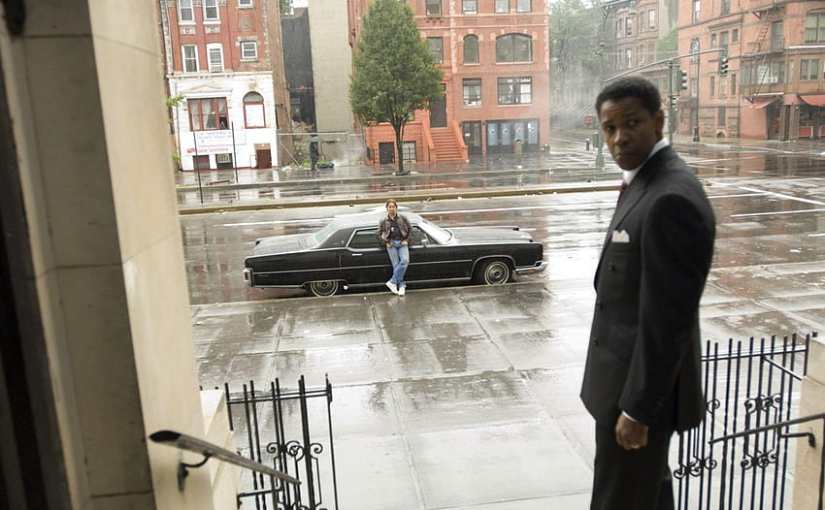
Ridley Scott and his nominated art directors, Arthur Max and Beth A Rubino, capture a gritty urban, crime ridden Harlem of the 1960s/70s.  The streets are filthily here, as well as in the five New York boroughs and all the way across the bridge into New Jersey.  Frank’s markets carry a very wide berth. The buildings are distressed and cracked.  The clothes are of the hippie era with polyester suits.  This is where Frank Lucas moves his imported contraband, white powder heroin, labeled exclusively as “Blue Magic.”  The film provides a convincing source locale deep within the jungles of Vietnam where thousands of kilos are shipped to Frank for sale on the street.  The purity of the drug is beyond compare.  Scott and his art designers place you directly in this time period of dingy grime and among the sweaty Viet Cong and rivers to finally arrive at the crop Frank purchases his products from.

Once he finds his footing by eliminating the competition and recruiting his brothers and cousins to run his business, Frank invests in creature comforts with a furnished penthouse apartment for himself and a beautiful mansion for his mother (Ruby Dee in an Oscar nominated performance that comes off so naturally; you’d think she’s sitting at the Thanksgiving table with you).  He marries a beautiful Puerto Rican wife that he treats like a princess. Frank is smart.  He stays under the radar by wearing conservative suits and not making many waves like going out at nights and showing himself around the social scene.  He knows famous athletes like boxer Joe Lewis or the staff on the New York Yankees that could give his nephew a shot at being a pitcher. Still, his profile manages to stay low. Like his mentor, he just operates a business with a viable commodity.  He tells his younger brother (Chiwetel Ejiofor) that the loudest one in the room is the dumbest and the most likely to get caught.  So, mind how you carry yourself, how you dress yourself and how you flaunt yourself.

A separate story has no business intersecting with Frank’s plight until something gives.  Richie Roberts is a good, honest cop. Though he’s also a lousy husband and father. He has been assigned to head up a task force that will bust the top of the assorted drug empires.  He needs those rare breed cops who are not on the take and follow a strict policy of law enforcement ethics.  His team will not bust a common street hustler.  They will be looking for the kingpins with unquestionable evidence to put them away for good.

American Gangster follows two separate stories for most of its running time.  At least during the first two acts of the film, Frank and Richie are unaware of one another.  It’s only through some gradual surveillance that the cop finally gets a whiff of an idea and starts to move methodically towards a conclusion. The methods are the fascinating parts the movie.

When Denzel Washington plays a villain it’s always memorable and contrary to popular opinion, Frank Lucas is my favorite of his antagonists, especially compared to his Oscar winning work in Training Day.  Watch how he walks or sits on a sofa and broods over how his family and his business are functioning.  He’s the only African American actor I can see playing this guy because I’m always convinced that whoever Denzel Washington portrays, it’s a character who will never be intimidated.  This guy faced down Gene Hackman during a threat of nuclear holocaust. Not many other actors can do that so authentically.

Russell Crowe works like that hero who doesn’t want to wear the cape.  Richie Roberts succeeds on so many levels where his peers surrender to their inhibitions.  This cop passes the bar exam while fighting for custody of his kid on top of going after the empirical criminals who litter the streets in drugs and murder.  I’m reminded of his role in The Insider, where he used a similar American accent.  Richie is not as temperamental or hard wired as that guy, but he is at least as focused on doing what’s right regardless of threat or distraction.  Russell Crowe has a way of getting audiences to admire the concentration needed for many of his complicated characters.  You have as much tunnel vision as he wants the men he’s portraying to have. You are zoned in with what his characters live by.  You only trust their standards.

There are signature staples within the construct of this true story adaptation.  There are gunfights.  Punches are thrown.  The guy at the top beats up one of his cronies when he gets out order.  Yet, what stands this material apart from others is that now I’m watching how Denzel Washington and Russell Crowe handle everything.

The truth behind the story of a black gangster defying the dirty cops and the Italian mobsters who were thought to run the metropolitan undergrounds is amazing.  It’s so interesting to see how novel Frank is with smuggling the product from one side of the world to the other. Then, you see how he uses his family members to distribute to the consumers and collect the monies. Ridley Scott provides all the breadcrumbs in an easy-to-understand fashion.  

Painted against the landscape of an unwinnable Vietnam War that just won’t end, power is acquired and thus the best police officers are forced to change their approach.  So again, you see two different stories that start out small and undetected.  Frank and Richie are the most careful and meticulous of guys in their respective fields.  Therefore, it only makes sense that their paths don’t cross until their missions are nearly over.

There’s much to learn from American Gangster.  

You get an idea of how the harm of the war was not exclusive to just what was happening over in Vietnam.  There were more indirect effects to that crisis impacting the streets of New York and New Jersey.  

You see what subtleties an investigation will collect upon before pouncing on to a bigger stake.  You also learn how to handle a criminal empire with trust and dignity rather than announcing your immorality. You witness the sheer defiance of a righteous guy in what is supposed to be a law-abiding field. Steve Zaillian’s script is not just good guy vs bad guy. It’s each of these guys holding on to the top while trying to catch up with or stay away from each other.

American Gangster is a very thorough and well-planned biographical thriller.  

GLADIATOR II

By Marc S. Sanders

With Gladiator II, you get two of everything.  Two heroes, two emperors, two great white sharks, but only one Denzel Washington which is plenty.

The sequel to Ridley Scott’s Best Picture Oscar winner takes place sixteen years after those events when we had the impression that Rome was left in a state of nobility, devoid of treacherous gladiator games. Not so.  

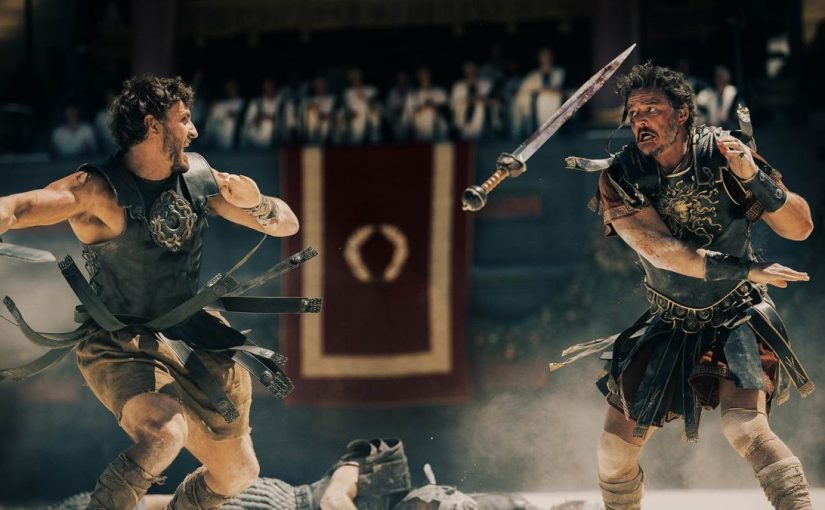
Two flamboyant young men named Geta and Catacalla have taken joint rule of Rome thanks to their continued worldwide conquering delivered by their General Acacious (Pedro Pascal).  The general fought for Rome, even if he didn’t agree with the rulers’ policies.  Now he wants to rest with his wife Lucilla (Connie Nielsen, one of two returning cast members of the original film).  Though it’s hard for Acacious to remain apathetic even while the two brats demand more widespread conquests.

Elsewhere is Lucius, Lucilla’s son, a child in the first film, now an adult whose African army suffers defeat at the opening of this film.  The opening naval sea raid upon an impenetrable fort is massively impressive with arrows, fireballs, swords, sea water drownings and gory bloodletting.  Lucius is played by Paul Mescal.   

Gladiator II is full of parallel stories.  Still, you can bet these characters’ paths will all intersect in coincidental soap opera fashion during the run time of the film.

There’s nothing new to this follow up picture that you hadn’t already seen in the original Gladiator.  In fact, the first hour follows a near exact blueprint of its predecessor.  Lucius, a once revered battle commander who lost his wife, is purchased as a slave by Macrinus (Denzel Washington) to fight in gladiator games throughout the Coliseums of Rome.  Because the violence of the sport is so well assembled and enhanced compared to the last movie, it’s easy to get caught up in the fun the film offers.  The action pieces are magnificent.

Though most of the movie is ridiculous.  Historians just close up your encyclopedias.  

Most absurd, yet deliciously fun, is when the emperors arrange for the ring to be filled with salt water and man-eating sharks at the ready as naval battles are reenacted.  Now I’m not sure if this was truly accomplished in Roman times with state-of-the-art plumbing to transport and hold all of this water.  I am also skeptical of bringing bloodthirsty great white sharks straight from the Mediterranean directly into the Coliseum, but I’ll be damned if anyone tells me this centerpiece of bloodshed is not giddy to behold.

Other moments that will have you clapping are match ups between the warriors and big ass mutant, buck toothed (I mean like BUCK TOOTHED) monkeys as well your typical rhino melee.  That latter match had Miguel thinking of Attack Of The Clones.  

The best of the performances belongs to Washington.  As gleefully over the top (Miguel’s description) as Ridley Scott’s sequel is, Denzel Washington is doing scene stealing work on level with Jack Nicholson and Gene Hackman.  He’s playfully deceitful while appearing proudly respectable with his signature, toothy grin and colorfully eloquent robes that billow with his performance.  The film is not Oscar worthy, but Washington’s performance is because he masterfully works the mind-bending trickery of the character.  Macrinus worms his way through the Senators with conniving wagers placed on Lucius’ undetected fighting talents.  Actor Tim McInnerny is someone I’ve never heard of but as he plays a pitiful, gambling addicted weakling (think of Beaker from The Muppets) against Denzel Washington’s brash and conceited character, you can’t help but take pleasure in how things work out for each of the pair.

Joseph Quinn and Fred Hechinger are the cherub appearing emperors with extroverted cheekbones highlighted in bright rouge.  Combined,  these guys work really well as fill ins for the spoiled brattiness that Joaquin Phoenix left behind in the prior film.  Oh these kiddies are cruel and you just love to hate them.

The two heroes, Paul Mescal and Pedro Pascal, are what is left a little too bland.  They do not match the appeal that Russell Crowe delivered and it’s not simple to care for them or their outcomes.  Lacking any kind of dynamics, they occupy the athletic builds of these guys they’ve been cast to play and that’s where the script limits them.

Thankfully, Gladiator II is very entertaining.  It might not be wholly original when digging up tropes that have been used in many other sword and sandal epics, but Ridley Scott really committed to the carnage and gore we expect.  The director took much pleasure with the outrageous material and the smartest decision was to acquire Denzel Washington.  

Another actor would have slept his way through this role just for a paycheck.  Washington uses the twisted material at his disposal to own the picture all to himself.  I imagine the script documents an unforgettable monologue for his character in front of the weakling Roman senators.  This two time Oscar winning actor must have approached Ridley Scott and said let me try something.  Then the prop department made preparations for a sickeningly, grisly presentation that offers a marvelous image for the Roman Gods to behold, and one that’s hard to forget or not laughingly appreciate.  It may be a stomach-turning scene for some.  On the other hand, I applaud the brashness of the moment.

Our current Congress might be in disarray but with Gladiator II, Denzel Washington and Ridley Scott declare with confidence a resounding “HOLD MY BEER!”

GLADIATOR II (2024)

by Miguel E. Rodriguez

DIRECTOR: Ridley Scott
CAST: Paul Mescal, Denzel Washington, Pedro Pascal, Connie Nielsen
MY RATING: 6/10
ROTTEN TOMATOMETER: 72% Certified Fresh

PLOT: After his home is conquered by the tyrannical emperors who now lead Rome, a rebel soldier becomes a gladiator and must look to his past to find the strength to return the glory of Rome to its people.


[SPOILER ALERT: There is a key plot point that I must divulge in my review, but it is not something I knew before watching the film, despite the fact it was supposedly spoiled in one of the trailers.  You have been warned.]

While I was being underwhelmed by Ridley Scott’s latest film, Gladiator II, I was reminded of his previous lapses in judgement.  Although he is the deservedly acclaimed director of masterpieces like Alien, Black Hawk Down, Kingdom of Heaven, and Thelma & Louise, he also helmed such misfires as 1492: Conquest of Paradise, House of Gucci, and the regrettable Robin Hood [2010].  My point is that Gladiator II is a reminder that Mr. Scott is human like anyone else and occasionally makes mistakes.

I’m not saying that Gladiator II is a terrible film, though.  It is not aggressively bad like some other films I could mention (*cough, The Counselor, cough*).  It has some amazing sights, like the rhino battle in the Colosseum, and it boasts a triumphantly over-the-top performance from Denzel Washington as Macrinus, a flamboyant trainer of gladiators with designs of his own for the city of Rome.  On those merits alone, Gladiator II is maybe worth a watch.

But…but…

While the story is interesting from a standpoint of pure plotting, and while we get the requisite nostalgia bombs of seeing Connie Nielsen back again along with periodic flashbacks to the first Gladiator [2000], I felt curiously distant from the film itself.  I have theories about this phenomenon, but nothing conclusive.

First, the lead actor, Paul Mescal, as [SPOILER ALERT] Lucius.  He looks the part, I grant you that, at least from a physical standpoint.  He’s built, he appears to do most of the physical stunts himself, and he delivers his lines with the appropriate gravitas.  But I never got behind him as the hero of the piece.  Maybe it’s because he’s a complete unknown to me?  Maybe because we barely got to know him before he was suddenly thrust into the main story arc?  (By contrast, in the first Gladiator, we got to know Maximus inside and out before he became a gladiator.)

My sympathies went entirely towards Pedro Pascal as General Acacius, the military mastermind behind Rome’s greatest victories.  He is the new husband of Lucilla (played by the returning Connie Nielsen), whose son, you’ll remember, was last seen following Maximus’s body out of the Colosseum, sixteen years before Gladiator II begins.  Acacius is dutiful almost to a fault, deferring all glory on the battlefield to the empire of Rome, even if it’s currently being run by a couple of brothers (Emperors Geta and Caracalla) who are entitled, bloodthirsty tyrants.  He is weary of the constant bloodshed and wonders if there isn’t a better way to restore Rome to glory.

And Denzel Washington…well, I’ll get to him in a minute.

So, the story, while it must have been compelling on paper, seems to be a healthy echo of the first film.  Another defeated soldier becomes a gladiator.  Another successful Roman general wants to restore Rome.  More spectacular, bloody battles inside and outside the Colosseum.  More political intrigue regarding power-hungry senators and double-dealing merchants.  Forgive me, but I’ve been there, and I’ve done that.  (And adding massive sharks to a Colosseum battle does not intrinsically make it better than anything from the first film.  However, some basic research does show that the Colosseum WAS occasionally flooded with about 5 feet of water to stage mock naval battles…so there you go.)

The undeniable highlights of the film are any scenes involving Denzel Washington.  Not since Training Day has he chewed the scenery with this much gusto (although his recent turn as Macbeth comes pretty close).  I’m guessing he still has traces of Gladiator II set pieces stuck between his teeth.  He can command a scene by his presence alone, but he adds these marvelous gestures of adjusting his robes and tossing in one of his dazzling smiles when you might least expect it.  He makes one of the greatest uses of a dramatic pause that I’ve ever heard.  (“I own…[beat, beat, beat, beat, beat]…your house.”)  In another scene, he uses an exceedingly gory prop as a punctuation mark during a speech; if he gets nominated for an Oscar for this role, that’s the scene they SHOULD use for a clip, but they probably won’t.  Shame.  The whole performance is a classic example of taking a smaller role, owning it, and turning it into a thing of beauty.  In hindsight, it’s probably a good thing that he doesn’t have much screen time, because he simply outguns his scene partners at every turn.  You can’t take your eyes off this guy.

The drawback to Washington’s masterful performance is that I found myself marking time between his scenes, instead of falling into the world of the story.  I followed along, was able to keep track of which senator was doing what and why Lucilla was so distraught and so on.  But to the degree that I was able to follow along, I just didn’t care.  I was reminded of Troy, another sword-and-sandals epic, also told on a grand scale with innumerable extras and some world-class battle scenes, but which also left me apathetic for much of its running time.

Gladiator II improves on the first film only in terms of the complexity of its visual effects and the addition of Denzel Washington.  Aside from that, I’m afraid it does very little to make me care about its heroes, its plot twists, its unexpected deaths, and the glory of Rome.

(And I had to exercise superhuman restraint, at the final shots of the film, to keep myself from yelling out loud, “Talk to me, Goose!”)

ALIEN: ROMULUS

By Marc S. Sanders

To make an effective horror film requires the necessary scares to startle an audience, but it doesn’t stop there.  The story has to work. Still, it doesn’t stop there.  You also have to care about the characters of the piece.

I guess one out of three is not bad for a new installment in a nearly fifty-year-old science fiction/monster movie, horror franchise.  However, with Fede Alvarez’ Alien: Romulus, I left wanting more.

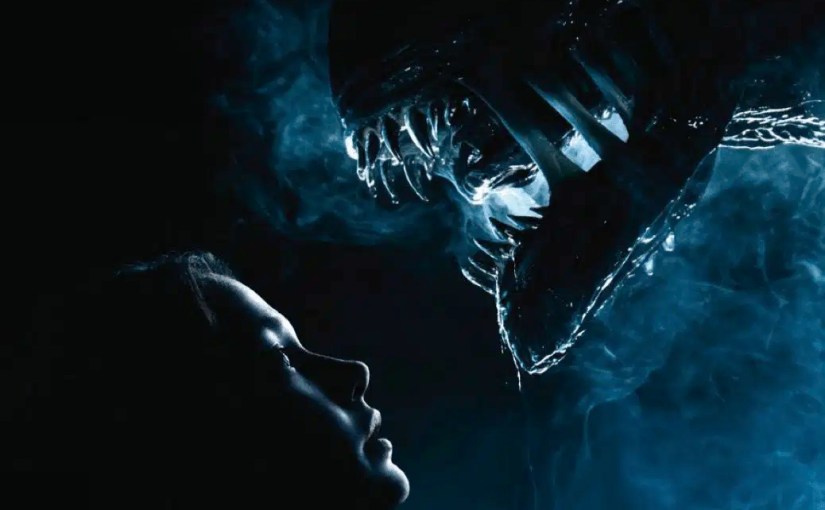
I have no doubt I was the loudest, perhaps most frequent screamer in the Dolby theater last night.  Knowing what I know about Alien, I still get terribly nervous when watching a picture of these grotesque-like creatures, originally designed by H. R. Gigar.  The assortment of Xenomorphs in this film is a faithful treatment to what the monsters should look like.  Teeth, slime, black skeletal frames with scaly limbs and tails.  What these monsters do is another story. It is primarily the same old routine of the creatures from the other films.  Their quiet behavior ahead of their ritual attacks leaves me very nervous and anxious.  I’ve gotta scream at the screen to help me overcome what scare tactics Alvarez and his crew have in store for us.  

Alien: Romulus follows a Michael Myers/Friday The 13th blueprint.  In basic terms, a handful of twentysomethings board a deserted space station as a means to getting off a mining colony overseen by the franchise corporate antagonist Weyland/Yutani.  An audience familiar with the franchise knows this is not going to go well, and soon will expect the clawlike facehuggers, phallic shaped chestbursters and fully developed aliens, aka Xenomorphs, to run around trying to slash, eat, cocoon and build up their population.

Upon attending a screening with my Cinemaniac pals, the guys will testify to my shock and horror at what popped out on screen.  I was terrified for what was coming out of Fede Alvarez’ dark and disturbingly silent settings.  I was nervous when the cast crawled through narrow crevices or stepped into various labs, only to get stuck behind a jammed door or commit a clumsy trip into knee high, unclear water.  Cocooned bodies representing an aftermath of violent carnage sent a doomed message too.  The atmospheric sets alone work well at being terrifying.

Yet, for all of these technical achievements in luridly dark scenic design, jump scare editing, gross looking attacks along with alien “deliveries” and terrifying pursuits and chases, my friend Anthony said it best.  He didn’t care about one single character.  Same for me.  I can’t deny how accurate he is. Like a slasher movie, I could care less if any of the players lived or died.  Even with a periodic countdown during the course of the film, I also didn’t care if they got away from the deserted ship.  So, the suspense never sustained. I was only anxious for when the next monster was going to make an appearance. In the third act, many of the jump scares were nil and upstaged by machine gun shooting and acid (for blood) splashes.

I also didn’t care for the expository scenes either because the information presented was nothing new.  Anything that this gang learns they are suddenly up against has been told to me in all of the other films.  There’s some wink and nod material to salute the other pictures with famous line send ups and even one broad character salute.  It’s fun for a moment but what about this movie and this story

I was also quite bothered by the convenient “just made it out alive” encounters that the main character played by Cailee Spaeny survives over and over.  Anytime danger was knocking at her door her means of survival were not consistent with the long-established fiction of the Alien science of it all.  When I wasn’t screaming, I was asking myself, how is she getting away.  That’s the script not respecting the story elements, the universe or what is presented to an audience, and what they clearly know after almost a dozen pictures.

None of the characters have a personality.  One is Asian with a buzzcut, two are English, and one is pregnant.  The only interesting portrayal is an android named Andy (David Jonnson) who is a sidekick “brother” to Spaeny’s character, and behaves like an autistic savant, until a change comes over him, causing him later to operate like HAL 9000.  Jonnson is really good in this role, and it is unfair that his cast mates were not as fleshed out like most of the other franchise films depicted in portrayals by such actors Ian Holm, Yaphet Kotto, Paul Reiser, Bill Paxton, Lance Henrickson, Charlize Theron, Noomi Rapace, and of course Sigourney Weaver. The characters in this new picture are entirely forgettable and carry no value.

Jump scares with things that come out of dark corners or when crusty hive like walls come alive only go so far.  To effectively win over horror, I need to also care when the next victim is taken down, or about to go through a near death experience on an even playing field.  Romulus comes up short in that department.

Alien: Romulus is decent, but not great as it opts to only think with one side of its brain primarily focused on sneaking up to shiver you in hopes that you’ll pee a little.

NOTE: I knew what not to expect out of this film.  My wish was to see a book end to the last two films that Ridley Scott helmed (Prometheus and Alien: Covenant).  Questions were presented within those films that seemed to promise answers with a later film installment that has yet to come to fruition.  So, the production company seems to have abandoned what they started in response to lackluster box office revenue and a divisive audience response.  Therefore, reinvention came into play once more.  I was always on the enthusiastic side of the divide with those two films. I carry great appreciation for what was done with them, and I was eager for how a prequel trilogy (now remaining incomplete) would wrap up. Alas…

As well, at close to fifty years, if you’re going to keep this up, I believe it’s time to reveal more about the villainous puppet masters, namely “The Company” or to be more specific, Weyland/Yutani.  It has always been supposed how people who work for them may be expendable. Researching and controlling weaponized biological organisms is the company’s main priority.  Yet, how, who and why are these ideas being set in motion?  Does anyone at the top question the company’s practices and look at the moral and ethics of their functions?  Even the Marvel Cinematic Universe has approached these kinds of angles already.  Star Wars as well.  Regrettably after several decades though, the Alien franchise segues away from those perspectives.  This is my take only of course. Yet, I think it’s time to show who else is performing within this house of horrors universe.  Prometheus and Covenant were moving in that direction but sadly they seemed to run out of road. 

NAPOLEON

By Marc S. Sanders

I never knew much about Napoleon Bonapart.  He was short.  He’s French of course. There’s that famous painting with his right hand tucked into his tunic. Or was it his left?  The big hat. I’d heard he was kind of a brat.  Ridley Scott’s latest period piece, Napoleon, confirms most of what I recall.  The painting was nowhere in sight though.

Joaquin Phoenix portrays General Bonapart, and he surely had a great challenge ahead of him. I cannot say that I was bored with any part of the film, but I did find Napoleon to be quite bland during the first act of the film.  Phoenix, doing his best with a script by David Scarpa, seems to be a stand in with nothing of much consequence to say.  It is only when the Captain all but invites a promotion upon himself to the rank of General, following the guillotine beheading of Marie Antoinette, that his arrogance begins to show.  Thereafter, he takes it upon himself to force the hands of the governing council to resign from their positions, a very entertaining sequence for sure.  Then Napoleon sees no other purpose but ongoing conquest. 

With each passing scene in Napoleon, the ego of the title character grows and grows and that is the underlying theme of Scott’s picture.  We journey to the pyramids of Egypt to witness Napoleon lead his armies towards further conquest.  Alternatively, we also trek through the raw winters of Russia and on to a blazing Moscow.  Who set the Russian city alight is a question that history may contradict of the General’s claim.

Napoleon is sure to get a slew of Oscar nominations.  However, it will likely not be in any of the major categories.  The numerous battles are outstanding in whatever setting Ridley Scott offers.  Whether it is in the desert or murky winter grounds, I could not tell if the armies were physical extras or CGI.  It all looked seamless in its construction.  David Lean would be proud.  Sound editing was also perfectly in sync.  The set designs of the many scenes throughout are exemplary from bedrooms to halls and the wallpapers, furnishings and floors and even the outdoor landscaping of the French estates.  Even Napoleon’s tent on one battlefield after another are absorbing.  The costuming always makes a statement.  Every stitch and distressed shade of blues, reds and whites tell a story.  Yes, it’s all very impressive.  However, I did not go to Napoleon to grade a college project assignment in fine arts.  Overall, it has to be the movie itself that grabs me.

Unfortunately, Ridley Scott’s film suffers from shortcomings that cannot be forgiven.  I have to lend credit to my wife who pointed out flaws that did not come to my attention until I heard her input, and thus could not deny.  There are topics brought up in the film that are either not followed through clearly or are left with questions. 

One moment in particular occurs when Napoleon opts to marry the daughter of a leader. Do not ask me to remember which leader. Characters leave the picture just as quickly as they enter.  One daughter is of proper age.  The other daughter we are told is only age fifteen and Napoleon turns down the idea of the latter, but in the scene afterwards it appears that he actually did choose to marry the fifteen-year-old.  The girl certainly looked like a teenager.  So, how did that come to be? 

A storyline I really took an interest in was Napoleon’s marriage to Josephine (Vanessa Kirby).  The widow of a dead soldier, with three children, he marries her for love.  Then he leaves to conquer some more and more around the world.  Yet, the general returns when he realizes she is happily having affairs in his absence.  The bruised egotistic response of Napoleon is very well played out. Joaquin Phoenix has his best moments in the storyline he shares with Vanessa Kirby.  However, while I thought I understood, my wife pointed out that the film does not clearly explain how the relationship continues.  There’s animosity at first but then there is a mutual love between the couple and how exactly did that flourish and change?  When was the mutual affection eventually sparked?  What works best is how the two are unable to bear a child together.  Napoleon is nothing but forceful in his moments of sex with Josephine.  He will damn well force a pregnancy even if it means he has to thrust harder and harder inside of her.  Yet, no results come of his efforts. An heir must carry on the Bonapart legacy.  Since one does not appear, it taxes heavily upon the powerful leader.

Later in the film, following the couple’s dissolution of marriage, a child is born but who exactly carried the offspring?  Details like these seem to be glossed over.

Few directors are as skillful at showing grand scenes of battlegrounds with sharp, clear edits of how the fighting progresses.  Ridley Scott demonstrates that over and over again with one scene after another.  He accomplishes fare like this so well in other films like Gladiator and his interpretation of Robin Hood.  The dark hazy cinematography works beautifully on a big screen.  However, I’m not sure if it will be as effective on a sixty-inch flat screen where there’s a risk of intrusive glares in your living room.  These magnificent scenes need to be watched on a big screen.

Unfortunately, the attention to detail is not lent to the story as effectively. Napoleon’s mark in history did not just happen in a period of a few years.  For a brief window of time, France was a superpower ahead of the likes of Egypt, Britain, Austria, Prussia and even Russia.  Two hours and forty minutes may seem like a long film and yet Napoleon likely needed at least an additional hour to serve a complete historical recount.

If you want to see Napoleon, now is your chance while it plays in theaters.  Again, I do not believe it will have the same effect at home.  Regrettably, the film does not offer enough on the plate.  No one in the cast is doing anything of Oscar caliber accomplishments.  Ridley Scott comes up short of end of the year award considerations for not inviting tighter storytelling, and that also goes for David Scarpa’s script. 

The visual marvels of this period piece are what is to behold.  Watching Napoleon, I certainly felt like I was there amid the glorious costumes, set designs and cinematic photography.  Nevertheless, while I may have been in the room, the hosts of the picture were not sharing their entire conversation with me around the dinner table.  Alas, at times, I was left to stand in the corner, feeling like an unwelcome guest.

GLADIATOR

By Marc S. Sanders

Ridley Scott’s Gladiator is a terrifically sweeping sword and sandal epic adventure.  It contains well drawn characterizations of its heroes and its one tyrannical villain, along with superbly bloody hack n chop violence and action that live up to its title. 

Rome has finally finished its campaign of conquer throughout at least one quarter of the world.  General Maximus (Russell Crowe) is ready to return to his wife and son to live out the rest of his days as a farmer and family man.  However, the dying Emperor Marcus Aurelius (Richard Harris) begs him to take over his position so the Roman Empire may carry forth with prosperity.  If Maximus does not take over, the empire is at risk of being inherited by Marcus’ spoiled son Commodus (Joaquin Phoenix).  While Maximus ponders the request, Marcus dies and Commodus quickly takes over, and orders the immediate deaths of the celebrated General and his family.  Maximus and Commodus will eventually circle back with one another, however.

Gladiator feels like an epic film in the vein of a David Lean picture that would require time and work to follow through its various developments.  Maximus certainly goes through a widespread arc.  One of the advertising bylines described it as the man who was General, who became a slave, who became a gladiator. Russell Crowe is right for this role.  Not only is he lean and built for the part, but he brings a empathetic approach to the character.  Maximus is loyal to his country, but he also carries pain and longing for his family and when he is wronged, Crowe does very well at displaying his character’s plot of  vengeance against Commodus with strategy and skill.

Joaquin Phoenix rightly earned his first Oscar nomination as a wonderful villain.  The screenplay from David Franzoni, John Logan and William Nicholson offer memorable pieces of dialogue for the bratty son.  “I feel vexed. I am very vexed.”  – a line that sounds so minimal and yet when Phoenix delivers it, it’s only more terrifying.  This little monster captured in an adult body can respond to anything that slightly irks him.

The battle between Commodus and Maximus is hardly physical.  Maximus realizes through his companions that a better and wiser form of revenge is to win Rome’s admiration away from its ruler.  Commodus lives off his ego.  So, when Maximus is encouraged by his slave owner to “win the crowd” amid the games performed in the famed coliseum, it not only lends to the gladiator’s ongoing survival, but it tears away at Commodus’ rule.  A great subplot is included focusing on the ruler’s nephew, Lucius (Spencer Treat Clark).  The expression on Joaquin Phoenix’ face when young Lucius role plays as the great Maximus works like a frozen moment in time.  Imagine a famed quarterback’s child cheering for the defensemen who performs an unforgivable sack during the final ten seconds of a game.  It’s terribly bruising.

When Gladiator was first released in theaters, I found the CGI to lack texture and it appeared very dark like a bad 3D film.  It looked too animated.  This most recent viewing was on a restored 4K transfer and the picture quality is astounding.  Every element of the broad landscapes within the battlefields and especially in the gold sheen photography of the coliseum battles blend perfectly.  If you still don’t understand the importance of 4K, turn to this film to uphold the argument. 

Ridley Scott does not waste a shot in this picture.  Reactionary sequences are just as effective as the cuts to the action.  Blades and barbaric weapons shed gorgeous splashes of blood. Every thrust and parry are easy to see. I’ve never forgotten when a chariot rider is cut in half at the torso from an oncoming blade attached to rolling wheel.  The choreography and editing of the battles are thrilling with sound editing that compliments the moments. 

Beyond Russell Crowe and Joaquin Phoenix, the cast is wonderful.  I’ve always admired Richard Harris’ quiet approach in the twilight years of his career.  He never had to do much to offer a presence.  Connie Nielsen portrays Lucilla, Commodus’ sister who he has affections for.  Her subtle resistance allows Joaquin Phoenix more opportunities to feel “vexed.”  Oliver Reed passed away during the making of this film. Fortunately, Ridley Scott and company did not opt to cut out his role as the gladiator/slave trader, Proximo.  He works well as a kind of mentor to Maximus and the band of other warriors, coaching them on how to stay alive and rise above Commodus’ monarchy.  “Win the crowd and you win your freedom.”  Djimon Hounsou is a loyal sidekick to Crowe’s character. Derek Jacobi is once again that guy you have seen before allowing his expert craft in Shakespearean performance to flesh out the political angle of the story among the Senators.  Every actor serves a valuable purpose in the film.  None of these performances feel like walk on roles.  So, the overall casting of the picture must be commended.

Gladiator is a crowd-pleasing film. Though it is based in ancient history, there remains a fantasy element to the movie when you look at grand designs of the settings, costumes, and dialogue.  Storylines of politics and tyranny hold relatable to modern current events.  What can occur when one man takes over everything for his selfish purposes?  Pointless displays of theatrics can occur at the behest of others who were once heroes, instrumental in placing a despot atop a throne.  I presume Ridley Scott’s film is just one more example of the inherent nature found in humans.  Some of us are destined to rule and control.  That alone is cruel and selfish.  It is even worse when this totalitarian mindset is unleased upon those that put these rulers in their place.  History and especially modern times demonstrate that loyalty is only fleeting.  The ability to possess totalitarian control, however, is hopefully even more short-lived.

ALIEN: COVENANT

By Marc S. Sanders

I imagine it would take a defiant personality to become a God and bearer of life.  That individual would most likely have to be beyond human to follow through on such an endeavor.  In cinematic fiction, to occupy such a role would require an exceptional actor with a calm yet powerful command.  It is fortunate that in Ridley Scott’s follow up to his Alien prequel, Prometheus, that he was able to recruit Michael Fassbender in the role of David – the android invested in discovering new amalgamations of life from unknown sources within a very deep universe.

I understand Alien: Covenant left many fans and critics divided and that it was not the box office success many were hoping for.  In addition, a follow up chapter to this film seemed more unlikely following Disney buying out 20th Century Fox.  Nevertheless, none of these occurrences dismiss one of best dual role performances I have ever seen, compliments of Michael Fassbender. 

The actor first appears in a prologue as David discussing challenging questions with his maker, the wealthy industrialist Peter Weyland (Guy Pearce), a younger looking iteration than from the prior film.  David has met his maker.  However, he questions who created his own maker.  No satisfying answer comes from the conversation and thus it ends with Weyland commanding his “child servant” to a menial task of serving him tea.  David, we learn, will resent humans who opt to subject his incredible capabilities to menial tasks.  He is destined for greater achievements than servitude.  David is meant to be a God.

The film diverts to a period eleven years after the events of Prometheus.  A massive ship known as The Covenant is embarking on a journey to a paradise where the cryo-sleeping colonists and the hundreds of human embryos in storage will set up a new civilization for themselves.  They have just over seven years left of their journey.  The crew of fifteen who command this expedition are also sleeping while an android named Walter (Fassbender in another role) oversees operations.  Following a collision with a storm-like phenomena in space, the crew is violently awakened and the captain (James Franco) does not survive. A reluctantly nervous replacement named Oram (Billy Crudup) now must lead, and it appears fortunate that Covenant has come upon another nearby planet sending a signal source in the form of a John Denver song.  Why John Denver????? I guess the Beatles and Rolling Stones were too expensive. This locale might suit the colonists’ needs and save them another seven years of travel and unexpected risk.

Oram and the former captain’s wife, Daniels (Katherine Waterston), lead a team down to the planet.  A wheat field is surprisingly found.  There’s beautiful blue sky and mountain ranges.  Water is found.  Still, there’s a disturbing realization. Not a single animal or life form is anywhere.  No insects, no birds, no wildlife, nothing.  Like prior installments in the franchise, it is not long before some crew members get ill, very, very rapidly.  Then the first of several terrifying episodes begins.  All of that is visual and not necessary to recap here.

David makes an “Obi Wan Kenobi” like appearance amid the mayhem and calms everything down.  The highlight of Covenant is when Fassbender as Walter (a down to earth American interpretation of an android) encounters Fassbender as David (a refined English example). Upon entering David’s habitat, it is clear he has been busy over the last decade since he and Dr. Elizabeth Shaw (Noomi Rapace, from Prometheus) arrived on this uncharted planet that was once populated by The Engineers, also from the first film.

At the risk of mild spoilers, I offer the following observations, because the thought provoking aspects of Ridley Scott’s third monster movie, are worthy of insightful conversation. 

Walter and David are undoubtedly the most interesting characters of Alien: Covenant.  They possess two totally opposite mindsets.  Almost like they are the angel and devil figures found on a person’s shoulders.  They regard the value of people differently.  Walter holds humanity in high esteem, ready to assist while they continue explorations of great beyonds.  David is prepared to dismiss them, though they serve a valuable purpose in his own selfish discovery to harbor a new breed of creature – one considered to be a perfect organism.  Experimentation has been David’s sole focus.  Now he may have finally uncovered precisely what he needs for his masterpiece of creation.

There are staple moments and happenings that are no longer surprising in Alien: Covenant because there’s a formula that traditionally worked in the long gestating franchise before.  Nevertheless, the film is far from stale.  The story offers up a well-conceived history to the origins of the alien breed, known as Xenomorphs from other films.  Why and how they came to exist are provided.  Hey, I’ll happily say this is more definitive than the Old Testament.

To witness one actor on both sides of a debate discussing the purpose of human preservation and what value people serve from this point is really a thrill.  Both Walter and David are artificial intelligence.  They are so advanced that they have usurped humans as the greatest thinkers in the universe.  It’s not farfetched in this age of smart phones and an over reliance on technological innovations to incorporate this into a monster movie.  It only enhances and improves upon a tired old Godzilla cliche.  Movies are sometimes quite prophetic.  So, it’s not even ridiculous to categorize a film like Network with a bloody sci-fi horror film like Alien: Covenant or even a couple of Tom Clancy political thrillers.

Alien: Covenant boasts a good cast particularly with Katherine Waterston, Billy Crudup, and an unusually serious Danny McBride as a good ol’ boy pilot named Tennessee.  McBride does well with the drama and horror to come.  He’s not a novelty act.  While these actors may be playing well developed characterizations, I know they are only here for the body count and to keep David and the aliens busy.

Again though, the film especially belongs to Michael Fassbender.  A brilliantly inspired casting choice for the first film in this more recent resurgence of the franchise.  It’s only a huge blessing that he returned, and this next film pounced on his capabilities to balance the two roles on opposite ends of the spectrum.  Regardless of whether he’s playing Walter or David, Alien: Covenant only gets more interesting when Fassbender occupies a scene. 

An especially telling moment is so wisely written with a kind of seductiveness between the androids while one teaches the other to play the flute.  Humans no longer need to program computers.  The computers can work it out themselves, and even develop an intimate attraction for one another.  What’s most delightful is again, I remind you, that Michael Fassbender is the only one working in scenes like this.  How often has an actor gone in for a kiss in another role that he is playing in the same scene?  He hides so well in Walter and David, that you lose sight of the fact that you’re watching only one performer doing all the work.

The final scene of the picture caters beautifully to what Fassbender offers in his two roles.  The story’s conclusion will leave you thinking and wondering what comes next.  Intentional or not, I regard the ending of Ridley Scott’s picture as an homage to other great films like The Silence Of The Lambs and The Usual Suspects.  You may feel shockingly haunted as the end credits roll.

Overall, Alien: Covenant is a chilling, mind-bending masterpiece of science fiction horror and what-if prophecy.

PROMETHEUS

By Marc S. Sanders

In 2012, Ridley Scott was well established as an elite film director that I’d argue could pick and choose what projects he would want to work on.  So, the question is was it worth the opportunity to return to the Alien franchise that had been established back in 1979?  Following its just as magnificent sequel, Aliens helmed by James Cameron, none of the other subsequent installments (including the Predator mish mash stuff) lived up to the first two films. Not even close.  So, was it worth another go at exploring the world of Alien under Ridley Scott’s leadership?  Yes.  I believe it was worth every effort exhausted into making the prequel/side story picture known as Prometheus.

The movie begins with an odd prologue where an unusual looking strong man consumes a black liquid while standing at the precipice of a wild waterfall, while an unidentifiable shadow looms above, darkening a blue sky.  Shortly after his drink, the man seems to violently implode, and a graphic of his DNA strand explodes apart while what is left of him descends into the bottom of the falls.  The natural waters are now contaminated.

Afterwards, in the year 2089, an exploration crew of scientists uncover a hieroglyphic on the wall of a cave in Scotland, and then the film follows Prometheus, a large technologically advanced spaceship (a very cool looking spaceship I might add), on a trajectory into deep space four years later.  An elderly man named Weyland (Guy Pearce) is uploaded on a video and describes the mission to the ship’s crew.  He explains that he is now dead and that the lead scientists, Shaw and Holloway (Noomi Rapace, Logan Marshall-Green), have discovered a link between what they found in Scotland to similar hieroglyphics uncovered in other parts of Earth.  Coordinates lead to this particular planet where Prometheus will make its landing.  Their goal is to research what made them–the human race in other words.

Prometheus works like a sci-fi/monster fest of course, like the other Alien films.  However, I admire the intelligent questions it asks even if it is all based on fiction.  For example, I look at the film as continuously testing whether technology can overcome man, or religion, or even the theory of Darwinism.  A significant character in the piece is an android known as David (Michael Fassbender, doing an uncompromisingly sterile performance).  As the ship embarks on its four-year journey, with the crew resting in cryo-sleep, David continues to collect data including studying the film Lawrence Of Arabia and looking over visuals of Dr. Shaw’s dreams.  Both sources seem to offer a tolerance to live (“The trick…is not minding that it hurts.”) and die.  The latter option depicts a pre-adolescent Shaw inquiring of her father about the death of her mother.  David is a mechanical creation that never stops pursuing advancement even beyond what the science of humanity allows.

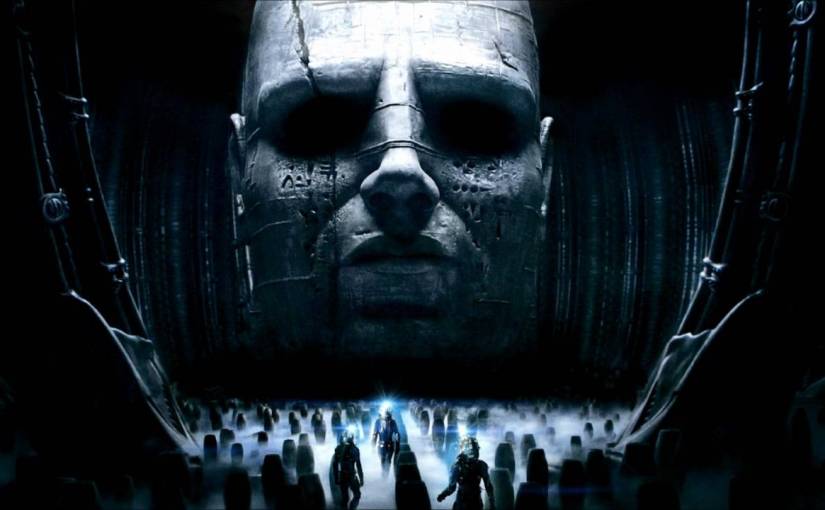
Upon arrival on the mysterious planet, the crew enthusiastically approaches a structure to explore.  Finally, they will receive answers to life’s greatest mysteries.  It’s not hard to realize that things will not go as planned, however.  It’s also not worth detailing everything that happens within the confines of this column.  I’ll let you absorb the imaginative visual feast of horrors and effects for yourself.  Most interestingly is that Dr. Shaw shares with her lover/scientist partner that the strong men, which they identify as “Engineers,” possess the same DNA as humans.  That’s an interesting observation.  Is it disappointing though?  Should it be grander for this long hike into outer space?

In many films like Prometheus or Alien, not everything cooperates as the characters expect.  None of that is surprising but it is welcome for the entertainment of suspense and thrills.  However, what I took away from the picture is where technology duals against religion and biology.  A pertinent blink and miss moment occurs following a traumatic event for Shaw.  David the android removes the cross around her neck.  Is there sound reason any longer to believe in God or the biblical teachings she was raised on if Shaw found the origin of herself and fellow humans?  Is her faith now a moot point?

On a scientific level, we learn Shaw is incapable of bearing children.  Yet, through a set of circumstances David informs her that she is suddenly three months pregnant.  The high-tech invention of David may have had a hand in this development by the way, and this is not some normal kind of pregnancy either.  Technology lends to a horrifyingly memorable scene where Shaw “delivers” her offspring. 

I’m sure we all question our beginnings.  Did it begin in six days by God, with Adam and Eve, as initial products?  Was there a big bang that just started it all?  I’d argue these questions will likely never be answered in our lifetimes.  Thus, the debates rage on because we have nothing better to do with our lives.  Cynical, right?  Well movies like Prometheus try to offer suppositions on possibilities.  In fact, there’s one pessimistic crew member on the ship who questions Shaw and Holloway’s goals of undoing a century of Darwinism on some distant planet, billions of miles away from Earth.

As the film reaches its climax, I found it even more interesting that Shaw puts on her cross necklace again, and David asks her if its even necessary at this point. 

The visuals of Ridley Scott’s film are impressive, though the planet surface and space travel doesn’t look any more creative than other science fiction films.  Frankly, it doesn’t need to reinvent the wheel.  The cast is quite diverse in personalities from a space pilot captain portrayed by Idris Elba, to a nothing but business professional played by Charlize Theron.  Other cast members are there for the casualty line up.

How Prometheus relates to the universe of Alien is fun, but the film still stands on its own. This movie does not require knowledge of the other films to follow this storyline.  Yet, if you’ve seen the other pictures, it is fun to uncover a few wink and nods here and there.

Jon Spaihts and Damon Lindelof (writer of the TV series Lost) deserve more credit for the construction of Prometheus because of the subtle debates ingrained in the monster movie themes of the picture.  Would an emergency C-section be considered a natural way of giving birth?  Would a belief in an “Engineer” supersede someone’s faith in a higher God-like power?  Should technological advancement overcome what’s destined for humanity?

As I close this article, you know what?  I’m going to say yes to all those questions.  Whatever put people on the planet Earth to live and occupy, granted us the capabilities to find alternatives to biological functionality.  Alternatives of religion preach a variety of different content that all humans choose to believe (yes even atheism, because if it’s got a name then it is some form of belief).  The science and engineering capability of technology did not arrive and develop without tests and experimentation, and it will forever proceed that way.  Dr. Frankenstein toyed with invention that did not go as expected.  Ridley Scott’s film suggests that the characters of Prometheus had a similar experience.  The point is we never advance unless we try and unless we fail before we hopefully succeed.

ALIEN

By Marc S. Sanders

To be lost and alone is my absolute greatest fear.  I don’t know what to do when I find myself in situations like that.  I feel palpitations and terrible anxiety.  The only argument my wife and I had on our honeymoon was when we got lost in the Louvre in Paris.  She was relaxed.  I definitely was not.  I didn’t know in which direction to walk through the massive museum, located in a country that I’m not at all familiar with, inhabited by a majority of people who speak a language that I’m terribly limited at using for conversation.

When a person is completely, physically isolated, the only thing to depend on is his/her own wits and sensibilities.  That’s step one in constructing a scene of terror.  Step two is to lock that person away with an entity that is unpredictable, unrecognizable, smart and grotesquely frightening.  In a film, each time that entity comes into the play, the scene should not look like the last time the protagonist or the audience encountered this creature.  Whatever I learned a few minutes ago is not going to offer much help the next time around. 

I’ve just described the spine of the story that makes a horror film like Ridley Scott’s Alien so successful.

Science Fiction always works best when it can be convincing enough to lend authenticity to the fiction of its, well, science.  With Alien, a variation of biology and evolution lends to the terror of the picture and you don’t even realize it until the movie is half over. The title character is introduced in different characterizations with every scene it is called for.  First, it’s an egg, then a tentacled creature wrapped around the face of an unfortunate victim.  Later, at dinner time, it reveals itself in an unforgiving and memorable scene as a phallic shaped organism with a snake like tail and steel teeth.  Lastly, you just can’t even describe what it is except to say it is huge and its even worse than the monsters you imagined as a kid hiding in your closet or under your bed.  Credit has to go to the creature designs from H.R. Giger.  Every limb or shape of the monster seems to serve a purpose.  If that’s not enough, the animal bleeds acid that’ll burn through the hull of an enormous spaceship.  The alien in this 1979 film, later deemed a “xenomorph,” is one of the scariest and most unforgettable monsters in movie history.

A crew of seven are piloting a large ship back to the planet Earth.  Their cargo is carrying mineral ore (whatever that is).  This crew is not military of any kind.  There’s a science officer, but by and large, I’d characterize these people as truckers in outer space working on behalf of a company, by hauling a load across the galaxy.  During the long journey, they rest in a cryo-like sleep.  As the film opens, they are awakened by their transmission computer, known as “Mother,” to respond to a distress call.  Their ship has been diverted from Earth to investigate an unexplored planet.  As the piece continues, the crew brings back a plus one. They have no idea what to expect or how to handle its presence, and then they are hunted across the maze of the large ship, dispatched one by one.

The byline for Alien is marketing brilliance.  In Space, No One Can Hear You Scream.  It only scratches the surface of the terror you encounter when watching this terrifying film.  Ridley Scott uses art direction set up with long, dark hallways and warehouse size rooms that make the cast appear infantile.  His labyrinth of a spaceship offers up practically any place for a killer creature to hide and strike at an opportune time. 

It’s important to point out that Alien lends to the argument for the value of 4K resolution.  This latest print to honor the film’s 40th anniversary offers much clarity within the dark settings of the picture.  Having seen Alien countless times, I still examine each frame carefully because Giger’s designs allow the monster to blend in properly with engineering architecture of long and large pipes and cables, and immense darkness.  Chains hang from the ceilings and water drips down for no reason to be explained.  It’s just how the spaceship lives, apparently.  The atmosphere rattles you, however, when you realize there’s a dangerous bug crawling around somewhere.  Did I just catch a glimpse of the alien’s head there????  Was that his tail????  Is that a limb, like an arm or a hand????  I know all of the highlights of the picture by now, but to this day I still look for when and where the silent terror is looming, thinking I missed it from the last time I watched.  Would you believe on this last viewing, I found a caption of the alien I don’t recall ever seeing before?

Once the monster is established and we see our heroes within inescapable danger, then paranoia and mistrust can lend to their erratic nature.  The screenplay from Alien co-creator Dan O’Bannon establishes how the “grunts” of the seven (Yaphet Kotto, Harry Dean Stanton) debate what is and isn’t their responsibility and what monies they truly are entitled to on this mission.  Early on, before the threat is even considered, a divide exists within the band.  They are not always going to get along.  Later, the debate on whether to quarantine the crew members who investigated the distress signal on the strange, unknown planet comes into play.  It would be easy to simply make Alien all about blood, guts and sci fi laser pistols in a post Star Wars/Star Trek era, but it is even more effective to create disagreements and seeds of unreliability among the group.  One or two of them could end up operating in a different and unexpected direction that won’t help their cause.  Maybe it’s not just the alien we should be afraid of.

The seven members (5 men, 2 women) all have different personalities.  They like one another well enough, but they all have uncommon values and motives.  Sigourney Weaver portrays Ripley, the third in command, behind two men.  However, in outer space, does it really matter where she falls in the line?  The science officer, Ash (Ian Holm), seems to drift into his own way of thinking, separate from the rest.  Captain Dallas (Tom Skerritt) moves along the straight and narrow, only doing what’s assigned simply to move on and get things over with.  The other woman Lambert (Veronica Cartwright) does not have much dialogue to work with, but her expressions seem to be questioning why she even took this job.  Was this woman desperate for work and this is the best she could find?  She’s definitely the most unrelaxed and fearful of the crew.

Like Steven Spielberg’s Jaws, Alien does not operate on the movie monster alone.  There are other factors at play.  A popular Hollywood story is that Spielberg didn’t show the shark for a long period of time simply because the thing would not work, mechanically speaking.  Ridley Scott, however, demonstrates that he can present the animal one way and then show it in a completely different form later.  When it has reached what we can only believe is full evolution, we still don’t get a clear physical picture of the creature’s design from head to toe.  Scott will show us teeth, or maybe a shoulder blade or a tail that whips or moves at a slow and cautious pace.  The alien functions with a combination of real-life predators’ behaviors.  It hatches.  It sheds its skin.  It bites.  It runs.  It hunts a prey.  It grows and evolves…and seemingly very quickly.

Alien has been duplicated many times following its release, including a few shameless sequels.  Mind you, some of the franchise follow ups remain exceptional in their own right.  What misgivings Ridley Scott’s movie have later inspired cannot be helped.  Mr. Scott should consider it an honor, at best, that various craftspeople have attempted to top what he accomplished, I guess.  Those copycats don’t follow the recipe of Alien though.  There’s either too much of an ingredient included like blood and guts or there’s a lacking in its script, such as the eerie haunts of a dangerous setting or the overeager intelligence of its characters.  Whatever the case may be, the achievements in horror work so well in Alien, because it moves with dread, uncertainty, helplessness, a lack of knowledge, and then with only a few touches of gore and violence that are mostly left to our worst imaginations. 

Alien is not only one of the best science fiction films ever made.  It is also one of the best horror films ever made.

BLADE RUNNER

By Marc S. Sanders

Ridley Scott’s Blade Runner is a technical and special effects masterpiece…however thin-very thin-its story may be. 

When the film was originally released in 1982, its period setting of November 2019 seemed unimaginable.  So, it was easy to accept that the dystopian future first conceived by author Phillip K. Dick (in his book Do Androids Dream Of Electric Sheep?) could actually happen.  With the Vietnam War behind us, and shopping malls becoming the happening place to be in our Members Only jackets and Jordache jeans with Swatch watches, the 1980s seemed like eternal bliss.  Middle class America felt prosperous and free and comfortable with a President on his way to eight years in office.  Bright pastel and neon colors took over.  A hopeless, dreary future was all but fantasy.  Therefore, just like Star Wars, a gritty, urban Los Angeles seemed like another possibility where science fiction had become as trendy as super hero movies are today.  It was cold and rainy and dirty, but we wanted to see that because that was nowhere near what we were living in, much less envisioning. 

Ridley Scott achieved greatness with visuals never thought possible.  George Lucas might have introduced moviegoers to desert and swamp planets and industrialist Death Stars, but Scott delivered an Earth where Coca-Cola, Pan Am, Atari and Cuisinart still existed amid a dark, rainy Chinatown section of Los Angeles with glowing umbrella handles, flying police cars and cabs, hovering electronic billboards, and exhaust flames that spewed out of the rooftops of cylindrical skyscrapers.  Ridley Scott might have supervised this palette of futuristic film-noir, but the real heroes of Blade Runner belong to its Oscar nominees Lawrence G. Paull, David L. Snyder, and Linda DeScenna for set decoration, as well as Douglas Trumbull (already a legend for 2001: A Space Odyssey), Richard Yuricich and David Dryer for visual effects.  All these years later, there’s much to explore within the appearance of Blade Runner, but the storyline still remains shallower than a puddle of water.

I’ve watched Blade Runner a number of times because fellow peers and colleagues carry such admiration for the film.  I cannot deny the first third of the film holds your attention as you acclimate yourself to this enveloping world.  Once your accustomed however, the story is what has to carry you through to the end, and the journey is as slow moving as a rickshaw on one wheel.  Harrison Ford is Rick Deckard, a blade runner and the best one there is.  Upon learning of an escape of four Replicants from an off-world slave site, Deckard is tasked with coming out of retirement to hunt down these Replicants and “retire” them.  Retire is the polite word for kill, exterminate, slaughter or execute.

A replicant is an android that looks completely human, bleeds like a human and talks like a human.  It’s near impossible to tell the difference on sight between a human and a replicant. As well, replicants are manufactured with four-year life spans and are not permitted on Earth.  They are intended for the sole purpose of slavery towards their human creators.  Yet, what makes them so exemplary or offensive?  What trait do they carry that threatens their human counterparts?  Racism often occurs because of fear derived from skin color or appearance.  Antisemitism will have you believe that Jews have horns growing out of their heads under their yarmulkas.  What is so terribly misconstrued or offensive or threatening about Replicants?  The film never makes clear, and that’s frustrating.  What makes a villain a villain?

M Emmet Walsh comes on early enough to tell us through dialogue that he needs the best of the blade runners back and that’s Deckard.  When I’m to understand that I’m watching the absolute best of something, whether it be a cop, lawyer, baker, student, doctor, painter or blade runner, I want to see what exactly makes them the best.  In Top Gun, I saw the aerial maneuvers that potentially justified why Maverick could be the best of the best fighter pilots.  The problem with Blade Runner and the script, written by Hampton Fancher and David Webb Peoples, is that I never see in its two-hour time span when or how Rick Deckard is such an exceptional blade runner.  How is a blade runner different from an ordinary cop or a simple person with a large gun?  No matter which of the various cuts of the film I’m watching, with or without Harrison Ford’s voiceover narration, I fail to see any outstanding fighting skills or clear thought-provoking intuition.  This guy is neither as good as Dirty Harry or Sherlock Holmes or even James Bond.  He’s not even as personable as Sam Spade, the original noir detective.  Rick Deckard just looks like Harrison Ford with a very large hand gun.  Furthermore, where does the term “Blade Runner” derive from?  Is it just there because it sounds cool?  The moniker wasn’t even created by Philip K. Dick.

The film’s eventual sequel, Blade Runner 2049, is a far superior film.  It’s longer, but it’s much more fleshed out in tone and character and understanding of its setting.  The original film stands on the heels of its cult like legendary status.  Some of the best filmmakers today cite Blade Runner as an influence in how they construct their own movies.  I buy that.  The assembly of whatever cut I’m watching is evident of how mind blowing its appearance is.  You can see some of the blue print visuals that carried over in to Christopher Nolan and Denis Villeneuve’s pictures. But I’m past all that.  Now I need to appreciate what it’s all there for, and who is playing in its yard. 

I cannot simply rely on IMDb trivia and endless social media sites that speculate on whether Deckard is a replicant himself, or why he dreams of a unicorn and why Ridley Scott opted not to include said dream in the original cut.  I cannot just tickle my curiosity with the picture’s eerie foreshadowing of the various product placements that suffered real life eventual downfalls after its release.  Beyond the visuals, what am I watching Blade Runner for?  This is not just a riddle in the Sunday paper.

The film boasts an eclectic cast that work well together.  I just wish they were provided with something much more insightful with background and personal experience.  Rutger Hauer became a familiar name following the release of this picture.  When he’s finally given the opportunity within the second hour of the film to come off as hideous and terrifying and strange, it’s worth looking at.  His famous “tears in the rain” closing dialogue is beautifully poetic, as it was personally written by him.  It’s as ambiguous as the film.  Yet, Shakespeare can be vague too.  I might not understand what anyone is talking about, but the performance can keep my attention.  Regrettably, he does not do much else in the film beyond his closing fight scene with Ford.  Ridley Scott insisted on casting Sean Young as Rachel, as her appearance was reminiscent of Vivian Leigh.  She’s intentionally mysterious as a likely replicant and/or niece of the wealthy creator of the replicants, Dr. Tyrell.  It works, but again, if the viewer is going to be questioned on the mystery of this major character early on, then why doesn’t the film follow further into that enigma?  You don’t have to say for sure, but at least give me evidence to argue one way or the other.  The same goes for the speculation on Deckard.  Had it not been for outside references, I’d never question who or what Deckard really is.  Daryl Hannah, Brion James and Joanna Cassidy round out the rest of the cast/replicants within the film.  Edward James Olmos is here too with a curious and odd habit of making origami.  They all have their unique way or look about them.  In science fiction, every character should stand apart.  Yet, again, it’s all about appearance.  What is the motivation here?  What is the motivation to live on earth or off earth?  What is the motivation to kill a human?  What is the motivation to kill a replicant?

I’ve beaten my head enough over this film.  Blade Runner has always been frustrating to me.  Maybe I’m not being fair to myself, as I try to find something else or some underlying layer each time I watch it.  Why do people love this movie so much?  Why does it consistently appear on “greatest of all time” tabulations?  Ultimately, I’ve come to the conclusion that I’m just pounding sand, or maybe as Rutger Hauer’s Roy Batty suggests, I’m impossibly looking for tears in rain.