A MOST VIOLENT YEAR

By Marc S. Sanders

If Michael Corleone had kept his promise to Kay to go strictly legitimate, he’d probably have become Abel Morales, the protagonist of A Most Violent Year, played exceedingly well by underrated Oscar Isaac.

Writer/Director J.C. Chandor sets his story in winter 1981, on record statistically recognized as what the film’s title literary suggests.  Therefore, it is a challenge for Morales to successfully bring his heating oil enterprise to a capital success when his competitors don’t play by the rules and hijack his product while threatening his able staff of truckers and salespeople. Then there is the stigma Morales must endure by being married to a reputed mob boss’ daughter, searingly played by Jessica Chastain, ready at a moment’s notice to call on her own family for help or to just pull a trigger herself.  Morales tried his hardest to keep her in check.  Furthermore, the industry he’s chosen is riddled with suspicion of fraud, embezzlement, racketeering, and underhanded tricks. All this warrants the DA to bring an endless array of indictments against Morales and his business, despite all the cooperation and legal activities that have been accomplished so far.

So why go through with this at all?  A lifetime has been invested.  Time of money and work to fight for an opportunity.  Abel knows this more than anything, and he will not surrender to deals from the DA or the mob.  He will not compromise despite the challenges.

Chandor’s film is well done.  It had been on my radar to watch since its release and yet it was not what I expected.  I was waiting for Abel’s widely seen beautiful camel overcoat to end up soaked in blood.  It never came to be.  That observation only suggests that A Most Violent Year does not promise on its descriptiveness.  On the contrary, it offers the setting so that we understand Abel’s conflict.  

A good story piles on one problem after another to keep a viewer compelled. Maybe one primary problem is wrapped up a little too neatly here, but no matter.  I also would have preferred better camera positioning from Chandor on occasion. Some characters who are being introduced for the first time are heard speaking off camera only to then be shown a close up of them with no more to say.  Happened more than twice and I can’t understand why.  I’m sure Chandor artistically intended it to be that way.  Yet, I didn’t like it.

Oscar Isaac and Jessica Chastain are great.  These are two actors rarely seen in the gossip rags.  So, they are more well known for selecting smart roles and stretching their flexibility for the parts they agree to take.  It’s refreshing. It’s why A Most Violent Year can be capably made with a great script (better than the film) amid all of the tentpole blockbuster sequels.  

It’s worth it to check out.

MOLLY’S GAME

By Marc S. Sanders

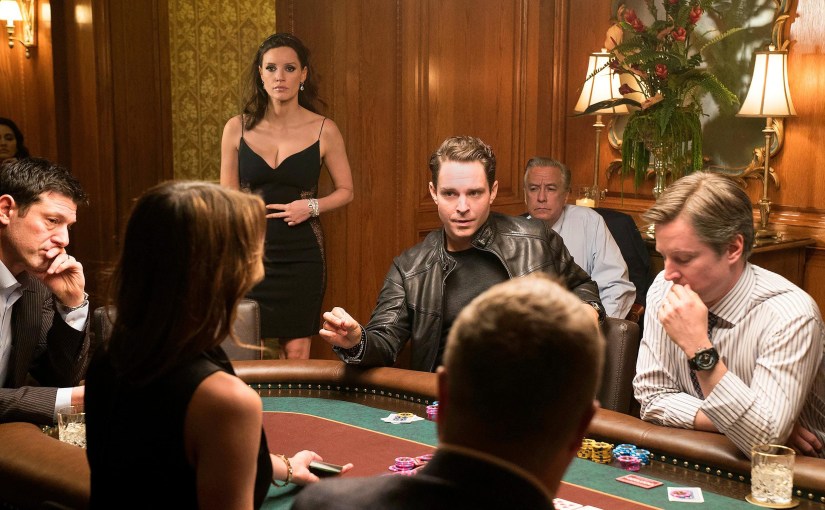
Despite being a little distracted by a drunk patron sitting next to me, I thought Molly’s Game was very good. It doesn’t measure up to The Social Network, and I feel justified in comparing the two because the sharp, fast dialogue follows what appears to be an intentionally similar narrative from writer, and here director, Aaron Sorkin.

Sorkin in his directorial debut uses great techniques for film editing to match the beats of his dialogue.  His opening voiceover of Jessica Chastain as Molly describing the ultimate worst sports experience will get your heartbeat racing.  It draws you into the film right away.

Chastain is good, but maybe a little over the top.  I needed a little more convincing that she was actually this brilliant, inventive and resourceful woman who was also considered one of the world’s greatest skiers.  Can’t put my finger on it but something was missing with her playing the Molly Bloom role.  Was she really holding her own against these high stakes guys who take big risks in her personally constructed poker ring?  I’m just not sure.

Felt the same about Kevin Costner in the role of her father.  He’s supposed to be an incredibly brilliant psychologist and an intimidating patriarch.  Yet Costner doesn’t fit that mold for me here.  Couldn’t feel the pressure from Dad on his daughter.  Someone else might have been stronger.

Michael Cera too.  I think he is playing a combination variation of Tobey Maguire & Leonardo DiCaprio, two of the most famous celebs that participated in the real Molly Bloom’s underground poker games, but Michael Cera?  Really?  He doesn’t carry the weight or looks of guys like that.  There just was not enough power or presence from him.

None of these actors were the worst options for this cast, I just think the film could have used more appropriate performers. There was more appropriate talent out there, I’m sure.

Idris Elba is great, however.  He’s blessed with an awesome Sorkin monologue in the 3rd act of the film, and he hits every note.

A great script.  A great story worthy of being a big screen film and it’s got me interested to learn more about the real Molly Bloom, including reading her novel.

MISS SLOANE

By Marc S. Sanders

Jessica Chastain is an aggressive actress. The talent is on par with Meryl Streep or Katherine Hepburn for sure, and the Oscar trophy she won earlier this year is evident of that. Actually, she’s worthy of more than just one. My question, though, is if she is too aggressive. Films like Zero Dark Thirty, Molly’s Game, and Miss Sloane, put her in characters that never stop to react and smell the roses. That wears me out. Could you just slow down Jessica, so I can take this all in, please? You’re talking faster than I can think.

In Miss Sloane, Chastain portrays an impenetrable lobbyist. Nothing gets past this woman and despite her shortcomings, nothing will harm her either. Elizabeth Sloane will always be one step ahead of the game. This is a fierce chess player in the political arena. She’s omnipotent and admits to hardly ever sleeping. Maybe the pill popping helps with that. Like the Faye Dunaway character from Network, she also has no time for personal relationships or sensitive sex. So, she’s a high paying client for a male escort who will wait for her to come home to satisfy her fix.

Elizabeth is first employed with a wealthy private law firm who wants her to head up a bill in favor of the gun lobby. She declines, walks out the door with one long speech, a way over the top laugh (this is where there’s too much Jessica in my morning coffee) and over half her staff. She goes to the other side of the aisle to lobby aggressively against the gun bill.

From there it’s one aggressive maneuver after another and Elizabeth more than proves that she’s got the balls for this game. Only thing is, as Elizabeth proceeds to countermeasure and attack from her side, is she losing sight of the subject at play? Will her soul swim to the surface showing any sense of morality?

The film begins where Elizabeth is being questioned at a hearing headed by a state Senator (John Lithgow, always a pleasure to see). Then it moves on to show us how Elizabeth finds herself at that hearing.

Miss Sloane has no limits to what she’ll do to protect the integrity of a client’s argument for the bill even if it means embarrassing a traitorous teammate, putting another teammate in an unwelcome limelight of political journalism or maybe even employing a cockroach of the sort to use as a listening device. Miss Sloane won’t hesitate to take risks for the lobby she’s been hired to pursue, even if it risks someone’s life or their reputation.

A twist presents itself at the end and yeah, it could work assuming you believe Elizabeth Sloane, the brilliant lobbyist, can telegraph about fifty different actions that could take place amounting to that one moment. The math adds up, but were the numbers fudged to allow the arithmetic to work? That’s why a film like Miss Sloane is hard for me to swallow.

Does this woman have ESP? The final card she plays would require not only her own personal endurance, but that of a colleague as well. A lot of factors all have to be in sync to make this story work out the way it does. So my suspension of disbelief was really tested with this film.

I go back to Jessica Chastain. Zero Dark Thirty remains my favorite of hers. She was a great underdog against a male oriented governing body in the pursuit of Bin Laden. After that, Miss Sloane released a few years later and Chastain got bit by the Aaron Sorkin bug, I think. Endless talking works as an intellect that’s hard to challenge. Problem is, I’m the viewer and I’m wondering for the first thirty minutes what in the hell you’re talking about. Miss Sloane isn’t an Aaron Sorkin film, but Jessica Chastain will have you convinced she wants it to be.

Fortunately, writer Jonathan Perera with director John Madden ease up on the brakes allowing much more realistic and human characters to invade the film including Lithgow, Alison Pill and an especially riveting performance from Gugu Mbatha-Raw (recently seen by me with a subpar script called The Whole Truth) who becomes Elizabeth’s trusted sidekick both behind and in front of the cameras for political jockeying. This is an actress ready for some lead roles.

I described Miss Sloane as omnipotent earlier and that’s a problem for the first act of the film. This character never shuts up early on. There’s next to no impact on anyone around her. She just talks and talks and talks and she convinces me that she’s the smartest one in the room, but she also makes me want to turn the movie off. The film saves itself with the able supporting cast eventually.

To watch Miss Sloane is not to take any position on gun lobbying especially seriously. I’m not sure the filmmakers have a stance to play. I’m not sure the filmmakers know whether to even regard the titled character as a hero or villain. Actually, I just think the purpose of the film is to show corner cutting and how aggressive a made-up lobbyist can actually be, devoid of any determining factors. We are privileged to see how far a woman with stiletto heels, a cinched up red head ponytail and a tight business suit will go to win at any cost. It’s intriguing, but I guess I just felt unfulfilled by the end. It was all there. It just seemed to work itself all out too conveniently by the end. 

THE 355 (2022)

by Miguel E. Rodriguez

Director: Simon Kinberg
Cast: Diane Kruger, Penélope Cruz, Jessica Chastain, Lupita Nyong’o, Bingbing Fan
My rating: 5/10
Rotten Tomatometer: 25% (…oof…)

PLOT: When a highly advanced technological googah falls into mercenary hands, a wild card CIA agent joins forces with three international agents on a mission to retrieve it.


I can’t speak for my colleague, Marc, but sometimes it’s harder for me to write about mediocre films than about films that are either outstanding or truly terrible. It’s harder to muster up the motivation to break down a movie that’s not bad or great, but merely so-so.

That’s the situation in which I find myself, sitting down here to write about The 355, a female-led action-thriller from director Simon Kinberg, whose previous writing credits are like a roll call of woulda-shoulda-coulda superhero movies: xXx: State of the Union, X-Men: The Last Stand, Jumper, X-Men: Apocalypse, the ill-fated 2015 reboot of Fantastic Four, and so on. (Full disclosure: he did write the 2005 comedy thriller Mr. & Mrs. Smith, which I believe is highly underrated, but that might be due more to the onscreen chemistry of Angelina Jolie and Brad Pitt than the script.)

The 355 (the title is explained only in the film’s final five minutes, so be patient) is standard Bond/Bourne stuff: an advanced technological doodad has surfaced and every bad guy on Earth wants it. It’s a fancy-looking USB drive that, once connected to any laptop in the world and properly decrypted, can access literally any network and/or mainframe in existence. As proof, the device’s inventor uses it to first crash a military transport jet flying overhead and then, as an encore, cuts the cable to his house. Personally, I would have reversed that lineup, but that’s just me.

(If this plot device sounds familiar, well, that’s because it is, as anyone who remembers the movie Sneakers will attest…but whatever.)

The device is stolen, and the good guys need to get it back before the bad guys do. Enter the main characters of the film: Mason Browne (Jessica Chastain) for the CIA, Marie Schmidt (Diane Kruger) for German intelligence, Khadijah Adiyeme (Lupita Nyong’o) for MI6, and poor Graciela Rivera (Penélope Cruz), a therapist who is in the wrong place at the wrong time. There’s some nonsense about them fighting each other at first, then banding together when they belatedly realize they’re on the same side.

The first major action scene is really well done, I have to say. There’s a foot chase through Parisian streets and subways that is as well done as any similar chase in the Bourne trilogy or any given Bond film. For that matter, ALL of the action scenes are competently executed…but that’s about it. There’s no flash or style, no real sense of originality.

There’s one sequence in particular that takes place in and around a fish-packing warehouse that, after a few minutes, became extremely muddled, and I lost track of who was chasing whom, and why, and how. The camera just seemed to be recording the action without getting me invested. It was curiously bland and detached.

The story itself was vaguely disappointing and unsatisfying, as well. It serves as the very definition of “by-the-numbers.” Virtually every cliche from better spy films are evident. The partner (Sebastian Stan) who’s dead…or is he? The trustworthy boss…or is he? The villain (Bingbing Fan) who lurks in the background…or is she a villain?

Now, there are uncountable films that have used these cliches to better effect, but it’s especially disappointing in The 355 because, throughout the movie, the story felt as if it was on the verge of talking about some truly interesting topics, specifically as it relates to women. There are subplots about how Mason, the CIA agent, has no personal attachments, while Khadijah, the MI6 agent, has a lover, and Graciela, the therapist, has a whole family waiting at home for her. Marie, the German spy, has some REAL problems that I won’t get into here. The story dances around the social perception of what women should or shouldn’t do with their lives. You want to be a secret agent full time? Okay, but you’ll get judged for not wanting to start a family. You want to start a family? Okay, but you’ll get judged for not being as professional or as dedicated as others in your line of work. You want to try to do both? Fine, but just when you think it can work, it doesn’t, so you should have come down on one side or the other. It’s a no-win scenario, and it happens all the time.

The movie dances with exploring this concept further, and then dances away in favor of more cliches and unnecessary plot twists. There’s even a whole sequence that feels as if it was lifted directly from one of the Ocean’s movies. Any one of them, take your pick.

There is also a moment when, out of NOWHERE, the stakes are raised in dramatic and horrifying fashion, so much so that it felt completely out of place. I was reminded, oddly, of a scene in the 2006 remake of The Hills Have Eyes where one of the mutant baddies slowly waves a gun over an infant in a crib. To me, it felt like overkill, and that’s the feeling I got with this off-putting twist. Was it necessary? It was shocking, true, and effective, but was it necessary? I don’t believe it was. I would have believed these women were motivated enough without bringing in outside pressure. And, to be honest, it felt like it was punishing those women who dared to have a life outside of their profession and rewarding those women who didn’t. No doubt there are other interpretations, but that’s how I saw it.

All in all, The 355 wasn’t downright unpleasant or super thrilling. It wasn’t exactly a waste of time, but it didn’t exactly blow my hair back, either. I don’t think it’s quite as bad as that Tomatometer would suggest, but…

Yeah…wait for streaming.