THUNDERBOLTS*

By Marc S. Sanders

Thunderbolts* is the next Marvel movie out of the assembly line, the second of 2025 (after Captain America: Brave New World).  A new team is haphazardly assembled and the witty lines come through that poke fun at their idiosyncrasies and their origins.  Yelena (Florence Pugh) is the Russian assassin with a daredevil streak.  John Walker (Wyatt Russell) is the wannabe Captain America known formally as U.S. Agent.  There’s Ghost (Hannah John-Kamen) who can teleport in and out of places, and Red Guardian (David Harbour), the Soviet equivalent of Captain America with a shaggy beard, a beer belly and an adorably estranged father/daughter relationship with Yelena.  Bucky, The Winter Soldier (Sebastian Stan) is back too.  We’ve talked enough about him though.

Marvel and Disney are advertising this cast as the anti-heroes, or anti-Avengers and the film lives up to that mantra.  However, it still has the witty banter of those other superhero team up pictures.  What sets this one apart though is that eventually the characters and the story use their brain and a little welcome psychosis for a thrilling final act that leaves you alarmed while welcoming you to empathize. 

The strongest actor and most dimensional character portrayal belongs to Florence Pugh.  No doubt that she carries the film as she leads us into an unexpected underground trap where the other members of this cast are all trying to kill each other at the assigned behest of Valentina Allegra de Fontaine (Julia Louis-Dreyfus).  Yelena quickly figures out Valentina’s deceit while overlooking an innocent looking Frankenstein’s monster of a young man named Bob (Lewis Pullman).  The others are there to just exercise their skills for some cool action scene edits, and tag along with Yelena and Bob.  An escape out of the underground structure might overstay its welcome, but fortunately the characters are fun.

Once the escape is complete, the action gets better from there with explosions and fire power and such.  Cars and a limo go boom.  Bullets deflect everywhere.

Naturally, disaster eventually has to arrive in New York City and it is up to these Thunderbolts* to save the city.  Honestly, as the citizens kept on disappearing into blackness, I kept asking myself why Dr. Strange or Spider-Man didn’t show up.  That’s the become the unwelcome problem with the Marvel films and their ongoing connections to each other.  Why would I expect a teleporter and a group of acrobatic fighters who carry shields and handguns to stop a godlike entity that is destroying New York City?  Last I recall, Stephen Strange was not dead.  I had to look past the obvious though because there’s interesting material that harbors itself during this third act. 

Florence Pugh and Lewis Pullman steer the reins to triumph, and it is more so done with an underlying, bordering hokey message that these two capable actors balance quite well.  There’s punching and running and screaming and superpower stuff, yes.  However, the win works on an emotional level too, setting itself apart from the various Avengers movies.  There’s good editing to be found here as the characters jump from one room to another as personal demons are confronted.  The room jumps make you feel like you are in that inflatable wonder wheel you would walk on in the swimming pool. It certainly keeps you alert. All the while, Yelena, the skilled martial arts assassin, uses her brains and instinct to rescue her teammates and especially Bob.

The debate rages on the oversaturation of superhero movies and how they might be destroying cinema.  I’ve never been so quick to surrender to that argument.  The box office of these films keep jobs in place for a large multi-billion dollar industry and the profits to be made allow for small more arthouse like films to be produced.  Also, they are still so fun and entertaining if you allow yourself not to be such a film snob. So, stop complaining so much. 

As for the material of these pictures, Thunderbolts* is a good, up to date example of not simply relying on special effects and city destruction with another villain of the week.  It has a Ghostbusters/Men In Black humorous vibe to it while still catering to intrinsic insecurities and personal baggage that all of us carry through life.  Sometimes, when we want to escape to the movies, it helps to uncover someone telling a story that gets me, gets you…gets all of us. 

THE COMMUTER

By Marc S. Sanders

Sometimes it gets boring to have your suspension of disbelief tested with a movie.  Especially if it is a movie where there’s that eye in the sky that can see everything the hero does, thereby making his dilemma that much harder.  Downright impossible, actually.

You know what I mean when I say eye in the sky?  That’s where the villain or the antagonist can see everything the hero attempts to do to save the day, and every time he tries something like making a cell phone call or writing a secret message on a piece of paper (hidden next to his thigh under the table) for someone else to see, the bad guy always knows what he’s doing. It’s a wonder if the protagonist can even take a leak in private.

In The Commuter, Liam Neeson plays a former New York cop, now insurance salesman, who takes his morning and afternoon train from upstate into the city and then back after work.  Everyday, it’s the same regulars on the train while Neeson’s character, Michael MacCauley, reads the classic literature books that his son is assigned to cover for school.  I guess it’s the way they bond, and it’s pretty fortunate that this is Mike’s hobby because on the day he gets fired from his job, it might come in handy.  Go figure.  These bad guys messed with the wrong avid reader.  I mean he’s reading The Grapes Of Wrath for heaven’s sake.

Just before Mike enters the train, his wallet and cell phone are pickpocketed.  He defeatedly slumps down in his seat and shortly after an alluring woman named Joanna played by Vera Farmiga sits across from him and proposes a hypothetical.  Find twenty-five thousand in cash hidden somewhere in the bathroom.  Then seek out a passenger who identifies as Prynne and swipe the bag that person is holding.  Once that is done, he’ll collect an additional seventy-five thousand, but it must be done before the train reaches the Cold Spring station.  Joanna leaves the train making the offer sound so simple.

Considering Mike just lost his job and he’s got no cash savings as well as his son’s college tuition to pay for, he retrieves the hidden money and tries to make a clean getaway at the next stop.  However, he’s immediately halted by someone who gives him an envelope with his wife’s wedding ring in it.  Now, he knows this woman and whoever else is setting him up with his wife and son in possible danger.

As he finds a way to communicate with Joanna by phone, Mike tests just how serious she and her cohorts are, and that’s when a couple of people wind up dead.  Ultimately, the only way out of this conundrum is for Mike to find out which passenger is Prynne.

Much of the running time of The Commuter is occupied with red herrings.  Could Prynne be the punk girl with the nose ring (Florence Pugh)?  Is it the asshole Investment Banker with the phone earpiece?  Maybe it’s the guy all dressed in black?  Or the one with the guitar case?  Yeah.  It could be any one of these folks who Mike does not recognize as regular travelers.  I won’t even tell you if any of the people are the real Prynne or not, but I knew what to expect from this kind of storytelling pattern.  Mike finds a way to small talk some of them and seek out clues.  He uses the conductors by explaining that he sees something suspicious and suggests they look in their parcels.  At times, I felt like I was playing the Clue or Guess Who?  or Twenty Questions.  I dunno.  This kind of set up for a movie just seems too silly.

Sixty-year-old Mike also engages in hand-to-hand fist fights with some suspects.  I don’t know how old Liam Neeson is, but Mike says he’s sixty, and sixty-year-old Mike endures getting his head bashed through more than one speeding train window, plus a couple of knife slashes and some ass kickings, in his pursuit for the truth.  I know.  He’s a cop so he’s got fighting skills.  That’s okay.  I buy that, but to have your head bashed through doubled paned windows while this commuter train is going a hundred miles an hour? Well, that’s enough stretching for one day.

So how does Joanna stay one step ahead of Mike to ensure he’s playing by the rules?  Well, apparently there are cameras positioned in the overhead vents of every train car that can follow his every move.  C’mon now!  I’d rather the writers and director simply turn this into a sci fi cheapo and declare the villain omnipotent.  This train is at least six cars long.  Maybe seven, and the length of each one is maybe five yards if I’m being conservative, and I’m supposed to believe that these cameras cover every nook and cranny of every single train car?  Seriously, stop stretching.  You’re bound to pull something.

I stayed with The Commuter until the end because frankly I was curious who Prynne turned out to be and what the significance of this particular passenger was to the interests of Joanna. It actually works.  It’s Mike’s convenience in detective work and the powers operating against him that’s ridiculous. 

Moreover, the visuals are incredibly distracting in this picture.  The CGI could not be more apparent anytime Liam Neeson throws a punch or takes one across the chin or out a broken window.  The animation of the CGI appears terribly false.  It looks unfinished and rushed for editing as Neeson’s facial expressions of pain and struggle contort in odd ways.  The bad guys he gets into fisticuffs with appear to have the same problem.  Truly some of the worst action scenes I can remember watching in quite some time. 

The speed of the train looks false as well.  I read where Liam Neeson said that the settings within the train cars were shot on a soundstage.  Afterwards, director Juame Collet-Serra was challenged with changing the outdoor scenery of the train on a constant basis to simulate ongoing speed and movement.  I imagine this is all incredibly challenging.  I don’t know how to do it.  However, it just does not work.

The visuals for most of The Commuter fail tremendously.  Last year’s most recent installment of Mission: Impossible demonstrated how a speeding train should look in an action picture.  With this movie though, the finalized print was rushed for that all so busy January release in 2018.  Look, if you can’t do it right, then let somebody else handle the job, or better yet, make a better movie.

The Commuter would have been a much better and much shorter film had Mike never let his curiosity overtake him and go to the bathroom for that money.  Mike, why couldn’t you just stay in your seat and finish reading your Steinbeck?

OPPENHEIMER

By Marc S. Sanders

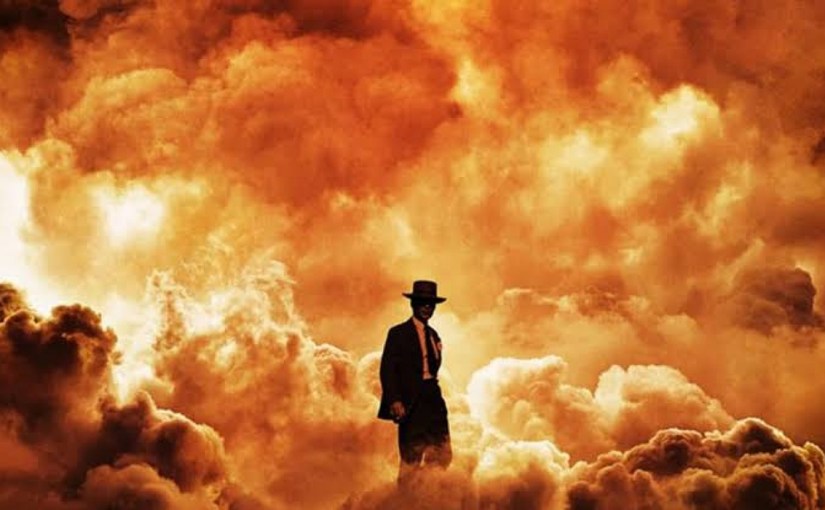
Christopher Nolan is one of the modern-day directors that you can rely on for brainy science fiction whether they are in embedded in dream subconsciousness, intergalactic space travel, transcendences of time, or even putting a fresh polish on a favorite superhero.  With Oppenheimer, he triumphs with exploring the actual prophets of science in the twentieth century, particularly its title character J Robert Oppenheimer, the brilliant physicist played convincingly well by Cillian Murphy.  Nolan doesn’t just stop at the assembly and discovery of science though.  He uncovers the consequences of Oppenheimer’s innovation and genius insight.  Dr. Oppenheimer might have been the man who knew too much and arguably that cost him quite a bit, personally.  Additionally, the so-called lab rat of his atomic bomb, namely the planet Earth, suffered the expense of a, at the time, troubling present day, and a still ongoing future. 

This movie seems to start right in the middle of its story and as a viewer you need to claw your way through the dense foliage to find its beginnings and what comes afterwards.  The first two scenes of the movie are titled “Fission” and “Fusion.”  There are no time periods specified by a font caption, however.  The differences in various points in history are distinguished by where J Robert Oppenheimer is located during select points in his life.  For seconds at a time, the film will change its photography from vibrant color to black and white, for example.  The characters will either look more aged with grey hair and some wrinkles or during more youthful time in their lives.  At one point Oppenheimer is being recruited by Lewis Strauss (Robert Downey, Jr) to head the department of a new kind of weapon development.  Work the science to make a difference.  There’s another time period where he’s being interrogated in a small room by a governmental suit and tie committee.  Oppenheimer is also in his classroom or debating and working with colleagues.  Another story observes his progress with building the atomic bomb among a collection of other engineers and scientists in a desert town, Los Alamos, specifically built at his own request, under the order of the nothing but militant Colonel Leslie Groves (Matt Damon), to conduct his work and research while hiding in plain sight. 

The film also covers Oppenheimer’s association with possible suspects of the Communist Party during the stressful pre-cold war era of McCarthyism.  Questions arise if his reliable brother Frank (Dylan Arnold) is a communist or even his mistress (Florence Pugh).  Does that in turn make Oppenheimer a communist as well?  If that is the case is J Robert Oppenheimer, the man tasked with ultimately ending World War II in favor of the Allies, sharing secrets with Russia and/or the Communist Party?

Nolan’s film gets easier to watch as it moves along, but you must get used to his pattern of filmmaking.  If you have never seen a Christopher Nolan film, I do not recommend you start with Oppenheimer.  His work is recognized for fast paced edits of different time periods and conversations.  There is much information to decipher. As well, there’s a very large collection of welcome characters to sort through, who worked with or against Oppenheimer.  Having only seen it once, I was captivated with the picture, but I know that I need to see it again.  The quick edits, working beautifully against the soundtrack orchestrations of Ludwig Göransson (nominate him for an Oscar, please), happen a mile a minute.  I appreciated this method because it enhanced the urgency of Dr. Oppenheimer in the eyes of the world, first as the savior of the united Allies against the last remaining superpower of the Axis countries, Japan. Then later focus is on whether it is in the United States’ best interests for the regarded physicist to have security access to the country’s most secret weapons and technological progress in a post war age.

People have been cajoling about how they know the ending to Oppenheimer.  They drop the bomb, of course!  (Twice actually.)  However, they do not know the entire story adaptation that Christopher Nolan as director and screenwriter presents. 

Cillian Murphy is perfectly cast. Give him an Oscar nomination.  He serves the confident, assured scientific leader who becomes envious of competing powers who achieve the impossible, like splitting the atom, while also admiring peers and mentors like Niels Bohr and Albert Einstein (Kenneth Branagh, Tom Conti).  All these men are interested only in what can be accomplished.  The superpowers that fight in war, though, are interested in how these accomplishments of modern science can be used to their advantage at a cost of collateral damage.  It is these conflicts of interests that Nolan admirably demonstrates over the course of the film. 

A telling scene for me, that I won’t forget, is when Robert Oppenheimer meets Harry Truman (Gary Oldman, doing an unforgettable cameo).  As the physicist exits the Oval Office, having shared his concerns and scruples with the Commander in Chief, Nolan includes a throwaway line delivered by the President, that I won’t soon forget.  It will not be spoiled, here.  Yet, the dialogue speaks volumes of what the United States held important regarding the servants who did the country’s bidding.  The scene closes like a stab in the heart, and suddenly science is no longer just facts within our planet.  Science is now questioned on whether it should ever be acted upon. Those questions certainly have remained as long as I’ve been alive to read about our never-ending world climate.  These inquiries will be here for many generations after I’m gone as well; that is if men and women’s recklessness with science doesn’t destroy the Earth before then.  At one point, Oppenheimer shares a small fraction of possibility for the end of the world when they activate and test their first atomic bomb. Matt Damon’s Colonel Groves’ asks for a reiteration of that observation.  Is this finding worth even the smallest, most minute risk?

Emily Blunt portrays Kitty Oppenheimer.  She’s marvelous as a lonely alcoholic wife to Robert, and a mother minding a home built in the desert while her husband serves an important purpose.  I didn’t take to her presence in the film until her grand moment arrives during an interrogation scene.  As the character gives her testimony regarding Oppenheimer’s communist ties, Blunt locks herself in for a wealth of awards in late 2023/early 2024.  Once you’ve watched the movie, you’ll likely know which scene I’m referring to and you can bet it’ll be that sample clip shown on all the awards programs.  This might not be Blunt’s best role, because it is rather limited within crux of the film, but I’d argue it is her greatest scene on film that I can remember.

Oppenheimer is a three-hour film, and it demands its running time.  There are so many angles to the man that few really know about.  Many know it was he who instrumentally built the atomic bomb that to date has only been used twice within a period of four days.  Thankfully never since.  Nolan emphasizes how unaware we are of how carefree the doctor’s government supervisors performed with the weapon he agreed to build.  Don’t just drop the bomb once.  Send a message to Japan by dropping it twice so they know to no longer engage in this ongoing war.  Choose the area where an army/government official didn’t honeymoon though.  It’s too beautiful a region.  Tens of thousands of men, women and child civilians perished immediately following the strikes.  Many others died weeks later following exposure to the nuclear effects that followed.  All issued as a horrifying cost to end a war that was already being won now that Hitler was dead.

Mechanically, Christopher Nolan does not disappoint either.  I watched Oppenheimer in a Dolby theater and I highly recommend it over a traditional one.  However, beware of the sound.  It is a LOUD!!!!!  Your seat will rattle early in the film when Cillian Murphy is shown in close up imagining the collision of atoms, protons, and neutrons.  How a star naturally dies in space runs through Oppenheimer’s consciousness as well, and then we see how a black hole forms.  Nolan offers a Cliff’s Notes edit of science doing its job.  Murphy performs so well when he’s not speaking and cut against the quick edits of Nolan’s visual and sound effects of science at play.  It shows how an educated scientist thinks beyond what is documented on a chalkboard or in a textbook.  J Robert Oppenheimer used to teach about the building blocks and natural destruction that occurs within the universe.  Regrettably, what he learned about natural function soon becomes manufactured capability when the professor accepts the task of building scientific destruction with his bare hands. Man stole fire from the Gods.

Oppenheimer is so dense in the scope of science and the scientist behind it.  That’s a huge compliment.  It’s an engaging film with much to tell, and a lot more to think about afterwards.  It accomplishes what the best movies do.  It leaves you thinking long after the film has ended.  More importantly, it’ll leave you frightened for the future based on the behavior of this planet’s past. 

Oppenheimer is one of the best films of the year.

MIDSOMMAR (2019)

by Miguel E. Rodriguez

Director: Ari Aster
Cast: Florence Pugh, Jack Reynor, Vilhelm Blomgren
My Rating: 6/10
Rotten Tomatometer: 82% Certified Fresh

PLOT: A couple travels to Sweden to visit a rural hometown’s fabled mid-summer festival, but what begins as an idyllic retreat quickly devolves into a series of increasingly bizarre rituals at the hands of a pagan cult.


There is a lot to like in Midsommar, the second film from Ari Aster, director of last year’s masterful Hereditary.  It clocks in at 2 ½ hours, and the vast majority of that running time is devoted to creating and maintaining an atmosphere of unsettling oddness, where I was constantly asking myself, “Okay, what the hell is going on here?”  That’s a tricky task, because if you get it wrong, you wind up boring your audience.  And I was never bored during Midsommar.  So there’s that.

The plot: a young woman, Dani, suffers a terrible tragedy and turns for comfort to her boyfriend, Christian, who, truth be told, had been looking for an excuse to end things with Dani before the aforementioned tragedy struck.  But he stays with her more out of duty than real love, and they wind up going to Sweden with a bunch of friends on the recommendation of a college classmate of theirs who tells them of a marvelous nine-day solstice celebration held in his hometown, a quaint country village in the middle of nowhere that doesn’t seem to have or need electricity.

This place is…strange.  In scenes of ordinary behavior that nevertheless manage to somehow give you goosebumps, we observe the villagers performing tasks that would be at home in Amish country: folding clothes, preparing meals, gathering flowers, and the like.  Everything is brightly lit due to the perpetual sunlight at that time of year in that part of Sweden, and all that light somehow, instead of draining the scenes of suspense, actually increases it.  It’s very hard to describe accurately.  (Even the architecture contributes to this sense of unease, with a couple of buildings built with the kind of angles that would have been at home in a Tim Burton film.)

The film takes its time establishing this bright, passive weirdness.  One of the college friends asks the purpose of one of the strange buildings and is told it’s a temple…but no one is allowed there.  There are plainly crops in a field…but it’s difficult if not impossible to tell what’s being grown.  There’s a large bear in a wooden cage that the villagers seem not to notice or care about.   Some of the young village women openly admire Dani’s strapping boyfriend, much to Dani’s annoyance.

Then there’s a bizarre ceremony that starts out with a ritualized dinner, and then two of the older villagers are taken to a high cliff on the edge of the village, and…

Well, that’s when things REALLY start to get weird.  And bloody.  And even more trippy.  I think that’s where I have to stop describing events in the movie.

So.  Like I said, the film does a great job at creating this superbly unsettling atmosphere and maintaining it.  I couldn’t wait to see what was coming up next. But then the movie reached a point where it became obvious how it was going to end…

SPOILER ALERT, SPOILER ALERT, I SAY AGAIN, SPOILER ALERT.

When it became clear that this was NOT going to have a Hollywood ending, I didn’t mind at first.  I mean, Hereditary doesn’t end happily, and I thought it was brilliant.  (Well, I didn’t at first, but I do now.)  But…ugh.  In the last five minutes or so before the credits, instead of sucking in my breath at the audacity of this ending, I was instead shaking my head, saying to myself, “What the f***…?”  And not in a good way.  Midsommar ends with a whimper, not with a bang.

Which is so disappointing.  For 135 minutes, I was breathless with anticipation for the next scene.  And they lost me in the last five.  I HATE it when that happens.

I’m sure there are levels to Midsommar that make it more than just a horror movie.  No doubt there are all sorts of psychological – psychiatric? – parallels between the rituals of the village and the relationship between Dani and her boyfriend.  No doubt.  But when a movie loses me that badly at the end, all the poetic symbolism in the world won’t make me change my opinion.

Midsommar is a long ride for a short day at the beach. A crowded beach with no lifeguard and lots of seaweed.