A COMPLETE UNKNOWN (2024)

by Miguel E. Rodriguez

DIRECTOR: James Mangold
CAST: Timothée Chalamet, Edward Norton, Elle Fanning, Monica Barbaro, Boyd Holbrook
MY RATING: 9/10
ROTTEN TOMATOMETER: 79% Certified Fresh

PLOT: In 1961, Bob Dylan arrives in NYC for the first time.  Four years later, his groundbreaking performance in Newport changed the music world forever.


The 1994 documentary Hoop Dreams began as a small-scale, 30-minute project concentrating on two inner-city boys who dreamed of making it to the NBA.  It was supposed to cover only a few months in their lives, but as their stories progressed, the filmmakers just continued filming, and the sprawling documentary eventually covered five years and became an absorbing three-hour odyssey.

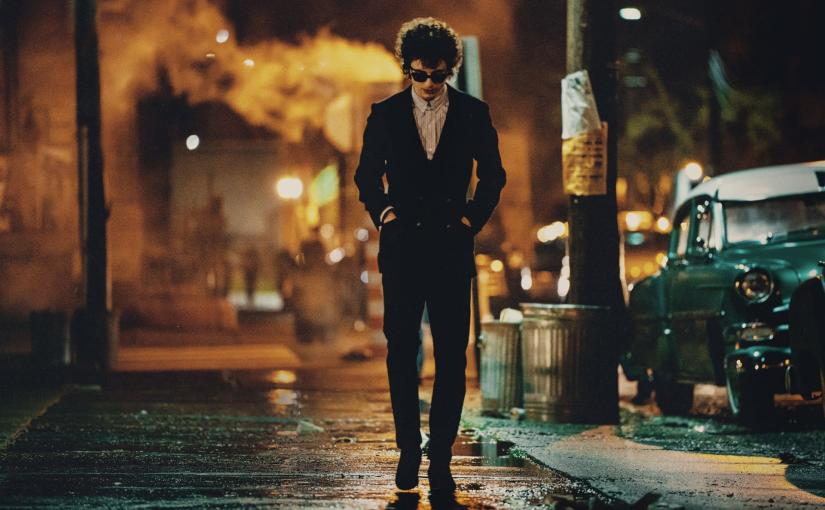
In a weird way, that’s how I felt about James Mangold’s Dylan biopic A Complete Unknown.  The movie opens with no backstory, no flashbacks, just a disheveled young Bobby Dylan (Timothée Chalamet) arriving in 1961 New York City with his guitar, determined to meet his idol, legendary folk singer Woody Guthrie, hospitalized at the time with Huntington’s disease and no longer able to sing or speak.  In Guthrie’s hospital room, Dylan also meets another folk legend, Pete Seeger (Edward Norton), in what must count as one of the greatest musical summit conferences of all time.

The way this scene is shot, it almost feels like, after it’s over, it could be the end of a marvelous short film about three legends bumping into each other.  But, like Hoop Dreams, this biopic remains focused on the unknown Bobby Dylan, with his nasal whine and preternatural gift for lyrics, for five years.  He eventually gets more and more exposure and cuts his first album.  Along the way, he meets two women who will be his emotional touchstones during the film: the celebrated Joan Baez (Monica Barbaro), whom Dylan accuses of being and singing “too pretty,” and Sylvie Russo (Elle Fanning), who becomes his girlfriend despite his flirtations with Ms. Baez.

But throughout the film – and this is one of the reasons I enjoyed it more than I thought I would – we remain focused almost exclusively on Dylan, the man and his music.  We are treated to countless scenes of Dylan performing live, Dylan recording in a studio, Dylan scratching out a new song note for note and word for word.  If a soundtrack album were ever compiled of the full-length versions of all the songs we hear in A Complete Unknown, I have to believe it would be between two to three hours long, if not more.

Why did I react so favorably to this kind of treatment?  My two favorite musical biopics of all time are Ray [2004] and Amadeus [1984].  Amadeus certainly contains a LOT of music, much like A Complete Unknown, but we are given a lot of background information into Mozart’s life, his relationship with his father, his childhood years, and so on, whereas the Dylan film presents him as a blank slate without a single flashback to his younger years.  Ray is much more in the vein of your “traditional” musical biopics like Walk the Line [2005, also directed by Mangold] or Bohemian Rhapsody [2018], containing the standard story beats of struggles in their personal lives, a haunting past, liberal-to-moderate use of flashbacks, you get the idea.

I suppose part of my enjoyment of A Complete Unknown stems from the fact that, even though I’m not a Dylan fan, or Fan with a capital F, I appreciate the songs themselves, with their intricate lyrics and folksy rhythms, so I thoroughly enjoyed the myriad musical breaks.  I also liked the way the movie did not spoon-feed me chunks of information it felt I needed to know.  Instead of the movie telling me how I should feel about a scene or a moment with clunky dialogue or exposition, it simply presents a situation and kind of stands back from it, allowing me to form my own emotional reactions to the material.  That’s a tricky storytelling method; one false step and you’re left with a story with no heart, no meat in the middle.  But A Complete Unknown pulls it off extremely well.  I’m sure there’s a way to explain how they did it, but I’m not the one to try.  I just know that it works, and that’s enough for me.

Any discussion of this movie must necessarily include Timothée Chalamet’s magnetic performance as Bob Dylan.  It is destined for an Oscar nomination.  I am reliably informed that Chalamet did all the singing himself (as did Norton and Barbaro as Seeger and Baez, and Boyd Holbrook as Johnny Cash), and he went to great lengths to mimic Dylan’s trademark sound.  Combined with the pitch-perfect hair and makeup, it really feels like the real Dylan onscreen, especially when the movie jumps forward to the Newport Music Festivals of ‘64 and ‘65.  Of course, I wasn’t alive back then, but I have seen pictures and documentary footage of the man himself, and Chalamet is utterly convincing.  Even if you’re not a Dylan fan, this movie is worth watching just to see Chalamet’s performance…he’s that good.

My colleague, Marc Sanders, mentions in his review how the production design of the film went to great lengths to recreate early-1960s New York City, and I second that statement.  It’s as utterly convincing as Chalamet himself, especially when it comes to the various “underground” music clubs Dylan performs in, clubs where the folk music revolution was born.  I get the feeling that anyone who watches this movie, who was also alive at the time, will be easily transported back to that era when Kennedy’s Camelot was in full swing, as was the hippie movement, the folk movement, the civil rights movement, the Cold War, the Beatles.  There are aspects of this film that I may never fully appreciate since I was born in the early ‘70s, but I get the gist.

I feel compelled to rebut a specific argument from my girlfriend, who did not like the movie because it did not give us any real background information about who Bob Dylan really is.  (We only get a single tantalizing glimpse when someone leafs through one of his old scrapbooks that had been delivered to a “Mr. Zimmerman.”)  All the movie does, so her argument goes, is present us with a performer singing his music, culminating in a pivotal big concert, of which the same could be said of many other biopics that came before.  A Complete Unknown could just as well have been about Richie Havens, or Jerry Lee Lewis, or Janis Joplin, or anyone else.  There is no real personal conflict presented in the film.

To which I have to say…that’s not quite true.  I acknowledge the absence of background story and flashbacks, but for me, as I said, that’s a strength, not a weakness.  It follows the theme set up by the film’s title, after all.  Also, there is a real conflict in the story, as Dylan, after becoming the figurehead for the folk music movement in America, takes the unprecedented step of recording an album and performing live songs that are (gasp!) non-acoustic.  He complains that his fans want him to sing “Blowin’ in the Wind” for the rest of his life. This generates shockwaves throughout the folk community, and at one of his concerts where he performs an electric set, the crowd jeers, throws trash at him, and even calls him “Judas.”  That pretty much counts as “conflict,” in my opinion.

A Complete Unknown goes down as one of the best films of 2024 that I’ve seen.  For Dylan fans, it is an absolute must-see.  For fans of great acting, it’s also a must-see.  If you’re not a Dylan fan at all, well, it’s not likely to change your mind, but do yourself a favor and give it a chance.  Not many musical biopics, or films of ANY kind, are made this well and with as much loving care as A Complete Unknown.

A COMPLETE UNKNOWN

By Marc S. Sanders

A drifter hitches a ride into New York City with a guitar on his back looking for Woody Guthrie.  He only comes to realize that his musical idol is in a New Jersey hospital ward with a debilitating illness. The drifter just came from Jersey.

The young stranger eventually catches up with the legendary folk singer, and a friend named Pete Seegar.  He plays a song he wrote for the ill and mute Mr. Guthrie and the men are dazzled by this young man.  This is Bob Dylan, and he writes music and lyrics as quickly as he breathes.  But where did this wunderkind stem from?  To everyone that encounters Bob Dylan, he’s simply A Complete Unknown.

Timothée Chalamet delivers a blazingly convincing performance as Bob Dylan, surely a front runner for the Best Actor Oscar.  The appearance is easy to get used to. The dialect and expressions of what I’d like to think is the summit of what most of us know about the musician never falters from an apathetic expression or that mumbling hoarseness we all know.  Everything from the clothes to the shaggy brown hair to the sunglasses and motorcycle he confidently rides perfect this embodiment. In James Mangold’s latest musician biography (prior credits include the Johnny Cash bio Walk The Line), with Timothée Chalamet in this role, I was truly watching a Bob Dylan of the early to mid-1960’s.

Any movie has a conflict for its story to work around.  There’s more than one conflict in A Complete Unknown, but Bob Dylan would not know that.  He’s content with doing what he does and has not one care for what anyone else wants him to be or wants him to share.  Bob lacks much concern for the tumultuous times of the mid twentieth century either.  JFK and Malcolm X are assassinated.  The Vietnam War persists.  The Cuban Missile Crisis terrifies everyone.  Yet, Bob only focuses on his songwriting.  He’ll make connections with Pete Seegar (Edward Norton) and develop a sometimes-romantic tryst but mostly singing partnership with Joan Baez (Monica Barbaro).  He also gets involved with Sylvie Russo (Elle Fanning), one of his first fans.  However, no matter what they might expect of the performer, he’s only going to follow the path that drives him.  Therefore, that will be their own respective problems to contend with, not his.  Bob is only going to follow that path that he chooses.

Sylvie wants to know more about her live-in boyfriend who only tells tales of when he moved with a travelling carnival.  Joan wants to know where he learned to play guitar or even how he developed a knack for poetic lyricism.  Later, she’ll want to play the original numbers that solidified their friendship on stage despite his stubbornness not to agree.  It becomes curious when photo albums are delivered, addressed to a Robert Zimmerman.  Pete and his other peers want Bob, a now marquee name, to hold on to the grassroots of folk singing.  Bob will not acquiesce though.  Like other masterful musicians such as Prince or John Lennon and Elton John, Bob Dylan is going to continue to reinvent himself. 

In a matter of months, the signer becomes a nationwide superstar and he can’t walk the streets without getting bombarded; something he never wanted.  He performs with a passion for the music he’s written and he persists in making the next new thing with his talents as he transitions from acoustic to electric guitar and incorporates keyboards and drums to accompany his performances.  His friend Pete sees a berth becoming wider from the folk music he parades at annual festivals in Newport, Rhode Island and what Dylan insists on only playing.  Record producers (primarily represented by actor Dan Fogler) beg the singer to perform his older familiar tracks, but Bob Dylan only wants to move on to what is new and fresh. 

A Complete Unknown is full of such energy because it delivers what was produced by the guy who composed all of these magnificent and magnetic tracks from Song To Woodie to Blowin’ In The Wind to Like A Rolling Stone and to The Time’s They Are A Changing and A Hard Rain’s A-Gonna Fall.  You might not know or even understand all the verses by heart, but you quickly catch on to the choruses. To hear these newly composed songs pulled out of a dusty attic for an updated biography, performed by Timothée Chalamet in underground bars, at concert festivals or even in messy apartments is addicting.  You don’t want the actor to stop the song.  You don’t want the film to cut away from any of the numbers and you wish the concert would never end.  Like Joan Baez, Bob Dylan’s works stay with you.

I’ve become a huge admirer of James Mangold.  He’s a writer/director who does not criticize his subjects.  He empathizes with them and respects their boundaries.  We might find frustrations in people like Bob Dylan or Johnny Cash, but Mangold does not compromise the biography.  He finds reasons for you to like these men even while those who stand in their circles might not care for their attitudes. 

The director is also skillful at showing the history of the time.  Like the last Indiana Jones film he covered, the settings are so authentic.  New York City in A Complete Unknown is depicted down to the finest detail including the yellow street signs within the small boroughs of damp Brownstones and city streets that Bob Dylan navigates. The musty interiors of Woody Guthrie’s hospital room or Pete Seegar’s cabin home are shot with a hazy photography.  The Newport music festival, full of concert spectator extras feels like it was pulled from a documentary; what maybe a calm and relaxing Woodstock might have looked like.

Beyond Timothée Chalamet, the cast of this film is superb.  Elle Fanning need not say a word as James Mangold provides an assortment of close ups depicting her pain of wanting to love Bob Dylan but knowing she just can’t.  Her complexion turns into a weeping pink without one tear shed.  Monica Barbaro is on the cusp of becoming a marquee name in films.  The actress who was recently in action material with Tom Cruise and Arnold Schwarzenegger hides so well under the folk appearance of Joan Baez and she carries an immense stage presence. Scoot McNairy is Woody Guthrie who never speaks and only stares straight ahead during visits from Bob and Pete. Yet, the silent performance offers the only character who truly understood the value of an enigmatic Bob Dylan. Edward Norton has given a new range as a liberal and calm Pete Seegar who uses folk music as an escape from the turmoil of the times and not as a harbor to protest or fight an authority with aggression and violence.  He might wish for his friend Bob Dylan to uphold the value of folk music, but he knows he can’t keep a bird caged in one place either.  Norton’s introductory scene in a courthouse with a banjo in hand is unforgettable.  The casting is simply perfect in A Complete Unknown.

Since I saw this film on Christmas Day, I have not stopped thinking about it, and I think I want to see it again in a theater with a speaker system that amplifies the power of Bob Dylan’s guitar and mumbly vocals.  Right now, nothing sounds better.

A Complete Unknown is one of the best films of the year.

MALIFICENT

By Marc S. Sanders

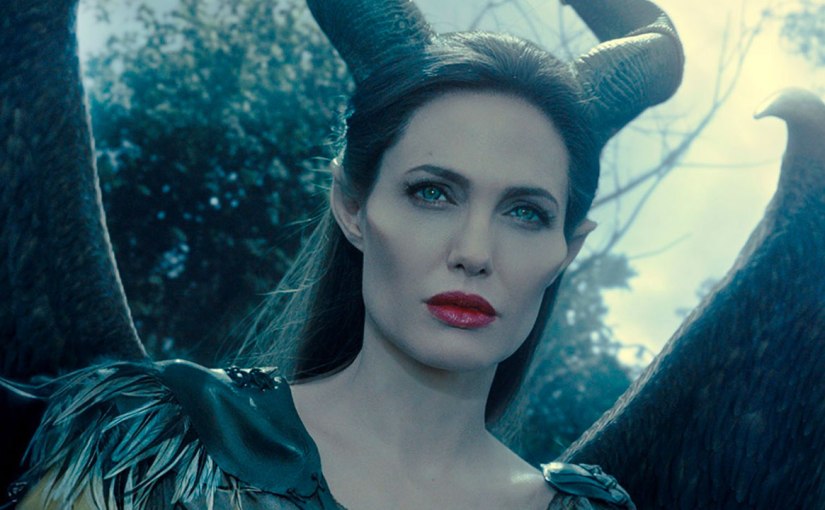
The wagon train of live action adaptations of Disney animated classics reached its pinnacle with 2014’s Maleficent. Much credit going towards Angelina Jolie’s portrayal of the title character. However, the visuals cannot be dismissed either. It’s a gorgeous film directed by Robert Stromberg.

Stromberg brings his wealth of experience in visual effects (Avatar and Master And Commander: The Far Side Of The World) to his directorial debut. The fantasy world of Maleficent’s forest, as well as the looming castle on its outskirts are dressed in gorgeous colors and vast dimension of pathways and caverns. The magical spells wafting in greens, golds, blues and reds, wielded by the characters, including the three protective fairies (led by a strong Imelda Staunton) is hypnotic and blends beautifully with the live actors’ performances. It’s as bold in the visual department as anything cropped up by Peter Jackson or James Cameron.

What makes this brisk 90 minute film special is a different point of view from the classic film Sleeping Beauty. Is there justification to a villain’s actions? Stromberg and Jolie certainly make a case for it. It’s a reminder that there are two sides to every story. Anyone ever consider that maybe Maleficent might have been betrayed at one point? I’ll be damned. At least that’s what I thought, after watching this film.

No one in life is born evil. I like to think people are made evil or perceived as evil. This film is a great example of that, much like the musical Wicked or the recent hit film Joker.

Jolie offers up the frightening aspects of the fairy dressed in black that we’ve been familiar with all these years. However, she’s fortunate that the capable script from Linda Woolverton offers up opportune moments to consider her soft, sensitive side. There are moments of no dialogue as Maleficent observes Princess Aurora (Sleeping Beauty) grow, and she develops a reluctant (it’s hard to resist calling her “Beasty”) affection for the child. Maleficent will even participate in a playful mud fight. There are more than just evil machinations going on here.

Unlike the other Disney live action iterations, Maleficent shows something new and unexpected. It harbors my appreciation for the film whereas Beauty And The Beast or Aladdin did not because they just churned out the same old thing.

If Stromberg’s film suffers from one weakness I’d say it could have used a stronger performance from Sharlto Copley (The A Team film adaptation) as the antagonist, Aurora’s father and Maleficent’s first love; the eventual king. There was not much threat from this guy. He was no match in character much less performance against Jolie.

Still, Maleficent is a great character film with lots of fun, whimsical visuals to explore.

MALIFICENT: MISTRESS OF EVIL

By Marc S. Sanders

Maleficent: Mistress Of Evil has a strong cast and a serviceable approach for the sequel to Disney’s 2014 live action hit. Yet, the film falters anyway.

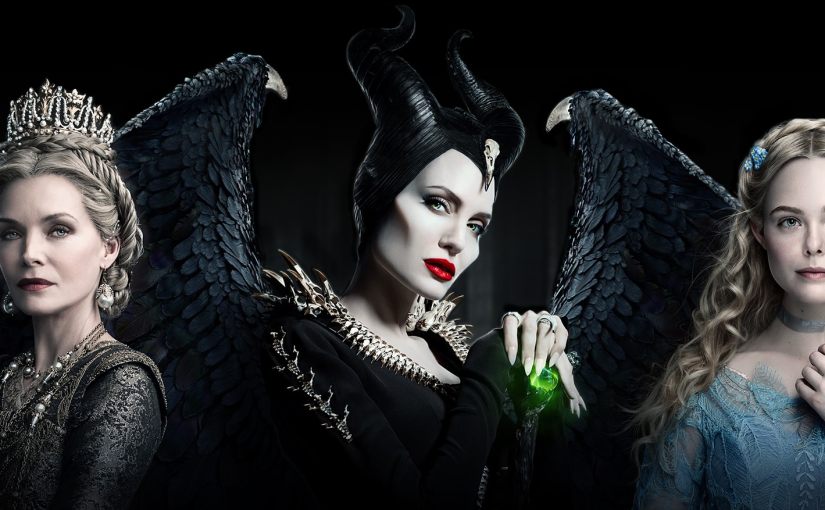
First, and this is always something that irks me, the sub title is completely inappropriate. (Like Star Wars: The Phantom Menace where the only menace was Jar Jar Binks, who was never my first choice to be a phantom.). The film carries a bait and switch title. Did the marketing department at the Happiest Place On Earth even watch the film? Angelina Jolie returns as the title character, still dressed in stereotypical evil black. However, the script penned by Linda Woolverton, Noah Harpster and Micah Fitzerman-Blue offer up an adoring struggle for her to keep up appearances. Never does the film imply that Maleficent returns to her evil impulses. Rather, she’s only characterized by Michelle Pfeiffer’s evil queen as such. So there’s a betrayal of advertising going on here.

The film directed by Jochaim Ronning is a Meet The Fockers variant. When Princess Aurora (Elle Fanning), who was unofficially adopted by Maleficent, gets engaged to the Prince, naturally the in laws have to become acquainted. As expected, dinner does not go very well and the King is spellbound, leaving Maleficent as the scapegoat forced into running underground where she meets up with her fellow fairy community ready to wage war against the human kingdom.

Pfeiffer’s queen uses this as an opportunity to convince the kingdom to wipe out the fairies. Yeah. You’ve heard this story a hundred times before.

I can forgive the redundancy of the storytelling. However, Rollins can’t get his film right. The cinematography is annoyingly murky in darkness and clouds and mist. Doesn’t matter if it’s the fairy kingdom, the castle or even the forest in daylight. Rollins serves up murky, dramatic effect for the sake of murky dramatic effect. It’s hardly visible. This film has Angelina Jolie and Michelle Pfeiffer. If I want to emit drama, I’m gonna rely on them to bring their game.

As well, and disappointingly, Jolie is hardly in the film, at least not enough to justify the title. Rather, Pfeiffer is here to chew up much of the scenes. There are long periods of storytelling where Jolie is nowhere to be seen. She actually doesn’t appear for at least the first 15 minutes. Again, like the title itself, the film under promises what it sells. I have no problem with Pfeiffer or Fanning. They’re really good. Yet, there’s just too many opportunities for them to exchange dialogue and threats, and not much else. Yes, you get to see the fairy kingdom, but they really are a miserable angry bunch for a family oriented film. The 3 fairies led by Imelda Staunton? Yup. They’re here…hardly though and they were the most fun of the last film. Maleficent’s sidekick, Diaval (Sam Riley) – the half man/raven? Well he’s only there when Maleficent is there (literal sidekick) and tell us he wishes he could be turned into a bear. What do you think happens? Incidentally, the CGI bear is nothing great, an uncolorful blur of roaring with a raven beak.

All of these elements present themselves but never follow through with any humor or fun or eye opening surprise. Instead we get a lot of Pfeiffer and Fanning.

The third act is straight out of Lord of the Rings with swords and shields and marching and charging. Meh. I was bored with all of this and the CGI of fairy flights and swoops looked blurry.

Clearly, Disney prioritized preparation of the film for IMAX and 3D. Can we let this go for a change, and just make a movie, please? It’s apparent, watching a 2D standard presentation of this film, where the 3D pops were to occur. Yet, it’s a lousy sacrifice for a simple view.

Maleficent: Mistress Of Evil is a shameless, opportune cash grab on Disney’s behalf. Crank out the sequel, prime it for 3D, get Jolie back for whatever time she’s available, and make sure to slap on a title that amps up the darkness that audiences relish and surefire goosebumps.

I like the story. The execution however fell very short however. No one will remember this sequel in a year from now.