NOSFERATU (2024)

by Miguel E. Rodriguez

DIRECTOR: Robert Eggers
CAST: Lily-Rose Depp, Nicholas Hoult, Bill Skarsgård, Aaron Taylor-Johnson, Willem Dafoe
MY RATING: 8/10
ROTTEN TOMATOMETER: 85% Certified Fresh

PLOT: The true OG vampire movie gets a fresh coat of paint in this gothic tale of obsession between a haunted young woman and the terrifying vampire infatuated with her.


Allow me to begin, as so many great films do, with a couple of flashbacks.

2018: The indie band Weezer records and releases their polarizing cover of Toto’s stone-cold classic “Africa.”  While recorded and produced with all the modern techniques at their disposal, fans of both bands say, correctly, that this new version is virtually identical to the original…so what was the point?  Couldn’t they have put some kind of new spin on it, like (for better or worse) UB40 and their cover of “Can’t Help Falling in Love”?  Why bother?

1991: Orion Pictures releases The Silence of the Lambs, an adaptation of Thomas Harris’s terrifying psychological thriller.  It goes on to win the coveted “Big Five” at the Oscars: Best Picture, Director, Actor, Actress, and Screenplay (Adapted).  Having devoured the book during one summer vacation, I go to a screening expecting to be wowed.  But…because the filmmakers stuck SO closely to the book (with some minor exceptions), there is little to no suspense for me.  While I am genuinely floored by how well-made and well-acted the film is, I do not experience any of the thrills and chills felt by those viewers who had NOT read the book.  I knew ahead of time what they would find in the corpse’s throat in the funeral parlor, how Lecter would escape from the courthouse, and how Starling would stumble upon Buffalo Bill’s house.  Don’t get me wrong, it’s a stellar movie.  But it was never truly scary for me.

Which brings me to Robert Eggers’s long-gestating remake of THE original vampire movie, Nosferatu.  Based on the immortal silent classic of the same name from 1922, directed by F.W. Murnau, the story will be familiar to any serious film/horror buffs, especially since Murnau “borrowed” liberally from Bram Stoker’s novel, Dracula, without first obtaining legal permission from Stoker’s estate.  How liberally?  Here’s a quote from IMDb: “All known prints and negatives were destroyed under the terms of settlement of a lawsuit by Bram Stoker’s widow.”  The only way the film survived was via 2nd-generation copies from other countries around the world.  Plagiarism?  Or homage?  I would normally say here, “You be the judge,” but the courts seem to have answered that question pretty definitively.

I mention this because every version of the Dracula mythology, starting with Nosferatu all the way through the semi-campy Hammer films to Coppola’s famous “low-tech” version and beyond – all of them tell the same story with only minor changes.  Consequently, the thing I look for in those films is not WHAT they’re telling me, but HOW they’re telling it.  Any student of pop culture knows Bruce Wayne’s origin story, so Batman Begins [2005] holds no surprises there, but the story is told extremely well, and so you roll with it, you know what I mean?

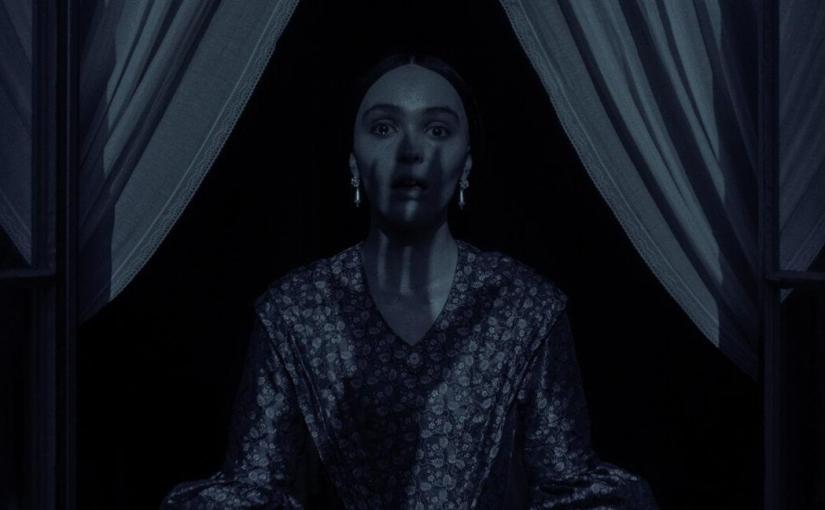
With Eggers’s Nosferatu, the production values on display are magnificent.  Eggers gets the mood and tone of a genuinely gothic horror story exactly right, as I knew he would, based on his previous films, especially The VVitch [2015].  The colors are muted to recreate the vibe of a black-and-white film, which paradoxically makes some of the scarier scenes even scarier.  The performances all around are top notch.  Poor Nicholas Hoult is saddled with the thankless Thomas Hutter role, stuck in straight-man mode the entire film; but Lily-Rose Depp had me thunderstruck with her performance as Ellen, Thomas’s wife, and the dependable Bill Skarsgård delivers the goods as Count Orlok, with a proper Transylvanian moustache (right out of the history books, haters) and an accent thick enough to tar ten miles of a country road with.

But let’s think about this for a second.  Those of you unfamiliar with the story of Nosferatu might be thinking to yourselves, “Who’s Thomas Hutter?  Who’s Ellen?  Don’t you mean Jonathan Harker and Mina?”  Well, naturally, those are the names the vast majority of filmgoers are going to be familiar with, not Thomas and Ellen and Count Orlok (which for my money is a much creepier name than “Dracula,” but I digress).

And therein lies part of the problem with this film.  I was so thoroughly familiar with the Dracula story that, even though this new film is a wonder to behold, it held very little suspense for me, since I knew exactly what was going to happen next, beat for beat.  There are, of course, cosmetic differences here and there: Thomas’s visit to a Romani village before he arrives at Orlok’s castle…Orlok’s straight-up possessions of Ellen…the highly effective jump-scares with the dogs here and there.  But I’ve seen it all before, MANY times.

(By contrast, I just recently watched one of the greatest slasher movies I’ve ever seen, X [2022], and it has virtually every slasher-movie-trope imaginable, and yet it somehow managed to transcend its own genre and become some kind of crazy masterpiece.)

In fact, in a very unexpected twist, there actually were two genuinely scary/creepy moments for me, and neither of them featured Count Orlok himself, at least not in the flesh.  They both involved Ellen, Thomas’s new wife, who becomes literally possessed by Orlok’s influence in scenes that legitimately give The Exorcist [1973] a run for its money.  Ellen thrashes about, rolls her eyes into the back of her head, speaks in an unnaturally guttural croak, bends backwards impossibly far – is Lily-Rose Depp a contortionist on the side? – and generally scares the bejeezus out of her husband and the audience.  On the strength of these two scenes alone, in addition to the general excellence of filmmaking craft on display, I would have no hesitation in recommending Nosferatu to moviegoers.

So, yes, despite my disappointments at the story level, given there were virtually no surprises plot-wise, I still give the movie a favorable rating just because it’s so well made.  If it had been created in a vacuum, if there had never been a vampire movie before this one, I believe I would have been creeped out to a much greater degree than I was, and this would have been hailed as an instant masterpiece.  But it is darkly beautiful to look at and wonderfully moody; there are many shots that are very nearly duplicates of shots from the original, which I enjoyed on a film-geek level.  I look forward to Robert Eggers tackling purely original material again.  He knows what he’s doing.

BORN ON THE FOURTH OF JULY (1989)

by Miguel E. Rodriguez

DIRECTOR: Oliver Stone
CAST: Tom Cruise, Kyra Sedgwick, Raymond J. Barry, Jerry Levine, Frank Whaley, Caroline Kava, Willem Dafoe
MY RATING: 7/10
ROTTEN TOMATOMETER: 84% Certified Fresh

PLOT: A biography of Ron Kovic, a fiercely patriotic Marine who fights in Vietnam, is paralyzed in battle, and experiences a dramatic turnaround upon his return home.


I can already tell this is going to be a difficult review to write.

There is nothing overtly wrong with Oliver Stone’s Born on the Fourth of July.  It is expertly directed, and the pacing never flags.  Tom Cruise’s Oscar-nominated performance is deservedly legendary; he leaves nothing in the tank, a fierce rebuttal to critics who thought he was nothing but a pretty face.  But even though there is much to admire, when the closing credits rolled, I felt oddly detached.  The movie kept me at arm’s length from really engaging with the lead character.  Or maybe I kept the movie at arm’s length.

Could it be that I simply don’t care for Vietnam films anymore?  Not likely.  One of my absolute favorite films is Michael Cimino’s masterpiece The Deer Hunter.  In fact, the opening scenes of Born on the Fourth of July are reminiscent of that earlier film in that it takes its time establishing the main character, Ron Kovic, as a young man in the early-to-mid 1960s at the dawn of the Vietnam War.  Born and raised in Massapequa, New York, his strict Catholic upbringing and his devotion to high-school wrestling instill a strong sense of right and wrong in the world.  A point is made about how America had never lost a war up to that time.  Kovic’s wrestling coach exhorts him and his teammates as if he were a Marine drill instructor.  “I want you to kill!  You hear me?! …You got to pay the price for victory, and the price is sacrifice!!”  It’s not very subtle, but Stone is making it clear that, in those days leading up to the Vietnam quagmire, the American credo was, “Winning isn’t everything, it’s the ONLY thing.”

Kovic enlists, sees combat, and during two horrific sequences, he experiences: an unintended massacre of Vietnamese civilians, the accidental shooting of a fellow soldier (with Kovic himself behind the trigger), and a fateful gun battle during which a bullet went through his right shoulder, collapsing a lung and severing his spinal cord, paralyzing him from the waist down.  These scenes are appropriately skittish and terrifying, putting us in Kovic’s boots and making us feel the unimaginable stress of fighting a war where half the time you weren’t sure who or what you were shooting at.  Kovic is shipped stateside…and here, as they say, is where his troubles REALLY began.

If the scenes set at the VA Hospital during Ron Kovic’s convalescence weren’t based on his actual experiences, I would denounce them as sensationalistic and manipulative.  Rats roam free among the beds.  (A nurse provides spectacularly unhelpful advice: “You don’t bother them, they ain’t gonna bother you.”)  Orderlies spend their down time getting high on marijuana or worse.  Unchecked catheters get backed up.  When a vital blood pump malfunctions, a doctor has to go to the basement to “rig up a substitute.”  And through it all, Ron Kovic does everything in his power to prove to the (correctly) pessimistic doctors that he will walk again, even re-injuring himself in the process.

(It’s futile, I know, to critique a film for what it’s not instead of what it is, but I can’t help wondering if I might have developed a more emotional reaction or attachment to the film if the entire film had focused on Kovic’s tenure at the VA hospital…although I will admit that would be a thoroughly depressing film.  Also, it might have developed some unintentional similarities to One Flew Over the Cuckoo’s Nest.  Who knows.)

The rest of the film details Kovic’s return home to his family, his emotional swings between the lowest kind of depression (“Who’s going to love me, Dad?  Who’s ever going to love me?”) and angry shouting matches with his parents and occasional bar fights.  Eventually, Kovic has a revelation: he still loves his country, but he can’t stand the government that sent him and his friends halfway around the world for a cause he no longer understands.  After a short hiatus in Mexico (I won’t get into too many details about that plot point because it’s the one section of the film that borders on boring), he returns home and dedicates his life to speaking up for the men and women who returned from Vietnam to a country that, at worst, hated them, and at best, simply didn’t care about them.

Again, the film is a stirring portrait of a man and a life.  However, as much as I want to, I can’t pin down what it is about the movie that failed to reach me at the kind of emotional level that other biographies have done before.  I just recently watched My Left Foot, with Daniel Day-Lewis’s towering performance at its center.  Another film biography, another main character confined to a wheelchair, a character who comes to terms with himself and how the world responds to him and comes up with a way to respond to the world.  But My Left Foot made my heart soar in a way that Born on the Fourth of July never achieved.  I watched the movie intently, focusing on every plot development and every nuance.  But it just didn’t grab me.  I am at a loss to explain why.

Could it be because of the presence of Tom Cruise in the lead role?  He showed these kinds of acting chops again ten years later in Magnolia, giving another Oscar-nominated performance.  In that movie, he completely disappeared into the role, despite having one of the most recognizable faces on the planet.  Perhaps the younger Tom Cruise (only 27 at the time) emits the kind of wattage that overshadows those around him?  So that you’re aware of the face first and the character second?  Maybe.  So why doesn’t the same thing happen in Magnolia or even The Last Samurai?  Perhaps it took him ten years to find a way to modulate or customize his performance so that, when it counts, the character comes first and the Cruise persona second.

I’m speculating.  The bottom line is, Born on the Fourth of July is a worthy addition to the resumes of both Oliver Stone and Tom Cruise.  It knows the story it wants to tell and resolutely sticks with it the whole way.  There are no sidetracks at any time, not even when he becomes an activist.  The focus is always on Ron Kovic, not the cause.  Stone and his screenwriters trusted that the story of Ron Kovic would draw enough attention to the cause on its own.  That approach would work with just about any other film.  This time, it had the effect of diluting the emotional experience while still holding my attention all the way through.  I would still recommend it to anyone who hasn’t seen it, if for nothing else to see Cruise play a role where he gets to sound notes he rarely got to play in his early career.  Would I watch it again?  Maybe.  I think the story is important enough for me to try to see what I might have missed this time around.

INSIDE MAN

By Marc S. Sanders

The abundance of Spike Lee’s films offer a message as quickly as the film begins.  Then they set out to demonstrate what Lee is talking about in the scripts he writes and/or directs and what is presented on screen for the next two or three hours.  BlacKKKlansman (a favorite of mine) and especially Do The Right Thing are perfect examples.  Lee is direct and hardly ever ambiguous.  Inside Man is an exception.  

This Spike Lee Joint is having a bit of fun with the director’s own take on the staple bank robbery found in so many films.  By the time the film is over, and all the cards are on the table, you realize the audacity of this caper is as unique as Sidney Lumet’s Dog Day Afternoon or Michael Mann’s Heat.  With a screenplay by Russel Gerwitz, Spike Lee is proudly vague until he finally reaches his conclusions during the third act of the piece.  It’s unusual.  It’s out there and it’s a stretch, but the math of the heist seems to add up.  Still, knowing what I know now, I do wish there was a little more focus on some characters that lend to the film’s twist. Then again, maybe that would have implied too much.

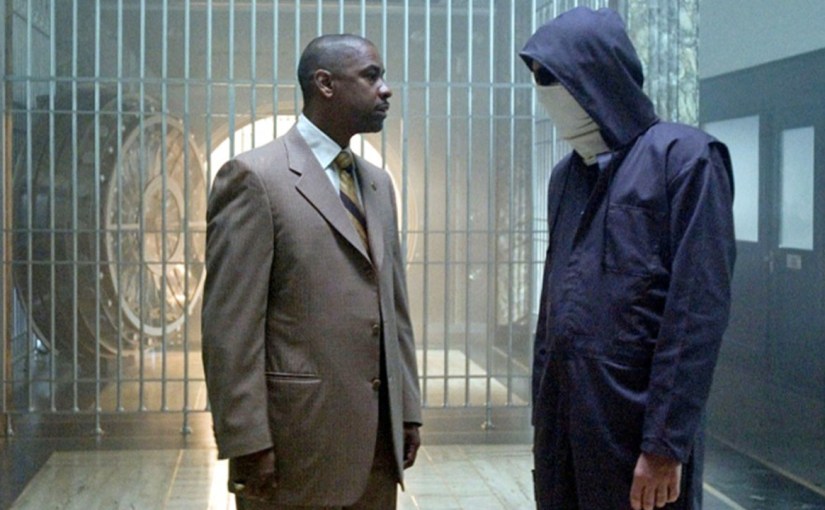
Four people wearing sunglasses, caps and painters’ uniforms take a well trafficked New York City bank branch hostage, complete with the entire staff and around thirty customers who are in the lobby.  The ringleader is played by a mostly concealed Clive Owen.  You might not see his face too often in the film, but you’ll be grateful he’s the bad guy in charge.

Denzel Washington is Detective Keith Frazier, and with his partner Bill Mitchell (Chewetel Ejiofor), they are on the scene attempting to diffuse the situation. The police captain right next to them is John Darius (Willem Dafoe).  Ejiofor and Dafoe are good as expected, though their roles are routine elements for these kinds of movies.  Washington has the kinetic pace that audiences are familiar with as he tries to outthink the bank robbers.  His character is labeled with a checkered reputation as he’s suspected of stealing drug money.  That element really goes nowhere.

Another party comes into the fold with Jodie Foster as a well-tailored and confident “fixer” hired by the bank’s president (Christopher Plummer).  To get these two actors together in a film along with Washington?  Well, that begs for repeat viewing.  Unfortunately, I didn’t see much point to the Foster character.  Upon hearing the news of the robbery, Plummer’s character clandestinely employs Foster to contain the situation so that a particular item in a safe deposit box remain untouched.  She arrives on the scene, exchanges dialogue with Washington that does not add up to much.  She surveys the hostages being held and then exits the story, until the epilogue.  As welcome as it is to see Jodie Foster, I can’t imagine what was gained from the context of her role, which does nothing to advance the story.

Inside Man always kept me interested and guessing.  The structure of Gerwitz’ script jumps ahead at times to show the detectives interrogating each hostage with suspicion after the incident is over.  So, I always wanted to know how it ever came to that shift in direction.  Plus, what happened to the bank robbers, and what precisely had Christopher Plummer so concerned about one particular branch robbery that he had to reach out for special services from Jodie Foster’s character? 

The answers arrive, and I can swallow the explanations.  Yet, the wrap up actually involves additional characters who hardly say a word or appear on screen earlier in the film.  Because they are briskly glossed over, it did not give me complete satisfaction.  I like the twist a lot.  It just needed a more solid foundation.

Inside Man is of those rare films that Spike Lee is invested simply for the fun.  The quick cuts and bustling New York atmosphere work well.  I love the opening credits to the movie; kind of his own spin on what Lumet did with Dog Day…  Lee has a good villain and appealing heroes. Other than few shortcomings, this is a solid crime drama.  

Often, Spike Lee positions himself on a platform that endorses a cause for the African American populace, or he brings attention to social wrongs in world history.  He is one of the best at what he does with his filmmaking approach.  Ironically, a message and a comeuppance arrive with Inside Man, but for a different demographic.  It might not be as hard hitting or thought provoking as other Spike Lee Joints, but it is appreciated.  

CLEAR AND PRESENT DANGER

By Marc S. Sanders

Tom Clancy’s Jack Ryan finds himself in an inadvertent private war between the United States and Colombian drug kingpins in Clear And Present Danger.  Harrison Ford returns as the heroic government operative. I like this film for much of the same reasons I liked the prior Jack Ryan pictures.  These movies give an inside view of internal politics within Congress, the CIA and inside the hallowed halls and Oval Office of The White House.  The Clancy adaptations are not just about action set ups and shootouts.  Though we are treated to plenty of that material as well.

The film opens with a luxury yacht being raided by the Coast Guard. They uncover Colombian killers that have murdered a wealthy American and his family for reasons of a failing partnership with drug dealers.  The incident can be bridged to the President played by Donald Moffat, a terrific character actor who also shared the screen with Ford in Mike Nichols’ Regarding Henry. He secretly initiates a retaliation for what has occurred while also insisting on collecting over six hundred and fifty million dollars he feels the US is entitled to, following his friend’s murder.  Henry Czerny, playing a carbon copy of his role in Mission: Impossible, headlines the covert plot and recruits a mercenary named John Clark (Willem Dafoe) to place a clandestine militant team into the South American jungles to take out the drug runners one by one.

The suit and tie formal dynamics fall on Jack Ryan when he swears testimony on the legitimacy of the country’s response.  However, the President’s armament exercises are unbeknownst to Jack.  When it finally dawns on him what has been occurring, into the field Jack Ryan goes to clean up the mess.

A lot of spinning plates structure the storytelling of Clear And Present Danger which is on par with Clancy’s thousand-page novels.  There’s an abundance of characters to address, betrayals to happen and even the mechanics of various weaponry and policy decisions that need exploring, despite the innate complexities of it all.  It can feel overwhelming.  However, with this film, as well as with The Hunt For Red October and Patriot Games, I feel included.  If you’re patient through the exposition and set ups, then these fictional controversies become very absorbing, and you feel like you’re there.  

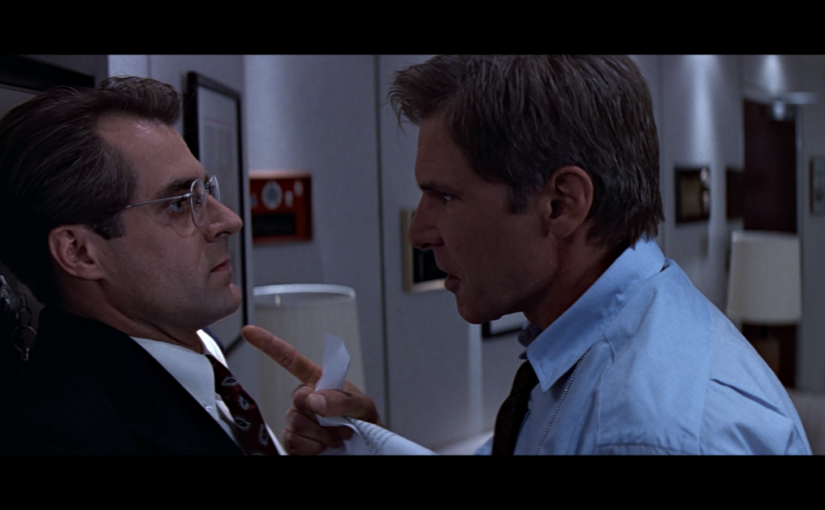
There’s a great scene between Ford and Czerny racing to download vs delete some suspicious files on a computer.  These guys are in their boring offices, dressed in their boring suits and they’re clicking on the mouse pad and typing away on the keyboard.  Director Phillip Noyce gets nail biting back and forth closeups on each guy as they are off to the races trying to get ahead of each other.  Then it becomes a yelling match in the hallway with threats of prosecution between both men, and I feel I’m in on the whole thing.

There is also a good amount of internal conversations between the main drug czar (Miguel Sandoval) and his top henchman (Joaquim de Almeida).  Almeida’s role is written very well as we witness how smart and resourceful he is while protecting the best interests of his employer.

For the most part, the action is nothing special.  However, the highlight of the whole film involves an SUV convoy getting ambushed by Colombian terrorists mounted on rooftops firing missiles at the government vehicles below.  Harrison Ford prefers to do as much stunt work as possible and it definitely helps the ten-minute sequence.  This is an outstanding part of the picture with perfect editing of sound and photography. Later on, we see Ford leap on to the landing gear of an ascending helicopter. Very impressive. Harrison Ford always does his best to invest himself in his movies.

I also admire many of the explosions that went into the Special Forces’ continuing storyline of sabotaging the drug lords’ laboratories and various locales. Nothing is miniaturized here, and the resulting blasts are really big and eye opening. This movie did not shortchange on anything it was attempting to accomplish.

The film adaptation of Clancy’s fourth book takes some major liberties.  In the novel, the story is primarily focused on John Clark and his mission, with Jack Ryan not appearing until after the midway point.  However, at this stage of Harrison Ford’s career there was no way he’d accept just a supporting role.  The notable changes hold well within the screenplay though, and a showdown between Jack Ryan and the President is one for the ages.

Overall, Clear And Present Danger was a successful picture at the box office. Critics and Clancy fans alike had favorable responses to the picture.  So, it’s disappointing that producers decided to try numerous reinventions of the Jack Ryan franchise subsequentially.  Those other movies, along with a TV show, would prove well.  Yet, it is regrettable that Harrison Ford, or at least this interpretation of the hero, did not move on through Tom Clancy’s ongoing stories transcending within other areas of government and espionage.  If you have read the books, then maybe you recall the unbelievable ending to Without Remorse.  Boy, would I have loved to see what Harrison Ford did with the cliffhanger that closed out that book. Care to know? Then this Unpaid Movie Critic suggests you pick up a book.

NOTE OF TRIVIA: James Horner conducts the music for this film and he includes samples that were used in the beginning of Aliens. Interesting to catch this as the music works for both a science fiction piece, as well as for a political thriller.

POOR THINGS

By Marc S. Sanders

A sexually explicit rendering of Mary Shelley’s Frankenstein is brought to life by Yorgos Lanthimos’ film, Poor Things.  The strongest element of the picture is certainly Emma Stone’s uncompromising performance as Bella Baxter.  It’ll at least get an Oscar nomination.  The film will likely collect an abundance of nominations as well for it’s fantastical imagination in art direction, garish costuming and makeup and directing.  Maybe there will be some accolades for Willem Dafoe and Mark Ruffalo as well.  The adapted screenplay of Alasdair Gray’s novel, written by Tony McNamara, is a contender too.  It’s already being hailed by many outlets as a top 10 picture for 2023.  Yet, I grew tired of the novelty, and bored with the excessive sexual exploits of Bella.

Bella was once a pregnant woman who deliberately plunged herself off a London bridge to escape her misery.  Godwin Baxter (Willem Dafoe), who Bella appropriately recognizes as simply God, discovers her lifeless body in time to conduct an experimental procedure.  Replace Bella’s brain with that of the unborn child she carries and raise her from there.  God is scarred and altogether bizarre, and recruits a medical student named Max (Ramy Youssef) to observe the reborn girl’s progression and behavior; a grown woman with that of an infant who is learning to speak, walk, eat, and behave for herself.  After a while it is decided by God that Max will become engaged to Bella.  However, another man enters the picture, Duncan Wedderburn (Mark Ruffalo), who convinces Bella to accompany him on a sojourn.  God permits the idea as an opportunity for Bella to learn what is out there and not restrict her.  It is at this point, that Lanthimos’ film transitions from a blue tinge monochrome photography to vibrant color as Bella and Duncan travel to destinations such as Lisbon, Alexandria, and Paris, where Bella abandons a destitute Duncan to join a Parisian brothel.  Bella sees opportunity.  She can earn money for allowing men to put their things inside her.

I could not help but think of films like Forrest Gump, The Curious Case Of Benjamin Button and even Pinocchio while watching Poor Things.  An unwise subject discovers an independence to witness how a world around her functions.  As she learns, she matures, and she realizes she does not need to be held down by any party.  Shelley’s monster also broke free of its master’s clutches, tried to acclimate itself, but was revolted against for its grotesqueness on the outside and simply for being misunderstood.  Bella does not encounter such a fate.  Instead, she discovers acceptance but only at what she’s worth monetarily speaking with a simple attraction limited to individual thought.

Poor Things is constructed in the narrative themes of Yorgos Lanthimos’ preferred way of filmmaking.  Just like The Favorite, it’s deliberately weird and proud of it.  Nothing appears conventional.  You could substitute the settings for Paris, London and even the cruise ship that Bella and Duncan travel on for set pieces in Wonka.  It’s all fantasy with an adoption of real-world locales.  I surmise Lanthimos excuses these outlooks as a perception of Bella.  The settings look like they were spawned from a pop-up children’s book.  It’s all so different but I found it to be tiring. If someone were to argue that it is inventive as opposed to another stale backdrop of London Bridge or the Eiffel Tower, I wouldn’t debate them. Yet, I was growing tired of the piece. 

Moreover, the second act of the film concentrates abundantly on Bella’s adventures within the brothel.  Bella discovers the comfort of self-pleasure.  Later, the sensation is enhanced by the possibilities of getting satisfied by the company of a man.  The audience chuckled.  So did I, but I also squirmed quite a bit.  Bella insists to God that she wants to “go adventure,” and God allows her his blessing.  Yet, I found these series of sexual encounters to be overly exploitive.  Nothing is held back on what Emma Stone performs for the camera as a concubine for one needy, stinky, and ugly gentleman caller after another.  She takes it the traditional way, the oral way, the way from behind and much more.  She is captured with S & M straps across her nude body and the Oscar winning actress goes all the way to sending the scenes home.  It’s as if Yorgos Lanthimos needs to deliver his point, but it’s not enough to try it once, twice, or even three times.  I get it already.  Bella is used for whatever fetishistic imagination the male mind can fathom and more importantly she thrives off of the stimulation. She happily recounts how a pineapple can be used in the bedroom.  It’s even better that she can get paid for this lifestyle.  It sounds amusing while I type this all out, but I was not entirely comfortable watching it either.  I’ve seen enough porn in my day to not be shocked, and I wasn’t shocked.  Yes, I was amused at times.  Look, I don’t have ice water running through my veins.  Eventually, though, I was just bored.

Godwin Baxter is an interesting character as played by an always reliable Willem Dafoe.  Early on, we see how in addition to his experiment with Bella, God has toyed with the ideas of blending different breeds of animals together.  Roaming his estate are the likes of a dog crossed with a chicken and a pig crossed with…you know what I can’t even remember after seeing the film only once.  There was also a duck crossed with something.  Kind of sophomoric material and I think Lanthimos would accept that observation as a compliment.  Oh yeah, there was a goat crossed with something too; was that the pig?  What I think lacks from Poor Things, however, is to probe if these kinds of experiments should even be conducted and I cannot recall a conversation that goes in that direction.  Max seems taken aback by what he witnesses but he never investigates further.  This is all most unusual (a serious understatement) and it’s hardly ever questioned. Even Jeff Goldblum tossed a contrary opinion at the idea of Jurassic Park.

I suppose I wanted more from Poor Things.  Beyond sexual pleasure and what can be gained from it, isn’t there anything else that naïve Bella has to learn about?  I guess in conjunction, she also learns how to earn a wage and a gumption to stand up for herself.  What about love and the fear of death?  What about what else occurs within the world around her?  What about loss, or betrayal?  As well, Godwin’s occupations never go further than what we see he is capable and daring enough to do.  How do others consider his experiments?  What residual effects stem from his accomplishments?

I’m glad I saw Poor Things.  I think I’d like to see it again actually because I may gain a greater understanding from the attempts the script strives for in accordance with Lanthimos’ vision.  I know this film is not for everyone, though.  It’s proudly peculiar, but its plodding in its glee to step very far over a line that most filmmakers wouldn’t dare go.  It has my salute for what it has set out to do.  Nonetheless, I’m not sure I’m a fan of the material it served, though.

PLATOON

By Marc S. Sanders

Oliver Stone’s Oscar winning Platoon takes place in the late 1960s, somewhere on the Cambodian border during the Vietnam War.  Many of the chaotic happenings the film presents are based on Stone’s own experiences after he voluntarily enlisted to fight.  However, while there is an unwinnable war occurring for the American troops, there is just as horrifying a battle going on within the ranks of the platoon the film focuses on.

Charlie Sheen echoes a lot of his father’s, Martin Sheen, voiceover narration, and performance in Francis Ford Coppola’s Apocalypse Now.  He portrays Chris Taylor, a college dropout who voluntarily enlisted for a one-year tour of duty to serve.  After only one week within the harsh, humid, and wet jungles, he’s writing his grandmother a letter asking what the hell was he thinking.  Chris is quite virginal to the harshness of war and that won’t work to his advantage when needing mentoring and support from his fellow soldiers.  The newest enlistees are the ones at the front point.  They haven’t devoted enough time to sit in the back and because of their lack of experience with war, they are not as valuable for the ongoing campaign in battle.  Platoon is not the heroics depicted in John Wayne movies.  This was one reason that Oliver Stone wanted to make this picture.  Platoon is a bitter retort to Wayne’s celebrated movie, The Green Berets.

There is an angel and devil flanking Chris in the form of Elias (Willem Dafoe) and Barnes (Tom Berenger).  Berenger is the cruel side of the conflict with his battle-scarred face.  He gives his underlings the impression that because he’s seen so much fighting and endured being shot seven times, that he must be invincible.  Elias is a fighting soldier, but he adheres to the rules of war and when it is time for rest, he joins his fellow troops in a unified vigil of drug-induced relaxation.  Chris warms up to Elias easily despite his initial fears of being a soldier with no experience or knowledge of how to survive, much less fight alongside his fellow men.

What drives the conflict between Barnes and Elias occurs following the first act of the movie.  The infantrymen come upon a Vietnamese village.  Some men, including Chris, get wildly abusive with the unarmed people, burning and pillaging their huts.  Only after Chris gets control of himself does he realize the wrongs he’s capable of by serving in this war.  He prevents a group of men from gang raping a child.  Furthermore, he witnesses Barnes commit the illegal murder of a defenseless village woman, shot at point blank range.  Elias has his bearings though and will file the proper reports when the opportunity permits.  Nothing in Platoon is easy though.  This war rages on and the possibility of an investigation and court martial is held off while the fighting continues. 

An interesting take on Oliver Stone’s direction is that he never really shows any close ups or lends any dialogue to the Viet Cong.  I believe Stone is confident that people know who our battalions were supposed to engage with.  However, as another favorite picture of mine stated (Crimson Tide), the true enemy of war is war itself.  The enemies of Elias, Chris, and Barnes as well as the rest of the platoon permeate within and among themselves and it lends to the chaos of the brutal combat scenes depicted in the film. Stone doesn’t offer much opportunity to see who any of the soldiers are shooting at or who is shooting at them.   There is much screaming and hollering but who are any of the characters shouting at and can they even be heard or understand what is being said amid the gunfire?  Platoon demonstrates that a Vietnam war picture is not one of heroics with grandstanding trumpets and a towering John Wayne who takes a hill.  War is disorganized, messy, and terribly bloody. 

This may be Charlie Sheen’s best film of his career.  As he represents the fictional account of Oliver Stone’s personal experiences, we see the trajectory of his change.  He is supposed to be there for 365 days, and he, along with his buddies, count down to when their tour will be complete.  However, this one short year will be the longest he ever encounters, and it will change him permanently, assuming he survives.  Chris is always tested of his tolerance.  He’s always subject to respond to how Barnes commands or how Elias mentors and leads. 

Oliver Stone is so convincing in his often-documentary approach to Platoon that it is at least understandable to see how the men in this picture behave and carry themselves.  Why do they refer to the Vietnamese as “gooks.”  Why do they bully with intent to commit rape.  Why do they quickly pounce to kill when for even a moment there is no threat.  Moreover, why they are willing to turn on each other.

They were never the decision makers for this conflict.  These soldiers are depleted of sleep and rest.  They are the pawns of a higher power, and they have been left to their own devices in a dense environment infested with bugs, snakes, unbearable humidity, and bodies that infest the waters and land while armed men appear out of nowhere ready to ambush.  Some ensnarements might occur within their own regimen.  None of these men are justified in their actions.  Yet, it is not hard to understand where their motivations stem from.  They are not programmed for heroics.  Keith David portrays a likable soldier who tells Chris that his mission is just to survive until he’s summoned home.  Survive among those you march and sleep with.  Outlast this hellish environment and overcome those that are trying to mow you down in machine gun fire.  Everything else around here is “just gravy.”  When you are an infantryman, you are not making a statement any longer.  You are not fighting for a cause anymore.  You are only trying to stay alive.

Platoon is such a shocking film of unconventional madness and turmoil.  Oliver Stone is relentless in the set ups he stages.  This picture came out in 1986, long before the strategic methods of the modern “shaky camera” approach.  It’s beneficial to watch the film as Stone must be positioning his camera on a track as the platoon hikes through the forest, parallel to his moving lens.  We are walking alongside them.   Early morning overhead shots depict the carnage of battles that occurred in the dark of night. Flares and sparks come from nowhere.  I think you could watch this movie ten times and still not know when to expect gunfire to intersect with the story or when the bombs to go off.  It’s hectic hysteria like I can only imagine these young men experienced before they spilled their blood on the battleground and either died right there or returned home physically and mentally crippled for life.

Platoon is one of the best and most frightening war pictures ever made.

ASTEROID CITY (2023)

by Miguel E. Rodriguez

DIRECTOR: Wes Anderson
CAST: More Actors Than You Can Shake a Stick At
MY RATING: 5/10
ROTTEN TOMATOMETER: 76% Certified Fresh

PLOT: In the mid-1950s, a roadside motel in a fictional mid-Western flyspeck plays host to a junior stargazing event that unexpectedly escalates, changing everyone’s world view forever.  …sort of.


Asteroid City, Wes Anderson’s latest film, feels like a collector’s edition box of Cracker Jack with no prize inside.  Or a cake that has prize-winning decorations, but it’s hollow inside.  It looks phenomenal; one of my fellow cinephiles, Anthony, predicts it will be nominated for cinematography and production design, and I agree with him.  But where the heart of the film should be is simply a crater like the one around which the fictional town of Asteroid City was built.  This is yet another star-studded cast for Wes Anderson, but Anderson has given them very little to do other than wear colorful costumes, look solemnly into the camera, and speak in very precise phrases.

This strategy has served him very well…no…EXTREMELY well in the past.  Moonrise Kingdom (2012) and Grand Budapest Hotel (2014) spring immediately to mind.  But some crucial piece of machinery is missing from Asteroid City.  The characters are colorful and quirky, but at the end of the day, I simply didn’t care about what they did or said.  (Well…except when actress Midge Campbell [Scarlett Johansson] decides to rehearse her nude scene for her next-door neighbor…I did care about that.)

The film opens with a pillarboxed segment in black-and-white.  Our host (Bryan Cranston) explains that we’re about to watch a staged presentation of the newest play from author Conrad Earp (Edward Norton), who proceeds to lay out the “set” for us.  “Upstage right is the crater…upstage left are the motel cabins”, etc.  Then the screen expands to full letterbox and we are treated to eye-popping Kodachrome desert landscapes as we follow a 165-car freight train as it passes by Asteroid City.  Well, “City” should be in quotes…the population is officially listed at eighty-seven.

This is some wacky city.  It’s as if Wes Anderson watched every Coen Brothers film set in the Midwest, from Raising Arizona to No Country for Old Men, and filtered them through a Looney Tunes cartoon written by Charlie Kaufman.  Vending machines on the porch of the rental office sell everything from snacks and drinks to martinis and parcels of local real estate.  (Cost for the real estate parcels: forty quarters…they’re not big parcels.)  An abandoned highway overpass lurks on the outskirts.  Periodically, a police chase roars down the otherwise empty highway, guns firing and sirens blaring.  The residents say nothing about this phenomenon.  And every now and then, the town shakes from nuclear testing being done hundreds of miles away, but close enough that the mushroom clouds are visible.

Man, I love this kind of thing.  The stage is set for one of the all-time great satires, or maybe just a flat-out fairy tale.  We meet the cast of characters who have congregated here to honor young geniuses who have invented everything from rocket packs to particle guns to a projector strong enough to project an image on the moon.  A full rundown of all these characters would wind up being a novella, but if you’re acquainted with Anderson’s work, they will all be familiar to you in one way or another.  (Not least because many of them have worked on Anderson’s other films.)  They have also gathered to witness a rare astronomical event: a solar ellipse.  Not an eclipse.  An ellipse.  The mechanism required to view an ellipse without damaging your retinas looks like something out of Brazil.

Again, I normally love this kind of stuff, really, I do.  But…okay, look, first of all, the film intermittently takes a break from the movie itself to yank us out of the story and show us an event in the playwright’s life that led to the casting of Augie Steenbeck.  Or to show us a rehearsal where an acting coach (Willem Dafoe) encourages the actors – that we’ve already been watching perform in the movie/play – to improvise what it’s like to wake up by first falling asleep.  There’s even a moment where the host shows up where he really shouldn’t be.  And when one of the actors has a moment of existential crisis concerning the character he’s playing, he simply walks off the set, goes backstage and asks the director (Adrien Brody) why he’s doing what he’s doing.

…I mean…what IS this?  Conceptually, I get it, even if it’s a little heavy-handed.  (“What’s my motivation?”  “You’ll have to figure it out as you go along.”  “That’s too hard!”  “Well, that’s life.”)  But…why is it here?  Anderson worked with non-linear structure before in Grand Budapest Hotel, and it worked marvelously.  Here, it feels indulgent.  In fact, many of the scenes in the movie feel that way.  There’s a moment where an army general (Jeffrey Wright) announces he’s going to deliver a speech he’s prepared for the occasion of the “ellipse.”  But this is no ordinary speech.  It’s practically beat poetry, delivered with the kind of conviction that only Jeffrey Wright’s magnificent voice can provide, but…but…why is it here?  Even in this weird, cotton-candy, retro-fever-dream of a movie, this “speech” felt out of place and just plain goofy.  In fact, quite a lot of the scenes between characters felt less like story and more like the kind of dialogues you find in source books for actors.  (101 Scenes for Two and Three Actors…that kind of thing.)

I will provide full disclosure and say the movie did deliver some decent laughs and chuckles.  There is an event that occurs during the ellipse (I’ll have to tread carefully here) that may not be entirely unexpected, but it’s executed and timed so well that I laughed pretty much through the whole scene.  It’s the kind of thing I imagine Buster Keaton and Charlie Chaplin would have thoroughly enjoyed, if I may be so bold.  There is also the problem of the disposition of a Tupperware container holding a valuable, ah, keepsake.  Oh, and that roadrunner was awesome.

But by the time Asteroid City rolled credits, I didn’t feel like I had seen one of Wes Anderson’s best films.  (The Royal Tenenbaums remains his best film, in my opinion.)  This almost felt like a movie made on a whim, kinda like, “Hell, I don’t know if this’ll work, but if I get enough star power behind it, this may turn out to be something.”  Alas, it did not.

THE LIGHTHOUSE (2019)

by Miguel E. Rodriguez

Director: Robert Eggers
Cast: Robert Pattinson, Willem Dafoe
My Rating: 8/10
Rotten Tomatometer: 90% Certified Fresh

PLOT: Two lighthouse keepers try to maintain their sanity while isolated on a remote New England island in the 1890s.


tone poem
NOUN, a piece of orchestral music typically in one movement, on a descriptive or rhapsodic theme


As I watched Robert Eggers’ The Lighthouse, that term “tone poem” kept leaping to my mind.  It’s not told in a standard or familiar fashion.  There are scenes where we’re not sure, until they’re over, whether they’re real or not.  The Willem Dafoe character, Thomas Wake, makes references to behavior in the past by the Robert Pattinson character, Ephraim Winslow, that Winslow never committed…or did he?  We are certain that Wake is the character who is going mad, if he’s not there already.  But what if it’s the other way around?  Or are they both going mad?

The mood or tone of the piece seems to be insanity and how one might get there given the right circumstances.  In many ways, it has quite a bit in common with another sensational tone poem of madness, Stanley Kubrick’s The Shining (1980).

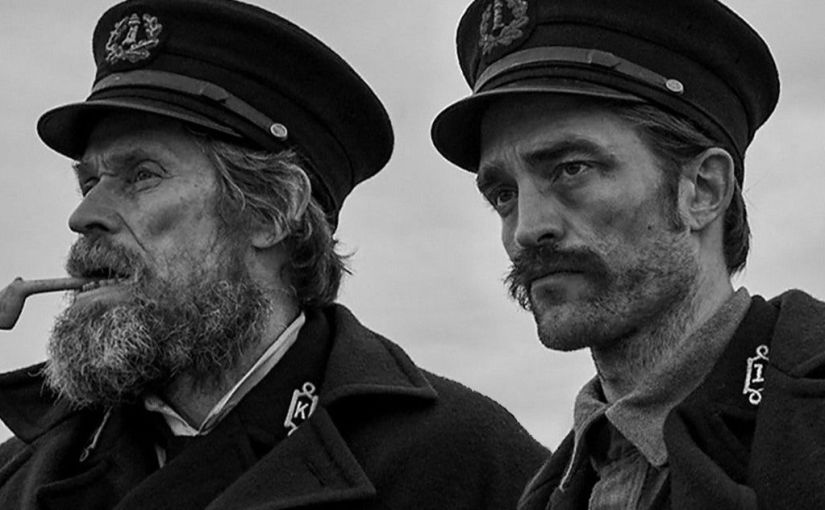
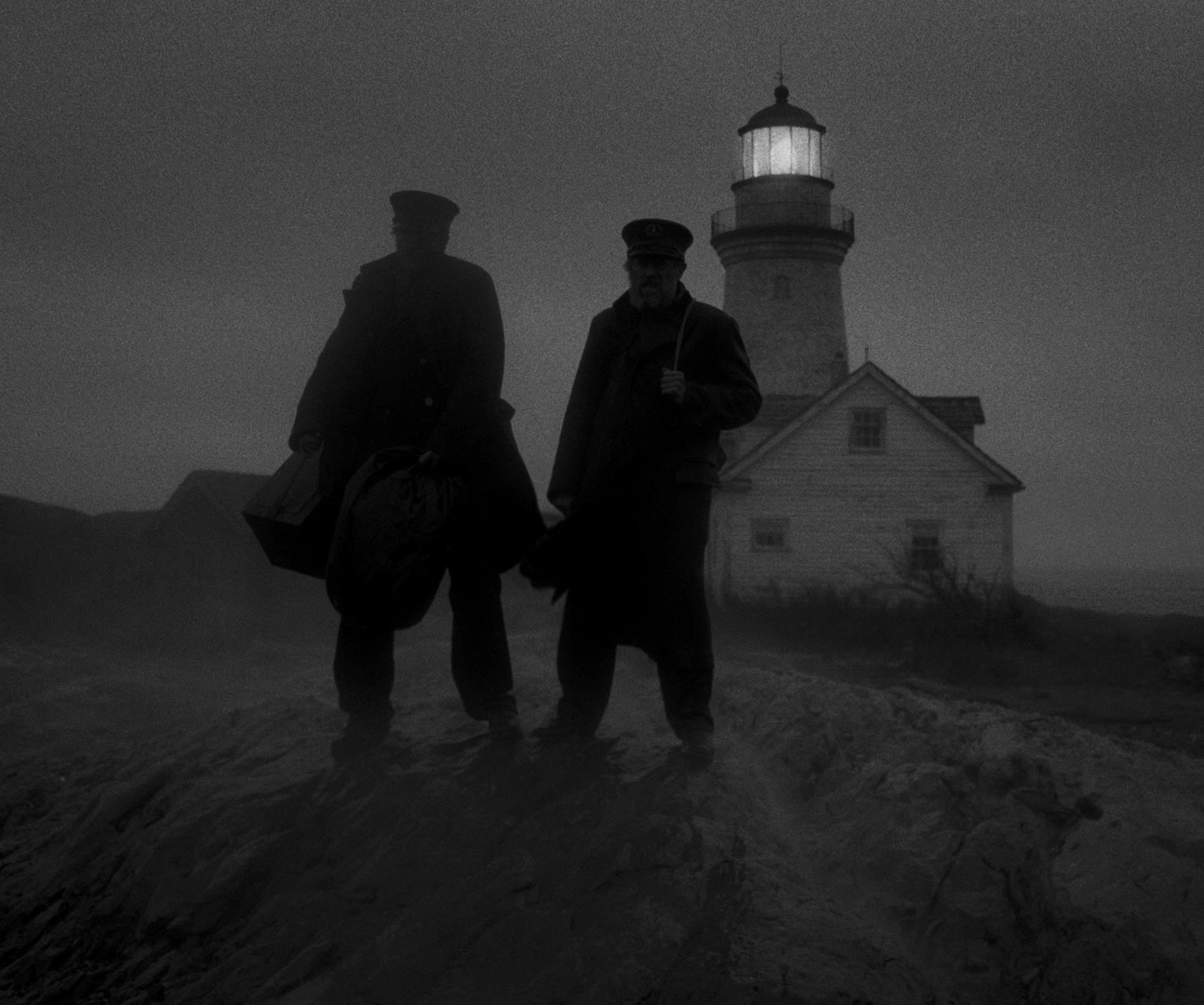
Two men, Wake and Winslow, are lighthouse keepers in the late 19th century.  They are brought to a remote island in the stormy waters off the New England coast and left to fend for themselves for four weeks until the next tender brings supplies.  Wake (Dafoe) is a crusty old veteran lighthouse keeper whose speech and mannerisms appear to be based on Long John Silver, right down to the gimpy leg.  Winslow (Pattinson) is a much younger and, let us be honest, handsomer gentleman who keeps to himself whenever possible.  He tends to his duties, sometimes grudgingly but mostly not, but wonders why Wake flatly refuses to share the duty of tending the actual light source at the top of the lighthouse.  That mystery lies at the heart of the film, but don’t expect all your questions to be answered by the time the credits roll.  Fair warning.

A key decision by director Eggers was to shoot in black-and-white and in a very old screen format, 1:19, so the picture area is a virtually square space in the center of the screen, with black bars on either side.  (The Coen brothers did something similar with their brilliant adaptation of The Tragedy of Macbeth [2021].)  This visual language creates a uniquely claustrophobic atmosphere, especially in scenes taking place in Wake’s and Winslow’s quarters.  The walls are closer together, the ceiling feels lower, and the actors’ faces seem much closer to the screen than normal.  Even exterior shots seem more constricted and confining.  Wide open sky doesn’t look as inviting as it might to someone essentially imprisoned on a storm-lashed island for four weeks.


Like all the best films, The Lighthouse begins its descent into madness slowly and gains momentum as time passes.  Winslow discovers a mermaid figurine stashed inside his mattress.  That night he dreams about a mermaid in the surf.  Or was it a dream?  We glimpse Wake standing naked at the top of the lighthouse, almost as if he’s worshiping the light itself.  When Winslow tries to get a closer look at what Wake is doing up there, he glimpses something…supernatural.  Or does he?  The film is brilliant at not only portraying mounting madness on the screen, but also at conveying the tone of madness in the cinematography and editing.  If we’re not quite sure what is happening, even when we see it happening, that’s on purpose.  The audience is meant to be kept off balance throughout the movie to put us in the heads of the two main characters.

Another factor that I found riveting was the acting workshop on display from both Pattinson and Dafoe.  We’ve seen this kind of thing from Dafoe before.  He chews the scenery with Nicolas Cage-like gusto, spittle flying, prosthetic teeth flashing in manic sneers, and that crazy piratical accent.  If it had been revealed during the film that his character’s last name was Osborne, and that he was a distant relative of Norman Osborne from Spider-Man (2002), I would not have been the least surprised.

But equally impressive is Robert Pattinson’s performance, which must be seen to be believed.  Here is an actor who is set for life after being a part of two of the most profitable film franchises in history (Twilight and Harry Potter) and who has just rebooted a third (The Batman [2022]).  But in this film, he easily keeps pace with Dafoe’s quirkiness, which is not easy.  As his character descends into madness (or does he?), Pattinson dances a jig while singing a sea shanty that devolves into complete gibberish.  He laughs like a loon.  He, ah, takes some time for himself while fondling that mermaid figurine from earlier.  It’s the kind of performance that might be described as “courageous.”  He swings for the fences with abandon.  In so doing, he helps to make The Lighthouse one of the most unique movies I’m ever likely to see.

But what is really going on at the top of that lighthouse?  Why do seagulls pester Winslow so often, seemingly unafraid of him in any way?  Why does he continue to dream about mermaids?  IS he dreaming them?  Is Wake actually a merman?  Did real foghorns sound like that?  Why is one seagull missing an eye?

Well, come on, I’m not actually going to ANSWER those questions, but those are questions that occurred to me.  The movie does answer quite a few of them, but not all.  The point of the movie, like The Shining, isn’t about solving the mystery.  It’s about conveying the mystery, creating a mood of dread, and wallowing in it for a good 110 minutes.  It’s not the happiest movie I’ve ever seen, but it’s definitely one of the most original films of the last ten years or so.

TO LIVE AND DIE IN L.A.

By Marc S. Sanders

William Friedkin is the director of one of the greatest automobile chases ever put on film with the 1971 Best Picture The French Connection. In 1985, he tried to up his game with the counterfeit caper called To Live And Die In L.A. He just about tops himself.

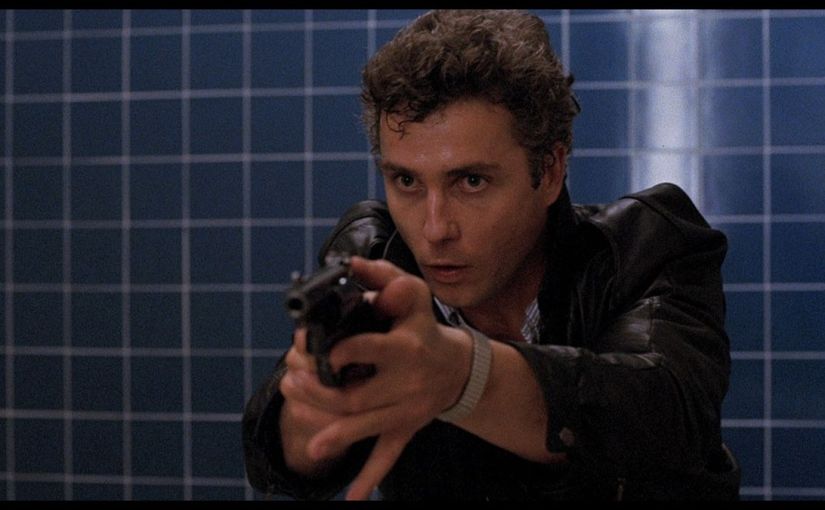
It is a dated flick with a Wang Chung soundtrack, popped up shirt collars, black leather jackets, and skinny ties. Friedkin goes Miami Vice and it more or less works but his lead player, William Peterson, is no Don Johnson. He’s more like a contestant on the dating show Love Connection.

Peterson plays a Secret Service agent with the last name of Chance; Richard Chance to be more precise. Kind of apprapo as he seems to always test his fate like bungee jumping off bridges (long before bungee jumping was ever a thing) and taking his tactics over lines that should not be crossed.

Chance is on the trail of nabbing counterfeiter, Rick Masters (Willem Dafoe), who killed Chance’s partner with only three days left until retirement. The cop who gets killed early on always seems to have three days left until retirement. To get at Masters will require Chance to…well…take some chances. He’ll blackmail a prostitute informant. He’ll also pressure his new partner (John Pankow) into circumventing policy. As well, like any movie cop or agent, he’ll go against the instructions of his supervisor. Chance might even rip off a diamond dealing exchange.

The acting is nothing special here. Peterson looks more athletic than fierce or driven. He’d never be Gene Hackman. Dafoe’s weirdly youthful appearance with his Benneton ‘80s outfits look…just that…well…weird! He’s an artist (like with actual paintings) while also printing fake money.

Friedkin’s film carries on its longevity through the years with an effective car chase; one of the best on film. From what I can tell he mounted a camera on the hood of the car. The camera can pivot 360 degrees. So we can see Peterson driving the car and then the camera can swoosh and turn to give a point of view as to where the car is driving. So now the viewer can see where the cars are careening and turning and speeding towards. It gets especially hairy when the car goes the wrong way up the freeway exit ramp into rush hour traffic. No CGI work here. This is in your face material.

To Live And Die In L.A. is worth the watch. A surprise moment towards the end also gets your attention by going against the typical cops and robbers formula film. The shoestring budget is apparent here with quite dull, very dull, cinematography and no big stars at the time (Peterson, Dafoe, Pankow, John Turturro, Dean Stockwell). However, William Friedkin does his best to make every moment worth it, and I can’t deny it, this 80s raised kid thinks the Wang Chung soundtrack is so friggin’ cool.

NIGHTMARE ALLEY (2021)

By Marc S. Sanders

Guillermo del Toro’s Nightmare Alley is a visual feast of the macabre set in a Depression era western America.  Every caption caught on film is unbelievable to look at, and while I know del Toro released his picture in black and white to enhance its film noir theme, I was truly delighted with the color version of the film.  With del Toro’s direction and photography designed by Dan Lausten, every dimension and sparkle of color from a sunset to a dreary cloud in the sky to the lights on a Ferris wheel spinning in an open field from the distance is absolutely jaw dropping.  Nightmare Alley is a modern technical masterpiece.  It makes me want to go back and watch the original 1947 version, as well as explore other productions in the film noir category.

Bradley Cooper portrays Stanton Carlisle, a murderous drifter who ends up accompanying a traveling carnival of garish figures who entertain their quirky qualities for townsfolk to be marveled and amazed.  There’s the flexible snakeman, the world’s strongest man (del Toro regular, Ron Perlman), the smallest man alive, the electrical woman, the psychic and the terrorizing, caged “geek” who will eat the head off a live chicken in front of your very eyes.  At first Stanton serves as a heavy meant to carry loads and set up and strike the tents and stages as the show moves from town to town.  He connects though with the psychic (Toni Collette) and the architect behind her façade (David Strathairn).  Soon, Stanton is adopting their techniques of using code words and hand gestures to “read the minds” of the various audience participants. 

He goes even further by redesigning the electrical woman’s presentation. Before she was using teslas to demonstrate her will to generate electrical currents.  Now she can be zapped in an electric chair.  The woman is Molly (Rooney Mara), and a relationship begins that sends her and Stanton on a successful tour away from the carnival where they entertain more sophisticated and wealthier nightclub guests with his psychic abilities.  One attendee, however, is on to Stanton’s devices, a beautifully alluring psychiatrist named Lilith (Cate Blanchett).  She maneuvers Stanton into using his manipulative talents into conning her clients.  She has recorded her sessions and will share confidential information with Stanton. Then, he will use that towards his ongoing psychic advantage as a means to swindle them of their fortunes.  Lilith and Stanton will split the rewards.  The play seems convincing enough for the likes of a wealthy industrialist named Ezra, played by Richard Jenkins yearning to reconnect with his deceased wife at a cost of thousands of dollars for Stanton’s services.

The narrative of Nightmare Alley is so absorbing.  Everything is beautifully staged.  A fun house hall of mirrors has a décor of disturbing imagery.  Stanton enters this place symbolically at the beginning of the film in search of the runaway “geek.”  The surroundings display the seven deadly sins around a large skull and other haunted house imagery.  del Toro demonstrates what Stanton is about to enter, which occupies the remainder of the film.  Stanton performs on the motivations of greed and lust and vanity.  Maybe, pride as well.  At least those are the first couple of sins that come to my mind.  How will his actions reflect back on him later on, though?

The film is also performed by a magnificent cast.  Cooper is doing some of his best work here.  While I feel like I’ve seen Blanchett’s deceitful character before, I don’t mind.  I can’t think of anyone else to play the role.  Curiously, del Toro has Mara, with her snow-white complexion, dressed in red quite often amid a cast of characters and extras wearing blacks and dark greys.  She’s meant to stand out as the innocent.  Molly questions Stanton’s decisions while also trying to convince him to end his charades.  Yet, she only serves as a disturbing pawn in the shyster’s tricks.  Will Stanton corrupt Molly though?  It’s one thing to put on a magic show for a couple of hours each night.  It’s another when you are swindling the massive fortunes of others and toying with their despair. 

Other surprise performers that appear include Willem Dafoe as the showman for the “geek,” and a late appearance by Tim Blake Nelson to close out the film and deliver what’s to come of Stanton. 

Nightmare Alley deliberately moves at a slow pace, but that only allows you to take in its various environments.  From the carnival tents to the nightclubs to the alleyways, to Ezra’s snow covered never-ending garden, and even Lillith’s gold embossed office of cabinetry and furniture are so hypnotic and dark in its intended film noir way.  Again, while I’m sure there’s some striking qualities to the black and white interpretation of the film, I really fell in love with the colors provided by Lausten’s photography.

I won’t call this a favorite film of mine, but I loved the journey of it all.  I appreciated the script by del Toro and Kim Morgan, adapted from the novel by Lindsay Gresham, that depicts a sinful man like Stanton devolve into more sin, until he’s only undone by a smarter sinner than he; a sinner masked within beauty and wealth with a noble and educated profession.  Bradley Cooper and Cate Blanchett perform beautifully with one another.  They make a terrific pair.  I only hope they’ll do another film together.