GHOST

By Marc S. Sanders

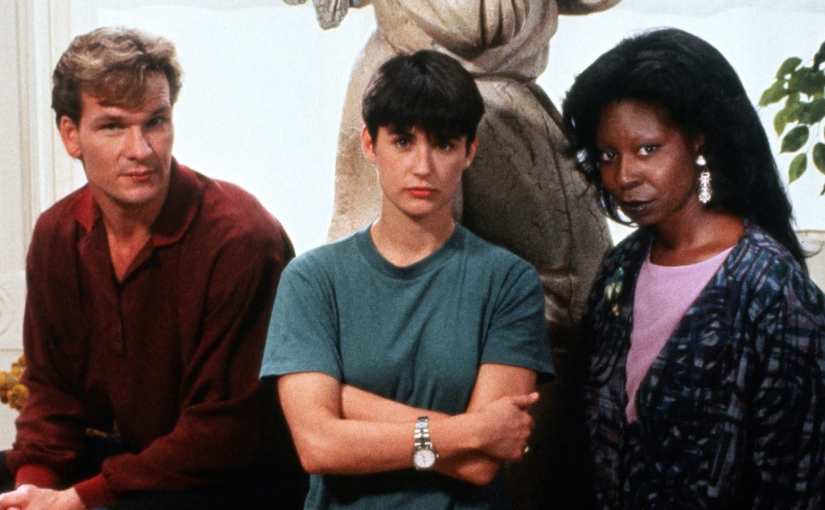
For a perfect blend of the supernatural, suspense, mystery, drama, romance and comedy, the first film that will always come to mind is the surprise hit film Ghost from 1990.  One of the zany Zucker brothers, Jerry to be more precise, who introduced the world to slapstick spoof (Airplane!, The Naked Gun) directed this film turning Demi Moore into a ten-million-dollar actress, placing Patrick Swayze ahead of his Dirty Dancing looks and earning Whoopi Goldberg a very well-deserved Academy Award.  Ghost was a film for all kinds of movie goers.

Sam Wheat (Swayze) is an up-and-coming New York City business executive who loves his new live-in girlfriend, Molly (Moore) even if he can only say “Ditto!” when she tells him she loves him.  Shortly after the picture begins Sam is gunned down following an evening at the theatre.  Unbeknownst to Molly and anyone else living on earth, Sam’s spirit lives on though, and he realizes that he was not the victim of some random mugging/murder.  Now, Sam must find out who arranged to have him killed and why, while also protecting Molly from becoming a victim.

Along the way, Sam crosses paths with a phony con artist, working as a medium, named Oda Mae Brown (Goldberg) who turns out to be the real thing when she can actually hear Sam’s voice and communicate with him.  Sam must recruit Oda Mae to be a go between for him with Molly and everyone else necessary to follow up on in order to resolve the mystery of his sudden death.

Ghost succeeded in every category of filmmaking.  Rewatching the film decades later, I believe Demi Moore should have gotten an Oscar nomination.  Her close ups on camera with beautiful, muted colors from Adam Greenberg’s cinematography are masterful.  Greenberg should have been nominated too.  He’s got perfect tints of pearl whites both on the cobble stone streets of New York with the outer architecture of the apartment buildings, as well as within the studio apartment where the couple lives.  He strives for an ethereal look with his lens. Gold often occupies Molly’s close ups with dim lighting.  Blues and blacks and steel glinting shines follow Sam’s trajectory. 

Look at the lonely scenes that Moore occupies in the couple’s apartment.  There’s a haunting image of isolation with no dialogue capturing the young actress at the top of a staircase when she eventually rolls a glass jar off the top and it shatters below.  It’s one of the moments that defines a sorrowful character, and not many cry on screen better than Demi Moore.  Later, Sam is engaging in a pursuit through the subway system and races down a steep blue escalator in the dead of night.  Zucker places Greenberg’s camera at the bottom of the escalator to show the depth of hell that Sam may be risking continuing his chase.  The images and transitions of this whole movie from scene to scene are stunning.

I mistakenly recall Whoopi Goldberg as just a comedienne doing her stand up schtick in this film.  Not so.  Goldberg looks radiant on film and while she starts out comically as the script calls for, she eventually resorts to sensitive fear of what her paranormal partner demonstrates as real within this fantasy.  There are so many dimensions to this character.  She’s silly.  She’s exact in her nature for what’s at stake and the dialogue handed to her from Bruce Joel Rubin’s Oscar winning script compliments the actress so well. Goldberg never looks like she’s working for the awards accolades. Yet, she earned every bit of recognition that followed her.

Patrick Swayze makes more out of the straight man role than what could have been left as simple vanilla.  His spirit character uncovers more and more about his afterlife and what happened to him as the film moves along. With each discovery, you’re convinced of Sam’s surprises and what he becomes capable of as a ghost.  Long before superhero films became the novelty, Sam Wheat operates like one who has to learn of his origin and then acquire his new talents and powers to fend off the bad guys.

Jerry Zucker, working with Rubin’s script, Greenberg’s photography and Oscar nominated editing from Walter Murch, along with haunting yet sweet scoring from Maurice Jarre, builds a near perfect film.  The narrative of Ghost shifts so often from comedy to crime to drama to romance and the various natures of the piece hinge so well off each other.  That’s due to storytelling and the editing necessary to smooth out any wrinkles.  You become absorbed in Jerry Zucker’s direction, especially with the movie’s most famous scene where Demi Moore and Patrick Swayze are sensually doing pottery together accompanied by Bill Medley’s rendition of “Unchained Melody.”  Watch that scene with someone you love or take it in on a late Saturday night by yourself with no one to distract you with cackles and eye rolls.  You’ll see how effective Zucker’s work is along with Swayze and Moore upholding the scene in a dark, empty apartment.  Take it as seriously as the scene was originally constructed.  (Then go watch Zucker’s Naked Gun 2 ½ for a chuckle.)

The mystery of Ghost works well with surprises if you are watching it for the first time.  You build trust with a character only to realize it is a ruse for something else.  I do not want to give too much away.  For viewers who have never seen the film, maybe you’ll see an early twist as soon as the film begins.  Maybe not.  Either way, Ghost performs very naturally, unlike a forced kind of twist that M Night Shyamalan too often relies upon.  I do advise that you not watch the trailer that was used for Ghost as I believe it deals out too many of the film’s secrets.

There are movies that I watch over and over again because I love to relive the special moments they offer.  Ghost has those kinds of gifts and yet I have not seen it in ages.  I’m glad.  To experience the picture again was such a treat.  While I recalled all of its secrets, this time I was able to take in the various technical achievements and the assembly of the piece, along with outstanding performances. 

I have no problem saying that Ghost possesses the best performances within the vast careers of Demi Moore, Patrick Swayze and Whoopi Goldberg.  Ghost still holds up. It deserves a rewatch and an introduction to new generations.

OPPENHEIMER

By Marc S. Sanders

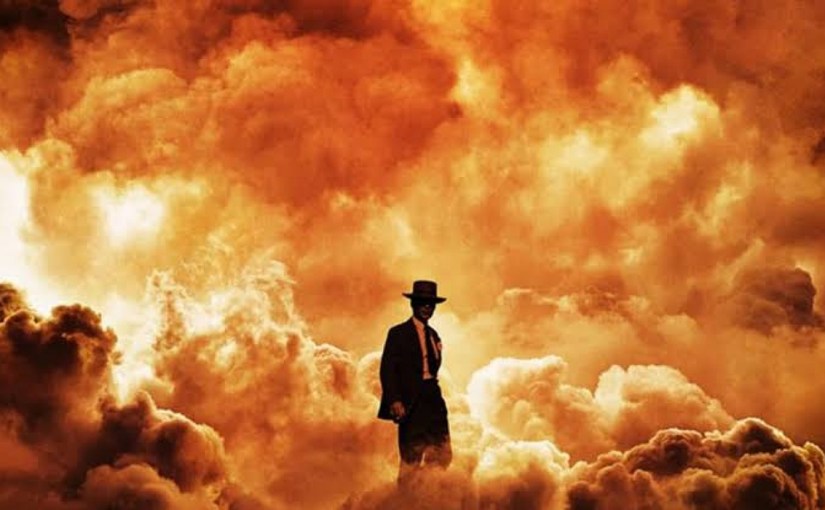
Christopher Nolan is one of the modern-day directors that you can rely on for brainy science fiction whether they are in embedded in dream subconsciousness, intergalactic space travel, transcendences of time, or even putting a fresh polish on a favorite superhero.  With Oppenheimer, he triumphs with exploring the actual prophets of science in the twentieth century, particularly its title character J Robert Oppenheimer, the brilliant physicist played convincingly well by Cillian Murphy.  Nolan doesn’t just stop at the assembly and discovery of science though.  He uncovers the consequences of Oppenheimer’s innovation and genius insight.  Dr. Oppenheimer might have been the man who knew too much and arguably that cost him quite a bit, personally.  Additionally, the so-called lab rat of his atomic bomb, namely the planet Earth, suffered the expense of a, at the time, troubling present day, and a still ongoing future. 

This movie seems to start right in the middle of its story and as a viewer you need to claw your way through the dense foliage to find its beginnings and what comes afterwards.  The first two scenes of the movie are titled “Fission” and “Fusion.”  There are no time periods specified by a font caption, however.  The differences in various points in history are distinguished by where J Robert Oppenheimer is located during select points in his life.  For seconds at a time, the film will change its photography from vibrant color to black and white, for example.  The characters will either look more aged with grey hair and some wrinkles or during more youthful time in their lives.  At one point Oppenheimer is being recruited by Lewis Strauss (Robert Downey, Jr) to head the department of a new kind of weapon development.  Work the science to make a difference.  There’s another time period where he’s being interrogated in a small room by a governmental suit and tie committee.  Oppenheimer is also in his classroom or debating and working with colleagues.  Another story observes his progress with building the atomic bomb among a collection of other engineers and scientists in a desert town, Los Alamos, specifically built at his own request, under the order of the nothing but militant Colonel Leslie Groves (Matt Damon), to conduct his work and research while hiding in plain sight. 

The film also covers Oppenheimer’s association with possible suspects of the Communist Party during the stressful pre-cold war era of McCarthyism.  Questions arise if his reliable brother Frank (Dylan Arnold) is a communist or even his mistress (Florence Pugh).  Does that in turn make Oppenheimer a communist as well?  If that is the case is J Robert Oppenheimer, the man tasked with ultimately ending World War II in favor of the Allies, sharing secrets with Russia and/or the Communist Party?

Nolan’s film gets easier to watch as it moves along, but you must get used to his pattern of filmmaking.  If you have never seen a Christopher Nolan film, I do not recommend you start with Oppenheimer.  His work is recognized for fast paced edits of different time periods and conversations.  There is much information to decipher. As well, there’s a very large collection of welcome characters to sort through, who worked with or against Oppenheimer.  Having only seen it once, I was captivated with the picture, but I know that I need to see it again.  The quick edits, working beautifully against the soundtrack orchestrations of Ludwig Göransson (nominate him for an Oscar, please), happen a mile a minute.  I appreciated this method because it enhanced the urgency of Dr. Oppenheimer in the eyes of the world, first as the savior of the united Allies against the last remaining superpower of the Axis countries, Japan. Then later focus is on whether it is in the United States’ best interests for the regarded physicist to have security access to the country’s most secret weapons and technological progress in a post war age.

People have been cajoling about how they know the ending to Oppenheimer.  They drop the bomb, of course!  (Twice actually.)  However, they do not know the entire story adaptation that Christopher Nolan as director and screenwriter presents. 

Cillian Murphy is perfectly cast. Give him an Oscar nomination.  He serves the confident, assured scientific leader who becomes envious of competing powers who achieve the impossible, like splitting the atom, while also admiring peers and mentors like Niels Bohr and Albert Einstein (Kenneth Branagh, Tom Conti).  All these men are interested only in what can be accomplished.  The superpowers that fight in war, though, are interested in how these accomplishments of modern science can be used to their advantage at a cost of collateral damage.  It is these conflicts of interests that Nolan admirably demonstrates over the course of the film. 

A telling scene for me, that I won’t forget, is when Robert Oppenheimer meets Harry Truman (Gary Oldman, doing an unforgettable cameo).  As the physicist exits the Oval Office, having shared his concerns and scruples with the Commander in Chief, Nolan includes a throwaway line delivered by the President, that I won’t soon forget.  It will not be spoiled, here.  Yet, the dialogue speaks volumes of what the United States held important regarding the servants who did the country’s bidding.  The scene closes like a stab in the heart, and suddenly science is no longer just facts within our planet.  Science is now questioned on whether it should ever be acted upon. Those questions certainly have remained as long as I’ve been alive to read about our never-ending world climate.  These inquiries will be here for many generations after I’m gone as well; that is if men and women’s recklessness with science doesn’t destroy the Earth before then.  At one point, Oppenheimer shares a small fraction of possibility for the end of the world when they activate and test their first atomic bomb. Matt Damon’s Colonel Groves’ asks for a reiteration of that observation.  Is this finding worth even the smallest, most minute risk?

Emily Blunt portrays Kitty Oppenheimer.  She’s marvelous as a lonely alcoholic wife to Robert, and a mother minding a home built in the desert while her husband serves an important purpose.  I didn’t take to her presence in the film until her grand moment arrives during an interrogation scene.  As the character gives her testimony regarding Oppenheimer’s communist ties, Blunt locks herself in for a wealth of awards in late 2023/early 2024.  Once you’ve watched the movie, you’ll likely know which scene I’m referring to and you can bet it’ll be that sample clip shown on all the awards programs.  This might not be Blunt’s best role, because it is rather limited within crux of the film, but I’d argue it is her greatest scene on film that I can remember.

Oppenheimer is a three-hour film, and it demands its running time.  There are so many angles to the man that few really know about.  Many know it was he who instrumentally built the atomic bomb that to date has only been used twice within a period of four days.  Thankfully never since.  Nolan emphasizes how unaware we are of how carefree the doctor’s government supervisors performed with the weapon he agreed to build.  Don’t just drop the bomb once.  Send a message to Japan by dropping it twice so they know to no longer engage in this ongoing war.  Choose the area where an army/government official didn’t honeymoon though.  It’s too beautiful a region.  Tens of thousands of men, women and child civilians perished immediately following the strikes.  Many others died weeks later following exposure to the nuclear effects that followed.  All issued as a horrifying cost to end a war that was already being won now that Hitler was dead.

Mechanically, Christopher Nolan does not disappoint either.  I watched Oppenheimer in a Dolby theater and I highly recommend it over a traditional one.  However, beware of the sound.  It is a LOUD!!!!!  Your seat will rattle early in the film when Cillian Murphy is shown in close up imagining the collision of atoms, protons, and neutrons.  How a star naturally dies in space runs through Oppenheimer’s consciousness as well, and then we see how a black hole forms.  Nolan offers a Cliff’s Notes edit of science doing its job.  Murphy performs so well when he’s not speaking and cut against the quick edits of Nolan’s visual and sound effects of science at play.  It shows how an educated scientist thinks beyond what is documented on a chalkboard or in a textbook.  J Robert Oppenheimer used to teach about the building blocks and natural destruction that occurs within the universe.  Regrettably, what he learned about natural function soon becomes manufactured capability when the professor accepts the task of building scientific destruction with his bare hands. Man stole fire from the Gods.

Oppenheimer is so dense in the scope of science and the scientist behind it.  That’s a huge compliment.  It’s an engaging film with much to tell, and a lot more to think about afterwards.  It accomplishes what the best movies do.  It leaves you thinking long after the film has ended.  More importantly, it’ll leave you frightened for the future based on the behavior of this planet’s past. 

Oppenheimer is one of the best films of the year.

KISS THE GIRLS

By Marc S. Sanders

When you’re watching a movie and one character says “Now wait here. Let me handle this!” what do ya think is gonna happen? When you’re watching a movie and one character says “Kate, we’ve covered every inch of those woods. There’s no building there!” whatcha think? You think there actually is a building there?

Let me ask you this, what do you think happens in the film Kiss The Girls?

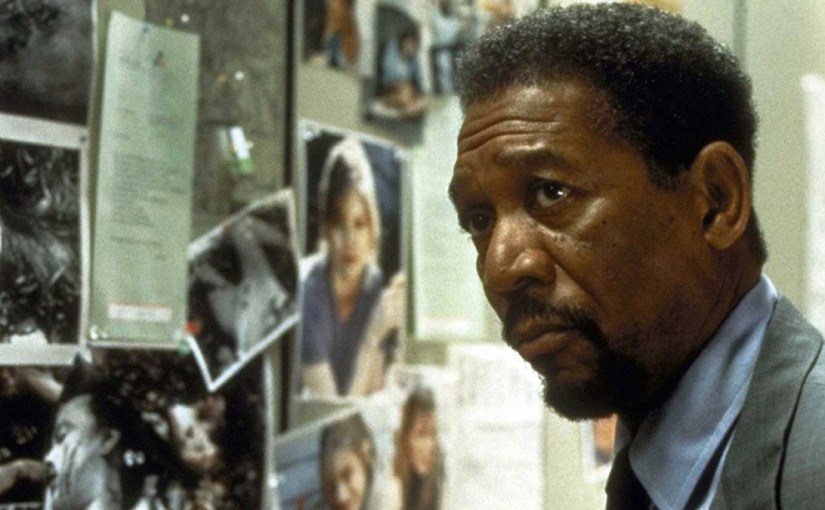
Yup! A whole lot of this nonsense and more that I could cover endlessly. Adapted from James Patterson’s best selling novel featuring his forensics detective hero Alex Cross, Kiss The Girls begins as an effective thriller focusing on the backgrounds of its two leads: dependable Morgan Freeman as Cross, and Ashley Judd as Dr. Kate McTiernan, a skilled surgeon with a specialty in kick boxing (that may come in handy later). At first, we see these characters handling snippets of storylines related to their careers. Cross defuses a suspenseful suicide situation. McTiernan has to console a family whose little girl was in a motorcycle crash. There’s good acting and emotion going on here and I was hoping the film would live up to the promise of these scenes; the characters’ expertise now being applied to Patterson’s main story. It doesn’t.

Instead, the movie just mires itself in plot holes and filler where one character insists on working alone while the other insists on not sitting idly by. This is not character development. This is ping pong volleying. Kate is kidnapped by a serial “collector” of smart, young, beautiful and highly intelligent women by someone regarded as “Casanova.” When Alex’ niece is one of the women taken, he travels from Washington DC to Raleigh, NC to join the investigation.

Soon after Kate has been taken, she manages to be the only one to escape from some hidden dungeon located in the woods. She joins Alex at every turn to find Cassanova and rescue the other captives. Okay. So that’s not a bad set up.

Where it falls apart is in the development. Kate managed to escape by jumping into a river where she’s retrieved by two kids. So wouldn’t law enforcement just sweep that entire area? I mean be really thorough, top to bottom! Surely, you’ll pick up footprints or scents from the dogs. Well, Alex says they did. Fortunately, his niece’s boyfriend finds the map. You know…the map that’s hidden in the library that no one else is aware of and shows this dungeon or whatever it is that’s there. Only one guy, ONE GUY, knows about this map????

When an hour and forty minutes has surpassed, you bet that map is gonna turn up. Remember, also when someone says wait in the car, the one thing you do is not wait. You know, this is a movie. So, Mr. Freeman, please spare me the act of surprise when Ms Judd walks into the bar you’re scoping out. This is all unnecessary, and boring and tired and old.

Kiss The Girls is another film with THAT TWIST! Was it really needed though? Just when the film apprehends the bad guy, and the ladies are recovered safely, there’s a gotcha moment in Kate’s kitchen with lots of knives and pots and pans to play with. Gary Fleder directed this 1997 disturbing thriller in a post age of The Silence Of The Lambs and Seven, which are far superior films. It’s not a film dependent on gore or torture porn, but it’s got the dark stone lined halls for haunted house creepiness. I’m good with that. It’s a thriller after all.

The film’s best assets, however, are Freeman and Judd. These are two top class actors who invest themselves in performance. If only they were working with a much more believable story.

It’s the implausibility in the script that make my eyes roll.