THE MUMMY (2017)

By Marc S. Sanders

The Universal logo comes up with that familiar music across the blue globe. Then it goes in reverse and turns black and gold to introduce a new franchise known as the Dark Universe.  This is the first installment.  The problem is of all the famed monsters in the studio’s library, they probably shouldn’t have started with The Mummy.  Brendan Fraser’s attachment to this mythical Egyptian horror is still widely accepted, and Tom Cruise is no Brendan Fraser.

This reinvention begins much like the 1999 film by telling of a Pharoh’s daughter who believed she was the sole heir to the kingdom.  Yet, betrayal happens and the beautiful princess is mummified into eternity, buried deep under the desert and laid with vengeance on her mind.  Elsewhere, another tomb is discovered under the streets of London. Could there be a connection? A dagger with a red stone might have the answers.

Jump to present day and Tom Cruise is back with another character who can run very fast.  He is Nick Morton and with his partner he clumsily runs and jumps over rooftops in the Egyptian desert while closely evading military air strikes from above.  Why the military is dropping bombs is apparently irrelevant.  Tom Cruise just needs something to run away from.

A massive crater opens up and the pair along an expert archeologist named Jenny Halsey (Annabelle Wallis) come upon a tomb.   Nick mistakenly frees the Egyptian princess buried within and they transport her, still contained in her coffin, back to London aboard a cargo plane.  Only now Nick is seeing visions of what once was and becoming familiarized with an ancient language with which he had no prior knowledge.  Nick has been chosen.

When you place Tom Cruise on board a military cargo plane, what do you think happens? It doesn’t have to be called Mission: Impossible to be a seemingly impossible mission. The crashing airplane sequence is impressive, not the best, but I’ve seen this stuff already. I’ve seen this stuff already with Tom Cruise. I do not need to see it again. 

The Mummy cannot decide what it wants to be.  It has some good ideas but just when I think I’m watching another Brendan Fraser swashbuckler with a monster, Tom Cruise must pound it over my head that this is a stunt filled trajectory.  

Russell Crowe is a mysterious character offering voiceover narration during a prologue. He later reveals his identity to Nick.  I will not spoil who he turns out to be.  Let’s just say it is likely you heard of this guy.  It’s hard to believe that Nick has not, and Mr. Cruise does not play dumb very well. This man has an interesting laboratory that contains relics and possessions that belonged to other well-known cinematic monsters.  Frankly, this picture should have exclusively belonged to Crowe’s character who comes off very dynamic and fresh while setting up a whole – forgive the pun – universe for a long line of films to come.  

Alas, Tom Cruise sets the stage.  He’s okay in the role, but between his temptation to be Ethan Hunt while adopting a Robert Downey Jr sarcasm and the imperfect Brendan Fraser/Indiana Jones hero, it all gets muddied. I just didn’t like this guy.  Cruise delivers what each chapter of the script demands of him and none of it is consistent. Near the end of the film during the final battle, Cruise offers up a one liner that comes nowhere near as close to what Downey, Fraser or even Arnold Schwarzenegger could have accomplished.

The only clarity I find in the visual effects is that they look rushed for final print towards a summer blockbuster release.  The Mummy Princess (Sofia Boutella) unleashes her monster minions to pursue Nick and Jenny while they are escaping in a clumsy looking ambulance.  As the creatures attack the top and both sides of the vehicle they are shaken off, thrown into trees, or run over.  They all look like monster vomit accompanied by loud hissing to startle your hearing.  

This iteration of The Mummy is partly assembled by the guys who made the Transformers movies where the robots look like metallic throw up mush.  Guys like Robert Orci and Alexander Kurtzman, the director, are poor artisans at the sci-fi/adventure/horror genre.  They know how to helm movies like this about as well as I do.  I don’t know shit, but I do know the visuals here are pure junk while being an enormous step back from the Fraser films of twenty-five years ago.  

The Mummy ends like the Marvel movies with the hanging threads of what we should expect.  I’m game!  Only, don’t do it like this.  Anything but this, please.  

Sadly, as quick as the Dark Universe got started it all got canceled.  This film was poorly received and did not generate the box office bonanza the studio was counting on.  I recall a fascinating publicity photo that assembled Cruise, Crowe, Boutella, along with Javier Bardem, and Johnny Depp. All were publicized to occupy upcoming installments of this new franchise.  The potential was so strong to see the likes of The Mummy, the Invisible Man, the Bride of Frankenstein, the Creature From The Black Lagoon, The Wolfman, Dracula and Jeckyl/Hyde sharing the screen together.  This could have been the antithesis to The Avengers and Justice League with gags of gore to delight audiences.

I swear when I saw that Dark Universe logo at the beginning, I was ready to love this movie.  I really was.  Unfortunately, The Mummy works hard to be a Tom Cruise actioner with his preserved thirty something looks adhered to an assortment of unfinished and indecipherable special effects.  Its script from David Koepp (Jurassic Park) is exhaustingly incoherent.  

The Mummy was a long-term investment by a million-dollar corporation.  It’s too bad the wealth went into junk bonds though. I urge Universal to try again. There is something to be made here, and it cannot get worse than this.

A BEAUTIFUL MIND

By Marc S. Sanders

The genius was always easier than living with the monsters in his mind.  So was the dilemma that consistently plagued Nobel Prize winning Professor John Nash.

Ahead of seeing A Beautiful Mind for the first time, what you don’t know about Professor Nash is what will dazzle you the most when Ron Howard uncovers the mysteries he lived with during graduate school and on through his fellowship at MIT and with his enduring and loving marriage to his wife Alicia (Jennifer Connelly in an Oscar winning role).  John Nash is masterfully portrayed by Russell Crowe in a celebrated, nominated performance.

Dr. Nash comes off like a genius savant when Howard’s film introduces him in 1947 at Princeton University.  The director adopts a technique of presenting much of Nash’s depths and highlighting patterns and numbers in magazines or on chalk boards or even within the reflections that appear before his eyes in bright sunlight.  On a clear night, see if you can find an umbrella within a starry sky. 

For many of us, I presume it’s hard to decipher what it means to live the life of a mathematical genius. Ron Howard with Akiva Goldsmith’s hailed adapted screenplay does not expect anyone to comprehend formulas or equations.  The filmmakers simply ask you to witness how discovery is processed.  Nash writes endlessly on his dorm room windows.  He fills up every inch of the chalk boards at his disposal.  He tears apart articles in magazines and wallpapers his room and office with them.  Even when he is not writing, he is computing how situations will end up best towards his and his peers’ advantage. There’s one curvaceous, blond woman standing in the center of a bar for one of the men to hopefully have a tryst with, but then who will be left to pair with the dark-haired ladies that surround her?  Nash finds the logic in all of the men abandoning the blond.  The genius realizes what none of us can see.  Go for what no one would ever expect to have occurred.

Despite the professor’s odd ticks, unwelcome vernacular and his lack of social skills, a well-established livelihood works out for him.  He falls in love with a former student that he marries, Alicia, and he obtains a fellowship for himself and two Princeton comrades to practice out their theories at MIT.  Personal companionship arrives with his former roommate, Charles (an energetic Paul Bettany), and his niece.  On the other hand, John has also been recruited to become a code decipherer for the government and he must answer to a mysterious gentleman named Parcher (Ed Harris) who is using John to stay a step ahead of the Soviets.   John’s work must remain top secret and as his clandestine activities become more threatening and intense, so does the paranoia get increasingly overwhelming.

I’ve only covered the first act of A Beautiful Mind because when the truth of John Nash’s purpose and how he is regarded is revealed, this biography becomes something much further from how it began.  Akiva Goldsmith’s trickery in his script is capable of surprising an audience when some veils are lifted for both the primary subject of this piece and those who come in and out of John Nash’s life.  This is a true story but it’s incredibly surprising that a mathematical wizard like John Nash could be living a whole other life that makes little sense at first.

Ron Howard is doing some fine work here reaching for material that might feel familiar with other cinematic geniuses in film ranging from the fictional Will Hunting to more recently real-life figures like Mark Zuckerberg. Characters like these stand out for their quirkiness and oddities.  With Russell Crowe’s brilliant characterization of awkwardness in his uneven walk and how he carries his papers and briefcase, it is not hard to adapt to the man on film.  What he says and how he speaks would leave any one of us to roll our eyes at his behavior.  You’d likely chortle at John just as his Princeton classmates do.  Later though, you understand how valuable his accomplishments are to a greater good, and at the same time you become alarmed at how Dr. Nash is being used both from his own perspective as well as by those figures who unexpectedly enter his life and will not just leave.

Jennifer Connelly’s role does not amount to much at first.  With her alluring looks that have graced other films in her earlier career, she initially comes off as a token spouse to the main character and you remind the person sitting next to you that is actress Jennifer Connelly who got her start in Labyrinth with David Bowie, and Once Upon A Time In America with Robert DeNiro.  Yet, as more dynamics are revealed about her husband does the character Alicia show through, and she has no choice but to survive with her spouse’s torment.  Connelly has a scene that will crush you when she must unleash her frustrations in the middle of the night as well as sporadically throughout the film. She has to be carefully observant of her husband’s behavior for the safety of their child and herself.  Ron Howard sets up scenes that haunt Alicia only, and his wide camera work is absolutely eye opening as it lends to her personal performance.

It’s fascinating to observe John Nash’s willpower as he persists to live with personal demons while upholding the demands of his genius.  This film works on so many levels of enhanced editing and perspective, but without unforgettable work from Russell Crowe, Jennifer Connelly, and a supporting cast of character actors like Christopher Plummer, Josh Charles, Judd Hirsh, Ed Harris and Paul Bettany it could not sustain its staying power. 

A Beautiful Mind is a thoroughly effective biography.

AMERICAN GANGSTER

By Marc S. Sanders

My favorite kind of crime dramas are the ones that tackle the grit.  The screenwriters and directors go for where the itty-bitty stuff scrounges up into something bigger for either the career criminal or the low-level cop.  These guys start out as butterflies flapping their wings and before you know it their legacies and pursuits are as big as hurricanes.  Movies like The French Connection or Heat operate on these trajectories.  How did we get from there to HERE?

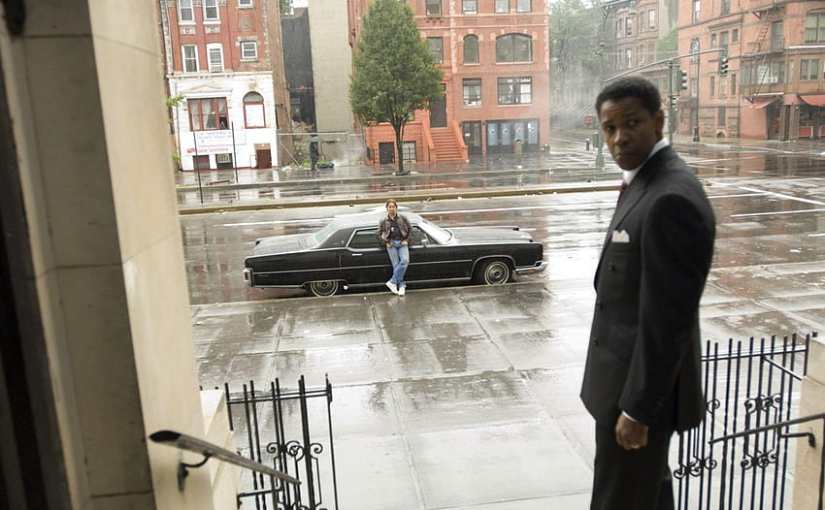
Ridley Scott went in an unconventional direction away from his science fiction eye and ancient history recollections when he directed American Gangster with a screenplay by Steve Zallian based on the true stories of Harlem drug kingpin Frank Lucas (Denzel Washington) and narcotics detective Richie Roberts (Russell Crowe).

These two sensational actors don’t share one scene together until the epilogue of this always interesting three-hour opus.  Yet, in their second film together their pairing is as classic as DeNiro and Pacino or Newman and Redford.  I hope before they retire, these men pair up for at least one more film.  

Ridley Scott and his nominated art directors, Arthur Max and Beth A Rubino, capture a gritty urban, crime ridden Harlem of the 1960s/70s.  The streets are filthily here, as well as in the five New York boroughs and all the way across the bridge into New Jersey.  Frank’s markets carry a very wide berth. The buildings are distressed and cracked.  The clothes are of the hippie era with polyester suits.  This is where Frank Lucas moves his imported contraband, white powder heroin, labeled exclusively as “Blue Magic.”  The film provides a convincing source locale deep within the jungles of Vietnam where thousands of kilos are shipped to Frank for sale on the street.  The purity of the drug is beyond compare.  Scott and his art designers place you directly in this time period of dingy grime and among the sweaty Viet Cong and rivers to finally arrive at the crop Frank purchases his products from.

Once he finds his footing by eliminating the competition and recruiting his brothers and cousins to run his business, Frank invests in creature comforts with a furnished penthouse apartment for himself and a beautiful mansion for his mother (Ruby Dee in an Oscar nominated performance that comes off so naturally; you’d think she’s sitting at the Thanksgiving table with you).  He marries a beautiful Puerto Rican wife that he treats like a princess. Frank is smart.  He stays under the radar by wearing conservative suits and not making many waves like going out at nights and showing himself around the social scene.  He knows famous athletes like boxer Joe Lewis or the staff on the New York Yankees that could give his nephew a shot at being a pitcher. Still, his profile manages to stay low. Like his mentor, he just operates a business with a viable commodity.  He tells his younger brother (Chiwetel Ejiofor) that the loudest one in the room is the dumbest and the most likely to get caught.  So, mind how you carry yourself, how you dress yourself and how you flaunt yourself.

A separate story has no business intersecting with Frank’s plight until something gives.  Richie Roberts is a good, honest cop. Though he’s also a lousy husband and father. He has been assigned to head up a task force that will bust the top of the assorted drug empires.  He needs those rare breed cops who are not on the take and follow a strict policy of law enforcement ethics.  His team will not bust a common street hustler.  They will be looking for the kingpins with unquestionable evidence to put them away for good.

American Gangster follows two separate stories for most of its running time.  At least during the first two acts of the film, Frank and Richie are unaware of one another.  It’s only through some gradual surveillance that the cop finally gets a whiff of an idea and starts to move methodically towards a conclusion. The methods are the fascinating parts the movie.

When Denzel Washington plays a villain it’s always memorable and contrary to popular opinion, Frank Lucas is my favorite of his antagonists, especially compared to his Oscar winning work in Training Day.  Watch how he walks or sits on a sofa and broods over how his family and his business are functioning.  He’s the only African American actor I can see playing this guy because I’m always convinced that whoever Denzel Washington portrays, it’s a character who will never be intimidated.  This guy faced down Gene Hackman during a threat of nuclear holocaust. Not many other actors can do that so authentically.

Russell Crowe works like that hero who doesn’t want to wear the cape.  Richie Roberts succeeds on so many levels where his peers surrender to their inhibitions.  This cop passes the bar exam while fighting for custody of his kid on top of going after the empirical criminals who litter the streets in drugs and murder.  I’m reminded of his role in The Insider, where he used a similar American accent.  Richie is not as temperamental or hard wired as that guy, but he is at least as focused on doing what’s right regardless of threat or distraction.  Russell Crowe has a way of getting audiences to admire the concentration needed for many of his complicated characters.  You have as much tunnel vision as he wants the men he’s portraying to have. You are zoned in with what his characters live by.  You only trust their standards.

There are signature staples within the construct of this true story adaptation.  There are gunfights.  Punches are thrown.  The guy at the top beats up one of his cronies when he gets out order.  Yet, what stands this material apart from others is that now I’m watching how Denzel Washington and Russell Crowe handle everything.

The truth behind the story of a black gangster defying the dirty cops and the Italian mobsters who were thought to run the metropolitan undergrounds is amazing.  It’s so interesting to see how novel Frank is with smuggling the product from one side of the world to the other. Then, you see how he uses his family members to distribute to the consumers and collect the monies. Ridley Scott provides all the breadcrumbs in an easy-to-understand fashion.  

Painted against the landscape of an unwinnable Vietnam War that just won’t end, power is acquired and thus the best police officers are forced to change their approach.  So again, you see two different stories that start out small and undetected.  Frank and Richie are the most careful and meticulous of guys in their respective fields.  Therefore, it only makes sense that their paths don’t cross until their missions are nearly over.

There’s much to learn from American Gangster.  

You get an idea of how the harm of the war was not exclusive to just what was happening over in Vietnam.  There were more indirect effects to that crisis impacting the streets of New York and New Jersey.  

You see what subtleties an investigation will collect upon before pouncing on to a bigger stake.  You also learn how to handle a criminal empire with trust and dignity rather than announcing your immorality. You witness the sheer defiance of a righteous guy in what is supposed to be a law-abiding field. Steve Zaillian’s script is not just good guy vs bad guy. It’s each of these guys holding on to the top while trying to catch up with or stay away from each other.

American Gangster is a very thorough and well-planned biographical thriller.  

THE QUICK AND THE DEAD

By Marc S. Sanders

The Quick And The Dead is a gritty, stylish western that boasts a who’s who of great actors.  Some of which went on to magnificent careers.  I wish the story was a strong as the cast list though.  It’s watchable.  It’s intriguing. It’s also too repetitious.

Sharon Stone is Elle.  Otherwise known in these parts as The Lady.  Two minutes into the picture and my suspension of disbelief is withering away.  Not because this gunslinger cowboy is a cowgirl, but because Stone does not look like she fits in the Old West.  Her blond locks are shampooed and conditioned.  Her complexion perfectly made up without a hint of grime or dirt or sunburn.  Stone looks like she took one step off the Oscars red carpet and onto this set. Her costume with a scarf, leather pants, black rimmed hat, and spurred boots looks like its attempting its own kind of Clint Eastwood stranger.  Frankly, it appears to have leaped off the pages of an Old Navy catalogue.

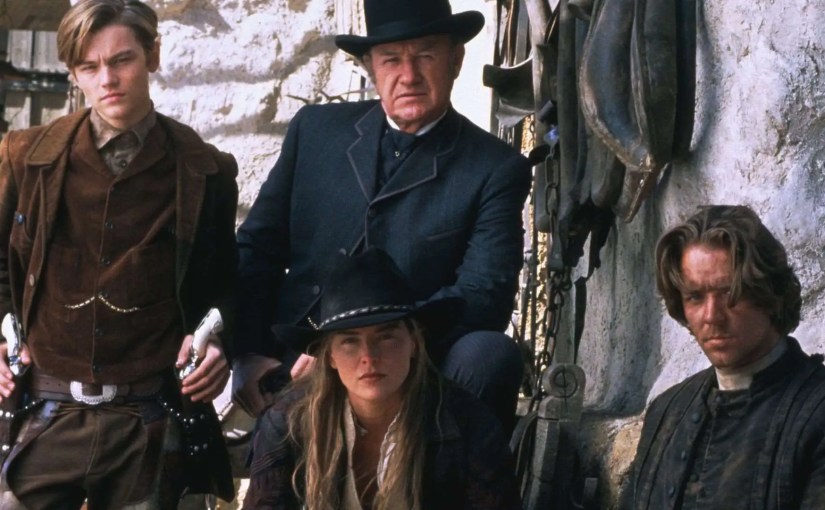
Below Stone on the credit lineup is a much more redeemable list of characters.  Gene Hackman is Mayor Herod who has amped up his level of sinister from his Oscar winning performance in Unforgiven.  There’s also Ace Hanlon played by Lance Henrickson with a rare on-screen giddy grin, whose personal deck of cards consists of aces of spades for every man he’s killed. Sgt Cantrell is the flamboyant personality with the handlebar mustache, deep voice and toothy grin that actor Keith David proudly bears.  A kid named Leonardo DiCaprio plays up the youthful cockiness of an outlaw named The Kid.  All these folks are gunslingers participating in the sport of gunslinging.  Last one left standing is the winner.  Midway through though, Herod will up the ante and deem that the last one left alive is the winner.  Each one challenges another until a final winner is recognized.  One reluctant participant is played by a very youthful looking Russell Crowe.  Cort is a former fast draw, who is now a remorseful preacher for all of the killings he’s committed.  Herod is not entirely convinced and will antagonize Cort to throw his hand in the game.

Sam Raimi directs and Sharon Stone produces this slick small town modern day High Noon.  The problem though is that Raimi and screenwriter Simon Moore choose to only send up the climax of that classic Gary Cooper western over and over.  Time and again, two opponents line up at opposite ends of the street.  The townsfolk observe with close up tension shots.  The hands twitch their fingers next to the holsters and when the clock strikes twelve, the guns go off.  Raimi often gives you the impression that the one expected to live is the one who is going to topple over dead and then an edit shows the match went exactly like you thought it would. 

This whole supporting cast has enough presence and charisma to keep my attention, but the set ups are the same over the course of the film.  Cut in between are discussions within the saloon or the hotel rooms where Herod or the Lady rest.  Cort remains chained in the town square.  When the movie breaks away it goes to flashbacks of Stone’s character as a child when she once crossed paths with the devilish Herod. 

I like the polish that Sam Raimi brought to The Quick And The Dead.  Before Quentin Tarantino was glamourizing his pulp fiction to his own two dimensional westerns and war movies, Raimi was daring enough to let us look through literal bullet holes from the front to the back of his victims.  Holes through the hand, the chest and the head.  It’s fun.  There are also countless closeups of haunting music from Alan Silvestri as a new stranger enters a saloon to click his spurs on the wooden floor.  Quick draw action is how these pistols perform too.  Hangings are a part of any day as well.  All of this is familiar and standard to the B movies brought to us by Sergio Leone’s spaghetti westerns during the mid twentieth century, but now we have a modern day cast and some glossy cinematography.

I was ready for a worthy salute.  It just comes up short due to a lack of any depth in story.  Gunslinging quick draws are not as dynamic as a gunfight at the OK corral.  How much different is one dual draw going to be from the last one we watched five minutes ago?  Raimi’s camera points from behind each challenger.  The music builds louder and louder.  Zoom in shots of townsfolk cut in.  The minute hand on the clock tower moves closer and closer to the roman numeral twelve, and then…BANG BANG!!! (I’ve said this before, haven’t I?  Well, so does the movie.)

The Quick And The Dead is worth seeing especially for another scenery chewing villain from the great Gene Hackman.  I’ll never tire of watching him.  To see the beginnings of Russell Crowe and Leonardo DiCaprio’s potential is a real treat as well.  They all certainly have some acting moments that I loved digging up from this time capsule.  Character actors Keith David and Lance Henrickson break from the standard personas you’ll find on the rest of their resumes.  I just needed more of a variety to this town setting they got play in.  The déjà vu is too overdone.

Sharon Stone usually looks like she’s giving a so so community theatre audition.  It’s hard to take her seriously, the same way I would had Uma Thurman, Susan Sarandon or Geena Davis been cast as The Lady.  Those actresses work for their appearance to be appropriate for the setting of their films.  Look at Sharon Stone here in the dusty Old West.  Then look back to what Sarandon and Davis did in Thelma & Louise.  You’ll see right away, practically anyone else would have been more suitable for the lead of The Quick And The Dead.

GLADIATOR

By Marc S. Sanders

Ridley Scott’s Gladiator is a terrifically sweeping sword and sandal epic adventure.  It contains well drawn characterizations of its heroes and its one tyrannical villain, along with superbly bloody hack n chop violence and action that live up to its title. 

Rome has finally finished its campaign of conquer throughout at least one quarter of the world.  General Maximus (Russell Crowe) is ready to return to his wife and son to live out the rest of his days as a farmer and family man.  However, the dying Emperor Marcus Aurelius (Richard Harris) begs him to take over his position so the Roman Empire may carry forth with prosperity.  If Maximus does not take over, the empire is at risk of being inherited by Marcus’ spoiled son Commodus (Joaquin Phoenix).  While Maximus ponders the request, Marcus dies and Commodus quickly takes over, and orders the immediate deaths of the celebrated General and his family.  Maximus and Commodus will eventually circle back with one another, however.

Gladiator feels like an epic film in the vein of a David Lean picture that would require time and work to follow through its various developments.  Maximus certainly goes through a widespread arc.  One of the advertising bylines described it as the man who was General, who became a slave, who became a gladiator. Russell Crowe is right for this role.  Not only is he lean and built for the part, but he brings a empathetic approach to the character.  Maximus is loyal to his country, but he also carries pain and longing for his family and when he is wronged, Crowe does very well at displaying his character’s plot of  vengeance against Commodus with strategy and skill.

Joaquin Phoenix rightly earned his first Oscar nomination as a wonderful villain.  The screenplay from David Franzoni, John Logan and William Nicholson offer memorable pieces of dialogue for the bratty son.  “I feel vexed. I am very vexed.”  – a line that sounds so minimal and yet when Phoenix delivers it, it’s only more terrifying.  This little monster captured in an adult body can respond to anything that slightly irks him.

The battle between Commodus and Maximus is hardly physical.  Maximus realizes through his companions that a better and wiser form of revenge is to win Rome’s admiration away from its ruler.  Commodus lives off his ego.  So, when Maximus is encouraged by his slave owner to “win the crowd” amid the games performed in the famed coliseum, it not only lends to the gladiator’s ongoing survival, but it tears away at Commodus’ rule.  A great subplot is included focusing on the ruler’s nephew, Lucius (Spencer Treat Clark).  The expression on Joaquin Phoenix’ face when young Lucius role plays as the great Maximus works like a frozen moment in time.  Imagine a famed quarterback’s child cheering for the defensemen who performs an unforgivable sack during the final ten seconds of a game.  It’s terribly bruising.

When Gladiator was first released in theaters, I found the CGI to lack texture and it appeared very dark like a bad 3D film.  It looked too animated.  This most recent viewing was on a restored 4K transfer and the picture quality is astounding.  Every element of the broad landscapes within the battlefields and especially in the gold sheen photography of the coliseum battles blend perfectly.  If you still don’t understand the importance of 4K, turn to this film to uphold the argument. 

Ridley Scott does not waste a shot in this picture.  Reactionary sequences are just as effective as the cuts to the action.  Blades and barbaric weapons shed gorgeous splashes of blood. Every thrust and parry are easy to see. I’ve never forgotten when a chariot rider is cut in half at the torso from an oncoming blade attached to rolling wheel.  The choreography and editing of the battles are thrilling with sound editing that compliments the moments. 

Beyond Russell Crowe and Joaquin Phoenix, the cast is wonderful.  I’ve always admired Richard Harris’ quiet approach in the twilight years of his career.  He never had to do much to offer a presence.  Connie Nielsen portrays Lucilla, Commodus’ sister who he has affections for.  Her subtle resistance allows Joaquin Phoenix more opportunities to feel “vexed.”  Oliver Reed passed away during the making of this film. Fortunately, Ridley Scott and company did not opt to cut out his role as the gladiator/slave trader, Proximo.  He works well as a kind of mentor to Maximus and the band of other warriors, coaching them on how to stay alive and rise above Commodus’ monarchy.  “Win the crowd and you win your freedom.”  Djimon Hounsou is a loyal sidekick to Crowe’s character. Derek Jacobi is once again that guy you have seen before allowing his expert craft in Shakespearean performance to flesh out the political angle of the story among the Senators.  Every actor serves a valuable purpose in the film.  None of these performances feel like walk on roles.  So, the overall casting of the picture must be commended.

Gladiator is a crowd-pleasing film. Though it is based in ancient history, there remains a fantasy element to the movie when you look at grand designs of the settings, costumes, and dialogue.  Storylines of politics and tyranny hold relatable to modern current events.  What can occur when one man takes over everything for his selfish purposes?  Pointless displays of theatrics can occur at the behest of others who were once heroes, instrumental in placing a despot atop a throne.  I presume Ridley Scott’s film is just one more example of the inherent nature found in humans.  Some of us are destined to rule and control.  That alone is cruel and selfish.  It is even worse when this totalitarian mindset is unleased upon those that put these rulers in their place.  History and especially modern times demonstrate that loyalty is only fleeting.  The ability to possess totalitarian control, however, is hopefully even more short-lived.

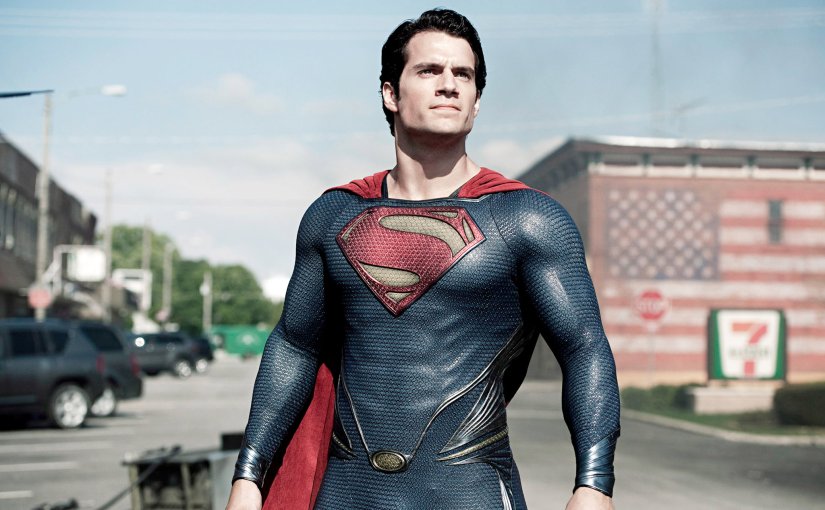
MAN OF STEEL (2013)

by Miguel E. Rodriguez

Director: Zack Snyder
Cast: Henry Cavill, Amy Adams, Michael Shannon, Diane Lane, Russell Crowe, Kevin Costner, Laurence Fishburne
My Rating: 9/10
Rotten Tomatometer: 56% (damn…haters gonna hate)

PLOT: The last son of a dead planet finds a home on Earth and, thanks to enhanced senses and powers, becomes its mightiest defender when an ancient enemy attacks.


I never tire of repeating this: the majority of my enjoyment of a movie is derived from how it affects me on an emotional level.  And, brother, in my case, Man of Steel knows exactly which buttons to push to make the hairs on my arm stand on end.

I can still remember the first time I saw the very first teaser trailer, back in 2012.  It fired my imagination almost as much as the first trailers for The Phantom Menace did.  “At last,” I thought, “someone is going to make a SERIOUS Superman movie!  It worked for The Dark Knight, why not Superman?”

And in my humble opinion, it did work.  But before I get into the debate between different Superman versions, let me talk about this movie first.

Man of Steel is ambitious, audacious, and visually spectacular.  Its one major fault lies in the finale, in which a human family is threatened by a heat ray, and it seems all they have to do is just…run the other way.  But a point is being made (a good one, I might add), so I can forgive it after the fact.  On first viewing, though, I will admit the mildly absurd situation took me a little bit out of the moment.

But I’m picking nits.  The rest of Man of Steel is just a great experience at the movies.

Right from the get-go, we know we’re in for something different when, for the first time since Superman II [1980], we get a glimpse of Kal-El’s homeworld, Krypton.  But this is not your father’s Krypton.  This is a lush, red-sky world, with stunning vistas, flying creatures, and hyper-advanced technology.

The familiar story is all there: a dying race and a loving mother and father who send their infant son to the stars for one last chance of survival, for him and for their race.  In flashback, we see Kal-El’s childhood in Kansas, as he struggles to adapt to his enhanced senses.  This is one of the great concepts I’m glad the movie took the time to show.  We see him trying to cope with seeing and hearing EVERYTHING, all at once, and learning to focus his powers so he can function in this new world.  That was a nice touch.  The school bus scene was handled especially well.

We see him as a grown man (played by Henry Cavill) before he dons the familiar suit, a drifter, only reluctantly playing the hero from time to time.  I liked the beats in this section because they echoed some of the good deeds we saw in “Superman” [1978], but everything was done from a standpoint of genuine awe and astonishment.

Then an alien ship is discovered buried under the ice in northern Canada, Clark investigates, and so does ace reporter Lois Lane (Amy Adams), and things start to snowball from there.  But in “Man of Steel”, everything is handled in a way that makes the far-fetched story seem more real and relatable, more so than its predecessors.  And that appeals to some part of me that is hard to quantify or put into words.

Ever since I was a kid, I was drawn to the darker, grittier aspects of comic books.  My favorite Batman comic?  “The Dark Knight Returns,” Frank Miller’s magnum opus in which Bruce Wayne is an old man, the Joker winds up getting killed, and Batman and Superman fight to the death.  My favorite Marvel comic?  “Identity Crisis,” in which a superhero’s wife is murdered and the Justice League bands together to find her killer.  My other favorite comics?  “Preacher”, “Y: The Last Man”, “Saga”, “Watchmen”, “V for Vendetta”, and “Ronin.”  I was always, and still am, a fan of how the medium of comics can be used for telling mature stories that don’t always depend on happy endings, or heroes swooping from the skies to catch falling helicopters.

So when a movie DOES come along that, by default, has swooping heroes and a happy ending, but can ALSO make things a little darker or grittier than usual, I am thrilled, because it means the filmmakers are not confining themselves to ancient stereotypes.  They’re trying to surprise me.  They’re making a movie for ME.  …at least, that’s how I feel, because it’s right up my alley.  For example, one of the heaviest criticisms involves the overblown battle scenes.  But, man, I was TOTALLY okay with it.  No flying sheets of cellophane or creepy identical twins here.  These guys are playing for KEEPS.

Does this mean I am somehow in favor of comic book movies removing all traces of fun?  Of course not.  One of my favorite DC movies is “Shazam!” which was WAY more fun than I anticipated.  It’s pretty much a straight up comedy.  Would I prefer a grittier “Shazam” movie drained of fun, with dark skies and a darker ending?  No.  For “Shazam”, the fun approach worked.

When it comes to Superman, I think it’s a mark of the character’s versatility and endurance that it’s even possible for the “fun” Superman (yes, including “Superman Returns [2006]) to exist alongside the darker Superman.  It’s not like “Man of Steel” or its sequels somehow erased or replaced previously existing versions.  They’re still there.  If the comic book industry has taught us anything, it’s that the market for reboots and “remixes” is almost inexhaustible, as long as you stay true to the core principles of the character you’re working with.  In my opinion, “Man of Steel” does exactly that.  It keeps Clark Kent’s innate principles and values in place while dressing up the story to give us one of the best reboots of a character since “The Dark Knight” [2005].

There is, perhaps, one glaring exception, and it comes at the finale of “Man of Steel”, so SPOILER, SPOILER, SPOILER.

SPOILER ALERT.  You have been warned.

If you’ve seen the movie, you know what I’m talking about: Superman is forced to kill General Zod (Michael Shannon) when it becomes clear that Zod will never stop his war on humanity, when he vows to kill everyone on Earth to avenge his lost civilization.  In the comic book, it’s a given that Superman himself does not kill anyone.  (There may be exceptions, but give me a break, I don’t read comic books religiously.)  So why this egregious contradiction?

Since “Man of Steel” is a reboot, I choose to think of it this way:

This is Kal-El’s first test as a hero, his first battle with an enemy as strong as he is in every physical way possible.  He is faced with an impossible choice: kill Zod, or allow countless more humans to die in who-knows-how-many-more battles.  He may be more powerful than a locomotive, but he is just plain inexperienced when it comes to this kind of decision.  So he does what he feels is necessary to preserve life.  He is definitely NOT okay with it.  Watch the movie, and you’ll see his howl of anguish and regret after the deed is done.

But he makes his choice.  He is the son of two worlds, but he chooses Earth.  “Krypton had its chance,” he yells at one point.  It’s time for him to move on.

I know, movies are subjective, and there are no doubt many excellent arguments against my interpretation.  Maybe that’s what makes “Man of Steel” and the Superman character so durable: the fact that there are so many vastly differing interpretations, and that they all apply equally.  Superman can be many things to many people, but no matter how many years go by, he’ll still be what he’s always been: a symbol of hope.

(Got a little mushy there at the end, hope you don’t mind.)

THOR: LOVE AND THUNDER

By Marc S. Sanders

Taika Waititi’s Thor: Love And Thunder doesn’t just operate as a standard Marvel Super Hero movie.  I think it encapsulates what moviegoers treasure when watching a film, and that consists of a gamut of emotions with the opportunity to absorb the best in sight and sound.  Even if we are watching a guy fly through the skies with a cape that’ll be marketed into a million toys and t-shirts, sight and sound are nothing without brains behind a script.  It’s fortunate that a director like Waititi always works with that in mind.  Marvel overseer Kevin Feige knows how to recruit talent behind the camera and you just can’t go wrong with the architect of a spoof on the surface, yet an all too horrifyingly real film underneath, like the widely acclaimed Jo Jo Rabbit.

I’ve always laid claim to the fact that movies largely recognized as “tear jerkers” like Steel Magnolias and Terms Of Endearment are actually comedies first, and then dramatic sob stories second.  I’m serious about that observation.  Why?  Because if a film is going to go to great lengths to risk the outcome of one of its main characters, then it must get its audience to embrace and deeply love that person first.  The best avenue to that approach is to outrageously laugh and cheer that character on ahead of what’s to come.  Taika Waititi’s second film to center on the God of Thunder does just that.  The best reward I got from Thor: Love And Thunder is that I laughed quite often (as the trailers imply), but I also teetered on tears as well.  Good fantasy storytelling will incorporate an all too real conflict with its protagonists and then introduce the strange and unusual as an escape.  The best example may be The Wizard Of Oz, and the simple set up of Dorothy and the risk of her perishing with her dog Toto in a threating tornado.  More recently, I also think about Guillermo Del Toro’s Pan’s Labyrinth centering on a young girl in early twentieth century war torn Europe.  Again, Waititi’s coming of age during Nazi occupation opus, Jo Jo Rabbit, follows this formula as well.  Without spoiling too much from Thor’s latest adventure, Waititi presents an all too real and unforgiving circumstance for one of the film’s characters and then segues into his delightfully and never too weird assortment of settings and characters.

It’d be easy to think that by what may be the sixth or seventh time we’ve seen Chris Hemsworth in the garb of this character that anything inventive would have been exhausted by now.  Not so.  A new dimension in storytelling arrives midway through the film that presents a different crisis for the proud God.  Hemsworth really approaches it beautifully.  It was reminiscent of Christopher Reeve in the original Superman, actually.

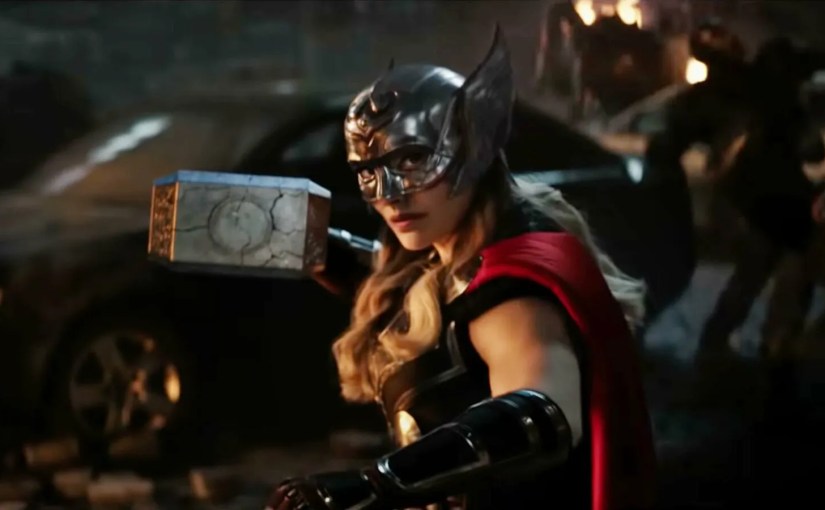
A supporting cast of return players work well together, particularly Natalie Portman, who is given a much more fleshed out and well considered character arc than her two previous Thor films. (Early on, Marvel Studios was notorious for not writing good female characters in any of their pictures.  They were just presented as glamorous damsels in distress. Thankfully, that’s well behind them by now.)  Portman returns as the on again/off again love interest, Dr. Jane Foster, for Thor.  Even better though, Jane actually becomes Thor!!!!! (No spoiler there.  Just look at the trailer or marketing poster.)  There’s great on-screen interaction with Portman and Hemsworth, even when it’s a montage of past dating episodes like in ridiculous Halloween costumes or having a domestic squabble as any typical married couple might have.  Hollywood should reunite these two for a romantic comedy in the vein of Rob Reiner/Nora Ephron material.  Chris Hemsworth is a much better partner than Ashton Kutcher ever was in a past Natalie Portman film.  Put Chris Hemsworth together with Natalie Portman again and they could become as adoring as Tom Hanks and Meg Ryan did.

By the time the fourth movie comes, does it really matter who the villain is played by?  Well, when you are writing a smart script amid ridiculous visuals like Taika Waititi is known for, the answer is yes.  This film surprisingly opens on a downer prologue that necessitates good dramatic acting amid silly CGI and garishly loud costumes.  It’s fortunate that Christian Bale, who regularly performs on a method level comparable to Daniel Day Lewis, was available to portray the scrawny, pale and scarred Gorr The God Butcher.  Bale puts all his talents into what could’ve been a throwaway role like, say a Ghostbusters bad guy.  (Can anyone tell me who actually played Gozar in the 1984 film????)  This is another notch in Bale’s repertoire of outstanding credits that should not be overlooked.  You can sympathize with Gorr, as well as be frightened of him.  There’s much range in this character on the same level as the Thanos villain from earlier Marvel films.

Russell Crowe has a fun appearance as the God known as Zeus.  He looks over the top ridiculous and he works in antics that seem like they came out of episodes of Who’s Line Is It Anyway?  Put it this way, I haven’t forgotten how Crowe walks down a staircase yet.  If Russell Crowe is anything of an educated performance artist, then when he was getting sized up in wardrobe, I’m sure the wheels were turning and he was considering what tics could work for that of a God drowning proudly in his own vanity.

Tessa Thompson and Taika Waititi are thankfully back, respectively as Valkyrie, King of the fishing/tourist destination New Asgard, and the simply innocent rock guy buddy, Korg.  The Guardians Of The Galaxy are here too.  It’s a fun bit of material they have to play with.

In another director/screenwriter’s hands, any Thor film would likely get boring with its standard formal Shakespearean like vocabulary and artificial CGI.  Isn’t that an ongoing problem with CGI anyway?  So often it looks to fake.  Because Taika Waititi opts for bright colors and odd shapes and sizes of setting and background characters, nothing could look artificial, because the fantasy is always acknowledged as over the top by the very characters occupying the space.  A glass castle of pinks and purples that resembles gigantic glass Mary Jane bongs or science lab beakers is accepted in a Thor film, just as much as munchkin size, owl like creatures with small beaks are a terrorizing army in flying jet skis with mounted laser guns.  Mix in a blaring rock soundtrack and Waititi hits the notes where it’s okay to laugh at the silliness of it all. In other moments, he’ll invite his audience back in from recess to take in what’s hard and difficult to live with and endure.  Again, Waititi pleasantly surprised me with the balancing act of outrageous comedy against crushing drama when he made Jo Jo Rabbit.  The blend works so well here in not so typical Marvel fashion.

Thor: Love And Thunder left me thinking that it is the best of the superhero’s four films.  It’s measure of laughs and choked up drama kept engaged and I appreciated the experience.  Remember, I recalled Steel Magnolias and Terms Of Endearment in this write up.  If you don’t take that comparison lightly, then hopefully you’ll have the same experience I did with this installment of the Marvel franchise.

PS: Hats off to the trailers for not incorporating everything the film has to offer.  Within the first fifteen minutes of the movie, I was actually taken aback by an element I never considered or expected.  It only enhanced my perspective of the film.

PSS: Anyone that knows me, knows that I love Guns N Roses.  Consider me a born-again fan.  Particularly Sweet Child O’ Mine will always be one of my most favorite songs.  This film reminded me that it was the first song my daughter heard the day after she was born, when I sang it to her in the hospital room. 

THE INSIDER

By Marc S. Sanders

When I think of Michael Mann’s The Insider from 1999, I cannot get over how deep it is with its storytelling. Inspired by true events and based upon a Vanity Fair article, I consider the adjective “deep” because it’s really a one-story trajectory, but it covers so many different facets; so many different industries and how they operate and sometimes overlap with one another. The tobacco industry, journalism in both television and print, state law and even the deterioration of an American household. Michael Mann shows how one simple action can balloon into something bigger affecting others all at once. You gotta get through one thing before you swim deeper into the bottomless pool of policy, contracts, ethics and threats.

Russell Crowe portrays Jeffrey Wigand, a top leading chemist with the Brown & Williamson Tobacco Company. Upon realizing that he has detrimental information should it go public, the company fires him and compels him to sign a confidentiality agreement not to reveal any of his research or activities while in service to them. That won’t suffice for the incredibly powerful tobacco company though, as Dr. Wigand receives threats that include disturbing emails, possible prowlers and a bullet that mysteriously turns up in his mail box.

Wigand crosses paths with Lowell Bergman (Al Pacino), a producer with 60 Minutes at CBS Television. Bergman works often with famed interviewer Mike Wallace (Christopher Plummer, who should have been nominated, much less won an Oscar). Wigand gets more and more motivated to go on Bergman’s show and tell everything about how the tobacco industry manipulates cigarette manufacturing to make it all the more addicting.

Bergman wants the story but he wants to play it carefully. Toeing the the line of maintaining Wigand’s confidentiality agreement might require a deposition by the scientist in a state courtroom so that his testimony will be public record. In other words, get a state to subpoena him and then the interview can happen because what Wigand says in an interview is already public record.

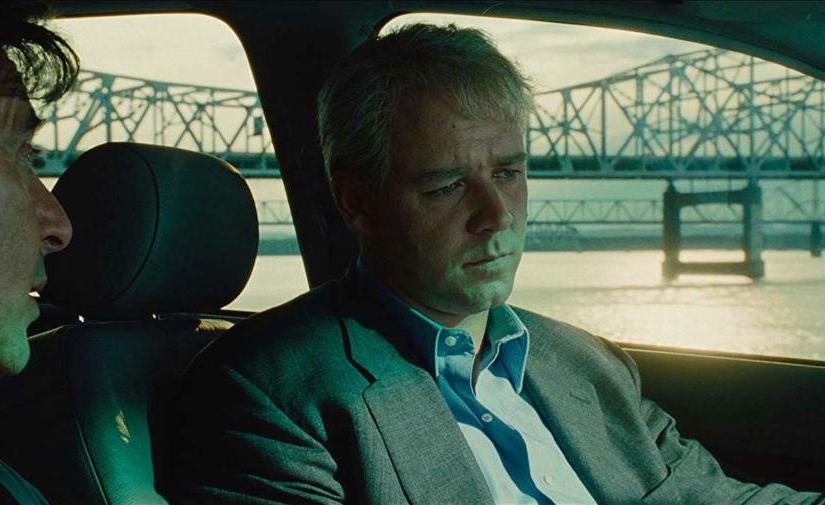
It’s complicated. Not so much for the viewer though. It’s complicated for Jeffrey Wigand. Russell Crowe emotes his rock and hard place situation with terrible anguish and a short temper. Michael Mann gets great closeups that capture the stress like deep wrinkles and dark circles under the eyes along with pale white skin, a big gut, wrinkled dress shirts, and rough shaves. The stress also carries over to his southern gentile wife (Diane Venora in an entirely different role from Mann’s Heat) and his two girls. They are collateral damage here. Wigand could also lose medical coverage on top of his salary and the threats of civil liability. Jeffrey Wigand is an ant under the very large heel of Big Tobacco.

Lowell Bergman also has obstacles from within his own camp. Journalistic integrity is tested with Wigand’s interview. It’d almost be better if Wigand was lying. That way Big Tobacco could not sue CBS for breach of a confidentiality contract. The more truth he tells, the greater the liability. Considering that CBS Corporate is in the middle of a buyout that could be very profitable for a select few, CBS is disregarding Bergman’s reputation for bringing in experts and informants that have made 60 Minutes the most watched news program on television.

These are the dilemmas that comprise Mann’s near three-hour film. What’s as interesting is the in between material. With Mann sometimes shooting with a documentary like approach, we catch glimpses of how a journalist will pass a colleague in a rotating lobby door and they’ll make arrangements to exchange one story in a time slot for another. These are mere seconds, but it paints a colorful setting that the news never sleeps. We see how Big Tobacco (represented by a slimy Michael Gambon) can subtly intimidate one man in a corporate office. We see a trio of lawyers take a phone call from a private jet they are piloting to consider Wigand as a material witness. We see how one of those lawyers (Bruce McGill) will handle an objection during his questioning of a witness (an unforgettable scene). We see how Wigand must adjust with his family to downgrade to a smaller home with old dusty kitchen cabinets and how it all gradually weighs down his marriage. We see how Bergman has to be covert with meeting Wigand in a hotel lobby. We also see how Big Tobacco can issue a smear campaign and how Bergman has to go across the street to a newspaper colleague to first ask for a deadline of print to be pushed back, and later how he grants a story to the paper to reveal shady dealings and how to refute what’s already been falsely claimed. There’s even a deal that indirectly involves the infamous Unabomber. It’s these little details that keep the film’s pulse alive.

Even before all of this begins, Mann demonstrates the lengths Bergman and Wallace will go to for 60 Minutes. They go deep into the Middle East to get an exclusive interview with the Head Sheik for the Hezbollah terrorist group. Christopher Plummer as Mike Wallace is marvelous here as he stands up against an irate bodyguard strapped with a machine gun to argue about how close he will sit next to the Sheik. If you want the story, the true story, you have to be genuine and be fearless with risk.

I can’t say enough good things about The Insider. It’s truly an education to watch the film with blazing cinematography in blues and grey hues from Dante Spinotti. Mann is always known for his coolness with film, dating all the way back to the MTV vibe of Miami Vice to Thief with James Caan, and his LA crime drama Heat. The tradition carries on here.

As well, the dialogue is so crisp from a script by Mann and Eric Roth. Pacino is memorably given an opportunity to sum up the machinations of CBS corporate in the third act of the film. The Mike Wallace character is not written as a television personality with a cue card. He’s got real, good, seasoned intelligence in his words. Plummer just enhances the script.

The Insider ranks at the top of the list of films focused on journalism next to features like Sidney Lumet’s Network, Tom McCarthy’s Spotlight and Alan J Pakula’s All The President’s Men. It explores the danger that can come from truths that need to be told which others never want disclosed. It covers the methods by which parties are recruited to help get the truth and the lengths operatives will go to, to squash a story.

The Insider is a gripping, magnificent film.

MAN OF STEEL

By Marc S. Sanders

The first time I saw Zack Snyder’s Man Of Steel, I was disappointed.  Very disappointed.  It was only after a second viewing about a year later that I realized I was simply biased and unfair with my perception of the film.  I grew up with the Richards’, Donner and Lester, films that featured Christopher Reeve in the role of Superman/Clark Kent.  Nothing could violate what was done in those films from the ’70s and ’80s. 

My impression of Man Of Steel now is that it is a marvelous film.  It’s an exploration of a stranger in a strange land questioning how to adapt to a living environment that he is not from, nor where anyone around him is genetically built like him either.  Henry Cavill fills the role of the title character.  What’s especially important is that he is not attempting to do what Reeve memorably did before him.  Actually, David S Goyer’s script really doesn’t allow for the hijinks of the prior films.  Clark Kent is not portrayed as a goofy and lovable klutz this time around.  Instead, the boy from Smallville, Kansas is challenged to limit his abilities at the behest of his Earthling father, Jonathan (Kevin Costner).  It’s dangerous for Clark to show all that he is capable of from his super strength to his heat vision.  Clark’s Earth mother, Martha (Diane Lane), is more protective of her son.  A really powerful scene occurs when young Clark is in the classroom and he has a bout with sensory overload of super hearing and super x-ray vision.  He can’t get the encompassing sounds and sights out of his head.  One of many CGI effects in the film come with Snyder showing the skeletal insides of Clark’s classmates and teachers.  It’s frightening; even to an innocent alien boy from another world.  This is good conflict.  Does the world need Clark Kent?  Would Clark Kent be better off someplace else?  Can he manage to live with daily life drowning out his sensibilities?

Another dilemma opens the film on Clark’s home planet of Krypton where he was born with the name Kal-el.  His father, Jor-el (Russell Crowe) has insisted to the governing body that the planet is expected to self destruct soon, and civilization needs to be relocated to another planet.  The politicians refuse to accept his theory.  Jor-el’s friend, the military leader General Zod (Michael Shannon) sides with his opinion.  Though his approach is violent insurrection of the Kryptonians.  Zod is punished for his crimes and sentenced to an eternal prison known as The Phantom Zone before baby Kal-el is shipped away, and the planet implodes with all its inhabitants.

Following this opening, Snyder cuts his film with flashbacks and forwards showing Clark in various different roles as either a fishing boat crewman or a bartender trying his best to remain undercover even when the temptation for use of his powers repeatedly shows itself.  Clark reflects on moments from his childhood when he and his Earth parents questioned how to present himself.  

Superman’s known love interest eventually shows herself, Pulitzer Prize winning reporter for the Daily Planet, Lois Lane (Amy Adams).  She’s following up on an alien ship that has been discovered in the arctic after 20,000 years.  Clark and Lois connect at this moment.  Of all the Superman angles that are familiar to so many of us, this is where Goyer and Snyder perhaps do not focus enough.  Man Of Steel is a satisfyingly long film, but there’s a lot of material and drawn out action to cover as well.  So the Lois and Clark relationship is somewhat sacrificed and not as nuanced as we have experienced in other iterations.

Zod arrives on Earth requesting that Kal-el reveal himself along with the intent to destructively turn Earth into a new Krypton at the sacrifice of the planet’s human population.  Naturally, a city wide battle will ensue. and lemme tell you reader you wanna talk about destroying the village just to save it….well…that’s what happens here.  When New York got destroyed in Marvel’s The Avengers or Ghostbusters, those pictures looked like spilled milk compared to what Superman and Zod do here.

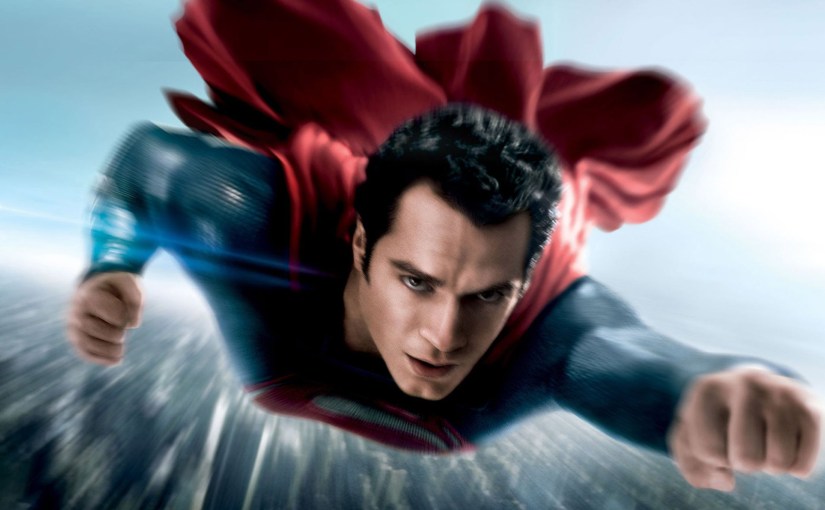
Man Of Steel is the best film of the new Warner Bros/DC universe.  It might be Zack Snyder’s best film as well.  The assembly of the picture is masterful.  Hans Zimmer’s score has these great build ups as Clark discovers more of his capabilities.  It especially lends to when the character dons the cape and costume for the first time ready to leap in the sky and fly.  Snyder shows the efforts needed for Superman to carry out this talent.  The flying doesn’t come easy.  It looks like work on the super hero.  Zimmer’s score starts out quiet and then advances to these powerful notes as Superman soars higher and higher.  The boy from Kansas is making himself into something greater that he has no familiarity with.

Michael Shannon plays another of many kinds of villains and antagonists on his resume.  I’m not sick of this guy’s antics yet.  It’s time he become a James Bond villain.  He plays Zod with an uncompromising determination and disregard for anything else but to rule.  It’s all very sci fi like but I love how unforgiving he is with the role.  Much less Shakespearean than when Terrance Stamp played the part so well with Reeve as the hero.  Shannon is more direct and bloodthirsty.  Michael Shannon just knows how to be scary on film. This kind of personality would work great in a silly comedy from the Farrelly brothers as well.

Amy Adams is fine as Lois, but there’s not much here to work with honestly.  More details of her relationship with Superman come through in later films.  However, this story development soured me on my initial viewing.  The iconic irony of Superman pathos is that as sharp a reporter as Lois Lane is, she can not realize that the guy wearing the glasses who is working right next to her is actually Clark Kent?!?!?! Readers and viewers were always thankfully in on the joke.  On follow up viewings of Man Of Steel, I understand that Goyer and Snyder were never aiming for irony.  Lois knows who Clark really is from the get go. What was once an unforgivable departure for me, no longer is a concern.  There are deeper angles to question in Man Of Steel, like a purpose to others and the freedom to force a change because it can be done.

Snyder and Goyer broach on the well known Christ allegory with Superman.  The film takes place in Clark’s thirty third Earth year.  Jor-el is slain with with a stabbing to his rib.  There’s also the crucifixion  pose on a number of occasions.  I must admit, as a Jew raised conservatively with just the Old Testament, I am not very educated on the texts of Jesus Christ.  However, the basics are explored in Man Of Steel.  Is Superman a savior?  Snyder wisely even has Clark visit with his Smallville priest to question his obligations to Earth and to Zod’s calling, with window artwork of Christ in the background.  

One vice I have with Snyder’s picture is the shameless plugging.  How overt must signage from Sears, U-Haul, 7-Eleven and IHop be?  Granted, all of these summer blockbuster films have the inserts of brand labels going all the way back to the original Superman films.  Here though, the corporate advertising is a true eyesore.  Superman being thrown into the dining area of an IHop is not as memorably funny as when Zod’s underling, Non, crashed into New York’s famed Coca-Cola sign back in 1981.

The seemingly endless battle consuming about forty five minutes of the third act of the film are over the top outrageous.  I might normally be saying I’ve seen enough while casualties are never considered as buildings literally topple over into mushroom clouds of concrete dust.  Still, the cast keeps these moments alive.  Shannon and Cavill, along with Laurence Fishburne as Perry White, the Daily Planet editor, and Amy Adams, actually show risk and fear amid all of this bombastic action.  Still, Snyder is insistent on his freedom to go crazy with CGI effects.  It’s more than a bit much, but the characters up to this point keep me engaged with the film all the way through.  Later DC films in this franchise don’t do it so much for me, but that’s another column altogether.  

Again, what I especially like about Man Of Steel is how Snyder cuts back and forth with the film.  Heroic moments occur and then are reflected back to times in Clark’s childhood with Jonathan and Martha.  With Zimmer’s score, it seems to allow Clark to consider conversations and moments from his past as meaningful to what he is experiencing in the present.  When Zack Snyder stays on this trajectory it makes Man Of Steel more than just another comic book movie for summer box office.  There’s depth from Goyer’s script that Snyder wisely does not disregard.  

Man Of Steel is a new and unfamiliar kind of Superman, but its a very welcome Superman too.