GONE BABY GONE

By Marc S. Sanders

Ben Affleck’s directorial debut, Gone Baby Gone, is crime drama mystery thriller that never offers easy answers and concludes with great debate.  You’ll ask yourself if right decisions were made.  You will argue with your best friend or significant other about the endings.  What’s undeniable though is that the film, adapted from Dennis Lehane’s novel, is full of an array of characters, most operating with the best of intentions, and yet they wind up doing everything wrong or against their sworn principles.  In order to work the problem, these people will have to betray themselves. 

One of Affleck’s many best decisions was casting his brother Casey Affleck in the lead role of private detective Patrick Kenzie.  With his girlfriend, Angie Gennaro (Michelle Monaghan), they specialize in tracking down missing persons in and around the Southeastern Boston area.  The brothers’ pairing is especially effective as Boston, Massachusetts is where they were born and raised.  They know this setting intimately. Unpolished multi-floored tenement neighborhoods near seedy watering holes are where the crimes of Gone Baby Gone occur.  Casey can ensure that his character, Patrick, can speak the slang, use the thick dialect, and feel comfortable amid a crowded and overpopulated area. As director, Ben ensures the setting is captured in great detail from Red Sox caps to beat up cars and dirty unkept apartments and secret hang outs.

In the middle of the night a little girl has gone missing and her deadbeat, drug addicted, careless mother Helene (Amy Ryan) is unmotivated to offer the police much to go on. Helene’s brother and sister-in-law (Titus Weliver, Amy Madigan) take it upon themselves to hire Patrick and Angie to find their niece.  The only leads that Patrick, Angie and the police (Ed Harris, John Ashton and occasionally Morgan Freeman) have to go on are Helene’s contacts within the drug peddling underground.  Someone within that community might have taken the girl or know someone who did.

Gone Baby Gone may feel like a Law & Order episode where red herrings are offered early and then dismissed for the actual truth.  However, Lehane’s story twists much deeper beneath the surface.  Not one character is wasted in this film.  Each serves a purpose to how and why this crime ever occurred.  Mysteries get resolved but the answers are not simple because they are multi-layered with many different people spinning twice as many plates.

Ben Affleck seems nothing like an amateur director here.  He does not always rely on dialogue to describe a scenario because he films quite a bit of a disheveled room or kitchen, or an outdoor area.  A daylight scene will take place in a darkly lit bar where only people need to hide from their troubles on an ordinary workday, or maybe they are in there to suppress something uglier.

The cast is outstanding.  While the characters belonging to Freeman, Harris and Ashton seem familiar from much of their other career films, they look like they lived within this environment of three-story houses bordering the harbor, across town from Fenway.  You believe these guys know every alleyway, street corner or contact among the city’s small-time deadbeats. 

Amy Ryan was nominated, and perhaps should have won, for her trashy Bostonian performance as Helene, the missing girl’s mother.  This actress is buried so deep in this role, from her worn out facial features to her New England dialect that blends so well.  She is completely believable, which is why you would not be able to stand sharing the same space with her.

Titus Welliver dons a thick, wide Irish mustache.  I read he had to keep it because he was shooting his HBO series, Deadwood, at the same time.  Nonetheless, it builds his character into the blue-collar working man whose greatest achievement is getting out of the life of small-time crime in order to put food on the table, while his sister could not.  His wife played by the great Amy Madigan, an actress that does not get enough coverage, is perfect.  Just her facial expressions with a pale, freckled complexion, tight chin and pinched lips show her biting her tongue while in the same room as her loser sister-in-law.  It sickens her that a sweet little girl like her niece is missing.  Everything is read on her face.  I know Madigan best as Kevin Costner’s midwestern cheerful wife in Field Of Dreams.  She played this role almost two decades later and she absolutely hides herself.  You forget you are watching her.  An outstanding character actress.  (I’m glad she’s getting new recognition with 2025’s hit horror movie Weapons.)

Michelle Monaghan as the girlfriend Angie is the sidekick to Casey Affleck’s Patrick.  Yet, she makes the horror of this movie convincingly real.  Early on, Angie is reluctant to accept the case because she doesn’t “want to find a kid in a dumpster.”  Now this isn’t some Dirty Harry or Lethal Weapon cop showcase.  It’s not glamourized with Hannibal Lecter glee.  This has not become much further materialized.  I don’t want to see a horrifying outcome for a child either, but Ben Affleck’s direction does not make any promises.  There are some repulsive, scary people in this world, right outside the front doors where people listen to the game on the radio and kids play stickball in the street.  Monaghan seems like that young woman who came from another place in the country with a fine upbringing and fell in love with Affleck’s character. With her brains, instincts and empathy, Angie took up the cause as a fellow crusader.  None of this is spelled out in the film and I have not read Lehane’s books, but I can see it in Michelle Monaghan’s performance.

Casey Affleck is a perfect surprise.  He dons the appearance of a thin, shrimpy kind of kid (supposedly age 31), and yet no matter who he is coming face to face with he never shows any sort of apprehension.  I truly believe that Patrick is not afraid of his work or the people he has to confront while trying to solve his various mysteries.  If a large gun is introduced into a scene, Patrick’s reaction is an act of “whoa, what’s this?”  Another character in another film would tighten up and hold their breath, or they would knock the weapon out of the way for an action scene.  Patrick has put this kind of act on before to outlast a situation.  Angie has definitely seen it before. 

Casey Affleck is great at just listening.  Shortly after he accepts the case, Patrick and Angie are in one of these darkened bars trying to collect information.  Ben Affleck shoots his camera above Casey sitting in a booth with a beer.  The actor keeps his head tilted as if he is listening to nothing spewing from a possible lead sitting across the table.  When a gun is pulled though, Casey stands three feet taller than his posture implies and controls the scene.  That is Dennis Lehane’s character Patrick Kensie completely defined because Casey Affleck has a full understanding of this guy.  Someone like Patrick knew that if he was going to take this kind occupation on full time, he had better be aware he would not survive on brawn that he cannot show.  It’s a confidence that has to come through. 

Gone Baby Gone is a gripping and engaging thriller shown with varying degrees of light and perfect cinematography to offer genuine on-site locations of Boston and the surrounding areas.  Ben Affleck chose not to compromise any of his set pieces.  With handheld cameras, when a missing person’s search is happening, it feels like a documentary of procedure is being shown. 

The various directions and endings are entirely unexpected and yet very, very plausible.  This is a smart, sensational crime drama that deserves a resurgence of attention nearly twenty years after its release.

BATMAN BEGINS

By Marc S. Sanders

The merits of a lot of action/adventure films is predicated on how strong the villain is to the story.  Often the hero is the straight character in the heroic garb ready to enter the scene just as the bad guy is on the brink of maniacally destroying the world.  In the early 2000s however, the focus diverted to the hero when big franchises opted to reinvent themselves.  James Bond’s origin was finally offered up in the best film of the series, Casino Royale.  Christopher and Jonathan Nolan served up one of the best cinematic Batman stories on screen.  The title said it all.

Batman Begins gets every note right with the all too familiar back story of Bruce Wayne’s drive to become Gotham City’s Dark Knight vigilante.  The film has its collection of villains but the center of the picture is always circumventing around Bruce Wayne, perfectly played by Christian Bale, with somber truth hidden by handsome playboy disguise.  As a child, he discovers his fear of bats and then attends the theater with his billionaire parents.  Upon their exit through a back alley, he witnesses their death and is left to be raised by his trusty butler, Alfred Pennyworth (Michael Caine, my favorite actor in the role to date).

This film achieves my undivided attention because it paints a full canvas of this character before he ever adopts an alter ego in a black costume.  We explore how he becomes motivated followed by his intense training in the zenith alps, on the Asian continent.  Then we see how he supplies himself with all of the familiar gadgets and costumes when he befriends an ally within his father’s company, Lucius Fox (Morgan Freeman). 

Jonathan Nolan’s script diverts away on occasion to embrace the capable villains of this story with the Scarecrow (Cillian Murphy), Rha’s Al Ghul (Ken Watanabe) and mob boss Carmine Falcone (Tom Wilkinson).  Bruce’s mentor, Ducard (Liam Neeson), is a big factor in the hero’s development as well.  Lastly, there’s Bruce’s childhood friend and legal connection, Assistant D.A. Rachel Dawes (Katie Holmes).  Lt. James Gordon is the uncompromised police detective that Bruce singles out to trust within this dense world of corruption.

Just to read this cast list is impressive as they fall beautifully within the matrix of Nolan’s blueprint.  Everyone is given enough time to make more than one impression as their storylines twist and alter.

Christopher Nolan’s films are always moving like a smooth ride on a never-ending stretch of road with no traffic in the way.  Nothing bears repeating from what was already shown in an earlier scene.  There’s something new to learn as the pace continues.  Nolan is one of the few filmmakers where you do not mind the time jumps he incorporates into his stories.  Bruce will first be seen as a ten-year-old boy, then in his muscular fit thirties in a Chinese prison completely departed from the wealth of Wayne Manor.  A step back before that shows him as a Princeton drop out with a mop top haircut.  Every different appearance of Bruce is interesting and you become intrigued with how he ends up in one place after another. 

Like the first appearance of Daniel Craig in the Bond series, this Batman/Bruce Wayne is repeatedly imperfect.  He’s flawed because he still needs to learn and the characters that enter and exit and reenter his life must teach him.  Alfred will lecture a short-triggered Bruce when he’s on the cusp of risking the reputation of his father’s legacy.  Rachel will slap him when he’s prepared to kill in cold vengeance.  Ducard will teach him the ways of physical survival and will test Bruce’s loyalty and the measures of crime with punishment.  Even the Scarecrow is smarter than Batman when he springs an unexpected trap.

The ongoing education of Bruce Wayne is the theme of Batman Begins, all the way to the end, when he finally learns to mind his surroundings.

Christopher Nolan made Batman exciting in a new unfamiliar way.  The Batmobile is a not a sporty kind of vehicle.  It’s a tank called The Tumbler and it bears a thunderous series of sound edits as it barrels through Gotham City.  After some slip and falls off rooftops, Batman becomes much more covert than in other interpretations.  You don’t have to physically see Batman to observe him operate.  If a thug gets swallowed into a void of darkness, you know what has ensnared him.  The crusader’s devices which stem from his gold utility belt are demonstrated with explained reason for why he selected them for his fighting advantage.  The Nolans proudly recognize the theatricality of this guy.

Cillian Murphy is unforgettable as he lives up to the name of Scarecrow, also known as Dr. Jonathan Crane, a criminal psychologist.  His choice to put his victims into a hypnotizing sense of fear lend to the back story of Bruce Wayne’s intent to become a frightening figure himself, where his enemies will recognize his dread.  Tom Wilkinson claws his gangster persona straight from a Godfather kind of picture, but he represents an old guard of Gotham City before costumed and makeup identities take over.  Gotham will transition from the sharp dressed mobsters over to the crazed clowns yet to come. 

Gary Oldman invents another unique personality – a strait-laced city guy who might have come from a 1970s ABC cops and robber show like Dragnet.  No two characters of Oldman’s are ever the same.  So much so, you almost wish they would all assemble in a movie for the various personalities to interact.  Morgan Freeman and Michael Caine are like comfort food who are so subtle and relaxed in front of a camera.  Neither one makes big waves with their characters.  Jonathan Nolan wrote their respective purposes for this Bruce Wayne and they execute their techniques of less is more beautifully.

Liam Neeson delivers the second-best performance of his career thus far, after Oskar Schindler.  He adopts the same kind of method that Freeman and Caine work with, but then he sways from that behavior when Ducard has to surprise Bruce as a means for his pupil’s development. Some of what he does comes from nowhere.  Early in the film, his first two scenes could not be more different.  Neeson works like an unpredictable entity.

The next film in this trilogy replaced Katie Holmes with Maggie Gyllenhaal.  I was disappointed because Holmes was maturing as a very formative actor by this time.  She was blessed with a well written character in Rachel Dawes.  When I watch the next film, The Dark Knight, I cannot help but wonder how she would have performed the role for a second and much more developed opportunity. 

There is not one flaw in Batman Begins.  This is the movie that placed Christopher Nolan in the echelon of top blockbuster directors like Spielberg and Hitchcock, along with Lumet and Mann.  Hans Zimmer’s soundtrack is thrilling as it speaks for The Dark Knight who is of few words.  Zimmer’s scores announce the introduction of Bruce Wayne first, and then later Batman. 

Gotham City makes for a sensational character with various rooftops, fire escapes, tunnels, bridges and a gorgeous, elevated train at its center.  The entire city breathes steam amid the distressed decay, wet streets and rusted architecture. 

Wayne Manor has a ghostly effect as Alfred and Bruce climb the large staircases and floors.  Further down under its platforms rests the cave that’ll serve Batman well.  The waterfalls and rocky caverns are immense. 

Batman Begins is not one of the best films of a genre like any other superhero movie.  I refuse to recognize it that way.  Instead, I see a character study where a man accepts a responsibility to fix what scarred him at a young age.  He wants to right a world that once had promise.  I don’t see the costumed protagonist announce himself as a superhero.  I don’t see the costume.  With the cape and the horns on the head and the car and the tools, I see an image, never a superhero.  With Christopher Nolan’s first film in what will become a well-received trilogy, I always see the man underneath the mask. 

TEACHERS

By Marc S. Sanders

I grew up watching the television show M*A*S*H with my mother and brother.  Don’t hate me but I have yet to see the Robert Altman film.  Perhaps that is because I was afraid of major disappointment.  The formula for many of the episodes and seasons of the TV show work so well at blending tidbits of comedy within a setting that is nothing else but bloody turmoil.   For those characters to survive required all of them to laugh and lampoon into the face of an uncontrollable situation where their lives could end at any time while they live in misery.

These thoughts came back to me as I watched an unsung and forgotten film from 1984, Teachers directed by Arthur Hiller.  John F Kennedy High School is only going in one direction which is very far south beyond the gates of hell.  A gym teacher is getting students pregnant, a kid shows up at the principal’s office with a stab wound in the arm, and the school psychologist has just lost her marbles because the old fart tenured teacher hogs the ditto copy machine (Remember those?  You could get high off the ink on the paper.).  A mental patient has managed to worm his way into a comfortably welcome substitute teacher position.  The driver’s ed car has been stolen and one student terrorizes another teacher in an assortment of ways beginning with biting and then moving on to theft.

Alex Jurel (Nick Nolte) is the admired social studies teacher who has lost his passion for the profession.  It’s not so much that the student body or the teaching staff is out of control.  The whole administration has taken to a new mentality of profit over proficiency.  The merits that come with an education are all but dismissed.  The assistant principal (Judd Hirsch) used to care as well.  Now, his job is to maintain a façade for the school and churn out one student body after another year after year.  The principal only knows to answer any questions with a genuine “I don’t know.” reply.  Bottom line is no student should ever be flunked from John F Kennedy High School.  If they can read enough, then it’s enough to get the diploma.

A former student of the school is Lisa Hammond (JoBeth Williams), now an attorney and representing a graduated student who is suing the school claiming he is an illiterate who cannot find a job or begin a future due to the negligence of the school. Lisa is a crusader.  She’s not here for the money to be earned from the case.  She’s here to make a change and her lynchpin deposition will come from Alex who will testify about the truth that’s occurring. Hopefully, he will also recruit other teachers in tow to back up the claim.  Naturally, as his former student with the nice ass, Lisa becomes involved with Alex on the side.  Like most movies, this one also does not question the conflict-of-interest circumstance.  We just have to roll with it.

I really take to the dilemma of the school and I understand both sides of the argument.  Now, more than ever, over forty years after the release of this film, I think our educational system is in dire straights with minimal funding, lack of support and respect for a teaching staff, parents who exonerate themselves of being responsible for their children’s lack of progress and behavior, and then of course there is the very real epidemic of school shootings and on campus violence. 

However, school is a necessary element to our society and its where all of us begin.  To uphold a reputation will involve both losses and wins.  Not every student will make it.  Not every student will miss out either.  As Judd Hirsch’s character insists, half of these students will not graduate with a proper education but half of them will.

Okay.  Enough arguing!  How about Arthur Hiller’s movie? Teachers has much to stand on and I wish it had garnered more attention.  It’s undoubtedly worthy of it. 

Like M*A*S*H, there’s organic comedy that comes from the film and a variety of teachers and students appear like they have been cut from familiar cloths.  Most of the comedy works especially well.  I love the ongoing joke of the one teacher who sits at the back reading his paper and dozing off, with the students facing away from him while they complete an assignment during the period.  The punchline to this joke may be predictable, but I’m still allowed to laugh as I watch it play out.  It’s funny. 

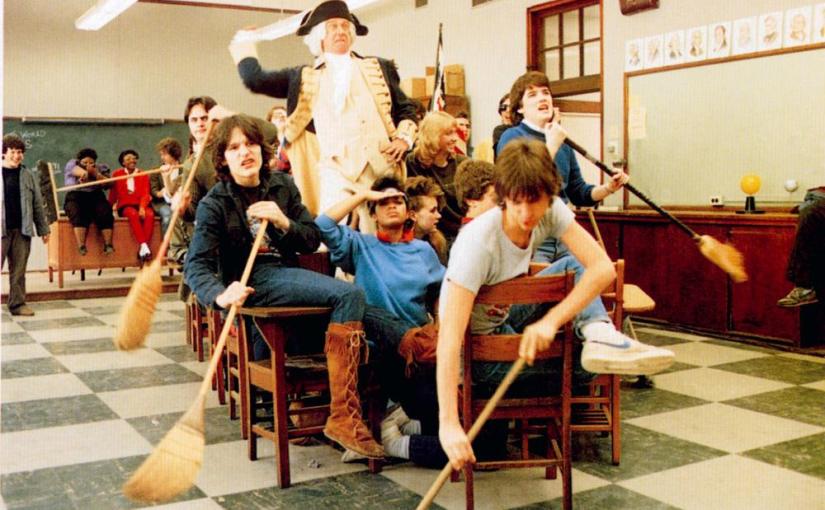
Richard Mulligan (Empty Nest) plays a mental patient that ironically engages his students when he conducts his classes dressed as famous historical figures like Lincoln and Custer.  Watch him reenact George Washington’s crossing of the Delaware with his students “rowing” the boat.  It’s an image I will not forget.  Nor will I forget his final scene in the picture as he encounters Nolte’s character in the hallway.

Where the film falls short is in the one student that is primarily focused on, played by Ralph Macchio, shortly after coming off his first Karate Kid movie.  Just like in The Outsiders, which I recently wrote about, Macchio relies on his dark complexion, stylish black hair, blue jeans and that popped up jacket collar again.  There’s also that strut he always has.  Forgive me for beating up on the kid, but too often I see Macchio donning the same image – that cool kid pose needed for the cover of Teen Beat Magazine.  Nick Nolte shares a lot of scenes with the actor playing the troubled kid with a sixth grade reading level.  However, Nolte is the only one working most of the time.  Another actor in this role would have served better.  It’s a necessary role as it attempts to awaken Nolte’s teacher character to try saving another kid before he gets lost.  Back then, maybe Emilio Estevez or Lou Diamond Phillips would have been more suitable.  Instead, we get Ralph Macchio being Ralph Macchio all over again.

Teachers is a comedy drama that mostly works.  It’s easy to get caught up in the comedy and, sadly, the absurd truth of what goes on in a metropolitan public school system back in the 1980s.  There’s also very dramatic and heavy elements to the film that stay with you.  Before school shootings no longer became shocking (a sad and current truth), Teachers explored the trauma of school bullying and the response the comes with that issue.

Arthur Hiller’s film did not invent the wheel on troubled times within school.  Heck, even The Sweat Hogs from Welcome Back, Kotter were troublemakers too.  Not to mention there are other school dramas to come before, like Blackboard Jungle.  However, Teachers is an very engaging film. I was completely absorbed as soon as the movie began, first in its comedy, and then later in its drama.  A near final scene of the film is eye opening and much like Steel Magnolias will leave you laughing and crying all at the same time.  That happens because you quickly begin to care for most of these characters and the turbulent times they live through as a teacher making next to no money while working under unfair and unreasonable scrutiny.

I think Nick Nolte is delivering one of the best performances of his career.  He has great chemistry with JoBeth Williams, who is good in her role.  The romantic storyline does not go overboard.  It does not get schmaltzy.  It is just enough, and it’s wise to include dialogue where they debate one another from two different sides of a coin.

Teachers also works as a great look back piece.  A lot of well-known, eventual recognizable actors round out this cast including Morgan Freeman, Crispin Glover, Laura Dern, Allen Garfield, and Lee Grant. Anytime Nolte is on screen, he only enhances the scenes he shares one on one respectively with most of these actors.  The moments between him and Macchio only work because of Nick Nolte.  Call Nolte the Alan Alda/Hawkeye Pierce of this picture. 

Teachers might look tame by the turmoil we see today in schools across the country but none of what is seen is untrue or exaggerated either.  Well, maybe except for the mental patient who arguably turns out to be the most engaging and influential instructor of them all.  That’s funny stuff, but you gotta be a little bit crazy to become a teacher nowadays.

MILLION DOLLAR BABY

By Marc S. Sanders

Clint Eastwood has one of the most remarkable careers in Hollywood history.  As his appearance has aged, so have the roles he’s occupied. He’s got these long lines that run down his cheekbones and across his forehead that compliment his signature scowl and white hair.  These facial features lend to a background in many of the characters he’s portrayed over the last thirty years ranging from a “Frank” in In The Line Of Fire to a “Frank” in Million Dollar Baby, his second film to be a recipient Oscars for Best Picture, Best Director, and Best Supporting Actor.  A Best Actress Oscar was also garnered for Hilary Swank. 

Swank won her second Oscar as Maggie Fitzgerald, a backwoods product of a hillbilly upbringing, who only lives for one dream and that is to be a championship boxer.  When she’s not waitressing to collect coins and singles for tips, she is spending every waking moment at Frank’s boxing gym, The Hit Pit.  Maggie keeps to herself by punching a bag, but she is persistent at convincing a closed off Frank to become her trainer.  Frank has no interest in training a girl, but maybe there’s more to why he’s reluctant to take her on.  The lines on Eastwood’s face seem to metaphorically hint at a challenging past.

Frank’s best friend is Eddie, or otherwise known as “Scrap Iron,” played by Morgan Freeman in a very long overdue Oscar winning role.  Some may argue that Freeman was bestowed with an award for such an illustrious career.  That’s fine.  I still believe that this performance is just as worthy as his other celebrated works (Driving Miss Daisy, The Shawshank Redemption).  Eddie lives in a small room in the gym and manages the place by day.  Frank is a crank towards Eddie, but they’re the best of pals. Frank carries the responsibility for Eddie losing an eye in the ring while under his coaching. 

Frank also suffers from the loss of a relationship with a daughter.  He writes her but the letters come back “return to sender.”

Million Dollar Baby is a boxing movie but the film, written by Paul Haggis, serves a much deeper and intimate purpose.  Eastwood, as director, gives beautiful and sensitive focus towards a relationship between Maggie and Frank.  Maggie has an ungrateful family with a mother (Margo Martindale) who spits the gift of a purchased home back in Maggie’s face.  Hilary Swank offers silent, yet agonizing hurt at the rejection and Haggis writes a simple line for her to share with her coach by asserting “You’re all I have, Boss.”  In turn, without his daughter, Maggie is all Frank has.  Their commonality is “Scrap Iron” who is there to offer insight into what Maggie needs from Frank, and what Frank needs from Maggie.  As well, Scrap even suggests that Maggie seeks out another manager to salvage both of their souls.

Haggis and Eastwood go even further with the setting of The Hit Pit.  A mentally disabled kid who proudly identifies himself as Danger (Jay Baruchel) relies on the gym for his own personal glorification.  Danger is a kid with no experience and no business being a boxer, but he glorifies himself as the next all-time great champion while the other boxers (Anthony Mackie, Michael Pena) tease and jeer him.  Frank hems and haws at Scrap Iron to get rid of him.  Danger doesn’t belong here.  Scrap Iron just lets the kid come and go.  The two old guys are both protecting Danger.  One doesn’t want to see another kid get permanently injured, but the other is well aware this kid has nowhere to go.

Million Dollar Baby is a film of acceptance when every other direction leads to rejection for its characters.  Every main character is destined to serve a purpose for another character.  The surprisingly heartbreaking third act is an ultimate test for a dare-to-dream fighter and her coach, however. 

A grizzled old trainer like Frank will laugh in the face of one of God’s ministers with his daily visits to Mass to hide the guilt he feels responsible for, while a girl boxer who wasn’t even much of a fighter until Frank reluctantly accepted her is forced to question how useful she is for herself or Frank or Scrap Iron after she’s been trained to be an elite.

There is so much to appreciate of the sins and curses that weigh on Frank, Scrap Iron and Maggie.  Accompanied with their anguish is a quiet, tearful piano soundtrack composed by Clint Eastwood, himself.  To complete the picture is the dark shadowed cinematography from Tom Stern.  So often, Eastwood with Stern shoots the cast in silhouette. A narrow beam of white light points down on Maggie punching the bag with earnest, but no rhythm.  It could also be Scrap Iron looking from a window upon his friends who accept the pain they live with.  The characters show only a small portion of profile while they are involved in their character.  You’ll catch a glimpse of Frank’s chiseled lines, or Maggie’s black eye and broken nose, or the rough texture of Scrap Iron’s dark complexion.  Other moments, Eastwood follows himself walking through the front door of Frank’s home to find another letter on the floor coming back to him, unopened, returned to sender.  The pain never gets numb.  The darkness of Stern’s photography is haunting, and yet it’s blanketed as comfort for these lonely souls.

Morgan Freeman as Scrap Iron narrates this bedtime story, and we eventually learn who he’s actually speaking to.  It’s the last element of the picture needed to complete Million Dollar Baby.  Freeman is the best candidate for any kind of voiceover.  He only draws attention to these people, in this beat-up old boxing gym, who never acquired acceptance from who they once thought should matter most in their lives. 

This film takes place in and out of a boxing ring.  However, it’s not so much about the sport as it is about surviving through personal battles that’ll never be won. 

Million Dollar Baby is one of the best films Clint Eastwood directed as well as performed in, and it belongs at the top of Freeman and Swank’s career best as well.  It’s just a beautiful piece.

SEVEN

By Marc S. Sanders

There’s an interesting dynamic to David Fincher’s Seven that is not touched upon often enough.  Beyond the clever and grisly murders set to a theme of the Seven Deadly Sins, the two police detective protagonists are carved from completely different molds.  The spine of Fincher’s film, written by Andrew Kevin Walker, focuses on how these men approach the craft of the killer’s accomplishments.  One man wants to cut to the chase, find the criminal and cuff him.  The other wants to study the nature of this mystery man, and only then will it lead to the suspect’s true identity.

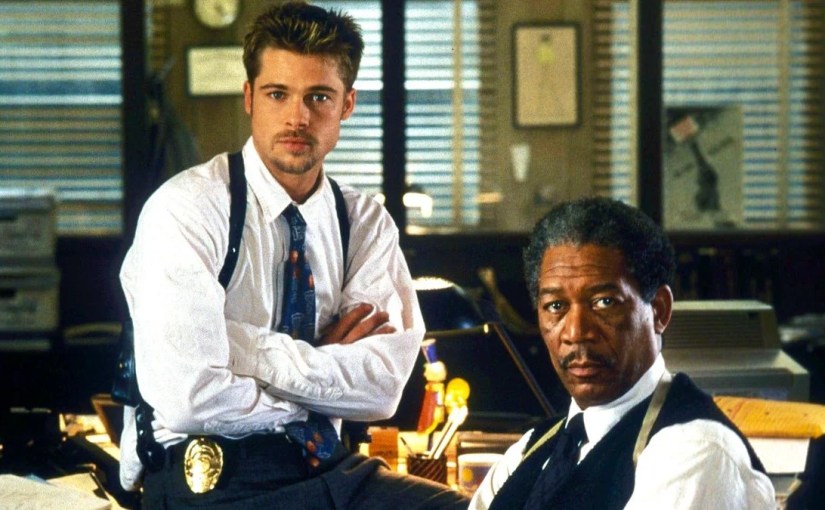
Detective William Somerset (Morgan Freeman) stems from a time gone by for the cinematic detective.  He’s the trench coat wearing investigator who examines and connects dots, never resorting to fists or police intimidation with a gun.  Newly assigned Detective David Mills (Brad Pitt) dons the leather jacket with the cute goatee and boy blond haircut.  He’s more apt to making fun of the sick weirdo they are chasing, hardly lending any valuable insight or observations.  Somerset will approach with respect for the killer and his work.  Mills, with nowhere near the experience of his new partner, will disguise his loss of where to begin with this case by resorting to cheap shots at the killer’s expense, calling him Yoda and surmising this guy must be pleasuring himself in peanut butter, perhaps.

Fincher is widely recognized for the dark photography of his films, like the cherry wood hallways of Harvard in The Social Network or the lurid neighborhoods in movies like Zodiac and Gone Girl.  In Seven, the setting is very much a character in and of itself, but other than the fact that it is a California (thanks to a throw away piece of dialogue) metropolitan area, we never know the name of this city.  It is a dreary, ongoing rain-soaked environment that hinders the police officers and keeps everyone contained in the film, especially David’s wife Tracy (Gwyneth Paltrow), unsettled.  The city has no name or identity.  Therefore, the police officers who occupy it are not the stereotypical cops designed for this place.  One works as a tired, wise and experienced Colombo figure, minus the sarcasm.  The other is an aggressive hot shot who is over trying to prove himself to peers and superiors.  Now he wants to be in charge.  They both follow the footsteps of the mystery together.  Yet, they are reading different roadmaps.

With seven days left before retirement, Somerset meets newly arrived Mills.  They are quickly dispatched to a filthy apartment for an ugly murder scene of an odd nature.  It is a scene labeled as Gluttony by the killer.  Greed follows shortly thereafter, and Somerset knows none of this random.  Whoever has orchestrated these two executions is methodical and resourceful, with a point to prove.  The artistic measure and inspiration are too creative, far from the sloppiness of a standard stabbing or gunshot to the head.  Somerset already knows five more murders will likely turn up and doesn’t want to get involved.  He’s seen enough.  Mills has the cavalier attitude.  Find the freak, and maybe take him out in a blazing shootout.  It’s reckless. 

Could Seven be an answer to how cop movies performed at one time and how they act now?  Seven may be the closest outline of pairing Humphrey Bogart’s Sam Spade with Mel Gibson’s Martin Riggs.  Sure, the murder scenes are hard to look away from, as deliberately repulsive as they are.  Even after multiple views of the film, I still get curious with how the killer planned all of this out to the absolute most minute detail.  However, ninety percent of the dialogue is exchanged only between Freeman and Pitt. Paltrow has a couple of scenes that help paint the sad picture of life in this city, but ultimately the film belongs exclusively to the two cop characters.  Seven has one action scene, but it primarily covers how the two men respond to the nature of what they come upon.  Mills will crack jokes that maybe his college pals would snicker at.  Somerset asks the young man to just be quiet while he explores the scene.  Mills gets grossed out by a bucket of vomit.  Procedurally, Somerset will ask Mills if there was any blood in it.  Mills will resort to Cliff’s Notes on the Seven Deadly Sins.  Somerset will spend his evening in the library, digging through the original source.  Mills will kick down a door without authority.  Somerset will protest against that action without following the standards of procedure.  It’s a dichotomy of impatience versus patience.

The two men actually don’t come to a common platform until the third act of the picture, when the rain has subsided, the sun comes out, and the killer opts to surrender himself.  Still, the mystery of his purpose remains and there’s an unknown element of what to expect next.  So, while the partners may agree that there’s more to come, they still respond to the killer, in person, differently.  Mills can only yell at the deranged suspect and call him names.  Somerset interviews the gruesome and imaginative architect with questions. 

Seven is a sensational crime drama.  It’s eerie, creepy and appreciatively sickening in its crimes.    The outline of some of the killer’s actions might seem conveniently questionable or far-fetched.  Some of the crime scenes were planned over a year’s time. Others were not meant to be revealed until a certain point within these particular seven days.  So, the writing might be a little too overly precise.  However, that should not be dwelled upon.  Rather, one kind of cinematic cop is not the standard in Hollywood films anymore.  Another kind of cop has filled that void in its stead. 

Andrew Kevin Walker’s script follows a very structured outline.  It’s not until the story’s infamous end does the film divert itself, as it is almost unfathomable that it could have actually happened. 

It is fortunate that David Fincher was allowed vast liberties with the production of only his second film, following the abysmal Alien 3 which famously took away any of the personal oversight he depended on as a rookie filmmaker.  With Seven, Walker and Fincher draw out four characters quite well – Somerset, Mills, the city with Tracy as its spokesperson, and the killer’s actions.  Blend these elements together and see if they make for a good product.  Fact is they couldn’t be any more disagreeable, but the chemistry works perfectly. 

Seven is a sensational movie and will likely always remain as one of David Fincher’s best films.

WAR OF THE WORLDS (2005)

By Marc S. Sanders

There’s a harsh reality to science fiction in the 21st century.  When the aliens arrive on Earth, a little girl will ask her dad “What is it?  Is it terrorists?”  Steven Spielberg’s interpretation of H.G. Wells’ War Of The Worlds covered that territory when it was released four brisk years after 9/11.  All these years later and there’s still some legitimacy to that sadly reasonable question.  I find it interesting that one of the most pioneering novels in sci fi was published just ahead of the twentieth century paving the way for endless approaches to alien arrivals and attacks on Earth.  When Spielberg approaches it on his third try, the trope may have been done to death, but now the reality of the response is updated and all too real, and brutally disturbing.

Tom Cruise is the lead in this adaptation, and he is arguably in the most vulnerable role of his career.  He plays a storage bin dock loader, only regarded as a half caring deadbeat and divorced dad to his teenage son (Justin Chatwin) and 10-year-old daughter (Dakota Fanning). After his ex-wife (Miranda Otto) drops the kids off for the weekend, there’s an uncomfortable game of catch in the backyard followed by the beginning of the mayhem.  What appears like a lightning storm evolves into dead batteries and no electricity along with odd wind currents and hammering echoes.  When the people all around the main characters in their New York neighborhood get vaporized, then naturally their first instinct is to think it’s terrorists.  In today’s science fiction, terrorists are real and aliens are not.

Later, once the extra terrestrials (not the friendly kind who consume Reece’s pieces) have viciously introduced themselves, Spielberg’s film resorts to demonstrating mass exodus of the people of Earth.  Military units advise folks to “keep movin’.”  When the attacks happen, people scatter in different directions.  When a ferry is leaving the mainland, helpless folks rush for the dock, desperately climbing over the gates and leaving loved ones behind.  Spielberg hasn’t forgotten about the unlawful occupations from world history.  He simply applies it to a Tom Cruise action piece.

Tim Robbins shows up as a crazed man hiding in a farmhouse basement with a shotgun ready to begin a one-man revolution.  Cruise tries to contain the hysteria.  A scene like this could have had Nazis or aliens circumventing on the floor above, as the central characters remain as quiet as the Jews used to do in the basement below.  The parallels are eerily the same. 

Still, I respect the reality of the piece.  For one thing, much of the film, scripted by Josh Friedman and David Koepp is pulled right from H.G. Wells’ pages, including the nice and tidy ending that eventually arrives.  Don’t knock it.  That’ how Wells wrote the story to begin with.  Spielberg and crew don’t invent their own new image of the invaders.  They are still the tall three-legged tripods towering over the people of Earth and blasting them with their “heat rays.”  My favorite touch of this film is using Morgan Freeman’s vocals as the bookended narrator reciting Wells’ novel text, nearly word for word.  It’s a welcome salute to the memorable radio show that Orson Welles lent to the story decades before. 

I consider this adaptation of War Of The Worlds to be an observational picture or a reactionary film.  Cruise is not super skilled with fighting techniques and weapons handling.  All he can do is watch and react.  He’s an everyman here, which is actually quite unusual for him when you gloss over his resume.  This is not Maverick or Ethan Hunt: Superspy.  His purpose is to watch and return his kids to their mother in Boston, assuming she is still alive.  The success of the mission here only depends on getting the kids back to mom. 

Dakota Fanning and Justin Chatwin go against the grain of so many other Spielberg kid characters.  They are not intuitive or inventive.  Especially for Fanning’s character, she is just a scared little girl.  Not a Goonie and not like Gertie, who is scared for the sake of humor with precocious one liners.  If aliens were attacking the Earth, this is how my kid would react. 

Once it is established that this movie is a Spielberg running man film, then you may be grateful for the realistic mentality of the story’s community.  You’ll also appreciate the amazing set pieces accompanied by John Williams’ original score that plays like a drive-in monster movie or a Twilight Zone episode.  The aftermath of a plane crash on a Jersey suburban neighborhood is very convincing.  A runaway train set ablaze intrudes upon the cast with great surprise.  A cracked piece of concrete that gets swallowed up below only to immediately vomit a tripod in the air for instant attack is eye popping. 

War Of The Worlds is a well-crafted film, and the thought was definitely invested in its approach ahead of making it.  Yet, I won’t say it’s fun escapism.  It’s a reminder of the unrelenting realities we live in now.  Sadly, it’s not reaching to say that maybe we live in a time where it is in fact every person for themselves.  Even Cruise’s son insists on going off on his own, abandoning both him and his sister with nary a care at all.  Unlike Close Encounters or E.T., there’s not much to laugh or grin at in this Spielberg alien film.

The 2005 adaptation of War Of The Worlds is certainly loyal to H.G. Wells.  It may be realistic in the human nature of its science fiction, but in the end, it is also a very bleak film.  There’s much to marvel at, but once the movie is over, as my colleague Miguel and I often recommend to one another, it’ll likely be best that you get outside and bathe in the warm sun under a blue sky, roll around in the grass with your dog, and taste an apple for the first time all over again.  It’s about all we have left to embrace what little is left of our sanity.

KISS THE GIRLS

By Marc S. Sanders

When you’re watching a movie and one character says “Now wait here. Let me handle this!” what do ya think is gonna happen? When you’re watching a movie and one character says “Kate, we’ve covered every inch of those woods. There’s no building there!” whatcha think? You think there actually is a building there?

Let me ask you this, what do you think happens in the film Kiss The Girls?

Yup! A whole lot of this nonsense and more that I could cover endlessly. Adapted from James Patterson’s best selling novel featuring his forensics detective hero Alex Cross, Kiss The Girls begins as an effective thriller focusing on the backgrounds of its two leads: dependable Morgan Freeman as Cross, and Ashley Judd as Dr. Kate McTiernan, a skilled surgeon with a specialty in kick boxing (that may come in handy later). At first, we see these characters handling snippets of storylines related to their careers. Cross defuses a suspenseful suicide situation. McTiernan has to console a family whose little girl was in a motorcycle crash. There’s good acting and emotion going on here and I was hoping the film would live up to the promise of these scenes; the characters’ expertise now being applied to Patterson’s main story. It doesn’t.

Instead, the movie just mires itself in plot holes and filler where one character insists on working alone while the other insists on not sitting idly by. This is not character development. This is ping pong volleying. Kate is kidnapped by a serial “collector” of smart, young, beautiful and highly intelligent women by someone regarded as “Casanova.” When Alex’ niece is one of the women taken, he travels from Washington DC to Raleigh, NC to join the investigation.

Soon after Kate has been taken, she manages to be the only one to escape from some hidden dungeon located in the woods. She joins Alex at every turn to find Cassanova and rescue the other captives. Okay. So that’s not a bad set up.

Where it falls apart is in the development. Kate managed to escape by jumping into a river where she’s retrieved by two kids. So wouldn’t law enforcement just sweep that entire area? I mean be really thorough, top to bottom! Surely, you’ll pick up footprints or scents from the dogs. Well, Alex says they did. Fortunately, his niece’s boyfriend finds the map. You know…the map that’s hidden in the library that no one else is aware of and shows this dungeon or whatever it is that’s there. Only one guy, ONE GUY, knows about this map????

When an hour and forty minutes has surpassed, you bet that map is gonna turn up. Remember, also when someone says wait in the car, the one thing you do is not wait. You know, this is a movie. So, Mr. Freeman, please spare me the act of surprise when Ms Judd walks into the bar you’re scoping out. This is all unnecessary, and boring and tired and old.

Kiss The Girls is another film with THAT TWIST! Was it really needed though? Just when the film apprehends the bad guy, and the ladies are recovered safely, there’s a gotcha moment in Kate’s kitchen with lots of knives and pots and pans to play with. Gary Fleder directed this 1997 disturbing thriller in a post age of The Silence Of The Lambs and Seven, which are far superior films. It’s not a film dependent on gore or torture porn, but it’s got the dark stone lined halls for haunted house creepiness. I’m good with that. It’s a thriller after all.

The film’s best assets, however, are Freeman and Judd. These are two top class actors who invest themselves in performance. If only they were working with a much more believable story.

It’s the implausibility in the script that make my eyes roll.

CLEAN AND SOBER

By Marc S. Sanders

There’s nothing pretty about alcoholism and drug addiction.  Surprisingly enough, I can only think of a handful of films that really explore the struggle ahead of the main character admitting to a problem, then going through the rehabilitation process, and then trying to live without the chemical dependency, thereafter.  Each of these stages have been depicted plenty of times, in all kinds of mediums.  Yet, Clean And Sober, directed by Glenn Gordon Caron, with Michael Keaton in the lead role, covers all three quite effectively.

Keaton portrays Daryl Poynter, a successful real estate broker.  When he’s awakened by a phone call one morning, his incessant sniffing is interrupted by his insistence to the caller that he’ll check on a missing $92,000 from an escrow account on Monday morning.  He quickly hangs up the phone and turns towards the nude woman in his bed.  Then it dawns on him that something is not right with her.  Police determine she has overdosed, and Daryl better stay in town. 

Instead, Daryl opts to check in anonymously to a nearby rehabilitation center.  He’ll get free room and board, and no one will know to look for him while he’s hiding out from those looking for the escrow money or how he may be responsible for the drugged woman.  He’s just hiding out, though.  Daryl has no intention of following the program the center offers.  So, Daryl is a rule breaker where he sneaks in phone calls to his stockbroker, and his friend that he insists send him an overnight package of cocaine he kept stashed in his office desk.  Morgan Freeman is Craig, the leader of the recovery program and a recovering addict.  He easily sees through Daryl’s shenanigans and kicks him out.  Following a late night, out-of-control episode at his office, while looking for his drugs, Daryl returns to the center and gradually acknowledges his problem, while still living in fear of the consequences when he learns the woman he was with has died and her father has gone out looking for him.  His bosses are also questioning the whereabouts of that money.

Keaton turns in a chain smoking, red eyed performance.  His appearance and body language convincingly send the message of his harmful addictions more than his line deliveries.  Honestly, I found him to be a little over the top with his rantings and “fuck you” temper tantrums.  When I was observing his behaviors, only then was I buying his portrayal.  This role should serve as a significant accomplishment in the history of Keaton’s career.  Before this film, from 1988, the actor was more well known for comedies (Mr. Mom, Gung Ho, Johnny Dangerously) and his tours on the stand-up circuit.  I think he became a better dramatic actor later on. 

Freeman is once again so good as a subdued, in charge and street-smart mentor.  Another good mentor comes from the never showy character actor, M Emmet Walsh (I find him in so many of these now classic films; he really had a presence in Hollywood.)  Walsh is Richard, the unglamourous sponsor that Daryl was never expecting.  Daryl was holding out for an attractive woman to be his sponsor.  A great scene occurs between the two actors when Daryl meets Richard at a diner for lunch.  Richard has three desserts and a milkshake on the table in front of him.  Daryl makes a crack about it, and Richard reminds him that they are addicts.  It’s in their nature to be compulsive, even with food.  Good writing here, from Tod Carroll, who doesn’t take for granted how a recovering addict lives with himself, for the rest of his life, from one day to the next.

Carrol offers up other special scenes.  We’ve all seen the staged AA meetings where the character stands up, says his name and the others say hello back.  Tod Carroll goes a step further.  Morgan Freeman as Craig is a smart character who sees past the well to do appearance, and smiling face of one young female character and calls her out for being high right in front of the group.  He immediately asks her to leave, and rather than come off embarrassed, she exits the room.  The rest of the group, Daryl included, are shocked.  They are only beginning to learn how people like them function only on the dependency of the drug and drink.

Kathy Baker portrays another addict that Daryl becomes attached to.  She’s also very good in her role as the lonely woman with the boyfriend who treats her like dirt, yet she can’t imagine anyone better for her; not even Daryl as he’s moving on a positive path towards recovery, and wants to begin a life with her.

Caron and Carroll focus the script of Clean And Sober on a variety of ways that addiction affects different walks of life.  It’s fortunate that the film does not fall into the trap of melodrama.  Chemical dependency is an ugly ordeal that destroys so many lives, not just the abuser.  Relationships are tested.  The will to function is also tested.  As well, the endurance to remain clean and sober is tested. 

This film might be from the late 1980s, but I’d argue that its themes and messages remain prevalent today.  Alcohol and drug addiction still stand as leading killers within the country.  I believe violations of DUI are not taken seriously enough.  Alcohol and drugs are too easily accessible and affordable, thereby feeding the illness.  Ultimately, we can only be responsible for ourselves.  One way to hold fast to our committments is to observe and learn.  Clean And Sober will allow you to do just that.

UNDER SUSPICION

By Marc S. Sanders

I’ve noted before how sometimes you can’t decide if you like a movie until it reaches the final, climatic five minutes that remains.  That’s the experience I had with a below the radar picture called Under Suspicion, which features two of the best headlining actors ever – Morgan Freeman and Gene Hackman.  Well, I didn’t care for the last five minutes of the film.  So, I didn’t care for Under Suspicion.

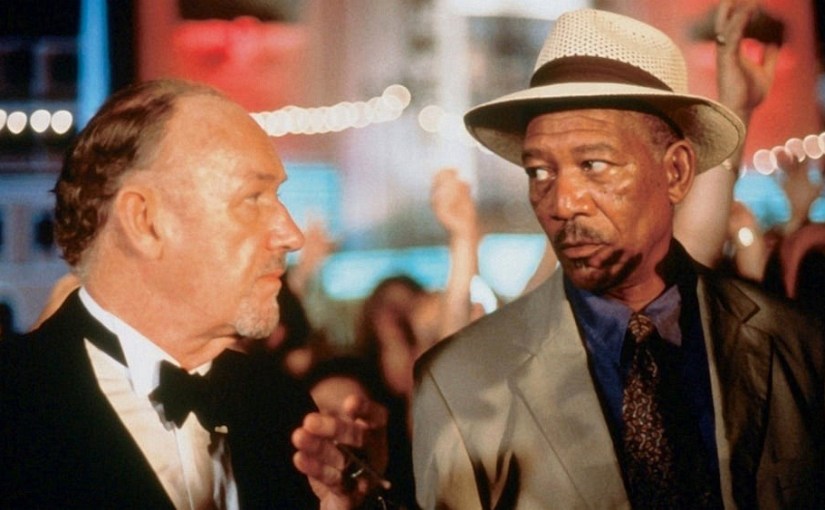
Gene Hackman plays Henry Hearst, a wealthy, hot shot tax attorney who resides and practices on the island of Puerto Rico.  When the film opens, he’s already dressed in his tuxedo and his gorgeous, much younger wife, Chantal, played by Monica Bellucci, is zipping up her black evening gown.  They are on their way to a benefit dinner to honor him for his charitable fundraising for underprivileged children.  Henry has to take a quick detour to the police station however to answer a few questions that Captain Victor Benezet (Freeman) has regarding the recent strangulations of two young girls. Victor plays good cop, while his underling, Felix Owens (Thomas Jane), does the bad cop routine on Henry. 

Since this is Gene Hackman playing a likely suspect, it’s no surprise that he’s cool as can be with Victor’s inquiries into some inconsistencies that have been uncovered.  Flashbacks to recent moments of where Henry has been jogging or visiting his sister-in-law cut in, and director Stephen Hopkins puts a present-day Victor within the scene of Henry’s recollections.

The theme of Under Suspicion is all about the gradual breakdown of a powerful guy.  Victor and Felix chip away at Henry’s alibis.  While Henry starts out virtually bulletproof to the cops’ questions, soon he’s reduced to being stuck without explanations, and even physically humiliated.  Let’s just say that more than just his tuxedo gets torn.  Eventually, the officers bring Chantal into the fold and the story diverts into a checkered relationship that Henry has with Chantal’s sister and her family, but what does that really have to do with the murders of two girls?  I hoped I’d see some relevance by the time the conclusion arrived.  I didn’t, and that’s the problem with this picture. 

What did I gain from the prior two hours that I was watching?  The main question at hand is did Henry murder these two girls?  Only if he did commit the acts is what the picture will have you believe is pertinent.  The script from John Wainwright (based on his book Brainwash), and Claude Miller & Jean Herman (based on their 1981 screenplay Garde à vue) never really scratches the surface for a motive.  Implications that Henry could be a child sex pervert come up, but I didn’t think it was explored deep enough to then bridge it to murder.  All that Victor and Felix seem concerned with is whether Henry killed the girls.  That’s too simple.  The movie isn’t thinking hard enough for us.  What makes this self-assured guy, with the familiar cockiness of Gene Hackman’s many other film personas, tick?

When the veil is finally lifted on who committed the murders, I felt emptyhanded like I’d been dealt a bait and switch.  The reveal comes out of nowhere and then the credits roll.  Under Suspicion practically promises a plot twist that never materializes.  A shame really, because there are winning moments between these two acting giants on screen.  Not an ounce of dialogue is memorable, however.  Yet, to see the pair together longer than the screen time they shared in Clint Eastwood’s award-winning film Unforgiven, bears my attention and curiosity.  Ultimately, Hopkins’ film is further proof that a script must come first before the talent is recruited.  It doesn’t matter if you have contracted the likes of Hackman and Freeman for your film.  If you don’t give them anything interesting to say, then there’s nothing interesting to see them do.

LEAN ON ME

By Marc S. Sanders

The career of director John G. Avildsen is best defined by his inspirational stories of athletic prowess for the underdog, particularly The Karate Kid from 1984, and the Oscar winning Best Picture sensation, Rocky.  Both films follow similar formulas once the exposition phase is completed.  Music montages fill the screen with endless training with the protagonists giving it their all.  Avildsen’s film, Lean On Me, teeters on these conventions and it tells me one thing.  Training montages belong in the field of physical activities, not with tests of intelligence and academics.

Morgan Freeman portrays Joe Clark, or Crazy Joe Clark with the baseball bat, who singlehandedly (at least according to the film) turned around the Eastside High School of Paterson, New Jersey from a hell hole of violence, drugs and terror into a respectable institution of education.  Eastside, where the actual film was shot, is depicted as the absolute worst.  You can’t even tell the original paint colors of walls because they are covered in so much graffiti.  Early in the film, a teacher’s head is bashed into a puddle of his own blood while trying to break up a fight among the students.  Drugs are exchanged out in the open.  This is a dangerous place. How dangerous?  “Welcome To The Jungle” by Guns N Roses is playing over all of this footage. 

Worst of all, however, seems to be the last place ranking of the school’s score on state’s standardized test for basic education.  After all that I saw in the first ten minutes of the film, that is the biggest concern? 

Joe seems to be the one and only candidate to get in there and clean this mess up.  His tough exterior and reputation for not getting along with his superiors or his peers is a gamble but what other choice does the mayor have at this point.  The first move that Joe carries out is to have all the drug pushers and criminals explicated from the school immediately.  His second move is to chain every door in the school to keep this riff raff out, which only ticks off the fire marshal and a firebrand activist mother who wants Clark terminated.  While I thought the mother was needlessly a pain in the ass, only to serve as a poorly written antagonist, I can’t help but empathize with the fire marshal; cuz, yeah, what would happen if there was an actual fire?

In between all of this, Crazy Joe bullies, berates and screams at his teaching staff and administration while the students paint over the graffiti.  Some of the staff scream back or toss over desks.  Morgan Freeman is such a capable actor and you can’t take your eyes off the energy he brings to his roles, whether they are subdued like in The Shawshank Redemption or Driving Miss Daisy, or they are out of control hyper as on display here.  Yet, I didn’t feel fulfilled or inspired by his portrayal of Mr. Clark or the film as a whole.  It’s not his fault.  Rather it’s the outline of the script.

A running theme here focuses on the scores of the test.  Joe is first mad as all hell at the low score of the practice tests.  We eventually reach the actual final exam.  Much has been cleaned up at Eastside and Joe screams like a hyped-up football or wrestling coach to the entire study body about how important it is to pass the exam they are about to take within the hour.  The students clap and applaud and sing the title song in harmony.  This scene supplies the inevitable and inspiring training montage that Avildsen relies on.  You know what’s going to happen, right?  They pass of course!  Yet, how did they really pass this exam within the ninety days that the film tells us they have to study?

Lean On Me gets distracted with its other problems such as single mothers who kick out their children and drug pushers who manage to get back into the school, where Crazy Joe disarms one of them threatening with a switch blade.  Late in the film, a teenage student gets pregnant, only to have this storyline abandoned thereafter.  The debate with the erratic mother and the fire marshal takes up large portions of the film as well, and when they don’t, Joe is screaming at his band of teachers making sure they know it is their own fault that the students are failing.  All of these moments are meant to get the audience to nod and shake their heads at how much the world is falling apart, while getting tearfully inspired by the angry, tough love of Mr. Clark.  Right on Joe!!!! It’s like a bad afterschool special, really.  I’m not in denial of the endless variety of problems our schools encounter.  However, this film is less than two hours, and these kids have a test to pass, people!

I just think the wrong movie was made here.  I recall from the late 1980s, the real Joe Clark on the cover a Time Magazine defiantly holding his baseball bat.  My teenage self found the cover shocking.  Having gone to private schools full of unspoken discipline, I’d never imagine a teacher brandishing a bat to make his point.  So unusual was this to me that naturally Clark’s story should be made into a movie.  Yet, the triumph of Lean On Me depends on the passing score of the state exam.  Only, just how did these students pass this exam? 

It’s easy to compare Lean On Me to the film Stand And Deliver.  It’s also easy to see which is the better film.  The latter film focused on underprivileged and uneducated Southeast Los Angeles students who triumphantly passed the most difficult of standardized mathematic exams.  When the passing scores arrive at the end, though, I believed the truth of it all because the film focused on the inspiring teacher Jaime Escalante and his methods for teaching algebra and calculus.  Stand And Deliver showed how those students sacrificed their Saturdays to attend class and studied while working or tending to their families.  In Lean On Me, I don’t recall one student opening a single book or any teacher even writing on a blackboard.  They did learn the school song though.

I don’t disagree with anything that Avildsen’s film offers.  Joe Clark saw the importance of learning the school song to build up pride among his students.  He saw the necessity in painting over the graffiti to maintain the image of a proper institution for learning.  He went to desperate and defiant measures to protect the integrity of Eastside High School.  My problem is the means don’t justify the end.  How does chaining doors, painting over graffiti, and singing the school song, accompanied with endless screaming measure up to passing a standardized test?  Did it all just hinge on one proud moment ahead of taking the test with a beautiful and soulful rendition of the song “Lean On Me”?   I know the passing scores were all achieved in real life.  I just wish I got to see it on screen.

Note: Eastside High School is where my mom graduated from.  It did her proud to see the school recover to its original reputation.