AVENGERS: INFINITY WAR

By Marc S. Sanders

Avengers: Infinity War is a really FAT movie. Like ORCA FAT (thank you Keyser Soze), because it is chock full of so much to see. If this equated to gorging on junk food, after two hours and forty minutes, I would have a diabetic cardiac arrest immediately following the credits. Is this a film that is worth that handicap, however? You bet it is.

There is an ensemble of top Hollywood talent portraying a huge cast of characters, once again, and thus another installment has surfaced in the franchise that allows them to have various moments to shine. Producer Kevin Feige with all of Disney’s support, has mastered the formula to ensemble casting and production, as good as when George Clooney and company performed under Steven Soderbergh’s direction in the Ocean’s 11 remake. Thousands of special effects shots do not overpower the stage presence of the actors. The Marvel movies succeed because a story is always written first. Then witty dialogue comes thereafter, and then valid, convincing shock value. The special effects are the final ingredient. This is what the Transformers franchise and (yes, I’ll even own up to it) the Star Wars prequel trilogy (about ¾ of it) failed to achieve. This successful formula gives merit to the (at the time) biggest opening weekend ever, worldwide, and Avengers: Infinity War deserves the accolades.

How good is it? Well, reflecting back to May 1980, when sitting in a crowded theatre watching the ending to The Empire Strikes Back, by comparison I think audiences have finally been served up a cliffhanger (10 years in the making) that is just as effective. How is this all going to wrap up from here? How is this all going to be resolved? Reader, I don’t know if the next chapter will be satisfying. I don’t know if we will feel cheated like Annie Wilkes from Stephen King’s Misery. Presently, however, I’m turning an ending like this over in my mind; the same way I did with my pals in 1980 debating the survival ratio of Han Solo and if Darth Vader has told the truth, and if that was Vader’s brain or head that I saw, and who is this “another” that Yoda referred to….and that, my friends, is what makes a spectacular film. I don’t care if it gets watered down in the hype and McDonald’s promotions and toys. If you can mull over a movie long after it has ended, for days, even months and years, then a film like The Empire Strikes Back and Avengers: Infinity War has more than served its purpose.

Josh Brolin provides a villain with a justification to his madness. He’s not just twirling his mustache to be mischievous and sinister. He has a destiny to fulfill, and his portrayal of the mad titan Thanos does not compromise. This is a beast of a purple villain with size 52 boots and gold-plated armor with a chin that looks like it was clawed by Wolverine. Thanos cries, actually cries, while committing his crimes. He’s not just cackling. He flat out says that he executes his actions all so that he can relax and retire. Isn’t that what we are all trying to do, anyway? Nothing wrong with that. Guy sounds like a CEO to a large corporation. Maybe Thanos is updated to resemble an Elon Musk. 

All of the other actors from main staple Robert Downey Jr to Chris Pratt to Chadwick Boseman to Zoe Saldana and Chris Hemsworth, and so on, remain consistent to what we’ve seen of various prior installments. Their gimmicks continue to avoid becoming stale. Audience applause is cued by their appearances. These are well loved characters.

As an avid comic book reader of the silver age (1980s), Avengers: Infinity War presents itself as of one those annual limited series runs that were special because they were MAIN EVENTS!!!! My favorite back then was Marvel’s Secret Wars. Typically, a comic book from the 1980s would average about 18-22 pages with advertisements sprinkled in. Nearly every scene in this film equates to one issue of a limited run of a main event. That is a why a fat movie like this succeeds. The cast of characters are separated in various story lines. The scenes are given their time to flesh out and develop to move the subplots and overall story along. Each scene is like reading a new 18 page issue comic book. If I’m watching a comic book film, by golly, I want to see how a comic book is brought to life in a cinematic medium. Marvel’s films succeed greatly over DC’s films (produced by Warner Bros) because they rely on the source material. They know they got the goods. Cast it right, adapt it properly and go with that. If it ain’t broke, don’t fix it. A wealth of material (nearly 70 years) and Marvel/Disney uses it all. (How does DC/Warner Bros miss the mark so often?)

Of all of the Avengers films, Infinity War is definitely the best one. Ironically, I wasn’t expecting it to be. I was waiting for this stuff to get old and tiring. It just hasn’t faltered yet. It hasn’t gotten lazy yet. It all seems so fresh still. It’s a fantastic cinematic accomplishment. Sure, its main story is a guy chasing down six different colorful MacGuffins. So what! It’s simple. It allows the characters to stand out from there. An organized plotline like this doesn’t take much effort or time to explain its purpose. It states its conflict early on, and then the show stopping moments present themselves. One after the other after the other until a monster of an ending that is so jaw dropping, head shaking, thrilling and gasping, satisfyingly arrives. 

More importantly, the MacGuffin search drives the motivations and fleshes out the film’s main character, Thanos. This Marvel installment belongs to Josh Brolin as Thanos. Everyone else serves as his antagonists. What matters is that the bad guy wins this time, just like demonstrating that an Empire will strike back. Ironic that Spider-Man makes a humorous correlation to that celebrated franchise from almost forty years ago.

Avengers: Infinity War ended up in my top 10 list of 2018, and still holds as the best film in the Marvel Cinematic Universe.

POOR THINGS

By Marc S. Sanders

A sexually explicit rendering of Mary Shelley’s Frankenstein is brought to life by Yorgos Lanthimos’ film, Poor Things.  The strongest element of the picture is certainly Emma Stone’s uncompromising performance as Bella Baxter.  It’ll at least get an Oscar nomination.  The film will likely collect an abundance of nominations as well for it’s fantastical imagination in art direction, garish costuming and makeup and directing.  Maybe there will be some accolades for Willem Dafoe and Mark Ruffalo as well.  The adapted screenplay of Alasdair Gray’s novel, written by Tony McNamara, is a contender too.  It’s already being hailed by many outlets as a top 10 picture for 2023.  Yet, I grew tired of the novelty, and bored with the excessive sexual exploits of Bella.

Bella was once a pregnant woman who deliberately plunged herself off a London bridge to escape her misery.  Godwin Baxter (Willem Dafoe), who Bella appropriately recognizes as simply God, discovers her lifeless body in time to conduct an experimental procedure.  Replace Bella’s brain with that of the unborn child she carries and raise her from there.  God is scarred and altogether bizarre, and recruits a medical student named Max (Ramy Youssef) to observe the reborn girl’s progression and behavior; a grown woman with that of an infant who is learning to speak, walk, eat, and behave for herself.  After a while it is decided by God that Max will become engaged to Bella.  However, another man enters the picture, Duncan Wedderburn (Mark Ruffalo), who convinces Bella to accompany him on a sojourn.  God permits the idea as an opportunity for Bella to learn what is out there and not restrict her.  It is at this point, that Lanthimos’ film transitions from a blue tinge monochrome photography to vibrant color as Bella and Duncan travel to destinations such as Lisbon, Alexandria, and Paris, where Bella abandons a destitute Duncan to join a Parisian brothel.  Bella sees opportunity.  She can earn money for allowing men to put their things inside her.

I could not help but think of films like Forrest Gump, The Curious Case Of Benjamin Button and even Pinocchio while watching Poor Things.  An unwise subject discovers an independence to witness how a world around her functions.  As she learns, she matures, and she realizes she does not need to be held down by any party.  Shelley’s monster also broke free of its master’s clutches, tried to acclimate itself, but was revolted against for its grotesqueness on the outside and simply for being misunderstood.  Bella does not encounter such a fate.  Instead, she discovers acceptance but only at what she’s worth monetarily speaking with a simple attraction limited to individual thought.

Poor Things is constructed in the narrative themes of Yorgos Lanthimos’ preferred way of filmmaking.  Just like The Favorite, it’s deliberately weird and proud of it.  Nothing appears conventional.  You could substitute the settings for Paris, London and even the cruise ship that Bella and Duncan travel on for set pieces in Wonka.  It’s all fantasy with an adoption of real-world locales.  I surmise Lanthimos excuses these outlooks as a perception of Bella.  The settings look like they were spawned from a pop-up children’s book.  It’s all so different but I found it to be tiring. If someone were to argue that it is inventive as opposed to another stale backdrop of London Bridge or the Eiffel Tower, I wouldn’t debate them. Yet, I was growing tired of the piece. 

Moreover, the second act of the film concentrates abundantly on Bella’s adventures within the brothel.  Bella discovers the comfort of self-pleasure.  Later, the sensation is enhanced by the possibilities of getting satisfied by the company of a man.  The audience chuckled.  So did I, but I also squirmed quite a bit.  Bella insists to God that she wants to “go adventure,” and God allows her his blessing.  Yet, I found these series of sexual encounters to be overly exploitive.  Nothing is held back on what Emma Stone performs for the camera as a concubine for one needy, stinky, and ugly gentleman caller after another.  She takes it the traditional way, the oral way, the way from behind and much more.  She is captured with S & M straps across her nude body and the Oscar winning actress goes all the way to sending the scenes home.  It’s as if Yorgos Lanthimos needs to deliver his point, but it’s not enough to try it once, twice, or even three times.  I get it already.  Bella is used for whatever fetishistic imagination the male mind can fathom and more importantly she thrives off of the stimulation. She happily recounts how a pineapple can be used in the bedroom.  It’s even better that she can get paid for this lifestyle.  It sounds amusing while I type this all out, but I was not entirely comfortable watching it either.  I’ve seen enough porn in my day to not be shocked, and I wasn’t shocked.  Yes, I was amused at times.  Look, I don’t have ice water running through my veins.  Eventually, though, I was just bored.

Godwin Baxter is an interesting character as played by an always reliable Willem Dafoe.  Early on, we see how in addition to his experiment with Bella, God has toyed with the ideas of blending different breeds of animals together.  Roaming his estate are the likes of a dog crossed with a chicken and a pig crossed with…you know what I can’t even remember after seeing the film only once.  There was also a duck crossed with something.  Kind of sophomoric material and I think Lanthimos would accept that observation as a compliment.  Oh yeah, there was a goat crossed with something too; was that the pig?  What I think lacks from Poor Things, however, is to probe if these kinds of experiments should even be conducted and I cannot recall a conversation that goes in that direction.  Max seems taken aback by what he witnesses but he never investigates further.  This is all most unusual (a serious understatement) and it’s hardly ever questioned. Even Jeff Goldblum tossed a contrary opinion at the idea of Jurassic Park.

I suppose I wanted more from Poor Things.  Beyond sexual pleasure and what can be gained from it, isn’t there anything else that naïve Bella has to learn about?  I guess in conjunction, she also learns how to earn a wage and a gumption to stand up for herself.  What about love and the fear of death?  What about what else occurs within the world around her?  What about loss, or betrayal?  As well, Godwin’s occupations never go further than what we see he is capable and daring enough to do.  How do others consider his experiments?  What residual effects stem from his accomplishments?

I’m glad I saw Poor Things.  I think I’d like to see it again actually because I may gain a greater understanding from the attempts the script strives for in accordance with Lanthimos’ vision.  I know this film is not for everyone, though.  It’s proudly peculiar, but its plodding in its glee to step very far over a line that most filmmakers wouldn’t dare go.  It has my salute for what it has set out to do.  Nonetheless, I’m not sure I’m a fan of the material it served, though.

COLLATERAL

By Marc S. Sanders

A salt and pepper haired gentleman in a knitted suit with sunglasses arrives at LAX before the sun sets.  He exchanges bags with a man he runs into, played by Jason Statham. Elsewhere, a driver does a polish and check on his taxi cab before beginning his evening shift.  He picks up an attractive, overworked attorney named Annie (Jada Pinkett Smith) and before she hands him her business card, the driver has at least convinced the woman to re-examine her life’s purpose and consider simple ways to escape reality.  The man in the suit is Vincent played by Tom Cruise.  The cab driver is Max played by Jamie Foxx.  They are about to collide with one another on this night and put Michael Mann’s film, Collateral, into play.

Following being a massive fan of the TV show Miami Vice, and the films Thief, Heat and The Insider, I remember my anticipation sky rocketing when I saw the trailers and write ups for Collateral.  Mann, Cruise, Foxx, and crime in a cool looking L.A. with a symphonic soundtrack? I’m there!  It seemed like a perfect formula.  When I finally saw the movie, I think I was let down because it was too formulaic following a step-by-step recipe.  The editing for Collateral is abundantly cookie cutter, never taking any risks with its story.

Vincent chats with Max as soon as he gets in the cab.  He offers eleven hundred dollars to occupy Max’ evening, transporting him from one location to the next. Max has dreams of running his own limo company one day and this easy money is too good to resist.  It’s only when Vincent tosses someone out a fourth-floor window to land on the roof of the cab that Max realizes there’s a hitch to this arrangement.  

Vincent is a hitman out to check off a list of targets before sunrise, and he needs Max as a cab escort.  Threats to Max’ ill mother in the hospital will keep the driver in check, and if inconveniences like a shattered windshield draw the cops’ attention then Max will have to abide by Vincent’s demand for no interference with his plans.  

The two hour running time of Collateral is structured on one stop after another.  Mann abides by side scenes from Stuart Beattie’s script to look at the undercover night detective (Mark Ruffalo) who is one step behind the pair’s frequent stops within the city.   I guess it’s fortunate for this guy that ballistics and coroner’s reports are quickly and readily available within minutes and hours to connect some dots.  

In between the kills, Vincent and Max chat in the cab.  Standard stuff really where Tom Cruise is at one time charming and other times sociopathic.  Jamie Foxx is the bright but frightened guy with dialogue that doesn’t amount to much in convincing this unwanted passenger to either let him go free or to give up on his mission.

Ironically, the many scenes shared between Tom Cruise and Jamie Foxx are the least interesting parts of the film.  When the sound editing isn’t failing by making their dialogue sound like incoherent mumbling, neither guy is ever convincing the other to look in a new direction or consider another idea.  Therefore, the conversations never go anywhere.  Look at films like The Silence Of The Lambs, Cape Fear, Seven, and especially Mann’s best picture to date, Heat by comparison.  Those films work when either the antagonist or protagonist allow themselves to consider the arguments, even if it’s just for a second, against the ones they are debating.

There is action and violence in Collateral, but it’s really a talking piece.  Still, the best exchange of dialogue occurs with Foxx and other cast mates besides Cruise.  A great scene occurs when Vincent insists that Max act under the guise that he is Vincent when he has to report to the drug kingpin employer who originally hired him (a surprise welcome from an at the time unknown Javier Bardem); great acting and writing happening here.  The early scene between Jada Pinkett Smith and Jamie Foxx also works at a thought provoking and interesting level.  These scenes are short one act plays that belong elsewhere.  Jamie Foxx is doing some great work in these moments.

Unfortunately, when Foxx and Pinkett Smith reconnect later in the film, they are not written with the same kind of intelligence during a run and hide third act climax.  The suspense is absent here because the setup is ridiculous.  While standing on the top level of a parking garage, Max can easily see Annie in a fourteenth-floor office window, blocks away across the city, and specifically direct her where to run from the dangerous killer who is a few floors below, all while using a dying cell phone.  

More to the point, why is Annie still wearing a suit and heels, with her hair and makeup done up, at four o’clock in the morning? I know an aggressive lawyer never stops working, but don’t they go home, pour a glass of white wine, get into sweats and pop open the laptop while Miles Davis plays softly on the stereo?  How would these guys even know this is where Annie would be at four in the morning? Reader, you might tell me to dismiss what’s merely circumstantial here, and normally I would.  Yet, if I’m an expert hitman like Vincent is supposed to be, my first instinct is to go to Annie’s home first before the office in the middle of the night.  It’s the circumstances that negate the believability of the main character.  

As expected, Los Angeles looks moody and cool like in any other Michael Mann picture.  He’s got blazing overhead shots that emit a white glow in the thick of night.  The wolf is holding a fang and claw to the neck of the sheep as they careen through this endless city maze.  In that respect, the environment of this film works like a great character game master. What turn or straight avenue or bridge is going to work in either saving Max or getting him killed?

The technique of this filmmaker, who I usually favor, is here.  It’s been seen many times before for the other sharp, well-dressed killers in Michael Mann’s worlds. I welcome it back, but it’s not new or inventive in Collateral.  I guess that’s why the film is ordinary.  It lacks the depth that other productions from Mann rely upon.  The setups are quite amateurish and most of the talking is wholly uninteresting.

In spite of a phenomenal and reputable cast and crew, it’s a shame this Michael Mann installment is only ho hum in its finished product.  Collateral needed another script rewrite, followed by some additional reshoots.  There was a better movie to made here. 

THOR: RAGNORöK

By Marc S. Sanders

Thor’s third adventure in the Marvel Cinematic Universe, subtitled Ragnarök, is altogether fun, silly and primarily very campy. Sure, Cate Blanchett looks wickedly theatric as Thor’s evil older sibling Hera, but even she is not taking any of this too seriously.

There’s not much to evaluate within this film. Chris Hemsworth and Tom Hiddleston return as brothers at odds, Thor & Loki, and get sidetracked on a gladiator battle planet where they encounter a lighter, more tender and funnier Hulk care of Mark Ruffalo. The camp also comes to the forefront by way of Jeff Goldblum as the Gamemaster, a role obviously engineered to cater to his dialect idiosyncrasies.

The film is lots of neon colors of CGI and set piece junk helmed by director Taika Waititi. I commend Marvel Studios for recruiting these (at the time) unheard of directors with insightful visions. While most every Marvel film to date has its own unique appearance, Thor: Ragnarök is a balance of the prior Thor films, banking on the humorous success of the Guardians Of The Galaxy films.

The gem this film offers is combining Led Zeppelin’s “Immigrant Song” with a fierce lightening powered one eyed Thor to fend off a few baddies. Compliments also to a bad ass, and sometimes drunk, Tessa Thompson as the Asgardian known as Valkyrie.

A favorite moment is an encounter with Benedict Cumberbatch as Dr. Strange. Good editing and direction offer an inspired Three Stooges routine where Thor is unexpectedly thrust about down a staircase or through a room. Plays like a great cartoon short.

Ragnarök has some shocking moments in its ending, but the weight of drama or story is none too burdensome.

It’s nothing special of a film, but it is amusing and gleeful, especially when Thor is forced to a chair while Willy Wonka’s “Pure Imagination” plays like annoying elevator music. That is sure to make the God Of Thunder irritable, and we the audience only gain from it.

Thor: Ragnarök is really a fun family movie of adventure, good character design and laughs.

AVENGERS: AGE OF ULTRON

By Marc S. Sanders

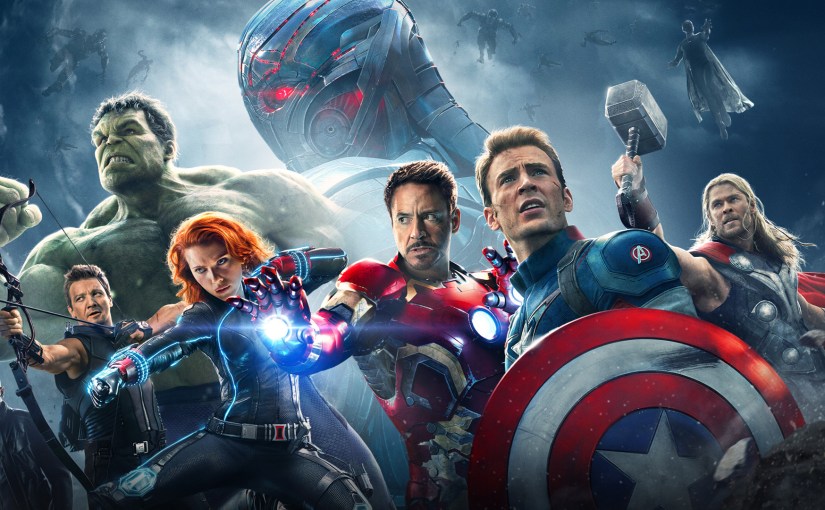
The character of Ultron, a terrorizing cyborg, has been a favorite Marvel Comics villain of mine ever since I discovered him in 1984 during the Secret Wars 12 issue limited run. He looked sinister with a devilish face in the shape of a metallic claw. His sonic blasts appeared more destructive than anything else ever drawn on the page. Ultron was a badass!!! (“Language!”). That being said, the cinematic interpretation is quite different, yet he’s modeled on a much more grown up sculpt.

Ultron is still a terrorist bent on utter destruction, but now he has a disregard for man. He’s written quite inventively as a direct contradiction to arguably the favorite of all the Marvel cinematic characters, Iron Man aka Tony Stark. How fitting that James Spader is cast opposite his former brat pack cast mate (Less Than Zero), Robert Downey, Jr. It is really uncanny how the dialect of Spader’s limitless Ultron can sound just like Downey’s genius Stark but with a means of annihilation; “All of you against all of me.” Ultron is smart first, powerful second. He’s not just a monochromatic android. There’s a means to his end and an inventive science to his purpose; uproot a country high in the sky and then DROP IT BACK DOWN INTO THE PLANET, like an anvil flattening Wile E. Coyote. It’s actually more novel than I’m giving it credit for.

Most Marvel afficianados from the blogs, and fellow colleagues as well, do not care much for this chapter in the MCU. I have yet to understand why. Again, each character is really drawn out beautifully by Joss Whedon with a respective storyline. Finally, Jeremy Renner’s Hawkeye is given some oomph to his back story. So is Paul Bettany as the other cyborg, Vision, formerly J.A.R.V.I.S, the artificial intelligence.

Vision/J.A.R.V.I.S. outshines Data (“Star Trek: TNG,” apologies to my friend, Jim Johnson), but will never top C-3PO. I like how he’s introduced as an amalgamation of all of the film’s main characters’ abilities. Bruce Banner and Tony Stark, Thor, Ultron, Scarlet Witch, some brilliant doctor friend, and even the nation of Wakanda. They all have a piece of themselves in Vision. It’s a better story than the comics ever suggested. Maybe I’m biased having grown up on these stories, but the Vision element makes me want to clap every time I see it. So inventive and economically told for a two-hour film with a ginormous cast. Vision’s introduction is one of the best scenes in all of the Marvel Cinematic Universe.

A great device to unhinge most of the Avengers comes through by means of Elizabeth Olsen’s Scarlet Witch (identified as Wanda Maximoff) who cripples them with mind control. How else should a sorceress take out a whole lotta muscle? It works and it gives Olsen conflict to play with. The visual effects surrounding her are also pretty cool. Sure, it might be just some neon red mist, but the cinematography and CGI surrounding her look gorgeous.

This installment also serves as neat set up for what’s to come. Quick Easter Egg in Age Of Ultron: Tony Stark Name drops the term “Endgame.” Oooooooo!!!!!!

It is really admirable what Marvel and Disney have done with the MCU, and especially watching this film. It’s ironic how filmmaker James Cameron made a statement hoping for “Avengers fatigue” so the phenomenon can die down in movie houses, etc. Funny! For me, seeing all of Ultron’s toys and wit seemed to outshine quite a bit of the residuals spawned from Cameron’s Terminator franchise.

Whedon wrote and directed a film with much more intelligence, wit, at least as much action, and threat than I ever got from Cameron’s reputation of clunky dialogue and plot hole time travel storytelling. It would do Mr. Cameron well to maybe not throw stones at the glass Avengers towers. I’m skeptical that his upcoming FOUR Avatar films will carry the smirk inducing cues the MCU has used to its advantage.

THE LAST CASTLE

By Marc S. Sanders

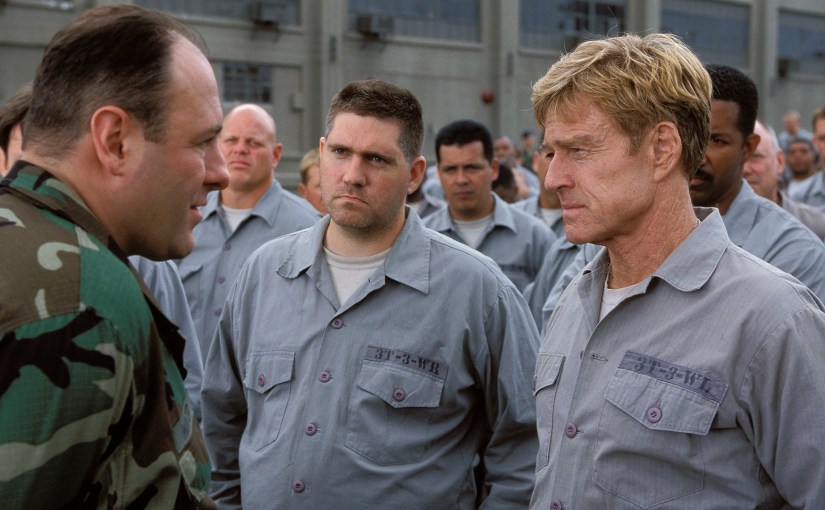
Robert Redford, James Gandolfini and Mark Ruffalo go to sleep in The Last Castle, a prison movie of no consequence directed by Rob Lurie.

They go to sleep. So naturally, I go to sleep.

Redford plays Three Star General Eugene Irwin (a real tough guy name!) sentenced to a military prison. It’s where we have to accept that Gandolfini as a “ruthless” Colonel Winter controls his inmates with an iron fist. (Iron? Aluminum Reynolds Wrap is more like it.). That’s what the Netflix or TV guide description might tell you.

Watch the film however, and you’ll nary see anything terribly harsh from Gandolfini, much less will you see anything triumphant from a run of the mill Redford. Exactly what is the problem these two guys have that motivate the General into a forever-to-get-there uprising against the prison? These guys never appear to be enduring much of a harsh reality.

Amid the concrete walls, basketball is played with glee, rocks are carried to and fro and bets for cigarette winnings are proffered. I don’t get it. What’s wrong with this, and why is Gandolfini regarded as such a dick about it? This Colonel Winter is no Tony Soprano. That’s for sure.

I think it’s in Redford’s contract that dirt must never grace his boyhood good looks and his neat blond hair style remain preserved even when he’s running through 7 foot flames to rescue Ruffalo from a downed helicopter. (Psst, that’s the most exciting—that’s the only exciting—part of the film.)

The Last Castle is not a good movie.

As the allegorical chess play between the opposing leaders carries forth, much flexibility is offered to both sides to plan accordingly for the final battle. This is too neat and too pretty for a prison mutiny uprising. It’s real convenient that there are only rubber bullets in the guards’ rifles. That way it’s safe for everyone to play in the sandbox a little longer past curfew.

Don’t believe me about all this? Then answer me this question:

Where in the hell did Redford’s band of prisoners find the time, resources and covert opportunity to construct a building tall SLING SHOT STRAIGHT OUTTA BRAVEHEART OR LORD OF THE RINGS to chuck boulders with? I mean how the hell would you even hide such a thing when you are locked in a prison? It ain’t under the mattress. That’s for sure.

MARVEL’S THE AVENGERS

By Marc S. Sanders

Phase One of the Marvel Cinematic Universe concludes with Marvel’s The Avengers. This is a real treat and a feast for the eyes. It’s not my favorite of all the Marvel films because it gets a little too Saturday morning cartoon like at times, but it’s enjoyable to watch for good escapist popcorn fun.

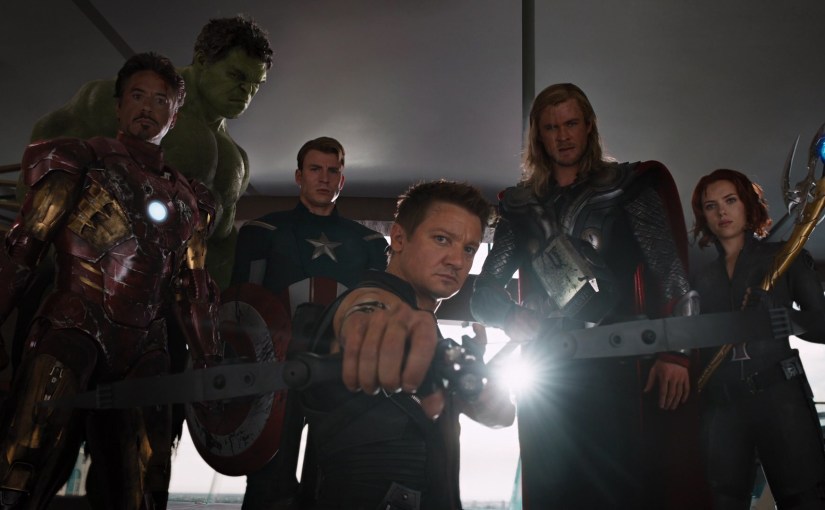
Movie goers were salivating for the year 2012 to arrive which would finally assemble Thor, Iron Man, Captain America and the Hulk on screen. Thanks to writer/director Joss Whedon that wish had finally come true and Whedon does not try to reinvent the wheel. When you assemble a team of heroes, you pit them against a large army and watch every variation imaginable of how the Hulk can smash, or what Iron Man’s armored suit can launch.

By now, you all know how I feel about the actors portraying their respective roles. Best to just say the chemistry works among them. They find reasons to squabble and Whedon provides moments for them to use their given talents against one another. So you get to see what happens when Thor smashes his hammer against Cap’s shield.

The actor who finally gets his moment in the sun is Samuel L. Jackson as Nick Fury, the orchestrator behind this team up. Jackson is more subdued than his other well known characters from the Tarentino films or Snakes On A (Mother effing) Plane. He does get to say “stupid ass idea” at one point and there’s the Samuel L. Jackson we all know and love! In comics, the Nick Fury character was reinvented before any of the films to harbor the appearance of Jackson. This film proves why the writers went that route. He’s great. He’s fun to watch. He makes for a great leader of the secret agency SHIELD. In tow with him is Clark Gregg as Agent Phil Coulson, a welcome cameo guy before this film, Gregg gets in a few scenes that show his endearment, and offer some dramatic weight as well. The guy could be waiting on hold while Black Widow takes out a couple of thugs, and you are cracking up at Gregg as Coulson, not necessarily Black Widow. He’s so likable that well…heck…he should get his own Marvel TV show….wait….nevermind….I digress.

Again, however, the women of the MCU are not drawn well for the screen. Scarlett Johansson makes her second appearance as Black Widow. She’s got a great, funny early fight scene while tied to a chair in a sleek black dress, but that’s all for show. She hints at a checkered past but this film does not offer much to expound on that. I understand. There’s a lot going on here. So there’s not much here for her to do. It’s time she got a film of her own, however. I’ll sign the petition. Wait! Nevermind! Colbie Smolders is a waste as Agent Maria Hill. She is nowhere convincing as a bad ass agent. Her line delivery seems forced. Her role seems unnecessary. Her scenes should have been on the deleted floor. It would have allowed more time for Johannson to play up her character. How is Maria Hill different from Black Widow in this film, anyway? She’s not. Therefore, cut out Maria Hill.

Jeremy Renner is given nothing to do but shoot arrows as Hawkeye, and work against the Avengers while under a spell from Loki.

Speaking of Loki, the great Tom Hiddleston is back. Hiddleston just elevates the Marvel films to more than just a comic book movie. His glee as the God of Mischief is different than say any version of the Joker’s. Pay attention Syndrome (from The Incredibles)!!! When Hiddleston monologues, you want to listen, unless you are the Hulk.

Whedon does an awesome job with the action scenes as he gradually destroys an aircraft carrier when chaos takes hold among the various heroes, and then later he destroys New York City in a fun amusement park like battle through the streets, subways and skyscrapers. It’s a little reminiscent of Richard Donner’s (or Richard Lester’s) Superman II, and Ivan Reitman’s Ghostbusters. It’s fun to watch the Hulk run through a building only to come out the other side and leap upon the head of a gigantic, flying centipede to bring it down on to the top of a building. Who cares how this all gets cleaned up? The greatest city in the world always figures out a way.

Whedon sealed the pop culture significance of superheroes in the early 21st Century. He’s done what guys like Michael Bay beg to do with other toy/comic book franchises. Marvel’s The Avengers stands out as an important impact in cinematic filmmaking. It’s not best picture worthy, but it is nonetheless important to how blockbuster films are conceived and created. Sadly, some people still don’t get it right, all these years later.

AVENGERS: ENDGAME (2019)

By Miguel E. Rodriguez

Directors: Anthony Russo & Joe Russo
Cast: Robert Downey Jr., Chris Evans, Mark Ruffalo, Chris Hemsworth, Scarlett Johansson, Jeremy Renner, Don Cheadle, etcetera, etcetera…
My Rating: 10/10
Rotten Tomatometer: 96% Certified Fresh

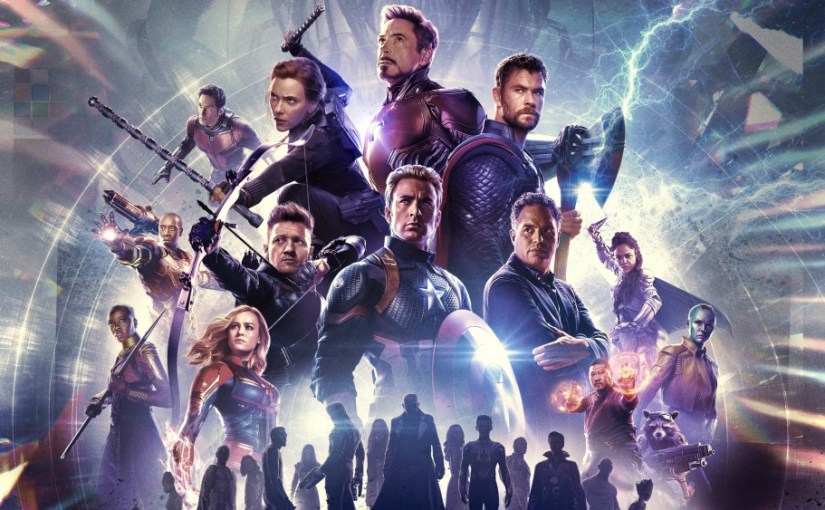
PLOT: After the devastating events of Avengers: Infinity War, the universe is in ruins. With help from some of their remaining allies, the Avengers assemble once more to try to undo Thanos’ actions.


I have tried several different drafts of this review, and I simply am unable to write a decent review without necessarily revealing spoilers.

So…

DO NOT READ ANY FURTHER IF YOU HAVE ANY INTENTION OF SEEING AVENGERS: ENDGAME IN THE FUTURE.  SPOILER ALERT!!!

SPOILER ALERT!!!

SPOILER ALERT!!!

You have been warned.

For starters, Avengers: Endgame is not my favorite movie in the MCU.  (That title still goes to the incredibly complex, endlessly debatable Captain America: Winter Soldier, the superhero movie for people who hate superhero movies.)  BUT…Endgame contains my single favorite moment in the entire franchise.  It occurs during the climactic battle, and it involves…hardware.  YOU know what I’m talking about.

That aside, while Endgame is a more-than-worthy sendoff for the 11-year-long story arc, and is Hollywood spectacle at its best, I gotta be honest and say that the 3-hour running time was starting to get to me around about the 2-hour mark.  Yes, the plot threads all had to be woven together to bring everything to a head for the ultimate showdown, and I wouldn’t dream of eliminating anything that I saw, but it just was feeling a little slow.

Other than that…it gets all A’s across the board.

  • ACTION – I haven’t seen CGI action on this scale since the Battle of the Pelennor Fields in The Lord of the Rings: The Return of the King.  Or Avengers: Infinity War, take your pick.  I can only imagine the headaches and nervous breakdowns experienced by the hordes of CGI artists who painstakingly created the outstanding battle scenes.  They were incredibly dense, but I was never unable to see any of the key moments involving key characters.  Nothing was too dark or murky.  It was an event.
  • HUMOR – In spite of the heaviness of the proceedings, the filmmakers never lost sight of their origins: COMIC books.  From the first appearance of Thor in residence at New Asgard, to Stark’s never-ending supply of dry one-liners, to Hulk’s selfie in the diner, the audience is always kept from falling into major depression, even after some really, REALLY dark moments in the story.
  • CLOSURE – The film ends the way it does because it HAD to.  Some of the original actors are just getting too old to do it anymore, folks, that’s just the way it is.  Hugh Jackman hung up his claws on Wolverine because he was getting too old to get into that kind of shape anymore.  And some other actors are just ready to move on.  It’s time.  Regardless, though, the way that certain characters were granted their own particular curtain call…it was IMMENSELY satisfying, not a bit gratuitous, and even noble for everyone involved.  I wasn’t moved to tears myself, but there were audible sniffles in the movie theater.

(I did also REALLY like the abandoned New York cityscapes after we jump ahead in the timeline a little bit.  I’ve always LOVED the concepts of modern edifices and cities left to ruin after abandonment.  That’s one of the reasons I really love I Am Legend.  BUT I DIGRESS.)

So, yes, it’s worth the hype.  They got it right.  It is a fitting final chapter to one of the most amazing cinematic achievements in history.  It IS a little long, but I can get over that.

And I am stoked to see what comes next.

SPOTLIGHT

By Marc S. Sanders

It’s tough to be a fair journalist when a higher power carries great influence over the what and how of honest reporting. In Tom McCarthy’s Best Picture Oscar winner, Spotlight, it’s not so much the crimes of child molestation by the hands of priests from the Boston Archdiocese that are so important. Rather, it is how the facts are suppressed and the pressure to contain the truth are so apparent. Maybe it finally took the will of a new editor, a Jewish editor from New York, named Marty Baron (Liev Schrieber), at the esteemed Boston Globe newspaper to get the special section crew known as Spotlight to work on how case after case of reported child molestation incidents were allowed to occur for decades under the eye of the highest powers in the church.

First, it’s important to note how easy it is for a priest to seduce a young boy. He welcomes the boy for special duties within the church. Then the priest and child may share a dirty joke together. Just their little secret. After that, touching occurs which leads to unimaginable and irreversible damage. Yet, the grown man once considered that special attention he received as a direct link to God himself. McCarthy deliberately repeats that viewpoint from more than one victim in the film; it was as if God had selected them for special attention and God was especially speaking to them. None of this could be more patterned.

Marty Baron counts on his team to not only collect the mounting number of cases. He tells them to uncover an even worse truth and that is the systemic response the church upheld where when a new case comes to light, a deal is worked with a pawn for an attorney to give settlement hush money while the priest in question will take sick leave or simply be reassigned to another church location free to do God’s will while also committing his own willing nature.

The Spotlight team consists of Mark Ruffalo and Rachel McAdams as well as Michael Keaton. All of their true to life characters were born and raised in Boston. Some under Catholic influence. So the conflict for them to do their jobs ethically and morally is challenging when faced with literally going up against the one institution that seems to own the city of Boston without it showing on paper necessarily. It also means coming to disheartening terms with their own upbringing.

To convincingly depict the grasp the church has on the politicians and newspapers in the area, McCarthy shoots a lot of his talking scenes outdoors on public benches and sidewalks. Therefore, you get an almost claustrophobic shadow of how close the Catholic Church is to the city’s residents. If a scene is at a dinner party or cocktail hour, a man of the cloth is nearby. A sidewalk stroll between a victim and a reporter seems to tread carefully. You never know if that cathedral on the corner is listening. Spotlight is primarily a journalism film of the highest standard. The pursuit for the truth is ripe with the obstacles of slamming doors when trying to get a statement or dealing with the unfair reveal of no records that legally are meant to be public. There’s a race to get the whole truth before a competing media outlet grabs it and misconstrues it. As well, what happens when a bigger story suddenly takes precedence and this story must be put on hold. I mean how do you not drop everything to report on 9/11?

Spotlight is another important film as it does not compromise in its true to life storytelling. It’s unfathomable to believe that men of God could use their positions to take advantage of the innocence of children and then refuse to accept responsibility for it. Even worse is the egregious actions taken to modify the authority of local law enforcement and judicial objectivity that should be there to protect the rights of these victims.

Tom McCarthy’s piece is excellent with a cast in top form. It would have to be as the screenplay is peppered with conversation after conversation. This is a newspaper film. So therefore it’s a talky piece. You get passionate monologues from Ruffalo who does not hold back his anger and disgust at what he uncovers with an acerbic but crusading attorney played beautifully by Stanley Tucci. This attorney has lost every battle he’s had with the church but he does not give up on his client victims either. He’s their only protector in an arena of powerful criminals who hide behind scripture.

You also have a real go-getter reporter in Rachel McAdams. McCarthy repeatedly shoots her from behind walking the streets of Boston with a pad and pen as she meets a victim or simply knocks on neighboring doors for some facts. Her challenge is seeking the truth while her grandmother holds an undying faith in religion of Catholicism by visiting the church at least three times a week. A crushing, albeit brief, scene occurs near the end of the film when the reporter’s grandmother reads her final story in the Spotlight section.

Michael Keaton is the Irish Bostonian rooted in tradition. He knows all the important people in the city. He knows Cardinal Law who runs the church and he holds on to his journalistic code of fact collecting for as long as he can muster.

The truth and web of lies and deceit could never really shock me in Spotlight. I’ve heard it all before. Instead, it’s the knowing acts of concealing horrifying sin. Ironically, those actions are committed by those that listen to the confessions of its sinful disciples. As I’m of an age where I question the validity and need for religion in our upbringing, I can’t help but wonder how these victims would have turned out had religion never became a factor in their lives. These children, now men, went on to commit suicide, become chemical dependent, and occasionally became child molesters themselves. It’s easy to argue that these conditions were never part of their chemical make up. It’s also easy to argue that the Catholic Church carelessly determined the destinies of these men without any regard for being accountable of the damaging results. Spotlight confidentially reaffirms both of these arguments.