
By Marc S. Sanders
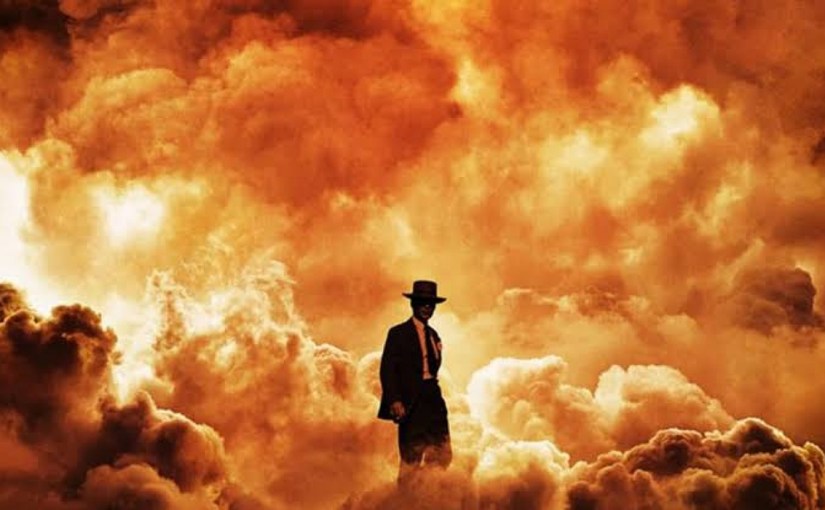
Christopher Nolan is one of the modern-day directors that you can rely on for brainy science fiction whether they are in embedded in dream subconsciousness, intergalactic space travel, transcendences of time, or even putting a fresh polish on a favorite superhero. With Oppenheimer, he triumphs with exploring the actual prophets of science in the twentieth century, particularly its title character J Robert Oppenheimer, the brilliant physicist played convincingly well by Cillian Murphy. Nolan doesn’t just stop at the assembly and discovery of science though. He uncovers the consequences of Oppenheimer’s innovation and genius insight. Dr. Oppenheimer might have been the man who knew too much and arguably that cost him quite a bit, personally. Additionally, the so-called lab rat of his atomic bomb, namely the planet Earth, suffered the expense of a, at the time, troubling present day, and a still ongoing future.
This movie seems to start right in the middle of its story and as a viewer you need to claw your way through the dense foliage to find its beginnings and what comes afterwards. The first two scenes of the movie are titled “Fission” and “Fusion.” There are no time periods specified by a font caption, however. The differences in various points in history are distinguished by where J Robert Oppenheimer is located during select points in his life. For seconds at a time, the film will change its photography from vibrant color to black and white, for example. The characters will either look more aged with grey hair and some wrinkles or during more youthful time in their lives. At one point Oppenheimer is being recruited by Lewis Strauss (Robert Downey, Jr) to head the department of a new kind of weapon development. Work the science to make a difference. There’s another time period where he’s being interrogated in a small room by a governmental suit and tie committee. Oppenheimer is also in his classroom or debating and working with colleagues. Another story observes his progress with building the atomic bomb among a collection of other engineers and scientists in a desert town, Los Alamos, specifically built at his own request, under the order of the nothing but militant Colonel Leslie Groves (Matt Damon), to conduct his work and research while hiding in plain sight.
The film also covers Oppenheimer’s association with possible suspects of the Communist Party during the stressful pre-cold war era of McCarthyism. Questions arise if his reliable brother Frank (Dylan Arnold) is a communist or even his mistress (Florence Pugh). Does that in turn make Oppenheimer a communist as well? If that is the case is J Robert Oppenheimer, the man tasked with ultimately ending World War II in favor of the Allies, sharing secrets with Russia and/or the Communist Party?
Nolan’s film gets easier to watch as it moves along, but you must get used to his pattern of filmmaking. If you have never seen a Christopher Nolan film, I do not recommend you start with Oppenheimer. His work is recognized for fast paced edits of different time periods and conversations. There is much information to decipher. As well, there’s a very large collection of welcome characters to sort through, who worked with or against Oppenheimer. Having only seen it once, I was captivated with the picture, but I know that I need to see it again. The quick edits, working beautifully against the soundtrack orchestrations of Ludwig Göransson (nominate him for an Oscar, please), happen a mile a minute. I appreciated this method because it enhanced the urgency of Dr. Oppenheimer in the eyes of the world, first as the savior of the united Allies against the last remaining superpower of the Axis countries, Japan. Then later focus is on whether it is in the United States’ best interests for the regarded physicist to have security access to the country’s most secret weapons and technological progress in a post war age.
People have been cajoling about how they know the ending to Oppenheimer. They drop the bomb, of course! (Twice actually.) However, they do not know the entire story adaptation that Christopher Nolan as director and screenwriter presents.
Cillian Murphy is perfectly cast. Give him an Oscar nomination. He serves the confident, assured scientific leader who becomes envious of competing powers who achieve the impossible, like splitting the atom, while also admiring peers and mentors like Niels Bohr and Albert Einstein (Kenneth Branagh, Tom Conti). All these men are interested only in what can be accomplished. The superpowers that fight in war, though, are interested in how these accomplishments of modern science can be used to their advantage at a cost of collateral damage. It is these conflicts of interests that Nolan admirably demonstrates over the course of the film.
A telling scene for me, that I won’t forget, is when Robert Oppenheimer meets Harry Truman (Gary Oldman, doing an unforgettable cameo). As the physicist exits the Oval Office, having shared his concerns and scruples with the Commander in Chief, Nolan includes a throwaway line delivered by the President, that I won’t soon forget. It will not be spoiled, here. Yet, the dialogue speaks volumes of what the United States held important regarding the servants who did the country’s bidding. The scene closes like a stab in the heart, and suddenly science is no longer just facts within our planet. Science is now questioned on whether it should ever be acted upon. Those questions certainly have remained as long as I’ve been alive to read about our never-ending world climate. These inquiries will be here for many generations after I’m gone as well; that is if men and women’s recklessness with science doesn’t destroy the Earth before then. At one point, Oppenheimer shares a small fraction of possibility for the end of the world when they activate and test their first atomic bomb. Matt Damon’s Colonel Groves’ asks for a reiteration of that observation. Is this finding worth even the smallest, most minute risk?
Emily Blunt portrays Kitty Oppenheimer. She’s marvelous as a lonely alcoholic wife to Robert, and a mother minding a home built in the desert while her husband serves an important purpose. I didn’t take to her presence in the film until her grand moment arrives during an interrogation scene. As the character gives her testimony regarding Oppenheimer’s communist ties, Blunt locks herself in for a wealth of awards in late 2023/early 2024. Once you’ve watched the movie, you’ll likely know which scene I’m referring to and you can bet it’ll be that sample clip shown on all the awards programs. This might not be Blunt’s best role, because it is rather limited within crux of the film, but I’d argue it is her greatest scene on film that I can remember.
Oppenheimer is a three-hour film, and it demands its running time. There are so many angles to the man that few really know about. Many know it was he who instrumentally built the atomic bomb that to date has only been used twice within a period of four days. Thankfully never since. Nolan emphasizes how unaware we are of how carefree the doctor’s government supervisors performed with the weapon he agreed to build. Don’t just drop the bomb once. Send a message to Japan by dropping it twice so they know to no longer engage in this ongoing war. Choose the area where an army/government official didn’t honeymoon though. It’s too beautiful a region. Tens of thousands of men, women and child civilians perished immediately following the strikes. Many others died weeks later following exposure to the nuclear effects that followed. All issued as a horrifying cost to end a war that was already being won now that Hitler was dead.
Mechanically, Christopher Nolan does not disappoint either. I watched Oppenheimer in a Dolby theater and I highly recommend it over a traditional one. However, beware of the sound. It is a LOUD!!!!! Your seat will rattle early in the film when Cillian Murphy is shown in close up imagining the collision of atoms, protons, and neutrons. How a star naturally dies in space runs through Oppenheimer’s consciousness as well, and then we see how a black hole forms. Nolan offers a Cliff’s Notes edit of science doing its job. Murphy performs so well when he’s not speaking and cut against the quick edits of Nolan’s visual and sound effects of science at play. It shows how an educated scientist thinks beyond what is documented on a chalkboard or in a textbook. J Robert Oppenheimer used to teach about the building blocks and natural destruction that occurs within the universe. Regrettably, what he learned about natural function soon becomes manufactured capability when the professor accepts the task of building scientific destruction with his bare hands. Man stole fire from the Gods.
Oppenheimer is so dense in the scope of science and the scientist behind it. That’s a huge compliment. It’s an engaging film with much to tell, and a lot more to think about afterwards. It accomplishes what the best movies do. It leaves you thinking long after the film has ended. More importantly, it’ll leave you frightened for the future based on the behavior of this planet’s past.
Oppenheimer is one of the best films of the year.

 2 UNPAID MOVIE CRITICS!!!!