DJANGO UNCHAINED

By Marc S. Sanders

Quentin Tarantino’s scripts have never been shy with using the N-word or any other colorful terminology.  He turns harsh and biting vocabulary into rhythmic stanzas of dialogue.  When he films these scripts, he’s not bashful with the buckets of blood splashed all over the set either.  His interpretation of violence works in a kind of slapstick fashion among his seedy one-dimensional characters.  Normally, I never get uneasy with his approach.  I know what to expect of the guy.  Yet, as well cast, written and formulated his Oscar winning film Django Unchained may be, I wince at both his word play and physical carnage.  I think Tarantino gets a little too comfortable with his slave era storylines and the African American actors he stages in his set ups.  A good portion of this Western may be thrilling, but it’s also cringy like watching a drunk uncle at a three-year old’s birthday party, and I defy viewers not to squint at the movie if they so much as live day to day with even the smallest shred of kindness in their hearts.

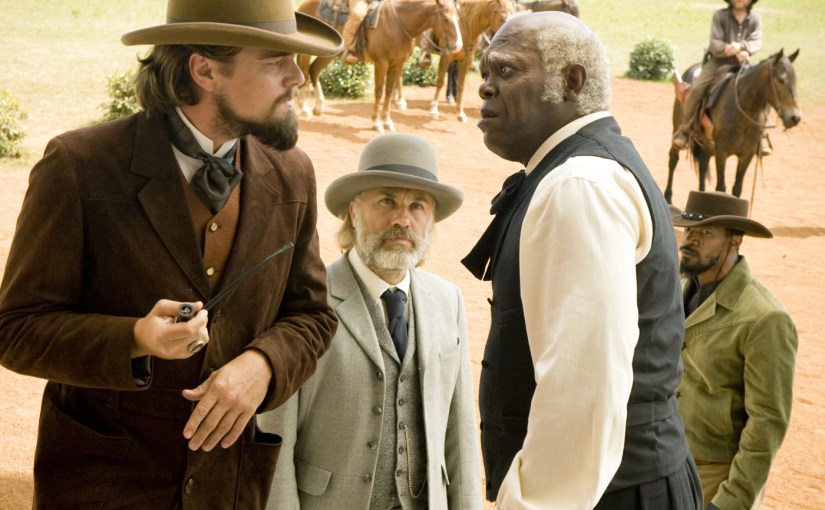
Django Freeman (Jamie Foxx) is released from slavery by the former dentist now bounty hunter, Dr. King Schultz (Christoph Waltz, in his second Oscar winning performance cast by Tarantino).  Django is a good man, though uneducated and mostly illiterate.  Once he assists the doctor with locating and collecting a bounty, the two make an arrangement to stick together through the winter collecting further ransoms.  In return for the former slave’s help, Dr. Schultz will assist in rescuing Django’s wife, the German speaking Broomhilda (Kerry Washington).  She is believed to be held at the infamous Mississippi slave plantation known as Candyland, owned by the ruthless Calvin Candie. He is played by Leonardo DiCaprio in one of his best roles while also delivering one of his most unforgiving portrayals.  Calvin Candie is a mean son of a bitch slave owner who has too much fun with investing in slaves for brutal Mandingo wrestling matches that don’t finish until the loser is dead in bloody, bone cracking fashion.  

All of these figures belong at the top of Quentin Tarantino’s list of sensational character inventions, particularly Django.  He has more depth than most of the writer’s other creations.  This guy goes from an unkempt, nearly naked, tortured and chained slave to a free man proudly wearing a bright blue court jester costume on horseback.  His third iteration places him in a gunslinger wardrobe comparable to a Clint Eastwood cowboy and when the conclusion arrives, Django is meaner, more confident and instinctively wiser, glamorously dressed (purple vest with gold inlay designer seems) like a graphic novel superhero ready to take on an endless army of redneck slave abusing outlaws.  Django is taught everything he needs to know from Doc Schultz.  Christoph Waltz and Jamie Foxx stand as an impressionable mentor/student pair.  They are the spine of Django Unchained.

The villainy of the piece belongs to DiCaprio and his head slave in charge, known as Steven, played by the director’s go to player for happy street slang and N-word droppings, Samuel L Jackson.  Steven is Jackson’s best career role because as an old, decrepit and frightening individual it’s this portrayal which looks like no other part the actor has ever played.    Both actors are funny, and you can’t take your eyes off of their unlimited grandstanding, but they will leave you feeling terribly uncomfortable.

I think what is most unsettling about Django Unchained is that the cruelty persists for nearly the whole three hour run time, and it is more so at a shameless attempt of comedic, pulpy entertainment, rather than just insight and education.  A Schindler’s List finds no glee in the torment that kept the Holocaust alive.  Tarantino didn’t even go to great heights with Inglourious Basterds because that film featured ongoing grisly heroics with his assortment of vengeful protagonists.  The Nazis were never celebrated in that film at the cost of innocent Jewish lives that faced peril and threat.

In Django Unchained, it’s hard to watch the Negro characters and extras getting brutally whipped while bound by inescapable chains.  Kerry Washington’s nude character is yanked out of a sweat box on the Candyland plantation and while I’m watching it, I ask myself if I’m too much of a prude.  No.  I don’t think I am.  This teeters on torture porn. The N-word is now being used way too freely to stab at the slaves for gleeful poetry. It grows tiring and, yeah even for a Quentin Tarantino picture downright ugly and offensive. I imagine Tarantino grinning behind the camera every time DiCaprio or Jackson happily drop another N-bomb.

Quentin Tarantino has been applauded time and again for his excessive abuse and tortuous murders committed by his characters.  Because he’s courageously gone so far before, the line of acceptance is either pushed out farther or maybe in the case of Django Unchained it is entirely erased.  

My compliments to a well-known humanitarian like Leonardo DiCaprio for energetically acting through this bastard of a role that requires a twisted pleasure in watching two husky black bruisers beat the bloody tar out of each other in a formal drinking parlor.  Later in the picture, a weeping slave is shredded to pieces by ravaged, bloodthirsty dogs.  These fictional scenes staged by Tarantino and his filmmakers come off a little too real and even by the director’s standards much too over the top for the temperature of this film’s narrative.  

What could these extras cast to play these slave and Mandingo roles have really been thinking while shooting this picture?  Did these men recognize the racially poetic humor in Tarantino’s verbiage? Did they find a commitment to demonstrate a once historic atrocity for a lesson learned? I doubt it. Did these actors simply succumb because they needed the work?  Believe me.  I empathize.  Yet, Tarantino took this film to a very uncomfortable extreme for a movie intended on following his reputable and always admired lurid material.  Here, despite my reverence for his work, I think Quentin Tarantino goes unnecessarily over the line.  The whippings and dog torture are quite uneven from what The Bride commits in Kill Bill when a Crazy 88 henchman gets spanked with a sword and there’s nothing to compare to whatever sick, graphic novel atrocities occur in his later western, The Hateful Eight – both are PG rated compared to what is offered in Django Unchained.

Much of Tarantino’s signature comedy works.  The Ku Klux Klan of the late 1850s are represented with brilliant stupidity by a cameo appearing Jonah Hill and a racist, foul speaking, plantation owning charmer played by Don Johnson, known by what else but Big Daddy.  The filmmaker turns these guys into bumbling stooges who can’t even wear their hoods properly. And yes, they also freely drop the N-word in cruel like fashion. I get it, Mississippi and Southern Plantation owners were not the Mickey Mouse sort, and I’m not asking for whitewashing what the real-life despicable characters stood for or how they carried themselves. Still, when all of this compounded together, it goes too far. In a drama like 12 Years A Slave, I see an authenticity to an ugly slave era. In Tarantino’s world, I see a kid who learned a bad word and dad said go ahead son, play with the machine gun but make sure the vocabulary ammo will riddle the entire script to pieces.

Django Unchained is a gorgeous looking picture.  Tarantino goes to the outdoor plains following the interiors of Pulp Fiction and Jackie Brown.  Jamie Foxx and Christoph Waltz’ cowboy antics look marvelous riding on horseback or even simply camping by the fire as well written exposition is revealed on cold moonlight evenings.  

I can watch this western on repeat and feel a free-spirited energy when Django steps out in his cowboy outfit with boots, spurs, the hat, and a brand-new saddle to ride off on his steed while Jim Croce’s uplifting “I Got A Name” cues into the picture.  I love how Jamie Foxx appears as a super heroic action star, especially in the final act of the movie.  I can absorb the sadism of DiCaprio’s downright mischievous evil, particularly when he uses a bone saw and skull prop to make a point.  I feel like I’ve gained a comforting friend in Christop Waltz’ kindly sensible Doc Schultz, and I welcome a very funny and altogether different Samuel L Jackson that finally arrives.  

It’s the filling within these strong moments and characterizations that is very hard to swallow.  Django Unchained is that great picture that still should have been made but with a modicum of caution. Perhaps one of the Weinsteins, or maybe even these powerhouse, marquee actors who led this piece should have shared some constructive input with the writer/director.

Django Unchained is fun, but it’s not entirely fun.

MEGALOPOLIS

By Marc S. Sanders

Francis Ford Coppola’s Megalopolis is undeniably the director’s most ambitious project of his long career.  Like other films, Coppola put up the entire $120 million to finally make the picture, including selling his well-known vineyard to make it happen.  Every penny he invested is well spent.  Especially seeing it on IMAX, this is an absolutely gorgeous motion picture, like James Cameron’s Avatar films.  I mean…wow do the colors pop and shine.  

However, as beautiful as the visuals are in Coppola’s self-described “Fable” (it literally says that in the title card), it is mostly devoid of substance beyond the paint by numbers debates that cause conflict among these very strange characters.

In New Rome City, an alternative reality to the Big Apple (the Statue of Liberty holds the torch in her left hand), Caesar Catalina (Adam Driver) is a “designer” who recently invented Megalon, a substance that he believes is the answer to a utopian future.  It’s indestructible and it can be molded to serve practically any purpose.  For example, you don’t even have to walk to where you’re going.  Step on the Megalon puddle and it will move you there.  Not much of a departure from the flat movable floors you find in nationwide airports.  This is one of Megalon’s major innovations, designed to impress me?

Megalon can also be used for healing, and it has the ability of transparency.  It is more durable than wood, steel or concrete.  It’s truly the next greatest wonder of resources.  Frankly, I was more dazzled by the Vibranium found in Wakanda.

As Caesar the artist pushes his agenda for absolute Utopia, the hardened Mayor Franklyn Cicero (Giancarlo Esposito) is the opposing side of the argument declaring Utopia to be an impossibility.  Caught in between the two figures is Julia (Nathalie Emmanuel), daughter of Cicero and in love with Caesar.  Gotta have a soap opera element to this piece so the stubborn divide between these two men remains firmly in place.

Just as in typical political rings, the Mayor works to smear Caesar the idealist who is solely focused on his end goal design.

Outside the boundaries of their public quarrel are other overly colorful and garish looking characters such as the banker Hamilton Cressus III (Jon Voight), his wife, the gossip reporter Wow Platinum (Aubrey Plaza), Constance Cassius Catalina who is Caesar’s mother (Talia Shire), a lone, crazed revolutionist and nephew to the Mayor called Clodio Pulcher (Shia LeBeouf) and Nush “The Fixer” Berman (Dustin Hoffman).

These names are exhausting.  Coppola’s film is even more tiresome.  The filmmaker truly must believe he is the second comings of both Nostradamus and William Shakespeare.  The ego of this picture could not be more apparent.  The director’s head must be THAT BIG to believe he has the nerve to tell this story of such biblical proportions.

Much of those character names, and the actors who play them, are here for show and tell.  Their value to this piece is nowhere near as prized as anyone living in Harry Potter’s world, though. Megalopolis only takes time to calm itself down when the three principal players have scenes isolated to themselves or when they only occupy the screen together.  Otherwise, this movie serves as vehicles for much of the cast to be adorned with updated and trendy Roman costume wear, from fig leaf crowns to golden armored chest plates.  At times, LeBeouf is so unrecognizable in hair, makeup and clothes you don’t even realize you’re looking at him.  

The performances are all over the place.  I never once believed that whatever Dustin Hoffman was talking about that he knew what he was even saying or representing.  Shia LeBeouf mostly runs with the privilege of getting to say “Fuck Caesar!” while finding motivation only in whatever weird appearance he’s dressed in.  Adam Driver can lead a picture for sure, but here he looks like he showed up for filming with a bewitching overnight hangover.  

This is a film that cannot be ignored for its technical achievements at Oscar time.  For no reason other than aesthetics, Driver and Emmanuel will share a scene while balancing themselves on swinging steel construction beams high above the city. The view is spectacular.  All undeniably eye opening.  You also cannot look away from the costumes or scenic art direction.  The sound mixing in an IMAX theater totally envelops you in this weird world.  It’s a digital film’s dream just like James Cameron banks on.  

Still, maybe none of these efforts will be recognized because frankly much of the visuals, audio and physical construction make zero sense or relevance to the central storyline that Coppola is striving for.  Namely, the possibility for Utopia versus the practicality of simply living through life with the necessity for economics, technology, healthcare, fuel and on and on and on.

Of all films I thought about while watching Megalopolis, my mind went to William Shatner’s Star Trek V: The Final Frontier.  Shatner had the idea to have the Enterprise crew meet face to face with the almighty God.  Well, if you’re going to deliver God to a movie house, without George Burns or Morgan Freeman in the role, you’re setting yourself up to disappoint at least half or maybe even one hundred percent of your audience.  When you factor in the tremendous assortments of beliefs and religions, I’d argue no two people who believe in God, see the ethereal, omnipotent entity in the same way.  The same goes for Utopia.  How can Francis Ford Coppola be so audacious as to believe audiences will accept Caesar’s vision of a perfect land?  

Reader, he can’t!

My Utopia is different than your Utopia.  This is practically an untouchable subject and Francis Ford Coppola is far from the fabled prophet that the world needs or will draw their attention to.

Still, I remained as open minded as I could with Megalopolis all the way towards the ending that finally arrived.  The Utopia shown on this giant IMAX screen was told by the film’s narrator (Laurence Fishburne, also paying Caesar’s chauffeur) that the world was showered in gold dust.  A far cry from the Bible’s claim of arriving upon a land of milk and honey.  Why should I ever need the nourishment of milk and honey when I can have gold dust?

Think about that for a second.  Gold Dust.  I know.  The narrator is being allegorical.  Still, couldn’t that be interpreted as a little too materialistic for the Utopia we yearn for?  Gold is only a precious metal the same way a diamond is only a precious stone, or the Atari 2600 is now an expired precious commodity among former twelve year old kids in the 1980s.  

I have little shame.  I’m an admitted materialistic kind of guy.  My Mustang and my flat screen TV and my Star Wars collectibles mandate that I am. Yet, none of these possessions have ever delivered me into a paradise of perfection.  The Mustang needs precious fuel to operate.  Try as I might, I can’t collect everything.  My flat screen TV is still on the fritz.  (DAMN YOU BEST BUY GEEK SQUAD!!!)

Coppola contradicts himself with the conclusion of his fantasy opus.  He pans over the extras who occupy this film with big toothy grins of enormous gratitude while the very well dressed and bejeweled surviving characters of his story seem to be shot from an elevated stage above me, the viewer, and all who occupy a brightly lit Times Square located within the heart of New Rome City.  I am meant to look up to these giants!!! 

THIS IS UTOPIA???  

No!  I could never accept this interpretation of grand decadence as the enigmatic paradise we have all envisioned in dreams and discussion and literature.  Shouldn’t Utopia consist of a life where stress is absent, and pain is a foreign unfamiliar word and feeling? I’m not even giving Utopia its fair due.  It’s practically impossible to describe, but I’m at least certain that the rich shades of gold and black glamours within a Times Square shopping district is not the way to go.  Yet, Francis Ford Coppola is suggesting this is all that it is.  A Times Square showered in gold dust.

Frankly, I normally would give much more credit to the man who pioneered the stellar Godfather films along with the bombastic Apocalypse Now and the intimate The Conversation.  He’s never been more short sighted though, than when he finally made his “fable,” Megalopolis.

The greatest flaw and tragedy of Megalopolis is the very broad contradiction that Francis Ford Coppola declares within his fictional, fantasy-like prophecy.  Once the “fable” is all over, I feel like I paid an enormous amount of money for a cult like weekend seminar meant to brainwash me into broadening heights of positivity and awareness, showered in gold dust of course.  

Where’s The High-Level Minister Coppola?  

I’d like my money back because this preach is no more believable than an L Ron Hubbard doctrine.  Battlefield Earth just might be a little more convincing Megalopolis.

OPPENHEIMER

By Marc S. Sanders

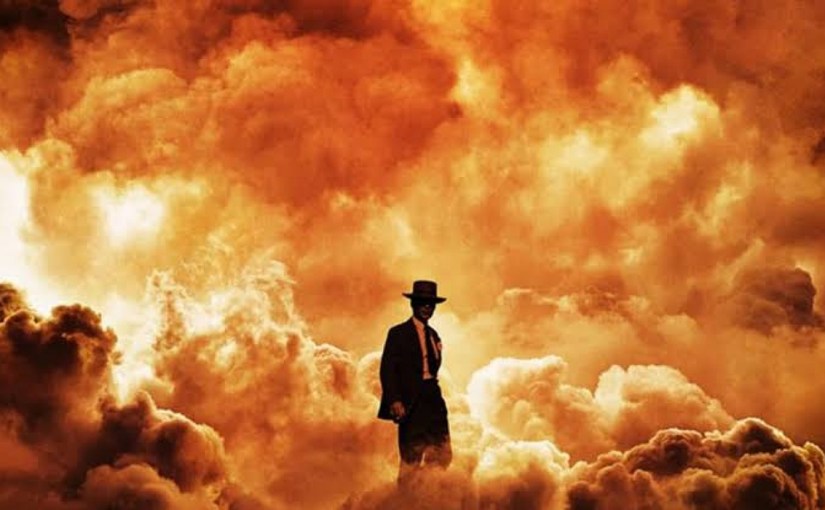
Christopher Nolan is one of the modern-day directors that you can rely on for brainy science fiction whether they are in embedded in dream subconsciousness, intergalactic space travel, transcendences of time, or even putting a fresh polish on a favorite superhero.  With Oppenheimer, he triumphs with exploring the actual prophets of science in the twentieth century, particularly its title character J Robert Oppenheimer, the brilliant physicist played convincingly well by Cillian Murphy.  Nolan doesn’t just stop at the assembly and discovery of science though.  He uncovers the consequences of Oppenheimer’s innovation and genius insight.  Dr. Oppenheimer might have been the man who knew too much and arguably that cost him quite a bit, personally.  Additionally, the so-called lab rat of his atomic bomb, namely the planet Earth, suffered the expense of a, at the time, troubling present day, and a still ongoing future. 

This movie seems to start right in the middle of its story and as a viewer you need to claw your way through the dense foliage to find its beginnings and what comes afterwards.  The first two scenes of the movie are titled “Fission” and “Fusion.”  There are no time periods specified by a font caption, however.  The differences in various points in history are distinguished by where J Robert Oppenheimer is located during select points in his life.  For seconds at a time, the film will change its photography from vibrant color to black and white, for example.  The characters will either look more aged with grey hair and some wrinkles or during more youthful time in their lives.  At one point Oppenheimer is being recruited by Lewis Strauss (Robert Downey, Jr) to head the department of a new kind of weapon development.  Work the science to make a difference.  There’s another time period where he’s being interrogated in a small room by a governmental suit and tie committee.  Oppenheimer is also in his classroom or debating and working with colleagues.  Another story observes his progress with building the atomic bomb among a collection of other engineers and scientists in a desert town, Los Alamos, specifically built at his own request, under the order of the nothing but militant Colonel Leslie Groves (Matt Damon), to conduct his work and research while hiding in plain sight. 

The film also covers Oppenheimer’s association with possible suspects of the Communist Party during the stressful pre-cold war era of McCarthyism.  Questions arise if his reliable brother Frank (Dylan Arnold) is a communist or even his mistress (Florence Pugh).  Does that in turn make Oppenheimer a communist as well?  If that is the case is J Robert Oppenheimer, the man tasked with ultimately ending World War II in favor of the Allies, sharing secrets with Russia and/or the Communist Party?

Nolan’s film gets easier to watch as it moves along, but you must get used to his pattern of filmmaking.  If you have never seen a Christopher Nolan film, I do not recommend you start with Oppenheimer.  His work is recognized for fast paced edits of different time periods and conversations.  There is much information to decipher. As well, there’s a very large collection of welcome characters to sort through, who worked with or against Oppenheimer.  Having only seen it once, I was captivated with the picture, but I know that I need to see it again.  The quick edits, working beautifully against the soundtrack orchestrations of Ludwig Göransson (nominate him for an Oscar, please), happen a mile a minute.  I appreciated this method because it enhanced the urgency of Dr. Oppenheimer in the eyes of the world, first as the savior of the united Allies against the last remaining superpower of the Axis countries, Japan. Then later focus is on whether it is in the United States’ best interests for the regarded physicist to have security access to the country’s most secret weapons and technological progress in a post war age.

People have been cajoling about how they know the ending to Oppenheimer.  They drop the bomb, of course!  (Twice actually.)  However, they do not know the entire story adaptation that Christopher Nolan as director and screenwriter presents. 

Cillian Murphy is perfectly cast. Give him an Oscar nomination.  He serves the confident, assured scientific leader who becomes envious of competing powers who achieve the impossible, like splitting the atom, while also admiring peers and mentors like Niels Bohr and Albert Einstein (Kenneth Branagh, Tom Conti).  All these men are interested only in what can be accomplished.  The superpowers that fight in war, though, are interested in how these accomplishments of modern science can be used to their advantage at a cost of collateral damage.  It is these conflicts of interests that Nolan admirably demonstrates over the course of the film. 

A telling scene for me, that I won’t forget, is when Robert Oppenheimer meets Harry Truman (Gary Oldman, doing an unforgettable cameo).  As the physicist exits the Oval Office, having shared his concerns and scruples with the Commander in Chief, Nolan includes a throwaway line delivered by the President, that I won’t soon forget.  It will not be spoiled, here.  Yet, the dialogue speaks volumes of what the United States held important regarding the servants who did the country’s bidding.  The scene closes like a stab in the heart, and suddenly science is no longer just facts within our planet.  Science is now questioned on whether it should ever be acted upon. Those questions certainly have remained as long as I’ve been alive to read about our never-ending world climate.  These inquiries will be here for many generations after I’m gone as well; that is if men and women’s recklessness with science doesn’t destroy the Earth before then.  At one point, Oppenheimer shares a small fraction of possibility for the end of the world when they activate and test their first atomic bomb. Matt Damon’s Colonel Groves’ asks for a reiteration of that observation.  Is this finding worth even the smallest, most minute risk?

Emily Blunt portrays Kitty Oppenheimer.  She’s marvelous as a lonely alcoholic wife to Robert, and a mother minding a home built in the desert while her husband serves an important purpose.  I didn’t take to her presence in the film until her grand moment arrives during an interrogation scene.  As the character gives her testimony regarding Oppenheimer’s communist ties, Blunt locks herself in for a wealth of awards in late 2023/early 2024.  Once you’ve watched the movie, you’ll likely know which scene I’m referring to and you can bet it’ll be that sample clip shown on all the awards programs.  This might not be Blunt’s best role, because it is rather limited within crux of the film, but I’d argue it is her greatest scene on film that I can remember.

Oppenheimer is a three-hour film, and it demands its running time.  There are so many angles to the man that few really know about.  Many know it was he who instrumentally built the atomic bomb that to date has only been used twice within a period of four days.  Thankfully never since.  Nolan emphasizes how unaware we are of how carefree the doctor’s government supervisors performed with the weapon he agreed to build.  Don’t just drop the bomb once.  Send a message to Japan by dropping it twice so they know to no longer engage in this ongoing war.  Choose the area where an army/government official didn’t honeymoon though.  It’s too beautiful a region.  Tens of thousands of men, women and child civilians perished immediately following the strikes.  Many others died weeks later following exposure to the nuclear effects that followed.  All issued as a horrifying cost to end a war that was already being won now that Hitler was dead.

Mechanically, Christopher Nolan does not disappoint either.  I watched Oppenheimer in a Dolby theater and I highly recommend it over a traditional one.  However, beware of the sound.  It is a LOUD!!!!!  Your seat will rattle early in the film when Cillian Murphy is shown in close up imagining the collision of atoms, protons, and neutrons.  How a star naturally dies in space runs through Oppenheimer’s consciousness as well, and then we see how a black hole forms.  Nolan offers a Cliff’s Notes edit of science doing its job.  Murphy performs so well when he’s not speaking and cut against the quick edits of Nolan’s visual and sound effects of science at play.  It shows how an educated scientist thinks beyond what is documented on a chalkboard or in a textbook.  J Robert Oppenheimer used to teach about the building blocks and natural destruction that occurs within the universe.  Regrettably, what he learned about natural function soon becomes manufactured capability when the professor accepts the task of building scientific destruction with his bare hands. Man stole fire from the Gods.

Oppenheimer is so dense in the scope of science and the scientist behind it.  That’s a huge compliment.  It’s an engaging film with much to tell, and a lot more to think about afterwards.  It accomplishes what the best movies do.  It leaves you thinking long after the film has ended.  More importantly, it’ll leave you frightened for the future based on the behavior of this planet’s past. 

Oppenheimer is one of the best films of the year.