MEMENTO

By Marc S. Sanders

Christopher Nolan’s Memento was Oscar nominated for his screenplay, adapted from a short story by his brother Jonathan, as well as for editing.  You’d be hard pressed to find a better example that lives up to the merits of these categories because without the inventive storytelling and how it’s cut together, Memento would not be so memorable.  

Guy Pearce plays Leonard, but he distinctly remembers that only his wife called him Lenny.  We observe him in two different narratives.  A black and white collection of scenes has him in a hotel room chatting on the phone with an unknown caller.  In modern color, Leonard is wearing a tan suit and driving a dusty Jaguar while traipsing from one place to another.  He’s trying to make progress with uncovering who murdered his wife.  The scenes in color though must be shown in reverse.  In other words, a scene is shown, then it will cut to Leonard back on the phone, and then another scene is revealed showing what occurred literally just prior to the last color scene we saw.

It must be done this way so we can be just as discombobulated as Leonard.  He suffers from a condition where he has no short term memory.  Therefore, if Leonard learns something or meets someone or arrives at a location, he’ll soon forget anything he just encountered minutes ago.  

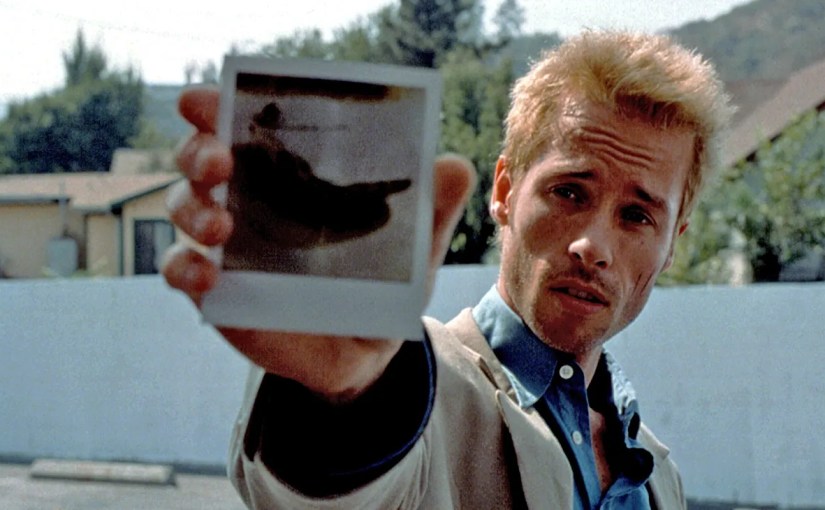
While he pursues the mystery of his wife’s killer, Leonard tattoos his flesh with notes to help guide him when his short attention span can’t. He also takes instant Polaroids of people he meets and the places he goes.  As quick as he can, he’ll jot a note on the photos to aid him as he carries on.

Memento starts at the end of the story and when the film concludes, the viewer arrives at the beginning.  Perhaps the beginning will explain the end that was shown almost two hours before.

Christopher Nolan had a small budget to work with and the California city locales are nothing dazzling.  There’s little to offer with special effects as well.  So, it is impressive that he uses Jonathan’s idea to create a mystery we want to see resolved where the information we get seems to erase itself as quickly as it is told.

Leonard can’t remember anyone he’s recently met, but oddball cases like Teddy (Joe Pantoliano) and Natalie (Carrie-Anne Moss) certainly remember him.  Are these folks working with Leonard or against him?  Even with seeing the ending first, I could never spoil anything, and you’ll find it hard to decipher what these are these characters’ best interests.  

Nolan exercises some neat visuals to keep you on track.  We see a broken car window before we see how it got shattered.  Leonard can’t recall how that happened.  Leonard is also unable to remember why a bar patron is chuckling at him.  Christopher Nolan maintains well placed book marks to aid the viewer in this story that makes an effort at throwing off its protagonist as well as the audience.

What also helps is that when all the secrets are revealed, at least to the viewer, it’s a pretty solid crime set up that does not come off like a stale Murder, She Wrote episode.  It’s clever, tricky and unexpected.

Guy Pearce is really good in his role that eventually reveals some duality, but that’s where I’ll stop.  Carrie-Anne Moss always seems questionable, but what’s her agenda?  Joe Pantoliano is the sleazy guy with the mustache.  So why is he always turning up in Leonard’s way?

Like his future efforts to come, Christopher Nolan layers his films in great depths of dimension.  It never stops thinking. Often, he answers a riddle with one or two or three more conundrums.  What’s especially appreciative is that he eventually reaches a final answer to all of his questions.  Still, that doesn’t mean he ever would want you to stop thinking about what you ascertained from Memento.

THE BRUTALIST (2024)

by Miguel E. Rodriguez

DIRECTOR: Brady Corbet
CAST: Adrien Brody, Felicity Jones, Guy Pearce, Joe Alwyn, Raffey Cassidy
MY RATING: 7/10
ROTTEN TOMATOMETER: 93% Certified Fresh

PLOT: When a visionary architect and his wife flee post-war Europe, their lives are changed forever by a wealthy client.


Maybe I’m a victim of too much hype.  Maybe that’s partly my fault, too, as I waited to see Brady Corbet’s The Brutalist until after it had been nominated for a whopping ten Oscars, including the so-called “Big Five:” Best Picture, Director, Actor, Actress, and Screenplay.  As a result, my expectations were possibly a little too high.  I admit it.  However, even if my expectations hadn’t been inflated, I don’t believe The Brutalist would have affected me any differently.  It never lost my interest during its 3.5-hour running time, but it never achieved the kind of liftoff I felt I was being prepped for.  At the end, I was left with more questions than answers, which can be acceptable for some films, but for this one, I felt like I was left out of the loop.

In 1947, László Tóth (Adrien Brody), an Austro-Hungarian Jew, successfully emigrates to America, fleeing intolerable conditions at home, but is forced to leave behind his wife, Erzsébet (Felicity Jones), and his mute niece, Zsófia (Raffey Cassidy).  He was a respected architect in his home country, but now he is part of the huddled masses, represented in a sensational shot as his ship sails past Lady Liberty, the camera tilting so she is upside-down and cattywampus in the frame.  That really got my attention, for some reason.  If you want to really drill down, it could be visual foreshadowing for how László’s American experience will not be quite as stable as he had hoped.  Or maybe director Corbet just liked how it looked.  Either way.

Although László’s overriding priority is to somehow get his wife and niece to America, he must first get a job (after first engaging in a surprisingly frank and raunchy sex scene with a prostitute).  His first safe harbor is with his Americanized cousin, Attila (Alessandro Nivola), who runs a custom furniture company with his shiksa wife, Audrey.  It’s through this job that László meets American millionaire Harrison Lee Van Buren Sr. (Guy Pearce), a man who will unwittingly shape László’s life for the next several years.  Harrison has a son, Harry (Joe Alwyn), who looks like a distant relative of the Hemsworth clan and is a condescending racist, let us not mince words, but who, in his own words, tolerates László’s presence because of his architectural skills.  (Harrison wants László to design a community center in honor of his late mother.)

This is all just in the first act of the movie, before the intermission.  The Brutalist moves with a deliberate calmness, in spite of its thriller-esque title.  I was reminded of Doctor Zhivago [1965], as it covers large swatches of László’s life with nice attention to detail, never hurrying, but never losing my interest.  The second act finally introduces Erzsébet, László’s wife, for the first time in two hours (hope that’s not too much of a spoiler).  The plot spins out for the rest of the film as a series of conflicts between László, his wife, Harrison and his son, and the crew building the community center that László has designed.  László becomes more irascible as changes are proposed and approved without his knowledge, plus he must deal with a change in his wife’s condition.  There is a detour to Italy where László and Harrison must decide on which marble to use for the center’s, er, centerpiece, and it’s here where an act is committed that, although it feels like it came out of left field, does not seem too surprising considering the behavior of the perpetrator during the first couple of hours.

As I was watching The Brutalist play out, I was repeatedly reminded of another film, featuring another madman with a single-minded focus, also played out in an earlier era of American history, though it takes place decades earlier than The Brutalist: Paul Thomas Anderson’s There Will Be Blood [2007].  Both films have the same deliberate pacing, the same focus on men of industry, their familial and professional challenges, even the same kind of jarring, atonal score playing in the background during key scenes.  But while The Brutalist is at least equally as well made as There Will Be Blood, the latter movie reached out and grabbed me by the lapels and didn’t let go until the final scene, ending with a bang and not a whimper.  I cannot say the same about The Brutalist.  I give props to the craft of the film, to the filmmakers who clearly had a lot to say and needed the time to say it.  The editors knitted everything together and gave the film a very specific voice.  But as the film’s epilogue played out, and I realized how it was about to end, I sank a little lower in my seat and thought to myself, “Well, this is mildly disappointing.”

Sidney Lumet once wrote words to the effect of, “If your movie is over two hours long, you’d better have a lot to say.”  The Brutalist does have a lot to say about the Jewish experience in post-war America, about the single mindedness of gifted artists, about the casual racism embedded in white America that persists even today.  But I couldn’t get away from the feeling that it could have said it in a movie that wasn’t long enough to require an intermission, that didn’t answer questions that were left unanswered (how and when did Zsófia suddenly start speaking?  where did Harrison go??  what exactly happened on that stream bank between Harry and Zsófia???), and that didn’t leave me feeling as if I’d watched a correspondence course video on American architecture instead of a movie.  Again, it’s well-made and occasionally beautiful to look at.  It’s not a BAD movie.  It’s just not a GREAT one.

THE BRUTALIST

By Marc S. Sanders

Before I started writing this article, I had to marinate on my impression of Brady Corbet’s magnum opus film, The Brutalist.  It has the makings of a biography but it’s fiction.  It indulges practically every inch of a Holocaust survivor’s life after immigrating to America.  It takes daring approaches in its photography particularly since it was filmed using an antiquated 35 mm print in Vista Vision. (The director found it appropriate to use the filming methods that were available during the mid-century decades when most of the film takes place. Wise and insightful choice.) Despite using questionable AI techniques, two of the leads use impressive dialects and fluently speak in Hungarian and Hebrew as well.  Set designs, score, sound, visuals.  It’s all here.  Yet, I don’t feel I wholeheartedly enjoyed the experience of watching the picture, and this is coming from a guy who had the entire AMC auditorium #16 to himself on a chilly Thursday afternoon at 4:45pm.  Not a cell phone lit in my line of sight or a crying baby within earshot.  The theater was my oyster.  The Brutalist was not.

Adrien Brody won his first Oscar at age 29 for Roman Polanski’s The Pianist.  He earned his accolades for a heartbreaking performance.  He arguably works even harder as a visionary architect named László Tóth.  This nuanced creation from Brady Corbet is a most convincing historical character…of fiction, that is.  

László arrives on Ellis Island, separated from his wife and niece by concentration camp assignments during the war.  The ladies remain in captivity while he reunites with his brother, Atilla (Alessandro Nicola) and Christian sister-in-law who reside in Philadelphia, operating a custom furniture and carpentry shop.

Enter a raving mad and wealthy industrialist named Harrison Lee Van Buren (Guy Pearce) who arrives home to find out his son Harry Lee (Joe Alwyn) has hired the carpenters to redo a library as a big surprise.  Harrison is outraged at the finished product and denies payment for the job, thus causing a permanent rift between László and Atilla.  László is kicked out of his brother’s home following an accusation of making a pass at the wife, and he can only find refuge within a church shelter.  

Harrison has a change of heart however when his socialite friends take a special liking to the new room.  He tracks László down, pays him for the work, invites him to a Christmas party and subsequently insists he stay on the property while also connecting the Hungarian with an attorney who will make efforts to reunite him with his wife and niece who remain overseas.  

Meanwhile, an ambitious Harrison conjures up big plans right off the top of his head.  He wants to commission László to design an enormous building consisting of a library, a gymnasium, theatre and a chapel on a wide expanse of Pennsylvania land nearby his grand estate.  The building will be erected in honor of his loving mother’s memory.  A humble László accepts the assignment though he’s funding a heroin addiction with the monies given to him by Harrison.  

Though The Brutalist is fiction, I believe it should still be considered a lesson in north eastern American history.  As building gets underway, a perfectly timed intermission in the middle of the film arrives when we learn of Pennsylvania state’s aggressive campaign to manufacture and build with the precious commodity of US steel.  Fictionally speaking, we have Harrison Lee Van Buren and László Tóth to thank for these newly created jobs of construction and commodity developments.

There is a whole lot of story to tell in this three-and-a-half-hour picture that traverses through decades.  Brady Corbet’s depiction of his main character, László, runs the gamut of so many circumstances.  He’s a stranger in a strange land, even towards his newly Americanized brother who has shed his Jewish identity for prosperity.  The Anglo Christian mentality of Harrison Lee Van Buren, along with his family and fellow socialites, curiously study László as the alienated man he appears to be.  Loneliness is not a direct message that Corbet offers in the film, but how can László not feel lonely in this new land without the sensibilities of a wife to help him mind his boundaries and stay away from the poisons of heroin or personal betrayals that will challenge him?

The second half of The Brutalist oversees László growing accustomed to reuniting with his wife, Erzsébet (Felicity Jones), who has drastically changed in her physicality since they were last together.  Their primarily mute niece, Zsófia (Raffey Cassidy), has arrived as well.  The problem is that László has had opportunity to shed his weakness of being a Holocaust prisoner while taking charge of his most mesmerizing architectural design yet. His family’s arrival does not feel conducive with his new way of life, both intimately and religiously. The Brutalist covers a lot of conflicts while also showing massive progress for Harrison’s grand investment and László’s treasured work.  

After providing all of this exposition for the film, I think I’m ready to deliver my point.  It’s too much.  There’s so much story here that some of it feels unwelcome.  László’s heroin addiction never seems to add up or intrude effectively enough.  Because of the long running time of the movie, there are long sections where any reference to his yearning for heroin feels neglected.  This man of energetic and artistic passion is hardly ever weighed down by his vice and I questioned just how important it was for the drug addiction to be included in the film.  The script goes in so many different directions at times, it feels like it forgot about this important monkey that should be on László’s back.

László also gets challenged by Harrison’s American business and architectural partners which is one more conflict.  Unexpected fallbacks also occur that affect both László and Harrison’s years-in-the-making plans.  Then there is László’s friendship with an assistant who started as a fellow drug addict.  Finally, there is László and Erzsébet and the problems they face intimately and as common partners. The reunification of the married couple has new, unexpected dynamics to face.

It’s a lot.  While I never minded the running time of The Brutalist, all of these layers of storytelling become exhausting.  

Guy Pearce actually impressed me the most.  I loved his character and the shrewdness he exhibits to everyone he shares a scene with.  His gruff dialect with a pencil thin mustache, slicked back hair and perfectly tailored suits are distinct, but his presence in a room is always felt even when the camera is not on him or if he has nothing to say.  His stature gave me an impression of Rockefeller, a man with the appropriate and seemingly out of reach dreams that will deliver a future of advanced American building and development.  I may have loved Harrison Lee Van Buren’s story more than László Tóth’s.

However, I got angry with the film as the story was beginning its descent towards the end. Harrison commits a truly unexpected and heinous act that arrives out of nowhere.  This is a fictional story. So, I feel comfortable with my stance that what Brady Corbet opts for Pearce’s character seems wrong and unjust; a downright inappropriate take that did not add up for me.  Guy Pearce is giving a career high performance, but I did not care for how his character’s trajectory concluded.

Felicity Jones is a powerhouse actress as Erzsébet.  She appears so confident within the skin of her character as a defiant woman, unhinged by any sort of attempted intimidation from her husband or the Van Burens.  

Adrien Brody is the sure front runner to win a Best Actor Oscar, though I wish Ralph Fiennes would finally get his due recognition for Conclave.  There are so many directions that László Tóth is pulled in.  This is a very challenging personification for an actor to belabor.  For this one character alone, The Brutalist feels like five different movies are being played at once.  If you have read my reviews before then you may know that I’m a big admirer of multi-dimensional characters.  It’s hard to find a character this nuanced.  Michael Corleone is a comparison that comes to mind.  As I write this review, it astounds me how much depth I’m reflecting on within Corbet’s script and Brody’s performance.

I told a friend who has also seen the film that The Brutalist feels like a marriage between Paul Thomas Anderson’s There Will Be Blood and Milos Foreman’s Amadeus.  While these characters are considered audacious, great artists beyond comparable realms, they are never the most powerful people in the room.  The power belongs to those with the resources of wealth and those who proudly carry the rank and titles bestowed upon them.  For the artists, men of power stand in the way of the achievements they strive for, forcing them to vent their frustrations with self-harm and abuse towards the ones closest to them.

Everything I saw in Brady Corbet’s film is interesting.  Beginning with the arrival on Ellis Island and the Statue of Liberty towering over a lost László, all the way to a visit at the seemingly unreachable mountains of Italy where beautiful, white porcelain exists in the highest reaches of nature.  You feel like you have traveled to places uncharted by most people of this Earth.  It’s breathtaking.  

The Brutalist follows the trajectory of a man arriving in America to accomplish his dreams and obtain a destiny he feels worthy of.  Only there are obstacles that will divert his path and thus a different outcome may arrive. 

Visually and with Brady Corbet’s ambition for this picture, The Brutalist is often astonishing to absorb.  Still, at least on my one and only viewing thus far, the film was overwhelmingly abundant, and I could not feel comfortable with all of it coming at me once.  Then again, that is likely how László and Erzsébet Tóth felt upon their arrival in the land of the free.

ALIEN: COVENANT

By Marc S. Sanders

I imagine it would take a defiant personality to become a God and bearer of life.  That individual would most likely have to be beyond human to follow through on such an endeavor.  In cinematic fiction, to occupy such a role would require an exceptional actor with a calm yet powerful command.  It is fortunate that in Ridley Scott’s follow up to his Alien prequel, Prometheus, that he was able to recruit Michael Fassbender in the role of David – the android invested in discovering new amalgamations of life from unknown sources within a very deep universe.

I understand Alien: Covenant left many fans and critics divided and that it was not the box office success many were hoping for.  In addition, a follow up chapter to this film seemed more unlikely following Disney buying out 20th Century Fox.  Nevertheless, none of these occurrences dismiss one of best dual role performances I have ever seen, compliments of Michael Fassbender. 

The actor first appears in a prologue as David discussing challenging questions with his maker, the wealthy industrialist Peter Weyland (Guy Pearce), a younger looking iteration than from the prior film.  David has met his maker.  However, he questions who created his own maker.  No satisfying answer comes from the conversation and thus it ends with Weyland commanding his “child servant” to a menial task of serving him tea.  David, we learn, will resent humans who opt to subject his incredible capabilities to menial tasks.  He is destined for greater achievements than servitude.  David is meant to be a God.

The film diverts to a period eleven years after the events of Prometheus.  A massive ship known as The Covenant is embarking on a journey to a paradise where the cryo-sleeping colonists and the hundreds of human embryos in storage will set up a new civilization for themselves.  They have just over seven years left of their journey.  The crew of fifteen who command this expedition are also sleeping while an android named Walter (Fassbender in another role) oversees operations.  Following a collision with a storm-like phenomena in space, the crew is violently awakened and the captain (James Franco) does not survive. A reluctantly nervous replacement named Oram (Billy Crudup) now must lead, and it appears fortunate that Covenant has come upon another nearby planet sending a signal source in the form of a John Denver song.  Why John Denver????? I guess the Beatles and Rolling Stones were too expensive. This locale might suit the colonists’ needs and save them another seven years of travel and unexpected risk.

Oram and the former captain’s wife, Daniels (Katherine Waterston), lead a team down to the planet.  A wheat field is surprisingly found.  There’s beautiful blue sky and mountain ranges.  Water is found.  Still, there’s a disturbing realization. Not a single animal or life form is anywhere.  No insects, no birds, no wildlife, nothing.  Like prior installments in the franchise, it is not long before some crew members get ill, very, very rapidly.  Then the first of several terrifying episodes begins.  All of that is visual and not necessary to recap here.

David makes an “Obi Wan Kenobi” like appearance amid the mayhem and calms everything down.  The highlight of Covenant is when Fassbender as Walter (a down to earth American interpretation of an android) encounters Fassbender as David (a refined English example). Upon entering David’s habitat, it is clear he has been busy over the last decade since he and Dr. Elizabeth Shaw (Noomi Rapace, from Prometheus) arrived on this uncharted planet that was once populated by The Engineers, also from the first film.

At the risk of mild spoilers, I offer the following observations, because the thought provoking aspects of Ridley Scott’s third monster movie, are worthy of insightful conversation. 

Walter and David are undoubtedly the most interesting characters of Alien: Covenant.  They possess two totally opposite mindsets.  Almost like they are the angel and devil figures found on a person’s shoulders.  They regard the value of people differently.  Walter holds humanity in high esteem, ready to assist while they continue explorations of great beyonds.  David is prepared to dismiss them, though they serve a valuable purpose in his own selfish discovery to harbor a new breed of creature – one considered to be a perfect organism.  Experimentation has been David’s sole focus.  Now he may have finally uncovered precisely what he needs for his masterpiece of creation.

There are staple moments and happenings that are no longer surprising in Alien: Covenant because there’s a formula that traditionally worked in the long gestating franchise before.  Nevertheless, the film is far from stale.  The story offers up a well-conceived history to the origins of the alien breed, known as Xenomorphs from other films.  Why and how they came to exist are provided.  Hey, I’ll happily say this is more definitive than the Old Testament.

To witness one actor on both sides of a debate discussing the purpose of human preservation and what value people serve from this point is really a thrill.  Both Walter and David are artificial intelligence.  They are so advanced that they have usurped humans as the greatest thinkers in the universe.  It’s not farfetched in this age of smart phones and an over reliance on technological innovations to incorporate this into a monster movie.  It only enhances and improves upon a tired old Godzilla cliche.  Movies are sometimes quite prophetic.  So, it’s not even ridiculous to categorize a film like Network with a bloody sci-fi horror film like Alien: Covenant or even a couple of Tom Clancy political thrillers.

Alien: Covenant boasts a good cast particularly with Katherine Waterston, Billy Crudup, and an unusually serious Danny McBride as a good ol’ boy pilot named Tennessee.  McBride does well with the drama and horror to come.  He’s not a novelty act.  While these actors may be playing well developed characterizations, I know they are only here for the body count and to keep David and the aliens busy.

Again though, the film especially belongs to Michael Fassbender.  A brilliantly inspired casting choice for the first film in this more recent resurgence of the franchise.  It’s only a huge blessing that he returned, and this next film pounced on his capabilities to balance the two roles on opposite ends of the spectrum.  Regardless of whether he’s playing Walter or David, Alien: Covenant only gets more interesting when Fassbender occupies a scene. 

An especially telling moment is so wisely written with a kind of seductiveness between the androids while one teaches the other to play the flute.  Humans no longer need to program computers.  The computers can work it out themselves, and even develop an intimate attraction for one another.  What’s most delightful is again, I remind you, that Michael Fassbender is the only one working in scenes like this.  How often has an actor gone in for a kiss in another role that he is playing in the same scene?  He hides so well in Walter and David, that you lose sight of the fact that you’re watching only one performer doing all the work.

The final scene of the picture caters beautifully to what Fassbender offers in his two roles.  The story’s conclusion will leave you thinking and wondering what comes next.  Intentional or not, I regard the ending of Ridley Scott’s picture as an homage to other great films like The Silence Of The Lambs and The Usual Suspects.  You may feel shockingly haunted as the end credits roll.

Overall, Alien: Covenant is a chilling, mind-bending masterpiece of science fiction horror and what-if prophecy.

PROMETHEUS

By Marc S. Sanders

In 2012, Ridley Scott was well established as an elite film director that I’d argue could pick and choose what projects he would want to work on.  So, the question is was it worth the opportunity to return to the Alien franchise that had been established back in 1979?  Following its just as magnificent sequel, Aliens helmed by James Cameron, none of the other subsequent installments (including the Predator mish mash stuff) lived up to the first two films. Not even close.  So, was it worth another go at exploring the world of Alien under Ridley Scott’s leadership?  Yes.  I believe it was worth every effort exhausted into making the prequel/side story picture known as Prometheus.

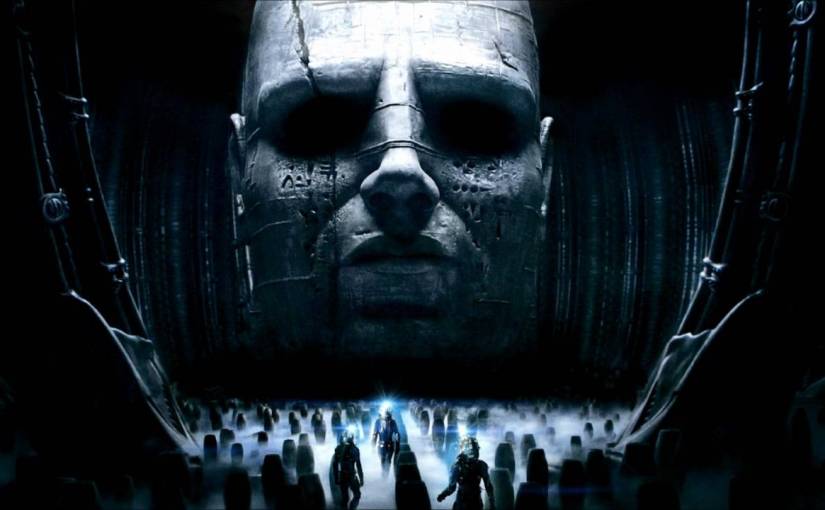
The movie begins with an odd prologue where an unusual looking strong man consumes a black liquid while standing at the precipice of a wild waterfall, while an unidentifiable shadow looms above, darkening a blue sky.  Shortly after his drink, the man seems to violently implode, and a graphic of his DNA strand explodes apart while what is left of him descends into the bottom of the falls.  The natural waters are now contaminated.

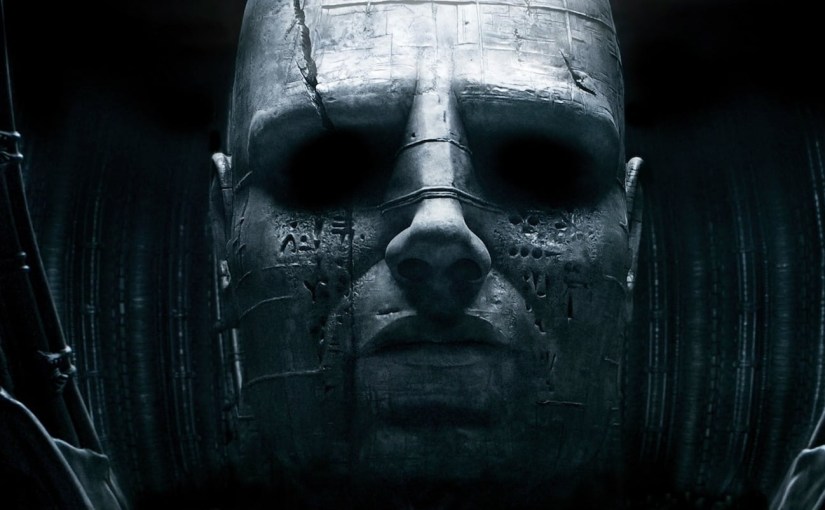
Afterwards, in the year 2089, an exploration crew of scientists uncover a hieroglyphic on the wall of a cave in Scotland, and then the film follows Prometheus, a large technologically advanced spaceship (a very cool looking spaceship I might add), on a trajectory into deep space four years later.  An elderly man named Weyland (Guy Pearce) is uploaded on a video and describes the mission to the ship’s crew.  He explains that he is now dead and that the lead scientists, Shaw and Holloway (Noomi Rapace, Logan Marshall-Green), have discovered a link between what they found in Scotland to similar hieroglyphics uncovered in other parts of Earth.  Coordinates lead to this particular planet where Prometheus will make its landing.  Their goal is to research what made them–the human race in other words.

Prometheus works like a sci-fi/monster fest of course, like the other Alien films.  However, I admire the intelligent questions it asks even if it is all based on fiction.  For example, I look at the film as continuously testing whether technology can overcome man, or religion, or even the theory of Darwinism.  A significant character in the piece is an android known as David (Michael Fassbender, doing an uncompromisingly sterile performance).  As the ship embarks on its four-year journey, with the crew resting in cryo-sleep, David continues to collect data including studying the film Lawrence Of Arabia and looking over visuals of Dr. Shaw’s dreams.  Both sources seem to offer a tolerance to live (“The trick…is not minding that it hurts.”) and die.  The latter option depicts a pre-adolescent Shaw inquiring of her father about the death of her mother.  David is a mechanical creation that never stops pursuing advancement even beyond what the science of humanity allows.

Upon arrival on the mysterious planet, the crew enthusiastically approaches a structure to explore.  Finally, they will receive answers to life’s greatest mysteries.  It’s not hard to realize that things will not go as planned, however.  It’s also not worth detailing everything that happens within the confines of this column.  I’ll let you absorb the imaginative visual feast of horrors and effects for yourself.  Most interestingly is that Dr. Shaw shares with her lover/scientist partner that the strong men, which they identify as “Engineers,” possess the same DNA as humans.  That’s an interesting observation.  Is it disappointing though?  Should it be grander for this long hike into outer space?

In many films like Prometheus or Alien, not everything cooperates as the characters expect.  None of that is surprising but it is welcome for the entertainment of suspense and thrills.  However, what I took away from the picture is where technology duals against religion and biology.  A pertinent blink and miss moment occurs following a traumatic event for Shaw.  David the android removes the cross around her neck.  Is there sound reason any longer to believe in God or the biblical teachings she was raised on if Shaw found the origin of herself and fellow humans?  Is her faith now a moot point?

On a scientific level, we learn Shaw is incapable of bearing children.  Yet, through a set of circumstances David informs her that she is suddenly three months pregnant.  The high-tech invention of David may have had a hand in this development by the way, and this is not some normal kind of pregnancy either.  Technology lends to a horrifyingly memorable scene where Shaw “delivers” her offspring. 

I’m sure we all question our beginnings.  Did it begin in six days by God, with Adam and Eve, as initial products?  Was there a big bang that just started it all?  I’d argue these questions will likely never be answered in our lifetimes.  Thus, the debates rage on because we have nothing better to do with our lives.  Cynical, right?  Well movies like Prometheus try to offer suppositions on possibilities.  In fact, there’s one pessimistic crew member on the ship who questions Shaw and Holloway’s goals of undoing a century of Darwinism on some distant planet, billions of miles away from Earth.

As the film reaches its climax, I found it even more interesting that Shaw puts on her cross necklace again, and David asks her if its even necessary at this point. 

The visuals of Ridley Scott’s film are impressive, though the planet surface and space travel doesn’t look any more creative than other science fiction films.  Frankly, it doesn’t need to reinvent the wheel.  The cast is quite diverse in personalities from a space pilot captain portrayed by Idris Elba, to a nothing but business professional played by Charlize Theron.  Other cast members are there for the casualty line up.

How Prometheus relates to the universe of Alien is fun, but the film still stands on its own. This movie does not require knowledge of the other films to follow this storyline.  Yet, if you’ve seen the other pictures, it is fun to uncover a few wink and nods here and there.

Jon Spaihts and Damon Lindelof (writer of the TV series Lost) deserve more credit for the construction of Prometheus because of the subtle debates ingrained in the monster movie themes of the picture.  Would an emergency C-section be considered a natural way of giving birth?  Would a belief in an “Engineer” supersede someone’s faith in a higher God-like power?  Should technological advancement overcome what’s destined for humanity?

As I close this article, you know what?  I’m going to say yes to all those questions.  Whatever put people on the planet Earth to live and occupy, granted us the capabilities to find alternatives to biological functionality.  Alternatives of religion preach a variety of different content that all humans choose to believe (yes even atheism, because if it’s got a name then it is some form of belief).  The science and engineering capability of technology did not arrive and develop without tests and experimentation, and it will forever proceed that way.  Dr. Frankenstein toyed with invention that did not go as expected.  Ridley Scott’s film suggests that the characters of Prometheus had a similar experience.  The point is we never advance unless we try and unless we fail before we hopefully succeed.

THE KING’S SPEECH

By Marc S. Sanders

A man can carry the title of Duke Of York, but that doesn’t make him a super man.  After all, he is just a man like any other, and he can possess annoying hinderances like a stammer for example.  However, when you are part of the Royal Family with a historical lineage of thousands and thousands of years, celebrated and honored in majestic paintings and medals, the inconvenience is never acceptable. 

Colin Firth is Prince Albert George (and forgive me but he has assumed two or three other first names as his birthright that I can not recall.  Phillip, as well I think).  The King’s Speech opens when Albert has been tasked by his father, the King of England, to deliver a speech at Wembley Stadium.  Director Tom Hooper never made a small staircase, a microphone or an audience appear so fearful.  As Albert addresses the crowd, the words do not come out and the only one who can lovingly empathize with him is his devoted wife Elizabeth (Helana Bonham Carter).  The archbishop (Derek Jacobi) puts his head down in disappointment along with all the other formally attired spectators.  It’s a heartbreaking beginning of a story for a well-dressed crippled hero.

Following advisors and doctors who offer ridiculous remedies that allow no alleviation, Elizabeth finally finds an Australian speech therapist who just might be the best last resort for her husband.  Albert is stubbornly reluctant to visit with Dr. Lionel Logue (Geoffrey Rush) who insists that their sessions occur in his office.  Albert does not like that he will also not be addressed formally by Dr. Logue.  Lionel will call him Bertie. 

An unorthodox approach, at least for royalty, is what Lionel insists will aid Bertie.  It is certainly better than his doctor’s recommendation of smoking cigarettes directly into his lungs.  Bertie will lie and roll on the floor.  He’ll hum and bellow unusual noises.  He’ll have to loosen up his physique and even allow Elizabeth to sit on his belly to help him with breathing exercises while working his diaphragm.  The art of swearing is especially helpful.

An interesting fact that Lionel shares with Bertie is that no infant is born with a stammer.  It develops from another source.  Perhaps it is abuse or neglect as a child.  When you are a child of royalty you are not necessarily loved directly by your parents.  A nanny is likely closer to you; maybe even more abusive. 

The King (Michael Gambon) is respected by Bertie, but he is fearful of the future of his monarchy.  The older son, David (Guy Pearce) is next in line to assume the throne, but he is an immature bedhopping playboy, and the threats of Hitler and Stalin are becoming more prominent.  The King begins prepping his Albert by insisting he deliver radio addresses.  The father is not the encouraging type, though.  His disdainful demands are not the cure for Albert’s debilitation.

The King’s Speech advances a couple years during the 1930’s towards the precursors ahead of World War II.  The King has died.  David is behaving just as expected and Albert still suffers with his ability to speak, but Lionel has therapeutically made advances with his student and friend.  He just can’t lose his student.  Otherwise, Bertie will not overcome.

The film’s strength relies on a solid friendship that develops between a common civilian and a man of Royalty.  Geoffrey Rush and Colin Firth work marvelously together.  They are very different personalities with backgrounds that could not be more apart from each other.  The chemistry is a beautiful duet of dialogue from an Oscar winning script from David Seidler. This was Seidler’s first script he ever wrote at the age of eighty. 

The entirety of the picture has a set design from Eve Stuart and Judy Farr that is absolutely grand.  Every room of the palace has the most beautiful furnishings and wallpaper designs.  Tom Hooper uses wide distant lens’ that show the enormities of each room of the castle as well as Prince Albert’s home.  Sometimes he shoots from the floor above, pointing his camera at Albert and Elizabeth.  The majesty of royalty looks down upon the Prince and his speech impediment.  It’s an absorbing setting for the film.  Exterior shots also look authentic with the cars and the dreary coldness of the country and London cobblestones.  I love the hardwood floors that the characters walk upon in the picture, particularly in Lionel’s office.  The resonances of their dress shoes speak more clearly than the Prince. It all seems to echo the overwhelming conflict that our protagonist must overcome, and Colin Firth is terrific at demonstrating his frustrated insecurities.  It’s an Oscar winning performance not only earned for the well-timed stammer but also the mournful facial expressions that are caught in close ups.

The triumphant moment at the end of the film occurs after Albert has succeeded the throne from his incapable brother. He is obligated to address his country in a world-famous speech that eventually brought a defiant England into the second world war to fight off Hitler’s undoubted tyranny.  Tom Hooper’s camera follows a strong hearted, yet nervous Colin Firth walk from one room of the palace to the next until he finally reaches the small makeshift studio where his friend Lionel accompanies him to offer assurance as he speaks to his people and allies across the seas.  I don’t simply see a coach or one who lends confidence.  I see a friend working with another friend.  Again, Geoffrey Rush and Colin Firth make a wonderful pair in a long line of cinematic mentors and their students.

As history has taught us, the King’s speech was simply the beginning of a very dark and bloody experience.  The speech itself became a success, but the real challenge was yet to come.  However, confidence is what allowed a generation to survive.  The irony of The King’s Speech is that the hero a people needed lacked confidence in himself.  By the end of this picture, he is sending his faith, his trust, and his own assurance over to his constituents, who needed it the most in spite of a hindering stammer.  It’s a doubly blessed occasion that a lifelong friendship formed out of a troubling time.

IRON MAN 3

By Marc S. Sanders

The third chapter of the armored superhero, Iron Man, is an improvement on the second installment. Still, that’s not much of a compliment.

Action director Shane Black takes the reins from Jon Faverau, and gives himself a writing credit as well. I’ve always liked Shane Black’s writing style. Like this film, a lot of his works take place during Christmas. Lethal Weapon is a well-balanced picture that over thirty years later shows a nice offering of character background and action. When the action occurs, you are already invested in the characters. So, suspense is capable of holding some weight to an action movie. I only wish I saw some more of that here with Iron Man 3. Oh well!

First, let’s get the most obvious problem out of the way. Once again, Gwyneth Paltrow is there to wear sharp looking ladies suits, carry a brief in her hand and yell “TONY” a lot. You could make up a drinking game around that bit. Just when the Marvel films got it right with Hayley Atwell as Agent Peggy Carter in Captain America: The First Avenger, they revert back to their old ways yet again. If you are going to have female characters in your films, give them something weighty to work with that is evenly matched with the guys.

Robert Downey Jr is another problem, I’m afraid. He is so cherished in the role of Tony Stark by now. The first Iron Man really offers a great performance by him with a good arc. The prior film in the MCU, The Avengers gives him some great play with the other titanic superheroes. However, the writing is not thoughtful in Iron Man 2 or Iron Man 3. The first installment left you feeling that Tony was open to accepting care and tenderness from other people. His cockiness became subdued following a traumatic capture and escape.

Then the cocky monster within seemed to resurface in #2 and #3. Did Downey (who improvises a lot of his material) and the writers forget where they left off? Black literally has Tony Stark give away his address on live television to the bad guys, headed by a mysterious terrorist known as The Mandarin (Ben Kingsley). How stupid is this? Batman doesn’t give away where his Bat Cave is. Why would Iron Man do that?

From that point, we are treated to an attack on Tony’s ocean view, cliff side home from helicopters. Reader, Shane Black wrote a sequence like this twice before, in Lethal Weapon and Lethal Weapon 2. It’s been done before. The filming appears clunky in this centerpiece scene with camera shakes and uneven sound editing and lots of ceiling and wall dust. It’s a little hard to follow.

I’ll give credit to Black for throwing in a twist that comes out of nowhere. To my knowledge, this moment has left viewers very divisive. For me, I admire the effort but the development comes off wimpy. It involves Ben Kingsley as The Mandarin who promises to be a real threat to the film. Yet, the character’s motive turns out to be something else entirely. It’s odd, but it kept me engaged during the film. When the film ended, I was left wishing it was something else altogether. For the first two thirds of the film, Kingsley is very good with a hard, edged, roughly intimidating voice as he shares disturbing newscasts of threats to the President and the world. He was a different kind of villain that we hadn’t seen before, much like Heath Ledger’s Joker. Then the rug is pulled out on that attraction.

One really bright spot comes from Ty Simkins, as a kid named Harley that winds up assisting Tony when everything is against him. He is a fun, spunky kid who has some good exchanges with Downey’s well recognized, zippy delivery. He’s more fun to watch than Gwenyth Paltrow. That’s for sure.

Guy Pearce is another adversary who leads a team of baddies. Their bodies heat up to extremely hot and orange looking temperatures. (Forgive my poor English! That’s what comes to mind. Oh well!) Amazingly enough, their clothes don’t burn off while they easily can singe any Iron Man suit they come in contact with. Should I be focusing on that inconsistency? That’s one main problem with the film. It’s too apparent. I know this is all sci fi, but don’t make the fiction of the fiction so obvious, please. Pearce is fine in the role but he’s overshadowed by what his super villain powers are capable of. So, basically cast iron metal burns, but clothing fabrics do not. Got it! Check!

I’m not sure if Iron Man 3 is really worth a watch. Probably not, actually. Maybe so, if you want to marathon through all the Marvel films like I do. Yet, it really offers nothing significant to the films yet to come and shows nothing new to carry forward from the prior films. Much like Iron Man 2, it’s a pretty meaningless.

PROMETHEUS (2012)

by Miguel E. Rodriguez

Director: Ridley Scott
Cast: Noomi Rapace, Michael Fassbender, Charlize Theron, Idris Elba, Guy Pearce, Logan Marshall-Green
My Rating: 10/10
Rotten Tomatometer: 73%

PLOT: A deep-space research vessel arrives at a distant moon, searching for clues to the origins of mankind.  What they find instead threatens their lives and the lives of everyone back on Earth.


I am at a loss to explain the mediocre Tomatometer score for Prometheus, Ridley Scott’s long-awaited return to the universe he created in Alien [1979].  Intellectually, I can hear the arguments:

  • “Where’s the Xenomorph?”
  • “So did the ‘Engineers’ create humans or what?”
  • “Is that planet at the beginning supposed to be Earth?”
  • “Where’s the Xenomorph?”
  • “Why did that idiot scientist approach the snake-looking creature?”
  • “How is the android able to break almost all of Asimov’s Laws of Robotics?”
  • “What’s with the open-ended ending that provides no resolution?”
  • “WHERE’S THE XENOMORPH???”

I get it.  You hear Ridley Scott is making a prequel to Alien and you build up a lot of expectations, especially after watching some of the sorrier sequels that piled up after Aliens [1986].  When you go into a movie expecting one thing and get another, people get hacked off.  I feel you, bro.

But to those people who dismissed Prometheus because it didn’t deliver what they expected to get, all I can say is: your loss.  Because Prometheus is one of the greatest sci-fi movies of all time, in my humble opinion, and it’s mostly for the very same reasons that people disliked it in the first place.

After a brief prologue set in an unknown time in an unknown place, we jump to the year 2093, when a deep-space research vessel arrives at a far distant moon, searching for clues to the origin of mankind.  Dr. Elizabeth Shaw (Noomi Rapace) says they were led to this specific moon by “Engineers”, humanoid beings who are visible in ancient cave drawings from across the globe.  She believes the Engineers can provide an answer, THE Answer, to Life, the Universe and Everything. (Apologies to Douglas Adams.)

Instead of Engineers, Dr. Shaw and her expedition discover miles of underground caverns and a room full of canisters that turn out to contain a horrifying contagion that attack the body at a cellular and/or genetic level, creating painful mutations that, if they don’t kill the host outright, turns them incredibly violent.  We also get a glimpse of the famous “space jockey”, the fossilized alien creature seated in some kind of contraption inside the spaceship in Alien.  So at LAST we’re in familiar territory.

But still no Xenomorph.

The story progresses, the shipboard android turns out to be less than trustworthy, people die in creative and horrifying ways, an Engineer actually turns up, we get a couple more visually spectacular tie-ins to the first Alien…but by the time we get to the end, what gives?  The movie’s obviously over, but we haven’t gotten any answers to the burning questions: Who are the Engineers?  If that was an Engineer in the prologue, was that supposed to be Earth?  If it WASN’T Earth, why even HAVE that prologue?  And don’t try to tell me that was a Xenomorph at the end…

Well, here’s my two cents.

First, of all, expectations are tricky.  They can color and compromise your entire movie-watching experience.  When I went to see Prometheus, I did have my own set of expectations, but as the movie settled in and it became clear that the movie had other designs, I had to consciously shake myself loose of my expectations and embrace what was being presented to me.

Second of all, the visuals are stunning.  I happened to see this in 3-D, and it’s one of a handful of movies where the technology was used PERFECTLY.  No gimmicky shots of spears or harpoons or whatever being pointed out of the screen.  It was used as it should always be used: as a tool to further immerse you into the world of the film without overloading you or being ridiculously obvious.  The gorgeous landscapes during the prologue and during our heroes’ descent to the surface are awe-inspiring.

And then, the story.  I was completely okay with the open-ended nature of the story, and I’ll tell you why.

There are some films out there that play Prometheus’s game of asking questions and not answering them.  One of the most famous examples is Stanley Kubrick’s adaptation of 2001: A Space Odyssey [1968].  If you’ve never read the book, I defy you to provide a concise explanation of the last thirty minutes of that movie.  But that didn’t bother people, because the goal was to get the viewer to ask questions, to provoke discussions about the movie that would eventually get around to some of the same questions asked in Prometheus: Why are we here?  What is our purpose?

And then there are other films that play that open-ended game and fail.  The one that comes immediately to mind is Darren Aronofsky’s The Fountain [2006].  By the end of that movie, my head was locked in a tilted position like a cocker spaniel hearing a strange noise.  If I had been a cartoon character, the word balloon over my head would have been all question marks.  I once read a full description of what was really going on in that film, but to the degree that I understood it, I simply didn’t care.  If I have to go that much work to “get” a movie, the movie didn’t do its job.

There are those who say that’s what Prometheus did, throwing us in the deep end and making us do some mental heavy lifting with no payoff.  But I disagree.

I think, for me, it has to do with the very nature of the questions Prometheus is asking.  “If we could discover the answers to the riddles of our existence, to what lengths would we go, or should we go, to get those answers?  And do we even want to know the answers?  Are we better off NOT knowing?”  These are questions that, almost by definition, can’t be answered in any satisfying way.  So Prometheus presents a possible answer, but then teases it away so there is still some mystery in the story.  If the characters in Prometheus had discovered some kind of document that laid out the Engineers’ plans in detail, I would have felt cheated.  It would have been woefully anticlimactic.  I liked it better that the biggest questions went unanswered, so I could formulate my OWN theories about the Engineers, their plans, their methods, their history, their future, etcetera.  It’s much more stimulating to let my imagination run riot.

(Granted, some of those questions are answered in Alien: Covenant [2017], but that movie still had the guts to leave some things to the imagination by the end.)

Prometheus couches deep philosophical riddles about our very existence within a crackling good thriller with spectacular visuals from beginning to end.  It stands tall as one of the best prequels ever made…Xenomorph or no Xenomorph.

QUICK TAKE: Mary Queen of Scots (2018)

By Miguel E. Rodriguez

Director: Josie Rourke
Cast: Saoirse Ronan, Margot Robbie, Guy Pearce
My Rating: 6/10
Rotten Tomatometer: 60%

PLOT: Mary Stuart attempts to unite England and Scotland, but her cousin, Elizabeth I, refuses to acknowledge her sovereignty, resulting in years of treachery and political maneuvering.


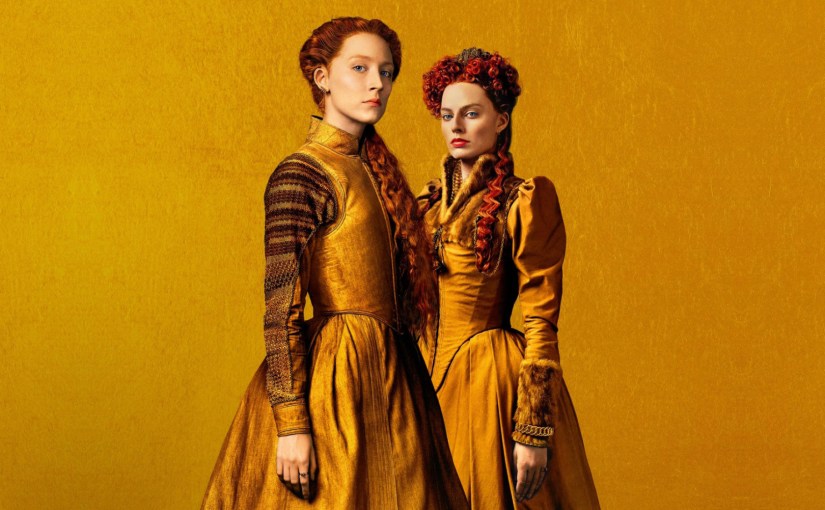
I came into Mary Queen of Scots with only movie knowledge to guide me, mostly from Elizabeth, the 1998 film starring Cate Blanchett.  After watching this movie, I can honestly say that, in terms of knowledge, not much has changed.  All I learned was that Mary Stuart would stop at nothing to keep the throne, which she believed was her birthright, and her cousin, Elizabeth I, refused to acknowledge that birthright because of her religion.  I think.  And much heartbreak and backstabbing ensued, resulting in Mary Stuart’s beheading.  (That’s not a spoiler, we see it happening at the very beginning.)

This isn’t so much a BAD movie, as it is a DENSE movie.  It assumes the audience knows much more about Elizabethan intrigues than I obviously do.  It becomes clearer as the movie progresses, but for the first 20 or 30 minutes, I was a little lost.  There is some excitement during a military attack, not to mention the unexpected exhibition of cunning linguistics, but for the most part the movie is content to sit back and simply regard the drama without getting invested in the story.  It was rather bland.  Not boring, just lacking in flavor.

The biggest draws here are the performances from the two female leads.  Saoirse Ronan and Margot Robbie are riveting, Robbie in particular as Elizabeth I.  She disappears into the role, without any trace of her previous screen personas.  Ronan’s Scottish brogue is on point, and she brings Mary Stuart to fiery, red-headed life.  But the surrounding story density never seems to let the actors swing for the fences.  It was a muted experience.

Fans of this historical period will likely enjoy Mary Queen of Scots more than I, much as Queen fans adored Bohemian Rhapsody more than non-fans.  I wouldn’t necessarily run to theaters, though.  Maybe wait for cable or Netflix.  Yeah.