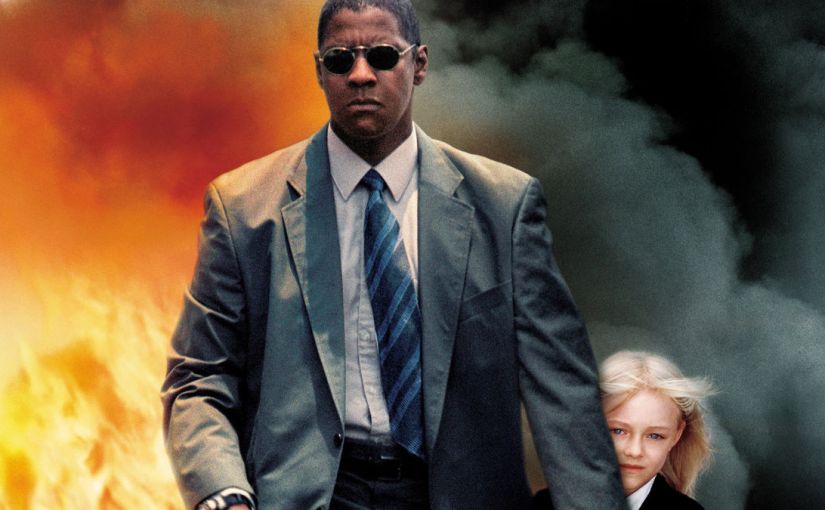
CRIMSON TIDE

By Marc S. Sanders

A little over a year ago, having just seen Christopher Nolan’s Oppenheimer, I shared with friends how it is sadly surprising that a nuclear weapon has not been launched by a super power country since the bombs were dropped on Hiroshima and Nagasaki.  Those two bombs certainly served their purpose in response to the Pearl Harbor attack of 1941.  I deem it sad that any of us consider this a possibility that can easily be repeated. With all of the threats that continue worldwide with weapons testing, technological advancements and arms trading, it’s frightening to wonder what can ever be expected. Is it easier to execute a command like that again, now that it has been done?  It’s got to be a little surprising that the United States did not respond that way following the 9/11 attacks.  Tony Scott’s Crimson Tide comes close to providing an answer by weighing sound vs unsound reasoning. 

This is not only my favorite of Tony Scott’s films, but the movie also offers maybe my favorite performances from Denzel Washington and Gene Hackman.  The two actors of different generations are equal in measure as they debate what should be done, along with how the submarine they command, the U.S.S Alabama, should respond while in the midst of a revolutionary conflict stemming out of Russia.  

Washington is Commander Hunter, recruited at the last minute to serve as the Executive Officer aboard the Alabama.  Hackman is Captain Ramsey who proudly leads the charge of the sub with an intimidating welcome to Hunter.  Before any kind of real conflict comes their way, Ramsey puts Hunter to the test.  An uncomfortable dinner conversation, wisely written by Robert Towne (Chinatown), has the Captain question Hunter’s stance on using nuclear force to deliver a harsh defeat to the enemy.  Hunter’s position though is the real enemy is war itself.  Ramsey and his commanding staff have no reply to the new member’s observation.

Another moment occurs when Ramsey orders a missile launch drill while Hunter is assisting with containing an on-board fire in the galley.  The Captain has his reasons that Hunter cannot truly debate. Besides, Ramsey precisely tells his XO to “bite (his) fucking tongue,” even if he doesn’t agree with him.

The centerpiece of the officers’ conflict arrives when they receive a fractured message from command.  Ramsey’s instinct is to launch missiles at Russia based on the presumption that the Soviet rebels have overtaken the country’s arms.  Though Hunter cannot deny the concern, he will not agree to a missile launch until they receive the entirety of the broken order.  This occupies the second half of the film, and it becomes a back-and-forth mutiny of power.  The Captain is relieved of command but then retains control and the crew is divided between the leaderships of these two characters.

Having recently seen and reviewed the submarine classic Das Boot, it’s fair to say that film feels much more authentic and maybe it should be much more tense than any other movie of its kind.  Crimson Tide is glossier with outstanding interior cinematography on a studio constructed set designed to tilt like a maritime vessel should.  The dashboards and colored lighting are fancier.  The cast is good looking as Tony Scott obtains close up shots of them beaded in glistening perspiration with no facial hair.  Crimson Tide is definitely a Hollywood picture.  However, the screenplay from Michael Schiffer is razor sharp with not one wasted piece of dialogue.  In addition to Robert Towne’s contribution, Quentin Tarantino also script doctored a portion of the piece as well which includes a well-placed Star Trek allegory. 

There’s a jolt of energy to Crimson Tide that Das Boot has at times, but because of the latter’s three hour plus running time it also slumbers like life should while living on a submarine.  It is the theatrics of Crimson Tide that hold my attention on many repeat viewings.  I’d never want to question a guy like Captain Ramsey, but I’d be grateful that someone like Commander Hunter is around to stand in protest.  

I wish Gene Hackman and Denzel Washington had done another film together.  Their conflicted chemistry is second to none.  You like them both equally in the scenes they share together, or individually.  The timing of their tempos is perfect.  They find just the right moments to be alarming in a quiet way and save other opportunities for shocking outbursts.  The best actors practice their scripts this way and avoid any traps of overdramatizing.

Tony Scott made this film before his penchant for chaotic angles and grainy captions took over much of his other films to come hereafter.  Crimson Tide is cut perfectly from one scene to another with outstanding colors of blue, red and green lights that illuminate the cast while they stand at their posts.  Washington, Hackman as well as a sensational supporting cast (Viggo Mortensen, James Gandolfini, George Dzundza, Steve Zahn, Matt Craven, Lillo Brancato) do fine work and respond beautifully to the director’s camera positions. 

It’s impossible not to feel the tension accompanied with the progression of this film.  It serves as a motivation to wonder if we act on what we know or don’t act on what we don’t know.  As taut and dramatic as Crimson Tide is, you find yourself considering if those with access to the real-life red button consider all that could come of their decisions.  

Crimson Tide may tidy itself up after two hours, but the movie still makes me ponder if this planet’s military forces are thinking each and every day about if we are preventing nuclear war or if we are on the cusp of waging a nuclear holocaust.

This is one of my most favorite films. 
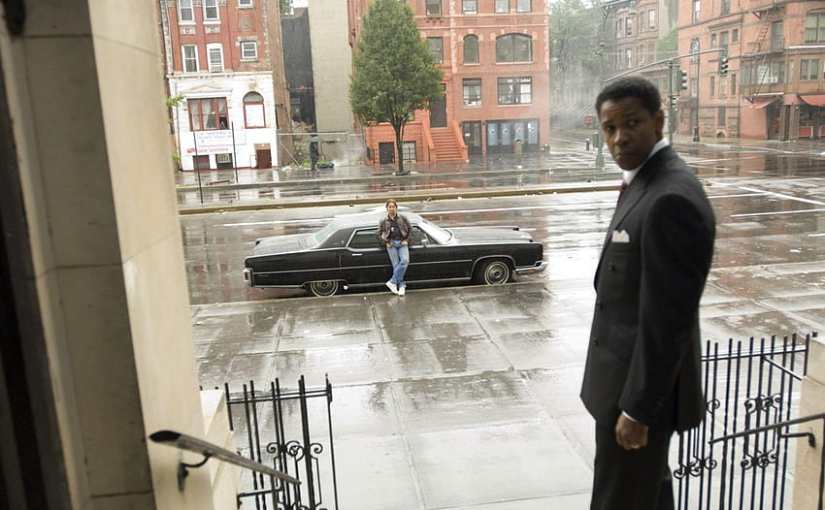
AMERICAN GANGSTER

By Marc S. Sanders

My favorite kind of crime dramas are the ones that tackle the grit.  The screenwriters and directors go for where the itty-bitty stuff scrounges up into something bigger for either the career criminal or the low-level cop.  These guys start out as butterflies flapping their wings and before you know it their legacies and pursuits are as big as hurricanes.  Movies like The French Connection or Heat operate on these trajectories.  How did we get from there to HERE?

Ridley Scott went in an unconventional direction away from his science fiction eye and ancient history recollections when he directed American Gangster with a screenplay by Steve Zallian based on the true stories of Harlem drug kingpin Frank Lucas (Denzel Washington) and narcotics detective Richie Roberts (Russell Crowe).

These two sensational actors don’t share one scene together until the epilogue of this always interesting three-hour opus.  Yet, in their second film together their pairing is as classic as DeNiro and Pacino or Newman and Redford.  I hope before they retire, these men pair up for at least one more film.  

Ridley Scott and his nominated art directors, Arthur Max and Beth A Rubino, capture a gritty urban, crime ridden Harlem of the 1960s/70s.  The streets are filthily here, as well as in the five New York boroughs and all the way across the bridge into New Jersey.  Frank’s markets carry a very wide berth. The buildings are distressed and cracked.  The clothes are of the hippie era with polyester suits.  This is where Frank Lucas moves his imported contraband, white powder heroin, labeled exclusively as “Blue Magic.”  The film provides a convincing source locale deep within the jungles of Vietnam where thousands of kilos are shipped to Frank for sale on the street.  The purity of the drug is beyond compare.  Scott and his art designers place you directly in this time period of dingy grime and among the sweaty Viet Cong and rivers to finally arrive at the crop Frank purchases his products from.

Once he finds his footing by eliminating the competition and recruiting his brothers and cousins to run his business, Frank invests in creature comforts with a furnished penthouse apartment for himself and a beautiful mansion for his mother (Ruby Dee in an Oscar nominated performance that comes off so naturally; you’d think she’s sitting at the Thanksgiving table with you).  He marries a beautiful Puerto Rican wife that he treats like a princess. Frank is smart.  He stays under the radar by wearing conservative suits and not making many waves like going out at nights and showing himself around the social scene.  He knows famous athletes like boxer Joe Lewis or the staff on the New York Yankees that could give his nephew a shot at being a pitcher. Still, his profile manages to stay low. Like his mentor, he just operates a business with a viable commodity.  He tells his younger brother (Chiwetel Ejiofor) that the loudest one in the room is the dumbest and the most likely to get caught.  So, mind how you carry yourself, how you dress yourself and how you flaunt yourself.

A separate story has no business intersecting with Frank’s plight until something gives.  Richie Roberts is a good, honest cop. Though he’s also a lousy husband and father. He has been assigned to head up a task force that will bust the top of the assorted drug empires.  He needs those rare breed cops who are not on the take and follow a strict policy of law enforcement ethics.  His team will not bust a common street hustler.  They will be looking for the kingpins with unquestionable evidence to put them away for good.

American Gangster follows two separate stories for most of its running time.  At least during the first two acts of the film, Frank and Richie are unaware of one another.  It’s only through some gradual surveillance that the cop finally gets a whiff of an idea and starts to move methodically towards a conclusion. The methods are the fascinating parts the movie.

When Denzel Washington plays a villain it’s always memorable and contrary to popular opinion, Frank Lucas is my favorite of his antagonists, especially compared to his Oscar winning work in Training Day.  Watch how he walks or sits on a sofa and broods over how his family and his business are functioning.  He’s the only African American actor I can see playing this guy because I’m always convinced that whoever Denzel Washington portrays, it’s a character who will never be intimidated.  This guy faced down Gene Hackman during a threat of nuclear holocaust. Not many other actors can do that so authentically.

Russell Crowe works like that hero who doesn’t want to wear the cape.  Richie Roberts succeeds on so many levels where his peers surrender to their inhibitions.  This cop passes the bar exam while fighting for custody of his kid on top of going after the empirical criminals who litter the streets in drugs and murder.  I’m reminded of his role in The Insider, where he used a similar American accent.  Richie is not as temperamental or hard wired as that guy, but he is at least as focused on doing what’s right regardless of threat or distraction.  Russell Crowe has a way of getting audiences to admire the concentration needed for many of his complicated characters.  You have as much tunnel vision as he wants the men he’s portraying to have. You are zoned in with what his characters live by.  You only trust their standards.

There are signature staples within the construct of this true story adaptation.  There are gunfights.  Punches are thrown.  The guy at the top beats up one of his cronies when he gets out order.  Yet, what stands this material apart from others is that now I’m watching how Denzel Washington and Russell Crowe handle everything.

The truth behind the story of a black gangster defying the dirty cops and the Italian mobsters who were thought to run the metropolitan undergrounds is amazing.  It’s so interesting to see how novel Frank is with smuggling the product from one side of the world to the other. Then, you see how he uses his family members to distribute to the consumers and collect the monies. Ridley Scott provides all the breadcrumbs in an easy-to-understand fashion.  

Painted against the landscape of an unwinnable Vietnam War that just won’t end, power is acquired and thus the best police officers are forced to change their approach.  So again, you see two different stories that start out small and undetected.  Frank and Richie are the most careful and meticulous of guys in their respective fields.  Therefore, it only makes sense that their paths don’t cross until their missions are nearly over.

There’s much to learn from American Gangster.  

You get an idea of how the harm of the war was not exclusive to just what was happening over in Vietnam.  There were more indirect effects to that crisis impacting the streets of New York and New Jersey.  

You see what subtleties an investigation will collect upon before pouncing on to a bigger stake.  You also learn how to handle a criminal empire with trust and dignity rather than announcing your immorality. You witness the sheer defiance of a righteous guy in what is supposed to be a law-abiding field. Steve Zaillian’s script is not just good guy vs bad guy. It’s each of these guys holding on to the top while trying to catch up with or stay away from each other.

American Gangster is a very thorough and well-planned biographical thriller.  

GLADIATOR II

By Marc S. Sanders

With Gladiator II, you get two of everything.  Two heroes, two emperors, two great white sharks, but only one Denzel Washington which is plenty.

The sequel to Ridley Scott’s Best Picture Oscar winner takes place sixteen years after those events when we had the impression that Rome was left in a state of nobility, devoid of treacherous gladiator games. Not so.  

Two flamboyant young men named Geta and Catacalla have taken joint rule of Rome thanks to their continued worldwide conquering delivered by their General Acacious (Pedro Pascal).  The general fought for Rome, even if he didn’t agree with the rulers’ policies.  Now he wants to rest with his wife Lucilla (Connie Nielsen, one of two returning cast members of the original film).  Though it’s hard for Acacious to remain apathetic even while the two brats demand more widespread conquests.

Elsewhere is Lucius, Lucilla’s son, a child in the first film, now an adult whose African army suffers defeat at the opening of this film.  The opening naval sea raid upon an impenetrable fort is massively impressive with arrows, fireballs, swords, sea water drownings and gory bloodletting.  Lucius is played by Paul Mescal.   

Gladiator II is full of parallel stories.  Still, you can bet these characters’ paths will all intersect in coincidental soap opera fashion during the run time of the film.

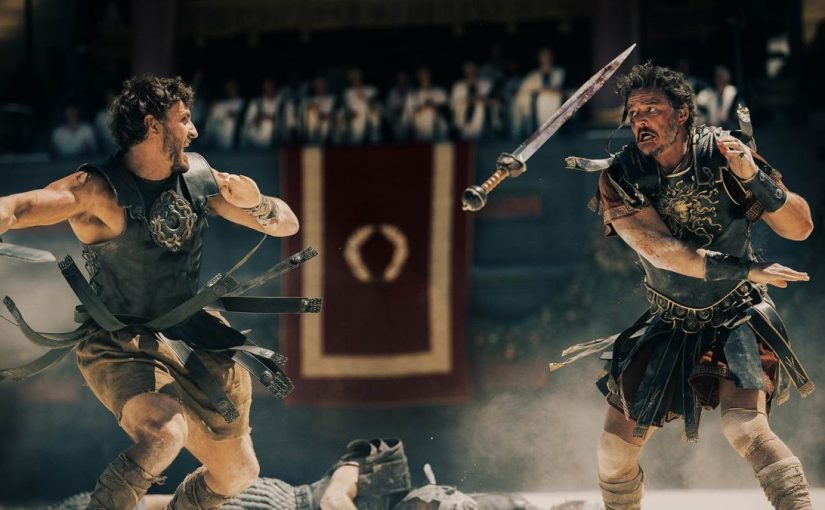
There’s nothing new to this follow up picture that you hadn’t already seen in the original Gladiator.  In fact, the first hour follows a near exact blueprint of its predecessor.  Lucius, a once revered battle commander who lost his wife, is purchased as a slave by Macrinus (Denzel Washington) to fight in gladiator games throughout the Coliseums of Rome.  Because the violence of the sport is so well assembled and enhanced compared to the last movie, it’s easy to get caught up in the fun the film offers.  The action pieces are magnificent.

Though most of the movie is ridiculous.  Historians just close up your encyclopedias.  

Most absurd, yet deliciously fun, is when the emperors arrange for the ring to be filled with salt water and man-eating sharks at the ready as naval battles are reenacted.  Now I’m not sure if this was truly accomplished in Roman times with state-of-the-art plumbing to transport and hold all of this water.  I am also skeptical of bringing bloodthirsty great white sharks straight from the Mediterranean directly into the Coliseum, but I’ll be damned if anyone tells me this centerpiece of bloodshed is not giddy to behold.

Other moments that will have you clapping are match ups between the warriors and big ass mutant, buck toothed (I mean like BUCK TOOTHED) monkeys as well your typical rhino melee.  That latter match had Miguel thinking of Attack Of The Clones.  

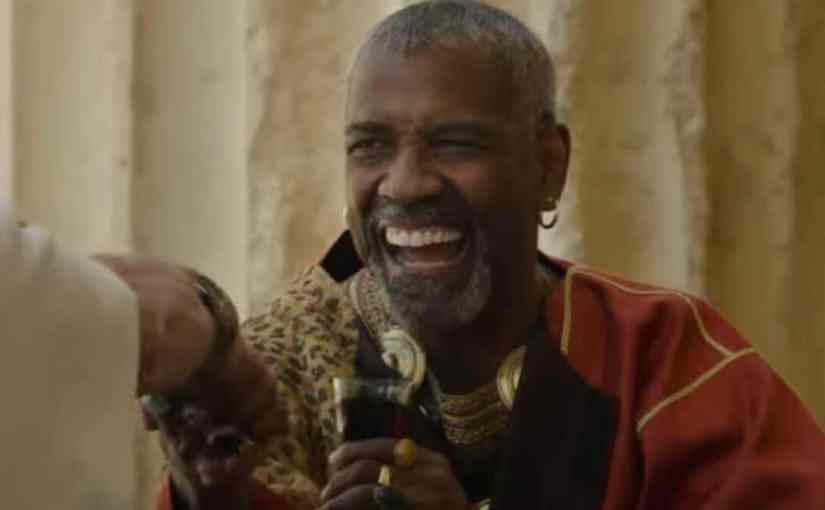
The best of the performances belongs to Washington.  As gleefully over the top (Miguel’s description) as Ridley Scott’s sequel is, Denzel Washington is doing scene stealing work on level with Jack Nicholson and Gene Hackman.  He’s playfully deceitful while appearing proudly respectable with his signature, toothy grin and colorfully eloquent robes that billow with his performance.  The film is not Oscar worthy, but Washington’s performance is because he masterfully works the mind-bending trickery of the character.  Macrinus worms his way through the Senators with conniving wagers placed on Lucius’ undetected fighting talents.  Actor Tim McInnerny is someone I’ve never heard of but as he plays a pitiful, gambling addicted weakling (think of Beaker from The Muppets) against Denzel Washington’s brash and conceited character, you can’t help but take pleasure in how things work out for each of the pair.

Joseph Quinn and Fred Hechinger are the cherub appearing emperors with extroverted cheekbones highlighted in bright rouge.  Combined,  these guys work really well as fill ins for the spoiled brattiness that Joaquin Phoenix left behind in the prior film.  Oh these kiddies are cruel and you just love to hate them.

The two heroes, Paul Mescal and Pedro Pascal, are what is left a little too bland.  They do not match the appeal that Russell Crowe delivered and it’s not simple to care for them or their outcomes.  Lacking any kind of dynamics, they occupy the athletic builds of these guys they’ve been cast to play and that’s where the script limits them.

Thankfully, Gladiator II is very entertaining.  It might not be wholly original when digging up tropes that have been used in many other sword and sandal epics, but Ridley Scott really committed to the carnage and gore we expect.  The director took much pleasure with the outrageous material and the smartest decision was to acquire Denzel Washington.  

Another actor would have slept his way through this role just for a paycheck.  Washington uses the twisted material at his disposal to own the picture all to himself.  I imagine the script documents an unforgettable monologue for his character in front of the weakling Roman senators.  This two time Oscar winning actor must have approached Ridley Scott and said let me try something.  Then the prop department made preparations for a sickeningly, grisly presentation that offers a marvelous image for the Roman Gods to behold, and one that’s hard to forget or not laughingly appreciate.  It may be a stomach-turning scene for some.  On the other hand, I applaud the brashness of the moment.

Our current Congress might be in disarray but with Gladiator II, Denzel Washington and Ridley Scott declare with confidence a resounding “HOLD MY BEER!”

GLADIATOR II (2024)

by Miguel E. Rodriguez

DIRECTOR: Ridley Scott
CAST: Paul Mescal, Denzel Washington, Pedro Pascal, Connie Nielsen
MY RATING: 6/10
ROTTEN TOMATOMETER: 72% Certified Fresh

PLOT: After his home is conquered by the tyrannical emperors who now lead Rome, a rebel soldier becomes a gladiator and must look to his past to find the strength to return the glory of Rome to its people.


[SPOILER ALERT: There is a key plot point that I must divulge in my review, but it is not something I knew before watching the film, despite the fact it was supposedly spoiled in one of the trailers.  You have been warned.]

While I was being underwhelmed by Ridley Scott’s latest film, Gladiator II, I was reminded of his previous lapses in judgement.  Although he is the deservedly acclaimed director of masterpieces like Alien, Black Hawk Down, Kingdom of Heaven, and Thelma & Louise, he also helmed such misfires as 1492: Conquest of Paradise, House of Gucci, and the regrettable Robin Hood [2010].  My point is that Gladiator II is a reminder that Mr. Scott is human like anyone else and occasionally makes mistakes.

I’m not saying that Gladiator II is a terrible film, though.  It is not aggressively bad like some other films I could mention (*cough, The Counselor, cough*).  It has some amazing sights, like the rhino battle in the Colosseum, and it boasts a triumphantly over-the-top performance from Denzel Washington as Macrinus, a flamboyant trainer of gladiators with designs of his own for the city of Rome.  On those merits alone, Gladiator II is maybe worth a watch.

But…but…

While the story is interesting from a standpoint of pure plotting, and while we get the requisite nostalgia bombs of seeing Connie Nielsen back again along with periodic flashbacks to the first Gladiator [2000], I felt curiously distant from the film itself.  I have theories about this phenomenon, but nothing conclusive.

First, the lead actor, Paul Mescal, as [SPOILER ALERT] Lucius.  He looks the part, I grant you that, at least from a physical standpoint.  He’s built, he appears to do most of the physical stunts himself, and he delivers his lines with the appropriate gravitas.  But I never got behind him as the hero of the piece.  Maybe it’s because he’s a complete unknown to me?  Maybe because we barely got to know him before he was suddenly thrust into the main story arc?  (By contrast, in the first Gladiator, we got to know Maximus inside and out before he became a gladiator.)

My sympathies went entirely towards Pedro Pascal as General Acacius, the military mastermind behind Rome’s greatest victories.  He is the new husband of Lucilla (played by the returning Connie Nielsen), whose son, you’ll remember, was last seen following Maximus’s body out of the Colosseum, sixteen years before Gladiator II begins.  Acacius is dutiful almost to a fault, deferring all glory on the battlefield to the empire of Rome, even if it’s currently being run by a couple of brothers (Emperors Geta and Caracalla) who are entitled, bloodthirsty tyrants.  He is weary of the constant bloodshed and wonders if there isn’t a better way to restore Rome to glory.

And Denzel Washington…well, I’ll get to him in a minute.

So, the story, while it must have been compelling on paper, seems to be a healthy echo of the first film.  Another defeated soldier becomes a gladiator.  Another successful Roman general wants to restore Rome.  More spectacular, bloody battles inside and outside the Colosseum.  More political intrigue regarding power-hungry senators and double-dealing merchants.  Forgive me, but I’ve been there, and I’ve done that.  (And adding massive sharks to a Colosseum battle does not intrinsically make it better than anything from the first film.  However, some basic research does show that the Colosseum WAS occasionally flooded with about 5 feet of water to stage mock naval battles…so there you go.)

The undeniable highlights of the film are any scenes involving Denzel Washington.  Not since Training Day has he chewed the scenery with this much gusto (although his recent turn as Macbeth comes pretty close).  I’m guessing he still has traces of Gladiator II set pieces stuck between his teeth.  He can command a scene by his presence alone, but he adds these marvelous gestures of adjusting his robes and tossing in one of his dazzling smiles when you might least expect it.  He makes one of the greatest uses of a dramatic pause that I’ve ever heard.  (“I own…[beat, beat, beat, beat, beat]…your house.”)  In another scene, he uses an exceedingly gory prop as a punctuation mark during a speech; if he gets nominated for an Oscar for this role, that’s the scene they SHOULD use for a clip, but they probably won’t.  Shame.  The whole performance is a classic example of taking a smaller role, owning it, and turning it into a thing of beauty.  In hindsight, it’s probably a good thing that he doesn’t have much screen time, because he simply outguns his scene partners at every turn.  You can’t take your eyes off this guy.

The drawback to Washington’s masterful performance is that I found myself marking time between his scenes, instead of falling into the world of the story.  I followed along, was able to keep track of which senator was doing what and why Lucilla was so distraught and so on.  But to the degree that I was able to follow along, I just didn’t care.  I was reminded of Troy, another sword-and-sandals epic, also told on a grand scale with innumerable extras and some world-class battle scenes, but which also left me apathetic for much of its running time.

Gladiator II improves on the first film only in terms of the complexity of its visual effects and the addition of Denzel Washington.  Aside from that, I’m afraid it does very little to make me care about its heroes, its plot twists, its unexpected deaths, and the glory of Rome.

(And I had to exercise superhuman restraint, at the final shots of the film, to keep myself from yelling out loud, “Talk to me, Goose!”)

UNSTOPPABLE (2010)

By Marc S. Sanders

An adventure of the unexpected needs to start with urgency. 

“Let’s say there’s a runaway train that’s barreling through the state of Pennsylvania and no one is on board to stop it.”

“Not bad.  What else you got?”

“This train is a half mile long. So, it’s a roller coaster of a beast.”

“Go on.”

“How about there’s another train on the same track and the two are going to collide with each other?”

“It’s got potential.  Anything else?”

“Oh yeah.  The train is carrying toxic chemicals that could cause mass destruction and casualties of epic proportions throughout the rural area.”

“Okay.  Now we’re talking.  Any guns?  Can we find a way to get machine guns into the mix?” 

“Yes!  I got it.  How about if the people try to derail it and the only way to make that happen is the cops shoot at this tiny button on the bottom of the engine, and this button is located between the gas tanks?  So it’s gotta be a direct hit while the train is in motion.”

“Okay.  Okay.  That’s genius.  Let’s green light it.”

Now this might have been how Unstoppable, director Tony Scott’s final film, got put into commission, but what is especially fascinating is that this is based on a true story. An out-of-control locomotive actually went off with no one on board to control it.  It happened within the state of Ohio about fifteen years prior to the release of this film.  Only it was not as dramatic or suspenseful as Tony Scott and his crew assembled their movie.  Unstoppable is a pumped-up, steroid enhanced reenactment of the actual story.

The director recruited his most common go to lead, Denzel Washington, for the role of Frank Barnes.  He’s an engineer with over thirty years’ experience who is wiser than the big wig suits on the top floor.  He can bring this potential disaster to a halt before it happens.  Frank is also a mentor to the fresh, young conductor, Will Colson (Chris Pine). 

Will is cranky because his wife is upholding a restraining order against him and the two are at a standstill of hashing their problems out over the phone.  Frank is in a bad mood because the young guys like Will are being brought in to replace the grizzled fellows who are being pushed out.  Frank is also a widower with two estranged daughters. Though, he gets a kick out of telling Will the girls are paying their way through college by working at Hooters.

Denzel Washington and Chris Pine make a good pair.  Buddies who antagonize each other at first, they later share what’s eating at them personally and professionally. Then they work well together to resolve the crisis at hand.  Their characters are not very dimensional, nor should they be.  After all, it’s all about the train.  Yet, I believed them as train engineers/conductors.  Either of these guys could be operating a merry go round and I’ll believe they know some serious shit about how the carousel operates and moves in a circular motion.  My point is these actors really work at it to appear like guys who are well trained within the freight train industry, and I buy all of it.

In the control center, staring at large monitors with high tech maps is Connie (Rosario Dawson).  She’s communicating on the CB with Frank and Will and giving them updates on the status of when their engine will be within hookup range with the one speeding out of control.  She’s also the figurehead with the smart mouth, needed to stand up to her bubbleheaded corporate boss (Kevin Dunn) who threatens to fire all of them.  In other movies, this guy would be the angry police captain in a cop movie.  He’d be the government official who believes he can protect the President while Kevin Costner or Clint Eastwood knows that’s not how it works.  This is a slot role.  Use the same dialogue for a guy like this no matter what the picture is about because it’s all standard stuff. 

On paper, Unstoppable sounds ridiculous and quite ordinary for an adventure.  A runaway train.  Isn’t there anything else?  Yet, Tony Scott applies his quick edits and aggressive zoom in and zoom out shots to the movie’s breakneck progression.  He’s also got those curved Steadicam movements within Connie’s control center accompanied with glowing bright lights of greens, reds and blues. 

News reporters’ updates, along with footage from helicopters, are spliced in between the scenes that Washington and Pine share together in the cab of their train engine.  The glue holds up well.  There’s time allowed for Frank’s girls to cheer daddy on while at Hooters. Will’s wife played by Jessy Schram holds their young son while nervously fidgeting and tearing up watching the news.  I don’t think she has any dialogue beyond the line “C’mon Will!” Soon, she’s live on the scene staring straight ahead for the final act of the film.  That’s a problem.   I’m questioning why she’s looking in the same spot straight ahead if this train barrels on and on.  It’s certainly not in a stationary position.  She’s not watching a baseball game.  No bother.  It’s not fun to question a picture like this with such semantics. 

The exhilaration comes in how Tony Scott sets up his action pieces with daring leaps on and off the train and running sprints on top of and in between the cars.  Guys hang from helicopters with attempts to board the train.  Cop cars turn their sirens on and speed parallel to the locomotive, and yes, as in any Tony Scott film, a handful of cop cars bang themselves up real good in some gritty pile ups. A gorgeous red pickup truck works its way into the story too.

Screeching sound effects are also necessary.  They were nominated for an Oscar. 

Perhaps my one complaint that’s hard to accept is that in some shots, the train, which is supposedly going at over 70 mph, doesn’t look like its going fast enough.  Urgency is important in a film like this and when I get the impression the train is not traveling at a high enough speed, well then the threat doesn’t feel so threatening.  It’s when there are shots underneath from an on the track perspective that you really get an idea of the exhilaration.  In a movie like Speed, the bus always looked like it was accelerating and never slowing down.  Here, the train seems to move slow enough at times that anyone could have just leaped on board, but as Miguel always says, “Then there would be no movie.”

Don’t go into Unstoppable with your Neil deGrasse Tyson laws of physics.  Don’t get hung up on the wife who can see everything that’s happening by staring straight ahead when this speeding train is racing past her from right to left.  Don’t worry. Move on.  It may not look like it, but this train is going faster than it appears. 

Just enjoy the ride, and relish in what set Tony Scott aside as a well-equipped and capable action director.  Sadly, he left this world too soon.  There were more fun action movies to be made by him.  Unstoppable at least reminds you why he is still so sadly missed.

THE EQUALIZER

By Marc S. Sanders

I guess Liam Neeson and Gerard Butler were unavailable when Antoine Fuqua and Denzel Washington collaborated to make the first installment of The Equalizer trilogy, based on the CBS television series that starred Edward Woodward.  This film is nothing special with a nothing special kind of script, a nothing special hero and a nothing special collection of Russian Mafia villains.  The kills are nothing special either.  The action is nothing special.  The explosions are nothing special, even when they are started by a trip wired microwave.

Robert McCall (Washington) lives a quiet life by himself, while working at a jumbo home improvement store (think Home Depot or Lowes – big places for lots of not so special action to take place at the conclusion of a not so special movie).  Turns out McCall, who also lives with OCD, is a retired special ops commando.  Robert uses his down time to read one of a hundred books that should be read before you die, while sitting quietly in a coffee shop each night.  He also volunteers his assistance with getting people to improve their lives.  A plump co-worker named Ralphie (the go to name for fat guys) played by Johnny Skortis is on Robert’s strict diet regimen to lose enough weight so that he can be promoted to the store’s security guard position.  Skortis occupies the best and most interesting character in The Equalizer.  During the final action sequence, it’s what Ralphie does that earned my one cheer during the course of the picture.

Robert also becomes acquainted with a young lady named Teri (Chloë Grace Moretz) who has aspirations of becoming a singer but is weighed down by her call girl commitments to members of the Russian mob.  When Robert sees that Teri has been beaten and is in serious trouble, he doesn’t wait to be asked for help.  He just does what is necessary to even the score.

That about does it for The Equalizer

No.  Seriously.  That’s all there is to it.  And so I’m very disappointed. 

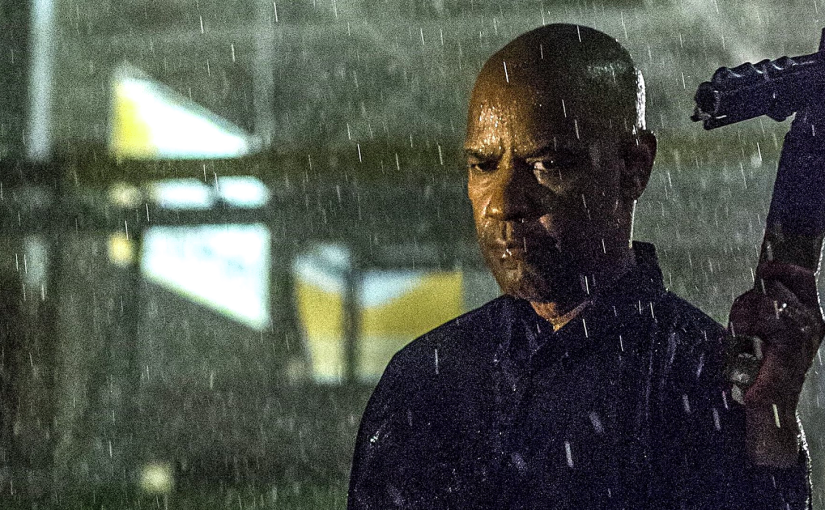
First, Denzel Washington does not even look like he’s trying.  His demeanor to this character is no different than what he did in the lousy Man On Fire, directed by Tony Scott.  The script to this film is not challenging in the slightest.  Like Man On Fire, The Equalizer is simply a series of scenes where Robert torments his villains.  David Harbor is a corrupt Boston cop who gets trapped in his own car, while Robert runs a garden hose from the exhaust pipe to the inside with the engine running.  Where is the entertainment in this?  Washington sits in a chair while he mechanically opens and closes the car window and Harbor gasps for breath.  McCall is inventive with his methods but it does not lend to any story progression or character depth.  I guess Robert McCall is an artiste – one who specializes in torment, torture and death.

The climactic showdown, within the store, is a great set up for some tête-à-tête methodology to happen, but all of it is executed with little interest.  Here’s where I asked myself a question.  McCall nabs a guy in a makeshift kind of bear trap down aisle 10 (I guess).  The thug gets his neck caught in a barb wire noose and up he goes to the second level of pallet platforms for McCall to stare the guy down while the blood squirts out from his throat.  There’s four or five heavily armed other guys roaming the store, but McCall can take a break to stare this guy down for his last breaths.  If this trap works so well with this one guy, then why not set up six or seven more of these MacGyver contraptions and let each machine gun toting baddie go through the same routine?  I know.  I know.  Miguel would respond, “because then there would be no movie!”  Yet, what does that say about The Equalizer that my mind drifts to this idea?

Later in the sequence, McCall easily walks up to another thug from behind and delivers a power drill to the back of his head.  Then he puts the drill back on the shelf.  Again, if this worked so efficiently and covertly, why not just do it again? And what is so exciting about a power drill anyway if Jason Vorhees isn’t using it?

A nail gun is used a few minutes later and Fuqua opts to just have Washington shoot one nail after another into his opponent.  Bang – Nail – Cock! Bang – Nail – Cock!  There’s no pun or one liner.  There’s just a bad guy who falls to one knee, then an arm goes down.  The machine gun lets off a few rounds and drops to the floor. There goes the other knee and then he’s dead.  Washington just observes the guy die while the sprinkler system drenches him stylistically in slow motion. 

I look at The Equalizer and I think back to the ‘80s actioners from Schwarzenegger, Van Damme, Stallone (some of them), Jackie Chan and even Seagal.  The Rock had fun with a few of these action pieces too.  Go check out The Rundown.  There was a pizzaz to the hero’s methodologies back then.  It wasn’t just a brutal killing and bloodletting.  A one liner accompanied the kills.  It made you cheer and applaud.  Those pictures worked like symphonies of dialogue and ultra cool action that John Wayne never accomplished.  Robert McCall is boring.  Just boring.  An absolute bore.

The villain of this effortless piece is also boring.  Marton Csokas did not advance his career with the lack of anything beyond his Russian dialect and three-piece suits used in this picture. 

Antoine Fuqua has yet to wow me.  Though I know he’s an accomplished director, Training Day always feels like it comes up short with the three or four times I’ve watched it looking for its merits. The critically poor procedural of The Equalizer only lessens his promise for growth and potential.

Denzel Washington has resorted to uninspired characters a few times now. He still earns accolades with pictures like the recent The Tragedy Of Macbeth (a Best Actor nomination) and on stage (I was in the third-row orchestra when I saw him do a forty five minute monologue in The Iceman Cometh on Broadway.  Amazing!).  Still, he just recently completed the third installment of the Equalizer series. Ugh!  Why?  Why Denzel?  Why are you trying to be another past his prime, tired Liam Neeson in these cheapo action pictures?

What I wouldn’t give for another Crimson Tide kind of thriller.

INSIDE MAN

By Marc S. Sanders

The abundance of Spike Lee’s films offer a message as quickly as the film begins.  Then they set out to demonstrate what Lee is talking about in the scripts he writes and/or directs and what is presented on screen for the next two or three hours.  BlacKKKlansman (a favorite of mine) and especially Do The Right Thing are perfect examples.  Lee is direct and hardly ever ambiguous.  Inside Man is an exception.  

This Spike Lee Joint is having a bit of fun with the director’s own take on the staple bank robbery found in so many films.  By the time the film is over, and all the cards are on the table, you realize the audacity of this caper is as unique as Sidney Lumet’s Dog Day Afternoon or Michael Mann’s Heat.  With a screenplay by Russel Gerwitz, Spike Lee is proudly vague until he finally reaches his conclusions during the third act of the piece.  It’s unusual.  It’s out there and it’s a stretch, but the math of the heist seems to add up.  Still, knowing what I know now, I do wish there was a little more focus on some characters that lend to the film’s twist. Then again, maybe that would have implied too much.

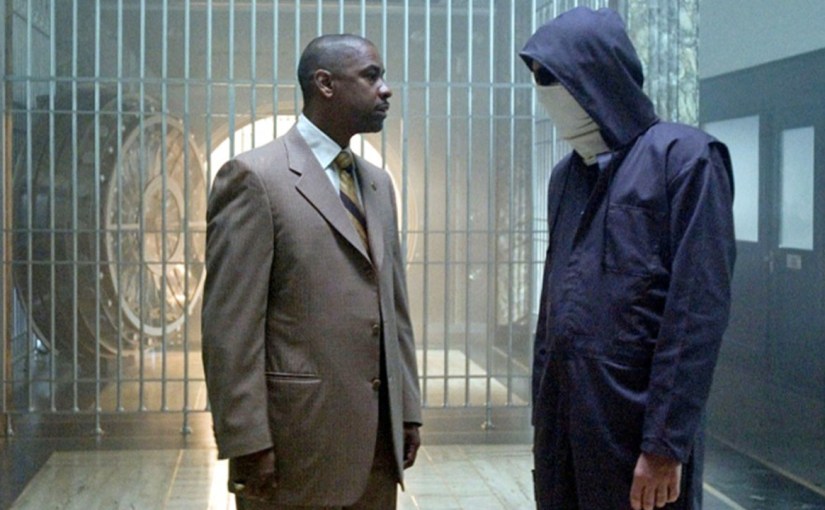
Four people wearing sunglasses, caps and painters’ uniforms take a well trafficked New York City bank branch hostage, complete with the entire staff and around thirty customers who are in the lobby.  The ringleader is played by a mostly concealed Clive Owen.  You might not see his face too often in the film, but you’ll be grateful he’s the bad guy in charge.

Denzel Washington is Detective Keith Frazier, and with his partner Bill Mitchell (Chewetel Ejiofor), they are on the scene attempting to diffuse the situation. The police captain right next to them is John Darius (Willem Dafoe).  Ejiofor and Dafoe are good as expected, though their roles are routine elements for these kinds of movies.  Washington has the kinetic pace that audiences are familiar with as he tries to outthink the bank robbers.  His character is labeled with a checkered reputation as he’s suspected of stealing drug money.  That element really goes nowhere.

Another party comes into the fold with Jodie Foster as a well-tailored and confident “fixer” hired by the bank’s president (Christopher Plummer).  To get these two actors together in a film along with Washington?  Well, that begs for repeat viewing.  Unfortunately, I didn’t see much point to the Foster character.  Upon hearing the news of the robbery, Plummer’s character clandestinely employs Foster to contain the situation so that a particular item in a safe deposit box remain untouched.  She arrives on the scene, exchanges dialogue with Washington that does not add up to much.  She surveys the hostages being held and then exits the story, until the epilogue.  As welcome as it is to see Jodie Foster, I can’t imagine what was gained from the context of her role, which does nothing to advance the story.

Inside Man always kept me interested and guessing.  The structure of Gerwitz’ script jumps ahead at times to show the detectives interrogating each hostage with suspicion after the incident is over.  So, I always wanted to know how it ever came to that shift in direction.  Plus, what happened to the bank robbers, and what precisely had Christopher Plummer so concerned about one particular branch robbery that he had to reach out for special services from Jodie Foster’s character? 

The answers arrive, and I can swallow the explanations.  Yet, the wrap up actually involves additional characters who hardly say a word or appear on screen earlier in the film.  Because they are briskly glossed over, it did not give me complete satisfaction.  I like the twist a lot.  It just needed a more solid foundation.

Inside Man is of those rare films that Spike Lee is invested simply for the fun.  The quick cuts and bustling New York atmosphere work well.  I love the opening credits to the movie; kind of his own spin on what Lumet did with Dog Day…  Lee has a good villain and appealing heroes. Other than few shortcomings, this is a solid crime drama.  

Often, Spike Lee positions himself on a platform that endorses a cause for the African American populace, or he brings attention to social wrongs in world history.  He is one of the best at what he does with his filmmaking approach.  Ironically, a message and a comeuppance arrive with Inside Man, but for a different demographic.  It might not be as hard hitting or thought provoking as other Spike Lee Joints, but it is appreciated.  

MAN ON FIRE (2004)

By Marc S. Sanders

A movie that has eluded me until now is Man On Fire featuring Denzel Washington in another Tony Scott film.  I say eluded because with this director/actor combination I’m usually satisfied with the finished product.  That wasn’t the case here, though.

Washington portrays a hard drinking bodyguard named John Creasy.  He’s recruited by his war buddy, played by an uninteresting Christopher Walken, to protect a young girl named Pida (Dakota Fanning), daughter of an automobile industrialist and his always fashionable wife (Mark Anthony, Rahda Mitchell).  Creasy is a cold fish at first who refuses to accept Pida’s friendship.  Jump to a couple of quick scenes later and he’s become her surrogate father and swimming coach.  In a matter of seven minutes of running time, I’m supposed to accept that this guy has turned into a cuddly teddy bear for this kid.  As soon as that happens, Creasy is ambushed and Pida is kidnapped following her piano lesson. We are not even a quarter of the way through the picture, but the remaining hour and forty minutes play like an awful how-to documentary on effective means of torture for bad guys before ruthlessly killing them.

Tony Scott is a director who always seeks to demonstrate that glossy film styles are more significant than the screenplays he directs or the characters who reside within.  (Two exceptions come to mind though, Crimson Tide and True Romance.  Maybe some of Top Gun too.)  Man On Fire is a frustrating watch as Scott’s camera performs like a narrator with attention deficit disorder.  It can never sit still.  The movie jerks around so much with ridiculous quick cuts and deliberately grainy and distressed cinematography.  Just when I’m trying to comprehend a new player who enters the fold, the camera jumps to something else like a street corner or a moving car or Denzel Washington’s sunglasses. There are subtitles for the Spanish speaking characters that appear in a block letter font that looks like it came from a karaoke machine.  There’s also subtitles for what somehow appear to be “important” or “powerful” statements.  A line like “pass the salt” might read like “PASS the SaLt…PLEASE!!!!”  Tony Scott is obviously going for some kind of MTV music video approach, but it’s awfully distracting and downright annoying.  As well, I must ask why.  Why go through all this effort? The cameramen must have been getting motion sickness while fumbling and shaking around their equipment to shoot this picture.  So why bother?

The most interesting plot point happens in the first three seconds of the movie.  A statistic pops up describing how often kidnappings occur in Mexico (one every sixty seconds), and how as many as seventy percent of those incidents end up with a dead victim.  That’s a shocking dilemma, worthy of attention. Through his career, Washington’s selection of scripts has allowed him to tackle important issues with moments of debate and smart dialogue, as well as suspenseful action if there is a call for it.  However, Tony Scott and screenwriter Brian Helgeland are not interested in using these facts as a springboard with Man On Fire

Once the expected kidnapping occurs, and following a very quick healing – as in less than two days – of multiple gunshot wounds to the chest and back, John Creasy goes on a war path of revenge when he learns that Pida is dead.  Creasy doesn’t get to perform with much intellect here.  Having only a partial license plate number, he’s able to follow the breadcrumbs that lead to a crime syndicate notorious for winning millions in ransom demands.  Creasy simply goes up the food chain from one member to the next until he gets to the top of the pyramid.  That’s the movie!  That’s it!

He’ll cut a guy’s fingers off and cauterize them with a car cigarette lighter.  He somehow has access to a rocket launcher to use within the city.  Sadly, the most novel technique is to stick a rectal detonator (yes, I said rectal) up a man and set a timer for the guy to come clean with information before it goes off.  We can thank Tony Scott for putting up a countdown digital clock on the screen to gauge how close this thug is to his demise.

My past experience with movies like these have taught me that there’s always a traitor.  Someone set the plan in motion to abduct the little girl.  That’s not hard to figure out.  Once the character appears on screen, it could not be more obvious.  The motivation is just as ridiculous.

Man On Fire is only imaginative in how the protagonist dispatches one guy after another.  It lacks any effort in creativity towards its hero.  The guy drinks. He torments his enemies.  He’s got nothing interesting to say.  There’s a neglect for a very real and common problem within the country of Mexico.  The only design that is given attention is “artistic style” that Tony Scott adopts to mask away what is not there in any of the writing or character development.

I’d like to learn more about how the Mexican government responds to these kidnappings and maybe the experience that survivors endured.  Show me the torment that the families go through.  Can I see the method to the kidnappers’ plots or how they select their next target?  A very real predicament was offered with Man On Fire, but then it was tossed aside so I could see the effectiveness of an explosive suppository.  Now, is that really a movie that any of us want to see?

THE PELICAN BRIEF

By Marc S. Sanders

Tulane Law Student Darby Shaw (Julia Roberts) is unbelievably lucky. She can find herself being pursued by one white guy in a suit after another over the course of a two hour movie and will be fortunate enough to escape every threat by sheer chance. It’s only to her benefit when she is being chased by two assassins in a creepy downtown parking garage that someone left an angry doberman in a car to startle the killers. As well, it’s really a blessing that Darby has caught on that if an engine sputters when turning the ignition it can only mean one thing – car bomb! GET OUT!!!!!

Darby is the main protagonist of The Pelican Brief directed by Alan J Pakula, adapted from John Grisham’s best-selling novel. When the eldest and the youngest Supreme Court justices are murdered, Darby conceives of an outrageous conspiracy stretching all the way to the President and documents the whole rundown in the so-called Pelican Brief. She shares the document with her law professor who shares it with his government friend who shares with the CIA who shares it with…and so on and so on.

Pakula is an under celebrated director when you consider his better thrillers like Presumed Innocent, Klute, and especially All The Presidents Men. Here though, I think he got a little lazy with his screenplay and direction. The Pelican Brief is a little too paint by numbers.

Sure, the film has suspense. I think Grisham’s story has some convincing weight to it where wealth and government won’t stand for the platforms of environmental causes and therefore people have to die. Still, while the meat of that story eventually surfaces, we are left with A LOT of buildup before Darby gets involved. Just a lot of white guys in different office buildings walking down hallways, entering doorways and talking on the phone. Every so often we come across a DC crack reporter, Grey Grantham (Denzel Washington) who gets a phone call from a potential informant. When that guy gets scared and hangs up, thank goodness Darby just happens to call two seconds later regarding the same story. Good on you Grey for being by that telephone.

That’s my problem here. Pakula just works in the lucky conveniences to keep Grey and Darby on the trail. Neither of them ever truly escape a bind on their own. Neither of them ever truly dig the hole any deeper without something COMING UPON THEM to help them along at just the right moment.

We learn a safe deposit box belonging to a dead character exists. Darby just strolls into the bank and posing as the widow, who is not a signer on the box, is just asked for her address and phone number. No proper identification necessary. Why didn’t anyone ever tell me it’s that easy? Folks, hide your valuables because I’m gonna be robbing you blind.

Pakula will even set up a good scenario where Darby thinks she’ll be meeting someone who can help but it’s an assassin ready to kill, only suddenly the assassin is killed while holding Darby’s hand in a crowded courtyard. Wow!!! Lucky again, Darby. I’m still fuzzy on who actually killed the guy. That didn’t concern Pakula though. It’s explained in a quick throwaway line before the credits roll. Pakula only had to get Darby out of danger again. So let’s see he’s got the barking doberman for something else, the engine sputter will be used later on. Hmmmm??? Meh!!! we’ll just have someone randomly kill this guy. Now run, Darby. RUN!!!

Notice I haven’t talked about performances. Well, there’s not much to them. The Pelican Brief boasts an impressive cast of character actors like Sam Shepherd, Anthony Heald, John Lithgow, Stanley Tucci, Robert Culp and John Heard. Yet, these guys, along with Roberts and Washington are flat. Just reciting their lines when the cues call for them. There’s nothing very exciting to any of them really. Very monotone. Roberts is beautiful yet depressing even before she gets caught up in the mystery. Washington, while handsome, does not seem to have the gusto that Pakula’s reporters did when he directed Hoffman & Redford. Grey is too neat, physically fit and tailored for an always on the job, aggressive reporter looking for a scent.

There was a better movie to be made here, thanks to some convincing motivations that were started with Grisham’s novel. Unfortunately, Pakula just didn’t devote enough respect to the original author’s imagination.

THE BOOK OF ELI

By Marc S. Sanders

Do you believe in the word of God?

The Book Of Eli directed by The Hughes Brothers will make sure you do.

Faith carries Denzel Washington’s loner character on a journey through a grim, sunburned post apocalyptic wasteland as he protects a rare, sacred text. He has been on a sojourn to reach a final destination out west.

Me, being the religious skeptic these days, might normally find the convenient episodes of survival that Washington encounters as far fetched. However, The Hughes Brothers direct a script penned by Gary Whitta that never mocks the purpose of the film presented. As a viewer it would be rude of me to laugh at how Washington continues to walk when it seems he’s getting shot in the back. I wouldn’t dare misbehave in that manner. Watching The Book Of Eli…well…I feel like I’ve gone to church.

The Loner carries a book he faithfully reads every day as continues his long walk through treacherous, barren and motorcycle pirated lands. If the sun doesn’t blind him and kill him, the various marauders might.

The worst adversary of this bunch is Gary Oldman in yet another treasured villain role. Oldman keeps a tight authority on an “old west” inspired town, commanding from his comfortable leather chair in the upstairs level of the town’s bar (saloon, perhaps?). He’s been tirelessly dispatching men to find a particular book and perhaps it’s the one that The Loner possesses.

Post-apocalyptic wasteland, a book, a Loner, a villain. That’s the structure of this film along with some side characters like an impactful Mila Kunis and Jennifer Beals. Very simple ingredients allow for well edited moments where Washington can display his unexpected fighting techniques with a gun or a shotgun or a forearm length sword. When he exercises these moments the scenes are outstanding. Oldman is the guy who sits back letting his own horde do the dirty work and only acts when he sees that he has an upper hand. He’s oily, scary and in this dense waste of a future he likely dreams of being a prophet or a high powered evangelical might.

I was so pleasantly surprised by this film. Post apocalyptic films wear on me these days. How much is there to show that I haven’t already seen like abandoned cars, skulls, and deserted highways?

This is different however because Whitta’s script offers a reason to live through this hellish void. I had to wait for it but the ending is a very satisfying conclusion. I loved it, actually.

The Book Of Eli is a great film.