
By Marc S. Sanders
Some films simply focus on the internal struggle of a character. There might side component figures, but those are not fully formed because they exist to shape the main character we are directed to observe. In Taxi Driver, Paul Schrader and Martin Scorsese scrounge up several people from a seedy New York City underbelly to intrude upon the life of isolated and angry Travis Bickle, the Vietnam war veteran. All walks of life enter his cab and leave it. Travis sums up the various individuals by his own twisted meter. Some he’ll follow. Some he’ll abandon. Eventually, he’ll even protect someone vulnerable to the salacious world he occupies.
Bobby Dupea, played with heartbreaking brilliance by Jack Nicholson, the main character of Bob Rafelson’s Five Easy Pieces, journeys down a similar path. However, he’d be apt to abandon everyone. One problem is he can’t escape from himself. He could leave his personal jacket behind in a restroom and face a bitter cold, but he’ll never be able to shed his own skin.
Bobby lives with an airhead hick waitress named Reyette (Karen Black in an Oscar nominated role), but he doesn’t value her. He cheats and boozes around with the next dingbat woman who approaches him in the local bowling alley (Sally Struthers). Whatever is currently in Bobby’s life is one more chapter that’s left behind as a means to gain further mileage away from where he originates. It’s hard to comprehend how Bobby, a young man with the potential to be a celebrated concert pianist, could flee from a past and dwell within a mundane life as a worker in a California oil field. Otherwise, all he’s doing is bowling and drinking at night with his buddy Elton (Billy Green Bush) while never thinking about Reyette. Bobby is a problematic guy, never wanting to challenge complexities in relationships or advance his gifts of talent. Bobby Dupea is never destined for self-comfort or pleasure.
Carole Eastman’s script, with input from Rafelson, examines what I believe many people are too proud or reluctant to admit. Try as they might they cannot come to grips with the life handed to them, albeit with extraordinary talent or simplicity. Reyette is happier to be a greasy spoon waitress with a penchant to sing the songs of Tammy Wynette. Bobby has so much more potential but he’s that much more unsatisfied than Reyette.
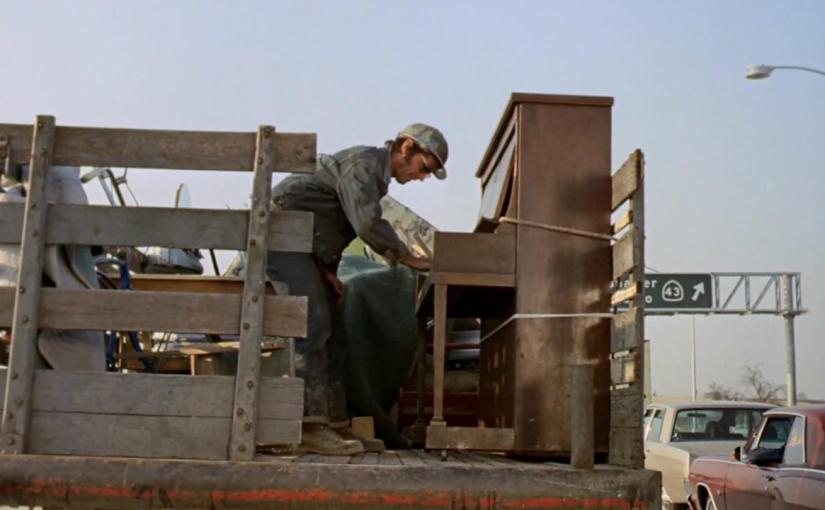
Often within the film there are visual allegories to Bobby’s struggle. He nurses a bottle of booze while driving on the freeway with Elton. Traffic is at a standstill. No one is going anywhere. There’s no escape, and about the only action anyone can take in this stationary position is to honk their horns with intolerable impatience. Bobby can’t even settle for that, however. He storms out of the driver seat to wail at the other cars. When he sees an old piano resting on a moving truck, he climbs aboard and starts to play. Nicholson’s body language doesn’t show a man at peace with the instrument though. Bobby appears like a crazed madman using the piano as a means to drown out the bellows of the automobiles and he does not even show care when the truck exits the freeway leaving Elton far behind. Bobby Dupea has no sense of direction.
Elton has a child with his wife and there’s a moment where he displays his paternal affection. Elton possesses value for someone. Bobby, however, is beyond feeling. Reyette tries to hold on to Bobby and find purpose in a life with him. She’s uneducated and uncultured in art. Yet, she’s ready to bowl with Bobby and accompany him in life. Bobby is only content, never happy, unless he’s frustrated with her. She gutters the ball down the lane all night and only on the last round does she finally get a strike? Why should Bobby celebrate? The strike was for naught.
When Bobby’s sister tells him that their father has suffered a stroke leaving him handicapped and mute, he’s conflicted about making the drive to Washington state to see him. It’s a return to a life he could never find comfort in despite the musical talent he earned from a lineage of artists. The people who live there are eccentric and maybe too philosophical. There’s nothing there that Bobby finds enriching. He certainly doesn’t maintain a relationship with his father. Yet, he decides to make the drive up the coastline by almost making a clean getaway from Reyette who he reluctantly welcomes to tag along. Now he’s trapped in a car with someone he feels he has to be with but never wants to be around. How does he resolve his dilemma? He picks up two women stuck on the side of the rode, only to find one uniquely irritating by harping on the filth of the environment as she attempts an escape to the apparent purity of Alaska. Bobby knows this woman won’t find her utopian salvation, just as he will never get there either.
Bobby fights against standards. The well-known diner scene (one of my favorites in all of movies) has him revolting against a server’s adherence to menu policy with a crass comment directed at her followed by a chaotic clearance of the drinking glasses on the table. This man can’t decide what makes him happy, but he also cannot endure the tolerance of how others live in this world. Nothing offers salvation for him.
At the Washington home, he comes across a student named Catherine (Susan Anspach) who is married to a dweebish fellow – a violinist with a sprained neck. Catherine appreciates Bobby’s calm interpretation of playing Chopin, but she knows she cannot go further than that with him. Bobby can’t confound her reasoning. The answer for Bobby has always been to leave everything behind. Why can’t Catherine do the same?
He also can’t find a way to connect with his father. His sister assures him that dad can hear him, but the bearded expression stays the same and the best that Bobby can do is say he can’t stay in anything he’s at. The monologue that Jack Nicholson performs to his mute father is such a departure from so many of his other crazed roles peppered within his body of work. This is a weak man; a man who can deliver an endless number of communicative notes on the piano but cannot find the words to express himself, because he’s at a loss of what to say and uncover what he wants. His devices leave him to either rage or let it be, or maybe it’s best if he leaves.
Bob Rafelson’s choices for this film must be praised. For a film about a pianist, there’s more selections from the twangy tunes of Tammy Wynette than there are from the piano. Quite a contrast of Midwest country music against the eloquence of classical pieces that the main character was raised on.
When Bobby finally sits to play Chopin for Catherine, you never actually see Nicholson play the piano. Rafelson turns his camera away from Nicholson to pan over the various photographs hanging on the walls of the room. The long ancestry of the Dupea family is shown. Yet, because there is no passion from Bobby, there is nothing to see. Rafelson never shows Bobby’s hands touching the keys. When he boards that truck to play while sitting in traffic, Rafelson shoots Nicholson from the car positioned behind the truck. The camera never boards the truck with Bobby. I don’t recall ever seeing even a glimpse of eighty-eight keys during the entirety of the film. The piano haunts Bobby Dupea. It never compliments him.
Five Easy Pieces arrived after Jack Nicholson’s scene stealing comedy in Easy Rider demonstrated how well the famed actor could carry a picture. This guy was a dynamo. He could be loud and brash on the back of a motorcycle, or he could evoke crazed lunacy through outbursts or torturous, quiet solitude. Nicholson’s performances are magnetic because he uses his fellow actors to enhance his characterizations. Actors like Karen Black, Billy Green Bush and Susan Anspaugh serve as sounding boards for Bobby’s struggles. Other than the monologued confession that he delivers to his father, all others aid Nicholson to convey his assortment of frustrations in scene after scene.
With an astute vision from Bob Rafelson, the director effectively shares how Jack Nicholson’s Bobby Dupea knows nothing is as simple as the five easy pieces beginners use to learn to play the piano.
Once a master, but always enslaved.

